
Ancient Terrible Things
At a glance
Rules, cards and Q&A (Chinese)
The rules, card data and player questions for this game are written in Chinese. Open the Chinese page to read them.
Where to find full rules
Full rules and card lookup are available in the cunlema app at cunlema.cn — pick this game and ask about any rule, card or turn you are unsure about.
Related games
Rulebook text (Markdown)
This game has 1 rulebook Markdown file(s) in our library; 1 rendered inline below — expand to read or download.
ATT_v2_0_English_RulesofPlay_web.md29.8 KB
ANCIENTERRIBLE THINGS v2.0
The history of, that doomed expedition is shroūded in whispered rumour.
A group of adventurers set out by riverboat deep into a remote jungle in foolish pursuit of fortüne ånd glory.
The battered journal of the lone survivor, said to contain fantastical scribblings of ancient secrets and terrible things awakened, was soon consigned to the sanatorium furnace.
OBJECT OF THE GAME
In Ancient Terrible Things, you play the role of an intrepid adventurer exploring a dark jungle river for Ancient Secrets (points).
Each turn, you will travel to a Fateful Location and attempt overcome an Ominous Encounter there (worth Ancient Secrets at the end of the game), as well as gain valuable resources (Tokens) to help you overcome later, more powerful encounters.
To accomplish these tasks, you will use a combination of rolled dice, tokens and cards.
If you fail to overcome an encounter, you unleash a Terrible Thing, which counts against your score at the end of the game.
After your encounter, you will return to the Trading Post, where you may purchase valuable Swag cards, to help you further in your quest for secrets.
The winning player is the one who holds the most Ancient Secrets when the game ends at the Unspeakable Event.
COMPONENTS
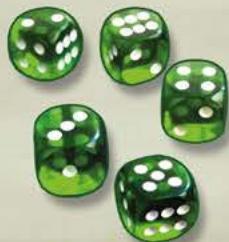
5 x Basic dice (green)
2 x Luck dice (yellow)
2 x Panic dice (red)
2 x Feat dice (blue)
32 x Courage tokens
26 x Treasure tokens
26 x Feat tokens
26 x Focus tokens
6 x Modifier tokens
16 x Terrible Thing tokens
4 x Re-roll Track Tokens
1 x Map token
1 x Battered Journal token
36 x Ominous Encounter cards
37 x Feat cards
26 x Swag cards
4 x Scenario cards
4 x Achievement cards
1 x Promotional Card
4 x Character mats
1 x Gameboard
1 x Rulebook
4 x Wooden Character pawns with stickers
COMPONENT OVERVIEW
Characters
The Character pawns are used to indicate the positions of each player on the board throughout the game.
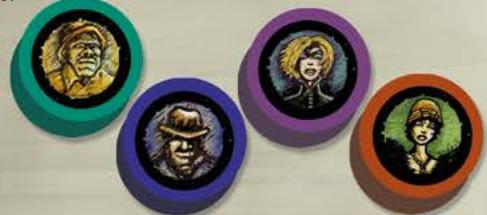
Character Mats
The character mats provide convenient placement for tokens during the game, as well as detailing each characters starting resources, back story, a summary of the game turn sequence,
and a convenient re-roll track.

Resources
There are four resources in Ancient Terrible Things which are used to help you overcome Encounters, focus your dice, play Feat cards, and buy Swag. These resources are represented by the following tokens:
Dice
There are four types of dice in Ancient Terrible Things that are rolled to overcome Encounters and acquire resources.
Yellow Treasure tokens are spent to buy valuable Swag cards from the Trading Post, at the end of your turn.
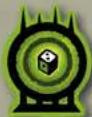
Green Focus tokens are spent to re-roll individual dice during an Encounter, improving your chance to overcome the Encounter or acquire resources.
Green Basic dice are always rolled during an Encounter. They can be re-rolled up to two times, either through a Focused or an Unfocused re-roll
Purple Courage tokens are spent to perform a Desperate Act and overcome an Encounter without spending dice to do so.

Blue Feat tokens are spent to play Feat cards, and they can increase the value of a Feat die by 1.

Yellow Luck dice are rolled much like Focus dice, except they do not cost Focus tokens to re-roll during a Focused re-roll.

Grey Modifier tokens help manage excess tokens in your stash and represent a quantity of 5 tokens. If required, exchange 5 tokens of a type and place a Modifier token on the appropriate resource space on your character mat.

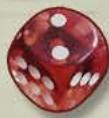
Red Panic dice cannot be rerolled using Focus tokens or card effect
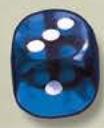
Blue Feat dice cannot be re-rolled with Focus tokens. Instead, you may spend a Feat token to increase the value of a Feat die by one before you re-roll your other dice.

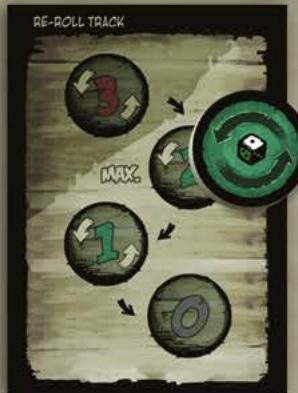
Re-roll Track token
The re-roll track token may be used to keep track of available re-rolls on the Re-roll track on a character mat.
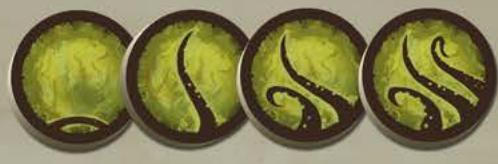
Terrible Thing tokens
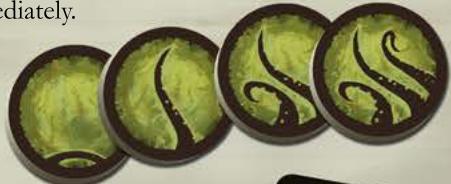
Terrible Thing tokens are taken from the
Expedition Track when a player fails to overcome an Encounter. Each Terrible Thing token
represents a penalty of zero to three points, which counts against the Ancient Secrets point total of the player possessing it at the end of the game. When the last Terrible Thing token is removed from
the Expedition Track, the game
ends immediately.
The Map
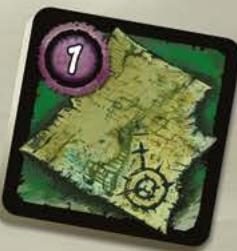
The player holding the Map token choose who goes first at the beginning of a round. In addition, the map is worth 1 Ancient Secret at the end of the game.

The Battered Journal
The winner of the game temporarily receives the Battered Journal before it is loathsomely tossed into the Sanatorium furnace.
Card Types
Swag
Swag cards represent the equipment and tools that your character uses on
their quest for Secrets.
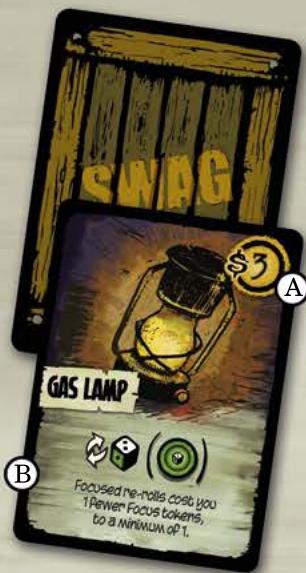
Shown on each Swag
card is (A) the cost of
the card in Treasure
tokens and
(B) the benefit of
owning that Swag card. Note that some Šwag
cards provide Ancient
Secrets.
Feat
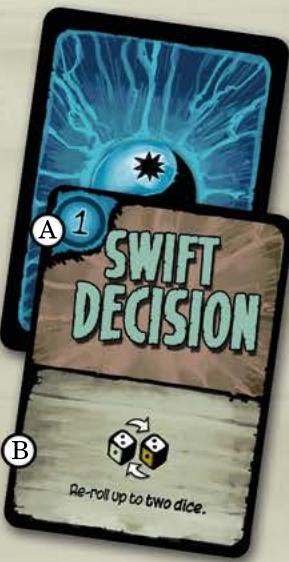
Feat cards represent the leadership, skill, and cunning of your character. Shown on each Feat card is (A) the cost of playing the card in Feat tokens and (B) the effect of the card.
When played, the card takes effect immediately and is then placed in the Feat discard pile. When the Feat deck is empty, shuffle the discard pile to create a new Feat deck to draw from.
Ominous Encounter
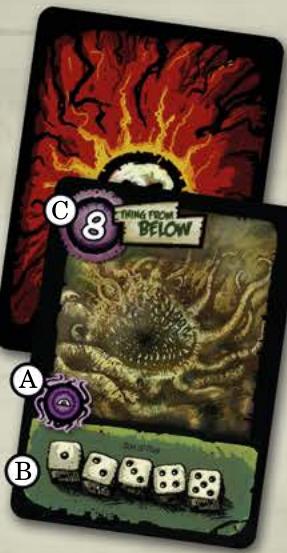
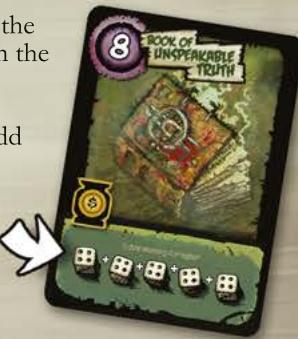
Encounter cards represent the dangers and hazards of the jungle, whether man, beast, or otherwise. These cards are dealt from the Ominous Encounters deck onto the spaces next to Locations on the board. Each card shows (A) the Encounter Type, (B) the dice combination needed to overcome the Encounter, and (C) the Ancient Secrets value of the Encounter when it is overcome.
Encounter Types
Encounters are categorised into four Encounter Types, each contributing a different resource token to its Location:

Pitfall. (Focus token) - The jungle is full of deadly natural hazards and traps for the unwary.
Villain. (Feat token) - Where evil powers dwell, there will be people who seek to profit from them.

Artefact. (Treasure token) - Mysterious objects can be discovered in forgotten places.

Horror. (Courage token) - Fear for your sanity; these are Éncounters with things not of our world.
Some Encounters belong to more than one Encounter Type. These Encounters contribute more than one resource to their Location.
Scenario
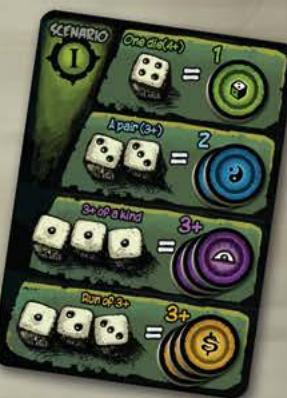
Scenario cards describe how various dice combinations may be spent during an Encounter to acquire resources when not used to overcome the current Encounter card.
Achievement
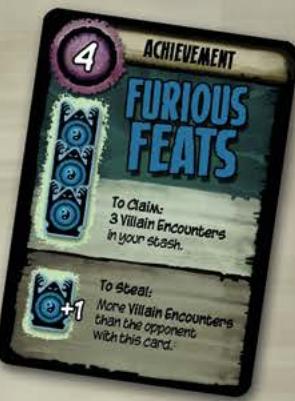
Achievement cards reward Ancient Secrets for
achieving a particular game condition, and are available to any player.
Each Achievement card is held by a single player, but players can steal an
Achievement card from
another player by
outperforming them.
The conditions for claiming and stealing a particular
achievement are described on the Achievement card itself.
Some Swag cards count as a particular Éncounter type for the purposes of scoring Achievements.
SETUP THE GAME
Game Board
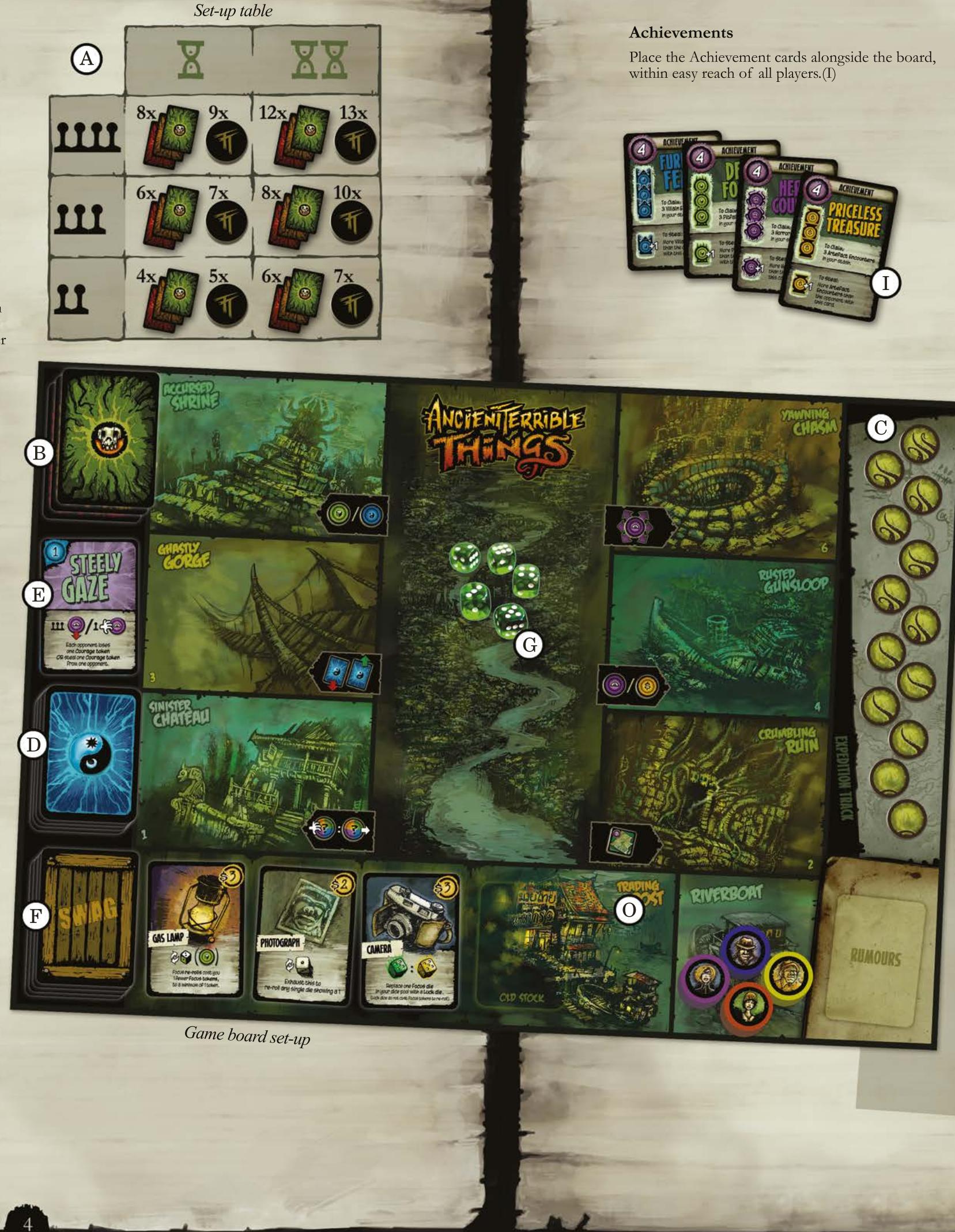
Place the game board in the center of the play area within easy reach of all players.
Ominous Encounters and Terrible Things
Setup begins by building the Ominous Encounters deck, and building the Expedition track. Shuffle the Encounter cards.
Separate the Encounter cards into piles of red, orange, and green backs.
Shuffle all of the Terrible Thing (TT) tokens face down.
Depending on the number of players and the length of game you wish to play, count out a number of Encounter cards from each stack and draw a number of TT tokens, according to set-up table (A)
Pile the Encounter stacks together (face down) with red at the bottom, orange in the middle, and green on top. Place the deck on the marked space on the board.(B) Place the remaining Encounter cards back into the box.
Flip the drawn TT tokens face up, and place them in ascending order from bôttom to top onto the Expedition Track. (C) Place the remaining TT tokens back into the box.
Feats
Shuffle the Feat cards.
Place the Feat deck in (D) the marked space on the board. Place the top card from the
Feat deck face up to form (E) the adjacent Feat discard pile.
Swag
Shuffle the Swag cards together and deal three of them face-up onto (F) the slots in the Trading Post. Place the Swag deck in the marked space on the board.
Dice and Tokens
Place the five green Basic dice in the middle of the board.(G) Place all tokens and extra dice within easy reach of all players.(H)

Players
Each player, starting with the one who most recently faced arcane horrors on a dark river, chooses a Character, taking the Character mat representing that character.
If the Captain character is in play, give them the Map. Otherwise, the player who chose their Character last, gets the Map.
Each player starts with one of each token type, Focus, Treasure, Courage, and Feat (J)
and 3 Feat cards. (K) Each player takes any additional starting resources as listed on their Character mat.(L)
Place a Re-roll track token on the Re-Roll Track of each Character mat. (M)

Pawns
Place the Character pawns chosen by each player onto the Riverboat (O) and place any remaining pawns back into the box.
Scenarios
Each player takes a copy of the Scenario card. (N) The Scenario cards supplied with the game have two different faces representing easy or difficult game environments. Decide with the other players which scenario you want to play with, and then have each player turn their Scenario card to the corresponding face.
Player Set-up (The Prospector)

TURN OVERVIEW
Ancient Terrible Things is played over a number of rounds. The player in possession of the Map token at the start of a round takes the first turn. Each player completes their entire turn before the next player begins their turn.
Play continues clockwise until each player has taken one turn, at which point the round ends. The game ends immediately if the Encounter deck is either empty at the end of the round, or when the last Terrible Thing token is removed from the Expedition Track in the Terrible Thing phase.
Turn
A turn consists of seven phases:
-
Riverboat phase
-
Explore phase
-
Desperation phase
-
Encounter phase
-
Terrible Thing phase
-
Trading Post phase
-
Refresh phase
1. Riverboat Phase
Skip this phase if there are Encounters at any of the Fateful Locations.
• If no cards remain in the Ominous Encounters deck when you start this phase, the game immediately ends. (consult the Unspeakable Event section.)
Otherwise, Deal cards face-up from the Encounter Deck into the numbered slots on each Location, from the lowest numbered slot to the highest numbered slot.
Take resource tokens from the supply matching the Encounter type(s) shown on each newly-placed Encounter card, and place those tokens on the corresponding Fateful Location.
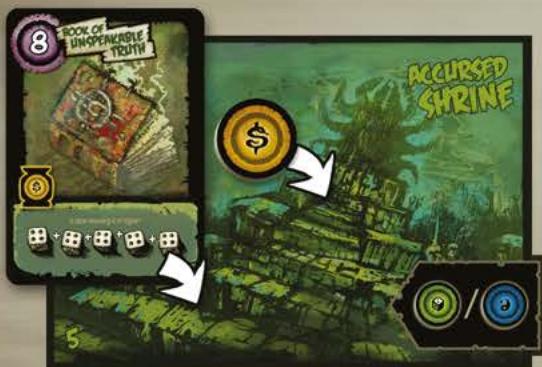
Example: Book of Unspeakable Truth is added to the Accursed Shrine, and a Treasure token is added to the Location, as per the Artefact icon on the Encounter card.
2. Explore phase
• Move your pawn to an active Location (one with an Encounter card).
• Take any resource token(s) on that Location, and add them to your stash.
You may take the special Location Action shown on the Location. (See the Location Actions section for more information about these Location Action effects.)

Example: The Captain moves to the Accursed Shrine, and takes the Treasure token there. He then has the option to take the Location Action which would allow him to gain an additional Focus or Feat token.
3. Desperation Phase
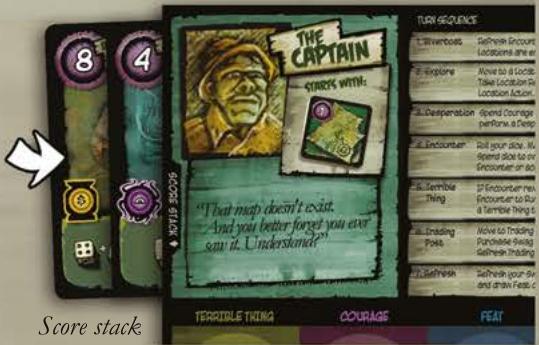
• You may spend Courage tokens equal to the Ancient Secrets value of the Encounter card at your current Location to perform a Desperate Act Doing so means you immediately overcome the Encounter, placing it in your score stack.

Example: The Captain now has the option to spend 8 Courage tokens to perform a Desperate Act, to immediately overcome the Book of Unspeakable Truth, and add it to their score stack.
4. Encounter Phase
In the Encounter phase, you will roll dice and spend-During the Encounter phase, you will roll dice and spend dice combinations in an attempt to overcome an Encounter at your Location and gain valuable resources. If you overcome the Encounter, you add the card to your score stack. If you do not overcome it, you will unleash a Terrible Thing in the next phase. (Note: If you have already overcome the Encounter by performing a Desperate Act in the previous phase, you roll the dice solely to gain resources.)
Rolling the dice
• Take the five green Basic dice to form a dice pool.

You may then play any Swag or Feat cards that allow you to add or swap out Basic dice from your dice pool for other kinds of dice (such as Luck, Feat and Panic dice.)
•Roll your final dice pool.
• You may then choose to re-roll your dice up to 2 times.
Should you choose to do so, decide whether to make a Focused or Unfocused Re-roll.
To make a Focused Re-roll, select the dice you wish to re-roll, and spend Focus tokens equal to that number of dice. Then, re-roll the selected dice. (Note: Yellow luck dice do not cost Focus tokens to re-roll, and red Panic dice may never be re-rolled.)
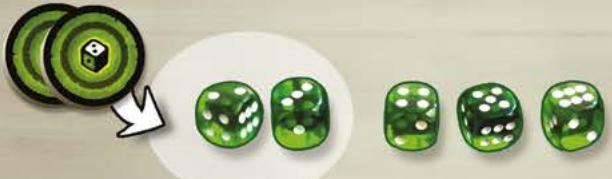
To make an Unfocused Re-roll, re-roll all of your dice. (except red Panic die, which may never be re-rolled.)
Before or after each re-roll, you may perform the following actions in any order and any number of times:
Perform A Feat. Play a Feat card from your hand, paying the Feat tokens prompted on the card to the supply. These cards immediately take effect and are then discarded. If you cannot take the action on the Feat card, it has no effect.
Use Equipment. Exhaust (turn face-down) one of your Swag cards to use its effect, paying its token cost if prompted. This action applies only to Swag cards that specify they are Exhausted when used.
Note: You may not play Feat or Swag cards that allow you to swap out dice in your dice pool after your initial roll. You may however play cards that allow you to add dice to your pool.
Spending the dice
Once you are finished rolling, you may spend your combinations of dice to gain resources as per your Scenario car and/or overcome the Encounter card. Once you perform either of these actions, you may not re-roll any of your dice. You may perform the following actions until you choose not to, or until can no longer make any useable combinations with your reaining dice, or choose not to:
• Overcome the Encounter.
Select dice that match the combination shown on the Encounter card. Remove those dice from the board, and add the Encounter card to your score stack.
• Gain Resources.
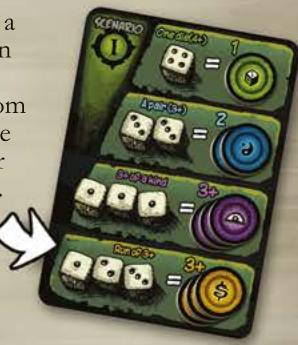
Select dice that match a combination shown on your Scenario card. Remove those dice from the board, and gain the resources specified for that dice combination.
Re-roll track (optional):
Towards the end of the game, you might plan an eloborate sequence of cards, additional rolls and re-rolls in to achieve a particulary hard dice
combination.To keep track of how many re-rolls you have remaining in this situation, each character mat has a convenient re-roll track with a corresponding re-roll tracker token.
Each player has a maximum of 2 re-rolls.
Move the tracker token on the Re-Roll track down one space, before each re-roll.
Cards that allow you roll additional dice do not
count towards your Re-rolls.
Reset your Re-roll marker to 2 on the Re-roll track on your character mat, during the Refresh phase. Some cards may allow you to have an additional re-roll during your turn.
5. Terrible Thing Phase
If you fail to overcome the Encounter (or choose not to), you unleash a Terrible Thing. Discard the Encounter card to the Rumours space on the board, and tāke a Terrible Thing token from the lowest available space on the Expedition Track.

If this is the last
token on the track,
the game ends
immediately; consult
The Unspeakable Event section.
6. Trading Post Phase
• Move your pawn to the Trading Post.
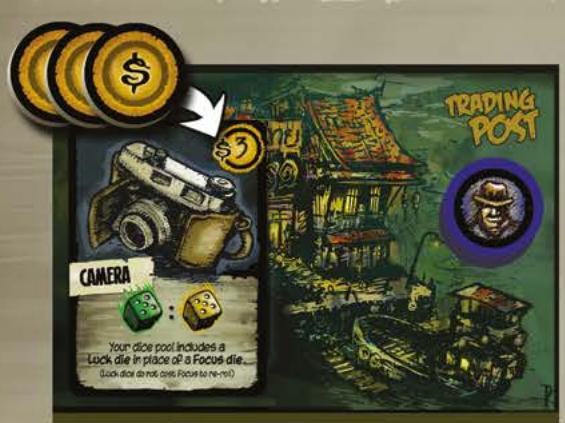
• You may move any card in the Trading Post onto the Old Stock pile, and replace it with a new card from the top of the Swag deck.
Then, you may buy any of the face-up Swag cards (including the top card of the Old Stock pile), by paying the cost shown (A), with Treasure tokens from your stash.
• You may spend 2 Treasure tokens to refresh up to 3 cards, placing them onto the Old Stock pile, and drawing new cards to replace them.
When you have finished buying cards, refresh any empty slots, by dealing new cards into them.
7. Refresh Phase
• Draw Feat cards from the Feat deck until you have three cards in your hand.
• Turn all of your face-down (exhausted) Swag cards face-up.
Your turn is now over. If all pawns are on the Trading Post, the round ends. If the Encounter Deck is empty at the end of the round, the game ends immediately; consult The Unspeakable Event section. Before beginning a new round, place all character pawns back onto the Riverboat.
THE UNSPEAKABLE EVENT
The Unspeakable Event represents the end of the game, as a result of which the winning player Šurvives the cursed journey, and the other players are Never Heard Of Again.
The Unspeakable Event is triggered when one of the following conditions is met:
The last Terrible Thing token is removed from the Expedition Track during the Terrible Thing phase.
There are no more Encounter cards in the Encounter Deck to place at the start of a Riverboat Phase, and there are no active Locations.(Locations with an Encounter card.)
Each player counts the total value of all Ancient Šecrets in their score pile, which includes:
• Overcome Encounter cards
• Swag cards that are worth Secrets
• Achievement cards
• The Map
Each player then subtracts the total penalty value of the Terrible Thing tokens in their stäsh to arrive at a final score.
The winner of the game is the player with the highest score. If any number of players tie for the highest score, break the tie by comparing Terrible Thing tokens (the fewer tokens the better) and Courage tokens (the more tokens the better) in that order.
The player who wins
the game becomes the lone Survivor and briefly receives the
Battered Journal
as their reward,
before it is loathsomely committed to the
Sanatorium furnace.
The End.

LOCATION ACTIONS
There are six Fateful Locations shown on the game board. Each of these Locations is associated with a unique Action, as follows:
Accursed Shrine
When you place your pawn on the Accursed Shrine, you may gain one Focus or Feat token, adding it to your stash.
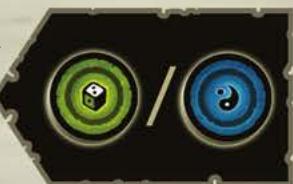
Ghastly Gorge
When you place your pawn on the Ghastly Gorge, you may discard any number of Feat cards from your hand, and draw that many fresh Feat cards.
Sinister Chateau

When you place your pawn on the Sinister Chateau,
you may exchange a
resource token of any
type from your stash
with a resource token of
a different type in another player's stash.
You may not move
TerribleThing tokens this way.

Yawning Chasm
When you place your pawn on the Yawning Chasm, you may perform a Desperate Act against any Encounter card in play. To do this, spend Courage tokens to immediately overcome

an Encounter in any other
Location and place that card in your score pile, returning any resource tokens on that Location to the supply. The number of Courage tokens paid to activate this Location Action is equal to the value in Ancient Secrets shown on the Encounter you overcome using this Location Action. (You may still perform a Desperate Act at your current Location during the Desperation phase.)
Rusted Gunsloop
When you place your pawn on the Rusted Gunsloop, you may gain a Courage or Treasure token, adding it to your stash.

Crumbling Ruin
When you place your pawn on the Crumbling Ruin, assume control over the Map.


Dice Combinations
Encounter and Scenario cards show particular combinations of dice, which come in four types:
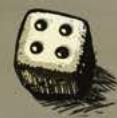
High numbers (single die showing a particular number or higher)
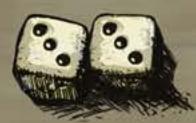
Pairs of dice
showing the same number, (which must be a particular value or higher),

Blocks of 3 or more dice showing the same number (which must be a particular value or higher)
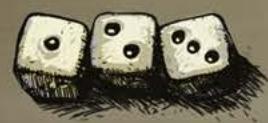
Runs of 3 or more dice in a sequence (starting with a particular value or higher),
These cards show the minimum value of dice required for a combination. For instance,

represents a combination which can be met with three (or more) 4s, or three (or more) 5s, or three (or more) 6s.
The following example,
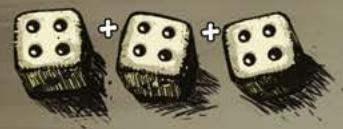
represents a set of High number dice, which can be met with any three dice showing 4 or higher.
You must fulfill combinations one at a time, removing from the board any dice used to fulfill that combination. Values shown on dice cannot be combined or split. Runs and Blocks can be made of three, four, five, or more dice.
When you fulfill a dice combination listed on a Scenario card, you get one resource of the type shown for every die in the combination (e.g., In Sceñario I, a Run of Four combination would reward you with four Courage tokens, a Run of Five, would reward five tokens, etc).

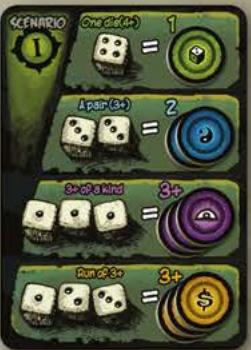
Encounter Phase example:
a.) Player 1 is facing an Ominous Encounter with the Bad Egg, using Scenario Card I. At the beginning of the Encounter, she rolls the 5 green Focus dice, with a result of:

b.) To overcome the Encounter with the Bad Egg, she needs a run of 3 dice of 3+4+5 or higher. She decides to press her luck, and rolls all the dice again, with a result of :
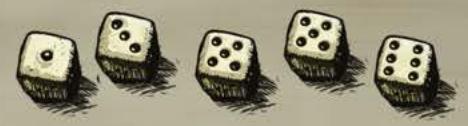
c.) For her final re-roll, she spends 2 Focus tokens to reroll the 1 and the 3,
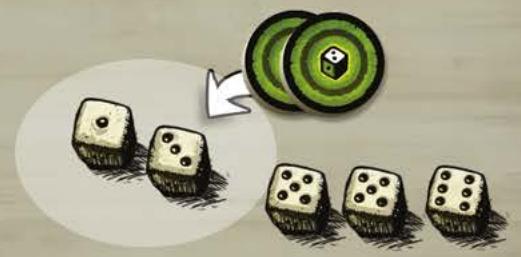
For a final result of:
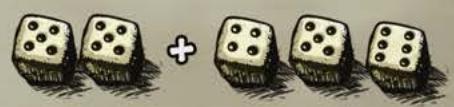
d.) She now spends 4+5+6 to overcome the Bad Egg and unlock it's Ancient Secrets, adding the card to her score pile. She can now choose to use the two dice showing a 5 to gain two Feat tokens, or two Re-roll tokens. She choses to take the Feat tokens. She has no more dice to allocate, so the Encounter ends.

Examples of spending dice
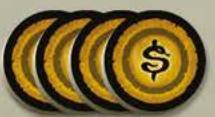
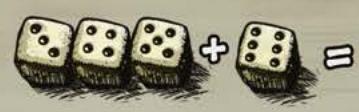
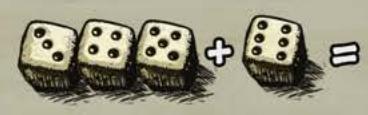
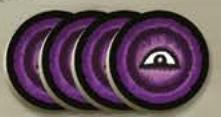
Different dice combinations result in different rewards, and it's up to the player to decide how they want to spend their rolled dice. T'he below combinations show an example of how this works. Note: Only one dice combination can be chosen.
Yo
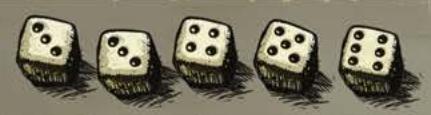
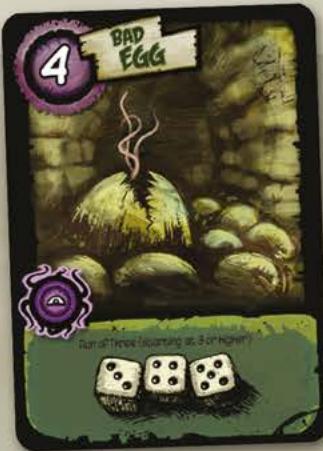
Overcome the Encounter
These can be spent as:
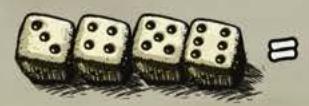




You roll:

These can be spent as:





CREDITS
Art and Graphic Design by Rob van Zy
Game Design by Simon McGregor
Written by Rob van Zyl, Simon McGregor, John Dunning, Anthony Silverston
Rules Editing by Simon McGregor, Anthony Silverston, Rob van Zyl
Proofing and Copy Editing by Josh Yearsley, Anne van Zyl, Robert Nava, Steve Motts, Kevin Colville
Game Development by Simmy Peerutin, Anthony Silverston, Kevin Colville, Rob van Zyl
Concept Art by Paul Painting, Sky Penderis, Juan Coleman
Writing by Joseph Soonsin Lee, Andrew McCurry, Jason Hanchett, Joseph Ryan Van Arsdall, Neal Hoffman, Steve
Motts
Playtesting by Simon Cross, Neil Muller, Jeremy Thurgood, Kevin Colville, Diane Making, Colin Payne, Anthony
Silverston, Nathaniel Virgo, Mike Beaton, Greg Cheetham-Slade, Catherine Hill, Paul van Kan
Thank you to the following for their support, enthusiasm and ideas : Danelle Foerie, Tanya Surtess, Rob Murray, Quinton & Margo Frieslich, Adhil Patel, Jonothan Maingard, Thomas van Heerden, Marvin Hsaio, Desilu Crossman, Neil Muller, Jeremy Thurgood, Kevin Colville, Richard Breese, Paul Painting, Tom Schwarer, Margaret Jack, Dianne Making, Colin Payne, Kane Croudace, Sevi Spanoudi, Kate Ball, Simon Atwell, Robyn Ormond, Julia Ormond , Ed Ormond, JP Smith, Graham van der Made, Claire Rivera, Jackie Sargent, Paul van Kan, Abhaya Goldberg, Priya Forster, Gavin Williams, Stefan Wessels , Dom Touwen, Hillary Murdock, our awesome backers on Kickstarter, and many many others.
A Pleasant Company Studios Pty(Ltd) product. All rights reserved.
Download MarkdownTexts are community-compiled or publicly released by publishers; copyright remains with the original authors. For personal reference only.