
Andean Abyss
At a glance
Rules, cards and Q&A (Chinese)
The rules, card data and player questions for this game are written in Chinese. Open the Chinese page to read them.
Where to find full rules
Full rules and card lookup are available in the cunlema app at cunlema.cn — pick this game and ask about any rule, card or turn you are unsure about.
Related games
Rulebook text (Markdown)
This game has 2 rulebook Markdown file(s) in our library; 2 rendered inline below — expand to read or download.
rules_en_andean-abyss_91080.md95.4 KB
来源类型:纯文本规则(非 PDF 源,早期抓取/转换产物)
说明:原文未改动,仅调整存放位置与文件名;非 PDF 扫描件,无对应原书 PDF
Andean Abyss Rulebook | RulesPalRulesPalChatRulebookAndean AbyssAndean Abyss Rulebook Table of Contents Table of Contents 1.0 Introduction 1.1 General Course of Play
1.2 Components
1.3 The Map
1.4 Forces
1.5 Players & Factions
1.6 Support and Opposition
1.7 Resources and Aid
1.8 Control
2.0 Sequence of Play 2.1 Set Up
2.2 Start
2.3 Event Card
2.4 Propaganda Card
3.0 Operations 3.1 Operations in General
3.2 COIN Operations
3.3 Insurgent Operations
4.0 Special Activities 4.1 Special Activities in General
4.2 Government Special Activities
4.3 FARC Special Activities
4.4 AUC Special Activities
4.5 Cartels Special Activities
5.0 Events 5.1 Executing Events
5.2 Dual Use
5.3 Govt Capabilities
5.4 Insurgent Momentum
5.5 Free Operations
6.0 Propaganda Rounds 6.1 Victory Phase
6.2 Sabotage Phase
6.3 Resources Phase
6.4 Support Phase
6.5 Redeploy Phase
6.6 Reset Phase
7.0 Victory 7.1 Ranking Wins and Breaking Ties
7.2 During Propaganda Rounds
7.3 After Final Propaganda
8.0 Non-Player Factions 8.1 Non-Player Sequence of Play
8.2 Random Cities and Departments
8.3 Random LoCs
8.4 Non-Player Events
8.5 Non-Player Cartels Actions
8.6 Non-Player AUC Actions
8.7 Non-Player FARC Actions
8.8 Non-Player Government Actions
8.9 1-Player Victory
What Does Victory Mean?
Set Up (2.1) General
Deck Preparation
Standard Deployment
Open Deployment
Quick-Play Scenario
Available Forces (1.4.1)
Key Terms Index
1.0 Introduction
Andean Abyss is a 1-4-player game depicting insurgent and counterinsurgent (COIN) conflict in Colombia during the 1990s and early 2000s. Each player takes the role of a Faction seeking to run Colombian affairs: the Government (Govt) or 1 of 3 Insurgent Factions—the Marxist FARC, the right-wing AUC "paramilitaries", or the narco-trafficking Cartels. Using military, political, and economic actions and exploiting various events, players build and maneuver forces to influence the population, extract resources, or otherwise achieve their Faction's aims. A deck of cards regulates turn order, events, victory checks, and other processes. The rules can run non-player Factions, enabling solitaire, 2-player, or multi-player games.
Andean Abyss is the inaugural volume in the COIN Series of games that use similar rules to cover a variety of insurgencies and other inter-factional conflicts. This Second Edition extensively alters and augments rules and play aids throughout to bring this volume up to date within the Series. Updated cards are marked "2nd Ed".
This rule book lists and defines key game terms in an index (see "Key Terms Index" below). The most important game functions are summarized on several aid sheets. Game setup is explained on the flip side of the Sequence of Play aid sheet (see "Set Up" below).
1.1 General Course of Play
Andean Abyss—unlike most card-assisted war games—does not use hands of cards. Instead, cards are played from the deck one at time, with one card ahead revealed to all players. Each Event card shows the order in which the Factions become Eligible to choose between the card's Event or one of a menu of Operations and Special Activities. Executing an Event or Operation carries the penalty of rendering that Faction Ineligible to do so on the next card. Propaganda cards mixed in with the Event cards provide periodic opportunities for instant wins and for activities such as collecting resources and influencing popular sympathies.
1.2 Components
A complete set of Andean Abyss includes:
A 22"x34" mounted game board.
A deck of 76 cards.
153 dark and light blue, red, green, and yellow wooden forces pieces, some embossed (1.4; see "Available Forces" for a complete listing).
8 cylinders, embossed (1.7, 2.2).
6 black and 6 white pawns (3.1.1).
A sheet of markers.
2 Sequence of Play and Setup sheets.
4 Faction player aid foldouts.
1 Non-player Insurgents flowcharts foldout.
1 Non-player aid foldout with Government flowchart.
3 6-sided dice: 1 red, 1 yellow, 1 green.
A background Playbook.
This rule book.
1.3 The Map
The map shows the country of Colombia divided into various types of spaces, as well as parts of neighboring countries.
Map features identified on the board include: Mountain Department (Dept), Grassland Department, Forest Department, Line of Communication (Pipeline), Line of Communication (Road), City, Town, Department Boundary, Department Name, Population Value, boxes to place Bases, "At Start" set up notations, boxes to place Terror markers, and boxes to place Support and Opposition markers.
1.3.1 Map Spaces. Map spaces include rural Departments (Depts), urban Cities, and Lines of Communication (LoCs) between them. All spaces—including LoCs—can hold forces.
1.3.2 Departments. Each Department shows a Population value (Pop) of 0, 1, or 2 that affects victory via Support for or Opposition to the Government (1.6) and some Insurgent Operations (3.3). Departments are further distinguished by terrain as Tropical Forest (Forest), Mountain, or Grassland, affecting some COIN Operations (3.2) and Events (5.0).
1.3.3 Cities. Each City similarly shows a Population value of 1 to 8 (each Population value representing a million Colombians).
1.3.4 LoCs. Each Line of Communication (LoC) shows an Economic value (Econ) of 1 to 3 that affects Government Resources (1.7). LoCs are further distinguished as Roads or Pipelines. Pipelines tend to have higher Economic value and affect certain Events.
DESIGN NOTE: LoCs also represent other transportation arteries and infrastructure such as power lines that parallel roads and pipelines.
1.3.5 Foreign Countries. The map includes parts of Brazil (Brasil), Ecuador, Panamá, Perú, and Venezuela. They are not spaces (1.3.1) unless and until specified by Event (5.0).
EXAMPLE: The "Darién" Event renders Panamá a 0 Population Forest Department for all purposes, except that Sweep Operations do not Activate Guerrillas there (3.2.3).
NOTE: Venezuela is next to Guainía but not Vaupés, affecting the "Hugo Chávez" Event.
1.3.6 Adjacency. Adjacency affects the movement of forces and implementation of certain Events. Any 2 spaces meeting one of the following conditions are adjacent:
Spaces that border on (touch) one another.
Departments separated by LoCs.
LoCs or Departments separated by Towns.
NOTE: Towns are not spaces; they merely separate LoCs or Departments.
ADJACENCY EXAMPLE: The 4 Departments and 4 LoCs around the Town of Ayacucho are all adjacent to each other because they are separated by a Town. Antioquia and the Forest Department to the west are adjacent because they are separated by a LoC.
1.3.7 Coasts. Spaces adjacent to blue areas are coastal, affecting the "Narco-Subs" Event.
1.4 Forces
The wooden pieces represent the Factions' various forces: Government Troops (dark-blue cubes) and Police (light-blue cubes), Insurgent Guerrillas, and all Factions' Bases.
Types of forces:
Government Cubes: Troops, Police.
FARC Guerrillas: Underground or Active.
Bases: Cartels, Government, FARC, AUC.
Other pieces and markers include: Drug Shipment markers, Overflow markers, markers to show City and Department Control (1.8), markers to show FARC Zones (6.4.4), Govt Capabilities markers, victory-related and Aid markers for the Edge Track, a marker for the Propaganda Track, Support and Opposition markers (1.6.2), Terror markers (3.3.4), Event Reminder markers, and Sabotage markers (3.3.4).
DESIGN NOTE: Bases represent not only training and bivouac facilities but also, for the Insurgents, political administration as well as coca or poppy fields and processing labs.
PLAY NOTE: Use "Overflow" boxes for Forces that exceed the room in a City or smaller Department on the map; place the corresponding Overflow marker in that space.
1.4.1 Availability and Removal. The inventory shown on the "Available Forces" chart limits the number of pieces that may be in play. Keep forces not on the map in the Available Forces holding areas. (Place Bases in the highest-numbered empty circles, revealing the number of on-map Bases to help track victory, 7.0)
Forces may only be placed from or replaced with those available in the holding areas—ignore any instructions to place forces if the appropriate type is not available because all are already on the map (remove rather than replace such pieces; see also next bullet).
Important: A player Faction while executing an Operation or Event by the Sequence of Play (2.3.4, 3.0, 5.0), may remove its own pieces to Available Forces. EXAMPLE: Insurgents without Available Guerrillas could remove Guerrillas during a Rally (3.3.1) in order to place them Underground.
Once an enemy Faction is targeted, removal or Activation of pieces to the extent of the executing Faction's ability is required. EXAMPLE: A Government Assault (3.2.4) with 3 Troops in Forest must remove 3 Active pieces if there are at least that many among those Factions targeted.
1.4.2 Stacking. No more than 2 Bases (regardless of Faction) may occupy a single Department or City. Bases may not occupy LoCs. Government forces may not occupy a FARC Zone (6.4.4). (See also the "Sucumbíos" Event regarding Ecuador.) Ignore any instructions (such as from Operations or Events) to place or move forces if stacking would be violated. Except as noted above, any number of Government cubes and Guerrillas may occupy a space.
1.4.3 Underground/Active. Guerrillas are either Underground—symbol end down—or Active—symbol end up. Certain actions and Events flip them from one to the other state. Bases, Troops, and Police are always Active. Always set up and place new Guerrillas Underground (including if replacing a piece).
NOTE: Unless instructions specify "Underground" Guerrilla, it is sufficient to "Activate" already Active Guerrillas (they stay Active).
1.5 Players & Factions
Andean Abyss is playable by 1-4 players. The 1st player plays the Government (blue), the 2nd the FARC (red), the 3rd the AUC (yellow), and the 4th the Cartels (green) (2.1). (If preferred, the 3rd player in a 3-player game can play Cartels instead of AUC.) Each of these Factions is enemy to all others. Leftover Factions are Non-Player; their actions are governed by rules section 8. See the Playbook for a Role Summary of each Faction.
1.5.1 Spare Factions. With two or three players, the players run leftover Factions:
With 3 players, AUC runs the Cartels.
With 2 players, Government runs AUC; FARC runs the Cartels.
A player running two Factions uses the lower victory margin of the two (7.1-.3) and only causes play to end on a victory check (6.1) if both Factions are meeting their conditions. Players may not voluntarily transfer (1.5.2) between their own Factions.
Non-Player Option: If playing solitaire, or as an alternative to the above with two or three players, use the Non-player rules in section 8 to govern leftover Factions.
1.5.2 Negotiation. Players may make any mutual arrangements within the rules but may voluntarily transfer only Resources (1.7) or Shipments (4.5.3) and only during either's execution by the Sequence of Play (2.3.4) of an Operation or Event. All negotiations are open. The rules do not bind players to agreements.
1.6 Support and Opposition
Support and Opposition affect victory and some Operations.
1.6.1 Cities and Departments with at least 1 Population (1.3.2-3) always show 1 of 5 levels of its populace's Support for or Opposition to the Government that can shift during play:
Active Support.
Passive Support.
Neutral.
Passive Opposition.
Active Opposition.
1.6.2 Show Active or Passive Support or Opposition with markers placed in each City or Department. Show Neutral spaces by the absence of such markers. Active Support/Opposition counts double for Total Support/Opposition (1.6.3).
NOTE: LoCs (1.3.4) and Population 0 Departments never hold Support or Opposition markers (they are always Neutral).
1.6.3 Total Support and Total Opposition. Government or FARC victory depends on the total value of population Support or Opposition (plus FARC Bases, 7.2), respectively. Adjust "Total Support" or "Opposition + Bases" on the numbered edge track per the box below as any change to Support, Opposition, or the number of FARC Bases occurs.
Total Support and Opposition Equations:
Total Support equals: (2 x Population in Active Support) + (1 x Population in Passive Support)
Total Opposition equals: (2 x Population in Active Opposition) + (1 x Population in Passive Opposition)
Opposition + Bases equals: Total Opposition + The number of FARC Bases on the map
1.7 Resources and Aid
At any moment, each Faction has between 0 and 99 Resources that it uses to pay for Operations (3.0). During some Propaganda Rounds (6.3.1) and Events, a level of Aid (between 0 and 29) adds to Government Resources. Mark Resources and Aid on the edge track—for Resources, with a cylinder of the Faction's color (1.5).
1.8 Control
The Government Controls a City or Department if its pieces alone exceed those of all other Factions combined. In the same way, FARC Controls a City or Department if its pieces alone exceed those of all other Factions combined. Cities or Departments that are not Controlled by either the Government or FARC are Uncontrolled. As helpful, place appropriate Control markers on spaces as reminders.
PLAY NOTE: Control mainly affects Propaganda Round (6.2-6.5) and some Non-player Government actions (section 8).
DESIGN NOTE: "FARC Control" of a City might not represent complete military control of a major urban area but rather sufficient presence to inhibit commerce and encourage resistance to government authority.
2.0 Sequence of Play
2.1 Set Up
Follow the instructions on the flip side of the Sequence of Play aid sheet to decide upon various play options, assign Factions to players, prepare the deck, and set up markers and forces. (See "Set Up" below.)
2.2 Start
Begin play by revealing the top card of the draw deck and placing it onto a played cards pile. Then reveal the next card on top of the draw deck. The card on the played card stack is played first; the card on top of the draw deck will be played next. NOTE: Players will see 1 card ahead into the deck. All played cards and the number of cards in the draw deck are open to inspection.
RECORD STEPS: As the steps of each Event card play are completed, place a cylinder of the Faction's color (1.5) into the Sequence of Play track's appropriate box (or, for Propaganda Rounds [6.0], advance the Prop Card marker).
2.3 Event Card
When playing an Event card, up to 2 Factions will execute Operations or the Event; other Factions may Pass and collect Resources.
Factions whose cylinder is in the "Eligible" box receive these options in the left-to-right order of the Faction symbols shown at the top of the card.
Factions with cylinders in the "Ineligible" box do nothing.
2.3.1 Eligibility. Factions that did not execute an Operation or Event on the previous card are Eligible (their cylinders will start the card in the "Eligible" box per 2.3.7). Factions that did are Ineligible. (All Factions start the game Eligible.) See also Free Operations, 3.1.2.
2.3.2 Faction Order. The Eligible Faction with the leftmost symbol in its color (skipping any Ineligible Factions) is the 1st Eligible to execute an Operation or Event or to Pass. The next leftmost is the 2nd Eligible.
NOTE: The gray 2 symbol and "2nd: Ops" on some cards affect Non-player choices (8.1)—ignore them unless using Non-players.
2.3.3 Passing. If a 1st or 2nd Eligible Faction opts to Pass, it receives +1 Resources (or +3 Resources if Government) and remains Eligible for the next card. The next leftmost Eligible Faction then replaces the Passing Faction as the new 1st or 2nd Eligible Faction and receives the same options to execute or Pass. If the last (rightmost) Eligible Faction Passes, adjust cylinders (2.3.7) and play the next card.
2.3.4 Options for Eligible Factions.
FIRST ELIGIBLE: If the 1st Eligible Faction does not Pass (2.3.3), it may execute either:
An Operation (3.0)—with or without a Special Activity (4.0)—or
The Event shown on the card.
OPTIONS FOR 2ND ELIGIBLE: If the 2nd Eligible Faction does not Pass (2.3.3), it also may execute an Operation and possibly the Event, but its options depend on what the 1st Eligible Faction executed:
Op Only: If the 1st Eligible Faction executed an Operation, the 2nd Eligible Faction may execute a Limited Operation (2.3.5).
Op & Special Activity: If the 1st Eligible Faction executed an Operation with a Special Activity, the 2nd Eligible Faction may execute either a Limited Operation or the Event. (see also Final Event Card, 2.3.9).
Event: If the 1st Eligible Faction executed the Event, the 2nd Eligible Faction may execute an Operation, with a Special Activity if desired.
NOTE: For ease of reference, these options are illustrated on the Sequence of Play aid sheet and on the game board.
2.3.5 Limited Operation. A Limited Operation (LimOp) is a player Operation in just 1 space, with no Special Activity. If the Limited Operation is a Patrol (3.2.2), Sweep (3.2.3), or March (3.3.2), it can involve pieces from multiple spaces but only 1 destination space. A Limited Operation counts as an Operation. See also Final Event Card (2.3.9) and Non-player Operations (8.1).
2.3.6 Ship. Whenever a 1st or 2nd Eligible player Faction pays Resources to execute an Operation (including a Limited Operation, 2.3.5) but executes no Special Activity, it may remove a Shipment that it owns (4.5.3) to immediately execute an additional, free, Limited Operation of any type. Alternatively, a different Faction may remove its own Shipment to enable the 1st or 2nd Eligible Faction to execute such a free Operation. A Faction may only benefit from 1 such Shipment per card.
EXAMPLE: Cartels is 1st Eligible and executes a March, removes a Shipment, then executes a Rally in 1 space at no Resource cost.
DESIGN NOTE: The added Op reflects proceeds from a major drug deal greasing the skids.
2.3.7 Adjust Eligibility. After the 1st and 2nd Eligible Factions complete all execution of Operations, Special Activities, and Events (or after all Eligible Factions instead have Passed), adjust cylinders on the Sequence of Play Track as follows:
Move the cylinder to the "Eligible" box if the Faction did not execute an Operation or Event (and not rendered Ineligible by an Event).
Move the cylinder to the "Ineligible" box if the Faction executed an Operation (including a Limited Operation) or Event (unless otherwise specified by the Event; see also Free Operations, 3.1.2.).
2.3.8 Next Card. After adjusting Eligibility, move the draw deck's top card onto the played card pile face-up and reveal the draw deck's next card. Play the card on the played card pile, proceeding with the appropriate sequence.
2.3.9 Final Event Card. On the last Event card before the final Propaganda Card (2.4.1), any player Operations must be Limited (2.3.5, no Special Activities) and may not include Sweep (3.2.3) or March (3.3.2).
2.4 Propaganda Card
If playing a Propaganda Card, conduct a Propaganda Round (6.0).
2.4.1 Final Propaganda. If the 4th Propaganda card's Round is completed without a victory (6.1), the game ends: determine victory by 7.3.
Short Game Option: Agree at set up that the 3rd Propaganda card's Round will be the final round.
PLAY NOTE: Set aside Propaganda cards to show how many have gone by. Each series of Event cards up to a Propaganda Round is called a "Campaign".
3.0 Operations
3.1 Operations in General
The Faction executing an Operation (Op) chooses 1 of the 4 Operations listed on its Faction aid sheet and, if applicable, selects the map spaces to be involved. The Faction usually pays a cost in Resources (not Aid, 1.7), often per space selected; it must have enough Resources to pay for the Operation, including in each selected space. Select a given space only once for a given Operation.
The executing Faction chooses the order of the spaces in which the Operation is resolved, the enemy Factions or pieces to be affected (targeted), and the friendly pieces to be placed or replaced. A single Operation may target one or more Factions and ignore others. Once targeted, a Faction's pieces are affected to the maximum extent possible (1.4.1).
NOTE: Players pay for Operations space by space as they go, enabling Insurgents at 0 Resources to Extort, Kidnap, or Process to add Resources and then pay for additional Operations spaces. (See 4.1 and its EXAMPLE).
3.1.1 Pawns. Players may mark spaces selected for Operations (3.0) with white pawns and Special Activities (4.0) with black pawns. (The pawns are for convenience, not a limit on the number of spaces that may be selected.)
3.1.2 Free Operations. Certain Events (5.5), phases (6.4.5), or Shipping drugs (2.3.6) grant free Operations or Special Activities: they cost no Resources and, if executed by a Faction other than the one playing an Event, could leave it Eligible (2.3.7). Other requirements and procedures still apply unless trumped by Event text (5.1.1, 5.5).
3.2 COIN Operations
The Government chooses from Train, Patrol, Sweep, and Assault Operations. Note: The Government may never place or move its pieces into FARC Zones; see 6.4.4.
3.2.1 Train. Training Operations augment Government forces and possibly build Support (1.6). Select any Departments or Cities and pay 3 Resources per selected space.
PROCEDURE: First, in each selected Department with a Government Base AND in each selected City, place up to 6 cubes (any combination of Available Troops and Police). Then, in up to 1 selected space, either:
Replace any 3 cubes with 1 Government Base (within stacking, 1.4.2), OR
Conduct Civic Action (6.4.1) to build Support. As during the Support Phase, the Government must have Troops, Police, and Control (a majority of forces, 1.8) in the space and must pay added Resources per 6.4.1 (even if Training was free).
3.2.2 Patrol. Patrol Operations protect LoCs by moving Troops or Police onto them and finding and removing Guerrillas there. Pay 3 Resources total (not per space). If a Limited Operation (2.3.5), all moving cubes must end on a single destination space.
PROCEDURE: Move any number of cubes from any spaces. Each cube may move into any adjacent LoC or City (1.3.6) and may keep entering adjacent LoCs or Cities until the player chooses to stop moving it or it enters a space containing 1 or more Guerrillas. Then, in each LoC (even if a LimOp, and whether or not a cube just moved there), Activate 1 Guerrilla for each cube there. Then, if desired, conduct an Assault (3.2.4) in 1 LoC at no added cost. If a Limited Operation (2.3.5), the Assault must be in the destination LoC.
3.2.3 Sweep. Sweep Operations move Troops (typically, into contested areas) and locate enemy Guerrillas. Select any Cities or Departments as destinations (not FARC Zones, 6.4.4). Pay 3 Resources per space selected. Sweep is not allowed on the final Event card (2.3.9).
PROCEDURE: First, simultaneously move any adjacent Troops desired into selected spaces. In addition, Troops may first move onto adjacent LoCs (1.3.6) that are free of Guerrillas and then into adjacent spaces. (Any Troops that move must reach spaces paid for as destinations.)
Then, in selected spaces other than Forest, Activate 1 Guerrilla (1.4.3) for each cube there (Police plus Troops, whether they just moved or were already there).
In Forest spaces, Activate only 1 Guerrilla for every 2 cubes (round odd cubes down).
NOTE: Sweeps do not have to both move Troops and Activate Guerrillas; they may move where no Guerrillas and may simply Activate Guerrillas in place.
EXAMPLE: The Government selects Cesar-La Guajira Department for a Sweep. There are no Guerrillas on any LoCs. Troops could move from Cúcuta, Bucaramanga, and Sincelejo to the LoCs south of Baranquilla and from there into Cesar. Troops already in Baranquilla or any of the 3 Departments or 4 LoCs adjacent to Cesar also could enter Cesar.
3.2.4 Assault. Assault Operations eliminate Insurgent forces. Select any spaces and pay 3 Resources per space selected.
PROCEDURE: In each selected space, remove 1 Active Guerrilla (1.4.3) for each Troops cube there. Once a targeted Faction has no Guerrillas in the space, remove its Bases instead.
In a City or LoC, also remove 1 enemy piece for each Police cube there.
In Mountain, instead remove only 1 piece for every 2 Troops (rounded down).
DESIGN NOTE: Guerrillas are less militarily capable than Government forces but enjoy an information advantage in that Government Operations generally must first Sweep to Activate (locate) them before Assaulting them.
NOTE: The Faction aid sheets use the phrase "Bases last" to remind that an Operation cannot remove an enemy Base as long as Guerrillas (Active or Underground), Troops, or Police of the same Faction remain in the same space. Also, all of a Faction's Guerrillas in a space may be Underground, preventing further removal via Assault of its pieces (including Bases) until the Guerrillas are Activated.
3.2.5 Drug Bust. For each Shipment (4.5.3) removed by Assault, add +6 to Aid (to a maximum of 29).
3.3 Insurgent Operations
Insurgent Factions (FARC, AUC, and Cartels) choose from Rally, March, Attack, and Terror Operations.
Note that, on the Faction aid sheets under "Insurgent Operations", the terms "Guerrillas" and "Bases" mean those of the executing Faction (friendly), unless otherwise specified.
3.3.1 Rally. Rally Operations augment or recover friendly forces. Select any Departments or Cities. Pay 1 Resource per space selected.
FARC may only select Neutral or Opposition spaces, not those with Support (1.6).
AUC may only select Neutral or Support spaces, not those with Opposition.
PROCEDURE: In each selected space, the executing Faction places 1 of its Available Guerrillas or replaces 2 of its Guerrillas with 1 of its Bases, within stacking (1.4.2). If the space already has at least 1 of that Faction's Bases, the Faction may instead either:
Place a number of its Available Guerrillas up to the number of its Bases there plus the space's Population value (1.3.2-.3) OR
Move any of its Guerrillas from any spaces on the map to there and flip all its Guerrillas there Underground (whether they moved or not) (1.4.3).
3.3.2 March. March Operations move friendly Guerrillas. Select any spaces as the origins of the moving Guerrillas. Pay 1 Resource per City or Department that Guerrillas move into (0 Resources to move onto LoCs). If a Limited Operation (2.3.5), all moving Guerrillas must end in a single destination space. Players may not March on the final Event card (2.3.9).
PROCEDURE: The executing Faction moves any of its Guerrillas desired into adjacent spaces (1.3.6). No Guerrilla moves more than once. Guerrillas moving from 1 space to another move as a single group. Set Guerrillas of a moving group to Active (1.4.3) if:
The destination space is a LoC or is a City or Department with Support (1.6)—or, for AUC March, Support or Opposition—AND
The moving group's number of Guerrillas plus the number of cubes in the destination space exceeds 3. For AUC March, count FARC Guerrillas as cubes.
EXAMPLE: A group of 2 Underground FARC Guerrillas March from Meta East to Santander-Boyacá, which has Passive Support and where there are 1 Police and 1 Troops cubes. Because the destination is a Department with Support and the total of 4 cubes and moving Guerrillas involved exceeds 3, the 2 moving Guerrillas flip to Active.
NOTE: March often Activates Guerrillas, but moves by Event (5.0) do so only if specified.
3.3.3 Attack. Attack Operations seek to eliminate enemy forces; particularly successful attacks augment friendly Guerrillas (by capturing enemy weapons, equipment, rations, recruits, or drugs). Select any spaces where the executing Faction has at least 1 Guerrilla and 1 enemy piece; pay 1 Resource per space.
PROCEDURE: In each selected space, Activate (1.4.3) all the executing Faction's Guerrillas and then roll a die: if the roll is less than or equal to the number of the executing Faction's Guerrillas there (whether or not they began Active), remove up to 2 enemy pieces (executing Faction's choice; may include Underground Guerrillas). The 2 pieces may belong to different Factions. A targeted Faction's Bases cannot be removed before all its cubes or Guerrillas in the space.
CAPTURED GOODS: If the roll was a "1", place 1 of the executing Faction's Available Guerrillas (1.4.1) there. If a Shipment (4.5.3) was removed, place it in the space with a Guerrilla of the executing Faction.
3.3.4 Terror. Terror Operations in Departments or Cities neutralize (or, for FARC, build) Support or Opposition (1.6) and place Terror markers that hinder future efforts to influence it. On LoCs, they place Sabotage markers that block Government Resource earnings (6.3.1). AUC Terror harms Aid to the Government. Select any spaces where the executing Faction has at least 1 Underground Guerrilla; pay 1 Resource per City or Department (0 for LoCs).
PROCEDURE: Activate 1 friendly Underground Guerrilla in each selected space.
If the space is a Department or City, place a Terror marker and shift any Support or Opposition 1 level toward Neutral (remove Passive or shift Active to Passive and adjust Total Support or Opposition, 1.6) OR, if FARC, toward Active Opposition.
If the space is a LoC without a Sabotage marker, place a Sabotage marker.
Do not place a Terror/Sabotage marker if all are already on the map. (There are 40.)
AID CUT: If AUC is executing the Terror (including via Event, 5.0), drop Aid by –3 if the Terror occurred in a single space or by –5 if in 2 or more spaces, to a minimum of 0 (1.7). Note: Aid at 0 does not stop AUC Terror.
4.0 Special Activities
4.1 Special Activities in General
When a Faction per the Event Card sequence of play (2.3) executes an Operation in at least 1 space (3.0), it may also execute 1 type of its Special Activities (Exception: Limited Operations, 2.3.5). Some Events grant free Special Activities (3.1.2).
As with Operations, the executing Faction selects spaces, Factions, or pieces affected and the order of actions. A Faction may execute its Special Activity at any one time immediately before, during, or immediately after the execution of its Operation.
EXAMPLE: FARC with 0 Resources Extorts or Kidnaps enough to pay for the necessary accompanying Operations thereafter (4.1.1).
PLAY NOTE: If the 1st Eligible Faction uses a Special Activity, the 2nd Eligible will have the option of executing the card's Event (2.3.4).
4.1.1 Accompanying Operations. Some Special Activities specify that they may only accompany certain types of Operations (3.0). Certain Special Activities may take place only in the locations of their Accompanying Operations. If not otherwise specified, Special Activities may accompany any Operations and take place in any otherwise valid spaces.
4.2 Government Special Activities
The Government may choose from Air Lift, Air Strike, or Eradicate Special Activities.
4.2.1 Air Lift. Air Lift moves Troops, especially to mass them quickly for an Operation.
PROCEDURE: Move up to 3 Troops from 1 space to another (not FARC Zone, 6.4.4).
4.2.2 Air Strike. An Air Strike destroys an exposed Insurgent unit. It may only accompany a Patrol, Sweep, or Assault (3.2.2-.4) and take place in a single Department or LoC (not City).
PROCEDURE: Remove 1 Active Guerrilla or, if the targeted Faction has no Guerrillas in the space, 1 of its Bases.
4.2.3 Eradicate. Eradication destroys rural Cartels Bases and earns Aid but at a cost of increasing local sympathy for FARC. It may take place in any 1 Department with Cartels pieces (even Cartels Guerrillas without Bases).
PROCEDURE: Boost Aid by +4, to a maximum of 29 (1.7). Remove all Cartels Bases in the selected space (regardless of Guerrillas there). Then:
Shift that or an adjacent Department 1 level toward Active Opposition (1.6.1), if possible.
Or, if not possible (because all are already at Active Opposition or have 0 Population), instead place 1 available FARC Guerrilla in that Department.
DESIGN NOTE: Farmers of coca and other crops harmed tend to resent Government spraying.
4.3 FARC Special Activities
FARC may choose from Ambush, Extort, or Kidnap Special Activities.
4.3.1 Extort. Extortion enables FARC to gain Resources from regions they dominate. FARC may simultaneously Extort in any spaces (including LoCs) where FARC forces include at least 1 Underground Guerrilla and FARC has Control (its forces outnumber all enemies, 1.8).
PROCEDURE: For each selected space, Activate 1 Underground FARC Guerrilla there (1.4.3) and add +1 to FARC Resources (1.7).
4.3.2 Ambush. An Ambush enables FARC to ensure the complete success of an Attack in 1 space. It must take place in a space selected for Attack (3.3.3, not yet resolved) and that has at least 1 Underground FARC Guerrilla (1.4.3).
PROCEDURE: Instead of the usual Attack procedure (3.3.3), the Attack in that space Activates 1 Underground Guerrilla only and automatically succeeds (do not roll; remove the 2 enemy pieces normally). Place an Available FARC Guerrilla in the space (Underground, 1.4.3) as if a "1" had been rolled.
4.3.3 Kidnap. Kidnapping takes variable amounts of Resources (1.7) from the Government or the Cartels or a Shipment (4.5.3) from the Cartels, at a small risk of adding to AUC growth. It may take place in up to 3 spaces that:
Were or will be selected for Terror (3.3.4) this Operation, AND
Are City, LoC, or have a Cartels Base, AND
Have more FARC Guerrillas than Police.
PROCEDURE: Target either the Government if the space is a City or LoC, or the Cartels if the space has 1 or 2 Cartels Bases. Roll a die for each space and transfer to FARC from the targeted Faction a number of Resources equal to the die roll. Whenever a "6" is rolled, AUC places 1 Available piece in that space (within stacking, 1.4.2). If a targeted Faction runs out of Resources, no more is transferred.
DRUG RANSOM: If targeting the Cartels where they hold a Shipment (4.5.3), instead of rolling, place the Shipment with a FARC Guerrilla there.
DESIGN NOTE: This Special Activity represents the potentially lucrative kidnapping of family members of drug lords, politicians, and other wealthy. Routine kidnapping is represented in the game within Terror and Extort.
4.4 AUC Special Activities
AUC may choose from Extort, Ambush, or Assassinate Special Activities.
4.4.1 Extort & Ambush. AUC Extorts and Ambushes the same as FARC (4.3.1-2) but using AUC instead of FARC forces.
4.4.2 Assassinate. Assassination efficiently eliminates enemy units—even protected Bases. It may occur in any of up to 3 spaces selected for AUC Terror (3.3.4) this Operation in which AUC Guerrillas outnumber Police.
PROCEDURE: In each such space, remove any 1 enemy piece.
COMMANDEER: If an Assassination forces the removal of a Shipment (4.5.3) place it with an AUC Guerrilla in the space.
4.5 Cartels Special Activities
The Cartels may choose from Cultivate, Process, or Bribe Special Activities.
4.5.1 Cultivate. Cultivation relocates trafficking activity or propagates a new growing area. It may only accompany a Rally or March Operation (3.3.1-.2). The destination is 1 Department or City with Population greater than 0 and with more Cartels Guerrillas than Police.
PROCEDURE: Relocate 1 Cartels Base from any space to the selected space (within stacking, 1.4.2). Or, if the space is a Department selected for a Rally Operation (whether or not it just received a Guerrilla), if desired instead place 1 Cartels Base there.
DESIGN NOTE: Cultivation represents the ability of drug syndicates quickly and clandestinely to arrange purchase from new growers and move processing labs and delivery routes.
4.5.2 Process. Processing prepares major drug Shipments or exchanges Bases for Resources. It may only accompany a Rally or March Operation (3.3.1-.2) and may occur in any spaces with at least 1 Cartels Base.
PROCEDURE: Remove any Cartels Bases desired and add +3 Cartels Resources for each Base removed. Alternatively, place a total of 1 or 2 available Shipments (4.5.3) under any Guerrillas in spaces with Cartels Bases.
4.5.3 Shipment Markers. The 4 Shipment markers represent major processed drug caches awaiting delivery and are a limit on play. On the map, they are always placed beneath a Guerrilla and move with it. That Guerrilla's Faction owns the Shipment. A Guerrilla may hold several Shipments. The owner may transfer the Shipment to another Guerrilla in the same space at any time (even as the Guerrilla is removed or replaced and including to another Faction's Guerrilla). Shipments are only removed via Event (5.0) or as follows:
If a Guerrilla holding a Shipment is removed, the owner must immediately transfer the Shipment to another Guerrilla if possible, otherwise remove it.
Players after executing Operations without Special Activities may remove a Shipment they own for a free, extra Limited Operation (2.3.6).
During the Resource Phase, all Shipments are removed and provide the owner either a Base or +6 Resources (6.3.3).
4.5.4 Bribe. Bribes neutralize other Factions' units or expose or hide Guerrillas but cost Resources (1.7). They may occur in any of up to 3 spaces, and may accompany any Cartels Operation.
PROCEDURE: For each space, reduce Cartels Resources –3 and remove up to 2 cubes there, remove or flip up to 2 Guerrillas there, or remove a Base there. NOTE: Bribe is the only Special Activity with a Resource cost.
CONTRABAND: The Cartels player may transfer any Shipments (4.5.3) removed by Bribe to any Guerrilla in the space.
5.0 Events
Each Event bears a title, italicized flavor text, and Event text. Flavor text provides historical interest and has no effect on play. Cards with text updated for this edition are marked "2nd Ed".
Each Event card shows: Card Number, Faction Order, Title, Italicized Flavor Text, Event Text, Lasting Effects Indicator, and Shaded Text (see Dual Use, 5.2).
5.1 Executing Events
When a Faction executes an Event, it carries out the Event text literally (sometimes involving actions or decisions by other Factions). Unless otherwise specified, the executing Faction makes all selections involved in implementing the text, such as which pieces are affected. EXAMPLE: A Faction executing an Event that forces another Faction to Attack could choose the Attacking Faction; the Attacking Faction would make any selections allowed within the Event's required Attack (per 3.1). Some Events with lasting effects have markers as aids to play. (For Events that place FARC Zones, see 6.4.4.)
5.1.1 Where Event text contradicts rules, the Event takes precedence. EXAMPLE: If the Event says any Guerrilla in a particular space executes Terror or Ambush, even an already Active Guerrilla there can do so. However:
Events never place pieces that are not available (1.4.1); they remove rather than replace if the replacement is not available.
Events may not violate stacking (1.4.2, including no Government forces into FARC Zones, 6.4.4).
Events may not raise Aid beyond 29 or a Faction's Resources beyond 99 (1.7).
Events never allow a Faction to execute a type of Operation or Special Activity available only to other Factions (3.0, 4.0).
5.1.2 If two Events contradict, the currently played Event takes precedence.
EXAMPLE: "Former Military" could result in Assault against FARC even if FARC had just played "Senado & Cámara".
5.1.3 If not all of an executed Event's text can be carried out, implement that which can.
5.2 Dual Use
Many Events have both unshaded and shaded Event text. The executing Faction may select either the unshaded or shaded text to carry out (not both). While the unshaded text often favors the Government, a player may select either text option regardless of Faction.
DESIGN NOTE: Dual-use events represent opposed effects of the same cause, forks in the historical road, or instances subject to alternative historical interpretation.
5.3 Govt Capabilities
Dual-use Events marked "GOVT CAPABILITIES" have lasting effects that either help or hurt the Government. When executing such an Event, place the corresponding marker on the appropriate side in the Govt Capabilities box. The Event's effects last for the rest of the game.
5.4 Insurgent Momentum
Dual-use shaded Event text marked "INSURGENT MOMENTUM" has lasting effects that hurt the Government. When executing such shaded text, place the card in one of the Insurgent Momentum holding boxes. The effects last until the next Propaganda round's Reset phase (6.6), when the card is discarded. Note: The 2 holding boxes are intended for convenience and not a limit on the number of Insurgent Momentum Events that can be in play.
5.5 Free Operations
Some Events allow the Executing or another Faction an immediate Operation or Special Activity that interrupts the usual sequence of play and typically is free: it bears no Resource cost and does not affect Eligibility (3.1.2, 2.3.1), though other requirements remain unless trumped by Event text (5.1.1).
EXAMPLE: Free Terror must Activate an Underground Guerrilla per 3.3.4, but Event text specifying Terror by "any Guerrilla" could use an already Active Guerrilla.
6.0 Propaganda Rounds
Conduct a Propaganda Round in the sequence of phases below as each Propaganda Card is played. The Sequence of Play sheet and board also list this sequence.
EXCEPTION: Never conduct more than 1 Propaganda Round in a row (without at least 1 Event card in between)—instead, additional Propaganda cards are played without a Propaganda Round. If such an additional Propaganda card is final (2.4.1), end the game and determine victory (7.3).
6.1 Victory Phase
If any Faction has met its Victory condition, the game ends (exceptions: Non-player option [1.5]; 1-player [8.8]). See Victory (7.0) to determine winner and rank order. Otherwise, continue with the Propaganda Round. After completing the final Propaganda card's Round (2.4.1), determine victory per 7.3.
6.2 Sabotage Phase
Sabotage (3.3.4) each unSabotaged LoC where total Guerrillas exceed cubes or for which an adjacent City is under FARC Control.
6.3 Resources Phase
Add to Factions' Resources per the following sequence, to a maximum of 99 (1.7).
6.3.1 Government Earnings. Add the total Economic value (1.3.4) of all LoCs that have no Sabotage markers (30 minus the Econ of Sabotaged LoCs) plus Aid. Exception: If El Presidente (6.4.3) is Samper, do not add Aid.
6.3.2 Insurgent Earnings. Add to:
FARC and AUC: The number of its Bases.
Cartels: Three times its Bases.
6.3.3 Drug Profits. FARC, then AUC, then Cartels remove any Shipments (5.2.2) that they own, selecting to receive for each either an available Base at the Shipment's location (within stacking, 1.4.2) or +6 Resources.
6.4 Support Phase
The Government then FARC may spend Resources to affect popular Support and Opposition (1.6), then an Election is held.
6.4.1 Civic Action. Government may spend any number of Resources to build Support in Govt-Controlled Cities or Departments (1.8) that have both Troops and Police. Every 3 Resources spent removes 1 Terror marker or—once no Terror is in a space—shifts it 1 level toward Active Support. (Adjust Total Support, 1.6.3.)
DESIGN NOTE: Troops and Police together provide the security needed to make gains in popular support. See also Training, 3.2.1.
6.4.2 Agitation. FARC similarly may spend Resources to encourage Opposition in FARC-Controlled Cities or Departments (1.8). Every 1 Resource spent removes 1 Terror marker or—once no Terror is in a space—shifts it 1 level toward Active Opposition. (Adjust Opposition+Bases, 1.6.3.) (1-player: see 8.7.5.)
6.4.3 Election. A track called El Presidente records who currently is the President of Colombia and notes his effects. If El Presidente is Samper or Pastrana and Total Support is 60 or less, advance the El Presidente marker 1 box rightward and carry out the noted effect.
If Samper, the Government will not collect Resources from Aid during Propaganda Rounds (6.3.1; it may still do so via Events).
If Pastrana, the Government must immediately place 1 FARC Zone (below).
If Uribe, immediately remove all FARC Zones. (Events may still place them.)
6.4.4 FARC Zones. Whenever Events or the El Presidente track (6.4.3) specify that a FARC Zone is to be placed, the Government selects from among Departments with the most FARC pieces that is not already a FARC Zone to receive a FARC Zone marker.
The Government must immediately Redeploy any cubes (6.5; judge Control, 6.2, at the moment that a FARC Zone is placed) and remove any of its Bases there.
Government Forces may not enter or be placed into a FARC Zone Department (1.4.2), even by Event (5.1.1).
EXAMPLE: The "Zona de Convivencia" Event places a FARC Zone into the Mountain Department with the most FARC pieces. The Government player chooses among any Mountain spaces tied for most FARC pieces.
PLAY NOTE: FARC Zones have no effect on Air Strikes (4.2.2), Eradication (4.2.3), or the movement or placement of Insurgent forces.
6.4.5 Elite Backing. AUC now may free Rally (3.3.1) in 1 space with neither Opposition, nor Govt Control, nor FARC Control (1.8).
6.5 Redeploy Phase
The Government relocates its forces as described below. Control does not change until all Redeployment is complete.
6.5.1 The Government must move any Troops on LoCs or in Departments without Government Bases to Govt-Controlled spaces (1.8) that either are Cities or have Government Bases (if no such spaces, then to Bogotá).
6.5.2 The Government may move any other Troops to such Govt-Controlled Cities or Bases.
6.5.3 The Government may move any Police to any LoCs or Govt-Controlled spaces.
6.5.4 Once all Redeployment is finished, Control of all Cities and Departments adjusts per 1.8.
DESIGN AND PLAY NOTE: While Troops are the Government's main means of attacking Insurgents in the countryside, Police are its main means of maintaining presence over time.
6.6 Reset Phase
Prepare for the next card as follows:
Mark all Factions Eligible (2.3.1).
Remove all Terror and Sabotage markers.
Place any cards in the Insurgent Momentum holding boxes onto the played cards—their Events' effects no longer apply (5.4).
Flip all Guerrillas to Underground (1.4.3).
Play the next card from the draw deck and reveal the draw deck's new top card (2.3.8).
PLAY NOTE: In the final Round of the game, players should conduct as much Civic Action and Agitation as possible (6.4.1-2) and can skip the Redeploy and Reset phases (6.5-6).
7.0 Victory
Each Faction has unique victory conditions, covered below and on the Faction aid sheets.
7.1 Ranking Wins and Breaking Ties
If any Non-player Faction (8.0) passes a victory check (7.2), all players lose equally. Otherwise, whenever any player does so or if none does by game end, the Faction that reached the highest victory margin (7.3) comes in 1st place, 2nd-highest comes in 2nd place, and so on. Ties go to Non-players, then Cartels, then AUC, then FARC. (See also 1-player victory, 8.8.)
7.2 During Propaganda Rounds
Check victory at the start of each Propaganda Round (6.1). Victory conditions are:
Government: Total Support exceeds 60.
FARC: Total Opposition plus the number of FARC Bases exceeds 25.
AUC: AUC has more Bases than FARC.
Cartels: Cartels have more than 10 Bases and have Resources above 40.
7.3 After Final Propaganda
If the final Propaganda Round (2.4.1) is completed without a victory check win (7.2), the Faction with the highest victory margin wins. A Victory Margin is the amount a Faction is beyond or short of its victory condition set forth in 7.2.
NOTE: The victory margin will be positive if the Faction has reached its goal, negative or zero if it has not. See the Playbook's tutorial for a full example of victory determination.
Government: Total Support – 60.
FARC: Total Opposition + FARC Bases – 25.
AUC: AUC Bases – FARC Bases.
Cartels: Take the lower of the following: Cartels Bases – 10, or Cartels Resources – 40.
STOP! You have read all rules needed for 4 players or the no Non-Player option (1.5, recommended if playing the first time).
8.0 Non-Player Factions
This section modifies the above rules with priorities that govern actions by any Factions beyond those represented by a player, as an option to substitute for players when fewer than four players are available, including for solitaire (1.5). NOTE: If players among themselves are running the Government and the three Insurgent Factions, this entire section is not needed! "Non-players" can substitute for any of the four player Factions, but the following combinations are recommended:
With three players, use either the Cartels or AUC Non-player and play the other three Factions.
With two players, play Government and FARC and use the Cartels and AUC Non-players.
With one player, play Government or FARC and use the remaining three Non-players.
The Playbook features an extensive 1-player Example of Play illustrating these rules.
DESIGN NOTE: Non-player Factions may not act as would a player but rather create a dynamic setting with which the player(s) must contend. Like players, they sometimes will help, sometimes attack, one another.
8.1 Non-Player Sequence of Play
The Sequence of Play aid sheet and Non-player flowcharts summarize the following rules.
Non-player Government: Non-player Government uses its flowchart (8.8) and Event Instructions (8.4.4) to determine whether or not it plays an Event for which it is eligible.
Non-player Insurgents: 1st Eligible Non-player Insurgent Factions whose symbol is leftmost on the Event's card execute the Event (2.3), if not leftmost, then Operations. 2nd Eligible Non-player Insurgent Factions choose the Event when given an option, unless the Event's card has a gray "2nd Eligible Insurgent: choose Ops" symbol, in which case, Operations.
Exception—Insurgent Discord: In a 2-player game (only) where Government is a player Faction, Government chooses between an Event with effect or Operation for any 2nd Eligible Non-player Faction with at least 1 Resource.
In any game where Government is a Non-player, Non-player Insurgents only execute Events that meet at least one of the following restrictions:
a. The executing Faction places or moves pieces, gains Resources, or gets free Operations or Special Activities. b. If AUC, the Event shifts spaces towards Active Support or causes Terror in Opposition spaces. c. If FARC, the Event shifts spaces towards Active Opposition or causes Terror in Support spaces. d. The Event would harm a player Faction by removing its pieces or Resources, preventing it from executing specific Operations or Special Activities, making it Ineligible, or—for player FARC—by shifting spaces towards Active Support. DESIGN NOTE: These restrictions prevent Insurgent Non-players from helping an Insurgent player too much against a Non-player Government.
Ineffective Events. Regardless of the above, Non-player Factions only opt for Events that would have an effect (something happens, including Government Capabilities, 5.3) and opt for Momentum Events (5.4) when the next card is "Propaganda" only if they would have an effect during the Propaganda Round ("Alfonso Cano" and "Mexican Traffickers").
Insufficient Resources. When a Non-player Insurgent is to execute Operations but has 0 Resources, it Passes instead (earning +1 Resource, 2.3.3). If a Non-player Faction hits 0 Resources while executing an Operation, it Operates in no further spaces that card (it may execute a Special Activity). When Non-player Government is to execute an Operation but has too few Resources, it immediately (before executing any Special Activity) follows the "if none" arrows on its flowchart until either arriving at an Operation it can afford to execute or Passing (to earn +3 Resources, 2.3.3).
Operations Not Limited. Whenever a Non-player Faction is to execute a Limited Operation (2.3.5), it instead executes a normal Operation and (typically) Special Activity. Final Event Card restrictions (2.3.9) do not apply to Non-players.
No Shipping. Non-player Factions may not receive Operations from Shipments (2.3.6).
INEFFECTIVE EVENT EXAMPLE: Non-player Cartels is 1st Eligible for "Narco-Subs". There are no Cartels pieces in coastal spaces. Because the shaded text would have no effect, Cartels executes Operations and a Special Activity.
8.1.1 Operations, Special Activities, and Events. To execute a Non-player Faction's Operations and Special Activities or a specific Event, see the Non-Player flow charts and the relevant rules below.
GUIDELINES: Carry out whatever actions apply to the maximum extent (such as with the most pieces allowed and only as long as needed pieces are available). Normal requirements, Resource costs, and procedures still apply.
EXAMPLE: Non-Player Terror requires Activating an Underground Guerrilla and costs 1 Resource per City or Department, per 3.3.4.
OP NOT POSSIBLE: If none of a flowchart-designated Operation or Special Activity can be carried out, instead follow the arrow (or circle) marked "if none" on the flowchart and execute the next Operation or Special Activity indicated (even if the normal conditions for selecting that action were not met). If the "if none" instruction is to Pass, do so even if the Non-player has Resources left.
NOTE: Each "if none" arrow points directly to an Instructions box, bypassing decision diamonds; the diamonds' conditions do not apply when following the "if none" arrows. Conditions listed in the Instructions boxes themselves still apply.
EXAMPLE: Cartels are to March but all their Guerrillas on the map are spread 1 per Base space; it Rallies and Cultivates instead, even with fewer than 10 pieces available.
8.1.2 Procedure Guidelines. Unless otherwise specified, once spaces involved are selected, Non-player Factions:
Place friendly Bases before Guerrillas or cubes. Non-player Government alternates placing Police and Troops as far as able, beginning with the fewest in the space (Police if even).
Place Shipments with Underground Guerrillas before Active, and with Guerrillas with other Shipments if possible (4.5.3).
Attempt to remove enemy Bases, then Police, Troops, Underground Guerrillas, and finally Active Guerrillas. Remove pieces to be replaced even if no pieces are available to replace them (1.4.1).
If Insurgent, remove friendly Active before Underground Guerrillas. Transfer Shipments about to be removed (4.5.3) to their own then another Non-player's Underground then Active Guerrillas (FARC, then AUC, then Cartels), if possible. Voluntarily transfer nothing else.
If Government, alternate removing Troops and Police beginning with whichever most in the space, but keeping the last Police in each space as long as possible.
Retain Shipments first to place Bases, then to gain +6 Resources.
March so as to move as many Underground Guerrillas as possible without flipping them to Active (3.3.2). Where Activation is unavoidable, move Active first. Within those priorities, move Shipments first.
MARCH EXAMPLE: A group of Active and Underground Non-player Guerrillas is to March into an otherwise empty space with Support. By the rule above, only 3 of the Guerrillas in the group would make the move, priority going to the Underground Guerrillas.
PLAY NOTE: Players may transfer (1.5.1) to Non-player Factions normally, for example, Government to Non-player AUC.
8.1.3 Reading the Flowcharts. The Second Edition Non-Player flowcharts show priorities with circled numbers (e.g., black 1, black 2, white 1, white 2) and colored letters (e.g., a, b) to indicate their order and nature:
Numbered priorities (e.g., black 1, white 1) are sequential priorities. Execute the instructions in each sequential priority to the maximum extent before moving to the next sequential priority (8.3). Some top-level sequential priorities (black circles; e.g., black 1, black 2) contain further sequential priorities (white circles; e.g., white 1, white 2) that are parts of and sequential steps to that top-level priority.
Lettered priorities (e.g., a, b) are nested priorities. Nested priorities act as tie breakers within the sequential priorities to which they are ordained. Each nested priority further narrows the thus-far selected set of spaces or targets. For readability, nested priorities have a shaded background.
NOTE: So as to provide a quicker reference, the flowcharts abbreviate the rules below. Should you find a flowchart priority unclear, please refer also to the corresponding text here.
8.2 Random Cities and Departments
If several candidate Cities or Departments have equal priority for a Non-player Operation, Special Activity, or Event, select spaces using the Random Cities or Department table:
Roll the red, yellow, and green dice and refer to the table: red indicates column, yellow indicates row of space trios, and green indicates the space within the trio.
If the resulting space is not a candidate, move down the column until one is reached. Follow the arrows, moving from the bottom of one column to the top of the next and from Chocó to Cali (or just follow the gray arrows on the Random City or Department map).
If Panamá or Ecuador is a space (1.3.5), select it before the other space in the box.
Carry out as much of the action as possible in the candidate reached, then roll again to select another, if needed.
PLAY NOTE: Use a die roll if the choice is among few spaces and all players agree.
8.3 Random LoCs
To select a LoC, choose from candidates:
With highest Econ, then
Adjacent to a random City, then
With an equal-chance die roll.
Sabotage only unSabotaged LoCs.
EXAMPLE: No 3-Econ LoCs are eligible but several 2-Econ LoCs are. The first random City next to a 2-Econ LoC is Bogotá. Designate the 3 adjacent LoCs with 2-Econ as 1-2, 3-4, and 5-6, respectively, and roll a die to select one.
8.4 Non-Player Events
NOTE: If the Government is a player, Events will not always benefit the executing Non-player Faction, as Non-player Insurgents assist one another.
8.4.1 Dual Use. Non-player Insurgents execute the shaded text if the event is Dual Use (5.2); Non-player Government executes unshaded text.
8.4.2 Placement. Place or relocate as many pieces (per 8.1.2) as the Event, availability (1.4.1), and stacking (1.4.2) allow.
8.4.3 Where. Select spaces randomly (8.2-.3) unless otherwise specified by Event special instructions (8.4.4). For shift spaces, Non-player Insurgents select for the greatest change in Total Support and Opposition; Non-player Government selects for the greatest shift towards Active Support or the smallest shift towards Active Opposition.
8.4.4 Event Instructions. Whenever a Non-player Faction has the option to execute Event text, check for any sp
Content is long; only the first part is inlined. Download the file or open the rules page for the full text.
Download MarkdownAndean Abyss rules flowchart 1_2.md624 B
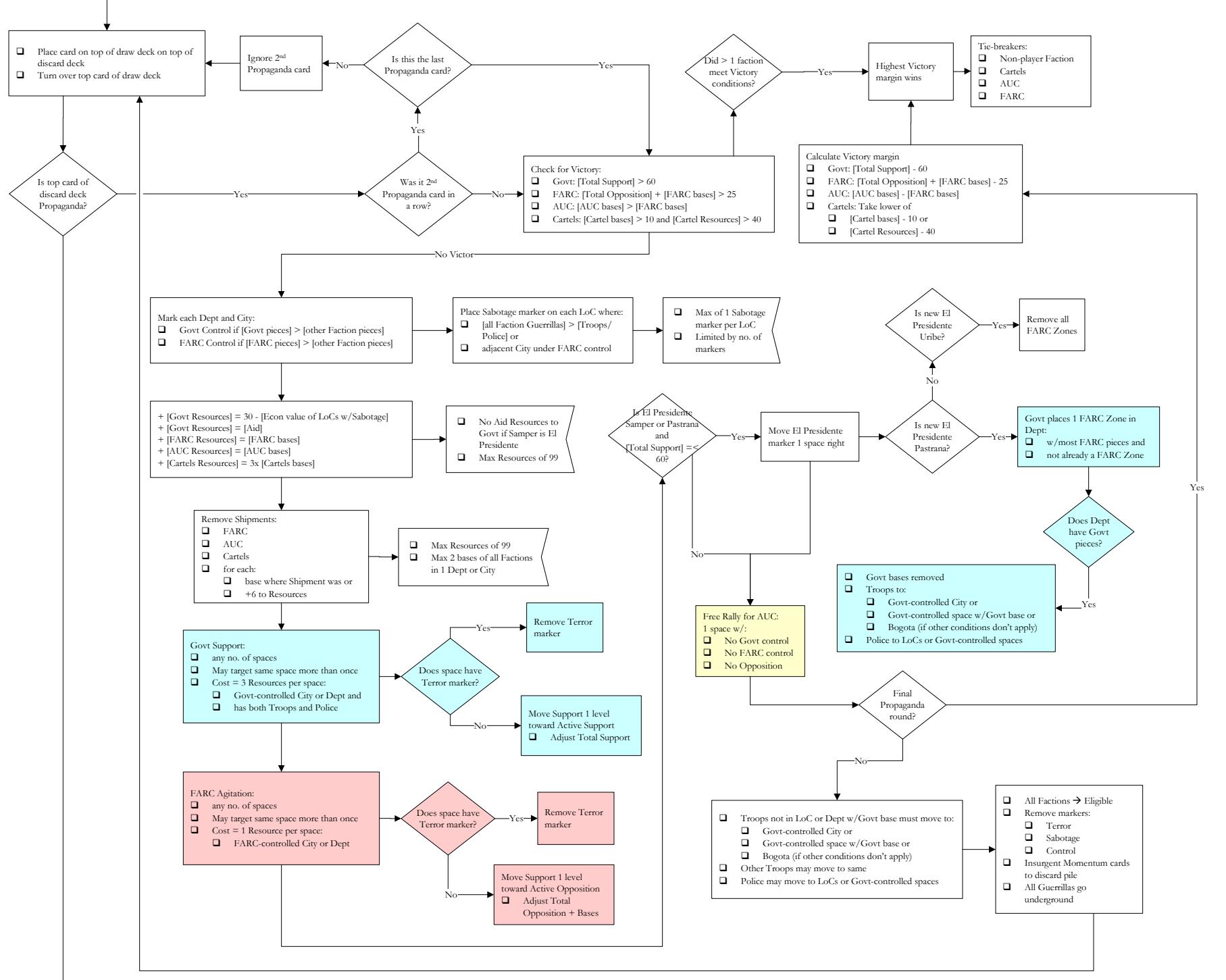
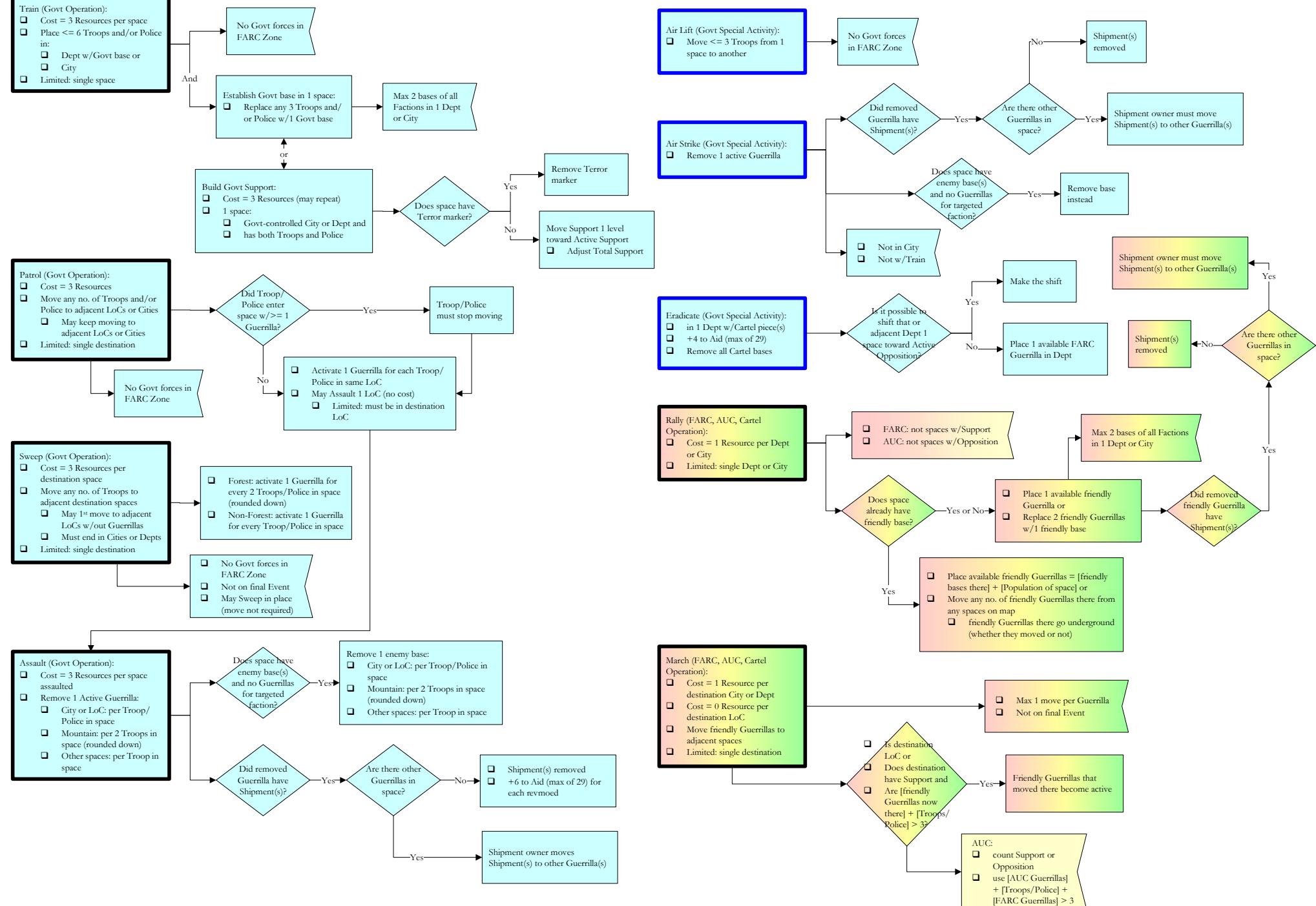
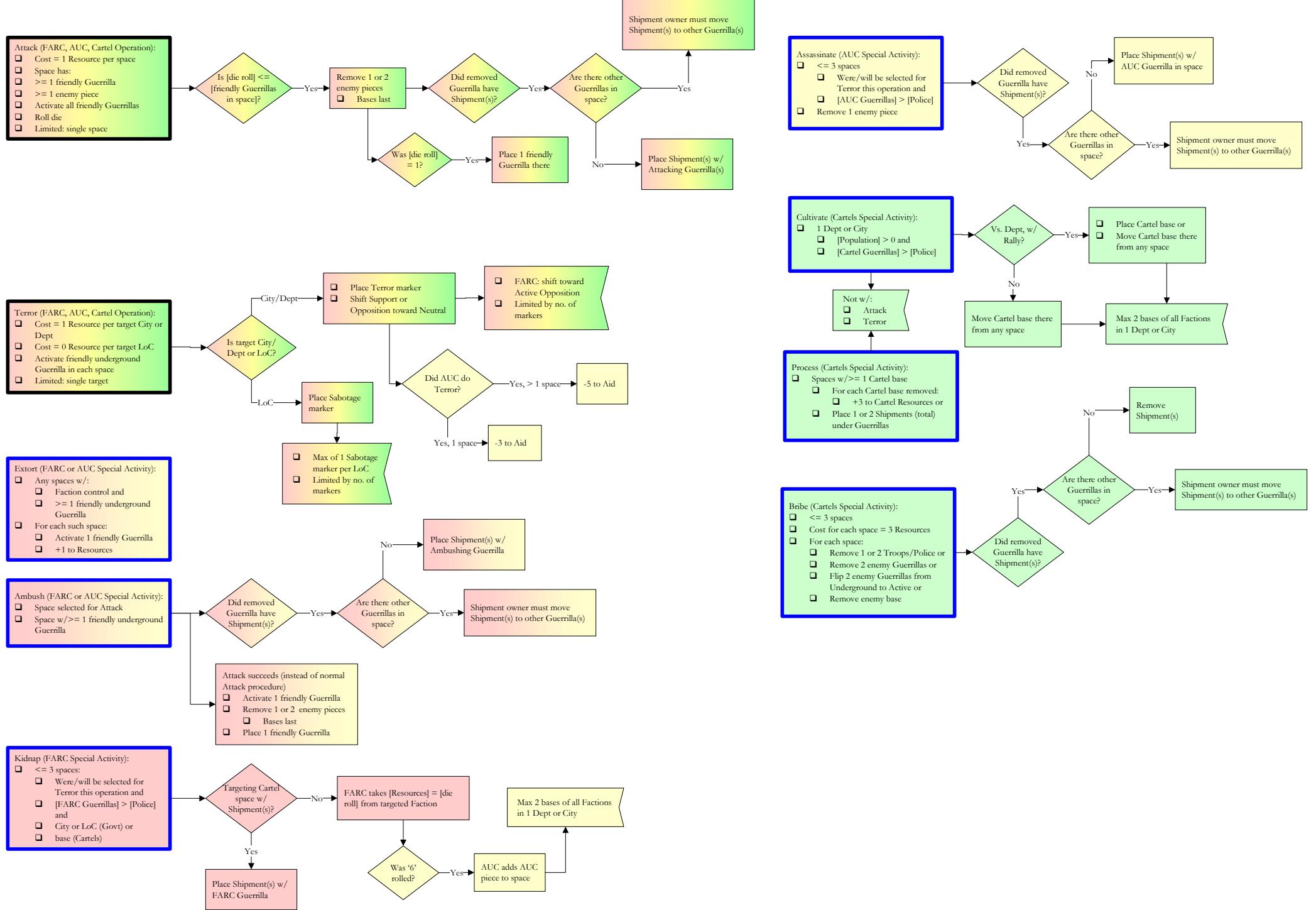
Andean Abyss
GMT Games 4 player Visio rules Version 1 . 0 by R Monk EmperorMonk@ ahoo com


Texts are community-compiled or publicly released by publishers; copyright remains with the original authors. For personal reference only.