
Android
At a glance
Rules, cards and Q&A (Chinese)
The rules, card data and player questions for this game are written in Chinese. Open the Chinese page to read them.
Where to find full rules
Full rules and card lookup are available in the cunlema app at cunlema.cn — pick this game and ask about any rule, card or turn you are unsure about.
Related games
Rulebook text (Markdown)
This game has 10 rulebook Markdown file(s) in our library; 3 rendered inline below — expand to read or download.
rules_zh_安卓纪元主机_5004.md13.6 KB
Your PAD's alert sounds. A new message, sent to one of your dead-drop accounts, flashes on the virt projection once your secretary AI has decrypted it. Touching the holographic display to open it, you read:
::The mainframe at Titan Transnational Bank has been isolated. Its security protocols have been deactivated and the sysops shut out. As far as they are concerned, it has gone offline, but the truth is so much sweeter: it is open to anyone with the attached key. You have 23 seconds to use a Sneakdoor before the security at Titan Transnational Bank comes back online. Grab what you can. %@Naga8946::
You trust "Naga" as much as any anonymous source...which is to say, not at all, but the high price of Naga's information has been more than made up for in the resulting payouts. You rush to your console and jack in to discover the server's defenses are indeed down, but there are other connected users—runners like you—plundering its contents. Though you would have preferred to do it quietly, you've never exactly shied away from an audience. This might just be your ticket to fortune—and fame—but only if you can grab more credits and data than the rest.
GAME OVERVIEW
Android: Mainframe is an abstract strategy game for two to four players set in the Android universe. During a game of Mainframe, players assume the roles of runners, members of a criminal subculture who infiltrate cyberspace for fame and profit. Players choose generic and unique program cards to execute various programs, allowing players to place and manipulate partitions and access point tokens. Each player wants to surround his own tokens with partitions to create a zone. Zones with only one runner's tokens inside score points at the end of the game, and the player who earns the most points wins!
ASSEMBLING THE BOARD
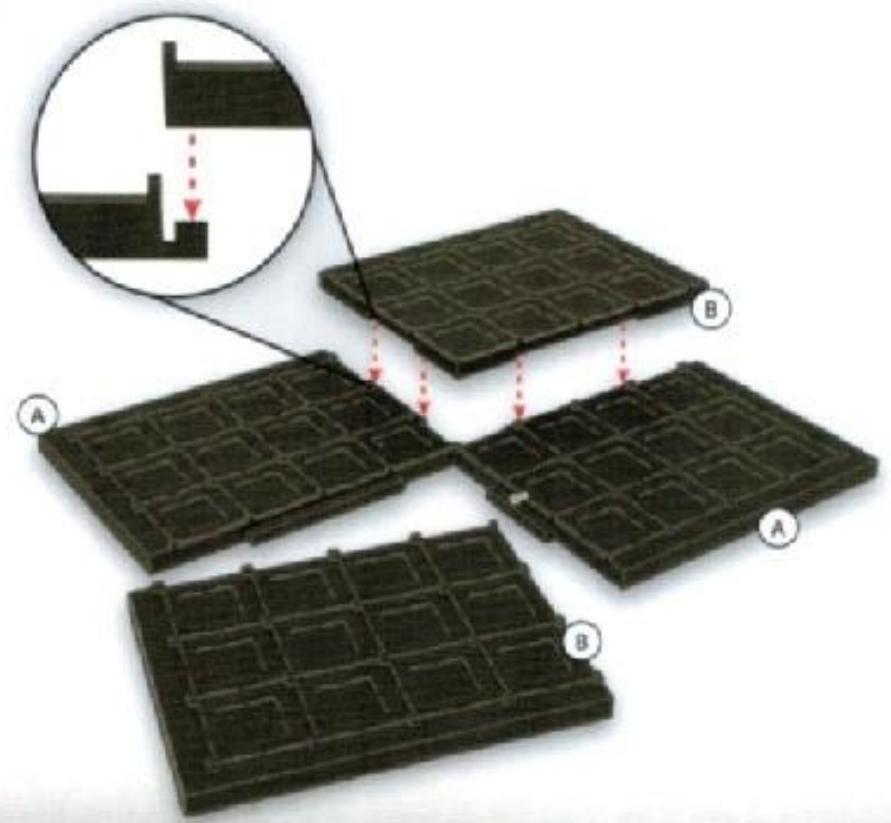
The board consists of two "A" sections and two "B" sections. Assemble the four pieces of the board as shown in the diagram.
游戏配件

1个游戏主板 (4块组成)
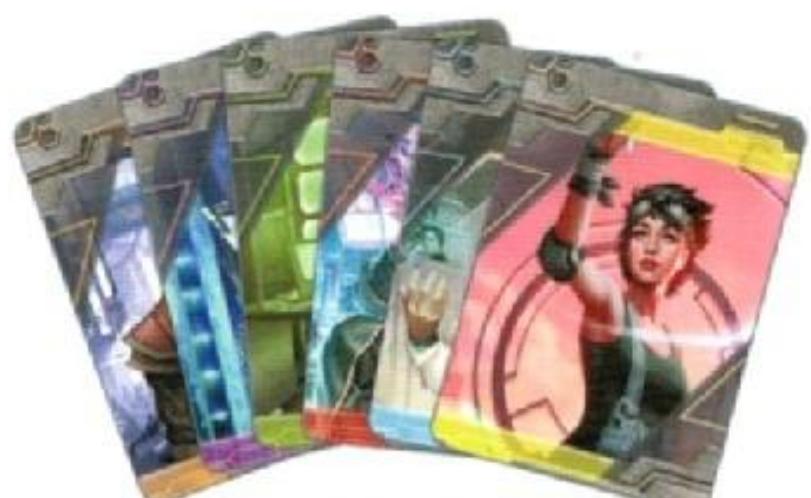
30张 独有程序

45张 通用程序

48个 域名标记

95个 防火墙
游戏设置
-
组装主板:把主板的四个部分组装起来,放在桌子的中央。
-
防火墙供应堆:把栅栏放在主板旁边,当栅栏供应堆。
-
决定起始玩家:随机决定一个起始玩家。
-
选择黑客:从起始玩家开始,顺时针方向依次选择,每个玩家选择一个黑客(即5张相同牌背的独有程序卡),剩下的黑客放回游戏盒中。
-
创建程序:把通用程序卡洗混后放在主板旁边,形成程序库。
-
筹备入侵: 每位玩家洗混自己的独有程序卡, 随机抽出3张。然后, 每个玩家拿取对应的8个域名标记, 将它们面朝上放在自己面前。其余的独有程序卡和域名标记放回游戏盒中。
-
设置值起始域名标记:从起始玩家先开始,顺时针进行。每个玩家把自己的1个域名标记人头面朝上放在有效网点上。
-
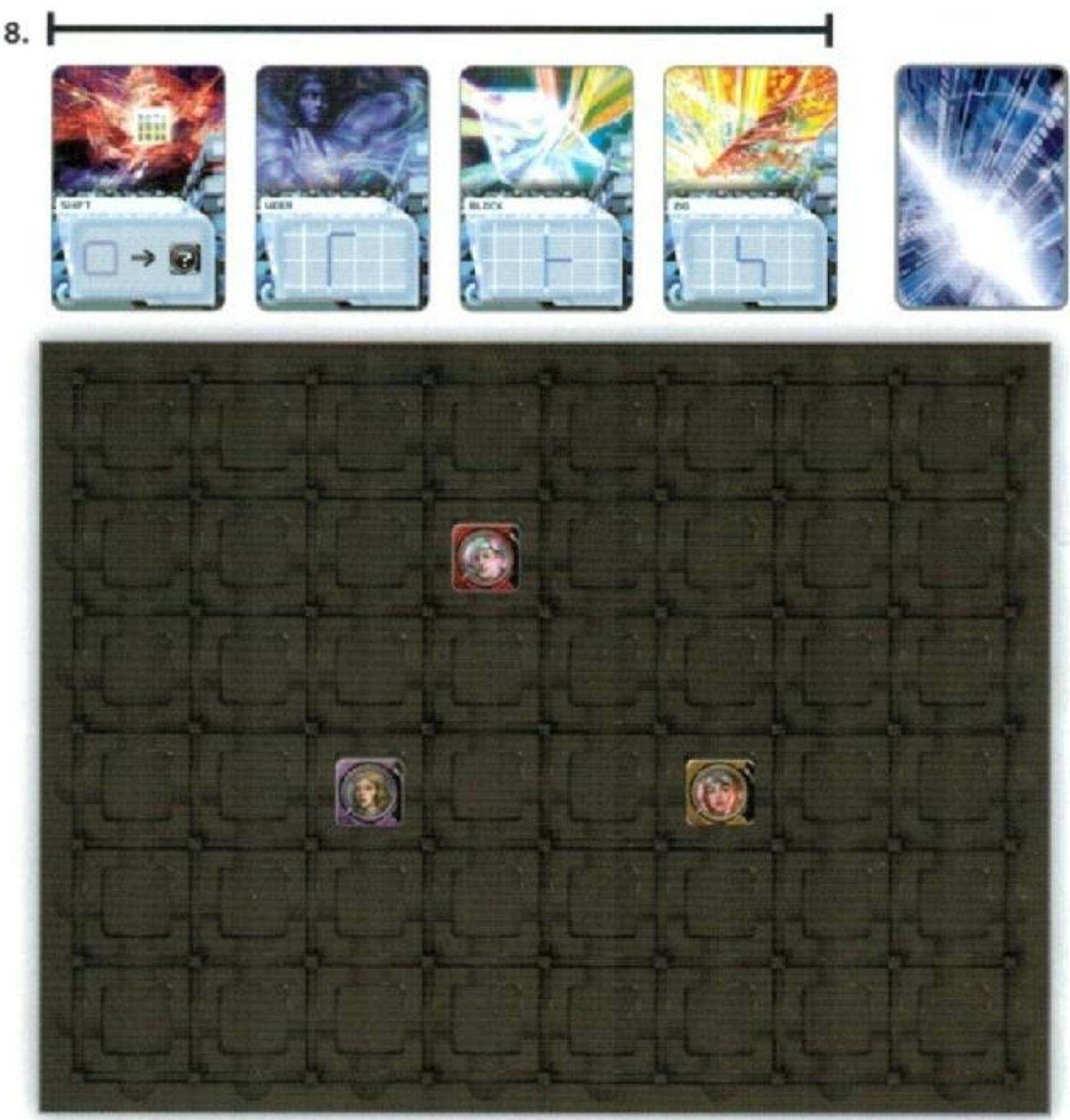
创建程序组:把牌堆顶部的4张程序翻开,形成程序组。
游戏设置示意(3人游戏)



游戏设置
游戏按照顺时针方向进行若干个回合。
玩家在回合中,可以执行1个通用程序;从手上执行一个独有程序;或者弃掉程序库最上面的牌,在1个有效网点放置1个域名标记。
域名标记和防火墙在主板上有特定的位置。域名标记要放置在有效网点上,防火墙要放置在有效路径上。
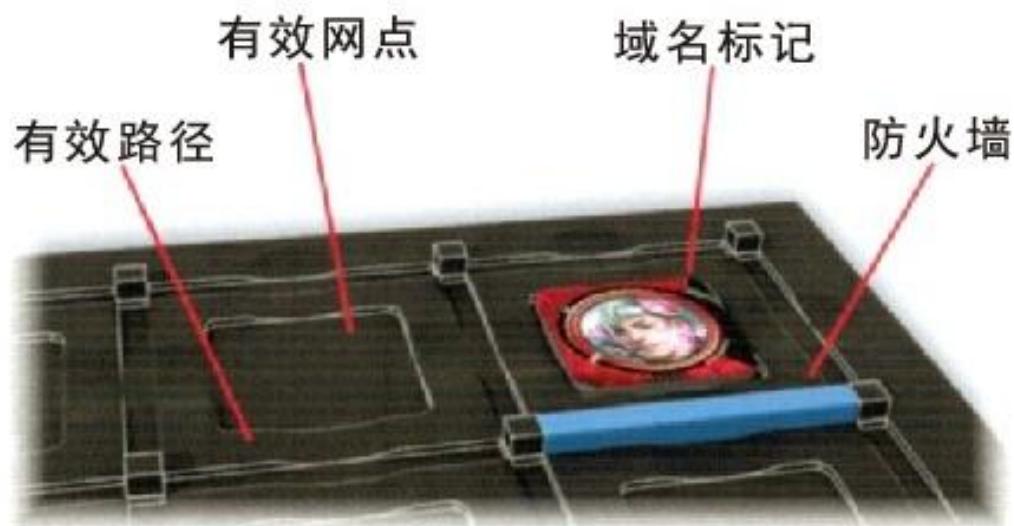
域名标记
域名标记是双面的;正面是黑客头像;反面是符号标记。
标记正面朝上时,会受卡牌效果的影响;标记反面朝上时,不会受卡牌效果的影响。
在游戏结束时,每个反面的标记都会为玩家带来分数。

正面域名标记

反面
域名标记
防火墙
防火墙放置在主板上,可以形成一个网络空间。网络空间是由防火墙把若干个网点围起来的封闭区域。域名标记放在主板上,是为了确定谁控制了这个网络空间。
通用程序
通用程序可供所有黑客使用。在每个回合开始时,程序组会有4张通用程序。当执行1张通用程序后,该牌将被面朝上放到回收站顶部,然后翻出一张新的程序。
执行通用程序:回合玩家选择程序组的1张通用程序(不能选择无法执行的程序),执行牌上的效果,然后将其正面朝上弃到回收站。最后从程序库翻出一张新的程序,使下一个玩家的回合也有4张通用程序可以选择。
当通用程序从程序组中弃掉时,总是会立刻从程序库翻出新的程序。
通用程序可以让玩家执行以下操作:
域名标记移动:移动1个正面的域名标记到有效网点。

域名标记交换:交换任意2个正面域名标记的位置。
防火墙移动:将1个不在网络空间里的防火墙移动到有效路径。

防火墙放置:从供应堆拿2个防火墙,并将它们放置在有效路径中。

防火墙布局:从供应堆拿3个防火墙,并将它们按照图上的布局放置,图不能镜像但可以平面转动观看。
域名标记的放置
丢弃程序库的顶部卡牌。然后把你自己的1个域名标记正面朝上放在1个有效网点上。
独有程序
独有程序一般只能被自己的使用。在游戏开始时,每个玩家都有3个独有程序。当执行1个独有程序时,该牌将被丢弃到独有程序回收站,且后面不会出现在游戏中。当黑客没有独有程序时,他只能执行通用程序。
域名标记的放置
网络空间是由防火墙把若干个节点围起来的封闭区域。但放置防火墙时,禁止玩家围成没有域名标记的网络空间。在围成网络空间后,程序不能影响网络空间。
通用程序示意
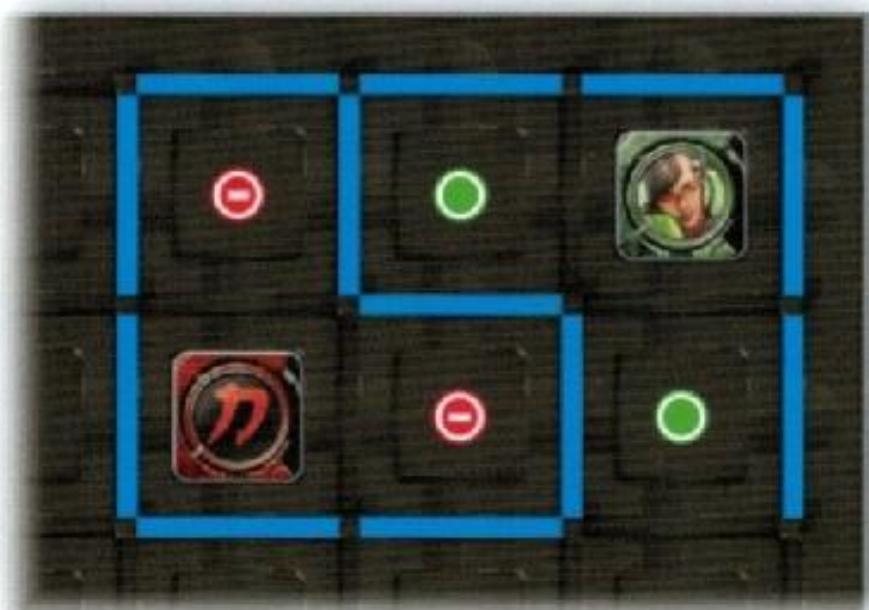
域名标记放置示意:域名标记不能放置在安全区,但它可以放置在绿色域名标记旁边,因为它尚未围成稳定区。
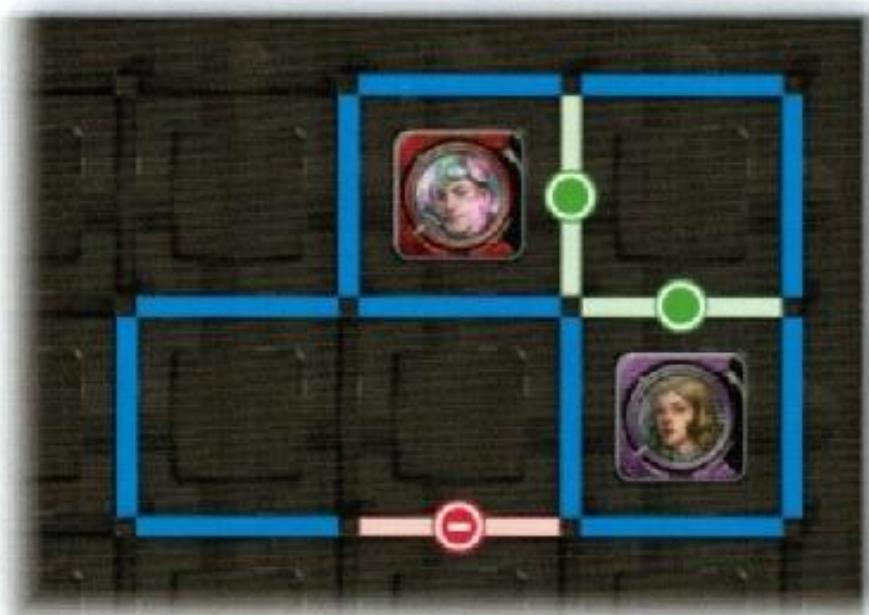
防火墙放置示意:防火墙不能放置在左侧创建网络空间,因为该区域内没有域名标记。
右边的区域是不稳定区,所以防火墙可以放置在里面的路径,无论放在哪,都会创建两个安全区域。

防火墙布局示意:3个防火墙不能按镜像后的布局去放置,但可以按旋转后的布局去放置。

○ = 合法的
- = 非法的
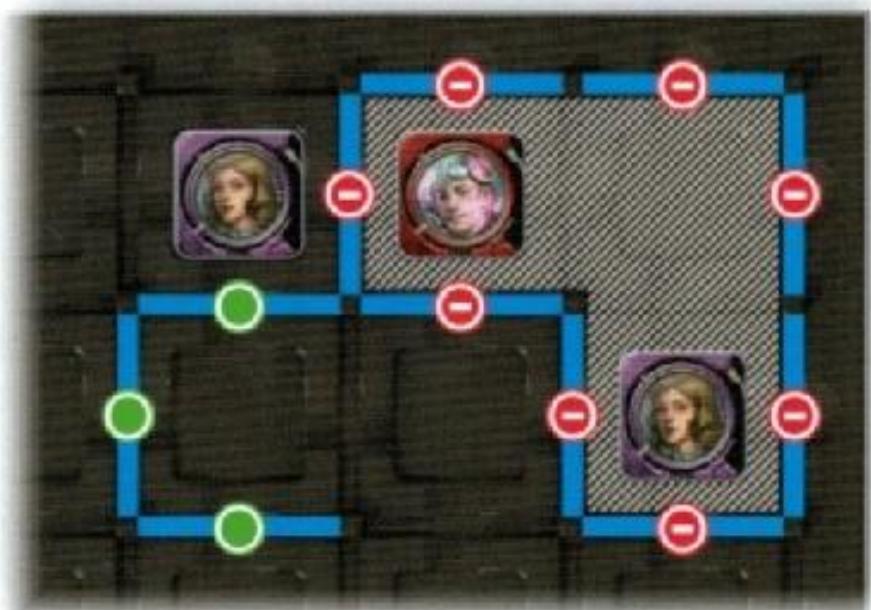
防火墙移动示意:不稳定区域的防火墙不能移动,但不包含在区域的其他防火墙可以移动。

域名标记移动示意:紫色域名标记不能移动到安全区的网点,但它可以移动到其他的网点,包括不稳定区内的网点。
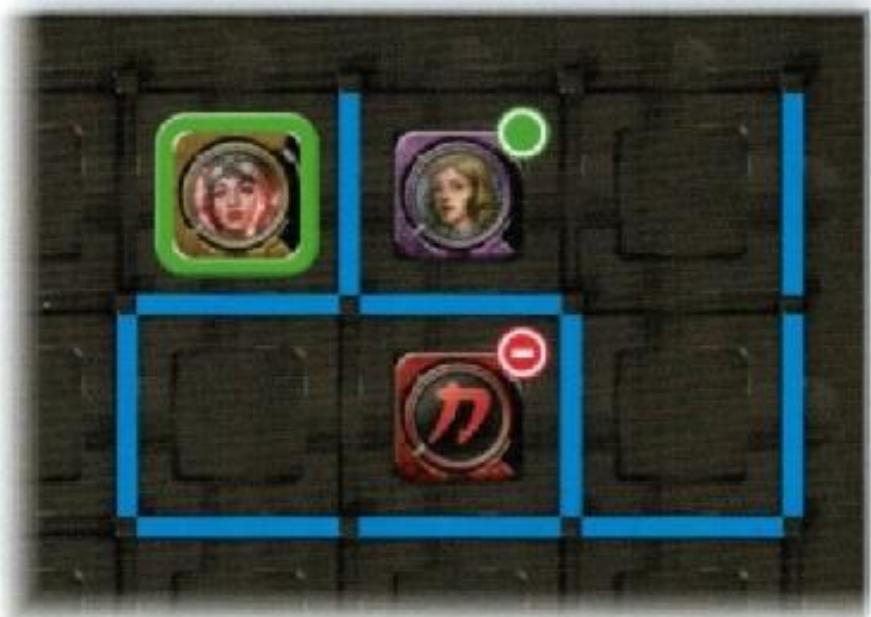
域名标记交换示意:黄色域名标记可以和正面的紫色域名标记交换位置,但不能和红色交换。
有两种类型的网络空间:稳定区和不稳定区。
稳定区
如果网络空间只有相同黑客的域名标记在里面,则称作稳定区。当1个防火墙放置并创建了一个稳定区后,就把里面的域名标记翻到反面。
稳定区中的域名标记不受程序的影响。另外,防火墙和域名标记不能放到稳定区内。
不稳定区
如果网络空间有不同黑客的域名标记在里面,则称作不稳定区。当放置1个防火墙创建了一个不稳定区后,域名标记保持正面朝上。
域名标记可以放在不稳定区内、移进或移出不稳定区、且可以在不稳定区内进行替换。另外,防火墙可以放在不稳定区内。
如果不稳定区(无论何时)只有相同黑客的域名标记在里面,它立刻变成稳定区;这时把不稳定区里面的域名标记翻转到反面,以确定其为稳定区。
游戏结束
有两种条件触发游戏结束:当没有程序可以被执行、或当程序库用完。
在特殊的情况下,某个玩家无法执行行动,则所有玩家都会连续跳过自己的回合,游戏也立即结束,玩家进行最后的计分。
当玩家在程序库中翻开最后1张程序后,每个玩家都可以额外执行1个完整的回合。之后游戏结束,所有的稳定区将进行计分。
游戏计分
游戏结束的计分:每个反面的域名标记都会为玩家带来分数。
每个反面域名标记的分数=它所在的网络空间网点数。
正面朝上的域名标记不计分。
最后,得分最多的玩家赢得游戏胜利。

游戏结束计分实例(具体算法看第7页的蓝色方框)
如果出现平局,则控制了更多安全区的玩家获胜。如果还是平局,则有最大安全区的玩家(即某个安全区的网点数最多)获胜。如果仍有平局,则第二大安全区的玩家获胜,以此类推……
如果平局不能打破,则所有平局玩家共同胜利。
游戏结束计分实例
游戏结束,每个玩家计算自己反面域名标记的总分。
紫色玩家有4个反面标记。他在主板右边的1个区域有2*3分、在主板中间的1个区域有1分、在主板上部的1个区域有3分,所以紫色玩家有(2*3 + 1 + 3)10分。
其他3个名玩家的分数:
绿色玩家获得(4 + 2 + 1)7分
黄色玩家获得(2 + 2 + 1 + 2 + 1)8分
红色玩家获得(5 + 5)10分
紫色和红色平局。
然而,紫色玩家比红色玩家有更多数量的稳定区,所以红色玩家赢得了游戏胜利!
游戏补充说明
本栏目主要说明游戏中可能出现的问题。
程序
玩家在回合内必须执行1个行动。如果玩家无法从手上执行1个独有程序、无法弃掉程序库顶部的牌去放置域名标记、或无法从程序组执行1个通用程序时,玩家只能跳过该回合。
遇到这种特殊的情况,会迫使所有玩家也跳过后面所有的回合,然后游戏立即结束,玩家进行游戏计分。
防火墙
防火墙不能放在稳定区里,但它可以放在其他的有效路径中。
创建网络空间而放置防火墙时,禁止玩家围成没有域名标记的网络空间
当准备放置防火墙时,玩家可以试放一下,只要记住哪个是你试放的防火墙。
当执行防火墙布局时,不允许按镜像的图去布局。
当执行程序去放置防火墙时,玩家必须将防火墙放置在可以放置的路径中,否则他不能执行该程序。放置防火墙时,玩家必须将防火墙“完整地卡入”路径中,不能露出半截防火墙在路径外。
游戏结束计分
不稳定区、正面的域名标记、防火墙都不会参与计分。
区域
玩家可以在不稳定区的路径中放置防火墙。这意味着玩家可以将不稳定区分为更小的区域,也可能在这个过程创建一个稳定区。
THE RUNNERS
The cybercriminals who call themselves "runners" have less in common than you might think. One thing they all share is a passion for taking what they can, especially when it doesn't belong to them.
JI "NOISE" REILLY
While in utero, Noise was genetically modified for superior intelligence; his parents dreamed their son would be the perfect corporate executive. But Noise uses his gifts for hacking, a pursuit more suited to his capricious nature. Noise's

system intrusions range from damaging viruses which destroy corporate servers to defacing a corp's Net presence in embarrassing but harmless ways.
Download Markdown08.md14.8 KB
Lily Lockwell, the Reporter
Lily Lockwell is a roving reporter who is trying to write a story about the murder that the detectives are investigating. She can be both a help and a hindrance for the detectives.
When a detective enters Lily's location, he must spend 1 Time if he has any left, as Lily questions him. If the Time is spent, she slips the detective some info in return, since she knows that it's best to keep her contacts happy. As a result, the player may choose one piece of evidence on any suspect sheet and reveal it, turning it faceup. After talking to Lily, the player moves her. Lily must be moved to a location of the same type (color) in a different district, just like a lead that is being moved. Lily may be moved to a location that already contains a lead, but cannot be moved to Jimmy the Snitch's location.
Jimmy the Snitch
Jimmy the Snitch is one of the most infamous informants in New Angeles. Cops and criminals come to him for the latest news all the time. Of course, his dangerous lifestyle means he's always on the move.
A player whose detective is in the same location as Jimmy may spend 1 Time to talk to him. That player may then either look at any one other player's hand of cards, or he may peek at all of the facedown evidence on a single suspect sheet. Whatever the player chooses, the information he learns may not be shared with the other players. After the player gets done looking, he moves Jimmy to another location of the same type (color) in a different district. Just like Lily, Jimmy may be moved to a location containing a lead, but he cannot be moved to Lily Lockwell's location.
NPCs and Elimination
NPCs are important characters in the lives of the detectives. A given NPC's care and welfare (usually) means a lot to the detective associated with them. It is possible, over the course of the game, for NPCs to be eliminated. Elimination might signify the NPC's death, or simply that he has left the life of the detective he was associated with for good.
If an NPC is eliminated, turn that NPC's status marker facedown, revealing the skull on the other side. The detective associated with that NPC must discard any NPC favors he possesses from that NPC, and cannot gain any more this game.
Two of Raymond's NPCs are unusual in that they don't have an eliminated side. They are shown as follows: Keene (Start) — Keene Troubled / Keene At Peace. Parsons (Start) — Parsons Missing / Parsons Found.
NPC Favors
Certain NPCs can grant favors to the detective they are associated with. These favors can be spent just like any other favor, with one difference. NPC favors may be spent as though they were one of two or more different types of normal favors, as shown on the token. Each NPC favor spent still only counts as one favor; it can just be one of several different types.
Example: A Mr. Li favor can be spent as a corp, political, society, or street favor. It still only counts as one favor, however.
Closing the Case
After the end of the sixth day of week two, the game comes to an end. At this point, the players determine which suspect is the murderer, tally up their VP, and determine a winner.
Determining the Murderer
For each suspect, do the following.
Turn all of the facedown evidence tokens on the suspect's sheet faceup.
Look for the lowest-value evidence token in the suspect's strong evidence file (even if it has a positive value), and then discard all pieces of evidence of that numerical value from that file. For instance, if Vinnie the Strangler has five pieces of evidence in his document evidence file, valued at –1, –1, 2, 3, and 5, the players would discard the two –1 tokens, since they share the lowest value on that file.
Look for the highest-value evidence in the suspect's weak evidence file (even if it has a negative value), and then discard all pieces of evidence of that numerical value from that file. For instance, if Vinnie the Strangler had four pieces of evidence in his testimony evidence file, valued at –1, 2, 4, and 4, the players would discard the two 4 tokens, since they share the highest value on that file.
Add up all of the values of remaining evidence on the suspect, across all three files.
Match each perjury token up with an alibi or surprise witness on the same suspect. Any perjury token that cannot be matched up with an alibi or surprise witness is discarded without effect. Subtract 5 from the evidence total for each alibi or surprise witness on the suspect that is not matched up with a perjury token. Add 5 for each alibi or surprise witness on the suspect that is matched up with a perjury token.
Note: When matching perjury tokens with surprise witnesses and alibis, it doesn't matter what file the tokens are placed in on the suspect sheet.
The suspect with the highest total is the murderer (even if that total is lower than zero). The player with that suspect's guilty hunch is correct, and every player with any other suspect's innocent hunch is correct. (Exception: Hunches for suspects who have been killed are never correct.)
Example of Determining the Murderer: The diagram depicts four suspects at the end of a three player game. First, the lowest-value evidence is removed from each suspect's strong evidence file, and the highest-value evidence is removed from each suspect's weak evidence file. Next, the surprise witness on Thomas Haas subtracts 5 from his total, while the alibi combined with the perjury token on Mark Henry adds 5 to his total, giving the final total shown below (numbers in parentheses are the totals of each of the suspect's evidence files):
Eve 5VA3TC: 4 Guilt (4–1+1) Noise: –1 Guilt (3–1–3) Mark Henry: 14 Guilt (4+5+0, +5 for perjured alibi) Thomas Haas: –5 Guilt (5–2–3, –5 for surprise witness)
Therefore, Mark Henry is guilty, while the other three suspects are innocent.
Obsession
A player who has both the guilty and an innocent hunch for the same suspect is said to be obsessed with that suspect. He is out to prove that the suspect is guilty beyond the shadow of a doubt.
An obsessed detective's hunches pay off normally, with the innocent hunch paying off if the suspect is innocent and the guilty hunch paying off if the suspect is guilty. However, if the suspect has a total guilt that is at least 5 higher than every other suspect's total, both of the obsessed detective's hunches are considered to be correct, and, furthermore, he receives an additional bonus of 3 VP.
The Puzzle
When tallying up points at the end of the game, remember that some point values may be modified by the links that have been made on the puzzle.
For each link (see "Links to the Conspiracy" on page 24) made between the conspiracy and a group, one of the VP values scored at the end of the game is adjusted.
Tallying the Points
After the murderer has been determined, the players add up all of their VP, as listed below. Whichever player has the highest total wins. In the event of a tie for highest total, if only one of the tied players had a correct guilty hunch, that player wins. Otherwise, the tied players share the victory.
*Endings with a VP value of 1 or higher are "happy" endings, while endings with a value of –1 or less are "sad."
**Although favors are not normally worth points, the conspiracy puzzle may cause them to be worth points. Note that NPC favors gain all VP bonuses for each type of favor they show on their token (e.g., a Mr. Li favor gains the VP bonuses for all four types of normal favors).
Example of Scoring: The diagram shows the puzzle at the end of the game. Mark Henry was guilty of the murder. Tallying up the links, Jinteki and Cardinal Reese have 2 each, and Human First and Haas-Bioroid have 1 apiece. This means that street favors and Haas tokens are worth +1 VP each, Jinteki tokens are worth +2 each, and "sad endings" (endings worth –1 VP or less) are worth an extra –2 VP each.
Raymond is the first to score. First, he has two Haas tokens worth 4 VP each (normally they're worth 3 VP, but the puzzle has boosted their value). He also has a conspiracy token (4 VP) and two street favors (1 VP each, again due to the puzzle). Lastly, he has 4 trauma (–4 VP). Therefore, from just his tokens, Raymond has 10 VP. Next, he adds in 14 VP from his plot, bringing him to 24 VP. His guilty hunch is wrong, so he gets only 5 VP from his innocent hunch, bringing his final tally to 29 VP. If Eve had been the murderer, he would've received an extra 18 VP (15, plus 3 more for being obsessed).
Caprice scores next. Tallying her tokens, she has two Jinteki tokens (5 VP each, gaining +2 each from the puzzle), 1 street favor (1 VP), and two trauma (–2 VP). This brings her to 9 VP so far. Both of Caprice's hunches were correct, so she receives 20 VP for that (29 VP total). Finally, Caprice has one happy ending (7 VP) and one sad ending (–1, reduced to –3 VP because of the puzzle). That brings her final tally to 33 VP.
Rachel scores last. Adding up her tokens, she has one Jinteki token (5 VP), two Haas tokens (4 VP each), one conspiracy token (4 VP), two street favors (2 VP), and one trauma (–1 VP). She also has two Captain Beckmann favors, which count as street favors, giving her another 2 VP, for a total of 20 VP. She receives no VP for her incorrect hunches, but she receives 3 VP for her leftover money, bringing her to 23 VP. Finally, looking at her plots, she receives 13 VP for her two happy endings, and 2 final VP for her two unspent Captain Beckmann favors, giving her 38 VP total.
Even though she didn't solve the murder, Rachel is the winner!
Designer's Notes
I don't usually do designer's notes, but Android is very near and dear to my heart, so I'm making an exception this time.
First off, I want to thank my family for supporting me over the years. I know it's been hard to watch me screw up sometimes, but thanks for always sticking by me regardless.
I'd also like to thank Dan Clark and Andrew Navaro for their tireless work on this game. Dan was helping me design the setting from the very start, when it was just a gleam in my eye. We spent many hours on the trip to and from the Origins game convention designing the characters and their stories, and he wrote many excellent story snippets and pieces of flavor text to get just the right feel. Andrew, for his part, really stepped up to bat on the graphic design and went above and beyond the call of duty to make the game gorgeous.
I shouldn't forget to thank Zoë Robinson, our art director, who worked relentlessly and found some truly phenomenal artists, even when I had trouble explaining the look I was after. Thanks also to Jeff, Mark, Gabe, and everyone else at FFG who touched this game in some way. Everyone put in a lot of work and it shows.
Finally, I want to thank Christian for letting me do Android in the first place. He's given me a place to work and learn, and he gave me a lot of free reign on this game. I hope it lives up to his expectations.
Android (at least my part of it) was inspired by a lot of things. Growing up, I spent a lot of time reading. Seriously, a lot of time. I did too well in school and too poorly at sports to really be popular with the other kids, as you might expect. But any problems I was having could be banished with a good book, at least for a while. I tore through the works of David Eddings, the two Roberts (Heinlein and Howard), Peter Beagle, and a host of other talented writers. To this day, the books I read as a child form the foundation of what I do (and here's the happy ending), which is designing games for a living. Without that prior exposure to all those brilliant minds and imaginations, I certainly wouldn't be where I am now.
But there's one other major inspiration for Android that I would be terribly remiss in leaving out – NASA. We lived in Cocoa, Florida, which is about ten miles from Cape Canaveral, one of the main sites for the U.S. space program. My dad worked at the Cape, and as a result, I got to see and experience a lot of things not readily available to the general public.
One of my strongest memories is getting in the old powder blue van with the family and driving down to the Cape, where we got out lawn chairs and watched the very first shuttle launch. It was something out of my science fiction books as the Columbia shot up into the sky on a bright spark of flame, and I remember cheering with all my heart. At that moment, to a little boy, it felt like we were just a step away from colonizing the stars.
Of course, we've still got a long way to go, and I did not at that time suspect the raw hurt I would later feel as I watched Challenger explode from the little playground of my school.
They usually let us go outside to watch the launches, and everyone was very excited because a teacher was being sent into space. All was well at first, but then the candle-like flame was obscured by a puff of smoke. I figured something had gone wrong, but I stood there, hoping the shuttle would emerge and be okay. Then the booster rockets came out of the cloud, flying in different directions, and I started crying. There was no way the shuttle had survived. The rest of the day was a tearful blur spent in the school auditorium watching the news.
It's hard for anyone who didn't live in that area to understand, but lots of us had parents working at the Cape and we felt like we were somehow a part of the space program – if not as contributing members, then at least as the cheering section.
That day kicked the heart out of the entire area, and you could see the grief in everyone's faces for days to come. I remember being so disappointed as the country pulled back from the space program after that. I guess we weren't racing the Russians anymore, so it wasn't worth the loss of any lives to most people, or perhaps we simply couldn't forgive them that one failure. It was, and still is, hard for me to understand.
Android, while gritty and grim at times, depicts a hopeful future. One in which we've colonized the inner planets of the Solar System and have avoided polluting or overpopulating ourselves to death. There are still wars, the divide between rich and poor, and a fresh ethical dilemma in the form of the androids, but it is a future that I feel is worth working towards. It's not perfect, but then, nothing is. It's a future like the one that the men and women of NASA work towards every day, and I dedicate Android to them and others like them, who have given their labor and their lives towards a brighter future. Hopefully someday, we'll all get our flying cars, our sleek spaceships, and our robot butlers.
Here's to the future!
Kevin Wilson
Download Markdown06.md11.9 KB
Playing Twilight Cards
Each player has a light deck and a dark deck devoted exclusively to his detective. Normally, a given detective's twilight cards are only played during his turn, although there are a few exceptions, which are described on the cards themselves.
A player may pay 1 Time in order to play a light card from his hand. In order to do so, he must pay the card's twilight cost (as described below) and meet any conditions listed on the card itself. Afterwards, he performs the actions listed on the card and then discards it faceup to the bottom of his light deck. Note that any additional costs listed on a card (such as spending one or more favors) must be paid in order for the card to take effect.
Example: Raymond's player plays his "I owe you one, Ray" light card. He pays 1 Time, along with the card's twilight cost of 2 dark shifts. The card has no other conditions that need to be met, so he gains one Kate favor and discards the card faceup to the bottom of his light deck.
Other players may also play a given detective's dark cards during that player's turn. It costs a player 0 Time to play a dark card, but the card's twilight cost must still be paid, and any conditions listed on the card must still be met. Afterwards, the player performs the actions listed on the card and then discards it faceup to the bottom of the dark deck from which it was drawn.
Dark cards do not cost Time to play because they are played on another player's turn, and they may only be played in response to the actions of that player (for example, that player starting his turn, that player moving his detective to a major location, etc.).
Example: During Caprice's turn, she enters a location. Raymond's player then plays her "Report, Caprice" dark card. He pays 0 Time, since this takes place on her turn, then plays the card's twilight cost of 2 light shifts. Caprice has a warrant on Jinteki, so the card takes effect and she loses 2 Time. Raymond then discards the card faceup to the bottom of Caprice's dark deck.
Important Note: Any time a card contradicts the general rules (such as light cards that say they cost 0 Time to play), the card takes precedence.
Remember: Dark shift to the right to play a light card. Light shift to the left to play a dark card.
Paying Twilight Costs
Light and dark cards represent good and bad things that happen to the detectives. In the world of Android, a certain balance of good and bad events is maintained, and this balance is represented by twilight costs.
A detective's twilight level is tracked on his detective sheet using a twilight marker. If the marker is all the way to the left side of the sheet (in the lightest space of the twilight track), the detective is said to be completely light shifted. If the marker is all the way to the right side of the sheet (in the darkest space of the twilight track), the detective is said to be completely dark shifted. In a similar vein, moving leftward along the twilight track (towards the lighter end) is called light shifting, while moving rightward along the twilight track (towards the darker end) is called dark shifting. Whenever a detective must light or dark shift, he only moves one space along the twilight track unless otherwise stated.
When a player wishes to play one of his detective's light cards from his hand, he must dark shift by the number of spaces shown in the card's upper left corner. Similarly, when a player wants to play another detective's dark card from his hand, he must light shift by the number of spaces shown in the card's upper left corner.
Remember: To play light cards, a detective must dark shift to the right. To play dark cards, a detective must light shift to the left.
Although it may seem confusing that a player must dark shift to play a light card and light shift to play a dark card, players should find it easy to learn if they remember that a detective wants to be completely dark shifted in order to play dark cards, and he wants to be completely light shifted in order to play light cards.
Tip: Effective card play requires a player to play both light and dark cards. Playing dark cards on other players "recharges the batteries," allowing more light cards to be played on the player's own turn. Ideally, a player should play at least one light card and one dark card each round.
Discarding Cards for Discounts
Sometimes a player may want to play a card from his hand that he cannot quite pay the twilight cost for. Other times a player may simply want to get rid of excess cards in his hand. In either case, a player may discard twilight cards from his hand when playing a twilight card in order to reduce the card's twilight cost. For every card that is discarded in this way, the played card's cost is reduced by one. Once a card's cost has been reduced to 0, that player cannot discard any further cards to reduce its cost. The discarded cards do not have to match the type of card they are reducing the cost for. It is permissible for a player to discard light cards to reduce the cost of a dark card and vice versa. However, players may not discard cards to reduce the cost of a card being played by another player.
Matching the Current Plot
When a light or dark card whose color matches the target detective's current plot is played, the player playing the card may choose to either increase or decrease its twilight cost by one (see "Plots" on page 29). A player might want to decrease a card's cost to make it easier to play. On the other hand, a player might want to increase a card's cost to shift further along his twilight track in preparation for playing other cards later on.
Example: Louis's "Krausey Case" plot is in play. Krausey Case plot cards have a blue border. Another player plays "I want you in my office now, Blaine!," which is one of Louis's dark cards. It has a blue border, so it matches Louis's current plot. The player that played it may increase its twilight cost to 4, reduce it to 2, or even choose to leave it at 3.
Cardplay Priority
Often, more than one player will want to play a twilight card in response to the same event. However, only one dark card and one light card may be played in response to a single event. First, determine which player gets to play a dark card. If there is a disagreement, the first player has priority to play a card. If he chooses not to play a card, priority passes clockwise from him. After the dark card has been played and resolved, the active player may then play his light card, assuming that he can still fulfill its requirements.
Important Note: Light and dark cards drawn at no cost upon entering ritzy or seedy locations are drawn before any cards can be played in response to the detective entering that location.
Card Traits
Many cards have bolded, italicized words on them. These words are called traits. Normally, traits do not have any effect on their own. Instead, they are used to categorize cards into groups that may be affected by other cards. For example, Caprice Nisei's "The Liberty Society has filed a suit" plot card causes her Human First cards to cost 0 twilight to play.
Plots
Plots are problems that spring up in the detective's personal life while he's investigating the murder. Each detective must deal with one plot each week (exception: each of Raymond's plots takes two weeks to resolve), and the VP gained or lost from plots can tip the outcome of the game. Each plot is comprised of a start card (single-sided), a crossroads card (double-sided), and two ending cards (double-sided with VP on them). All of a detective's start cards have the same image on the back to make them easy to shuffle and select from randomly. At the start of each week, a random plot is selected for each detective, and its start card is put into play.
Each plot's start card (front), crossroads card (front and back), and two ending cards (front and back) form the full arc of the plot.
Fights
Some light and dark cards are identified with the Fight trait. When a Fight card is played on a player (either by himself or by another player), that player must respond by choosing either light tactics or dark tactics for the fight. Light tactics represent the detective fighting like a good guy, shooting to injure instead of kill, and so on. Dark tactics represent the detective doing whatever is necessary to win the fight, honorable or not. If the player chooses light tactics, he light shifts (if able) and does whatever is listed on the "light tactics" portion of the card. If the player chooses dark tactics, he dark shifts (if able) and does whatever is listed on the "dark tactics" portion of the card. Note that a detective who is completely light shifted can still choose light tactics, and a detective who is completely dark shifted can still choose dark tactics.
Although "weak" or applied AI systems have been used for years in devices such as secretary software agents, none of these devices approached true human intelligence, or "strong" AI, until the creation of bioroids. The key to strong AI proved to be brainmapping, a technology originally developed to diagnose and study brain disorders.
Plots accumulate emotional baggage over the course of the week, and this baggage determines how they resolve. Each start and/or crossroads card has a "good baggage" section and a "bad baggage" section. The good baggage section (in orange) explains how the plot can accumulate good baggage, while the bad baggage section (in grey) explains how the plot can accumulate bad baggage. When a plot gains good baggage, a baggage token is placed on it, orange side up. When a plot gains bad baggage, a baggage token is placed on it, grey side up. Generally, a player wants his plots to accumulate more good baggage than bad baggage, but this may be difficult, particularly if the other players decide to gang up on him.
Example: Louis Blaine's "The Krausey Case" plot gains good baggage each time he follows up a lead and sacrifices the evidence from it, while it gains bad baggage each time another player sacrifices 2 Time.
Baggage, both good and bad, keeps building on each player's start card until the end of the third day of the week, when the start card resolves (as described below) and one of the two sides of the crossroads card corresponding to that plot enters play. The start card indicates which side of the crossroads card comes into play based on whether it was resolved with more good baggage than bad (a positive result), or less good baggage than bad (a negative result). If good and bad baggage are equal, the negative result transpires.
When the crossroads card comes into play, the start card is discarded, along with all of the baggage on it. Baggage then accumulates anew on the crossroads card until the end of the sixth day of the week, when the crossroads card, and the entire plot, resolves. This time, similar to the resolution of the start card, the crossroads card indicates, depending on the accumulated baggage, the ending for the plot. The ending card is then put into play with the appropriate side faceup, and then, if the game isn't over, a new plot is chosen at random for the detective for the next week.
Example: For the first three days of the week, Louis's "Krausey Case" plot goes well, and its start card resolves positively, so his player discards that card and its baggage, putting the "I finally caught a break" side of Louis's crossroads card into play. Unfortunately, for the next three days of the week, this plot goes poorly, and the crossroads card resolves negatively, so the player discards it and its baggage, putting Louis's "I found him too late" ending card into play. At the end of the game, this ending card will cost the player 1 VP.
Download MarkdownTexts are community-compiled or publicly released by publishers; copyright remains with the original authors. For personal reference only.