
Ashes Rise Of The Phoenixborn
At a glance
Rules, cards and Q&A (Chinese)
The rules, card data and player questions for this game are written in Chinese. Open the Chinese page to read them.
Where to find full rules
Full rules and card lookup are available in the cunlema app at cunlema.cn — pick this game and ask about any rule, card or turn you are unsure about.
Related games
Rulebook text (Markdown)
This game has 1 rulebook Markdown file(s) in our library; 1 rendered inline below — expand to read or download.
ph1225-5-rulebook-web.md67.3 KB
REDORAINS RULEBOOK
ATTENTION!
This rulebook is for players who are learning or relearning Ashes in order to play the solo or two-player co-op version of the game. If you are already an experienced Ashes player we suggest you learn how to play this version of the game using the Chimera Rulebook instead.
OBJECT OF THE GAME
In Ashes: Red Rains, you are a Phoenixborn-a powerful magic wielder battling a god-like monstrosity known as a Chimera. Cast spells and summon allies in an effort to destroy the Chimera and win the game.
Phoenixborn Card
Your Phoenixborn is your most important card. Its battlefield and spellboard values dictate how many units and ready spells you can have in play at a time and its life value is how many wound tokens can be placed on it before you are out of the game. A Phoenixborn is not a unit.
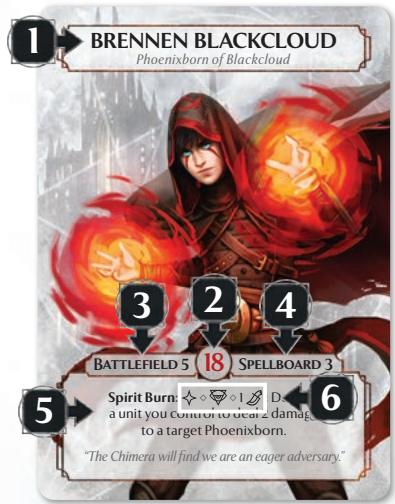
- Name 4.Spellboard Value
2.Life Value
5.Ability
- Battlefield Value
6.Activation Cost
Unit Cards
Allies and conjurations are the two types of units that you will summon to your battlefield. Units on your battlefield are under your control.
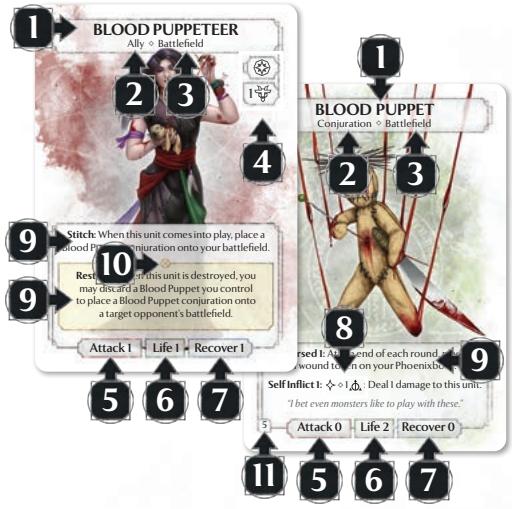
-
Title 7. Recover Value
-
Type
8.Activation Cost
-
Placement
-
Ability
-
Play Cost
-
Inexhaustible Effect
-
Attack Value
-
Life Value
-
Conjuration Limit
Spell Cards
Action and reaction spells are discarded for one-time effects whereas ready and alteration spells have longer lasting effects. The spells in your play area are under your control.
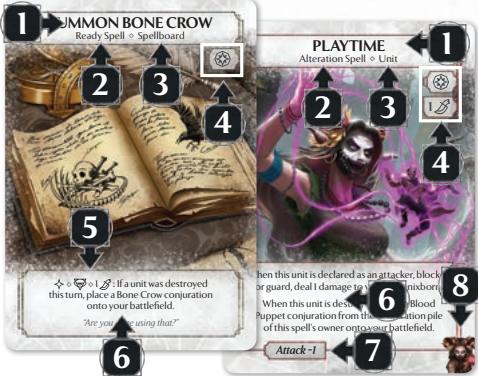
-
Title
-
Activation Cost
-
Type
-
Effect
-
Placement
-
Value Bonus
-
Play Cost
-
Unique Identifier
Tokens
Wound
Exhaustion

Status

Red Rains
Dice
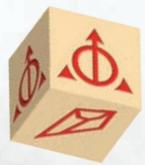
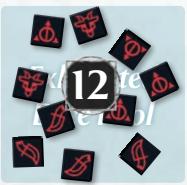
Dice are the magic that let you cast spells and summon units. You will encounter many types of dice in your battles; four types come in the master set. Each die has three levels: power > class > basic. Higher level dice can be used to pay for lower level costs.
• A power symbol can be used as that die's power, class or basic symbol.
• A class symbol can be used as that die's class or basic symbol.
In addition, each die's power symbol can be spent to activate a dice power effect.
Power symbol
Class
symbol
Basic symbol
Natural die


Charm die


Ceremonial die


Illusion die


Sympathy die


Divine die


Time


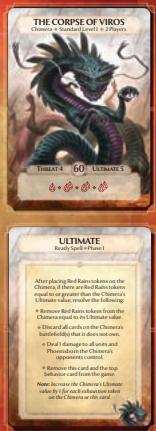
Chimera Card
The Chimera is your opponent and comes in a variety of difficulties, so that players can choose their challenge level. The Chimera must receive wound tokens equal to or greater than its life value for you to win the game.
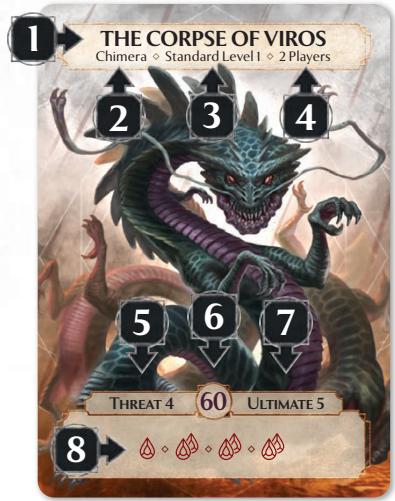
- Name
2.Type
5.Threat Value
3.Difficulty/Level
6.Life Value
4.Player Count
- Ultimate Value
8.Starting Setup
Aspect Cards
Aspect cards represent different aspects of the Chimera that it will deploy to its battlefield throughout the course of its battle against you. Aspects are a type of unit and are considered to be all other types of unit (like ally or conjuration).
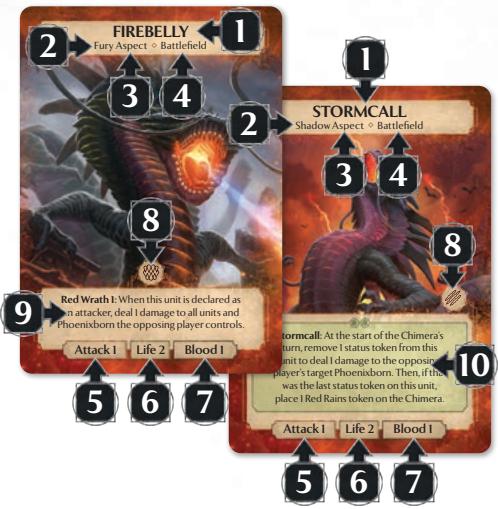
- Title
2.Subtype
-
Life Value
-
Type
-
Blood Value
-
Targeting Icon
-
Placement
-
Ability
-
Attack Value
-
Status Ability

Behavior Cards
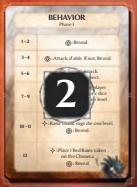
Behavior cards, along with the behavior die, dictate the Chimera's actions.
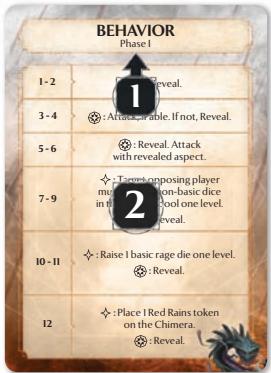
-
Phase (1, II, II)
-
Behavior Die Results
Ultimate Cards
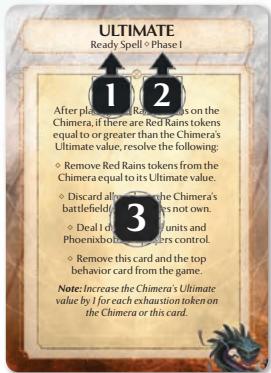
Ultimate cards list the effects that will resolve after the Chimera collects Red Rains tokens equal to its Ultimate value.
- Type: Ready Spell
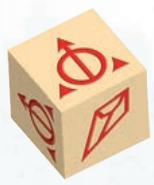
Behavior Die
- Phase (I, II, IIII)
Power symbol
The behavior die, along with the behavior cards, dictate the Chimera's actions.
- Ultimate Effects


Basic symbol
Rage Dice

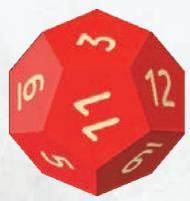
The Chimera has 5 rage dice that power up over time to generate Red Rains tokens that will eventually trigger its Ultimate effect! Each rage die has 3 power sides and 3 basic sides.
Fatigued Card
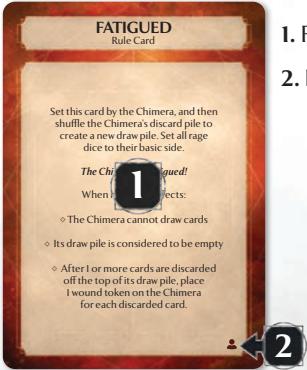
This card is placed under the Chimera's draw pile during setup. When the Chimera empties its draw pile, it becomes fatigued. Follow the card's instructions.
-
Fatigued Effects
-
Player Count
GAME SETUP
This rulebook will teach you the setup and rules for a solo player game of Ashes: Red Rains and then (on page 22) will go over additional setup and rules for a 2-player co-op game.
-
Decide what difficulty level you will play at and place the corresponding Chimera card, single player side up, on its designated space on the Chimera board.
-
Create stacks of the behavior and Ultimate cards, with the phase I cards on top, followed by the phase Il and phase Ill cards beneath them.
-
Place the behavior die near the behavior cards.
-
Set all 5 rage dice to their basic side and place them in the Chimera's active dice pool.
-
Gather 18 aspects that all share the same subtype. In this set you will have a choice between gathering all 18 Fury aspects or all 18 Shadow aspects.

-
Place a row of randomized Blood 1 () and Blood 2 () aspect cards face down on the Chimera's battlefield in the order shown on the Chimera card's starting setup.
-
Shuffle the remaining Blood 1 and Blood 2 aspect cards together into a single deck to create the Chimera's draw pile. Put the fatigued card (single player side up) on the bottom of the draw pile and place the draw pile on the Chimera board.
-
Choose your deck. See page 21 for details.
-
Place your Phoenixborn in your play area with the information side face up.
-
Place your conjuration pile face down in your play area.
-
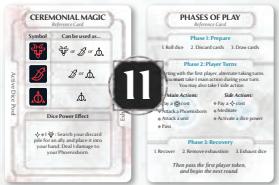
Place the dice power reference cards that correspond to the dice you are using in your play area and take a phases of play reference card, if needed.
-
Place all ten of your dice to the right of your dice power reference cards. This is your exhausted dice pool.
-
Choose your First Five by taking five different cards of your choice from your deck. This is your starting hand. You cannot include more than one copy of a card in your First Five. Shuffle the rest of your deck and form a face down draw pile in your play area.
-
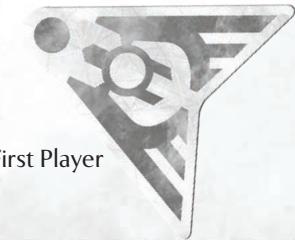
Place the first player token on your side of the play area.
-
Create a supply of each token type near the play area.

Bottom of Draw Pile

Opposing Battlefield
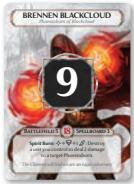
Player Battlefield

Player Spellboard
Active Dice Pool
ROUND ORDER
Ashes: Red Rains is played over a series of rounds. Each round is divided into three phases that must be resolved in order. Most of the game takes place during the player turns phase.
1. PREPARE 2. PLAYER TURNS 3. RECOVERY
1. PREPARE PHASE
During the prepare phase resolve the following steps in order:
-
Roll Dice: Roll all of the dice in your exhausted pool and place them to the left of your dice power reference cards. This is your active dice pool.
-
Discard Cards: You may discard any number of cards from your hand.
-
Draw Cards: Draw cards until you have 5 cards in your hand.
• Fatigue Damage: Place I wound token on your Phoenixborn for each card you should have drawn but could not.
2. PLAYER TURNS PHASE
The player turns phase typically consists of many very short turns alternating back and forth between your turn (the player turn’) and the Chimera's turn.
On your turn, you must take one main action and may choose to take one side action. You may take them in any order.
During the Chimera's turn, it will also take a main action and possibly a side action, determined by game state and the behavior die.
Play will continue to alternate back and forth between you and the Chimera until you both Pass on consecutive turns. At that time the player turns phase will be over and play will move on to the recovery phase.
Player Actions
Main Actions (required)
• Pay a cost
• Attack
• Pass
Side Actions (optional)
• Pay a cost
• Activate a dice power
• Meditate
Main Action: Pay a Cost
To take this main action, play or activate a card where the symbol appears in the play or activation cost.
Playing a Card
Many turns in Ashes consist of playing a card or activating a card that was played on a previous turn. It is common for your entire turn to consist of playing or
activating just one or two cards.
To play a card from your hand, first pay its cost0, then place it as directed by the card's placement2

Paying Costs
There are 5 different types of costs:

Main Action: Take your main action for the turn.

Side Action: Take your side action for the turn.

Exhaust: Place l exhaustion token on this card.

Discard: Discard a number of cards from your hand equal to the number shown.
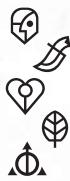
Magic: Exhaust dice of the appropriate type and number by moving them from your active
Thol to your hausted pool magic play cost. Remember that higher level dice can be used to pay for lower level costs.
Parallel Costs
Some cards have two or more connected costs in their play cost or their activation cost. These costs are called parallel costs.
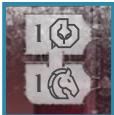
1中 or1月:
To pay a parallel cost, pay one of the options, plus any other costs.
Example: Paying Costs
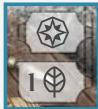
To play Summon Iron Rhino to your spellboard, take your main action for the turn and exhaust 1or die.

To activate its effect, take your main action,
place l exhaustion token on the card, and exhaust any six dice (any die can be used as).

Card Types
There are 5 different types of cards that can be included in a player's deck (ally, alteration spell, ready spell, action spell, reaction spell), and 2 types that can be included in a player's conjuration pile (conjuration, conjured alteration spell).
Ally (Unit) Allies are a type of unit. Old Salt is an ally0which will be played to your battlefield ②. To play the Old Salt, pay its costs3, and then place the Old Salt to the
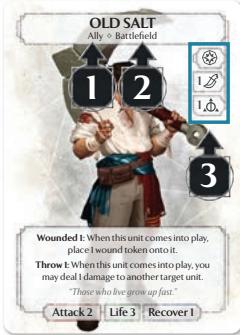
right of any units already on your battlefield. The number of units that can be on a your battlefield is determined by the battlefield value on your Phoenixborn.
• Attack value: how much damage a unit deals in battle.
• Life value: how many wound tokens it takes to destroy a unit.
• Recover value: how many wound tokens are removed from a unit during the recovery phase.
Conjuration (Unit)
Conjurations are a type of unit. Conjurations start in a conjuration pile, are brought into play by other card effects, and return to that conjuration pile when they leave play. They otherwise work exactly the same as ally units.
Action Spell
Action spells
have a one-time
effect. Final Stand
is an action spell
0which will be
played to your
discard pile2
To play Final
Stand, pay its play
cost3, carry
out its effect, and tl out its effect, and then discard it.
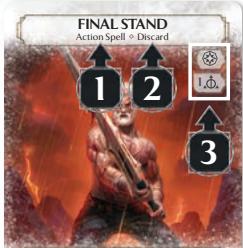
If you have no cards in your hand, deal 4 damage to a target unit an opponent controls. Ifthere are 12 or more wound tokens on your Phoenixborn, deal 2 damage to a target Phoenixborn.
Alteration Spell Alteration spells modify the units they are attached to. Playtime is an alteration spell 0which can be played (attached) to any unit in play2on any battlefield. To

play Playtime, pay its costs3, and then target any unit in play and attach the spell by placing it underneath that unit. As long as Playtime remains attached to the unit, its card text and value bonuses modify the unit. In this case, the unit is affected by some effect text4and its attack value is reduced by 15
Conjured Alteration Spell
Conjured alteration spells are considered to be alteration spells, not conjurations, while in play. Conjured alteration spells start in a conjuration pile, are brought into play by other card effects, and return to that conjuration pile when they leave play.
Ready Spell
Ready spells
usually do not
have an
immediate effect, but will remain in play to be
activated later.
Summon Bone
Crow is a ready
spell0which will be played to your
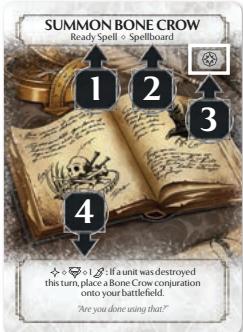
spellboard2. To play Summon Bone Crow, pay its play cost3, and then place Summon Bone Crow in an empty slot on your spellboard. The number of spellboard slots is determined by the spellboard value on your Phoenixborn.
If you already have 1 or more copies of the same ready spell on your spellboard, place the new one on top of the existing one(s)—it does not take up an extra slot.
On a subsequent turn you can activate Summon Bone Crow by paying its activation cost4, taking a Bone Crow conjuration from your conjuration pile and placing it to the right of all other units on your battlefield.
Focusing a Ready Spell
If you have placed 2 or 3 copies of a ready spell on top of each other, that spell is focused. Each copy of a ready spell is separate, can have its own exhaustion and status tokens, and can be activated separately, paying all activation costs each time.
Some ready spells have effects that say Focus 1 or Focus 2. A spell's Focus 1 effect becomes active for all copies of that spell when it has been focused at least once (1 additional copy on your spellboard). A spell's Focus 2 effect becomes active when the spell has been focused at least twice (2 additional copies on your spellboard).
Reaction Spell
Reaction spells can be played on any turn, when its conditions are met. A player can only play one reaction per turn.
Shadowblade is a reaction spell1
which will be played to your discard pile ②.You have Shadowblade in your hand when the Chimera declares attackers. You may respond by playing Shadowblade, paying its play
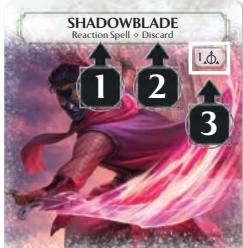
You may play this spell after a player declares attackers. Draw 2 cards. Deal 1 damage to a target unit an opponent controls. Deal1 damage to another target unit an opponent controls.
cost 3, carrying out its effects, and then discarding it.
Other Reactions
Some cards have reaction abilities or effects on them, indicated by a blue box. These cards may be played from your hand as reactions when their conditions are met.
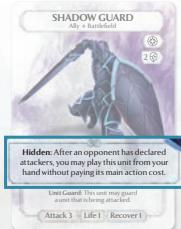
Using a reaction ability or effect counts toward your limit of 1 reaction per turn.
Main Action: Attack
When you Attack, 1 or more of your unexhausted units will enter battle.
Unexhausted: A card with no exhaustion tokens on it.
Battle: In battle an attacker deals damage equal to its attack value to a defender. Sometimes the defender will counter. After the battle, 1 exhaustion token is placed on the attacker, and 1 on the defender, if it countered, unless it is an aspect.
Counter: When a defender counters, it deals damage equal to its attack value back to its attacker. Attack and counter damage occur simultaneously. Aspects always counter if unexhausted, and they do not exhaust as a result of countering.
Blood Value: When an aspect is destroyed or discarded from the battlefield, place a number of wound tokens on the Chimera equal to its blood value.
To take an Attack action, first target the CHIMERA or one of its UNITS.
If you target a CHIMERA do the following in order:
-
Declare Attackers: Choose ANY NUMBER of unexhausted units you control to be attackers.
-
Declare Blockers: If the Chimera has an unexhausted aspect with the Defender ability, it will block the leftmost attacker with that aspect. If there are multiple Defender aspects, it will assign one blocker to each attacker from left to right.
-
Resolve Battles: One at a time, resolve each battle in the order of your choice.
• If Blocked: The attacker battles its blocker and the blocker counters.
· If Unblocked: The attacker battles the Chimera.
If you target a UNIT do the following in order:
-
Declare Attackers: Choose ONE unexhausted unit you control to be the attacker.
-
Declare Guard: When targeting an aspect without the Defender ability, if the Chimera has any unexhausted aspects with the Defender ability, it will guard with the leftmost unexhausted Defender. Otherwise, roll the behavior die. On a result of 9+, the Chimera guards. The Chimera may guard any number of times per round.
3. Resolve Battle:
• If Guarded: The attacker battles the guard. If the guard is a unit, it counters.
• If Unguarded: The attacker battles the target unit. If it is unexhausted, it counters.
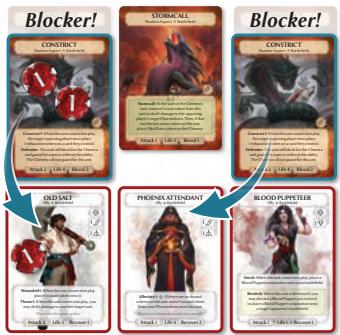
Example of an Attack

You declare an attack with your Old Salt, Phoenix Attendant, and Blood Puppeteer, targeting the Chimera.
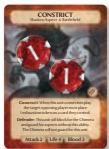
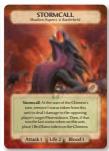


Targeted Chimera!
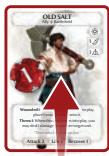
Attacker!
Attacker!
Attacker!

2 The ChimaCicttsh them as blockers, from left to right, against your attacking units. The Chimera does not have enough Defender aspects to block the Blood Puppeteer.

Attacker!
Attacker!
Attacker!


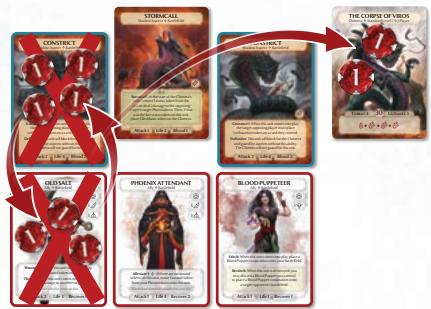
Resolve each battle in the order of your choice. First, the Old Salt and leftmost Constrict deal damage to each other. They both receive enough damage to be destroyed. Constrict's blood value is added to the Chimera.

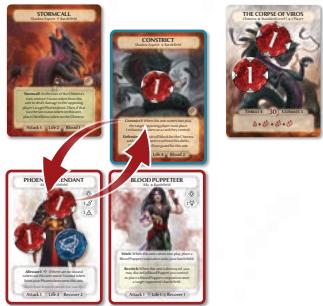
Next, your Phoenix Attendant and the rightmost Constrict deal damage to each other. Your Phoenix Attendant becomes exhausted as a result of attacking.

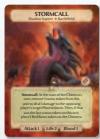
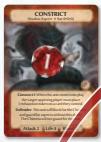
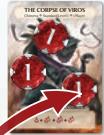
Then, since your Blood Puppeteer was unblocked, it deals 1 damage to the Chimera and is exhausted. THE CORPSE OF VIROS


Main Action: Pass
When you Pass, your main action is to do nothing.You may still take a side action. If a player/Chimera Passes but their opponent takes a different main action, both player and Chimera may continue taking turns. If you and the Chimera both Pass on consecutive turns, the player turns phase ends and play moves on to the recovery phase.
The Red Rains halt for no one! If you take a Pass main action while there are l or more face down aspect cards on the opposing battlefield, the Chimera raises 1 basic rage die one level.
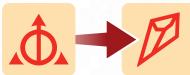
Raising Rage
Side Actions
Pay a Cost
To take this side action, play or activate a card where the symbol appears in the play or activation cost.
Activate a Dice Power
For a side action you may exhaust a die that is on its power side to activate its dice power effect. The effect for each type of power symbol is detailed on the dice power reference card corresponding to that die. (To exhaust a die, move it from your active pool to your exhausted pool.)
Meditate
The Meditate side action allows you to raise the levels of your dice. When you Meditate, discard any number of the following, one at a time:
• Cards in your hand
• Cards off the top of your deck
• Ready spells from your spellboard
For each card discarded, you may change a die in your active pool to a side of your choice.
Chimera Turn
To resolve a Chimera turn, first resolve any status (green box) abilities on aspects on its battlefield, from left to right. Then, the Chimera does one of the following, based on the game state:
• Roll: If there are one or more face down aspects, the Chimera will (1) roll one basic rage die and then (2) roll the behavior die and take the action(s) indicated on the Chimera behavior card.
» Note: Side actions on the behavior card are dice power effects.
• : Attack. If there are no face down aspects, the Chimera attacks with the leftmost unit that can attack.
: Pass. If there are no face down aspects and no units that can attack, the Chimera passes. The player turns phase ends when the player(s) and Chimera all choose Pass on consecutive turns.
Chimera Reveals
When the Chimera Reveals, flip over the leftmost face down aspect.
If the revealed aspect has a status ability, it comes into play with status tokens on
it equal to the pips on the top of the green box.

After revealing, resolve any abilities on that card that trigger when it comes into play (if any), targeting the opposing player.
Chimera Attacks
When the Chimera Attacks, it declares one attacker: either the specified unit or the leftmost unit that can attack. Aspects will target the opposing player's leftmost or rightmost unit (as indicated by the Claw icon on the left or right of the card), or their Phoenixborn (as indicated by the Jaw icon in the center).


Left Claw
Jaw
Right Claw
If your PHOENIXBORN is targeted for an attack (jaw icon), you may assign up to one unexhausted unit you control as a blocker for each attacker.
• If Blocked: The attacker battles its blocker and the blocker counters.
• If Unblocked: The attacker battles your Phoenixborn.
If a UNIT you control is targeted for an attack (claw icon), you may guard with your Phoenixborn or an unexhausted unit with the Unit Guard ability. A Phoenixborn can only guard once per round, but may do so even if exhausted.
If Guarded: The attacker battles the guard. If the guard is a unit, it counters. If the guard is a Phoenixborn, rotate it 90º to indicate it is unable to guard again this round.
If Unguarded: The attacker battles the target unit. If it is unexhausted, you may counter with it.
After the Chimera attacks with a unit, place l exhaustion token on that unit.
Targeting: Special Circumstances
Some card effects may prevent an aspect from targeting/attacking a unit. In such a case, the aspect will target the next left/rightmost unit. If it cannot target any unit for an attack, it will target the Phoenixborn instead.
The Chimera may end up in control of a non-aspect unit. When the Chimera attacks with a non-aspect unit, that unit will always target the Phoenixborn.
Fatigued Chimera
When the Chimera empties its draw pile, it becomes fatigued. During setup the fatigued card is placed on the bottom of the Chimera's draw pile as a reminder of that and

instructs what to do when the Chimera becomes fatigued and the ongoing effects of its being fatigued.
Draw and Hand Effects
Because the Chimera has no hand of cards, when the Chimera is forced by an effect to draw cards, it will immediately discard those cards. When the Chimera is fatigued, it cannot draw cards.
When an effect would affect the hand of the Chimera, set aside the top 5 cards of the Chimera's draw pile (or as many as you can) to create a hand. After resolving the effect that affects the Chimera's hand, return the set aside cards to the top of the Chimera's draw pile in a random order.
Red Rains Tokens and the Ultimate Card
Red Rains tokens represent the Chimera's growth in power as it prepares to progress to its next phase. They are placed when there are still aspects during the recovery phase, when raising rage dice, and as otherwise directed.
After placing Red Rains tokens, if there are Red Rains tokens equal to or greater than the Ultimate value on the Chimera card, resolve the following steps in order as they are listed on the
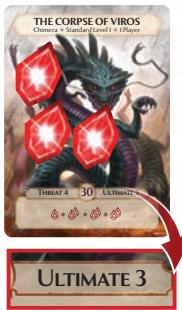
Chimera's current Ultimate card:
• Remove Red Rains tokens equal to its Ultimate value from the Chimera.
• Discard all cards on the Chimera's battlefield(s) that it does not own.
• Resolve the phase-specific effect printed on the Ultimate card.
Remove the topmost Ultimate card and behavior card from the game to reveal the Chimera's next phase (unless it is already at phase Ill). The Chimera is now stronger!
Note: Increase the Chimera's Ultimate value by 1 for each exhaustion token on the Chimera or the Ultimate card.
3. RECOVERY PHASE
During the recovery phase, resolve the following steps in order:
-
Recover: Remove a number of wound tokens from each unit in play equal to that unit's recover value. Aspects do not recover.
-
Remove Exhaustion: First, remove 1 Red Rains token from the Chimera for each exhaustion token on the Chimera and Ultimate cards. Then, remove l exhaustion token from each card in play that has 1 or more exhaustion tokens on it. Rotate your Phoenixborn so that it is upright.
-
Exhaust Dice: Move any number of dice from your active pool to your exhausted pool.
-
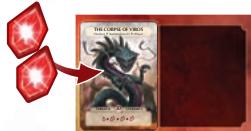
Place Red Rains: Place 1 Red Rains token on the Chimera for each aspect in play, resolving the Ultimate card if applicable.

Battlefield
- Replenish Aspects: Add face down aspect cards to the Chimera's battlefield (on the right) until its battlefield has a number of aspect cards equal to its threat value (face up or face down).

- Replenish Status Tokens: For any aspects with status abilities, if they have fewer status tokens on them than there are pips on their status ability, refill their status tokens until they are equal to the number of pips.
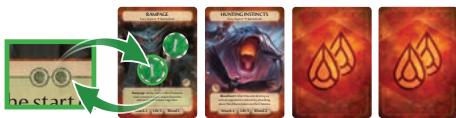
End of Round
The first player (you or the Chimera) resolves all 'end of round' effects they control, then the other player does the same. The Chimera resolves from left to right, and you resolve in the order of your choice. Then, the first player token is passed.
WINNING AND LOSING THE GAME
If your Phoenixborn has a number of wound tokens on it equal to or greater than its life value, you lose the game. If the Chimera has a number of wound tokens on it equal to or greater than its life value, you win the game!
RESOLVING EFFECTS
When playing cards or resolving effects:
• Resolve the card text from top to bottom, one effect at a time.
• Resolve as much of each effect as possible.
• Resolve each card completely, even if it is removed from play.
• Card text always supersedes game rules.
• If a player's effect would require the Chimera to make a choice between multiple options, that player chooses which option the Chimera selects.
A card can have multiple effects, and they will be separated either by periods or by the words “to” or “and." If an effect on a card triggers another effect, pause resolving the current card until all related triggered effects have been resolved.
Example: Complex Effect Resolution
Isaac has one empty battlefield slot and he has the Summon Gilder ready spell in play. He activates the spell, causing two effects.
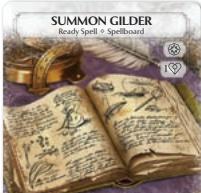
1:Place a Gilder conjuration onto your battlefield. You may deal 1 damage to a target unit.
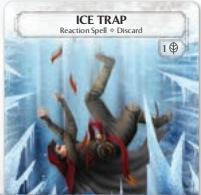
After a unit comes into play: Fernanda reveals the Ice Trap reaction spell

- Place Gilder: Isaac resolves these effects in order, starting by placing a Gilder onto his battlefield.
in her hand, which was triggered after the Gilder came into play. Fernanda plays the Ice Trap, destroying the Gilder.
When this unit is destroyed: The Gilder's Inheritance 1 ability now triggers.
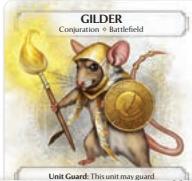
Inheritance I: When this unit is destroyed, you may place I status token on a target unit.
You may play this spell after a unit with a life value of 2 or less comes into play. Destroy that target unit.
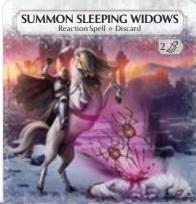
》 After a unit is destroyed: Now Isaac reveals the Summon Sleeping Widows reaction spell in his hand, which was triggered after his Gilder was destroyed. He plays it, placing
one Sleeping Widow conjuration onto his battlefield. He cannot place the second one because his battlefield is now full, but he resolves as much as possible.
You may play this spell when a unit you control is destroyed. Place 2 Sleeping Widow conjurations onto your battlefield.
- Deal damage: Now that all effects that triggered off of placing the Gilder have been resolved, Isaac resumes resolving the next effect on Summon Gilder by dealing 1 damage to a target unit.
2 Attack1 Lifel Recover0
Damage, Destruction and Blood Value
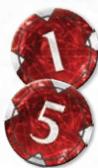
When a unit, Phoenixborn or Chimera is dealt damage, place a number of wound tokens on it equal to the amount of unprevented damage it received. After a unit, Phoenixborn or Chimera has a number of wound
tokens equal to or greater than its life value, destroy it.
• When a unit is destroyed, it is discarded.
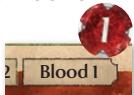
• When an aspect is destroyed, after it is discarded, place a number of
wound tokens on the Chimera equal to that aspect's blood value.
• When a Phoenixborn is destroyed, the player(s) lose the game.
• When a Chimera is destroyed, the player(s) win the game!
Note: A card's life value is not reduced when wound tokens are placed on it.
Note: Deal damage▶Place wounds Destroy. An effect that “deals damage" places wound tokens and destroys, but an effect that “destroys” does not deal damage or place wound tokens.
Status Tokens
Status tokens can have various effects based on the cards that are in play. Those cards will detail how the status tokens are to be used.

Inexhaustible effect
Exhaustion Tokens

Some game effects place exhaustion tokens on cards. When a card has l or more exhaustion tokens on it, it is considered to be exhausted. An exhausted card has no ability or effect text though it retains everything else including all of its values (attack, life, etc), and value bonuses (on alteration spells). In addition, exhausted units cannot attack, block, guard or counter.
Some cards have inexhaustible
effects or
abilities,
indicated by
a yellow or
green box.
These effects or abilities remain even if the card is exhausted.
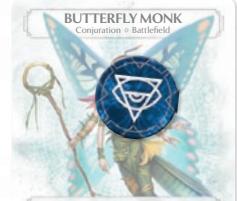
Mend I: When this unit is destroyed, you may remove I wound token from a target unit or Phoenixborn.
Discarding Cards
When a card in play is discarded or otherwise removed from play, set it aside along with any cards underneath it that are attached or face down. After resolving any triggered effects, return any tokens on any of these cards to the supply, discard the cards that are underneath, and place that card in its final destination. Discarded cards go to their owner's discard pile.
Exception: Discarded conjurations and conjured alteration spells do not go to a discard pile but return to their owner's conjuration pile.
Battlefield Management
When you place units on any battlefield, they must be placed to the right of all other units on that battlefield and the position of units cannot be changed relative to each other. As units leave the battlefield, slide the remaining units to the left to fill in gaps. The Chimera will attack and resolve effects based on the positions of the units, so positioning and sequencing will be a crucial skill to defeating it!
Phoenixborn Uniques
This expansion introduces new Phoenixborn unique cards for previously existing Phoenixborn. When constructing a deck, players may mix and match their Phoenixborn's unique cards, but cannot exceed three total. In addition, no more than one Phoenixborn unique card may be included in a player's First Five.
Advanced Timing
Certain card interactions or competitive settings can find players seeking details on more precise timing of certain game effects. These details can be found on pp. 16-17 of the Ashes Rulebook Version 1.5.
The Ashes Rulebook Version 1.5 is a complete guide to playing the PvP version of Ashes and can be found in the Rise of the Phoenixborn Master Set, the Ashes Reborn Upgrade Kit and online at plaidhatgames.com/ashes.
DECK FROM THIS SET
This set comes with 4 Phoenixborn and 12 Phoenixborn unique cards (3 cards for each Phoenixborn).
To build a deck using only cards from this set follow these simple steps:
- Choose a Phoenixborn and collect its 3 unique cards. Return all other Phoenixborn and their unique cards to the box.

- Locate the 6 Channel Magic cards and return them to the box too.
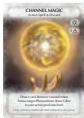
- Take all remaining cards with white backs (including your 3 Phoenixborn unique cards) and shuffle them together to form your draw pile.
- Gather all of the cards with black backs together to form your conjuration pile.
- Gather 10 ceremonial dice to form your dice pool.

First Five
You get to select 5 different cards to start the game in your hand. We suggest: Summon Bone Crow, Summon Calamity Golem, Phoenix Attendant, Old Salt and Blood Puppeteer.
DECK BUILDING
To build a deck, do the following:
-
Choose a Phoenixborn.
-
Choose exactly 30 cards to be included in your deck. You may only include up to 3 copies of any 1 card. Do not include conjuration and conjured alteration spell cards in your deck. These cards are only brought into play by the effects and abilities of other cards.
You can only include 3 Phoenixborn unique cards in your deck and those cards must be a match to your chosen Phoenixborn (have your Phoenixborn in their lower right corner).
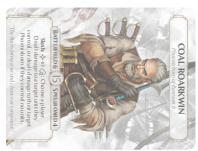
Example: Nick's Phoenixborn is Coal Roarkwin. He includes 2 x Final Stand from this set and 1 x One Hundred Blades from the Master Set in his deck.
- Choose 10 dice to be included in your dice pool. You may choose a variety of die types to be in your dice pool.
Example:x3x 2x34x2
- Assemble your conjuration pile as follows: Some effects or abilities can bring conjurations and conjured alteration spells into the game. Each conjuration or conjured alteration spell has a conjuration limit placed in the lower left corner of that card. Identify all such cards your deck is capable of producing and collect a number of copies of each card equal to the conjuration limit of that card.
PLAYING WITH TWO PLAYERS
When playing Ashes: Red Rains cooperatively with two players, add in the following rules and adjustments.
Winning and Losing
The Chimera is a shared opponent of both players, and they win together if the Chimera is defeated. If either player's Phoenixborn receives wound tokens equal to or greater than its life value, both players lose.
Setup
When choosing the Chimera difficulty, use the 2p side of the Chimera cards.
When setting up the Chimera's starting battlefield, create two full battlefields, one facing each player.
When setting up the Chimera's draw pile, place the fatigued card on the bottom of the Chimera's draw pile with the 2-player side facing up. In a 2-player game the Chimera must empty its draw pile twice before it becomes fatigued.
Either player may start with the first player token.
Player Turns
Players take a shared turn, with a main and side action each, in any order.
Players are each allowed to play one reaction on each shared player turn and each Chimera turn.
Card effects may target cards on ANY battlefield, spellboard, etc. When attacking a unit, you may target a unit on either opposing battlefield.
Chimera Turns
The Chimera takes two consecutive turns, first taking a turn against the First Player or the player the first player token is pointing to, and then a turn against the other player. Treat each Chimera turn as if it were facing only one player; the Chimera ignores the other player's battlefield as well as the battlefield that opposes that player.
When the Chimera declares attackers only the opposing player may block or guard the attack with their units/ Phoenixborn.
Recovery Phase
When Replenishing Aspects, add face down aspects to both of the Chimera's battlefields until they have a number of aspect cards equal to the Chimera's threat value (face up or face down).
Miscellaneous
When the first player token is passed to the Chimera, point it at the player who did not just have it. The Chimera will pass the first player token to that player at the end of the next round.
When resolving an effect that affects all/each/every of something in play (e.g. dealing damage to all units), it only affects your own battlefield and the opposing Chimera battlefield.
2 Player Setup



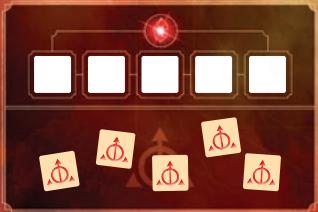
Player Battlefield
Player l's Opposing Battlefield

Playg e , eld




RED RAINS CAMPAIGN
Tell the story of Argaia by choosing Phoenixborn to play through a threeencounter campaign against an increasingly difficult Chimera. Each player starts by choosing a preconstructed deck. You may customize it by (a) mixing and matching your Phoenixborn's unique cards, (b) substituting up to three copies of Channel Magic instead of cards you do not wish to use, and (c) adjusting your dice pool however you wish. When playing a heroic campaign, you may also (d) substitute up to three copies of any one card from your collection. (Your deck can never violate the deck building rules.)
Example of a Starting Campaign Deck
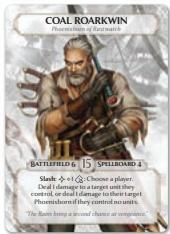
Phoenixborn
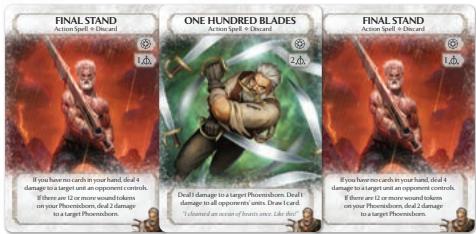
Mix of 3 of the Phoenixborn's Unique Cards
Pre-con Deck
Players can choose to run either a standard or heroic difficulty campaign, using the corresponding difficulty cards when setting up the Chimera. For the first encounter, use the level 1 card of the matching difficulty (standard or heroic). If you are victorious, the next encounter will be level 2. If victorious again, level 3. Defeating a level 3 Chimera will result in a campaign victory!
After each encounter, you may further customize your deck by choosing one other preconstructed deck you own and selecting up to three copies each of three different cards from that deck to build with. You may not choose a new Phoenixborn. You may adjust your dice pool freely between encounters.
Players can check off each Phoenixborn on the back of the Chimera rulebook to chronicle their victories against the Chimera.
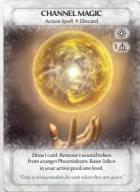
Channel Magic
When playing a Red Rains campaign, players may choose to substitute some cards from their preconstructed deck with this spell. Channel Magic may also be used in regular Ashes gameplay. No more than three copies may be used in a player's deck.
GLOSSARY
Entries in purple apply to the Red Rains game mode only.
Ability: A named effect on a unit or Phoenixborn. A unit ability with a number after its name will stack if the unit receives an additional copy of that ability. See Stacking Abilities.
Activate: Use an activated effect on a card in play or on a die on its power side. To activate an effect, announce it, pay the associated costs, and then resolve it.
Activated Ability/Effect: A card effect or dice power that only resolves when you pay its activation cost, which will always include a main or side action.
Active Dice Pool / Active Pool: The place where you keep dice that are available to spend.
Active Player: The player whose turn it is or, if it is not during the player turns phase, the first player.
Adjacent: Units to the immediate left or right of a unit are adjacent to that unit.
Affect: A card or dice power affects a spell if it does any of the following to that spell: places or removes tokens/ dice, adds or removes effects, causes the spell to be attached to a different card, or moves it in or out of play.
Aspect: A type of unit. Aspects are considered to be all other types of unit (e.g. ally or conjuration). Aspects always counter if unexhausted, and they do not exhaust as a result of countering. When an aspect is destroyed or discarded from the battlefield, place a number of wound tokens on the Chimera equal to its blood value.
Attach: The process of placing an alteration spell underneath a target unit and applying its effects and value bonuses to that unit. Attaching an alteration spell to a unit targets that unit.
Attack: See the rules for how to attack. Some additional clarifications: Attackers deal attack damage and blockers/guards/targets can deal counter damage.
A unit with 0 attack value that attacks or counters does not deal damage, but still receives an exhaustion token. (Dealing 0 damage = not dealing damage.)
Attack Value: The damage a unit deals when attacking or countering. Attack value can be negative, but whenever it is used in resolving a game effect or battle, the minimum is 0.
Attacker: An unexhausted unit that has been declared to be attacking when taking an Attack main action.
Attacking Player: The player that is taking an Attack main action.
Battle: An attacker is in battle with the unit, Chimera or Phoenixborn it is dealing attack damage to.
Battlefield: The part of a Chimera or player's play area where units are placed The number of units on a player's battlefield cannot exceed the battlefield value on that player's Phoenixborn. When playing an ally with placement = Battlefield from your hand, you can only play it to your battlefield. All face up cards on your battlefield are in play under your control.
When you place units on any battlefield, they must be placed to the right of all other units on that battlefield and the position of units cannot be changed relative to each other. As units leave the battlefield, slide the remaining units to the left to fill in gaps.
Blocker: Unexhausted units may become blockers when a Phoenixborn or Chimera is targeted with an Attack action. Up to one unit may be declared as a blocker per attacking unit. Blocking is not the same as guarding. Blockers must counter. If a blocker is destroyed before it battles, the attacker it was blocking becomes unblocked.
Blood Value: When an aspect is destroyed or discarded from the battlefield, place a number of wound tokens on the Chimera equal to its blood value.
Cancel: When an effect is canceled, immediately stop resolving that effect and all remaining effects that are in the process of being resolved on the canceled effect's card.
If a behavior card lists multiple actions, only the remaining effects in the current action are canceled.
Choose: Some effects ask players to choose something, e.g. targets, options or other game elements. Choosing a card or other game element does not, by itself, affect or target it, but may cause an effect to affect or target it. If a player's card effect asks the Chimera to make a choice, that player chooses for the Chimera.
Conjuration: A type of unit that starts the game in a conjuration pile and can be brought into play by a card effect.
Conjuration Limit: The number of copies of a conjuration or conjured alteration spell that you must put into your conjuration pile before the game begins. It is located in the lower left hand corner of those cards.
Conjuration Pile: A face down stack of all the conjurations and conjured alteration spells that your deck is capable of producing. The number of cards in any conjuration pile is public information.
Conjured Alteration Spell: A type of spell that starts the game in a conjuration pile and can be brought into play by a card effect. Conjured alteration spells are considered alteration spells while in play.
Control: The following are under your control: your Phoenixborn and its abilities, any face up cards on your battlefield or spellboard and their abilities and effects, and any action or reaction spells, dice powers, attacks, or counters that you are resolving. Alteration and conjured alteration spells are under your control while you are attaching them and then are under the control of the player who controls the card they are attached to.
Counter: Countering is when a defender deals counter damage equal to its attack value back to the attacking unit. Blockers and unit guards must counter.
Aspects always counter if unexhausted and they do not exhaust as a result of countering.
Current / Currently: The words “current” and “currently” in an effect refer to the game state before the effect resolves.
Current Value: The attack, life, and recover values of a unit after modifiers have been applied. When an effect references the current values of a unit it refers to the values before the effect resolves.
Damage: Dealing damage is what starts the damage resolution process. Dealing damage is not the same as placing wounds, but usually leads to placing wound tokens. Dealing 0 damage does not start the damage resolution process and therefore is considered not dealing damage.
Damage Resolution Process: The process by which damage becomes wounds and then destruction. It is covered in detail in the Ashes Rulebook.
Defender: A unit, Phoenixborn or Chimera that has been declared as a blocker or guard, or is the target of an attack.
There is also an ability named Defender. When capitalized, Defender refers to an aspect with the Defender ability.
Defending Player: The Chimera/player whose Chimera, Phoenixborn or unit has been declared the target of an Attack action.
Dice Power: An effect that can be activated by spending a side action and a die on its power symbol side. Each die type has a different dice power.
Side actions on a behavior card are considered dice power effects.
Discard Pile: Each draw pile has a discard pile where discarded cards are placed. Discarded cards are placed face up. Discard piles are public information.
Draw Pile: A face down pile of cards that are drawn from during the game. The number of cards is public information.
Effect: An effect is any text that is resolved from a spell or ability. Attack and counter damage are not effects.
Exhaust: The process of placing exhaustion tokens on a card OR the process of moving dice from an active pool to an exhausted pool.
Exhausted: A card that has 1 or more exhaustion tokens on it OR a die that is in your exhausted pool. An exhausted card has no ability or effect text (except for inexhaustible ones) though it retains everything else including attack, life, and recover values (on units), and value bonuses (on alteration spells). Exhausted units cannot attack, block, guard or counter.
Exhausted Dice Pool / Exhausted Pool: The place where you keep dice that have already been exhausted/spent this turn.
Face Down: A card that is face down underneath a card in play is not considered to be attached to that card and is not considered to be in play.
First Five: When setting up a game of Ashes, select 5 different cards from your deck to become your starting hand. You cannot include more than one copy of a card or more than one Phoenixborn unique card in your First Five. In a competitive setting, find a non-player to verify that the cards are unique.
First Player: The player/Chimera who currently possesses the first player token. The First Player takes the first turn of each round.
Focus: When multiple copies of a spell are on your spellboard, it is focused. Some ready spells modify existing effects or grant additional effects when they are focused. Any additional effects must be resolved in order as usual.
Game Event: Anything that could occur in the game as a result of following the rules or resolving effects. Examples: a unit comes into play, an alteration spell is attached, a player declares attackers, wound tokens are placed on a Phoenixborn, etc.
Guard: A Phoenixborn or an unexhausted unit you control with the Unit Guard ability can be declared as a guard when a unit you control is targeted with an Attack action. A Phoenixborn may only guard once per round, indicated by rotating a Phoenixborn 90° after guarding. Guarding is not the same as blocking. A guarding unit must counter. A Chimera may guard multiple times
per round. If a player's attacking unit cannot be guarded against (such as from the Bypass or Stalk ability), the Chimera does not roll to guard. If a Defender unit cannot guard due to effects like Terrifying or Gigantic, select the leftmost Defender that can be declared as a guard.
Inexhaustible Effect: An effect on a card that remains even if that card is exhausted. A card may grant a unit an ability in an inexhaustible box. In this case, the granted ability is inexhaustible on that unit. However, if the effect that grants it (“This unit now has the following ability”) is not inexhaustible, the ability can be removed by exhausting the granting card.
Status abilities are a special type of inexhaustible effect.
Level: Dice have 3 levels: basic, class, and power. When an effect raises a die one level, basic dice turn to class sides, and class dice turn to power sides. When an effect lowers a die one level, power dice turn to class sides, and class dice turn to basic sides.
Rage dice have 2 levels, so raising a basic rage die one level turns it to its power side and lowering a rage power die one level turns it to its basic side.
Life Value: The number of wound tokens that a Phoenixborn, Chimera or unit can have on it before it is destroyed. A card's life value is constant unless modified by a game effect. It is not reduced when wound tokens are placed on it.
Magic Play Cost: The magic play cost of a card is the total number of die symbols that must be spent to play the card from your hand. Action, exhaust, and discard costs are not included and “X” equals “0” for the purpose of calculating magic play costs. The magic play cost of a card with a parallel cost is the maximum number of symbols that could be spent to play that card.
Main Action: You must take one main action on each of your turns. The possible main actions are: Pay a cost, Attack, or Pass.
Move: When a game element (e.g. token) is moved from one location (e.g. card) to another, it is removed from the first location and placed on the second location in a single resolution. If a move effect is canceled, leave the game element in the first location.
Opposing: Your battlefield and the Chimera's battlefield that is directly facing yours are opposing one another. The units on your opposing battlefield consider you their opposing player.
Owner: A card's owner is the player/ Chimera whose deck or conjuration pile that card started the game in.
Parallel Costs: Some cards have two or more connected costs in their pla
Content is long; only the first part is inlined. Download the file or open the rules page for the full text.
Download MarkdownTexts are community-compiled or publicly released by publishers; copyright remains with the original authors. For personal reference only.