
Ayar Children Of The Sun
At a glance
Rules, cards and Q&A (Chinese)
The rules, card data and player questions for this game are written in Chinese. Open the Chinese page to read them.
Where to find full rules
Full rules and card lookup are available in the cunlema app at cunlema.cn — pick this game and ask about any rule, card or turn you are unsure about.
Related games
Rulebook text (Markdown)
This game has 2 rulebook Markdown file(s) in our library; 2 rendered inline below — expand to read or download.
rules_zh_阿亚尔太阳之子_44064.md35.1 KB
太阳之子
规则
中文翻译 & 排版:陈斌华
FABIO LOPIANO & MANDELA FERNÁNDEZ-GRANDON
CHILDREN OF
THE SUN
游戏设计:Fabio Lopiano 和 Mandela Fernández-Grandon
插画与平面设计:Ian O’ Toole
规则排版:Jacoby O’ Connor
游戏开发:Rhys Ap Gwyn、Luke Evison 和 Jordan Wheeler
主题专家:Antti Korpisaari
测试玩家: Chuck Case、David Digby、Stuart Ellis-Gorman、Mario Gazzaniga、Ioana Ghica、Dominik Goldnagl、Kyle Graves、Jane Liz Robb、Mauro Lazzara、Noralie Lubbers、Chris Manley、Isabella Mattasits、Dean Morris、Gary Perrin、Andrea Robbiani、Sara Rohling、David Spada、Pieter Jan Tiersma、Dávid Turczi、Pierre Vagneur-Jones、Christoph Weis 和 Carl Zee
First published in Great Britain in 2025 by OSPREY GAMES Bloomsbury Publishing Plc
Kemp House, Chawley Park, Cumnor Hill, Oxford OX2 9PH, UK,
29 Earlsfort Terrace, Dublin 2, Ireland,
1385 Broadway, 5th Floor, New York, NY 10018, USA
OSPREY GAMES is a trademark of Osprey Publishing Ltd
© Fabio Lopiano & Mandela Fernández-Grandon, 2025.
Fabio Lopiano & Mandela Fernández-Grandon have asserted their rights under the Copyright, Designs and Patents Act, 1988, to be identified as Author of this work.
All rights reserved. No part of this publication may be reproduced or transmitted in any form or by any means, electronic or mechanical, including photocopying, recording, or any information storage or retrieval system, without prior permission in writing from the publishers.
ISBN: 9781472860071
25 26 27 28 29 10 9 8 7 6 5 4 3 2 1
Printed in China
Osprey Games supports the Woodland Trust, the UK's leading woodland conservation charity.

MIX
Paper | Supporting
responsible forestry
FSC® C173672
起初...
维拉科查创造了太阳神因蒂和月亮神玛玛·基利亚。他们从的的喀喀湖中升起,既是夫妻,又是兄妹。然而,因蒂嫉妒玛玛·基利亚的光辉,向她撒了灰烬,使她不会比自己更耀眼。他们共同生育了四对儿女——阿亚尔兄弟姐妹,他们将从位于大湖南部的蒂亚瓦纳科出现,与第一代人的十个较小的部落一起。阿亚尔兄弟姐妹的任务是找到宇宙中心的肥沃土地,建立塔瓦廷苏尤帝国,同时教导部落建立文明所需的技能。当四对阿亚尔兄弟姐妹向北穿越土地时,他们一个接一个地遭遇命运——被困在洞穴里或变成石头——直到只剩下一对。最后的阿亚尔兄弟姐妹将幸存下来,被授予携带金杖的荣誉,建立塔瓦廷苏尤帝国——作为萨帕·印加和科亚坐在帝国的顶端。
在游戏中,你扮演的是散落在大地上的较小部落之一,协助阿亚尔兄弟姐妹踏上旅程,从他们那里学习印加生活的基本技能,并希望能够成为他们最喜欢的部落:享有特权的印加人。
在四轮游戏过程中,你将协助阿亚尔兄弟姐妹从蒂亚瓦纳科前往库斯科,同时在编织、制陶、捆扎芦苇和梯田耕种等技能方面提升自己的能力。通过取悦太阳神因蒂,你可以从这些技能中获得分数。在每一天结束时,夜幕降临,一位阿亚尔兄弟姐妹将会迷失,化为石像。正是在夜晚,你将通过取悦月亮神玛玛·基利亚来获得分数。
你需要分别追踪因蒂和玛玛·基利亚的分数,在游戏结束时,当只剩下一位阿亚尔兄弟姐妹仍在旅程中时,你所获得的太阳分数和月亮分数中较低的那个将成为你的最终得分。
得分最高的玩家将成为游戏的胜利者。
1x 船
游戏配件
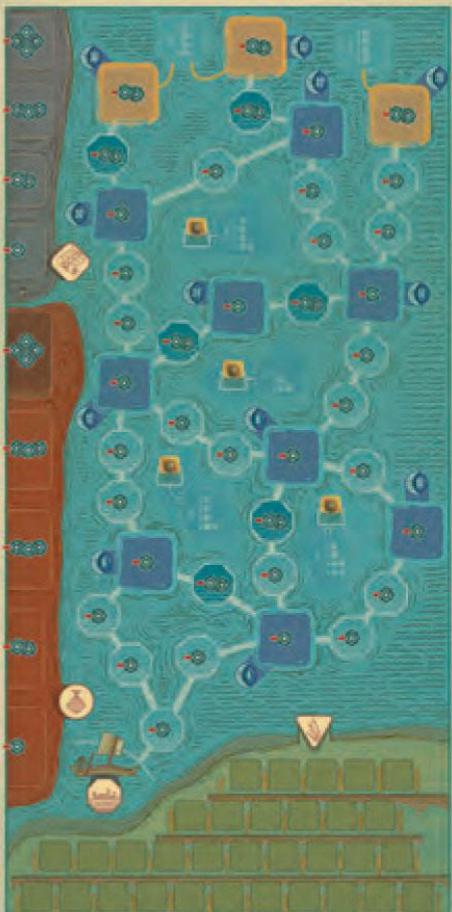
1x 湖泊版图
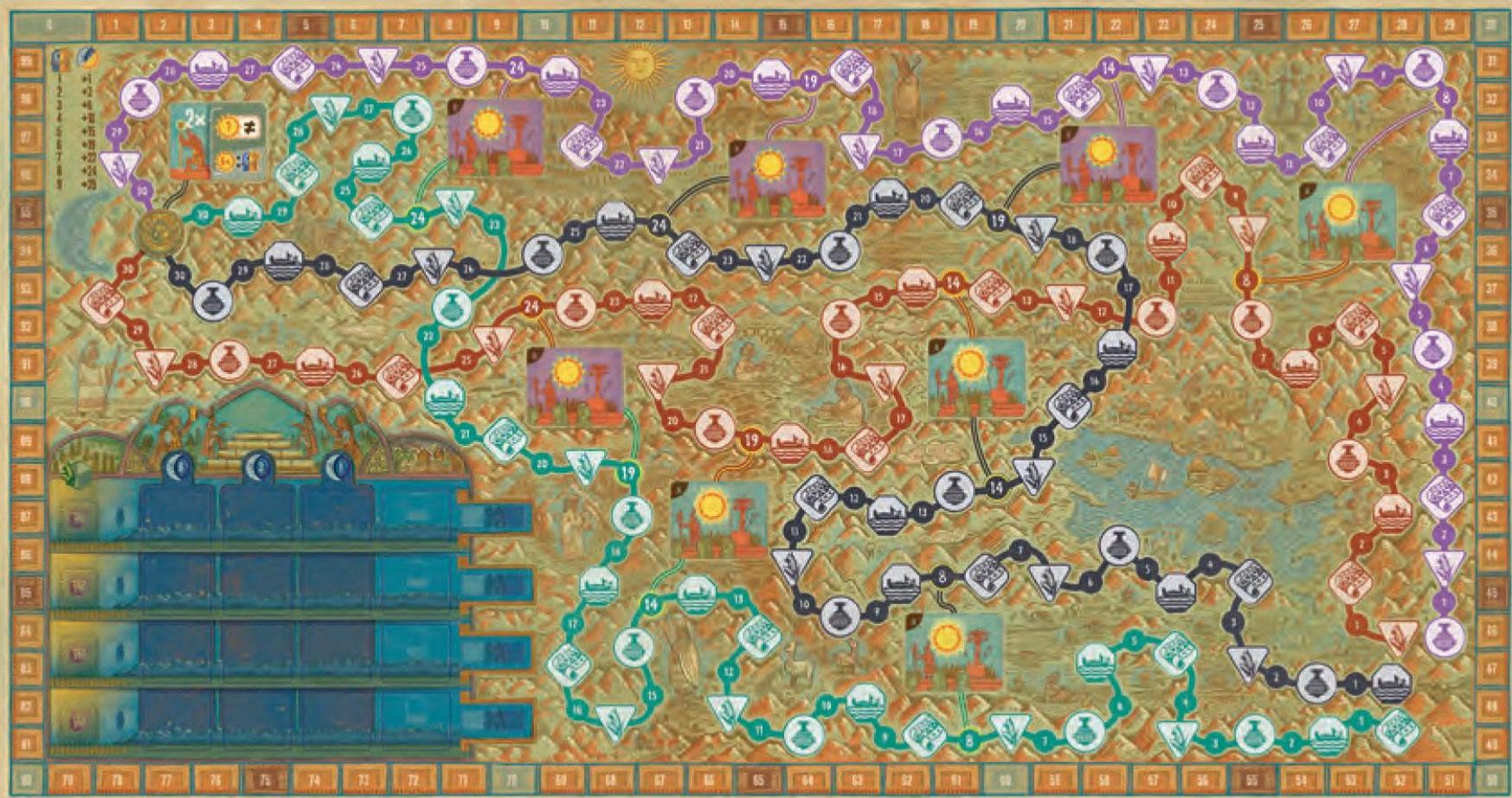
1x 主版图
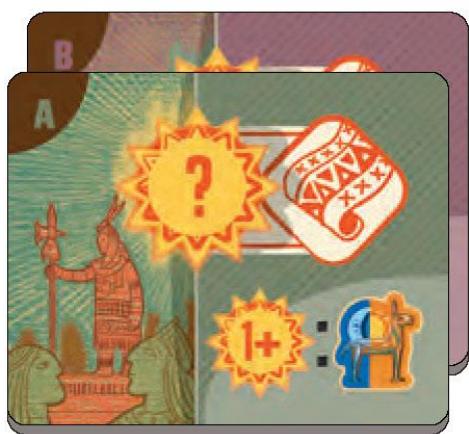
8x 雷米板块

30x 陶罐

40x 维拉科查
40x 骆马

64x纺织品板块
女阿亚尔

男阿亚尔
4 对阿亚尔
单人游戏

5x 活动指示物

玩家版图的反面
1x 袋子
1x 起始玩家指示物

1x 印地表盘

2xVP 指示物
6x 岛屿


4x 奖励标记

1x 参考卡
16x 塔姆博
4 组玩家配件

2x 计分标记
1x 太阳 &1x 月亮

4x 神庙
1x 步骤板块


22x 玉米

1x 玩家版图
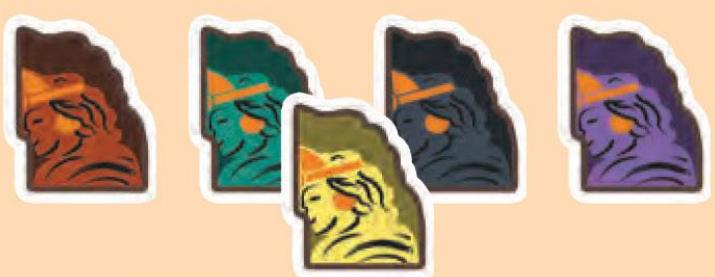
5x 阶梯标记
4x 阿亚颜色 &1 百搭颜色
游戏设置
梯田耕作
芦苇捆扎
月亮计分
编织
塔姆博网格
陶器



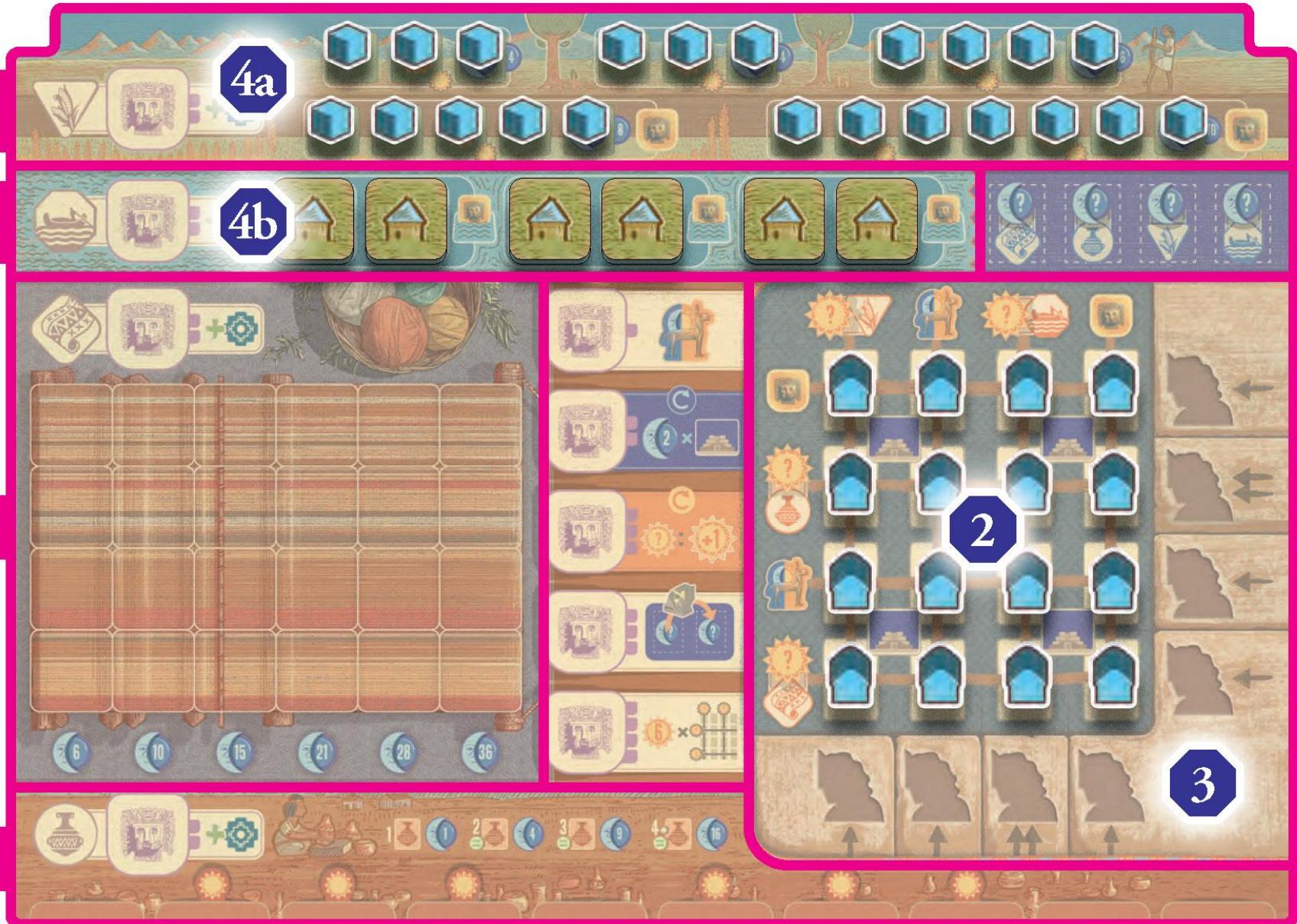
玩家版图
-
给每位玩家一套同一种颜色的所有配件,以及一个玩家版图、每种颜色的 1 个阶梯标记和一张参考卡。
-
将 16 个塔姆博放在你的玩家版图上的网格上②。
-
如果少于四人游戏, 拿起你的阶梯板块, 用它盖住你玩家版图上塔姆博网格旁边的阶梯③, 且与玩家人数 ( ) 相符的一面朝上。
-
将 22 个玉米4a和 6 个岛屿4b放在它们对应的插槽上。
-
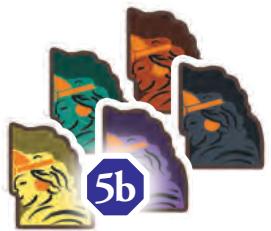
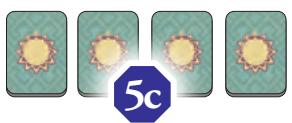
将 4 个神庙 5a、5 个阶梯标记 5b、4 个奖励标记 5c、印地转盘 5d 和参考卡 5e 放在你的玩家版图旁边。
- 给一位玩家起始玩家指示物 6。


主版图
-
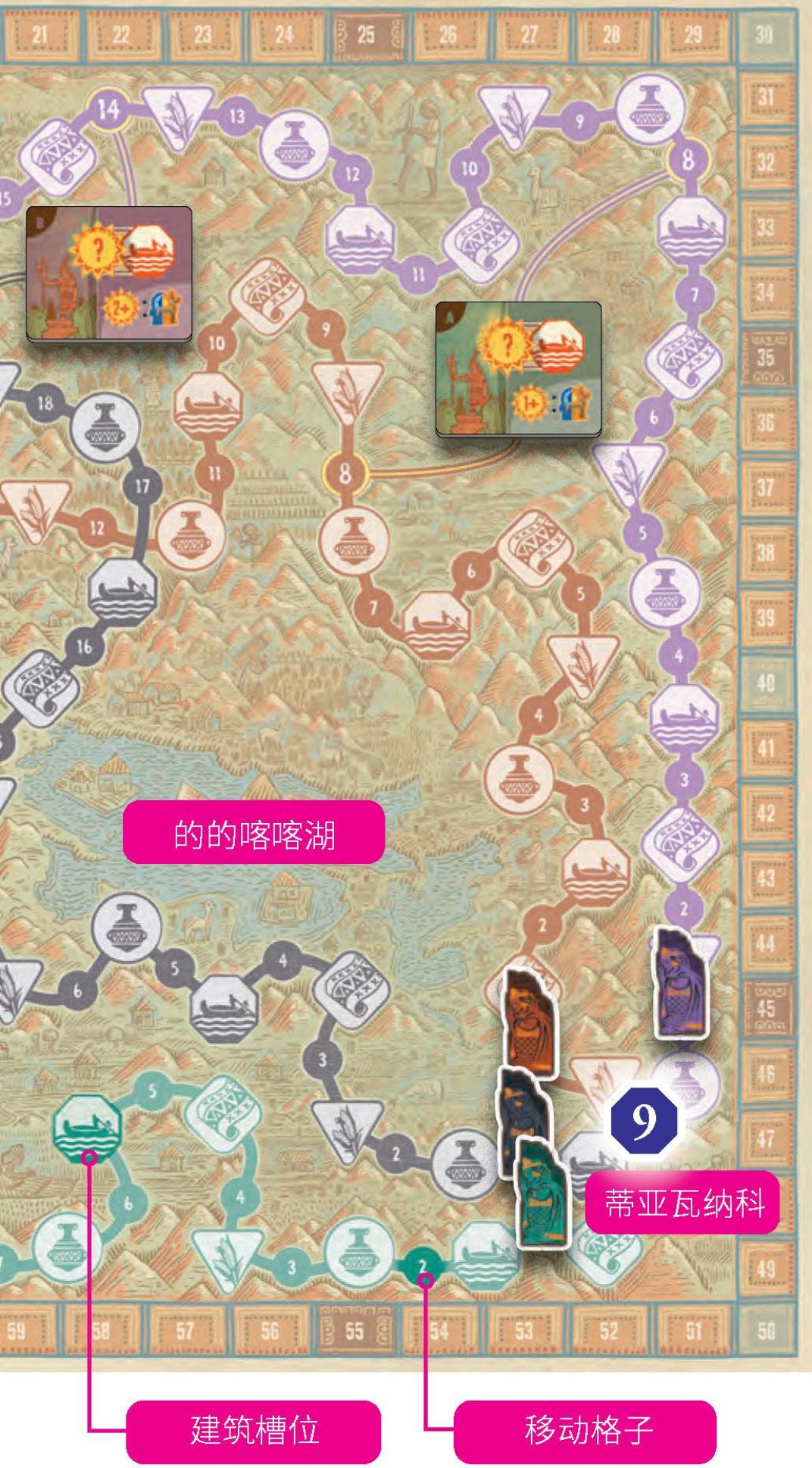
将主游戏版图 7 放在游戏区域的中央。
-
将每位玩家的月亮和太阳得分标记放在得分轨道的 0 区域 8 上。
-
将每位男性阿亚尔放在与其颜色对应的路径的⑨第一个移动区域①
-
随机放置他们的位置,将每位女性阿亚尔放在神庙区域10a左侧的插槽上。在每个阿亚尔旁边放置一个维拉科查10b。
-
随机放置他们的位置,将雷米板块放在主游戏版图上与字母对应的插槽上,字母面朝上⑪。
-
将维拉科查和骆马分别放在游戏版图12旁边的供应区。
湖泊版图
-
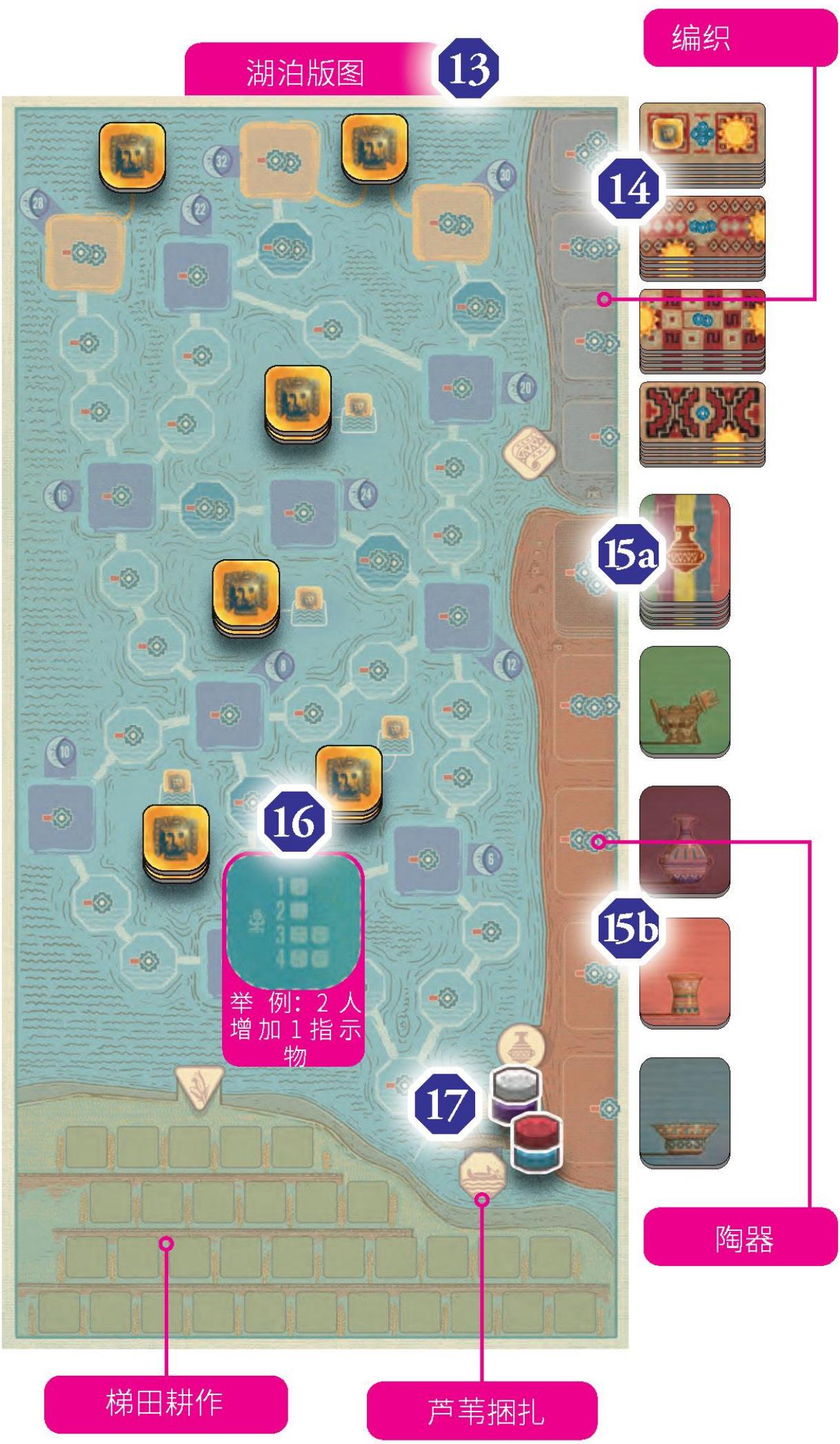
将湖泊版图13放在主游戏版图的右侧或左侧。
-
按照力量数字 🌐 将纺织品分成四组,并将它们堆放在湖板上对应的编号插槽旁边 14。
-
将陶罐堆面朝下放在湖泊版图15a上对应的插槽旁边。抽取陶罐,直到你找到四个没有维拉科查图标的陶罐。将这些陶罐放在四个空插槽15b旁边,并将剩下的陶罐重新洗回堆中。
-
将指定数量的维拉科查放在湖泊版图上与玩家人数对应的插槽中⑯。
-
将每位玩家的船放在湖泊版图底部的起始区域⑰。
你现在可以开始游戏!

游戏流程
游戏将在四个轮次中进行,每个轮次包含两个阶段:
-
白天阶段:玩家按顺序进行活动。
-
夜晚阶段:一位阿亚尔退休,玩家同时为他们的月亮和太阳计分。
在第四个夜晚阶段结束后,玩家将计算他们两个得分标记(月亮或太阳)中的最低分数。得分最高的人获胜。
计分标记
你只会在夜晚阶段移动你的计分标记。

白天阶段
从持有第一玩家令牌的玩家开始,每位玩家依次完成以下5个步骤。游戏按顺时针方向进行,直到每位玩家都放置了他们所有的可用阶梯标记。此时,将进入夜晚阶段。
-
放置阶梯标记
-
移动阿亚尔
-
选择并放置一个塔姆博
-
执行活动
-
回合结束检查
0. 起始活动
仅在第一个白天阶段开始时,每位玩家执行一次活动。从起始玩家开始并按顺时针方向进行,每位玩家必须从其玩家板上的任意插槽中放置一个塔姆博到任意路径的第一个建筑插槽中(只要该插槽仍然为空)。以1的力量执行相应的活动。有关活动的详细信息,请参阅下一页。
1. 放置阶梯标记
选择一个你可用的阶梯标记。所选择的颜色会影响在第 2 步中将移动哪位阿亚尔。
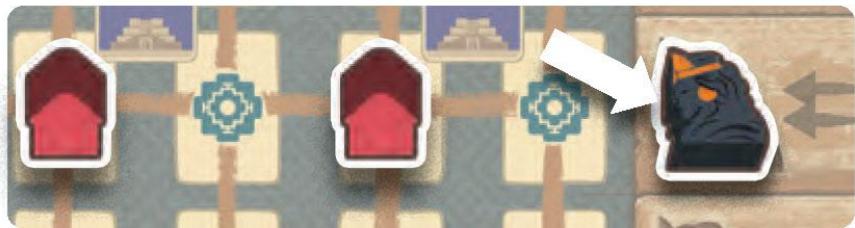
将其放倒在塔姆博网格旁边的任意一个空插槽中。你放置阶梯标记的行或列中必须至少有一个塔姆博。
阶梯标记
竖立的阶梯标记是可用的,而放倒的阶梯标记则表示在这一轮已经移动过了。你将在每个夜晚阶段结束时将它们重新竖立起来。在第2至4个白天阶段,前一天放置的阶梯标记会挡住一些插槽,从而进一步限制放置阶梯标记的选择。

2. 移动阿亚尔
移动与放置的阶梯标记颜色相匹配的男性阿亚尔,沿着其对应颜色的路径移动。如果你放置的是金色阶梯标记,你可以决定移动哪一个阿亚尔。标记插槽旁边的箭头数量表示阿亚尔移动的确切格子数。
如果阿亚尔到达其路径的尽头,它将不再移动。忽略阿亚尔后续会移动的任何步骤。你可以继续正常地放置塔姆博并执行其路径上的活动。
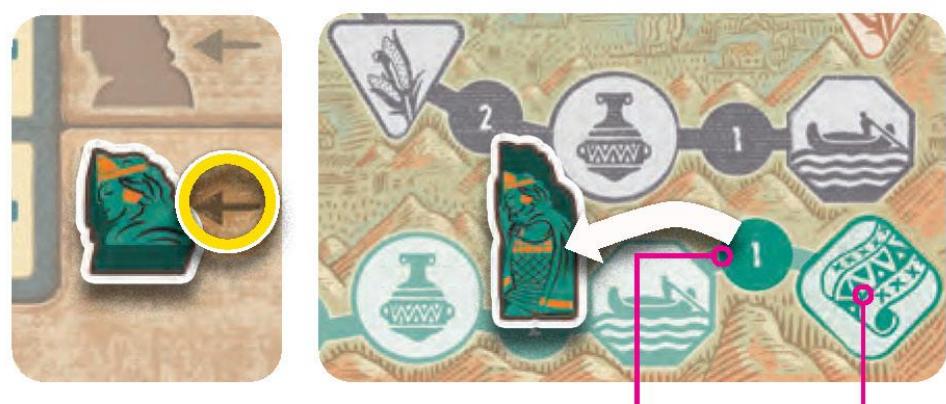
移动格子
建筑槽位
3. 选择并放置一个塔姆博
从你放置阶梯标记的行或列中取任意一个塔姆博,并将其放置在你刚刚移动的阿亚尔身后的路径上任意一个空的建筑插槽中——也就是说,在阿亚尔和蒂亚瓦纳科之间的任何地方。你必须将塔姆博放置在一个表示你可以执行的活动的插槽上(也就是说,你有执行该活动所需的配件和插槽)。
历史注释
印加人监督在塔瓦廷苏尤的道路上建造了数千个塔姆博(驿站)。这些驿站之间的距离是相等的,以匹配一天的行程,并且有多种用途,包括作为旅行的国家官员的存储和休息场所。
4. 执行活动
执行与你放置塔姆博的槽位上的图标相匹配的活动。所有活动都在湖泊版图上进行。

陶器

纺织


梯田耕作
芦苇捆绑

每项活动都有 1 到 4 的强度。要确定你活动的可用强度,数一数你放置阶梯标记的行或列中空的塔姆博槽的数量。强度越高,你进行活动的机会就越多。你可以总是选择使用比你可用的强度更少的强度来执行一项活动。

陶器
从湖泊版图上拿取任意数量的罐子, 其总强度值与你的强度相等或更低。你可以将你的强度分配到两个罐子上。例如, 如果你的强度是 3 , 你可以拿一个 3 强度的罐子, 或者拿一个 1 强度的罐子和一个 2 强度的罐子。

拿取罐子时不要翻转它们。你可以从堆叠的顶部拿取罐子而不翻转它们。这些罐子是百搭的,在计分时可以算作任何颜色。
如果你拿了一个显示维拉科查的罐子,立即从供应中拿取一个维拉科查并将其添加到你的玩家版图上(见第20页)。
拿取罐子后,将所有剩余的罐子向下移动,从堆叠中翻转罐子以填补任何空槽。
将你的新罐子添加到玩家版图的陶器区域,从左到右填满槽位。你不能替换已经放置的罐子。
因蒂崇拜(白天阶段:步骤5)
如果增加因蒂崇拜,计算填满罐子的槽位上方的太阳总数。将你的因蒂指针向前推进那个数量。
月亮计分(夜间阶段)
你的月亮得分取决于你每种五种罐子颜色的罐子数量。1/2/3/4+个相同颜色的罐子套装分别值1/4/9/16分,如玩家版图上所示。要得到你的月亮得分,将每组的分数加在一起。
百搭罐子(那些面朝下的)在计分时可以算作任何颜色,但每个百搭罐子不能算作多于一组。
计分举例:陶器
白方目前有6个罐子。在计算因蒂崇拜得分时(由个人奖励或雷米板块在步骤5中触发),他们会计算他们罐子上方的所有4个太阳。在夜间阶段计算月亮得分时,他们会将罐子分组:3个绿色(包括百搭的,得9分)、2个粉色(得4分)和1个蓝色(得1分),总共得到14分的月亮得分。
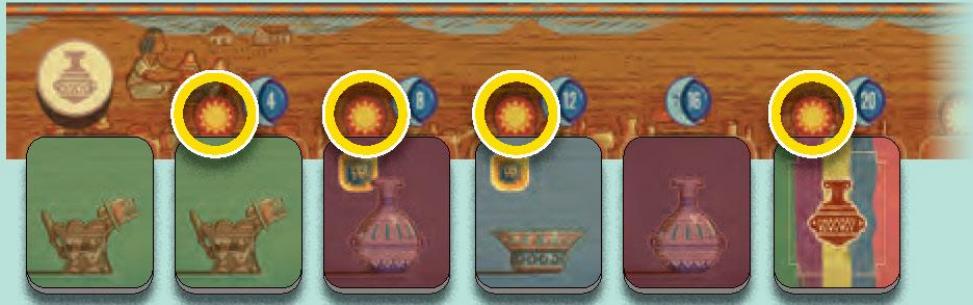
太阳与月亮
每次你进行活动时,你都可以增加你可用的太阳或月亮,因为神明会因你努力工作并遵循安第斯(Andean)良好的生活方式而给予你回报。
你将在白天阶段的第 5 步检查你拥有的太阳总数,此时

个人奖励和雷米板块可能会增加你指针上的因蒂崇拜(见第 11 和 12 页)。然后,你的因蒂崇拜将在夜间阶段的“黎明”步骤中转化为得分轨道上的太阳点数(见第 14 页)。
你可用的月亮将在夜间阶段的“计分神庙”和“计分阶梯标记”阶段直接转化为得分轨道上的月亮点数(见第14页)。
你永远不会在这个“执行活动”步骤中计算你的太阳和月亮得分。

纺织
从湖泊版图上拿取任意数量的纺织品,其总强度值与你的强度相等或更低。你可以将你的强度分配到两个纺织品上,但你不能从每个堆叠中抽取超过一个纺织品。
如果你拿了一个显示维拉科查的纺织品,立即从供应中拿取一个维拉科查并将其添加到你的玩家版图上(见第20页)。
将你的新纺织品添加到你的玩家版图上的编织区域。在放置之前,你可以自由旋转和翻转纺织品。只要你覆盖了正好两个空槽,你可以将纺织品放在编织区域的任何地方。
因蒂崇拜(白天阶段:步骤5)
如果增加因蒂崇拜,计算你的纺织品上可见的完整太阳的总数。将你的因蒂指针向前推进那个数量。
月亮计分(夜间阶段)
你的月亮得分是你编织区域中最右边连续完成列下方显示的值。为了得分,完成列左侧的所有列也必须是完整的。
计分举例:纺织
紫色玩家到目前为止已经放置了7块纺织品。如果在步骤5中增加因蒂崇拜,他们将获得5分,因为有五个完整的太阳。在夜间阶段获得月亮点数时,紫色玩家将获得10分——他们不会为值21分的列计分,因为在其左侧有未完成的列,所以他们为值10分的列计分。
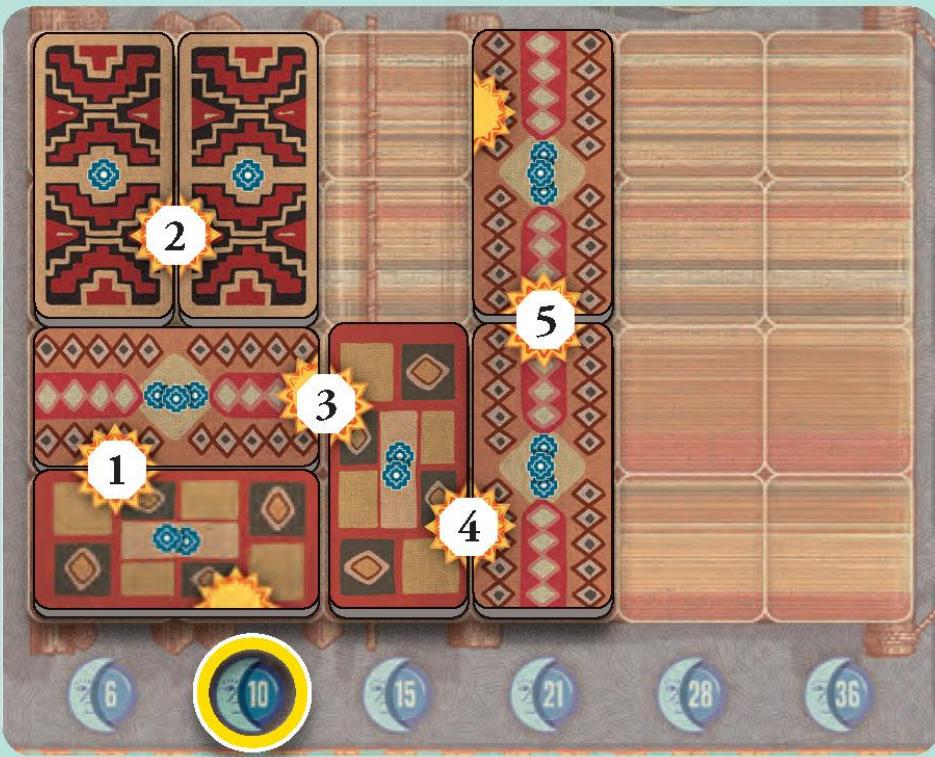
梯田耕种
在湖泊版图的梯田耕种区的第一个可用槽位中放置数量等于你强度的玉米,从左上角开始。
你可以从你的玩家版图上的任何盒子中取出玉米,但在每个盒子中,你必须取出最左边的玉米。当你清空一个显示维拉科查的盒子时,立即从供应中拿取一个维拉科查并将其添加到你的玩家版图上(见第20页)。因蒂崇拜(白天阶段:步骤5)
如果增加因蒂崇拜,计算通过从你的玩家版图上移除玉米而揭示的可见太阳的总数。将你的因蒂指针向前推进那个数量。
月亮计分(夜间阶段)
你的月亮得分是通过清空你的玩家版图上的盒子而揭示的月亮的总数。
计分举例:梯田耕作
粉色玩家到目前为止已经种植了 12 玉米。在这个过程中,他们揭示了 4 个太阳①和 14 个月亮②,这些将在后续步骤中转化为因蒂崇拜和月亮得分。当他们清空最大的盒子时,他们还获得了一个维拉科查③。
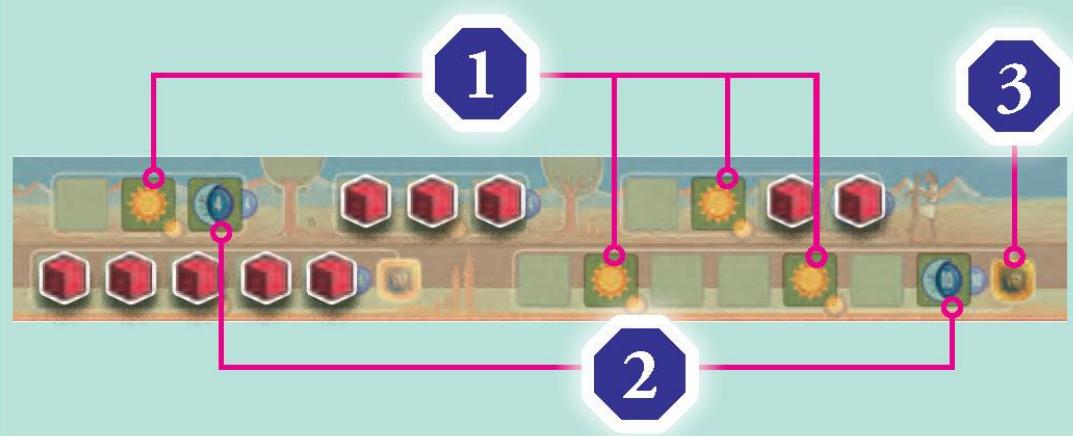
梯田耕种
在湖泊版图上沿着路径移动你的船,使得它进入的区域的总强度不超过你的强度。你可以折返,但你只能从你的船当前所在的位置继续前进。
当你进入一个你还没有岛屿的方形槽位时,在那里建造一个岛屿,方法是放置你玩家版图上最左边的岛屿。黄色的岛屿槽位(如图所示)只能包含一个岛屿和一艘船。对于所有其他岛屿槽位,任意数量的岛屿或船只都可以共享该槽位。

当你从显示维拉科查的槽位(2号、4号和6号槽位)放置一个岛屿时,立即从你刚刚建造的岛屿相邻的湖段中拿取一个维拉科查,并将其放置在你的版图上(见第20页)。如果没有可用的维拉科查,则不拿取。
进入有岛屿的区域不需要消耗任何强度。进入有船的区域不会改变强度成本。
历史注释
被印加人征服的数十个民族之一是乌鲁人(Uru),他们用生长在的的喀喀湖(Lake Titicaca)中的芦苇建造船只和浮动岛屿。乌鲁人一直延续着这种生活方式,如今仍有超过120个岛屿作为一个集体主义社会存在。
因蒂崇拜(白天阶段:步骤5)
如果增加因蒂崇拜,计算通过从你的玩家版图上移除岛屿而揭示的可见太阳的总数。将你的因蒂指针向前推进那个数量。
月亮计分(夜间阶段)
你的月亮得分是你在湖泊版图上拥有的岛屿旁边的最高数字。
游玩和计分举例:芦苇捆绑
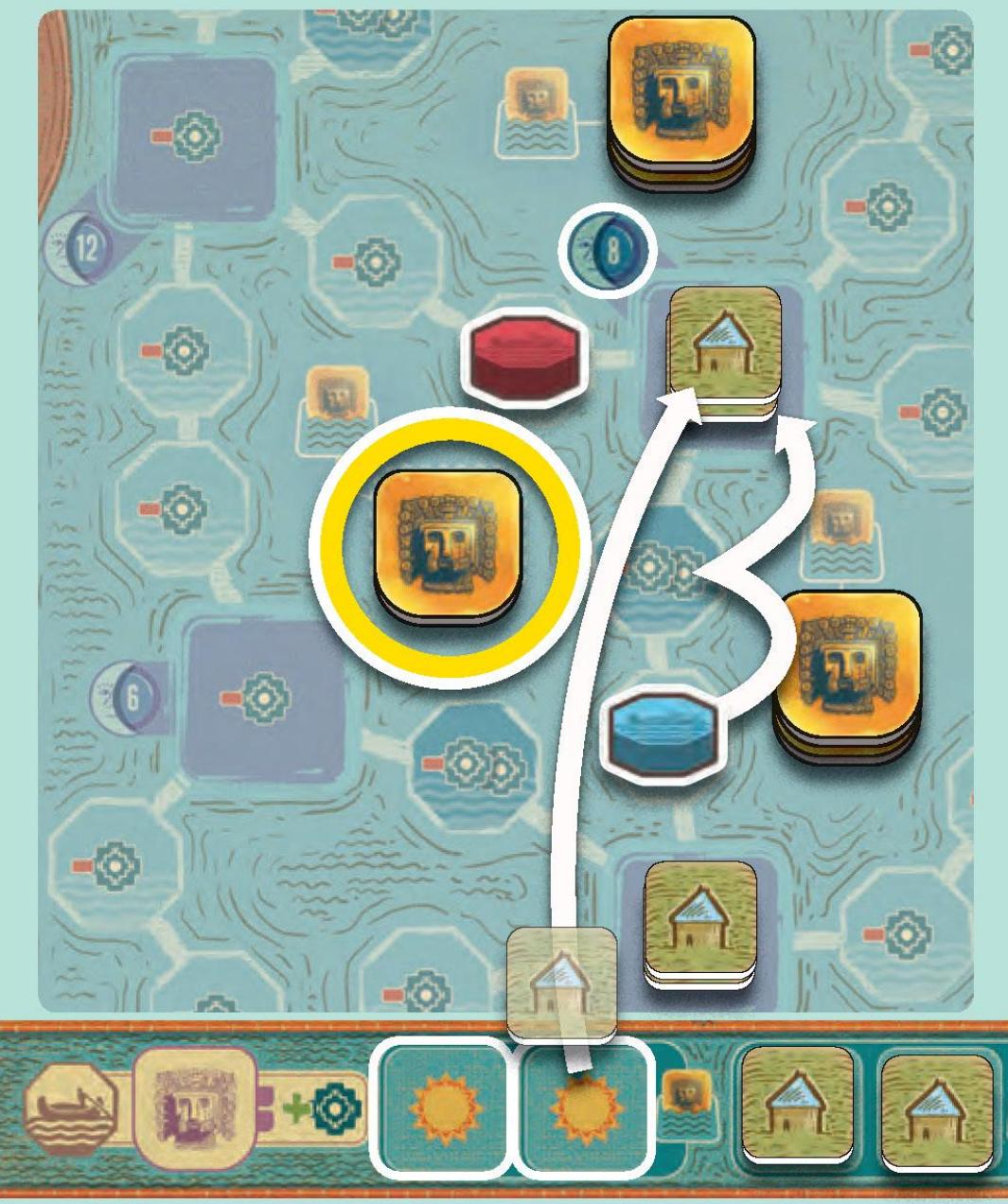
蓝色玩家正在用 2 点能量完成一项芦苇捆扎活动。他们沿着这些区域移动他们的船,免费进入岛屿槽位,因为那里有一个红色岛屿。他们放置了玩家版图上的第二个岛屿,这使他们能够从相邻的湖域拿取一个维拉科查。
在计算月亮得分时,他们将获得8分,因为这是他们最高价值的岛屿。如果增加因蒂崇拜,他们会因2个可见的太阳而增加2点崇拜值。
5. 回合结束检查
检查你是否触发了以下任何情况。你可以按照你选择的顺序解决这些触发条件。
放置神庙
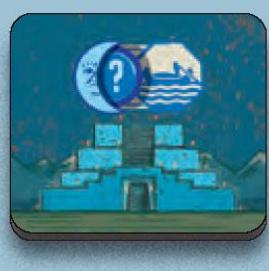
玩家版图在塔姆博网格的每个象限都有一个神庙图标。在回合的第5步,当一个象限的第四个塔姆博被移除,使得该象限为空时,你必须放置一个你选择的神庙。
从你的供应中拿取任意一个神庙。将其放置在主版图的神庙区域,放在与你本回合激活的阿亚尔颜色相匹配的行的最左边的空槽中。
当该颜色的阿亚尔退休时,这些神庙将为所描绘的活动提供月亮得分。
在每一行中,前三个槽位只能有一个神庙,但最后一个槽位(带有此处所示图标)可以容纳任意数量的神庙。

游玩举例:放置神庙
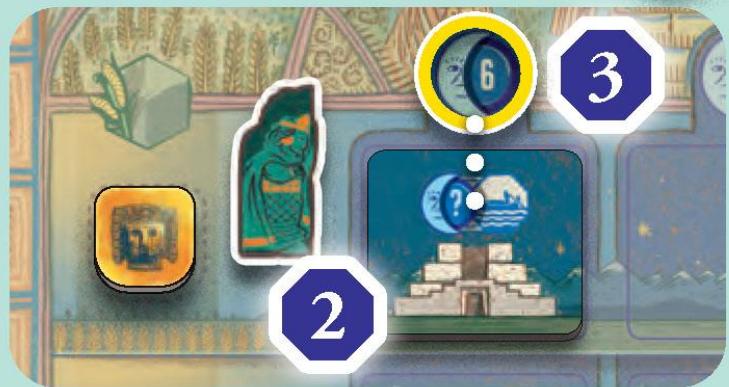
通过移除右下角象限的最后一个塔姆博 1,白方解锁了那里的神庙。因为他们本回合移动了青绿色的阿亚尔,所以他们将神庙添加到青绿色阿亚尔所在的行 2。
因为它位于第一列,所以在计分时它将额外获得6分3。

神庙
神庙将在游戏中的一个夜间阶段获得月亮点数,这发生在与之对齐的阿亚尔退休时。阿亚尔存活的时间越长,你就有越多的机会提升你神庙的月亮价值。
在游戏过程中,你将放置总共 15 个塔姆博:1 个用于你的起始活动,第 1 轮放置 5 个,第 2 轮放置 4 个,第 3 轮放置 3 个,第 4 轮放置 2 个。这意味着你将能够放置总共 3 个神庙。
个人奖励

如果你清空了一行和 / 或一列塔姆博,你将获得玩家版图上指示的奖励。
- 如果奖励是一只美洲驼,从供应中拿取一只并将其放置在你的版图旁边。
- 如果奖励是一个维拉科查,从供应中拿取一个并将其放置在你版图上的九个维拉科查槽位中的一个。
- 如果奖励显示一个太阳和四种活动之一,根据该活动的因蒂崇拜规则增加你因蒂指针上的数字。当你获得这些因蒂个人奖励之一时,在图标上放置一个奖励标记以跟踪。

美洲驼
在游戏结束时,你可以使用你收集到的美洲驼来增加你的太阳、月亮或两者的得分。
你分配给太阳和月亮的美洲驼数量将决定你将为每种得分增加多少点数,具体如主版图上的关键说明所示。因为你在游戏结束时的得分将是你的两个得分标记中较低的那个,所以尽可能保持你的太阳得分和月亮得分接近是非常重要的。

维拉科查
维拉科查可以解锁永久性或一次性奖励。关于每种奖励的详细信息,请参见第20页。
当你获得一个维拉科查时,立即将其放置在你的玩家版图上的一个奖励槽位上。一旦放置,维拉科查不得移动。

当你放置了槽位右侧指示数量的维拉科查时,奖励将立即对你可用。将完成的维拉科查正面朝上放置,以明确这一点。你不能再向该槽位添加更多的维拉科查。
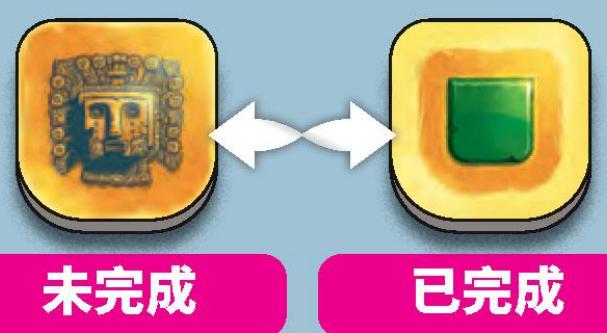
未完成
已完成
游玩举例:个人奖励
通过移除该行的最后一个塔姆博,紫色玩家触发了他们的陶器个人奖励。在第5步,他们根据陶器上可用的太阳数量增加他们因蒂指针上的崇拜值。这种崇拜将在每个夜间阶段的黎明步骤中转化为太阳点数。他们最后通过在图标上放置一个奖励标记来表明已完成。

雷米板块
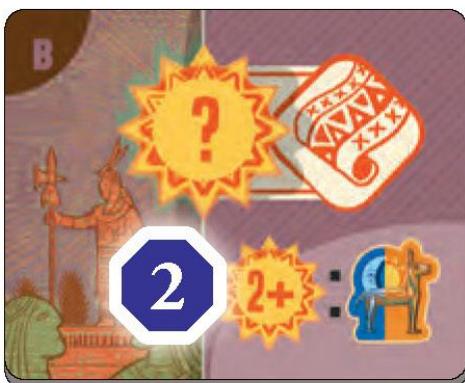
当一个阿亚尔落在或经过与雷米板块相连的移动区域时,在该回合结束时,所有玩家都将因所描绘的活动获得因蒂崇拜①。
每位玩家计算他们当前该活动的太阳数量,并将他们因蒂指针上的数值增加这个数量。如果他们该活动的太阳数量至少与雷米板块底部显示的数字②一样多,他们还将获得一只美洲驼。
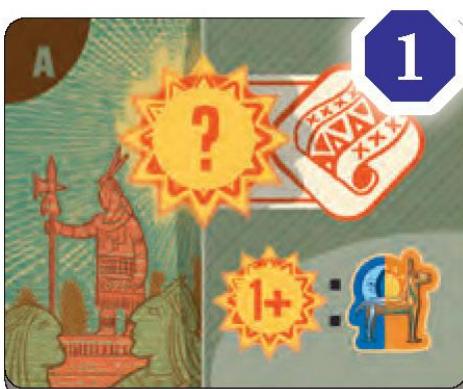
所有玩家计分后,翻转雷米板块。它现在将显示一个更高的太阳值用于美洲驼。如果第二个阿亚尔到达雷米板块,使用这一面来计分。
如果对应路径上的两个阿亚尔都已经经过雷米板块或退休,它将不再被激活,你可以将其从版图上移除。
时机与退休
在决定移动哪个阿亚尔时,要提前查看哪些阿亚尔会经过为你的最高价值活动计分的雷米(Raymi)板块。你不想让这些阿亚尔过早退休,因此要确保他们在白天阶段结束时不要处于最后一名。
历史注释
与其他安第斯文化的冬至节日类似,因蒂·雷米是印加人组织的年度节日,用以庆祝太阳。这一节日至今仍在每年6月24日由安第斯原住民文化庆祝。在这些节日中,可能会携带美洲驼雕像——金色的代表因蒂的汗水,银色的代表玛玛·基利亚的泪水。
达到肥沃之地
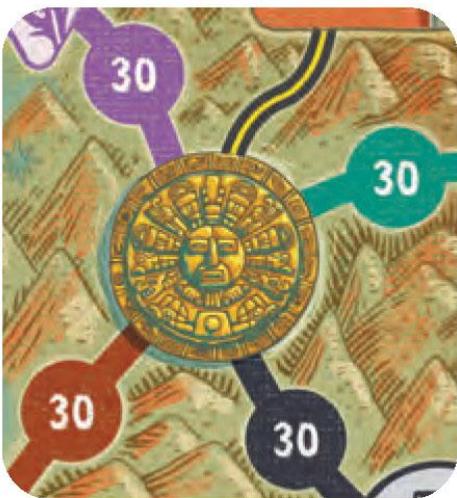
当一个阿亚尔到达移动区域 30 时,在该回合结束时将进行一次共享计分。这次计分使用版图上印制的雷米板块。每位玩家选择任意两种不同的活动,并将这些活动的太阳数量加到他们的因蒂指针上。
如果玩家在这些活动中至少有六个太阳,他们还将为每种活动获得一只美洲驼。
因蒂指针
在白天阶段的第5步,你可能会因为个人奖励或雷米板块计分而增加你因蒂指针上的数字。这个指针记录你对太阳神的崇拜。
这种崇拜将在每个夜间阶段的黎明步骤中加到你的太阳点数上。当你这样做的时候,你的因蒂指针不会重置,所以太阳点数在整个游戏过程中是累积的。这意味着早点获得它们会更加有利可图。

游玩举例:白天阶段
- 放置阶梯标记:粉色玩家将青绿色的阶梯标记放置在他们塔姆博网格的第二行①。

- 移动阿亚尔:他们根据玩家版图上的箭头指示,将青绿色的阿亚尔移动 2 个移动区域 2。
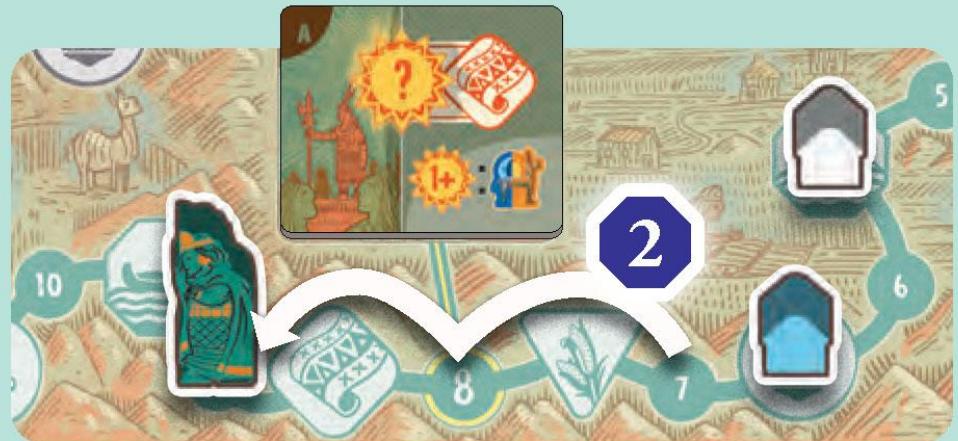
- 选择并放置一个塔姆博:粉色玩家随后从他们放置标记的行中拿取一个塔姆博3a。然后将其放置在青绿色阿亚尔后面的空梯田耕种槽位上3b。
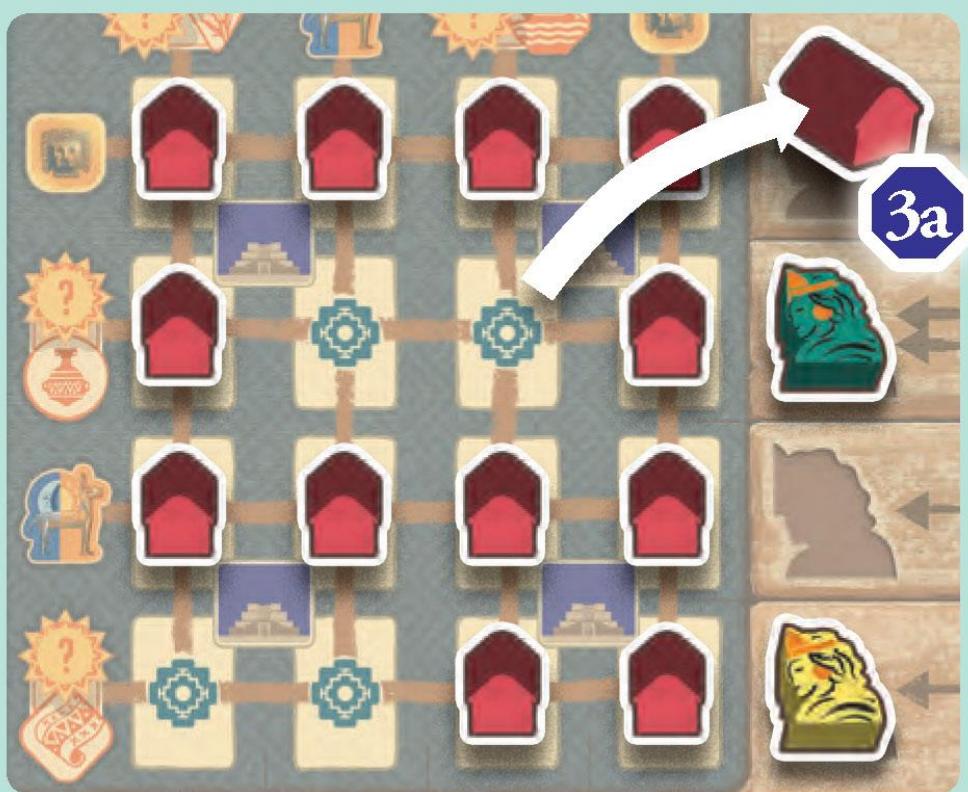

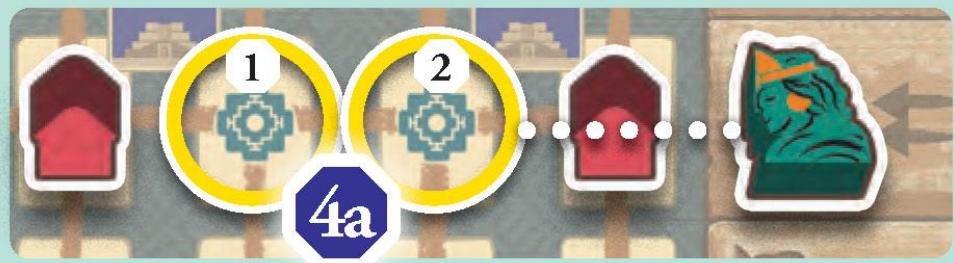
- 执行活动:由于所选行中有两个空槽,他们以2点能量执行梯田耕种活动4a。他们在湖泊版图的梯田耕种区4b放置了2玉米。在这个过程中,他们揭示了玩家版图上的一个新的太阳,这将提升未来从个人奖励和雷米板块获得的任何梯田耕种因蒂崇拜。

- 回合结束检查:由于该象限中仍有塔姆博,他们没有放置任何神庙,并且本回合没有触发任何个人奖励。然而,青绿色的阿亚尔已经经过了一个为编织计分的雷米板块。每位玩家根据他们编织区域中可见的太阳数量增加他们因蒂指针上的崇拜值5a。因为粉色玩家在这个区域至少有一个太阳,他们还拿取了一只美洲驼5c。他们随后翻转雷米板块,游戏轮到他们左边的玩家。

+1 美洲驼
夜晚阶段
当所有玩家用完他们所有的可用阶梯标记后,他们将进入夜间阶段,在这个阶段中,月亮点数将为玛玛·基利亚计分,太阳点数将为因蒂计分。这个阶段有6个步骤:
-
阿亚尔退休
-
收获玉米
-
计分神庙
-
计分阶梯标记
-
黎明
-
准备
1. 阿亚尔退休
首先,通过查看他们的移动区域上的数字来检查每个阿亚尔已经旅行的距离。旅行距离最短的阿亚尔(即位于最低数字上的那个)将退休。在最后一个夜间阶段,最后一个剩余的阿亚尔将退休。
如果出现平局,查看神庙区域中女性阿亚尔的位置。平局中的阿亚尔,其女性伴侣在神庙区域最下面一行的,将退休。
将退休的男性阿亚尔放置在神庙区域,放在包含其伴侣的那一行的最右边的阿亚尔槽位上。
2. 收获玉米
在本轮中在湖泊版图的梯田耕种区种植玉米最多的玩家将获得神庙区域中女性阿亚尔旁边的维拉科查,其伴侣
如果出现平局,平局中首先种植任何玉米的玩家将获得维拉科查。如果没有任何玩家种植玉米,则将维拉科查令牌返回供应中。
然后从梯田上移除所有的玉米,将其放回游戏盒子中。
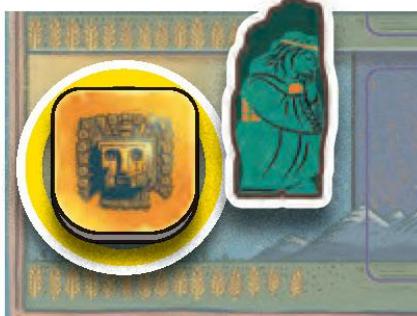
3. 计分神庙

在计分神庙之前,任何解锁了图示维拉科查奖励(右侧)的玩家现在将为他们在神庙区域中的每个神庙获得2个月亮点数。
然后,正在退休的阿亚尔的女性伴侣从左到右沿着该行行走,沿途为每个神庙计分。每个神庙的所有者立即为神庙的活动获得月亮点数(见第9-10页),以及列上方显示的任何额外月亮点数,通过移动他们在主轨
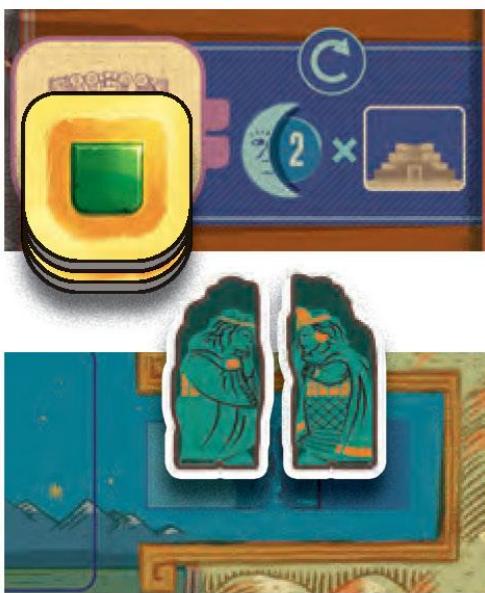
道上的得分标记来实现。
计分神庙后,将它们全部放回盒子中。然后,阿亚尔夫妇在该行末端的阿亚尔槽位中团聚。
4. 阶梯标记计分

从持有起始玩家指示物的玩家开始,按顺时针方向,每位玩家将与退休的阿亚尔相匹配的阶梯标记放置在其玩家版图上塔姆博网格上方剩余的空槽之一中。这个标记不再算作你可用的阶梯标记之一,并且在游戏的剩余时间内它将不会移动。
为放置标记的槽位上显示的活动计算你的月亮点数(见第9-10页)。

月亮计分
你可能希望将为你最高得分的活动计分的月亮保存到后面的轮次。不要害怕在第一轮得零分!
5. 黎明

所有玩家现在查看他们因蒂指针上的当前数值,并在主得分轨道上获得相应数量的太阳点数。
因蒂崇拜
因蒂指针保持其当前数值,因此你将在每个未来的黎明阶段再次获得这些点数。
6. 准备
将所有剩余的阶梯标记在其当前槽位中竖起,这些槽位位于塔姆博网格旁边。
然后,起始玩家指示物顺时针传递给下一位玩家,一个新的白天阶段开始。
游玩举例:夜晚阶段
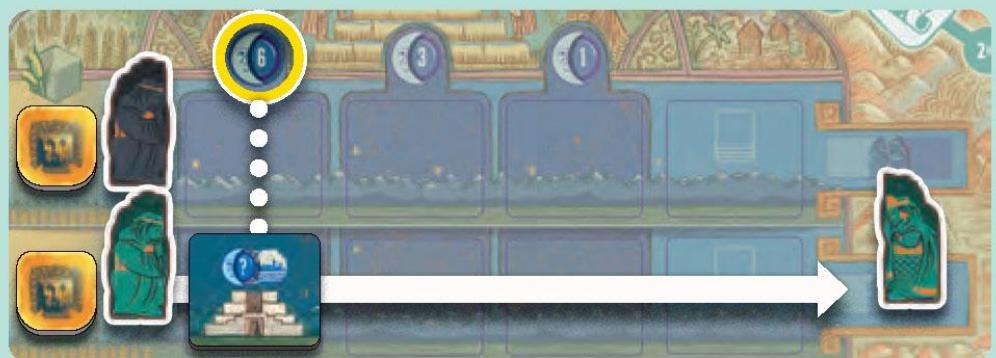
- 阿亚尔退休:在第一个白天阶段结束时,灰色阿亚尔和青绿色阿亚尔都旅行了最少的步数(各5步)。青绿色阿亚尔在神庙区域处于更低的一行,因此青绿色阿亚尔退休,并被放置在神庙区域的右侧。


- 收获玉米:蓝色和粉色玩家都种植了 2 玉米,因此在种植数量上打成平手。然而,蓝色玩家首先种植了玉米,从而赢得了平局,并获得了本回合的维拉科查。他们拿取了位于青绿色阿亚尔旁边的维拉科查。

- 计分神庙:青绿色阿亚尔的女性现在沿着神庙的行进。白色玩家为他们的芦苇捆扎活动计算月亮点数,并因处于第一列而额外获得6分。
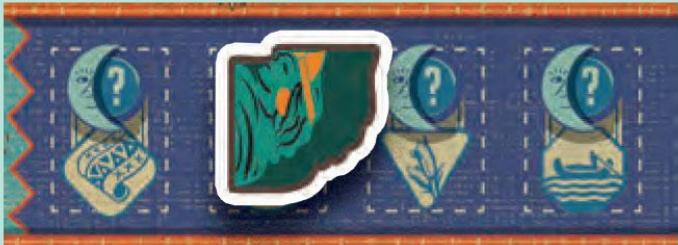
- 计分阶梯标记:每位玩家现在都将他们的青绿色阶梯标记放置在他们玩家版图上的一个月亮槽位中。粉色玩家决定他们想早点获得一些月亮,所以他们为陶器计分并获得6分。所有其他玩家都想把他们更高得分的活动留到后面的月亮计分中,所以他们每个人都将他们的青绿色标记放在一个得0分的位置。
5. 黎明: 所有玩家将他们的因蒂崇拜转化为太阳点数。
- 准备:所有玩家将他们剩余的阶梯标记竖起,起始玩家指示物传递给蓝色玩家,他开始第二轮。
游戏结束
在第四个夜间阶段之后,游戏将结束。
你现在可以使用你在游戏过程中获得的美洲驼来赚取额外的太阳和月亮点数。每位玩家可以自行决定将他们的美洲驼分配到太阳和月亮之间,并根据下方所示的转换表将点数加到相应的得分标记上。
然后,所有玩家只根据他们两个得分标记中较低的那个进行计分(无论它是太阳还是月亮)。在这些得分中得分最高的玩家是赢家。
如果出现平局,平局中另一个得分标记最接近前者的玩家获胜。如果仍然平局,则平局的玩家共同获得胜利。

Ayar rulebook.md52.1 KB
CHILDREN OF THE SUN
GAME RULES
FABIO LOPIANO & MANDELA FERNÁNDEZ-GRANDON
lAN O'TOOLE
Ayar
CHILDREN OF THE SUN
GAME DESIGN: FABIO LOPIANO AND MANDELA FERNÁNDEZ-GRANDON
ILLUSTRATION AND GRAPHIC DESIGN: IAN O'TOOLE
RULES LAYOUT: JACOBY O'CONNOR
GAME DEVELOPMENT: RHYS AP GWYN, LUKE EVISON, AND JORDAN WHEELER
SUBJECT MATTER EXPERT: ANTTI KORPISAARI
PLAYTESTERS: CHUCK CASE, DAVID DIGBY, STUART ELLIS-GORMAN,
MARIO GAZZANIGA, lOANA GHICA, DOMINIK GOLDNAGL, KYLe GRAVES,
JANELIZROBB, MAURO LAZZARA, NORALIE LUBBERS, CHRIS MANLEY,
ISABELLA MATTASITS, DEAN MORRIS, GARY PERRIN, ANDREA ROBBIANI,
SARA ROHLING, DAVID SPADA, PIETER JAN TIERSMA, DÁVID TURCZI,
PIERRE VAGNEUR-JONES, CHRISTOPH WEIS, AND CARL ZEE
First published in Great Britain in 2025 by OSPREY GAMES Bloomsbury Publishing Plc Kemp House, Chawley Park, Cumnor Hill, Oxford OX2 9PH, UK, 29 Earlsfort Terrace, Dublin 2, Ireland, 1385 Broadway, 5th Floor, New York, NY 10018, USA
OSPREY GAMES is a trademark of Osprey Publishing Ltd
© Fabio Lopiano & Mandela Fernández-Grandon, 2025.
Fabio Lopiano & Mandela Fernández-Grandon have asserted their rights under the Copyright, Designs and Patents Act, 1988, to be identified as Author of this work.
All rights reserved. No part of this publication may be reproduced or transmitted in any form or by any means, electronic or mechanical, including photocopying, recording, or any information storage or retrieval system, without prior permission in writing from the publishers.
ISBN: 9781472860071
25 26 27 28 29 10 9 8 7 6 5 4 3 2 1
Printed in China
Osprey Games supports the Woodland Trust, the UK's leading woodland conservation charity.

MIX Paper | Supporting responsible forestry FSC® C173672
To find out more about our games and sign up to our newsletter, visit www.ospreypublishing.com/osprey-games.
For more information or replacement parts, email info@ospreygames.co.uk.
INTHEBEGINNING..
Viracocha created Inti, the Sun God, and Mama Quilla, the Moon God. They rose from Lake Titicaca as one: husband and wife, sister and brother. But Inti looked on jealously at the brilliance of Mama Quilla and threw ash on her, so that she would not shine brighter than him.
Together they bore four sons and four daughters - the Ayar pairs – who would emerge from Tiwanaku, south of the great lake, with the ten lesser clans of the first people. The Ayar would be tasked with finding fertile ground at the centre of the universe to found the empire of Tawantinsuyu while teaching the clans the skills necessary to start a civilisation. As the four Ayar pairs traversed the lands northwards, one by one they would meet their fate - trapped in a cave or turning to stone - until only one pair remained. The final Ayar pair would survive to be granted the honour of carrying the golden rod and founding the empire of Tawantinsuyu – sitting at its head as the Sapa Inca and Coya.
You play as one of the lesser clans spread across the land, helping the Ayar on their travels, learning from them the essentials of Incan life, and hoping to become their favoured clan: the Inca of Privilege.
Over four game rounds, you will help the Ayar on their journey from Tiwanaku to Cusco while building your skills in weaving, pottery making, reed bundling and terrace farming. From each of these skills you will be able to score points by pleasing the Sun, Inti. At the end of each day, night will fall and one Ayar will be lost, turning to stone. It is during the night that you will score points for pleasing the Moon, Mama Quilla.
You will track the points for these gods separately and at the end of
the game, when there is only one Ayar left on the journey, the lowest of these two scores, Sun or Moon, will be your final score. The player with the highest score will be the winner.
GAME COMPONENTS
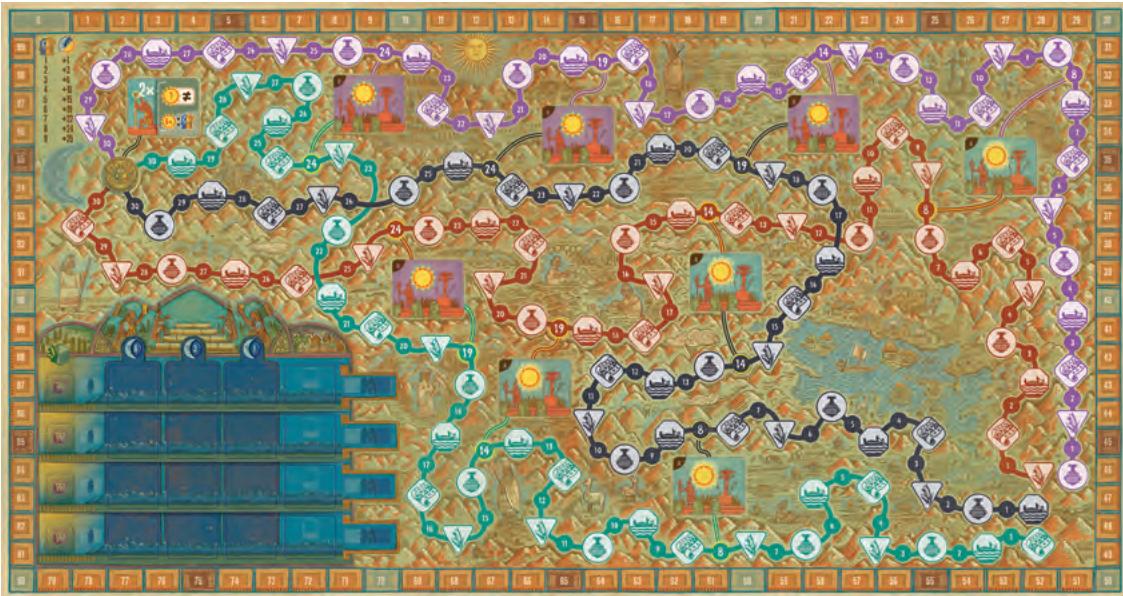
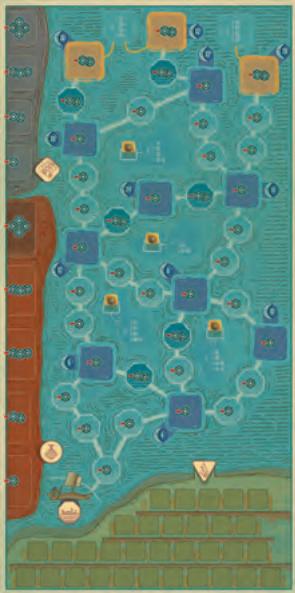
1× Lake board
1× Main board

8× Raymi tiles
30× Pots

40× Viracocha

40× Llamas

64× Textiles


Female Ayar Male Ayar 4 pairs of Ayar
Solo Game
4× Solo boards
On the reverse of the Player boards
5× Activity tokens

1× First Player token
4 sets of Player Components

1× Inti dial

2× VP tokens

6× Islands

4× Bonus markers
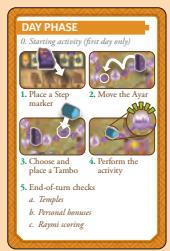
1× Reference card
4× Temples

1× Step tile
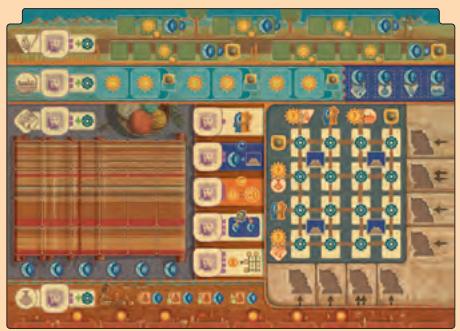
1× Player board

1× Boat
16× Tambos

2× Score markers
1× Sun 1× Moon

22× Maize
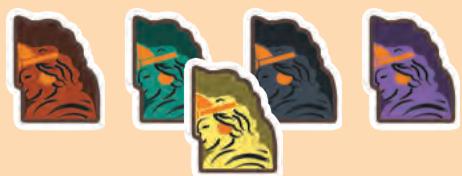
5× Step markers
4× Ayar colours 1× Wild

Terrace Farming
Reed Bundling
Weaving
Moon Scoring
Tambo Grid

Pottery


3. Choose and 4. Perform the place a Tambo activity
- End-of-turn checks a. Temples b. Personal bonuses c. Raymi scorir

Player boards
-
Give each player all pieces of one colour, along with a Player board, 1 Step marker of each colour, and a Reference card.
-
Place the 16 Tambos on their grid on your Player board

- If playing with fewer than four players, take your Step tile and use it to cover up the steps next to the Tambo grid on your board 3, with the side matching the number of players () face up.

- Place the 22 Maize 4 and 6 Islands 4 on their matching slots.


- Give a player the First Player token


Inti dial

5d, and Reference card

next to your Player board.


Main board
- Place the Main board7 in the centre of the play area.

- Place each player's Moon and Sun Score markers on the 0 space of the scoring track


- Place each male Ayar onto the first movement spaceof the path matching their colour

- Randomising their positions, place each female Ayar on a slot to the left of the Temple area 10a. Place a Viracocha on the slot next to each 0b

- Randomising their positions, place the Raymi tiles on the slots on the Main board matching their letter, with the letter side face up .

- Place the Viracocha and Llamas in separate supplies next to the board


Lake board

-
Place the Lake board 13 to the right or left of the Main board.
-
Split the Textiles into four sets by power number , and stack them next to the corresponding numbered slots on the Lake board .


-
Place the stack of Pots face down next to their slot on the Lake board a. Draw Pots until you have found four without Viracocha icons. Place these next to the four empty slots 5b, and shuffle the rest back into the stack.
-
Place the specified number of Viracocha in the slots on the lake that match the number of players 1.

- Place each player's Boat in the starting space at the bottom of the lake 17

GAMEPLAY
You will play the game over four rounds, each with two phases:
- Day phase: Players perform activities in turn order.
2. Night phase: One Ayar retires and players simultaneously score their Moons ând Suns.
After the fourth night phase, players score the lowest of their two Score markers (Moon or Sun). Whoever has the highest score wins.
SCORE MARKERS
You will only move your Score markers during the night phase.

DAY PHASE
Starting with the player with the First Player token, each player completes all of the following 5 steps.
Play continues clockwise until every player has placed all their available Step markers. At this point, you will enter the night phase.
1. Place a Step marker
-
Move the Ayar
-
Choose and place a Tambo
-
Perform the activity
-
End-of-turn checks
0. Starting Activity
At the start of the first day phase only, each player performs one activity. Starting with the first player and moving clockwise, each player must place a Tambo from any slot on their Player board into the first building slot on any path (as long as it is still empty). Perform the corresponding activity with a power of 1. See next page for details on activities.
1. Place a Step Marker
Choose one of your available Step markers. The colour chosen affects which Ayar will move in step 2.
Place it laid down in any empty slot next to the Tambo grid. The row or column in which you place the Step marker must have at least one Tambo in it.
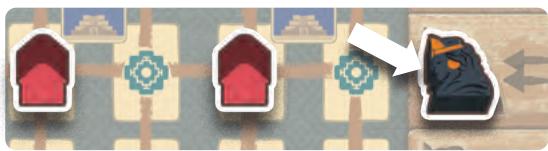
STEP MARKERS
Step markers stood up are available, while those laid down have already moved for this round. You will stand them back up at the end of each night phase. In day phases 2 to 4, the Step markers that were placed the previous day will block some of the slots, further limiting the options for placing a Step marker.

2. Move the Ayar
Move the male Ayar matching the colour of the placed Step marker along its coloured path. If you placed the gold Step marker, you decide which Ayar to move. The number of arrows next to the marker's slot indicates the exact number of movement spaces that the Ayar travels.
If the Ayar reaches the end of their path, they will not move further. Ignore any subsequent steps the Ayar would take. You may continue to place Tambos and perform the activities along their path as normal.

Movement Space
Building Slot
3. Choose and Place a Tambo
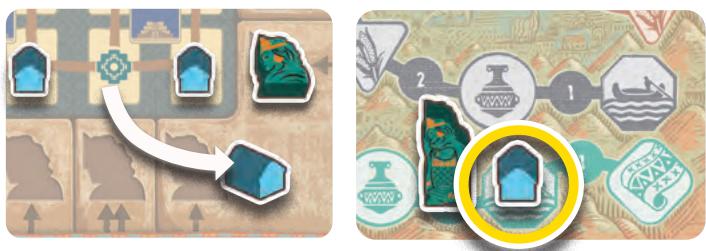
Take any Tambo from the row or column where you placed your Step marker. Place it on any empty building slot on the path behind the Āyar you just moved – that is, anywhere between the Ayar and Tiwanaku. You must place the Tambo on a slot that indicates an activity you can perform (meaning you have the pieces and slots available to do the activity).
Historical note
The Inca oversaw the building of thousands of tambos (way stations) along the roads ofTawantinsuyu. These were equally distanced to match one day's travel and had many uses, including storage and resting places for travelling state functionaries.
4. Perform the Activity
Perform the activity matching the icon on the slot where you placed your Tambo. All activities take place on the Lake board.




Pottery
Weaving
Terrace Farming
Reed Bundling

Each activity has a power from 1 to 4. To determine the power available for your activity, count the number of empty Tambo slots in the row or column where you placed your Štep marker. The higher the power, the more opportunities you have for the activity. You may always choose to perform an activity using less power than you have available.

Pottery
Take any number of Pots from the Lake board whose total power value matches or is less than your power. You may split your power between two Pots. For example, with a power of 3, you can take either a single 3-power Pot or both a 1-power Pot and a 2-power Pot.

Do not turn the pots over when you take them. You may take Pots from the top of the stack without turning them over. These Pots are wild, and count as any colour for scoring.
If you take a Pot showing a Viracocha, immediately take a Viracocha from the supply and add it to your Player board (see page 20).
After taking Pots, slide all the remaining Pots downwards, flipping over Pots from the stack to fill any empty slots.
Add your new Pots to the pottery area of your Player board, filling the slots from left to right. You may not replace Pots that have already been placed.
Inti Devotion (Day Phase: Step 5)
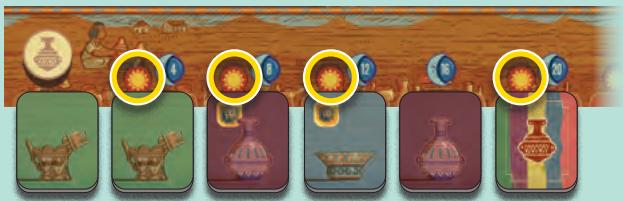
If increasing Inti devotion, count the total number of Suns above slots filled with Pots. Advance your Inti dial by that amount.
Moon Scoring (Night Phase)
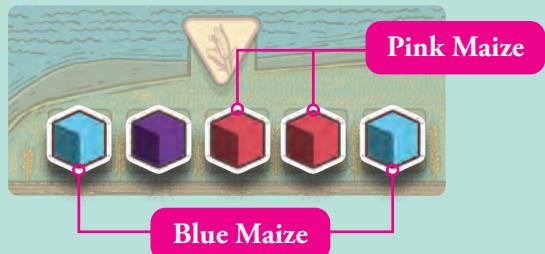
Your Moon score is determined by how many Pots you have in each of the five Pot colours. Sets of 1/2/3/4+ Pots of the same colour are worth 1/4/9/16 points as indicated on the Player board. To get your Moon score, add together the points for each set.
Wild Pots (those face down) count as any colour for scoring, but each wild Pot cannot count towards more than one set.
SCORING EXAMPLE: POTTERY
White currently has 6 Pots. When scoring Inti devotion (triggered in step 5 by Personal bonuses or Raymi tiles), they would count all 4 Suns above their Pots. When scoring Moon points during the night phase, they would group the Pots into sets: 3 green, including the wild (9 points), 2 pink (4 points), and 1 Blue (1 point), for a Moon score of 14 points.
SUNS AND MOONS
With each activity you perform, you may increase your available Suns or Moons as the gods reward your toil and observation of a good Andean life.

You will check your total number of Suns in step 5 of the day phase, when Personal bonuses and Raymi tiles may increase your Inti devotion on your dial (see pages 11 and 12). Your Inti devotion then becomes Sun points on the scoring track in the Dawn’ step of the night phase (see page 14).
Your available Moons will translate directly into Moon points on the scoring track during the Score Temples’ and Score Step marker’ phases of the Night phase (see page 14).
You never score your Suns and Moons during this Perform the activity step.

Weaving
Take any number ofTextiles from the Lake board whose total power value matches or is less than your power. You may split your power between two Textiles, but you may not draw more than one Textile from each stack.
If you take a Textile showing a Viracocha, immediately take a Viracocha from the supply and add it to your Player board (see page 20).
Add your new Textiles to the weaving area on your Player board. You may rotate and flip the Textile freely before placing it. You may place a Textile anywhere in the weaving area, as long as it covers exactly two empty slots.
Inti Devotion (Day Phase: Step 5)
If increasing Inti devotion, count the total number of complete Suns visible on your Textiles. Advance your Inti dial by that amount.
Moon Scoring (Night Phase)
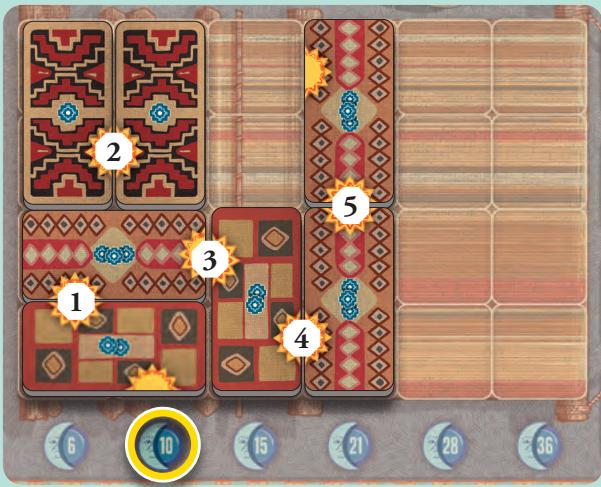
Your Moon score is the value shown below the rightmost consecutive completed column ofTextiles in your weaving area. All columns to the left of the completed column must also be complete in order for it to score.
SCORING EXAMPLE: WEAVING
Purple has placed 7 Textiles so far. If increasing Inti devotion in step 5, they would gain 5 points, because there are five complete Suns. When gaining Moon points in the night phase, Purple would gain 10 points - they do not score for the column worth 21 because it has uncompleted columns to the left of it, so they score for the column worth 10 instead.
Place Maize equal to your power in the first available slots in the terrace farming area of the Lake board, starting from the top left.
You can take Maize from any box on your Player board, but within each box you must take the leftmost Maize. When you empty a box showing a Viracocha, immediately take a Viracocha from the supply and add it to your Player board (see page 20).
Inti Devotion (Day Phase: Step 5)
If increasing Inti devotion, count the total number of visible Suns revealed by removing Maize from your Player board. Advance your Inti dial by that amount.
Moon Scoring (Night Phase)
Your Moon score is the total number of Moons revealed by emptying boxes on your Player board.
SCORING EXAMPLE: TERRACE FARMING
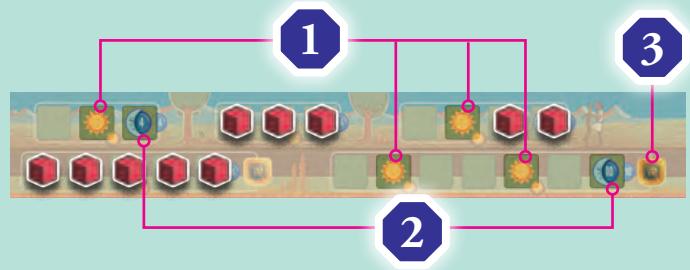
Pink has planted 12 Maize so far. In doing so, they have revealed 4 Suns1 and 14 Moons2 which will translate into Inti devotion and Moon points in later steps. They also gained a Viracocha③ when they emptied the largest box.

Reed Bundling
Move your Boat along the paths on the Lake board such that the total power of the spaces it enters does not exceed your power. You may retrace yout cps, bt you may only continue from where your
When you enter a square slot where you do not already have an Island, build one there by placing the leftmost Island from your Player board. The yellow Island slots (shown right) can contain only one Island and one Boat. For all other Island slots, any number of Islands or Boats may share the slot.
When placing an Island from a slot showing a Viracocha (slots 2, 4, and 6), immediately take a Viracocha from a lake section adjacent to the Island you just built and place it on your board (see page 20). If there are none available, do not take a Viracocha.
Entering a space with an Island does not cost any power. Entering a space with a Boat does not change the power cost.
Historical note
One of the dozens of ethnic groups subjugated by the Inca were the Uru, who constructed boats and floating islands from the reeds that grew in Lake Titicaca. The Uru have continued this way of life, with over 120 islands existing today as a collectivist society
If increasing Inti devotion, count the total number of visible Suns revealed by removing Islands from your Player board. Advance your Inti dial by that amount.
Moon Scoring (Night Phase)
Your Moon score is the highest number next to an Island you have on the Lake board.
PLAY AND SCORING EXAMPLE: REED BUNDLING
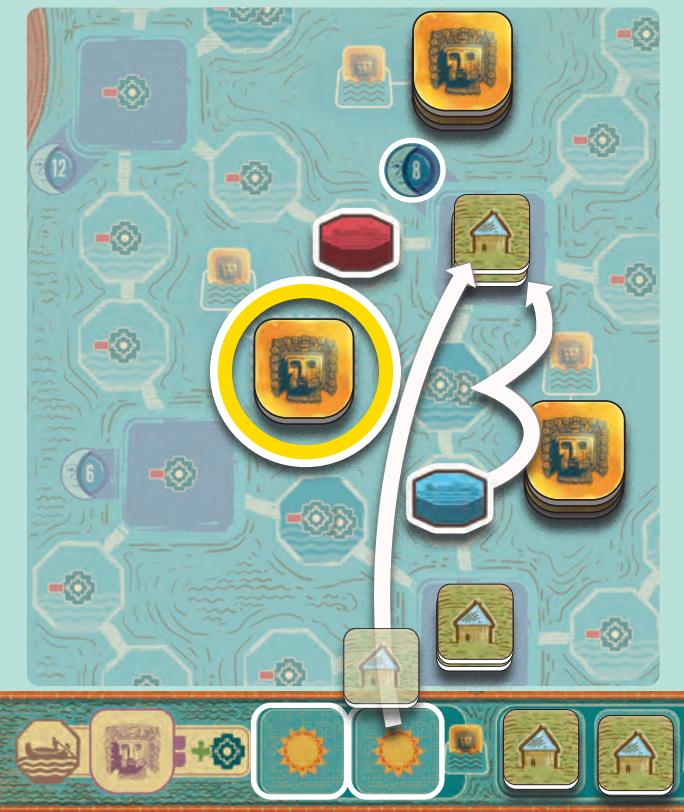
Blue is completing a reed bundling activity with a power of 2. 'They move their Boat along these spaces, entering the Island slot for free because there is a Red Island there. They place the second Island from their Player board, which allows them to take a Viracocha from an adjacent area of the lake.
They would gain 8 points when scoring their Moons, because this is their highest-value Island. If Increasing Inti devotion, they would increase their devotion by 2 for the 2 visible Suns.
5. End-of-Turn Checks
Check if you have triggered any of the following. You may resolve these triggers in your preferred order.
Placing a Temple
Player boards have a Temple icon in each quadrant of the Tambo grid. In step 5 of a turn when the fourth Tambo of a quadrant has been removed such that the quadrant is empty, you must place a Temple of your choice.
Take any Temple from your supply. Place it in the Temple area of the Main board, onto the leftmost empty slot of the row matching the Ayar colour you activated this turn.
When that colour Ayar retires, these Temples will provide Moon points for the depicted activity.
In each row, the first three slots can have only one Temple, but the final slot, with the icon shown here, can hold any number of'Temples.

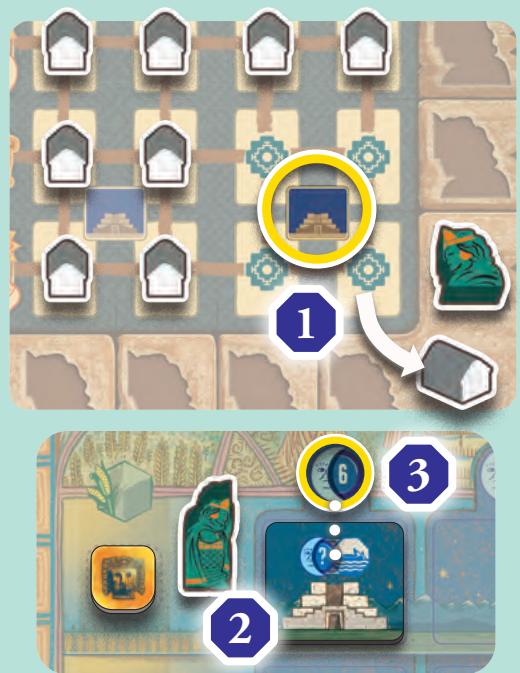
PLAY EXAMPLE: PLACING A TEMPLE
By removing the last Tambo from the bottom right quadrant 1, White unlocks the Temple there. Because they moved the teal Ayar this turn, they add the Temple to the row with the teal Ayar 2 As it is in the first column, it will be worth 6 additional points when scored 3
TEMPLES
Temples will score Moon points in one night phase during the game, when the Ayar they are aligned with retires. The longer that Ayar survives, the more opportunities you will have to improve the Moon value of your Temple.

You will place exactly 15 Tambos during the game: 1 for your starting activity, 5 in round 1, 4 in round 2, 3 in round 3, and 2 in round 4. This means you will be able to place exactly 3 Temples.
Personal Bonuses

If you have emptied a row and/or column of'Tambos, you will gain the bonus(es) indicated on your Player board.
• If the bonus is a Llama, take one from the supply and place it next to your board.
• If the bonus is a Viracocha, take one from the supply and place it on one of the nine Viracocha slots on your board.
If the bonus shows a Sun with one of the four activities, increase the number on your Inti dial according to that activity's Inti devotion rules. When you score one of these Inti personal bonuses, place a Bonus marker on the icon to keep track.

LLAMAS
At the end of the game, you can use the Llamas you have collected to increase your points for Suns, Moons, or a mixture of both.
The number of Llamas you allocate to Sun and to Moon will determine how many points you will add to each, as shown in the key on the Main board. Because your score at the end of the game will be the lower of your two Score markers,

keeping your Sun and Moon scores as close as possible is crucial.
VIRACOCHA
Viracocha can unlock permanent or one-use bonuses.
For details on each bonus, see page 20.
When you gain a Viracocha, immediately place it on one of the bonus slots on your Player board. Once placed, Viracocha may not be moved.

When you have placed the number of Viracocha indicated to the right of the slot, the bonus is immediately available to you. Place the Viracocha with its completed side face up to make this clear. You may not add any more Viracocha to the slot.

Uncompleted
Completed
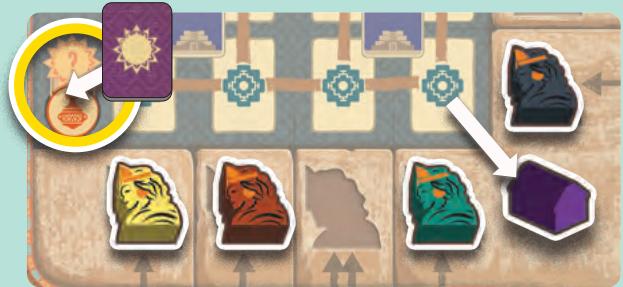
PLAY EXAMPLE: PERSONAL BONUSES
By removing the last Tambo of the row, Purple triggers the personal bonus for their pottery. During step 5, they increase the devotion on their Inti dial according to the Suns available from their pottery. 'This devotion will turn into Sun points in the dawn step of each night phase. They finish by placing a Bonus marker on the icon to mark that it has been completed.
Raymi Tiles

At the end of a turn in which an Ayar lands on, or passes, a movement space linked to a Raymi tile, all players will gain Inti devotion for the depicted activity 1

Each player counts their current Suns for that activity and increases the value on their Inti dial by this amount.
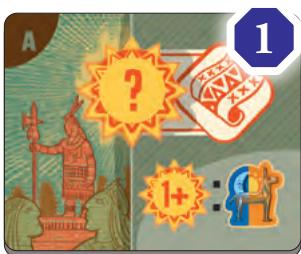
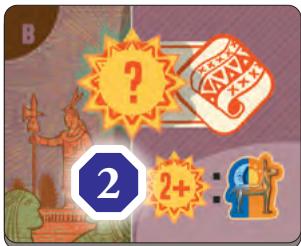
If they have at least as many Suns in that activity as the number shown at the bottom of the Raymi tile 2, they also gain a Llama.
Once all players have scored, flip the Raymi tile. It will now show a higher Sun value for the Llama. If a second Ayar reaches the Raymi tile, use this side to score.
If both Ayar along the corresponding paths have already passed the Raymi tile or retired, it will not be activated again, and you may remove it from the board.
TIMING RETIREMENT
When deciding which Ayar to move, look ahead to see which ones will pass the Raymi tiles that score your most valuable activity. You do not want these Ayar to retire early, so make sure they are not in last place at the end of the day phase.
Historical note
Similar to other Andean cultures' solstice festivals, Inti Raymi was an annual festival organised by the Inca to celebrate the Sun. It is still celebrated by indigenous Andean cultures on the 24th of June every year. Llama statuettes may be carried at these festivals – gold ones to represent the sweat of Inti, and silver ones to represent Mama Quilla's tears.
Reaching Fertile Ground
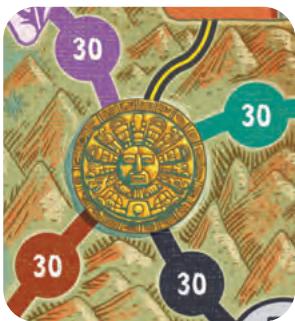
At the end of a turn where an Ayar reaches movement space 30, a shared scoring takes place. This scoring uses the Raymi tile printed on the board. Each player chooses any two different activities and adds the Suns from those activities to their Inti dial.
Players also gain a Llama for each of these activities that they have at least six Suns in.
THE INTI DIAL
During step 5 of the day phase, you may increase the number on your Inti dial due to personal bonuses or Raymi tile scorings. This dial tracks your devotion to the Sun god.
This devotion will be added to your Sun points on the main scoring track during the dawn step of each night phase.

Your Inti dial does not reset when you do this, so Sun points are cumulative over the course of the game. This means getting them early is extra lucrative.
PLAY EXAMPLE: DAY PHASE
1.Place a Step marker: Pink places the teal Step marker on the second row of their Tambo grid 1
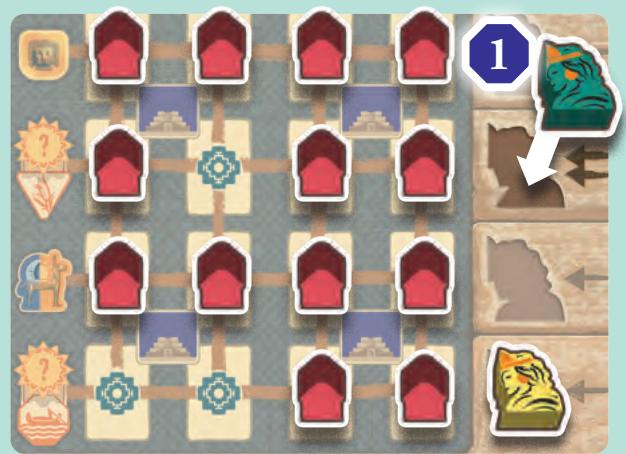
2.Move the Ayar: They move the teal Ayar 2 movement spaces 2, as determined by the arrows on their Player board.
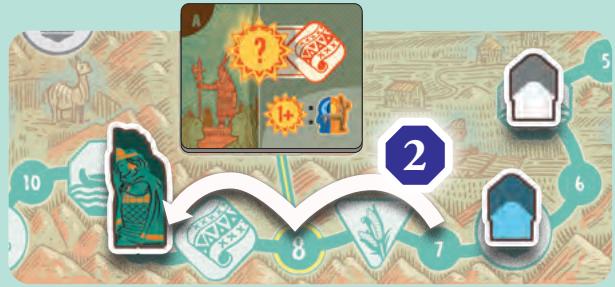
3.Choose and place a Tambo: Pink then takes a Tambo from the row where they placed their marker a. They place it on the empty terrace farming slot behind the teal Ayar 3b

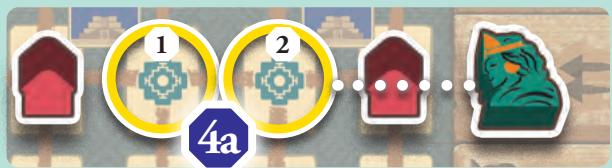
4.Perform the activity: 'They perform a terrace farming activity with a power of 2 due to the two empty slots in their selected row 4a. They place 2 Maize in the terrace farming area 4 of the Lake board. In doing so, they reveal a new Sun on their Player board, which would improve any terrace farming Inti devotion gained from future personal bonuses and Raymi tiles.

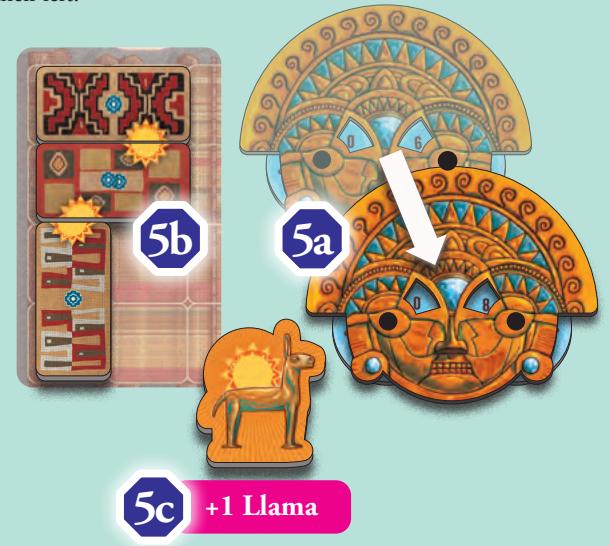
5.End-of-turn checks: They do not place any Temples because the quadrant still has Tambos in, and they trigger no personal bonuses this turn. However, the teal Ayar has passed a Raymi tile that scores for weaving. Each player increases the devotion on their Inti dial 5a according to the number of visible Suns in their weaving area Because Pink has at least one Sun in this area, they also take a Llama 5 . They then flip the Raymi tile, and play passes to their left.
NIGHT PHASE
After all players have used all their available Step markers, they will enter the night phase, where Moon points are scored for Mama Quilla and Sun points for Inti. This phase has 6 steps:
-
An Ayar retires
-
Harvest Maize
-
Score Temples
-
Score Step marker
-
Dawn
-
Prepare
1. An Ayar Retires
First, check how far each Ayar has travelled by looking at the number on their movement space. The Ayar that has travelled the least (the one on the lowest number) will retire. In the final night phase, the last remaining Ayar will retire.
In the case of a tie, look at the position of the female Ayar in the Temple area. The tied Ayar whose female partner is in the row furthest down in the Temple area will retire.
Place the retiring male Ayar in the Temple area, on the rightmost Ayar slot of the row that contains their partner.
2. Harvest Maize
The player who planted the most Maize in the terrace farming area of the Lake board this round will gain the Viracocha next to the female Ayar in
In the case of a tie, the tied player who planted any Maize first will get the Viracocha. If none of the players planted any Maize, return the Viracocha token to the supply.
Then remove all the Maize from the terrace, returning it to the game box.
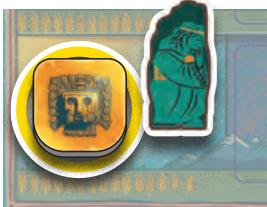
3. Score Temples
Before scoring Temples, any players who have unlocked the pictured Viracocha bonus (right) will now gain 2 Moon points for each Temple they have in the Temple area.
The female Ayar whose partner is retiring then walks along the row from left to right, scoring every Temple on the way. The owner of each Temple immediately scores Moon points for the Temple's activity (see pages 9-10), along with any bonus Moon points shown above the column, by moving their Score marker on the main track

After scoring the Temples, return them all to the box.
The Ayar couple then reunites in the Ayar slot at the end of the row
4. Score Step Marker

In clockwise order from the player with the First Player token, each player places the Step marker matching the retired Ayar onto one of the remaining empty slots above the Tambo grid on their Player board. This marker no longer counts as one of your available Step markers, and it will not move for the rest of the game.
Score your Moon points for the activity shown on the slot where you placed the marker (see pages 9-10).

MOON SCORINGS
You may want to save scoring Moons for your highest-scoring activities until a later round. Don't be afraid to score zero in round 1!
5. Dawn
All players now look at the current value on their Inti dial and gain that many Sun points on the main scoring track.


INTI DEVOTION
The Inti dial stays at its current value, so you will score those points again in each future Dawn phase.
6. Prepare
Stand up all remaining Step markers in their current slots next to the Tambo grid.
The First Player token then passes to the next player moving clockwise, and a new day phase begins.

PLAY EXAMPLE: NIGHT PHASE
- An Ayar retires: At the end of the first day phase, the grey Ayar and the teal Ayar have travelled the least (5 steps each). The teal Ayar is in a lower row in the Temple area, so the teal Ayar retires and is placed to the right of the Temple area.
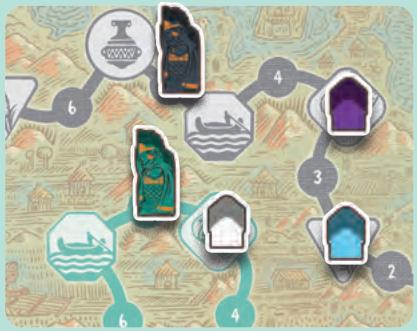

- Harvest Maize: Blue and Pink both planted 2 Maize each, tying for majority. However, Blue planted Maize first, winning the tie and gaining the Viracocha for this round. 'They take the Viracocha next to the teal Ayar.
- Score Temples: The female teal Ayar now walks down the row of Temples. White scores their Moons for reed bundling and gains a bonus of 6 points for being in the first slot.
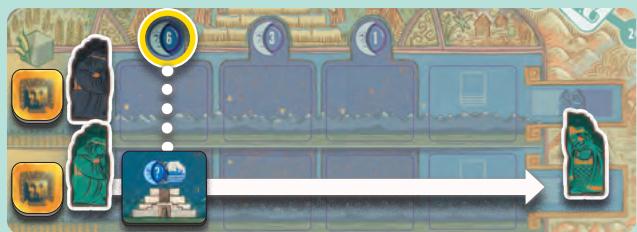
- Score Step marker: Each player now places their teal Step marker into one of the Moon slots on their Player board. Pink decides they want to gain some Moons early, so they score for pottery and gain 6 points. All other players want to save their higher-scoring activities for later Moon scorings, so they each place their teal marker in a spot where it gains 0 points.

5. Dawn: All players translate their Inti devotion into Sun points.
- Prepare: All players stand up their remaining Step markers, the First Player token passes to Blue, and they start the second round.
GAME END
After the fourth night phase, the game will end.
You may now use the Llamas you acquired over the course of the game to earn additional Sun and Moon points. Each player can split their Llamas between Sun and Moon as they choose, adding points to the respective Score markers as indicated by the conversion chart shown below.
All players then score only for the lowest of their two Score markers (whether it is Sun or Moon). The player with the highest score of these is the winner.
In the case of a tie, the tied player whose other Score marker is the closest to the former is the winner. If there is still a tie, the tied players share the victory.

SOLO MODE
In the solo mode of Ayar, you will play against one of the Ayllu. In these rules, you' or yourself' refers to the human player, and it', 'they', or 'the Ayllu' refers to your automated opponent.
Playing the solo mode of Ayar requires you to be familiar with the main rules.
Setup
Historical note
In the Andes, the Ayllu are a social group larger than the household yet smaller than the ethnicity or polity. Ayllus are kin-based communities, each of whose members claim descent from a common ancestor.
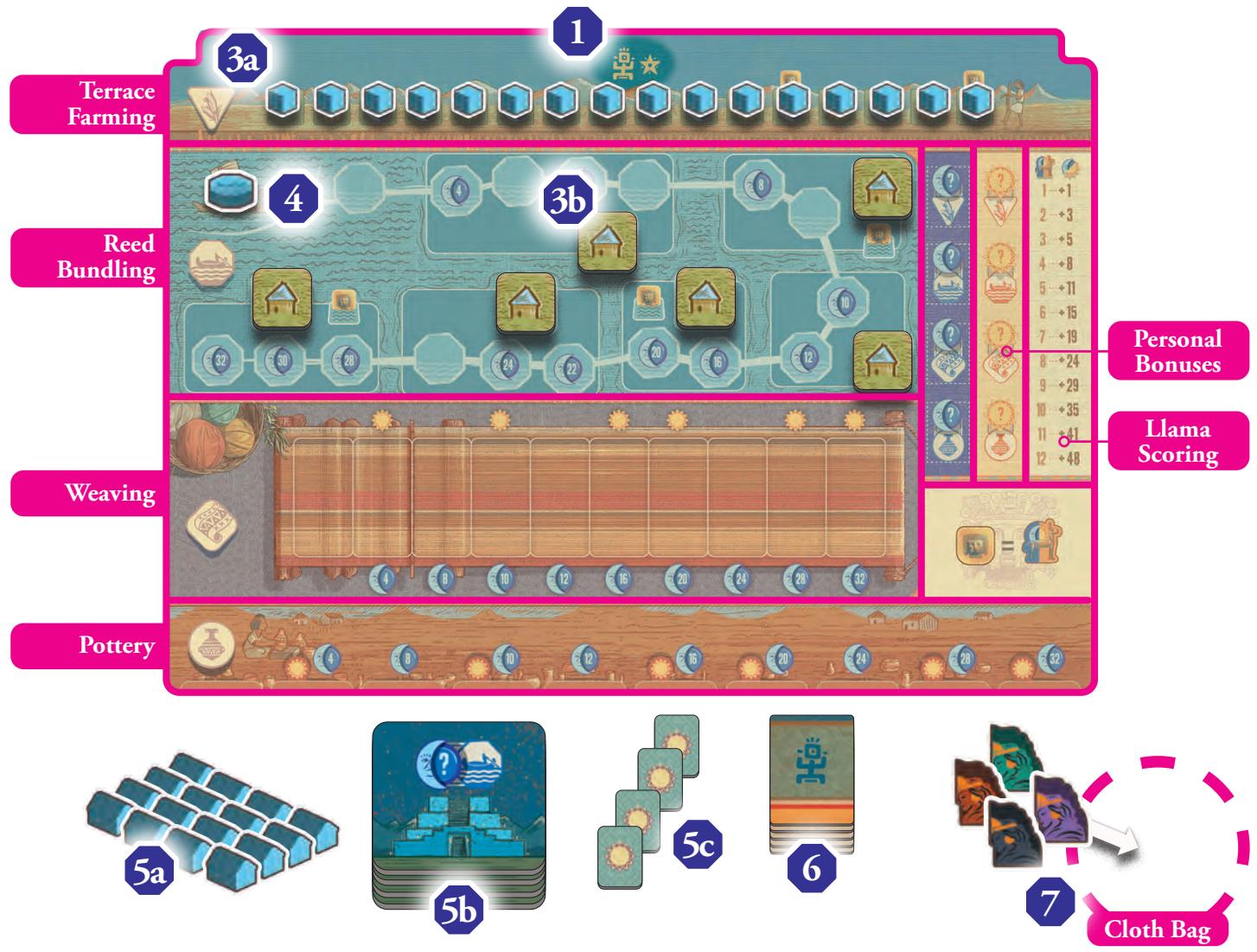
-
Choose a difficulty level and find the appropriate Solo board. The difficulty level is shown on each Solo board by the number of
-
Choose a player colour for the Ayllu, and give them all pieces of their colour.
-
Place the Maize 3a and Islands 3b on the matching slots of the Solo board. Any spare Maize can be returned to the box.
-
Place the Boat on the start space of the reed bundling track4 Solo board.

- Place the 16 Tambos 5a , 4 Temples 5b, and 4 Bonus markers next to the Solo board.


-
Shuffle the 5 Activity tokens and place them in a face-down stack next to the board.
-
Place the gold Step marker back in the box (it won't be used by the Ayllu) and put the 4 coloured Step markers in the cloth bag 7

-
Set up the Main board, supplies, and your Player board as you would for two players.
-
Give the First Player token to yourself.

Activity Tokens
During an Ayllu's turn, they will draw 1 Activity token, which helps dictate their turn.'
Power level based on round number
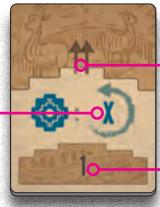
Ayllu steps
Removed in round 1

The Ayllu places a Temple at the end of a turn in which they draw the token with a Temple icon.
To decide which Temple to place, identify which activity with a remaining Temple the Ayllu currently has the most Moons for. If there is a tie, choose the available Temple whose activity is topmost on the Solo board.
Place the chosen Temple on the row of the Temple area with the Ayar that matches the drawn Step marker.
Viracocha
Every time the Ayllu would gain a Viracocha, it gains a Llama instead.
Day Phase
Refer to the main rules for how to take your turn. On the Ayllu's turn, follow these 4 steps.
-
Flip the top Activity token from the stack and randomly draw a Step marker from the cloth bag. If the bag is empty, first put all the markers back into the bag. Then draw one as usual for the Ayllu's last turn of the round.
-
Move the Ayar whose marker was drawn by the number of steps indicated by the arrows on the Activity token.
-
Place a Tambo on that Ayar's path, following the rules in Placing Tambos’.
-
Resolve the activity with a power equal to the current round plus any modifier shown on the Activity token. For example, if the Ayllu draws a tile with X +2 on the first round, the activity will have a power of 3.
-
Resolve any Raymi scorings as in the multiplayer game. The Ayllu may place a Temple if it drew the appropriate Activity token (see above).
You and the Ayllu will both have the same number of turns each day phase.
0. Starting Activity
At the start of the first day phase only, you complete the starting activity as normal by placing one Tambo from your board and performing the activity at power 1.
The Ayllu places their Tambo on the slot whose activity matches the activity on one of the two Raymi tiles linked to the 8’ movement spaces. If there is still a choice of slots, they choose the one whose Ayar in the Temple area is in the topmost row.
Placing Tambos
When placing a Tambo and more than one building slot of different activities are available, the Ayllu follows these tiebreakers:
-
If the Ayllu has already reached the maximum on the Solo board for any activity, they ignore all related building slots. Terrace farming and reed bundling are at maximum when all pieces of that type have been placed, whereas weaving and pottery have reached maximum when all slots of that type on the player board are full.
-
Pick the building slot whose activity matches the first unscored Raymi tile for the Ayar on this path. If the Ayar's movement this turn took it past a Raymi tile, the Ayllu will still choose a building slot matching that tile's activity, as it hasn't scored yet.
-
If there are no available building slots for that Raymi tile's activity, check the next closest Raymi tile on the same path, and so on.
-
If there are no available building slots for the remaining Raymi tiles, or if there are no more Raymi tiles, pick the activity of the topmost unscored personal bonus on the Solo board with available building slots.
-
If there is still no matching building slot, pick the topmost activity with available building slots that has not had its night phase Moons scored.
-
If there is still no matching building slot, pick the building slot closest to the Ayar.
During any of these tiebreakers, if there is more than one possible building slot for the chosen activity, pick the one closest to the Ayar.
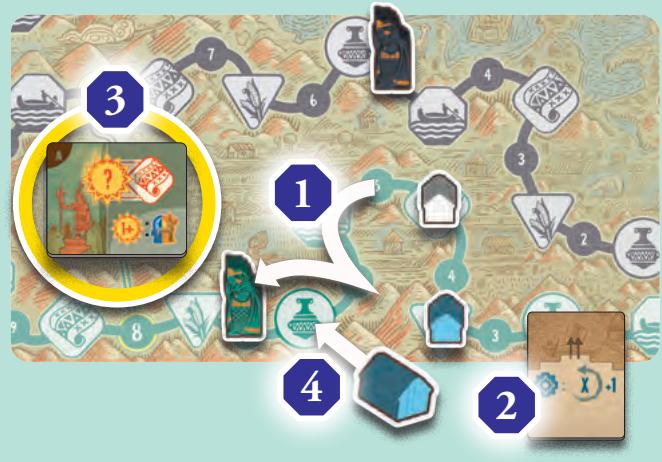
PLAY EXAMPLE: PLACING TAMBOS
The Ayllu moves the teal Ayar forward by 2 movement spaces as indicated on the activity token②

They have not reached the maximum on the Solo board for any activity, so are choosing between all available building slots.
The closest Raymi tile3scores weaving, but there are no available weaving building slots behind the teal Ayar. The Ayllu then looks at the next-closest Raymi tile, which scores pottery. 'There are two available building slots for this activity, so they place a Tambo4 on the one closest to the Ayar.
Activities

Pottery
The Ayllu takes the highest quantity of Pots compatible with their power. If they have a choice, they will choose to take Pots with Viracocha icons. If they still have a choice, they take from the lower slot.
After taking Pots, slide all the remaining Pots downwards, flipping over Pots from the stack to fill any empty slots. Place all Pots on the pottery track on the Solo board, filling the slots from left to right.
Inti Devotion: Count the Suns above each Pot.
Moon Scoring: Use the value above the rightmost Pot.

Weaving
The Ayllu takes different Textiles depending on their power. With a power of 1 or 2, they take the top Textile from the corresponding stack. With a power higher than 2, they take the top Textile from stack 1 and the top Textile from stack N-1, where N is their power.
Place the Textiles in the weaving area on the Solo board, filling the slots from left to right.
Inti Devotion: Count the Suns above each Textile.
Moon Scoring: Use the value below the rightmost Textile.

Terrace Farming
The Ayllu places Maize equal to the current power into the terrace area of the Lake board. They take this Maize from the Solo board, taking from left to right. 'The Ayllu will take a Viracocha from the supply when placing Maize from the slots with a Viracocha icon above it.
Inti Devotion: Count the visible Suns.
Moon Scoring: Use the rightmost visible value in the terrace area.

Reed Bundling
The Ayllu moves their Boat along its track by the number of spaces equal to their power.
When the Ayllu enters one of the sections on their Boat track, they place the Island from that section on the Lake board space whose Moon value matches the value indicated on the highest space reached within that section. If the Ayllu moved through a section during their turn, they use the highest value of that section for placing the Island.
The Ayllu cannot place an Island in a yellow slot where you already have an Island. If they would do so, instead place the Island on the empty yellow Island slot with the next highest value. If there are no available slots of this type, place it instead on the empty yellow Island slot with the next lowest value.
If the Island placed has a Viracocha icon next to it on the Solo board, take a Viracocha from an adjacent lake area as usual. When choosing between two or more lake areas, the Ayllu picks the area with the lowest number on their highest-valued adjacent Island.
Inti Devotion: Count the visible Suns uncovered by the Islands.
Moon Scoring: Use the highest value of a placed Island.
PLAY EXAMPLE: AYLLU REED BUNDLING
The Ayllu has already placed their first two Islands on the Lake board slots worth 4 and 8 Moon points. They now do a reed bundling activity with a power of 3, moving their Boat 3 spaces along its track.
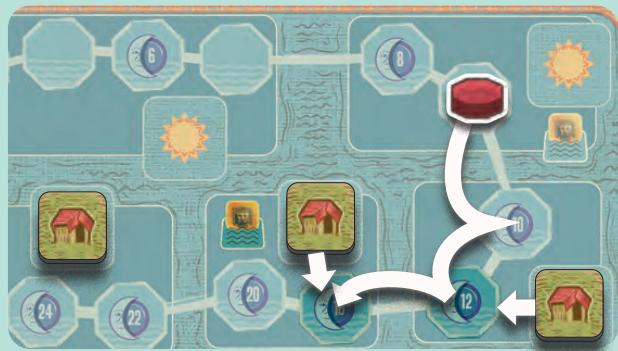
As they pass through their third track section, they place the Island there on the slot with the higher of the two Moon values shown: 12. They also place their fourth Island on the 16 Moon slot because their Boat lands there.
Placing the Island from the fourth slot requires the Ayllu to take a Viracocha from an adjacent lake area. They have a choice of two, and pick the bottom one, as the highest value of its Islands adjacent to this area (12) is lower than the highest adjacent to the top area (16). As per the solo rules, the Ayllu discards that Viracocha and takes a Llama from the supply instead.
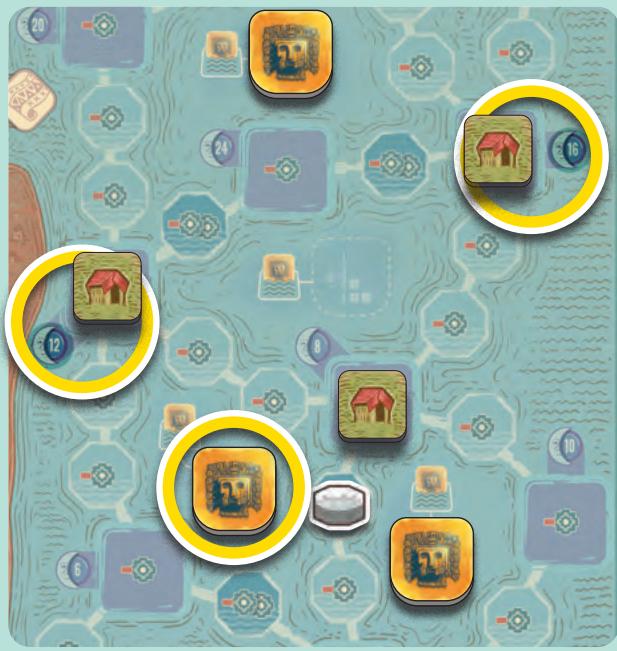
Night Phase
Proceed to the night phase when you have played all your Step markers, and the Ayllu has completed the same number of turns as you. Complete the night phase as normal, with the following changes:
• In the Score Step Marker' step, place the Step marker on the empty slot for the activity that the Ayllu has the most Moons for. In the case of a tie, choose the activity that is topmost on the Solo board. The Ayllu then scores that activity's Moon points (see previous page).
• In the Dawn' step, place a Bonus marker on the empty slot for the activity that the Ayllu has the most Suns for. In the case of a tie, choose the activity that is topmost on the Solo board. Increase the Ayllu's Inti dial by this amount. Then perform the normal dawn step, moving the Ayllu's Sun marker on by the amount on the Inti dial.
• In the Prepare' step, put all remaining Ayllu Step markers in the bag. Remove the Activity token displaying the number of the current round, then shuffle the rest back into a face-down stack. Pass the First Player token in the Prepare step as normal.
Game End
To calculate the Ayllu's score, assign the Llamas to their Sun and Moon markers to maximise their final score. The Ayllu uses the Llama conversion printed on their board.
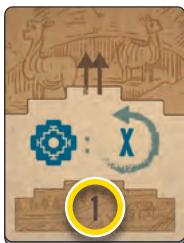
HL
VIRACOCHA BONUS REFERENCE
Viracocha can unlock permanent or one-use bonuses. When you gain a Viracocha, immediately place it on one of the bonus slots on your Player board.
Once placed, Viracocha may not be moved.
When you have placed the number of Viracocha indicated next to the slot, the bonus is immediately available to you. Place the Viracocha with its completed side face up to make this clear. You may not add any more Viracocha to the slot.
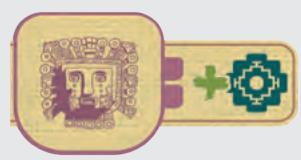
Placing 2 Viracocha in one of these slots permanently gives you 1 extra power for all activities of that type. If you gain this bonus during an activity, you may immediately apply it. The bonus enables you to reach a maximum of 5 power for an activity.
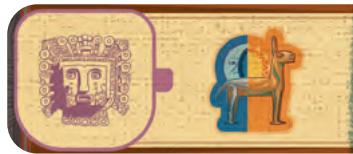
Placing 1 Viracocha here immediately gains you a Llama.
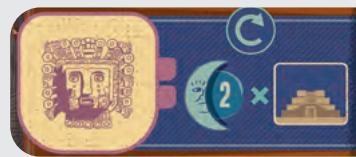
Placing 2 Viracocha here permanently increases the number of Moons gained during each night phase. Before you score Temples during step 3 of the night phase, gain 2 Moon points for each Temple you still have on the board.

Placing 3 Viracocha here permanently gives you 1 extra Sun whenever you gain Inti devotion from any activity. This counts for Raymi scoring and when scoring personal bonuses.
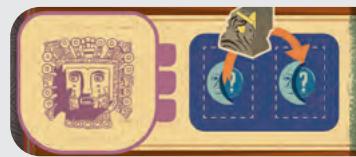
Placing 3 Viracocha here immediately allows you to move one of your retired Step markers to a different slot, making the slot available again for future Moon scoring.

Placing 4 Viracocha here immediately adds 6 to your Inti dial for each Inti personal bonus already scored (tracked using markers).
Cultural Historical Reference
In the fifteenth and early sixteenth centuries, the Inca created the most extensive and powerful empire in pre-Columbian South America. Before it collapsed as a result of European-introduced diseases, a bloody civil war, and, ultimately, the Spanish conquest, this empire – Tawantinsuyu — spanned a vast area from southern Colombia to central Chile. From his capital in Cusco in the southern Peruvian highlands, the Inca emperor ruled over some 10 million people belonging to dozens of ethnic groups. As one way to validate their rule, the Inca employed a complex system of elaborate myths and lavish religious ceremonies. A central component of Inca religion was their origin myth, some 40 versions of which were written down in the sixteenth and seventeenth centuries. According to most versions, the first eight Incas — the Ayar siblings – emerged into the world from the cave of Pacaritambo, located some 30 kilometres from Cusco. In other important versions of the myth, however, the Ayar siblings were created in the Lake Titicaca region, where the influential Tiwanaku polity had flourished in the second half of the irst millennium of the Common Era. This intriguing and lavishly illustrated game takes this second narrative as its starting point.
- Antti Korpisaari
Download MarkdownTexts are community-compiled or publicly released by publishers; copyright remains with the original authors. For personal reference only.