
Backgammon
At a glance
Rules, cards and Q&A (Chinese)
The rules, card data and player questions for this game are written in Chinese. Open the Chinese page to read them.
Where to find full rules
Full rules and card lookup are available in the cunlema app at cunlema.cn — pick this game and ask about any rule, card or turn you are unsure about.
Related games
Rulebook text (Markdown)
This game has 1 rulebook Markdown file(s) in our library; 1 rendered inline below — expand to read or download.
BACKGAMMON_EN.md6.6 KB
BACKGAMMON A board game for 2 players
INTRODUCTION
Backgammon is one of the oldest board games for two players in which the playing pieces are moved according to the roll of dice. Players win by removing all of their pieces from the board.
COMPONENTS
Backgammon includes:
- A Backgammon board
- 15 white stones
- 15 blue stones
- 2 dice
- 1 red counter (the doubling counter)
SETUP
Each side of the board has a track of 12 long triangles, called points. The points are considered to be connected across one edge of the board, forming a continuous track in the shape of a horseshoe, and are numbered from 1 to 24. One player uses the white stones and the other uses the blue stones. Both players place their pieces on the board according to the following picture:
White’s outer board
White’s home board
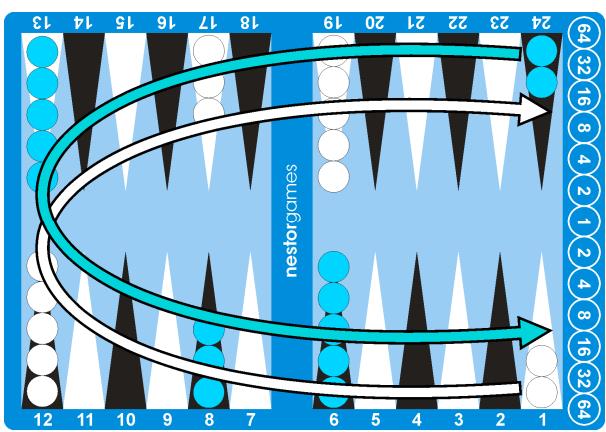
Blue’s outer board
Blue’s home board
Arrows indicate paths of movement for white and blue.
RULES
The objective is to remove (bear off) all of one's own stones from the board before one's opponent can do the same. The stones are scattered at first and may be blocked or hit by the opponent. As the playing time for each individual game is short, it is often played in matches, where victory is awarded to the first player to reach a certain number of points.
To start the game, each player rolls one die, and the player with the higher number moves first using both the numbers shown. Both dice must land completely flat on the right hand side of the gameboard. The players then alternate turns, rolling two dice at the beginning of each turn.
After rolling the dice players must, if possible, move their stones according to the number of pips shown on each die. For example, if the player rolls a 6 and a 3, that player must move one stone six points forward, and another or the same stone three points forward. The same stone may be moved twice as long as the two moves are distinct: six and then three, or three and then six. If a player rolls two of the same number, called doubles, that player must play each die twice.
For example, upon rolling a 5-5 that player may move up to four separate stones forward five spaces each. For any roll, if a player can move both dice, that player is compelled to do so. If players cannot move either die in a roll, given the position of their stones then that turn is over and the turn passes to the opponent.
If it is possible to move either die, but not both, the higher number must be played. For example if a player rolls 6-3 and can only move a 6 or a 3, the 6 being the bigger number must be moved; if it is possible to move the 3 but not the 6 then the 3 is played. Further, if one die is unable to be moved, but such a move is made possible by the moving of the other die, that move is compulsory.
For example, in the case of a 6-3 roll, no moves of 3 are possible by any stone. However there are 2 moves of a 6, with stone A or stone B. If stone A is moved 6, the 3 still cannot be played. If stone B is moved 6, a 3 now may be played. The rules state that the player is forced into moving stone B 6 points, and then 3. In short, the rules compel a player to exhaust every option available to complete both die moves where possible.
In the course of a move, a stone may land on any point that is unoccupied or is occupied only by a player's own stones. It may also land on a point occupied by exactly one opposing stone, or "blot". In this case, the blot has been hit, and is placed in the middle of the board on the bar that divides the two sides of the playing surface. A stone may never land on a point occupied by two or more opposing stones; thus, no point is ever occupied by stones from both players simultaneously.
Stones placed on the bar re-enter the game through the opponent's home board. A roll of 2 allows a blue stone to enter on the 23-point, a roll of 3 allows a white stone to enter on the 3- point, and so forth. A player may not move any other stones until all stones on the bar belonging to that player have re-entered the game.
When all of a player's stones are in that player's home board, that player may start removing them; this is called bearing off. A roll of 1 may be used to bear off a stone from the 1- point, a 2 from the 2-point, and so on. A die may not be used to bear off stones from a lowernumbered point unless there are no stones on any higher points. For example if a player rolls a 6 and a 5, but has no stones on the 6-point, though 2 stones remain on the 5-point, then the 6 and the 5 must be used to bear off the 2 stones from the 5-point. When bearing off, a player may also move a lower die roll before the higher even if that means 'the full value of the higher die' is not fully utilized.
For example, if a player has exactly 1 stone remaining on the 6-point, and rolls a 6 and a 1, the player may move the 6-point stone 1 place to the 5-point with the lower die roll of 1, and then bear that stone off the 5-point using the die roll of 6; this is sometimes useful tactically.
If one player has not borne off any stones by the time that player's opponent has borne off all fifteen, then the player has lost a gammon, which counts for double a normal loss. If the losing player has not borne off any stones and still has stones on the bar or in the opponent's home board, then the player has lost a backgammon, which counts for triple a normal loss.
THE DOUBLING TRACK
(The doubling track substitutes the ‘Doubling dice’)

The doubling track
To speed up match play and to provide an added dimension for strategy, the doubling track may be used. At the start of each game, the red counter is placed on the ‘1’ circle of the doubling track. Before rolling the dice on their turn, players may propose that the game be played for twice the current stakes. Opponents must either accept ("take") the doubled stakes or resign ("drop") the game immediately. If the opponents take, he takes the red counter and places it on the next power of 2 on his side of the board.
Example: The red counter is on space ‘4’ on blue’s side of the board. Then blue proposes to double the stakes. White accepts and places the red counter on the ‘8’ space on his side of the board.
Thereafter, the right to re-double belongs exclusively to the player who last accepted a double.
If the opponent drops the doubled stakes, he loses the game at the current value of the doubling cube. For instance, if the counter was on ‘8’, and a player wanted to redouble the stakes to put it at ‘16’, the opponent choosing to drop the redouble would lose a ‘8’ points game.
Download MarkdownTexts are community-compiled or publicly released by publishers; copyright remains with the original authors. For personal reference only.