
Bios Genesis
At a glance
Rules, cards and Q&A (Chinese)
The rules, card data and player questions for this game are written in Chinese. Open the Chinese page to read them.
Where to find full rules
Full rules and card lookup are available in the cunlema app at cunlema.cn — pick this game and ask about any rule, card or turn you are unsure about.
Related games
Rulebook text (Markdown)
This game has 9 rulebook Markdown file(s) in our library; 3 rendered inline below — expand to read or download.
Bios Genesis Rulebook CS4 v3.md138.5 KB
·● SECOND EDITION●·.
BIOS:GENESIS THE MOLECULAR ARMS RACE GAME
BYPHIL EKLUND
A. WHAT’S THIS GAME ABOUT?
One to four players start as organic compounds shortly after Earth’s formation, represented by up to three Biont tokens. The Amino Acids (Player Red) command Metabolism, the lipids (Player Yellow) create cells, the pigments (Player Green) control energy absorption and storage, and the nucleic acids (Player Blue) control templated replication.1 Their goal is a double origin of life: first as Autocatalytic Life (a metabolic cycle reproducing its own constituents yet not replicating),2 and the second as Darwinian Life (an Organism using a template to replicate in an RNA world).
Warning, this is a brutal game of survival. The players may decide to cooperate rather than compete, see C3. A less brutal variant is found in C4.
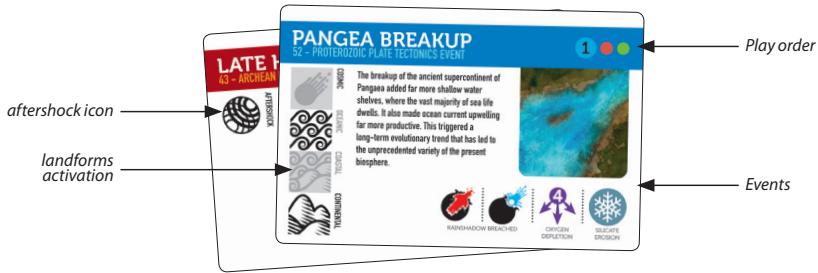
The Event Phase starts the turn. Each event card encapsulates 200 million years, and the game may last 21 events (about 18 turns, the first 4 billion years of Earth’s 4.6 billion year history). Each event depicts which Landforms (cosmic, ocean, coastal shelf, or continent) are active for the turn.
In the Assignment Phase, players attempt to create autocatalytic life by assigning one starting Biont to one of the Refugia, placards representing suitable hatcheries for life either on Earth or in space. These sites contain “building block” cubes called Manna, which reside in either disorganized (dead) or organized (metabolically-alive) populations. You may also assign a Biont to become a Parasite, if there are any Hosts available. To be suitable, a Host must have Mutations or Organs that you can invade as a Disease. If any of your Organisms has a HGT (horizonta gene transfer) Mutation, you may move your Bionts from one Microorganism to another. You always have at least one Biont available to assign to Refugia or to a Parasite, unless all of your Bionts are already employed inside Organisms.
In the Autocatalytic Phase, a roll is made for each Refugium which may move Manna from disorganized to organized, or vice versa. The number of dice rolled is equal to the number of organized Manna, plus two dice for each Biont, either friendly or enemy. If you roll doubles, you may flip the placard and move it, along with organized Manna, to start your tableau. This side of the card, called Bacteria, represents Darwinian Life. Bacteria and Parasites are collectively called Microorganisms.
Bios Genesis postulates an extensive pre-LUCA (Last Universal Common Ancestor) evolution of life, where four parallel lineages are represented by the four players. Although Player Blue is the only player starting with exacting replication with heredity and portable templates, all four undergo natural selection using reproduction, specificity, or immortality. To use a computer analogy, the metabolism, specificity, and energy is provided by the hardware, and the heredity is provided by the software. The hardware was already in place when the LUCA invented RNA, an upgrade which spread by HGT to all the other bits of hardware floating around. In other words, the LUCA did not supplant all the other life, but merely provided a software upgrade. In computers as in life, software is subservient to hardware. The LUCA reproduced by RNA, and so is simulated in the game with the first purchased mutation (unpromoted mutations are RNA-based). The first mutation promotion simulates the upgrade to DNA (promoted mutations are DNA-based).
Replication is the ability of a molecule to make a copy of itself by a specific chemical process, with a specific margin of error. Modern biological replication uses the bases on a nucleic acid strand as a template to form a complementary base-paired strand, built from manna-like raw materials. Replication is not the same as reproduction. Replication ends up with two approximate equal-sized copies, while reproduction ends up with two “halflings”. Soap bubbles (and presumably the earliest protocells) can reproduce merely by being split into two halves, each daughter cell with part of the cellular constituents. But only molecules with templates can replicate.
Four critical life parameters are tracked by Chromosome cubes on your Microorganism or its Mutations: Metabolism (how well you manufacture Catalysts), Specificity (the error rate of inappropriate Catalysts admitted into the cell), Entropy (how many Bionts you can have assigned to Refugia), and Heredity (fidelity of templated transmission into daughter populations). In the Darwin Phase, each of your Microorganisms makes a Darwin Roll, rolling a number of dice equal to the number of tokens on it or on its Mutations. If your Heredity is not high enough to survive Error Catastrophe, your Microorganism sufers an Atrophy (token loss) for each excess error.
With a suficiently good Metabolism, both the Autocatalytic and Darwin Rolls generates disks called Catalysts. In the Assignment Phase, spend these as Enzymes which helps organize more Manna for future Chromosomes in the Autocatalytic Roll. Catalysts are also used in the Purchase Phase to make one purchase for each Biont, which can be for a Mutation, Mutation promotion, Macroorganism upgrade, Red Queen, or Organ. A Mutation is a card placed in your tableau alongside a Microorganism, giving it Chromosomes and Abilities. Photoautotroph Mutations3 add to your Entropy, but also pollute the air with oxygen. You will need Antioxidants to survive this oxygen spike. Red Queen acts against your Host or Parasite, making Chromosomes either Diseased or undiseased.
Each player maintains a tableau, and a pool of Catalysts tied to that tableau. Each Biont in an Organism, even ones belonging to other players (Parasites, Foreign Genes, and Endosymbionts), may make one expenditure per turn for that Organism, all using the same pool of Catalysts in the tableau that Organism resides in. If you produce Catalysts, these also go to the tableau pool the Organism reside in
The game ends when the events run out, or Earth becomes uninhabitable. The winner is the player with the most number of cubes in his Organisms, plus Bionts of his color in play. If playing the [advanced] game, each Macroorganism gets bonus VP according how high it is in the food chain in both land and sea. Solitaire (C2) and cooperative (C3) games have special victory conditions.
The [advanced] Game introduces Macroorganisms, cards that elevate Bacteria from single cell to multi-cell which gives you VP. If the elevated Bacteria had Parasites or Foreign Genes, they now become Endosymbionts, hybridized to the Macroorganism and sharing equally its VP. The Endosymbionts and Organs also give the Macroorganism extra powers such as shielding from catastrophes. New Parasites can attach to a Macroorganism by infesting its Organs. Since Parasites don’t share VP like Endosymbionts do, they should attach to a Bacterium BEFORE it becomes multicellular.
• The Style Rule. Terms being defined are listed in bold, or italicized if defined elsewhere. Capitalized terms are defined in the glossary.
• The Golden Rule. If the text on a card contradicts these rules, the card has preference.
A1. BIOS GENESIS4 SEQUENCE OF PLAY (five phases per turn)
-
EVENT (Part D). Turn over the next event card. Flip Landforms & Roil Mutation decks (D2). Apply event icons to all players (D3 to D10).
-
ASSIGNMENT (Part E - in player order). Assign Biont and Catalyst tokens (E1) respecting Entropy limits (E2). Assign Parasite Biont to attach (E3) or supplant (E4). Assign Catalyst tokens as Antioxidants or Vitamins (E5). Move Bionts from one Microorganism to another using HGT(E6).
-
AUTOCATALYTIC ROLL (Part F - in refugia order).5 Make an Autocatalytic Roll for Bionts in Refugia. See how many Manna become organized (F1). See how many Manna become disorganized, generating a Catalyst (F2). Doubles creates life (F3).6
4. DARWIN ROLL (Part G) in Player Order.
Make a Darwin Roll for each Microorganism.
Roll modification for Specificity (G1).
Catalyst Creation for Biosynthesis (G2).
Atrophies (token losses) & Extinctions (see glossary).
- PURCHASE (Part H) in Player Order (except Parasites purchase immediately after their Host).
Each Biont makes a purchase: a new Mutation (H1), Mutation promotion (H2), Macroorganism (H3), Red Queen (H4), or Organ (H5).
- Then go to the next turn. Two hundred million years have passed.
| JARGON TABLE | Cube | Disk | Dome |
| Bacterium Placard | Chromosome | Vitamin (green)Antioxydant (red, yellow or blue) | ChromosomeBiont (own)Foreign Gene (opponent's biont) |
| Macroorganism Card | Organ (Chromosome) | Vitamin (green)Antioxydant (red, yellow or blue) | ChromosomeTrophic BiontEndosymbiont Chromosome Biont |
| Mutation Card | Mutation (Chromosome) | ||
| Parasite Card | Diseased cube (Chromosome) | ChromosomeBiontForeign Gene (opponent's biont) | |
| Refugium Placard | Manna | Enzyme | MannaBiont |
| Tableau Pool | Catalyst | Unassigned Biont |
life was present even though signs of Metabolism were detected.) For this game, I have expanded the NASA definition to include two more properties of life: cell-based selectivity (follows the biologists’ definition that non-cellular entities such as viruses are not alive) and nonequilibrium maintenance (follows the Erwin Schrödinger definition of life). I further suggest that all four may have had separate origins, but have since adopted the same RNA-DNA replication software, starting with the LUCA (Last Universal Common Ancestor). These four properties correspond to the four players in the game: red = Metabolism (self-sustaining feedback loops), yellow = Specificity (discrimination about its own constituents, allowing individual identity and natural selection), green = negative Entropy (non-equilibrium energy), and blue = Heredity (the capacity to pass on attributes to a new population).
A2. PLAYER ORDER

On each event card, just above the event icons, is a row of three colored icons. For 1 aftershock events (D1), it’s the event after the aftershock(s) that has these icons. The leftmost icon indicates the color of the first player, who is the first to perform his actions in each phase. Then play goes clockwise.
• Two or Three Player Game. If the first player is a color who is not in the game, the second color in the row is the first player, etc.
• Wanton First Player. At the beginning of any phase, if there is a player with more wantonness than any other, he may declare himself to be the first player that phase (then proceed in Player Order with the next player the color of the leftmost icon). A player’s Wantonness is defined as the number of HGT icons on all his Y Microorganism’s Mutations and Microorganisms he resides in (as a Foreign Gene).
• Parasite Exception. During Phase H (purchases) a parasite purchases immediately after its Host.
• Pass. During Phase E (assignment) or H (purchases), a player may elect to do nothing.
B. COMPONENTS

16 wooden domes represent Bionts. You start the game with three or four in your player color: red = metabolic biont, yellow = cellular biont, green = energyabsorbing biont, and blue = replicative biont.7

64 wooden cubes represent Manna if on a Refugium, a Chromosome if on an Organism or Mutation, and an organ if on a Macroorganism. There are 16 in each of the player colors: red = Amino Acids, yellow = lipid vesicles, green = PAH (polycyclic aromatic hydrocarbons)8 and blue = nucleobases.
Note: Even though Manna/Chromosomes come in player colors, they are not necessarily controlled or counted for victory by the player of its color.

48 plastic disks represent Catalysts. They come in the four player colors (12 of each color): red = peptides, yellow = lipid micelles, green = thioesters, and blue = nucleotides. A disk played into a Refugium is called an Enzyme, and onto an Organism is called an Antioxidant/Vitamin.
• 60 cards. There are 4 Landforms, 24 Events, 20 Mutations (double-sided, prokaryote on the unpromoted side, and eukaryote on the promoted side)9, 4 Parasites, and 8 Macroorganisms. See card anatomy on the side of the box.
• 16 placards. The front side is a Refugium, and the reverse is a Bacterium. See placard anatomy on the side of the box.
• 12 six-sided dice (12d6). Use for Autocatalytic and Darwin Rolls.
B1. TABLEAU MANAGEMENT
An Organism is a Bacteria, Parasite, or Macroorganism with at least one Biont. Your tableau consists of the placards and cards for your Bacteria and Macroorganisms, plus (to the right) the cards for their Mutations (H1), plus (to the left) the cards for their Parasites (which belong to other players).
• Tableau Size Limit. In your tableau, you can have up to three Organisms plus up to one Parasite (which belongs to another player) for each one.
• Cards in hand. There is no hand.
B2. CUBE LIMITS
Store all unused cubes in a public bowl or area called the soup. If cubes run out, then use substitutes.
Easily missed rule : Return all cubes lost in the game to the soup.
B3. DISK LIMITS
Store all unused disks in the soup, along with the cubes.
• Tableau Pool. Each player maintains a pool for his unassigned Bionts and Catalysts. This pool is tied to his tableau, so that any Biont in the Tableau (including foreign ones such as Parasites) spends from it. Any Organism in this tableau that produces Catalysts through Biosynthesis adds to this pool.
Easily missed rule: For your Parasite, you may pay with your own Catalysts, the host’s Catalysts, or some combination thereof.
• Pool Limit. The number of Catalysts in each color in each tableau pool is limited to 12 divided by the number of players in the game
Example: In a 3-player game, your tableau pool is limited to 4 red disks.
During Biosynthesis, for every full two Catalysts you cannot take because of the pool limit, you can substitute one Catalyst of any other color that does not exceed the limit. If disks run out, then use substitutes.
B4. BIONT LIMITS
You start with three bionts in the 4-Player game, and four otherwise. Your three Bionts are initially stored in your tableau pool. You never gain or lose Bionts to the soup, but normally you are allowed to have only one assigned to Refugia (see E2) and any number assigned to Organisms.

• Compensation Biosynthesis. Whenever one of your Bionts is returned to your pool as of your color to your pool as compensation.
Easily missed rule : Bionts moved to another Organism (e.g, a Trophic Biont is lost), or moved by HGT to your pool, are not compensated.

C. SETUP
-
Player Color. Each player is randomly assigned a color. He receives the three or four wooden domes (Bionts) and the one Parasite card of his color. Place one biont upside down (to indicate at the game start he has one available unassigned Biont).
-
Soup. Provide a bowl to serve as a “public deadpool”. Place all the cubes and Catalysts of all colors into this bowl, called the soup.
-
Starting Catalyst. Each player receives one disk of his color from the soup and places it in a tableau pool with his Bionts. This is his starting unassigned Catalyst.
-
Event Deck. Separate the 24 event cards (hereafter

called events) into the three eons: Hadean (black), Archean (red), and Proterozoic (blue).
Shufle each deck facedown. Randomly remove (without looking at them) 3 Hadean events10, leaving 3 remaining. Place the Proterozoic Deck on the bottom, then the Archean, then Hadean.11 Remove the bottommost card without looking at it, so that the Proterozoic has only 10 cards.


• Optional Short Game. Remove the bottommost 4 cards instead of 1 card.
-
Refugia Decks. The 16 Refugia placards (hereafter called Refugia) are separated into four decks according to their Landform icons (left edge): cosmic, ocean, coastal, or continent. Shufle each deck and arrange them in a column of four decks. The 3 cosmics are in the uppermost, followed by the 3 oceans, the 5 coastals cards, and the 5 continents at the bottom. All the placards have the Refugia side up.
-
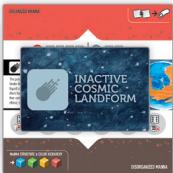
Landforms. Place each of the four Landform cards (hereafter called Landforms) on top of its corresponding placard deck: cosmic, ocean, coastal, or continent. Landforms are placed on their inactive (dim) side in “landscape” orientation, see illustration. The Refugia under the Landform card are not yet in play.
-
Mutation Decks. Shufle the 20 Mutation cards (hereafter called Mutations) and make 4 decks of 5 cards each. The single-strand (RNA) side is faceup. Arrange the 4 decks in a column just to the left of the Refugia-Landform column (Parts 5 - 6).
-
Public Stack. The 8 Macroorganism cards are put into a public stack somewhere on the table. Any card in the public stack (not just the top) can be examined or purchased by a player during his purchase phase.
-
To start the game, reveal the first event per Part D. The first player is per A2.
C1. THE SOLITAIRE GAME (Parasite AI developed by Jon Manker of Ion Game Design)
The solitaire player chooses two of the four player colors, maintaining separate tableaus and tableau pools for both of his colors. He is allowed a turn for both of the colors in each phase. He follows the rules for two players (e.g. pool limits, B3).
• Solitaire Victory Conditions. Achieve a marine win by ending the game with Bionts of both colors in marine Macroorganisms, either as two marine Macroorganisms or as a single Macroorganism with an Endosymbiont. Achieve a terrestrial win by doing the same in terrestrial Macroorganisms.
• Parasite AI. One Biont of each of the two colors not chosen is used to enable one non-player controlled (NPC) Parasite. The turn order for these two NPC Parasites follows the rules for their color. Each is hostile until assimilated as an Endosymbiont or Foreign Gene. Right after a player color takes his assignment phase, a random side of the NPC Parasite of that color will try to attach to the Host that will give it the most allowed Diseased cubes. However, it can’t become a Hyperparasite.
• AI Biont. For the NPC Biont, set a dome on top of a cube. In this fashion the NPC Biont can be distinguished from the Player Bionts.
• AI purchasing. As usual, the NPC Biont uses its Host’s Catalysts for its purchase. Determine which Mutations it has Catalysts to buy, then randomly select among them with dice. The NPC Parasite always upgrades its Mutations first before buying a new one. AIs will use fission to buy two mutations if they can.

• AI Specificity. AIs will only use Specificity re-rolls to re-roll errors, starting with 6’s.
• AI Sex. AIs will use sex to roil a mutation deck that they can’t buy the top card from. (The choice is random if there is more than one such deck in active rows.)
• AI Red Queen. AIs always refuse Red Queen attacks if they can. They cannot themselves perform Red Queen attacks.
C2. THE COOPERATIVE GAME
Each player has only two Bionts (the third will be used for a NPC Parasite). Players are not given a Parasite card (it is under hostile AI control). The players collectively win if they all end the game with Macroorganisms, with at least one is terrestrial.
• Parasite AI. The unused Biont of each player in the game is used to enable an NPC Parasite per C1. Thus, in a three player game, there will be three NPC Parasites. Players are not given a Parasite card (it is under hostile AI control).
C3. THE INTRODUCTORY GAME
This simpler variant ignores climate change (the climate is always warm), and Macroorganisms, and thus plays only in the microworld. Ignore all rules marked [advanced]. For your first games, I recommend that the use of Parasites, Red Queen actions, Endosymbionts, and Foreign Genes be prohibited. Instead of Bionts becoming Foreign Genes or Endosymbionts, they are returned to their owners with compensation.
C4. THE MACRO VARIANT (courtesy Kyrill Melai)
In this “kinder gentler” variant, an Error Catastrophe in the Darwin Roll (G3) occurs only on a 6 instead of 5 and 6, and the DNA icon counts as an error shield. Accordingly, players have a better chance of reaching the Macroorganism stage.
D. PHASE 1, EVENTS
Reveal the top event by placing it face-up into the event discard pile.

D1. AFTERSHOCK, TROPICAL WATERWORLD, OZONE LAYER FORMATION
These three types of events have special or enduring efects:

Aftershock. The next event card is drawn and its icons are combined with this event, so that a double event occurs. Several aftershocks can occur in a row. See A1.1 for the icon resolution order.
Note: If the very last game card is an aftershock, use the player order of the previous turn.
• Tropical Waterworld. [advanced] After performing the events on this card, place it on top of the continent Landform. While this card is present, the continent Landform remains inactive (the result of plate tectonics shutting down)12, all (+earth) events (D3) skip over the continents row and go to the next Refugia deck higher (therefore no roiling of continent Mutations or adding of continent Refugia), and a runaway greenhouse Armageddon (D10) occurs with three instead of four. Remove the card and its efects (restarting plate tectonics) when the next aftershock occurs.13
• Ozone Layer Formation. When this occurs, for the rest of the game ignore UV events (D7), except that if the Comet Impactor (card 51) occurs, it punches a hole in the ozone layer allowing UV events for that turn only.
D2. LANDFORMS AND ROILING
On the left edge of the event, the four Landform icons are shown in a column. If an icon is bright, ensure that the landform is flipped to its active side, and its corresponding Mutation deck is roiled, see below. If it’s dim, it is flipped to its inactive side.
12 Plate tectonics drives the carbon cycle by sweeping carbon deep into the crust, where it is slowly released bacthe atmosphere by volcanoes. If it had stalled, Earth would have avoided the fate of Venus only by heroic Gaian sures. Furthermore, there would be no continents of granite, only an archipelago of volcanic islands like Hawaii. “Tropical Waterworld”. Other “what ifs” in this game: what if Earth had no moon, what if it had no oceans or the were frozen solid?


• Activation Efects. An active Landform means that you can assign Bionts and Enzymes to Refugia in its row.14
• Roiling. To roil a deck means to take its top card and put it on the bottom of the deck. Roil each Mutation deck next to an active Landform. Easily forgotten rule!
D3. IN THE BEGINNING...

Each (+heaven) indicates the creation of a new Refugium, coming down from above (such as comets delivering ocean water). For each +heaven icon, draw the top Refugia placard from under the Landform card from the uppermost active Refugia deck with cards remaining.

For each (+ earth, indicating the creation of mountains etc. by plate tectonics), draw the top Refugia placard from under the Landform card from the lowermost active Refugia deck with cards remaining.15
• Setup. Place all new Refugia as the new rightmost Refugia in the rows they came from.
• Dead Population. Then take from the soup all the Manna indicated by the colored squares and place where indicated by the “Manna structure” in the “disorganized” field. The Manna must be cubes of the colors indicated.
Easily missed rule: Refugia emerge only if their row is active.
Example: Two events occur, and the cosmic deck has one card left. This last card comes out, as well as the top card in the next active deck down (the oceans deck).
D4. SMITE EVENT

The smite event icon indicates a radiation surge that causes all Refugia to lose their rightmost Enzyme. If it has no Enzymes, it loses one Manna cube. The color lost is the leftmost color depicted on the placard that still has Manna remaining. Should the same color Manna be both organized and disorganized, remove the disorganized first.
• Deserted Refugium. Should a Refugium ever be left without any Manna cubes, it is removed from the game, returning any bionts without compensation.

Resiliency. Three Refugia, as marked on the card, are immune from the efects of smite crisis.
D5. EXTREMOPHILE CRISIS

X The icon indicates temporary extraordinary temperatures afecting all Organisms.The number of ’s indicates the extremity. In the case of an aftershock (D1), the extremity is the summation of the events from all cards, and applied as soon as the first event occurs. In player order, each player subtracts the heat shield of each of his Organisms from the extremity. If this is a positive number, that Organism sufers that many Atrophies (See Glossary).

Heat Shield. Each Microorganism has a heat shield equal to the number of its red Chromosomes plus the number of red shield icons found on its Mutations. For Macroorganisms, the heat shield include all red system Chromosomes (printed on the card), other red Chromosomes (i.e. red Organs, Endosymbionts, and Trophic Bionts), and any Organs or Endosymbionts with the red shield icon.
Example: Your viroid has a red Diseased cube, two red Bionts, and a blue ribozyme Mutation with one red shield. Its heat shield is four, strong enough to survive the most extreme aftershocks in the game.
D6. OXYGEN SPIKE16

: An $\dot { C } _ { 2 }$ icon causes an oxygen spike attack on all Organisms, with the number of $\dot { C } _ { 2 }$ icons indicating its extremity. In the case of an aftershock (D1), the extremity is the summation of the $\ddot { \mathbf { C } }$ events from all cards, and applied as soon as the first $\ddot { C }$ event occurs. In player order, each player subtracts the Antioxidant shield of each of his Organisms from this extremity number. If this is a positive number, that Organism containing the Biont sufers that many Atrophies.

Organism Antioxidant Shield. Each Microorganism has an Antioxidant shieldequal to the number of its green Chromosomes, its green shields on Mutations, plus its Vitamins. For Macroorganisms, the Antioxidant shield includes all green system Chromosomes (printed on the card), other green Chromosomes (i.e. green Organs, Endosymbionts, and Trophic Bionts), and any Organs or Endosymbionts with the green shield icon.
For this event type only - To satisfy Atrophy damages, Antioxidants or Vitamins may be discarded instead of cubes. See example below.
Example: The ‘oceans rust out’ aftershock event is drawn, generating two $\dot { C } _ { 2 }$ spike attacks. A flatworm Macroorganism has one green system Chromosome and an Antioxidant disk. Since the $\dot { C } _ { 2 }$ level is one over the shielding, the flatworm sufers an Atrophy, killing its Antioxidant. If it did not have its Antioxidant, the flatworm would go extinct, reverting to Bacteria.
D7. ULTRAVIOLET RADIATION18

The UV icon contains a number from 0 to 4, indicating the limit to number of Mutations or Organs each Organism can have. In player order, each player discards Mutations or Organs from each of his Organisms until the limit is reached.
• Mutations Cube. Each Mutation card, promoted or unpromoted, counts as one Mutation. Each Mutation card lost also loses its associated Mutation cube(s). The cube is lost even if it’s a Diseased cube on a Parasite.
• Order Lost. You choose which Mutations or Organs are lost from your Organisms, except that, if the Organism has no Immunology (see glossary), it must lose healthy Mutations before Diseased ones.
• All Mutations discarded are placed face-up on the bottom of the Mutation deck in the Organism’s home row, in the order of your choice.

UV Shield. [advanced] If a Macroorganism has an Organ or occupied Endosymbiont space with the UV Shield icon, the entire organism is safe from UV.
Example: The late heavy bombardment (LHB) occurs, which is a limit = 1 UV event. A Bacterium with three Mutations loses two of them, a Macroorganism with two Organs loses one, but a Parasite with only one Mutation is safe. But if the Parasite happened to be attached to the Bacterium, in particular to the two Mutations lost by the Bacterium, it would lose its two Disease cubes. The follow-up to the LHB aftershock happens to be hydrocarbon fog, a limit = 2 UV event. This event has no efect, being eclipsed by the deadlier limit = 1 UV event.
D8. CANCER [advanced]

If the crab icon appears, then every Macroorganism must make a Cancer Roll, rolling one dice for each Organ and two dice for each Biont. Each ‘5’ or ‘6’ rolled will generate an error. If the number of errors is greater than its error shield (i.e. the number of its blue Chromosomes), then the Macroorganism sufers one Atrophy for each excess error.19

Cancer Shield. If the Macroorganism has the crab shield icon (found on certain Organs), errors are generated only on ‘6’ instead of a ‘5’ or ‘6’.20
• Macro Biosynthesis. For every ‘1’ rolled, you generate one Catalyst of the color of your choice, added to your tableau pool.
Example: A crab event occurs. You have a sea star with mitochondria (an endosymbiont with the cancer shield), brain, eyes, and kidney. With 2 bionts and 3 organs, you roll 7 dice for your Cancer Roll. You have 2 blue system chromosomes, so you are allowed two errors (6’s). But the roll is 1,1,2,5,6,6,6, so you lose one organ but gain two catalysts.
D9. DROUGHT [advanced]

If the drought icon appears, then every terrestrial Macroorganism sufers an Atrophy unless it has an an Organ or Endosymbiont providing a drought shield (H3).
Easily missed rule: Droughts only impact terrestrial creatures.
D10. GLOBAL WARMING AND COOLING [advanced]

A red sun in the lower right corner indicates a warming climate, and a blue snowflake indicates a cooling climate. If the climate is warming, the red sun animation (F1) will be in efect during Autocatalytic Rolls, and this warm climate
will persist until the climate changes to cool with a blue snowflake event. A cooling climate puts the blue snowflake animation into efect, again until the climate changes.
and a leading cause of cancer is the disruption of PCD due to accumulated genetic damage. The cell’s mitochondria plays a central role in the integration of the PCD (Programmed Cell Death) pathways. Since the mitochondria developed from symbiotic bacteria, in this game bacterial parasites are necessary for cancer protection. Consider a liver cell in your body. All your ancestors had livers, but none of the cells in these ancestral livers ever left any descendants. In fact, all liver cells present and past are expected to stop dividing in order to do their job. And yet, each liver cell ordered not to divide is derived from an embryonic germ cell that has been dividing for untold generations (or else it would have left no descendants). Your life depends on how good each and every cell follows orders. Randolph Nesse, M.D., 1994
20 Although not in the game, bacteria use PCD (Programmed Cell Death) to commit suicide if infected with a virus, soas not to infect their kin. PCD is an example of epigenetics, by which genes can be activated or repressed by envi- ronmental factors, e.g. binding with chemicals introduced from the outside. These changes may or may not be heritable. Pseudoscience new-agers like to testify that all bad and evil choices that one makes is due to epigenetics. In other words, my genes made me do it. But bad choices are based on a bad philosophy, not bad epigenetics.
• Armageddon. If by the end of the event phase the last four climate change icons are red suns, then the game ends in runaway greenhouse after this turn’s purchase phase. If the last four climate change icons are blue snowflakes, then the game ends in snowball earth after this turn’s purchase phase. See Part I for the winner.
Tip: Stagger the discard pile to show the string of climate change icons on the right edge of the card, so all can see how close to Armageddon the game is.

• Gaia. Just before a climate change icon would be enacted that will cause Armageddon to occur or persist, any player can call for a blind Gaia vote to cooperatively negate it. Each player secretly places a cube into his hand (indicates a “Gaia” vote) or no cube (indicates a “Medea” vote). If everyone says Gaia, those who have Catalysts or Organisms must either spend a Catalyst to the soup or sufer one Atrophy (see glossary). This cancels Armageddon, and the game proceeds.
• Medea. Any player who votes “Medea”, and thus ends the game with the destruction of the Earth, sufers the loss of half his VP, rounding in his favor.
Example: Global cooling occurs during the “Huronian Snowball”. The previous five events had three global cooling and two with no climate change, so the Earth goes snowball. The trailing player calls for a Gaia vote. The first player that turn is Player Red, who happens to be in the lead. However, he says “Gaia” because he would not be the winner with his VP halved. The other players also say “Gaia”, and Armageddon is averted. However, if the next event is either a global cooling, or no climate change at all, another Gaia vote is necessary to avert Armageddon.
E. PHASE 2, ASSIGN BIONTS & CATALYSTS (player order)
In player order (A2), each player may assign any or all of his Bionts and Catalyst disks, as he chooses. Each Biont may be assigned (E1, E3), used to supplant (E4), or moved (E6) only once during this phase. 21
E1. ASSIGNING BIONTS AND CATALYSTS TO REFUGIA
Assign one or more of your Bionts to a Refugium by placing it in the organized field. This is the upper field on the Refugium card. Respect Entropy limits (E2) when assigning. You may assign one or more Catalysts to a Refugium as Enzymes by placing it in the leftmost unoccupied Enzyme slot.
• Biont Source. Your Biont token can come from your unassigned Bionts (B4) or from any Refugium in an active row (D2). You must respect Entropy limits per E2. If any of your Organisms have the HGT Ability (E6), you can remove your Bionts from any Microorganism (e.g. Foreign Genes). If this leaves any Microorganism without a Biont, it goes Extinct.
• Biont Target. You can only assign Bionts and Enzymes to Refugia in an active row (D2), or in a row where you have a Biont, either in a Refugium or in an Organism with that home row (E2). You may also assign Bionts from an active Refugium back to your pool.
• Catalyst Source. Catalysts assigned as Enzymes come from your tableau pool.
Easily missed rule: Enzymes remain until enzyme death and organized Manna remain until manna death (F2). Both are potentially removed via the smite event (D4).
Example: At the start of the game, you assign your one available Biont and Catalyst to Mars. They survive the Autocatalysis Roll, but on turn 2 the Cosmic Landforms are inactive, so this turn your Biont is trapped on Mars and you cannot assign another Biont there. You could assign Enzymes or a second Biont there, assuming your entropy limit (E2) was not exceeded.
E2. ASSIGNMENT RESTRICTIONS AND HOME ROWS
A Microorganism’s home row contains the Landform icon matching the one in the left edge of its placard. A Macroorganism’s home row is the ocean if marine, or the continent if terrestrial. A Parasite’s home row is the same as its Host.
• Entropy Limit.22 The number of your Bionts that you are allowed to have in Refugia is always at least one. If one of your Bionts lives in an Organism with one green Chromosome or Organ, then starting next turn you are allowed to assign two Bionts to Refugia instead of one. If more than one green Chromosome or Organ, you are allowed to assign three Bionts to Refugia.
• Biont Cull. Whenever all the Organisms in which your Bionts reside in have no green Chromosomes or Organs, and you have more than one Biont assigned to Refugia, immediately remove one of them of your choice (with compensation per B4).
• Other Limits. The number of Catalysts on a Refugium is limited to the number of Enzyme slots. There is no limit to the number of Bionts on a Refugium other than the Entropy limit of the players.
Easily missed rule: Your Entropy limit applies only to Bionts assigned to Refugia. You can have any number of Bionts assigned to Organisms.
• Deep Hot Biosphere. For each Biont assigned to the Deep Hot Biosphere, spend a Catalyst to the soup (due to the high subterranean temperatures).
• Spore. If any of your organisms have a Mutation with the spore icon, you may assign anywhere and are therefore not limited to active rows or home rows.
• Disease Efects (Mutations & Organs). See glossary.
Example: As the game begins, Player Green can only assign one Biont into Refugia. He starts a Bacterium, and the green Biont on this Organism allows him to assign his last two Bionts to Refugia next turn. They can both be assigned to the same Refugium, or two diferent ones.
E3. ATTACHING A PARASITE AND ASSIGNING A BIONT TO IT
Each player has one Parasite Card of their color. During this phase you can attach it as a Parasite to a Host Organism in a foreign tableau, or as a Hyperparasite in any tableau, and assign one or two of your Bionts to it. You choose which side of the Parasite card to play. Your new Parasite is a Microorganism which must make Darwin Rolls, and can make purchases (Mutations, Mutation promotions, and Red Queens).23
• Source.Your Biont(s) can be taken from the places specified in E1. See example below.
• Host Suitability. Place the new Parasite to the left of its Host’s card. The Host must be in the tableau of another player in the home row (E2) of one of your Organisms or in an active row. The Host must have at least one cube that can be stolen by the Parasite as a Diseased cube (see next bullets). If the Host already has a Parasite, either become a Hyperparasite or see E4.
Easily missed rule: You cannot attach a Parasite to an Organism in your tableau, only in a foreign tableau.
• Diseased Mutations. Each Parasite has two colored slots labeled Diseased cubes. To attach to a Bacterial Host, the Parasite must steal at least one of its Mutation cubes (H1) and put them into the Diseased slots of the correct color. It can steal up to two cubes from one or two of the Host’s Mutations. Losing mutation cubes to disease does not demote or remove the Host’s Mutations, or afect its Ability icons. However, a lost diseased cube sitting on the Parasite is not useful to the Host.
Easily missed rule: Although a Parasite needs at least one Diseased cube to attach, it does not detach if it later loses all its Diseased cubes. There is also no voluntary detachment. It only detaches if liberated (E4) or goes Extinct.
• Hyperparasite. If the Host is another Parasite, steal the Diseased cubes from the Host Parasite’s mutation cards per the preceding bullet. You can have your hyperparasite in your own tableau, attached to a parasite of one of your organisms.
• Diseased Organ. [advanced] If the Host is a Macroorganism, steal the Diseased cubes from Organs (H5).
• Pollution. If the Parasite is a polluter, see H1.
• Ownership. Even though the Parasite resides in a foreign tableau, the card color and moniker identifies that the Parasite is under your control as long as you have at least one Biont on it.
• Host Death. A Parasite goes Extinct if its Host goes Extinct.
Example: Player Blue starts with three unassigned Bionts, and is Entropy-limited to one Refugia assignment. He assigns one to a Refugium,leaving two left. Although these can’t be assigned to Refugia, he assigns one to animate his virus, and attaches it to a Host with a green Mutation. This steals the green Mutation cube from its Host. Since Player Blue now has a green Chromosome, he is allowed two instead of one Biont assigned to Refugia per E2. He may assign both his Bionts to Refugia starting next turn (assuming his Parasite is still alive). He can assign to the home row of his Host, or to an active row.24
E4. SUPPLANTING A PARASITE
Each Host may have only one Parasite. However, your Parasite may attempt to supplant an already attached Parasite, so that you become the new Parasite. If so, the old Parasite is liberated, returning any Diseased cubes to its Host, but retaining its Mutations and Hyperparasites, and able to immediately (i.e. out of turn order) attach or supplant in a home row of one of your organisms, or any active row to a new Host. If it fails to attach or supplant, it goes Extinct.
• Supplant success. The supplanting Parasite takes his Diseased cubes from the Mutation cubes of the Host and/or the Diseased cubes of the incumbent Parasite. Supplantation succeeds if the supplanting Parasite now has more Diseased cubes per E3 than the incumbent Parasite did before being liberated. Accordingly, a Parasite with its maximum of two Diseased cubes can’t be supplanted.
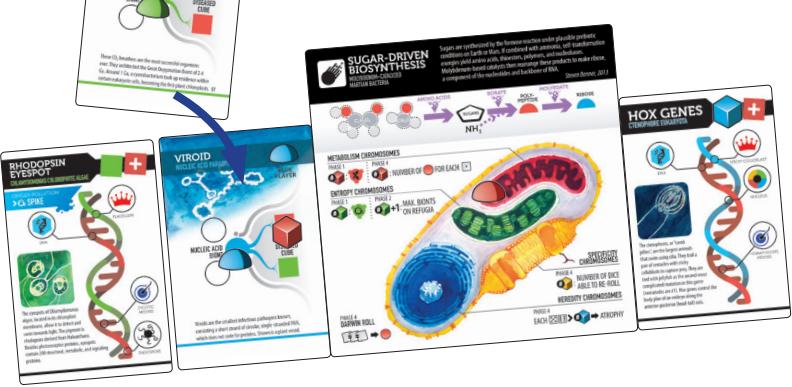
Example: Player Red has a Bacterium with one promoted blue-red Mutation “hox genes”. This Mutation is missing its red “+” cube, stolen by an attached viroid Parasite. Player Green sends his cyanobacteria to supplant the viroid. This is successful, because the cyanobacteria takes two Diseased cubes from the Mutation, one blue and one red. The viroid is dissolved, and Player Blue gets compensation for the lost blue Biont (which can be reassigned when Player Blue takes his turn). Tragically, the new cyanobacteria Parasite is a level one polluter, and its Host has no oxygen shield. Since the Host has no mutation cubes to lose, Player Red must choose a chromosome from its Bacteria card to discard. It chooses to lose its only biont, killing both the bacterium and its parasite
E5. ASSIGNING A NEW ANTIOXIDANT

C You may assign a Catalyst as an Antioxidant by placing it directly on yourOrganism’s card or placard (next to the Macroorganism card if present). This gives advantages during oxygen spike attacks (D6). You may assign multiple xidants per turn.
• Antioxidants. Each red, yellow, or blue Antioxidant can be expended to deflect damage during a spike attack.
• Vitamins. Each green Antioxidant is called a Vitamin, and it adds to its Antioxidant shield as well as being able to be expended during a spike attack. Thus a Vitamin can deflect two oxygen atrophies.
• Parasites. These are not allowed Antioxidants or Vitamins.
• Terrestrial Macroorganisms. [advanced] These are also not allowed Antioxidants or Vitamins (they usually don’t need them).
Easily missed rule : Assigning Antioxidants occurs during Phase E, not Phase H.
E6. MOVING BIONTS VIA HGT (Microorganisms only)

X HGT is the only way to move or reassign a Biont from or to a Microorganism. You have HGT this Ability for all your Bionts if any of your Microorganisms, or Microorganisms you X reside in (as a Foreign Gene or Endosymbiont), have the HGT icon. You may move one Biont of your color for each HGT icon you have. Your Biont must move from one Microorganism (in any row) to another Microorganism or Refugium in either the home row (E2) of one of your Organisms or in an active row (D2). Alternately, you can move your Biont into your pool (without compensation).25
• The Wanton Block. If you attempt to HGT into an opponent’s Organism, he can announce this move to be blocked if he has more wantonness (i.e. more HGT icons, see A2). The blocked Biont must move to another Microorganism or the pool. It can move back to the Organism it originally came from but this will count as the Biont’s one and only move and use one of your allowed HGT moves.
• Extinction. Note that HGT allows you to commit suicide.
Assign Biont (E1)
• Commandeering. If all your Bionts from one of your Microorganisms are lost, but it has a Foreign Gene, it becomes part of the foreign player’s tableau. If it is Bacteria, physically move it to the foreigner’stableau, but if it is a Parasite it stays put. If more than one player’s Biont remain, you choose whose tableau it Roll 4 dice (F1) moves to.
• Macroorganisms. HGT cannot be used to transfer to or from a Macroorganism.26
• No Double Move. A Biont may not use HGT if it has been assigned (E1, E3) or used to supplant (E4) this phase.
Example: You have two of your Bionts in a Bacterium, and send one via HGT to Player Yellow’s malaria parasite. He cannot block this move because he has no HGT icons in any of his organisms, and thus is not as wanton as you.
F. PHASE 3, AUTOCATALYTIC ROLL (row by row order, start at top left)
An Autocatalytic Roll is made for each Refugium occupied by one or more Bionts. See F1, F2, and F3 for results.27 If the Refugium is contested, see F4.

• Refugia Resolution Order. Start with the top row of Refugia, going from left to right. Then on to the next row.
• Procedure. Make a roll by rolling one dice for each organized cube and two dice for each organized Biont.
Easily missed rule: Each Biont counts as only one Manna, yet rolls two dice instead of one for the Autocatalytic Roll.
• Re-rolls. If your Biont is on an uncontested Refugium card that is in your player color, immediately after the Autocatalytic Roll you are allowed to make one re-roll of all dice involved. This roll is final.
F1. ANIMATION
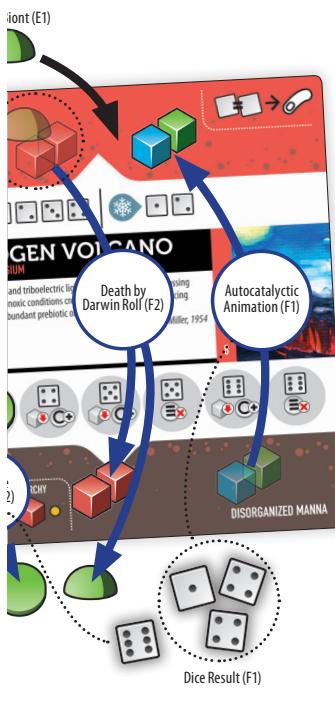
After the roll, consult the upper center of the placard. To the right of the icon are the life dice for a warm climate (D10), and to the right of the are life dice for a cool climate. For each life dice rolled, you must slide one Manna from disorganized (lower field) to organized (upper field), if there are any to slide. You choose which color.
• Manna. All Bionts and cubes on a Refugium, whether organized or not, are called Manna.
F2. DEATH AND BIOSYNTHESIS
After life comes death. The dice faces depicted in uncovered Enzyme slots are called death dice. There are two sorts, Manna death (marked with a square and a disk), and Enzyme death (marked with a disk only). Only the dice faces visible and not hidden by Enzymes before the dice roll are in efect. So if all the Enzyme slots are occupied, then there are no deaths.28 If the Refugia is contested, see instead (F4).
• Manna death. For each Manna death, you must remove one Manna from the organized field. Cubes slide down to the disorganized field, while Bionts are returned to your tableau pool with compensation (B4). You choose which color.

Biosynthesis. Each Manna death sending a cube to the disorganized field adds an unassigned Catalyst of the same color, taken from the soup, and stored in your tableau pool. You cannot take a Catalyst if your pool is at its limit (B3) for that color.

Enzyme death. After Manna death comes Enzyme death. For each Enzyme death, the rightmost Enzyme is lost to the soup.
• Death Dice. Each dice face may cause both Manna and Enzyme death. For instance, for all Refugia except eutectic brine, each “6” rolled will kill one Enzyme and disorganize one Manna (assuming the 6 is not covered by Enzymes).
Example: The climate is warm, allowing the hydrogen volcano to animate on rolls of 1,2,3,4. On its disorganized side is a green and blue Manna, and on the organized side are two red Manna and a green Biont. It also has two Enzymes. Player Green rolls 4 dice (2 for the organized cubes and 2 for the green Biont): 1,4,4,6. This animates three Manna, so both the green and blue Manna are shifted to organized. At this point, all the Manna is organized. But both the 4’s cause Manna death, and the 6 causes one more Manna death plus one Enzyme death. Player Green chooses his own Biont to die, and both red Manna to disorganize, earning him one green and two red Catalysts.
F3. CREATION OF DARWINIAN LIFE29
If any doubles were rolled in your Autocatalytic Roll, and your Biont remains on the Refugium after applying the results, you may optionally (!) take its placard into your tableau, flipped to its Microorganism side. This card is now your Bacterium, a type of Darwinian life.
• Chromosome Cubes. All organized Manna are taken from the former Refugium and placed according to color into the Microorganism’s four Chromosome fields. Your Biont(s) are also counted as Manna. While in these rows, the cubes and domes are called Chromosomes. Disorganized Manna are lost to the soup.
• Enzyme Cost. All Enzymes on the card go into the soup.
• Bacterial Anatomy. In a Bacteria’s left edge is its home row (E2).
Easily missed rule : Organized Manna during the creation of life or during the extinction of macroorganisms are the only times that chromosome cubes are added to the Bacteria placard itself. After creation, your Bacteria placard may lose cubes, but not gain them. The placard however can gain Bionts by HGT (E6) or Red Queen (H4), and the entire organism can add Chromosome cubes by purchasing Mutations (H1).
Example: Player Green, with two green Bionts on the alkaline seep, makes an Autocatalytic Roll of 3,3,3,3. This allows him to take the seep, inverted to pyrite reduction bacteria. The starting Chromosomes are two green Bionts.
F4. CONTESTED REFUGIA
If this phase starts with more than one Biont color on a Refugium, the players involved are called contestants. The contestant with the most Enzymes of his color plus organized Manna of his color is the called the progenote. In case of ties, look at the left-to-right order in the “Manna structure” printed on the placard (including the ‘dots’). The contestant with the leftmost color becomes the progenote.
• Dominance. The progenote makes the Autocatalytic Roll, and the other contestants do not roll.
• Progenote Life and Death Decisions. The progenote makes all decisions on which Manna to animate and which to disorganize. If he chooses to kill a Biont, that contestant receives his Biont plus compensation (B4). If the progenote sends a Manna cube to the disorganized field, he gives the Catalyst created to another contestant.
Easily missed rule : A player who started this phase as a contestant remains a contestant even if his Biont has been killed.
• Origin of Darwinian Life. If doubles were rolled, the progenote makes the decision whether to take the placard as Bacteria per (F3).
• Foreign Genes. If the progenote takes a placard with one or more foreign Bionts on it, the Bionts remain as Chromosomes in the progenote’s new Bacteria. These Bionts are called Foreign Genes.
• Ersatz Progenote. If the progenote rolls doubles, and choses to kill of all his own Bionts, but leaves Bionts of other players alive, he must pick one of them who is allowed to claim the Bacteria.
Example: The clay mound is contested by a green, red, and blue Biont. It has two Enzymes, red and blue, but no organized Manna, so there is a tie between red and blue. Since red is the leftmost printed Manna, Player Red becomes the progenote. He rolls 6 dice (for the three Bionts), and causes two blue Manna to live. He also causes two deaths, and chooses to kill both blue Manna and give one blue Catalyst to each of the other two contestants. He rolled doubles and creates Darwinian Bacteria with one Biont from all three contestants. He could have instead killed of both foreign Bionts, giving them both a Catalyst of their color, and the new Bacteria would have had two blue cubes, plus the red Biont.
G. PHASE 4, DARWIN ROLL (player order)
In player order, all players must make one Darwin Roll for each of his Microorganisms (i.e. Bacteria and Parasites). If they have multiple Microorganisms, they choose the order. This roll can create Catalysts through Biosynthesis, and/or cause Extinction through Error Catastrophe.30
• Procedure. Make a roll by rolling one dice for each cube on the Microorganism and its Mutations and two dice for each Biont. A Host never makes a Darwin Roll for its attached Parasite, nor for the Parasite’s Diseased cubes or Mutations.
Easily missed rule: Each Biont counts as only one Chromosome, yet rolls two dice instead of one for the Darwin Roll.
Example: Your Bacteria has its Biont, a foreign Biont as a ‘guest’, and one Chromosome. It also has two Mutations, each with a Mutation cube. Roll 7 dice for its Darwin Roll. Your Parasite has its Biont, two Disease Chromosomes, and one promoted Mutation with two Mutation cubes. Roll 6 dice for its Darwin Roll.
G1. SPECIFICITY RE-ROLLS

After you make the Darwin Roll, you may make one re-roll of some of the dice rolled. The number of dice you may re-roll is equal to the number of yellow Chromosomes (Specificity) your Microorganism (Bacteria or Parasite) has.
Example: Your Microorganism with a red Biont, plus a blue and two yellow Chromosomes rolls 5 dice, obtaining 1,2,3,4,6. You decide to re-roll both the ‘6’ and the ‘4’, obtaining a ‘3’ and ‘4’ instead.
G2. BIOSYNTHESIS31

Each ‘1’ rolled is a protein dice. For each protein dice rolled in a Microorganism’s Darwin Roll, add a number of Catalysts equal to the number of red Chromosomes (Metabolism) it has. For each triple you roll, additionally add one Catalyst. All Catalysts dded to the tableau pool your Organism resides in.
• Color. The Catalyst color earned by Bacteria Biosynthesis is indicated by the color of the disk shown by the “METABOLISM CHROMOSOMES” (upper left of placard). For Parasite Biosynthesis, it is the color of the Parasite Card. You cannot take a Catalyst if the pool is at its limit (B3) for that color.
Easily missed rule: A Microorganism with no Metabolism (red Chromosomes) will yield Biosynthesis only if you roll triples.
Example: Player Red rolls for GNA Lipid World life (a blue placard). He has a red Biont in the Metabolism row, plus a red, blue, and green cube sitting on Mutations. His Darwin Roll is 1,2,2,2,2. The ‘1’ is a protein dice, giving him two blue Catalysts. The triple 2 gives him an extra blue Catalyst. If he instead rolls 1,1,1,4,5, then he would get six blue Catalysts for the three protein dice, plus one for the triples. Assuming a 2-player game however, he is limited to 6 blue Catalysts per B3.
G3. ERROR CATASTROPHE

Every ‘5’ or ‘6’ rolled in a Microorganism’s Darwin Roll generates an error. These dice faces are called error dice. If the number of errors is greater than its error shield (i.e. the number of its blue Chromosomes), then the Microorganism sufers one Atrophy for each excess error.
 their biological analogues.
Ability (H4). Icons on Mutations, Organs, and Endosymbionts indicate abilities of the Organism, beginning the turn after the Mutation, Organ, or Endosymbiont is created. Abilities include:
Syringe. Control token discard order, see Immunology (Glossary).
Heat shield. Indicates shielding from Extremophile event-induced atrophies (D5).
O2 shield. Indicates shielding from oxygen spike-induced atrophies (D6).
Cancer shield. Cancer atrophies are generated on '6' instead of a '5' or a '6' (D8).
DNA. Error atrophies are generated only on '6' instead of a '5' or '6' (G3).
Drought shield. Blocks drought (D9).
UV Shield. Blocks UV Radiation (D7).
Spore. You can assign Bionts & Enzymes (E2) or purchase Mutations (H1) anywhere (not limited to active or home rows).
HGT. You may move Bionts per E6.
Fission. May make two purchases instead of one (H1).
Nucleus. May consider your Catalysts to be able to change into any color (H).
Sex. Before buying a Mutation, you may roil a deck (H1).
Red Queen. May make attacks per H4.
Amino Acids. Red Bionts and Manna. The folding of proteins to maintain homeostasis is the domain of Player Red, who commands Parasites (prions) able to fold proteins to its own benefit, and in higher Macroorganisms controls the nervous system for high Metabolism. This is the stuff of Metabolism, the ingredients of peptides, proteins, and Enzymes. Chemically, they contain an amino group and a carboxyl group. Of the vast numbers of amino acids only twenty kinds are found in proteins. Presumably the others, with rather similar and uninteresting side groups, or unable to form regular chains, were weeded out by specificity long ago.
Antioxidants (E5). A Catalyst disk placed on an Organism to protect it from an oxygen spike (D6). The Antioxidant is sacrificially expended in the oxygen spike. The green Antioxidants, called Vitamins, are exceptional in that they add to the Organism's Antioxidant shield as well as can be expended in the Oxygen Spike (E5).
Note: By being oxidized themselves, Antioxidants sacrificially inhibit the oxidation of other molecules, which would otherwise release destructive free radicals.
Atrophy. Loss of a Chromosome (either cube or Biont) from an Organism, caused by some events or Error Catastrophe. Mutation cubes must be lost first, then Chromosome and Organ cubes, then Bionts (Chromosomes, Foreign Genes, or Endosymbionts), and finally Trophic Bionts. In the case of oxygen spike attacks (D6), each Antioxidant or Vitamin may be discarded to reduce the atrophy losses by one to a minimum of zero.
Atrophied Mutations. If a promoted Mutation suffers an Atrophy, it is flipped (i.e. demoted) if its Mutation cube marked with a "+" is lost, and is unaffected if its other cube is lost (but will be discarded if it is ever demoted). A Mutation cube atrophied from an unpromoted Mutation discards it. All Mutations discarded are placed face-up on the bottom of the Mutation deck in the Microorganism's home row. The discarding player chooses the order discarded.
Atrophied Diseased Cubes. If your Parasite atrophies a Diseased cube (E3), this causes the Mutation which lost the cube originally to be discarded or unpromoted per the previous bullet. A Diseased Cube (Mutation or Organ) may never be atrophied by the Host it was stolen from.
Atrophy Example: Your viroid Parasite attached to a Bacterium has one promoted Mutation (two Mutation cubes), a Mutation (one Mutation cube), and two Diseased cubes. Therefore it rolls 7 Darwin Dice. If it suffers an Atrophy, you can either take it from the unpromoted Mutation (which discards it), or from the promoted one. If it suffers 5 atrophies, it loses all cubes, leaving just its blue Biont. The lost Diseased cubes remove the two Host Mutations (or one promoted Mutation) that originally lost their Mutation cubes to the Parasite.
Autocatalytic Roll (F0). A roll representing the success or failure of a Biont in a Refugium to maintain itself and produce Catalysts.
Note: Autocatalysis is a reaction which maintains organized populations by yielding a reaction product which is itself the Catalyst for that reaction. According to wikipedia: "Autocatalytic sets also have the ability to replicate themselves if they are split apart into two physically separated spaces. Computer models illustrate that split autocatalytic sets will reproduce all of the reactions of the original set in each half, much like cellular mitosis. In effect, using the principles of autocatalysis, a small metabolism can replicate itself with very little high-level organization. This property is why autocatalysis is a contender as the foundational mechanism for complex evolution."
Bacterium (pl Bacteria) (F3). A Microorganism placard in a tableau that does not have a Macroorganism card on it.
Life is divided into three domains: Archaea, Bacteria, and Eukarya. Archaea and Bacteria are both prokaryotes, and Eukarya include the eukaryotes (including all multicellular organisms). Bios Genesis uses the term "bacteria" in its older sense, as all prokaryotes or even preprokaryotes in the history of life.
Biont (B4). A wooden dome with a player color indicating which property of life it possesses, simulating an ingredient in the primordial soup. Each player controls 3 or 4 Bionts of his color. Each Biont requires two dice to be rolled in the Autocatalyst or Darwin Rolls, and if on an organism counts as a Chromosome.
Note: The biological term for a Biont is 'progenote', denoting a hypothetical preprokaryotic organization in cellular evolution, earlier than the last common ancestor (currently thought to be a prokaryote rather than a preprokaryote).
Biosynthesis (B4, F2, G2). Generation of Catalysts from the soup to the pool of the tableau you reside in. This can be from an Autocatalytic Roll (F2), a Darwin Roll (either protein dice or triples, see G2), or in compensation (B4) for a Biont lost by Manna death, Atrophy, or Extinction. The number of Catalysts you can have unassigned for each color is limited per (B3). For every full two Biosynthesis Catalysts you cannot take because of the pool limit, you can substitute one Catalyst of any other color that does not exceed the limit.
Macroorganisms have a special biosynthesis. For every '1' rolled during a cancer roll (D8), you generate one Catalyst of the color of your choice, added to your tableau pool.
Catalyst (B3). Each disk in a player's tableau pool represents a Catalyst, a substance that facilitates chemical reactions without itself being consumed. The four kinds of Catalysts are red = peptides, yellow = lipid micelles, green = thioesters, and blue = nucleotides. A special Catalyst is an Enzyme.
Chromosome (F3). A cube or Biont token on an Organism or its Mutations indicating genetically stored properties and shielding (D5, D6, G3) according to its color. Mutation cubes, Organs, Diseased cubes, Foreign Genes, Endosymbionts, and Trophic Bionts are all Chromosomes. The colored squares printed on a Macroorganism are special Chromosomes called system chromosomes. The number of Chromosomes indicates your Organism's Metabolism (red), Specificity (yellow), Entropy (green), and Heredity (blue).
Darwin Roll (G0). A roll testing the capacity of a Microorganism to replicate an imperfect copy of itself into the next generation. The central problem for any theory of replication is that if the replicative apparatus does not function perfectly, it will accumulate errors from generation to generation. This deterioration, called the "Error Catastrophe" eventually collapses the system into total disorganization. Only if a stable error rate is achieved can a population with a selective advantage be maintained.
Disease (G0). A Diseased Mutation or Organ is one whose cube has been stolen as a Chromosome by a Parasite. A Mutation is never lost or demoted by Disease, rather it remains and its Abilities remain active (for the Host, not the Parasite). A Diseased Organ is completely lost unless stolen back by a Red Queen action.
Note: Biologically, a disease is a microorganism which has commandeered a particular biological function for its own gene-spreading purposes.
Endosymbiont (H3). A special type of Foreign Gene Biont on a Macroorganism. It often confers shielding or immunology to the hybrid Organism, as indicated by the icons on the Macroorganism card. An Endosymbiont is able to make a purchase for the Organism it resides in, using the Organism's Catalysts. Endosymbionts are formed whenever a new Macroorganism is created containing multiple Bionts, including Parasites and Foreign Genes.
Note: The endosymbiont theory holds that mitochondria, chloroplasts, and peroxisomes started as parasitic prokaryotes, but were assimilated inside the larger eukaryotic Host cells to their mutual advantage. The parasite lost most or all of its genetic material as its reproduction was taken over by the eukaryotic nucleus. This idea, like the Gaia concept, was championed by Lynn Margulis, a brilliant biochemist (and the first wife of Carl Sagan).
Entropy (E2). One of the four properties of life (Player Green), increasing the number of Bionts you can support in Refugia. The pigmented absorption of energy and its controlled release is the domain of Player Green, who commands chloroplast Endosymbionts able to fix carbon for its own benefit, and in higher Macroorganisms controls the digestive or photosynthetic systems.
Note: A measure of disorder and the inability to do useful work. Entropy is gained as a system approaches equilibrium, the point where it has maximum disorder and degrees of freedom. Life regulates entropy generation by holding its system far from equilibrium. This involves not just energy storage, but also collecting fuel and emptying trash and bioproducts. For photoautotrophs, "trash" includes the reaction product oxygen.
Enzyme (E1). A Catalyst disk assigned to one of the "Enzyme slots" of Refugia, serving to increase the amount of organized Manna and keep autocatalytic cycles operating productively.
Note: Biologically, an enzyme is a large (usually protein) catalyst used in metabolism.
Error Catastrophe (G3). An Atrophy that occurs if the number of errors in a adjusted Darwin Roll is greater than the Microorganism's Heredity (its number of blue Chromosomes).
Note: Replication cannot be sustained unless the number of copying errors in each generation is less than the bits of information supplied by the selective action of the environment. If the error rate is too high, then errors will accumulate from generation to generation until the entire system collapses in disorganization; the so-called the Error Catastrophe discovered by Manfred Eigen. To avoid it, a system with N bits of information must have an error rate no more than N-1. Modern DNA organisms have a remarkably low error rate ≈ 10⁻⁸, and N ≈ 10⁸. RNA replications have an error rate ≈ 10⁻², implying N ≈ 10². One hundred bits of information is far too few to describe any interesting catalytic chemistry, let alone replication. If an RNA world existed, it must have teetered on the very verge of Error Catastrophe.
Extinction. An Organism goes extinct if it either loses all its Bionts (e.g. by Atrophy or HGT), or it is a Parasite whose Host goes extinct. A lost Bacteria placard or Macroorganism card is awarded to its owner as a trophy, worth a VP at the end of the game. A lost Parasite card is returned to its owner for possible reuse, beginning next turn. Each Biont lost during Extinction is compensated (B4).
Extinction, Microorganism. Discard its Mutations to the bottom of the Mutation deck in its home row. All disks and cubes are lost to the soup, except a Parasite's diseased cubes are returned to its Host.
Extinction, Macroorganism. [advanced] If the Trophic Biont from a marine or terrestrial Macroorganism is lost, resurrect it on the Bacteria placard underneath. Any system Chromosomes printed on it, plus any surviving organ cubes, are replaced as Chromosome cubes on the new Bacteria, as well as any other disks or Bionts that were on the Macroorganism. All its parasites (along with their disease cubes) become extinct.
Extremophile Crisis (D5). An event indicated by the icon, indicating temporary extreme temperatures.
Note: Extremophiles are Microorganisms able to survive in extreme conditions. Temperatures as high as 100°C can be withstood through the deployment of special protein folding arrangements and struts. The microorganisms with this shielding are mainly certain unicellular prokaryotes known as archaea. The few extremophile bacteria are believed to have acquired this shielding via HGT from archaean genes.
Foreign Gene (F4). A Biont of one player color residing as a Chromosome in the Organism of another player. A Foreign Gene is able to make a purchase for the Organism it resides in, using the Organism's Catalysts and its Abilities (spore, HGT, fission, and chameleon), as long as these Abilities were available from the beginning of the turn.
Note: Many fungi, plants, and insects have acquired foreign genes from their endosymbiotic bacteria, using viruses as vectors during HGT. The animal with the greatest percentage of foreign genes is the millimeter-long water bear (tardigrade), with 17.5% "borrowed" DNA.
Gaia (D10). A special procedure by which players can cooperatively nullify an event that would destroy all life on Earth (Armageddon).
Note: The idea that Microorganisms cooperate as a superorganism to keep the Earth habitable is called the Gaia hypothesis, as proposed by James Lovelock and Lynn Margulis. The opposite hypothesis, that Microorganisms cooperate to destroy multicellular life, is called the Medea hypothesis. This idea, as proposed by paleontologist Peter Ward, explains why Earth suffered the oxygen catastrophe, methane poisoning, and snowball conditions to remain in a microbial-dominated state for its first 4 billion years.
Heredity (E6). This is the number of blue Chromosomes on an Microorganism. This imparts an error shield (G3), signifying the number of errors that can be blocked in the Darwin Roll. Heredity is one of the four properties of life (Player Blue), representing transmitting templated information for replication, especially information stored in the sequence of Nucleotide Bases on a gene.
Note: Even without templated heredity, early life could have used crude versions of reproduction, immortality, or compositional heredity to perpetuate itself.
HGT (E6). Abbreviation of Horizontal Gene Transfer, by which you can move your Bionts among Microorganisms as Foreign Genes or Chromosomes. HGT applies to all of your Bionts, even if the organism they're in doesn't have the HGT ability. The sum of all the HGT icons you have on your Microorganisms and Microorganisms you reside in (as a Foreign Gene) is called your wantonness, so named because bacteria are noted for having HGT sex with just about any other living thing.
Note: Biologically, HGT is a method by which an organism can trade plasmids and other genetic material non-reproductively by mere contact. As if you could acquire night vision by stroking your cat. It is distinct from Vertical Gene Transfer, such as that between a parent and child. The prevalence of HGT suggests a substantial evolutionary history preceding LUCA (the Last Universal Common Ancestor). Such a history would have involved the extensive chimerism of lineages that evolved from different environments.
Host (E3). An Organism with an attached Parasite. See (E3) for Host suitability.
Hyperparasite (E3). A Parasite of a Parasite.
Immunology. An Ability conferred by a Mutation or Organ with the syringe icon. If an Organism has Immunology, it may discard tokens in any order during an Atrophy, and Mutations in any order (D7). Remember that loss of the Trophic Biont drives the macroorganism extinct.
Immunology & AIDS. If Immunology in a Macroorganism is conferred by an Endosymbiont, then the Endosymbiont owner controls the order of Atrophy losses, even if the Macroorganism also has an organ conferring Immunology. However, the Trophic Biont cannot be atrophied unless there are no Organs or Endosymbionts in the Macroorganism.
Immunology Example: Your amphibian suffers an Atrophy during a drought. It has an Organ and two Endosymbionts: gut Bacteria (green Biont) and antibodies (blue Biont). The syringe Ability on the antibodies allows Player Blue to Atrophy his rival Endosymbiont (the gut Bacteria). Alternatively, he can Atrophy the organ. He can't Atrophy the Trophic Biont and commandeer the frog (E6).
Landform (D2). A card in a column of four cards indicating a particular location. From uppermost to lowermost the four Landforms are cosmic (meteor icon), oceans (waves icon), coastal (shore icon), and continents (mountain icon). All cards in the row of a Landform or with a Landform icon are located in that Landform. Landforms are double-sided, either active or inactive. The active side means that all Bionts can travel to Refugia in that row.
Note: Each landform transports organics via a specific vehicle: meteors, hypercanes, tsunamis, and deluges. A hypercane is an extreme hurricane that can hypothetically form by runaway processes in warm (>50°C) oceans. Oceans could be this hot as a result of a supervolcano, asteroidal impact, or runaway greenhouse.
Macroorganism (H3). A special kind of Organism, formed by placing a Macroorganism card over a Bacterial placard. It can be marine (blue side) or terrestrial (brown side). It represents an eukaryote protist that has become multicellular in a DNA-protein world, either as a plant, animal, or fungus. Because of DNA's ultrahigh precision, no Darwin Roll is necessary for Macroorganisms.
Note: It is unknown why cells remained single for so long, over three billion years. Bacteria are still single today; even bacterial colonies such as stromatolites are not true multicellular organisms. Even eukaryotes, originating a billion years ago, did not leave any multicellular fossils until the Avalon Explosion of a half billion years ago. Once it took hold, the advantages of cellular collectivism rapidly expanded into today's macroscopic eukaryote world of fungi, plants, and animals.
Manna (F1). Cubes and Bionts on Refugia represent Manna, the building blocks of life that were likely present or easily formed on the early Earth. Manna comes in four colors: red = Amino Acids (proto-proteins), yellow = lipid vesicles (proto-fats), green = PAH (polycyclic aromatic hydrocarbons) and pteridine pigments, and blue = Nucleotide Bases (proto-RNA). If in the lower row of Refugia, they are disorganized, and organized if in the upper row.
Note: These building blocks came from preformed organic products of abiotic syntheses, and included energy-rich inorganic pyrophosphate or polyphosphates, and thioesters.
Metabolism (G2). One of the four properties of life (Player Red). It consists of protein-based catalyzed chemical reactions that maintain homeostasis. Expressed thermodynamically, Metabolism extracts negative Entropy from its surroundings. The metabolic rate of a Macroorganism is defined as its number of red and yellow Chromosomes (i.e. all wooden tokens on the card and all system Chromosomes printed on the card of these two colors).
Note: The central dogma of molecular biology, as formulated by Francis Crick, states information always flows from nucleic acids to proteins, and never the reverse. As should now be obvious, I do not believe in Francis Crick's dogma.
Microorganism (F3). A type of Organism represented by either a Bacterial placard or a Parasite card. Chromosomes on a Microorganism track its Metabolism, Specificity, Entropy, Heredity, and shielding. Once a Microorganism acquires a Macroorganism card, it becomes a multicellular Organism.
Note: Biologically, it's an individual single cell with four properties of life including templated replication.
Mutation (H1). A card representing an adaptation for your Microorganism. It has either one (if unpromoted) or two (if promoted) Mutation cubes on the card. If the Mutation is Diseased, these cubes sit on the attached Parasite, as Diseased cubes. A Mutation is in lockstep with its Mutation cubes: loss of its card (e.g. in a UV event) means loss of its cubes as well, and loss of its cubes (e.g. in an Atrophy) loses its card as well. This lockstep is honored even if the card is with a Host and the cubes with a Parasite.
Discarding Mutations. When a mutation is discarded, place it face up (non-promoted side) on the bottom of the Mutation deck in the Microorganism's home row. The discarding player chooses the order discarded.
"+" Mutation Cubes. A non-promoted Mutation that loses its Mutation cube is discarded. A promoted Mutation that loses the Mutation cube marked with a "+" is flipped (i.e. demoted) to it's non-promoted side. A promoted Mutation that loses its non-"+" cube is unaffected, but will be discarded if it is ever demoted.
Diseased Mutation Cubes. Cubes stolen by a Parasite never cause a Mutation to be discarded or demoted unless the Parasite later loses the cube.
Note: A mutation is an alteration of a gene, transmissible by replication. In this game, all the unpromoted mutations are from pre-RNA or RNA replication.
Nucleotide Bases. Blue Bionts and Manna. Templated information is the domain of Player Blue, who commands parasitical genetic templates (viroids and viruses) able to spread by usurping the metabolic machinery of the Hosts, as well as the reproductive systems of higher Macroorganisms.
Note: Each nucleotide has one base, one phosphate, and (for RNA and DNA) a sugar backbone. The sequence of bases along the nucleotide backbone forms a template containing the information of life, as used both for protein assembly instructions and in base-pairing for replication. Although ancient polynucleotides likely had many base-pairs, today's DNA and RNA have been winnowed down to just two base-pairs, which encodes all life from bacteria to humans. All known Microorganisms today replicate using DNA, but it is possible that RNA-based life from the putative RNA world still live in Refugia such as hydrothermal vents or the deep hot biosphere. Many RNA viruses and RNA phages, perhaps derived from the RNA world, never use DNA in their life cycles.
Organ (H5). A Chromosome cube on a Macroorganism. Some Organs confer the shielding (D5, D6, or D8) or other Abilities indicated by the bubble. Note: If a bubble points to two Organs, having either Organ gives you the Ability, and having both gives you the Ability twice.
Note: An organ is a collection of tissues with a common function. Organs are found in multicellular life; the equivalent in single-celled life are called organelles. Functionally related organs participate in organ systems, such as the nervous, respiratory, and reproductive systems.
Organism (B1). An Organism is a Bacteria, Parasite, or Macroorganism card or placard with at least one Biont. You are allowed three Organisms, which can be bacteria or Macroorganisms in your tableau, or the Parasite of your color in an opponent's tableau.
Note: The organism is the target of natural selection. However the target of mutations is the progenitor cell, since only mutations affecting a progenitor cell is relevant to the evolutionary fate of a multicellular organism.
Oxygen Crisis (H3). If you are the first to create a Macroorganism, it becomes a plant and you accelerate the game into the Age of Oxygen. In other words, the game is accelerated and often the next event will be the first event of the final Proterozoic Eon. This Oxygen Crisis is a one-time event.
Note: All cells, even those living in high oxygen habitats, have highly reduced cell interiors and cytoplasms. This indicates that the major biochemical pathways were fixed before the atmosphere became oxygenated as a result of cyanobacteria pollution approximately 2.5 Ga. Instead, cellular life have evolved numerous energy-requiring membrane transport systems to sustain redox and electrochemical gradients between their interior and the environment.
Parasite (E3). A two-sided Microorganism card, in each of the four player colors. During the Assignment Phase, you can animate either side of your Parasite by assigning a Biont to it and attaching it to another Organism called the Host. See (E3) for Host suitability. A Parasite steals one or two cubes (called Diseased cubes) from its Host. Either a Host or Parasite can use Red Queen purchases to grab Diseased cubes to or from the Parasite. A Parasite may use the Chromosomes on its Parasite card, plus those on its Mutations, for Biosynthesis, Abilities, and shields. When purchasing Mutations (H1), a Parasite uses the Catalysts but not the Abilities of its Host. A Parasite can later become an Endosymbiont (H2). However, it can also be supplanted (E4) by a better adapted Parasite.
Note: Because parasites have fewer than the four properties of life, they need to utilize the host's cellular machinery for the missing vital property. Parasites include viruses (no metabolism), puddle syncytium (no cellular specificity), crystalbiont (no energy maintenance), and prions (no heredity). Virus and prion parasites actually exist, while the puddle syncytium and crystalbionts are hypothetical "immortal" lifeforms I dreamed up. Because these parasites lack all four vital properties, they are not categorized as "life" by most biologists.
Red Queen (H4). A purchase that seizes control of Mutation cubes or Organs of your Host or Parasite. You must have more Red Queen icons than your victim (or permission, see H4) to make the attack.
Note: This term refers to Lewis Carroll's Red Queen from "Through the Looking-Glass", a character who must keep running to stay in the same place. This monarch has been used by Leigh Van Valen as an analogue to the tight evolutionary embrace between creatures and their internal parasites, both of them madly mutating and counter-mutating to stay in the same place. Matt Ridley has popularized the idea that the Red Queen has created the need for sex (and males) because this arms race demands gene shuffling every generation.
Refugium (pl Refugia) (D3). A card representing a "hatchery" region in the early Earth or space where autocatalytic cycles can be powered and maintained despite changes in external environments. The four types are cosmic, ocean, coastal, and continent. The reverse side of its placard is a derived Bacterium.
Specificity (G1). The admittance discrimination of a cell membrane, one of the four properties of life (Player Yellow). For every yellow Chromosome you have, you may re-roll one Darwin dice.
Note: This discrimination allows it to be choosy about its own constituents, giving the cell a specific nature with specific attributes. This nature allows it to live or die as an individual Organism in a Darwinian competition. It also allows self-recognition or (in higher animals) species recognition (this is necessary, for instance, so a jellyfish doesn't sting itself, or so an amoeba doesn't eat others of its own kind). Contrary to mainstream belief, it is specificity and not heredity that allows natural selection. In modern lifeforms, Specificity is conferred to the other three properties of life by cellular encapsulation. This acts as gatekeeper to admit and concentrate specific molecules inside for metabolism (Player Red), uses ionic gradients across its membrane to power the cell's machinery and charge its ATP "batteries" (Player Green), and segregates and maintains a private genome along with any favorable mutations (Player Blue).
Trophic Level (H3). Hierarchical levels in an ecological food chain, starting with the energy-producing plants (P) at the bottom, then herbivores (H) eating the plants, and finally carnivores (C) at the top. The oceans and land each have these three Trophic Levels in this game. Each Trophic Level can hold one Macroorganism, so a maximum of 6 Macroorganisms are in the game.
Note: If you have trouble thinking of animals sitting in the lowermost plant trophic level, remember that there are a number of solar-powered animals and fungi. Sea slugs, flatworms, coral reefs, jellyfish, sea anemones, sponges, giant clams, and lichens incorporate ingested chloroplasts into their transparent bodies, and thus derive energy from photosynthesis. Recently, a photosynthetic wasp and salamander have been discovered. Green animals have the advantage that they can move to stay in the sun.
Trophic Biont (H3). A Biont used to indicate both the owner and the Trophic Level of a Macroorganism. A Trophic Biont is created when Bacteria becomes a multicellular Macroorganism. If your Bacteria becomes a Macroorganism containing two of your Bionts, one becomes the trophic Biont and the other becomes an Endosymbiont. The red Trophic Bionts, along with Organs, and system Chromosomes, impart heat shielding per D5, and the green Trophic Bionts, Organs, and system Chromosomes impart Antioxidant shielding per D6. The blue Trophic Bionts, along with Organs, and system Chromosomes, impart Error shielding per D8.
Vitamins (E5). A green Catalyst disk placed on an Organism to add to its Antioxidant shield during an oxygen spike attack. Unlike other Antioxidants, they are not expended by an Oxygen Spike.
Note: Biologically, a vitamin is an essential substances that an organism is unable to synthesize and must find in its food.
Download Markdown05.md26.6 KB
H. Phase 5, Purchases (player order except a Parasite after its Host)
Each player may make one purchase for an Organism for each Biont he has in that Organism, either per H1 through H4 (for Microorganisms), or [advanced] per H4 and H5 (for Macroorganisms).
Cost. Each purchase discards one Catalyst. In the case of purchasing or promoting Mutations (H1, H2), the color of the Catalyst must match the card color of the Mutation purchased or promoted. If purchasing Organs (H5), the Catalyst color must match the cube purchased. For Red Queen actions (H4) you must pay the color of the cube attacked.
Order. Purchases are in player order (A2), except a Parasite makes its purchase immediately after the purchases of all the bionts in the Host (e.g. foreign genes).
The Chemoselectivity Rule. For any purchase, you may pay two Catalysts of the same color and consider them to be one Catalyst of any other color. Nucleated Cells. An Organism with one or more nucleus Mutations has the chameleon Ability, allowing any purchase for it to be made with a single Catalyst of any color.
Foreign Purchases. All expenditures for an Organism must spend from the pool of the Tableau it resides in. Parasites spend from the tableau pool of their Host, Hyperparasites from the Host of their Host, and Foreign Genes and Endosymbionts from the Organism owner (!). These purchases may use the Organism's spore, HGT, fission, and/or chameleon Abilities. For instance, when it is your turn to purchase, each of your Bionts in an Organism starting with one or more fission Mutations may make two sequential purchases instead of one.
Parasites. Parasites may use Abilities in their own Mutations, but not those of their Host. For instance, your Parasite may not purchase using the fission ability on a Mutation of its Host, even if that Mutation is the source of its Disease cube.
Gene Transfer Agents. A Parasite player, Foreign Gene, or Endosymbiont can donate Catalysts to the tableau pool it resides in at any time.
Example: As Player Yellow, your Foreign Gene inside Player Red's Bacteria is in danger of getting killed off by its RNAi immune system (ATP synthase). Noting that the Bacteria has enough Chromosome cubes to become a Macroorganism, during your purchase phase, you buy the lamp shell with one of your Host's Catalysts and install it on the Bacteria. You install the red Biont as the Trophic Biont and your yellow Biont as a mitochondrial Endosymbiont, and assign the extra cubes as Organs. If the Bacteria had a Mutation with fission, you may make a second purchase for the lamp shell. If Player Red has not taken his turn, he may also make a purchase for the lamp shell, using his own Catalysts.
H1. New Mutation Purchase (Microorganisms only)
To purchase a Mutation for a Microorganism, pay a Catalyst and take the top card off a Mutation deck. The deck must be either in the home row (E2) of the recipient Organism or in an active row, and the Mutation color must match the Catalyst paid. Place the Mutation on its unpromoted (one color) side into the tableau of the recipient. Mutations lie in a row, either to the right (bacteria), or to the left (parasite).
Easily missed rule: You are not allowed to look at the other side of a Mutation before you make your purchase. The card indicates (in its upper right corner) what color is added by its promotion.
Easily missed rule: A Mutation deck that runs out is refilled only when an Organism in this home row discards Mutations or goes extinct.
Sex. If your Organism has a sex Ability Mutation, before you make a purchase for this Organism you may roil (D2) one Mutation deck in an active row or its home row. You may roil multiple times if it has multiple sex Abilities.
Mutation Cube. Add one cube matching the card color where indicated on the Mutation. This cube, called a Mutation cube, is used by the Microorganism as a Chromosome.
Abilities. The Abilities of newly purchased / promoted Mutations are only in effect starting next turn.
Pollution. If you purchase a Mutation or attach (E3) a Parasite with the "Pollution!" effect, that mutated Organism makes an immediate oxygen spike attack against all other Organisms (including Hosts and Parasites) that share its home row. The spike attack is per (D6) except the attack extremity is equal to the number of the polluter's green Chromosomes (Entropy).
Note: Pollutants other than oxygen (e.g. methane etc.) are treated like oxygen polluters.
Example (pollution): See J10.
H2. Promoting a Mutation (Microorganisms only)
By spending a Catalyst of the color of the unpromoted Mutation, flip it to its promoted side.
Second Mutation Cube. Promotion adds one Mutation cube matching the new color (marked with a "+") on the Mutation, alongside the original Mutation cube.
You lose any Abilities listed on its unpromoted side, starting next turn.
Pollution. If the promotion is a "polluter", see H1.
Easily missed rule: Any Abilities acquired by the purchase or promotion of a Mutation are not active until the turn after purchase.
Example: Your Bacterium has the reverse citric acid cycle, a yellow Mutation. It has been parasitized, so there is no Mutation cube on the card, but that does not matter. You spend one yellow Catalyst to flip this to its yellow-green side (oxygen respiration), and place a new green Mutation cube there.
H3. Macroorganism Purchase (Bacteria only) [advanced]
The eight marine Macroorganisms are Algae, Plankton, Lamp Shells, Opabinia, Sea Stars, Flatworms, Trilobites, and Arrow Worms. By spending a Catalyst (any color), purchase an available card on its unpromoted (marine) side. Place it in portrait orientation on top of a Bacteria Placard where you have a Biont, replacing its tokens.
Purchase Prerequisites. On its left edge, each Macroorganism lists purchase prerequisites called system chromosomes. These represent its nervous (red), circulatory (yellow), digestive (green) and reproductive (blue) systems. To purchase a Macroorganism, your Microorganism must have this number and color of undiseased cubes (including Mutation cubes but not Bionts). Discard these cubes, so that the new lifeform will have only its system chromosomes plus the Bionts and cubes in excess to what is printed on the card.
Organs. The colored squares are used to hold cubes called Organs. If you have more Chromosomes than required to purchase, convert each into an Organ cube of the same color, placed on the card in a square of the right color (if any. If not, then they are discarded). If all the Organs are filled, you make landfall (H5) without paying any catalysts.
Trophic Level Entry. The pacman icons in the lower right corner are the three Trophic Levels. From lowest to highest they are P ("plants"), H ("herbivores"), and C ("carnivores"). Put your Biont, now called a Trophic Biont, into the lowest unoccupied Trophic Level. If all three Trophic Levels are occupied (counting all Macroorganisms of that landform), place it next to the Trophic Level icons. At the end of this phase, the Trophic Levels of all the Macroorganisms will get rearranged per H6.
Easily missed rule: The red Trophic Bionts, Organs, and system chromosomes impart heat shielding per D5, the green Trophic Bionts, Organs, and system chromosomes impart oxygen spike shielding per D6, and the blue Trophic Bionts, Organs, and system chromosomes impart cancer error shielding per D8.
Parasites And Foreign Genes Into Endosymbionts. When Bacteria becomes a Macroorganism, all Bionts it supported (e.g. Parasites and Foreign Genes) become assimilated as Endosymbionts. Place these Bionts into the appropriately colored circles in the column indicated. If there is more than one Biont of a color, return the extras to their owners (with compensation per B4). Any remaining tokens of the now defunct Parasite are returned to the soup, except for its card that is returned to its owner's pool, and its Mutations which go to the bottom of the Host's home row.
Easily missed rule: If your Bacteria becomes a Macroorganism containing two of your Bionts, one becomes the Trophic Biont and the other becomes an Endosymbiont.
Cascade. A Hyperparasite becomes a Parasite of the Macroorganism (without Disease cubes) if its Host becomes an Endosymbiont.
Shed Mutations. A Macroorganism discards its Mutations, which are returned to the bottom of its home row deck. Discard any previously placed Antioxidants and Vitamins.
Oxygen Crisis. If you are the first to create a Macroorganism, it becomes a plant and you accelerate the game into the Age of Oxygen. If the events are not yet in the Proterozoic Eon (the third and final eon), discard out of the game all the events on top of the event deck until only the Proterozoic cards remain. Therefore, the next event drawn will be Proterozoic (when the air was heavily polluted with oxygen).
Easily missed rule: A Macroorganism no longer makes a Darwin Roll. Its purchases can only be for Red Queens (H4) or Organs (H5).
Example: Your Bacteria has one red Biont, one yellow cube, three green cubes, and three blue cubes, including its Mutation cubes. You spend a Catalyst and buy the Dickinsonia, a marine Macroorganism with the following system prerequisites: yellow: 1, green: 2, blue: 3. After removing these cubes, you have only the red Biont and a green cube remaining. After installing the Macroorganism card on top of the Bacteria placard, you put the green cube into the green rhizomorph slot, thus gaining UV protection. Because you created the first Macroorganism, the red Biont is put into the bottom Trophic Level (plant). This discards event cards until the game enters the Age of Oxygen.
Number of Chromosome Cubes Needed to Purchase a Macroorganism
The first eight columns (Seaweed through Trilobites) are marine Macroorganisms; the last eight (Mosses through Insects) are terrestrial.
H4. Red Queen Ability
This action can be purchased by a Host against its Parasite, or vice versa. Unlike other purchases, your Organism needs to have an icon to make a Red Queen purchase. Furthermore, it needs to have either the permission of the owner of the target organism or more Red Queen icons than the targeted organism.
Red Queen against a Microorganism Parasite. Steal one of the Parasite's Diseased cubes as a Mutation cube back to your Mutation that originally lost it. If there are no Diseased cubes, you can steal one of its Bionts as a Foreign Gene. If you steal its last Biont, the Parasite goes Extinct. Because the Biont is still alive, it is not compensated (B4).
Red Queen against a Macroorganism Parasite. [advanced] Steal one of the Parasite's Diseased cubes as a healthy Organ, if you have an empty organ slot of the right color to put it. If there are no Diseased cubes, you steal one of its Bionts as an Endosymbiont. If you steal its last Biont, the Parasite goes Extinct.
Red Queen against a Host. Steal one of the Host's Organ or Mutation cubes as a Diseased cube, if you have an empty 'Host's Diseased Cube' slot of the right color to put it. For Disease effects, see Glossary.
Red Queen Cost. Spend one Catalyst of a color matching the cube being stolen. As always, spend from the tableau pool where the Organism resides. Player Yellow may perform Red Queen against Parasites for no Catalyst cost (because cell walls are the first line of parasite defense).
Trophic Level Change. [advanced] After everyone has finished purchasing, check H6 to see if these purchases changed your Trophic Level.
Example 1: Your cyanobacteria parasite has the cAMP pheromones mutation, giving it one Red Queen. Since your Host (an earthworm belonging to Player Green) has no Red Queen capacity, you spend one of Player Green's red Catalysts and steal the earthworm's red organ, infesting its brain. The red cube is moved to your red Diseased cube spot.
Example 2: Your malarial parasite has one Biont, one Diseased cube, and 2 Mutations, 1 of which has a Red Queen. Your Host is a Bacteria with two Red Queens, and on his turn he purchases a Red Queen attack. This attack steals your Diseased cube and returns it to the Host. The Host has a Foreign Gene, who also purchases a Red Queen action against you. As you have no more Disease cubes, this attack steals your one and only Biont as a Foreign Gene and drives malaria extinct.
H5. Organ Purchase (Macroorganisms only) [advanced]
By spending one Catalyst of the organ's color, add an Organ cube to any empty spot on your Macroorganism.
Shielding. Some Organs and some Endosymbionts confer the shielding (D5, D6, or D8) or other Abilities indicated by the bubble. Note: If a bubble points to two Organs, having either Organ gives you the Ability, and having both gives you the Ability twice.
Diseased Organs. An Organ can be parasitized per E3.
Trophic Level Change. Purchasing red or yellow Organs increases your metabolic rate (H6).
Landfall. If you have a marine Macroorganism with all its Organs filled, automatically flip it to its terrestrial side and enter the terrestrial ecosystem per H6. All cubes for Organs and all disks for Vitamins and Antioxidants are lost to the soup. All Bionts become either the Trophic Biont or an Endosymbiont.
Landfall with Parasites. If your marine Macroorganism has a Parasite, you can count its Diseased cubes as Organ cubes when seeing if all your Organ slots are filled to go to the terrestrial side. If so, the Parasite loses these cubes, but continues as a Parasite.
Example: A trilobite needs two Organs to become a terrestrial insect: a chitin cuticle and a shelled egg. It has the egg, but its chitin organ (green) is empty. However, it is parasitized by a prion with a green Diseased cube. This indicates it has a Diseased chitin cuticle, which immediately removes both the Organ cube and the Diseased cube and flips the Macroorganism to its terrestrial side. This landfall is automatic and involuntary, and does not count as a purchase.
H6. Trophic Levels (Macroorganisms only) [advanced]
There are three Trophic Levels in the marine ecosystem, and three more in the terrestrial ecosystem. These three are carnivore C (top), herbivore H (middle), and plant P (bottom). Each level can hold only one Macroorganism, as indicated by the position of the Trophic Biont on the card.
Food Chains, Sea & Land. The first Macroorganism to arrive at a marine or terrestrial ecosystem goes on the lowermost (plant) Trophic Level. At the end of each purchase phase that a Macroorganism is added, goes extinct, or changes its red or yellow Chromosomes, rearrange the Trophic Bionts in order of increasing metabolic rate (next bullet), with the lowest metabolic rate being the plant. If two metabolic rates are tied, roll the die to resolve.
Metabolic Rate. This is equal to the Macroorganism's number of red and yellow Chromosomes (including red and yellow system chromosomes printed on the card).
Overcrowded Ocean. If all three marine Trophic Levels are full and a fourth marine Macroorganism is created, all four Organisms are given an opportunity to go terrestrial per H5. In player order, each can spend any or all of its Catalysts to buy Organs if this is enough to go terrestrial (with extras going to establish terrestrial Organs). It can even count the Diseased cubes of its Parasite as Organs for this purpose. All of the Endosymbionts can contribute Catalysts for this purpose.
Extinction. If either the ocean or the terrestrial ecosystems remain overcrowded, the Macroorganism with the lowest metabolic rate goes Extinct. If tied, roll the dice to resolve.
Example: You create a sea star per H5. This Macroorganism has 2 red, 2 yellow, 1 green, and 2 blue system chromosomes, and you are endowing it with a Trophic Biont (yellow) and a kidney (green). However, all three marine Trophic Levels are full. At the bottom is seaweed, eaten by a Dickinsonia protofungus, eaten by an arrow worm. Your sea star has the highest metabolic rate (5), followed by the arrow worm (3), the Dickonsonia (1), and the seaweed (0). Luckily for the seaweed, the Dickinsonia opts to pay for the emergency development of its missing 3 Organs, and becomes a terrestrial mushroom.
Notes on Part H
It's not hard to get plain organic (i.e. carbon-based) molecules, but how do you generate nitrogen-containing organic compounds? Any scheme for the origin of life must find such a geochemically plausible pathway. Purchases in the game represent fixation, the biochemistry which converts inorganic nitrogen and carbon dioxide in the air into organic nitrous compounds. Organisms that grow by fixing carbon are called autotrophs. Autotrophs include photoautotrophs, which synthesize organic compounds using the energy of sunlight, and lithoautotrophs, which synthesize organic compounds using the energy of inorganic oxidation. The fixation of carbon in the carbon cycle is today performed mainly by cyanobacteria, marine algae and plants. The fixation of nitrogen in the nitrogen cycle is performed mainly by bacteria (rather inaccurately simulated in the game as antioxidant shielding on certain Mutations). All life would quickly go extinct without the fixation of these organisms.
A reagent has a high chemoselectivity if reaction occurs with only a limited number of different functional groups.
In the game, this double purchase ability is limited to unpromoted cellular mutations (prokaryotic), which multiply much faster than the more complicated eukaryotic ones. Bacteria (and other single-celled prokaryotes) can cover the entire Earth in two days, assuming unrestricted exponential growth. This is because it multiplies by fissioning, a fast and furious process. Protists (single-celled eukaryotes) would require more than 2 months for the same result. Multicellular eukaryotes (e.g. all of today's plants, animals and fungi) would require years. Eukaryote cells have a nucleus which needs either mitosis or meiosis to multiply, which is slow and laborious. Mitosis creates cells with the same number of chromosomes as the parent cell (e.g. for growth and asexual reproduction). Meiosis creates cells each with half the number of chromosomes as the parent cell (e.g. to produce the sex cells in sexual reproduction).
Gene transfer agents are produced by certain bacteria. These package random segments of DNA present in the Host bacterium, which can be transduced to a recipient cell. This is a form of horizontal gene transfer (HGT).
All creatures pollute their environment. Indeed, it is part of the metabolic definition of life that it changes its environment to suit its own well being and propagation. Contrary to popular belief, humans are one of the lowest impact polluters in proportion to their biomass. One reason is technology, which has reduced the human ecological footprint by four orders of magnitude. A modern human utilizing green revolution farming requires only 0.22 Ha land area to survive, compared to a paleolithic hunter-gatherer who requires 2800 Ha.
Throughout the boring billion the oceans were stratified, with a thin surface layer of green algae, and the depths dominated by purple sulfur bacteria. Both bacteria used photosynthesis, but the greens split water (with oxygen byproducts) while the purples split H2S (with toxic hydrogen sulfide byproducts). The rotting of the dominant purples kept oxygen out of the atmosphere, and turned the oceans into a purple near-boiling polluted miasma. Peter Ward & Joe Kirschvink, 2015.
Promoting a Mutation simulates evolving from a prokaryote in an RNA world to an eukaryote in the DNA-protein world. DNA (DeoxyriboNucleic Acid) differs from RNA (RiboNucleic Acid) mainly by a small change in its backbone structure. Removing the oxygen (the "deoxy" part of DNA) makes the backbone stiffer, less flexible. This makes DNA much better for information storage (a million times better fidelity), but not so good for all the various stuff RNA does (especially "translation", converting the DNA information into a protein).
My game assumes that the first all-four-color life was a bacteria-like prokaryote. The far larger and more complex eukaryotes surely came much later. Accordingly, all the unpromoted Mutations are based on extant bacteria and archaea, with the flip side based on protist and other eukaryote attributes. But before this game goes to press, a genetic analysis indicates my game is all wrong, and I am sorry you wasted your money on it. The title says it all: "Eukaryotes first: how could that be?", Mariscal & Doolittle, 2015. The implications are such that I can hardly fathom them: the LUCA as a complex community of protoeukaryotes with a RNA template and lipid membranes, the first life as living in moderate temperatures, with extremophile archaea emerging from this with a new heat-resistant membrane composed of ether isoprenoid lipids, bacteria as a reductive form of the eukaryote LUCA, the word "prokaryote" to be abandoned as "epistemologically unsound", bacteria far less "wanton" as generally supposed, RNA as having risen under natural selection pressures from "catalytic closure" or "compositional heredity" precursors, the nucleus with primal role in protecting and orientating RNA and since lost in bacteria and archaea.
A menagerie of multicellular forms evolved during a geologically brief period called the Avalon explosion. This must have been enabled by some development allowing the genetic programming of elaborate multicellular body-plans, using "indirect development", whereby an adult metamorphoses out of a pouch of cells that has no function during the life of the embryo.
In the game, each microorganism lives either in freshwater ponds, the deep ocean, in tidepools, or on Mars. Before the microorganism becomes macroscopic, it is assumed to have become widespread in Earth's ocean, where it can form a food chain with other players.
"In short, if all the matter in the universe except the nematodes (see card 33) were swept away, our world would still be dimly recognizable, and if, as disembodied spirits, we could then investigate it, we should find its mountains, hills, vales, rivers, lakes, and oceans represented by a film of nematodes. The location of towns would be decipherable, since for every massing of human beings there would be a corresponding massing of certain nematodes. Trees would still stand in ghostly rows representing our streets and highways. The location of the various plants and animals would still be decipherable, and, had we sufficient knowledge, in many cases even their species could be determined by an examination of their erstwhile nematode parasites." Nathan Cobb, 1914.
Oxygen exhaled by cyanobacteria was bubbling out of the oceans by the beginning of the Proterozoic, which quickly oxidized the Earth's supply of methane. Methane is a powerful greenhouse gas, and its loss plummeted the Earth into cataclysmic snowball conditions for hundreds of millions of years. Moreover, the buildup of an O3 layer in the stratosphere shut down the solar UV flux and the UV production of free nitrogen. The resulting nitrogen famine was also bad news for biology because fixed nitrogen is essential for biochemistry. Finally, oxygen is a highly reactive gas. Most of the life on Earth must have perished from being frozen, starved, and poisoned. An exception was cyanobacteria, which figured out a way both to protect itself from oxygen and evolve an anaerobic means of fixing nitrogen. Somehow Earth recovered from the snowball, but after a billion years (5 game turns) of photosynthetic O2 production, all the land O2 sinks had been filled. Atmospheric oxygen spiked to new highs, beyond today's levels, and the Earth fell into a new snowball called the Cryogenian. Again the Earth somehow recovered after about one game turn, and the very next game turn brought the Cambrian explosion, the rise of plants and animals, and a new adventure in the story of life.
This is one of the Ediacaran biota, the first known multicellular life. They originated in the Avalon explosion of 575 mya, after the Earth had thawed from the Cryogenian Snowball (card 50). They seem to have disappeared when the Cambrian explosion occurred, but I postulate here that Dickinsonia is a type of primitive fungi.
Life has dwelled in the oceans for most of its history, but could it have originated in fresh water and then invaded the ocean? Oceans represent a stable and sheltered suitable for hatcheries, but for this very reason have proven to be an evolutionary backwater. Life emerged from the ocean during the Cambrian, but since that day hardly anything else has emerged. Why is there so much traffic returning to the ocean, such as eelgrass, turtles, crocodiles, mosasaurs, sea snakes, penguins, whales, etc., and so little traffic coming out? There are some indications that even fish, the paradigm of the seas, originated first in freshwater and then, after being tempered for harsh conditions, re-invaded the oceans. Could the very first life have done the same, emerging from the warm little ponds favored by Darwin? Unlike hydrothermal vents, terrestrial geothermal fields are "conducive to condensation reactions and enable the involvement of solar light as an energy source. Geochemical reconstruction shows the ionic (chemical) composition conducive to the origin of cells could not have existed in marine settings but is compatible with emissions of vapour-dominated zones of inland geothermal systems...The pre-cellular stages of evolution might have transpired in shallow ponds of condensed and cooled geothermal vapour that were lined with porous silicate minerals mixed with metal sulfides and phosphorous compounds." Prof. Mulkidjanian, 2012.
Terrestrial macroorganisms do not have as many UV protection options as marine creatures. Ocean water is a screen for UV, and the intense UV radiation on land is still a leading cause of cancers today, even with the ozone layer in place.
Digestion was born when some hapless bacteria suicidally produced the deadly enzyme hydrolase. Since this chemical fragments proteins into amino acids, nucleotides into sugars, bases, and phosphate molecules, phospholipids into their constituents, it tended to destroy any organism that made it. But eventually a bacterial mutant was born which survived hydrolase production by immediately ejecting it. This secretion gave the cell an advantage - the ability to externally digest organic materials in its neighborhood. Eukaryotes have a complicated internal cytomembrane structure allowing the envelopment and internal digestion of prey, thus becoming the first predators. The trick was to trap prey in a fold of the cellular membrane, and pinching it off so that it became a mini-cell within the eukaryote cell.
Download MarkdownTexts are community-compiled or publicly released by publishers; copyright remains with the original authors. For personal reference only.