
Bitoku
At a glance
Rules, cards and Q&A (Chinese)
The rules, card data and player questions for this game are written in Chinese. Open the Chinese page to read them.
Where to find full rules
Full rules and card lookup are available in the cunlema app at cunlema.cn — pick this game and ask about any rule, card or turn you are unsure about.
Related games
Rulebook text (Markdown)
This game has 2 rulebook Markdown file(s) in our library; 2 rendered inline below — expand to read or download.
rules_zh_尚德之灵_29131.md11.9 KB

A 收割水果:收集个人版图上紫色梦水晶指示的奖励
B 首要之人: 回合顺位上的一号位得3vp
C 美德向你致敬: 玩家依据拥有的不同美德种类来得分:
| #美德种类 | 1 | 2 | 3 | 4 | 5 | 6 | 7 |
| 得分 | 1 | 2 | 4 | 7 | 11 | 16 | 22 |
D 湖泊的宝藏:玩家依据每个森林区域的树精灵地位来得分
E 岩仓之石的回响: 玩家根据个人面板朝圣者旁边的岩仓之石来得分
F 守护者朝拜:玩家加总现有的骰子点数及拥有的资源数,将此数字除以4,向下取整,获得分数
G 显露的幻象:玩家通过已完成的幻象得分,未完成的幻象扣分
H 完成命运:玩家加总个人版图上的终局紫色分数
伟大精灵之家(p.20)
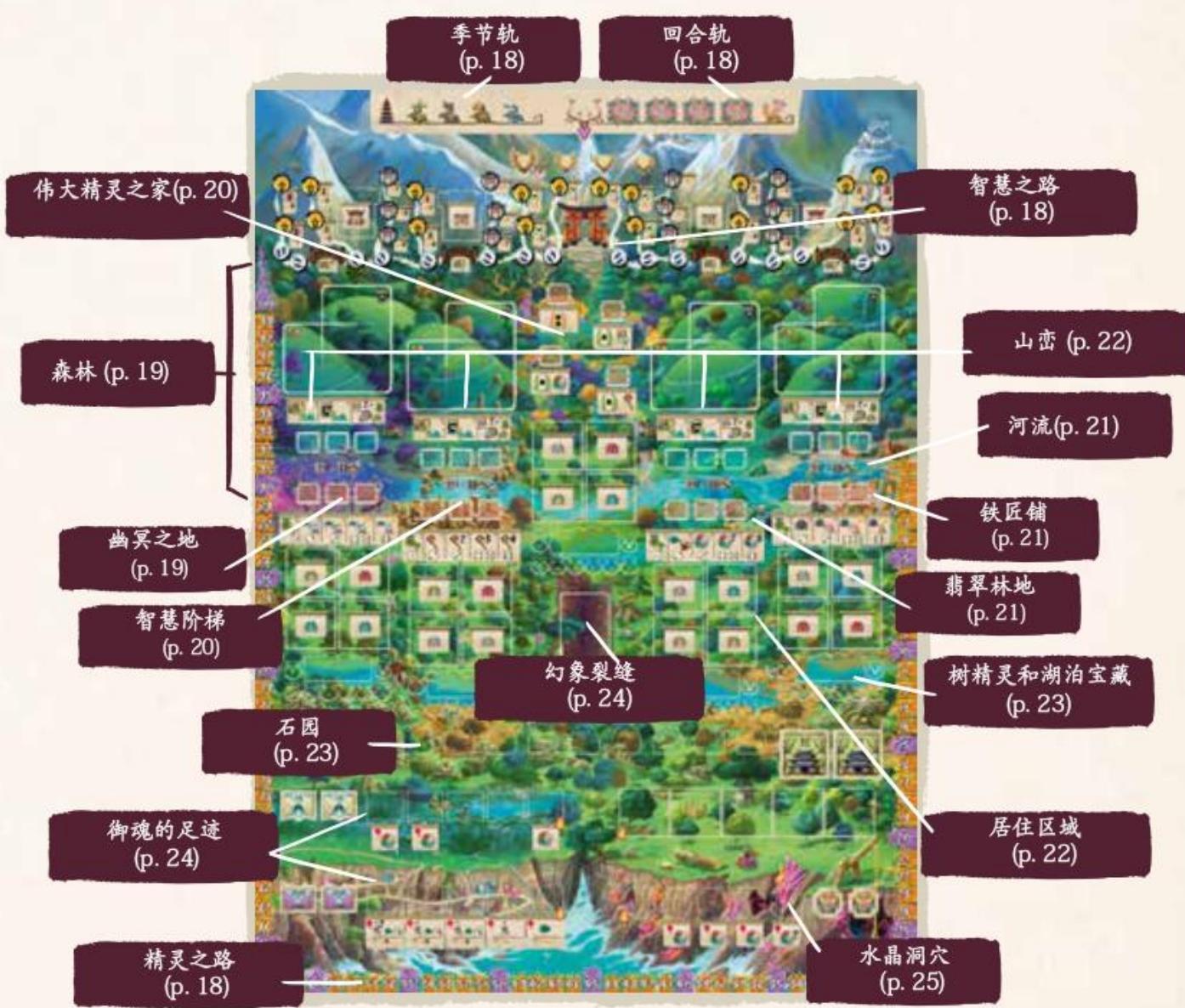
森林 (p. 19)

春季: 森林苏醒 Page 7.


召唤妖怪:抽卡直到手牌有4张,弃至3张

收割水果:收集个人版图紫色梦水晶上的奖励

夏季:守护者的召唤 Page 8.
玩家轮流选择4行动之一,直到所有玩家跳过

从手牌中打出一张妖怪卡
-
解锁刚打出的妖怪卡右边的骰子,如果需要的话
-
通过执行卡面行动来激活妖怪卡(可选项)
-
通过执行右边板块的行动来协调水晶(可选项)

B 使用个人版图一颗未被上锁的骰子
-
强化守护者:通过弃置护身符来增加骰子点数(可选项)
-
拜访森林:将骰子移动到游戏版图的任一空置的森林区域
-
执行森林和建造行动:执行森林行动(如果使用的骰子点数大于等于此区域的其他所有骰子)和/或执行你放置骰子的区域的建造行动之一,顺序由你决定。(可选项)

跨过河流
-
移动你的骰子跨越河流:这个骰子点数至少为2
-
执行忏悔:将骰子点数减1,如果骰子点数为6,则点数减3
-
获得森林恩惠:获得你移动骰子目的地的一个好处,并用光指示物覆盖它

跳过。这一行动不可重复执行。你只能在打完全部三张妖怪卡并在版图上放置三颗骰子后跳过。


秋季:敬拜Page 12.
向前走一步:决定新的回合顺位。在伟大精灵之家的骰子点数最高者成为一号位。

冬季:森林休眠 Page 13.
A守护者回家:从游戏版图收回你的骰子,把它们放回个人版图的红色区域,顺序由你决定。所有的骰子保持现有的点数。
B精灵的美德:如果你有至少五张妖怪卡,你可以选择从个人面板永久移除一张本回合打出的妖怪卡来得分
C 告别妖怪:取出个人面板所有剩下的妖怪卡并将其弃到个人弃牌堆,保存妖怪卡手牌,待下一轮用
D 伟大精灵前进:将伟大精灵指示物在回合轨上前进一格
E 森林中的雪:准备下一回合。
如果你有至少五张妖怪卡,你可以选择从个人面板永久移除一张本回合打出的妖怪卡来得分

图标解读

立即获得1美德点(VP) (p.7).

在上升阶段获得1 VP (p.7).

在上升阶段失去1VP如果此幻象未被完成(p.7).

从公共供应堆拿取任意一种资源 (p.10).
2行动选一执行(p.7).

从公共供应堆拿取指定的护身符(p.9).

解锁个人面板的一个妖怪骰(p.6).

使一个树精前进/后退(p.23).

使此森林区域的一个树精前进(p.23).

执行行动所需的最小骰子点数
(p. 19 to 22).

从你的牌堆抽一张妖怪卡并将其加入手牌(p.6).

从公共供应堆拿一张妖怪卡,抽2选1(p.6).

从公共供应堆拿一张美德卡,抽2选1(p.12).

从光之山拿美德/妖怪卡 (p. 6/12).
获得一张幻象卡,抽2选1 (p.16).

获得1行动点数(MP)
(p. 18).

激活版图上的鸟居展示的行动

黑色数字使行动加倍(p.7).

红手表示做行动的付费,黄手表示你可以打折付费(p.7).
建造建筑 (p.22).

建造财富加成银行
(p. 22).

获得1御魂(p.24).
获得1蜻蜓 (p.25).

混和蜻蜓和御魂(p.25).

获得1岩仓之石(p.23).

将一个朝圣者放在岩仓之石旁(p.24).

获得1水晶(p.25).

精巧的水晶-在它旁边打出妖怪卡后获得奖励

梦水晶-在收割水果阶段获得奖励

记忆水晶-每次执行行动之后获得vp
记忆水晶板块

每次建造一个建筑时获得2VP(p.22).
每次获得一个水晶时获得 2 VP (p.25).

每次获得一个御魂时获得 1 VP (p.24).
每次结合一对蜻蜓和御魂时获得 1 VP (p.25).

每次获得一个幻象卡时获得 2 VP (p.16).

每次获得一个妖怪卡时获得 2 VP(p.6).

每次获得一个美德卡时获得 1 VP (p.12).

每次完成一个美德卡时获得 1 VP(p.12).


每次将一个朝圣者放在一个光辉之地时获得 2 VP (p. 19).

个鸟居时获得 2 VP(p.19).

每次将一个朝圣者放在一个岩仓之石旁时获得1 VP (p. 24).
每次获得一个岩仓之石时获得 2 VP (p.23).
妖怪卡 - 精灵的美德 (P. 13)

每有一张幻象卡获得2VP (最多12vp).

你所有的树精每前进2格获得1VP(最多12vp)
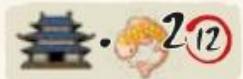
每建造一个建筑获得 2 VP (最多 12vp)
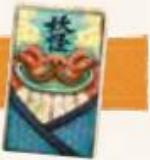

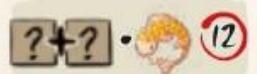
每有一颗水晶获得 2 VP (最多 12vp)

加总你两颗骰子的点数并获得相应的vp
(最多 12vp)

每在一个光辉之地放置一个朝圣者获得 3VP (最多 12vp)
每有一个御魂获得 2 VP (最多 12vp),不管是否已被结合

每完成一个美德卡获得 2 VP (最多 12vp)

获得相应vp


每有一个石头或一杯清酒得1VP (最多 12vp)

每有一个蜻蜓和御魂结合物获得2 VP (最多 12vp)


山姥
狐狸
单人模式 - 天狗的崛起 (P.27)

最爱的妖怪

最爱
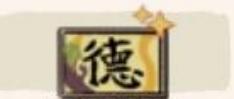
稀有的美德


稀有之物
Bitoku_ENG_baja_comprimido.md114.3 KB
Bitoku
RULEBOOK
LEARNING BITOKU
Bitoku is a game that brings a hefty volume of rules, as you can see while holding it on your hands right now. For this reason, we recommend that you watch the video tutorial that you can find at www.devir.com to complement what you will learn here.
This rulebook will expose the information in the most optimal way, by teaching the round and turn structure first, and then the details of the game board and the player board. Bear in mind that with such a complex game, it is likely that you will come across concepts early in the text that aren't explained in detail until a few pages later.
You should familiarize yourself with the game components and read all of the rules before sitting your friends around a table to play. You may find it helpful to set up the board in advance as if you were playing the game. Then play a few turns on your own, without any opponents, so you can see how the components move around the board and how to resolve actions in the different areas. In a short time, you will master the game and you will have no trouble finding answers to any questions in the rules.
Then, when you invite your friends and explain to them how the game works, do so by handing over the pplayer aids for them to follow along with your explanation. They are sure to appreciate you being a good host by having prepared the game beforehand!
Long ago, in the time of our ancestors, during an epoch that mankind has since forgotten, a Great Spirit inhabited a forest. Its mere presence imbued everything with life, abundance, and peace. After its given time, the Great Spirit would go away, never to return. A Bitoku spirit, worthy to take its place, would then arise to preserve the harmony of the forest.
This primordial forest, millennia old, stretches from the Earthquake Plains to the foothills of the Akaishi Mountains. The mountains are home to the source of the sacred river Kurirakugan, whose mighty flow traverses the forest before shooting out over the cliffs of Sea's Claw.
The Forest has no other name. Indeed, all forests are called such after this one. It is one of the Five Hearts of the World, and it is said that in its deepest, densest regions, the trees and vegetation are so thick that Lost Souls who wander there are able to at last fnd peace and transcend to the beyond—or become lost forever and cease to exist as the last memory of them is forgotten.
There has never been nor will ever be a place like it. Magical and spiritual beings inhabit it remembered today only in legend and children's tales...
The time has come for the Great Spirit to move on, and one of the Bitoku must be chosen as its successor. As one of those spirits, can you prove that you alone are worthy of this incredible honor?
THE GOAL OF THE GAME
The game is played over four rounds, each representing one year left for the Great Spirit. Each round is divided into four phases named for the seasons. At the end of the Winter Phase in the fourth round, the game ends and the Ascension occurs.
Each phase, you will carry out actions to earn Virtue Points (from now on called “VP”). As you earn VP, you will advance along the Spirit Path, which runs around the outside of the board. During the Ascension, you can earn additional VP by completing certain goals. The spirit who advances the furthest along that path will be the winner—and become the new Great Spirit!
INDEX
Components 3
Setting up the Game 4
The Path of the Great Spirit 6
Spring 7
Summer 8
Autumn 12
Winter 13
The Ascension 14
The Elements of the Forest 17
The Player Boards 26
Rise of the Tengu - Solo play 27
COMPONENTS
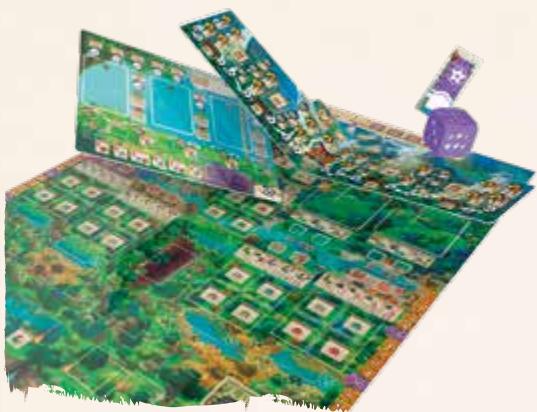
1 GAME BOARD
14 die-cut pieces (to complete the board)
4 player boards (1 per player) / Tengu board (solo mode)
4 flags / “+100 VP” (1 per player)
12 dice (3 per player)

172 COUNTERS
1 Great Spirit counter (to indicate the round)
1 Pagoda counter (to indicate the phase)
12 Player counters (3 per player: for turn order, VP, and their Bitoku Path)
44 Pilgrim counters (11 per player)
20 Kodama counters (5 per player)
24 Construction counters (6 per player)
o 72 Resource counters (18 wood, 18 stone, 18 jade, and 18 sake)


152 TILES

24 Building tiles (6 temples, 6 onsen, 6 farms, 6 ryokan)

6 Ancient Building tiles

5 Lake Treasure tiles

32 Crystal tiles

24 Mitama Spirit tiles (5 ara, 5 nigi, 5 saki, 5 khushi, and 4 shinigami)

632 Dragonfly tiles

) 16 Gate tiles (8 of type A and 8 of type B)

13 Iwakura Rock tiles

1 Tengu Attitude tile (solo mode)
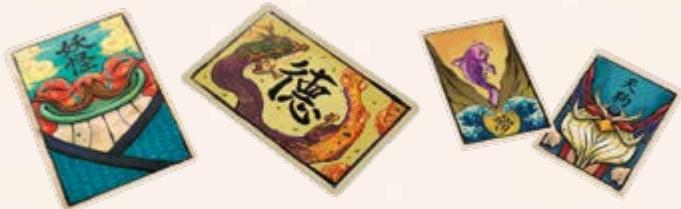
111 CARDS
29 Yōkai cards (5 Kappa, 5 Imomushi, 5 Nezumi,
5 Kitsune, 5 Shin Ookami, and 4 Yama-Uba)
20 Starting Yōkai cards (1 of each type per player)

24 Bitoku cards (5 Makoto, 5 Chuugi, 4 Yu, 4 Jin,
3 Rei, 2 Gi, and 1 Meijo)
28 Vision cards
10 Tengu Action cards (solo mode)
OTHER COMPONENTS
58 Amulets (+1, +2, +3)
32 3x Resources tiles
12 Hikaru markers
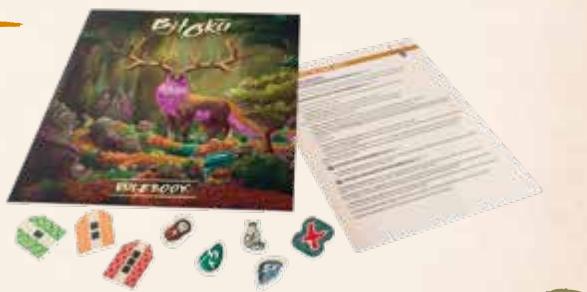
1 rulebook
4 player aids

SETTING UP THE GAME
The path of the Great Spirit is coming to its end. The nal step taken by this enigmatic being will mark the beginning of the path for the one who will be its successor. The imprint of its wisdom shall forever be upon the stones, glades, and green of the Forest. Those who are called to take its place have spent centuries, living through many reincarnations, just to prepare for this challenge. The wisest of the Bitoku are now ready. Which of them shall become the new Great Spirit of the Forest?
SETTING UP THE BOARD
Place the game board in the middle of the table. The side without any gaps is ready for solitaire and two-player games. If three or four of you are playing, add the die-cut pieces in the corresponding spaces as shown in the gaps (the four-player setup always has more spaces on the tiles).
Track (Spring).
Divide the Torii Gate tiles marked “A” and “B." Mix each group separately. Place a random “A” tile on each Torii Gate space marked “A” and a random “B” tile on each space marked “B”, with their rewards side facing up. Put any remaining Torii Gate tiles back in the box.
D
leftmost spaces of the four inhabited areas indicated on the board. In three-player games, place only two of these tiles on the lower leftmost spaces of the Lands of Yomi and the Glade of Jade (as indicated in the example). You don't
need Ancient Buildings in four-player games. Return any leftover tiles to the box.
randomly place one in each of the five Forest regions. For a two-player game, also place a Kodama counter of a neutral color on the fourth space of each region's Kodama Track.
tiles separately and place them in stacks with roughly the same number of tiles face down in the matching spaces. Then, turn over enough tiles of each type (from either of the stacks) to fill all of the spaces next to that stack.
Mix the Iwakura Rock tiles and, without looking at them, give one to each player. Then place one face up in each space of the Rock Garden. Put the remaining tiles back in the box.
Shuffe he ison cards and place them face down on their space on the board.
Shuffle the Bitoku cards and place them in their space on the board with space for a discard pile. Turn over and place one Bitoku card in each space of the Hills area of the board.
The example in this image shows a three-player game setup. The example images in the rulebook use a four-player setup.
The board shown on page 17 is the one used in two-player games.

Separate
the Starting Yōkai cards from the others and set them aside. Shuffle the remaining Yōkai cards and create a face-down deck in their space on the board with space for a discard pile. Turn over and place one Yōkai card in each space of the Hills area of the board (partially covering the Bitoku cards).
Create a common supply for the Resource counters (jade, sake, stone, and wood), the x3 Resource tiles, the Hikaru tiles and the Amulets.
PLAYER SETUP
Each player chooses a color and takes the following:


A player board and a flag of your color: place it in front of you.
3 dice: place them on the red spaces on your player board, with these values showing from left to right: 3, 2, and 1.
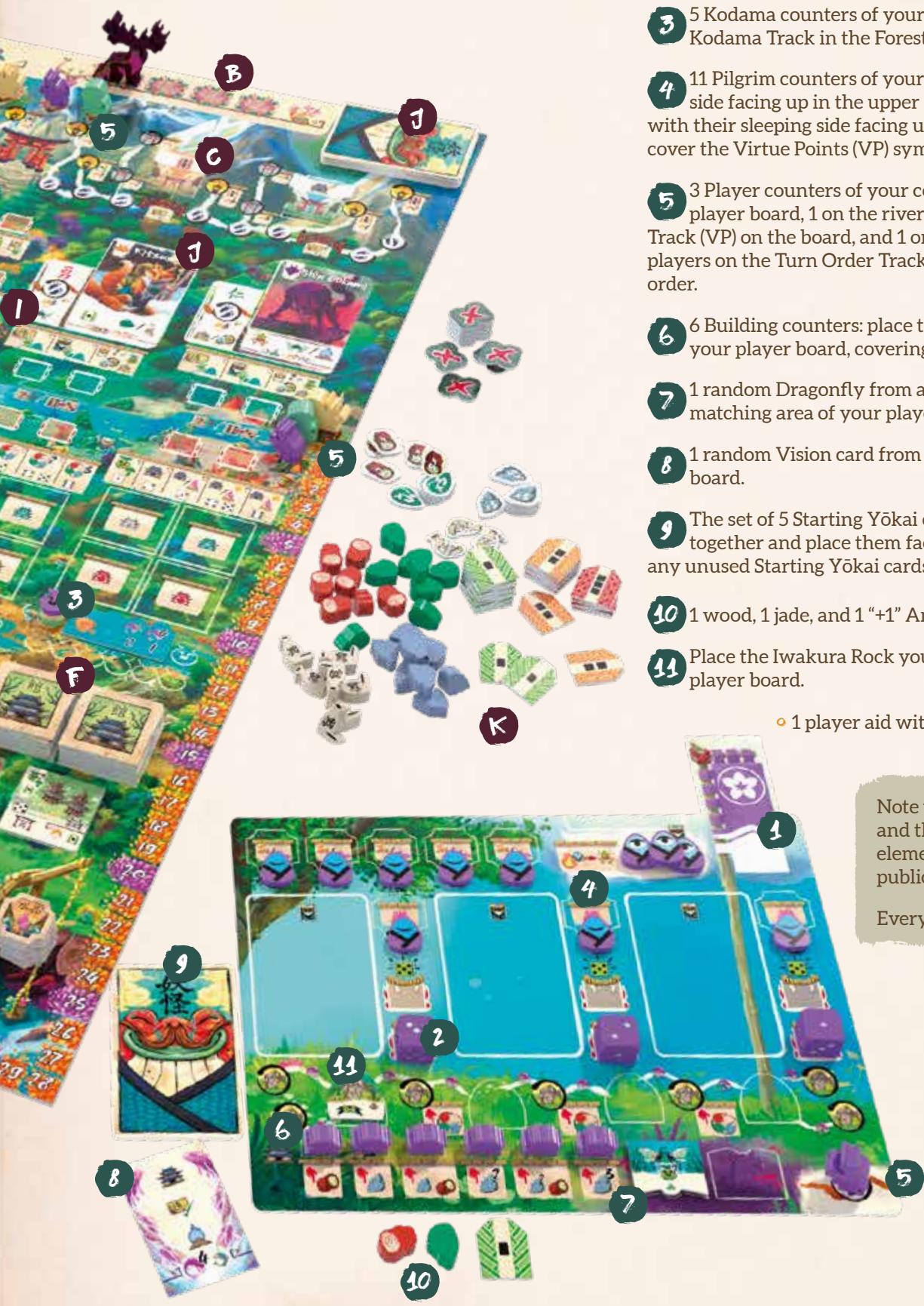
5 Kodama counters of your color: place 1 on the first space of each Kodama Track in the Forest area of the game board.
11 Pilgrim counters of your color: Place 3 of them with their awakened side facing up in the upper right area of your player board and the rest with their sleeping side facing up on the 8 spaces in the Crystal areas so they cover the Virtue Points (VP) symbols.
3 Player counters of your color: Place 1 on the Bitoku Path on your player board, 1 on the river space at the beginning of the Ascension Track (VP) on the board, and 1 on the Turn Order Track. Mix the tokens of all players on the Turn Order Track and place them on the track in random order.
6 Building counters: place them on the spaces in the Building area of your player board, covering the VP symbols.
1 random Dragonfly from any face down stack: place it face up in the matching area of your player board.
1 random Vision card from the deck: place it face up next to your player board.
The set of 5 Starting Yōkai cards of your color. Shuffle your Yōkai cards together and place them face down next to your player board. Return any unused Starting Yōkai cards to the box.
1 wood, 1 jade, and 1 “+1” Amulet: place them next to your player board.
Place the Iwakura Rock you received in the leftmost space on your 'player board.
1 player aid with the Game order and Icon summaries.
Note that except for the face down cards and tiles and the Yōkai cards in the players' hands, all game elements (counters, tiles, Vision cards, etc.) are public knowledge and available to all players.
Everything is now ready to begin!
THE PATH OF THE GREAT SPIRIT

The spirits of the Forest are united in harmony and symbiosis. In all they do, they aid one another, without conflict. Hatred is unknown here, and lush greenery grows everywhere, for the Bitoku oversee everything and together they take care of the Forest. The Great Spirit is the foremost of these, and all can rejoice in the plenitude of its efforts.
Bitoku is played over four rounds, each divided into four phases inspired by the seasons of the year:
Spring: The Awakening of the Forest. The players prepare their Yōkai cards and gather the fruits of their earlier labors.
Summer: The Call of the Guardians. The players call upon their Yōkai and perform actions in the various areas on the board.
Autumn: The Reverence. Based on their actions in the Summer, the players determine the new turn order.
o Winter: The Repose of the Forest. The players recover their pieces and prepare the board for the next round.
At the end of the last round, the Ascension will begin, when the final VP are awarded and the new Great Spirit will be chosen.
YÓKAI CARDS AND DICE
The duties of a Bitoku who aspires to become the Great Spirit of the Forest would be laborious and arduous if they had to do it all alone.
Fortunately, the Yōkai—Guardians who watch over and protect the Forest-are there to help. Their presence in the game is represented in the form of cards and dice. Using these is fundamental to the strategy of the game, and you must use them well if you hope to become the next Great Spirit.
During each round, you will use 3 cards and 3 dice.
o Yōkai cards are played onto your player board to allow you to perform various tasks and receive rewards. You begin the game with a basic deck of 5 Starting Yōkai cards, but you can gain more powerful cards during the game. In addition, they can give you VP at the end of the round in which they are played.

Obtain a Yōkai card from the common deck. Take the top two cards, choose one and keep it in your hand. Then place the other face down back at the bottom of the deck.

Obtain the Yōkai card from the Hikaru Hill you just moved your dice to. Place it in your hand.

Draw a Yōkai card from your deck and put it in your hand. Any time you draw Yōkai cards, always take them from the top of your own deck. Your deck is kept face down next to your player board and you may not look at those cards at any time. The cards in your hand should be kept secret from the other players.
When you discard Yōkai cards, place them in a face up discard pile next to your deck. You may examine the cards in your discard pile at any time, but under no circumstances can you draw cards from here.
If you need to draw a card and there are no cards left in your deck, shuffle your discard pile and create a new face-down deck, then draw the cards you need.
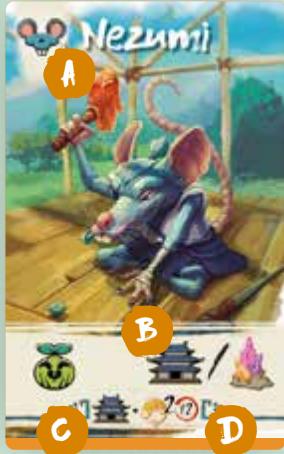
Each Yōkai card shows their type the action they offer when played and the VP they can grant you during the optional Spirit's Virtues step during the Winter Phase . The red circle indicates that you can obtain a maximum of 12 points by playing the Spirit's Virtues (see player aid). Also, the starting Yōkai cards show a symbol under the type icon matching the color of the player's pieces.
The card in the illustration is a Nezumi type, its action allows you to advance one of your Kodamas one space
forward and either construct a Building or obtain a Crystal, and if you choose to remove it during the Winter Phase you will receive 2VP for each building that you have constructed (Max. 12).
o Dice begin each round on the red spaces of your player board. The value on the die determines how powerful that Yōkai is: the higher the value on the die, the more powerful the action will be when you use that die. Also, as only Yōkai can cross the sacred River, only dice can be used to gain the Favor of the Forest by moving over the river to the Hills (see page 10).
Before you can use a die, you must unlock it, moving it to the green space. There are three ways to unlock a die:
• Play a Yōkai card in the space next to the locked die.
• Use an action that allows you to unlock a die.


• Discard a Pilgrim: You may use a locked die from your Personal Board if you discard a Pilgrim counter you have available. If you
do, you must use that die immediately (see page 9). The Pilgrim is removed from the game.
choose (see player aid). yer aid).
SPRING: THE AWAKENING OF THE FOREST

The cold winter's snow turns to crystal-clear streams, flooding the woods with fresh and green. The Forest erupts in a festival of life and exuberance as the animals awaken from their hibernation and the spirits resume their activities, taking care of the Forest. Spring is the time when life flourishes, and the Yōkai gather to assist the Bitoku.
During this phase, the players receive their Yōkai for the round and collect income. All players may act simultaneously during this phase, performing these two steps:
Summon the Yōkai: Each player draws cards from their Yōkai deck until they have 4 cards in their hand. It is possible for players to start this phase already with 4 or more cards in hand from previous rounds, in that case, they should not draw more cards from their deck. Then, they must choose which of those cards to discard, finally keeping a total of 3 in hand.
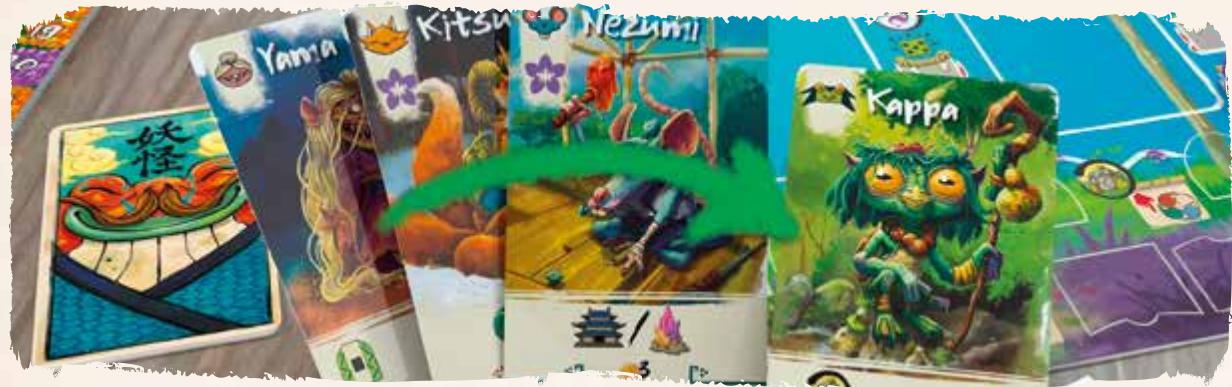
The purple player has 1 card from the previous round, so she draws 3 cards from her deck, bringing her hand to 4 cards. She must now decide which one she will discard so there will only be 3 cards in her hand.
B ReiintDllects Crystals (purple) on their player boards. You may collect these rewards in any order you
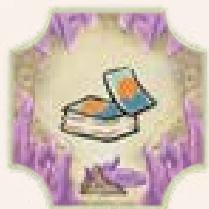
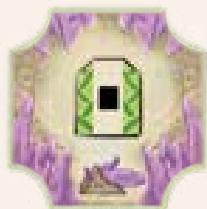
Purple continues by checking the 2 Dream Crystals on her player board: she draws 1 yōkai card from her deck (she now has 4 cards on her hand) and a +1 Amulet from the supply.
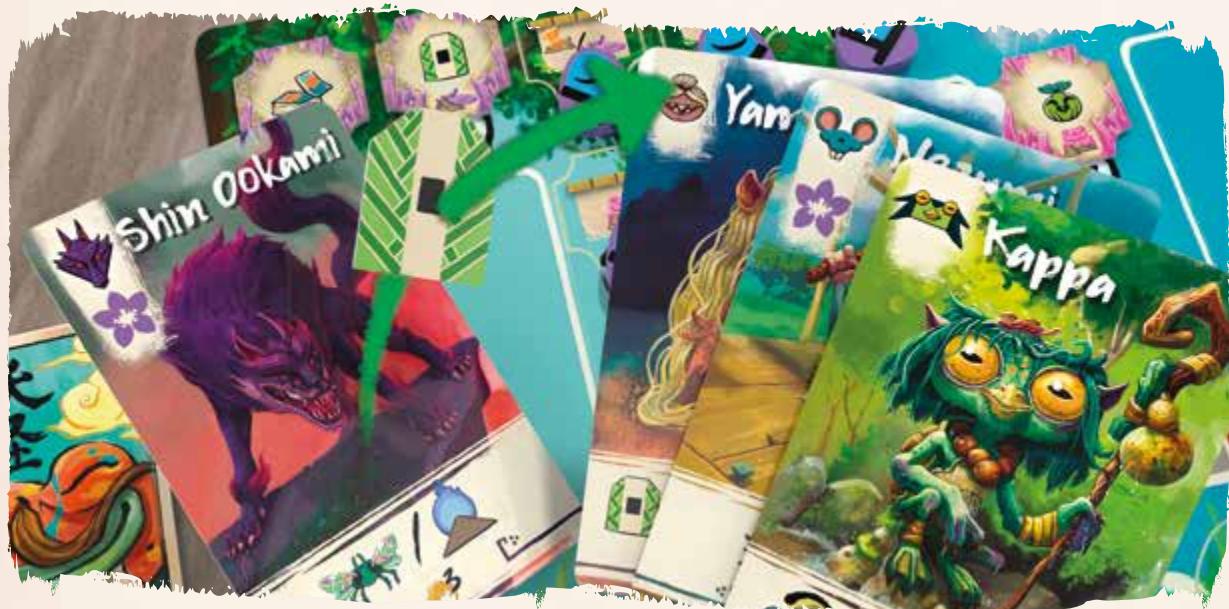
As soon as all players have completed both steps, the Summer Phase can begin-move the Pagoda counter to the next space on the Phase Track.
ICONS AND SYMBOLS
Bitoku uses a variety of icons and symbols to help you through the game and communicate valuable information. It may seem like a lot at first, but you will quickly learn to identify them. You can find them all in the player aid that briefly explains each symbol, as well as reference pages where they are explained in more detail.
A black number to the right of any icon indicates the number of times you can take an action. If there is no number, you only take that action once.

Receive 2 VP.
Obtain1 Dragonfly.
A red hand means that you must pay that Resource, returning it to the common reserve, in order to obtain a tile or perform an action. A yellow hand next to an icon indicates that we can take that action paying a lower number of Resources (of any type), by the amount indicated.

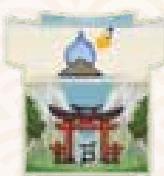
This Gate allows you to purchase a Mitama Spirit tile by paying 2 Resources less than the price shown. So, you could reduce the price by 2 sake or by 1 sake and1jade.
If a Virtue Points icon is orange, it means that you earn those VP immediately as soon as you take that action. If the icon is purple you do not earn those VP until the end of the game. A gray VP indicates a loss in VP.

When you see a slash “/” between two icons, you can decide which one of those to take.

You can receive two jades, two sakes or one jade and one sake.

You can construct a Building with a discount of one Resource, or obtain a Crystal with a discount of one Resource.
There are three main ways to gain actions during the game:
The basic actions are your options during your turn in the Summer Phase: play a Yōkai card, use an unlocked die, cross the river, or pass.
Forest and Building Actions are granted by the regions of the Forest when you place a die there. Forest Actions are different for each region (see page 19). The Building Action available depends on which Buildings are available in the region you place your die on (see page 22).
Some spaces on the game board, some tiles, and some Yōkai cards also allow you to take the action shown. These actions must be resolved at the moment the space, tile, or card is activated. This may trigger additional actions, possibly causing a chain of actions, one after another.
PLAYER AID
The player aid included in the game (there are four of them) has a handy summary of the round order. In any case, that is just a summary, so please refer to the main rulebook for detailed explanations of the rules.
Also, there is an image of the game board, with each section named and referenced with the page number in the rulebook where you will find all the relevant details.
Finally, in the inside of that leaflet there is the description of all the icons you can find in the game, and references to the relevant pages of the rulebook in case you need further explanation.
As spirits gain wisdom and become more powerful, they also grow proportionally larger. Some even grow to the size of oak trees and acquire masterful abilities. These are known as Yōkai Guardians. Summer is the season of hard work. This is the time that those who hope to become the Great Spirit call upon these Guardians for aid.
During this phase, the players will take individual turns. The order of turns is determined from left to right by the location of the Player counters on the Turn Order Track.
When it is your turn, you must choose one of these four basic actions:
A. Play a Yōkai card from your hand.
B. Use an unlocked die on your player board.
C. Cross the River.
D. Pass.
Once you have completed your actions, it is the next player's turn. Players continue taking turns in this way until all players have chosen to pass. Then the Autumn Phase can begin—move the Pagoda counter to the next space on the Phase Track. Let's take a look at the four actions in detail:
O Play a Yōkai Card from Your Hand
The Yōkai cards represent the guardian spirits of the Forest. They are divided into five types, each specialized in a different kind of effect.
When you choose this option, you will play one Yōkai card from your hand, placing it on an empty card space on your player board Yōkai area. Then, follow these three steps:
-
Unlock the die next to the Yōkai card you just played, moving it from the closed red space (to the right of your card) to the green open one, if needed.
-
Activate the Yōkai card by carrying out the action shown on the card. This step is optional.
-
Harmonize the Crystal, if you have one connected to that card space (see page 25), by carrying out the action shown on the tile. You may do this before or after you activate the Yōkai card. This step is optional.
Things to Consider When Playing a Yokai Card:
You may not play a Yōkai card on a space that is already occupied by another card.
You may play a Yōkai card even if the die in that space has already been unlocked or even played on the board.
If all three of your card spaces are full, you must choose a different option on your turn.
You may not move a Yōkai card to another space after you have played it.
Each card space can only have one Crystal connected to it for the entire game.

The brown player plays an Imomushi Yōkai card from his hand on the leftmost space of his player board. The die for that space was locked, so he moves it to the open space. Then, he activates the Yōkai card, taking his choice of 1 wood or 1 stone from the reserve. He has no Crystal attached to this card space, so his turn is over and the next player begins their turn.
Use an Unlocked Die on Your Player Board
The most powerful Yōkai are the Guardians, represented in the game by dice. When you use one of your unlocked dice, you will always place it in the Forest area of the game board. The Forest is divided into five regions. Each region has a number of spaces where dice can be placed (see page 19). You can only place a die in a space that is not already occupied by another die.
When you place a die in the game board, follow these steps:
-
Reinforce the Guardian: Before you place a die (and only at this time), you may increase the value shown on the die by discarding any number of Amulets you have to the supply. Each Amulet you spend in this way increases the value of the die by 1, 2 or 3, depending on the value of the Amulet. The value of a die can never be increased above 6 (any additional points are lost). This step is optional.
-
Visit the Forest: Move the die to any empty space on the Forest area of the game board. You may have more than one die in the same region (over multiple turns), as long as there are still empty spaces available.
-
Perform Forest and Building Actions: You may now use the Forest Action and/or one of the Building Actions that are available in the region where you placed the die. You may perform these actions in any order you choose. This step is optional.
FOREST ACTIONS
You may only use a Forest Action if the die you placed has an equal or higher value than all other dice already in that region. Note that any dice that have crossed the river over to the Hills are no longer counted as being in the Forest region.
The Forest Actions available in each region are described on page 19.
BUILDING ACTIONS
If there are any Buildings in the inhabited area attached to that Forest region at the moment in which you place the die, you may perform the action shown on one of those Buildings (see page 22). Unlike Forest Actions, you may use a Building's action regardless of the values of other dice in that Forest region. But, your die value must still be higher than or equal to the value shown on the Building you want to use.
Property Bonus: If you perform a Building Action on a Building that was constructed by another player (that is, one marked with another player's Building counter), the Building's owner receives the Property Bonus on the tile. This is in addition to the effect that you are using and comes from the common supply (you don't pay them the bonus yourself). There are three types of Property Bonuses: the owner earns 1 VP, the owner earns 1 VP or a +1 Amulet (owner's choice), or the owner earns 1 VP and a +1 Amulet.
You do not receive a Property Bonus if you use your own Building.
Things to Consider When Playing Dice in the Forest:
You may not perform more than one Forest Action per die placement.
You may not perform more than one Building Action per die placement.
You may not perform a Building Action from a Building you just built this turn.
You may not place a die from your personal board onto any space in the Hills over the other side of the River.
You may use a locked die by permanently discarding a Pilgrim available on your player board (see page 6).
You may perform the Building Action before the Forest Action or vice versa, but either way you must complete the first action before beginning the second one.
Both types of actions are optional: You may place a die without taking either type of action.
ONE QUICK TIP TO MAKE BITOKU MORE DIFFICULT
After your first few games, you can increase Bitoku's difficulty simply by adjusting the Forest action rules to the following:
You may only use a Forest Action if the die you placed has a higher value than all other dice already in that region. If any of those dice is showing a value of 6, you have to spend an Amulet at this moment in order to “virtually” increase your value over 6 for this Forest action only (do not change the top face of the die). Note that any dice that have crossed the river over to the Hills are no longer counted as being in the Forest region.
EMPTY SPACE IN THE FOREST AREA
AMULETS
These mystical tokens are used by Guardians to enhance their powers.
When you obtain them, take them from the common pool and place them next to your player board.
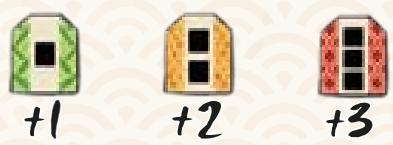
Any time you move a die to the game board, you may spend any number of Amulets to increase the value showing on that die (+1, +2, or +3 as marked on each Amulet).
Amulets cannot be broken down into other Amulets of smaller denominations: you can't change a +3 Amulet for three +1 Amulets.

RESOURCES
Resources are used to pay various costs during the game, and can be acquired from tiles, cards, and other sources. There are four types of Resources in the game:
The following icon indicates that you can take Resources of any type. As many as indicated, either the same or different, chosen by the player.

This icon would allow you to take 2 jade, or 1 stone and 1 wood, or any other combination of 2 Resources.
When you receive Resources, place them next to your player board. At any time, you may return 3 Resources of the same type to the supply and take a x3 Resources tile for that Resource type in exchange (or vice versa).


EMPTY RIVER SPACES
LIMIT OF COMPONENTS
There is no limit to the number of Resource tokens or Amulets available during the game at any given moment.
If you run out of any of these components and need more, just use any kind of temporary substitute, like coins.

Hikaru marker
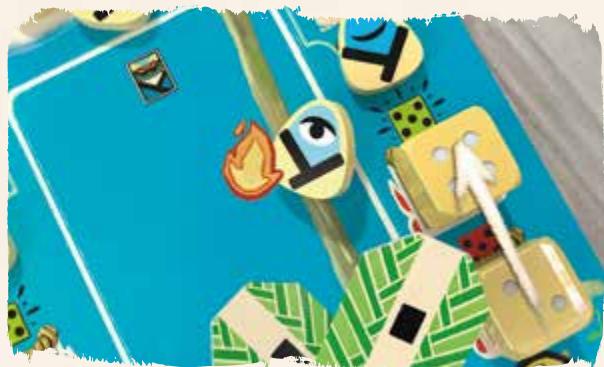
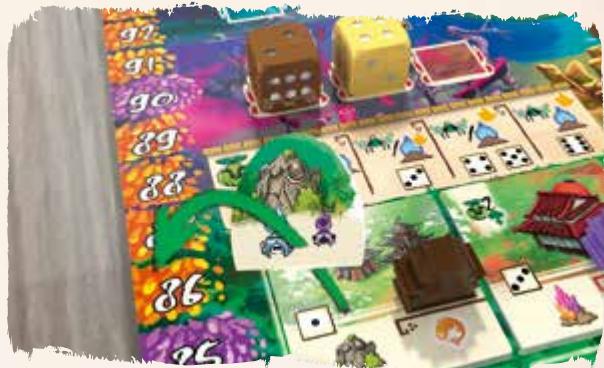
The yellow player has no unlocked dice, but they really want to claim a space on the board before any other player can, so they discard one of their Pilgrims from their player board (they will not be able to use this Pilgrim for the rest of the game) to unlock a die with a value of 2.
Then, they discard 2 Amulets marked +1 to increase the value of the die, turning it to show the value 4.
They place the die in the Forest region of the Lands of Yomi. There is a brown die here, but its value is only 2, so the yellow player can still use the Forest Action. If the brown die had a value of 5, they would not be able to use the Forest Action, since their die would not be equal to or higher than all of the other dice in the region.
Then, they choose a Building that has a minimum dice value requirement of 1, which is less than the value on their die, which allows them to get an Iwakura Rock. The Building belongs to brown, so he gets 1 VP, which is the Property Bonus for that Building.
Cross the River
If you have one or more dice in the Forest area of the game board, you may choose this option. If you do, follow these steps:
-
Move Your Die Across the River *: Choose one of your dice in the Forest and move it to an empty space in the matching Hikaru Hills area on the other side of the river. In two-player games, the spaces on the other side of the River can reach both Hikaru Hills on each side of the board (as divided by the Home of the Great Spirit).
-
Perform an Act of Contrition: Only the humble can cross the sacred Kurirakugan River, so you must reduce the value of your die by 1 point. If the die has a value of 6, however, you must reduce its value by 3 points instead. Note: You cannot cross the river with a die that has a value of 1 because it cannot pay for the Act of Contrition.
-
Obtain a Favor of the Forest: Gain one of the available benefits shown in the space you moved your die to. You can only move your die to an empty space, but you can choose any available Favor. Each Favor can only be gained once per round in each area, so players will cover them with Hikaru markers after claiming one of them to indicate that one not available until the following round. In two-player games you will be able to access the Favors of the two Hills connected to the space where you place your die when crossing the river. These are the three Favors available in each area:
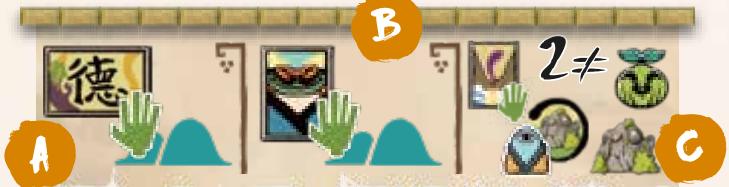
Take the Bitoku card from this space. Place it face up below your player board to begin or extend your Bitoku Path (see page 12).
3 Take the Yōkai card from this space. Add it to your hand. You may play this card during a later turn.
Choose two different of these four options:
• Draw 1 Vision card from the deck (following the process described on page 16).
• Take 1 Iwakura Rock from the board and add it to your Rock Path (see page 23).
• Place 1 available Pilgrim on your player board adjacent to one Iwakura Rock (see page 24).
• Move one of your Kodamas on any Kodama Track forward 1 space (see page 23).
Once a die has crossed the river, it remains there until the Winter Phase and cannot be moved again that round.
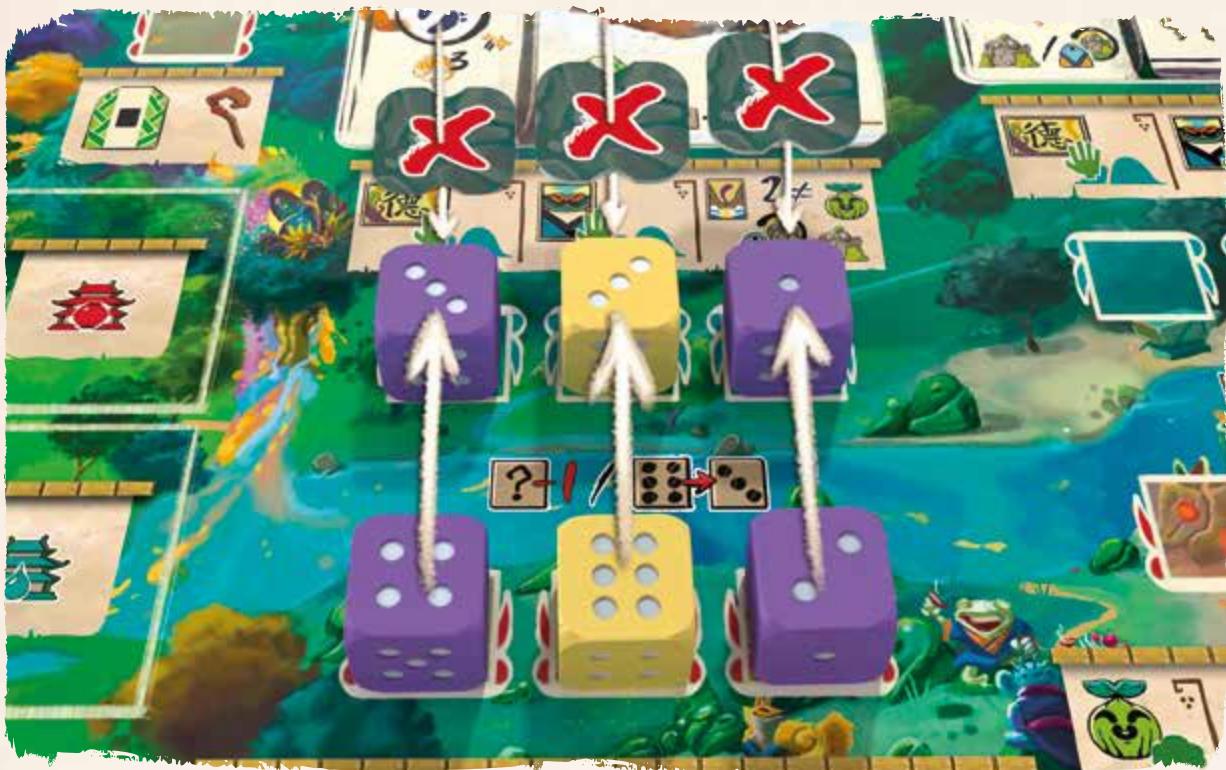
Purple crosses the river with her die showing a value of 4. She must reduce its value to 3, then she takes the Bitoku card and adds it to her Bitoku Path, and she covers that Favor space with a Hikaru marker.
Yellow crosses the river also, but since their die has a value of 6 they must reduce it by 3 points. They take the Yōkai card and add it to their hand, covering that Favor space with a Hikaru marker.
Later on, purple has another die she can cross the river with. The Yōkai and Bitoku Favors have already been taken, so she chooses to take an Iwakura Rock and move one of her Kodamas one space forward (she covers that Favor space as well).
Things to Consider When Crossing the River:
You can only place your die in an empty space after crossing the river.
The value on your die does not affect which Favors you may take here.
After you cross, the space in the Forest that your die left behind is now empty and available for another die to use.
A die at the Home of the Great Spirit cannot cross the river.
Taking the Favor of the Forest is optional: You may cross the river and choose a reward but decide not to take it, and simply cover that option with a Hikaru marker without any further effects.
Pass
After having played your three Yōkai cards on your personal board and moved your three dice over to Forest spaces, if you cannot or do not wish to cross the River, you may pass when it is your turn. Once you pass, you are “out” for the rest of the phase and you may not take any more actions.
Once all players have passed, the Summer Phase ends and the Autumn Phase can begin-move the Pagoda counter to the next space on the Phase Track.

BITOKU CARDS
Bitoku are powerful spirits on their own path to Ascension. But even the strongest of them require the advice and wisdom of other spirits.

Obtain a Bitoku card from the common deck. Take the top two cards, choose one and keep it on your Bitoku Path. Then place the other face down back on the bottom of the deck.

Obtain the Bitoku card from the Hikaru Hill you just moved your die to. Place it on your Bitoku Path.


Completed card.
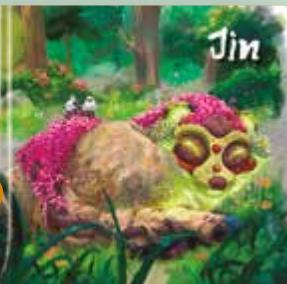
Each Bitoku card shows a type a space for a Player counter B a VP award and any other actions available when the Player counter moves onto that cardand a rarity number indicating the number of copies of that type available in the deck D.
Bitoku cards are used to create the Bitoku Path on your player board.
Each time you gain a Bitoku card, you must add it to your path as shown.
The Great Spirit of the Forest is a generous being, for with every step that it takes, life springs forth from its footprints. The Great Spirit of the Forest is a strict being, for every thing that lives must die when its time has come. The Great Spirit of the Forest is a fair being, for the decay of the expired feeds the fruit from whence new life is born.
Autumn is the season for reflection. At this time, the aspiring spirits present themselves humbly before the Great Spirit to review their deeds. Players take the following step simultaneously:
Take One Step Forward: The new turn order is decided at this point. The player whose die is on the highest position in the Home of the Great Spirit places their Player counter in the first position on the Turn Order Track, pushing the rest of the counters on the track to the right to make room. Then the player in the second highest position places their counter in the second position on the Turn Order Track, and soon.
If you have more than one die in the Home of the Great Spirit, only the one in the higher position is counted. If there are no dice in the Home of the Great Spirit, the turn order remains unchanged.
Once this step is resolved, the Autumn Phase ends and the Winter Phase can begin-move the Pagoda counter to the next space on the Phase Track.
The Home of the Great Spirit contains 3 dice in this order: yellow, brown, yellow. So, the yellow player is placed in the first position (since their die is highest) and the brown player is placed in the second position. The purple and green players' relative positions do not change when they are pushed to the third and fourth spaces.
If you have at least 1 Bitoku card beyond the space occupied by your Player counter, you may spend 1 Movement Point (MP) to move your counter to the next space (see page 18). When you do this you complete that Bitoku card and immediately gain the VP and any other action shown on that card. Also, you will need to have at least one or two completed Bitoku cards in order to cross the bridges in the Paths of Wisdom (see page 19).
At the beginning of the game, you have no Bitoku cards on your path, so you may not move your Player counter forward until you gain at least one card.
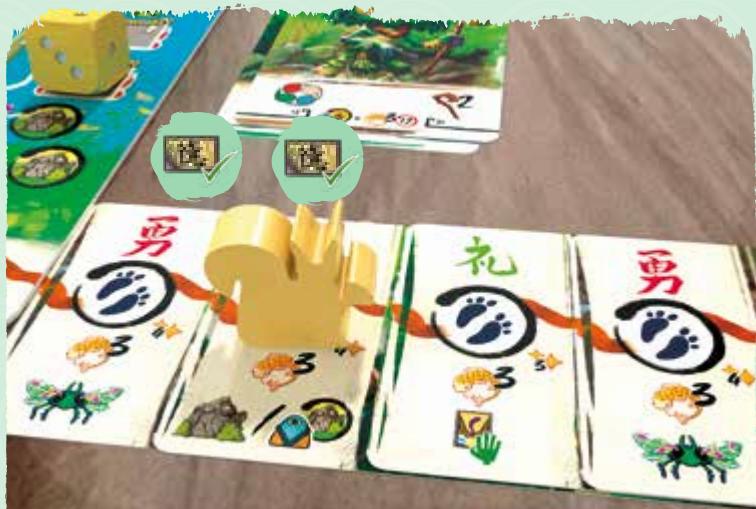

WINTER: THE REPOSE OF THE FOREST
Snow and ice overtake the Forest. The Great Spirit contemplates how the flakes light upon the branches of the evergreens and the way the ice slows the heartbeat of the ponds. Silence settles in as the Forest begins to rest. Winter is the season where the Forest recovers its strength for the coming cycle, and is the time for aspiring spirits to prepare themselves for their next challenges.
All players must follow these five steps in order:

Guardians Return Home: Take your dice back from the game board and return them to the red A spaces on your player board on the order of your choice. All dice keep their current values.
The Spirit's Virtue: If you have a total of at least 5 Yōkai cards (between your deck, your player B board, your hand, and your discard pile), you may choose to permanently remove one from the game to earn VP. This step is optional.
Using the new turn order, each player may remove 1 of the 3 Yōkai cards on their player board and score the VP shown at the bottom of the card. If you do so, place the card face up so it is visible under your player board (next to the flag), leaving its type visible. You will no longer be able to use that card for the rest of the game. At the end of the game, this card still counts when you score your Iwakura Rocks (see page 15).
Cards discarded this way will award VP by counting the number of copies of each item shown currently under your control, multiplied by the value of the VP icon, always up to a maximum of 12 points. You can see the details of these on the player's aid.

Receive 2 VP for every Building that you have constructed, up to a maximum of 12 VP.

0 T uyr board and ut them in
The Great Spirit Takes a Step: Advance the Great Spirit counter one space forward on the Round Track.
If the Great Spirit reaches the Ascension space, skip the next step and proceed directly to the Ascension Phase (see page 14).

3 Snow in the Forest: Prepare the game components for the next round:
-
Remove all Bitoku and Yōkai cards from the game board and discard them. If either deck has no cards left, reshuffle the matching discard pile and create a new deck at this time.
-
Return the « Hikaru » tiles from the Hills to the common supply.
-
Draw a Bitoku card and then a Yōkai card for each space in the Hills.
-
Remove the Mitama Spirits, Dragonfly, Building, and Crystal tiles that are in the last space (furthest away from the stack) of each of their areas on the game board from the game. Push the remaining tiles on these paths forward until they fill all of the spaces at the end of their paths. Then, turn over enough tiles to fill in all of the spaces on each path. Remember: The Iwakura Rocks are never refilled.


- Move the Pagoda counter back to the Spring space on the Phase Track.



Much time passed before the Great Spirit of the Forest was able to complete its journey into peace. Findina a replacement was no simple matter, for reaching the required state of balance and wisdom is a challenge for even the most enlightened'of beings. The oldest of trees, for whom the passing of centuries is like a single breath, if they are very lucky may live to see as many as three Great Spirits in their entire lifespan
As soon as the Winter Phase of the last round is complete, the players add up their final score to determine who will be the next Great Spirit of the Forest. If they prefer, the players can take turns calculating their personal score, or carry out each step of the Ascension together.
Add up your points by moving your marker on the VP path. If your score passes 100 VP, flip your flag to its “+100” VP side to show your accomplishment.
Here are the different items to score:
Reap the Fruits: Each player collects the rewards indicated on the Dream Crystals (purple) on their player boards. You may collect these rewards in any order you choose (see player aid).
Scoring Example, Part 1: The purple player has three Dream Crystals that allow her to draw one Yōkai card from her deck, one Amulet marked +1 (neither will do her any good at this point) and 1 sake.
B First Among Many: The player who is first on the Turn Order Track receives 3 VP.

Scoring Example, Part 2: The purple player finished the game in the first position on the Turn Order Track, so she gets 3 VP.
Thef how far you have progressed on your Bitoku Path.
| Different Bitoku Types: | ||||||||
| 1 | 2 | 3 | 4 | 5 | 6 | 722 |  | |
| VP Earned: | 1 | 2 | 4 | 7 | 11 | 16 |
Scoring Example, Part 3: Looking at her Bitoku Path, the purple player finds that she has 3 different kinds of Bitoku cards there. So, she gets 4 VP.
TruaTforonooThawmuac there is a tie, add the rewards of the tied positions and divide the total VP among the tied players (rounded down).
Remember: The final space on the track can be occupied by only a single Kodama (see page 23).
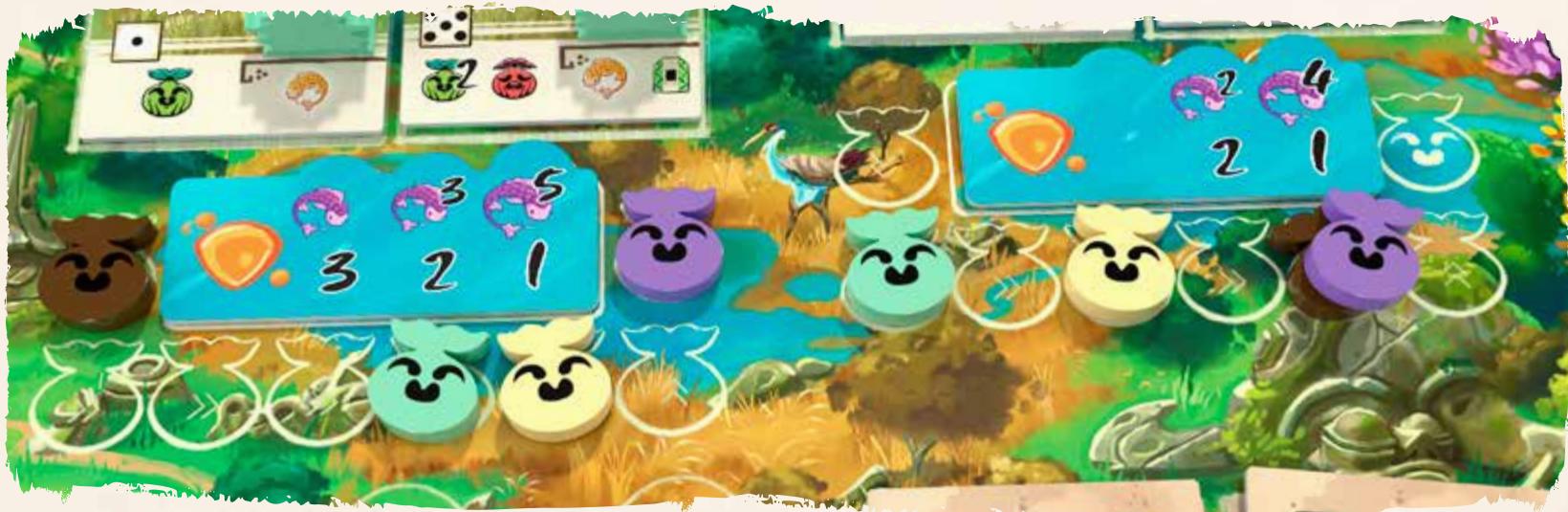
Scoring Example, Part 4: The purple player's Kodama holds the highest position on the track in the Lands of Yomi, so she gets 5 VP for that. In The Forges she is tied with Brown for first and second places, so they get 3 VP each (and yellow gets zero VP).
E waRckplanatheaath dFahmsting rent Rocks, you may count it both times
The items shown on the Rocks can be found on Yōkai cards, Buildings, or Mitama Spirits, as indicated below:

1.Yōkais:Each Yōkai card with the matching symbol, whether it is in your deck, discard pile, hand, or player board (or under it), including any Starting Yōkai cards, awards VP.
Yuma-uba cards act as “wild" cards: You may choose which unique type of Yōkai you want to assign to each of these cards at this time.
- Mitama Spirits: Each Mitama tile with the matching symbol that you have on your player board awards VP, whether you have combined them with a Firefly or not.
Shinigami Mitama Spirits act as “wild" cards: You may choose which type of Mitama you want to assign to each of these tiles at this time.

- Buildings: Each Building with the matching symbol that you own (has your Building counter on it) awards VP.

Scoring Example, Part 5: The purple player has 2 Iwakura Rocks and has 2 Pilgrims next to them. The first Rock allows her to score for each Ara Spirit she has. She chooses to count her Shinigami Mitama as an Ara, so she scores 3 VP x 2 Pilgrims = 6 VP. Her second Rock allows her to score for her ryokan and temple Buildings. She only has 1 temple, so she only scores 1 VP x 1 Pilgrim = 1 VP. Purple gets a total of 7 VP for her Iwakura Rocks.
Guardians Pay Homage: Each player now adds up the current value of all three of their dice, plus the number of Resources they still hold, then they divide this total by 4 (rounding down) and earns the result in VP.
Scoring Example, Part 6: At the end of the game, the purple player's dice show the values 3, 5, and 3. She has 2 wood, and 1 sake. Adding them together gives her 14. Dividing by 4 and rounding down, she is awarded 3 VP.
Visions Revealed: Each player earns the VP shown on each of the Visions that they were able to complete, and loses 1 or 2 VP for each uncompleted Vision as indicated. Remember: You can only use each game element to fulfill the requirements of one Vision (see page 16).
Scoring Example, Part 7: The purple player has only constructed a single Building. She completed 2 Bitoku cards on her path. She has 1 Pilgrim at a Torii Gate, and 3 Mitama Spirits combined with Dragonflies. She could complete either one of her Visions, but cannot complete both of them because they both require a Building. Obviously, she chooses the one worth the most VP: 6. Still she loses 1 VP for the uncompleted Vision.
The player who has the most VP becomes the new Great Spirit of the Forest and wins the game! If there is a tie, the one who completed the most Visions is the winner. If they are still tied, the winner is the one furthest ahead on the Turn Order Track.
Scoring Example, Conclusion: During the game the purple player gathered 67 VP. Now, during the Ascension she obtains 3 VP (First in Turn Order) + 4 VP (Bitoku Path) + 8 VP (Treasures of the Lake) + 7 VP (Iwakura Rocks) + 3 VP (Guardians) + 5 VP (Visions) + 6 VP (Fate Accomplished) which add up to 36 VP. 67 + 36 gains her a grand total of 103 VP. Fortunately for her, she beats the brown player by 2 VP. If they had tied, brown would have been the winner since he was able to complete 2 Visions, the first tie-breaker.

VISION CARDS
Each Vision card shows a specific list of requirements that you must fulfill in order to earn the VP shown on the card. You must complete all of the requirements on the card in order to earn the points, or lose VP for each Vision card that wasn't fully fulfilled at the end of the game.
OBTAINING VISION CARDS

When you take an action that awards you a Vision card, follow these steps:

Draw 2 Vision cards from the deck.

Choose if you want to keep one of the Vision cards or not:
-
If you choose to keep a Vision card, take 1 card and place it face up next to your player board. Take the other card and place it face down at the bottom of the Vision card deck.
-
If you do not wish to keep either of the Vision cards, return both of them to the bottom of the Vision card deck and take any 1 Resource of your choice from the supply instead.
SCORING VISION CARDS
In order to earn the VP listed on a Vision card, you must complete all of the tasks shown on that card before Ascension begins (see page 14). Players will lose 1 or 2 VP at the end of the game as indicated on each uncompleted Vision card.
Each item in the game can only be used to fulfill the requirements of one Vision card. So, if you have multiple Vision cards that require the same item, you must have a separate copy of that item for each Vision card you want to complete. If you do not have enough, you may choose which Visions to complete.
During Ascension, the brown player has 3 Vision cards. He has only 3 Crystals, which is not enough to meet the requirements of all 3 Vision cards. He will have to choose which Visions to complete, based on whether or not he can meet all of the other requirements, and lose VP for each uncompleted Vision.
Each Vision card shows the following information:


The Requirements you must fulfill to complete that Vision.

The Virtue Points you will earn during Ascension if you complete that Vision.

The number of VP you will lose in case it is not completed.
The requirements for a Vision card can include any of the following. Note that the icons used throughout the game to indicate actions, here should be read as “having fulfilled that action”:

Have a Resource of any type.


Have a constructed Building.
Have a Dragonfly combined with a Mitama Spirit.

Have a Crystal of any color.

Have a Pilgrim on an Illumination space.

Have a Mitama Spirit tile (combined with a Dragonfly or not. In case of being combined, the dragonfly will still apply for the following requirement).


Have a Pilgrim on a Gate space.
Have made an advancement on your Bitoku Path.
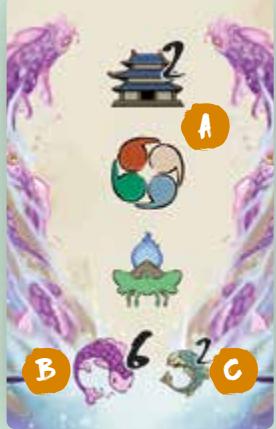
If you fulfill this Vision you will receive 6 VP. It requires that you construct 2 Buildings, have 1 of any Resource, and have 1 Dragonfly combined with a Mitama Spirit. Otherwise you will lose 2 VP.
THE ELEMENTS OF THE FOREST
In this section of the rulebook we will give you details of the different areas of the board and their game play.
THE GAME BOARD
The main game board is divided into a number of areas, each of which has a different function during the game:

Phase Track
B
Round Track
0
Spirit Path
①
Paths of Wisdom
日
The Forest, divided into five regions:

The Lands of Yomi
The Stairs of Knowledge
3
The Home of the Great Spirit

The Glade of Jade

The Forges

The Sacred Kurirakugan River
G
The Hikaru Hills
H
The Inhabited Areas
0
The Rock Garden
日
The Crystal Caves
K
The Rift of Visions
L
The Twisted Trail of the Mitamas

Kodamas and the Treasures of the Lake

MOVEMENT POINTS
You can earn Movement Points (MP) as the effects of some cards and tiles. MP must always be spent immediately when gained: they cannot be saved for later and are lost if not used. Each MP may be spent to carry out one of the following actions. You may spend MP to take different actions or repeat the same action more than once, but you must fully resolve each action before spending the next MP.

Move Your Spirit Along Your Bitoku Path: If you have at least
one Bitoku card on your Bitoku Path beyond the space occupied by your Player counter, you may spend 1 MP to move your counter to the space on the next card in your path. It is complete now and you take the action shown (see page 12).


Start a New Pilgrimage on the Paths of Wisdom: If you have a Pilgrim available in your player board, you may place it on the starting space (next to the starting Gate) on any of the Paths of Wisdom that you wish to follow (see this page).
Move a Pilgrim Forward on a Path of Wisdom: If you already have a Pilgrim on a Path of Wisdom, you may move it forward one space by paying 1 MP (see this page).


Available Pilgrim
Non-available Pilgrim
The Phase Track
The Pagoda counter is used on this track to remind the players which phase they are currently playing (see page 6). At the end of each phase, move the counter to the next space.
B The Round Track
The Great Spirit counter is used on this track to indicate which round of the game is being played. After the Winter Phase each round, move the Great Spirit counter forward one space towards Ascension (see page 6). The last space in this track indicates that it is time for the Ascension Phase.
The Spirit Path
This path is used by the players to keep track of their Virtue Points (VP) during the game and the Ascension. Remember to move your Player counter each time you gain VP. If your counter moves past the “100” space, flip your flag to its “+100 VP” side as a reminder.
The Paths of Wisdom
The journey towards Ascension brings spirits and pilgrims new levels of consciousness and self-awareness.
This part of the game board shows the paths that Pilgrims can follow as they seek enlightenment. In order to move a Pilgrim on a path, you must spend Movement Points (MP). In this section of the board you can take the following actions:

Start a New Pilgrimage on the Paths of Wisdom: If you have a Pilgrim available on your player board, you may place it on the starting space (next to the starting Gate) on any of the Paths of Wisdom that you wish to follow. Depending on the number of players, this Gate will be the starting point for one or two paths.
You may start as many pilgrimages as you like, as long as you have Pilgrims available. You can acquire more Pilgrims by earning Crystals (see page 25).
Optional: If you already occupy a Gate space with one of your Pilgrims (see below), you may start a new pilgrimage on the path space connected to that Gate instead of the starting Gate if you wish, saving yourself part of the journey. However, you always have the option of placing the new Pilgrim at the starting Gate if you prefer.
![](images/e69c7cdce7cd6bfdc
Content is long; only the first part is inlined. Download the file or open the rules page for the full text.
Download MarkdownTexts are community-compiled or publicly released by publishers; copyright remains with the original authors. For personal reference only.