
Bonsai
At a glance
Rules, cards and Q&A (Chinese)
The rules, card data and player questions for this game are written in Chinese. Open the Chinese page to read them.
Where to find full rules
Full rules and card lookup are available in the cunlema app at cunlema.cn — pick this game and ask about any rule, card or turn you are unsure about.
Related games
Rulebook text (Markdown)
This game has 3 rulebook Markdown file(s) in our library; 3 rendered inline below — expand to read or download.
rules_zh_盆景大师_36986.md31.9 KB
盆景大師

翻譯: Demi
主編: Nep.L.
美術:Alysha.L / Shum
校對: 呂伊恩
在日本,「盆景」有「種植在盆中微型樹木」之意,盆景是生機盎然的藝術品,
各方面都與日常的同類植物一致,但尺寸小上許多。
盆景是一個圓滿的微型世界,它本身蘊含著宇宙的奧秘。
玩家扮演匠心獨運的盆景大師種植自己的盆景,栽培出最優秀盆景者,可以獲得在御園展示其作品的尊榮成就。
遊戲配件
1塊 版圖
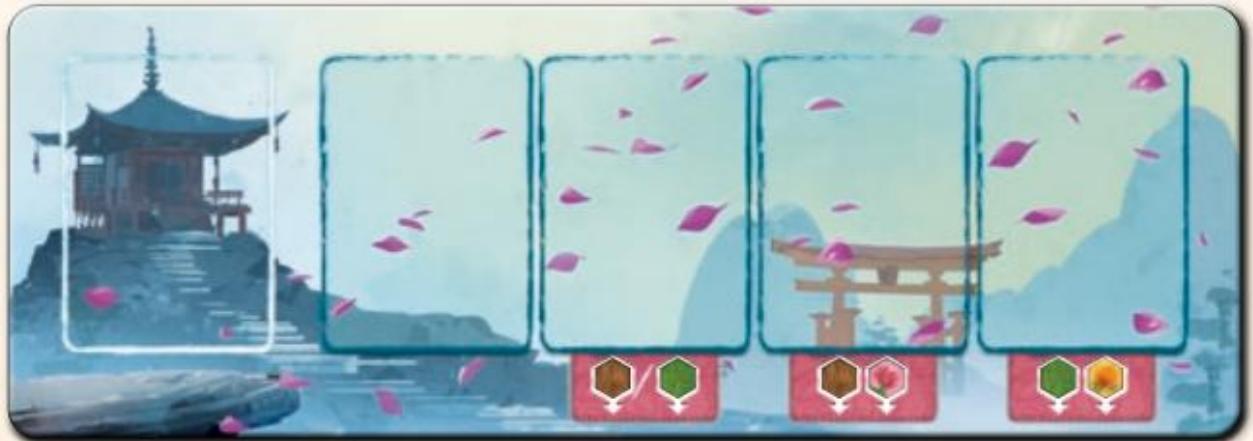
47張禪卡牌
包含五種類型:
成長、工具、幫手、大師和羊皮紙

顯示放置規則和計分方法
4張 遊戲幫助牌

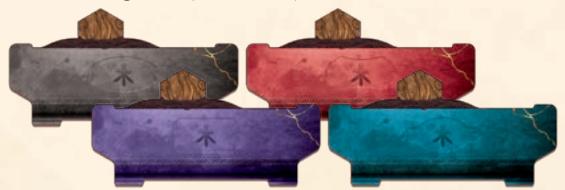
4塊 碎石起始板塊
碎石是種植和賦予盆景形狀的藝術,是對植物的尊重。

156塊 盆景板塊
15塊 目標板塊
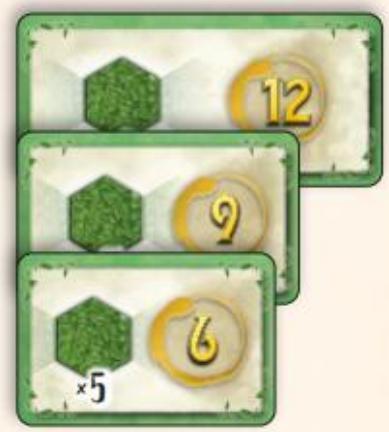
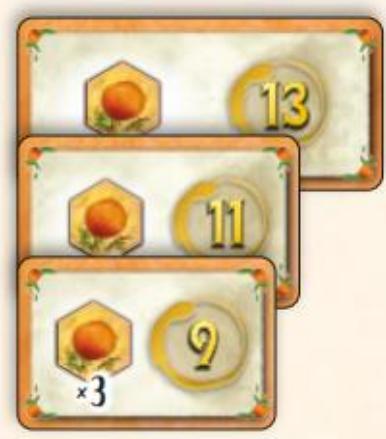
五種顏色各自都有三個按難度劃分的目標:
低難度、中等難度和高難度,難度愈高,所得分數就愈高。

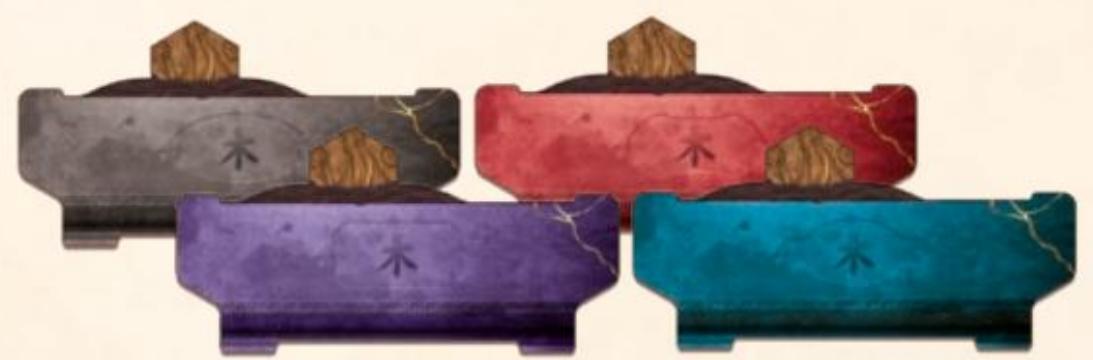
4塊 盆子板塊
附有起始根盤(木板塊)

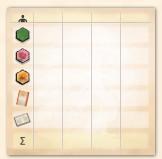
1 叠 計分紙

本遊戲說明書

52塊木

52塊葉

26塊花

26塊果


遊戲設置

以下的規則適用於二至四人遊戲。單人遊戲規則請參見第7頁。
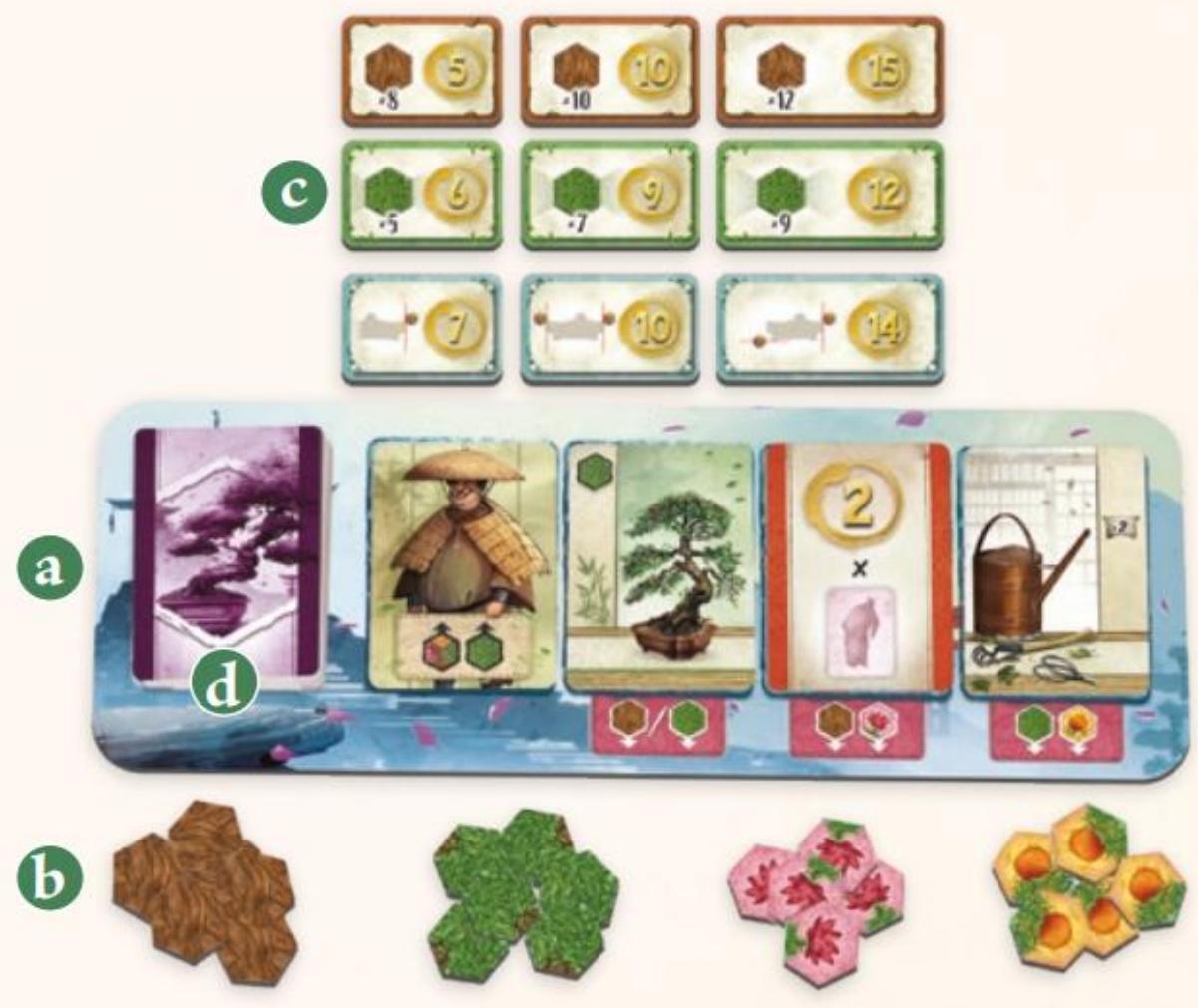
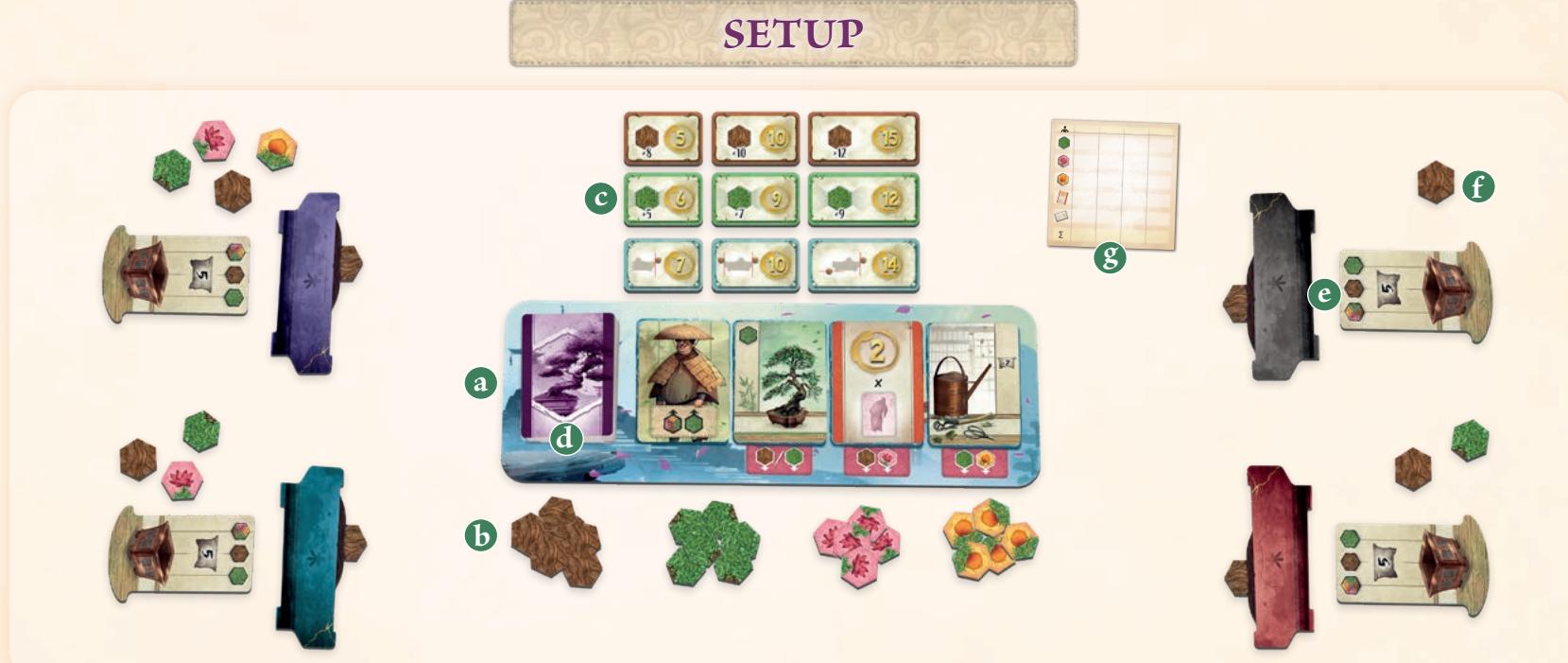
a 將版圖放在桌面中央。
b 將所有盆景板塊放在各玩家都能拿得到的地方,形成共享供應堆。
c 隨機選擇三種顏色目標板塊(棕色、綠色、粉紅色、橙色和淺藍色),將所選顏色的三塊目標板塊放在版圖旁(例如:3塊棕色、3塊綠色和3塊淺藍色目標板塊,總共9塊板塊),餘下的目標板塊則放回遊戲盒中。如果是一人或二人遊戲,每種顏色只需2塊目標板塊,請將中等難度的目標板塊拿走。(如果有玩家不熟悉遊戲,你們可選擇完全不使用目標板塊。)
d 依照不同玩家人數準備禪卡牌:
四位玩家: 使用所有禪卡牌;
三位玩家:移除有⑧的牌;
兩位玩家:移除有 🌱 / 🌱 的牌;
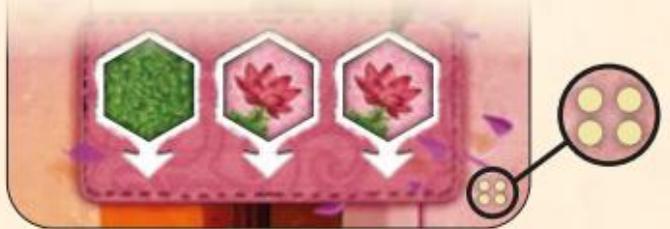

移除的禪卡牌不會在遊戲中使用。洗勻卡牌後,將牌庫面朝下放在版圖上最左側有寺廟圖示的空格。抽取牌庫頂的4張牌,並將它們面朝上放在版圖餘下的空格上。
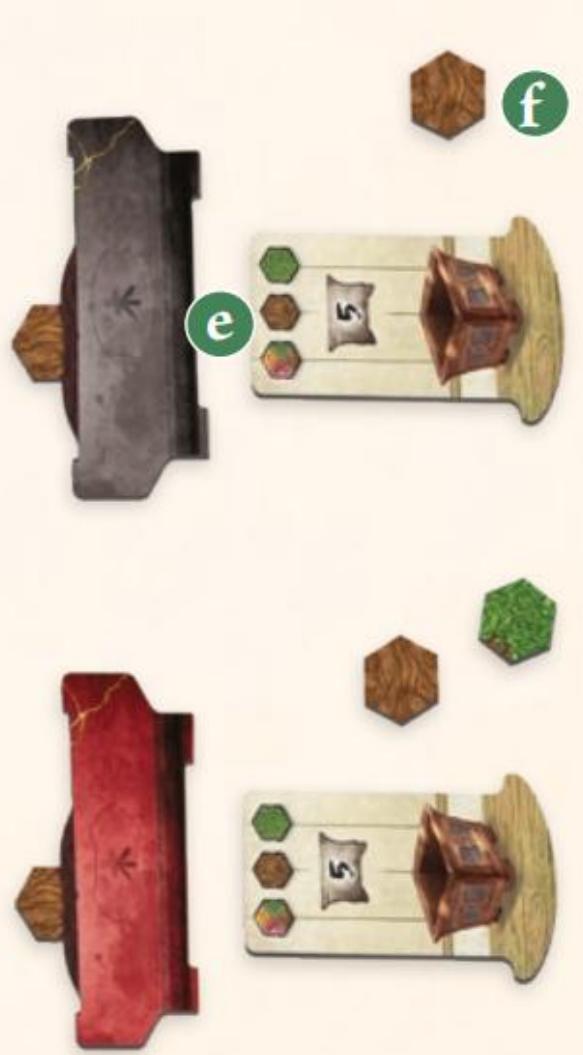
e 每位玩家選取1塊盆子板塊,並拿取與其顏色相同的碎石起始板塊和1張遊戲幫助牌(未有在上面圖例中顯示),將這些配件放在自己前面。未使用的盆子板塊、碎石起始板塊和遊戲幫助牌則放回遊戲盒中。
由年紀最大的人擔任起始玩家。由起始玩家開始,每位玩家按順時針方向輪流從共享供應堆拿取盆景板塊,從而形成個人供應堆。下表列出了各玩家要從共享供應堆拿取的盆景板塊種類和數量。
| 玩家顺序 | 起始玩家 | 第二位 | 第三位 | 第四位 |
| 起始板塊 |
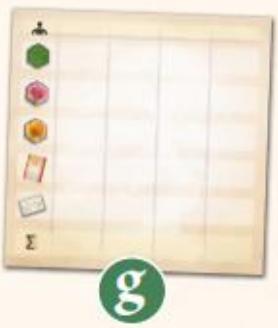
將計分紙放在方便拿得到的地方。
變體規則「凹間」
「凹間」是日式會客室中的一個凹陷空間,用來陳列羊皮紙、盆景等作觀賞之用的藝術品。
玩家在體驗過基礎遊戲後可嘗試變體規則。這變體規則會將所有羊皮紙牌集中放置在牌庫的上半部份,讓玩家可專注於這些卡牌。在你按照玩家人數調整好禪卡牌牌庫後,取出當中所有羊皮紙牌,接著將牌庫盡量平均分成兩份,先將其中一份洗勻後放在版圖上有寺廟圖示的空格上,然後在另一半的牌庫加入羊皮紙牌一起洗勻,最後把它放在另一半牌庫的上方,接著如常進行遊戲。
進行遊戲
遊戲按順時針方向進行,由起始玩家開始一輪行動。輪到你時,你可選擇執行靜心或培育,接著查看能否索取目標板塊。完成上述行動後(包括選擇索取或放棄目標板塊),你的一輪行動就結束,接著輪到下一位玩家。
靜心
拿取1張禪卡牌和最多2塊盆景板塊。
選取版圖上任何一張面朝上的禪卡牌,並拿取對應該牌下方圖示的盆景板塊。

如果你選取此位置的卡牌,就不能拿取任何盆景板塊。
如果你選取此位置的卡牌,可以拿取1塊木或1塊葉。
如果你選取此位置的卡牌,可以拿取1塊木和1塊花。
如果你選取此位置的卡牌,可以拿取1塊葉和1塊果。
從共享供應堆拿取盆景板塊並放入個人供應堆。(盆景板塊的供應並無上限。如果共享供應堆已耗盡,請自行找物件替代。)
最後,將版圖上面朝上的卡牌全部向右移動來填滿空格(如果給拿取的是位於牌庫旁邊的那一張牌,則略過此動作),接著從牌庫頂抽取一張牌來填補其右邊的空格。將你拿取的卡牌按照下方規則排列:
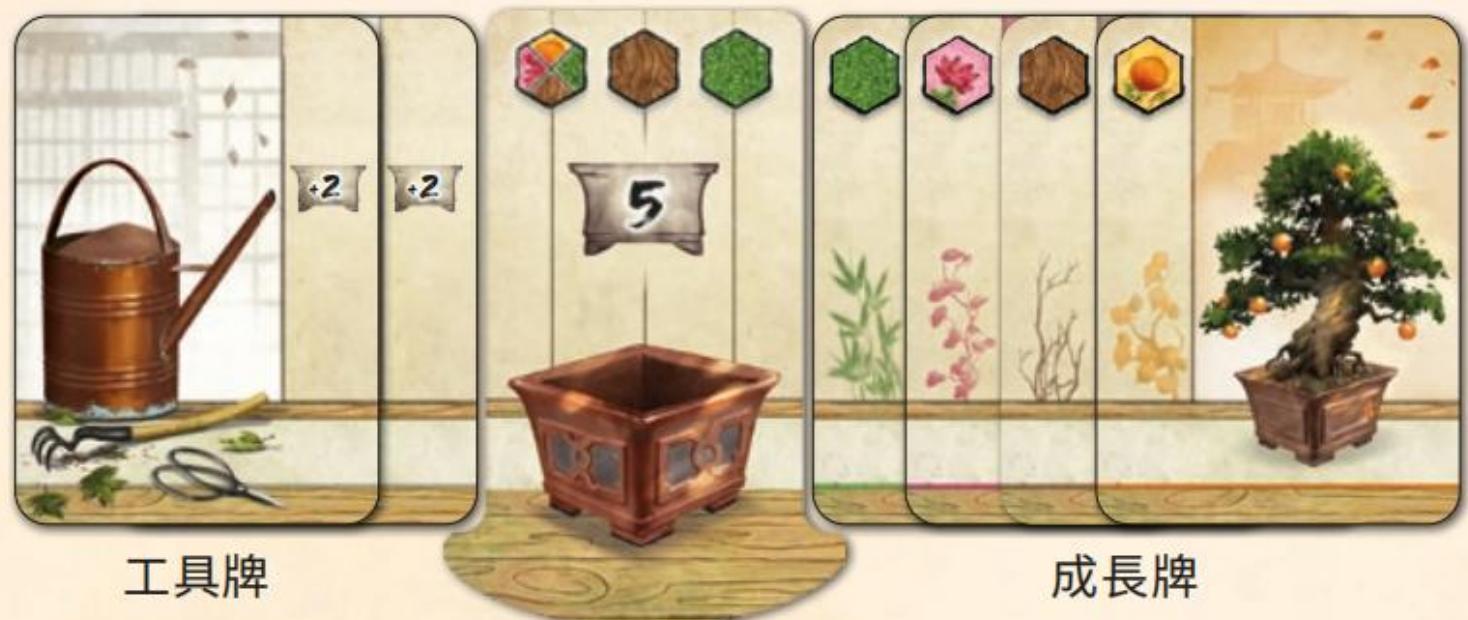
工具牌
成長牌
將你的成長牌放在碎石起始板塊右側,疊放至只展示出左側欄位(它表示在培育行動可放置哪些盆景板塊);工具牌以類似的方式放置,但在碎石起始板塊左側,且展示出右側欄位。

大師牌、幫手牌和羊皮紙牌
在結算完幫手牌和大師牌的效果後,將它們面朝下疊好形成一個獨立牌庫(棄牌堆),放在你的碎石起始板塊旁。羊皮紙牌也同樣面朝下放入這個牌庫(棄牌堆):遊戲結束時,牌庫裡的羊皮紙牌將令你得分。
卡牌詳情請參閱第12頁的〈禪卡牌〉一節。
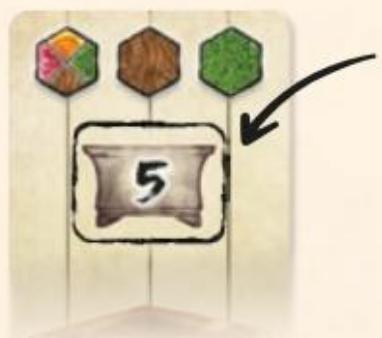
容量上限:你的碎石起始板塊上顯示個人供應堆最多只能保留5塊板塊,如果你在一輪結束時有多於5塊盆景板塊,就必須從中選擇板塊來丟棄,直到剩下5塊板塊為止。不過,你可以透過獲得的工具牌來提高容量上限。
培育
在盆景中放置板塊。
你可以將個人供應堆裡的板塊放入盆景中。你的碎石起始板塊和成長牌上顯示的圖示,就是你能放入盆景的板塊種類。每個圖示讓你可放置一個對應種類的板塊。
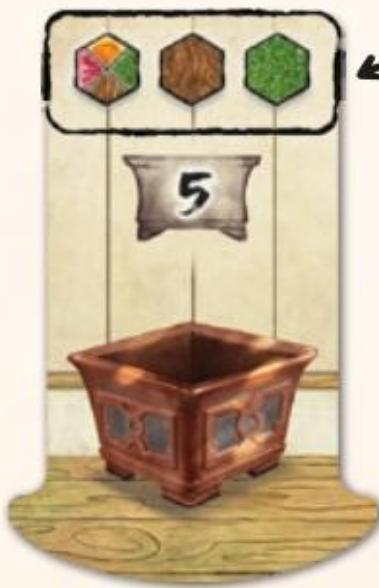
遊戲開始時,你只能依靠碎石起始板塊的圖示來放置盆景板塊。在培育行動中,你可按任意次序放置任何一個種類/木/葉的1塊板塊。隨著遊戲進行,你可使用獲得的成長牌,令你在選擇培育行動時能放置更多板塊(請參閱第12頁的〈禪卡牌〉一節)。
在培育行動中,你必須遵守以下的放置規則:

木板塊必須與另一塊木板塊相鄰 (即至少一邊是與木板塊直接連接)。

葉板塊必須與木板塊相鄰。

花
花板塊必須與葉板塊相鄰。

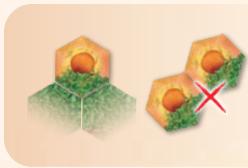
果板塊必須放在2塊相鄰的葉板塊之間,果板塊的一邊必須連接其中一塊葉板塊,而另一邊也要連接另一塊葉板塊。你不可將果板塊與另一塊果板塊連接。
注意: 在罕見的情況, 你在一輪的開始時有可能無法為盆景加添木板塊, 若然如此, 你可以從盆景移除最少量的板塊, 讓其再次符合放置規則。
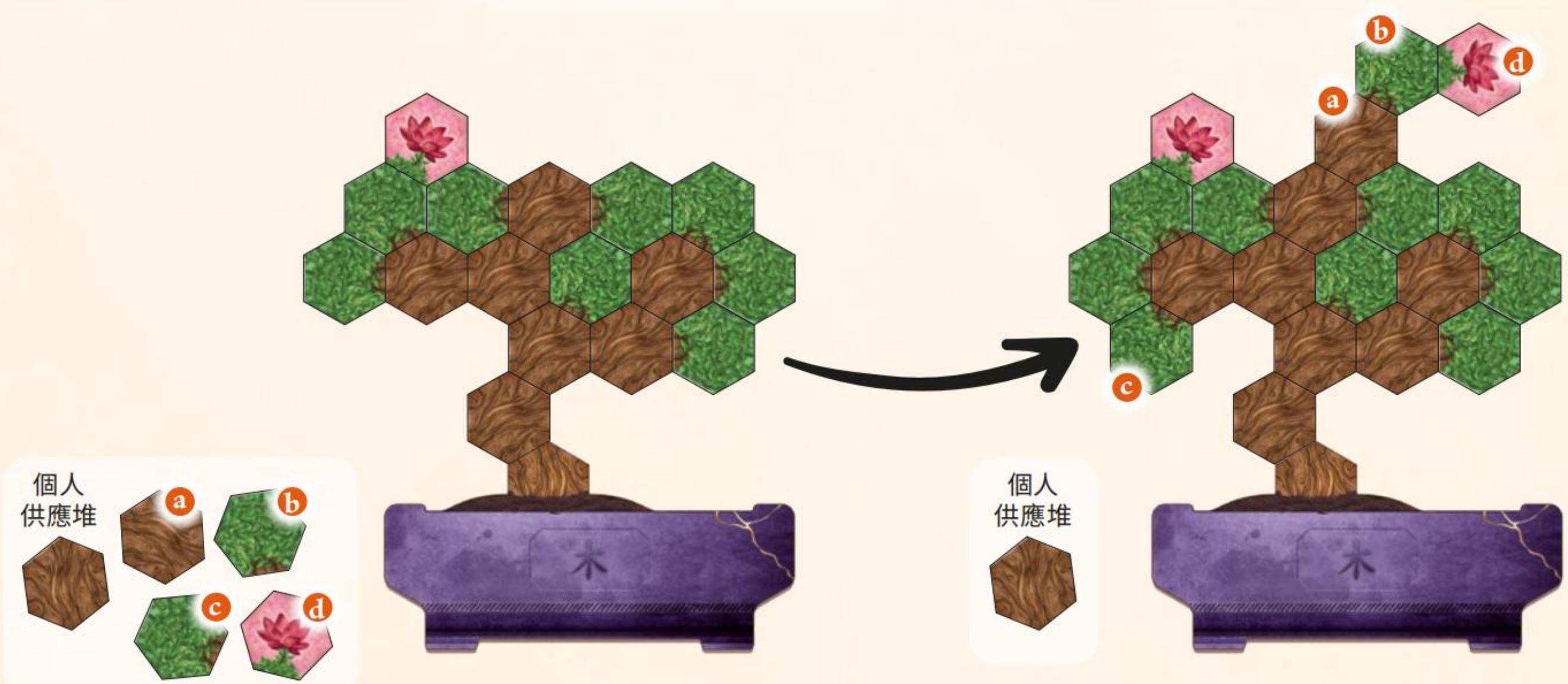

範例: 明基有1塊碎石起始板塊和3張成長牌, 按照圖示, 他可放置1塊任何種類的板塊、1塊木、2塊葉、1塊花和1塊果。在培育行動中, 因為他沒有果板塊, 所以決定放置1塊木 (a)、2塊葉 (b) 和 (c) 和1塊花 (d)。考慮到當前再加添板塊的用處不大, 所以明基選擇不再放置 (尚有「任何種類的板塊」圖示還未使用)。
索取目標板塊
在一輪中,當你的盆景達到或超過桌上目標板塊(即是還未給任何玩家索取的目標板塊)的條件,你必須立即選擇索取該目標板塊,還是選擇放棄索取,以嘗試達到更高難度的目標板塊條件。
如果你提出索取,就拿取相關的目標板塊並放到你的盆景旁邊。對於每種顏色,你只能索取其中一塊目標板塊。如果你放棄索取某一顏色的目標板塊,仍可在往後的輪次中嘗試完成該顏色更高難度的目標板塊條件並提出索取,但你無法再索取你曾經放棄的目標板塊。

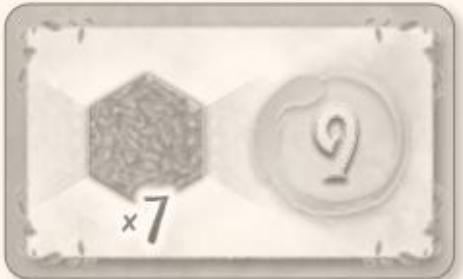

範例: 在一輪開始時, 雪儀的盆景有4塊葉, 在該輪中她再加添兩塊, 結果葉板塊總數達到六, 現在她能夠索取葉板塊數為五、值6分的目標板塊, 或者選擇放棄索取, 以嘗試達到葉板塊數為九、值12分的目標板塊條件。
葉板塊數為七、值9分的中等難度目標板塊早已給明基索取,所以已無法獲取。
遊戲結束
當禪卡牌牌庫的最後一張牌給翻開,就代表遊戲進入尾聲:所有玩家(包括觸發遊戲進入尾聲的玩家)都還有最後一輪可以行動,接著遊戲結束並進行計數(使用記分紙)。
盆景中的每塊板塊獲得的分數如下:


分
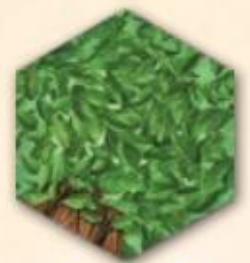

分


沒有連接其他板塊的每邊各得1分 (此板塊可值0至5分)。
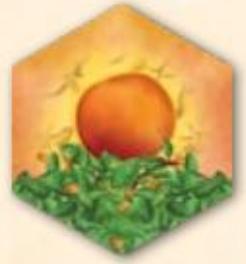
=
分
在個人供應堆的剩餘板塊不計分。
翻開在碎石起始板塊旁的面朝下牌庫,計算羊皮紙牌的分數,然後加上目標板塊的分數(請參閱第12頁的〈禪卡牌〉與〈目標板塊〉)。
得分最高的玩家獲勝。若最高分遇平手,則由按順時針方向距離起始玩家較遠者獲勝。
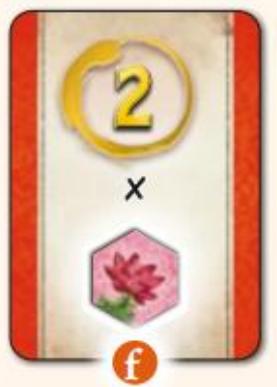
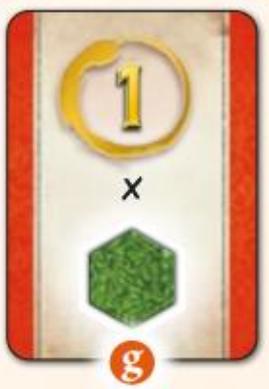
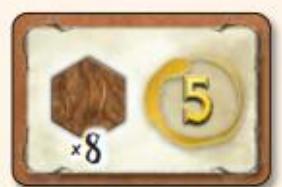
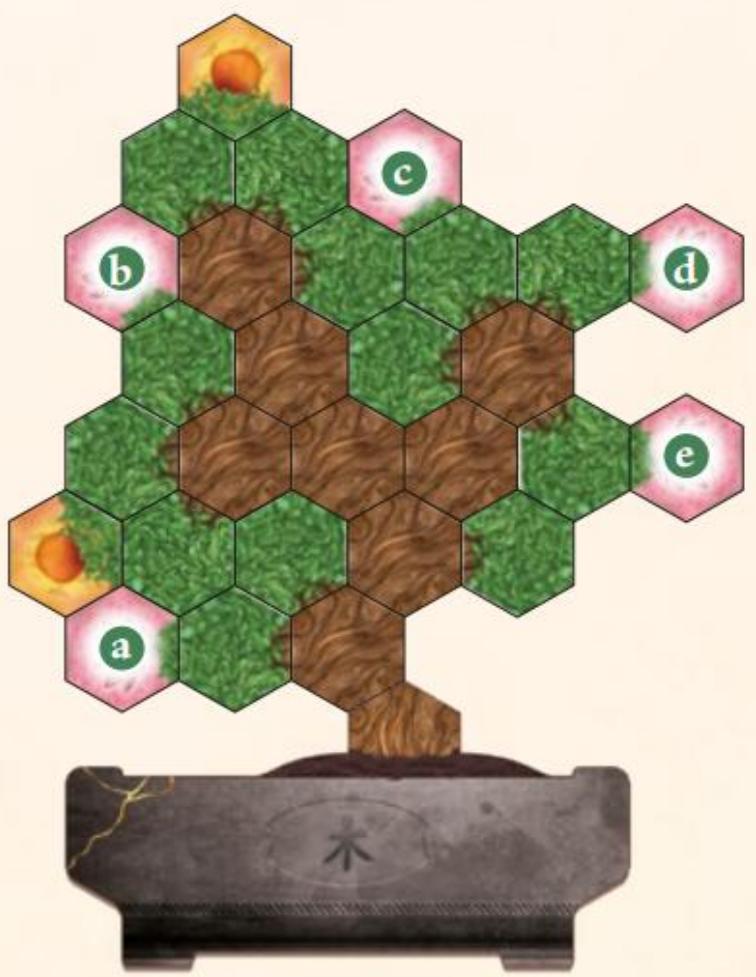
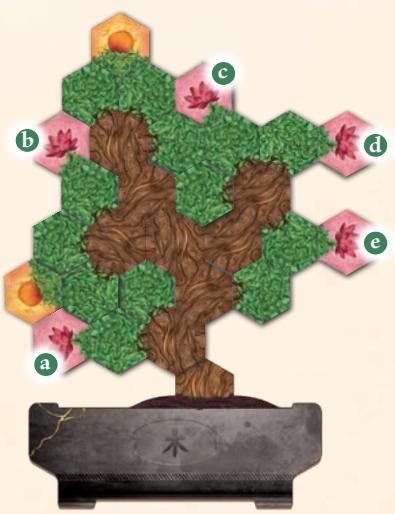
範例:
此盆景的得分為:
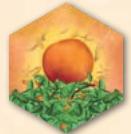
: $3 \times 13 = 39$
: 3(a) + 3(b) + 3(c) + 5(d) + 5(e) = 19

: 7 × 2 = 14
共計=72分
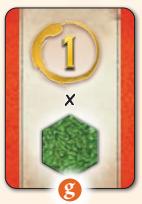
羊皮紙牌和目標板塊的分數與盆景的得分相加, 按照上述範例, 羊皮紙牌 f 貢獻10分, 羊皮紙牌 g 貢獻13分, 還有棕色目標板塊的5分。遊戲結束時, 此玩家獲得72 + 10 + 13 + 5分, 合共100分。
單人遊戲
套用二人遊戲規則並進行以下變動。
按照下表選擇難度等級:
| 等級 | 初學 | 專業 | 大師 | 勇者 |
| 難度 | 低 | 中 | 高 | 極高 |
| 要求分數 | 80 | 100 | 120 | 140 |
在遊戲設置時,拿取1塊木板塊和1塊葉板塊作為起始板塊,將它們加到個人供應堆中。
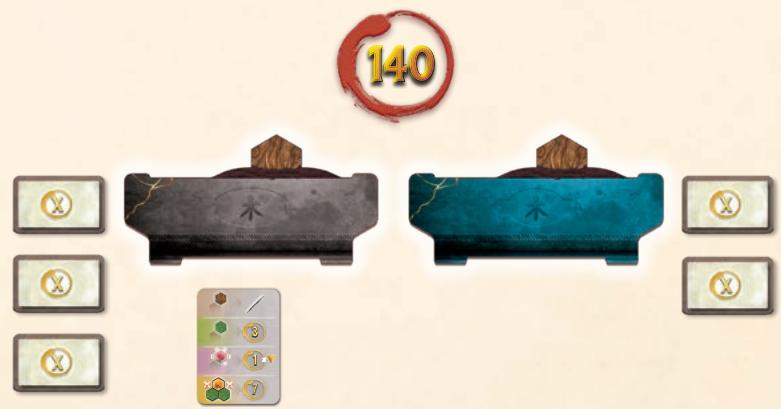
進行遊戲時:
- 每次執行靜心行動時,你必須將拿取的牌左側的牌丟棄至棄牌堆。如果你拿取牌庫旁的那張牌,則翻開牌庫頂的那一張牌並將其棄掉。將其他面朝上的卡牌向右移動來填滿空格,接著從牌庫頂抽取卡牌來補滿版圖。
- 每次執行培育行動時,你必須丟棄版圖上最右側的卡牌(離牌庫最遠的牌)。接著如同靜心行動結束時的步驟,將剩下的面朝上卡牌向右移動,並從牌庫頂抽取卡牌補滿版圖。
當牌庫的最後一張牌給翻開放到版圖上,你就只剩下最後一輪可以行動,接著遊戲結束。跟著你就查看是否達成遊戲勝利條件:必須獲得3塊目標板塊(每種顏色各一塊),且總分要達到或超過所選難度的要求分數。
單人場景挑戰
如果要遊戲更具挑戰性,你可以選擇遊玩以下任何一種場景(難度由低至高排列)。這些場景讓你探索栽種盆景的特殊策略。請按照單人遊戲規則和列出的變動來遊玩。
緩慢之秋
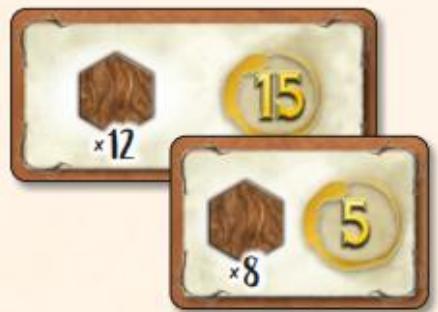

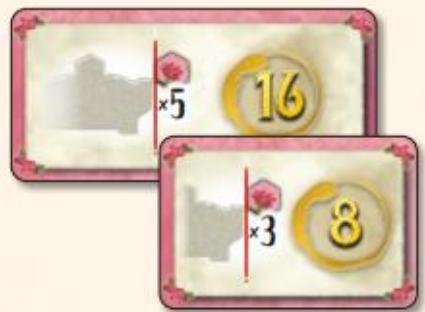
遊戲設置
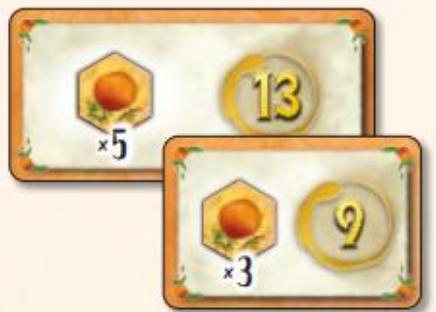
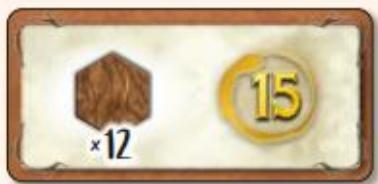
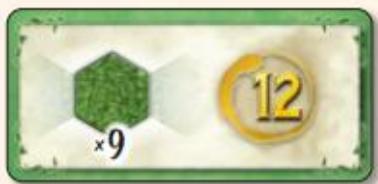
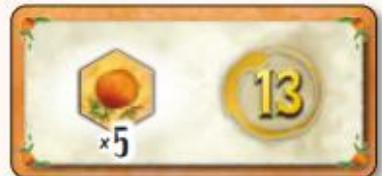
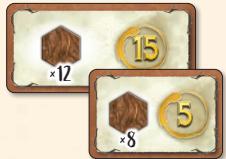
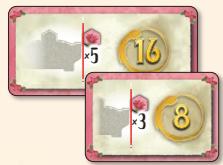
只使用上方顯示的目標板塊。
規則變化
無。
遊戲目標
至少獲得130分,獲得2塊高難度和1塊低難度目標板塊。(記得每種顏色的目標板塊最多只能索取一塊)。


綿長之冬


遊戲設置
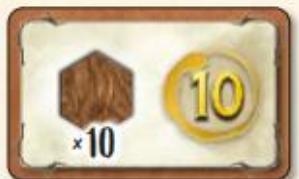
只使用上方顯示的目標板塊。
規則變化
無。
遊戲目標
至少獲得120分,獲得至少4張羊皮紙牌,獲得全部3塊目標板塊。
提示:為了記錄牌庫中還剩下多少張羊皮紙牌,你可以在棄牌時把它們面朝上形成獨立牌庫,放在版圖旁邊(羊皮紙牌共有7張)。

繁茂之春


遊戲設置
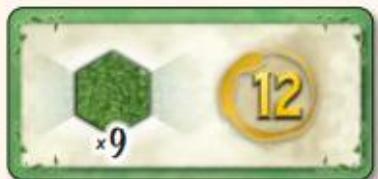
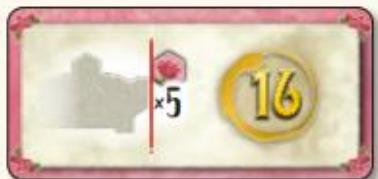
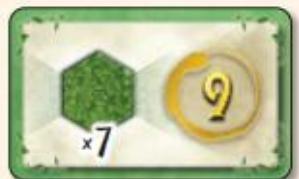
只使用上方顯示的目標板塊。
規則變化
每次執行培育行動,你必須在盆景加添1塊花板塊。執行此行動前,你的個人供應堆必須有花板塊,否則就無法執行。此規則不適用於幫手牌。
遊戲目標
至少獲得130分,獲得全部3塊目標板塊。



炎熱之夏



遊戲設置
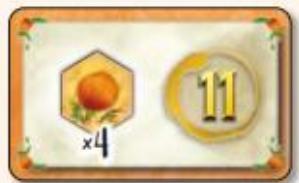
只使用上方顯示的目標板塊。
規則變化
遊戲結束時,移除所有未與花板塊相鄰的果板塊,以及所有未與果板塊相鄰的花板塊,換言之,只保留互為相鄰的花和果板塊。
遊戲目標
至少獲得130分,獲得全部3塊目標板塊。

競逐御園盆景資格之挑戰
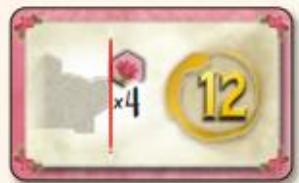
遊戲設置
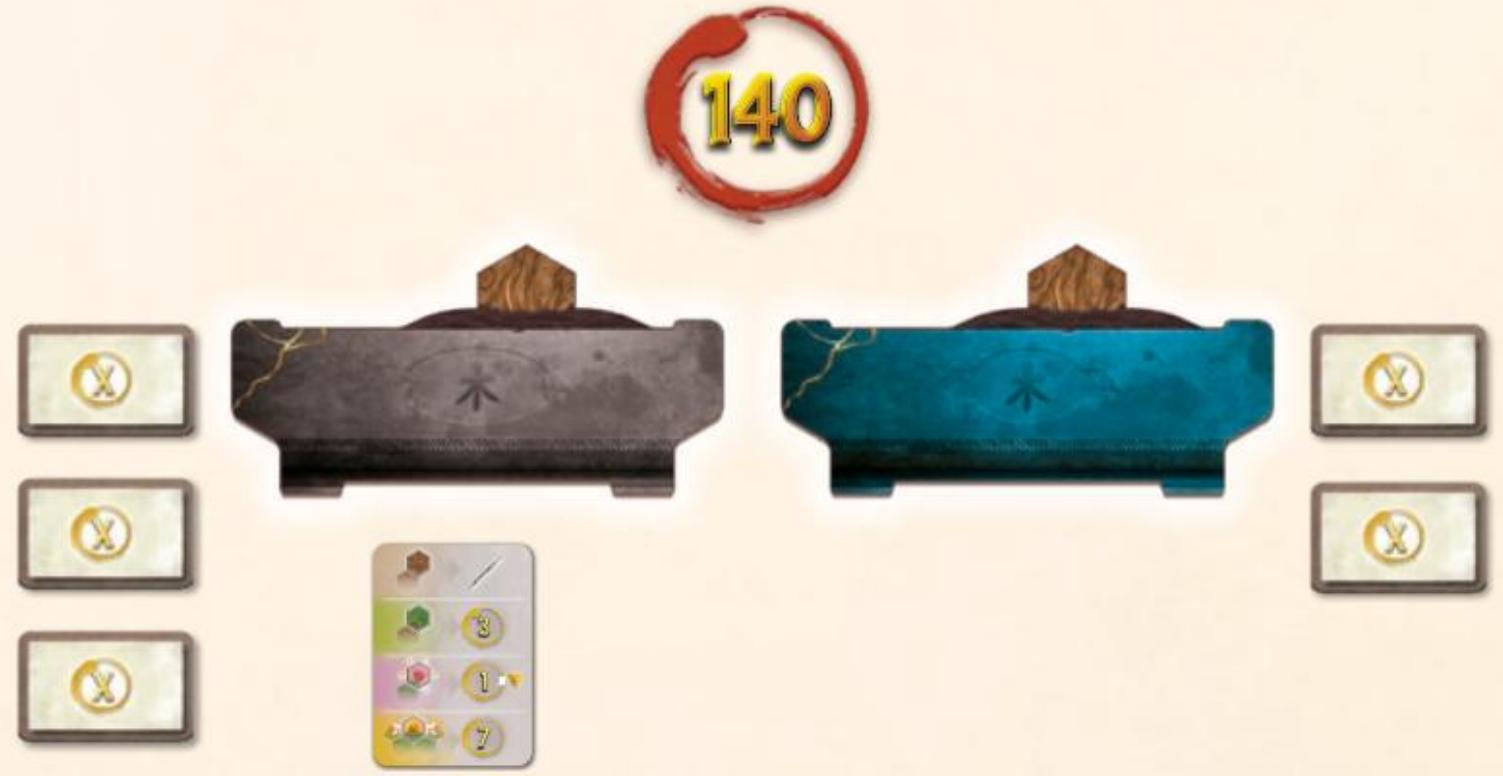
使用全部中等難度目標板塊。拿取第二塊盆子板塊放在自己前面(在2塊盆子板塊之間留出空間給盆景發展)。在其中一塊盆子板塊下方放1張遊戲幫助牌,以示該盆子的是主動盆景。
規則變化

執行培育行動時,你只能向主動盆景加添板塊。如果獲取目標板塊,它是屬於主動盆景的(將它放在相關的主動盆景旁邊以作記錄)。在培育行動結束時,將遊戲幫助牌移至另一塊盆子板塊下方,令它成為該輪的主動盆景。之後在每次培育行動結束時都要在盆子間轉移遊戲幫助牌。如果你拿取幫手牌,將相關的盆景板塊加到主動盆景上,但不須移動遊戲幫助牌。
索取目標板塊時,總是只計算主動盆景上的板塊數量。
遊戲結束時,計算兩個盆景的板塊以及羊皮紙牌的分數。

遊戲目標
至少獲得140分,獲得全部5塊目標板塊,當中三塊屬於一個盆景,另外兩塊屬於另一個盆景,索取目標板塊的次序並無規限。
盆景小知識
「盆景」一詞,很容易就讓人聯想到「盆中景致」的意思。盆景是種生生不息的藝術品,將植物縮小整體比例的同時,也展現大自然中樹木所展現的力量與協調之美。
盆景藝術源於2,000多年前的中國。盆景在六世紀時傳到日本,隨著禪理引入到栽種和培養之中,盆景藝術在日本廣為流傳。大約在十八世紀,盆景藝術在日本蔚為流行;而如今,在全球化和互聯網的出現下,盆景的賞析藝術逐漸擴散至全世界。
盆景是延綿不盡的視覺傑作:大自然中的植物會隨著季節更迭適切生長,但盆景須有專家的悉心養護,才得以塑造成特定的形狀。盆景通常具有上百年歷史,更可能是代代相傳的珍寶。這些藝術品帶來的力量、沉穩,使得每一位愛好者、專家和盆景初學者都能感受其中蘊藏的安逸之感。
盆景的養護
有些人可能會誤以為盆景是透過基因改造而產生的藝術品,但其實每一盆精雕細琢的植栽,都是成熟的樹木,並不是因為缺少水或養分而導致型態較小。
盆景在整個生命週期都需要細心呵護,透過塑型、施肥和其他護理植物疾病的技術,控制植物由樹根至樹枝的完美平衡。由於盆景是讓植物單獨栽種在盆中生長,並不會在生長過程與其他植物彼此競爭,才使其樹葉和根部之間的比例和諧,並讓盆景能維持一定的尺寸。
雖然這些做法看起來對植物有所侵害,但實際上比修剪果園或照顧家犬的傷害更低:盆景的養護旨在重視樹木的整體健康狀態下,展現其自然之美。此外,修剪葉片和根部、更換盆子和纏線等技術是為了維持植物的形態,增加葉片在陽光暴露的比率,並將樹根重新排列成更合適生長的空間,從而改造地形的營養,促進樹木的長期健康。
如果盆景在生長過程中獲得充分的照顧,它的壽命可以延長到數百年之久。盆景專家的經驗法則是:「不要將你的塑形要求強加於植物,只須給予它能夠茁壯生長的一切:成為盆景的看護者而不是控制者。」
主要盆景風格
栽培盆景時,專家必須考量整體形態風格,透過對植物的型態定期追蹤,以塑造最終的風格目標。形態風格只是一種盆景形象,培育時應集中在植物的自然表現,並順應植物的生長,例如:樹幹方向、分支方向、樹冠形狀以及樹棲物種在大自然會出現的其他元素;依據上述原因,專家首先要培養對自然界的觀察力。以下列出一些最著名的盆景風格,雖然部分盆景可能包含多種風格元素,但最好還是以其主要特徵來稱呼。
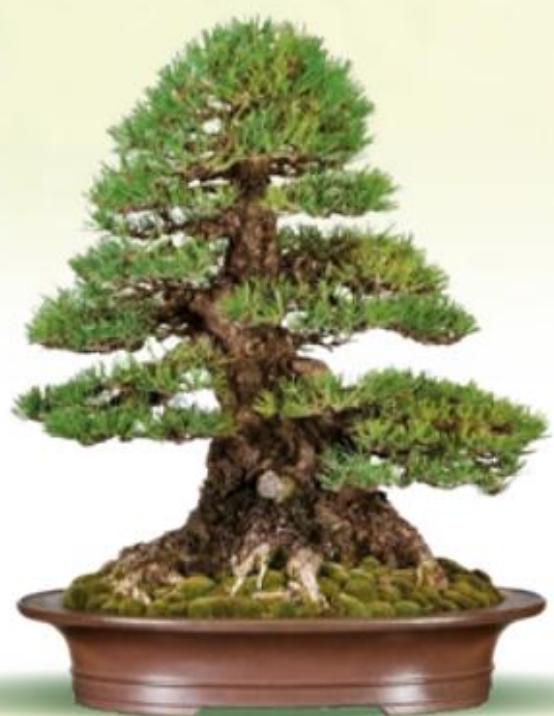
「直幹型」風格為自然中普遍可見的風格,特別是不受周圍樹木競爭、能獲得充分日光照射的樹木,這樣的特色尤為明顯。直立樹幹的漸變最為清晰,樹幹在底部最粗,愈往樹頂樹幹愈細。樹木的第一個分支大約落在樹幹總高度的四分一處,而樹頂只會由一個分支構成。

「文人樹」風格可在自然界找到,但對盆景藝術來說,它是很難仿照的風格之一。樹幹通常為扭曲形態,並逐步向上生長,由於日光一般只向頂點照射,所以樹枝數量較為稀少。此種風格的樹通常種植在小而圓的盆子中。
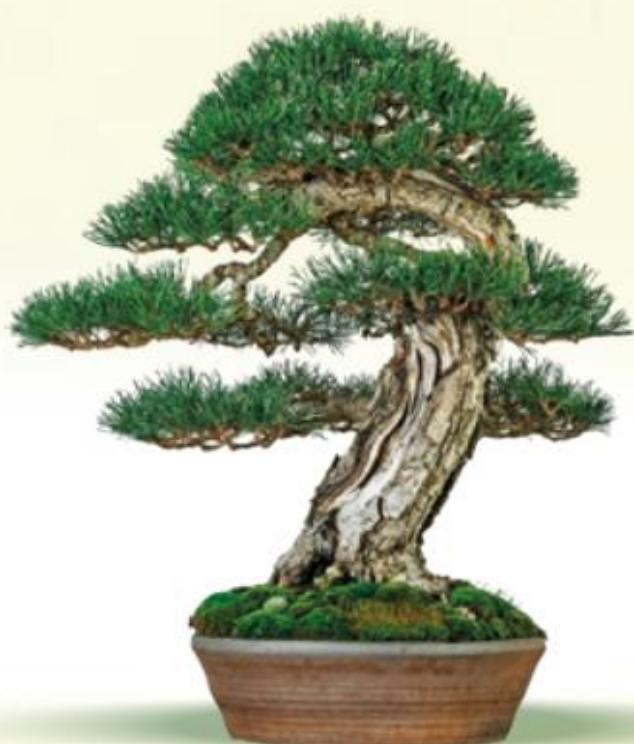
「曲幹型」風格在自然界和盆景藝術中都很普遍。樹幹為向上生長,同時略有彎曲,在每個轉彎處都有樹幹的分支。樹幹的漸變清晰,樹幹的底部也比樹頂大許多。

「懸崖式」或「瀑布式」風格靈感來自於野外生長在岩壁上的樹木,由於降雪或岩石滑坡等因素,導致它們會向下彎曲。栽培盆景時,因為樹幹是自然向上生長的,所以很難使其保持向下生長。這種風格的盆景通常種植在高大的盆子裡,樹頂會落在盆子下方,樹枝會向兩旁生長,以保持樹的平衡。
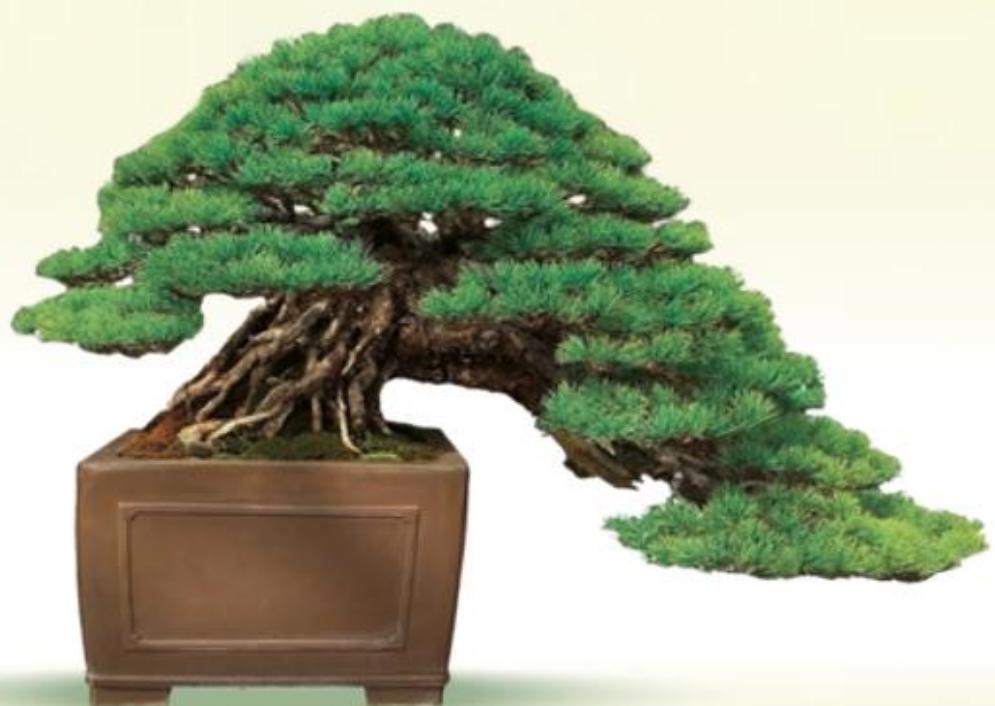
「半懸崖式」或「半瀑布式」風格是以生長在懸崖、河岸和湖岸的樹木為參考形態。它與「懸崖式」風格的不同之處為樹幹永遠不會低於盆子,樹冠通常在盆邊之上,而樹枝則在盆邊之下延伸。
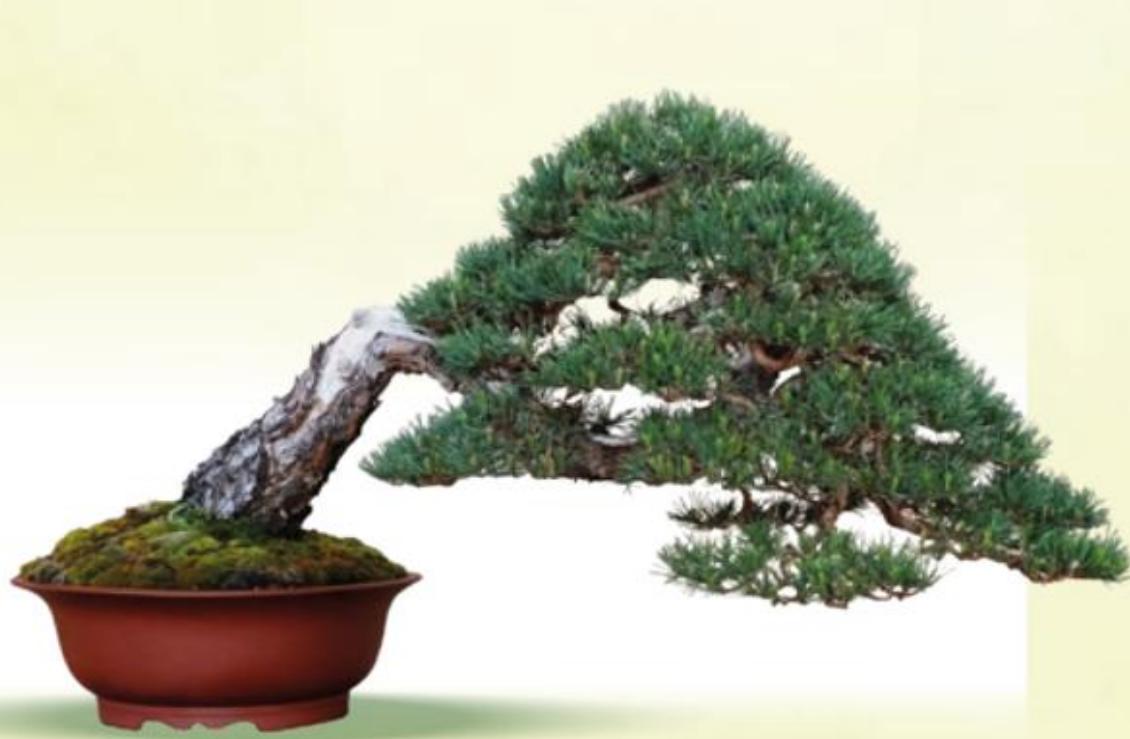
「傾斜式」風格與「直幹型」風格相似,不同的是植物以一定的傾斜度從土壤中生長。第一支樹枝通常會向樹幹的相反方向生長,以平衡樹體,該分支約莫落在植物總高的三分一處。

MIX
Paper from
responsible sources
FSC® C111082
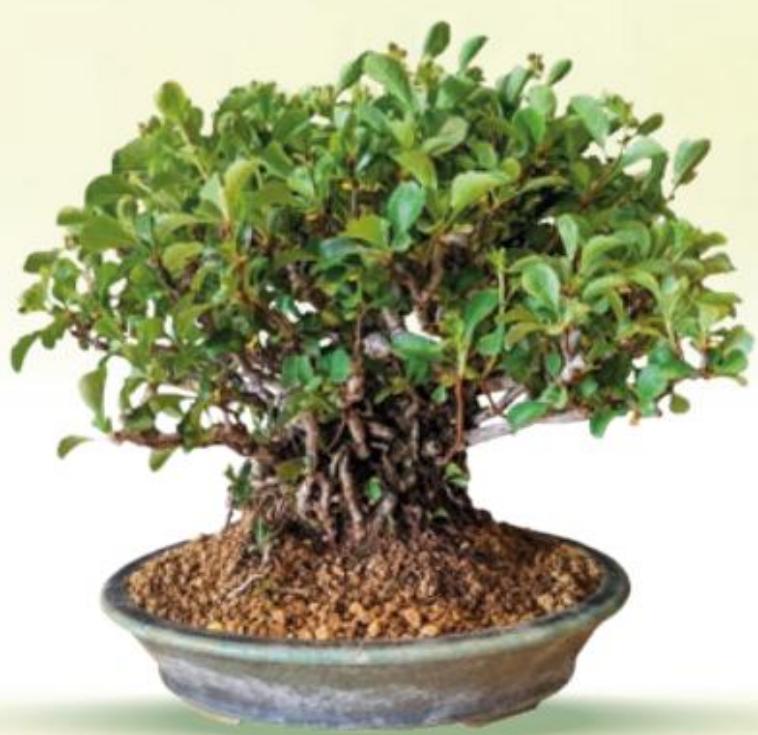
「掃帚式」風格用於落葉樹,具有多個延伸的細枝。樹幹為垂直但並沒有直達樹頂,相反的,它向各個方向延伸,約佔整棵樹高度的三分之一。枝葉形成球狀樹冠,在冬季落葉時,能看到令人驚嘆的美景。
遊戲設計:Rosaria Battiato、Massimo Borzì、Martino Chiacchiera
美術:Davood Moghaddami
開發:Luca Appolloni、Marta Ciaccasassi
美術指導:Matteo Brustenghi
平面設計:Lisa Bernacchia、Matteo Brustenghi、Daniele Solfrini
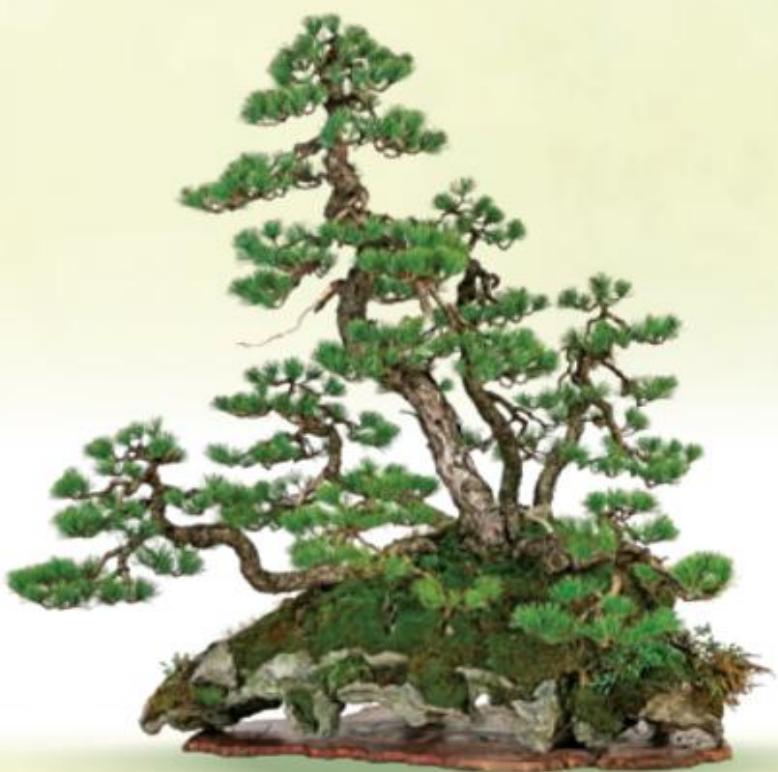
「多幹式」或「叢式」風格的特點是在一個盆景中,有許多相同品種的植物,通常會以奇數共存於盆中。此種風格在自然界相當普遍,但在盆景藝術中卻不常見;這種風格通常會創建一個倒下的樹幹,使其成為新植物的樹體,接著每根樹幹都要從此基底生長。在培育的同時,還須留意讓每一株植物和整體的形態維持三角形,以達成視覺平衡。
設計師衷心感謝下列人士:Sofia Battiato、Matteo Cianchetti、Circolo Quintet、Marco Cristaldi、Stefano Fedriga、Guido "Fox" Marzucchi、La Fustella Rotante、Vinia Mattioli、Francesco Moca、Michele Piccolini、Sergio Roscini、Diletta Salafia以及所有參與遊戲測試的人士。特別鳴謝:Paolo Mori,其遊戲《Augustus》啟發了《盆景大師》目標板塊的創作靈感。

DV Games衷心感激Matteo Dal Lago和意大利盆景專家聯盟(Unione Bonsaisti Italiani),他們對《盆景大師》原版本進行了仔細的校閱和內容查證,有賴於他們的重大貢獻,《盆景大師》方能締造豐富、完整的遊戲體驗。

DV Games製作本遊戲時時刻深念環保,盡量減輕對環境造成負擔。DV Games與植樹組織Trees for the Future合作,在亞撒哈拉地區(Sub-Saharan Africa)栽種新樹以恢復耕地。閣下購買《盆景大師》,就是對履行上述植樹承諾的幫助。

Copyright © MMXXII daVinci Editrice S.r.l. Via S. Penna, 24 - 06132 Perugia - Italy All rights reserved. www.dvgames.com


禪卡牌
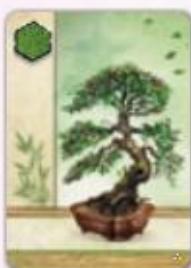
成長牌
在遊戲結束前,成長牌會一直留在自己前面。執行培育行動時,除了可以放置碎石起始板塊圖示的板塊外,你也可放置成長牌圖示的所有板塊。如果你有數張相同的成長牌,該牌效果可疊加。放入盆景板塊的次序並無限制,你也可選擇不把板塊放入盆景。
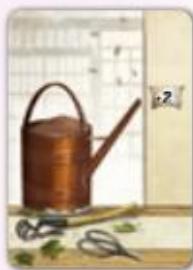
工具牌
在遊戲結束前,工具牌會一直留在自己前面。在每輪結束時,每擁有1張工具牌,就可在個人供應堆額外保留兩塊盆景板塊。
範例:如果你有2張工具牌,你的個人供應堆就可多保留4塊盆景板塊,連同碎石起始板塊容許保留的5塊,你的個人供應堆就能保留多達9塊盆景板塊。

幫手牌
你拿到幫手牌就立即結算其效果,之後將卡牌放在碎石起始板塊旁面朝下的棄牌堆。
結算此牌效果時,從個人供應堆拿取任何一種和/或牌上所示種類的板塊放入盆景中(你可以選擇放置在靜心行動和此牌一起獲得的板塊)。

大師牌
你拿到大師牌就立即結算其效果,之後將卡牌放在碎石起始板塊旁面朝下的棄牌堆。
從共享供應堆拿取大師牌所示的板塊,此外,你也要如常拿取該牌在版圖位置下面所顯示的板塊。每輪結束時,須注意板塊數量有沒有超過容量上限。
羊皮紙牌
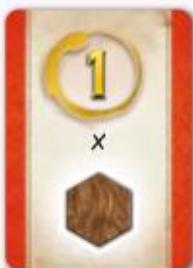
羊皮紙牌要保存在碎石起始板塊旁面朝下的棄牌堆。
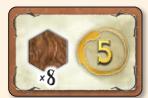
遊戲結束時,每張羊皮紙牌都會根據所示圖示帶來分數:
盆景中每塊木板塊值1分(包括起始根盤)
盆景中每塊葉板塊值1分


盆景中每塊花板塊值2分


盆景中每塊果板塊值2分


每張成長牌值2分

每張幫手牌值2分
每張大師牌值2分
文人樹風格目標
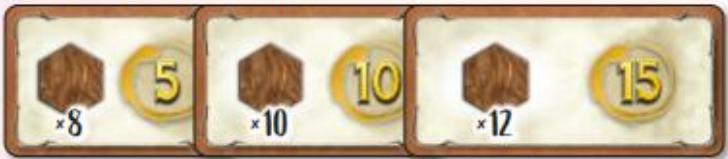
直幹型風格目標
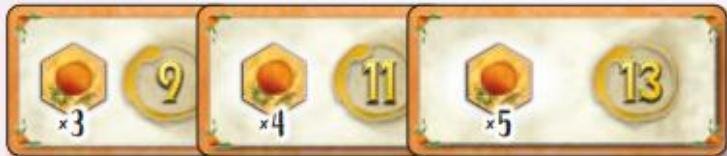
你的盆景有8/10/12塊木板塊,包括起始根盤。
你的盆景有3/4/5塊果板塊。
曲幹型風格目標
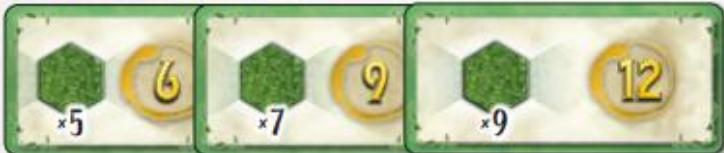
傾斜式風格目標你的盆景有5/7/9塊葉板塊,彼此相鄰。
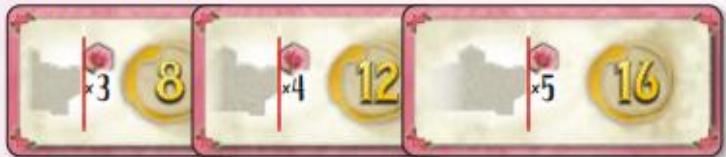
你的盆景有3/4/5塊花板塊從盆子的同一側延伸出來(不論是左側或右側皆可)。
目標板塊
懸崖式風格目標
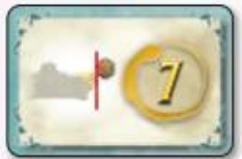
有板塊從盆子最遠的一側
(即顯示金繕修復處的一側)延伸出來。

有板塊從盆子的兩側延伸出來。
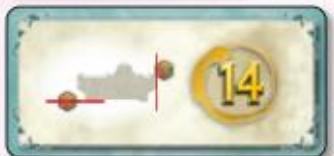
有板塊從盆子的一側延伸出來,
並有板塊從盆子另一側的盆底之下延伸出去
(以盆子任何一側作準皆可)。


從盆子的一側延伸;
相對來說,c 則從盆子的另一側延伸;


都算作在盆底之下延伸;


是金繕修復處。

栢龍玩具有限公司
Broadway Toys Limited
http://www.broadwaygames.com.hk
bw-hk@longshore.com.hk
Tel: +852 23631998
Bonsai_ENG-Rules.md32.1 KB
BONSAI
1-4 players aged 8 and up. 40 minutes.
The Japanese term "bonsai"means "planted in a pot." A bonsai is a living work of art, a perfect miniature plant, identical in all respects to its full-size simile, but several times smaller. A bonsai is a microcosm that contains within itself the mystery of the universe, unchanged in all but dimensions.
Players take on the role of expert bonsai masters intent on growing their own bonsai. Whoever grows the best plant will be appointed to show their bonsai at the Imperial Gardens.
CONTENTS
1 Board
47 Zen cards
of 5 types: Growth, Tool, Helper, Master, and Parchment
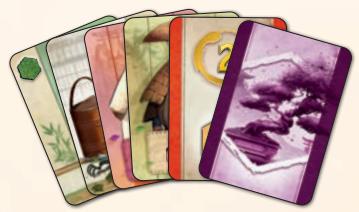
They show the placement rules and the scoring.
4 Summary cards
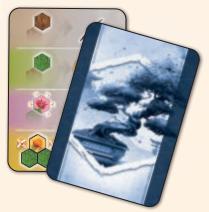
4 Seishi starting tiles
Seishi is the art of growing and giving bonsai a shape, respecting the plant.
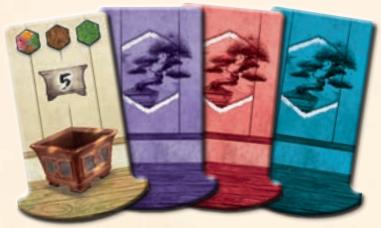
15 Goal tiles
For each of the five colors there are 3 Goals divided by difficulty: a low difficulty Goal, scoring the least number of points, an intermediate, and a hard Goal, scoring the greatest number of points.

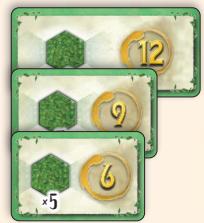
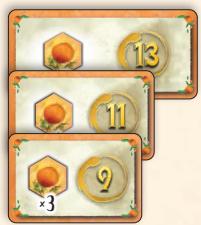


156 Bonsai tiles


52× wood
52× leaf

26× flower

26× fruit
4 Pot tiles with starting buds (a wood tile)
1 Score pad
These rules
The rules that follow apply to a game with 2 - 4 players. All modifications for a solo game are shown on page 7.
Place the board in the middle of the table.
Place all the bonsai tiles in an area which is within reach of all players. This is the common supply.
Choose three colors at random (among brown, green, purple, yellow, and blue) and place the three Goal tiles of each chosen color beside the board (e.g., 3 brown tiles, 3 green tiles, and 3 blue tiles, for a total of 9 tiles). Leave the unselected tiles in the box. With 1 or 2 players, use only 2 tiles per color: discard the intermediate Goals. (If you are playing with inexperienced players, you may decide not to use the Goal tiles at all.)
Prepare the deck of Zen cards, with:
4 players: use all the cards
3 players: remove the cards for 4 players, marked with 8
2 players: remove the cards for 3 and 4 players, marked with / 8


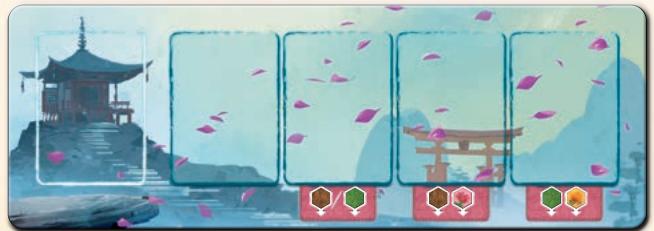
Removed cards are not used in this game. Shuffle the deck and place it face down on the board in the leftmost space, where a temple is depicted. Draw the top 4 cards and place them face up in the spaces of the board.
Each player receives a Pot tile of their chosen color, a matching Seishi starting tile, and a Summary card, which they place in front of them. Leave unassigned Pot and Seishi tiles as well as unused Summary cards in the box, as they will not be used.
The first player is the oldest player. Starting with the first player and proceeding clockwise, each player takes from the common supply the bonsai tiles shown in the following table. Keep these tiles in your personal supply.
| PLAYER | 1st | 2nd | 3nd | 4th |
| STARTINGTILES | 1 wood | 1 wood, 1 leaf | 1 wood, 1 leaf,1flower | 1 wood, 1 leaf,1 flower, 1 fruit |

Keep the score pad handy.
Game variant “Tokonoma”
A tokonoma is a recessed space in a Japanese-style reception room, in which items for artistic appreciation, such as parchments or bonsai, are displayed.
After a few games, you may try this game variant which offers a more controlled experience by putting all Parchment cards in the first half ofthe deck, encouraging players to concentrate on these cards.
Once you have adjusted the deck depending on the number of players, take out all Parchment cards, shuffle half of the remaining deck and put it on the board. Then take the remaining half of the deck and shuffle it together with the Parchment cards. Finally, put this pile of cards on top of the ones on the board. The game plays as usual.
THE GAME
The game is played in turns in clockwise order, starting with the first player. On your turn, choose and perform one of these two actions: meditate or cultivate , then check if you can claim a Goal tile. After performing the action, and eventually claimed a Goal tile, your turn ends and pass to the next player in clockwise order.
Meditate
Draw a card and from 0 to 2 tiles.
Choose one of the face-up cards on the board and take it, along with any bonsai tiles shown below the card you draw:

Take the bonsai tiles from the common supply and keep them in your personal supply. (Bonsai tiles are to be considered unlimited. In the improbable case you need extra tiles, use any suitable substitute.)
Finally, slide all face-up cards on the board to the right, so that the just vacated space gets filled, then draw the top card from the deck to refill the empty space to its right. Place the card you drew as described below:

Arrange your Growth cards to the right of the Seishi tile, fanning them out so that only the sidebar is visible (the bar that shows which tiles you can place with the Cultivate action). Arrange your Tool cards in a similar fashion, but to the left of the Seishi tile.
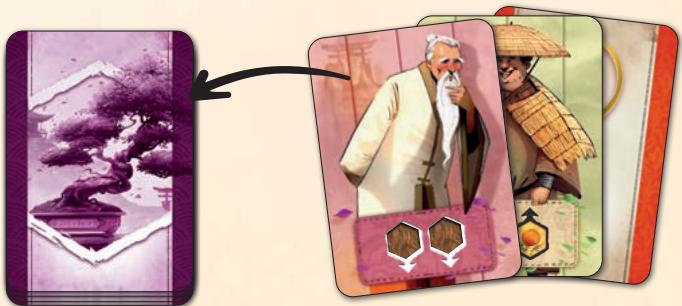
Master, Helper, and Parchment cards
Keep your Helper and Master cards beside your Seishi tile in a single face-down pile, after performing their effects. Also, keep your Parchment cards in the same face-down pile: they will be scored at game's end.
For further information about the cards, see The cards, page 12.
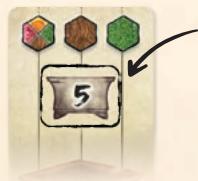
Capacity limit: your Seishi tile shows that you can only keep a maximum of 5 tiles in your supply. If you have more than 5 tiles at the end of your turn, then you must discard tiles of your choice until you have 5. You can extend this limit by acquiring Tool cards.
Cultivate
Place tiles in your bonsai.
You can place tiles which are in your personal supply in your Bonsai. You can place as many tiles as there are symbols depicted on your Seishi tile and any or all of your Growth cards. Each symbol will let you place one tile of the corresponding type.
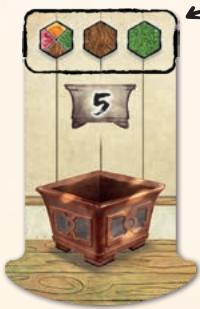
At the start of the game, you only have your Seishi tile to place bonsai tiles. It allows you to place one tile of your choice, and/or one wood tile, and/or one leaf tile during a Cultivate action, in any order. As the game progresses, you can acquire Growth cards that allow you to place more tiles when you choose to Cultivate (see The cards, page 12).

Wood
A wood tile must be placed adjacent to another wood tile (i.e., with at least one side touching a wood tile).

Leaf
Aleaf tile must be placed adjacent to a wood tile.

Flower
A flower tile must be placed adjacent to a leaf tile.
Fruit
A fruit tile must be placed between two leaf tiles which are adjacent to one another. One side of the fruit tile must touch the first leaf and the following side must touch the second leaf. You cannot place a fruit adjacent to another fruit.
Note: In the improbable case that, at the beginning of your turn, it is not possible anymore to add a wood tile to your bonsai, you may remove the least number of tiles from it needed to make that possible again.

Example: Bryce has a Seishi tile and three Growth cards that allow him to place a total of1 wood tile, 2 leaf tiles, 1 tile of his choice, 1 flower tile, and 1 fruit tile. During his Cultivate action, he decides to place 1 wood (Θ), 2 leaves ( and ©) and 1 flower (), as he has no fruit in his supply. He chooses not to place a tile of his choice, as he thinks this is not useful at the moment.
Claiming a Goal tile
During the turn in which your bonsai matches or exceeds the requirements of a Goal tile that is still in the middle of the table (i.e., the Goal tile has not been claimed yet by any player), you must immediately choose whether you want to claim that tile or if you want to renounce it in order to try to achieve a harder Goal tile.
If you complete and claim a Goal tile, take the tile and keep it beside your bonsai. You may only claim one Goal tile per color. If you renounce taking a Goal tile when you complete it, you may still try, in subsequent turns, to complete a harder Goal tile of the same color, but you may no longer claim the one you renounced.


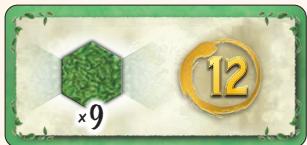
Example: At the start of her turn, Martha has a bonsai with 4 leaves. She adds 2, bringing the total to 6. Now she could claim the Goal tile showing 5 leaves which is worth 6 points, or she can renounce it and try to claim the one showing 9 leaves which is worth 12 points. The intermediate tile, the one showing 7 leaves worth 9 points, was already claimed by Bryce so it cannot be taken anymore.
END OF THE GAME
When the last card from the deck is revealed, the game end is triggered: All players, including the one who triggered the end, get one more turn and then the game ends and points are tallied (use the Score pad).
Each tile in your bonsai is worth a certain number of points, as follows:
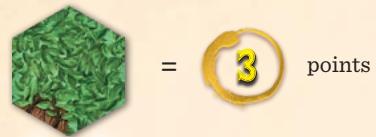

1 point for each side not touching any other tile (this tile will be worth from 0 to 5).

Example: This bonsai scores:

:3×13=39

points


Reveal the face down cards in your pile. Add to your score any points provided by your Parchment cards and by claimed Goal tiles (see The cards and The Goal tiles, page 12).
:7×2=14
The player with the most points is the winner! In case of a tie, the winner among tied players is the one farther away from the starting player, in clockwise order.
: 3(a) + 3(b) + 3(©) + 5(@) + 5 (Θ) = 19
Leftover tiles in your supply are not worth any points.
Total = 72 points
The points obtained from Parchment cards and Goal tiles are added to the bonsai points. In this case, you would add 10 points given by the Parchment card and 13 points from the Parchment card, plus 5 points from the brown Goal tile. In total at the end of the game, this player scored 100 points.
SOLO GAME
The rules for a 2-player game apply, with the following changes.
Choose a difficulty level according to the table below:
| LEVEL | GAKUSEI | SENMON | SENSEI | YÚSHA |
| DIFFICULTY | Low | Medium | High | Extreme |
| POINTS | 80 | 100 | 120 | 140 |
During setup, take 1 wood and 1 leaf tile as starting tiles, and add them to your personal supply.
During the game:
• Each time you take the Meditate action, you must discard in a discard pile the card to the left of the one you take. If you take the card to the right of the deck, reveal and discard the top card from the deck. Slide the other cards to the right to fill the gaps, then reveal new cards from the deck to fill the empty spaces on the board.
• Each time you take the Cultivate action, you must discard the rightmost card on the board, i.e., the one farthest from the deck. Then slide the remaining ones and refill the space as you would do at the end of a Meditate action.
When you reveal and add the last card from the deck to the board, play one last turn, then the game ends. Now check if you won: you must have claimed three Goals (one per color) and scored a point total matching or exceeding your chosen difficulty level.
Solo scenarios
If you want a more challenging game, use one of the following scenarios, which are designed to explore particular strategies in Bonsai. Choose one of the scenarios (they are ordered from easiest to more difficult), then follow the rules for the solo mode with the changes listed.
Slow Fall
Setup


Use only the Goal tiles shown above.
Rules adjustments
None.
Goal
Score at least 130 points. Claim 2 big and 1 small Goal. (Remember that you cannot claim more than 1 Goal for each color.)


Long Winter

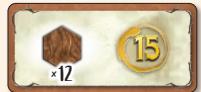
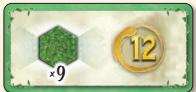

Setup: Use only the Goal tiles shown above.
Rules adjustments None.
Goal
Score at least 120 points. Collect at least 4 Parchment cards.
Claim all 3 Goals.
Hint: To keep track of how many Parchment cards are left in the deck, you can put them in a face up pile near the board when you discard them. (There are 7 in total.)

Flourishing Spring


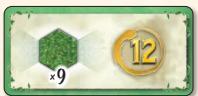

Setup
Use only the Goal tiles shown above.
Rules adjustments
Each time you take a Cultivate action, you must place a flower on your bonsai. You need to have this flower in your supply before taking the action, otherwise you cannot take it. This rule does not apply to the Helper card.
Goal
Score at least 130 points. Claim all 3 Goals.



Scorching Summer


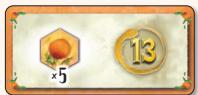
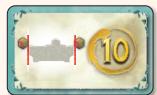
Setup
Use only the Goal tiles shown above.
Rules adjustments
At the end of the game, remove all fruit not adjacent to a flower, and all flowers not adjacent to a fruit. In other words, only keep flowers and fruits that are adjacent to each other.
Goal
Score at least 130 points. Claim all 3 Goals.


The Emperor challenge
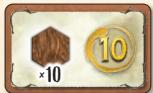
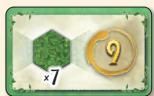


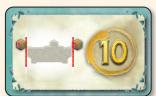

Setup
Use all intermediate Goals: white, yellow, brown, green, and purple. Take a second Pot tile and place it in front of you (leave room between the two Pots for the bonsai). Place a summary card below one of the two Pots: this will be the active bonsai.
Rules adjustments
When you take a Cultivate action, you may only add tiles to the active bonsai. If you claim Goal tiles, they belong to the active bonsai (place them beside it to remember). At the end of each Cultivate action, move the summary card to the other bonsai, which becomes the new active bonsai. Keep moving the card at the end of each Cultivate turn. If you take a Helper card, add the tiles to the active bonsai, but do not move the summary card.
To claim a Goal, always count only the tiles of the active bonsai.
At the end of the game, count the tiles in both bonsai to score points and for Parchment cards.
Goal
Score at least 140 points. Claim all 5 Goals: 3 with one bonsai and 2 with the other bonsai. The order in which you claim the Goals is irrelevant.
Bonsai origins
“Bonsai” is a term derived from the two kanji symbols 盆 “bon” (= pot) and 栽 “sai” (= to plant). Bonsai are living works of art in constant change, plants that even through their reduced proportions express all the power and balance of a big tree in the wild.
The art of bonsai originated in China over 2000 years ago, beginning in the VI Century, and was adopted and expanded in Japan with the introduction of Zenprinciples to the cultivation and care process.Approximately in the XVIII Century, the art ofbonsai was spread among all social classes of Japan; Today it is an appreciated and practiced form of art all over the world, through globalization and the advent of the internet.
A bonsai is a never-finished masterpiece: the plant keeps growing and changing with the same seasonality that it would have in nature, but with the additional care and attention given by a specialist to guide its natural path. Bonsai are usually passed along from generation to generation and it's not unusual to see bonsai that are centuries old. A fundamental aspect of bonsai is that they evoke a profound sense of strength, maturity and, most of all, deep peace and serenity to hobbyists, specialists, and newcomers alike.
Bonsai care
Bonsai are full-fledged trees, and contrary of some folk beliefs, they are not genetically selected and modified to grow smaller, nor do they stay small because they are not watered or fed enough.
Bonsai are followed meticulously for their entire vital cycle, a perfect balance between the apex and the roots is maintained through pruning, fertilization, and other common techniques used for protection and care of plant diseases. Bonsai keep their reduced dimensions, or to be more precise they slow their growth to maintain the right ratio between foliage and roots; This is possible because they are planted in a pot and are not in direct competition with other plants.
Although these practices can appear as invasive to the plant, they are not any more sothan pruning an orchard or taking care of a dog: it is the overall state of health of the tree that expresses its well-being. Moreover, techniques such as leaf trimming, root pruning, repotting and wiring are meant to sustain the form of the plant, to increase the exposition of the foliage to the sun, and to rearrange the root system in a better fitting space, thus renovating the terrain nutrients and increasing the long-term health of the tree.
If a Bonsai is thoroughly followed during its growth, the duration of the plant life increases up to hundreds of years. The rule-of-thumb of bonsai specialists is “do not do to the plant anything that you need, but only what is best for its health: you are not the owner, but the caretaker”.
Main bonsai styles
When working on a bonsai, the specialist must have a general goal to refer to, while following through the formation and education of the plant. This goal is a project that should focus on the representation of nature. The specialist should be careful to respect, for example, trunk orientation, branching direction, shape of the crown, and any other elements that the arboreal species would have in nature. For this reason, the first and foremost source of learning for a specialist is the observation of nature itself. The following is a list of some of the most famous bonsai styles. Although some bonsai may have elements of multiple styles, the best practice is to refer to it by its dominant characteristics.
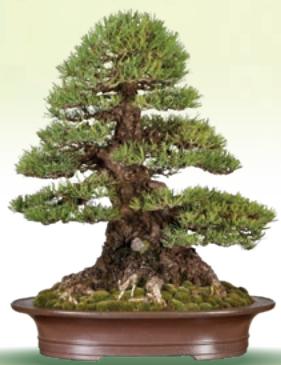
The“Chokkan”or“Formalupright”style is often visible in nature, especially when the tree is exposed to a lot oflight and does not suffer competition with neighboring trees. The tapering of the straight trunk should be clearly visible, which means the trunk should be thickest at the bottom, progressing and becoming finer as it reaches the top. The first branching is visible at roughly 1/4 of the total trunk height, while the apex is formed by only one branch.
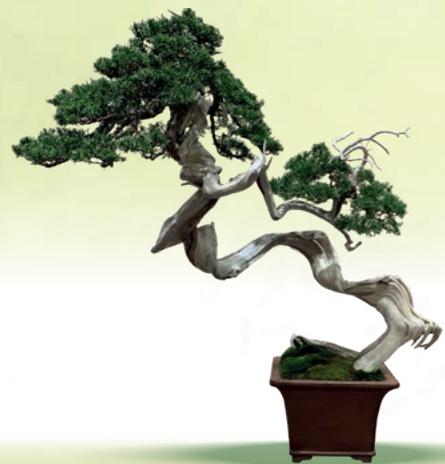
The “Bujin-ji” or “Literati” style can be typically found in nature, and it is one of the hardest styles because it's hard to replicate it in bonsai art. The trunk is usually contorted and grows upwards, the branches are absent or reduced to a minimum, because the sun exposure is generally only towards the apex. These trees are usually placed in small, rounded pots.
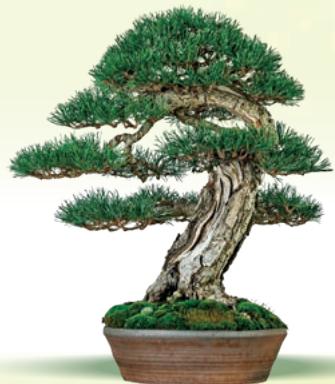
The “Moyoji” or “Informal upright” style is common both in nature and in bonsai art. The trunk grows upwards while slightly curving, and at each turn there is a branching of the trunk. The tapering of the trunk should be clearly visible, which means that the bottom ofthe trunk should be much larger than the top.

The “Kengai” or “Cascade” style is inspired by trees that grow in the wild on rocky walls and are bent downwards as a consequence of different factors, such as snow falling or rockslides. With bonsai, it can be difficult to maintain the growth downwards as the natural tendency for the trunk would be to go upwards. These bonsai are often planted in high pots with the apex falling below the base. Branches grow in either direction, horizontally, to maintain the balance of the tree.
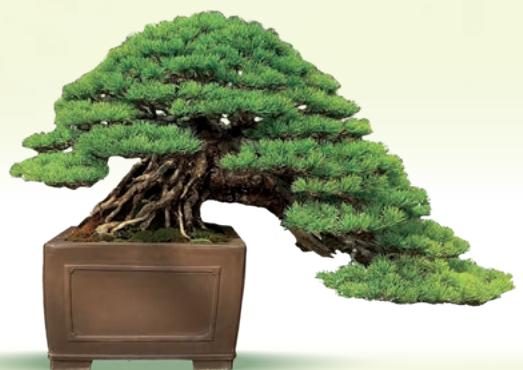
The “Han-Kengai” or “Semi-cascade” style is modeled after trees that grow on cliffs, riverbanks, and lake shores. It differs from the “Kengai” style as the trunk never goes below the pot, the crown is usually above the lip, while the branching spreads below the lip.

The "Shakan" or "Slant" style is similar to the Chokkan style, with the exception that the plant grows out ofthe soil inclined. Usually the first branch grows in the opposite direction of the trunk, to balance the tree. This branch can be found at 1/3 of the total height of the plant.

The “Hokidachi” or “Broom” style is employed for deciduous trees with extended and fine branches. The trunk is straight and does not reach the apex of the tree, instead it branches out in all directions about 1/3 of the entire height of the tree. Branches and leaves form a spheric-like crown, thus guaranteeing a breathtaking view even in winter, when leaves fall.

The “Kabudachi" or “Clump” style is characterized by having many plants of the same species, usually an odd number, in a single bonsai pot. It is common in nature, but not so common in bonsai art. This style tries to recreate a fallen trunk that generates branches that becomes trunks of new plants themselves. For this reason, it's important that each trunk grows out from the same base. It's also important to maintain a triangular shape in the whole formation as well as in each individual plant.
Special thanks to Paolo Mori for his game Augustus, for the inspiration of the Bonsai Goal tiles. DV Games would like to thank Matteo Dal Lago and UBI (Bonsai Specialists Italian Union) for their important contribution through review and fact checking of the game so that we manage to deliver an enhanced and complete game experience.
TREES FOR THE FUTURE
We have minimized the environmental impact of this game. In partnership with Trees for the Future, we are planting brand new trees to recover agricultural land in sub-Saharan Africa. By purchasing Bonsai you help us to renew our commitment.

Copyright © MMXXII daVinci Editrice S.r.I. Via S. Penna, 24 - 06132 Perugia - Italy All rights reserved. www.dvgames.com
THE CARDS
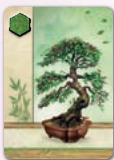
Growth cards
Growth cards stay in front of you for the rest of the game. When you Cultivate, you may place all tiles represented on your Growth cards in addition to the ones you can place thanks to your Seishi tile. If you have multiple copies of the same card, their effects add up. Choose freely the order in which you place the tiles. Each placement is optional.
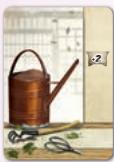
Tool cards
Tool cards stay in front ofyou for the rest ofthe game. For each copy of this card you have, at the end of each turn, you can keep two additional tiles in your personal supply.
Example: If you have two of these cards, you can keep up to 4 more tiles in your personal supply, in addition to the 5 tiles you can keep thanks to your Seishi tile, for a total of 9.
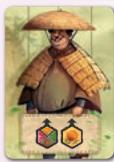
Helper cards
Helper cards are activated once when you take them, then they are kept face down in a pile beside your Seishi tile.
Place in your bonsai one tile of your choice, and/or one tile of the type shown, taken from your personal supply (you may place tiles you just took along with this card).

Master cards
Master cards are activated once when you take them, then they are kept face down in a pile beside your Seishi tile.
Take the tiles shown on the card from the common supply. Take these tiles in addition to the tiles you would normally take depending on the position of the card on the board. Remember to respect your capacity limit at the end of your turn.
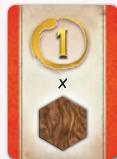
Parchment cards
Parchment cards are kept face down in a pile beside your Seishi tile. At the end of the game, each Parchment card awards points depending on the depicted images, as follows:


1 point for each wood tile in your bonsai (including the starting bud)
1 point for each leaf tile in your bonsai

2 points for each flower tile in your bonsai

2 points for each fruit tile in your bonsai


2 points for each Growth card you have

2 points for each Helper card you have
2 points for each Master card you have
Bujin-ji Style Goal
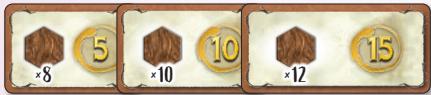
Your bonsai has 8/10/12 wood tiles, including the starting bud tile.
Chokkan Style Goal
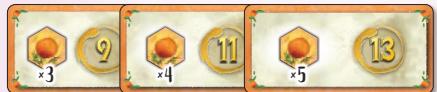
Your bonsai has 3/4/5 fruit tiles.
THE GOAL TILES
Moyogi Style Goal
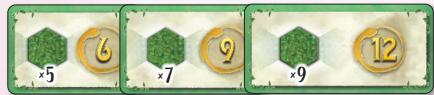
Shakan Style Goal

Kengai Style Goal
Your bonsai has a tile which protrudes out of the pot (on the side shown by the symbol).
Your bonsai has tiles protruding from both sides of the pot.

Your bonsai has a tile protruding out of the pot on one side, and another tile below the pot on the other side (the specific sides do not matter).

Your bonsai has 5/7/9 leaf tiles, adjacent to one another.

Your bonsai has 3/4/5 flower tiles that protrude from the same side of the Pot (it does not matter if it's the right or the left one).
and protrude out of one side of the pot
protrudes out of the other side of the pot
and are below the pot

简繁检索对照.md1.6 KB
903_366994_bonsai — 简体/繁体检索对照
本游戏的规则书是繁体中文原文。用户用简体提问时,把关键词按下面这张表转成繁体再去 grep 原文,命中率最高。
回答时用简体或繁体都可以,但引用的原文保持繁体。
简体 → 繁体 对照(按该游戏原文出现频率排序,共 59 字)
| 简体 | 繁体 | 原文出现次数 |
|---|---|---|
| 块 | 塊 | 234 |
| 游 | 遊 | 73 |
| 戏 | 戲 | 71 |
| 标 | 標 | 66 |
| 树 | 樹 | 55 |
| 时 | 時 | 38 |
| 种 | 種 | 34 |
| 动 | 動 | 34 |
| 长 | 長 | 33 |
| 风 | 風 | 32 |
| 将 | 將 | 31 |
| 个 | 個 | 30 |
| 则 | 則 | 30 |
| 为 | 為 | 28 |
| 图 | 圖 | 26 |
| 叶 | 葉 | 25 |
| 获 | 獲 | 24 |
| 张 | 張 | 24 |
| 干 | 幹 | 24 |
| 纸 | 紙 | 23 |
| 数 | 數 | 23 |
| 结 | 結 | 23 |
| 规 | 規 | 22 |
| 应 | 應 | 22 |
| 选 | 選 | 22 |
| 库 | 庫 | 22 |
| 并 | 並 | 21 |
| 从 | 從 | 21 |
| 来 | 來 | 20 |
| 于 | 於 | 19 |
| 须 | 須 | 19 |
| 术 | 術 | 18 |
| 难 | 難 | 18 |
| 会 | 會 | 18 |
| 后 | 後 | 18 |
| 侧 | 側 | 18 |
| 与 | 與 | 17 |
| 帮 | 幫 | 17 |
| 师 | 師 | 16 |
| 设 | 設 | 16 |
| 轮 | 輪 | 16 |
| 变 | 變 | 16 |
| 弃 | 棄 | 16 |
| 禅 | 禪 | 14 |
| 择 | 擇 | 14 |
| 对 | 對 | 13 |
| 艺 | 藝 | 13 |
| 计 | 計 | 12 |
| 体 | 體 | 12 |
| 过 | 過 | 12 |
| 进 | 進 | 12 |
| 显 | 顯 | 11 |
| 顶 | 頂 | 11 |
| 边 | 邊 | 11 |
| 类 | 類 | 10 |
| 颜 | 顏 | 10 |
| 这 | 這 | 10 |
| 开 | 開 | 10 |
| 间 | 間 | 10 |
Texts are community-compiled or publicly released by publishers; copyright remains with the original authors. For personal reference only.