
Brian Boru
At a glance
Rules, cards and Q&A (Chinese)
The rules, card data and player questions for this game are written in Chinese. Open the Chinese page to read them.
Where to find full rules
Full rules and card lookup are available in the cunlema app at cunlema.cn — pick this game and ask about any rule, card or turn you are unsure about.
Related games
Rulebook text (Markdown)
This game has 2 rulebook Markdown file(s) in our library; 2 rendered inline below — expand to read or download.
rules_zh_舌与剑至尊王传奇_28265.md30.0 KB
中文规则
布莱恩 博鲁 爱尔兰至尊王
BY PEER SYLVESTER
ART BY DEIRDRE DE BARRA
中文翻译:Taughastan
爱尔兰充斥着王位争夺者、权力的觊觎者和各自为政的势力。
诸省混乱,民不聊生。
国盼明君。
本作中,玩家努力通过军事力量、谋略和联姻,一统爱尔兰。并合力对抗维京人的入侵,修建修道院扩大影响力,获得全国各地的支持。想要成为全爱尔兰的至尊王,玩家需要驾驭不断变化的同盟关系,巧胜劲敌,把握历史。
历史背景

爱尔兰至尊王——布莱恩·博鲁,生活在公元1000年左右。他作为战士闻名,不仅击退了频繁的维京人入侵,还在战场上击败了国内的对手。奠定他地位的不仅仅是武略,更有政治手腕。他巧妙地通过与不同家族联姻建立起了重要联盟。他还重建了许多遭到袭击的修道院,因此也获得了主流教会的青睐。1014年的克伦塔夫战役中,他带领军队战胜了丹麦人,也殁于此役。
你可能会认为,争取赢得区域内多数席位是一种非常现代的民主观点或理论,但在布莱恩·博鲁时代已初具雏形了。爱尔兰人生活在部落之中,部落的权势者们共同选举产生各自部落议会的领袖,称为首领(Ri),在战争时期拥有绝对权力。每个首领(游戏中用城镇表示)都效忠于一个地区的领主(Ruiri),各领主不断在相互地区之间发动战争,争夺爱尔兰至尊王的头衔。
丹麦人,四处掠夺时自称“维京”,喜欢在掠夺过的地方定居,甚至与当地势力合作获得政治权力、达成协议,以维持新定居点的稳定。
请注意,联姻卡上描述的并不是历史上真实的爱尔兰或丹麦王室成员。

配件

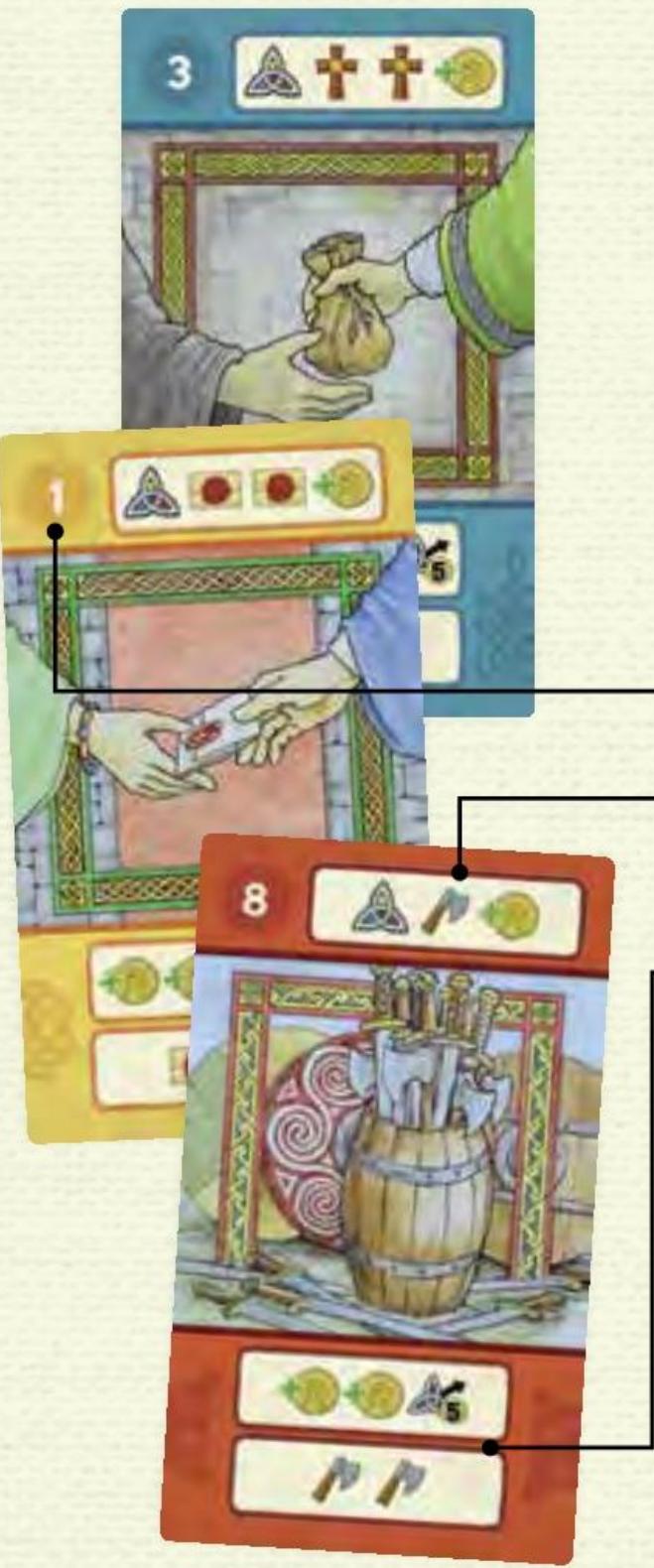
25张行动卡
颜色:卡牌颜色与版图上特定城镇对应,关联不同类型的行动。
战斗卡(红色):用于对抗维京人。
教会卡(蓝色):用来获得教会好感。
求亲卡(黄色):用来促进政治联姻。
王室卡(白色):百搭,可以用来获取任何颜色的城镇。
数值:卡的数值,决定了相关争夺能否成功。
主要行动:当争夺成功时,玩家执行的行动,涉及到对一个城镇的控制。
次要行动:当争夺失败时,玩家执行的行动。选择其中一个行动全部执行。某些卡牌仅有一个选项。
7张维京卡
入侵值:在准备阶段,将所示数量的维京掠夺者指示物,放置在战斗区域。
9张联姻卡
奖励:玩家成功联姻获取本卡时,获得的奖励。
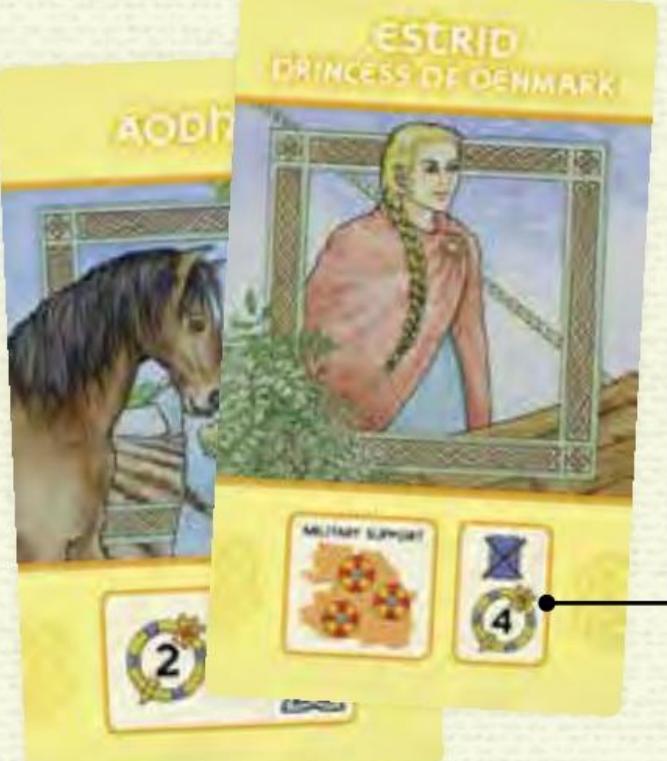
丹麦公主卡:一张特殊的双面联姻卡,代表了与维京人的联盟。


5张提示卡


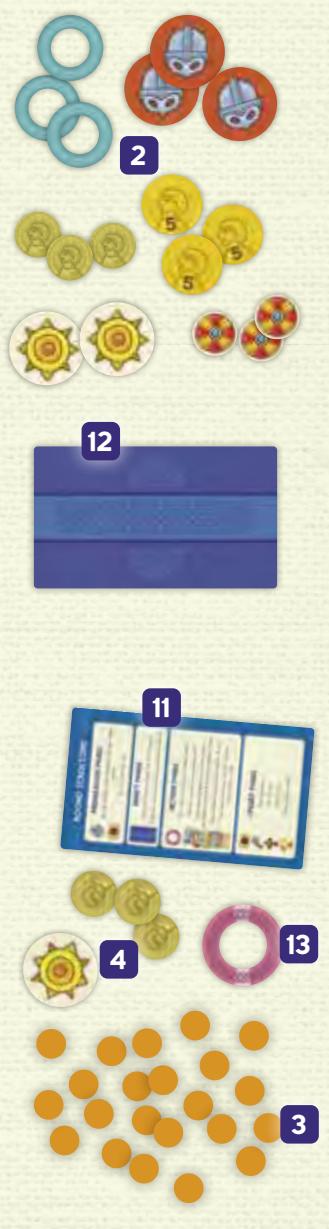
125个木质圆片 (5种颜色各25个)
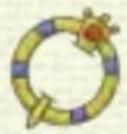
16个修道院指示物
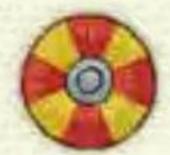
16个维京控制指示物

30个维京
掠夺者指示物
圆片和指示物视同为无数量限制。
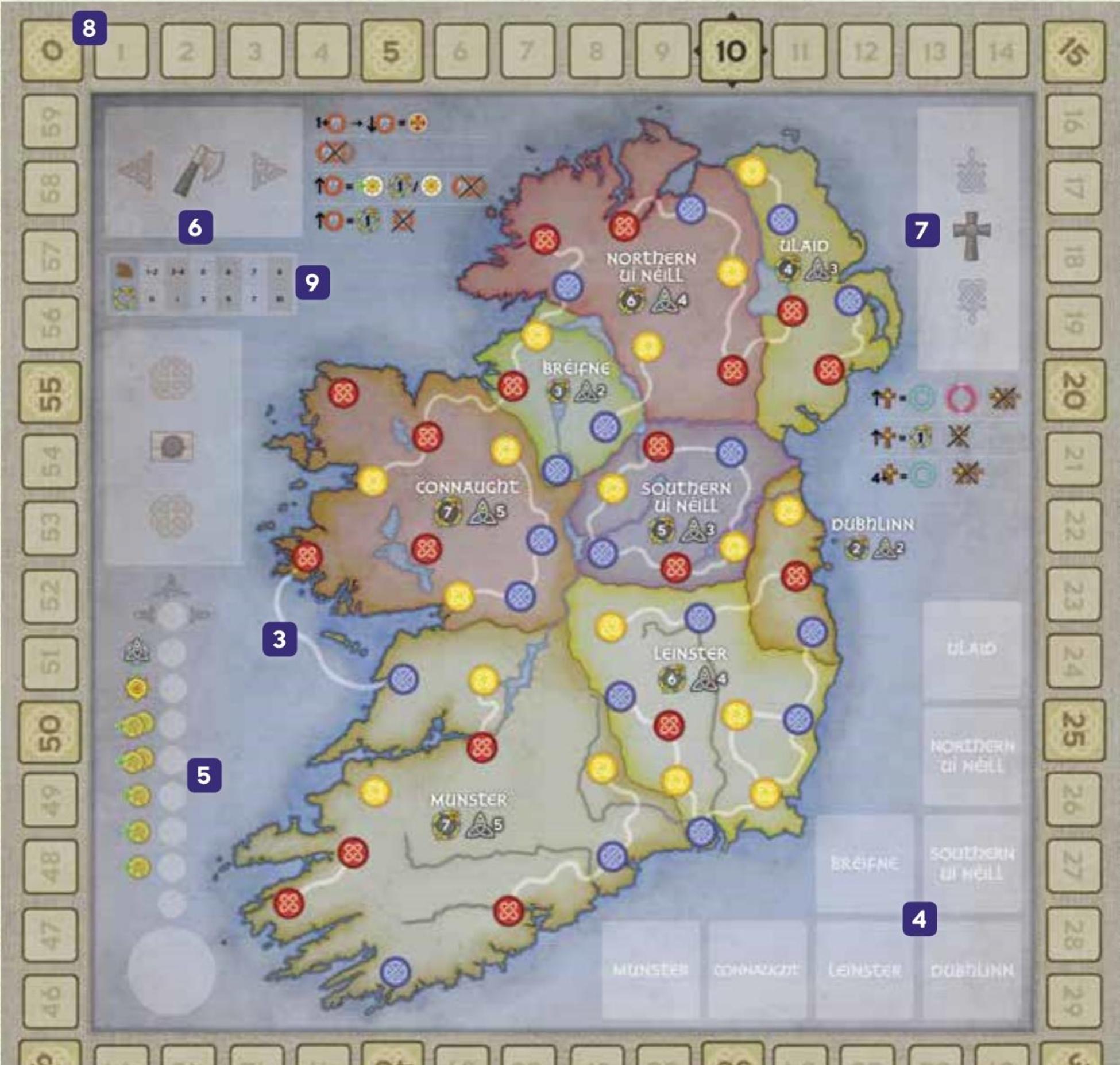
版图
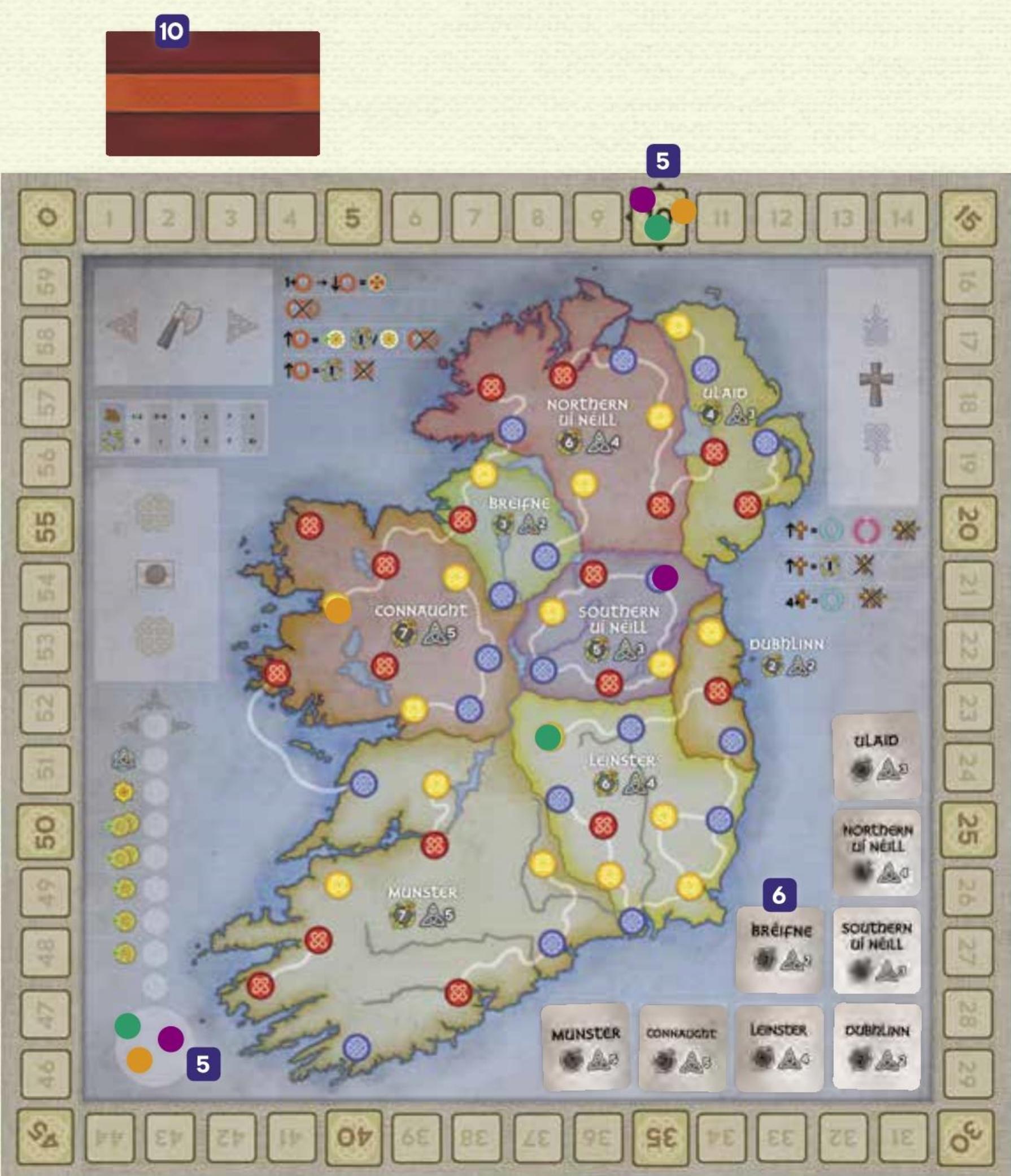
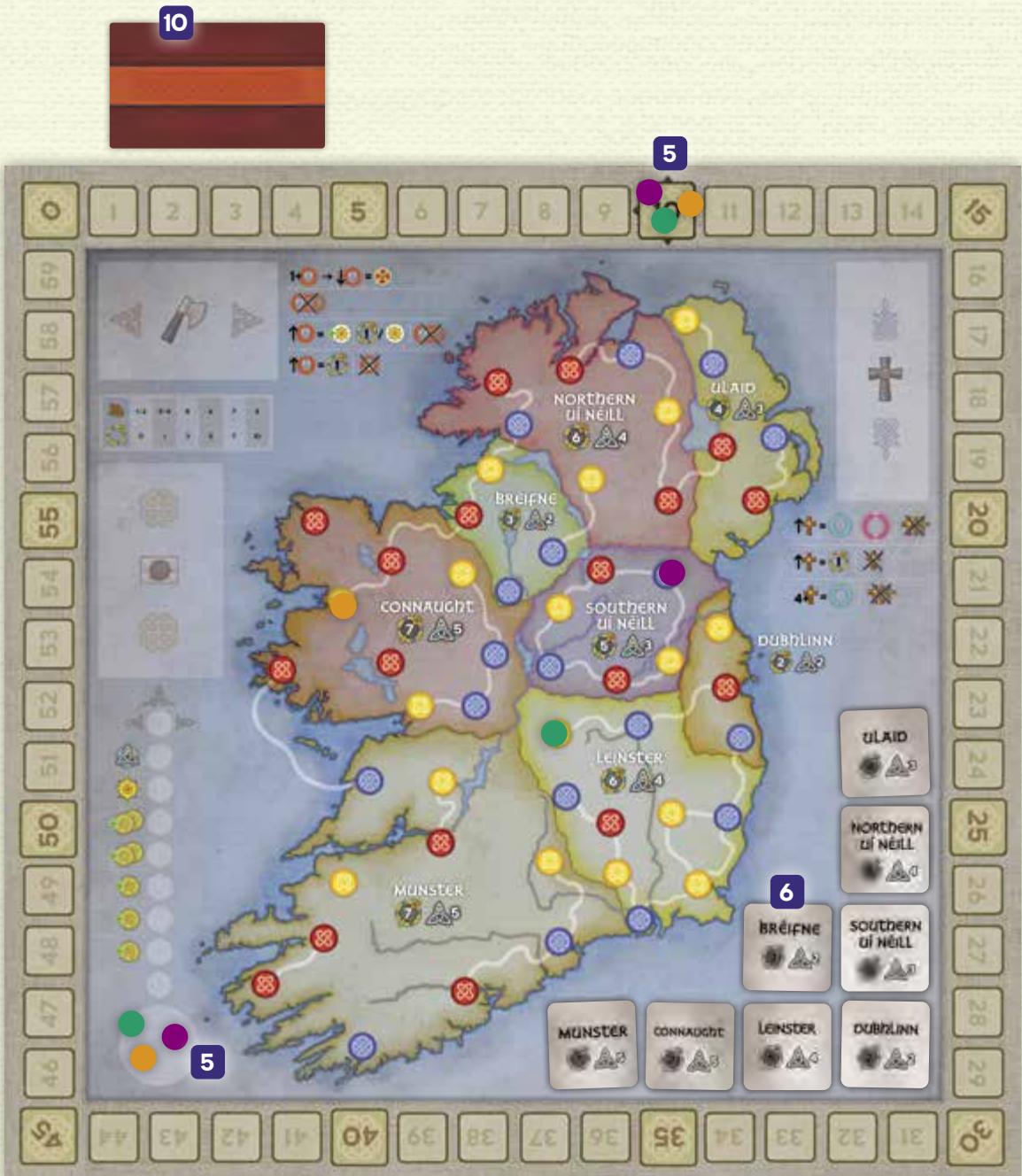
- 地区:版图上爱尔兰被分为八个地区。每个地区上都显示有一个基准值和一个分值,也显示在对应的占领指示物上。

基准值
分值
2.城镇:城镇的颜色与行动卡牌的颜色相对应。

红色,对应战斗卡

蓝色,对应教会卡

黄色,对应求亲卡
3.道路:一些城镇间有道路相连,可向周围扩张
4.占领指示物放置处:用来放置占领指示物
5.联姻轨:标记玩家为成功联姻的投入
6.战斗区域:标记维京人入侵的力量
7.教会区域:标记玩家为获得教会奖励的投入
8.计分轨:标记玩家的得分
9.地区得分表:游戏结束时,玩家控制城镇所在地区数的计分方式

60个钱币

14个声望指示物

1个目标城镇指示物
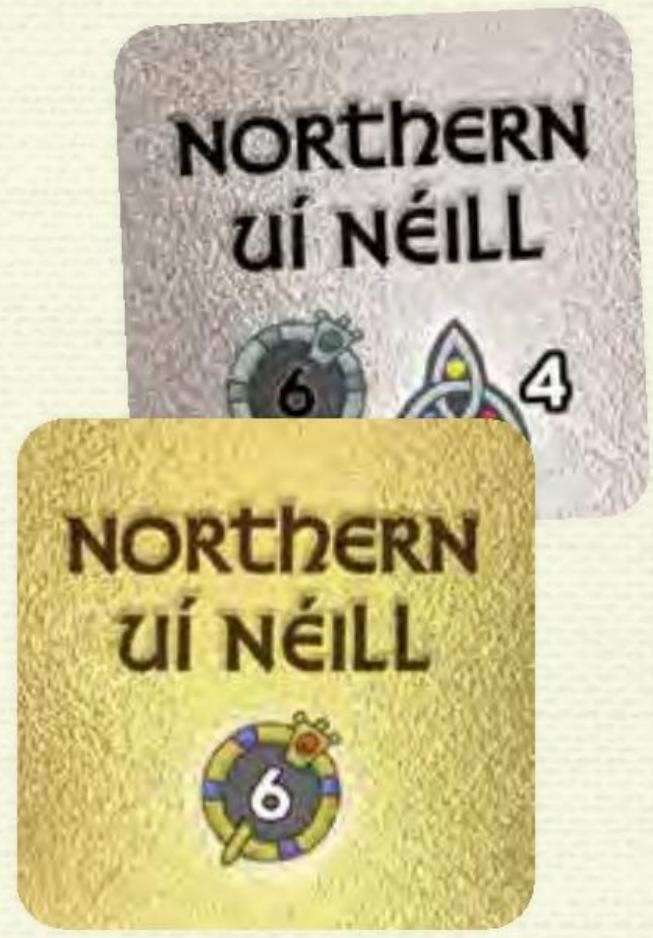
8个占领指示物
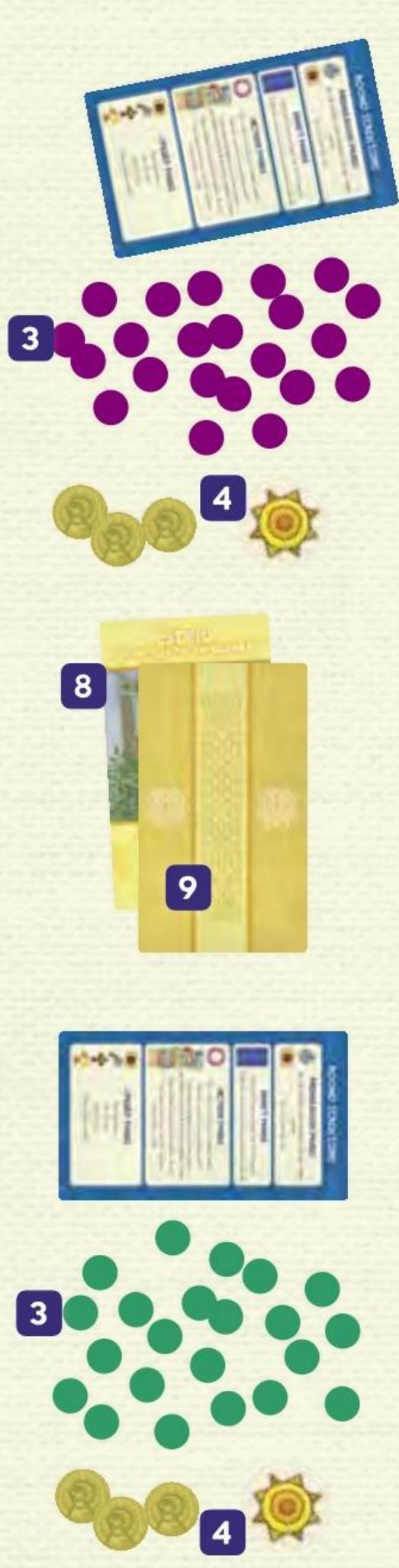
设置
-
将版图放在桌面中央。
-
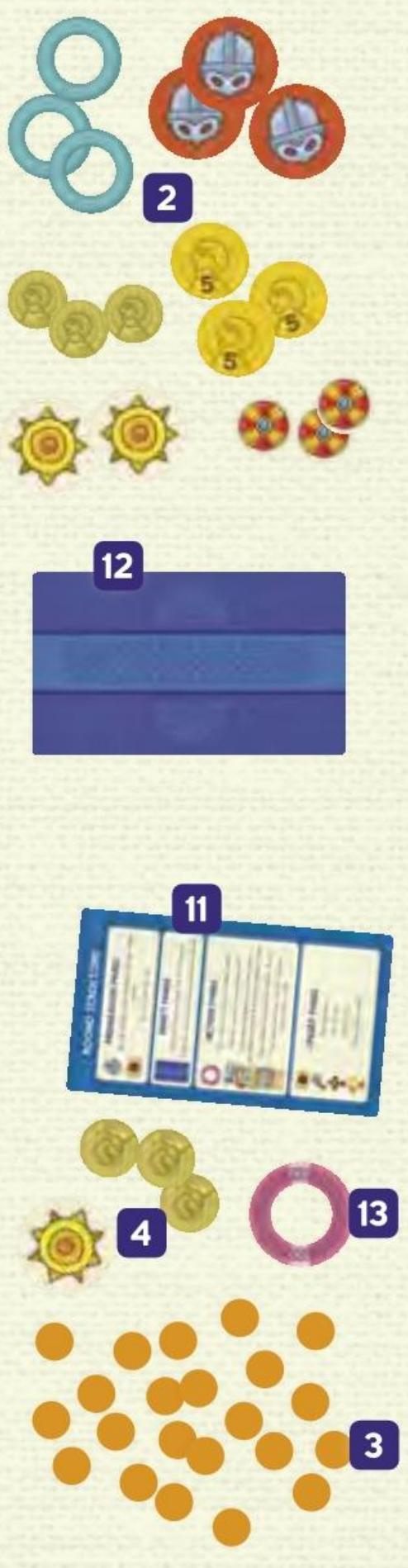
钱币、声望、修道院、维京掠夺者、维京控制指示物分开堆放在版图旁边,作为供应堆。
-
每位玩家获取一个颜色的所有木质圆片, 剩余颜色放回盒中。
-
每位玩家获得3块钱和1个声望指示物。
-
每位玩家将自己颜色的1个圆片放到联姻轨的初始位置、1个放到计分轨10的位置。
-
所有的占领指示物正面朝下放到版图的对应放置处。
-
行动、维京、联姻、提示卡分别叠放在版图旁边。
-
找出丹麦公主卡,单独放到联姻轨旁边。
-
洗混其他的联姻卡,按如下配置将联姻卡正面朝下叠放在丹麦公主卡之上,再将剩余的正面朝下放回盒中。
3人游戏:2张联姻卡。
4-5人游戏:3张联姻卡。 -
洗混维京卡,正面朝下叠放在战斗区域旁边。
-
每位玩家获得一张提示卡。
-
行动卡叠放在版图旁边。
-
玩家间自行决定好的起始玩家获得目标城镇指示物。
-
按顺时钟顺序,玩家依次将1个自己的圆片放到1个城镇的位置上。一个地区中的城镇只可以有1名玩家放置。
游戏流程
游戏由多个回合组成。3人游戏时为3回合,4-5人游戏时为4回合。终局分数最高者获胜。
每回合由4个阶段组成:准备、轮抽、行动、奖励。
准备阶段:玩家翻开新的维京卡和联姻卡。
轮抽阶段:玩家轮抽卡牌组建手牌,为行动阶段做准备。
行动阶段:玩家打出卡牌,并执行主要和次要行动。
奖励阶段:玩家获得联姻、对抗维京人、修建修道院、占领地区的奖励。
准备阶段
翻开维京卡牌堆最上面的那张,将其上所示数量的维京掠夺者指示物放入版图的战斗区域。然后弃置此卡牌。
然后翻开联姻卡牌堆最上面的那张,放在联姻轨上方放置处。到了丹麦公主卡,直接放到联姻轨上方放置处,此时就表明游戏进入到最后一回合。
接着就进入到轮抽阶段。
轮抽阶段
将所有行动卡洗混,按如下配置抽牌:
3人游戏: 每人8张
4人游戏: 每人6张
5人游戏: 每人5张
3-4人游戏时,将剩余卡牌正面朝下放在版图旁边。
从抽到的卡牌中选择2张,作为接下来行动阶段的手牌,正面朝下放在自己面前。所有玩家都选放好后,将剩下抽到的牌全部传递给左手边玩家。
从传递过来的牌中,再选择2张正面朝下放在自己面前。所有玩家都选放好后,再将剩下抽到的牌全部传递给左手边玩家。重复上述步骤,直到所有卡牌都面朝下放在了自己面前。当最后一个步骤只剩下1或2张卡牌传递过来时,直接将其作为自己的手牌。
将所有选择的牌拿到手上作为手牌后,进入到行动阶段。
手牌只供自己查看知晓,不可再与他人交换。
行动阶段
行动阶段由多次争夺组成。
本阶段持续到每位玩家只剩下1张手牌。
然后将剩下的这张手牌弃置,进入到奖励阶段。
争夺
起始玩家将目标城镇指示物放到版图中没有玩家圆片(无主)的1个城镇上,该城镇作为本次争夺的目标城镇。
然后,该玩家从手牌中打出1张与该城镇颜色一致的,或白色百搭卡。
接着按照顺时钟顺序,其余玩家依次从手牌中打出任意1张。打出卡牌与目标城镇颜色一致且数值最高的那名玩家获得本次争夺的胜利,其余玩家失败。百搭视同与目标城镇颜色一致。
按照打出卡牌上,数值从小到大(忽略颜色)的顺序,玩家依次执行卡上如下行动:
胜利者,执行打出卡牌上的首要行动(卡牌顶部)。
失败者,选择打出卡牌上的次要行动执行(卡牌底部,部分卡牌仅有1个次要行动选项)。
具体行动详解,见下一页说明。
执行完行动的玩家,将这张卡弃置。所有玩家都完成行动并弃置后,本次争夺结束。
玩家不可查看弃牌堆。
接下来,从此时拥有目标城镇指示物的玩家开始,重复上述动作,进入新的争夺。直到每位玩家执行完行动后都只剩下1张手牌,行动阶段结束。

行动说明
所有首要及次要行动都通过图标标识。当该行动多于1个图标时,必须从左至右全部执行。
图标 行动
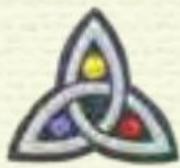
获得目标城镇指示物,并在该目标城镇指示物上放置1个自己的圆片。此时,该玩家控制了该城镇。本图标仅出现在首要行动中。
从供应堆中获取1块钱。钱币视同为可无限供应。

支付1块钱放入供应堆,如果自己没有钱,改为扣除自己2分。如果无分数可扣除也没钱,则本行动无效。只有本图标可以用分数代替钱币。

从供应堆中获取1个声望指示物。声望指示物视同为可无限供应。

将1个自己的圆片放置到教会区域。玩家也可选额外再按照2块钱1个的价格,将任意数量的圆片放入教会区域。圆片也视同为可无限供应。

从战斗区域获取1个维京掠夺者指示物。玩家也可选额外再按照2块钱1个的价格,获取不超过战斗区域已有数量的维京掠夺者,如果战斗区域没有维京掠夺者指示物,则本行动无效。
将联姻轨上自己的圆片向上移动最多一格。玩家也可选额外再按照2块钱1格的价格,向上最多移至顶格。如果玩家的圆片已达顶格,则本行动无效。除了联姻轨初始位置允许多名玩家圆片存在外,其他格内均只能最多允许1名玩家的圆片存在。因此,当自己卡牌上行动执行完成后,如果自己的圆片停留在已有其他玩家的格中,则此时必须将自己的圆片下降至最近的无其他玩家的格中。
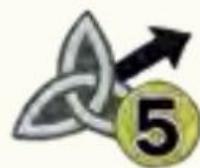
可选花费5块钱扩张至新的城镇。即:从自己已控制的城镇,通过道路相连紧挨着的,且无主的另一个城镇上放置1个自己的圆片,控制该城镇。
注意:扩张的城镇与原已控制的城镇之间不能间隔任何别的城镇。

从版图上移除1个维京控制指示物,显露出被其覆盖的圆片,表示此时该城镇恢复由该圆片所属玩家占领。
B

行动阶段示例

A、B、C、D四人正在行动阶段,刚刚结束了一次争夺。新的争夺开始之前,A获得了目标城镇指示物,A选择将其放置在康瑙特地区
(Connaught) 的一个无主城区镇上。由于这个城镇是红色的, 所以A必须选择打出红色 (或白色) 卡牌, A选择打出了红色11。

B无意获得本次胜利,所以B打出了红色2。
C想要获得本次胜利,C打出了白色13。
D手牌不好,打出了黄色17。
最终,C赢得了本次争夺的胜利。因为C是与该目标城镇颜色一致(白色视为百搭)的卡牌中数值最大的。
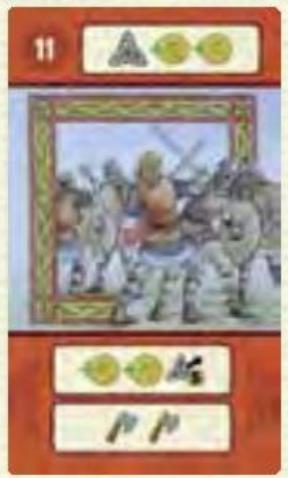

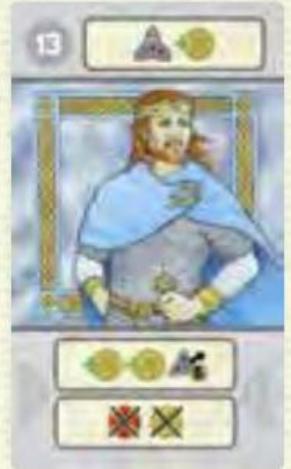
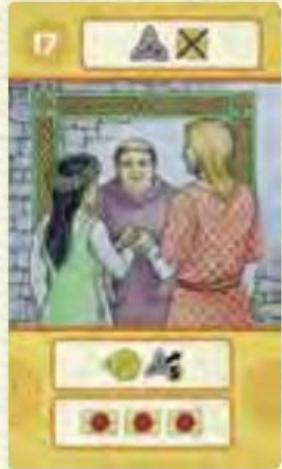
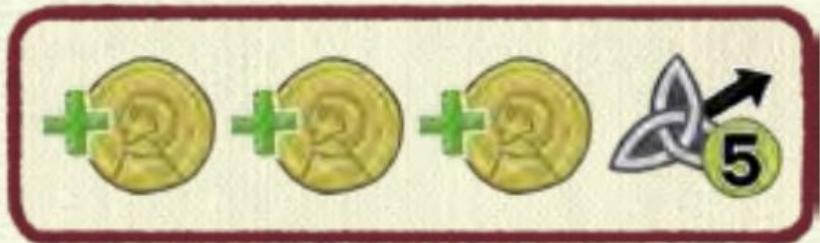
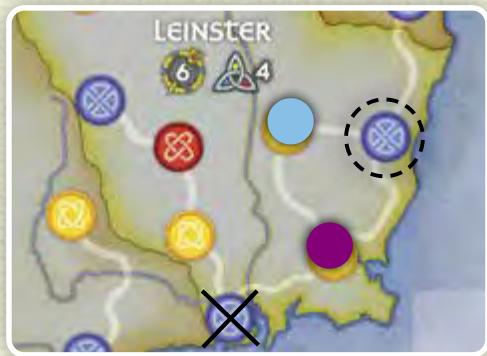
接下来,按照卡牌上数值从小到大,先后执行行动。B的数值最小,最先开始。B没有赢得行动,所以只能选择执行卡牌底部的行动之一。B选择了底部的第一个行动——获取3块钱,然后可以选择花费5块钱扩张到一个新的城镇。B选择做这个行动。在伦斯特地区(Leinster)中,由于C的紫色城镇挡住了一个方向,B只好选择往另一个方向上扩张。随即,B花费5块钱将1个自己的蓝色圆片放在与自己已占领城镇道路相连的邻近城镇上。


接着是A行动。A决定执行底部第二个行动——从战斗区域获取2个维京掠夺者指示物。然后A决定再花费4块钱,再获得2个,总共4个,用以防止维京入侵成功时,自己有失去城镇的风险。
轮到C行动。C赢得了本次行动,因此执行卡牌顶端的行动——获得目标城镇指示物,并将自己1个紫色圆片放在目前的目标城镇上。由此,C成为下一个行动的起始玩家。最后,从供应堆获取1块钱。

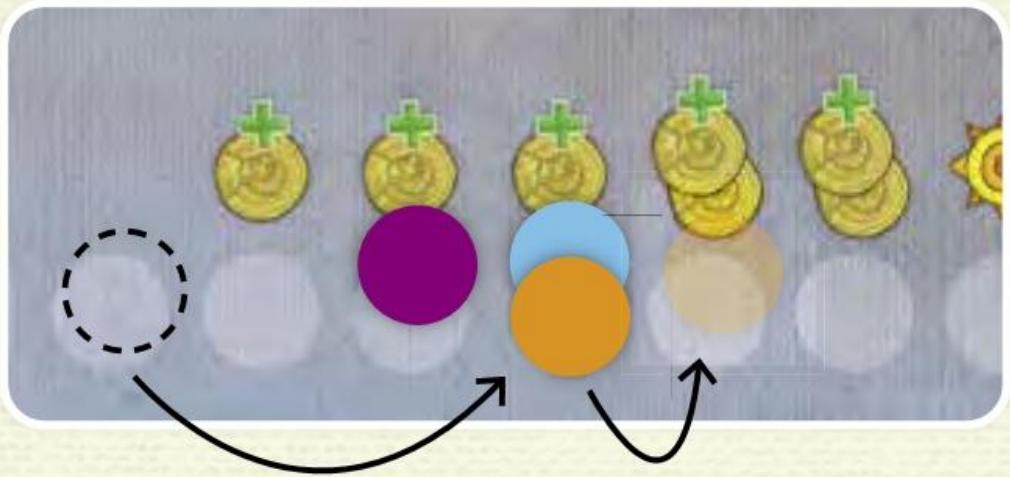
最后是D行动。D决定执行底部第二个行动——将联姻轨中自己的圆片向上移动3格。如此,则D与A同格,D必须选择要么花费钱币继续向上移动,要么往下降到最近的空格。C在下面一格,因此只能再降一格。D决定花费2块钱再前进一格,超过B。
到此,所有玩家都执行完成了自己的行动,本次争夺结束。此时,所有玩家手上都只剩下1张牌,于是将这张牌弃置,进入到奖励阶段。

奖励阶段
按以下4项顺序,获取奖励:
1、联姻
2、战斗
3、教会
4、占领地区
完成后,如果此时联姻卡牌堆已经空了,游戏就结束,进入终局结算。否则开始下一回合的准备阶段。

联姻
此时,如果玩家自己的圆片处于联姻轨的相对最高格,就成功联姻了。玩家不需要达到绝对最高格,只要比其他玩家高就行。
获取本回合翻开的联姻卡,立刻获得其上所示的奖励。然后,将自己联姻轨的圆片放回起始位置。
特殊情况下,本阶段开始时,所有玩家都处于联姻轨的起始位置,此时就要将本回合翻开的联姻卡弃置,直接进入到后续的战斗。
图标 奖励

获得所示数字的分数。

从供应堆中获取1个声望指示物。声望指示物视同为可无限供应。

在所示地区中选择任意1个无主城区上放置1个自己的圆片,控制该城镇。如果该区域的城镇均已被控制,则此次奖励无效。
联姻可与家族内部、爱尔兰其他贵族或王室缔盟。
丹麦公主卡
与丹麦公主成功联姻后,立刻选择下列奖励之一执行:

- 军事支援:将丹麦公主卡标有军事支援的那一面朝上放置。在占领地区的时候,所有被维京人控制的城镇都算作该玩家控制。
此外,终局结算版图中翻开的占领指示物计分时,所有被维京人控制的城镇都算作该玩家的。但不计入该玩家有控制城镇的地区数。
- 建立贸易:将丹麦公主卡标有建立贸易的那一面朝上放置。终局结算玩家有控制城镇所在的地区数时,所有被维京人控制的城镇都算作该玩家控制。
但终局结算时,所有被维京人控制的城镇,都不算作该玩家版图中翻开的占领指示物计分。
- 拒绝:弃置本卡,获得4分。

处理完联姻后,其他玩家获得自己圆片所处联姻轨位置旁所示的奖励,而成功联姻的玩家此时处于起始位置,所以不能获得本项奖励。
图标 奖励


将1个自己的圆片放在版图上任意1个无主城区镇中,控制该城镇。

从供应堆中获取1个声望指示物。声望指示物视同为可无限供应。
从供应堆中获取1块钱。钱币视同为可无限供应。

战斗
如果战斗区域此时无维京掠夺者指示物,则击退维京成功,否则维京入侵成功。
只要战斗区域此时尚有维京掠夺者指示物,则由此时拥有最多维京掠夺者指示物的玩家来决定,此时拥有最少维京掠夺者指示物的玩家控制的哪1个城镇,失去由维京人控制,并在其圆片上覆盖放置1个维京控制指示物。此时起,该城镇由维京人控制。
如果同时有多名玩家拥有最少维京掠夺者指示物,则这些玩家每位都失去1个城镇由维京人控制。
如果同时有多名玩家拥有最多维京掠夺者指示物,则由拥有最少维京掠夺者的玩家自行决定失去自己的哪1个城镇。
然后,将战斗区域尚存的所有维京掠夺者指示物放回供应堆,接着获得战利品。
战利品
无论是否击退维京人,都按下列2个步骤顺序计算,获得战利品。
1、由此时拥有最多维京掠夺者指示物的玩家:从供应堆获取1个声望指示物,接着,计算目前所拥有的声望指示物数量每个获得1分,最后将所有的维京掠夺者指示物放回供应堆。如果同时有多名玩家拥有最多维京掠夺者指示物,则既不获得声望指示物且得分,也不将维京掠夺者指示物放回供应堆,而是直接跳过本步骤,进入步骤2。
2、步骤1结束后,此时,拥有最多维京掠夺者指示物玩家自己的每1个都获得1分。然后,将1个自己的维京掠夺者指示物放回供应堆。
没有维京掠夺者指示物的玩家,不获得任何战利品的奖励。
教会
接下来,按下列3个步骤顺序计算,获得教会的奖励。
1、在教会区域放置了最多圆片的玩家,拿取1个修道院指示物,放在1个自己控制的城镇上。1个城镇最多只能有1个修道院指示物存在。然后,由该名玩家获得目标城镇指示物,再取回自己在教会区域的所有圆片。如果同时有多名玩家在教会区域放置了最多圆片,则直接跳过本步骤,进入步骤2。
2、步骤1结束后,此时,在教会区域放置了最多圆片的玩家自己的每1个都获得1分。然后取回自己在教会区域的1个圆片。
3、从此时拥有目标城镇指示物的玩家开始,以顺时钟顺序,按照教会区域至少有4个自己的圆片,即拿取1个修道院指示物,放到1个自己控制的城镇上,然后,有拿取修道院的玩家取回自己在教会区域的所有圆片。
如果没有可以放置的城镇,则忽略拿取修道院指示物。
占领地区
一个地区中控制了最多城镇的玩家占领该地区。
版图上,所有正面朝下的占领指示物对应的地区中,统计各有多少城镇被控制了(包括被维京人控制的)。如果数量达到或超过基准值(版图中各地区及对应占领指示物上都有注明),则将该占领指示物翻开正面朝上,否则,仍然保持正面朝下状态。
所有正面朝上的占领指示物,无论是在版图上还是已拿放到玩家面前的,检查该地区控制城镇最多的玩家获得该占领指示物,将其正面朝上放在自己面前。
如果该地区同时有多名玩家控制了最多城镇,则控制指示物仍停留在原处。
因此,即使有玩家获得了占领指示物,后续其他玩家在该地区控制的城镇比自己多时,则仍会失去。

修道院
在计算上述占领地区的所有环节中,有修道院的城镇都算作2个。
维京人以及丹麦公主
获取丹麦公主卡并选择了军事支援的玩家,可以将所有被维京人控制的城镇都算作自己控制的。
除此之外,如果是维京人在一个地区中控制了最多的城镇,则将对应的占领指示物放在版图上(如果此时该指示物在玩家面前则放回版图)。

游戏结束

奖励环节结束后,如果联姻卡牌堆已空,则进入终局结算计分环节。
计分
拥有最多钱币金额的玩家获得1分。如有多名玩家同时拥有最多钱币金额,则均不获得本得分。

此时,拥有目标城镇指示物的玩家获得1分。

所有玩家自己每有1个声望指示物,都给自己加1分。
NORTHERN UI NÉILL 6
各自获得此时自己拥有的占领指示物上显示的分数。
此时,留在版图上翻开的占领指示物对应的地区中,控制的城镇数最多的那名或多名玩家均获得指示物上所示分数的一半,不算余数。获得丹麦公主卡并选择了军事支援的玩家,此时由维京人控制的城镇算作由自己控制。
正面朝下的占领指示物不计分。
根据玩家有自己控制城镇的地区数,按如下表格计分。
获得丹麦公主卡并在之前选择了建立贸易的玩家,此时由维京人控制的城镇算作由自己控制。
| 地区数 | 1-2 | 3-4 | 5 | 6 | 7 | 8 |
| 分数 | 0 | 1 | 3 | 5 | 7 | 10 |
最后分数最高的玩家获胜。
多名最高分数玩家中,拥有最多占领指示物的玩家获胜。如仍有多名玩家,则其中获得最多联姻卡的玩家获胜。
如仍有多名玩家,则共享胜利。
Game Design: Peer Sylvester
Game Development: Filip Hartelius and Anthony Howgego
Illustration: Deirdre de Barra
Graphic Design: James Hunter
First published in Great Britain in 2021 by OSPREY GAMES
Bloomsbury Publishing Plc
Kemp House, Chawley Park, Cumnor Hill, Oxford OX2 9PH, UK
29 Earlsfort Terrace, Dublin 2, Ireland
1385 Broadway, 5th Floor, New York, NY 10018, USA
OSPREY GAMES is a trademark of Osprey Publishing Ltd
© Peer Sylvester, 2021. This edition © 2021 Osprey Publishing Ltd
All rights reserved.
www.ospreygames.co.uk
For more information or replacement parts, email info@ospreygames.co.uk
21 22 23 24 25 10 9 8 7 6 5 4 3 2 1

快速查阅

奖励阶段

联姻
-
轨上最高玩家:获得联姻卡,移回轨上起始格。
-
所有其他玩家:获得轨上所在格旁边所示奖励。
战斗
-
战斗区域有维京掠夺者:由拥有最多维京掠夺者的玩家来决定,拥有最少维京掠夺者的玩家控制的哪1个城镇被维京人控制。2. 将战斗区域所有维京掠夺者放回供应堆。
-
拥有最多维京掠夺者的玩家: 获得1个声望指示物、每拥有1个声望指示物获得1分, 并将自己所有的维京掠夺者放回供应堆。多数最多时跳过本项奖励。
-
步骤3之后,拥有最多维京掠夺者的玩家:获得1分、将自己的1个维京掠夺者放回供应堆。多数最多者均获得本项得分。
教会
-
教会区域有最多圆片的玩家:放置1个修道院、获得目标城镇指示物并收回所有的圆片。多数最多时跳过本本项奖励。
-
步骤1之后,教会区域有最多圆片的玩家:获得1分并收回1个圆片。多数最多者共享本项奖励。
-
教会区域有达到或超过4个圆片的玩家:放置1个修道院并收回所有的圆片。
占领地区
-
所有正面朝下的占领指示物:对应该地区中,被控制的城镇数达到基准值后,将其翻开正面朝上。
-
所有正面朝上的占领指示物:由对应该地区中,控制最多城镇数的玩家获得。多数最多时,仍停留在原处。
有修道院的城镇算作2个。
符号
图标
行动
控制当前的目标城镇。
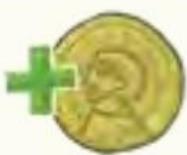
获得1块钱。

支付1块钱,没有钱就扣2分。

获得1个声望指示物。

获得所示数值的分数。

在教会区域放置1个自己的圆片。以2元1个的价格可以多放置。
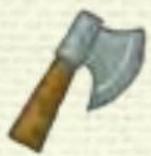
从战斗区域获取1个维京掠夺者。以2元1个的价格可以多获取。

联姻轨中上移1格。以2元1格的价格可以多上移。不可最终停留在有其他玩家圆片存在的格上,如出现此情况,则下降至最近的空格。

可选是否花费5块钱,从1个自己已控制的城镇通过道路,控制相邻的无主城镇。

移除1个维京控制指示物。
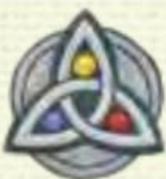
选择版图上任意1个无主城区镇控制。
12
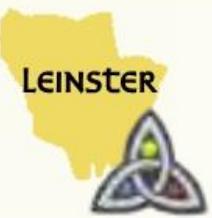
选择该地区中的任意1个无主城区镇控制。

Brian Boru Rulebook.md32.7 KB
ENGLISH RULEBOOK
BRIAN BORU HIGH KING OF IRELAND
BY PEER SYLVESTER
ART BY DEIRDRE DE BARRA
In Brian Boru, you will strive to unite Ireland under your domain, securing control through might, cunning, and matrimony. Join forces to fend off Viking invaders, build monasteries to extend your influence, and gather support in towns and villages throughout the land. To become High King of all Ireland, you will need to navigate a web of shifting alliances, outmanoeuvre your enemies, and grab history by the reins.

HISTORICAL NOTEFROM THEDESIGNER

Brian Boru was a High King of Ireland who lived around the year 1000 CE. He made his name as a warrior, repelling the Viking invasions that were frequent in these times and defeating many of his domestic rivals on the battlefield. But it was not his mastery of military tactics alone that led to his legendary status, for he also had a hand for politics. He deftly married off his various family members to forge important alliances - a practice I don't condone or recommend! He also rebuilt many monasteries that had been raided, so he garnered the favour of the predominant church. He died in 1014 at the Battle of Clontarf against the Danes, though his forces won the battle.
You might think that a game about winning majorities in regions stems from a very modern view of democracy or game theory, but something similar actually already existed in the time of Brian Boru. The Irish lived in clans. The privileged members of each clan elected the leader of their clan council, called Ri, who in times of war ruled with absolute power. Each Ri (which equates to a town in the game) was pledged to a king, the Ruiri (not represented in the game). Above the Ruiri stood the ruler of the region, the Ri Ruirech. The different Ri Ruirech in turn battled among themselves for the title of High King of Ireland. I did not use the terms Ri and Ri Ruirech in the game to avoid confusion.
The Danish liked to settle where they had plundered as 'Vikings' before (a term they called themselves when they were on a raid) and even worked with local authorities to gain political power and made deals to ensure their new settlements were left in peace.
Note that the people on the marriage cards are not meant to depict real Irish or Danish royalty.


COMPONENtS

25 ACTION CARDS
Colour: the colour of the card, which is associated with certain actions and towns on the board.
Battle cards (red) are used to fight Vikings.
Church cards (blue) are used to gain favour with the church.
Courtship cards (yellow) are used to arrange political marriages.
Royal cards (white) are wild, and can be used to claim towns of any colour.
Value: the value of the card, which determines whether or not it is successful in a trick.
Primary action: the action the card lets you take when you win a trick. This always involves gaining control of a town.
Secondary actions: the actions the card lets you take when you lose a trick. You will choose one of the options to resolve in full. Some cards have only one secondary action.
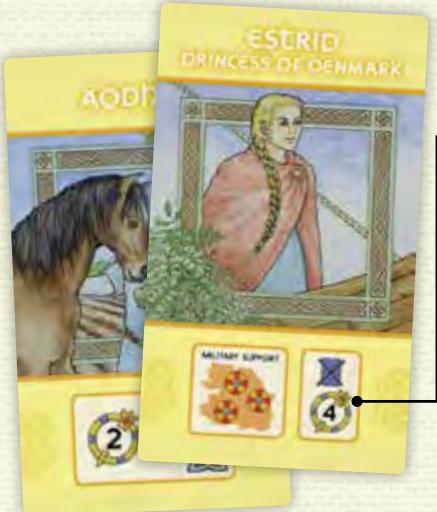
9 MARRIAGE CARDS
Reward: the benefit gained when you gain the card through marriage.
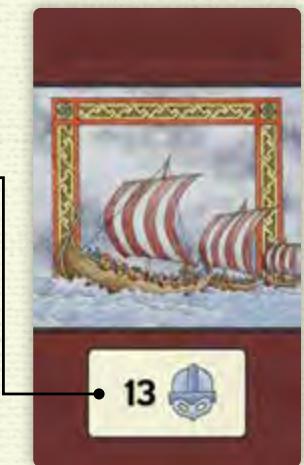
Invasion strength: the number of Viking raider tokens placed in the battle area during the preparation phase.
The Princess of Denmark is a special double-sided marriage card, which represents an alliance with the Vikings.
Dänische Prinzessin is only used if you're playing in German, instead of the Princess of Denmark.
7 VIKING CARDS
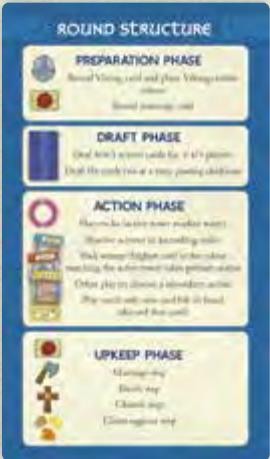
5 REFERENCE CARDS The reverse side is in German.




125 WOODEN PLAYER DISCS(25 OF EACH COLOUR)
16 MONASTERY TOKENS

10 VIKING CONTROL TOKENS

30 VIKING RAIDER TOKENS
Discs and tokens are not meant to be limited.
point value
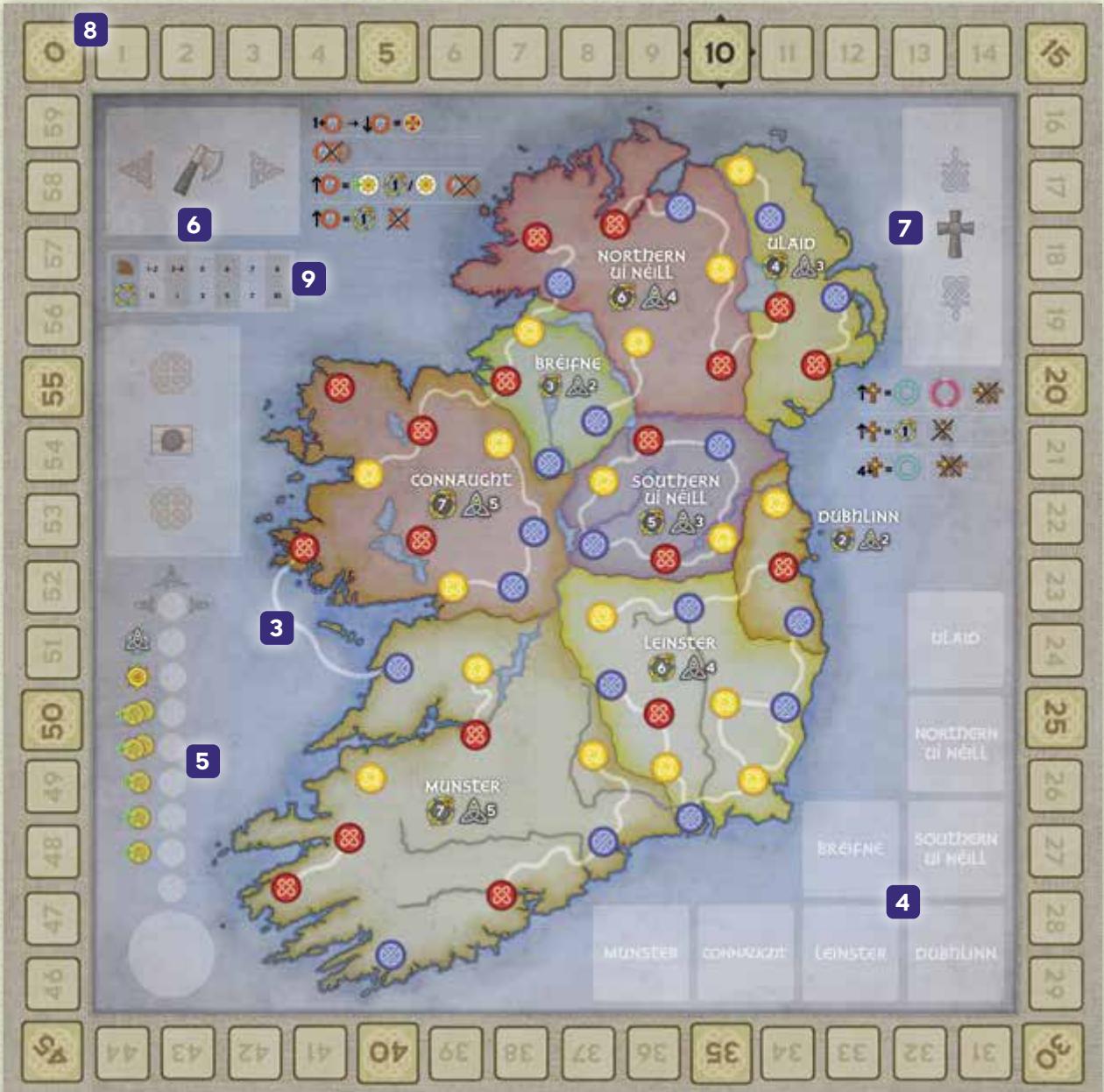
BOARD
-
Towns: each town has a colour, which is associated with the colour of an action card.
-
Regions: Ireland is broken down into eight regions. Each region has a threshold and a point value, which are also shown on the corresponding claim token.
threshold

14 RENOWN TOKENS

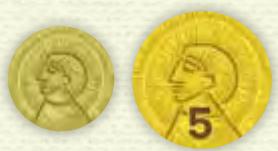
60 COINS
Red, associated with battle cards.


-
Roads: roads connect some towns, which makes them easier to expand into from adjoining towns.
-
Claim token slots: spaces in which to place the claim tokens.
Blue, associated with chruch cards.
Yellow, associated with courtship cards.
8 CLAIM TOKENS
1 ACTIVE TOWN MARKER
-
Marriage track: tracks your efforts to arrange political alliances through marriage.
-
Battle area: tracks your efforts to repel Viking incursions.
-
Church area: tracks your efforts to gain the favour of the church.
-
Score track: tracks your points.
-
Region scoring table: a reminder of the endgame points scored for controlling towns in multiple regions.

GS SEtUp CSS
-
Place the board in middle of the table.
-
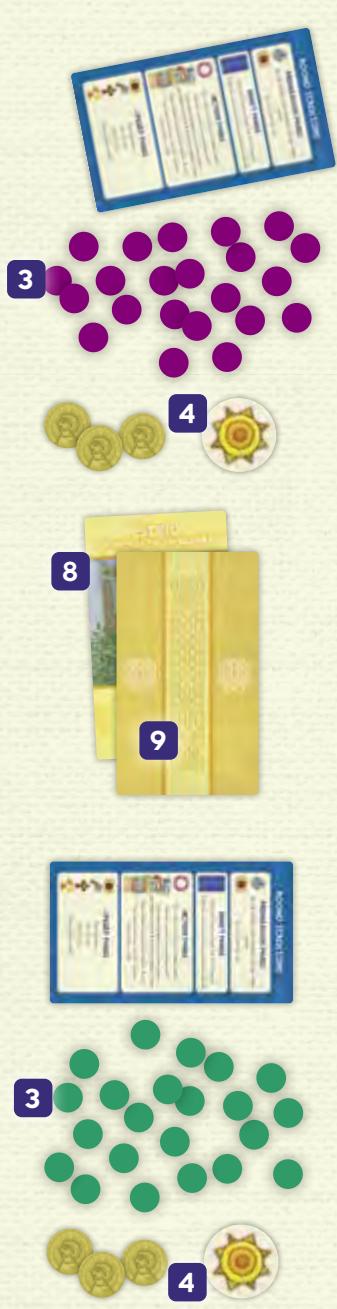
Sort the coins, renown tokens, monastery tokens, Viking raider tokens, and Viking control tokens by type and place them near the board. This is the supply.
-
Give each player all the wooden discs of one colour. Return any unused discs to the box.
-
Give each player three coins and one renown token.
-
Place a disc of your colour on the first space of the marriage track, and place another one on space 10 of the score track.
-
Place all the claim tokens face down on the board in their indicated slots.
-
Sort the action, Viking, marriage, and reference cards by type, and place them near the board.
-
Find the Princess of Denmark marriage card and place it next to the marriage track. Remove the Dänische Prinzessin card from the game.
-
Shuffle the other marriage cards. Then, place the following number of marriage cards face down in pile on top of the Princess of Denmark card, and remove the remaining cards from the game without looking at them. Three players: two marriage cards. Four or five players: three marriage cards.
-
Shuffle the Viking cards. Then, place them face down next to the battle area.
-
Give each player a reference card. Note that the reverse of the card is in German.
-
Place the action cards near the board.
-
Randomly determine the starting player and give them the active town marker.
-
In clockwise order, each player places a disc of their colour on a town space. You may not place a disc in the same region as another player's disc.



how to pLAy
The game is a played over a series of rounds. After three rounds (in a three-player game) or four rounds (in a four- or five-player game), the game ends and the player with the most points wins.
Each round has four phases: preparation, draft, action, and upkeep.
In the preparation phase, you reveal new Viking and marriage cards.
In the draft phase, you draft cards to form your hand for the action phase.
In the action phase, you play cards in tricks and perform primary and secondary actions.
In the upkeep phase, you arrange marriages, battle Vikings, build monasteries, and claim regions.
PREPARATIONPHASE
Reveal the top card of the Viking deck. Place the number of Viking raider tokens indicated by the card's invasion strength in the battle area of the board. Discard that card.
Then reveal the top card of the marriage deck and place it at the top of the marriage track.
If there are no more cards in the marriage deck, this is the final round of the game.
This way, the Princess of Denmark is always the final marriage card.
Then move on to the draft phase.
The action phase is resolved in a series of tricks.
Keep playing tricks until each player has one action card left in hand.
Then move on to the upkeep phase, discarding the remaining card in hand.
At the start of each trick, the player with the active town marker places the marker on any town on the board without a disc on it. This is the active town.
TRICKS
Then, they play a card from their hand. The card must match the colour of the town or be a royal (white) card.
In clockwise order, each other player plays one card from their hand. You may play any card, regardless of value or colour. You do not need to match the colour or value of any card that has already been played.
ACTION PHASE
DRAFTPHASE
Shuffle all the action cards. Deal cards depending on the number of players:
The player who has played the card with the highest value in the same colour as the active town wins the trick. All the other players lose the trick. Royal (white) cards are wild and always count as the same colour as the active town.
Four players: deal each player six cards.
Three players: deal each player eight cards.
Five players: deal each player five cards.
If you are playing with three or four players, place the remaining card face down near the board without looking at it.
From the cards you have been dealt, select two and place them face down in front of you. These will form your hand in the action phase. Once all the players have selected their cards, pass all your remaining cards to the player to your left.
Select two cards from those you have been passed, and place them face down in front of you with the two cards you have already selected. Again, once all the players have selected their cards, pass all the remaining cards to the player to your left.
Repeat this process until all the cards dealt have been placed face down in front of the players. When you are passed only one or two cards from the player to your right, place them directly into your face-down pile.
Take all the cards in front of you into your hand, and move on to the action phase.
You may look at the cards you have already selected, but you may not swap them out.
The player who played the card with the lowest value (regardless of colour) now takes an action listed on their card:
If they won the trick, they perform the card's primary action.
The primary action is at the top of the card.
If they lost the trick, they choose and perform one of the card's secondary actions. The secondary actions are at the bottom of the card. Some cards have only one secondary action.
Actions are explained overleaf.
Once they have performed a card action, they place the card into a shared discard pile, and the player who played the card with the next lowest value takes an action in the same way.
Once all the players have taken an action, the trick is over.
You may not look through the shared discard pile.
If players now have only one card left, the action phase ends.
Otherwise, the player who now has the active town marker begins a new trick.

ACTIONS

Each primary and secondary action shows one or more symbols. When you take an action, you must resolve all the symbols from left to right.
ICON
ACTION
Take the active town marker and place a disc on the active town. You now control that town.
This symbol appears in primary actions only.

Take a coin from the supply. Coins are not meant to be limited.
Return a coin to the supply. If you have no coins, instead lose two points. If you have no points either, this symbol has no effect.
This is the only time when points are spent in place of coins.

Take a renown token from the supply. Renown tokens are not meant to be limited.
Place a disc of your colour in the church area. You may then spend any number of coins to place one more disc in the church area for every two coins spent. Coloured discs are not meant to be limited.

Take a Viking raider token from the battle area. You may then spend any number of coins to take one more Viking raider from the battle area for every two coins spent. If there are no Viking raiders in the battle area, this symbol has no effect.

Move your coloured disc up one space on the marriage track. You may then spend any number of coins to move one more space up the marriage track for every two coins spent. If your disc is on the top space of the marriage track, this symbol has no effect. After fully resolving your action, if your coloured disc is on the same space as another coloured disc, move your disc back down until it is either on a space without any other coloured discs or on the first space of the marriage track.
You may spend five coins to expand into a new town. First, choose a town you control. Then select a town that is connected to it by a road and has no discs on it. Place one of your coloured discs on that town. You now control that town.
You may only expand into a town that is connected by a road to a town you already control, with no other towns in between (whether controlled or not)

Remove a Viking control token from the board to reveal the coloured disc underneath. That town is now controlled by the player whose disc is revealed.
ACtION phASE EXAMPLE
Deirdre, Kate, Georgios, and Peer are part-way through the action phase. They have just completed a trick.
At the start of the next trick, Deirdre has the active town marker, so she places it on an empty town in Connaught. As it is a red town, she has to play a red (or white) card. She plays the red 11.
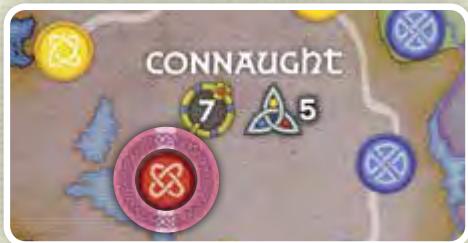
Kate decides she doesn't care about winning the trick, so she plays the red 2.
Georgios does want to win the trick, so he plays the white 13.
Finally, Peer doesn't have the cards to win the trick, so he plays the yellow 17.
Georgios wins the trick, as he played the card with the highest value in the colour matching the active town (because royal cards are wild).

They now take actions in ascending number order, so Kate goes first. She didn't win the trick, so she has to choose one of the card's secondary actions. She chooses the top action, so takes three coins. She then has the option to expand into a new town by spending five coins. Kate decides she does want to do so and as one of Georgios's purple towns blocks the road in one direction, she only has one town she can expand into. She spends the coins and places one of her blue discs in the town connected by road to one of her towns in Leinster.

Next, Deirdre resolves the bottom secondary action on her card, and takes two Viking raider tokens from the battle area. She decides to spend four coins to take another two tokens - for a total of four - as she's currently in danger of losing a town to the Vikings if there's a Viking incursion.
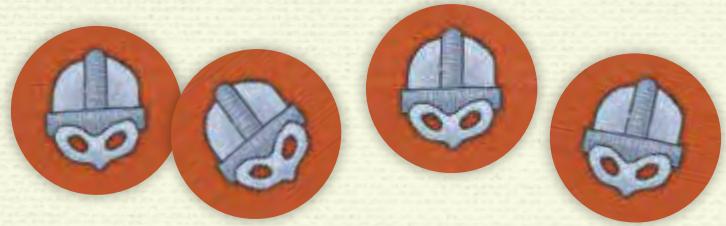
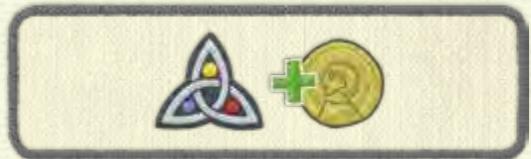
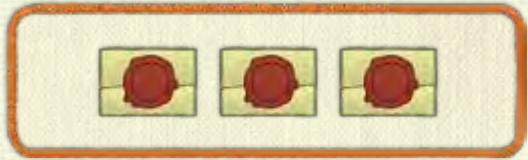
As Georgios won the trick, he takes the primary action on his card. He places one of his purple discs on the active town, and takes the active town marker, which means he will start the next trick. He also takes one coin.
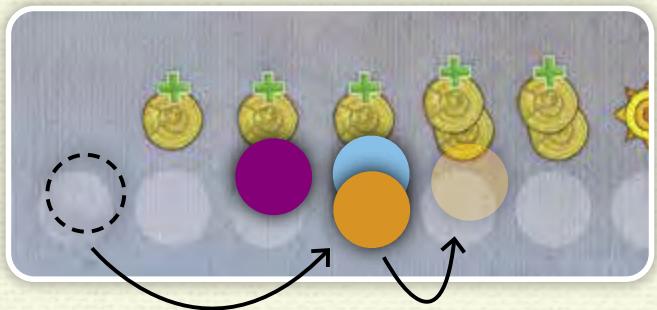
Finally, Peer resolves a secondary action on his card. He decides to move up the marriage track, advancing three spaces. This leaves him on the same space as Kate. He now must either spend two coins to advance another space on the marriage track, or move down one space. However, Georgios is on the space below, so Peer would need to move down another step. He decides instead to spend the two coins to move up one more step on the marriage track, putting him one space ahead of Kate.
As all players have now resolved their cards, the trick ends. They each have only one card left in hand, so those cards are discarded and play continues on to the upkeep phase.
UPKEEPPHASE
Resolve these four steps in order:
1. Marriage
2. Battle
3. Church
4. Claim regions
Then, if there are no cards left in the marriage deck, the game ends.
Otherwise, move on to the preparation phase of the next round.

MARRIAGE STEP
If your disc is on the highest space of the marriage track, you have successfully arranged a political alliance! You don't need to be on the topmost space, just above all other players' discs.
Take the marriage card, place it in front of you, and immediately gain the benefits shown. Then move your disc to the first space of the marriage track.
In the rare scenario that all players are on the first space of the marriage track, remove the marriage card from the game and move on to the battle step.
ICON
BENEFIT

Gain the number of points indicated.

Take a renown token from the supply. Renown tokens are not meant to be limited.
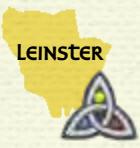
Place a coloured disc on any town without a disc in the indicated region. You now control that town.
If there are no towns without a disc in the indicated region, this symbol has no effect.
Marriages are political alliances arranged between members of your own house and other nobles and royals of Ireland.
PRINCESS OF DENMARK
Arranging a marriage with the Princess of Denmark forges an alliance with the Vikings. Immediately choose one of the following:

- Military support: Place the Princess of Denmark card with the side indicating military support showing. During the claim regions step, all towns controlled by the Vikings will count as if they are controlled by you.
In addition, at the end of the game, all towns controlled by the Vikings will count as yours for the purpose of scoring face-up claim tokens on the board, but not for scoring the number of regions you control towns in.

- Establish trade: Place the Princess of Denmark card with the side indicating establish trade showing. At the end of the game, towns controlled by the Vikings will count as yours for the purpose of scoring how many regions you control towns in.
Towns controlled by the Vikings will not count as yours for the purpose of scoring face-up claim tokens on the board.
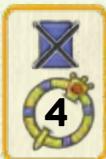
- Spurn her: Discard the Princess of Denmark card and gain four points.
Once the marriage card has been resolved, each player gains the benefits shown on the space of the marriage track that their disc is on, if any. The player who resolved the marriage card moves their disc to the bottom of the marriage track, so they gain no further benefit.
ICON
BENEFIT

Place a disc in any town on the board without a disc on it. You now control that town.

Take a renown token from the supply. Renown tokens are not meant to be limited.

Take a coin from the supply. Coins are not meant to be limited.


BATTLE STEP
If there are no Viking raider tokens in the battle area, the Vikings have been repelled! Otherwise, there is a Viking incursion.
If there is at least one Viking raider token in the battle area, the player with the fewest Viking raider tokens loses a town to the Vikings. The player with the most Viking raider tokens chooses one of the losing player's towns and places a Viking control token on top of one of the coloured discs. The Vikings now control that town.
If two or more players are tied for the fewest Viking raider tokens, each tied player loses a town to the Vikings.
If two or more players are tied for the most Viking raider tokens, the player or players losing the towns instead gets to pick the town they lose.
Then, return all the Viking raider tokens in the battle area to the supply and reward the spoils of battle.
SPOILS OF BATTLE
The spoils of battle are rewarded whether or not the Vikings were repelled.
First, the player with the most Viking raider tokens gains a renown token from the supply. They then gain one point for each of their renown tokens and return all their Viking raider tokens to the supply. If two or more players are tied for the most Viking raider tokens, no renown tokens or points are awarded and no Viking raider tokens are returned. Instead, skip to the next reward.
Next, the player or players who now have the most Viking raider tokens each gain one point. They then each return one Viking raider token to the supply.
You do not receive any rewards if you have no Viking raider tokens.

CHURCH STEP
You are now rewarded for your patronage of the church.
First, the player with the most discs in the church area places a monastery around a town they control, if they can. A town cannot have more than one monastery. The player then takes the active town marker and retrieves all their discs from the church area. If two or more players are tied for the most discs in the church area, these effects are not resolved. Instead, skip to the next reward.
Next, the player or players who now have most discs in the church area each gain one point. They then retrieve one disc from the church area.
Finally, in clockwise order, starting from the player with the active town marker, every player with at least four discs in the church area places a monastery around a town they control, if they can. Every player that placed a monastery then retrieves all their discs from the church area.

CLAIM REGIONS STEP
You now make your claim on regions where you have the most towns.
For every face-down claim token on the board, count how many towns are controlled in the corresponding region (including towns controlled by the Vikings). If the number equals or exceeds the threshold number (shown in the region and on the token), flip the claim token face up. Otherwise, leave it face down.
For every face-up claim token, whether on the board or in front of a player, check who controls the most towns in the corresponding region. The player with the most towns in the region takes the claim token and places it in front of them, face up.
If two or more players are tied for the most towns in a region, the token stays where it is.
So, if a player gains a claim token, they will lose it only if another player later controls more towns than them.

MONASTERIES
If a town has a monastery, it counts as two towns for the purposes of flipping claim tokens face up and claiming regions.
VIKINGS AND THE PRINCESS OF DENMARK
If a player has arranged a marriage with the Princess of Denmark and chose military support, all towns controlled by the Vikings count as controlled by that player.
Otherwise, if the Vikings control the most towns in a region, leave the claim token on the board (or return it there if they have wrested it from a player).


GAME END CD
If there are no marriage cards left at the end of the upkeep phase, the game is over and the final scores are tallied.
OSCORINGO
The player with the most coins scores one point.
If multiple players are tied for the most coins, no points are scored.

The player with the active town marker scores one point.

For every renown token you have, score one point.
NORthERN 6
For every face-up claim token in front of you, score the number of points shown on the token.
For every face-up claim token on the board, all players tied for the most towns in that region score half the number of points shown on that token, rounded down.
If you have the Princess of Denmark card in front of you with the military support side showing, towns controlled by the Vikings count as controlled by you instead.
Face-down claim tokens do not score.
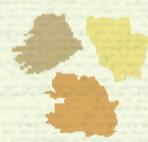
Score points according to the following table, depending on the number of different regions in which you control at least one town.
If you have the Princess of Denmark card in front of you with the establish trade side showing, towns controlled by the Vikings count as controlled by you instead.
| NUMBER OF REGIONS | 1-2 | 3-4 | 5 | 6 | 7 | 8 |
| POINTS | 0 | 1 | 3 | 5 | 7 | 10 |
The player with the most points wins.
If there is a tie for most points, the tied player with the most claim tokens wins.
If there is still a tie, the tied player with the most marriage cards wins.
If there is still a tie, the tied players share the victory.

Game Design: Peer Sylvester Game Development: Filip Hartelius and Anthony Howgego Illustration: Deirdre de Barra Graphic Design: James Hunter
First published in Great Britain in 2021 by OSPREY GAMES
Bloomsbury Publishing Plc
Kemp House, Chawley Park, Cumnor Hill, Oxford OX2 9PH, UK
29 Earlsfort Terrace, Dublin 2, Ireland
1385 Broadway, 5th Floor, New York, NY 10018, USA
OSPREY GAMES is a trademark of Osprey Publishing Ltd
© Peer Sylvester, 2021. This edition © 2021 Osprey Publishing Ltd
All rights reserved.
www.ospreygames.co.uk
For more information or replacement parts, email info@ospreygames.co.uk
21 22 23 24 25 10 9 8 7 6 5 4 3 2 1

QUICK REFERENCE C

UPKEEP PHASE
MARRIAGE STEP
-
Highest on track: take marriage card and move to bottom of track.
-
All other players: gain reward listed on space on track.
BATTLE STEP
-
Viking raiders in battle area: player with fewest Viking raiders loses town to Vikings. Player with most Viking raiders chooses which town.
-
Remove all Viking raiders from battle area.
-
Most Viking raider tokens: gain one renown, score one point for each renown, and return all Viking raiders. Skip if tied.
-
Most Viking raider tokens after step 3: gain one point and return one Viking raider. All tied players gain this reward.
CHURCH STEP
-
Most discs in church area: place monastery, take active town marker, and retrieve all discs. Skip if tied.
-
Most discs in church area after step 1: gain one point and retrieve one disc. All tied players gain this reward.
-
Four or more discs in church area: place monastery and retrieve all discs.

CLAIM REGIONS STEP
-
Each face-down claim token: flip it face up if number of towns in that region meets threshold.
-
Each face-up claim token: give it to the player with the most towns in that region. If tied, token stays where it is.
Towns with monasteries count as two towns.
SYMBOLS O
ICON
ACTION
Take control of the active town.
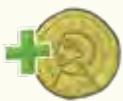
Gain a coin.

Pay a coin. If you have no coins, instead lose two points.

Gain a renown.

Gain the number of points indicated.
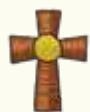
Place a disc in the church area.
Spend two coins per disc to place more discs. Take a Viking raider from the battle area.
Spend two coins per token to take more tokens. Move a space up the marriage track.
Spend two coins per space to move more spaces.
You cannot end on the same space as another disc.
If the space is occupied, move down to next empty space.


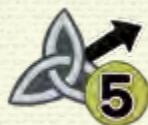
You may spend five coins to control a town immediately connected by road to another town you control.

Remove a Viking control token.
Take control of any town.

Take control of any town in the indicated area.
Download MarkdownTexts are community-compiled or publicly released by publishers; copyright remains with the original authors. For personal reference only.