
Call To Adventure Epic Origins
At a glance
Rules, cards and Q&A (Chinese)
The rules, card data and player questions for this game are written in Chinese. Open the Chinese page to read them.
Where to find full rules
Full rules and card lookup are available in the cunlema app at cunlema.cn — pick this game and ask about any rule, card or turn you are unsure about.
Related games
Rulebook text (Markdown)
This game has 1 rulebook Markdown file(s) in our library; 1 rendered inline below — expand to read or download.
CtA EO Rulebook.md58.1 KB
Aoventire Fric onans
Rules Overview
In Call to Adventure: Epic Origins, players battle alongside their party to defeat a menacing Adversary. Guided by your Heritage, you will grow from a starting Origin into your chosen Class, and finally achieve your Destiny by gaining Traits, facing Challenges, and performing heroic Feats. Every player will build a character and tell a story of triumph and tragedy as you work together to vanquish the Adversary!
1. Face the Adversary
As each game begins, you'll choose an Adversary. During your first few games, you'll have the chance to unlock a new Adversary every time you play! Players must balance competition and cooperation. If the Final Adversary survives, everyone loses. If the Final Adversary is defeated, the player with the highest Destiny score wins!
2. Gain Cards to Build Your Story
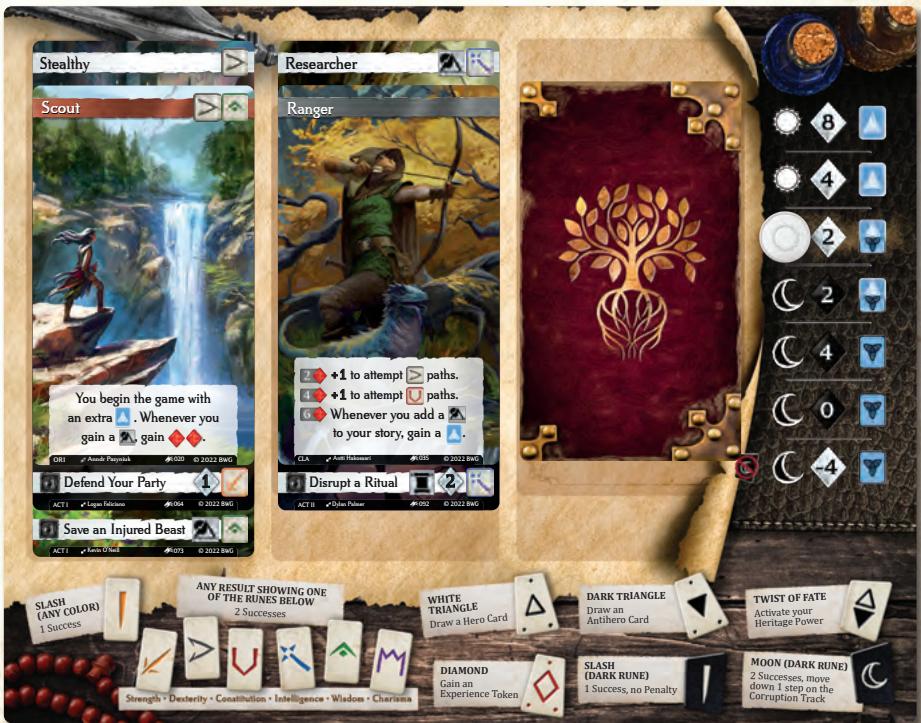
You begin the game by choosing four Character cards: your Heritage, Origin, Motivation, and Destiny (page 5). These cards form the basis of your story — the tableau of cards you will build over the course of the game. As you gain new Story cards, you'll tuck them under your Character cards. Each “path" you leave visible will become a part of your story, showing the icons you've collected and the points you've earned. New ability icons will make your hero stronger for the next Challenge they attempt, but choose wisely, as your Destiny rewards specific choices.
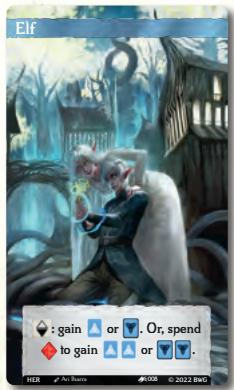
A young Elf Scout learns the ways of stealth and animal craft as they train to become a mighty Ranger, but will they fulfill their ultimate destiny?
3. Cast Ability Runes to Attempt Challenges
Overcoming Challenges is the key to building your character. Every hero begins with two Ability rune icons (as indicated on your Origin card). When you attempt a Challenge, you cast (roll) the three Core runes. Depending on the relevant icons shown on the Challenge card, you may also be able to cast Ability runes.
To overcome a Challenge, you must choose a path, then roll successes equal to or greater than its difficulty. Every result ofadds 1 success, while results of,oradd 2 successes. All other symbols add 0.
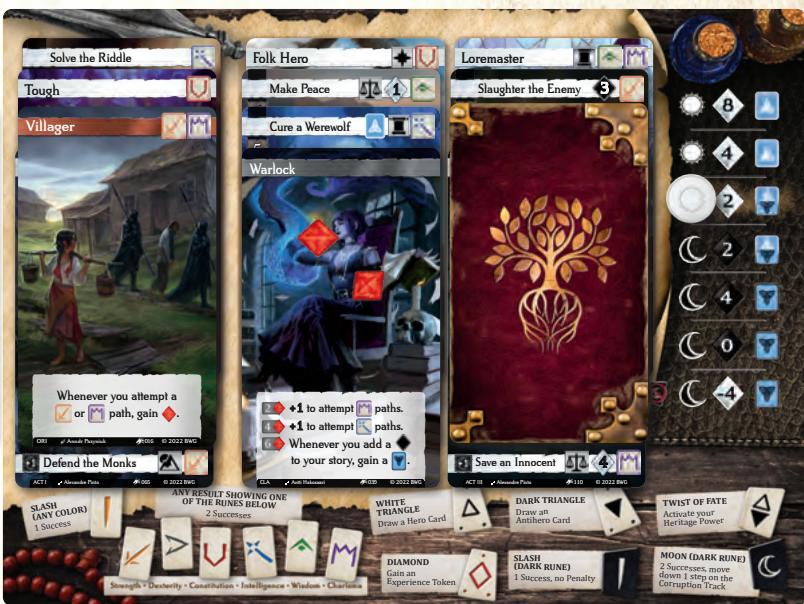
In this example, a Villager with the Perceptive Trait attempts her first Challenge: Mountaintop Monastery.
This hero has one icon and one icon. (In addition to a Micon that won't be used in this challenge.)
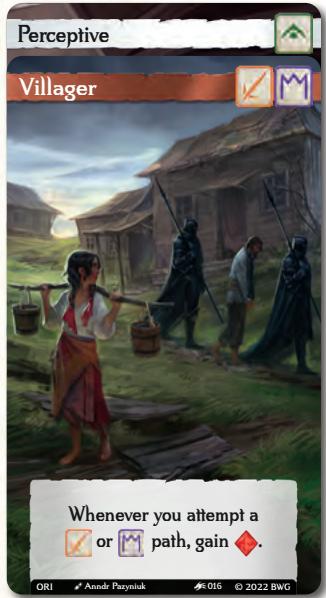
The base difficulty of the Challenge is 3. The relevant ability icons are and
The hero can use both and to attempt either path. She chooses to attempt “Defend the Monks." This path has the icon, adding 1 difficulty.

She rolls the runes and gets 4 successes, exactly what she needed. She takes the Challenge and tucks it under her Origin with "Defend the Monks" visible.

She gains anothericon and aStory icon!
All Challenges are resolved in the same way, adding runes and card effects according to how you've built your hero. For more details, see Attempt a Challenge (page 9) and Reading the Runes (page 10). You can also modify Challenge attempts by playing Feat cards (page 7).
4. Gain the Most Destiny Points to Win
In Epic Origins, players must work together to defeat the Adversary, but there can be only one true victor. During play, each player's hero will gain Triumph points for heroic acts, Tragedy points for darker paths, and Experience tokens when they fail. These points together equal your Destiny score.
Triumph () + Tragedy () + Experience () = Destiny
Further maximize your Destiny score by making choices that fulfill the condition on your Destiny card, and play as many Feats as possible. Collect sets of Story icons to gain more Destiny points. If your party defeats the Final Adversary, the hero with the highest Destiny score is the winner. If not, everyone loses!
The rest of this rulebook builds on these fundamentals! If this is your first game of Call To Adventure, begin reading the next page. Or, if you prefer a video explanation, use this QR code to visit BrotherwiseGames.com/epic-origins-rules.

Game Setup
I. Begin Your Story
If this is one of your first sessions, begin with the Solo/Co-Op campaign. Open a Campaign envelope, reveal the Adversary, and follow the instructions inside. (Start with Chapter One.)
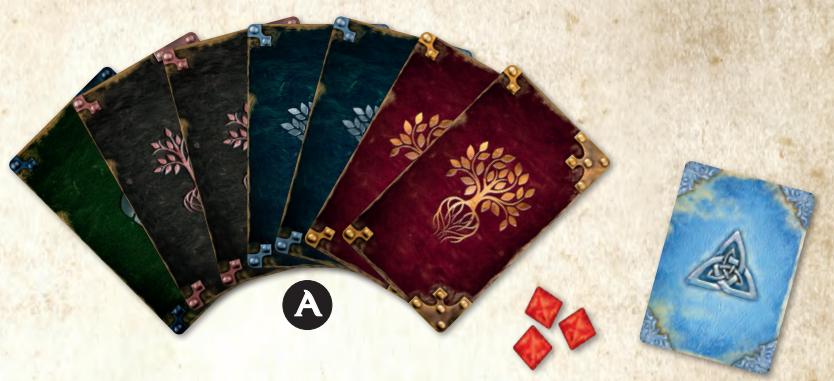
Shuffle all decks and deal each player seven Character cards A:
1 Heritage (green with a silver acorn)
• 2 Origins (brown with a bronze tree)
• 2 Classes (blue with silver)
•2 Destinies (red with gold)
Each player keeps their Heritage, then chooses one of each of the other Character cards to keep, then removes the rest from the game.
Deal every player one Hero card to form their starting hand. These cards should remain hidden from other players.
Finally, give each player three Experience tokens
II. Prepare the Adversary
To begin a Solo or Co-op game...

1.Place the Adversary Challenge B from the campaign envelope, Adversary side up, next to your play space.
-
Place the Adversary Quest card next to the Adversary. For your first game we recommend using the easier "Reign of the Adversary" side of this card.
-
Shuffle the Adversary's special Feat deck and place it near the Adversary.
-
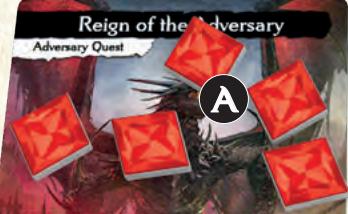
For each player in the game, place five experience tokens ( on the Adversary. Read the Adversary Quest and Adversary Challenge carefully to see what actions might cause them to gain or lose during the game.
(If you prefer to play a fully competitive game, you can skip Section Il. Set aside all Adversary cards and simply compete to see who earns the highest Destiny score.)
III. Prepare the Play Area
In the center of the table, set up the three shuffled Story decks (labeled I, II, and III E), the Hero deck, and the Antihero deck F .Place the Runes within easy reach of all the players, as well as the pile of
Beside each Story deck, lay out a row of face-down cards.
•For a 1-3 player game, lay out four cards per Act (as shown here in this 2-player set up).
•For a 4-player game, lay out five cards per Act.
IV. Reveal Characters
Each player should set up their player mat by placing their...
•Heritage to the left of their mat.
• Origin in the Act I (left-most) card slot face up.
• Class in the Act Il (middle) card slot face up.
• Destiny in the Act III (right-most) slot face down.
Hero marker on the third level down of the tracker.
• Starting Hero card and threenear their play area.
Once play is ready to begin, turn the row of Act I cards face up!


Card Types
During the game, you'll see several different types of cards. You begin with four Character cards (all pictured on this page), then gain Story cards and play Feat cards over the course of the game.

Your Heritage stays face up to the left of your player mat for the whole game.
Heritage Cards
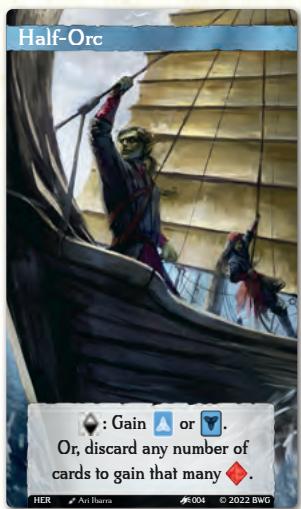
Whenever you cast a on the runes, you may gain one of two powers: draw a Hero () or Antihero () card, or use the second power, unique to your Heritage.

Class Cards
Your Class card grants powers based on how many you assign to it. Every round, you may take as many as you want from your pool and place them on your Class card.
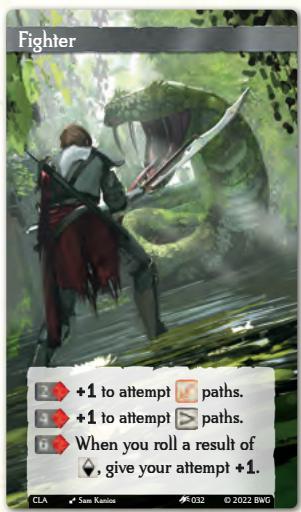
Once you have on your card, you permanently gain the first listed bonus. If you have or more, you gain the first two bonuses, and so on.

Your Origin provides your two starting Ability runes.
As you gain Act I cards, you will place them under your Origin card.
Origin Cards
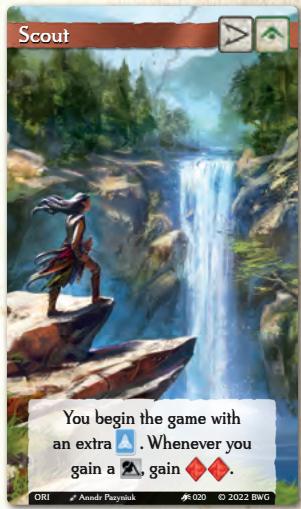
Some Origins affect how you begin the game. Every Origin has a power that is available for the entire game.

Some Destiny cards provide points or Story icons, listed at the top of the card.
Destiny Cards

Your hidden Destiny gives you additional ways to score points at the end of the game. Your Destiny stays face down until game end. However, you may look at it whenever you wish!
血
Traits can be freely gained on your turn (page 8). A Trait has one "path," the rewards listed at the top of the card. They may grant Ability runes, Story icons, points, or Feats cards.
Challenges must be attempted (page 9). Every Challenge has a difficulty number, two relevant Ability runes that can be used to attempt it, and two paths. You must choose your path before casting the runes.
Story Cards
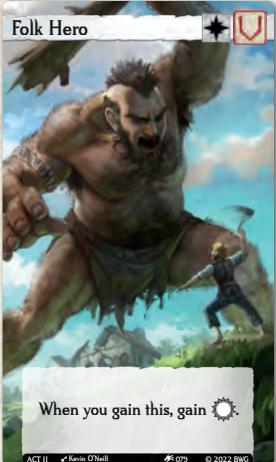

Traits also have a power that takes effect when you first add the card to your story.
If you succeed, tuck the Challenge under your Character card showing your chosen path.
The lower path of a Challenge has the+1 icon. The difficulty of the Challenge is increased by 1 if your hero takes that path.
Feat Cards
Feats are single-use powers played from your hand. Feats may be played at any time their card text allows. They may not be played if the game event they reference is not occuring.
Every played Hero card gives you at end of game, and every played Antihero card gives you at end of game. For more on Feats see page 7.
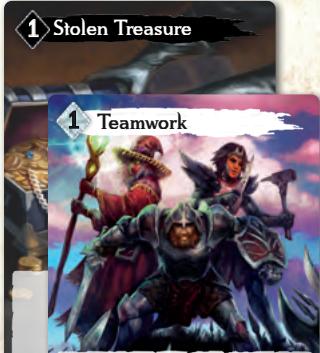
Choose a hero attempting a, 区 orpath. If itis your turn, gain +1 to your attempt. If it is another heros turn, they gain +2. HEROKevin O'Neill 质163 © 2022 BWG

Adversary Cards
The Adversary is a special Challenge you attempt twice during the game. The Adversary Challenge card and Adversary Quest card control its actions.
The Adversary Challenge card is double-sided. (Begin with the 6-Difficulty “Adversary” side faceup). Each player faces the Adversary the turn after they end Act II. The Challenge is then flipped to reveal the Final Adversary, which must be faced after Act III.
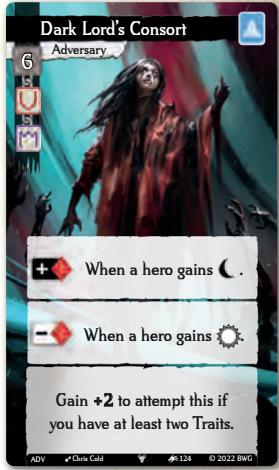

The Adversary Quest dictates the Adversary's starting experience and how it gains or loses during the game.
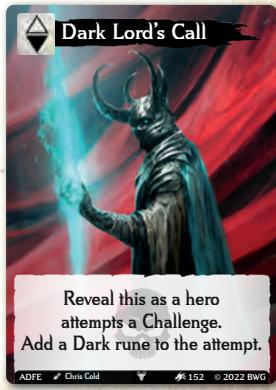
It also notes that whenever the rune is rolled, the Adversary plays a card from its special Feat deck (page 14).
The Adversary Feat deck must be constructed each game using the standard Feats (marked with a skull icon on the bottom bar) and an Adversary-specific Feat, as noted in the Campaign envelope.
Actions During Your Turn
Beginning with the first player, players take turns, one after another, in clockwise order. Each turn, players may take actions to build their hero's story:
Any number of times during your turn you may:
• Journey (but only at the beginning of your turn)
• Activate Character card powers
• Play Feat cards
Once per turn, on your turn, you may:
• Add a card to your story, either by attempting a Challenge OR drafting a Trait
Journey
At the beginning of your turn, you may spend to discardone card on the table and replace it with another card from the same deck. This action may be done multiple times, assuming you have the to do so. After gaining a Trait or choosing to attempt a Challenge, you may no longer journey. Note that some card abilities allow you to journey for free.
Activate Character Powers
Heritage, Origin, and Class cards have powers that you may activate or pay for during your turn. The effects and their costs are outlined in the card power text.
Heritage card powers are only activated during Challenge attempts when a result is cast. All Heritage cards allow you draw a Feat card when theis cast, OR activate a power unique to that Heritage.
Your Origin may provide a way to gain or allow you to spend to gain some effect. Each Origin is activated by a different set of conditions, so pay attention to this power throughout the game.
Your Class card grants ongoing effects, but only if enough tokens have been banked onto that card. You may place any number of tokens on your Class card at any point during your turn. If doing so during a Challenge would grant you a bonus applicable to that Challenge, it takes effect immediately! You may NOT take off of your Class card at any point in the game.
Play Feat Cards
Whenever you get a rune result of △, or acquire a path with immediately draw a Hero card A . Whenever your result includes or you gain a path with immediately draw an Antihero card B When your result includes you may activate your Heritage power, which always includes the option to choose to draw a Hero or Antihero card. Cards gained during rune casting may be played immediately, even if it changes the outcome of a Challenge attempt.
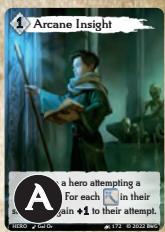
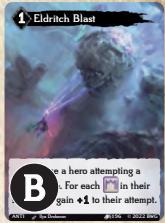
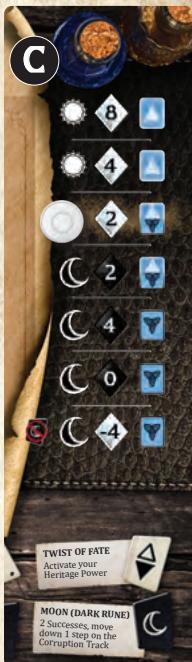
Your position on the Corruption track indicates whether you can play Hero cards, Antihero cards, or both. For example, if your position on the track has the icon, you may play Hero cards, but not Antihero cards In general, players begin the game able to play both. The player in the example to the right can play both Hero and Antihero cards as they are showing the symbol.
Most and cards specify when they can be played. Otherwise, they can be played at any time. These cards' effects can even interrupt other players' actions! Resolve these effects in reverse order, starting with the last card played and working backwards. When a card says it can affect “any hero," it means any hero including your own.
After a or card takes effect, place it faceup beside your story. At the end of game, add the Triumph and/or Tragedy values of played cards your score. You do not get points for cards still in your hand at the end of the game.
D

D

Add a Card to Your Story
Every turn you will attempt to add one card to your story. Your story is divided into three acts:
• Act I cards go under your Origin.
•Act Il cards go under your Class.
•Act III cards go under your Destiny.
When you have placed at least three Trait or Challenge cards under one of your Character cards, you must end your current Act and you may no longer gain Traits or attempt Challenges from that Act.
All players may gain or attempt Story cards from any revealed Act, as long as they have not already completed that Act (see more on Ending an Act on page 13).
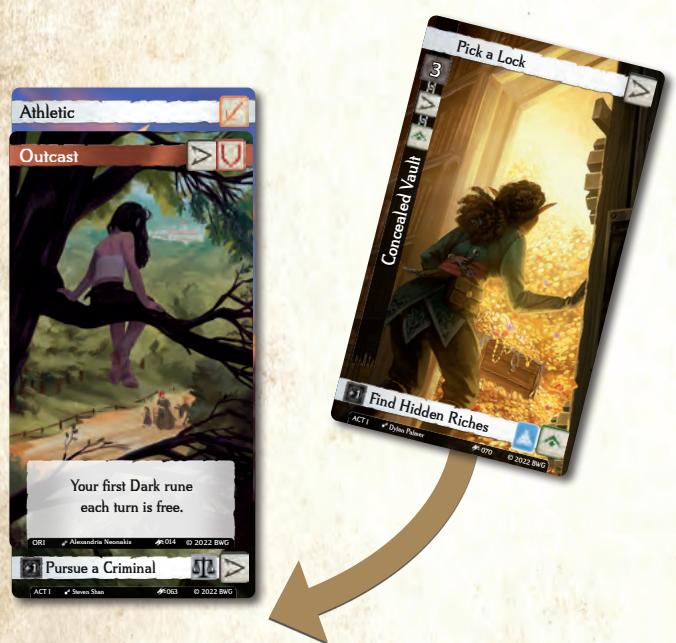
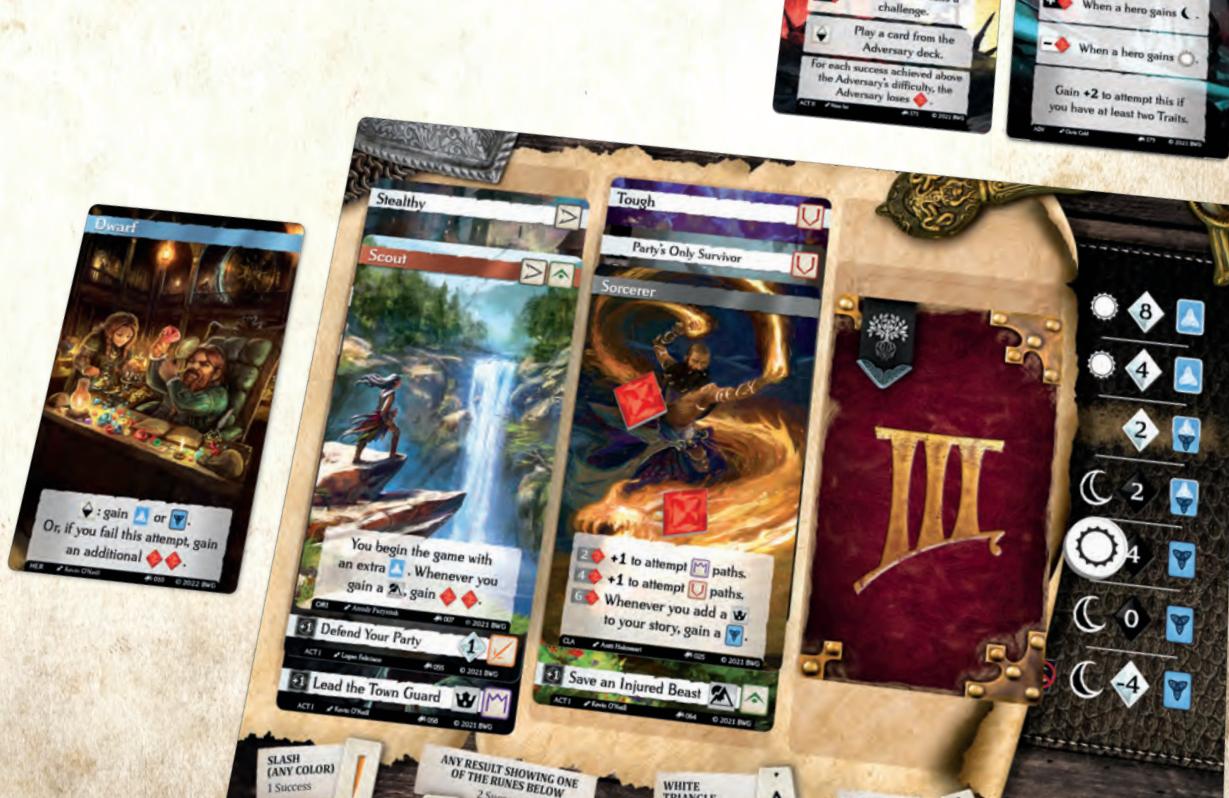
Brigid has found hidden riches! She places Concealed Vault in her Act I stack (under her Origin). She now has three cards under Act I and cannot place another there. Her next cards must be from Act II.
Draft a Trait
Traits define your character's personality, profession, and life experiences. A Trait has only one "path".
To gain a Trait, during your turn you simply take the Trait from your current Act row, activate the Trait's power text and then place the Trait under the Character card of your current act with the top of the Trait card visible. Any Ability runes, Story icons, or other rewards become a part of your story. Note that cards are never placed under your Heritage card.
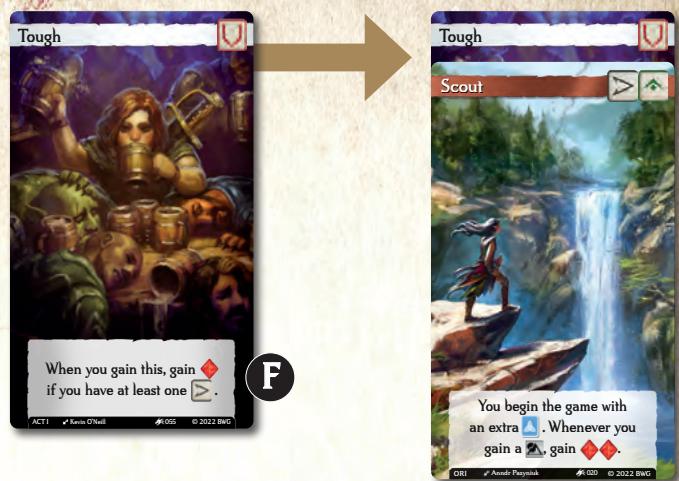
Matt decides to draft Tough for his card this turn. He places Tough under his Act I pile and because his Scout Origin has he also gains a
Traits are “gained," not “attempted." In this way they differ from Challenges, a more powerful but less certain way to build your hero's story (see page 9 for more on Challenges).
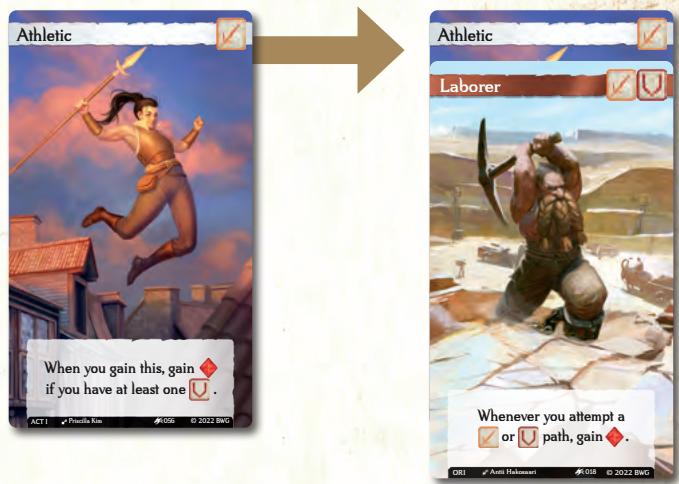
Chris takes the Athletic Trait for their card this turn and places it under their Origin. They gain a due to the on their Laborer Origin. However, the card text from Laborer is not activated because gaining a Trait is not an "attempt." Only Challenges are attempted.
Resolving Story Card Icons
= Move your hero marker up one level on the Corruption track.
= Move your hero marker down one level on the Corruption track.


= Draw a Hero card.
= Draw an Antihero card.
Atempt a Challenge
Challenges are the daring deeds your hero undertakes on the path to fame or notoriety. Challenges can bring great rewards, but they also carry the risk of failure! To attempt a Challenge:
-
Assess the difficulty A, indicated by the number on the left-hand side of the card.
-
Declare which path B you're taking (top or bottom). Bottom paths in Epic Origins all have a icon increasing the total difficulty of the Challenge by 1 if that path is chosen.
-
Gather your pool of runes.
You can always cast the three Core runes.
Add all matching Ability runes. Every Challenge has two relevant Ability rune types shown below its difficulty D. If you have matching Ability rune icons of either type in your story, you can add Ability rune stones to your attempt, regardless of which path you selected.
You may spend up to three to add that many Dark runes to your roll.
4. Cast the runes!
Roll the the runes and read the results (see next page for instructions on what each rune result means).
• If your result includes , reveal an Adversary Feat and activate your Heritage card.
• Apply any card effects, including Character card powers and Feat cards.
5. Resolve the attempt.
Add up any successes from your runes, along with any modifiers from card effects.
If the number of successes rolled equals or exceeds the difficulty, you overcome the Challenge. Take the card, placing it under your current Character card with the top or bottom of the new card showing (depending on which path you took).
• If you fail the Challenge, discard it from the table and gain a
• If your result included any , move that many spaces down the Corruption track.
Whenever you gain a card from the table, replace it with another card from that Act deck.

B
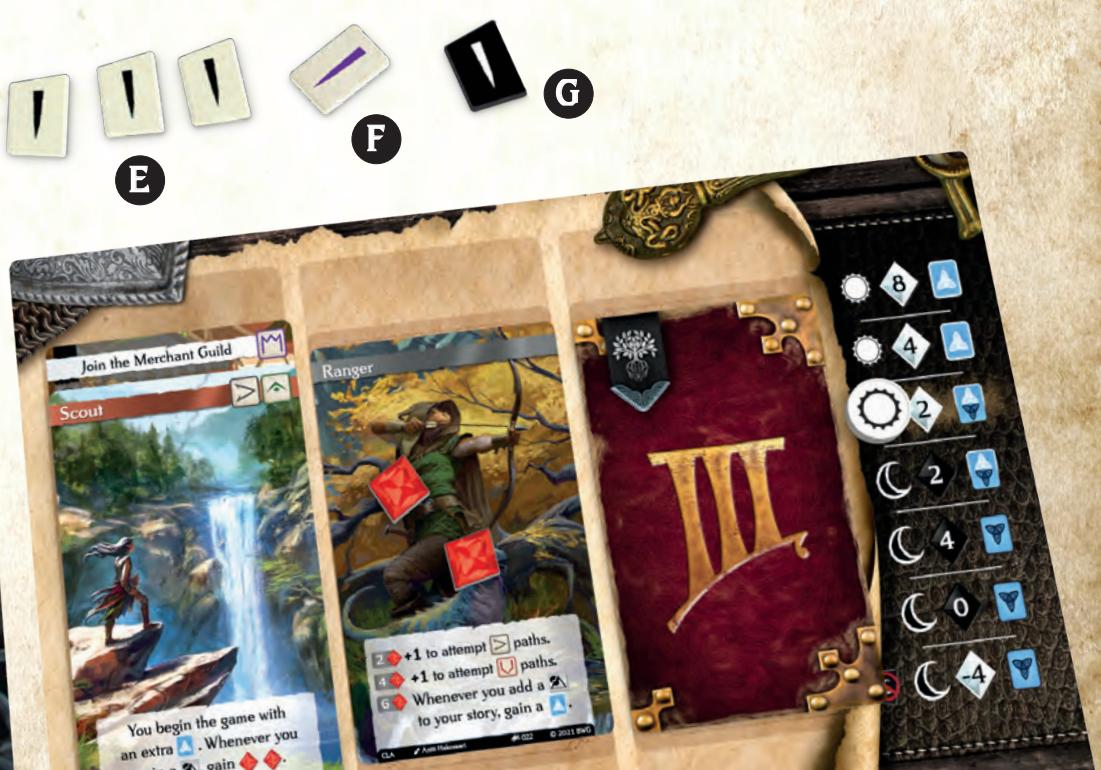
For her second card of Act I, Carrie decides to attempt Goblin Raid. She will attempt the top path, "Fight Off a Goblin" and gets to roll the three Core runes E and one Charisma rune F, thanks to the Charisma icon she has from "Join the Merchant Guild," a path she acquired earlier. She also chooses to spend her remaining to add a Dark rune to her roll. She needs at least 3 successes to overcome the Challenge.


Reading the Runes
Runes give Call to Adventure the element of chance, but you can improve the odds by building your hero's abilities. When you "cast the runes" during a Challenge, you throw them on the table to see which sides land face-up (as if rolling two-sided dice). Each side adds a different number of successes to your attempt. In the rare event that a rune lands on its thin edge, you may choose which side you want to be face-up!
Core Runes
You cast the three Core rune stones during every Challenge. Depending on how it lands, a Core rune adds 1 or 0 to your attempt.
Add 1 success to any Challenge
Add 0
Dark Runes
Add 0 and activate your Heritage card
Before you attempt a Challenge, you may spend to add a Dark rune stone to your attempt; this may be done up to three times per turn.


Add 1 success to any Challenge

Add 2 to any Challenge and move your Corruption track down by one
Beware! As you gain Corruption, you lose the ability to play Hero cards. At , you lose 4 Triumph points and may no longer spend to cast Dark runes.
Ability Runes
Whenever you attempt a Challenge, check your story to see if you have any Ability rune icons relevant to that Challenge. For each relevant icon you have, cast one rune of that type. You can cast a maximum of three rune stones per ability, and your third rune stone must be the special rune stone marked with three dots. (The special rune stone is only available when you have three or more icons in that ability.)
Add 2 (sword) or 1 (slash) to a Strength Challenge

Add 2 (arrow) or 1 (slash) to a Dexterity Challenge
Add 2 (shield) or 1 (slash) to a Constitution Challenge
Add 2 to a Strength Challenge or add 0 and immediately gain one
Add 2 (wand) or 1 (slash) to an Intelligence Challenge

Add 2 to a Dexterity Challenge or add 0 and immediately draw one
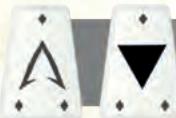
Add 2 to a Constitution Challenge or add 0 and immediately gain one
Add 2 (eye) or 1 (slash) to a Wisdom Challenge

Add 2 to an Intelligence Challenge or add 0 and immediately draw one

Add 2 (crown) or 1 (slash) to a Charisma Challenge
Add 2 to a Wisdom Challenge or add 0 and immediately draw one


Add 2 to a Charisma Challenge or add 0 and immediately draw one
Example: Facing a Challenge

When you gain this, gainif you have at least
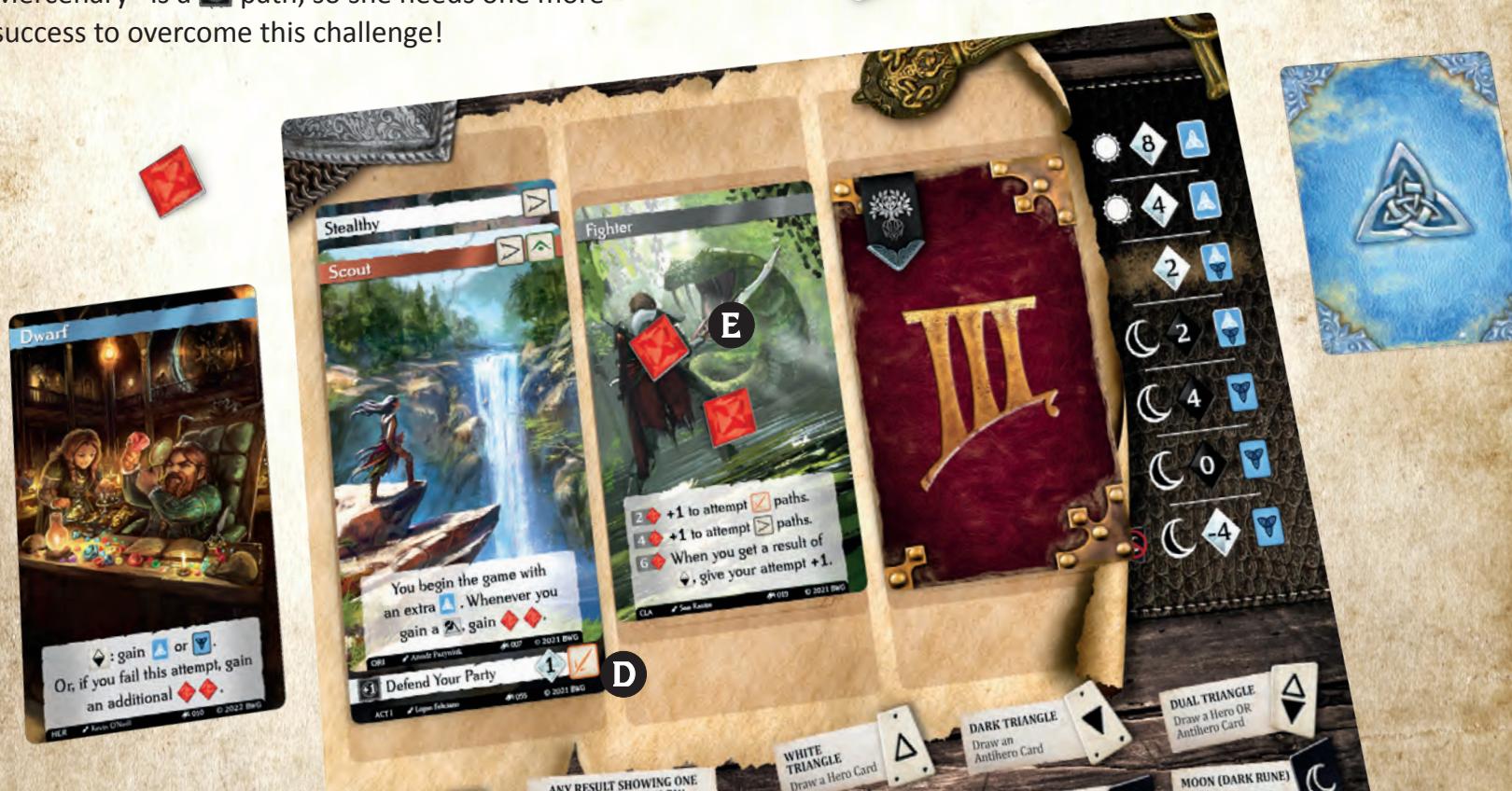
- Jia casts the runes! It's not what she was hoping for. She gains one success from the Core runes, and one success from her singlerune. That's only two successes!
But all hope is not lost. Jia has two banked onto her Fighter Class card . This gives her +1 to paths, taking her total successes to 3. "Become a Mercenary" is apath, so she needs one more success to overcome this challenge!
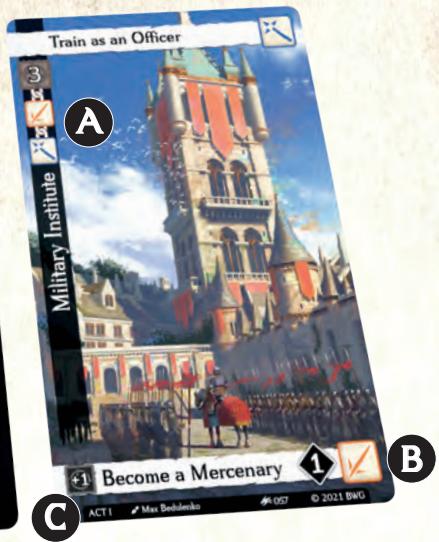
- Jia is hoping to get her third Act I card this turn. She decides to attempt a Challenge called Military Institute. It is an Intelligence and Strength ( Challenge with a difficulty of 3. Jia would like to gain another point of so she decides to attempt the bottom path B "Become a Mercenary." The bottom path has theicon giving it +1 difficulty for a total difficulty of 4.

- Jia prepares her runes for the attempt. Even though she is facing the bottom path, she can use anyand runes she has, because both are listed on the Challenge.
Jia gathers the three Core runes used in every Challenge attempt and adds onerune from the singleicon she has in her story D


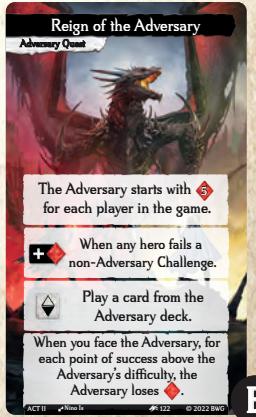
The Adversary starts with 6 for each player in the game.
When any hero fails a non-Adversary Challenge.
Play a card from the Adversary deck.
When you face the Adversary, for ach point of success above versary's difficulty

-
Jia tucks the Challenge under her Act I cards so that only the bottom path is showing I. She's gained anothericon and 1 Tragedy point!
-
Jia reveals a new Act I card to replace the Challenge she just acquired. She now has three cards under her Origin (Scout), so is prohibited from acquiring anymore cards from the Act I row. At the beginning of her next turn she will reveal four cards in the Act Il row, and choose one of those to gain or attempt. Play passes to the next player.
-
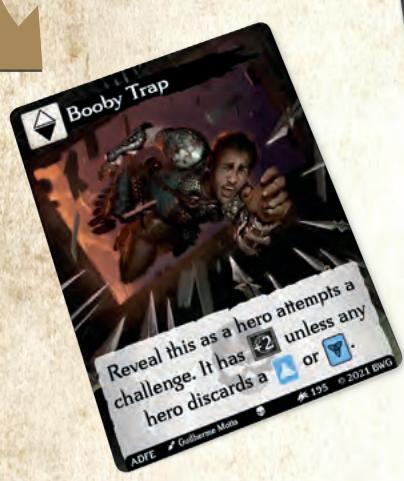
Jia notes that she rolled the Twist of Fate result F on one of her Core runes. According to the instructions on the Adversary Quest card this means she must play a card from the Adversary's Feat deck. Oh no! It's a Booby Trap. Unless Jia can discard a or card, the difficulty will be +2. Fortunately, she has her starting card and discards that.
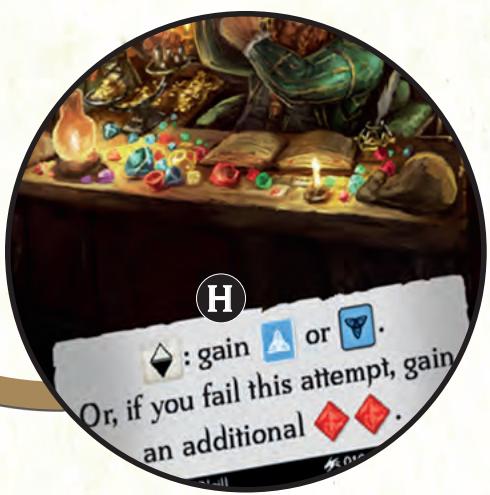
The result also triggers her Heritage card H and lets her immediately draw a Hero or Antihero card OR gain an extra if she fails this attempt.
Jia decides to draw an Antihero card. She draws Dark Dea/! She plays it right away, allowing her to spend her last remaining to gain +2 to the attempt. With 5 total successes, she overcomes the Challenge!


Ending a Turn
Ending Your Turn
Once a player is out of actions, or does not wish to take any more actions, play passes to the next player in clockwise order. When passing your turn, end any card effects you played this turn. The player ending their turn replaces any Story cards taken from the table during their turn.
Ending an Act
When any player has gained three Story cards under one of the Character cards on their player mat, they must end their current Act and may no longer gain cards from that Act. All players may gain or attempt Story cards from any revealed Act, as long as they have not already completed that Act.
At the start of your turn, if you are the first player to have three cards under your current Character card, reveal the next row of cards and move on to that Act.
When you have three cards under your Class, you must use your next turn to face the Adversary before moving on to Act III (page 14).
Every player, as their last turn (regardless of how many cards they have in their story) must face the Final Adversary (page 14).
The Adversary
The goal of Epic Origins is to work as a party to deplete the Adversary's pool of The Adversary is represented by two cards: The Adversary Challenge and the Adversary Quest The Adversary Challenge is double-sided. The Adversary side will be in play through Acts I and II, and the Final Adversary will be revealed for Act III.
The Adversary's Actions
During the game, the Adversary will work to disrupt the players'actions. As indicated on the Adversary Quest card, every time a player rolls a result, the Adversary plays a card from their special Feat deck.
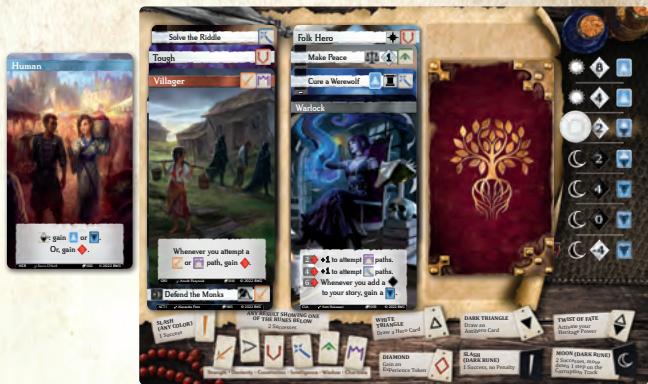
Josepha has completed Acts I and II. Her next turn must be spent facing the Adversary.
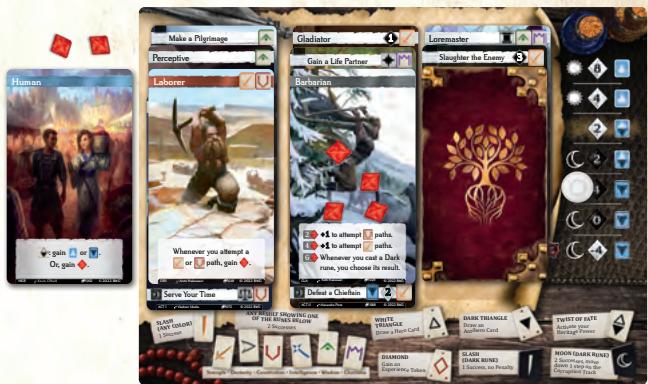
Another player has spent a turn facing the Final Adversary. Even though he is one card behind in the card count, Jeff must now also face the Final Adversary.
Additionally, the Adversary Quest and each Adversary Challenge include a number of other effects that either add to the Adversary, or remove it, or provide some other effect or modifier.


Adversary Effects

Add ato the Adversary's pool if the associated event occurs.

Remove a from the Adversary's pool if the associated event occurs.
When a rune result is cast, reveal and resolve the top card of the Adversary's Feat deck, then discard that card to the side. (Reshuffle that deck when it is exhausted.) This result also triggers a Final Adversary ability.
Facing the Adversary
Each player must face the Adversary side of the Adversary Challenge on the turn after they add the third card to their Act Il slot. The Adversary Challenge is attempted in much the same way as any Challenge. It has a difficulty and a set of Abilities that grant runes to attempt that Challenge. But if a player overcomes this Challenge, they do NOT add it to their story. Instead, they gain a Feat card as noted in the upper right hand corner. As indicated on the Adversary Quest, each success they achieve above the Adversary's difficulty removes one from the
Adversary. If they fail this Challenge, there is no effect other than failing to gain these rewards.
Once all players in the game have faced the Adversary, flip the card over to reveal the Final Adversary. The card abilities on the Final Adversary card will now be in effect for the rest of the game.
Facing the Final Adversary
The end game begins after one player acquires three cards under their Act IIl card. That player will face the Final Adversary on their next turn, and then all other players will face the Final Adversary on their last turn.
The Final Adversary is faced just like the Adversary: each success in excess of the Final Adversary's difficulty removes from it. If the Adversary has any remaining after all players have faced them, the party loses and there is no winner. If ALL have been removed from the Adversary by the end of the game, the party wins and the player with the highest Destiny score wins the game (page 17).
If a player overcomes the Adversary Challenge they do not move the card to their player mat, but they DO count the rewards from the Challenge in their final score.
Example: Facing the Adversary
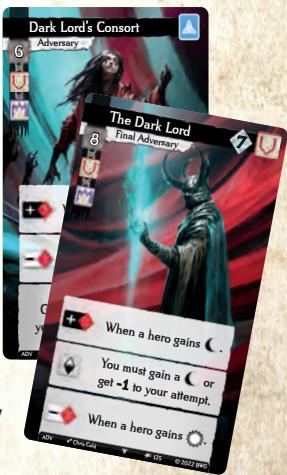
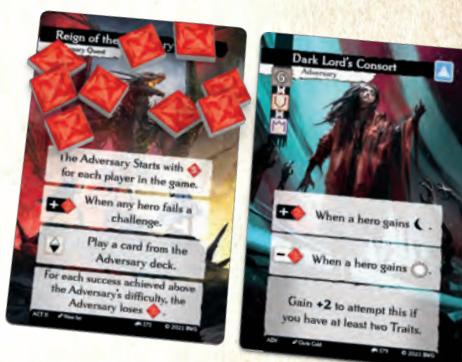
Ethan has three Story cards in Act I and three Story cards in Act Il. For his next turn, he must face the Dark Lord's Consort, a andChallenge.
Ethan has tworunes and one rune. He gathers those runes and the Core runes and casts them, getting just 5 successes. While this is normally a failure, Ethan has two Traits (Stealthy and Tough); as noted on the Dark Lord's Consort, this gives him +2 successes.
He overcomes her, gains the reward (a Hero card), and removes from the Adversary Quest (for exceeding her difficulty by 1)!

Example: Facing the Final Adversary
-
The game is almost over! Celeste was the first player to get three cards in Act Ill, and has already faced the Final Adversary (The Dark Lord). She succeeded, but there are still 5 left , and as the last player, Federico must defeat the Final Adversary Challenge and remove all remaining if the party is to win!
-
Federico considers his options. He's been planning for this moment the whole game, and has 3 ,and 2iconsin his story. He has on his Fighter Class card, but that won't help unless he rolls the result. He's also out of Feat cards, but he has one remaining in his pool E and plans to spend that on a Dark rune.
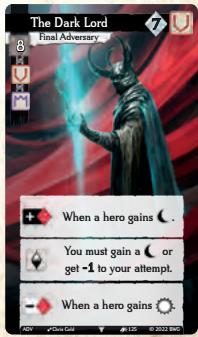
The Adversary starts with for each player in the game.
When any hero fails a non-Adversary challenge
Play a card from the Adversary deck.
When you face the Adversary, for
each point of success above the Adversary's difficulty, the Adversary loses
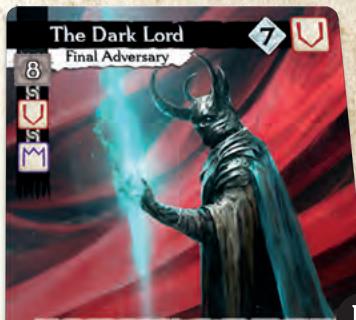
+When a hero gains .
You must gain a or get -1 to your attempt.
-When a hero gains
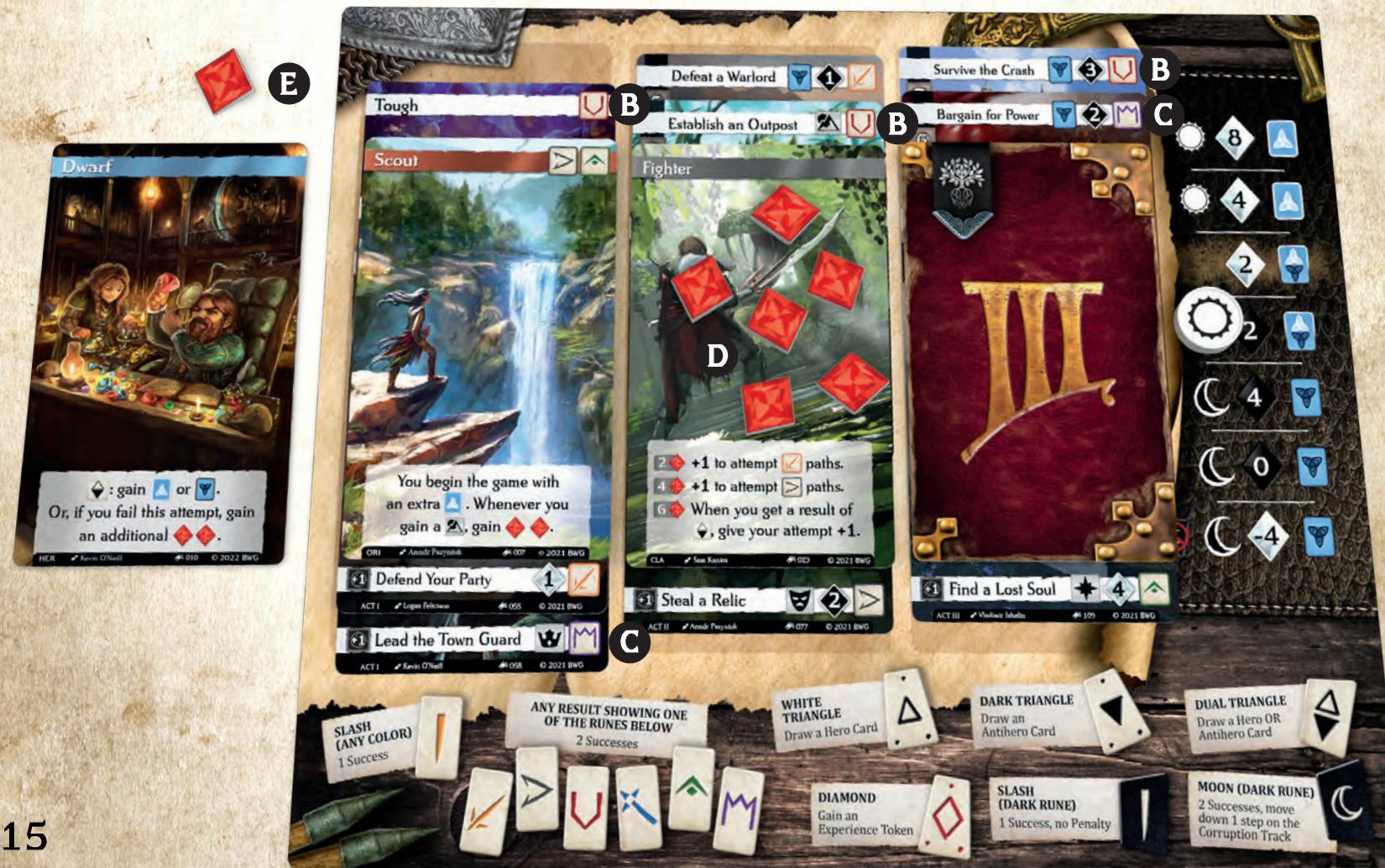
3.There's not much else he can do. He must roll at least 13 successes to both overcome the Final Adversary Challenge and defeat The Dark Lord. He gathers his 9 runes: the 3 Core runes, 3 runes, 2 runes, and 1 Dark rune, and casts them!
-
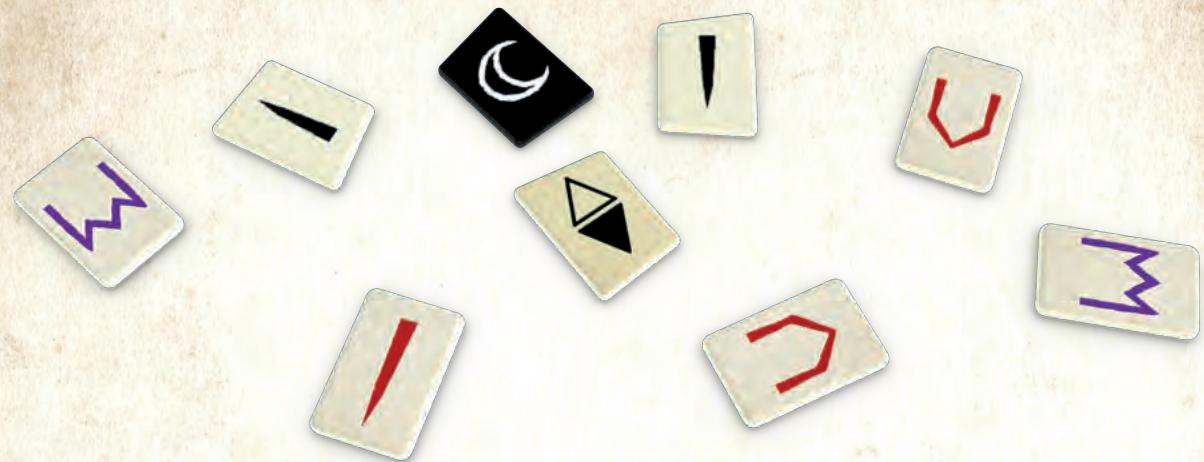
It's a heroic roll! He gets 2 successes from the Core runes, 5 from hisrunes, 4 from hisrunes, and 2 from his Dark rune. He also rolled the result, so his Fighter card gives him an additional +1, or 14 successes total! If the game ended now, he would not only have beaten The Dark Lord, he would have rolled enough excess successes to remove all of his
-
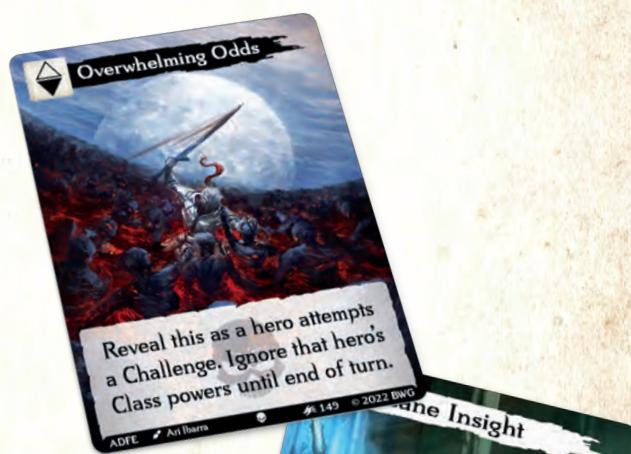
Compounding his troubles, the Dark Lord draws a Feat card due to the result H. It's Overwhelming Odds, so Federico doesn't get to use the +1 from his Class card! He still overcomes The Dark Lord Challenge, but now must come up with 2 more successes to remove the final 2
-
But wait, he rolled aresult, that means The Dark Lord immediately gains another And his result means that The Dark Lord will give him -1 to his attempt if he doesn't take another . Federico doesn't want to drop down two spots on the Corruption track, so he opts to take the -1 instead. He must now come up with one more success to fully defeat him.
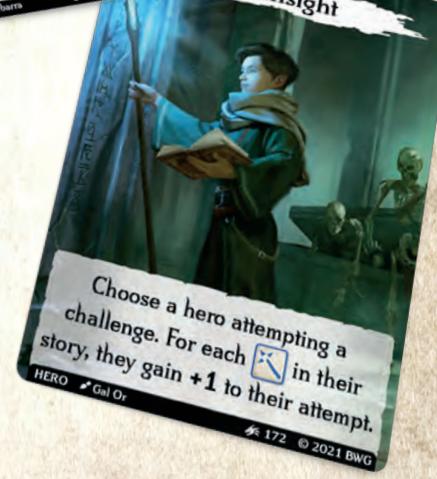
Fortunately, Federico also gets to draw a Feat card from the result. He chooses to gain a Hero card and draws Arcane Insight. It's the worst draw possible as he has no icons to power it up.
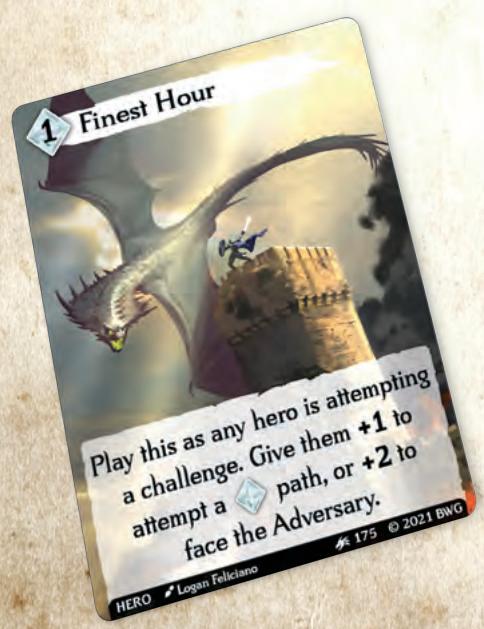
- All seems lost, but Celeste comes to the rescue. From her hand she plays Finest Hour, giving Federico the +2 needed to remove the Final Adversary's remaining two The Dark Lord falls and the party is triumphant! Now it's time to add up each player's score and see who is the ultimate victor.
Determining the Winner
At the end of the game, after each player has faced the Final Adversary, all players reveal their Destiny cards and calculate their final score:
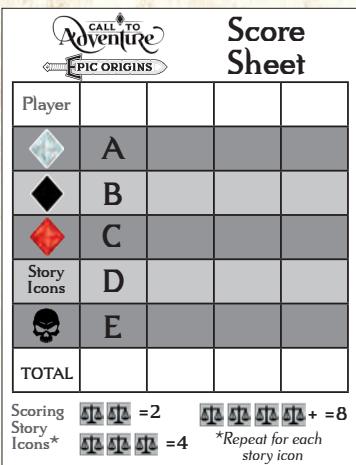
In Box A of the scoresheet, include:
All Triumph () visible in your story.
Any points from your Destiny card, based on the requirements you've met.
Any points from your final position on the Corruption track (these points are not cumulative).
One point for every Hero card () you played, regardless of your position on the Corruption track.
In Box B of the scoresheet, include:
• All Tragedy () points visible in your story.
• Any points from your Destiny card, based on the requirements you've met.
Any points from your final position on the Corruption track (these points are not cumulative).
One point for every Antihero card ( ) you played, regardless of your position on the Corruption track.
In Box C, add one point for every unspent you have (do NOT count on your Class card).
In Box D, add any points you have gained from Story icons (see below).
In Box E, record any points for defeating the Final Adversary. If you defeated the Final Adversary, don't forget to add the listed rewards to your tally, including any ability icons granted by the Adversary. (Adversary ability icons are only useful for scoring certain Destiny requirements; you will not attempt another Challenge after defeating the Adversary.)
If the Adversary was defeated, the overall victory is awarded to the player(s) with the highest Destiny score Ties are possible. If the Adversary was not defeated, no one wins!
To conclude the game, each player has a chance to tell their story. Describe how your hero's Character and Story cards fit together... how they emerged from humble Origins, trained in their Class, and achieved their Destiny. Whether or not you won the game, you've hopefully created a memorable character!
Story Icons
Some cards are marked with Story icons. There are six types of Story icons: Divinity, Justice, Arcana, Royalty, Villainy, and Nature.

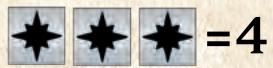
Collecting sets of matching Story icons will provide Destiny points at the end of the game. A single icon alone is worth no points. Each set of Story icons is scored in the same way, adding directly to your Destiny score at the end of the game:


The Campaign
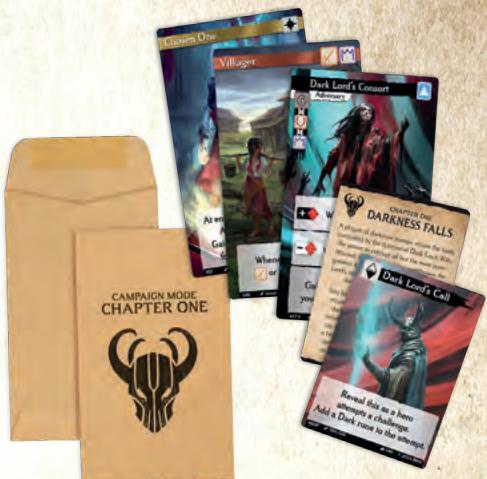
To guide you through your first several sessions, Epic Origins begins with a Campaign mode. It can be played solo or cooperatively, and your playgroup can change between sessions. Each time you start a new chapter, you'll build a new generation of heroes. Start with the envelope labeled "Chapter One."
Inside you'll find your Adversary for the game (The Dark Lord in Chapter One) as well as a Destiny and a Heritage or Origin. Add the new cards to their respective decks before dealing out Character cards. Each Adversary also comes with a unique Adversary Feat card. Add that card to the Adversary's Feat deck before beginning play, and remove it if you are not playing against that Adversary.
Glossary
Ability Rune: Your character's available Ability runes are defined by the visible icons in your story: . When attempting a Challenge on your turn, you have access to the rune stones that correspond to your ability icons. However, you may use no more than two types of runes that are relevant to that Challenge (page 9). All players share all rune stones, taking turns using them. If a card effect would add runes that are not relevant to a Challenge, those runes are not included in your attempt.
Act: Call to Adventure is split into three Acts. At the beginning of the game, reveal four Act I Story cards (or five, in a four-player game) in the central play area. Each Act is also associated with a Character card. Your Origin sits in the Act I column of your player mat, Class in Act II, and Destiny in Act III.
Adversary: The Adversary includes a double-sided Adversary Challenge and the Adversary Quest.
The Adversary Challenge begins the game with the Adversary side face up. Each player must face the Adversary the turn after they end Act Il. Once all heroes have faced the Adversary, flip it to its Final Adversary side. If the Final Adversary has any remaining on it at the end of the game, all players lose.
•There are two Adversary Quests in Epic Origins: The Reign of the Adversary and the more
Lastly, each campaign envelope includes instructions for what to do if you defeat the Adversary or fail to defeat the adversary.
As you play through each chapter, you'll unlock new cards. Once you’ve opened all seven envelopes, your collection is complete. In the future, begin a new solo or co-op session by randomly choosing an Adversary.
advanced Age of Darkness. You must always use one of the two Adversary Quests, regardless of which Adversary Challenge you are playing with.
Antihero Card: Whenever you gain a card with a icon or cast a rune result of , draw an Antihero card. You may only play an Antihero card when your position on the Corruption track displays the or symbol (page 7). Antihero cards are a type of Feat card.
Attempt: When attempting a Challenge, announce which path you wish to take, then cast (roll) the relevant runes to see if you succeed at the Challenge.
Challenge: Overcoming Challenges is the primary way to advance in Call To Adventure. If you attempt a Challenge and succeed, you may add that card to your story (page 9).
Character cards: There are four types of Character cards in Epic Origins: Heritage, Origin, Class, and Destiny. The Heritage card sits off your player mat, while the other cards take up the three Act slots on your mat. Class cards take the second slot on your player mat, and are interchangeable with Motivation cards from other Call to Adventure sets.
Class: Your Class card sits in the middle (Act II) slot of your player mat. At any time during your turn, you may move any number of from your pool to your Class card. Your Class card grants powers depending on how many tokens are on it. These effects are cumulative. If you have six on your class card you gain all three powers on the card.
Corruption: Players begin the game at the third level of the Corruption track, with no Virtue () or Corruption (). Whenever an effect says "gain , move one level up the Corruption track. When a Dark rune showsor an effect says "gain ," move one level down the Corruption track. Your position on the Corruption track determines your ability to play Hero or Antihero cards, and may affect your score at the end of the game.
Difficulty: A Challenge's difficulty represents the number of successes required to overcome that Challenge. When a card effect gives a Challenge that Challenge will require one additional success to complete. All of the bottom paths on Challenges in Epic Origins have.If a card effect gives a hero +1, that means the opposite: they have one automatic success toward that Challenge.
Feat: Antihero and Hero cards are collectively known as Feat cards (page 7). The Adversary also plays a special deck of Feat cards.
Heritage: Your Heritage is a new Character card that tells where your character comes from. Unlike the other Character cards, your Heritage sits to the side of your mat and no Story cards are tucked underneath it. Heritage cards provide a choice of powers when you roll the result. You may either draw a Feat card, or use the second power on the card, but not both.
Hero: Your “hero" is the character that you are creating over the course of the game, represented by the cards on your player mat. Cards that refer to “any hero" mean any character, including your own.
Hero Card: Whenever you gain a card with a icon or cast a rune result of△, draw a Hero card. You may only play a Hero card when your position on the Corruption track displays the or symbol (page 7). Hero cards are a type of Feat card.
Journey: Before attempting a Challenge, the active player may “journey" by spending to discard and replace one Story card in the current act (page 7).
Overcome: When attempting a Challenge, if you roll successes (or have total modified successes) equal to or greater to the path you were attempting, you overcome the Challenge.
Path: Every Challenge has two paths — one at the top and one at bottom of the card. When attempting a Challenge, you must declare which path you are attempting before casting the runes. If you succeed, place the card in your story with that path showing. Traits and Adversaries have only one path.
Reroll: When you reroll (re-attempt) a Challenge, you cast the runes again, keeping any effects from Hero cards, Antihero cards, or other abilities.
If your first attempt included a result of △, or , you gain that benefit immediately and keep it even if you reroll. If you get the same result on a re-attempt, you get that benefit an additional time!
• Ignore anygained from Dark runes during your first attempt.
• If the result of a re-attempt includes reveal a new Adversary Feat. If both rolls included both Adversary Feats take effect.
Until a re-attempt is resolved, the first attempt does not count as a success or failure.
Special Rune: Each rune set has a third, special rune, marked with three dots. Special runes are only cast when you have three or more icons in an ability (either in your story or from a Feat card).
Story: Your Story includes the tarot-sized cards in your character tableau: your Origin, Motivation, and all visible paths from any Story cards (Traits and Challenges) you have gained. At the end of the game, it includes your Destiny and the Final Adversary. It does not include the Corruption track, or Hero and Antihero cards.
Story Icons: Sets of Story icons are worth Destiny points at the end of the game (page 17).
Trait: Trait cards do not need to be attempted; you may add them to your Story without casting runes. Traits have one path, and grant the rewards listed at the top of the card. They also have a power that takes effect on the turn you gain the card.
FAQs
Am I allowed to have more than three rune icons in one ability?
Yes. While you may only cast a maximum of three runes per ability, you may gain additional rune icons as part of your story tableau. For example, if your Destiny is Favored Soul, gaining a fourth would help you earn an additional Triumph at the end of the game.
If I'm playing a Feat card to help with a Challenge, can I play it after the runes have been cast?
Most Feat cards in Epic Origins specify that they can be played as a hero is attempting a Challenge. You can wait to play these cards after the runes have been cast, before the attempt resolves.
Can I play Hero and Antihero cards on myself?
Yes. Feat cards that target “any hero" can be played on your hero or another player's hero.
If I get a result ofduring a Challenge, what is the sequence of events?
First, you reveal the Adversary's Feat. Then you decide how to use your Heritage power. If you draw a Feat card, you may play it immediately. Any Feats played by heroes take effect first, then the Adversary Feat, and then you resolve the attempt.
What happens if I gain four Corruption?
You cannot gain more than . If you reach this point, you cannot cast Dark runes. If you are able to remove Corruption (by gaining ), you move back to CCC.
If another player has moved on to Act II, but I have fewer than three cards under my Origin (Act I), can I try to gain Act Il cards?
Yes. As soon as any cards are revealed, all players may access them. For example, if you manage to overcome an Act Il Challenge when you have two cards under your Origin, you would tuck that Act Il Challenge under your Origin. However, you can only move forward: a player who has three cards under their Origin cannot place an Act I card under their Class (which is associated with Act Il).
What counts as an ability path (e.g. a path)?
A path that grants a icon as one of its rewards is a path." Most Class powers and Feats cards give a bonus or penalty to specific paths. For example, the Barbarian's first Class power grants +1 to attempt paths. When facing Mysterious Cave, that power would give a bonus to “Party's Only Survivor" but not “Defend Your Party." Similarly, The Dark Lord is a path, but the Dark Lord's Consort is not.
Can players reveal their Destinies to each other?
No. Remember that even though your party is working together to defeats the Adversary, your total Destiny score determines the ultimate winner. Keep it hidden until the end of the game so that your party members cannot use that information against you!
What does it mean if an effect triggers “whenever a hero gains C"?
Effects like this (including The Dark Lord's first power) trigger when a hero moves down the Corruption track. Such powers are not triggered by effects in place at the beginning of the game. They can be triggered more than once per turn, such as when multiple Dark runes produce a result of or CCC.
If an effect specifies “the Adversary," can it be used to face the Final Adversary?
Yes. Cards like Filthy Rich, Finest Hour, and Stolen Treasure can be used to interact with the Act Il and Act III sides of the Adversary Challenge card.
What happens if the Adversary has no experience before the end of Act III?
You have not yet defeated the Adversary, even if you exhaust their supply before game end. The Adversary is lying in wait and may gain more during the remaining rounds. Players must still face the Final Adversary at the end of the game to determine who gets the rewards for defeating the Adversary Challenge.
Does the final Adversary's rewards count as being "in your story"?
Yes. If a Final Adversary grants an Ability rune or Story icon, factor it into your final score. It counts as one Triumph or Tragedy path in your story.
Other Modes of Play
Call to Adventure: Epic Origins has been optimized for cooperative play: your party against the Adversary. But there are multiple play styles available that you may wish to explore.
Solo Play
Playing Epic Origins with a single hero is very similar to playing with a group. You'll follow the same rules for setup of the Adversary and change little else. Be aware that when a Feat card says it targets “any hero," that includes yourself!
Competitive Play
Should you wish to skip the cooperative experience altogether, just remove the Adversary Challenge, Quest, and Adversary Feats from the game and play solely against the cards in the Act rows. Your heroes will still build an epic story as they acquire Traits and Challenges, but only the final score will matter. Who can gain the most points and become the Hero of Destiny? At game end, follow the rules on page 17 for Determining the Winner, but omit any points normally gained from overcoming the Final Adversary.
Combining Epic Origins with Other Sets
All Call to Adventure sets are designed to be fully playable together, but curating the cards used in each game can help make the play experience more enjoyable.
If you wish to combine your Epic Origins game with the Call to Adventure base game, the Name of the Wind expansion, or the Stormlight Archive expansion, we recommend visiting our website to learn about how to best curate that experience. Visit BrotherwiseGames.com/epic-origins-conversion or use the QR code below.
Building RPG Characters
Your final story tableau is designed for easy conversion into the 5th edition of the world's most popular tabletop RPG! For a full conversion guide, visit BrotherwiseGames.com/ epic-origins-conversion or use the QR code here.

Rune Probability
Because Call to Adventure's rune system is so unique, it can be helpful to understand the probabilities involved. Here's a look at the minimum, average, and maximum values for common combinations of runes:
| Runes Cast | Example | Minimum | Average | Maximum |
| Core Runes (CR)Only | 000 | 0 | 1.5 | 3 |
| CR + One Dark orAbility Rune | à | 1 | 3 | 5 |
| CR + Two Dark orAbility Runes | 2 | 4.5 | 7 | |
| CR + Three Dark orAbility Runes | 3 | 6 | 9 | |
| CR + Four Dark orAbility Runes | 4 | 7.5 | 11 | |
| CR + Five Dark orAbility Runes | 5 | 9 | 13 |
Every Dark rune adds an average of 1.5 to your attempt, as do the first two runes in each ability. The special runes are less predictable, providing either a 0 or 2 (average of 1).
Game Components
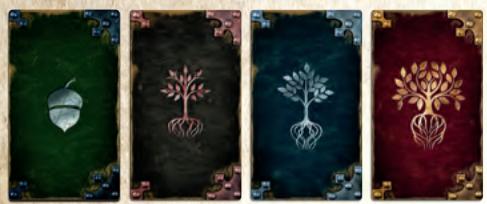
54 Character Cards 13 Heritage • 15 Origin 12 Classes • 14 Destiny
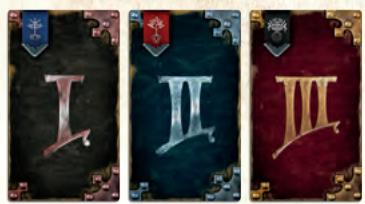
67 Story Cards 23 Act I • 23 Act II • 21 Act III
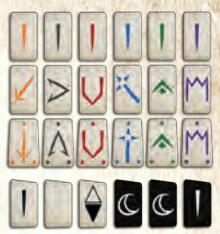
24 Rune Stones 3 Strength • 3 Dexterity • 3 Constitution 3 Intelligence • 3 Wisdom • 3 Charisma 3 Core Runes • 3 Dark Runes
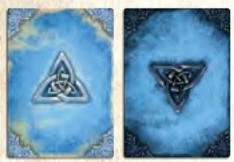

48 Hero & Antihero Cards 24 Hero • 24 Antihero 13 Adversary Feat Cards

11 Double-sided Adversaries 1 Adversary Quest Card
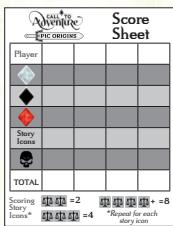
Scorepad
7 Campaign Envelopes *Contain cards included in the counts above
0000

Experience Tokens
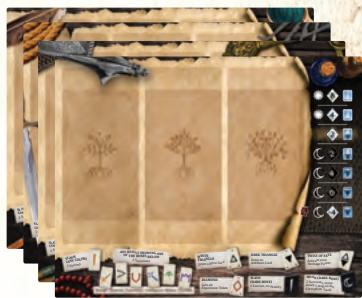
4 Player Mats with 4 Hero Markers
Acknowledgements
Graphic Designers: Matt Paquette, Kris Aubin, Darren Calvert • Art Direction: Darren Calvert, Johnny O'Neal • Editor: Alan Godfrey • Development Lead: Hayden Dillard • Cover Artist: Nino Is • Card Artists: Adam J. Marin, Alexandre Pinto, Alexandria Neonakis, Amirul Hhf, Angga Dwipayana, Anndr Pazyniuk, Antti Hakosaari, Ari Ibarra, Artem Demura, Artur Mosca, Chris Cold, Darren Calvert, Davey Baker, Dylan Palmer, Gal Or, Guilherme Motta, Ílya Drokonov, Jessica Fong, Kevin O'Neill, Logan Feliciano, Nino Is, Petar Penev, Priscilla Kim, Sam Kanios, Sami Rytkönen, Satoshi Kamanaka, Steven Shan, Thibaud Matras, Vladimir Ishelin, and Živko Kondić • Development Team: Keaton Dillard, Weston Dillard, Wade Bates, Jaison Binu, Zane Morris, Noah Bemont, Ethan Reid, Daniel Hussey, Brad Weiler, Jacob Gaines, Bryce Dixon, Colby Porter, James Ayres, Kalin Young, Spencer Reynolds, Owen Launius, James Boyer, Jeremy Watson, Daniel Chance, Christopher Spenner, Andy Myers, Ben Wadum, Ben Chance, Colin Kelly, Jacob De Hoyos, Matthew Chapman, Paul Schafer, David Leuders, and Marcus Rameau.
Call to Adventure: Epic Origins - 1st Edition; 1st Printing
All rights reserved. Printed in China. Reproduction of this rulebook in any form or medium is permitted for non-commercial use only. Call to Adventure title and logo are Trademark; Brotherwise Games, LLC, 2018. Epic Origins title and logo are Trademark; Brotherwise Games, LLC, 2021.
© 2022 by Brotherwise Games, LLC.

Object of the Game
Acquire Traits and overcome Challenges to build the hero with the greatest Destiny. Defeat the Adversary to win!
Set Up
Shuffle all decks, then:
-
Deal each player 1 Heritage, 2 Origin, 2 Class, and 2 Destiny cards, plus 1 Hero card and (page 3).
-
Reveal each hero's Heritage, and chosen Origin and Class, leaving their Destiny face down.
-
Prepare the Story decks (page 4).
The player who most recently played an RPG goes first. Play proceeds clockwise around the table.
Intelligence
Constitution
Quick Start Guide
Wisdom
MCharisma
On Your Turn
Dexterity
Every turn, you may gain a Trait OR attempt a Challenge.
Ending An Act
When you have three Story cards under one of your Character cards, you have ended that Act. At the start of your next turn, if you are the first player to have ended an Act, reveal the next row of cards (page 13). After filling your Act Il slot, you must face the Adversary. That card is then flipped for Act IlI, and as your last Challenge of the game you must face the Final Adversary.
Casting the Runes
-
Draft a Trait (page 8).
-
Attempt a Challenge by casting the runes. Always use the Core runes, then add any relevant Ability runes you have (pages 9-10). You may add a Dark rune for each you pay. Don't forget any bonuses from your Class card.
When you have a rune icon in your Story, you can cast that kind of rune when attempting Challenges of that type (page 9).

During your turn, you may also:
Strength
Journey: at the start of your turn, pay to discard and replace a Story card on the table.
• Play any number of Hero or Antihero cards (page 7).
Activate any abilities available to you from Heritage, Origin, or Class cards, and place any number of on your Class card.

Ending The Game
When any player has three cards under their Destiny card, each other player takes one final turn. If playing co-op, each player, in turn, must then face the Adversary! The Adversary is attempted like any Challenge, but loses for each success you achieve over the Adversary's difficulty. Remove all the Adversary'sto win (page 17).

Texts are community-compiled or publicly released by publishers; copyright remains with the original authors. For personal reference only.