
Carcassonne Hunters And Gatherers
At a glance
Rules, cards and Q&A (Chinese)
The rules, card data and player questions for this game are written in Chinese. Open the Chinese page to read them.
Where to find full rules
Full rules and card lookup are available in the cunlema app at cunlema.cn — pick this game and ask about any rule, card or turn you are unsure about.
Related games
Rulebook text (Markdown)
This game has 2 rulebook Markdown file(s) in our library; 2 rendered inline below — expand to read or download.
rules_zh_卡卡颂猎人与采集者_1973.md3.9 KB


《卡卡颂:猎人与采集者》规则简易版
支持2-5名玩家进行游戏,每位玩家持有2个小屋和5个米宝。在卡卡颂人民建造强大的城墙和城堡的数千年前,他们的祖先就在这土地上漫游,狩猎,捕鱼和收集生存所需的东西。
PS: 《卡卡颂:猎人与采集者》基本玩法与《卡卡颂》基础版一致,这里不再赘述,以下为《卡卡颂:猎人与采集者》的专属规则。

- 森林相当于城市,完成后一个板块2分.
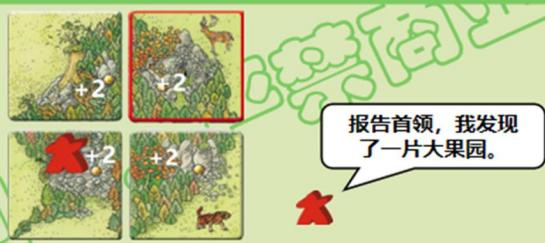
报告首领,我发现了一片大果园。
2.河流相当于道路,湖泊和森林是河流的终点,完成后得分,一个板块1分;两端如果有湖泊,加上湖中的鱼,每条鱼加1分。
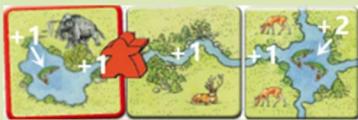
喔嚯,今晚有鱼吃喽。
(^^)
3.躺草地,按照草地上除老虎以外的动物计分,一个两分。但如果草地上有老虎,需要将鹿减去老虎数量。(躺草地只统计动物,老虎不得分,若形成虎群,不会扣负分。)
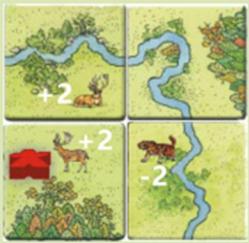

有老虎,快跑呀!
(°A°)
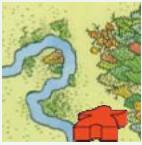
4.河流、湖泊整个连起来,构成河流系统,可以放一个小屋,终局时河流系统有几条鱼,小屋得几分。放到河流中的小屋和米宝互不干涉。

这片鱼塘,我承包了。
- 几人占有同一片地方,人多者得分,人数相同则共同得分,同理,小屋也一样。
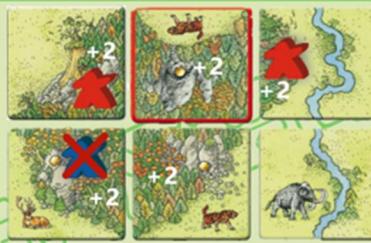
朋友,别怪我们人多欺负人少啊。
6.森林中如果有金块,谁完成那片森林,可以额外拿一块奖励板块,一片森林只能得到一块奖励板块,且不能连续获得奖励板块。

7.终局时森林和河流未完成的,没有分数。

哎,这次任务没完成,回去要饿肚子了。(T.T)
特殊板块:
1、有蘑菇的森林完成时多加2分。
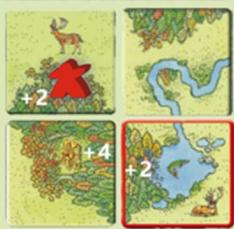
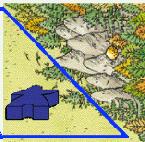
2、有火焰的草地会驱逐全部老虎,老虎不会扣分了。

我没有毒的,还很补哦!
啊,有火,快跑。
3、有遗迹的草地如果占米宝全算你的草地,无论草地还有几个其他玩家的米宝。
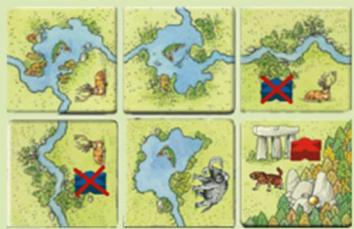
我的地盘,我做主。 $^{0}$

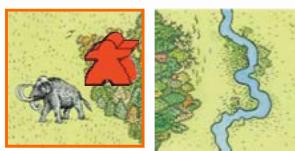
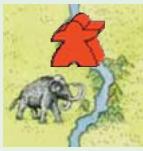
4、猛犸和野牛不会被老虎猎食,同时二者也能给占草地的猎人增加2分(同鹿)。
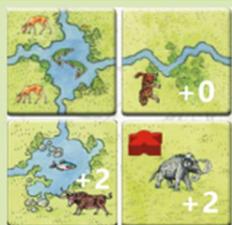
兄弟,你看那小子在干啥?

这俩块头有点大,
我先躲躲吧。
翻译:A.C.Milan 创意&编辑:小咏
排版&美术:Mr.傑校对:花斑大脸猫
Download MarkdownComplete Annotated Rules v1.0.md48.2 KB
CARCASSONNE: HUNTERS & GATHERERS © 2002 HANS IM GLÜCK, TRANSLATION AND NOTES BY SCOTT
TABLE OF CONTENTS
INTRODUCTION
CARCASSONNE—HUNTERS & GATHERERS
Game Contents
Overview
Preparation
Playing The Game
1. Place a tile
2. Deploy a tribe member or hut
3. Scoring completed rivers and forests
A completed river
A completed forest and the bonus tiles
Returning tribe members to their owners
Huts
The meadow
The End of the Game
Final scoring
Scoring the huts
Scoring the hunters in the meadows 2
Example of hunter scoring
Description of bonus tiles 12
Tile Distribution 13
SCOUT 14
Extra pieces 14
Additional rules 14
Preparation 14
1. Place a tile 14
CONSOLIDATED TILE REFERENCE 16 16
Introduction
Overview 16
Forest, forest, forest, forest 17
Forest, forest, forest, meadow 17
Forest, forest, forest, river 17
Forest, forest, meadow, meadow 17
Forest, forest, meadow, river 18
Forest, forest, river, meadow 18
Forest, forest, river, river 18
Forest, meadow, forest, meadow 18
Forest, meadow, forest, river 19
Forest, meadow, meadow, meadow 19
Forest, meadow, meadow, river 19
Forest, meadow, river, meadow 19
Forest, meadow, river, river 20
Forest, river, forest, river 20
Forest, river, meadow, meadow 20
Forest, river, meadow, river 20
Forest, river, river, meadow 21
Meadow, meadow, meadow, meadow 21
Meadow, meadow, meadow, river 21
Meadow, meadow, river, river 21
Meadow, river, meadow, river 22
Meadow, river, river, river 22
River, river, river, river 22
SELECTED VARIATIONS 23
The aurochs drives out a hunter 23
The aurochs strengthens the animals 23
The aurochs hunts a tiger 23
The aurochs herd 23
The aurochs as a riding animal 23
Domesticated aurochs 23
Aurochs as a wrecking ball 23
Aurochs as a plowing animal 23
Version history
1.0 (11 October 2008): added paragraph about computer game to Introduction
0.8 (4 October 2008): added Selected Variations; complete first draft
0.7 (4 October 2008): added tile distribution; revisions to the Table of Contents and Introduction
0.6 (4 October 2008): added rules, footnotes, and FAQ for Scout
0.5 (3 October 2008): added footnotes and FAQ to basic rules
0.4 (3 October 2008): basic rules completed
0.3 (3 October 2008): first four pages completed
0.2 (13 September 2008): first two pages completed
0.1 (7 September 2008): layout design
INTRODUCTION
This document is a translation of the Hans-im-Glück rules for Hunters & Gatherers and the Scout miniexpansion, including footnotes and tile distribution lists. It is intended to be a Hunters & Gatherers equivalent to Matthew Harper’s excellent Complete Annotated Rules for the original Carcassonne and it’s myriad of expansions.
Hunters & Gatherers is a stand-alone game in the Carcassonne series, and as such is NOT compatible with Carcassonne. Hunters & Gatherers is the only Carcassonne spin-off with an expansion of its own: Scout, released in 2003 as part of a combined King & Scout expansion. The King portion of the expansion is for the original Carcassonne, while the Scout portion is for Hunters & Gatherers. Hunters & Gatherers and the Scout expansion are, likewise, not compatible with any other Carcassonne spin-offs.
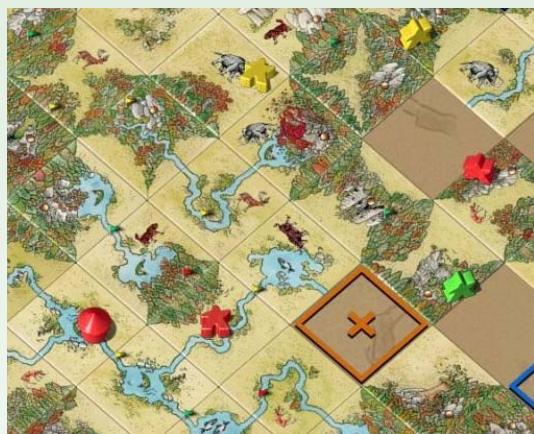
An officially licensed computer version of Hunters & Gatherers was produced by Koch Media and released in 2003. It was re-released in 2004 as part of a collector’s edition which also included a computer version of the original Carcassonne. (The computer version of the original Carcassonne was first released before the computer version of Hunters & Gatherers.) Neither release included the Scout tiles. The computer version of Hunters & Gatherers allowed a person to play alone against the computer, with other friends on a single PC, with other friends on a network of computers, or with other players on the Internet. This faithful re-creation offered 3D depiction of the tiles and game pieces in top-down or isometric perspective.
Acknowledgements
Klaus-Jürgen Wrede, for taking the 2001 Game of the Year to the stone age.
Hans-im-Glück, for publishing it.
Rio Grande Games, for bringing great games to North America.
Matthew Harper, for the Complete Annotated Rules concept.
Gantry Rogue, for creating CarcassonneCentral.com
Novelty, for remembering the things that I forgot.
The regular posters at CarcassonneCentral.com who gave me the necessary encouragement.
All errors are entirely my own. Please post all corrections, suggestions, and other feedback on the forums at CarcassonneCentral.com

www.carcassonnecentral.com
CARCASSONNE—HUNTERS & GATHERERS
released in 2002
A tile-laying game for 2 to 5 players aged 8 and above by Klaus-Jürgen Wrede
Thousands of years before the present city of Carcassonne was built, the area was already populated. The people hunted wild animals, gathered berries and caught fish for their daily survival. Even today there remains fantastic cave paintings and archaeological finds from which we understand the lives of those days.

CARCASSONNE: HUNTERS & GATHERERS © 2002 HANS IM GLÜCK, TRANSLATION AND NOTES BY SCOTT
OVERVIEW
The players place the land tiles turn by turn. There are meadows, forests and rivers, in which the players may deploy their huts and tribe members to score points. Since points are awarded during the game as well as at the end, the winner is not known until after the final scoring.
PREPARATION
The starting tile with the volcano is placed in the middle of the table. The 78 other land tiles are mixed and placed face-down on the table in several stacks, so that each player can access them easily. Similarly, the 12 bonus cards are mixed and placed face-down in a single stack. The scoreboard and the 5 point tiles are placed at the edge of the table.
Each player chooses a colour and receives the 6 tribe members and 2 huts of that color, placing one on the '0' field of the scoreboard. The remaining 5 tribe members and the 2 huts remain with the player as his or her supply.
The youngest player decides who will begin the game.
PLAYING THE GAME
Play progresses in a clockwise fashion. The player whose turn it is carries out the following actions in the order given:
The player must draw one new land tile from one of the stacks (not from the bonus stack) and place it.
-
The player may draw one tribe member or hut from their supply and deploy it to the tile just placed.
-
If any forests or rivers are completed through the placement of the tile, they must be scored now.
1. Place a tile
As their first action, the player must draw a land tile from one of the stacks. The tile is then shown to the other players (so they can 'advise' the player about where to place it) and placed on the table. The player must take care to observe the following:
At least one side of the new tile (with a red border in the examples below) must touch one or more tiles already in play. Corner-to-corner placement is not permitted.1
Any meadow, river and forest segments must continue segments already in play.
In the rare case that a tile cannot be placed anywhere, it is removed from the game, and the player draws another.
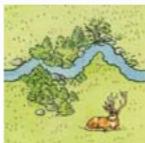
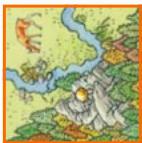
River and meadow segments must continue those in play.
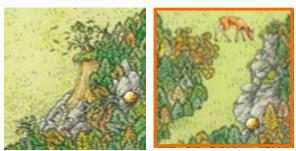
Forest segments must be continued.
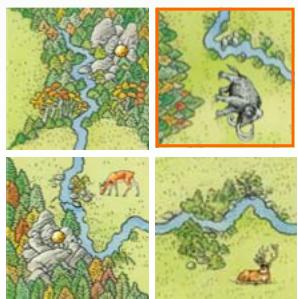
The forest continues on the left, the meadow on the bottom.
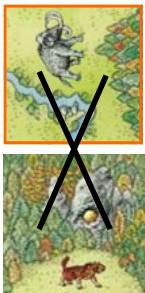
Not like this!
1The RGG edition adds the following sentence here: “The edge of the table limits the playing area. Thus, a player may not place a tile past the edge of the table or move the playing area to place a tile that would have been past the edge of the table.”
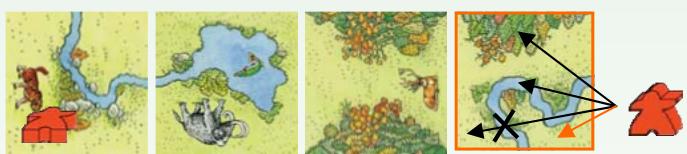
2. Deploy a tribe member or hut
When the player has placed the tile, he or she may deploy a tribe member or a hut. In doing so the following points must be observed:
• Only one tribe member or hut may be deployed each turn.
• The tribe member or hut must come from the player’s supply.
• The tribe member or hut may only be deployed to the tile just placed.
• The player must decide which part of the tile the tribe member or hut is deployed to.
A tribe member may be deployed as:
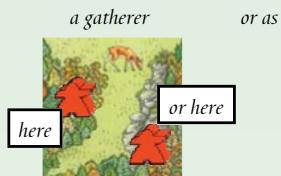
in a forest segment

on a river segment
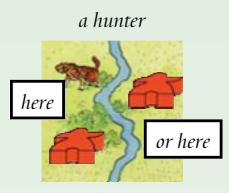
In a meadow segment.
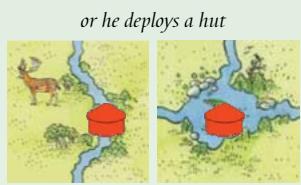
to a river segment or lake.
If the player deploys a tribe member as a hunter, he sets the figure flat on a meadow segment rather than upright. For details about this and the huts, see page 11.
There must be no other tribe member (not even one belonging to the same player) on the forest, river or meadow segments connected to the tile just placed. It does not matter how far away the tribe member is. The following two examples may help to explain:
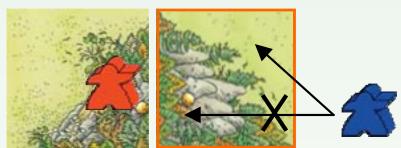
Blue can only deploy a hunter: there is already a gatherer in the connecting forest.
Red can deploy the tribe member as a gatherer or fisherman, or as a hunter on the small meadow segment. The large meadow is already occupied by a hunter.
It is still possible that several tribe members can exist on a contiguous territory (forest, river, grassland).
How that happens is explained on the next page.
If a player runs out of tribe members and huts during the course of play, he or she may only place tiles.2 But don't panic: you can also get tribe members back (see "Returning tribe members to their owners”). Huts, on the other hand, remain in play until the end of the game.
Now the player's turn is over, and it is the turn of the next player on the left. With the following exception: If a river or forest was completed through the placement of the tile, it must now be scored before the next player's turn begins. This does not apply to completed meadows, however.3
2The RGG edition places this sentence at an earlier point in the text.
3. Scoring completed rivers and forests
A completed river
A river is completed when there is a lake or spring on each end, or when the river forms a closed circle.4
A player with the only fisherman on a completed river receives 1 point for each river segment. If the river has a lake on either or both ends, the player also receives 1 point for each fish.

Red scores 6 points.
The completed river has 3 segments (1, 2, 3). Each segment scores 1 point. The lake at the end of the first segment contains 1 fish, the lake at the end of the third segment contains 2 fish. This adds 3 points to the score.
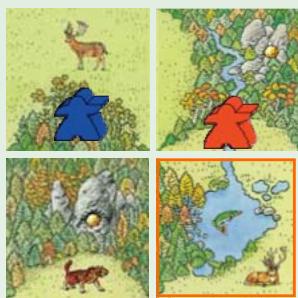
Red scores 3 points. (2 segments and 1 fish). Even though the tile was placed by blue to enlarge his forest, red scores points because the river has been completed on which he has a fisherman.
Note: The player who finishes the river is usually the same player who scores points for the river. That need not be this way. It may happen that a player completes a river and another player collects the points because he has a fisherman there, as in the example above right.
All points are immediately recorded on the scoreboard. When the field '0' is reached or passed, the player takes a point tile and places it in plain view of all other players, with the number '50' face up. In this way it is clear to all that the player has already scored 50 points
another point tile and display it next to the first, the '50' face up.

A completed forest and the bonus tiles
A forest is completed when it is completely surrounded by meadows (i.e. there are no open sides where the forest can be expanded) and there are no gaps within the forest. There is no limit to how many segments a forest may contain. A player who has the only gatherer in a completed forest scores 2 points for every forest segment.

Red scores 4 points.
After scoring, the players look to see if there are any gold nuggets in the forest. If so, the player who completed the forest draws 1 bonus tile from the stack.5 He or she then places the tile anywhere, following the normal rules for tile placement, and may also deploy 1 tribe member or hut on this tile.6 If the placement of the bonus tile causes a feature to be completed, it is scored immediately. However, the player may not draw another bonus tile if he or she completes another forest with gold nugget (there is no chain reaction). When the bonus stack is used up, players no longer draw bonus tiles!
In summary:
• The player with a gatherer in a completed forest scores the points.
4The RGG edition adds the following sentence here: “There is no limit to the number of segments in a river.”
Question: If I play a tile which completes more than one forest at the same time, do I get more than one bonus tile? Answer: No. You can only ever get one bonus tile per turn, regardless of how many forests you complete, either with your initial tile or your bonus tile. Playing your bonus tile takes place in the same turn, so no extra bonus tiles are awarded.
6The RGG edition adds the following sentence here: “If there is no legal place for the bonus card, the player discards it from the game and draws another.”
The player who completes the forest draws the bonus tile. In the example on the right: if red completes the forest, he or she receives both the points and the bonus tile. If blue completes the forest, red scores the points and blue draws the bonus tile.
The bonus tile may be placed in any valid location on the playing field.
Regardless of how many gold nuggets a forest contains, only 1 bonus tile may be drawn.
If the forest contains no gold nuggets7, a bonus tile may not be drawn.
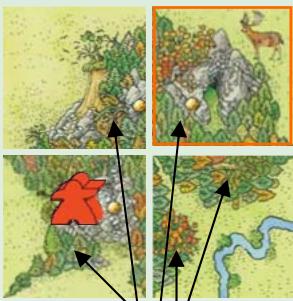
Although this completed forest contains several gold nuggets, only 1 bonus tile is drawn.
2 points for each forest segment. Red scores 10 points.
The bonus tiles are described in more detail later in the rules.
What happens if there are several tribe members in a completed forest or river?
Through the wily placement of tiles it is quite possible for several gatherers to be in a forest or for severa fishermen to be on a river.
The points are then scored by the player with the most gatherers or fishermen. In the case of a draw, all players involved score the full number of points.
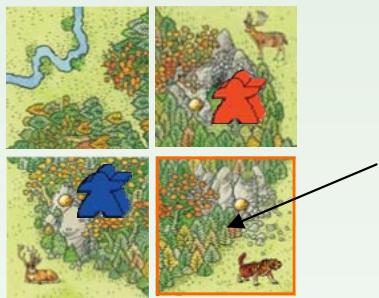
Red and blue both score 10 points each.
The newly-laid tile combines the previously separate forests. Afterwards, several gatherers occupy the same forest.
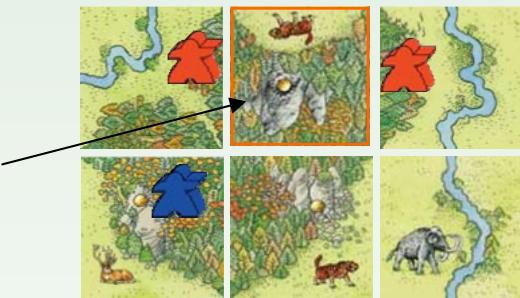
Red has the majority in this forest and scores 12 points.
Note: Several tribal members in the same area does not contradict the rule: "There must be no other tribe member (not even one belonging to the same player) on the forest, river or meadow segments connected to the tile just placed." This rule applies only to the deployment of new tribe members! Here, however, we are dealing with connecting areas where tribe members are already deployed.
Returning tribe members to their owners
After a river or a forest has been completed and scored - and only then - any tribe members involved are returned to their owners. From the next turn onwards, the player can then use them again in whatever role he or she chooses.
It is possible to deploy a tribe member, score immediately, and have the tribe member returned, all in the same turn. In this case, you must use the following order:
-
Complete a forest or river with the new tile.
-
Deploy a gatherer or fisherman.

-
Score the completed forest or river.
-
Return the gatherer or fisherman to your supply.8
7The RGG edition adds the following erroneous remark: “(only possible in 2 segment forests)”
Huts
Huts must always be placed on a river segment on a lake. A hut occupies an entire river system. A river system includes all connected river segments and is not interrupted by lakes. It ends only at a spring, or at the edge of the playing field. Huts are only scored at the end of the game.
The river system on the left belongs to blue. The river system on the right belongs to red.

When deploying a hut it should be noted: There must be no other hut (not even belonging to the same player) on the river system (this rule is similar to the one for deploying tribe members). Once deployed, huts remain on the river system for the duration of the game.9 Note: huts and fisherman do not prevent the placement of each other.
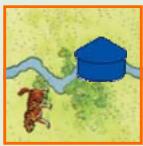

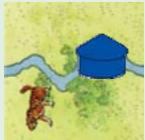
The blue hut may be deployed.
The meadow
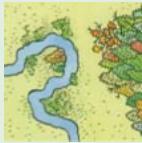
The red fisherman may be deployed.

Meadows are not scored. They serve only as places to deploy hunters. Once deployed, hunters remain on the meadow for the duration of the game. In order to make that clear, the hunters should be laid on their backs. This helps to distinguish them from gatherers and fisherman which can be returned during the game and redeployed. Hunters only score points at the end of the game (see "Final Scoring").

Left: All 3 hunters are on their own meadow. The forest, rivers, and the edge of the playing field separate the meadows from each other.
Right: After the placement of the new tile, the meadows of the 3 hunters are joined to form one. Note: The player who placed the tile may not deploy a hunter, since the meadow is already occupied by hunters.



THE END OF THE GAME
The game ends at the end of the turn in which the last land tile (not bonus tile!) is placed. The players remove all tribe members from incomplete forests and rivers from the playing field. Incomplete forests and rivers are not scored. The huts on the rivers and the hunters in the meadows remain on the playing field for the final scoring.
Final Scoring
Scoring the huts
A player with the only hut on a river system receives 1 point for each fish in the river system. If several players have an equal number of huts on the same river system, each player receives the full score. If one player has a majority of huts, he or she alone receives the points. For the scoring of the huts, it is irrelevant whether a river system is completed or not. In this way,

Blue scores 5 points (5 fish).
Scoring the hunters in the meadows
A player with the only hunter on a meadow receives the following points: 2 points for each deer, mammoth, and aurochs (only on bonus tiles).
Sabre-toothed tigers are competing with you for food. They only hunt the deer; they do not dare approach a mammoth or an aurochs. For every sabre-toothed tiger on the meadow, a deer is not scored. To simplify the scoring, you can use the green wooden discs to cover tigers and deer in pairs. The remaining deer, as well as the mammoths and aurochs, are then added together. If a meadow contains more tigers than deer, there are no minus points.
If several players have the most hunters in a meadow, each receives full points. If one player has the most hunters, he alone receives the points. For scoring the hunters, it does not matter whether a meadow is completed or not. In this way, all hunters in meadows are scored. After scoring, the wooden discs are collected for use on the next meadow to be scored.
Example of hunter scoring

Meadow 1: 1 deer. Green scores 2 points.
Meadow 2: 1 deer, 1 mammoth, 1 tiger. Yellow and red will each score 2 points for the mammoth, the tiger eats the deer.
Meadow 3: 2 deer, 2 mammoths, 1 aurochs, 1 tiger. Red has the most hunters. He alone scores 8 points (2 mammoths = 4 points, 1 aurochs = 2 points, 1 deer = 2 points).
Meadow 4: 2 tigers, 1 deer. Blue receives no points, but no minus points either.
(For the sake of clarity, a tiger and deer in meadow 3 are covered with wooden green discs.)10
The player with the most points wins.
Description of Bonus Tiles
The bonus tiles must be placed in accordance with the normal rules. In addition, they have the following features:

The fire chases all the tigers from the meadow - even if no hunter is deployed. On this meadow, all deer are scored.
Each mushroom tile add 2 points to the score of a completed forest.
Each aurochs adds 2 points to the hunter's score.

When a player deploys a hunter on the shrine, only he will receive points. Other hunters on the meadow will not receive any points, regardless of majority.
Note: When deploying the hunter - as usual - there must not be any other hunters on the meadow!
10The example given in the RGG edition differs slightly in that one tiger and one deer from Meadow 2 are covered instead.
TILE DISTRIBUTION
| Quantity | Tile | Quantity | Tile | |
| 1 |  | 1 | 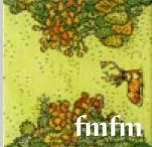 | |
| 1 | 2 |  | ||
| 4 | 4 | 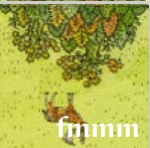 | ||
| 4 |  | 1 | 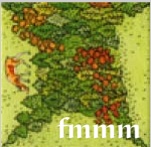 | |
| 10 | 1 | 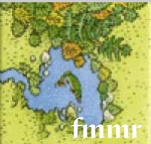 | ||
| 1 |  | 2 | 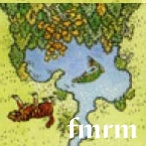 | |
| 1 | 4 |  | ||
| 4 | 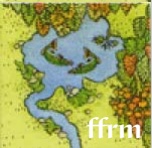 | 5 | 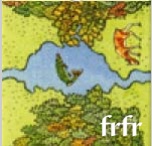 | |
| 7 |  | 3 | 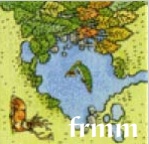 | |
| 3 |  | 2 | 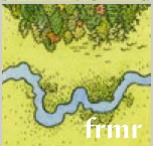 |
| Quantity | Tile |
| 3 | 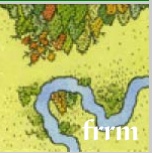 |
| 3 | 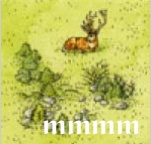 |
| 1 | 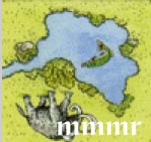 |
| 6 | 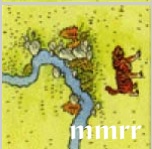 |
| 6 | 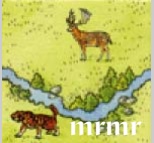 |
| 8 | 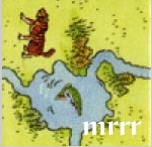 |
| 1 | 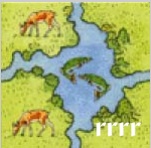 |
| 2 | 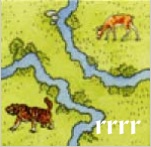 |
| 91 | Total |
CARCASSONNE: HUNTERS & GATHERERS © 2002 HANS IM GLÜCK, TRANSLATION AND NOTES BY SCOTT
SCOUT
released in 2003
EXTRA PIECES
4 new land tiles for Carcassonne: Hunters & Gatherers11
1 Shaman tile
ADDITIONAL RULES
Preparation
Shuffle the 5 tiles face-down. Each player draws a tile and places it face-up in front of themselves. For a 2- player game, draw 2 tiles each. Remove the remaining tiles from the game.

Shaman: Each turn12, the player may return to his or her supply one of their tribe members from an unfinished river, forest, or meadow13.
1. Place a Tile
The 4 other tiles are placed during the game: The player declines drawing from the stack and places his or her Scout tile. Then he or she must place a tribe member (or a hut with Agriculture14) on the tile. Otherwise, he or she may not place the tile. The figure remains there for the duration of the game.
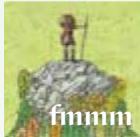
Scout: Each turn15, the player may reject the first tile he or she draws (including bonus tiles). He places the rejected tile under the stack and draws a new tile, which he must place.
When placing: There can be no other gatherers in the forest. When the forest is completed, the scout is considered a gatherer, but is not returned to the player's supply after scoring.
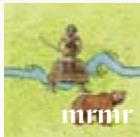
Hunter on Bridge: The hunter counts in the scoring of the meadows on both sides of the bridge. The bridge does not connect the meadows.
When placing: there may not be any hunters in either meadow. The bear is worth for 2 points.
11The Scout tiles can be distinguished from the normal Hunters & Gatherers tiles by the Shaman image on the reverse side.
12Question: If I have the Shaman do I return a tribe member to my supply at the beginning or the end of my turn? That is, can I remove a man and play him on the same turn?
Answer: Yes. The rules don't prevent it, so you may take a tribe member back at any time in your turn. If you take it back at the beginning of your turn you can play it on the same turn.
13The RGG edition does not include the word “meadow” here.
14Question: Can I choose whether I play a hut or a hunter on the Agriculture tile? Answer: No. You must play a hut.
15The RGG edition precedes this phrase with “once in play”.
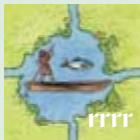
Dug-out: Every time a river in this river system is completed (regardless by which player), the owner of the dug-out scores as many points as the largest lake has fish.16 When placing: there may not be any fisherman on the river. When the river is completed, the dug-out counts as a fisherman, but is not returned to the player's supply after scoring.
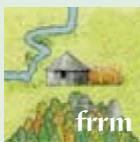
Agriculture: At the end of the game, the player scores 1 point for each meadow tile, regardless of the usual hunter scoring.17
When placing: There may not be any hunters in the meadow.18 No hunters may be placed in the meadow.1
16 Question: The English translation says "as many points as the largest lake on this river has fish". The original German just seems
to say "as many points as the largest lake has fish". Is it the largest lake on the river or the largest lake on the river-system?
Answer: The intention was that it should be the largest lake on the river-system.
17Question: If I place a hut on the Agriculture tile, does the hut get me points for the animals in the meadow? Answer: No. Only hunters score for animals.
18 Question: Can I place a hut on the Agriculture tile if there is already a hunter in the meadow.
Answer: No. The placement of the hut on the Agriculture tile is governed by the rules for hunter placement. You must place the
Agriculture tile in an empty meadow.
19Question: Once I have placed the hut on the Agriculture tile, can anyone place a hunter in that meadow? Answer: No. But of course you may connect two (ore more) meadows later in the game, as usual. Then you could have a hut getting points for the size of the meadow and a hunter scoring for the animals.
CONSOLIDATED TILE REFERENCE
Introduction
The distribution lists here are organized by the topological relation of their sides. The legend ‘mmmm’ on a tile in the game distribution list denotes a tile on which all four sides are meadows; ‘rrrr’ one on which all sides are rivers; and ‘ffff’ one on which all sides are forests. The section title ‘Forest, meadow, river, meadow,’ would correspond to ‘fmrm’, and describes a tile with the following arrangement:
| F | ||
| M | M | |
| R |
Of which this tile would be an example:
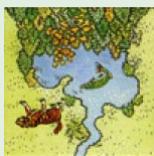
The arrangement always proceeds clockwise from the topmost position. Furthermore, the tile notation and section headings are ordered alphabetically, according to the following hierarchy:
-
forests (f)
-
meadows (m)
-
rivers (r)
Practically speaking, that means that a forest is always placed at the top, and the rest of the tile described clockwise from that starting point. If there is more than one forest, the first forest—again seen clockwise—is placed at the top. If there is no forest at all, then a meadow is placed at the top, and so on. The internal content of the tile is not taken into consideration.
The reason for this organization should be clear if you consider a situation where, deep into a game, there is a ‘hole’ in the playing field: only a tile with a certain arrangement of sides will fit.
Overview
| Total | Source |
| 91 | Hunters & Gatherers |
| 4 | Scout |
Forest, forest, forest, forest
| F | ||
| F | F | |
| F |
Forest, forest, forest, river
| F | ||
| R | F | |
Basic Game
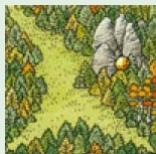
x1
| Total | Source |
| 1 | Basic Game |
Basic Game
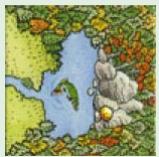
| Total | Source |
| 4 | Basic Game |
Forest, forest, forest, meadow
| F | ||
| M | F | |
| F |
Forest, forest, meadow, meadow
| F | ||
| M | F | |
| M | ||
Basic Game
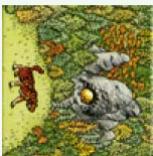
x1,
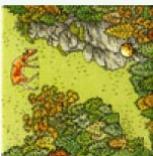
| Total | Source |
| 5 | Basic Game |
Basic Game
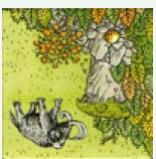
x10,

| Total | Source |
| 11 | Basic Game |
Forest, forest, meadow, river
| F | ||
| R | F | |
| M | ||
Basic Game
x1
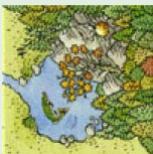
Forest, forest, river, river
| Total | Source |
| 1 | Basic Game |
Forest, forest, river, meadow
| F | ||
| M | F | |
| R | ||
| F | ||
| R | F | |
| R | ||
Basic Game
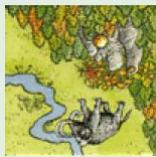
x7
| Total | Source |
| 7 | Basic Game |
Forest, meadow, forest, meadow
| F | ||
| M | M | |
| F |
Basic Game

x4
| Total | Source |
| 4 | Basic Game |
Basic Game
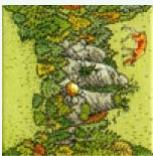
x4,

| Total | |Source |
| 5 | Basic Game |
Forest, meadow, forest, river
| F | ||
| R | M | |
| F |
Forest, meadow, meadow, river
| F | ||
| R | M | |
| M |
Basic Game

x2
Basic Game

| Total | Source |
| 2 | Basic Game |
x1
| Total | Source |
| 1 | Basic Game |
Forest, meadow, meadow, meadow
| F | ||
| M | M | |
| M | ||
Forest, meadow, river, meadow
| F | ||
| M | M | |
| R | ||
Basic Game
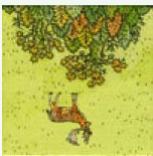
x4,

Scout
x1
Basic Game
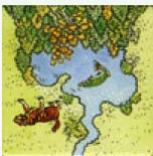
x2
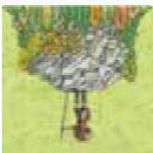
x1
| Total Source | |
| 2 | Basic Game |
| Total | Source |
| 5 | Basic Game |
| 1 | Scout |
| 6 | Total |
Forest, meadow, river, river
| F | ||
| R | M | |
| R | ||
Basic Game
Forest, river, meadow, meadow
x4
| F | ||
| M | R | |
| M |
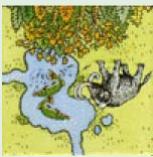
| Total | Source |
| 4 | Basic Game |
Basic Game
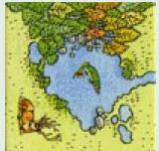
x3
| Total | Source |
| 3 | Basic Game |
Forest, river, forest, river
| F | ||
| R | R | |
| F |
Basic Game
Forest, river, meadow, river
| F | ||
| R | R | |
| M | ||

x5
| Total | Source |
| 5 | Basic Game |
Basic Game
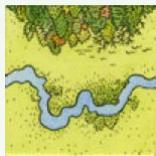
x2
| Total | |
| 2 | Basic Game |
Forest, river, river, meadow
| F | ||
| M | R | |
| R |
Basic Game
x3

Scout
x1
Meadow, meadow, meadow,
| Total | Source |
| 3 | Basic Game |
| 1 | Scout |
| 4 | Total |
meadow
| M | ||
| M | M | |
| M |
Basic Game

x3
| Total | Source |
| 3 | Basic Game |
river
Meadow, meadow, meadow,
| M | ||
| R | M | |
| M |
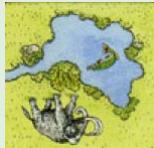
Basic Game
x1
| Total | Source |
| 1 | Basic Game |
Meadow, meadow, river, river
| M | ||
| R | M | |
| R |
Basic Game

x6
| Total | |Source |
| 6 | Basic Game |
Meadow, river, meadow, river
| M | ||
| R | R | |
| M |
River, river, river, river
| R | ||
| R | R | |
| R |
Basic Game
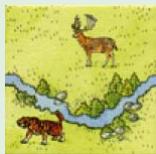
x6
Basic Game
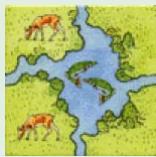
x1,

x2
Scout
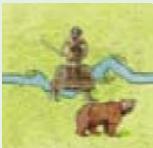
x1
| Total | Source |
| 6 | Basic Game |
| 1 | Scout |
| 7 | Total |
Scout
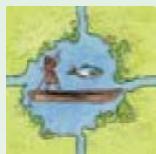
x1
| Total | Source |
| 3 | Basic Game |
| 1 | Scout |
| 4 | Total |
Meadow, river, river, river
| M | ||
| R | R | |
| R | ||
Basic Game

x8
| Total | Source |
| 8 | Basic Game |
SELECTED VARIATIONS
from the official home page at www.carcassonne.de
The following variations are all based around the aurochs as part of a competition that was held by Hansim-Glück. The first variant listed was the contest winner.
The aurochs drives out a hunter
After placing a tile with an aurochs, the player may remove one hunter (their own, or another player’s) from the meadow. The tribe member is returned to its owner and may be used again on their next turn.
The aurochs strengthens the animals
Each deer on a meadow with at least one aurochs brings 3 points, instead of the usual 2. The animals are eaten as usual by tigers. On mammoths the aurochs has no effect.
The aurochs hunts a tiger
If an aurochs tile is connected to a meadow with a tiger, the tiger flees and is covered with a green wooden disc. It eats no more deer. Tigers added to the meadow after the aurochs are not affected.
The aurochs herd
The more aurochs on a meadow, the more points each is worth. One aurochs is worth 2 points as before, 2 aurochs are worth 3 points each, and 3 aurochs are worth 4 points each. In a slightly tougher version, an individual aurochs could be worth zero points, with the same rate of progression.
The aurochs as a riding animal
Regardless of the normal rules, another hunter can be deployed to the aurochs, even if the meadow is already occupied.
Domesticated aurochs
An aurochs on a river system with a hut scores 5 points at the end of the game for the owner of the hut.
Aurochs as a wrecking ball
A player who places an aurochs tile on a river system, which has his or her own hut, can remove the hut and return it to his or her supply for later use. (The fact that the aurochs is on a meadow makes this variant somewhat complicated.)
Aurochs as a plowing animal
When placing an aurochs tile, the player can choose to deploy a hut. This happens regardless of hunters which may be located in the meadow. Other huts close as usual. The aurochs allows the meadow to be irrigated. There are two scoring possibilities:
-
When the occupied tile is completely surrounded by eight land tiles, the player who owns the hut scores 9 points and returns the hut to his or her supply. This functions similarly to the cloister in the original Carcassonne.
-
The hut remains on the meadow until the end of the game. The owner of the hut scores 1 point for each meadow segment without an animal.
Translator’s note: I took a few liberties in the translation of this page to make it easier to understand. I did my best to ensure that the meaning did not change, though in some instances the meaning was not entirely clear. Have a better translation? Let me know.
Download MarkdownTexts are community-compiled or publicly released by publishers; copyright remains with the original authors. For personal reference only.