
Carcassonne South Seas
At a glance
Rules, cards and Q&A (Chinese)
The rules, card data and player questions for this game are written in Chinese. Open the Chinese page to read them.
Where to find full rules
Full rules and card lookup are available in the cunlema app at cunlema.cn — pick this game and ask about any rule, card or turn you are unsure about.
Related games
Rulebook text (Markdown)
This game has 2 rulebook Markdown file(s) in our library; 2 rendered inline below — expand to read or download.
rules_zh_卡卡颂南海_1976.md6.2 KB


《卡卡颂:南海》规则简易版
游戏人数:支持2-5人。
南海,清澈蔚蓝的海水流淌在无穷无尽的岛屿之间,岛屿通过网状桥梁相连,这里劳碌的人们栖息在如同天堂般的地方,自然赋予了他们丰厚的礼物,海里的鱼、岛上的香蕉、桥上的贝壳等。商船也不时地停到岛上寻找货物,当地人将货物提供给商人,而他们的辛劳也会得到回报。
PS: 《卡卡颂:南海》基本玩法与《卡卡颂》基础版一致,这里不再赘述,以下为《卡卡颂:南海》的专属规则。

游戏配件:

· 游戏共73片游戏板块 ,含1片初始板块 。24片商船奖励板块 ,19个渔船token ,60个货物token(其中大、小的鱼类token 、香蕉token 、贝壳token 各10个,1个大token等于3个小token),每人4个米宝,无计分板。
初始设置:
- 初始板块正面放置在桌面中央,再随机抽取四片商船奖励板块,正面向上放置。货物token放置一旁备用。
- 米宝行动:放置一个游戏板块后,玩家可以在以下行动中二选一执行或者PASS。
1、放置一个米宝到游戏板块的合理位置。
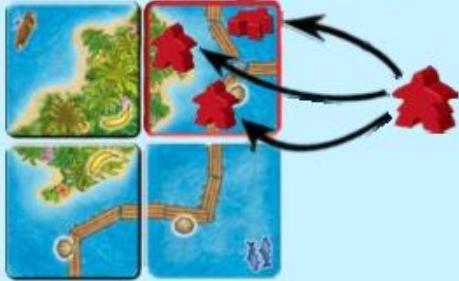
2、从游戏版图中收回一个属于自己的米宝。
元气满满的一天,由此刻开始。(^_^)

哎,看来今天是没收获了,还是早点回家吧。(T-T)
板块效果:
·桥梁(参考道路):完成后获得桥上所有贝壳。
·岛屿(参考城市):完成后获得岛上所有香蕉。
·海洋(参考草地):
1、海洋被桥梁或岛屿封闭后,可获得海域中所有的鱼类,同时回收米宝。
2、若海洋未封闭,当放置带有渔船符号的板块时,可获得这片海域中的所有鱼,并回收米宝,然后使用渔船token覆盖住该海域中一个鱼类图标,优先覆盖两条鱼。若两条鱼的图标覆盖完则覆盖一条鱼的图标。(鱼是越捕越少的哟!)

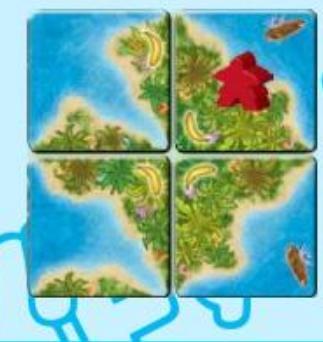
呼。。呼。。这一会弯腰,一会上树,不轻松啊!
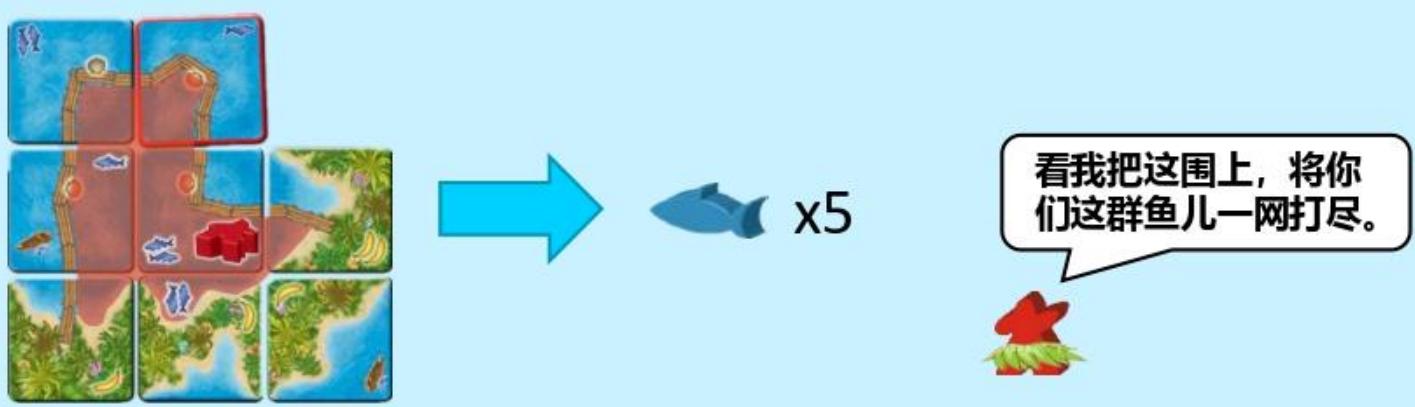
看我把这围上,将你们这群鱼儿一网打尽。


· 多人占用同一片地方时,米宝多者夺得货物,米宝相同则共同获得货物。
· 桥梁、岛屿、海洋同理适用。
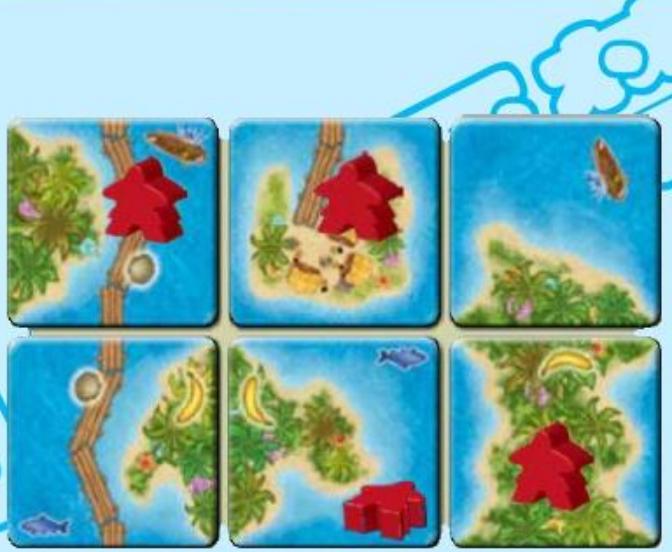
· 市场(参考修道院):当米宝占有的市场周围八片板块都完成时,则获得四片商船奖励板块中分数最高的。
· 若出现两片以上最高分时则任选其一,然后补齐四片商船奖励板块。
· 若多人同时完成市场,则按顺序选择商船,然后补齐四片商船奖励板块。

兄弟,别怪我们人多欺负人少啊。


我这小市场终于完工了,今天可以拿尾款喽。(∩_∩)
例:
·商船奖励板块:完成回合前,玩家可以用特定货物兑换商船奖励分,然后补齐四片商船奖励板块。每回合限兑换一次。

(注:若市场完成则优先选择商船奖励,然后补齐四片商船,进行货物兑换,最后再补齐四片商船。)
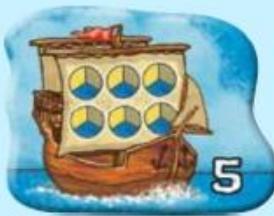

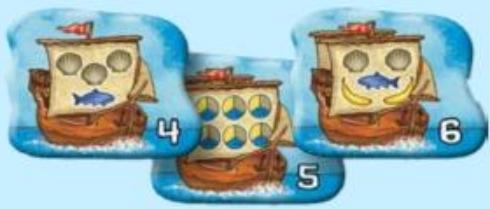
用2个贝壳,1个鱼类和1个香蕉兑换该商船板块。
用6个任意货物兑换该商船板块。
用3个相同货物及1个其他货物兑换该商船板块。
嘿,你这批货还挺不错的,给我搬上船吧。
好嘞!


游戏结束条件:
· 当最后一片游戏板块被放置或者最后一片商船奖励板块被兑换,该回合完成后游戏结束。

胜负条件:
· 游戏结束后,统计获得商船奖励板块的分数,加上版图上未回收的米宝所占有货物及手中货物token的总数量,3个货物为1分,不满3个不计分,未完成的市场不计分。
·分数多者获胜,同分则共同获胜。
南海蔚蓝着呼吸,网桥拥围着岛屿。
自然流淌着厚礼,人们劳碌着栖息。
黄袍加身的香蕉忘形骄傲,素衣白冠的贝壳细语轻悄。害羞沐浴的鱼儿随波飘摇,捕风捉影的人儿不停寻找。听,有风吹过。。。看,有船驶来。。。
x2

x1
x1

例:商船奖励板块计15分,货物共10个计3分,合计18分。
翻译: a_a 小咏
创意&编辑:a_a 小咏
排版&美术:Mr.傑
校对: A.C.Milan
Download Markdownrules_en_carcassonne-south-seas_147303.md18.1 KB
来源类型:纯文本规则(非 PDF 源,早期抓取/转换产物)
说明:原文未改动,仅调整存放位置与文件名;非 PDF 扫描件,无对应原书 PDF
Carcassonne: South Seas Rulebook | RulesPalRulesPalChatRulebookCarcassonne: South SeasCarcassonne: South Seas Rulebook Table of Contents Table of Contents Game Components
Game Overview
Game Setup
Playing the Game 1. Draw and place a tile
2a. Place an Islander
2b. Retrieve an Islander
- Completed Bridges, Islands, Sea Regions and Markets are evaluated A completed Bridge gives Shells
A completed Island gives Bananas
A completed Sea Region gives Fish
A completed Market gives a Ship token
Multiple Islanders on one completed Bridge, Island or Sea Region
Returning Islanders to a player's supplies
- Deliver to a Ship and gain points
Game End and Winner Evaluation of incomplete features
End game scoring and winner
Clarifications
Credits
Overview of Sea Tiles (72 tiles + 1 Start tile) and Ship Tokens (24 Ships)
Summary Evaluation — value during game and at end of game
Markets: value only during game
Game turn
Game end
Points
Game Components
73 Sea tiles (including 1 Start tile with a more florid backside): They feature bridges with shells, islands with bananas, seas with fish, marked as follows: Island areas, Market, Sea Regions, Bridge segments, Junctions.
24 Ship tokens: They indicate which Wares must be delivered in order to score the indicated points. Each Ship token shows the required wares and the points it is worth.
1 rulebook
60 wooden Ware tokens (10 large and 10 small of each type). Each small ware token is worth 1 Ware of that type. Each large ware token is worth 3 Wares of that type. The types are Bananas (small and large), Shells (small and large) and Fish (small and large).
19 Fishing boat tokens
20 wooden Islanders (4 each in 5 colors): Each Islander can serve as a Banana Picker, a Shell Collector, a Fisherman or a Merchant.
The symbols on the tiles indicate: Bananas, Shells, Fish and Fishing boats.
Game Overview
The players take turns placing Sea tiles on the table. These tiles create Bridges, Islands, Sea Regions, and Markets on which the players may place their Islanders in order to collect the various Wares. At the end of each turn, the active player may choose to deliver Wares to a Ship in order to score points. Once all of the Sea tiles have been placed or all the Ships have been supplied with Wares, the game is over and the player with the most points is crowned King of the South Seas.
Game Setup
The Start tile is placed in the middle of the table. The remaining tiles are mixed and placed in several stacks so that each player may easily draw tiles.
The Ship tokens are mixed separately and form a face-down supply. Draw and reveal 4 Ship tokens and place them face up on the table within easy reach of all players.
Each player receives 4 Islanders in their chosen color and places them in front of themselves as a supply.
The youngest player begins the game.
Playing the Game
Play proceeds clockwise from the start player. Each player carries out their turn in the following sequence:
The player must draw 1 Sea tile and place it according to the Sea tile placement rules.
a. The player may place 1 Islander from their supply on the tile they just placed OR b. The player may retrieve 1 Islander from a Sea tile and place it back in their supply. (A player may also choose not to place or retrieve an Islander.)
If the placed tile causes 1 or more occupied Bridges, Islands, Sea Regions or Markets to be completed, OR a Fishing Boat is added to an occupied Sea Region, an evaluation occurs and Wares or Ships are awarded.
The player may now deliver Wares to 1 of the face up Ships and score the corresponding points.
Then, the next player takes their turn.
The rules are similar to those of the original Carcassonne game. Experienced Carcassonne players may feel free to skip to page 4.
1. Draw and place a tile
The first action a player must take on their turn is to draw a Sea tile from a face-down stack and place it connected to previously placed tiles. The following placement rules must be observed:
The new tile (bordered with red in the following examples) must connect one or more of its four sides to those of previously placed tiles. A placement that connects only by corners is not allowed.
New tiles must always continue pre-existing Bridges, Islands and/or Sea Regions.
Examples: The Bridge and Sea Region are continued. The Island is continued. The left side continues the Island. The bottom continues the Sea Region. As an example, a placement is not allowed if the Island does not continue onto the newly placed tile.
A player may freely show their opponents their newly drawn tile in order to discuss placement options. In the rare case that a newly drawn tile may not be legally placed, it is removed from the game and the active player will draw a new tile to continue their turn.
2a. Place an Islander
After a player has placed a Sea tile, they may place an Islander according to the following rules:
Only 1 Islander may be placed.
The Islander must come from the player's supply.
The Islander may only be placed on the newly placed tile.
The player must choose on which part of the newly placed tile they wish to place an Islander. Either as a... Shell Collector — on a Bridge, or a
Banana Picker — on an Island, or a
Merchant — in a Market, or a
Fisherman — in a Sea Region. A Fisherman is laid down!
The player may not place an Islander on a Bridge, Island or Sea Region if it is connected to a Bridge, Island or Sea Region that already contains one or more Islanders (even if some or all of the pre-existing Islanders belong to the active player). For example:
Blue may not place a Shell Collector on an already occupied Bridge. Blue may, however, place a Merchant or Fisherman as indicated.
Blue may not place a Banana Picker on an already occupied Island. Blue may, however, place a Shell Collector or Fisherman as indicated.
Note: If a player does not have any Islanders available in their supply, they do not have the option of placing one. No need to worry: There are several ways of retrieving those Islanders. Read on.
2b. Retrieve an Islander
If a player has zero Islanders in her supply, she may instead retrieve one of her Islanders from the board and return it to her supply. No Wares or Ships are awarded.
Note: A player may choose to neither place nor retrieve an Islander.
3. Completed Bridges, Islands, Sea Regions and Markets are evaluated
When evaluating a completed feature, a player receives no points. Instead, Wares are awarded. Each type of feature gives a player a different type of Ware, or a Ship in the case of a completed Market.
Upon completion of a Bridge, Island or Sea Region, the player whose Islander occupy the completed feature receives Wares. Each player receives 1 Shell, 1 Banana or 1 Fish for each corresponding symbol present in the completed feature.
A completed Bridge gives Shells
A Bridge is complete when it is terminated on both ends, either by a junction (identified by the presence of a junction stone), an Island or a Market, or if the bridge forms a closed loop. This can result in bridges being very small or very large.
Examples: Red gains 2 Shells. Red gains 4 Shells.
A completed Island gives Bananas
An Island is complete when all of its borders are complete and there are no internals gaps. This can result in Islands being very small or very large.
Examples: Red gains 2 Bananas. Red gains 4 Bananas.
A completed Sea Region gives Fish
A single Sea Region can consist of numerous tiles. A Sea Region evaluation can be triggered in two different ways:
- When a Sea Region is completely enclosed (by Bridges and/or Islands).
OR
- When a Sea tile featuring a Fishing Boat is placed in an occupied Sea Region.
Important! A Fishing boat can only trigger an evaluation when it is first placed, and never during a later turn.
Example for an enclosed Sea Region: Red gains 5 Fish for this enclosed Sea Region.
Example for the placement of a Fishing Boat: Red places a new Fishing Boat so that it connects to her Fisherman's Sea Region and gains 5 Fish.
After Fish are awarded due to the placement of a Fishing Boat, the player covers one group of Fish in the corresponding Sea Region. If any groups of two fish are available, one of them must be covered. If no groups of two fish are available, a single fish is covered instead. Fish that have been covered by boats are not available to be gained during future evaluations.
Thanks to the addition of a Fishing Boat, the Red player received 5 Fish. A Fishing Boat token is then used to cover a symbol showing two Fish.
A completed Market gives a Ship token
A Market is complete when it is surrounded by 8 Sea tiles.
The player whose Islander occupies the completed Market gains the Ship token with the highest value, without delivering any goods. This token is placed face-down in front of that player and will give them points at the end of the game.
If there is more than one Ship token with the highest value, from these, the player takes one of their choice. The face-up supply of Ship tokens is then replenished to 4.
If several Markets are completed simultaneously, each player will receive the Ship token(s) they are owed in clockwise order from the active player. Replenish the face-up supply of Ship tokens to 4 after each token is awarded.
For the completed Market, Red gains one of the highest valued Ships. She chooses the 6 valued Ship on the far right (from face-up Ships valued 3, 4, 6 and 6).
Multiple Islanders on one completed Bridge, Island or Sea Region
Through clever placement of Sea tiles and Islanders, it is possible for several Islanders to occupy the same Bridge, Island or Sea Region.
Example 1: Blue places a Fisherman in a Sea Region.
Example 2: Red places a Sea tile and places a Fisherman in a Sea Region. This is possible because these are two distinct Sea Regions. (These two Sea Regions are not connected by the touching corners.)
Example 3: A Sea tile is placed that connects the two previously distinct Sea Regions. In this way, it is possible for multiple Fishermen to occupy the same Sea Region.
Similarly, it is possible for multiple Banana Pickers to occupy the same Island, or for multiple Shell Collectors to occupy the same Bridge.
When a feature with multiple Islanders is completed, only the player with the most Islanders present receives the depicted Wares. In case of a tie, all tied players receive the Wares.
The new Sea tile connects the two previously distinct Islands and completes it. Blue and Red each gain 4 Bananas, as they are both tied for most Banana Pickers on the completed Island.
Returning Islanders to a player's supplies
After a Bridge, Island, Sea Region or Market is completed and evaluated, all Islanders present at the completed feature are returned to their owner's supply, so that they may be used on a following turn.
Note: Islanders in Sea Regions whose evaluation was triggered by the addition of a Fishing Boat are also returned (even though the Sea Region is not necessarily considered "complete").
It is possible for a player to place an Islander, complete a feature and have the Islander return to their supply in one turn. To do so, players must act in the following sequence:
With the placement of a new Sea tile, complete an unoccupied Bridge, Island, Sea Region or Market.
Place a Shell Collector, Banana Picker, Fisherman or Merchant (again, the feature must be unoccupied).
The completed Bridge, Island, Sea Region or Market is evaluated and the player receives the appropriate reward.
The Islander is returned to its owner's supply.
Red places the Sea tile and a Fisherman. The Fishing Boat on the newly placed Sea tile forces an evaluation and Red gains 3 Fish. Red covers the group of two fish with a Fishing Boat token and returns her Islander to her supply.
4. Deliver to a Ship and gain points
At the end of a player's turn, he may deliver Wares to exactly 1 Ship. A player may choose from the supply of 4 face-up Ships. The Wares a player must deliver are depicted on the sail of each Ship. To deliver to a Ship, the player returns the appropriate Wares to the supply, and places the Ship face-down in front of him.
A new Ship is then drawn so that there are again 4 face-up Ships (unless the pile is empty).
The number depicted at the bottom right of the Ship indicates the number of points it is worth at the end of the game.
This Ship requires a delivery of 2 Shells, 1 Fish and 1 Banana. It is worth 5 points.
Some Ships require particular combinations of Wares, while other Ships denote a flexible requirement:
A blue-and-gold circle symbol indicates a Ware of the player's choice.
The letters A and B indicate Wares of the same type.
This Ship requires a delivery of 6 Wares of the player's choice: In this example, the player delivers 3 Fish and 3 Bananas. The Ship is worth 5 points.
This Ship requires a delivery of 5 Wares of the player's choice: In this example, the player delivers 5 Fish. The Ship is worth 4 points.
This Ship requires a delivery of 4 identical Wares: In this example, the player delivers 4 Shells. It is worth 3 points.
This Ship requires a delivery of 3 Wares of one type and 1 Ware of a different type: In this example, the player delivers 3 Shells and 1 Banana. It is worth 3 points.
Now, the player's turn is over and the next player clockwise may begin their turn.
Game End and Winner
The game ends after the turn in which the last Sea tile is placed or the last Ship has been acquired.
Evaluation of incomplete features
All incomplete Bridges, Islands and Sea Regions are evaluated as though they had been completed. Players receive Shells, Bananas and Fish as they would have during the game.
Important: Incomplete Markets offer no reward.
Example:
Left Island: Red has 2 Banana Pickers on the Island where Blue only has 1. Red has more Banana Pickers than Blue. Red alone receives the 4 Bananas shown on the Island.
Bridge: Green is alone on the Bridge and receives 3 Shells.
Market: Black gets nothing for his incomplete Market.
Sea Region: Yellow and Blue each have 1 Fisherman present. They each receive 4 Fish.
Right Island: Yellow is alone and receives 2 Bananas.
End game scoring and winner
Now we total each player's points:
Each player receives points for their acquired Ships.
Each player receives 1 point for each 3 remaining Wares, regardless of type.
Whoever has the most points is crowned King of the South Seas and wins the game.
Red has 6 Ships with the following values: 2 + 3 + 4 + 4 + 5 + 6 = 24 points. Red also has 10 Wares remaining, netting her an additional 3 points. Final score for Red: 27 points.
Clarifications
Islands A and B are distinct, although their tips are touching.
Sea Regions 1, 2 and 3 are also distinct.
The Island on this Sea tile stretches from left to right and features two distinct Sea Regions.
Credits
© 2013 Hans im Glück Verlags-GmbH
English version: © 2013 Z-Man Games Inc., 31 rue de la Coopérative, Rigaud QC J0P 1P0, Canada
Questions, comments, requests? www.zmangames.com — [email protected]
Made in Germany
The publisher thanks Udo Schmitz and the many playtesters and their enthusiasm.
Cover Illustration: Dennis Lohhausen
Game Illustration: Harald Lieske
Graphic Design: Christof Tisch
English version: Z-Man Games
Z-Man Games wishes to thank Adam Marostica for his incredible assistance.
Overview of Sea Tiles (72 tiles + 1 Start tile) and Ship Tokens (24 Ships)
Sea tiles, by quantity:
8x — Bridge running from the top edge to the bottom edge across open sea.
5x — Bridge running from the top edge and bending out to the right edge, across open sea.
9x — Bridge junction (junction stone) with arms to three edges, across open sea.
1x — Bridge junction (junction stone) with arms to all four edges, across open sea.
5x — Sea with an island along one edge; no bridge.
3x* — Bridge spanning from the left edge to the right edge with an island along the bottom edge.
2x — Bridge from the left edge bending up to the top edge, with an island on the right.
2x — Bridge from the left edge bending down to the bottom edge, with an island on the right.
3x — Bridge junction (junction stone) with arms to the top, bottom and left edges, with an island on the right.
1x — Bridge running top to bottom with a junction stone, meeting an island on the right.
2x — Bridge junction (junction stone) joining the left and bottom edges and running into the island on the right.
3x — Two separate islands with a sea channel between them; no bridge.
3x — Island in one corner, the rest sea.
3x — Island band crossing the tile with sea above and below.
2x — Island along one diagonal with sea on the other side.
6x — Island along one side with sea on the other.
5x — Three-way bridge junction (junction stone) over sea, meeting an island.
1x — Island curving around a sea inlet.
3x — Islands on two sides with a bridge crossing the sea channel between them.
1x — Market island with bridges leading off three edges.
1x — Market island with bridges leading off the top and bottom edges.
2x — Market island with a bridge leading off one edge.
1x — Market island with bridges leading off the top and right edges.
1x — Market island with a bridge leading off the right edge.
*This art is also on the Start tile.
Ship tokens, by quantity:
2x Ship worth 2 points
8x Ship worth 3 points
6x Ship worth 4 points
4x Ship worth 5 points
4x Ship worth 6 points
The Sea tiles and Ship tokens pictured above feature differing assortments of Wares.
Summary
Evaluation — value during game and at end of game
An evaluation triggered by a Fishing Boat causes a Fishing Boat to cover a group of Fish.
Markets: value only during game
Game turn
Place a Sea tile
a. Place an Islander OR b. Retrieve an Islander (or neither)
Evaluate completed features
Deliver to 1 Ship
Game end
All Sea tiles have been placed OR
All Ships have been acquired
Points
Ship points + 1 point for each 3 remaining Wares
Download MarkdownTexts are community-compiled or publicly released by publishers; copyright remains with the original authors. For personal reference only.