
Catacombs
At a glance
Rules, cards and Q&A (Chinese)
The rules, card data and player questions for this game are written in Chinese. Open the Chinese page to read them.
Where to find full rules
Full rules and card lookup are available in the cunlema app at cunlema.cn — pick this game and ask about any rule, card or turn you are unsure about.
Related games
Rulebook text (Markdown)
This game has 2 rulebook Markdown file(s) in our library; 2 rendered inline below — expand to read or download.
rules_en_catacombs_57390.md34.1 KB
来源类型:纯文本规则(非 PDF 源,早期抓取/转换产物)
说明:原文未改动,仅调整存放位置与文件名;非 PDF 扫描件,无对应原书 PDF
Catacombs Rulebook | RulesPalRulesPalChatRulebookCatacombsCatacombs Rulebook Table of Contents Table of Contents Objective
Game Components
Component Overview
Preparing to Play Choosing Your Hero
Choosing a Catacomb Lord To Fight
Preparing The Play Area
Configuring The Catacomb
Hero Setup
The Journey Through The Catacomb 1. The Exploration Phase
- The Setup Phase
Room Cards
Wandering Monsters
-
The Battle Phase
-
The Resolution Phase
Battle Rules Hits and Damage
Basic Shot Types
Shot Modifiers
Shot Sequences
Chain Shots
Allies
Monsters Monster Abilities
Incapacitation
Death of a Hero
Special Room Cards The Merchant
The Healer
The Final Battle: The Catacomb Lord Special Actions And Special Rules
Victory Conditions
Important Points
Credits
Game Summary 1. Exploration Phase
-
Setup Phase
-
Battle Phase
-
Resolution Phase
Basic Shots (1 health point of damage)
Shot Modifiers
Chain Shots
Objective
Up to four players take control of four heroes represented by wooden discs that must fight their way through a series of rooms filled with monsters controlled by the Overseer player. Battles are fought by skillfully flicking (otherwise known as shooting) different types of wooden pieces across the game board that represents the current room of the catacomb. If they survive all the rooms, the heroes face the objective of their quest: a fight to the finish with the Catacomb Lord. You will need dexterity and practice to be victorious.
Game Components
1 game manual
3 double-sided game boards representing rooms in the catacomb
72 total cards 12 wizard spell cards
9 item cards
38 room cards
13 monster cards
40 small currency cards representing gold in 2 denominations (100 and 500)
62 round wooden discs in 4 different sizes: tiny, small, medium and large 21 large pieces (2 black, 4 blue, 6 dark gray, 1 gray, 5 green, 2 orange, 1 purple)
32 medium pieces (3 blue, 5 green, 15 gray, 4 orange, 5 white)
3 small pieces (2 orange, 1 white)
6 tiny pieces (yellow)
6 red wooden cubes
8 player mats (one for each hero and Catacomb Lord)
1 sheet of stickers (please see component setup reference sheet for important instructions on how to correctly apply the stickers)
1 instruction sheet for applying stickers
Component Overview
Game Boards: There are 3 double-sided boards representing rooms within the catacomb where the main action of the game takes place. Each board has a small starting zone for the heroes and a large starting zone for the monsters who are controlled by the Overseer.
Hero Pieces (medium white wooden discs): These wooden pieces represent the four heroes (the Barbarian, the Elf, the Thief and the Wizard) who will bravely confront the dangers lurking in the dark of the catacomb.
Monster Pieces (medium and large wooden discs, various colours): These wooden pieces represent the monsters who are controlled by the Overseer.
Catacomb Lord Pieces (large black wooden discs): These wooden pieces are used by the Overseer during the final battle.
Fireball Pieces (small orange wooden discs): These wooden discs represent fireballs that can be shot by both the Wizard and certain monsters under control of the Overseer.
Missile pieces (tiny yellow wooden discs): These wooden pieces represent different types of missiles, for example arrows and spells, that can be shot during the course of the game.
Wizard's Pieces: shield piece (large purple wooden disc), summoned skeleton piece (medium white wooden disc), familiar piece (small white wooden disc).
Obstacles (large dark gray wooden discs): These wooden pieces fill the holes in the game boards. Players can use them for cover and for skillful ricochet shots.
Player Mats: Each player takes one of the player mats corresponding to the hero they wish to play. There are sections where a player can track how much health and gold their hero has. The rules for each hero's special action are summarized here. The Overseer also has additional player mats summarizing the health, minions, wandering monster, special actions and special rules of the Catacomb Lord.
Room Cards: The Overseer uses these cards to arrange the layout of rooms within the catacomb. There are many different room combinations so it is unlikely that any two catacombs will contain the same set of rooms. There are three levels of battle room cards which suggest advancing difficulty: 0, 1 and 2. There are also special room cards such as the Merchant where the heroes can purchase items and the Healer where the heroes can recover health. The room cards are arranged by the Overseer at the beginning and do not change during the course of the game. If at least one hero survives all the rooms, including the final confrontation with the Catacomb Lord, the heroes are victorious.
Track Markers (red wooden cubes): Each hero begins the game with his or her initial amount of health, the current level of which is represented by a track marker on the health track of the player mat. This represents the overall stamina of the hero which will decrease when the hero takes damage. Health can be recovered by making an offering to the Healer, but can never exceed its initial level. If a hero's health track reaches 0, he or she is considered to be dead and are removed from the board and are out of the game unless the heroes visit the Healer. The Catacomb Lord also has a health track and again is considered to be dead once it has been reduced to 0. A track marker is also used to indicate the status of the Barbarian's berserker rage special action on his player mat.
Monster Cards: Each monster in the catacomb has a corresponding monster card that describes how much health it has, the actions it can perform, any special abilities and how much gold it is carrying.
Wizard's Spell Cards: The spell cards are used exclusively by the player controlling the Wizard. He may choose to play a spell card on his turn as his action. Spells can only be used once per game and are discarded immediately after they take effect.
Currency Cards: These cards represent the gold (represented in 2 denominations) that the heroes collect to reward them for their efforts in slaying the monsters of the catacomb. Gold can be used to purchase items from the Merchant and services from the Healer.
Item Cards: Players purchase items from the Merchant to upgrade their hero with better weapons or abilities. Each item is described on its own card with its effect, which hero can use it and how much gold it costs. Aside from the restrictions above, there is no limit to the number of items that a hero can carry.
Preparing to Play
One player must occupy the role of Overseer who will run the game. The Overseer sets the pace and tone of the game and although trying to win by defeating all the heroes, should want to make the game enjoyable for the other players. The remaining players control heroes according to the following rules:
5 players: Overseer, 4 players controlling 1 hero each
4 players: Overseer, 2 players controlling 1 hero each and 1 player controlling 2 heroes
3 players: Overseer, 2 players controlling 2 heroes each
2 players: Overseer, 1 player controlling all 4 heroes
Choosing Your Hero
The four Heroes are summarized below in the order of how easy they are to play:
The Elf can fire at monsters from a safe distance with her bow and arrow.
The Barbarian has the most health points, enabling him to be a versatile melee fighter able to survive close encounters. He can unleash his savage berserker rage special action.
The Thief can make additional moves to escape from dangerous situations and has access to powerful items. She receives extra gold for every monster she slays.
The Wizard has a book of spells at his disposal to assist the party, including the ability to recruit and control allies.
Choosing a Catacomb Lord To Fight
The players decide which Catacomb Lord they will face if they survive all the rooms of the catacomb. The Overseer takes the corresponding player mat and Catacomb Lord piece and places a track marker on the highest numbered blood drop of the health track. The Overseer also informs the players which wandering monster (see Wandering Monsters) occupies this catacomb. Fighting the Sorcerer Catacomb Lord is recommended for new players.
Preparing The Play Area
The Overseer must make sure there is adequate space on the table for the game board representing the current room. The room cards are laid out vertically face down adjacent to one side of the board, and the monster cards for each monster in this room on the other side face up. The players put their player mats representing their chosen hero(es) in front of them. The Overseer shuffles the deck of item cards and puts them off to one side. The monster start zone is delineated by a line approximately 1/3 across the length of the board and must be in front of the Overseer. See the setup diagram.
Note: Given the dynamic nature of the game it is unlikely any of the players will be sitting down in their chairs for long, so make sure there is adequate space around the table.
Configuring The Catacomb
All the monster pieces should be piled by the Overseer ready for use. This is the monster pool. The Overseer then takes the room cards and sorts them into three decks according to their level (0, 1 or 2) which is indicated in the top right corner of each card. The Overseer then shuffles each of these decks. The Overseer should also have the Merchant, Healer and Catacomb Lord special room cards ready. Then the Overseer does the following:
Deals one level 0 card face down on the table.
Deals one level 1 card face down on the table and arranges it below the level 0 card.
Arranges the Merchant special card face down below the level 1 card.
Deals another two level 1 cards and arranges them face down below the Merchant special card.
Arranges the Healer special card face down below the last level 1 card.
Deals one level 2 card and arranges it face down below the Healer special card.
Places the Catacomb Lord special card face down below the level 2 card.
See the setup diagram. This is the basic recommended setup for a 30 minute to 1 hour game of Catacombs.
Hero Setup
The players place a player mat in front of them for each hero they control and take the corresponding wooden hero piece. Players put a track marker on the highest numbered blood drop of the health track for each hero they control. Players take any extra components as indicated by their player mat. The players do not start with any gold. Each hero should be setup accordingly:
Elf: track marker on blood drop 8 of her health track and 2 missile pieces representing arrows placed on her player mat.
Barbarian: track marker on blood drop 12 of his health track and a track marker on his berserker rage track at step two.
Thief: track marker on blood drop 10 of her health track.
Wizard: track marker on blood drop 8 of his health track, and the shield, summoned skeleton, fireball and magic missile pieces all placed on the appropriate sections of the player mat. The deck of Wizard spell cards should be placed off to one side.
The Journey Through The Catacomb
Each room presents a new challenge for the heroes as they fight for their lives against the monsters deployed by the Overseer. For each room the Overseer guides the players through the following Phases: 1. Exploration, 2. Setup, 3. Battle, 4. Resolution. The Merchant and Healer special room cards are described under Special Room Cards.
1. The Exploration Phase
Starting from the top, the Overseer flips over the next unrevealed room card and then proceeds to the setup phase for that room.
2. The Setup Phase
During the setup phase the Overseer does the following:
Finds the game board designated by the room card (the background texture of the card will be the same as the board) and places it in the center of the table. This is considered to be the current room.
Fills the circular holes in the game board with the dark gray obstacle pieces.
Finds all the cards from the monster deck for each monster displayed on the room card and places them beside the game board for the players to examine.
Gathers the appropriate number and type of monster pieces specified on the room card from the monster pool and places them to one side.
The players place the hero pieces they control in the hero start zone. The Overseer finds all the monsters listed on the room card in the monster pool and places them in the monster start zone of the room. The room is now ready to play.
Note: Since the heroes always take their actions first, it is to the Overseer's advantage to try to position his forces behind obstacles for cover.
Room Cards
There are two types of room card in the room deck: battle and special. Battle cards indicate to the Overseer what game board to use and what monsters to deploy from the monster pool.
A battle room card shows:
Room name
Room level
Game board to use for battle phase
Monsters in room
Wandering monsters in room (they don't appear in all battle rooms)
Room exits (for variant rules)
Special room cards are discussed under Special Room Cards.
Wandering Monsters
The player mat for the current Catacomb Lord will indicate to the Overseer which monster should be used when a wandering monster is required for a particular room. For example, when fighting through the Dragon's catacomb, the wandering monster is a Fire Spirit. In this case, if a room card has four wandering monster symbols on it (like the one in the diagram above), then the Overseer would take four Fire Spirits from the monster pool and place them on the board when setting up that room.
3. The Battle Phase
The battle phase consists of at least one round during which the heroes take actions during their turn and then the Overseer takes actions with the monsters during his or her turn. These actions typically require skill and dexterity on the part of the players as they flick their hero pieces around the board. The heroes always take their turn during a round first. Rounds continue until no monster pieces remain on the board.
Note: Put another way, a room is considered completed if only heroes, allies and any other pieces that don't have visible stickers are still on the board at the end of a round.
At the beginning of the round:
The players take their turn and may perform one action for each hero they control. There is no set order to which hero must go first: players are encouraged to confer amongst themselves to decide who should perform their action next. An action is considered to be either a hero's melee shot (see Basic Shot Types) or a hero's special action. Once all the players have performed an action with the hero(es) they control, then their turn is over.
In response, the Overseer on his or her turn can perform actions for all the monsters still alive in the room. Once all the monsters have taken an action, the Overseer's turn is over and a new round begins subject to the conditions above.
4. The Resolution Phase
When no monsters remain in the current room, the final round of the battle phase is over and the resolution phase begins. During this phase, each player takes an amount of gold equal to the total value of the monsters they killed during the battle phase from the currency deck. The amount of gold each monster is worth is printed on the monster card. The slain monsters are then returned to the monster pool.
Example: Jane's Wizard has killed two Skeleton Warriors (worth 100 gold each as indicated on the Skeleton Warrior's monster card) and 1 centaur (worth 200 gold each), so she would collect 400 gold (four 100 gold currency cards) and place them in the gold section of her Wizard's player mat.
Battle Rules
Hits and Damage
When a hero's shot successfully hits a monster piece then that monster is considered to have taken damage. Multiple monsters can be damaged by a single shot provided the shot hits them directly. For example, a hero's shot can ricochet off a Skeleton Warrior (doing one point of damage in the process) then hit an Orc (again doing another point of damage to that Orc). If a hero's melee shot strikes a Fire Demon who is then pushed into a Skeleton Archer, no damage is scored to the Skeleton Archer, because the hero did not hit the Skeleton Archer directly.
Finally it is possible for a hero to hit two monsters who are adjacent to each other simultaneously.
Many monsters have only one health point (as noted on their monster card) so they are immediately eliminated and removed from the board and placed beside the player mat of the hero that killed it. However, if a monster has more than one health point then it is flipped over in place and is considered to be damaged. It will take one more successful hit to destroy a monster who is in the damaged state. When a hero or Catacomb Lord is damaged, move the track marker on the corresponding health track of their player mat down the required number of blood drops.
Example: The Thief performs a melee shot and hits a Skeleton Warrior. Since the Thief's melee shot does one health point of damage and the Skeleton Warrior only has one health point it is removed from the board. It is then placed beside the Thief's player mat and the Thief's action for her turn is completed.
Second Example: The Elf uses her special action to flick a missile shot at an Orc who has two health points and is undamaged. The Elf successfully hits the Orc and the Orc is now damaged for one health point. The Overseer flips over the Orc in place to indicate this.
Note: There is no "friendly fire:" heroes and allies cannot damage each other in any way. In the same fashion, monsters cannot damage other monsters.
Basic Shot Types
The melee shot is the basic shot type and represents a hero, monster, ally or Catacomb Lord piece advancing across a room or if contact with another piece is made, charging into hand to hand combat. Pieces are flicked with the controlling player's finger across the board. If a piece leaves the board as the result of a melee shot then simply place it back on the edge of the board at the point where it left. A melee shot cannot result in a piece ending up on top of another piece including obstacles. A piece must always end a shot in a legal location on the board.
A missile shot piece is placed anywhere within 1" (2.5 cm) of the hero, monster, ally or Catacomb Lord and then flicked across the room. Missile pieces are removed from the board and returned to their owner when complete. For example a missile shot is performed by the Elf for her special action. Many monsters can also perform missile shots as indicated on their monster card.
A fireball shot functions identically to the missile shot, but the fireball piece is flicked instead. This is typically used by the Wizard when casting a fireball spell. Certain monsters, such as the Fire Demon, can also perform fireball shots.
All basic shots inflict one point of damage.
Shot Modifiers
As their name suggests, shot modifiers change the basic shot that is being performed. For example, if a melee shot has the critical modifier applied to it, then it would do two points of damage instead of just one.
Critical Shot Modifier (red): As mentioned in the example above, this shot modifier does an extra health point each time damage is calculated.
Stun Shot Modifier (blue): This shot modifier causes a target to become incapacitated. Normal damage rules for basic shots still apply. See the Incapacitation rules.
Shot Sequences
In some cases a card or player mat will indicate that multiple shot types can be performed in the same action. This is represented by an arrow between the shots. For example, a missile shot followed by an arrow and a second missile shot would indicate that a player would perform a missile shot then immediately perform a second missile shot as part of the same action.
In other cases, a player must choose which shot to perform from several alternatives. For example, the Skeleton Archer can either perform a melee shot or a missile shot. This is represented by the two shot symbols separated by a slash. In this case, the Overseer would choose either the melee shot or the missile shot to perform, but not both for the Skeleton Archer's action.
Chain Shots
These devastating attacks can damage multiple targets across the current room. Flick the specified number of melee or missile shots. If a shot goes off the board place it back on the board at its point of departure as normal. Under no circumstances can a chain shot damage the same target consecutively. If this happens, no damage is inflicted on the second hit.
Example: The Barbarian's berserker rage special action enables him to charge through the current room leaving a path of destruction. The player controlling the Barbarian flicks the first melee shot which hits an Orc in the center of the room. The player then performs a second melee shot with the Barbarian towards another Orc who is successfully hit and takes 1 point of damage. The player performs a third melee shot with the Barbarian against another Orc damaging it as well. For his fourth melee shot, the player targets the first Orc and successfully hits it dealing a second health point of damage and eliminating it from the board.
Note: In the specific case of the Barbarian after he completes his chain melee shot he is incapacitated (see Incapacitation).
Allies
Allies are assistants controlled by the wizard, but get their own action independently of him. There is no set order as to when either the wizard, allies or other heroes perform their actions. Monsters killed by allies are considered to have been killed by the Wizard and are placed beside the Wizard's player mat as normal. Allies cannot be incapacitated.
There are two allies:
The summoned skeleton is conjured into play by the Wizard playing the Summon Skeleton spell card. Place the summoned skeleton piece within 1" (2.5 cm) of the Wizard. It can only perform melee shots, has one health point and assuming it survives that long, disintegrates back into dust once the current room is completed. It cannot take an action on the turn when it was first summoned.
The familiar is purchased from the Merchant as an assistant to the Wizard and travels with him for the remainder of the game while he remains alive. It has one health point and must be placed beside the Wizard in the hero start zone during the setup phase. As an action, it can perform a melee shot, however this shot does no damage. If the familiar is damaged, it is immediately removed from the current room, but rejoins the Wizard for the next one. The Wizard can cast any spells from the familiar's location. Strategically the familiar can be sent into the thick of a battle while the Wizard remains safely behind cover. He can then use his spells to assist the other heroes.
Example: The player controlling the Wizard takes a melee shot by flicking the familiar. It hits a Zombie, but this does not do any damage so the Zombie is unharmed. Later in the same turn, the Wizard casts a Drain Energy spell from the familiar's location and flicks a missile at a nearby Zombie successfully draining one health point from it, thus killing it.
Monsters
The Overseer controls the monsters in each room. Each monster has a corresponding card in the monster deck that indicates the following:
The monster's picture.
The monster's name.
The monster's type, which helps the Overseer sort monsters by colour.*
How much gold it is worth when slain (typically from 100 to 300 gold).
The maximum number of health points that it has (1 or 2).
The shot types (with any shot sequences or modifiers) it can perform.
Any additional abilities which are special rules listed at the bottom of the monster card.
- Undead = gray, Mythological = blue, Dungeon = green, Infernal = orange
Monster Abilities
Retaliation: When a monster with retaliation is hit by a melee shot, the Overseer can immediately perform a melee shot with that monster during the heroes' turn. Even if the monster is in the damaged state it will still get a final melee shot before dying. The Overseer does not have to target the monster's original attacker. Example monster: Minotaur.
Regeneration: If a monster with regeneration is in the damaged state at the end of a round of the battle phase, the Overseer returns it to full health by flipping it back over. Example monster: Troll.
Fire Wall: A monster with the fire wall ability is immediately flipped over after it has successfully damaged a hero with its melee shot. It becomes a burning sphere of flame that will deal one health point of damage to any hero or ally (monsters and Catacomb Lords are unaffected) who comes into contact with it in any way: directly or indirectly. A fire wall is to be treated like an obstacle, thus it cannot be controlled further by the Overseer and does not count as a monster in the room. If it is pushed off of the board, return it to the point at the side of the board where it departed as normal. Example monster: Fire Spirit.
Feeding Frenzy: A monster with feeding frenzy is immediately flipped over and is considered incapacitated (see Incapacitation) after it has successfully damaged a hero with its melee shot. Normal rules regarding the incapacitated state then apply. Example monster: Zombie.
Incapacitation
Shots with the stun modifier cause the target to be temporarily incapacitated for one full round of the battle phase in addition to inflicting any damage. Incapacitated heroes cannot take any actions and effectively miss a full round of the battle phase. Note that no hero can be incapacitated for two consecutive rounds for any reason. Allies cannot be incapacitated.
Example: During the Overseer's turn, the Elf is hit by a Ghoul who performs a melee shot with the stun modifier. The Elf takes one health point of damage and assuming she is still alive, flips over to the incapacitated state. The round ends after the Overseer's turn is completed. In the next round of the battle phase, it is the players' turn to perform the actions for their heroes first, however the Elf is still incapacitated and can take no action. After the heroes have finished their turn, it is the Overseer's turn, who flicks all the remaining monsters in the room. Note that since the Elf is still incapacitated, she can be damaged but cannot be stunned again. At the end of the Overseer's turn and thus the end of the round, the Elf is flipped back out of the incapacitated state. She can now take her action again as normal during the heroes' turn of the next round of the battle phase.
Note: Even if the Wizard is incapacitated, the player controlling the Wizard can still take an action with an existing summoned skeleton and/or familiar. However, the Wizard cannot cast a spell from the familiar's location if incapacitated.
Important: If at any time, all four heroes are incapacitated or dead at the same time and no player can take an action, then the game is over and the Overseer has won.
Death of a Hero
If a hero's health track reaches zero at any time, they are considered to be dead and are removed from the board immediately. The hero does not collect any gold for the current room during the resolution phase, but does not lose any gold or items he or she has already acquired. If the heroes arrive at a Healer in the catacomb, she will resurrect any dead heroes able to afford the procedure.
Special Room Cards
The Merchant
When the heroes arrive at the Merchant (the card was flipped over in the exploration phase) they may use their gold to buy items to aid them in their quest. The Overseer shuffles the deck of item cards and flips over six cards for the players to see. These items are available for purchase. The Merchant will offer a discounted price (1/2 price rounded up) on a maximum of two items which the players choose. Players may, but are not obligated to, pool their gold and decide amongst themselves what to buy. Players can also buy items and give them to another player's hero, but that hero must be able to use the item in question: in most cases an item can only be used by one of the heroes which is indicated on the item card. Any hero can purchase and use the map item. When a given item has been successfully purchased, the gold is returned to the currency card deck and the item card is placed beside the player mat. Any additional pieces as specified on the item card are also taken at this time.
The Healer
The Healer offers rest and relief to the heroes and enables them to obtain the following services in exchange for an offering. As with the Merchant, players may, but are not obligated to, pool their gold together.
Healing Touch — Cost: 300 gold. One health point is restored to the hero. Move the health marker up the health track on the hero's player mat by one blood drop.
Resurrection — Cost: 1000 gold. One dead hero is brought back to life with two health points. The hero returns to life with all of his or her remaining gold and items and may purchase additional Healing Touches if desired and has the resources to do so.
Note: Multiple services can be purchased from the Healer, but a hero's health may never be increased beyond its initial maximum level.
The Final Battle: The Catacomb Lord
If the heroes have survived the last of the rooms, then they will face the object of their quest: one of the Catacomb Lords in their lair. Each one has a complete set of additional special actions and rules on their player mat which the Overseer should refer to.
There are four Catacomb Lords:
Sorcerer: as the master of illusion, he can be seen but not hurt
Dragon: can spawn fire spirits and charge into battle breathing fire
Gorgon: wields the power to turn a hero to stone
Lich: summons hordes of the undead who assist their master
The Catacomb Lord starts with some additional monsters in the room which are placed during the setup phase. These are listed on the Catacomb Lord's player mat and are known as his minions. Some Catacomb Lords can summon additional minions during the battle phase.
Special Actions And Special Rules
The Overseer controls the Catacomb Lord like any other monster. In addition to their basic melee shot, all the Catacomb Lords can perform one or more special actions that are described on their player mat. The Overseer can choose to perform a melee shot or one (and only one) of the special actions when controlling the Catacomb Lord during his or her turn of the battle phase. For example, as a special action, the Dragon can stay in its current location and spawn two fire spirits. Since this is his or her chosen special action with the Dragon, the Overseer cannot perform a melee shot or any other special action such as the Flaming Charge.
Victory Conditions
Each Catacomb Lord has a health track, like the heroes. The players must eliminate all of the Catacomb Lord's health in order to be victorious and win the game. It is not necessary to defeat all the Catacomb Lord's minions first. If the heroes are defeated, then the Overseer has won.
Important Points
Any special rules described on a player mat or card take precedence over the basic rules found in this manual.
The supply of pieces and cards represent hard limits in the game. For example, if there are no more currency cards in the currency deck, then the heroes do not collect any gold during the resolution phase. Another example: if there is no monster of a particular type in the monster pool, then the Overseer cannot use that monster.
If any obstacles are displaced from the board during play, immediately put them back.
The Overseer is the final arbiter of disputes that may arise during the course of the game.
The game is designed to be a framework and can be easily customized with additional house rules and more extensive and challenging catacomb layouts beyond the linear random one described here in this manual.
Visit our website at CatacombsGame.com for additional catacomb layouts, game variants, frequently asked questions and errata.
Credits
Designed by: Aron West, Ryan Amos, Marc Kelsey
Character Artist: Kandy Chen. Additional Artist: Jacqueline Moreno. Concept Artist: Christina Sealey. Logo Artist: Emma Bramma Smith.
Playtesters: Rob MacGregor, James Morgan, Jason Couper, Chris Stremlaw, Brian Drennan, Mike English, Chad Maker, Kirk Comrie, Jim Maker
Special Thanks: Jackie Randle, Rob MacGregor, James Morgan, Brian Drennan, Richard Oddie, Philip Mansfield, Delano Ducheck, Meaghan McLaren
Catacombs © 2009 Sands Of Time Games — SandsOfTimeGames.com
Game Summary
1. Exploration Phase
Flip over next unrevealed room card.
If it is the Catacomb Lord card begin the Final Battle (see The Final Battle: The Catacomb Lord).
Otherwise, proceed to Setup Phase.
2. Setup Phase
Take game board indicated on room card and place obstacles in holes. Players place their heroes in the hero start zone. Overseer places monsters from room card in monster start zone.
3. Battle Phase
Round Starts
Hero's Turn — Players perform an action for heroes they control in any order: Elf / Wizard / Barbarian / Thief / Allies (if present).
Overseer's Turn — Overseer performs all Monster Actions.
Any incapacitated pieces from the previous round return to their normal state.
Round Ends
All Heroes dead or incapacitated? Yes: Game Over — Overseer wins
No: Any Monsters still present in room? Yes: New Battle Phase Round starts.
No: Battle Phase ends, Resolution Phase starts.
4. Resolution Phase
Players receive gold in the form of currency cards for the monsters they killed and return them to the monster pool. Then start a new Exploration Phase.
Basic Shots (1 health point of damage)
Melee shot: flick hero, monster, ally or Catacomb Lord piece
Missile shot: flick yellow missile piece
Fireball shot: flick orange fireball piece
Shot Modifiers
Critical: Melee or missile shot does an extra health point of damage
Stun: Melee or missile shot causes target hero to become incapacitated
Chain Shots
Chain Melee shot: flick hero, monster, ally, Catacomb Lord piece specified number of times
Chain Missile shot: flick missile piece specified number of times
CatacombsGame.com
Download MarkdownCatacombs_extrarules_nobackground.md11.4 KB

Catacombs Extras: Alternate Exploration, Set-up and Battle Phase Rules
The following rules are presented as variants or advanced rules that can be used to substitute some of the rules from the Catacombs Rule Book that was included in the game. You can use none, some or all of these rules in your games of Catacombs.
Variant Set-Up #1: Heroes Place Last
This variant should be considered if the heroes have dificulty winning the game. To assist the heroes, this variant switches the order of the final action of the Setup phase.
As opposed to the rules described in the manual, the Overseer takes the appropriate monsters from the monster pool and places them in the monster start zone, then the other players place the heroes in the hero start zone. The battle phase then begins as normal.
Variant Set-Up #2: Story-Based Set-Up
Catacombs can also be played as part of a more developed role-playing or story-based system. A creative Overseer may wish to weave a story into each of the rooms of the Catacomb or even the whole adventure itself. In such a case, monster and hero set-up may be altered. Such a system would need to be agreed by all players prior to the start of the game.
Variant Set-Up #3: Fair Placement Of Monsters
The Overseer is the most dificult role to play in Catacombs. Firstly, the goal of the Overseer is to triumph over the heroes to win the game; however, the Overseer is also the player who ultimately controls the pace of the game. Players may find that the the Overseer tends to place the monsters in a position that is not fair and in the spirit of the game, such as placing all of the monsters in one corner of the board. In such cases, fair placement rules may need to be implemented.
In addition to requiring placement within the monster start zone, the following rules of placement for the Overseer are added:
• No monster may be placed within 1 inch (or one medium sized disc) of
another monster
• No monster may be placed within 1 inch of an obstacle or edge of the board
If these rules are unsuccessful in improving the spirit of play, it is recommended that a new Overseer be chosen to replace the current Overseer.
Advanced Battle Phase Rule #1: Wandering Monsters
Similarly to the last variant rule, the heroes or the Overseer may perform their actions defensively, such as avoiding conflict to prolong the game. If such play persists, players may wish to add this rule to force conflict.
If during the heroes’ turn, none of heroes hit a monster with a melee, missile, or fireball shot, then during the Overseer’s turn, the Overseer may add a wandering monster to the board in any legal position in the monster start zone. Consult the Catacomb Lord’s player mat to determine which wandering monster is added. That monster does not receive an action this turn. If no wandering monsters are left in the monster pool, then no monster may be placed. Note, the heroes do not need to damage a monster with a shot, they only need to hit a monster. This rule does not come into efect in the final battle with the Catacomb Lord.
VARIANT RULES: ALTERNATE CATACOMBS CONFIGURATIONS
Extra Healer Card
Included in the Catacombs game box are two Healer special room cards. If you are playing the game using the standard rules in the manual, you may choose either card to use when setting up the catacomb. The second Healer special room card may be used in any of these variations but it will most likely be used in the Labyrinths variant described below.
Added Rules: Camping
Allowing the heroes to regain health and spell cards, especially in the variants requiring longer game play, these rules make the game easier for the heroes. At
the start of the game, place the Camp Tracker card so that it is visible to all of the players. Take the red cube that is used to track the Catacomb Lord’s health and place it on the start space of the card. At the end of each resolution phase, the heroes will have to decide whether they will camp or not. To camp, move the tracker down one space and resolve that space. If the space is numbered, each of the heroes receive that number of health points (cannot exceed their maximum) or return that number of previously-used spell cards to their hand. A player can choose to take any combination of health points or spell cards but cannot exceed the maximum number printed on the space of the Camp Tracker card.

If the space has a question mark, the heroes will not receive any health points or spell cards and will have to fight monsters. The Overseer may choose 300 gold value of monsters to fight the heroes (e.g. a single Crypt Spider or a Troll and Skeleton Warrior or three Orcs, etc.). Keep the current room’s game board and allow the heroes to set-up in the Monster Start Zone. The Overseer sets up the appropriate monsters in the Hero Start Zone and then the battle phase starts as normal. The heroes may not camp more than once per resolution phase and cannot camp after defeating the monsters from a camp attempt.
Variant Configuration #1: Longer/Shorter Catacombs
This variant can be used to alter the dificulty or length of Catacombs for either the heroes or the Overseer. To increase the dificulty or length, during the initial set-up of the Catacombs (see pages 4-6: Configuring the Catacombs) simply add more level 0, 1, or 2 rooms to the initial layout of the Catacombs. To decrease the dificulty or length, remove any of the level 0, 1, or 2 room to the initial setup.
Variant Configuration #2: Fork in the Road
This variant gives the heroes more variety in the choice of their room cards and the monsters that they will face. It will also make the game slightly easier for the heroes.
To set-up this variant the Overseer does the following:
• Deals one Level 0 card face down on the table
Deals two Level 1 cards face down on the table and arrange them vertically aligned to the right of the Level 0 card
• Arranges the Merchant special card face down on the table to the right of the Level 1 cards
Deals two Level 1 cards face down on the table and arrange them vertically aligned to the right of the Merchant special card
Deals two Level 1 cards face down on the table and arrange them vertically aligned to the right of the Level 1 cards
Arranges the Healer special card face down on the table to the right of the Level 1 cards
Deals two Level 2 cards face down on the table and arrange them vertically aligned to the right of the Healer special card
• Arranges the Catacomb Lord special card face down on the table to the right of the Level 2 cards
SAMPLE FORK IN THE ROAD LAYOUT (END OF GAME)
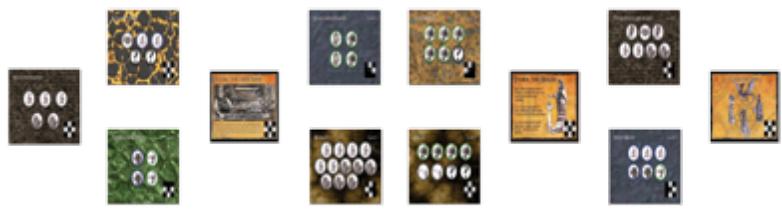
During the exploration phase after successfully completing the previous room, the Overseer flips over the next room card(s). If there are two room cards, the players are allowed to choose which room to enter.
Added Rules: Room Exits
In the bottom right corner of each of the room cards there is a box describing the available room exits. Using these room exits, more complex catacombs can

be set-up. The letters signify which direction the heroes may leave the room if the successfully overcome the monsters (N=North, E=East, S=South, W=West). Not all of the room cards allow the heroes to leave in all directions, therefore the heroes will sometimes be limited in their choices. To travel between rooms, the room exits of both rooms must match.
Variant Configuration #3: Labyrinths
This variant allows for a much longer and more challenging Catacombs adventure. The game length of this variant may be much longer than the original game, depending on the size of the Catacomb. In this variant, the Overseer creates a maze for the heroes prior to starting the game. It is the Overseer’s job to ensure that the heroes can travel between the rooms from the starting room to the Catacomb Lord and also to balance the rooms so that the players can at least reach the Merchant and the Healer successfully.
Prior to starting the game, the Overseer arranges the layout for the catacomb using the room cards and placing them face down, except for the starting room, which should be placed face-up. The Overseer should start with a Level O room and end the layout with the Catacomb Lord card special room card. At least one Healer special room card and the Merchant special room card should also be used in the layout. It is also recommended that each room card be accessible to the heroes. Consult the sample layout below for a basic example:
SAMPLE LABYRINTH LAYOUT (END OF GAME)
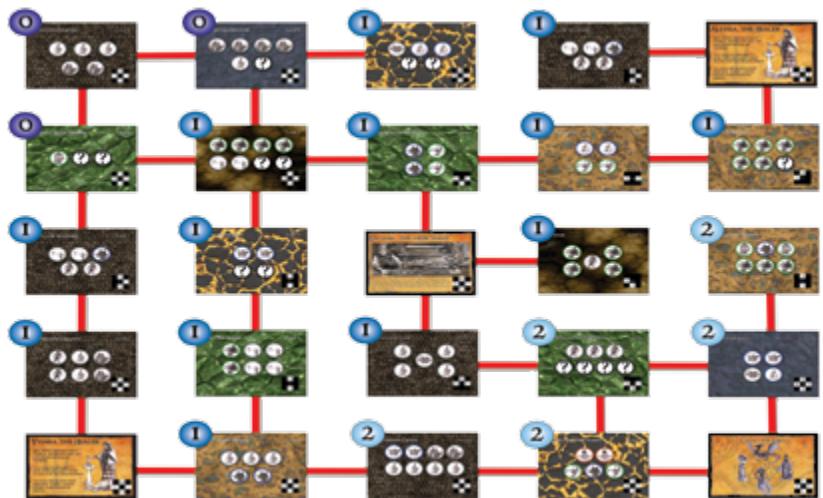
The red lines indicate the direction that the heroes are able to travel between rooms. As you can see in this example, every room is accessible and a path exists for the heroes to reach Catacomb Lord. The numbered circles in the left hand corner of the room cards indicate the level of the room card.
During the exploration phase, the heroes choose a valid room exit from their current room and flip over the adjacent room card, if one exists. If the room exits match (North to South or East to West) then the heroes enter that room and set-up continues as normal. If the room exits do not match, the heroes turn the card back over, face down. The heroes may then choose another direction and flip over the adjacent room card. In some cases, the heroes may need to travel back in the direction that they came from and re-play a previous room that they have already explored.
If the heroes enter a room that they have previously explored, they will encounter half of the monsters described on that card (rounded down). The Overseer chooses which monsters he wishes to place for the heroes to fight and play continues as normal. Players can also re-enter the special rooms such as the Healer and the Merchant to purchase additional items or to receive further healing. If the heroes re-enter the Merchant after purchasing items, the remainder of the item cards should be shufled into the deck to determine which items are available for purchase (maximum items available to purchase is still limited to six). Further, in this variant, the Merchant will not ofer any discount to the heroes for purchasing items; all items must be purchased at their original price even the first time that they enter the Merchant room.
The size of the Catacomb will greatly afect the dificulty of the game for the heroes. The size will also depend on various factors, such as the skill of the heroes, the skill of the Overseer, the room cards chosen for the make-up of the Catacomb, as well as the desired game length. The above sample set-up typically requires approximately 90 to 120 minutes to play. It mostly consisted of level 1 room cards. As an Overseer, it will take practice to design Catacombs that are challenging but not too dificult for the heroes.
The Map item may be removed from the starting items at the start of the game as it will remove much of the challenge of this version; however, it is up to the players and the Overseer whether to include this item in the game.
These rules may be the starting point for other ideas and even greater adventures. Feel free to be as creative as you would like as in designing layouts and modifying any of these rules as needed to fit the style of play for your group.
Download MarkdownTexts are community-compiled or publicly released by publishers; copyright remains with the original authors. For personal reference only.