
Chariot Race
At a glance
Rules, cards and Q&A (Chinese)
The rules, card data and player questions for this game are written in Chinese. Open the Chinese page to read them.
Where to find full rules
Full rules and card lookup are available in the cunlema app at cunlema.cn — pick this game and ask about any rule, card or turn you are unsure about.
Related games
Rulebook text (Markdown)
This game has 1 rulebook Markdown file(s) in our library; 1 rendered inline below — expand to read or download.
Peg_ChariotRace_Rules_EGG.md21.8 KB
CHARIOT Race
A furious racing game for 2 to 6 daring charioteers ages 8 and above by Matt Leacock
INTRODUCTION
Masses of people awaiting a spectacle... scorching afternoon heat... sweaty equine bodies nervously yanking their harnesses. There it is, the starting signal! Dashing ahead with your chariot, slowly at first, but, quickly gaining speed... circling the spina in the center of the arena to complete the first lap.... The next corner comes closer.... Glancing back, one of the chariots is already far behind, and, just ahead, another chariot's speed is too high for the corner, sending the vehicle crashing into the wall and out of the race. Only a single chariot blocks your path to victory. It's time to get uncivilized. Steadily you balance the javelin in your hand, waiting for the other charioteer to come into view... or should you just overtake him and throw caltrops in his path?
COMPONENTS
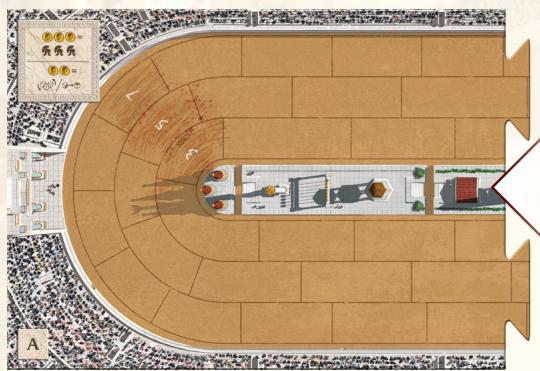

1 double-sided Game Board (A & B) in two parts

6Chariots in player colors (requires assembly before the first game)

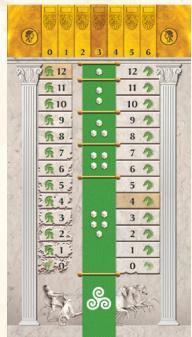
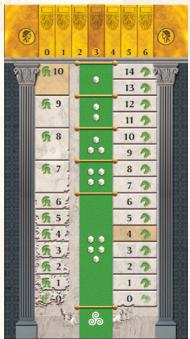
6 double-sided Chariot Boards in player colors Front side has white columns; reverse side has black columns
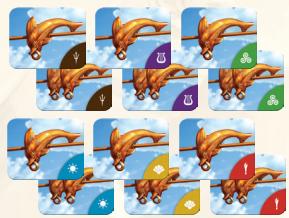
6 double-sided Round Counters in player colors

20 Caltrop Markers
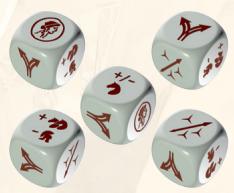
5 Dice
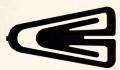
18 Pointer Clips
Players participate as charioteers in a great race in ancient Rome. Use the dice to complete two laps on the dusty arena's circuit and be the first to steer your chariot over the finish line. You will accelerate, brake, and skillfully change lanes. Sometimes you will even
SETUP

Chariot Boards
attack your opponents: either directly by hurling javelins or indirectly by dropping caltrops in their path. If the favor of Fortuna is with you, you can repair your chariot right in the middle of the race, which is often desperately needed.
Chariot Boards
The Chariot Boards
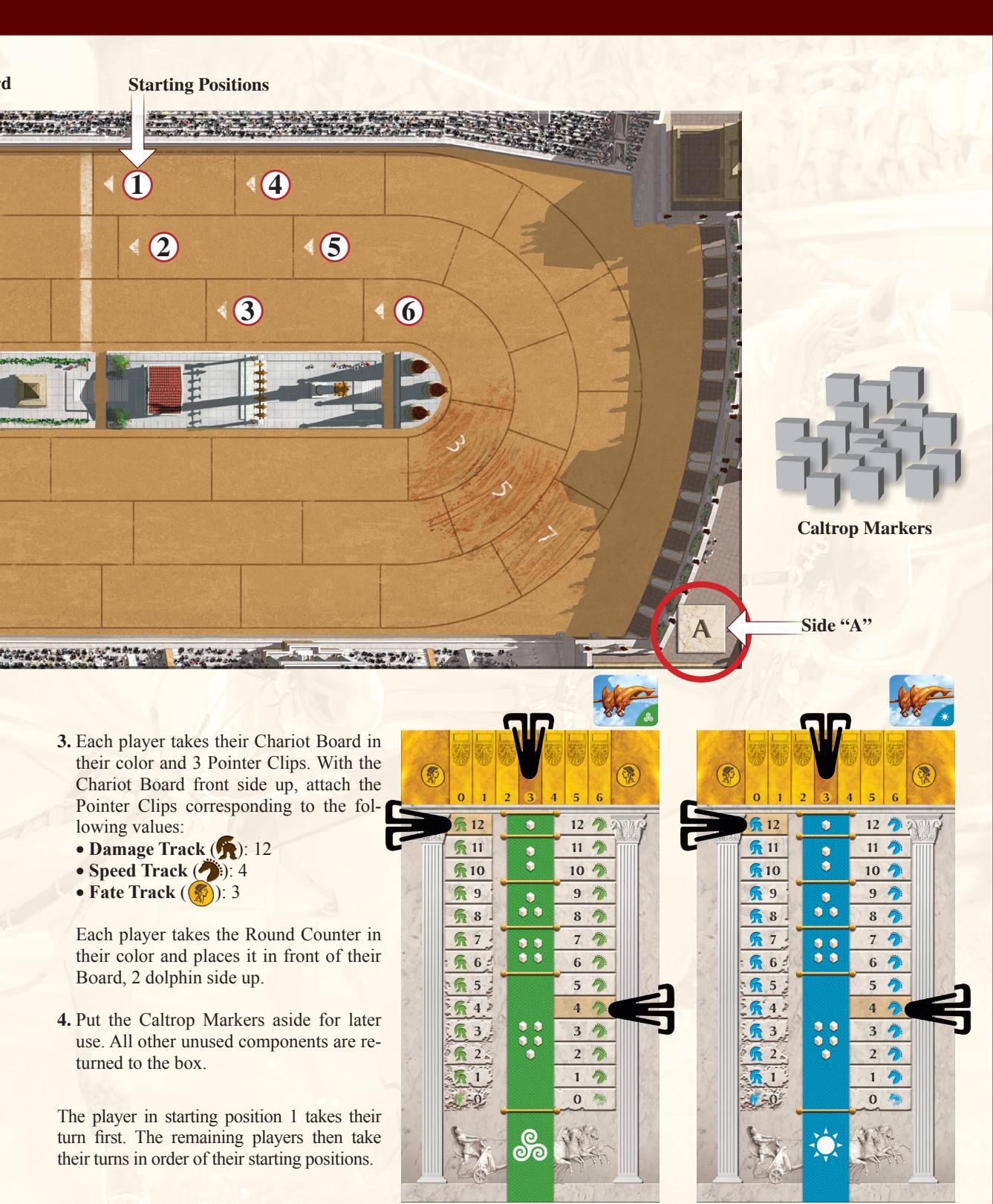
Before the game begins, each player puts their Chariot Board in their choice of color in front of themselves with the front side up. The Pointer Clips will be used to indicate each player's current values for their chariot. This information along with their current position on the game board, gives each player an overview of how well they are doing in the race. Each Chariot Board displays three tracks:
The Damage Track (indicated by a) shows how much damage your chariot can take. A 12 indicates that the chariot is in perfect shape. If the Damage Track ever reaches 0, the chariot is wrecked and is out of the game.
The Speed Track (indicated by a) shows the current speed: the value indicatedshows thenumberofspaces yourchariotmustmove inthisturn. This track also indicates how many dice you will have to use this turn. (The higher your speed, the less control you'll have over your chariots!)
NOTE: At the start of each of your turns, your Initial Speed must not be higher than the Damage Value on your Damage Track; if the Damage Track is marked lower than the Speed Track at this time, you must lower the value of your Speed Track to match the Damage Track. See also "Phase 2: Adjust Initial Speed", on page 5. Damage you receive while moving does not affect your speed, unless your Damage Track goes to 0 and your chariot is wrecked.
The Fate Track (indicated by a ) shows your current standing with the Goddess Fortuna. Her powers can be used to repair your chariot (see "Phase 1: Repair", on page 5), re-roll dice, or turn dice to a side of your choice (see “Phase 3: Roll Dice", on page 5).
None of the 3 values may ever exceed their maximum value.
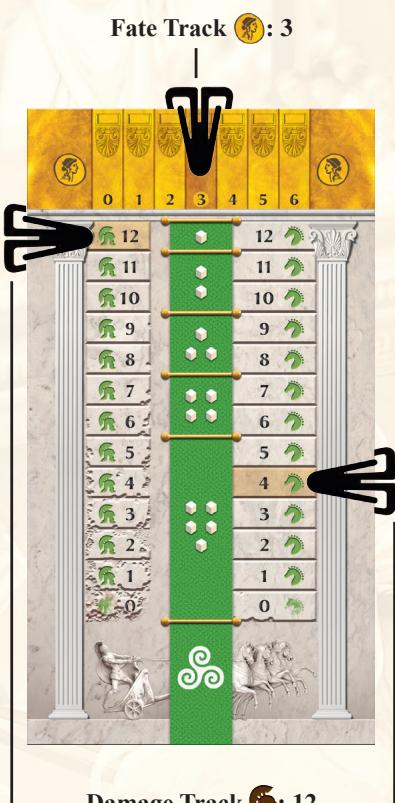
Damage Track R: 12
Speed Track 4
FLOW OF PLAY
Players take 1 turn per chariot per round. The order in which the players take their turns depends on their position on the game board. The player of the chariot that is furthest ahead (see the front border of the space) will take their turn first. Each other player will take their turns based on being further ahead of the players behind them, until the player who was furthest behind takes their turn to end the round.
A turn consists of the following 6 phases:
-
Repair (optional)
-
Adjust Initial Speed
Front line
-
Roll Dice
-
Obtain the Favor of Fortuna
-
Move
-
Attack (optional)
After carrying out 1 turn for each chariot, check to see if at least 1 chariot has completed 2 laps (See End of Game, page 7.) If not, continue to the next round of play.
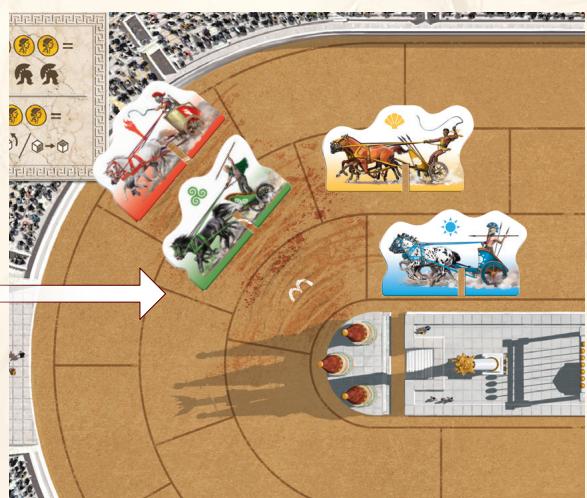
Alma, Benedict, Caesar, and Diana are playing a fourplayer game. A new round has begun and the players' positions are as illustrated above. Player order for this round will be: 1st Caesar (green); 2nd Benedict (red); 3rd Diana (yellow); 4th Alma (blue).
Phase 1: Repair (Optional)
Before you roll the dice, you may spend exactly 3 points from your Fate Track to repair up to 3 points of damage on your chariot.
Phase 2: Adjust Initial Speed
At the start of this phase your Initial Speed must not exceed the Damage Value on your Damage Track. If your Initial Speed is higher, adjust the Pointer Clip on the Speed Track to match the Damage Value.
Your Speed Value also defines the number of dice you have to roll on your turn.
Phase 3: Roll Dice
Your Initial Speed determines how many dice you have to roll. Roll the exact number of dice specified for this speed on your Chariot Board. Then, you may re-roll any number of your dice for free once.
If you are not happy with this result, Fortuna can allow you to roll again, but this will diminish your favor. You may spend 2 points from the Fate Track of your Chariot Board, to either (A) re-roll any number of dice or (B) turn 1 die to a side of your choice (except to the side with the ). In both cases you may also choose dice you have already set aside when you decide to re-roll dice or turn a die to the side of your choice.
You may manipulate dice results as long as you can pay the cost from your Fate Track before each adjustment.
Phase 4: Obtain the Favor of Fortuna
Bathe in Fortuna's glory! For each , rolled, you may adjust your Fate Track 1 step to the right. (Note that you never can exceed 6 points on your Fate Track.)
Remember to adjust the Pointer Clip on your Damage and Fate Tracks accordingly.
You may only repair once per turn.

Example: at the start of her turn and after Repair, Alma has an Initial Speed of 9 and a Damage Value of 6. She must now reset the Value on her Speed Track down to 6 to match her Damage Value. She will now have 4 dice to roll for her turn.
Do not forget to adjust your Fate Track each time you spend points. NOTE: If you don't have enough points on this track to pay, you cannot manipulate the dice. (You cannot use Fortuna dice results rolled this turn, as they have not yet been added to your Fate Track.)
An overview of all of the dice symbols can be found on page 7. Unused dice results in a turn cannot be saved for later; they are lost without effect. The following sections describe how the dice results may or must be used. (Put dice to the side as you use them.)
You may spend points from your Fate Track to repair your chariot (see “Phase 1: Repair", above) or to manipulate dice that you have already rolled (see “Phase 3: Roll dice").
Phase 5: Move
First, determine your speed for this turn:
For each $\overset { + / - } { \pmb { \mathscr { D } } }$ rolled you must either (your choice) add 1 point to your current speed or subtract 1 point. Adjust your Speed Track accordingly.
For each ${ } _ { \underline { { - } } \underline { { \hbar } } . } ^ { + \infty }$ rolled you must increase your current speed by 2 points. This short dash tires your horses causing you to take 1 point of damage. Adjust your Speed and Damage Tracks accordingly.
If you rolled several dice with ${ \pmb { \zeta } } ^ { + / - } \operatorname { a n d } / 0 \Gamma _ { - } ^ { + \infty }$ first calculate the total of all speed changes before you adjust your tracks.
You may never increase your speed above the allowed maximum of the track. For example, if your current speed is 11, and you have rolled a $\mathbf { \Pi } _ { - \hbar } ^ { + \prime \prime \mathbf { D } }$ which would bring your speed to 13, you will end up with a speed of 12 – the rest is lost. (You will still have to take 1 damage for the die result.)
For each point of speed on your Speed Track you now must advance 1 space on the Game Board. (The space you are currently on does not count.) There are 3 special cases:
Changing Lanes
Usually you must stay in your current lane. However, if you roll , you may change to a space in an adjacent lane as part of your movement. For each symbol rolled you may change lanes a single time. The front border of the space you move to must be further ahead of the space you moved from. The lane change costs you 1 point of speed, as usual.
Cornering
Cornering at a wild gallop is not really a bright idea! High speeds mean significant damage in corners. All numbered corner spaces indicate the maximum safe speed when you enter these spaces. Ending your movement in such a space counts as entering the space. For each point of speed exceeding this value you must take 1 point of damage. Adjust your Damage Track accordingly.
Ramming
If you move through a space occupied by another chariot, your chariots will ram each other. Both chariots involved in the ramming each take 2 points of damage. (Their respective Damage Tracks must be updated accordingly.) If the player of the ramming chariot still has speed points left, they must continue their movement as usual. The rammed chariot stays in its space.
If the ramming chariot ends its movement on a space with a rammed chariot: the ramming is completed as described above and the ramming chariot is placed on the first unoccupied space in the same line behind the rammed chariot. The rammed chariot stays in its space.
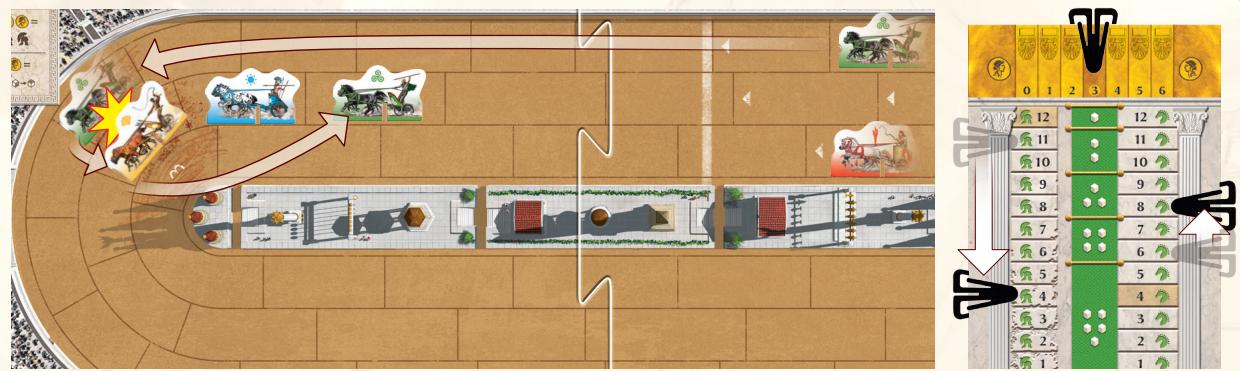
Movement example: on his turn, Caesar (green) has reached the Move Phase and has rolled the following dice results:

He has an Initial Speed of 6 and his chariot can still take 11 points of damage. First, Caesar determines his speed for this turn: he uses both ${ \bf \bullet } _ { { \bf 7 } } ^ { + / - } ,$ to simultaneously add and subtract 1 point to his speed that results in a Speed increase of 0. He must also use the $^ { + } _ { - \infty }$ This increased his Speed by 2, but he has to take 1 point of damage. As a final result, he now has Speed 8 and Damage 10 and updates his Speed and Damage Tracks accordingly. Now Caesar carries out his actual movement: he first uses 7 speed points to move forward in his lane, which puts him in the outer corner space that only allows a maximum speed of 7. So he must now take 1 point of damage (8 current Speed – 7 allowed Speed).
He can deal with that! And now, since he can, he decides to use his last remaining point of speed in combination with the $\curlyvee$ to change lanes to enter the corner space in the middle lane. This damages him again due to the maximum Speed allowance (8 current Speed – 5 allowed Speed) = 3 more damage. In addition, since this space is occupied by Diana's chariot (yellow), he rams her chariot and takes another 2 points of damage for the ram. As he has now used all of his movement allotment, this ends his turn. Since the space is already occupied, he must now place his chariot on the next unoccupied space behind Diana, which means he has to choose the space behind Alma (blue). Note: He does not ram Alma with this placement. Overall, this maneuver was quite expensive for Caesar, but he will also benefit by the elimination of an annoying opponent: Diana must also take 2 damage from the ram; and, since these were her last 2 points on her Damage Track, her chariot is wrecked and she is out of the game. At the end of his Move Phase, Caesar's Chariot Board looks like shown above.
Phase 6: Attack (optional)
If you have ever watched any movies showing an ancient chariot race you know this: victory is not achieved by speed, boldness, and skill alone! Sometimes you have to take direct measures against your opponents!
For each rolled you may attack once. The possible attacks are (Á) Drop a caltrop or (B) Throw a javelin.
A) Drop a Caltrop
You could decide to use your to drop 1 caltrop behind your chariot. [Caltrops, as used by the Roman army, are iron devices composed of four spikes, that no matter how they land on the ground rest on three spikes and keep the fourth upright.] Take 1 of the Caltrop Markers from the supply and place it on any one space through which you have moved on this turn.
You cannot put a Caltrop Marker on the starting or ending space of your movement in a given turn. In addition, no space may have more than 1 Caltrop Marker.
End of Round
After carrying out one turn for each chariot, check to determine if the end of game condition has been met. If not, continue to the next round. The next round's player order is determined by the position of the chariots on the Game Board. It does not matter in which lane a chariot is located. Starting with the player furthest ahead, each player
Wrecking Your Chariot
If the value on the Damage Track of a chariot ever falls to 0, it immediately is wrecked and is out of the game. Remove the chariot from the Game Board and put 1 Caltrop Marker on the space where the chariot was destroyed. It represents the wreckage of the failed chariot. The Caltrop Marker is treated like any other caltrop you usually drop by means of a (see above "Drop a Caltrop").
END OF GAME
The game ends at the end of the round in which at least 1 chariot has finished its 2nd lap and crosses the finish line (immediately put your Round Counter back in the box). Each player still in the game will have a chance to complete their turn for this round. A player who finishes the race by completing their second lap alone is the winner! If several chariots finish their second lap in the same round, the winner is the chariot that has moved the furthest distance after crossing the finish line (compare the front borders of the spaces, as usual).
Of course, you may still ram or throw a javelin in this final round to wreck a chariot and kick it out of the game! If all chariots have wrecked and are out of the game, there is no winner. And if all other chariots are out of the game, the final chariot must still finish the race according to the normal rules (though this player usually has no problem winning the race.)
If any chariot (including your own) moves through a space containing a Caltrop Marker or ends its movement there, it takes 1 damage. (This chariot's player has to adjust their Damage Track accordingly.) Then, remove the Caltrop Marker from the board and put it back into the supply.
B) Throw a Javelin
On the other hand, you could decide to use your to throw a javelin at another chariot in range of the thrower. You may only target a chariot that is up to 2 spaces away from you in any direction (including your rear). The javelin automatically hits the targeted chariot causing 1 damage. The player of this chariot must update their Damage Track accordingly.
Range is determined similar to movement so the space you are currently on does not count. You may also throw “over" other chariots and over caltrops. You are not allowed to throw a javelin until you have completed the Move Phase.
whose chariot is further ahead (compare the front borders of the spaces) will take their turn before players behind, until the last player completes their turn. When you cross the finish line on the racetrack for the first time (do not count the crossing at the start of the game), you have completed your first lap. Turn your Round Counter to the reverse side (1 dolphin!). The final lap still is in front of you!
If your chariot ever causes another chariot to wreck due to you ramming it on the final space of your move, place your chariot into the next available space in your lane (behind the rammed chariot). Then, remove the wrecked chariot and put the Caltrop Marker into its space.

The Dice Symbols:
Normal movement (x1). You must add or subtract (your choice) 1 point of speed.

Sprint (x1). You must add 2 points of speed, and you also must take 1 point of damage.

Steer (x2). You may change lanes to an adjacent lane. Each lane change consumes 1 point of speed.

Attack (x1). You may drop 1 caltrop or throw 1 javelin at any other chariot in range.

Obtain the Favor of Fortuna (x1). Adjust your Fate Track 1 step to the right.
VARIANTS
Games With 2 and 3 Players
In games with 2 or 3 players, each player controls 2 Chariots and Chariot Boards at the start of the game. All other rules are unchanged.
No Damage After Crossing the Finish Line
If all players agree to play with this rule, you may not damage a chariot that has finished its 2nd lap and completed its turn.
Alternate Racetrack
The racetrack on the reverse side of the game board (marked with a "B") has a new feature: stone heaps. Each lane has at least 1 of these. A careless charioteer who attempts to move into or through a stone heap space crashes into it. The Chariot is wrecked and is immediately out of the game (see "Wrecking Your Chariot" above, page 7). If you want, you can also combine a B-side with an A-side and vice versa.
Alternate Chariots
After you have played several games with the white column side of the Chariot Boards, you may want to try the reverse sides (with black columns). The chariots pictured on this side all have different characteristics and use the following rules:
Setup:
-
Regardless of the number of players, place all 6 Chariot Boards on the table, reverse side up.
-
Randomly select a player to first choose 1 of the Chariot Boards; this player also takes the corresponding Chariot as well as 3 Pointer Clips.
Then, in clockwise order, each of the other players chooses 1 of the remaining Chariot Boards (plus the corresponding Chariot Piece and 3 Pointer Clips).
If you play with 2 or 3 players, choose your 2ⁿd Board in counter-clockwise order, starting with the player who was the last to choose their 1st Chariot Board.
3. Now determine the starting positions:
4-6 players: the player who was last to choose a Chariot is the first to choose any starting position from the marked spaces of the game board. Then, in counter-clockwise order, all other players do the same.
2-3 players: the player who was last to choose their 1st Chariot, chooses any starting position for this Chariot from the marked spaces of the Game Board. Then, in counterclockwise order, all other players do the same for the Chariot they chose first. Then, the player who was last to place their 1st Chariot on a starting position, is the first to choose a starting position for their 2nd Chariot. Then, in clockwise order, all other players do the same for their 2ⁿd Chariots.
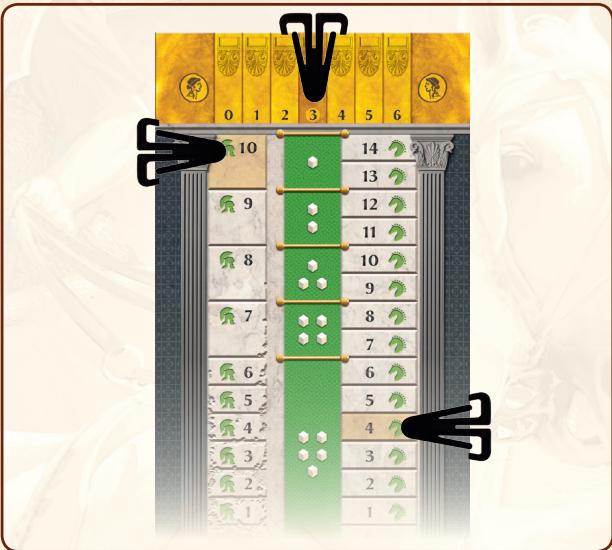
- Attach the Pointer Clips to the Tracks of your chosen Chariot Boards. The values you have to start with are highlighted in color.
5. Put all unused components back into the box.
Game play
Use the standard rules of the game. When using the green, purple, and yellow chariots, when you drop your Initial Speed, use the higher of the two Speeds in sections of the Speed Track that span two Damage Values. For example, if Caesar (green) had a Speed of 11 and a Damage Value of 8, at the start of his next turn he would adjust his Initial Speed to 10 (not 9).
CREDITS
Designer: Matt Leacock
Illustrations: Jarek Nocoń
Graphic Design: Jarek Nocoń, Hans-Georg Schneider
Translation: Michael Kröhnert
Game Development: Jan Christoph Steines und Benjamin Schönheiter
Playtesters: Duncan, Micki, Neil and Nico Christiansen, Matt Crawford, Anna, Colleen and Donna Leacock, Chris and Kim Farrell, Kate Frichette, Rich Fulcher, Beth Heile, Joe Huber, John Knoerzer, Scott Mackey, Brian and Lisa Modreski, Siew Siang Neo, Kevin O'Hare, Janice Pang, Jos, Ken and Kip Tidwell, Lisa Towell Special Thanks to: Ralph H. Anderson
© 2016 Pegasus Spiele GmbH, Am Straßbach 3, 61169 Friedberg, Germany. © 2016 Eagle-Gryphon Games, 801 Commerce Dr. Leitchfield, KY 42754 United States
Reprinting and publishing of game rules, game components, or illustrations without the license holder's permission is prohibited.All rights reserved.

Texts are community-compiled or publicly released by publishers; copyright remains with the original authors. For personal reference only.