
Code 777
At a glance
Rules, cards and Q&A (Chinese)
The rules, card data and player questions for this game are written in Chinese. Open the Chinese page to read them.
Where to find full rules
Full rules and card lookup are available in the cunlema app at cunlema.cn — pick this game and ask about any rule, card or turn you are unsure about.
Related games
Rulebook text (Markdown)
This game has 1 rulebook Markdown file(s) in our library; 1 rendered inline below — expand to read or download.
Code 777 Rules.md8.0 KB
CODE777
30TH ANNIVERSARY LIMITED EDITION
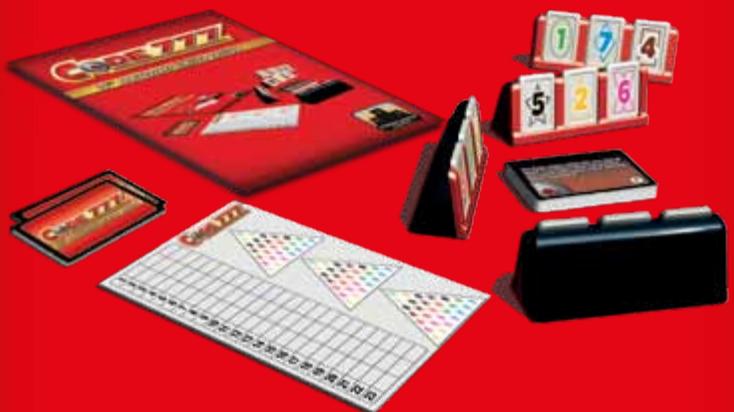
Contents
28 plastic Tiles
5 custom plastic Tile Racks
23 Question Cards
2 Question Summary
Cards
5 CODE 777™ cards
1 color Notepad
1 Rulebook
Preparation
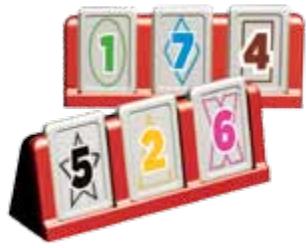
Each player receives a rack, a sheet from the notepad, and a Code 777 card. They place the rack in front of them with the side on which the tiles are to be placed pointing away from them. Shuffle the 23 question cards and lay them face down in a stack. Mix the tiles well and lay them face down. The question cards and the tiles are placed in the center of the table. Each player then draws three tiles and places the tiles on the rack belonging to the player to their left, making sure that this player does not see the numbers. Each player can now see the numbers of all their opponents but not those in their own rack.
Object of the game
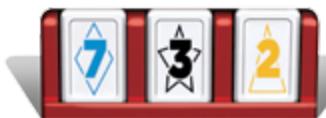
The object of the game is for the players to discover, as quickly as possible, what numbers are on their own rack. This is done by using the information obtained from the question cards.
Playing the game
Randomly select a player to begin. The player who has been selected takes the top question card from the stack, reads it out loud and answers the question. The question is answered by reviewing the numbers that the player can see and not about the numbers on their own rack. Here are some example answers:
“Do you see more blue sevens or more sevens of a different color?” The answer could be: “More blue” or “More of a different color” or “Just as many” (the latter answer applies if there are the same numbers of sevens or if there are no sevens at all). Don’t say how many of either color, as that is not what was asked.
“How many numbers do you not see at all?” The answer could be: “Three”, if for example you didn’t see any 1s, any 2s, and any 5s on all the visible racks. Don’t say which numbers you don’t see.
Each answer gives everyone, except the reader, a little bit more information.

Question cards that have been answered are placed in a discard pile, and if all the question cards are played, the cards are reshuffled and used again.
If a player thinks that they know the numbers on their rack, they can announce this at any time, and then say what the numbers are. They only have to say what the numbers are, not the colors. If two or more players announce at the same instant that they have a solution, then the player to the right of the card reader gives their solution first (and so on counter-clockwise).
One point is awarded for a correct solution. A solution only counts as correct if all three numbers have been guessed correctly. No points are scored for a wrong solution. In both cases the tiles are taken out of the player’s rack, placed out of play, and are then replaced by three new ones, naturally without letting the player see the new numbers.
If you guess correctly, then you get to see your code. This could help you if you knew the numbers, but not the colors, and therefore you can mark your sheet definitively with the tiles you had.
If you guess incorrectly, then you do not get to see your code. You do not get rewarded for an incorrect guess by getting more information on the tiles that you had.
In both cases, of course, all other players get a little more information, as the rack of the player who guessed is replenished with new tiles.
Draw Pile Refreshing
When you are about to replace the 3 tiles in any rack, if there is only ONE tile left in the draw pile, immediately bring all of the out-of-play tiles back into play, randomize them with the one remaining tile, and create a new tile draw pile. Then continue to replace the 3 tiles in the rack as above.
Note that, since no one gets to see the final tile before a reshuffle, no one will ever have “perfect information” on all the other tiles in the game, and therefore be able to make a “perfect guess”.
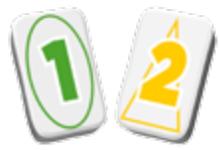
Note: The shapes and colors on the tiles are consistent, that is all green numbers have a circle, all yellow numbers have a triangle, etc. The shapes have been placed on the tiles for the benefit of those who are colorblind. They have no other game effect.
Ending the game
The first player to score three points is the winner.
Tips
The Code 777 cards have a diagram showing all the possible numbers in the game in the right color.
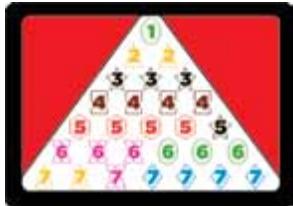
Diagrams are also printed on the notepad sheets. How to best use the Notepad is completely up to the players, since each player will want to take notes on the questions and their potential guesses in a different way. However, as a general rule of thumb, you might consider using the Notepad as such:
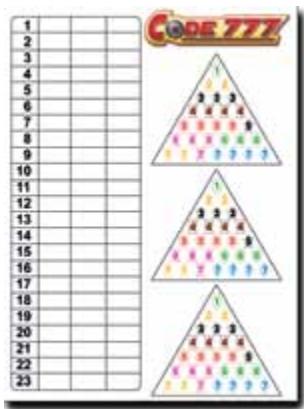
• In the Pyramid of numbers, scratch off any tiles you can SEE. You know you don’t have any of the tiles you can see.
• Also in the Pyramid, make a slightly different mark on the numbers that you THINK you don’t have (or you have DE-DUCED that you don’t have). Since you may be making a guess here, you might want to know the difference between what you definitely saw on another rack and what you believe you know (or what you have reasoned by logic that you cannot have).
• Use one Pyramid per shuffle of the tiles. When the tiles that were put out of play are brought back into play and shuffled to create a new draw pile, it is likely a good time to start using a new Pyramid. On the new Pyramid, make sure to mark all of the tiles that you can see currently.
• The numbers from 1 to 23 running down the left of the Notepad correspond to the 23 Question Cards, which are numbered from 1 to 23. When another player asks and answers a question, you can make a small note next to the number of the question for later reference. Just as with the Pyramids on the Notepad, you may also want to use a new column each time the tiles are reshuffled into a new draw pile, as the answers to the questions will change dramatically at that time.
Less than 4 players
If there are only three players, tiles are still placed on 4 racks. The rack without a player is visible to all the players. The tiles in this rack are replaced every time there is a correct solution. Four racks are also used if there are only two players and the tiles on one of the racks without a player are replaced each time a correct solution is given.
With 2 players, the player whose turn it is determines which of the 2 racks with no player gets refreshed.
Variants on “Draw Pile Refreshing”
To make the game more difficult, as a variant, you can perform the reshuffle when FOUR or SEVEN tiles are remaining in the draw pile. As you increase this number from the standard ONE tile to FOUR tiles or SEVEN tiles, you increase the difficulty of Code 777. It is extremely difficult if you refresh when seven tiles are still remaining in the draw pile!
For an easier game, perform the reshuffle when zero tiles are remaining. This will provide perfect information to the players upon revealing that last tile before the reshuffle.
Production Manager: Stephen M. Buonocore Art and Layout: Bill Bricker (www.kavoc.com)
(c) 2015 Stronghold Games LLC, a Delaware USA Limited Liability Company. All Rights Reserved.
If you have any questions, please email us at:
info@StrongholdGames. com
LIKE us on Facebook: www.facebook.com/ StrongholdGames
FOLLOW us on Twitter: @StrongholdGames
To see our other great games and to sign up for our Newsletter to find out about future games, visit Stronghold Games on the web at: www.StrongholdGames. com
Texts are community-compiled or publicly released by publishers; copyright remains with the original authors. For personal reference only.