
Codinca
At a glance
Rules, cards and Q&A (Chinese)
The rules, card data and player questions for this game are written in Chinese. Open the Chinese page to read them.
Where to find full rules
Full rules and card lookup are available in the cunlema app at cunlema.cn — pick this game and ask about any rule, card or turn you are unsure about.
Related games
Rulebook text (Markdown)
This game has 2 rulebook Markdown file(s) in our library; 2 rendered inline below — expand to read or download.
rules_en_codinca_131568.md10.8 KB
来源类型:纯文本规则(非 PDF 源,早期抓取/转换产物)
说明:原文未改动,仅调整存放位置与文件名;非 PDF 扫描件,无对应原书 PDF
Codinca Rulebook | RulesPalRulesPalChatRulebookCodincaCodinca Rulebook Table of Contents Table of Contents Contents
Game Objectives
Set Up
Playing Codinca Beginning the Game
A Player's Turn
Key Discs
Matching Key Patterns
Trap Cards
Luck Tokens
Luck Action Guide
The Winner
Contents
1 Playing Board
24 Key Discs
16 Double-sided Symbol Tiles
4 Luck Action Cards
2 Luck Action Guides
1 Lock Totem
20 Luck Tokens (Red counters)
24 Trap Cards
Game Objectives
Each player will have control of a set of 4 matching Symbol Tiles.
To win players must move their tiles into a series of specific key patterns on the board (indicated on the Key Discs drawn at the beginning of the game).
Players may match the required patterns in any order.
Set Up
Set out the playing board.
Place the Lock Totem in the centre spot. This is a neutral position — no tiles are locked while the Lock Totem is on this central spot. The Lock Totem should be returned to this position each time a Lock has ended.
Set out the 16 symbol tiles on the board in the starting pattern shown on the board (use the small symbols printed on each square of the board as a guide). This starting pattern must be matched exactly in order to give each player an equal and fair starting position.
Which Tiles do I control? The symbols printed at the edge of the board tell players which tiles they control depending on how they are seated around the board. For example, the player sitting on the Earth side of the board would control the Earth tiles. The four symbols represent Earth, Air, Fire, and Water.
Separate the 24 Key Discs into their four pattern groups: line of four, block of four, four corners, and diagonal four. Place the groups separately, face down so the patterns cannot be seen. Each player then draws one disc from each of the four groups, keeping them hidden from the other players.
Once all players have selected one from each group, each player may look at their four chosen discs to see the key patterns they must achieve to win the game. Players should keep their Key Discs hidden from their opponents and only show them when they have successfully matched the key pattern shown on each (see Matching Key Patterns). Set the remaining Key Discs to one side.
Shuffle the Trap Cards then deal one face down beside each player. (Players MUST NOT look at this card.)
Give each player their Luck Tokens. This depends on the number of players in a game: 2 player game – 4 tokens; 3 player game – 4 Luck tokens; 4 player game – 5 tokens.
Give each player a Luck Action Card (used to mark any additional actions taken).
Playing Codinca
Beginning the Game
The player controlling the tiles marked with the Fire Symbol begins the game. (If no player has selected to play as Fire then the player controlling Earth begins.)
A Player's Turn
On each turn a player must: SWITCH a tile and then FLIP a tile. A player must complete BOTH of these actions on every turn.
The Switch — Switching a Tile. When Switching, a player can swap the position of any one of their own four Symbol Tiles with any adjacent tile (including diagonally). They lift the tile they wish to move, then slide the adjacent tile into the empty square and place their tile back on the board in its new position. A Switch must always include at least one of the switching player's own Symbol Tiles.
The Flip — Flipping a Tile. Once a player has made a switch they can then turn over one tile. The tile does not move position but just flips over, turning from stone to gold or vice versa. This can be either one of the two tiles just switched, or any other tile (including opponent's tiles) anywhere on the board.
Once a Player's turn has ended (including taking any additional Luck Actions if they choose to do so) play passes on to the player on their left.
NO REWIND RULE. A player may not immediately 'un-switch' two tiles which have been switched by the previous player during this round. They can however un-flip a tile flipped by the same player if they wish. The No Rewind Rule only applies to the next player to take their turn after a switch has been made. Any other players in the game are free to undo the switch if they choose to do so on that round. This rule can be overridden once per game by each player by using the Rewind Luck action (see Luck Tokens).
Key Discs
Each Key Disc carries one of the four key patterns needed to unlock the temple. Each player must match the four patterns shown on their discs with their allotted Symbol Tiles. The Discs show players whether each pattern should be formed in Stone (with all their tiles displaying the stone coloured symbol up), in Gold (with all their tiles displaying the Gold coloured symbol up) or in a mixture of both in order to achieve the match. They may be achieved in any order. (Key Patterns may be rotated to achieve a match.)
The 4 Basic Key Patterns Are:
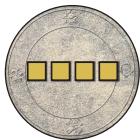
Line of four — Players must move their Symbol Tiles to form any vertical or horizontal line of four tiles anywhere on the board.
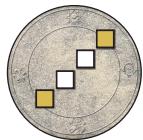
Diagonal Four — Players must move their Symbol Tiles to form any diagonal line of four tiles on the board.
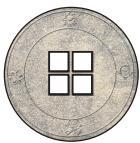
Block of Four — Players must move their Symbol Tiles to form a 2 x 2 block of four tiles anywhere on the board.
Four Corners — Players must move their four tiles into either the four corner spaces on the board or on to the four corners of any 3x3 block of 9 tiles anywhere on the board.
Matching Key Patterns
Players can only claim a key pattern at the end of their turn. They must complete a Switch and a Flip, (and take any additional Luck Actions if they choose to do so) before they claim the pattern. A player's turn ends when they claim a key pattern: they may take no further actions on that turn.
When a player successfully matches the pattern shown on one of their Key Discs, they must turn it over and show it to the other players. Once the other players have verified that the pattern on the Disc matches what has been achieved on the board the player then places that disc face down in front of them, beside the board.
Remember, players can match the key patterns in any order.
Trap Cards
Players must keep their Trap Card face down at all times. Players are not permitted to look at their Trap Card until they decide to bring it into play unless they choose to spend a luck token in order to do so. (See Luck Action Guide.)
Playing a Trap Card. A player may play their Trap Card at any time during their turn. The effects of a Trap Card must be made to the board instantly when the card is turned over.
The card should be placed face up in front of the player with the red arrow pointing towards the playing board. The player should then flip the tiles on the board as required in order to match the overall pattern shown on the Trap Card.
Traps make tiles flip from Stone to Gold or vice versa; but do not switch the positions of any tiles.
IMPORTANT: A Trap will cause any Lock in play to fail immediately (return the Lock Totem to its central spot on the board).
Luck Tokens
Spending a Luck Token allows a player to take an extra action in addition to their normal turn. The additional actions available are shown as icons on the Luck Action card and are explained on the Luck Action Guides. The additional action can be taken either before or after a player's normal turn.
When a player spends a Luck Token they should place the spent token on top of the relevant icon on the Luck Action Card. Players may spend their Luck Tokens to buy the same additional action more than once in a game (with the exception of the 'Rewind' action which can only be used once by each player in a game).
Players may spend more than one Luck Token and take more than one additional action on a turn if they wish. Players should be aware that it may be critical to winning the game that they save one or more Luck Tokens to help achieve their last Key Disc.
Luck Action Guide
A player may choose to spend one or more Luck Tokens on any turn and take one of the following actions for each token spent. These actions are taken in addition to a player's normal turn. The player should place the spent token on the relevant icon on their Luck Action Card. Players may use their Luck Tokens to take the same additional action more than once in a game with the exception of the Rewind Action which may only be used once by each player in any game.
Reveal Trap. A player may pick up and look at their trap card. They may then decide to play the Trap Card on that turn or keep it and play it on any following turn.
Line Push. Lift either end tile of any vertical or horizontal row of tiles and place it at the opposite end of the same row. Then move all tiles in that row up/across one space, until all tiles in the line are within the playing grid again.
Switch Pair. Switch the positions of any vertical or horizontal pair of tiles with any adjacent pair of tiles. Tiles may be moved vertically or horizontally but not diagonally in this action.
Rotate Block. Any 2 x 2 block of 4 adjacent tiles anywhere on the board may be rotated by 90º or 180º (clockwise or anti-clockwise).
Line Lock. Move the Lock Totem from the centre of the board onto any Red Crystal situated at the end of a vertical or horizontal row to lock that row for one full round. The locked tiles may not be moved or flipped by any player until the Lock Totem is removed and returned to the centre of the board at the beginning of your next turn.
Block Lock. Move the Lock Totem from the centre of the board onto any Blue Crystal on the board to lock the four surrounding tiles for one full round. The locked tiles may not be moved or flipped by any player until the Lock Totem is removed and returned to the centre of the board at the beginning of your next turn.
Block Flip. Turn over any 2 x 2 block of 4 adjacent tiles anywhere on the board.
Line Flip. Turn over any vertical or horizontal row of 4 tiles anywhere on the board.
Extra Move. Add an additional 'Switch' or an additional 'Flip' at the end of your turn.
Rewind. Undo a 'Switch' made by the preceding player on this round. This action may be used only once by each player for the duration of a game.
The Winner
Beginners Game. The winner is the first person to successfully match any three of the four key patterns shown on their Key Discs.
Full Game. The winner is the first person to successfully match all four of the key patterns shown on their Key Discs.
Once a player matches the last of their 4 required key patterns, they turn over their final Key Disc and are declared the winner. They have unlocked the temple of Codinca and the treasures of the ancients are theirs to plunder.
Download MarkdownCodincaEnglishRules.md6.2 KB

To win players move their tiles into a series of specific Key Patterns to match selected Key Cards.


A strategy game for 2-4 players Age 8+ Playing Time: 15 – 30 minutes by Leonard Boyd & David Brashaw © 2012 Backspindle Games Ltd.
CONTENTS
24 Key Cards
20 Double-sided Spirit Cards
16 Symbol tiles
INTRODUCTION
Deep within the rain forests of the Yucatan, rival teams of treasure hunters have discovered the lost city of Codinca. In the centre of the once great citadel stands a stone temple. Local legends tell of great treasures that lie beneath the temple but, despite weeks of searching no doorway has been found.
On the top of the temple stands a square stone altar, on it a pattern of 16 carved tiles. Examining them closely you discover an intricate series of mechanisms which allow the tiles to switch places and be turned over revealing a stone side and a gold side to each. Carvings on each side of the pillar indicate that a sequence of 4 Key Patterns must be made with the tiles to open the temple. Can you be the first to unlock the secrets of Codinca?
GAME OBJECTIVES
Each player controls one set of 4 matching Symbo Tiles; representing either Earth, Air, Fire or Water.
SET UP
• Set out the sixteen tiles on a table to match the pattern as shown inside of the box. Each player selects which set they will control.
• Separate the 24 Key Cards into their four pattern groups: Line of four, Block of four, Four corners & Diagonal four.
• Shuffle each group and deal each player one card from each group ‘face-down.’ Set remaining Key Cards aside. Players may look at their own Key Cards to see what they must achieve to win the game.
• Shuffle the Spirit Cards and deal each player three cards with the ‘Trap side’ facing downwards.
KEY CARDS
Each Key Card carries one of the four ‘Key Patterns’ needed to unlock the temple. Players must move their allotted Symbol Tiles to match the four patterns shown on their Key Cards.
The tiles must match the pattern and the colours displayed on the Key Card. (ie with the correct gold or stone coloured symbol showing).
1.
2.
3.

4.
THE 4 BASIC KEY PATTERNS ARE:
-
Line of four - can be formed vertically or horizontally,
-
Diagonal four - can be either diagonal line of 4 tiles,
-
Block of four - can be any block of 4 adjacent tiles,
-
Four corners - Four Corners can be formed with the 4 corners of the grid or with 4 corners of any 3x3 block of 9 tiles (see below).

Key Patterns may be rotated to achieve a match.
BEGINNING THE GAME
The player wearing the most gold begins the game.
Play then passes to the player on the left.
A PLAYER’S TURN
There are two basic actions a player may take on their turn.
A SWITCH
A player can swap the position of any one of their own four Symbol Tiles with any adjacent tile (including diagonally). A Switch must always include at least one of the switching player’s own Symbol Tiles.
A FLIP
A Flip is simply turning over any one tile from gold to stone or visa versa.
On each basic turn a player may take any two of those actions, choosing to do one of the following combinations as their turn:
• SWITCH a Tile, then FLIP any Tile,
• SWITCH a Tile, then SWITCH another Tile, or
• FLIP a Tile, then FLIP another tile (At least one of which MUST be one of their own Symbol Tiles.)
MATCHING KEY PATTERNS
When a player’s tiles are in the correct position to match the pattern shown on one of their Key Cards, they must show the card briefly to the other player/s for verification, then place it face down in front of them. If a player does not match one of their Key Patterns on their turn, play then moves to the next player to their left.
A player’s turn ends if they match one of their required Key Patterns.
SPIRIT CARDS
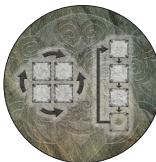
In addition to their two basic actions a player can also decide to spend one or more of their Spirit Cards on their turn.
Spending a Spirit CARD allows a player to take an extra action in addition to their normal turn.
The additional action can either be:
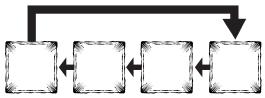
LINE PUSH, - Lift the end tile of any vertical or horizontal line and move it to the opposite end of the same line. Then move the tiles in that line by one space until all tiles fall within the grid again.
BLOCK ROTATE - Rotate any block of four adjacent tiles clockwise or anticlockwise by 90˚ or 180˚.

TRAP. - To play a Trap place the Spirit Card on any side of the grid with Trap pattern showing and the red arrow pointing towards the tiles. Then turn over the required tiles to match the pattern shown.
Traps make tiles flip from Stone to Gold or vice versa; but do not switch the positions of any tiles.
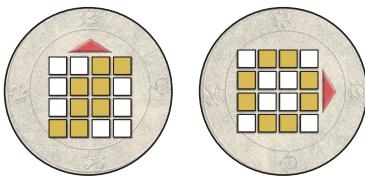
Examples of Trap patterns
NOTE: Spirit Cards can be critical to winning, particularly to help achieve the last Key Pattern.
NO REVERSE RULE
A player may not immediately undo the last single action taken by the previous player.
THE WINNER
The winner is the first person to successfully match all four of the Key Patterns shown on their Key Cards. The winner has unlocked the temple of Codinca and the treasures of the ancients are theirs to plunder.

www.backspindlegames.com
Texts are community-compiled or publicly released by publishers; copyright remains with the original authors. For personal reference only.