
Crossing
At a glance
Rules, cards and Q&A (Chinese)
The rules, card data and player questions for this game are written in Chinese. Open the Chinese page to read them.
Where to find full rules
Full rules and card lookup are available in the cunlema app at cunlema.cn — pick this game and ask about any rule, card or turn you are unsure about.
Related games
Rulebook text (Markdown)
This game has 1 rulebook Markdown file(s) in our library; 1 rendered inline below — expand to read or download.
Crossing_rules_0715_EN_PPP_BD.md7.7 KB
CROSING
A game by YOSHITERU SHINOHARA Artwork by CHARLÈNE LE SCANFF
In the kingdom of Spamootail, bumans, pixies, goblins, elves, dwarves, and fairies all live in perfect barmony.
Life is beautiful and simple in that kingdom. But on the day of the summer solstice, life stones appear on the giant mushrooms surrounding the small town of Crossing.
Gach race sends one of its inbabitants to the small town of Crossing, these stones are precious gems, so sharing isn't easy!
Do bolds are barred, including flching the stones gathered by the other players, so stay vigilant...
Contents
6 character tiles
1 bag
5 mushroom tiles
1 rulebook
60 life stones divided as follows:
◆ 18 Red
◆ 18 Blue
18 Yellow
6 White
Object of the game
Gather life stones in order to gain the most points.
Setup
Dealing cter
Each player chooses a character tile and places it in front of themselves (white-bordered side up). With fewer than 6 players, the remaining character tiles are not played and are returned to the box.

Placing mushroom tiles
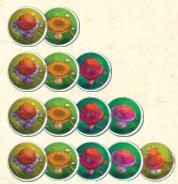
Then, the mushroom tiles are placed in the middle of the table, according to the chart below.
3 players
2 mushroom tiles
4 players
5 players
Ga
3 mushroom tiles
4 mushroom tiles
6 players
5 mushroom tiles
All of the life stones are placed in the bag.
A player who will have the task of distributing the life stones is chosen. If there's a banker at the table, that player gets the task. Otherwise, the player with the nicest jewelry will do just fine..
That player draws life stones randomly from the bag until there are two on each mushroom tile.
The game can now begin.
first turn
Count and point
The players count to three together. On three, they simultaneously point at a mushroom tile of their choice with their finger.
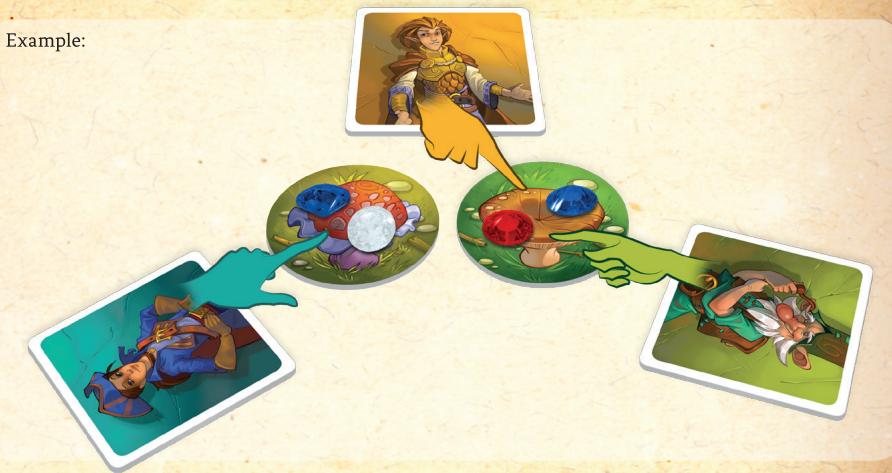
Single person pointing at a mushroom
If a player is the only one to point to a given mushroom, that player takes all of the life stones which are on it then places them on his or her character tile.
Multiple pointing at a mushroom
If two (or more) players point to the same mushroom, nothing happens and the life stones remain where they are.
The turn ends.
In the example above:

The blue human takes the stones from the mushroom.

Here, no one takes stones as multiple players are pointing the mushroom!
Reflling life stones on mushrooms
The player responsible for distribution randomly picks life stones randomly from the bag.
Distributing the stones
On each mushroom tile with at least one life stone, the player adds one.
On each empty mushroom tile, the player adds two.
NOTE: This operation occurs between each turn, until there are no life stones left in the bag (which triggers the end of the game).
If there are not enough life stones left to supply each mushroom, the responsible player distributes them as he wishes while following the rules above (some mushrooms may remain empty).
Starting on the second turn
Each new turn is played as previously explained, but players now have two new options.
FILCHING STONES
Instead of pointing at a mushroom, a player can point at another player's character tile.
Single person pointing at a character
If only one player points at this tile, that player steals the life stones on it and places them on their own character tile.
Multiple people pointing at a character
If two (or more) players are pointing at the same character tile, none of them take the life stones, which remain on the tile.
Reminder: - There's no play order! The actions of players are simultaneous.
Example:
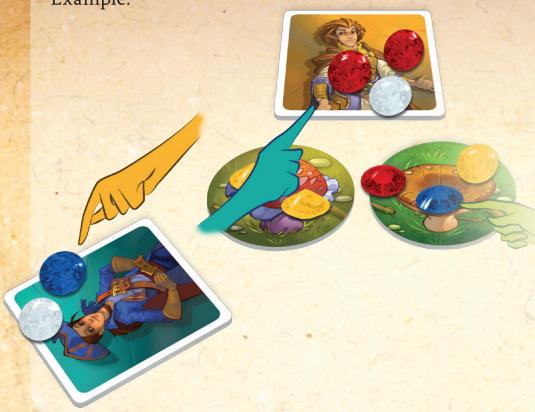
The blue human takes the stones from the yellow elf.

The yellow elf takes the stones from the blue human.
Example:
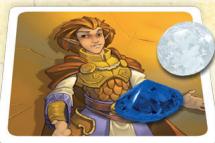


The blue human takes the stones from the green pixie..
The yellow elf takes the stones from the blue human.
The green pixie takes the stones from the mushroom.
PROTECTING STONES
Instead of pointing at a mushroom or at another character, the player can protect their life stones and claim them immediately. To do that, they cover their character tile with their hand.
Pointing protected tile
Important : If another player points at a character tile protected this way, that's too bad for them!
Example:
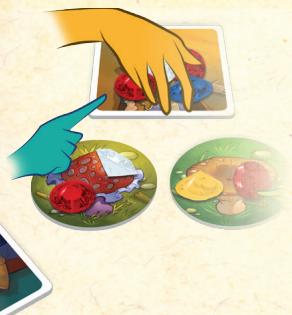



The yellow elf protects his stones and claims them.
The blue human gains nothing at all!
The protected life stones are removed from the tile and placed next to the player. They have now been claimed and can no longer be stolen.
Forced break
Players who claims their life stones flip their character tile over to the black-bordered side. On the next turn, they will not play. They are on break until the following turn. At the start of the next turn, they flip their character tile back to the side with the white border.

Example:

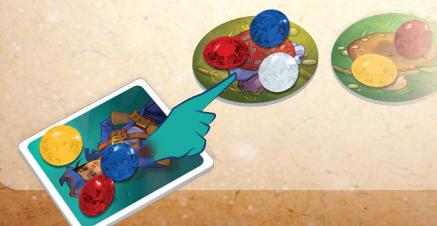

The yellow elf is on break for this turn.

The blue human takes stones.
End of the game
The game ends at the end of the turn where the last life stone is taken from the bag. It's time to tally points!
Score tallying
Each player gathers the life stones they have set aside and those on their character tile.
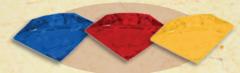
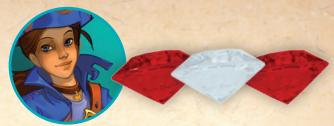
Each set of three stones of different colors is worth 5 victory points.
The white (transparent) life stones are each worth 2 victory points.

Each single colored stone (which couldn't fit in a combination of 3) is worth 1 victory point.
NOTE: The remaining life stones on mushrooms are worth nothing to players.
The Winner
The player who has the most victory points wins the game. In case of a tie, the player with the most white life stones wins. If a tie still occurs, play again!
Tips from the author: players are allowed to talk before or during the counting up to three to come to an agreement on the mushrooms to point at. But nothing's keeping you from breaking your word...Have fun!

DÉDITIONS
Published by

Texts are community-compiled or publicly released by publishers; copyright remains with the original authors. For personal reference only.