
Crusader Kings
At a glance
Rules, cards and Q&A (Chinese)
The rules, card data and player questions for this game are written in Chinese. Open the Chinese page to read them.
Where to find full rules
Full rules and card lookup are available in the cunlema app at cunlema.cn — pick this game and ask about any rule, card or turn you are unsure about.
Related games
Rulebook text (Markdown)
This game has 1 rulebook Markdown file(s) in our library; 1 rendered inline below — expand to read or download.
Rulebook_Crusader_Kings_1.1.md102.7 KB
FREE LEAGUE
Lead Your Dynasty to Tríumph
RUSADER KHNGS®
The Board Game
Rules Version 1.1
My King, the time has come. Your day is now. Are you ready to make your mark on History?
Free League Publishing and Paradox Interactive are proud to present Crusader Kings-The Board Game, based on the acclaimed grand strategy computer game. In this game, 3–5 players lead the historical dynasties of medieval Europe to triumph-or downfall.
Reshape History in your own image—if only that dimwitted son of yours set to inherit the throne doesn't spoil your grand plans..
TAKKF
Game Overview
The goal of this game is to spread your influence over medieval Europe and lead your Dynasty to triumph over its rivals. To do that, you will need to groom your family over the generations, build and develop your dominion, be shrewd in the realms of diplomacy and intrigue, and use your vassals wisely to grow your wealth and military power, while at the same time fulfilling your holy duty to partake in the crusades to the Holy Land. The winner of this game is the player who receives the most points at the end of the game.
Unless stated otherwise in the scenario, the game ends when a player has reached Jerusalem on the Crusade Track or after three Eras have been completed. When either of these two events occurs, the game is over.
Victory Points are given for territories under your control, with bonus points given for Achievements awarded for Dynasty Shields on the Crusade Track, for reaching Jerusalem, for Development Cards acquired, and for Castles built. Achievements and Scoring are described in detail on page 17.
20 Gold 30 Gold Tokens Value 5 Tokens Value 1
155 Action Cards
Components
1 Game Board

1 Rulebook
5 Player Trait Bags (colored)

5 Player Aids
70 Plastic Figures


1 General Trait Bag (brown)

40 Knights (8 for each Culture), 20 Footsoldiers (4 for each Culture), 10 Castles
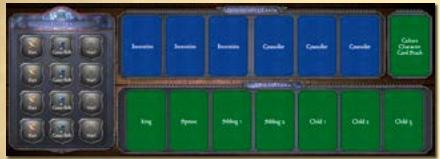
5 Family Boards
13 Dynasty Cărds
125 Character Cards
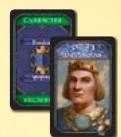
24 Starting Ruler Cards
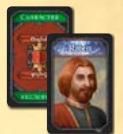
100 Culture Character Cards (20 for each Culture)
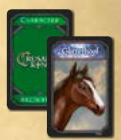
1 Glitterhoof Character Card
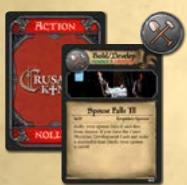
35 Realm Cards
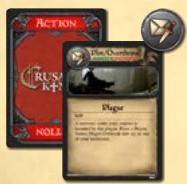
35 Intrigue Cards

35 War Cards

25 Tax Cards
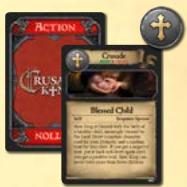
25 Crusade Cards
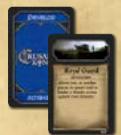
24 Development Cards

104 Dynasty Shields
12 Councilors 12 Inventions
144 Trait Tokens
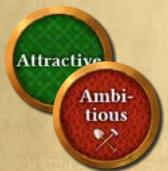
48 Starting Trait
12 Unrest Tokens

34 Event Trait Tokens
6 Plague Tokens
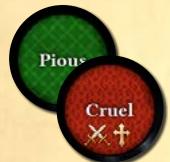
10 Crusade Trait Tokens
6 Harvest 6 Crop Tokens Failure Tokens
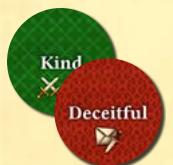
52 Random Trait Tokens
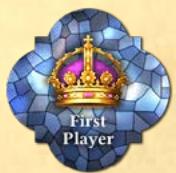
1 First Player Token




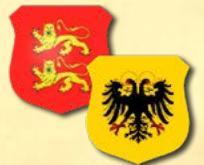
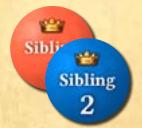
10 Sibling Duke Tokens

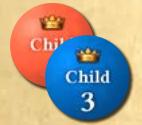
15 Child Duke Tokens
1 Inventor Achievement Token
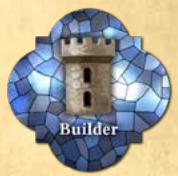
1 Builder Achievement Token
20 Age Tokens
1 Crusader Achievement Token
King of Jerusalem Achievement Token



Kings and Queens
In these rules and on the cards, the male pronouns “he” and "his" are used to designate a player of the game. This is an abbreviation and real ly means “he/she" or “his/her,” which would be too cumbersome to spell out each and every time. In the same vein, the term “King" is used to designate the leader of a Dynasty in these rules, even though it's possible for women to inherit the throne. No player should feel excluded from playing this game because of terminology—if you want to rule medieval Europe as a Crusader Queen, don't let anyone stop you!
TAKKO
Setup
-
Place the Game Board on the table, and pick a scenario from the end of this book. For your first game, we recommend “Kingdom of Jerusalem." The scenario determines when the game takes place, which Dynasties are played, and their starting conditions. Each Dynasty belongs to a Culture with a specified color—Red (English), Blue (Frankish), Black (Germanic) Green (Italian), and Yellow (Iberian).
-
Each player follows the scenario description. Each player should:
a. Place a Family Board and a Dynasty Card in front of him.
b. Place a Knight figure of his color in each territory under his control as indicated by the scenario. The Knight represents the King's vassal in the territory. Only one Knight figure can ever be placed in a single territory. Place remaining Knight figures within easy reach.
c. Place the Foot Soldier figures outside the Game Board, within easy reach.
d. Place any starting Castle figures in territories indicated by the scenario. Place remaining
Castle figures within easy reach of everyone.
Castles are all of the same color.
e. Place his starting King's Character Card on the King space on his Family Board, along with any starting spouse, siblings, and children as indicated by the scenario. Remove all starting Kings not used in the scenario.
f. Place the four Starting Trait Tokens for the King, as indicated by the scenario, in his Player Trait Bag.
g. Place Starting Trait Tokens on any Character Cards for starting siblings and children as indicated by the scenario.
h. Place the rest of his Culture Character Cards shuffled face down on the indicated space on the Family Board.
i. Place any starting Development Cards on the indicated space on the Game Board.
j. Take his starting amount of Gold and place it on his Dynasty Card.
k. Place all Dynasty Shields of the player's Dynasty within easy reach.
- The player who won the last game gets the First Player Token. If the game has not been played before by the group, the oldest player gets the First Player Token.
So, can I marry a horse in this game?
Of course you can! This is Crusader Kings, after all. Using the special Glitterhoof Character Card, you can relive the infamous equestrian event from Crusader Kings II. If you want to keep horses well away from your royal families, simply remove this card.

- Set up the Game Board according to these steps:
a. If less than five players are in the game, place Dynasty Tokens of the Dynasties not used in the scenario in all territories belonging to the same Culture as these Dynasties. These Dynasty Tokens indicate that the territories are off-limits. Off-limits territories cannot be Invaded and are not part of the game in any way.
b. Place all Random Trait Tokens in the General Trait Bag.
c. Place shuffled face down piles of the five different types of Action Cards (Realm, Intrigue, War, Tax, Crusade) on the indicated spaces on the Game Board.
d. Draw and place one random Culture Character Card on each empty territory on the Game Board (without a Knight on it), except off-limits territories. Draw these from the Character Card stack of the player whose Dynasty belongs to the same Culture as the territory. Draw one Random Trait Token from the General Trait Bag for each character on the map, and place them on the face up Character Cards.
e. Optional. If you want to include Glitterhoof in your game, replace one Character Card on an independent territory by this special Character Card. The player with the most hours played in Crusader Kings II gets to decide which territory to place Glitterhoof in. Draw a positive Random Trait Token for the horse—if you draw a negative trait, re-draw until you draw a positive trait.
f. Place a shuffled face down pile of Development Cards on the indicated space on the Game Board.
g. Draw three Development Cards and place them face up in the indicated spaces.
h. Place the Crusade Trait Tokens on the Crusade Track as indicated on the Game Board.
i. Place all Event Trait Tokens in a pile to the side within easy reach of everyone.
j. Place all Harvest, Plague, Crop Failure, Unrest, Achievement, and Succession Tokens in separate piles within easy reach of everyone.
k. Place all remaining Gold on the Treasury on the Game Board.
Sequence of Play
A game of The Crusader Kings boardgame is broken up into Eras, Rounds, and Turns. Each game consists of three Eras, unless the scenario states otherwise. Each Era consists of three Rounds. Each Round consists of two Turns. A game progresses like this:
| GRA1 | GRA₂ | GRA3 |
| ROUND | ROUND | ROUND |
| TURN TURN | TURN TURN | TURN TURN |
| ROUND | ROUND | ROUND |
| TURN TURN | TURN TURN | TURN |
| TURN | ||
| ROUND | ROUND | ROUND |
| TURN | TURN | TURN |
| TURN | TURN | TURN |
Player Order means that the player with the First Player Token goes first, followed by the rest of the players in clockwise order. Note that the First Player Token will change hands during the course of the game. When this happens, the current Turn is completed before the change in player order takes effect.
Summary
At the beginning of each Era, each player will draw eight Action Cards, of which six will be played during the Era. At the start of each Round, each player will pick two of these Action Cards to play in the two Turns of the Round, and decide which order to play them in. In each Turn, each player reveals one Action Card and performs one of the actions listed on the top of the card, and then resolves the event described at the bottom of the card.
The Gra
Draw: In player order. The player first draws any bonus cards from Crusade Track modifiers or other modifiers.
The player then draws eight (8) Action Cards to form his Hand for the Era. These eight cards must consist of 1–2 Crusade cards, 0–3 of each of the Realm, Intrigue, and War cards, and 0–2 Tax cards. The player may look at his cards only after he is done drawing.
Rounds: Three Rounds (below) are played.
Clean Up: At the end of the first and the second Eras, perform these steps:
All players discard all Action Cards that were not used during the Era, and place them face up on a shared discard pile next to the Game Board.
Remove all spouse Character Cards in independent territories and place them face up on a shared discard pile next to the Game Board. Return their Trait Tokens to the General Trait Bag. Draw new spouse Character Cards for each independent territory, and a random Trait Token for each of them.
Remove the three face up Development Cards on the Game Board, and place them face up on a shared discard pile. Draw three new Development Cards and place them face up on the indicated spaces.
Then, a new Era starts with a draw phase.
At the end of the third Era, the game ends immediately. Go to End the Game and Scoring (page 17).
The Round
-
Dynasty Phase: Each player, in player order, may make one attempt to Marry his King, a sibling, or a child (see page 10), or Adopt a child (see page 11), and may then grant and/or revoke any number of Duke and Duchess titles (see page 11).
-
Plotting Phase: Each player decides secretly which two Action Cards from his Hand to play this Round. These two cards are placed in front of the player, face down, with the card to be played first on top. If this is the third Round of the Era and a player has not yet played a Crusade card, he must do so now.
-
Turns: Play two Turns (below).
-
Upkeep Phase: Follow the three steps below. a. Troop Costs: All players pay 1 Gold for each territory under their control that is Mobilized (i.e. contains a Foot Soldier). If a player can't or won't pay for a territory, it is automatically demobilized. Remove the Foot Soldier and place an Unrest Token in the territory.
b. Demobilization: Each player may now demobilize any number of Mobilized
territories under his control. Simply remove the Foot Soldiers.
c. Age Tokens: All players place one Age Token on their King's Character Card.
If this is the King's fourth Age Token, the player may remove one Trait Token of his choice from his Trait Bag. If it's a Random Trait Token, return it to the General Trait Bag.
If this would be the King's fifth Age Token, the King instead dies peacefully. Perform a Succession Ceremony according to the rules (page 21).
After the third Round, return to the Clean Up phase of the Era (above).
The Turn
Each player, in player order, reveals one of the two Action Cards chosen during Plotting (above). The top card must be played in the first Turn of the Round, and the bottom card in the second Turn.
The player first resolves one of the actions indicated at the top of the card. Once the action is fully resolved, the player reads the event below the image on the Action Card and resolves its effects. The Action Card is then placed in the shared discard pile.
STRATEGY TIP:
War Takes Planning
When choosing your Action Cards for the Era, remember that war takes careful planning. Before you can Invade an enemy, you need both a Casus Belli and to Mobilize your armies. That means that going to war is a process that takes three Turns to complete: First, you need to Plot to Manufacture Casus Belli (unless you already have it), second you need to Mobilize Foot Soldiers in adjacent provinces, and third, you can Invade.
STRATEGY TIP:
Don't Crusade Too Early
When picking your two Action Cards to play in a Round, be careful not to Crusade before you have an heir to your throne. Without an heir, you'll need to send your King on the Crusade, and if he dies, a Succession Crisis will be triggered. That's not a good way to start your game!
General Rules
The Golden Rule
This rule means that if any information on a card says something different than what is written in the rules, the information on the card applies.
Trade
A player may initiate a trade with another player at any point time. Players are allowed to trade anything, barring these exceptions:
Territories that are involved in an action or event already revealed but not yet resolved cannot be traded.
* Character Cards can only be traded as part of a Marry action.
* Pacts cannot be traded. A Pact can only be created by marriage.
Trait Tokens can never be traded.
Action Cards can never be traded.
The Trait Bags
Players are allowed to look inside their own Trait Bags at any time. A player cannot demand to look inside another player's Trait Bag.
Supply of Tokens, Fígures and Cards
The included tokens and figures are the limit the players have to navigate. If a certain kind of token or figure becomes depleted, they cannot gain that type of figure or token any more. The only exception to this are the Dynasty Shields -should these run out, use any replacement.
All included cards can be reshuffled from their respective discard piles into new draw decks in case they run out.
TAKKO
Actions
A player performs an action by first choosing two Action Cards from his Hand during the Plotting phase of the Round, and then playing them one after the other in the chosen order during the Action phase of the Turn. The player must first perform one of the actions listed at the top of the card, and then resolves the event written below the image on the card. The player can choose not to perform any Action at all, but he must still resolve the event on the card.
Trait Check
A player may at any time examine the Trait Tokens in his own Trait Bag. A player may not, however, examine another player's Trait Bag. Some actions—such as Develop, Mobilize, and Tax-are completed automatically. Other actions require a successful trait check to be completed.
A trait check means that the player draws one random Trait Token from his Trait Bag, without looking. If the Trait Token drawn is for a positive trait (green), the trait check is successful. If the token drawn is negative (red), the trait check fails. (However, see Critical Traits below.) Some difficult actions require the player to draw several positive tokens in order for the trait check to succeed.
As soon as the trait check is successful, a player may not draw any more tokens, even if he was allowed to make more draws. Drawn Trait Tokens are only placed back into the Trait Bag after the trait check has been fully resolved.
Critical Draws
For each action, one specific negative trait means success when drawn in the trait check, and one specific positive traits means failure. Such traits are called critical traits, and are indicated on each Action
Card, as well as in the description of each action below. Simply put, a critical trait counts as the opposite color when drawn for a particular action.
Every Trait Token with a trait that is critical for any of the eight core actions of the game has one or more symbols printed on it to indicate this:

Critical trait for Build

Critical trait for Plot and Overthrow

Critical trait for Invade

Critical trait for Crusade

Critical trait for Marry
Sacrificing Critical Traits: If a player draws a green critical trait, i.e. a failed draw, he may choose to sacrifice this trait. That means that the draw counts as a success instead (only this draw, not the entire trait check if several successful draws are needed), but the player must permanently remove the Trait Token from his Trait Bag. This can be a good option if a player really needs to succeed at a particular check.
Conversely, if a player draws a negative critical trait, i.e. a successful draw, he can also choose to sacrifice the trait. He then fails this draw, but in return he gets to permanently remove the Trait Token from his trait bag. This can be a wise choice if a player wants to improve his trait bag at the cost of a failed draw.
Modifiers
Several different factors may affect a trait check. These include Dynasty Shields on the Crusade Track, Development Cards, and events on Action Cards. Such factors can allow a player to draw additional or fewer Trait Tokens than normal, or require him to draw additional or fewer successes to complete the trait check.
Invest in Success
As a general rule, a player may pay Gold to draw more tokens in a trait check. For each Gold spent, a player gets one additional trait draw. This Gold must be paid before any Trait Token is drawn, and once the first Trait Token is drawn, no more Gold can be spent on the trait check.
Note that the standard “free" draw is always just one, so if the player is required to draw more than one green or critical Trait Token to succeed, he must either have modifiers that allow more free draws, or spend Gold to have a chance to succeed.
A player may never spend Gold beyond what would give him two more draws than the required number of successes in the trait check.
EXAMPLE
Player A wants to Incite Unrest in Player B's territory. The territory has a Castle. Player A needs two successful draws. If he pays nothing, he has no chance to succeed (since he only gets to draw one Trait Token for free). Player A may not pay more than 3 Gold, which would give him four draws (two more than the required two successes).
Sabotage
Other players may pay Gold to sabotage a player making a trait check. They can work together to do this. 2 Gold paid by other players will negate 1 of the acting player's Gold. This procedure is only done once. The acting player pays, others may pay against him, and then the trait draw is resolved.
Only draws generated by paying Gold can be negated in this way—never free draws, nor draws generated by modifiers. In addition, sabotage can never reduce the number of draws below the number of successes needed to have a chance to succeed at the trait check.
Exception: Overthrow and Plot actions cannot be sabotaged (except the Murder plot if the target player has the Royal Guard Development Card).
EXAMPLE
Player A wants to Murder the King of Player B—a difficult task that requires three successful trait draws to complete. Player A has the Spymaster Councilor. Player A gets one base trait draw, one additional trait draw from the Spymaster, and pays the maximum 3 Gold, for a total of ive draws (two more than the required number of successes). Player B has the Royal Guard Development Card and thus can spend Gold to sabotage the Murder. Unfortunately he has no Gold at the moment, but he convinces Player C to help him. Player C pays 4 Gold to remove two trait draws. He cannot pay more, as Player A must retain at least three draws (the minimum needed to have a chance to succeed).
The trait check fails. Player B's King survives, and he now owes Player C a big debt of gratitude.
Discard Pile
Each played Action Card is placed face up in the players' shared discard pile. Discarded Action Cards are not used in the game again, unless a stack of Action Cards on the Game Board is depleted. In this case, take all discarded Action Cards of the corresponding type (Realm, Intrigue, War, Tax, or Crusade), shuffle them, and place them face down in a new stack on the Game Board.
Specíal Actions
The three special actions, Marry, Adopt, and Grant Title, are performed in the Dynasty Phase the beginning of each Turn, before the Action Cards for the Turn is played.
Marry (Trait Check) Critical Traits: Chaste, Lustful
Marriage is key to making a Dynasty prosper—both as a means of forming powerful alliances, and to give a King heirs to inherit the throne. In the Dynasty Phase at the start of a Round, each player may attempt to Marry one unmarried King, Queen, sibling, or a child on his Family Board.
A marriage proposal can be directed to A) a face up potential spouse Character Card in an independent territory on the game map, B) to an unmarried King, Queen, child, or sibling in another player's Dynasty, or C) to a spouse with a random trait from any player's stack of Character Cards.
Marriage proposals can only be made to members of the opposite sex (this is medieval times, after all).
To Marry a Character Card in an independent territory, a trait check is only needed if the target Character Card has a positive (green) Trait Token on it. A marriage proposal to a character with a negative (red) Trait Token is automatical ly accepted. If the marriage proposal is successful, the player forms a Pact with the territory that the spouse Character Card was placed in. Place the player's Dynasty Shield in the territory to indicate this. Read more on Pacts below. To Marry a King, sibling, or child of another player, that player only needs to give his consent. A King and a (ruling) Queen can never be Married to each other, however. A dowry may be negotiated. If the other player accepts the proposal, a Pact is formed between the two Dynasties. This immediately ends any state of War or Casus Belli that the players have against each other. Each player places the other player's Dynasty Shield on the Pact symbol on their own Family Boards.
To Marry a spouse from any player's stack of Character Cards, a trait check is needed. If successful, the player picks any Character Card of the opposite sex from the card stack chosen. Reshuffle the stack and then return it to the Family Board. Draw a random Trait Token for the spouse. Marriage to a spouse in a card stack does not create a Pact—it represents marrying a lesser noble and is usually a last resort if there are no other spouses available.
A New Family Member: After a successful marriage proposal, the Character Card of the newlywed spouse is placed on the player's Family Board. If the King is the one getting Married, the Character Card of the spouse is placed in the Spouse field and its Trait Token is immediately placed in the player's Trait Bag.
Children and Siblings: If a child or sibling is Married, the Character Card of the spouse, along with its Trait Token, is placed underneath the child's or sibling's Character Card on the Family Board (or on the game map, if the child or sibling is a Duke or Duchess—see Grant Title below). If the child or sibling later inherits the throne, its spouse is placed in the Spouse field. Both characters' Trait Tokens are then placed in the player's Trait Bag.
Marriage Between Dynasties: When a King of one player marries the child or sibling of another player, the child is always transferred to the King's Dynasty, no matter which player made the proposal to Marry. In a marriage between children or siblings of different players, it is up to the players to negotiate which Dynasty that the newlywed couple will belong to. A Pact is automatically formed nonetheless.
Pacts: A Pact is a powerful alliance between two Dynasties or between a Dynasty and an independent territory. A Pact has three effects:
If another player (outside the Pact) Invades an independent territory in a Pact, or a territory under the control of a Dynasty in a Pact, the (other) Dynasty in the Pact immediately gets Casus Belli against the Invading Dynasty. A Pact can thus be used as a “trigger" for Casus Belli.
Trait Tokens of Children
Until married children and siblings inherit the throne, place the cards so that it is clear which Trait Token is associated with each particular Character Card.
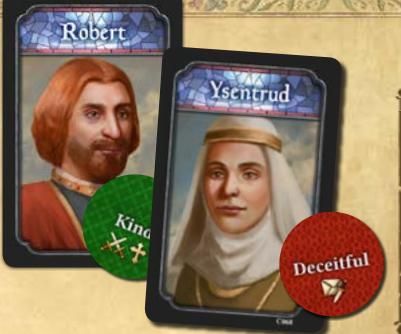
When a player in a Pact performs the Invade action, he gets an additional trait draw if the independent territory in the Pact, or a territory under the control of the other Dynasty in the Pact, is adjacent to the target territory of the Invasion. Read more under Invade (page 14).
A player who has a Pact with an independent territory can annex this territory with an Invade action. This works like a normal Invade action, but requires no trait check.
A Pact can never have more than two parties. A Dynasty can, however, have Pacts with several different independent territories and/or Dynasties—even with Dynasties that have Casus Belli against each other or are At War. Read more about Pacts, and how to break them, on page 20.
Divorce: Divorce is generally prohibited by the church, but by using a Plot action (below), a player may manufacture a just cause to annul a marriage of his King, a sibling, or a child. Read more under Plot on page 13. After a divorce, the spouse Character Card is removed from the Family Board and discarded.
Lost Spouse: If a King is divorced or if his spouse dies, the Trait Token of the spouse remains in the player's Trait Bag—the spouse has made a lasting impact on the Dynasty. If a child or sibling is divorced or its spouse dies, the Trait Token of the spouse is removed.
Adopt a Child (Automatic)
If a player's King has a spouse but no children, he may Adopt a child in the Dynasty Phase of the Round. At a cost of 2 Gold, the player draws a random Character Card from his own stack and places it on the Child 1 space on his Family Board. The player then draws a random Trait Token for the child and places it on the Character Card.
Grant Title (Automatic)
By granting Duke or Duchess titles to siblings and children of the King, a player can strengthen his Dynasty. But it comes at both cost and risk.
In the Dynasty Phase at the start of the Round, each player may grant a title of Duke or Duchess in territories under his control to any number of siblings and children of the King, or revoke such titles. Granting or revoking a Title requires no trait check.
The Duchy: A Duke/Duchess title must be granted in a specific territory under the player's control, which is then called a Duchy. Only one title can be granted per territory. When a title is granted, the player places a Duke Token of his color on the Duchy territory on the Game Board to indicate this. Use the Duke Token with a number corresponding to the position of the child or sibling on the Family Board. A Duke or Duchess has several effects:
For an enemy to Incite Unrest in a Duchy, Invade it, or Overthrow it, an additional success in the trait draw is required.
Glitterhoof
The horse Glitterhoof, of Crusader Kings II fame, is a special Character Card in this board game. During setup, a Character Card in an independent territory can be replaced by Glitterhoof. The horse is an eligible spouse for the Marry action. Both men and women can Marry Glitterhoof. Glitterhoof always has a positive trait. However, a King or Queen married to the horse cannot have children.

If a Duchy is Overthrown or Invaded, the Duke/Duchess is killed, along with any spouse.
When Invading from a Duchy, the player must place the Trait Token of the Duke/Duchess in the Trait Bag before the trait draw. Immediately after the draw is complete, remove this Trait Token from the Trait Bag and return it to the Character Card. Take care to remember which trait the Duke/Duchess has before placing the Trait Token in the Trait Bag.
Revoking a Title: During the Grant Title action, a player may also revoke any number of Duke or Duchess titles. Simply remove the Duke Token from the Game Board. In addition, a Duke/Duchess title is immediately revoked (no action required) in the following situations:
The Duke/Duchess inherits the throne and becomes a King/Queen.
The Duke/Duchess is Married to a character from another Dynasty and the character is moved to the other player's Family Board.

The Realm Cards: Build/Develop
Critical Traits: Humble, Ambitious
With a Realm Action Card, a player can perform either the Build or the Develop action.
Build (Trait Check)
To Build a Castle requires a trait check. If successful, it costs the player 3 Gold to complete the Castle, in addition to any Gold spent on getting extra draws. The player places a Castle figure on the board, in any territory under his control that doesn't already have a Castle.
A player may Build any number of Castles as part of the same action, in separate territories. All attempts must be declared before any trait check is made. Each individual Castle requires a separate trait check and a cost of 3 Gold to complete if the trait check is successful. A Castle has two effects: It makes the Invade and Overthrow actions * It makes the Invade and Overthrow actions
harder to accomplish in the territory.
When the player Taxes a territory with a Castle, it generates 1 extra Gold.
If a player loses control of a territory, the Castle remains, and can be used by other players who seize control of the territory.
Develop (Automatic)
This action always succeeds and never requires a trait check. The player may buy one, two, or all three Development Cards that lie face up on the track on the Game Board. The first card costs 1 Gold. The second bought in the same action costs 2 Gold, and the third card bought in the same action costs 3 Gold. When the player is done buying, he draws new Development Cards to refill the slots for the ones he bought.
There are two types of Development Cards: Councilors and Inventions. A player may only have three cards of each type on his Family Board. If a fourth card of either type is bought, one of the three cards of the same type already owned must be discarded. Furthermore, only one of each card may be owned (i.e. a player cannot take a Navy twice).

The Intrígue Cards: Plot/Overthrow
Critical Traits: Honest, Deceitful
With an Intrigue Action Card, a player can perform either the Plot or Overthrow action. As a general rule, other players cannot sabotage Intrigue actions by paying Gold (see page 9), since they occur from the shadows.
Plot (Trait Check)
Using the Plot action, the player may choose one of the five plots listed below. A failed Plot means that a player targeted by the Plot immediately gets Casus Belli against the plotting player. A successful Plot never gives Casus Belli against the plotting player.
Multiple Plots: A player may attempt multiple Plots as part of the same Plot action, by paying extra Gold. The second Plot costs 1 Gold to attempt (in addition to any Gold spent on getting more draws), the third Plot costs 2 more Gold to attempt, and the fourth Plot costs 3 additional Gold to attempt. Resolve one Plot before declaring the next. No more than one Plot of the same type may be directed at the same territory or character in a single Plot action. No more than four Plots in total can be attempted in a single Plot action.
MANUFACTURE CASUS BELLI
A Casus Belli—a cause for war—is required before a player can Invade a territory controlled by another player. A Casus Belli against a Dynasty applies to all territories under the control of that Dynasty.
If the Plot is successful, the player receives Casus Belli against the Dynasty. To indicate this, the player places the Dynasty Shield of the target Dynasty on a Casus Belli symbol on his own Family Board.
INCITE UNREST
This Plot causes Unrest in a territory that is adjacent to a territory under the player's control, and that is not Mobilized. If a player has the Spymaster Development Card, he can Incite Unrest in any non-Mobilized territory on the board.
For each of the following factors that apply, the player needs an additional success in the trait draw for the action to succeed:
* There is a Castle in the target territory.
* The target territory is a Duchy (it has a Duke/ Duchess character in it).
If the Plot is successful, an Unrest Token is placed on the territory. This means that the territory can be Overthrown, using the Overthrow action. A territory can have several Unrest Tokens on it. An Unrest Token can be removed in several ways:
A player Mobilizes the territory. This removes all Unrest Tokens.
The Marshal Development Card is used.
* An event that removes an Unrest Token.
The territory is Overthrown.
MURDER
This Plot can be used to kill any face up Character Card or Councilor in the game, including a player's own cards. If a Murder succeeds, the victim is killed (see page 18). Three further rules apply:
* To Murder the current heir to a throne (see page 21), two (2) successes are required.
* To Murder a King, three (3) successes are required.
A King cannot be Murdered in the first Round of the game.
Royal Guard: When a player Murders, other players can spend Gold to negate Gold spent by the player on his trait check only ifthe victim of the Murder is from another Dynasty than the player's own and if that Dynasty has the Royal Guard Development Card. The player spending Gold doesn't need a Royal Guard, it is sufficient that the victim's Dynasty does.
BRIBE
The Bribe action can be used to steal Councilors from rival Dynasties. In addition to a successful trait check, the player needs to spend 2 Gold to complete the Bribe action. These 2 Gold are in addition to any Gold the player has invested in the trait check to make additional trait draws If successful, the Bribing player can simply take a Councilor Development Card from the target player's Family Board.
A player may not Bribe a Councilor of a type that he already has himself.
DIVORCE
Divorce is generally prohibited by the church, but with this Plot, a player may manufacture a just cause for annulling a marriage. If successful, the spouse of the King, sibling, or child is removed from the game as if it had died. The Trait Token from a King's spouse remains in the player's Trait Bag even after a divorce. A Trait Token of a spouse divorced from a sibling or child is removed.
A Divorce Plot does not give any other player Casus Belli if failed.
Overthrow (Trait Check)
The Overthrow action causes such upheaval in the target territory that the Dynasty controlling the territory loses its control.
The target territory needs to have an Unrest Token on it, and it must be adjacent to a territory under the control of the Overthrowing player (unless the player has the Spymaster Development Card).
For each of the following factors that apply, the player needs an additional success in the trait draw for the action to succeed:
There is a Castle in the target territory.
The target territory is a Duchy (it has a Duke/ Duchess character in it).
If the Overthrow is successful, the target player's Knight is removed, along with the Unrest Token. Any Duke or Duchess in the territory is killed. The target territory is now independent. Draw a random spouse Character Card according to the Culture of the territory and place the card on the territory with a random Trait Token on top of it.
If the Overthrow fails, only the Unrest Token is removed, and the target player gets Casus Belli against the player attempting the Overthrow.
Multiple Overthrows: A player may attempt several Overthrows as part of the same Overthrow action, by paying extra Gold. The second Overthrow costs 1 Gold to attempt (in addition to any Gold spent on getting more draws), the third Overthrow costs 2 more Gold to attempt, and the fourth Overthrow costs 3 additional Gold to attempt. Resolve one Overthrow before declaring the next. No more than one Overthrow may be directed at the same territory in a single action. No more than four Overthrows in total can be attempted in a single action.

The War Cards: Mobilíze/Invade
Critical Traits: Kind, Cruel
Using the War Action Cards, a player can raise troops and attack other territories. To be able to Invade another territory, the player first needs to:
Have a Casus Belli against the Dynasty controlling the territory, or be At War with the Dynasty. (Casus Belli is not needed to Invade an independent territory.)
Have a Mobilized territory adjacent to the territory that he is Invading.
This means that the player will need to perform at least one other action (Mobilize), and often two other actions (Plot and Mobilize), before he can Invade. War takes careful planning!
Sea Passage & Navy: Normally, for territories to be “adjacent," they must share a land border. However, territories connected by sea passages (the dotted lines on the map) also count as adjacent. In addition, the Navy Development Card makes all of the player's coastal territories “adjacent” to all other coastal territories in the same ocean (North Sea, Atlantic Ocean, Mediterranean).
Mobilize (Automatic)
To Mobilize means that the King calls on his vassals in a territory under his control to make their forces available to Invade another territory, or to defend against an attack.
The Mobilize action always succeeds and requires no trait check. After the Mobilize action, one or more of the territories under the Player's control is Mobilized. Place a Foot Soldier of the player's color in the chosen territories (next to the Knight) to indicate this. No more than one Foot Soldier figure can ever occupy the same territory. Any Unrest Tokens are immediately removed when territory is Mobilized.
A player may Mobilize as many of his territories as he likes with a single action—but he can never have more than four (4) Mobilized territories at the same time.
Mobilizing has no immediate cost, but each Mobilized territory will cost the player 1 Gold in the Upkeep phase at the end of each Round. The player may remove the Foot Soldier (and thus demobilize the territory) in the Upkeep phase, but only after its cost has been paid.
Invade (Trait Check)
The Invade action is the most aggressive move a player can make—he sends his army into a territory controlled by another player (or an independent territory), and tries to take control of it by military force.
If the player has several Mobilized territories (see Mobilize above), he can perform one attack with each of them with a single Invade action. He can, however, only attack the same territory once per Invade action. The player must declare which Foot Soldiers do what (attack or support, see below) in the Turn before any trait draws are made.
Requirements: To be able to Invade a territory, the player must:
Be At War with the Dynasty controlling the territory, or have a Casus Belli against the Dynasty. Independent territories can be Invaded without Casus Belli.
Have Mobilized a territory adjacent to the territory that he is Invading (see the text on sea passage and Navy above).
If the requirements are met, both players place the other's Dynasty Shield on the “At War" space on the Family Board. Make a trait check to see if the Invade action succeeds.
Defense: For each of the following factors that apply, the Invading player needs an additional success in the trait draw for the action to succeed: There is a Castle in the target territory.
The target territory is Mobilized (there is a Foot Soldier in it).
The target territory is a Duchy (it has a Duke/ Duchess character in it).
Other modifiers (from Development Cards, Action Cards, or the Crusade Track).
Support: If the Invading player has Foot Soldiers in several territories adjacent to the target territory, he may use the additional Foot Soldiers to support the attack. Each additional Foot Soldier used in the attack gives an extra trait draw. A Foot Soldier used to support an attack cannot be used in another attack during the same Invade action.
Navy Limit: Even if a player with a Navy Development Card has Foot Soldiers in several coastal territories, only one such Foot Soldier can be used in a single Invade action against another coastal territory.
Pact Support: Additionally, when a player in a Pact (see page 20) Invades, he gets an additional trait draw if the independent territory in the Pact, or a territory under the control of the other Dynasty in the Pact, is adjacent to the target territory. If the Invading player has several Pacts, he can get several extra trait draws this way. Note that no Foot Soldier is needed for Pact support.
Giving Pact support to an Invade action against a Dynasty gives the target Dynasty Casus Belli against the supporting Dynasty. To prevent this, the supporting player in a Pact may choose to instead immediately break the Pact and withhold his support for the Invasion. The Invading player then immediately gets Casus Belli against the player who broke the Pact.
Modifiers from Development Cards, events on Action Cards, and the Crusade Track may give the Invader extra trait draws for free.
Victory: If the Invade action succeeds, any enemy Knight and Foot Soldier figures in the target territory are removed, and a new Knight from the Invading player's supply is placed in the territory instead. The Invading player may also, if he so wishes, move one Foot Soldier figure that took part in the attack into the target territory as well, thus Mobilizing this territory and demobilizing the territory from which the Foot Soldier came.
Pillaging: After a successful Invade action, a player may choose to pillage the target territory. The player then gains 2 Gold, but an Unrest Token is placed in the territory. The player may only choose to pillage if the attacking Foot Soldier is not moved into the target territory.
Characters: If a territory with one or several Character Cards on it is successfully Invaded, the characters are killed. This applies both to potential spouses in independent territories and Dukes/ Duchesses and their spouses.
Counterattack: If the Invade action fails, and if the target territory has a Foot Soldier figure on it, the player controlling the territory may immediately counterattack and perform an Invade action against one territory that took part in the failed Invade attempt. This includes other players' territories that supported the invasion as part of a Pact. The counterattack Invade action does not count as an action. It follows the normal Invade rules in all other respects, except that a player is not allowed to counterattack a counterattack.
Annexation: A player who has a Pact with an independent territory can annex this territory with an Invade action. This works like a normal Invade action, but requires no trait check—it succeeds automatically. Annexing a territory still requires using a Foot Soldier in an adjacent territory.
Control Limit: A player can never control more than eight (8) territories. If a player acquires a ninth territory, he must relinquish control of any territory under his control and remove the Knight figure from it. This territory becomes independent—draw a random spouse Character Card and place it on the territory, with a random Trait Token on top of it.
The Tax Cards
The Tax Action Cards is the main source of income in the game.
Tax (Automatic)
The Tax action does not require a trait draw. Taxing produces 1 Gold for each territory under the player's control (i.e. 1 Gold for each of his Knight figures on the board), plus 1 Gold for each Castle in a territory under his control. Certain tokens in the territory, Dukes and Duchesses, events on Action Cards, Crusade modifiers, and Development Cards can modify how much Gold a player receives when he Taxes.
Harvest: When a territory with one or more Harvest Tokens on it is Taxed, the player receives 1 additional Gold from that territory and removes one Harvest Token.
Crop Failure: When a territory with one or more Crop Failure Tokens on it is Taxed, the player receives no Gold from that territory but instead removes one Crop Failure Token.
Plague: When territory with a Plague Outbreak Token on it is Taxed, it produces no Gold. Instead, the Taxing player removes the token and makes a trait check (no critical traits) for each adjacent territory—even territories not under his control. Each territory that fails the trait check receives a Plague Token with the Outbreak Over side up, as well as an Unrest Token. Any Foot Soldier in the territory is removed. When a territory with the Outbreak Over side up is Taxed, it produces no Gold. Instead, the Plague Token is removed.
Multiple Tokens: If there are several different tokens in the territory, each type is dealt with separately. For example, one Tax action may remove one Harvest Token and spread one Plague Token. Harvest Tokens removed at the same time as a Plague or Crop Failure Token produce no Gold.

The Crusade Cards
Critical Traits: Kind, Cruel
To partake in the quest to redeem the Holy Land is a holy duty that a Crusader King cannot neglect. All players must take at least one Crusade Card at the beginning of each Era. One—and only one—Crusade action must be performed before the Era ends. A player may not perform more than one Crusade action in a single Era, unless he has the Archbishop Development Card (at the time of choosing cards for the Round).
Crusade Action (Trait Check) When performing the Crusade action, the player must any male member of his royal family to join the Crusade. If a player has no male family members at all, he can and must send his ruling Queen. Glitterhoof can be sent to the Crusade.
A trait check is required. If the Crusade action is successful, the player takes the First Player Token. The player then places his Dynasty Shield on the Crusade Track, on the lowest numbered position that is not already covered by a Dynasty Shield. If the position holds a Trait Token, the player must take it and place it in his Trait Bag.
No single player can ever have more than four Dynasty Shields on the Crusade Track at any one time. If a player gets to place a fifth Dynasty Shield for any reason, he must remove one of his previous Dynasty Shields from the Crusade Track.
Bonus Effects: After a successful Crusade action, the player also gains the bonus effect listed next to the position he just claimed on the Crusade Track. The bonus effects are cumulative. If a player loses a Dynasty Shield on the Crusade Track, the bonus effect is also lost, but the Crusade Trait Token stays in the player's Trait Bag.
Jerusalem: If a player, via a Crusade action, reached the tenth and final position on the Crusade Track (Jerusalem), the Crusade—and the game—is over (unless stated otherwise in the scenario). The Crusading player gets the King of Jerusalem achievement, and all players then immediately count their Victory Point scores and the winner is declared. See Ending the Game and Scoring, page 17).
Failure: If the Crusade action fails, the individual sent on the Crusade is killed (see Death, page 18).
TAKKF
Gvents
Each Action Card also describes an event. When a player plays an Action Card, he automatically triggers the event on the card. The event effect always occurs after the action is completed.
Events on Realm, Intrigue, War, and Tax cards are generally bad for the player playing the Action Card, or beneficial to another player. The events on Crusade cards are, on the other hand, generally bad for others or beneficial for the player himself.
Targeting and Requirements Target: Some events are marked Self. This means that the effect of the event affects the player who played the Action Card. Other events are marked Other. This means that the event affects another player. This player is generally described as the next player." Unless stated otherwise, this always means the next player in player order, i.e. the player to the left.
Requirements: Some events have a Requirement stated on the card in order to occur. If the player does not meet the Requirement of an event marked Self, the event has no effect and is ignored.
If the next player does not meet the stated Requirement of an event marked Other, the effect moves on to the next player after him in the player order, unless stated otherwise. The player who played the Action Card can never be affected by an event marked Other. If none of the other players fulfill the Requirement, the event is ignored.
Card Number: Some events target the member of the royal family with the highest or lowest card number. The card number can be found in small print at the bottom of each card.
EXAMPLE:
According to the event on the Action Card, the next player's King will have a new child, but the requirement is to have a spouse. The player next in the player order does not have a spouse, but the player after him in the player order does, so he gets the child instead.
Event Trait Draws
Some of the events on the Action Cards require separate trait checks to be made. Unless stated otherwise, a player is allowed to spend Gold to get additional trait draws on these. Other players may also pay Gold to negate your extra draws (see Trait Checks on page 8).
TANKKO
Achievements
Achievements can give players extra Victory Points. There are four achievements in the core game. The first player to reach an achievement is given the Achievement Token for it.
Crusader: Given to the first player to have two Dynasty Shields on the Crusade Track.
Builder: Given to the first player to have three Castles in territories under his control.
Inventor: Given to the first player to have four Development Cards on his Family Board.
King of Jerusalem: Given to the player who reaches the tenth and final position on the Crusade Track (Jerusalem). This immediately ends the game.
If a player falls below the requirement for an achievement, he immediately loses the Achievement Token. If another player meets the requirement, he gains the Achievement instead. If more than one other player meet the requirement, the player who is active in the situation gains the Achievement. If no such player can be identified, the next viable player in player order gains the Achievement.
If another player surpasses the player with an achievement—i.e. gains more Dynasty Shields, Castles, or Development Cards—the Achievement Token is handed over to the new leader. Only one player can have a specific Achievement Token at any given time.
TAKKKO
Endíng the Game and Scoring
Unless the scenario states otherwise, the game ends when the Crusade has reached Jerusalem, or after three full Eras have been completed. The player with the most Victory Points wins. Points are rewarded according to the below factors:
1 Victory Point for each territory under the player's control (Knights turned on their side do not count).
1 Victory Point for each Achievement Token.
In case of a tie, the player with the most Dynasty Shields on the Crusade Track wins. Still tied? Share the victory!
Game Concepts
Listed alphabetically.
Age
During the Upkeep phase of the Round, each player places an Age Token on their King's Character Card.
If this is the King's fourth Age Token, the player may remove one Trait Token of his choice from his Trait Bag. If it is a Random Trait Token, return it to the General Trait Bag.
If this would be the King's fifth Age Token, the King instead dies peacefully. Perform a Succession Ceremony (page 21).
Castle
A player can build Castles if he chooses the Build action (page 12) when playing a Realm Action Card. Only

one Castle can ever be placed in a single territory. A Castle has two effects:
* It makes the Invade and Overthrow actions harder to accomplish in the territory (requiring one extra success by the aggressor).
When a territory with a Castle is Taxed, it produces 1 extra Gold.
If the player loses control of a territory, the Castle remains and can be used by other players who seize control of the territory.
Character
A character is an individual depicted on a Character Card. Characters can be Kings, spouses, siblings, children, and potential spouses.
Control
Territories under a player's control are territories that his King rules over using his vassals. This is indicated by

the Knight figure. There can never be two Knights in the same territory. An independent territory that a player has a Pact with is not controlled by the player.
Crop Failure
A Crop Failure Token eliminates the Tax income the next time the territory it is placed on is Taxed. Instead of getting Gold from the
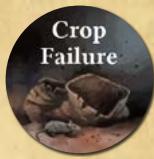
territory, the player removes one Crop Failure Token, regardless of how much gold the territory would yield. If a territory has several Crop Failure Tokens, only remove one after each Tax action.
Culture
There are five Cultures in the game, represented by a specific color:
English (red)
Frankish (blue)
Germanic (black)
Italian (green)
Iberian (yellow)
Each Dynasty specified in the scenario belongs to a Culture indicated. When placing Knights and Foot Soldiers on the Game Board, the players should use ones with the same color as their Culture.
All Character Cards also have a Culture indicated on the back. A player should only use Character Cards for his own Culture when drawing a random Character Card for a childbirth within his Dynasty.
Each territory on the Game Board is associated with a Culture, indicated by the color of the borders between the Cultures. The Culture of a territory has no effect on gameplay, except to determine which player's stack of Character Cards should be used when drawing a potential spouse in an independent territory (see page 5).
Death
When a character dies, its Character Card is discarded and has no further effect on the game. Place the card in a discard pile for the player's discard pile for Culture Character Cards, depending on which type it is. When a King dies, a Succession Ceremony (page 21) is performed.
When a character with a Random Trait Token on it dies, the token is returned to the General Trait Bag. Event Trait Tokens (with a silver border) are returned to their pile.
Díscard Piles
The game has two discard piles shared by the
players, all placed at convenient positions next to
the Game Board:
Action Cards
Development Cards
In addition, each player has a personal discard pile of Culture Character Cards for his Culture.
Discarded cards are not used in the game again, unless a stack of cards on the Game Board or Family Board is depleted. In this case, take all discarded cards of the corresponding type, shuffle them, and place them face down in a new stack on the Game Board or Family Board.
Glímínation
If a player's last Knight is removed from the board, his Dynasty is eliminated from history. Remove the Dynasty Board, discard all Character Cards on the Family Board, all Development Cards, and all Dynasty Shields, including those on the Crusade Track.
Yet, one Dynasty's loss is another Dynasty's opportunity. This makes it possible for players still in the game to place Dynasty Shields on the Crusade Track without hav
Content is long; only the first part is inlined. Download the file or open the rules page for the full text.
Download MarkdownTexts are community-compiled or publicly released by publishers; copyright remains with the original authors. For personal reference only.