
Daybreak
At a glance
Rules, cards and Q&A (Chinese)
The rules, card data and player questions for this game are written in Chinese. Open the Chinese page to read them.
Where to find full rules
Full rules and card lookup are available in the cunlema app at cunlema.cn — pick this game and ask about any rule, card or turn you are unsure about.
Related games
Rulebook text (Markdown)
This game has 1 rulebook Markdown file(s) in our library; 1 rendered inline below — expand to read or download.
Daybreak rulebook v1.0.md53.3 KB

Reference
Tags


Energy (27%)
Grid (10%)


Solar (8%)

Wind (8%)

Transportation

Nuclear (5%)


Society (25%)

Emissions
Industry
Agriculture

Buildings

Energy

Dirty Energy
Clean Energy
Setup

Geoengineering (7%)
Ecology (18%)
Incentive (20%)
Infrastructure (17%)
Innovation (11%)
Regulation (23%)
| Players | Trees | Oceans | World Powers used |
| 4 | 24 | 16 | All |
| 3 | 16 | 12 | Majority World, Europe,& US |
| 2 | 11 | 7 | China & US |
| 1 | 6 | 4 | Any (see Reference card) |

Fuel Extraction
Any type
Waste
Energy Demand
Watch our how to play video at daybreakgame.org
Resilience


Social
Ecological
Other


Oceans, Wetlands
Trees, Land, Soil
Infrastructure


Any type

Direct Air Capture

Community in Crisis

Not for Solo Play

Carbon


Player

Temperature Band
Thermometer
Recent Emissions
Planetary E!ects die

Geoengineering die
Global Project

Crisis
Local Project
Challenge
Planetary E"ects

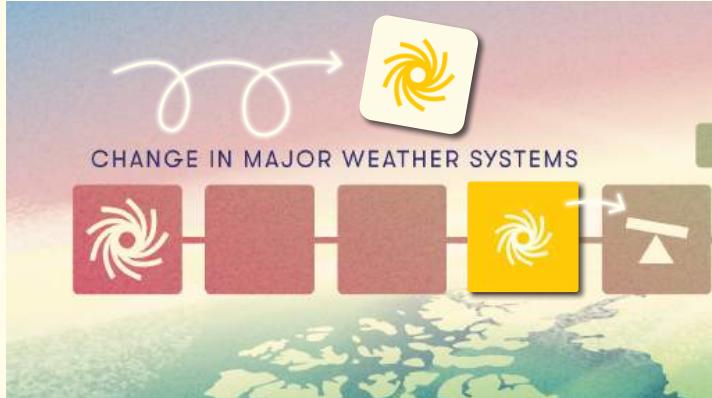
Change in Major Weather Systems: Draw 2 additional Crisis cards.

Deserti!cation: Remove 1 Tree token per player.

Ocean Acidi!cation: Remove 1 Ocean token per player.

Thawing Permafrost: Add 2 Carbon cubes per player to Recent Emissions.

Loss of Arctic Sea Ice: Add 2 Carbon cubes per player to the Thermometer.

Dieback of the Amazon: Add 1 Carbon cube per player to Recent Emissions, and remove 1 Tree token per player.
Introduction04
Setup14
How to play18 Global Local Emissions Crisis Growth Game end Reminders
Variants34 Challenge cards Other setups
About Daybreak36 Credits
Reference40

Watch how to play at daybreakgame.org

Each player takes the role of a di!erent World Power—China, Europe, the United States, and the Majority World. All of you have a shared goal: cut carbon emissions before it gets too hot or too many communities are put into crisis.
In Daybreak, you’ll build the mind-blowing technologies and resilient societies we need for a warming planet.
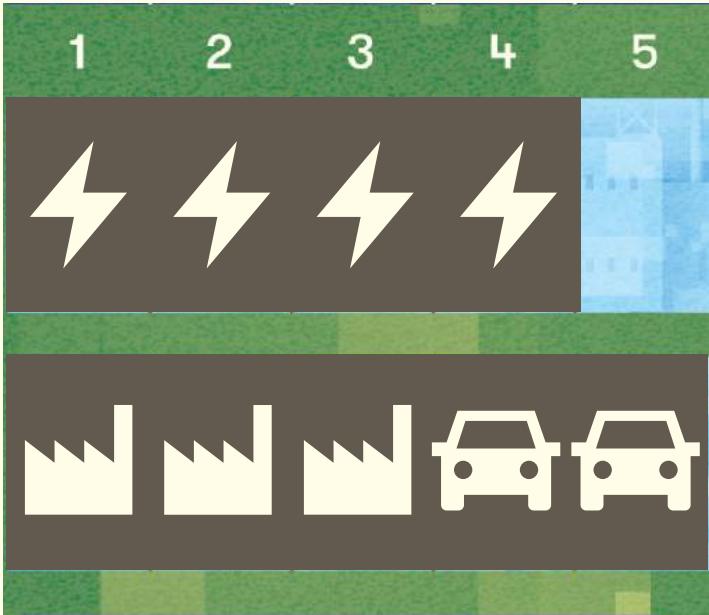

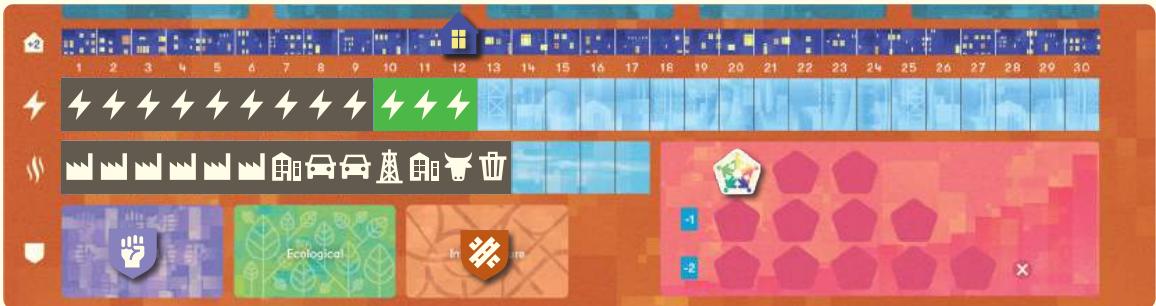
At the beginning of the game, everyone is generating massive amounts of Carbon cubes from Dirty Energy and Emissions tokens on their player boards.

4 Dirty Energy tokens +
3 Industry Emissions tokens +
2 Transportation Emissions tokens =
9 Carbon cubes
Reduce by 1 per
But you’re all emitting way more Carbon than the planet can handle. Those excess cubes go directly onto a Thermometer that tracks global temperature rise.
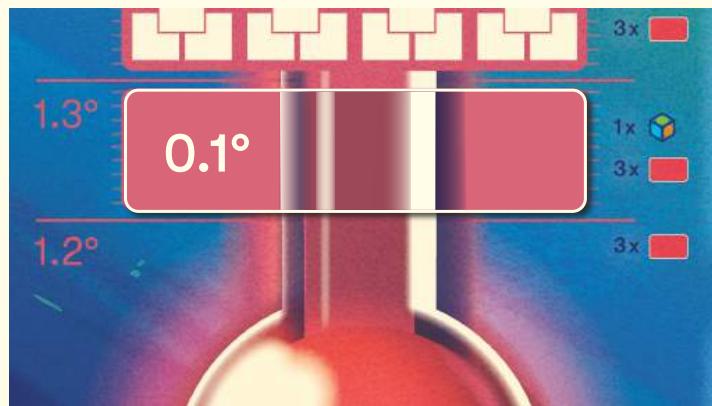
Some of these cubes will be sequestered by Tree and Ocean tokens on the central board and have no negative e!ects.
For each Temperature Band, you’ll roll a Planetary E!ects die, which represents the planet reaching critical ecological tipping points and makes the game more challenging.
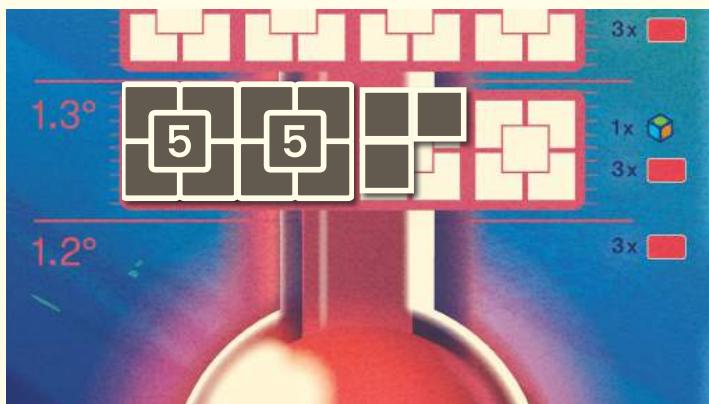
Once an entire row is "lled with cubes, a Temperature Band is added, representing the planet heating up by 0.1° C. And if you ever have 8 Temperature Bands, you all lose.


Crisis cards are what endanger your Communities. And if any player has 12 or more Communities in Crisis, everyone loses.

Rising temperatures also make you draw more Crisis cards, which all re#ect the various real world impacts of climate change.
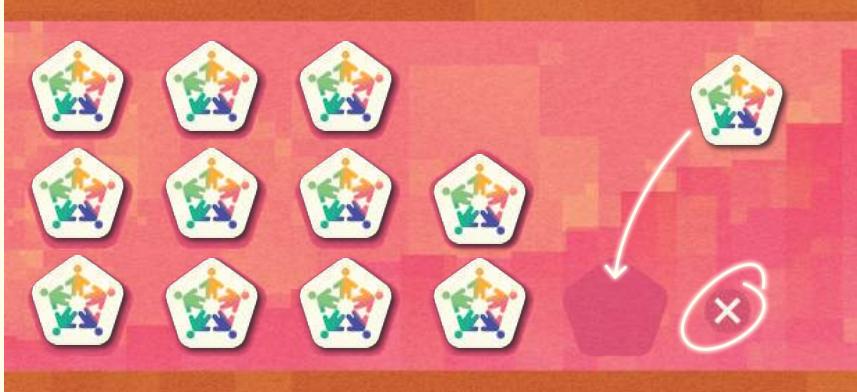
How do you protect your Communities? Build Social, Ecological, and Infrastructure Resilience.
The more Resilience tokens you have, the more protected you’ll be.




Here’s how you win
Reach Drawdown: the moment you collectively remove more Carbon from the atmosphere than you produce. You’ll do that by playing cards that remove Dirty Energy and Emissions tokens from your player board, while adding Clean Energy tokens to keep up with the Energy Demand of your World Power.
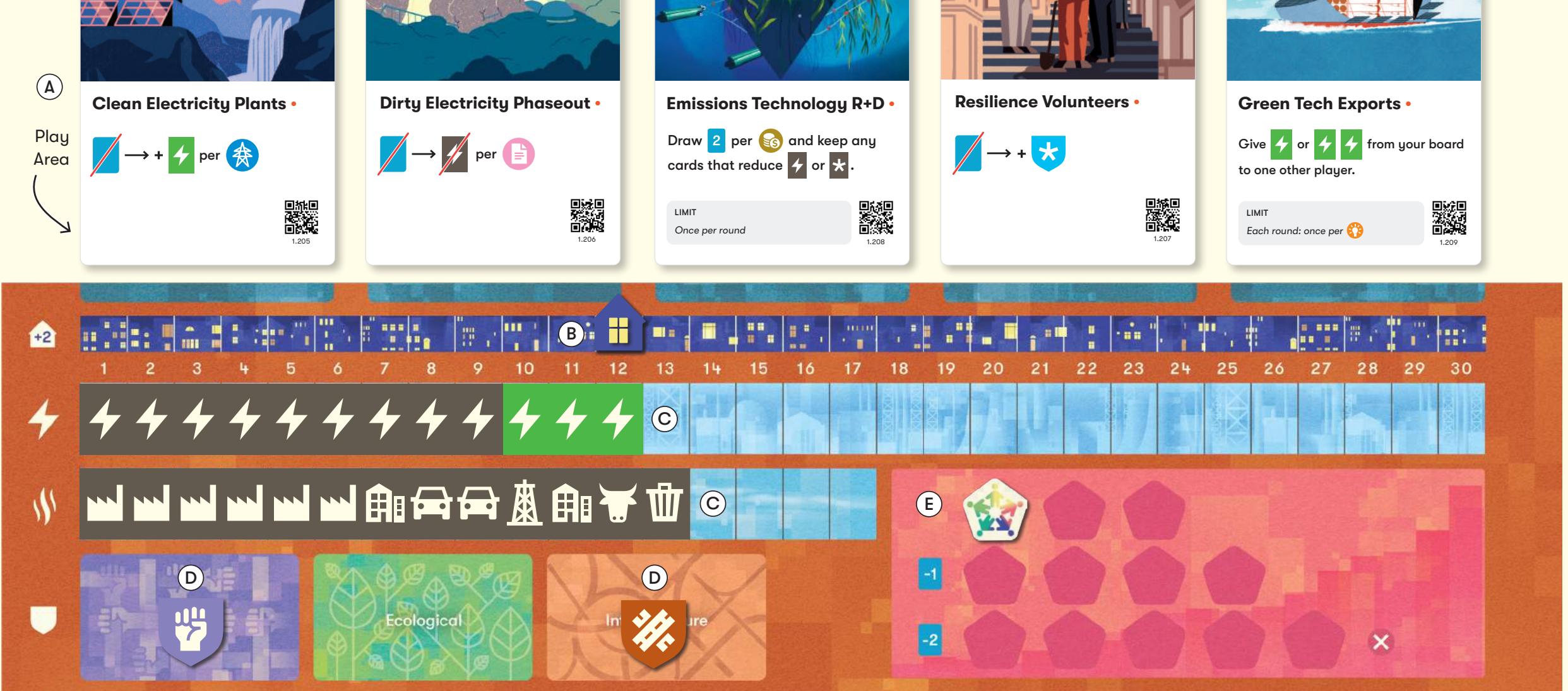
Everyone begins with 5 cards that are unique to their World Power. China’s starting Play Area is below, for example.
Each round, players will draw from a huge deck of cards "lled with unique actions. You’ll be playing these from your hand to your Play Area, either in front or behind of existing cards, to form powerful stacks of combos.
Remove Dirty Energy and Emissions tokens
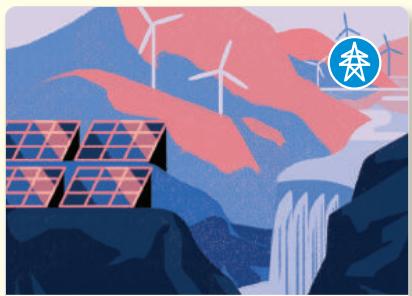


Add Clean Energy tokens to keep up with Demand

Dirty Electricity Phaseout • per

1.206


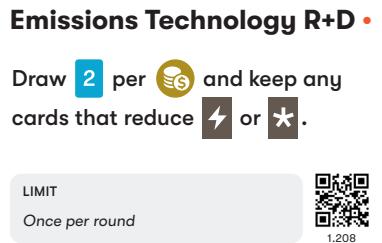

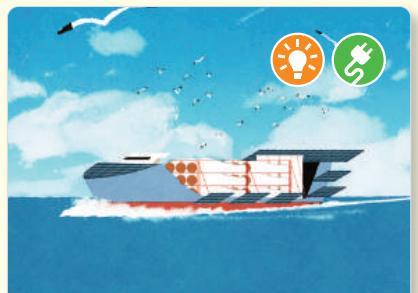
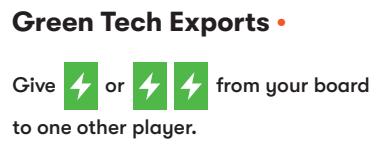

1.209
1.206
Play cards in 3 ways
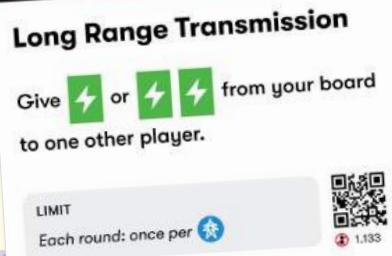
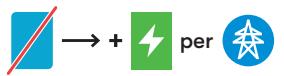
- Play cards in front of a stack to make their actions available. Here, you might play Long Range Transmission in front because you can use it once per blue Grid tag, which the Clean Electricity Plants card has. When you take actions, you get to use all the tags behind it!
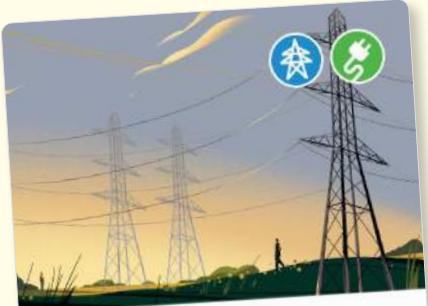


Clean Electricity Plants •

Dirty Electricity Phaseout •

1.205
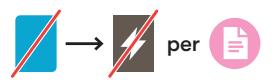

- Tuck a card behind, making the front card’s action more powerful! You may want to play Tree Farms behind Dirty Electricity Phaseout to double the pink Regulation tags in the stack, letting you remove 2 Dirty Energy tokens, instead of 1.
Tuck behind
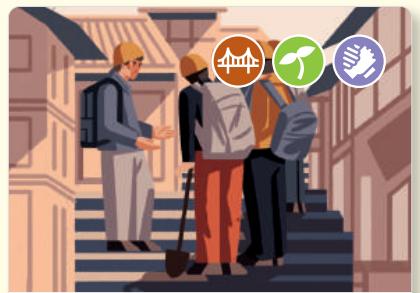

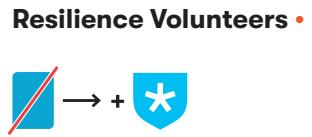
Resilience Volunteers •
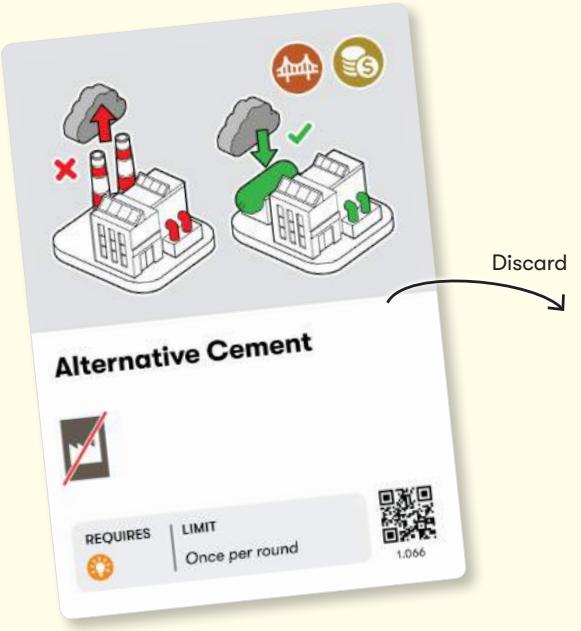

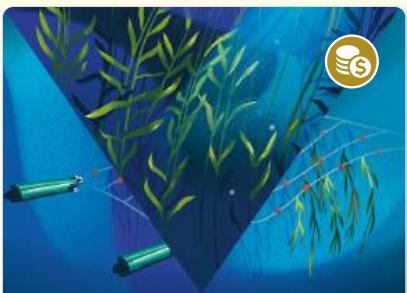
- Discard a card to pay the cost of some actions. Here, you discard Alternative Cement to take the Resilience Volunteers action, getting your choice of Resilience token. Since that action has no Limit, you could discard additional cards from your hand to take that action again and again, if you wanted to!

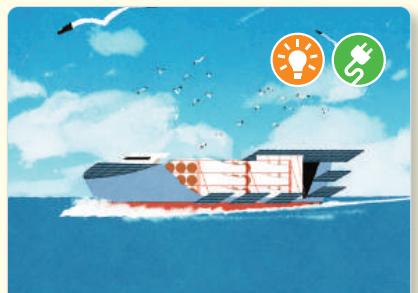
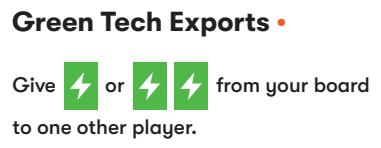

1.209
Stack tags to create powerful combos

So do you tuck High Speed Rail behind this stack to build a huge Infrastructure Resilience engine? Or do you play it in front to take advantage of the stack’s Grid tags, removing all your Transportation Emissions?
These are the kinds of decisions and tradeo!s at the heart of Daybreak!


G
E
Setup
Set up central board
A. Put the Current Round token with the clock side face up on the space marked 1 on the round tracker.
B. Put the 6 Planetary E!ects tokens onto their matching starting locations.
C. Put all 8 Temperature Bands, the Planetary E!ects die, and the Geoengineering die onto the bulb of the Thermometer, so they’re within reach.
D. Add the number of corresponding Tree and Ocean tokens to the board, using the chart on the right. Put these anywhere on the map that you prefer.
E. Keep all the other tokens in their trays and in reach during play.
Prepare card decks
F. Shu\$e the Global Project cards and place them face down to make a deck.
G.Shu\$e the Crisis cards and place them face down to make a deck.
H. Shu\$e the Local Project cards and place them face down to make a deck.
I. Do not use the Challenge cards in your "rst game. See page 35 for more info.

F

| Players | Trees | Oceans |
| 4 | 24 | 16 |
| 3 | 16 | 12 |
| 2 | 11 | 7 |
| 1 | 6 | 4 |
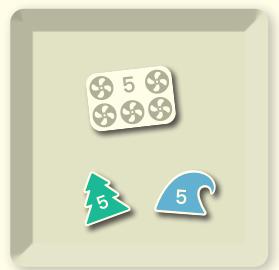
Tip: For ease of play, use 5-value Tree & Ocean tokens when you can.



Choose World Powers
Depending on the number of players, distribute the player boards and Reference cards below. Between yourselves, decide who is going to play which World Power.
| Players | World Powers used |
| 4 | All |
| 3 | Majority World, Europe, & US |
| 2 | China & US |
| 1 | Any (see Reference card) |

If you are playing the Solo game, remove and ignore all cards with this symbol from every deck as you play.
Prepare player boards
Connect and assemble each player board.
A. Hand each player their 5 starting Local Project cards, which all have the World Power’s name printed on the back. Place these face up above your player board to form your Play Area, as shown above. Return unused starting cards to the box.
B. Put your Energy Demand token on the number shown on your Reference card.
C. Add the number of Dirty Energy tokens, Clean Energy tokens, and Emissions tokens indicated on your Reference card into their respective rows.

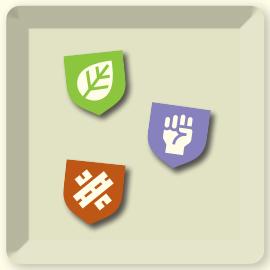
D. Add the number of Resilience tokens indicated on your Reference card to their matching areas.
E. Add the number of Community in Crisis tokens indicated on your Reference card to their area.
F. Leave the player board extenders in the box for now: these can be used if a player’s Energy tokens or Demand increases beyond 30.
How to play
Daybreak is played in rounds, until everyone wins or loses together. There is no player order: you will all play simultaneously. Rounds have 5 stages:
Global stage
Players hold a global summit to review the Forecast Crisis card and select a Global Project card.
Local stage
Players focus on their own boards, drawing and playing Local Project cards to remove Emissions and Dirty Energy, add Clean Energy, increase Resilience, and help their fellow players.
Emissions stage
Players total the amount of
Carbon cubes generated this
round, sequester as many as
they can, and add the rest to the Thermometer.
Crisis stage
Players resolve Planetary E!ects and Crisis cards to show their impacts on the planet and its communities.
Growth stage
Players check if they’ve won, and if not, they all increase their Energy Demand.
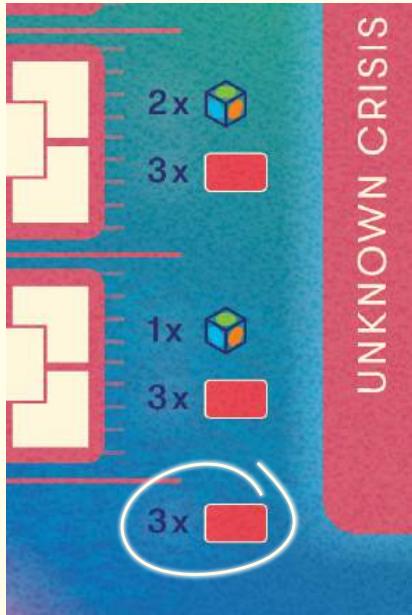
In the "rst round, players will draw a total of 3 Crisis cards: 1 face up (Forecast) and 2 face down (Unknown). This number will increase as more Temperature Bands are added to the Thermometer.

Global stage
Players hold a global summit to review the Forecast Crisis card and select a Global Project card.
Add Crisis cards
The number of Temperature Bands on the Thermometer determines how many Crisis cards you should add, indicated to the right of the Thermometer. Draw that many Crisis cards, placing one face up into the Forecast Crisis space and the rest face down in the Unknown Crisis spaces. There is no limit to the number of Crisis cards, so if you have more than 4 to resolve, simply continue to place them above the board.
For a detailed description of how Crisis cards work, see page 29.
Start a Global Project
Draw 2 cards from the Global Project deck. Then decide as a group which 1 of these 2 cards to keep. Place it face up in the topmost empty Global Project slot on the left side of the central board. Discard the other Global Project card, creating a discard pile next to the draw deck.
Once a Global Project’s requirement is met, it becomes active and a!ects all players.
Up to 4 Global Project cards can be in play at any time. If players want to play a new Global Project card when 4 are already in play, they must discard 1 of their choice (along with any cards tucked under to activate it). You may also decide not to start a new Global Project that round.
Local stage
Players focus on their own boards, drawing and playing Local Project cards to remove Emissions and Dirty Energy, add Clean Energy, increase Resilience, and help their fellow players.
Draw Local Project cards
Each player draws 5 Local Project cards to add to their hand. Your hand is public, and you should keep it face up on the table below your player board. There is no limit to how many cards you can have in your hand.
Note: Some Local and Global Projects increase the number of cards you draw each round. The number can also be reduced if you have 4 or more Communities in Crisis.
At any time, players may look at and discuss each other’s hands, Play Areas, and the discard piles. They may not inspect the contents of any face down deck.
If you ever need to draw a Local Project card and the deck has run out, turn the discard pile over, shu\$e it, and form a new deck. Then continue drawing.

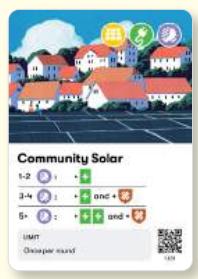

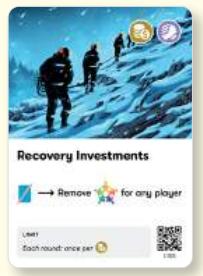
Your hand

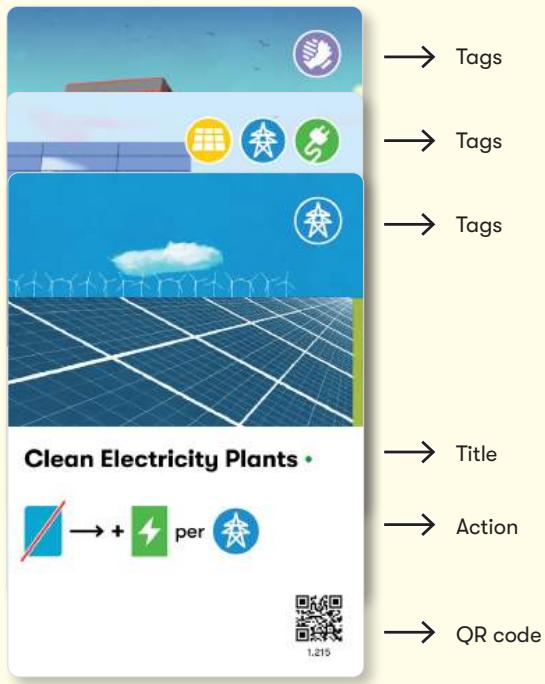
Example: A stack of Local Project cards. Note that actions use the tags on all cards in the stack.
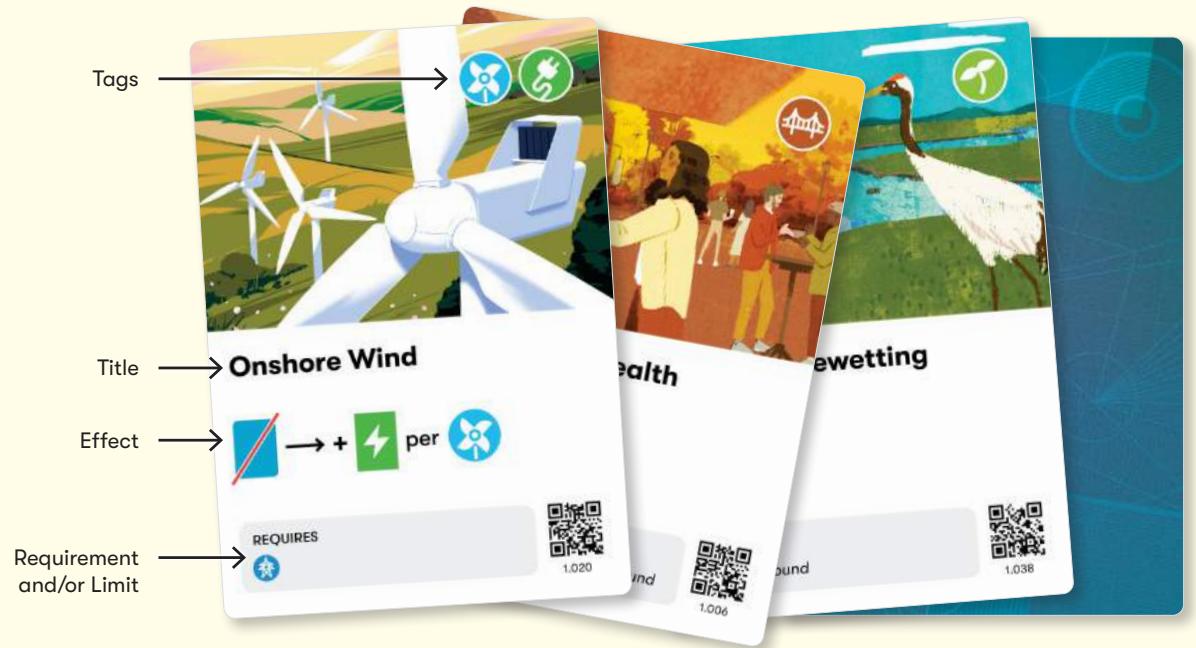
Tip: Each card has a unique QR code that takes you to a page that describes the card’s theme and gameplay in greater detail.
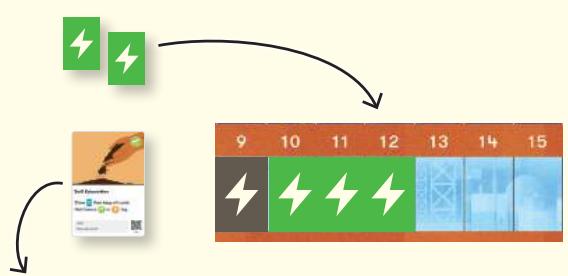
Example: Anjora wants to take the Clean Electricity Plants action above. She "rst selects a card from her hand that she doesn’t think will be useful to her, and discards it to pay the action’s cost. She then gets 2 Clean Energy tokens because this action gives her 1 token per Grid tag in this card’s stack. She then adds the 2 tokens to her player board.
In the Local stage, there are 3 types of actions available. You may do them in any order and as often as you like.

Take a Local Action
Each Local Project card in your Play Area has an action shown on it underneath its title. Typically, Local Actions only a!ect your own player board. For example, the card on the left’s action is: “Discard a card from your hand to add one Clean Energy token per Grid tag in this card’s stack.”
Unless otherwise noted, you can take a Local Action as often as you like, provided you pay the required cost and meet the requirements printed on it, if any. Costs are typically paid by discarding other cards from your hand.
Local Actions often make use of tags that appear on the top right corner of each card. When taking a Local Action that uses tags, you can use the tags on the card itself, plus any other tags on the cards behind it in the same stack.
By doing so, you can create powerful combos that combine the tags on multiple cards in their stacks!
Start a Local Project
Add a card from your hand to the front of any stack of cards in your Play Area. Make sure to space the card so that the tags on all the cards behind it are still visible, as shown in the examples throughout this book.
Be careful which cards you cover, since you can only take actions on the card that is in front of a stack. But since a card’s action is available immediately after it is added, clever players will be able to take an action on a card, add a new card in front that covers it, then take the action on the new card as well, using the covered card’s tags!
Support a card
Local Project cards can be tucked behind other cards to support di!erent Local Projects, Global Projects, or reduce the e!ects of a Crisis.
Support a Local Project
Take a card from your hand and tuck it behind one or more cards in a stack in your Play Area. This can help make another Local Project’s action more e!ective by providing additional tags in its stack.
Support a Global Project
Take a card from your hand and tuck it behind a Global Project card to help meet its requirement. Once the requirement is met, you can remind yourself that the card is active by placing an Active token on it to indicate its e!ects are in play.
Reduce the e"ects of a Crisis card

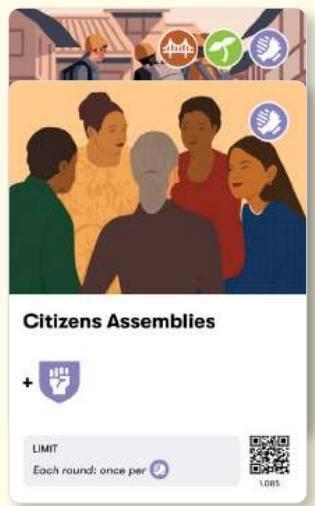
Example: Anjora adds the Citizen Assemblies card, covering her starting card, Resilience Volunteers. This new card will let her get 2 Social Resilience tokens this round, one per Society tag in its stack. However, she will no longer be able to use the Resilience Volunteers card that she covered.
Some Crisis card e!ects can be reduced by tucking Local Project cards under them. If a card in your hand meets the conditions speci"ed by a Crisis card, you can tuck it under that Crisis. You may not tuck cards under unknown Crisis cards.

Example: Before taking the Citizen Assemblies action, Anjora tucks another card with a Society tag behind it to support that action. She can now gain 3 Social Resilience tokens per round since there are now 3 Society tags in this stack!
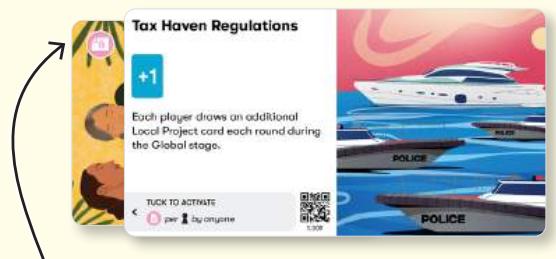
Example: Colleen tucks a card with a Regulation tag under the Global Project card, Tax Haven Regulations. Colleen encourages the other players to help support this project since they don’t have the cards to do it alone.
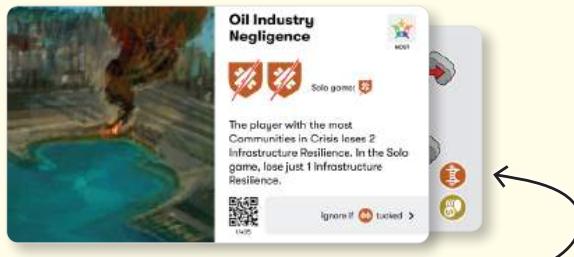
Example: Anjora tucks a card with an Infrastructure tag under the Crisis card, Oil Industry Negligence. By tucking this, players can ignore the negative e!ects on this card.

Example: Raha can take this action to remove Building Emissions tokens by increasing his Energy Demand. He can do this once per round per Innovation tag in the stack. To keep track, every time he takes the action, he puts a cube on the card. At the end of the stage, he returns these cubes to the supply.
Keeping track of Local Actions
Some actions can be done a limited number of times each round. To help keep track of how many times you’ve done these actions, you can place Carbon cubes on the card each time you take its action, as shown on the bottom left of this page.
This is purely for keeping track and has no in-game e!ect.
Finishing the Local stage
When everyone agrees that they’re "nished, proceed to the Emissions stage.
Emissions stage
Players total the amount of Carbon cubes generated this round, sequester as many as they can, and add the rest to the Thermometer.
Check Energy Demand
Each player reviews their player board to ensure that they can meet their Energy Demand: the total number of Dirty Energy plus Clean Energy tokens must equal or exceed your Energy Demand on each player board, as shown in the example on the right.
If any player cannot meet their Energy Demand, they must add Communities in Crisis equal to the di!erence (see page 30).
Add Emissions
Each player totals the number of Dirty Energy tokens plus Emissions tokens on their player board. Then they take the number of Carbon cubes from the supply equal to that total and add them to the Recent Emissions area of the central board.
You must count all of your Dirty Energy tokens each round, even if you can meet your demand more e%ciently with Clean Energy tokens. There is no immediate bene"t to producing more Clean Energy than your current Demand.
Removing Dirty Energy tokens is a great way to reduce your Emissions each round—just be sure to replace them with enough Clean Energy tokens to meet Demand!
Energy Demand of 12 is met by 9 Dirty Energy and 3 Clean Energy tokens.
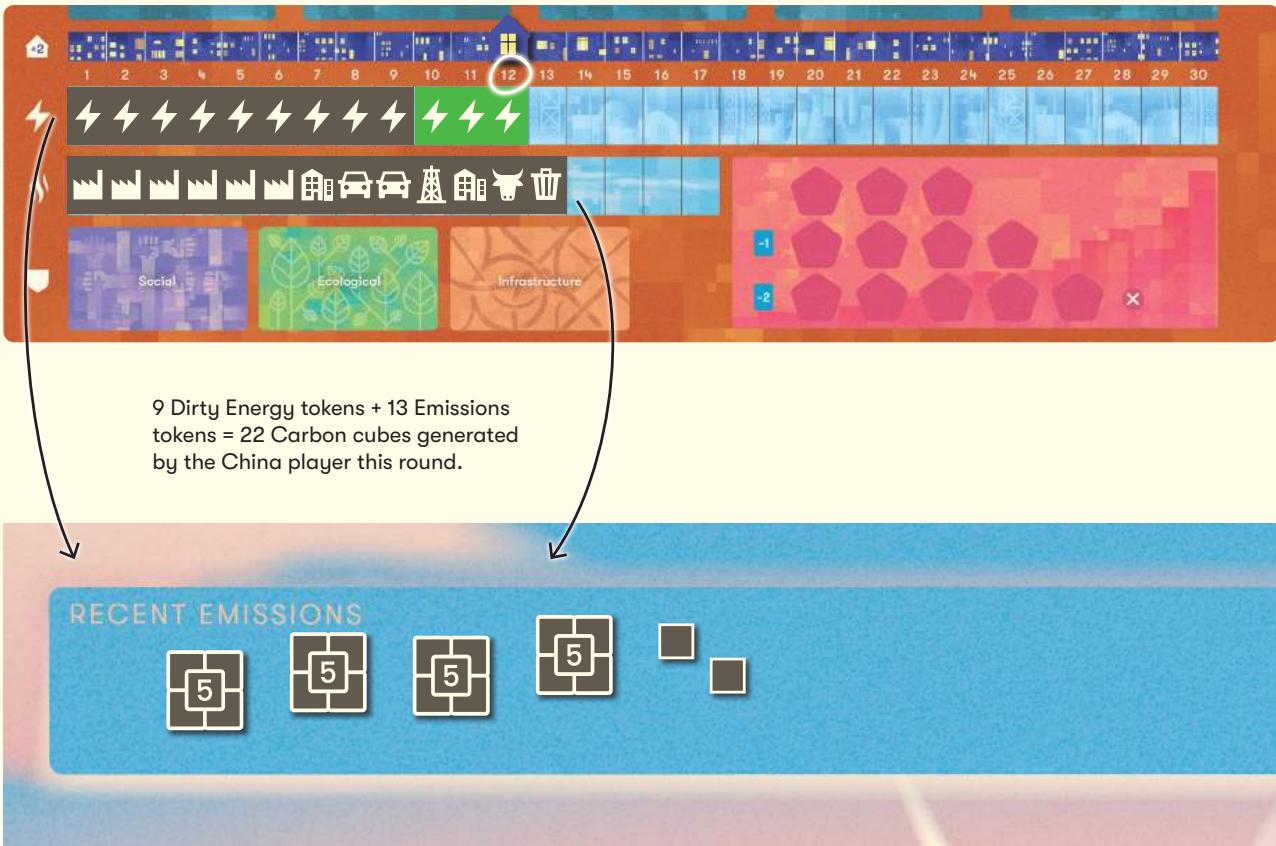
Tip: You can match Carbon tokens in the Recent Emissions area with Tree and ocean tokens on the board to quickly determine how much carbon is sequestered by them.

Sequester Carbon
Take Carbon cubes from the Recent Emissions area and cover the equivalent value of Trees, Oceans, and Direct Air Capture (DAC) tokens on the central board. DAC tokens are added by certain cards and function exactly like Trees and Oceans in sequestering Carbon.
Return all Carbon placed in this way to the supply, since this represents Carbon that was successfully sequestered and will not lead to rising temperatures.
Did you reach Drawdown?

After you Sequester Carbon, if you have 0 Carbon cubes in the Recent Emissions area, and there are remaining uncovered Trees, Oceans, and/or DAC tokens, you have reached an important milestone: Drawdown!
Continue sequestering Carbon onto the board, but instead of taking cubes from the Recent Emissions area, take them from the Thermometer.
Removing these cubes may help you survive the Crisis stage later this round. Note that you can even break down Temperature Bands and convert them into Carbon cubes, if you remove a row.
Then #ip the round marker over: you are now on track to win the game—if you can survive one "nal Crisis stage.
Adjust Temperature
Move all remaining Carbon cubes in the Recent Emissions area to the Thermometer. Each 1-value Carbon cube "lls one of the small squares and each 5-value Carbon cube "lls a big square. Fill the Thermometer from bottom-to-top and from left to right.
Only !ll columns equal to the number of players. For a 4-player game, you’ll use all 4 columns before moving to the next row. For a solo game, you’ll only "ll 1 column before moving to the next row.
Whenever a row is completely "lled with cubes, remove all the cubes in that row and replace them with a Temperature Band.
Each band on the Thermometer represents 0.1° C of warming and determines how many times you will roll the Planetary E!ects die, plus the amount and severity of Crisis cards to resolve.
Whenever you add a Temperature Band to a space that shows a higher number of Crisis cards than you added in the Global stage this round, e.g. from 1.5° to 1.6° you go from drawing 3 to 4 Crisis cards, you must immediately draw the additional cards to resolve this round, face down.
If the Thermometer ever reaches 2.0° C (8 Temperature Bands), you lose the game!

Crisis stage
Players resolve Planetary E!ects and Crisis cards to show their impacts on the planet and its communities.
Resolve Planetary E"ects die
Roll the Planetary E!ects die 1 time for each Temperature Band on the Thermometer. For each roll, advance the corresponding Planetary E!ects token 1 space on its track. If the token enters a space with a Tipping Point icon, resolve the e!ect, which is listed next to its track on the central board.
If a Planetary E!ect adds a Temperature Band, you must roll an additional die.
If a Planetary E!ect token reaches the end of its track, it will now trigger a Tipping Point every time that its e!ect is rolled, as indicated by the in"nity symbol.
Planetary E"ects

Change in Major Weather Systems: Draw 2 additional Crisis cards.

Deserti!cation: Remove 1 Tree token per player.

Dieback of the Amazon: Add 1 Carbon cube per player to Recent Emissions, and remove 1 Tree token per player.

Loss of Arctic Sea Ice: Add 2 Carbon cubes per player to the Thermometer.

Thawing Permafrost: Add 2 Carbon cubes per player to Recent Emissions.

Ocean Acidi!cation: Remove 1 Ocean token per player.
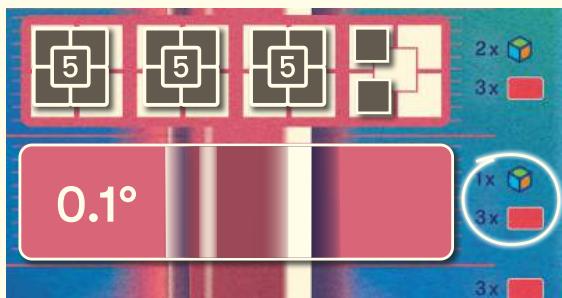
Example: The players roll the Planetary E!ects die 1 time since there is one Temperature Band on the Thermometer.

The result of the Planetary E!ects die is Loss of Arctic Sea Ice. The players advance that token one space. This space has a Tipping Point icon, so they must add 2 Carbon cubes to the Thermometer for each player in the game.
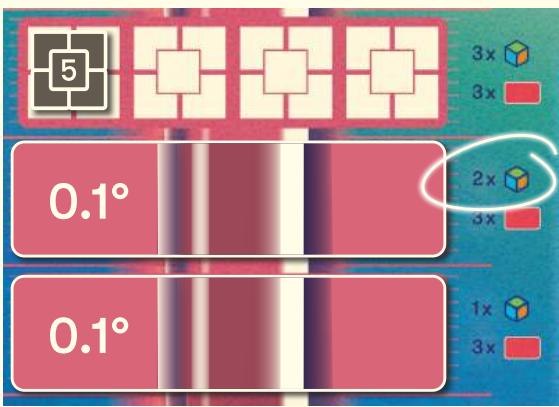
Since this is a 4 player game, the players add 8 cubes to the Thermometer, which "lls up the second band! Since there are now 2 bands on the Thermometer, the players will have to roll an additional Planetary E!ects die this round.
Resolve Crisis cards
Resolve all Crisis cards in play. Go one at a time, from bottom to top, starting with the Forecast Crisis.
If the number of Crisis cards in play is ever higher than the number shown to the right of your highest Temperature Band, you must still resolve all of them.
-
Flip the card face up, if it isn’t already.
-
Check who is targeted. Some Crisis cards a!ect every player and some only a!ect the player that meets certain criteria. If players are ever tied, they each roll the Geoengineering die: the single player with the lowest die roll is targeted. Repeat rolling if necessary.
-
Read the e"ects. Some e!ects can be reduced with Resilience tokens: if you are targeted and have tokens of this type, reduce the e!ect by 1 for each matching token you have. Note that this is reduced only for yourself and not other players. Resilience tokens used in this way are not discarded.
Some Crisis cards can be reduced or ignored if cards with certain tags were tucked under them during the Local stage. Cards tucked in this way reduce the e!ects for all targeted players, as described on the Crisis card.
-
Carry out the e"ects against each targeted player.
-
Discard the Crisis card and any Local Project cards tucked under it.

Adding Communities in Crisis
Crisis cards often add Communities in Crisis. To do this, add a Community in Crisis token to that area of your player board.
Fill the top row "rst, then the middle, and "nally the bottom, going left to right.
Reducing card draw
If you have 4–7 Communities in Crisis, you will draw 1 fewer Local Project card during the Local stage each round. If you have 8–11 Communities in Crisis, you will draw 2 fewer cards.
Losing Resilience, Trees, & Oceans
If a Crisis card or Planetary E!ect makes you lose Resilience, Trees, and/or Ocean tokens, return them to the supply.
If you must lose Resilience and you have none of that type to lose, you must add 1 Community in Crisis for each Resilience token you would otherwise remove.
If you must lose Tree and/or Ocean tokens and you have none of that type to remove, all players must add 1 Community in Crisis for each Tree and/or Ocean token you would otherwise remove.
Losing Cards Due to Crises
When a Crisis card forces you to lose Local Project cards, discard them from your hand or your Play Area. Cards discarded from your Play Area can come from anywhere in any stack, including the front card. If you discard the front card from a stack, the action on the card directly beneath it becomes available.
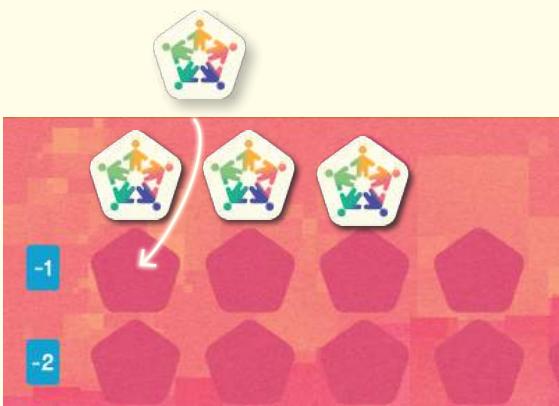
Add Communities in Crisis left to right, top to bottom.
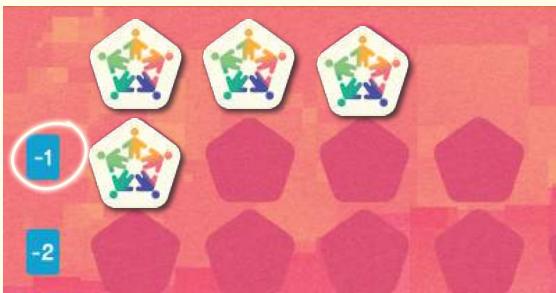
If you add a fourth Community in Crisis, you will draw one fewer Local Project card each round.
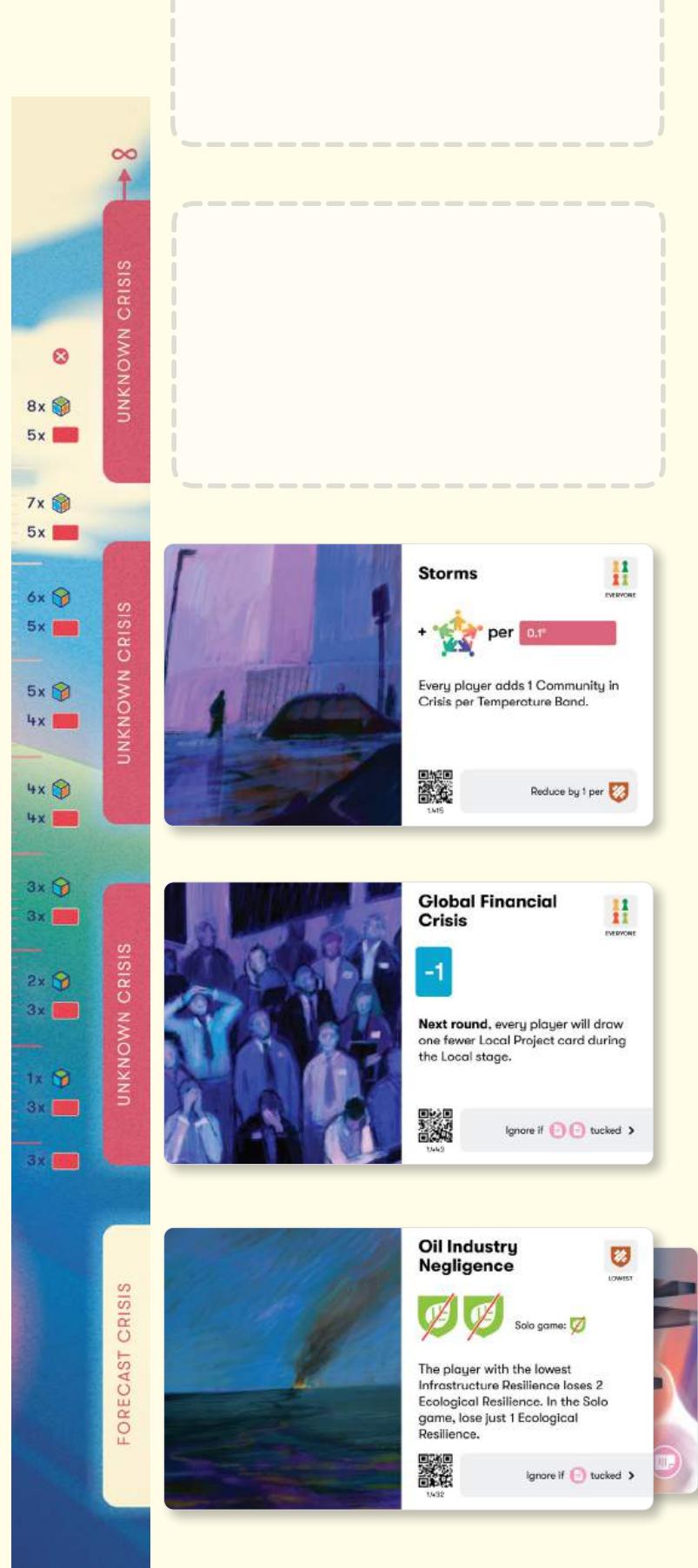
There is no maximum to the number of Crisis cards that can resolve each round. And if you ever need more cards than the total present—e.g. if you added a Temperature Band in the Emissions stage—draw that many more and add them face down above the rest.

If the temperature had risen considerably and added a fourth Crisis card, they would have drawn another one and placed it into this Unknown Crisis slot, face down.

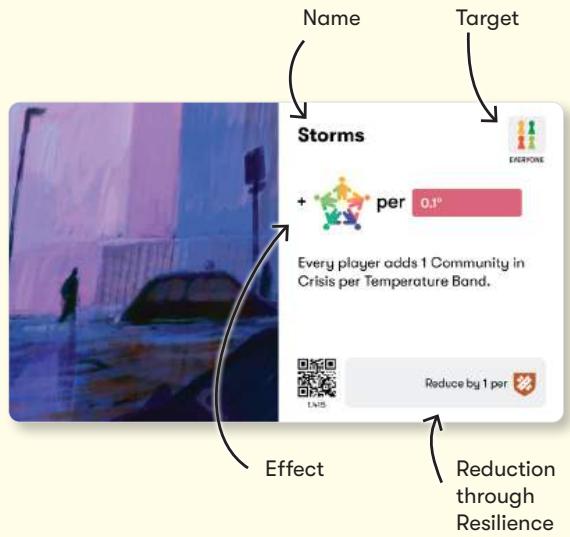
The last Crisis revealed is Storms, which also a!ects everyone. Players must add 1 Community in Crisis for every Temperature Band, unless they can individually reduce the e!ects with their Infrastructure Resilience tokens. Every player has 1 Infrastructure Resilience, but since there are now 2 Temperature Bands in play , all players have to add 1 Community in Crisis token to their player boards.

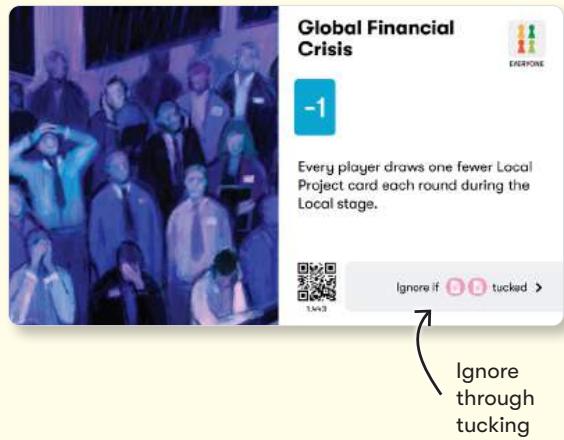
The next Crisis revealed is Global Financial Crisis. It a!ects every player and there is no way to reduce its e!ects since it was an Unknown Crisis. Each player will draw 1 fewer Local Project card during the Local stage next round.

The "rst Crisis drawn, Oil Industry Negligence, was forecast during the Global stage this round, meaning that players could see and respond to it. It makes the player with the lowest Infrastructure Resilience to lose 2 Ecological Resilience tokens. Anjora tucked a card with a Regulation tag under this Crisis card during the Local stage, so it has no e!ect.
Growth stage
Players check if they’ve won, and if not, they all increase their Energy Demand.
Check for victory

If the round marker shows Drawdown at this point, you win! Otherwise…
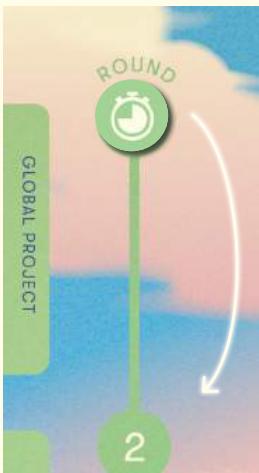
Advance the round
Advance the Current Round token to the next space on the round tracker. All the Local Project cards in your Play Area and hand carry over into the next round.
If you do not win by the end of Round 6, you all lose the game!
Increase Energy Demand
Each player moves their Energy Demand token to the right, by the amount shown on their Reference cards.
By default, the United States and Europe grow their demand by 1, China by 2, and the Majority World by 3. In the solo game, grow your demand by 2.

Example: China increases their Energy Demand by 2, from 12 to 14, as shown on the upper left of their player board.
Players lose the game if any of these conditions are met:
Game end
Players win the game if they reach Drawdown during the Emissions stage (see page 25), while managing to survive one "nal Crisis stage.
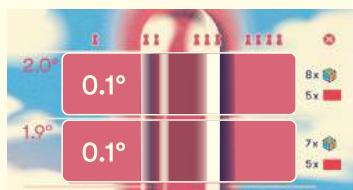
The Thermometer reaches 2.0°C (8 Temperature Bands)

Any player has 12+ Communities in Crisis
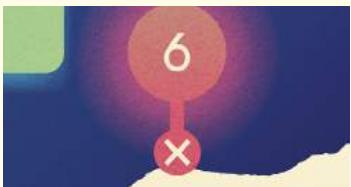
Players haven’t won by the end of Round 6
Reminders
• To start a Local Project, you can play a card in front of any stack in your Play Area.
• A Local Project card’s Requirement only refers to taking its printed action. You can still play and use it in other ways.
• Tags on a card can be used to meet that same card’s Requirement.
• You can take a Local Action multiple times on your turn, unless speci"ed otherwise.
• You can take a Local Action, then cover it, then do the new action using the tags on the recently covered action.
• You can take a Local Action multiple times on your turn, unless speci"ed otherwise.
• There is no limit to the number of actions you can take in the Local stage, as long as you can pay their costs.
• There is no hand size limit and you may keep them between rounds.
• To keep your Communities safe, plan on having 1 Resilience token of each type for every Temperature Band.
• You can have up to 5 stacks of cards in your Play Area. Each stack can be of any depth.
• Temperature Bands added during a round can trigger additional Planetary E!ects die rolls and make you draw more Crisis cards to resolve in that same round.
• Forecast Crisis cards with ongoing e!ects don’t take e!ect until the Crisis stage.

Challenge cards
Want to make your game more challenging, less di%cult, or just add variety? We’ve included a deck of Challenge cards that let you adjust the di%culty of the game or explore di!erent climate scenarios.
Challenge cards each have rules that either a!ect everyone or just an individual player.
To make the game harder, either turn 1 red “minus” group challenge card over and follow its instructions, or deal 1 individual red card to each player. To make the game easier, do the same, but with green “plus” icons. For variety, you can use the gray “question mark” icon cards that way as well.
Or feel free to mix and match the Challenge cards however you like.
Other setups
You can also change the di%culty level of the game by using di!erent combinations of World Powers, shown below.





Makes the game harder and a!ects everyone
Makes the game harder and a!ects one player
Makes the game easier and a!ects everyone
Makes the game easier and a!ects one player
Adds variety and a!ects everyone
Adds variety and a!ects one player
| Players | Difficulty | World Powers | Trees | Oceans | |||
| 4 | Standard | MW | China | Europe | US | 24 | 16 |
| 3 | Easier | China | Europe | US | 15 | 10 | |
| Standard | MW | Europe | US | 16 | 12 | ||
| Harder | MW | China | US | 19 | 14 | ||
| MW | China | Europe | 20 | 14 | |||
| 2 | Easier | Europe | US | 8 | 5 | ||
| Standard | China | US | 11 | 7 | |||
| China | Europe | 11 | 8 | ||||
| Harder | MW | US | 12 | 9 | |||
| MW | Europe | 13 | 9 | ||||
| Extreme | MW | China | 16 | 11 | |||
| 1 | Standard | Solo | 6 | 4 | |||
About Daybreak
Daybreak was inspired by our love of games like Wingspan, Terraforming Mars, and Race for the Galaxy. We set out to design a game in this genre to tell an uplifting story about decarbonizing the world—one where all of us can not just survive, but thrive.
Daybreak contains no plastic components or harmful textiles. It uses 100% FSC certi"ed wood and paper products. For more information about our sustainability commitments, go to daybreakgame.org
Acknowledgments
We would like to thank the people whose feedback and support have immeasurably improved this game: Julie Arrighi, Carina Bachofen, Elizabeth Bagley, Marco Contiero, Erin Coughlan de Perez, Martha Dillon, Declan Finney, Solomon Goldstein-Rose, Sabine Harrer, Sanne Hogesteeger, Peter Irvine, Justin Jacobson, Bettina Koelle, Laurie Laybourn-Langton, Amy Lee, Janot Mendler de Suarez, Bill McKibben, Ruth Meza, Oliver Morton, Andy Parker, Kate Raworth, Sayanti Sengupta, Andrew Sheerin, Pablo Suarez, Kevin Taylor, and Mark Turner.
Matteo would like to thank Dhri, Giulia, Hwa Young, and Martha for the chats that inspired the game’s inception. He’s grateful to Matt for being such a graceful and inspiring collaborator. Above all, thanks go to his parents Renato and Nadia, and to his darling Aimee, for always encouraging him to pursue his lofty ideas.
Matt would like to thank Matteo for being such an enthusiastic and unwavering design partner, and Donna for her generous, unending support.
Contents
Boards
1 central board
4 player boards (2 pieces each)
2 player board extenders
Cards
158 Local Project cards
48 Crisis cards
24 Global Project cards
42 Challenge cards
9 Reference cards
Cardboard tokens
60 Clean/Dirty Energy (1-value)
14 Clean/Dirty Energy (5-value)
48 Resilience (1-value)
12 Resilience (5-value)
69 Emissions
48 Communities in Crisis
10 Temperature Bands
40 Carbon cubes (1-value)
20 Carbon “cubes” (5-value)
6 Planetary E!ects trackers
1 Current Round tracker disc
4 Global Project tracker discs
4 Energy Demand tracker “houses”
8 DAC (1-value)
1 DAC (5-value)
8 Trees (1-value)
5 Trees (5-value)
8 Oceans (1-value)
3 Oceans (5-value)
Dice 1 Planetary E!ects 1 Geoengineering
Other
1 rulebook
6 pulp storage trays
Playtesters
Erin Adams, Max Albrecht, Sarah Ali, Joaquin Almirante, Je! Anderson, Joanne Andrade, Livio Andreatta, Patrizia Andreatta, Arianna Andreatta, Ilda Andreatti, Anica Araneta, Julie Arrighi, Lluisa Astruc, Carolyn Aubry, Carina Bachofen, Peter Baeck, Steven Baer, Justin Bagley, Elizabeth Bagley, Alex Barker, Aleks Berditchevskaia, Bindu Bhandari, Francesco Binetti, Emma Bird, Vincent Bizouard, Naoise Boyle, Rachel Briscoe, Victoria Brood, Bob Burgoyne, Attila Buzas, David Cairns, Seb Casalotti, Kiran Casseeram, Berto Catapang, Stefano Cecere, Emiliano Cenizo, Aindri Chakraborty, Pip Chalmers, Leslie Chan, Vasant Chari, Natalia Ciobanu, Terence Co, Matthew Cohen, Joshua Cortez, Erin de Perez Coughlan, Dominic Crapuchettes, Alessandra Crema, Jennifer Cromwell, Gabor Cseh, Henry Cylkowski, Rob Daviau, Alice Davies, Tammy Dayton, Selena Dhanak, Martha Dillon, Nico Disseldorp, Artur Donaldson, Anna Drenan, Alen Drino, Laura Dudek, Rebecca Dugard, Shannon Earle, Patrick Earle, Dan Egnor, Patrick Ellen, Drew Engelson, Sadie Engelson, Pasquale Facchini, Anum Farhan, Kim Farrell, Riccardo Fassone, Pia Faustino, Helena Fazeli, Lia Filippi, Declan Finney, Heidi Fischer, Emily Franzini, Carey Friedman, Johannes Friedrich, Lidija Garner, Jonathan Garner, Chloe Buckley Germaine, Nina Gillespie, Arpana Giritharan, Dom Glennon, Francisco Gomez, Anoshamisa Gonye, Stephanie Gounaris-Shannon, Natalie Gounaris-Shannon, Owen Grafham, Molly Grear, Darren Green, Darryl Green, Will Groom, Anirudh Gupta, Alicja Głowicka, Jonas Haefele, Colin Haine, Philip Haine, Kira Haine, Liam Hardy, Elizabeth Hargrave, Sabine Harrer, Zach Harris, Grit Hartung, Tamar Hazon, Beth Heile, Logan Herbort, Jack Hickish, Timothy Ho!man, Sanne Hogesteeger, Kim Hol#od, Nicole Hoye, Wei-Hwa Huang, Joe Huber, Vici Händel Daphne, Peter Irvine, Ashley Jackson, Amy Jackson-Bruce, Justin Jacobson, Dan Jeans, Phoebe Jekielek, Charise Johnson, Akhila Kallakuri, Imandeep Kaur, Tomo Kihara, Anthony Frizzera Kingsley, John Knoerzer, Bettina Koelle, David Krantz, David Kreiss-Tomkins, Yuki Kumagai, Ha Lam, Ollie Lamb, Trish Lantznester, Laurie Laybourn-Langton, Chris Lazenby, Tina Le-Thornburgh, Anna Leacock, Colleen Leacock, Donna Leacock, Amy Lee, Shang Lee Lun, Alexandra Lee, Tom Lehmann, Daniel Leonardi, Nisha Ligon, Nina Ligon, Evan Livelo, Diogo Lopes, Oisin Aodha Mac, Lizzy Mace, Kieran Mackey, Scott Mackey, Jiah Margallo, Shawn Martin, Chloe Mashiter, Gonzalo Kumike Matías, Jules Macatangay Matthew, Geo!rey McCormick, Amy McFie, Lily Mccraith, Renato Menapace, Janot de Suarez Mendler, Diana Monova, James Morgan, Oliver Morton, Alexander Moseley, Jessie Muhlin, Siew Neo, Sam Nixon, Anjora Noronha, Laetitia Nuss Anne, Matthew O’Malley, Sarah O’Malley, Savia Palate, Janice Pang, Massimiliano Panizza, Andrew Parker, Tappan Parker, Kathy Peach, Tom Peele, Maayan Pendler, Jon Perry, Magnus Persson, Matt Quintanilla, Lavina Ranjan, Evan Raskob, Lia Ravelo, Ludi Rebet, Alan Rees, Eleonora Riddo, Elisa Riddo, Jessica Roberts, Laura Robleto, Francesco Sedda Rugerfred, Smita S, Shyama S. V., Menka Sanghvi, Laura Santamaria, Reed Schuler, Sayanti Sengupta, Meera Shah, Bez Shahriari, Amit Sharma, Jake Sharpe, Andrew Sheerin, Suzannah Sherman, Phil Sherwin-Nicholls, Kayode Shonibare-Lewis, Soleil Silva, Dan Sirbu, Marek Sison, Marissa Smith, Clare Smyllie, Amy Solder, Kirsten Sorton, Monica Stephens, Ben Stevens, Matt Stevens, Pablo Suarez, Kevin Taylor, Diya Taylor, Shruti Thombare, Jordan Thompson, Anthony Thornton, Henry Throp, Greg Tilley, Emiliano Tolotti, Graziano Tolve, Lisa Towell, Antonios Triantafyllakis, Kyle Turakhia, Mark Turner, Ana Ulin, Esohe Uwadiae, Kasper van der Vaart, Nadia Valentini, Laura Valentini, Mauro Vanetti, Miklos Vecsei, Alethea Villaa, Tina Duedahl Visgaard, Guru Vishwas, Peter Vogel, Paul Wake, Phil Walker-Harding, Natalie Walsh, Eleanor Warr, Wolfgang Warsch, Tabea Weihmann, Kristin Welch, Kerry Whittaker, Douglas Wilson, Paul Wilson, Shannon Woo, James Wood, Magda Wrona, Dale Yu, Chihang Yuan, Anze Zadel, Yiran Zhou
Credits
Game Design Matt Leacock & Matteo Menapace
Creative Director Alex Hague
Game Development Alex Hague & Justin Vickers
Graphic Design Kristen Leach
Website Development Robert Xu
Sustainability Consultant Ruth Meza
Operations James Nathan Spencer
Cover Art Mads Berg
Art
Ojima Abalaka, Mads Berg, Denis Freitas, HifuMiyo, Kento Iida, Jia-yi Zoe Liu, Johan Papin, Rui Ricardo, Son of Alan, Wenjia Tang, Edward Tuckwell, Xuetong Wang, Holly Warburton
Icon Design Schultzschultz, Mads Berg
Video Richard Reininger
Manufacturer Strom Mfg
Publisher CMYK
Need help? Email us at hello@cmyk.games
Partner Organizations
Adrienne Arsht-Rockefeller Foundation Resilience Center, Project Drawdown, Red Cross Red Crescent Climate Centre
Atlantic Council

Adrienne Arsht-Rockefeller Foundation Resilience Center

Climate Centre
Download MarkdownTexts are community-compiled or publicly released by publishers; copyright remains with the original authors. For personal reference only.