
Dc Comics Deck Building Game
At a glance
Rules, cards and Q&A (Chinese)
The rules, card data and player questions for this game are written in Chinese. Open the Chinese page to read them.
Where to find full rules
Full rules and card lookup are available in the cunlema app at cunlema.cn — pick this game and ask about any rule, card or turn you are unsure about.
Related games
Rulebook text (Markdown)
This game has 3 rulebook Markdown file(s) in our library; 3 rendered inline below — expand to read or download.
rules_zh_DC超级英雄_4413.md30.0 KB
簡介
在這款 DC 超級英雄牌庫構築遊戲中,你將成為蝙蝠俠、超人、或其他勇敢的超級英雄,對抗一眾超級反派!在遊戲開始時,你只有毆打對手的能力,但隨著遊戲進行,你可以將更多更強的卡牌加進自己牌庫,以擊敗最多 DC 超級反派為目標。卡牌附有分數,遊戲結束時,牌庫中累積分數最高的玩家勝出。
遊戲配件
214張 卡牌
• 36張 殿打卡
• 16張 弱點卡
• 114張 主要牌庫卡
• 16張 飛踢卡
• 12張 DC 超級反派卡
• 20張 虛弱卡
7張 DC 超級英雄卡
1本 規則說明書
基本遊戲配置
- DC 超級英雄及起始牌庫
若這是你的第一場遊戲,將以下 DC 超雄英雄隨機派發給各玩家:蝙蝠俠、超人、綠燈俠、神奇女俠、閃電俠。將其他超級英雄放回遊戲盒中。
獲得超級英雄身份的玩家,各拿七張毆打牌和三張弱點牌,把它們面朝下洗勻並疊好,作為起始牌庫。毆打牌可讓你買入更強力的卡牌,強化你的牌庫。弱點牌代表令英雄們躊躇、顫抖的事物,它們並無任何作用,所以最理想就是盡快把它們清除(稍後會解釋如何辦到)。
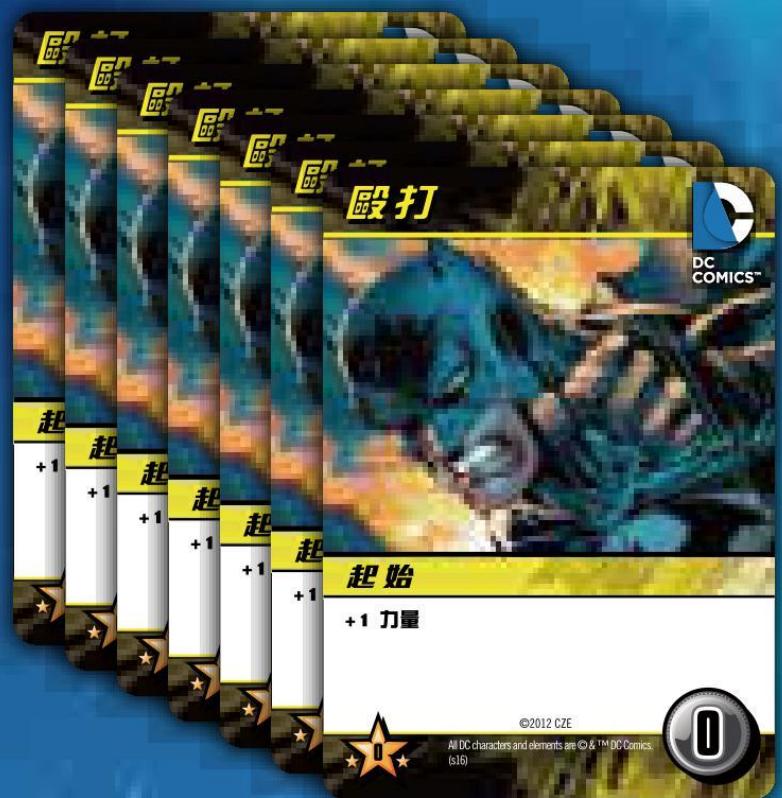
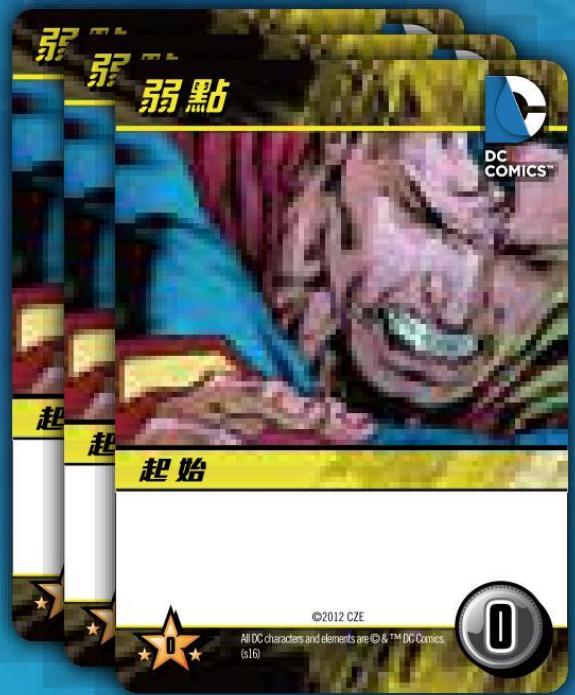
卡牌種類
DC 超級英雄
虛弱

DC 超級反派
反派
地方
具攻擊的反派
英雄
超能力
装備
具防禦的超能力

2. 主要牌庫
遊戲當中,大部份加進你牌庫的卡牌,都來自主要牌庫。把主要牌庫卡面朝下洗勻疊好,放在桌面中央。注意,以下的卡牌不應放進主要牌庫:超級反派、毆打、弱點、飛踢、虛弱,以及超級英雄。主要牌庫就是由其餘的所有卡牌所組成(共114張)。
3. 超級反派牌疊
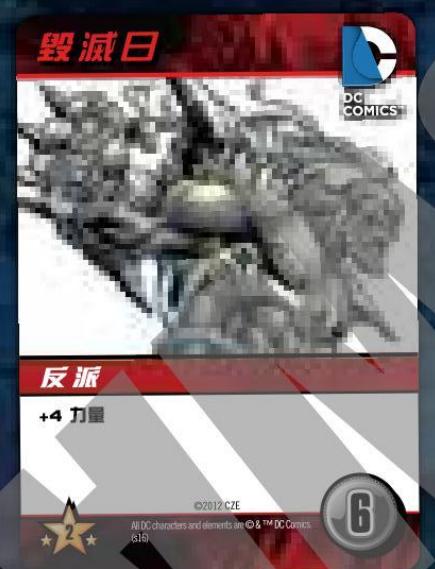
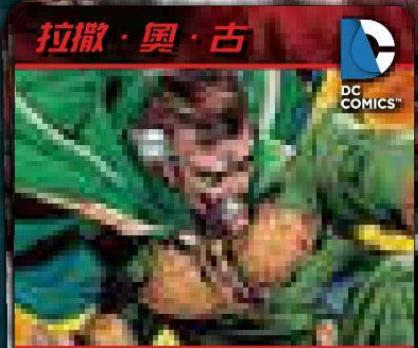
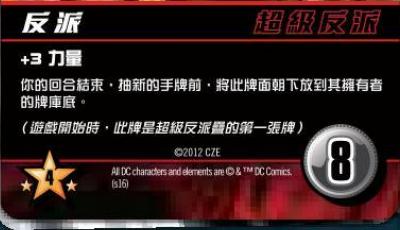
遊戲一共有十二張不同的超級反派,而在基本遊戲(Standard game)只需使用其中八張。若你們希望遊戲時間長一點,可用多於八張。而無論使用多少超級反派,都必須包括拉撒·奧·古。他的規則文字寫著:「遊戲開始時,此牌是超級反派疊的第一張牌」。
準備遊戲時,將拉撒·奧·古放在一旁,把其餘十一張超級反派面朝下洗勻,隨機移除一定數量的牌(那就是12減你們打算使用的超級反派數量),不要公開被移除的超級反派,把它們收回遊戲盒中。疊好獲保留的牌(保持面朝下),如此便沒有人知道使用了哪些超級反派,或他們的出現次序。最後,將拉撒·奧·古面朝上放在這超級反派疊頂。
拉撒·奥·古

DC
COMICS™
反派
超級反派
+3 力量
你的回合結束,抽新的手牌前,將此牌面朝下放到其擁有者的牌庫底。
(遊戲開始時,此牌是超級反派疊的第一張牌)
4
©2012 CZE
All DC characters and elements are © & ™ DC Comics.
(s16)
以下為基本遊戲的配置例子:
將拉撒·奧·古放在一旁,把其餘十一張超級反派牌面朝下洗勻。隨機移除四張,
然後將拉撒·奧·古,面朝上放在其餘七張牌之上。
4. 中央牌列
洗勻主要牌庫後,翻開主要牌庫最頂的五張牌,放到桌面的中央,作為遊戲的中央牌列。本遊毋須用上版圖,只須預留適當空間擺放卡牌。
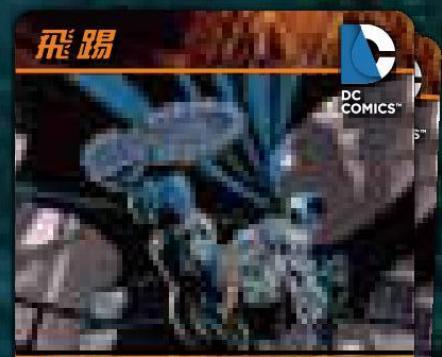
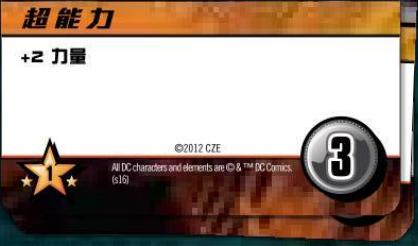
然後,把飛踢牌和虛弱牌各自疊好,連同超級反派疊,放到中央牌列的旁邊。每局遊戲都會用上所有的飛踢(16張)以及虛弱(20張)。在你的回合,只要飛踢/超級反派疊仍然有牌,你就可以購買/擊敗它們。你無法購買虛弱;它們只會通過不友善的卡牌功能而獲得。
主要牌庫、飛踢、虛弱、超級反派疊並不屬於中央牌列的一部份。
主要牌庫

反派
+2 力量
攻擊:每位對手選擇棄掉一張手牌。
中央牌列
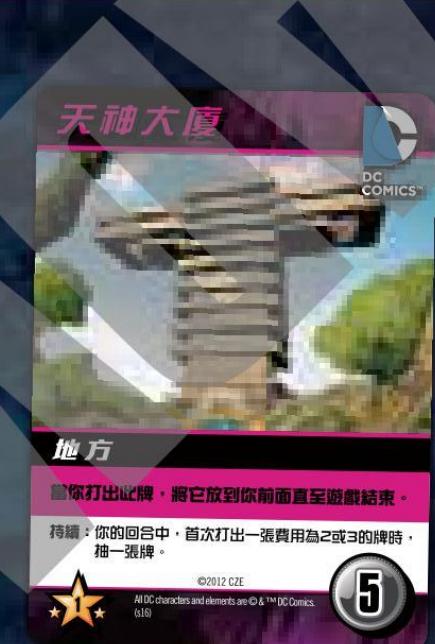
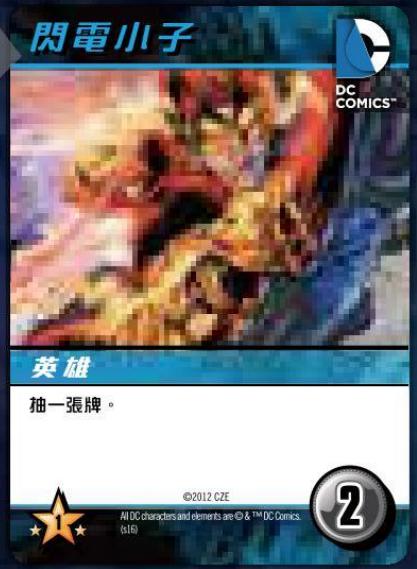
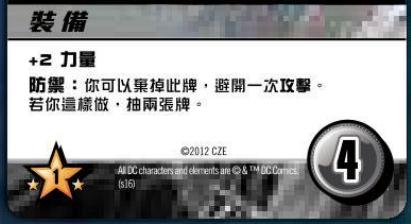
+2 力量
防禦:你可以集掉此牌,避開一次攻擊。
若你這樣做,抽兩張牌。
如上圖排列主要牌庫、中央牌列、及其他牌疊。中央牌列的五張起始牌是隨機的。每局基本遊戲開始時有:16張飛踢、20張虛弱、8張超級反派。
其他牌疊

虛弱會於遊戲結束時扣減你的分數。
遊戲進行
假如有閃電俠在場,該玩家就是起始玩家(閃電俠非常快!)。否則,以隨機方式決定誰是起始玩家。每位玩家將他們的牌庫洗勻,然後抽五張牌。遊戲按順時針方向進行。
輪到你的回合時,你可自中央牌列、飛踢、超級反派三處購買卡牌以強化你的牌庫(並獲取分數)。除非另有指示,否則所有你購買或獲得的牌都必須放進你的棄牌堆,保持面朝上。這裡你購買或獲得的新牌將會洗進你的牌庫,然後在你抽到它們之後供你使用。
這就是為什麼叫「牌庫構築遊戲」的原因。
閃電俠 超級英雄
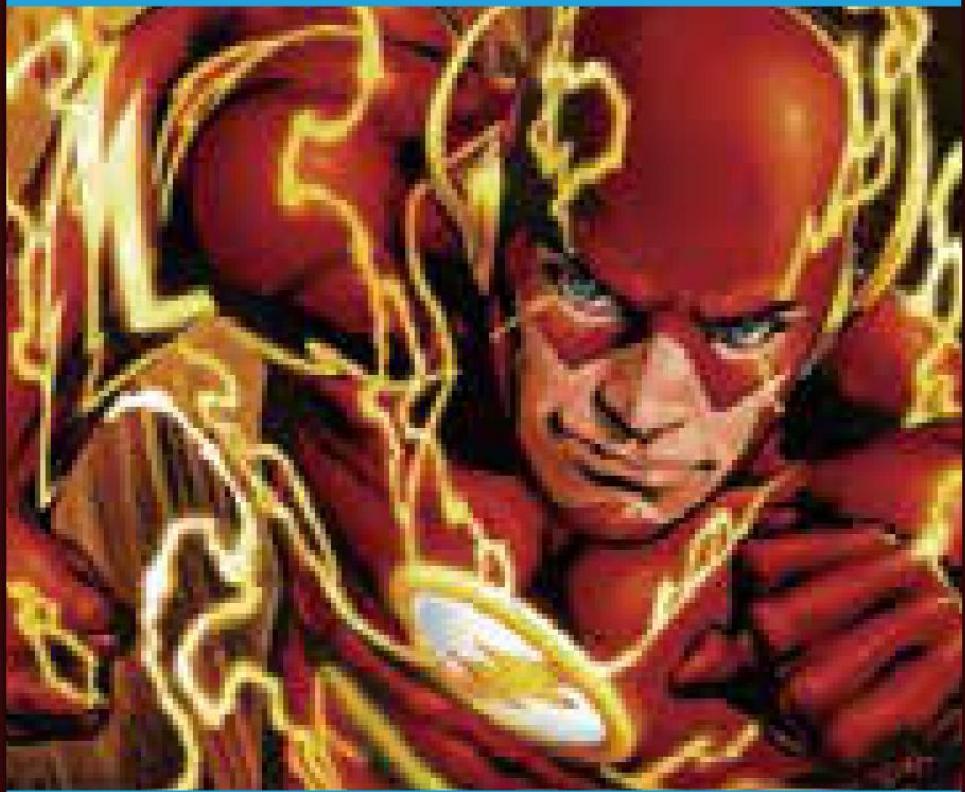
你是起始玩家。
你的回合中,首次因為卡牌效果而抽一張(或更多)
牌時,多抽一張牌。
All DC characters and elements are © & ™ DC Comics. (s16)
©2012 CZE
你可以購買任意數量的卡牌,只要它們的總費用不高於你這回合的力量總和。例如:每一張毆打牌會給你+1力量,若你抽到四張毆打,且沒有其他牌可令你獲得額外力量,則本回合你的力量總和是4。你可以購買一張費用為2、3或4的牌,或者兩張費用為2的牌(若有)。你亦可購買中央牌列旁的飛踢(通常都不會被買光),它的功能是+2力量,可助你購買中央牌列中較昂貴的卡牌。只要你有足夠的力量,一回合可以購買多張飛踢。當你無法或不想購買任何卡牌時,你可以選擇結束回合。
弱點牌和虛弱牌並不提供力量。它們只會弱化你的牌庫,因此你應儘早消滅它們。你可以打出它們,但不會有任何功能。它們只會在你回合結束時,連同你已打出及未使用的手牌,被放進棄牌堆。
出牌次序
在你的回合,你可自由決定出牌次序。當你打出一張牌時,立即執行其功能。當你把想要使用的手牌全部打出後,計算你力量的總和,然後從中央牌列或任何牌面朝上的牌疊,購買新牌。你不須要把所有手牌都打出後,才進行購買。
大部份的牌都只有簡單的功能,例如:+力量、抽牌、進行攻擊。打出的次序基本上並不重要。

結束回合
- 當你的回合結束,將所有你已打出的卡牌,以及未打出的手牌,放進棄牌堆。你失去所有未消費的力量。從你的牌庫頂抽五張牌,然後輪到你左手邊玩家的回合。
-
當你在回合中,從中央牌列購買或獲得卡牌時,注意不要立即補充。只有在回合結束時,方從主要牌庫翻開新卡牌,把中央牌列補充至五張。
-
若超級反派疊的頂牌牌面朝下,把它翻開,並立即執行該超級反派的首次出現——攻擊。
回合範例:

你的回合中,每打出一張裝備時,+1力量。
All DC characters and elements are © & ™ DC Comics. ©2012 CZE (s16)


洗勻你的起始卡牌後,第一回合你抽到了四張毆打和一張弱點。你打出四張毆打,獲得4點力量,足夠從中央牌列購買披風與頭套。購買後,你將該牌放進你的棄牌堆。弱點牌則不會提供力量。當你完成打出手牌及購買後,將你已打出、及仍在手中的卡牌放進棄牌堆(面朝上),並從你的牌庫頂抽取五張牌。從主要牌庫頂翻開一張牌,補充中央牌列至五張,然後輪到你左手邊的玩家。
遊戲結束
當觸發了以下任何一個條件,遊戲便立即結束:
- 超級反派疊沒有牌。
• 補充中央牌列時,主要牌庫不夠牌補至五張。
玩家計算各自的牌庫(亦包括手牌及棄牌堆),每張牌的分數 ★1 ★ 總和。虛弱牌會在遊戲結束時扣減玩家的分數。總分最高的玩家成為勝利者!若平手,擁有最多的超級反派的玩家獲勝。(若仍然平手,則共享勝利。)
分出勝負後,各玩家把自己牌庫的卡牌按類別歸還至所屬牌疊。若進行下一局遊戲的,注意把之前未被使用的超級反派加回去,才開始設定超級反派疊。
若你的回合中,打出一張(或更多)超能力,+1力量。
若你的回合中,打出一張(或更多)裝備,抽一張牌。
All DC characters and elements are © & ™ DC Comics.
(s16) ©2012 CZE
DC 超級英雄
你的回合中,可使用超級英雄牌所賦予的特別功能。若某超級英雄有兩種功能,它們均能在同一回合發動。在第一次遊戲之後,各玩家可選擇自己的超級英雄;假如數量足夠的話,派發兩張超級英雄予各玩家,然後玩家選擇一張作為自己的超級英雄。
稻草人
反派
+2 力量
攻擊:每位對手獲得一張虛弱。
超級速度
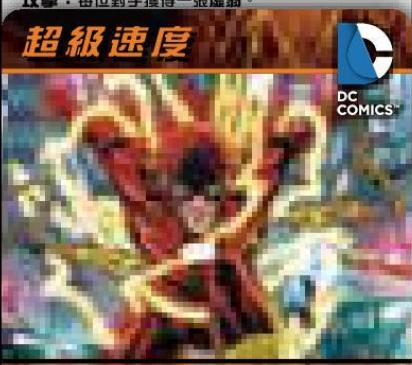
超能力
抽一張牌。
防禦:你可以棄掉此牌,避開一次攻擊。
若你這樣做,抽兩張牌。
攻擊與防禦
某些卡牌能讓你對其他玩家進行攻擊。當你打出一張具有攻擊功能的牌時,其他玩家可打出一張有防禦功能的手牌,以避開你的攻擊。只有發動了防禦功能的玩家才能無視攻擊,其他沒有避開的玩家,立即受到該攻擊的影響。每次受到攻擊,玩家只能使用一張防禦牌回應。避開攻擊並不會令攻擊牌失去其他功能(見下例),除非該功能列明需成功攻擊玩家。
例子:你打出了稻草人,它是一張具有攻擊功能的牌,假如其他玩家沒有避開你的攻擊,他們便要獲得一張虛弱。而即使所有玩家避開了你的攻擊,你仍能獲得+2力量。
超級反派
當你在一個回合內積蓄了足夠的力量,你可以選擇擊敗一名超級反派。假如你這樣做,將超級反派疊的頂牌放進你的棄牌堆。下一張超級反派會在你的回合結束時才翻開,因此玩家每回合只能擊敗一名超級反派。超級反派的費用範圍是8至12,而他們的出現次序是隨機的。
除了拉撒·奧·古,每當翻開一張新的超級反派時,便會立即發動他/她的首次出現——攻擊。所有玩家可選擇打出手上的防禦牌避開此攻擊。和普通的攻擊一樣,沒有避開首次出現——攻擊的玩家,立即受到該攻擊的影響。這類攻擊並不視為任何玩家的回合內發生。

將你本回合的力量加倍。
首次出現——攻擊:每位玩家展示手牌,並棄掉所有費用為2或以下的手牌。
當計算卡牌種類時,超級反派當成是反派。超級反派只是稱號,而非卡牌種類,因此打出超級反派及反派時,並不算是打出了兩個卡牌種類。
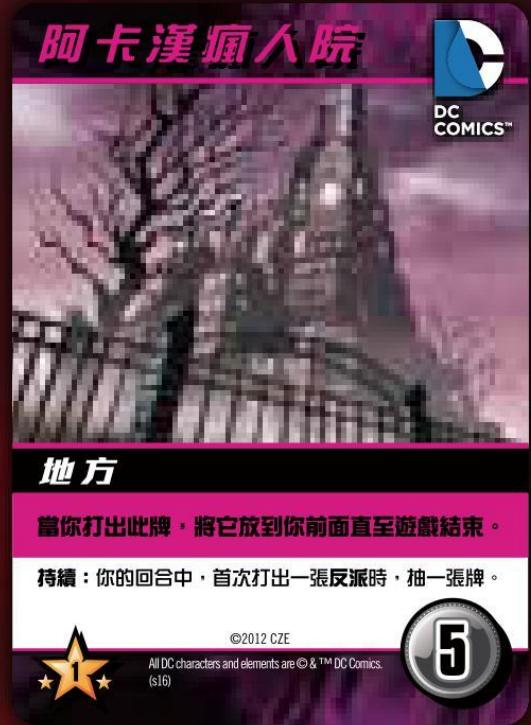
例子:若你的場上有阿卡漢瘋人院,並打出一張超級反派,這當然算作「打出一張反派」,因此你可以抽一張牌。
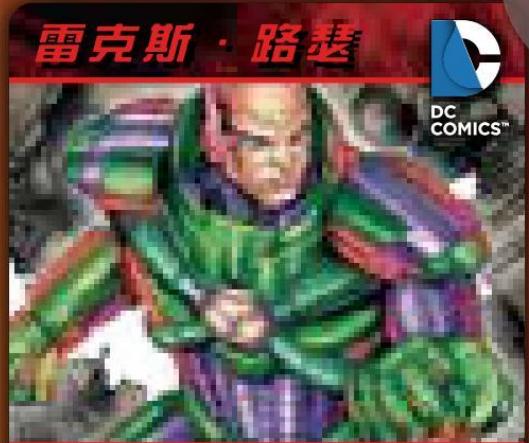
反派
抽三張牌。
首次出現——攻擊:每位玩家獲得與中央牌到的反派相同數量的虛弱。
你牌庫裡的超級反派
如同任何你獲得的卡牌,超級反派也會在被你擊敗後加進你的棄牌堆,強化你的牌庫。當你從手中打出一張超級反派時,不要再執行它的首次出現——攻擊。此攻擊只有當他在超級反派疊上的首次出現才會發動。你打出後,只執行在首次出現——攻擊的上方所描述的功能。
例子:你打出超級反派雷克斯·路瑟,然後抽三張牌。它的首次出現——攻擊則不會執行。
虛弱
某些攻擊功能會讓受到攻擊的玩家獲得一張虛弱;如無特別注明,則把新獲得的虛弱牌放進該玩家的棄牌堆。它在遊戲進行時無任何功能,而每一張虛弱會於遊戲結束時,讓持有的玩家扣減1分,因此你應該想辦法消滅它們!若在遊戲中途把20張虛弱牌用罄,所有令玩家獲得虛弱的功能就不再執行,但其他的功能則如常執行(例如:毒藤女的攻擊)。即使已無虛弱牌可獲得,玩家仍可打出防禦牌避開這類攻擊。
虛弱會於遊戲結束時扣減你的分數。

洗勻牌庫
即使你的牌庫用罄,你不應急著把你的棄牌堆洗進牌庫。只有當你需要從牌庫抽取、棄掉、或展示一張牌,而你的牌庫已經沒有牌的時候,才立即將你的棄牌堆面朝下洗勻疊好,組成你的新牌庫。
地方
當你購買或獲得地方牌時,如同其他牌一樣,會先進入你的棄牌堆。然而,當你從手中打出地方牌,它會一直放在你的前面,直至遊戲結束。每張地方牌都有一個持續效果,只要你在你的回合,首次打出指定種類的卡牌,便可以抽一張牌。切記不要把註明「持續」的卡牌在回合結束時放進棄牌堆。你可控制多張地方牌,但每張牌每回合只會發動一次效果。
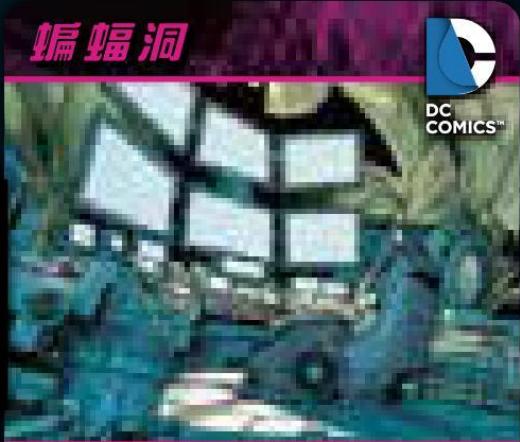
持續:你的回合中,首次打出一張裝備時,抽一張牌。
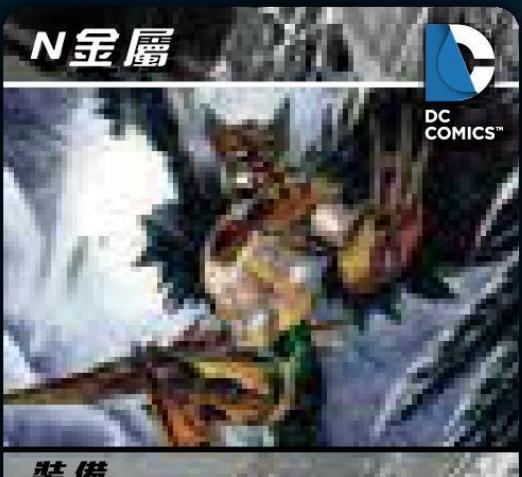
N金屬
消滅卡牌
某些卡牌的功能容許你消滅你的手中、牌庫、以至中央牌列的卡牌。當你消滅一張牌,把它面朝上移至一個共用的「被消滅卡牌堆」,它不會再回到你的牌庫,亦不會再在是次遊戲中出現。如無特別注明,你可自行選擇消滅哪一張牌/是否消滅該指定牌。若虛弱牌或飛踢牌被消滅,它們不會回到原來的牌疊。
獲得卡牌
若某卡牌的功能容許玩家獲得某張指定卡牌,或一張由玩家選擇的牌時,該牌立即進入該玩家的棄牌堆,且毋需支付額外費用(如無特別注明)。假如在獲得牌的時候,符合指定條件的牌並不存在(例如指定名稱、卡牌種類、或費用),那就無法獲得任何牌。

反派
從中央牌列獲得一張費用為4或以下的牌。
執行卡牌功能
若某卡牌的功能影響多名玩家,而次序會影響結果(例如有三名受到攻擊的玩家需要獲得虛弱,但場上只剩兩張),則由打出該卡牌的玩家開始,按順時針方向執行該功能。
超級反派的首次出現——攻擊則比較特別:由即將開始回合的玩家開始,按順時針方向執行。
當你將要打出的牌會觸發其他牌的功能,例如你的超級英雄或你控制的地方牌,首先完整地執行你所打出的牌之功能,然後才執行其他牌的功能。
例子:企鵝的功能是「抽兩張牌,然後選擇並棄掉兩張手牌。」若你的超級英雄是閃電俠,打出了企鵝並觸發閃電俠的特別功能:多抽一張牌,則你必須先執行企鵝的功能(抽兩張然後棄掉兩張)之後,才能執行閃電俠的功能(抽一張牌)。
變體規則
雙巨頭:這是一對一的遊戲,每位玩家各控制兩位超級英雄...就有如兩位超級英雄融合在一個身體裡!你的回合中,可使用你的兩張超級英雄牌所賦予的特別功能。遊玩這規則時,將所有超級英雄洗勻後,隨機派發兩張予各玩家。
團隊戰:這是二對二的遊戲,四位玩家分作兩隊,目標是要擊敗對面的隊伍!回合應在兩隊隊員之間交替進行,而非同一隊連續進行兩個回合。隊員之間可在決定行動前討論策略,但不應讓你的隊員看到你的手牌。每位玩家有各自的超級英雄、牌庫、及手牌,然而當你在你的回合購買或獲得一張卡牌時,你可選擇將該牌放進你的棄牌堆,或者你的隊員的棄牌堆。每一次,當你選擇把卡牌放進隊友的棄牌堆,則對手的其中一名隊員可選擇棄掉一張手牌,然後抽一張牌。
你的隊員不會受你的攻擊影響。當你的隊員被你的對手,或者超級反派攻擊時,你可以替他防禦。當你打出防禦牌時,你必須選擇要保護那一位玩家。而即使你選擇為隊員防禦,仍然是由你享有卡牌上所列的好處(例子:你打出真言套索為隊員防禦後,你可按卡牌功能抽一張牌)。遊戲結束時,將同隊的牌庫分數加總,成為你們隊伍的分數。分數較高的隊伍獲勝!
若平手,擁有最多的超級反派的隊伍獲勝。(若仍然平手,則共享勝利。)
- 關於此事遊戲設計者的親自說明:http://www.boardgamegeek.com/thread/896795/defending-against-joker「巡邏」模式:這模式在基本遊戲上增加一個新選項 - 你的回合中,只要中央牌列不足五張牌,你可以立即從主要牌庫補充,直至中央牌列有五張牌。若這些牌當中有攻擊功能,你便立即受到該牌的攻擊(其他玩家不受影響)。因此而觸法的攻擊不會讓玩家獲得任何好處。
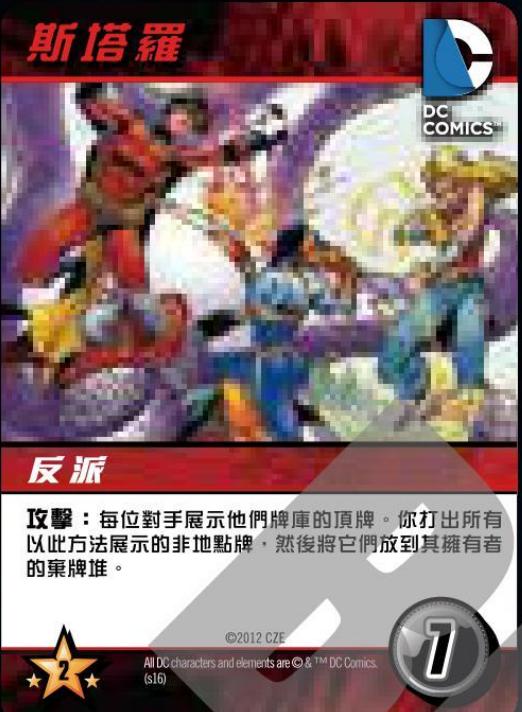
斯塔羅
反派
攻擊:每位對手展示他們牌庫的頂牌。你打出所有以此方法展示的非地點牌,然後將它們放到其擁有者的棄牌堆。
例子:你選擇立即補充中央牌列,其中一張為斯塔羅,一張有攻擊功能的反派。若你沒有防禦,則必須棄掉你牌庫的頂牌,但不會獲得好處(即使因此而棄掉地方牌,你亦不能將該牌打出)。
這變體規則令玩家能購買或獲得的卡牌選擇增多了,但同時伴隨著一些風險。由於你並不需要把所有手牌立即打出,所以在這規則下,最理想的出牌方法是:在立即補充中央牌列前,把適量的防禦牌留在手中。
特别卡牌
反監視者:超級反派、飛踢和虛弱並非中央牌列的牌,因此不能使用反監視者的功能消滅它們。另外你只能消滅打出反監視者時,已經在中央牌列的牌,而不能消滅用來補充中央牌列的牌。
注意:當它的首次出現——攻擊發動後,各玩家加進中央牌列的牌,會令中央牌列多於五張,故此在補充前,應先計算牌的數量是否少於五張。
阿特羅斯提斯:它的首次出現——攻擊不會令你的對手看到你放到超級英雄的底下的牌(當然,你可自願地向其他玩家展示)。
蝙蝠車:當發動其棄牌與抽牌的功能時,這張牌仍會留在場上,直到回合結束才被放進棄牌堆。不論發動上述的功能與否,蝙蝠俠都會因為打出這張裝備卡,而獲得+1力量。
畢沙羅:你牌庫裡的虛弱仍會扣減你的分數。
黑魔鬼魚、百烈煞、自殺小隊:若你已沒有手牌可在回合中打出,則你必須放棄該回合。從你牌庫頂抽五張牌,然後輪到下一位玩家。
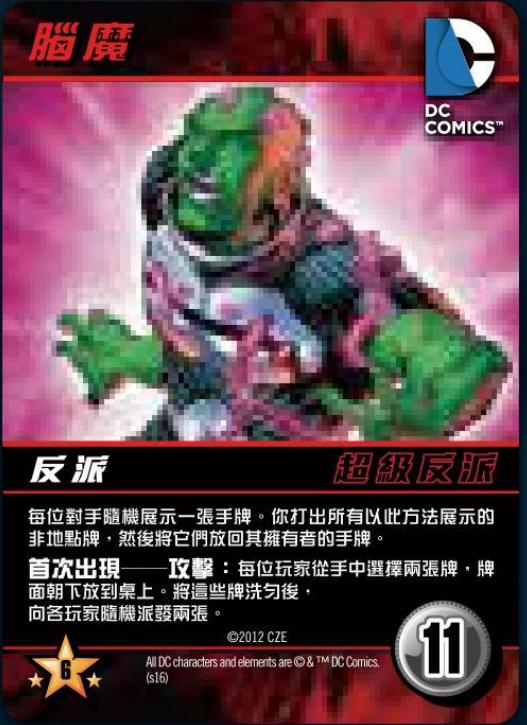
每位對手隨機展示一張手牌。你打出所有以此方法展示的非地點牌,然後將它們放回其擁有者的手牌。
首次出現——攻擊:每位玩家從手中選擇兩張牌,牌面朝下放到桌上。將這些牌洗勻後,向各玩家隨機派發兩張。
腦魔:在它的首次出現——攻擊期間,玩家貢獻了多少張牌,就獲發回同樣數目的牌。
冷凍隊長:當超級英雄牌面朝下時,它沒有功能。即使神奇女俠(面朝下)擊敗冷凍隊長,也不會觸發其功能。
泥面人:你不能選擇另一張在本回合打出的泥面人。
暗夜騎士:注意貓女可以把任何一張在本回合購買或獲得的卡牌,放進你的手牌,而不限於因暗夜騎士功能而免費獲得的裝備牌。貓女及暗夜騎士打出的先後次序並不重要——結果是一樣的。
達克賽德:你可以從你手中展示一張反派,或打出一張有防禦功能的牌,以避開達克賽德的首次出現——攻擊。假如你無法避開,則選擇兩張手牌並棄掉。
喪鐘:你並非從手牌或棄牌堆中二擇其一,再從該區選一張牌來消滅。只要你無法避開喪鐘的首次出現——攻擊,便須綜合你的手牌和棄牌堆,選擇一張英雄、超能力、或裝備牌,並消滅它。
翡翠騎士:你不可選擇飛踢,它並非中央牌列的牌。在本回合內,你不可購買或獲得你移走了的那張牌。
哈莉·奎茵:若某玩家的棄牌堆中,沒有毆打牌或弱點牌,則哈莉·奎茵不會對該玩家造成任何效果(但仍可使用有防禦功能的牌)。
高科技英雄:只要你在回合中打出過一張超能力牌,或裝備牌,不管打出的次序,高科技英雄都會讓你獲得+3力量。
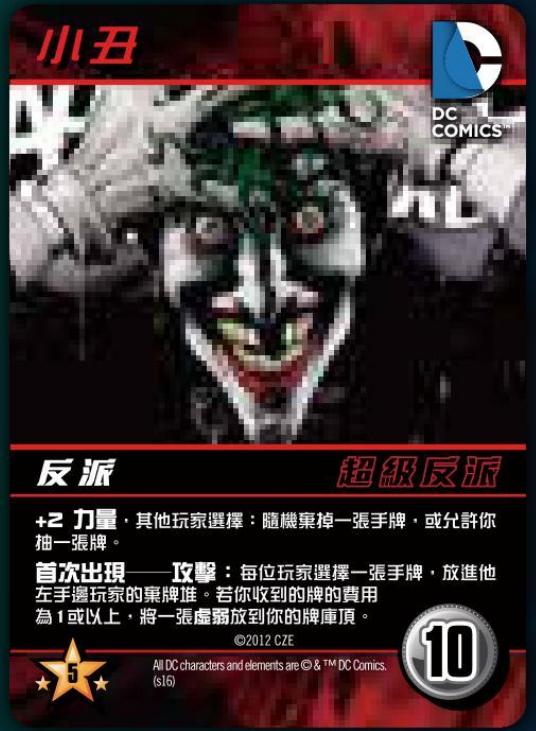
小丑:若某玩家避開了小丑的首次出現一一攻擊,該玩家不需要傳牌,亦不會收取卡牌。傳給該玩家的卡牌,改由他左手邊的玩家收取。
小丑的功能並不是攻擊。每位其他玩家必須選擇隨機棄掉一張手牌,或允許打出小丑的玩家抽一張牌。若你已無手牌,則不能選擇棄掉手牌。
雷克斯·路瑟:它的首次出現——攻擊並不會把雷克斯·路瑟計算在內:他並不在中央牌列。
鋼鐵英雄:你可以立即把放進手牌的超能力牌打出。
薇拉:只要你打出這張牌的時候,你的棄牌堆沒有卡牌,即使之後你需要棄牌,仍可獲得+4力量。
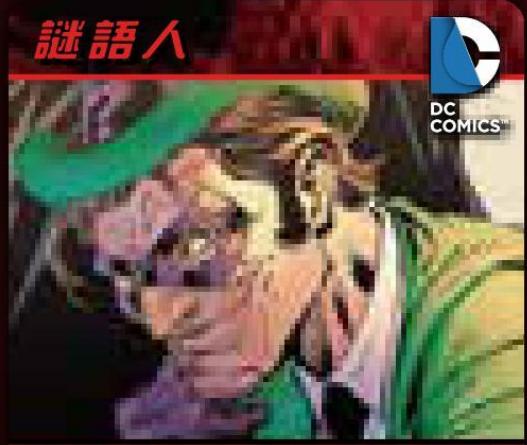
反派
你可以支付3點力量。若你這樣做,獲得主要牌庫的頂牌。本回合內,你可以重覆使用此功能。
若你選擇不這樣做,+1力量。
謎語人:你必須正式支付3點力量,才可以檢視(並獲得)主要牌庫的頂牌。當你打出這張牌時,你可以重覆使用它的功能,但每次必須從你現有的力量總和當中,扣除3點力量。若你選擇不使用上述的功能,則可獲得+1力量。
聖納托:它的首次出現——攻擊發生時,你不一定要棄掉你所展示的英雄牌;若你展示了兩張英雄牌,則你必須棄掉兩張任意手牌。
自殺小隊:主要牌庫裡有6張自殺小隊。遊戲結束時,這張牌的分數等同於你牌庫裡自殺小隊的數量,且每張自殺小隊獨立計算。因此,你獲得的分數,等同於你所擁有的自殺小隊之數量的平方(例子:你有3張自殺小隊,則它們會為你帶來 3*3 = 9分)。
沼澤異形:即使你控制多個地方,也不會獲得額外的力量。
X光透視:由於它不是攻擊,玩家無法對其功能作出防禦。若某玩家的牌庫用完,則他要把棄牌堆面朝下洗勻疊好,組成新的牌庫。
常見問題
問:「擊敗」、「被擊敗」是甚麼意思?
答:你「擊敗」了一個超級反派,代表你從超級反派疊的頂牌購買了它。它因此「被擊敗」了。不適用於其他情況。
問:我打出了閃電小子,然後抽到守望塔。我打出守望塔,然後再打出羅賓。如此,我能夠發動守望塔的持續效果,抽一張牌嗎?
答:不可以,因為羅賓並非你首張打出的英雄牌。閃電小子才是第一張,但當時守望塔並不在場。
製作人員
作者 Matt Hyra & Ben Stoll
Cryptozoic Entertainment
主席兼內容總監 Cory Jones
執行長 John Nee
營運總監 Scott Gaeta
銷售與企業發展 John Sepenuk
遊戲設計與發展
Matt Hyra (Lead), Phil Cape, Dan Clark, Matt Dunn, Kevin Jordan, Erik Larsen, Ben Stoll, Patrick Sullivan, Drew Walker, Chris Woods
圖像設計 Larry Renac (Lead), Marco Sipriaso, Nancy Valdez, John Vineyard
修改 Kate Stavola
財務主任 Joanne Barron
營運主任 Leisha Cummins
品牌管理 Patrick Dillon
助理產品主管 Rachel Valverde
企業專員 Rumi Asai
銷售 Kurt Nelson
環球銷售 Ming Wan
辦公室主管 April Jones
公共關係 AnnaMaria White
Javier Casillas, Alex Charksy, Sara Erickson, Drew Korfe, Mike Rosenberg, Christina Sims, Laura Waniuk
測試玩家
William Brinkman, Tom Driver, Scott Gaeta, Russ Greenwald, Adam Hensch, Cory Jones, Marcos Payan, Ry Schueller, Nathaniel Yamaguchi and many, many others who didn't log the 100+ games these testers did . . . though your help is still appreciated!
Cryptozoic 特別鳴謝
Miranda Anderson, Kyle Heuer, Matt Hoffman, Michael Kirchhoff, Lacy Lodes, Danielle McKay, Matthias Nagy, Jon Nee, Mike Sacco, Lisa Villaire, Galen Welch, MaryCarmen Wilbur
DECK-BUILDING GAME
DC COMICS
回合順序
- 打出你的手牌。
- 從中央牌列,購買總費用不高於你這回合的力量總和的卡牌(可多於一張)。
- 當你購買或獲得卡牌時,如無特別注明,將該牌放進你的棄牌堆。
回合結束
- 將所有你本回合打出的卡牌,以及未打出的手牌,放進你的棄牌堆,然後抽五張牌。
- 若中央牌列不足五張牌,則從主要牌庫補充至五張。
- 若超級反派疊的頂牌牌面朝下,把它翻開,並立即執行該超級反派的首次出現——攻擊。
必須等到你需要從牌庫抽取、棄掉、或展示一張牌,而你的牌庫已經沒有牌的時候,才立即將你的棄牌堆面朝下洗勻疊好,組成你的新牌庫。
當觸發了以下任何一個條件,遊戲便立即結束:
- 超級反派疊沒有牌。
- 補充中央牌列時,主要牌庫不夠牌補至五張。
栢龍玩具有限公司
Broadway Toys Limited
九龍紅磡鶴園東街4號恆藝珠寶大廈307室
Room 307, Heng Ngai Jewelry Centre,
4 Hok Yuen Street East, Hunghom, Kowloon, H.K.
Tel: +852 23631998 • http://www.broadwaygames.com
CRYPTOZOIC™
ENTERTAINMENT
All DC characters and elements are © &™ DC Comics. WB SHIELD: TM & © WBEI.
©2016 Cryptozoic Entertainment.
16279 Laguna Canyon Road, Irvine, CA 92618.
www.cryptozoic.com Made in China.
DECK-BUILDING GAME
DC COMICS
回合順序
- 打出你的手牌。
- 從中央牌列,購買總費用不高於你這回合的力量總和的卡牌(可多於一張)。
- 當你購買或獲得卡牌時,如無特別注明,將該牌放進你的棄牌堆。
回合結束
- 將所有你本回合打出的卡牌,以及未打出的手牌,放進你的棄牌堆,然後抽五張牌。
- 若中央牌列不足五張牌,則從主要牌庫補充至五張。
- 若超級反派疊的頂牌牌面朝下,把它翻開,並立即執行該超級反派的首次出現——攻擊。
必須等到你需要從牌庫抽取、棄掉、或展示一張牌,而你的牌庫已經沒有牌的時候,才立即將你的棄牌堆面朝下洗勻疊好,組成你的新牌庫。
當觸發了以下任何一個條件,遊戲便立即結束:
- 超級反派疊沒有牌。
- 補充中央牌列時,主要牌庫不夠牌補至五張。
栢龍玩具有限公司
Broadway Toys Limited
九龍紅磡鶴園東街4號恆藝珠寶大廈307室
Room 307, Heng Ngai Jewelry Centre,
4 Hok Yuen Street East, Hunghom, Kowloon, H.K.
Tel: +852 23631998 • http://www.broadwaygames.com
CRYPTOZOIC™
ENTERTAINMENT
All DC characters and elements are © &™ DC Comics. WB SHIELD: TM & © WBEI.
©2016 Cryptozoic Entertainment.
16279 Laguna Canyon Road, Irvine, CA 92618.
www.cryptozoic.com Made in China.
Download MarkdownUltimate Rulebook Ver. 4.0.md307.6 KB
DCDECKBUILDING ULTIMATERULEBOOK
INDEX
Game Play Modes...
Base Games.
Overview
Contents
Setup For Your Gam
Over-sized Cards and Starting Dec
Health Bar and Charge Meter
Transformed Cards
The Main Deck.
The Line-Up .....
Super-Villain/Super Hero Stack
Gameplay .
End of Game
Victory Point Token
Additional Rules .
New Concepts.
Variant Games. 19
Crossover Packs 23
Overview . 23
Contents.
Watchmen Crossover Pack
Rogues Crossover Pack 5 ... 26
Birds of Prey Crossover Pack 6. 26
New Gods Crossover Pack 7... 26
Batman Ninja Crossover Pack 8
DC Bombshells Crossover Pack 9 27
Flashpoint Crossover Pack 10 27
New Concepts...
Crisis Expansion Packs . 29
Overview . 29
Contents.
Co-op Crisis Set-Up 29
Hidden Objectives Crisis Set-U 30
Crisis Mode Rules of Play. ..30
Crisis Cards . 31
Personal Crisis Cards. 32
Crisis Solo Play. 32
Impossible Super-Villains.. 33
Setting Your Crisis Difficulty 33
New Main Deck . 33
New Super Heroes 34
New Competitive Super-Villains 34
Competitive Play . 34
Confrontations - Rivals .. 35
Overview 35
Content . 35
Set-Up For Your First Game ........
Gameplay ................. .37
End of Game.... .38
2 and 3 Player Variants. .38
Additional Rules . 39
New Concepts ..
Rebirth..
Overview .
Content ...
The Threat Track...
Winning and Losing ......
Moving You Character ..
Villains.. 46
Preventing Villain Movemen
Signature Cards .......
Side Mission ....
Solo Mode .....
Competitive Mode...
Rebirth Campaign Log......
Multiverse.
Overview .
Content .
The Multiverse and Randomizer Card 53
Specific Set Clarifications .. 55
World Hopper Variant ... 55
Confrontation Cost tokens Variant . 56
Specific Card Clarification.
Original Set ..........
Heroes Unite ....
Forever Evil...... 58
Teen Titans... 59
Dark Nights: Metal . 59
Injustice........ 59
Justice League Dark
Crossover Packs..... 60
Crisis Expansions . 62
Confrontations - Rivals 66
Rebirth ....
Multiverse ..
FAQs
Keywords
Combining Sets .
Turn Sequence ..
GAME PLAY MODES
BASE GAMES
• Competitive Play
• Can be combined to create custom decks (recommend 100-120 cards per deck).
CROSSOVER EXPANSIONS
• Can be added to any Base Deck
Recommended decks
o Crossover 1: JSA – Any Base
o Crossover 2: Arrow – Original Set/Heroes Unite
o Crossover 3: Legion of Superheroes – Teen Titans/Heroes Unite
o Crossover 4: Watchmen - Original Set
o Crossover 5: Rogues – Forever Evil
o Crossover 6: Birds of Prey – Teen Titans
o Crossover 7: New Gods – Original Set/Heroes Unite
o Crossover 8: Batman Ninja – Tested w/Original Set. Has fun combos with each set.
o Crossover 9: DC Bombshells
o Crossover 10: Flashpoint
MINI EXPANSION
• Can be added to any Base Deck
o Peacemaker
CRISIS EXPANSIONS
Provides Co-op or Solo play
• Can be added to and main deck and or mixed with crossovers and main deck.
o If adding with a Crossover, reduce the main deck size randomly.
Can be customized by selecting cards from each Crisis Expansion.
• Any Crisis Expansion can be played with any base game but the recommended is;
o Expansion 1 with DC Deck Building Game
o Expansion 2 with Heroes Unite
o Expansion 3 with Forever Evil
o Expansion 4 with Teen Titans.
o Expansion 5 with Dark Nights Death Metal
CONFRONTATIONS & RIVAL EXPANSIONS
• Competitive Play
• Player vs. Player, 2 vs. 2
Confrontations can be interchanged with each Rival Expansion
MULTIVERSE
• Competitive Play
• Utilizes all sets
REBIRTH
• Provides Co-op, Competitive or Solo play
CUBE DECKS
Custom built decks based individual preference.
• https//www.dcdeckbuilding.info offers some Official Rules and Banned Cards for competitive play.
BASE GAMES
Original Game, Heroes Unite, Forever Ever, Teen Titans, Teen Titan Go, Dark Nights: Metal, Injustice, Justice League Dark, Arkham Asylum
OVERVIEW
Base Game, Heroes United, Teen Titans, Forever Evil, Dark Nights: Metal, Arkham Asylum
In the DC Comics Deck-building Game, you take on the role of one of the brave and heroic allies in the struggle against the forces of Super-Villainy or one of the evil and nefarious cohorts in their plot to destroy the forces of good once and for all! While you begin armed with only the ability to Punch your foes, as the game progresses, you will add new, more powerful cards to your deck, with the goal of defeating as many DC Comics Super-Villains or Super Heroes as you can. In the end, the player who has accumulated the most Victory Points from the cards in his or her deck wins the game.
Injustice.
In DC Deck-Building Game: Injustice: Gods Among Us, you enter a world struck by tragedy: The Joker decimated Metropolis with a nuclear bomb and tricked Superman into killing his wife, Lois Lane. This grief drove Superman over the line and he has vowed to take the safety of the world into his own hands, no matter the cost. Meanwhile, Batman gathers a team of Insurgents to overthrow Superman’s tyrannical reign. One-time friends have become bitter enemies and new allies are found in old nemeses! Your deck begins the game with only the ability to Punch your foes. As the game progresses, you will add more powerful cards to your deck, with the goal of defeating your opponents. Build you team from a variety of Heroes, Villains, Equipment, and Super Powers. You’ll directly attack your foes and attempt to knock them out, which impedes their progress to victory. When the dust has settled, the player with the most Victory Points wins.
Justice League Dark.
DC Deck-Building Game: Justice League Dark puts you in the supernatural shoes of the DC team that thwarts the mystical forces lurking in the dark corners of the multiverse. You will Seal away magical threats and transform your cards into more powerful forms! Your deck begins the game with only the ability to Punch your foes. As the game progresses, you will add more powerful cards to your deck, with the goal of defeating your opponents. Build your team from a variety of Heroes, Villains, Equipment, Locations, and Super Powers. Once all the magical Nemeses have been Sealed away, the player with the most Victory Points wins! DC Deck-Building Game veterans will find the main new rules of this game on pages 10-11.
CONTENTS
DC Deckbuilding Game
214 Game cards
• 36 Punch Starting Cards
• 16 Vulnerability Starting Cards
114 Main Deck Cards
• 16 Kick Cards
• 12 DC Comics Super-Villain Cards
• 20 Weakness Cards
• 7 Oversized DC Super Heroes
Heroes Unite
211 Game Cards
• 36 Punch Starting Cards
16 Vulnerability Starting Cards
• 111 Main Deck Cards
• 16 Kick Cards
• 12 DC Comics Super-Villain Cards
• 20 Weakness Cards
• 7 Oversized DC Super Heroes
Forever Evil
211 Game Cards
• 36 Punch Starting Cards
• 16 Vulnerability Starting Cards
• 111 Main Deck Cards
• 16 Kick Cards
• 12 DC Comics Super-Villain Cards
• 20 Weakness Cards
• 7 Oversized DC Comic Super-Villains
• 6 Frozen Tokens
● Lots of Victory Point Tokens
Teen Titans
213 Game Cards
• 36 Punch Starting Cards
• 16 Vulnerability Starting Cards
113 Main Deck Cards
16 Kick Cards
• 12 DC Comics Super-Villain Cards
• 20 Weakness Cards
• 7 Oversized DC Super Heroes
Teen Titans Go!
115 Game Cards
• 14 Punch Starting Cards
• 6 Snack Time Starting Cards
• 64 Main Deck Cards
• 6 Titans Go! Cards
• 9 Nemesis Cards
• 10 Weakness Cards
• 6 Event Cards (Advanced Play Only)
• 5 Oversized Super Heroes-Sidekick
Dark Nights: Metal
202 Game Cards
36 Punch Starting Cards
• 16 Vulnerability Starting Cards
97 Main Deck Cards
• 16 Breakthrough Cards
• 7 DC Comics Super-Villain Cards
30 Weakness Cards
• 11 Oversized DC Super Heroes
• 1 The Batman Who Laughs Tile
Injustice
207 Game cards
• 20 Light Punch Starting Cards
• 8 Vulnerability Starting Cards
• 8 Heavy Punch Starting Cards
• 4 Defend Starting Cards
92 Main Deck Cards
• 16 Flying Kick Cards
20 Weakness Cards
• 9 Super Move Cards
• 14 Nemesis Cards
15 Clash Cards (Impossible Mode)
• 9 Oversized DC Character Cards
• 4 Oversized Health Tracker Cards
6 Health Markers
• 4 Charge Markers
25 KO’d Tokens
25 VP Tokens
10 Oversized Areana Cards (Advanced Mode)
Justice League Dark
215 Game Cards
40 Starter Cards
107 Main Deck Cards
12 Mystic Ritual Cards
16 Weakness Cards
• 29 Transformed Cards
10 Nemesis Cards
8 Oversized DC Character Cards
• 4 Seal Tokens
Justice League Dark Expansion 59 Game Cards
• 6 Oversized DC Character Cards
• 10 Super Hero Nemesis Cards
8 Main Deck Cards
• 3 Transformed Cards
• 20 Cursed Weakness Cards
• 4 Lepsid Esruc Cards
• 8 Reward Cards
Arkham Asylum
198 Game Cards
• 9 Oversized DC Character Cards
36 Starter Cards
97 Main Deck Cards
• 13 Henchmen Cards
16 Weakness Cards
• 14 Hostage Cards
• 12 Nemesis Cards
8 Riddle Tokens
• 4 Freeze Tokens
• 1 Two-Face Coin
28 VP Tokens
• 1 Bribe Tile
Arkham Asylum Shadows Expansion 59 Game Cards
• 8 Oversized DC Character Cards
18 Nemesis Cards
• 2 Oversized Team Codder Cards
• 8 Unique Starter Cards
18 Main Deck Cards
• 4 Turn Order Cards
SETUP FOR YOUR GAME
1. DC Comics Over-sized Cards and Starting Decks
Each player is dealt 2 random DC Comics Super Hero or Super Villain. Alternately, each player may choose to play as their favorite character. Return the unused Characters to the game box.
For Teen Titans Go, Place the unused Super Heroes nearby, then flip them over to their Sidekick sides. For Dark Nights, place the unused oversized cards face down in a stack nearby.
For Dark Nights: Metal, First remove Batman from the stack of oversized Super Heroes and shuffle the rest of them.
For Injustice, each player takes the Super Move for their chosen Character and tucks it under their Character card so that the charge cost is still visible. Return the unused Characters and Super Moves to the game box.
For Justice League Dark, each player also takes a Seal token of their choice.
For Arkham Asylum, each player takes 1 unique Starter Card, 6 Punch and 3 Vulnerability.
Each DC Comics Super Hero or Super-Villain begins with a starting deck of seven Punch cards and three Vulnerability cards (Snack time if using Teen Titans Go). You will use your Punch cards to buy more powerful cards to add to your deck, improving it as the game goes on. Vulnerability cards (Snack Time) represent the things that occasionally cause a DC Comics Super Hero or Super-Villain to falter. They don’t do anything for you when drawn or played, so it’s best to get rid of them as soon as possible (more on how to do that later).
For Injustice, each player begins the game with a starting deck of 5 Light Punch cards, 2 Vulnerability cards, 2 Heavy Punch cards, and 1 Defend card. Return any unused Starters to the game box.
For Justice League Dark, each player the game with a starting deck of 6 Punch cards, 2 Vulnerability cards, 1 Incantation card, and 1 Sealed Defense card. Return any unused Starters to the game box.
For Justice League Dark Expansion, Lepsid Esruc, these additional obstacles come with a silver lining of a new card for your Starter deck. If you set up the game with Cursed Weakness cards, each player should also swap out 1 Punch from their starting deck with a Lepsid Ersuc card. This new Starter allows you to dispel Curses back to their stack. Note that even if you have Lepsid Ersuc in your hand, you still must play a Weakness card in your hand (and suffer its abilities) before you can return it to the stack with this card.
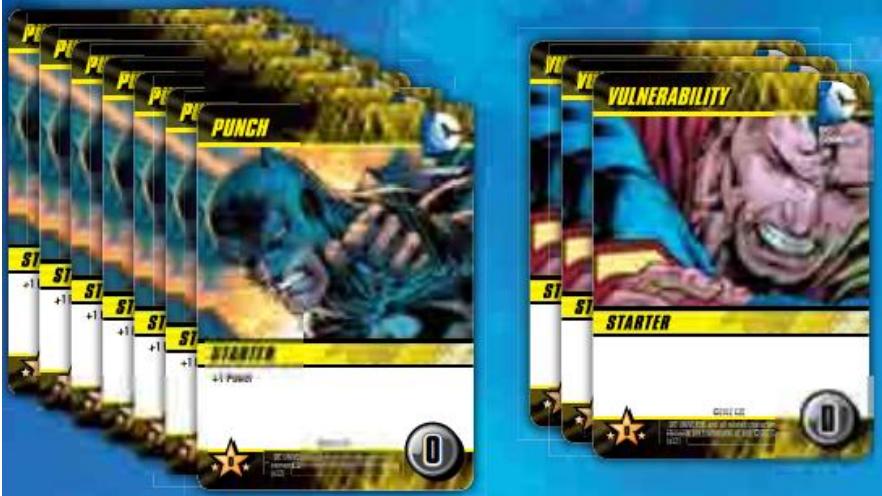

2. Health Bars and Charge Meter (Injustice)
Give each player a Health Track card, 1 Health marker, and 1 Charge marker. Place the Health marker on the number 20 on the upper Health Bar. Place the Charge marker on the number 0 on the Charge Meter.
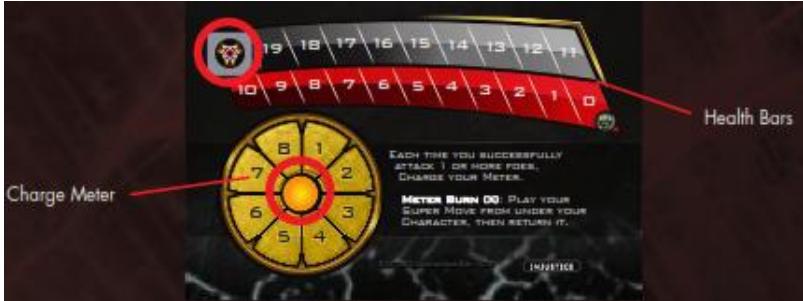
3. Transformed Cards (Justice League Dark)
Transformed cards have a black textbox with magical flair as well as the “Transformed” subtype to the right of their card type. Take all of the Transformed cards and make 4 separate stacks of them based on their card type. You may find it useful to sort the cards in each stack alphabetically so they’re easier to find during the game. Cards in this zone cannot be purchased and are only gained by specific card effects.
4. The Main Deck
Most of the cards that you will add to your deck as the game progresses come from the main deck. Teen Titans Go Advanced Game adds six Event cards to the Main Deck. Shuffle the main deck and place it in the middle of the table. None of the following cards should ever be placed into the main deck: Super-Villains, Super Heroes, Punch, Vulnerability, Kick, Weakness, or the oversized Super Hero cards and oversized Super Villains. The main deck is made up of every other card in the game (various cards total).
For Dark Nights: Metal, set aside all Breakthrough, Starter, Weakness, Super-Villains, and The Batman Who Laughs tile. Shuffle the remaining cards and place them in the middle of the table. This forms the main deck, which is made up of 97 cards total.
For Injustice, most of the cards that you will add to your deck during the game come from the main deck. Set aside all Flying Kick, Weakness, and Nemesis cards. Shuffle the remaining Hero, Villain, Equipment, and Super Power cards together and place them in the middle of the table. This forms the main deck, which is made up of 92 cards total.
For Justice League Dark, most of the cards that you will add to your deck during the game come from the main deck. Set aside all Mystic Ritual, Weakness, and Nemesis cards. Shuffle the remaining Hero, Villain, Equipment, Location, and Super Power cards together and place them in the middle of the table. (Reminder: There should be no cards with a black textbox in the main deck at the start of the game.) This forms the main deck, which is made up of 107 cards total.
5. The Line-Up and Stacks
After shuffling the main deck, place the top five cards from the main deck into the Line-Up. There is no board necessary to play this game; just reserve space for each card. Next, place the Kick, Super-Villain, and Weakness stacks at the end of the Line-Up. You may
want to turn these stacks perpendicular to the board so that everyone can reach them. You will always use all 16 Kicks and all 20 Weaknesses each game. The number of Super-Villains you use will vary. Kicks and Super-Villains are always available to be bought or defeated during your turn (while cards remain in their stacks). Weaknesses are never bought; they are gained only through unfriendly card effects. The main deck and the three stacks of cards on the end are not part of the Line-Up.
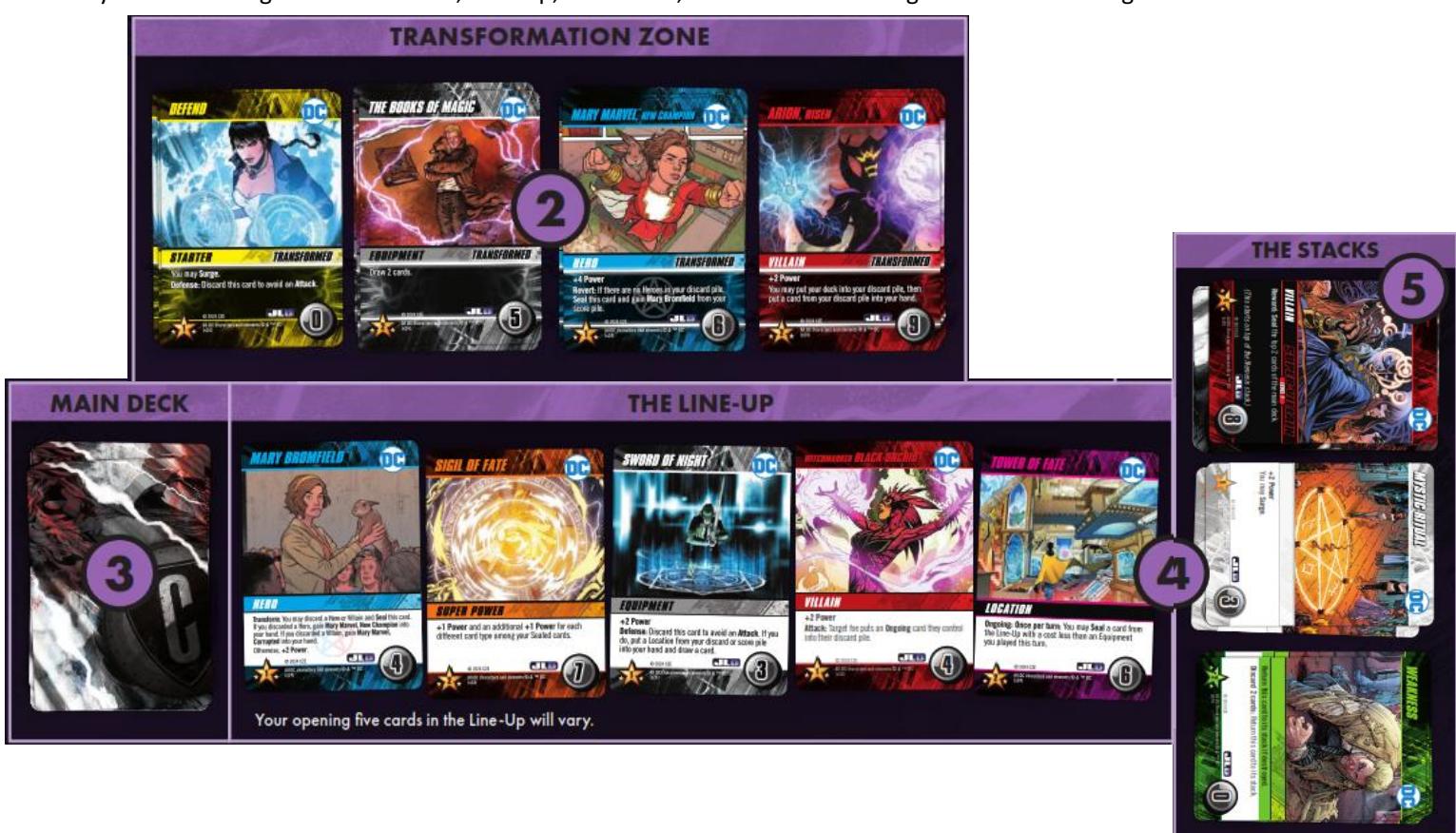
Once you have arranged the main deck, the Line-Up, and the other stacks, it will look something like the above. Your opening five cards in the Line-Up will vary. At the start of the game, there should be 16 Kicks, 8 Super-Villains, and 20 Weaknesses in their respective stacks.


For Dark Nights: Metal, place the Breakthrough, Weakness and Super-Villain Stack at the end of the Lineup. You will always use all 16 Breakthroughs and all 30 Weaknesses each game. Breakthroughs and Super-Villains are always available to be bought during your turn (while cards remain in their stacks). Weaknesses are never bought; they are gained only through card effects. The main deck and the 3 stacks of cards on the end are not part of the Line-Up.
For Injustice, place the Flying Kick, Weakness and Super-Villain stacks at the end of the Line-Up. At the start of the game, there should be 16 Flying Kick and all 20 Weaknesses each game
For Justice League Dark, after shuffling the main deck, place the top 5 cards from the main deck into a row below the Transformation Zone to form the Line-Up. Next, place the Mystic Rirual, Weakness and Super-Villain stacks at the end of the Line-Up. The main deck, the stacks of cards on the end, and Transformation Zone are not part of the Line-Up.
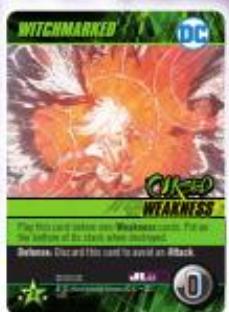
For Justice League Dark Expansion, Cursed Weakness cards offer an alternative Weakness stack. When setting up the game, you can choose to replace the base game’s entire Weakness stack with the Cursed Weakness stack. Since Cursed Weakness cards have a variety of abilities, be sure to shuffle the stack at the start of the game. When you have a Cursed Weakness in your hand, you must play it before other cards. Many of these cards have an additional negative penalty when played, such as discarding other cards from your hand. Some of them, however, have a benefit, such as drawing you a card. These beneficial Cursed Weakness cards come with an additional VP penalty, so you’ll have to weigh whether it is better to keep them around or destroy them before the game ends. Also note that when a Cursed Weakness is destroyed it goes to the bottom of the Cursed Weakness stack, not the destroyed pile. For Arkham Asylum, Place additional Line-up cards next to the Villain and Weakness Stacks the Hostage and Henchman Stacks. Add the Bribe Tile next to the Main Deck.
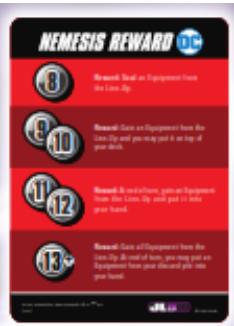
NEMESIS REWARD CARDS
These cards allow you to integrate Nemesis cards from other DC Deck-Building Game sets more seamlessly into your Justice League Dark games. At the start of the game, shuffle the Nemesis Reward cards face down and place the stack next to the Nemesis stack. When you reveal a Nemesis that does not have a Reward, also turn over the top card of the Nemesis Reward stack. When you defeat that Nemesis, you also resolve the Reward text on the Nemesis Reward card. You may only choose a Reward that has a cost equal to or less than the cost of the Nemesis you defeated. Then, place the Nemesis Reward card into a face-up Nemesis Reward discard pile. If the Nemesis Reward stack ever runs out of cards, shuffle the discarded cards together to make a new deck.
6. The Super-Villain/Super Hero Stack
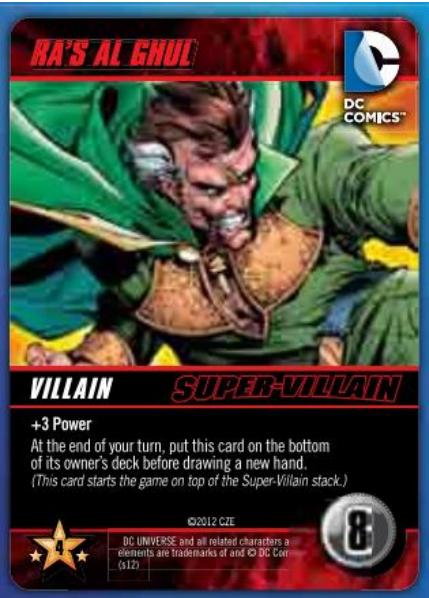
There are Super-Villains/Super Hero available to use each game. Typically, eight cards are used for a standard game. For a longer game, use more than eight. No matter how many you use, you will always use Ra’s al Ghul Original Set, Vandal Savage Heroes Unite, the Flash Forever Evil, Slade Wilson Teen Titans, Control Freak Teen Titans Go. On his card is text that reads, “This card starts the game on top of the Super-Villain or Super Hero stack.” If you use eight you will use seven selected at random, plus Ra’s al Ghul, Vandal Savage, the Flash or Slade Wilson.
Set Ra’s al Ghul, Original Set, Vandal Savage, Heroes Unite, The Flash, Forever Evil, Slade Wilson Teen Titans or Control Freak Teen Titans Go. aside and shuffle the remaining eleven Super-Villain/Super Heroes’ cards face down. Then randomly remove the number of cards you aren’t going to play with this game from the stack. The Super-Villain/Super Heroes stack remains face down this entire time, so no one will be able to see which Super-Villains are being used and which ones are not. Set aside the unused Super- Villains (still face down). Finally, place the set aside card face up on top of the Super-Villain/Super Hero stack.
Example: In a game using the Original Set, the typical eight Super-Villains, set aside Ra’s al Ghul and shuffle the rest. Remove four of them at random, then put Ra’s al Ghul face up on top of the remaining seven face-down Super-Villains.
For Dark Nights: Metal, set aside Barbatos and The Batman Who Laughs. Shuffle the three 11-cost Super-Villains and place them face down. Next, shuffle the three 9-cost Super Villains, place them face down on top of the 11-cost Super-Villains, then flip the top one face up. This will be the first Super-Villain you face. There is no “starting Super-Villain: in Dark Nights: Metal, but the is a final one. Place Barbatos face down on the bottom of the stack. His cardback is blue to remind you of this. Place the Super-Villain stack between the Breakthrough and Weakness stacks.
Place The Batman Who Laughs next to the stacks and place the oversized Batman card underneath it (face up). Shuffle the unused Super Hero stack face down and place it next to the stacks, but not too close to The Batman Who Laughs.
Batman begins each game Captured and it’s up to you to rescue him! The Batman Who Laughs is going to be menacing the players during each game, but he is not a Super-Villain you may buy. The back of his tile is red to warn you of the impending danger. More on Captured Super Heroes late…
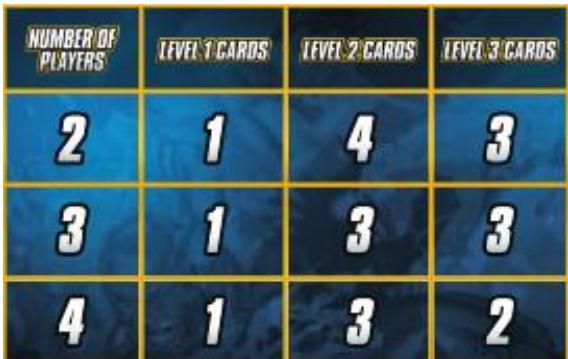
For Injustice, take the standard-sized Nemesis cards and sort them by their Level. You will use a certain number of each Level depending on the number of players in the game. Take the Level 3 Nemesis cards, shuffle them face down, and place them in a stack above the Flying Kick stack. Then, take the Level 2 cards, shuffle them face down, and place them on top of the Level 3 cards. Finally, put the Level 1 Nemesis on top of the stack face up. Note: The Level 4 Nemesis cards are only used in the Extended Game variant.
Count out 4 KO’d tokens per player and put them in a pile next to the Line-Up with the -3 VP side of each face up. Place the VP tokens in a pile next to the Line-Up. Once you have arranged the main deck, Line-Up, stacks, and tokens, it will look something like the below image.
For Justice League Dark, the term Nemesis is used to collectively refer to the standard-sized Super-Villain and Super Hero cards used to create the Nemesis stack. While all of the Nemesis cards in this set are Super-Villains, other sets (including the Justice League Dark Expansion) have Nemesis cards that are Super Heroes. You are free to use only Super-Villains, only Super Heroes, or a mix of both when forming the Nemesis stack.
Sort the standard-sized Nemesis cards by their Level and shuffle each facedown stack separately. (You may notice that some of these cards have a blue back. The different color is to help remind you that this card will always be the last in the stack.) Take the Level 4 Nemesis cards and place one of them face down next to the Mystic Ritual stack. Then, take two Level 3 Nemesis cards and put them face down on top of the Level 4 card. Next, take three Level 2 Nemesis cards and put them face down on the Nemesis stack. Finally, take one Level 1 Nemesis card and put it on top of the stack face up.
Once you have arranged the main deck, Line-Up, and stacks, it will look something like the below image.
GAMEPLAY
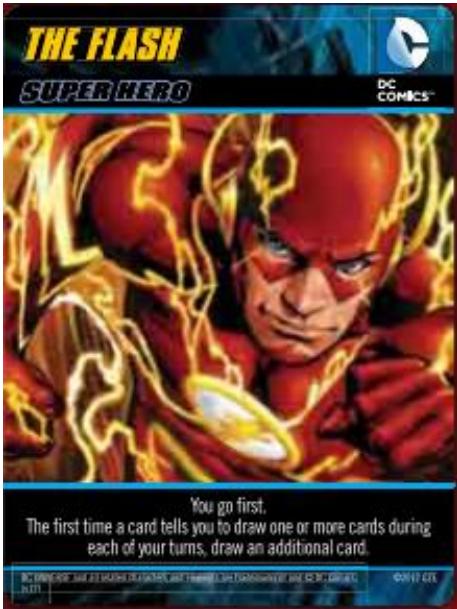
The player who most recently read a comic book gets to go first. Alternatively, you can determine first player randomly, unless someone is playing as The Flash. The Flash player always goes first (he’s pretty fast). Each player begins by shuffling their 10-card starting deck and drawing 5 cards. For Injustice, The last player in turn order charges their Meter twice. In a 4-player game, the third player charges their Meter.
Players take turns in clockwise order. You take your turn by playing cards from your hand face up for all players to see. The generates Power (the “currency” of the game) and other effects.
Each turn, you may buy cards from the Line-Up, Kick cards/Breakthrough/Flying Kick/Mystic Ritual Cards, and/or the top card of the Super-Villain or Super Hero (Nemesis) stack to improve your deck. Cards you buy or gain are always immediately placed into your discard pile unless you are instructed otherwise. Discard piles are always face up and may be looked through at any time.
For Dark Nights: Metal, If you choose to buy a Super-Villain, take the topmost faceup card from the stack and place it next to your discard pile (this will be referred to as
your score pile). Unlike most other releases in the DC Deck-Building Game line, in Dark Nights: Metal, Super-Villains you buy do not go into your deck. At the end of the game, the VPs from your score pile will be added to your score, including those from the Super Villains you have defeated. The next card in the Super-Villain stack remains face down until your turn is over, so you may buy only 1 Super-Villain per turn. Soon they’ll be shuffled into your deck, and then you’ll be drawing these newer, more powerful cards into your hand so you can play them. Buying powerful cards builds up the effectiveness of your deck. That’s why it’s called a “deckbuilding game.”
For Justice League Dark, you cannot buy cards from the Transformation Zone.
You can buy any number of available cards with combined cost less than or equal to the amount of Power you have for the turn. For example, your Punch cards each give you +1 Power. If you draw four of them and no other cards with any Power bonuses, your total Power for the turn is 4. You can buy a single card with cost 2, 3, or 4, or even two cards each with cost 2, assuming these options are available. Kick/Breakthrough Cards are (usually) available if the cards in the Line-Up are too expensive, and you may buy more than one during your turn if you wish. You may pass if you cannot buy or do not wish to buy any cards.
Vulnerability and Weakness cards provide no Power. Since they weaken your draws and deck, you should try to destroy them as soon as possible. You may play them if you wish, but they have no effect when played. They are not discarded until the end of your turn when you discard all cards you have played and any cards that you have kept in your hand
Playing Your Cards
On your turn, you get to play the cards in your hand in the order of your choice When you play a card, its game text resolves immediately. When you have played all the cards you wish to play at that time, total up the Power you have accumulated and buy what you wish to buy from the Line-Up or the face-up stacks. You do not have to play all of the cards in your hand before you start making purchases if you don’t wish to. You may play additional cards even after making purchases.
Ending Your Turn
-
Announce that you are ending your turn.
-
For Dark Nights: Metal, if you do not have a Super Hero in front of you, Recruit 1.
a) When you Recruit a Super Hero, look at the top 2 cards of the face-down Super Hero stack (not the Captured ones). Choose 1 of them and put it in front of you. Place the 1 you did not choose face down on the bottom of the stack.
b) During Step 2 of the End of Turn Sequence, if you have no Super Heroes, recruit a new 1 using the procedure described above.
c) In the unlikely event that the Super Hero stack runs out and you need to Recruit a Super Hero, you do not Recruit 1. Players without a Super Hero in front of them are not out of the game and play continues as normal. Place any cards remaining in your hand into your discard pile.
-
Place any cards remaining in your hand into your discard pile.
-
Resolve any “at the end of your turn” effects.
-
Put all non-Ongoing cards you Have played into your discard pile. Any unspent Power is lost.
-
Draw 5 cards from your deck.
-
Fill each empty slot in the line-up with a card from the top of the main deck.
-
If the top card of the Supper-Villain/Super-Hero stack is face down, flip it face up and read aloud the next Super-Villain/Super-Hero’s First Appearance – Attack.
-
For Injustice, every player who was KO’d this turn resets their health to 20.
-
The next player starts his turn.
Resolving Card Abilities
When an ability tells you to draw a card, that card is always drawn from your own deck. If you cannot fully resolve the text on a card, resolve as much of it as possible. When you play a card that triggers another ability, like on your Character, fully resolve the card you are playing before resolving any secondary abilities triggered by your card play. If you have multiple triggered abilities, you resolve them in any order you choose.
If a card’s ability affects multiple players, and the order matters (for example, each player gaining a Weakness, with only 1 Weakness remaining in the stack), resolve that ability for each affected player in clockwise order, starting with the active player.
Shuffling Your Deck
You don’t shuffle your discard pile and make it into your deck as soon as you run out of cards. However, if at any point during the game there are no cards in your deck and you need to draw, discard, or reveal a card from your deck, immediately shuffle your discard pile, and it becomes your new deck. Then, carry out the action
Sample Turn Sequence
After shuffling up your starting cards, you draw a hand of four Punches and one Vulnerability for your first turn. You may play the four Punches for a total of 4 Power, which is enough to buy The Cape and Cowl from the Line-Up. After buying it, you put into your discard pile. The Vulnerability provides you with no additional Power.
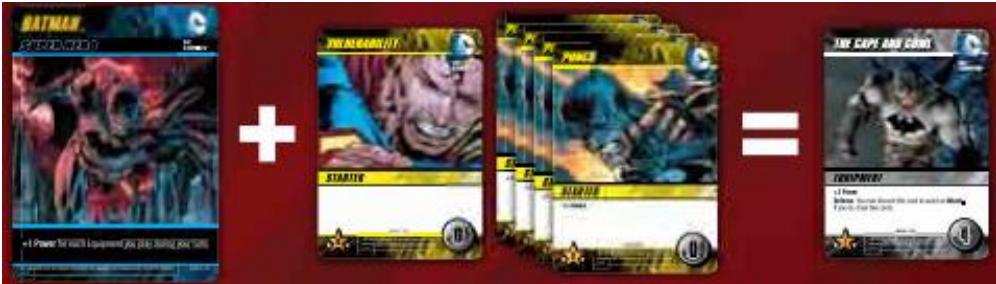
Once you have played and bought all the cards you want, discard the cards you have played and any remaining in your hand and then draw a new hand of five cards. Play proceeds to the player on your left.
END OF GAME
The game ends immediately when any of the following two conditions is met:
• At the end of the turn in which the last Super-Villain/Super Hero/Nemesis is defeated.
• You are unable to refill all five slots of the Line-Up.
• For Dark Nights: Metal, At the end of the turn in which Barbatos is bought.
• For Injustice, At the end of the turn in which the last KO’d token is given out.
Return all Ongoing cards you have in play, all cards in your hand, and all cards in your discard pile, and all cards in your score pile (Dark Nights: Metal only) to your deck. Then, players total up the Victory Points on cards in their deck. Weakness cards in your deck at the end of the game will subtract Victory Points (VP) from your total. Some cards have a * in their VP star. Such cards have additional information in their text box on how to score them at the end of the game. You will need to remind yourself of this text to maximize the value of these cards at end of game.
The player with the highest VP total is crowned the winner! In case of a tie, the player with more Super-Villain or Super Hero cards wins. If there is still a tie, the tied player with the greater number of cards in their deck wins.
After a winner has been determined, all players will need to take apart their decks, placing all of the cards back into their proper stacks. Be sure to return any Super- Villains or Super Heroes that were not used during the game to the Super-Villain stack, so they can be used in the next game.
VICTORY POINT TOKENS
With Forever Evil, you can now earn Victory Point tokens during the game! When a card effect tells a player to gain VPs, put that amount of VP tokens on your oversized Super-Villain/Hero. Victory Point tokens come in values of 1,5, and 10. The amount you have is public knowledge. At the end of the game, add those VP tokens to your total VP.
If you steal 1 VP from another player, they may need to make change in order to give you 1 VP. They don’t give you a 5 VP token if that is all they have. You cannot steal VPs from a player who has none. You cannot go into negative VP tokens. If you have none or lose 1, you stay at 0 VP tokens. If a card effect reference gaining VP or losing VP it is only referring to the tokens.
ADDITIONAL RULES
Oversized Character Cards
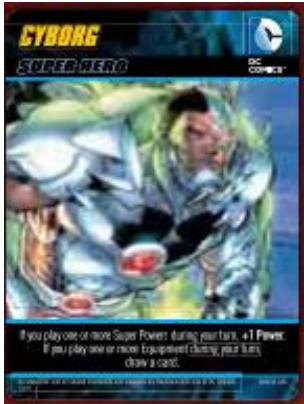
Your Character gives you access to a unique ability. Most abilities can only be used on your turn, but some of them function during other players’ turns as well. You should keep your ability in mind when deciding what cards to add to your deck. Some of the Characters are labeled as Super Heroes and others as Super-Villains. Those tags currently have no in-game function and only serve thematic purposes.
Attacks and Defenses

Some cards allow you to make an Attack against the other players in the game. When you play a card with an Attack ability, each
affected player has an opportunity to avoid the Attack with a card that has a Defense ability in their hand (or an Ongoing Defense
in play). If you have a ready Defense, you are not required to use it to avoid an Attack. Using a Defense card’s ability negates
the Attack only for that defending player. You may only utilize 1 Defense card per Attack. Using a Defense to avoid an Attack is not
“playing” the card. You are discarding it.
If you don’t avoid the Attack, you are immediately affected by the Attack card’s ability. However, if the Attack requires interaction
among the players (like passing cards), the Attack won’t resolve against any players until each player has had a chance to avoid
it. Avoiding an Attack does not negate any other abilities (like +3 Power) of a card, unless an ability specifically counts the players successfully hit by the Attack. An “Attack” card is any card that has
the bold keyword “Attack: “in its text box. A “Defense” card is any card that has the bold keyword “Defense: “in its text box.
The Super-Villains/Super-Heroes
When you have accumulated enough Power in a turn, you can choose to defeat a Super-Villain or Super Hero. If you do, take the topmost face-up card from the stack and place it into your discard pile, unless instructed otherwise. Dark Nights: Metal, Super-Villains you buy do not go into your deck. Place them in your Score Pile next to your Discard Pile. At the end of the game, the VPs from your score pile will be added to your score, including those from the Super-Villains you have defeated
The next card in the Super-Villain or Super Hero stack remains face down until your turn is over, so a player may defeat only one Super-Villain or Super Hero per turn. Super-Villains/Super Heros range in cost from 8 to 13, and their stack is randomized at the start of each game, so check the stack for the current Super-Villain’s/Super Hero’s cost.
Dark Nights: Metal, Super-Villains don’t go into your deck, but you do receive a Reward for your heroics. Look for the Reward text on each Super-Villain as they are all different. When you buy a Super-Villain, immediately resolve the Reward listed on its card.
While Ra’s al Ghul, Vandal Savage, The Flash, or Slade Wilson is content to gaze scornfully at the players from his lofty perch atop the DC Comics Super-Villain stack, the rest of the Super-Villains/Super-Heroes take a more hands-on approach. When a new Super-
Villain/Super-Hero is revealed, this is called his or her “First Appearance.” On each Super-Villain/Super-Hero (other than the starter), you will find that Super-Villain’s/Super-Hero’s First Appearance—Attack.
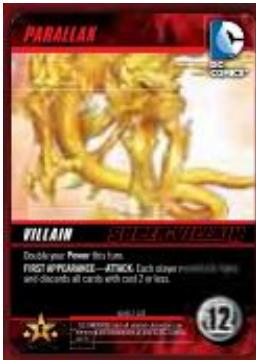
When revealed on the Super-Villain/Super-Hero stack, this Attack resolves immediately against each player in the game. Each player with a Defense card may defend against the Attack. The Attack will resolve against any players who do not defend themselves. These Attacks do not happen during any player’s turn.
Super-Villains are Villains. Super Heroes are Heroes. Super-Villain/Hero is a title, not a card type, so playing a Super-Villain/Hero does not count as playing two different card types.
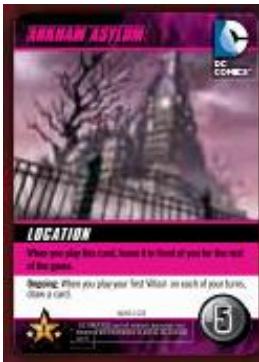
Example: If you have the Location Arkham Asylum in play and you play a Super-Villain, it counts as playing a Villain, so you get to draw a card.
Super-Villain/Hero Cards in Your Deck

Like any other card you acquire, the experience gained defeating a Super-Villain/Super Hero will aid you in your future turns. When you play a Super-Villain/Super-Hero from your hand, the text at the top of the text box is the relevant text. The “First Appearance—Attack” is no longer applicable, as the Super-Villain/Super Hero already made that attack when he was first revealed from the Super-Villain/Super Hero stack.
Weakness
Some cards force players to gain 1 or more Weakness cards. If this happens, each affected player takes the indicated number of Weakness cards from the Weakness stack and places them into their discard pile, effectively adding them to their deck. If the Weakness stack runs out, abilities that would cause a player to gain a Weakness do not do so, but any other abilities those cards have still resolve as usual. A player may still use a Defense card to avoid an Attack, even when there are no Weakness cards available to be gained. When you draw a Weakness card, you may play it during your turn. If you do, deal 1 damage to yourself and then return the Weakness card to its stack. If this reduces your health to 0, you receive a KO’d token, but no one receives a 1 VP token. You still return the Weakness to the stack even if you are already at 0 health when you play the Weakness card. When the game ends, each Weakness in your deck subtracts 1 VP from your total.

Events (Advanced Play Only)
Event cards are random happenings during the game that affect all of the players! As you might imagine, Events from the Teen Titans Go! Universe can be random, wacky, and highly amusing!
When you refill the empty slots in the Line-Up at the start of your turn, Event cards may appear. Effects that add cards to the Line Up during your turn may also cause Event cards to appear. When one or more Event cards are in the Line-Up, you must read each one aloud and then place them next to the Nemesis stack. Do not refill the empty slot in the Line-Up at this time. That empty slot will be refilled at the start of the next player’s turn.
Event cards next to the Nemesis are not part of the Line-Up and are never bought, but all players must do what they say. There can be any number of Events in play at once.
To get rid of an Event, defeat a Nemesis! When you defeat a Nemesis, choose any one Event and remove it from the game. You cannot skip choosing one even if you don’t want to get rid of one. When it is not your turn, you are an official member of the “Event Police” and should make sure the active player is resolving each Event appropriately.
If you gain an Event, place it next to the Nemesis stack. You do not gain a different card. Tough luck!
Controlling Cards
You control the cards in your play zone. These include the cards you played this turn and Ongoing cards still in play from a previous turn. You do not control cards in your hand, deck, discard pile, or score pile.
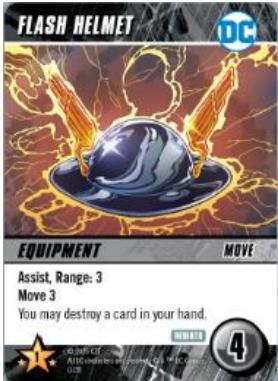
Destroying Cards
Some cards have an ability that allows you to destroy a card from your hand, your deck, or your discard pile. When you destroy a card, place it into a face-up pile of destroyed cards anywhere away from the play area, removing it from your deck. You will often get to choose which of your cards to destroy. Destroying Starter and Weakness cards will improve your deck greatly! If Weaknesses and Basic Cards are destroyed, they do not go back to their respective stacks. T
Gaining Cards
Gaining a card is the process of taking ownership of that card. This occurs most often when you purchase a card by paying its cost. When a card tells
a player to gain a card, that card is taken and immediately placed into that player’s discard pile at no additional cost, unless otherwise directed. If a card tells you to gain a card with a specific name, card type, or cost and there are none available, you simply don’t gain the card.
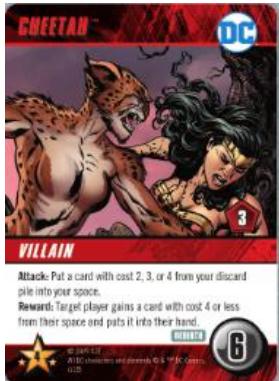
Discarding Cards
When a card tells you to “discard” a card, it means from your hand as the default. However, a card may tell you to discard a card from another place, such as the top of your deck. Cards that are discarded this way count as being “discarded.”
Shuffling Your Deck
You don’t shuffle your discard pile and make it into your deck as soon as you run out of cards. However, if at any point during the game there are no cards in your deck and you need to draw, discard, or reveal a card from your deck, immediately shuffle your discard pile, and it becomes your new deck.
Ongoing
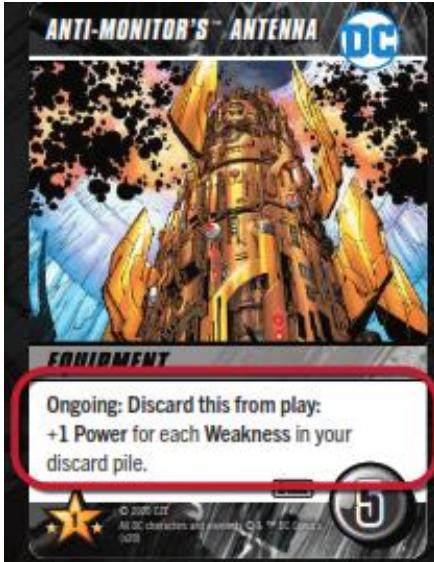
Some cards in this set have the keyword Ongoing. When you buy or gain a card with Ongoing, it goes to your discard pile just like any other card. However, when you later draw and play an Ongoing card, it will remain in play in front of you for the rest of the game, unless something tells you to discard it.
An Ongoing card in front of you (that you control) counts as “in play,” just like any card you played during your turn. It counts as “played” only on the turn in which it entered play. Cards in the Line-Up or that foe controls are never “in play” for you to take advantage of. Ongoing cards give you special abilities turn after turn while they remain in play.
When an Ongoing card says to “discard” it for an effect, that means removing it from play anytime during your turn and placing it into your discard pile. An “Ongoing” card is any card with the bold keyword Ongoing in its text box. You can have any number of different Ongoing cards in play at once.
Locations
Locations all have Ongoing abilities that will work for you turn after turn. Location cards go straight to your discard pile when bought or gained, just like any other card. However, when you later draw and play a Location, that card will remain face up and in play in front of you for the rest of the game. Ongoing means, “When you play this card, it stays in play for the rest of the game and works for you turn after turn.” However, there are Attack cards that can make you discard them. You’ll need to draw a Location card again to put it back into play.
Each Location has a unique effect that can trigger during each of your turns for the rest of the game. This effect triggers only once during each of your turns. You can have any number of Locations in play at once.
Note for experienced players: Locations no longer have the purple bar in their text box with the reminder text to leave them in play.
However, they work exactly like Locations from previous sets.
Resolving Card Abilities
If a card’s ability affects multiple players, and the order matters (for example, an Attack that has both opponents each gain a Weakness, with only one Weakness remaining on the board), resolve that ability for each affected player in turn order, starting from the player who played the ability.
When you play a card that triggers another effect, like on your Character card or a Location you control, fully resolve the card you are playing before resolving any secondary effects triggered by your card play.
When you see the phrase “that foe,” it refers to the foe you are currently acting against, like during a Confrontation or after choosing them as the target of an Attack.

Owner
A player owns all cards in their hand, deck, discard pile, and score pile. A player also owns the cards they played this turn and Ongoing cards from previous turns. A player becomes the owner of a card when they buy it, gain it, or are passed it. Sealing a card from the main deck, Line-Up, destroyed pile, or another player’s zone causes you to become the owner of that card.
Payment Abilities
Some Characters have a payment ability as indicated by a bolded action followed by a colon at the start of a sentence. These abilities can only be used during a player’s turn and may be used any number of times unless otherwise stated.
For example, during Swamp Thing’s turn, he can discard a non-Weakness card from his hand. Doing so allows him to add the top card of the main deck to the Line-Up. This ability does not have a limit printed on it, so he can do it multiple times in the same turn.
Confronting Your Opponent
When your turn begins, resolve all “start of turn” effects. Now you have a decision to make. If you wish, you may announce a Confrontation against the lowest-cost opposing Character. If there is a tie for lowest, you choose which one you wish to Confront. If your target’s cost changes, that does not switch your target. If a card causes you to switch targets, the new target is always a legal target, no matter the cost. Confronting an opponent is the best way to defeat them once and for all. Only by announcing a Confrontation can you attempt to defeat an opponent. If you can defeat all 3 of a foe’s Characters, your team instantly wins the game! However, the opposing team is no easy mark. Each Character has three versions. They are progressively harder and harder to beat. The first one has a cost of 9. That means you must amass at least 9 Power to defeat that Character. If you generate Power equal to or exceeding their cost during a Confrontation, that version of your opponent’s Character is removed from their Character card stack and placed near your side of the table. Should the game end due to being unable to refill the Line-Up, they are worth a lot of Victory Points.
The next Level of their Character will have a better ability and will also have a higher cost for the next time you Confront them.
Note that during a Confrontation you can only beat the top card; even if you have 30 Power, you cannot defeat more than one of an opponent’s Character cards in the same turn.
You will only want to Confront your opponent when you are fairly confident that you can amass enough Power to beat their cost. However, you are unlikely to have all of the Power you need to defeat your opponent at the very start of your turn. If you need 9 Power to defeat your opponent, and you start your turn with 5 Power and the ability to draw three cards, you might be able to get to 9 or more Power with those extra draws. If you know that you have some good cards left in your deck, you might want to announce a Confrontation at the start of your turn. Several cards you can acquire during the game work especially well during a Confrontation. Cards with the bolded keyword “Confrontation:” give you a special bonus when played during a Confrontation that you have declared, but never during an opponent’s Confrontation, since they cannot be played then. The only cards that may be played during an opponent’s turn are Defenses and Blocks.
You must announce a Confrontation at the very start of your turn in order to defeat an opponent. You cannot decide to do it after you have played cards.
• When you Confront an opponent, you cannot buy cards that turn, even if you have leftover Power.
A Confrontation is not an Attack. You may play Attacks during your Confrontation. Your opponents may use Defense cards to defend as usual. If the Attack says it affects “each foe,” it will hit both opponents; however, if it says to choose a foe, you may choose either one.
• Some Confrontation effects resolve against “that foe,” which means the foe you are Confronting.
During a Confrontation, resolve all game text after the keyword “Confrontation:” If you do not announce a Confrontation, you do not resolve this text, but you may still play the card. Typically, a card will have “Otherwise” text that you resolve when not Confronting.
When you have played all of the cards you and your teammate wish to play, let your opponent know. The opposing team may now play Block cards to increase the Confronted Character’s cost. You cannot play additional cards, so get your Power as high as you can before you say you are ready.
Target
Some cards in this set use the word “target.” Examples are “target player,” “target Villain,” or “target Character.” A target is something or someone that you can affect with a card or effect you generate. There is no Range involved unless the card specificall says so.
“Target player” can be any player in the game ... even you!
NEW CONCEPTS
Dark Night Metals
Weakness Cards
Weakness cards are extremely dangerous in Dark Nights: Metal. Not only do they clog up your deck and reduce your VP score, but they can also get your Super Hero Captured! Note that Weakness cards cannot be purchased from the stacks. They are only gained through certain card effects, mainly Attacks. They have a cost of 0 as some cards reference the costs of cards.
As the card text explains, you must play weakness cards in your hand before playing any other cards or ending your turn. Weakness must be played 1 at a time. As soon as you control 2 of them, your Super Hero becomes Captured and your turn ends. So, if you start your turn with 3 Weaknesses in hand, the first 2 will end your turn before the third can be played.
When 1 of your Super Heroes becomes Captured, resolve all effects generated from playing that Weakness, and then immediately end your turn. Place 1 Weakness in your score pile, and return the other to its stack. Discard your hand (including additional Weaknesses!) and all cards you played that turn. You can’t buy, gain, or play any other cards.
Place your Super Hero under The Batman Who Laughs. If that was your only Super Hero, you will Recruit a new 1 during Step 2 of the End of Turn Sequence. If you have more than 1 Super Hero in front of you when 1 of your Super Heroes becomes Captured, choose only 1 of them to place under The Batman Who Laughs.
Unless your Super Hero becomes Captured, you cannot end your turn while there are Weakness cards in your hand. They must be played. However, if you have a single effect that causes you to draw a card and then discard a card, you may discard a Weakness that you just drew from that effect. You can’t hold a Weakness in hand to discard to such an effect.
If a Weakness card is destroyed, return it to its stack. If the Weakness stack runs out, effects that would cause a player to gain 1 do not do so. Some cards allow you to choose to gain a Weakness for a particular bonus effect (see Phoenix Cannon and oversized Mister Terrific). If there are none, you cannot choose to gain 1. You don’t get the bonus effect if there are no Weaknesses on the stack. “At start of turn” effects happen before you may play any cards, including Weakness cards.
CONTROLLING MULTIPLE SUPER HEROES
In Dark Nights: Metal, you might be lucky enough to gather up a team of Super Heroes to battle against the forces of darkness. There is no limit to the number of Super Heroes you can have. Your Super Heroes exist on your team, which means they are working only for you. You don’t control them and they are not counted when counting cards, you control, etc
When you add a Super Hero to your team, its abilities are immediately in effect, but the Super Hero doesn’t look backwards for “play” effects (e.g., The Flash would not draw a card for a Defense you already played earlier that turn). A new Super Hero will recognize cards you “control” even if it was not part of your team when you played those cards. If you trigger effects on 2 or more of your Super Heroes at the same time, you choose the order in which to resolve them.
CAPTURED!
Batman starts each game under The Batman Who Laughs. In the Dark Nights: Metal storyline, Batman was captured early on and trapped in the Dark Multiverse by a vast conspiracy of villains, motivating many of his colleagues to take desperate measures to rescue him!
When a Super Hero becomes Captured, it is placed face up underneath The Batman Who Laughs. If there are multiple Captured Super Heroes, fan them out a bit so players can see that there is more than 1.
Each time you buy a Super-Villain (except Barbatos!), you also rescue a Captured Super Hero. Choose 1 from among all Captured Super Heroes, place it in front of you, and return the rest.
RECRUITING SUPER HEROES
When you Recruit a Super Hero, look at the top 2 cards of the face-down Super Hero stack (not the Captured ones). Choose 1 of them and put it in front of you. Place the 1 you did not choose face down on the bottom of the stack.
During Step 2 of the End of Turn Sequence, if you have no Super Heroes, recruit a new 1 using the procedure described above.
In the unlikely event that the Super Hero stack runs out and you need to Recruit a Super Hero, you do not Recruit 1. Players without a Super Hero in front of them are not out of the game and play continues as normal.
BREAKTHROUGH CARDS
Replacing the usual Kick cards are Breakthrough cards. They have no card type and aren’t worth any VP, but they can come in handy.
First, they give you +2 Power when played. As soon as you play a Breakthrough, you must immediately decide if you want to return your Breakthrough to its stack or not. If you do, you get to destroy a Vulnerability or Weakness you control (destroyed Weakness cards go back to their stack). A Breakthrough won’t destroy cards in your hand or discard pile. It can only destroy cards you have played this turn and currently control.
The story behind the card: The Super Heroes connect with everyone on Earth through Element X and bring them (and the Earth itself!) out of darkness. This unleashes so much energy that they break through the Source Wall at the end of the universe, unlocking infinite new space to explore. Getting rid of rotten cards is this game’s way of triumphing over darkness.
METAL CARDS
These cards are totally metal! “Metal” is a subtype that some cards have, mostly among the Equipment. A Metal card has the stylized keyword METAL in its middle info bar ... and a shiny foil treatment!
Injustice
HEALTH AND DAMAGE
Each player starts the game with 20 health. This is tracked on your two Health Bars. When you take damage, move your Health marker to the right a number of spaces equal to the damage dealt. When your Health marker would move off the end of the first Health Bar, move it to the second Health Bar and continue moving it. When you get to the end of the second Health Bar, leave your Health marker on the 0 space and gain a KO’d token (see the next section for more details). While you have 0 health, you cannot be dealt any more damage. However, you still can be affected by other Attack effects, such as gaining Weakness cards or discarding cards.
The main way you will damage your foes is with Attack cards. These will either deal damage to a singular targeted foe or each foe depending on the wording of the Attack. If you deal damage to a foe in excess of their remaining health, you are considered to have dealt the full amount of damage. For example, if you deal 5 damage to a foe with 2 remaining health, they will move their Health marker down to 0 and you will be considered to have dealt 5 damage to that foe. However, once a foe is at 0 health, they cannot be dealt any additional damage. You may still target them with Attacks that deal damage, but you will not be considered to have dealt them any damage or successfully attacked them. When you reduce a foe to 0 health, you receive a 1 VP token that will add to your score at the end of the game.
When a card tells you to Heal, you move your Health marker to the left a number of spaces equal to the amount healed. This can cause you to move from your second Health Bar back to the first. You cannot Heal above your starting health of 20.
KO’d Tokens
When your health drops below 1, you are temporarily knocked out. Never fear, your sidekicks are there to drag you back to you base for a speedy recovery! You will reset your health back to 20 during the End of Turn procedure, but you won’t come out of the
fight completely unscathed. When you get KO’d, you immediately gain a KO’d token that is worth -3 VP at the end of the game. You can gather multiple KO’d tokens if you are knocked out multiple times during the game.
Note: Ignore the text on the back of the KO’d tokens unless you are playing Impossible Mode.
Charge Meter, Meter Burn, and Super Move
Below the Health Bars on your Health Track, you will find your Charge Meter. Depending on player count, each player starts the game with 0 to 2 charges. Whenever you are told to “charge your Meter,” move your Charge marker 1 space around the Meter. You can hold a maximum of 8 charges. If you would gain charges in excess of 8, your marker remains at 8. You may not spend charges in the middle of gaining charges in order to make room for additional charges. Charges carry over from turn to turn. Do not reset your Charge Meter to 0 at the end of your turn.
Your charges can be spent to pay for Meter Burn abilities. There is one of these printed on your Health Track. This Meter Burn ability allows you to play your Super Move. The “X” in the Meter Burn cost is equal to the charge cost on your Super Move card. When you spend the charges to

activate your Super Move, play it. Then, return it under your Character. Note: Super Moves are not Attack cards and cannot be avoided with a Defense card.
Some main deck cards also provide ways to spend your Meter charges and trigger additional effects. These cards have the keyword “Meter Burn” followed by a number in parentheses. The number tells you how many charges you must spend from your Meter to resolve the text after the Meter Burn keyword. When you play a Meter Burn card, you do not have to choose to pay the Meter charges until you get to that part of the text. For example, you would get to see the card you draw from playing Running Man Stance before deciding to pay the charges to draw an additional card. If you decide not to use the Meter Burn ability, you cannot choose to pay the charge cost later in your turn. The Meter Burn ability on each card can only be used once per turn.
Note that if your Character charges your Meter by playing specific cards, you cannot use that charge to pay the Meter Burn cost of that card you just played, as those charges are not gained until after fully resolving the played card.
Justice League Dark
Surge
When a card tells you to Surge, add the top card of the main deck to the Line-Up. This can cause the Line-Up to increase above 5 cards. Note that Surging while there are no cards in the main deck does not cause the game to end.
Score Pile
Each player has their own score pile where they place their Sealed cards. You own but do not control the cards in your score pile. They are not part of your deck, and you will not be able to play those cards without a special card ability. When you would gain a card with the Reward keyword (such as on a Nemesis card), it goes into your score pile instead of your discard pile. At the end of the game, the cards in your score pile are also counted for your final score. If a card you do not own enters your score pile, you are considered to gain that card.
Sealing C
Content is long; only the first part is inlined. Download the file or open the rules page for the full text.
Download Markdown简繁检索对照.md1.6 KB
126678_125678_dc-comics-deck-building-game — 简体/繁体检索对照
本游戏的规则书是繁体中文原文。用户用简体提问时,把关键词按下面这张表转成繁体再去 grep 原文,命中率最高。
回答时用简体或繁体都可以,但引用的原文保持繁体。
简体 → 繁体 对照(按该游戏原文出现频率排序,共 60 字)
| 简体 | 繁体 | 原文出现次数 |
|---|---|---|
| 张 | 張 | 145 |
| 级 | 級 | 85 |
| 击 | 擊 | 70 |
| 库 | 庫 | 66 |
| 时 | 時 | 56 |
| 游 | 遊 | 50 |
| 弃 | 棄 | 49 |
| 戏 | 戲 | 48 |
| 获 | 獲 | 47 |
| 会 | 會 | 44 |
| 后 | 後 | 40 |
| 当 | 當 | 38 |
| 进 | 進 | 37 |
| 将 | 將 | 32 |
| 叠 | 疊 | 32 |
| 开 | 開 | 31 |
| 则 | 則 | 31 |
| 并 | 並 | 31 |
| 这 | 這 | 29 |
| 结 | 結 | 29 |
| 买 | 買 | 29 |
| 们 | 們 | 28 |
| 队 | 隊 | 28 |
| 虚 | 虛 | 27 |
| 购 | 購 | 27 |
| 选 | 選 | 27 |
| 择 | 擇 | 26 |
| 现 | 現 | 25 |
| 该 | 該 | 25 |
| 从 | 從 | 25 |
| 发 | 發 | 24 |
| 两 | 兩 | 23 |
| 数 | 數 | 22 |
| 为 | 為 | 21 |
| 御 | 禦 | 19 |
| 于 | 於 | 19 |
| 执 | 執 | 18 |
| 无 | 無 | 17 |
| 须 | 須 | 16 |
| 没 | 沒 | 16 |
| 补 | 補 | 16 |
| 对 | 對 | 15 |
| 点 | 點 | 15 |
| 匀 | 勻 | 15 |
| 顶 | 頂 | 15 |
| 灭 | 滅 | 15 |
| 侠 | 俠 | 14 |
| 总 | 總 | 14 |
| 飞 | 飛 | 13 |
| 随 | 隨 | 12 |
| 费 | 費 | 12 |
| 个 | 個 | 12 |
| 败 | 敗 | 11 |
| 别 | 別 | 11 |
| 员 | 員 | 11 |
| 机 | 機 | 10 |
| 闪 | 閃 | 10 |
| 电 | 電 | 10 |
| 类 | 類 | 10 |
| 动 | 動 | 10 |
Texts are community-compiled or publicly released by publishers; copyright remains with the original authors. For personal reference only.