
Dewan
At a glance
Rules, cards and Q&A (Chinese)
The rules, card data and player questions for this game are written in Chinese. Open the Chinese page to read them.
Where to find full rules
Full rules and card lookup are available in the cunlema app at cunlema.cn — pick this game and ask about any rule, card or turn you are unsure about.
Related games
Rulebook text (Markdown)
This game has 1 rulebook Markdown file(s) in our library; 1 rendered inline below — expand to read or download.
EN_DEWAN_RULES.md23.9 KB
DEWAN Johannes GOUPY Yoann LEVET GAME RULES
A new day begins, but our resources are dwindling. We have decided to break camp and explore the surrounding territory to ensure our survival.
Whether at the bend of a river or in the heart of the mountains,
we will seek the resources we lack. As we journey through forests and deserts, we will safeguard the precious fire that warms us and illuminates our path.
In response to the ever-increasing pressure from neighboring tribes, we will stand firm and strive to write our own story.

GOAL OFTHE GAME
To win at Dewan, you will compete against other players to earn the most points. You will do this by strategically placing your Camps to make the best use of terrain and resources so that you can satisfy the requirements found on your Story tiles. Along the way you will also gather Berries and master Fire to earn additional points.
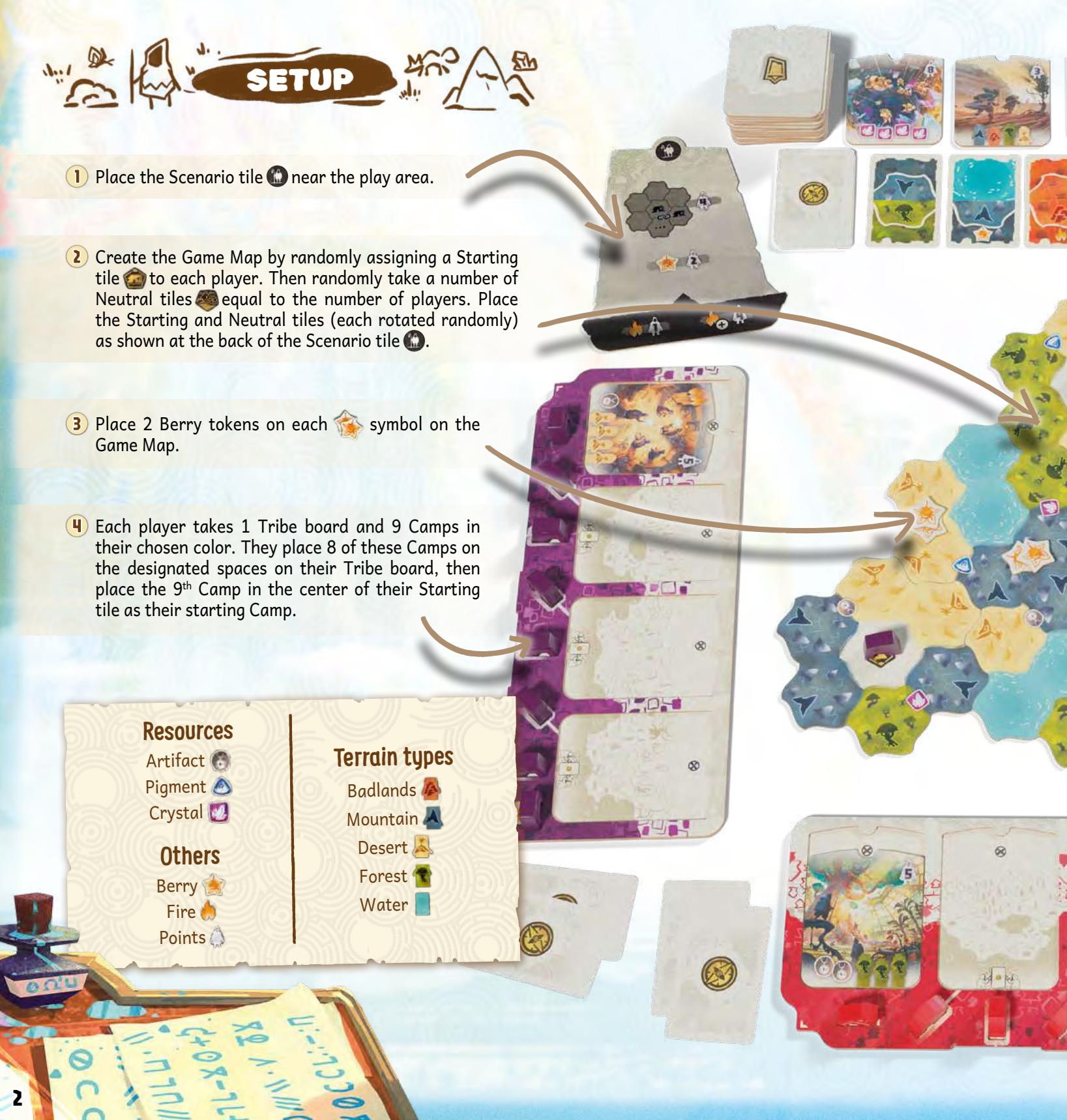


10 Territory tiles:
② 4 Starting
②6 Neutral
4 Tribe boards
36 Camps (9 per color)
1 Scenario tile

CONTENTS A一T營
15 Berry tokens
55 Terrain cards
24 Story tiles
1 Dewan token
1 Score Pad

The contents below will be used for additional scenarios (see page 10).
Leave them in the box for your first game.
4 Scenario tiles ①

8 Lava markers
1 Volcano Territory tile
8 Water markers


1 Event tile
1 Downpour Territory tile
20 Fish tokens

5 Shuffle the Story tiles and draw 5 of them faceup, placing them into a row next to the Game Map. The remaining Story tiles are placed into a facedown stack within reach of the players.
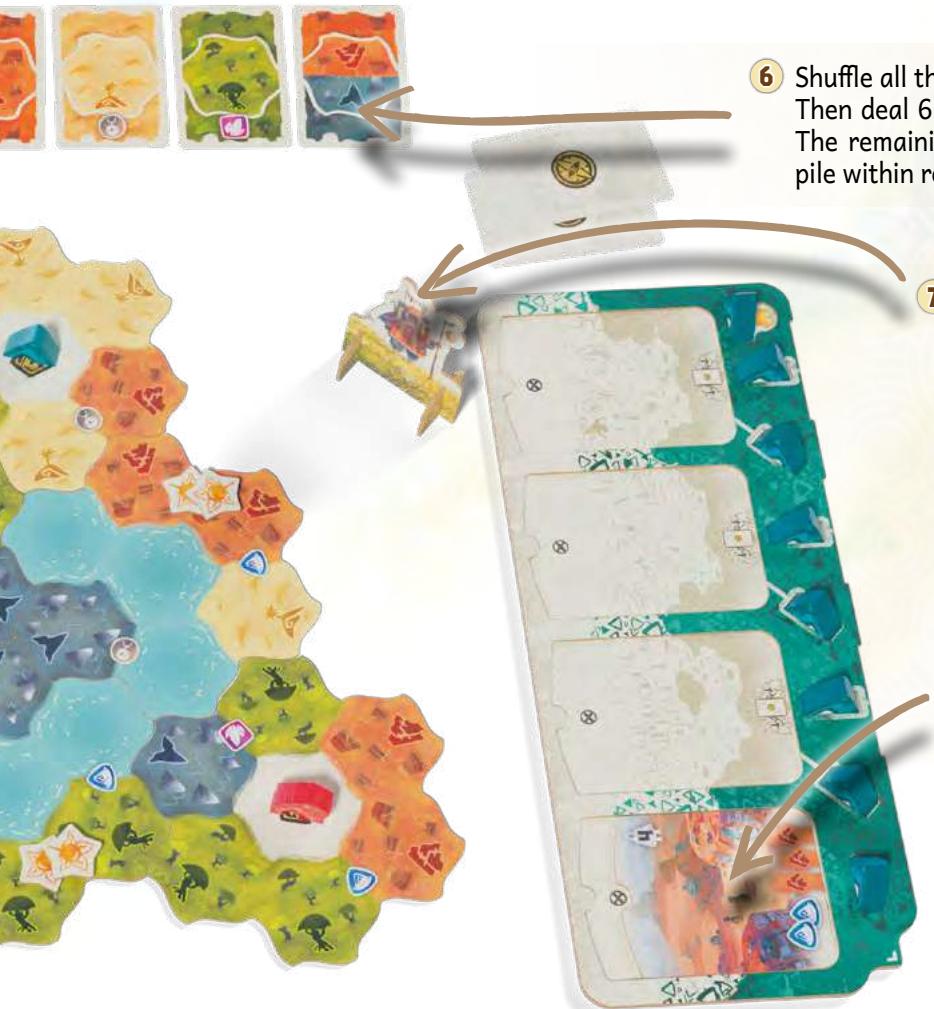
Shuffle all the Terrain cards and deal 2 facedown to each player. Then deal 6 cards faceup to form a row next to the Game Map. The remaining Terrain cards are placed into a facedown draw pile within reach of the players.
7 Finally, randomly select the first player and give them the Dewan token.
The player to their right chooses 1 Story tile from among the 5 available tiles. If they do not wish to take any of the available tiles, they may take the top tile from the stack instead. In either case, the chosen tile is placed onto the leftmost space of their Tribe board. Place the tile face up and slide it to the bottom, so that theis visible above it. If a tile was taken from the row, replace it with the top tile taken from the stack.
Then, the player on their right chooses a Story tile in the same manner. This process continues until all players have selected 1 Story tile.

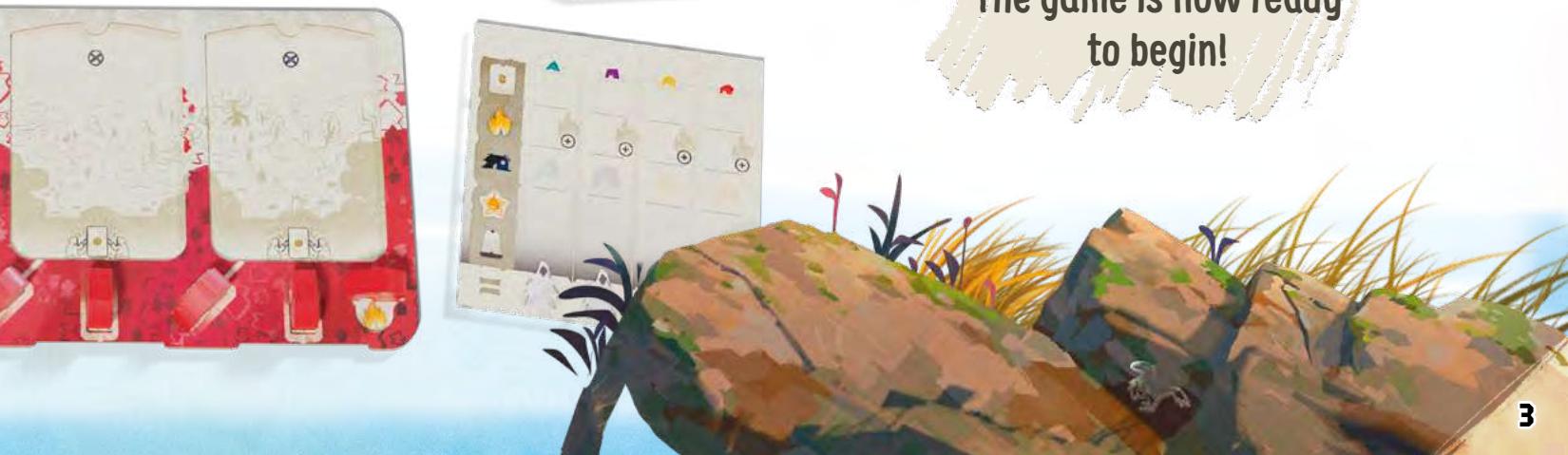
In each game round, players each take a turn, starting with the player holding the Dewan token and proceeding clockwise. A round is completed when each player has taken a turn, after which a new round begins.
On your turn, you must perform 1 of the following 2 actions:
Take 2 cards
OR
Place a Camp
Take 2 cards
Choose 2 Terrain cards from the card row which are next to each other and add them to your hand. You cannot draw a card from the draw pile. There is no hand limit.
Starting with the card closest to the draw pile, replace the cards you just took with the top 2 cards from the draw pile.
Note: If the draw pile is empty when you must replace a card, shuffle all the cards in the discard pile and place them facedown to create a new draw pile.

On their turn, Charlie takes 2 adjacent Terrain cards, which they add to their hand. They then replace these 2 cards with 2 cards from the draw pile, one after the other.

Place a Camp
Choose a Camp of your color on the Game Map as the starting point, then select a free space (a space without a Camp) as the destination. The destination cannot be a Water space. Next, discard 1 card face up from your hand corresponding to the Terrain type of each space you cross, including both the starting point and destination. When a card displays 2 Terrain types, choose 1 when discarding it while crossing a space. Make sure to follow these rules:
If the starting point is your starting Camp, the first card you discard can be of any type. If your starting point is not your starting Camp, the first card must match the Terrain type of the selected camp.
Charlie begins by discarding 1 card of any type for the starting point and then discards 1 Mountain card, as the next space crossed is a Mountain space.
@ Water zones are crossed differently: By discarding 1 Water card, you can cross any number of spaces within a single Water zone.
BCharlie next discards 1 Water card to cross both spaces within the Water zone.
@ Your route may require you to cross one or more Camps belonging to other players. In this case, give the card you used to cross that space to that opponent instead of discarding it. They will then add it to their hand. (If you cross another player's starting Camp, you must give 1 card of your choice to your opponent.)
Charlie gives Billy 1 Badlands card as they cross Billy's Camp.

Once all the required Terrain cards have been discarded (or given to another player), move the leftmost Camp from your Tribe board onto the destination.
Effects After Placing a Camp

If the zone where you placed your Camp contains at least 1 Berry, take 1 of those Berries and place it to the left of your Tribe board.
Note: Later, if you place another Camp in the same zone, you can take another Berry.
@ Apply the effect indicated by the space the Camp was taken from on your Tribe board as follows:
Zones
A zone consists of 1 or more connected spaces of the same Terrain type.
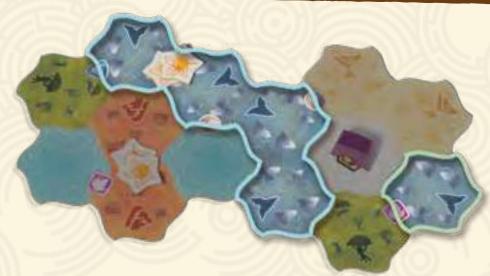
In the example above, the highlighted spaces depict 2 distinct Mountain zones.

ANo effect.
When you place your 2d, 4th, and 6th Camps, you take 1 Story tile from among the 5 faceup tiles in the tile row; or, if none of these tiles suit your needs, you may take the top tile of the stack and reveal it. Either way, place the tile in the leftmost available space on your Tribe board. If you took 1 of the 5 faceup tiles, immediately replace it with the top tile of the stack.
When you place your 3rd, 5th, and 7th Camps, you may take 1 Terrain card from your hand and slide it underneath your Tribe board in the corresponding spot so that 1 Terrain is visible; the chosen Terrain might also have a symbol on it. If you do not have any cards in your hand, or you choose not to apply this effect, the corresponding spot will remain empty.
DWhen you place your final Camp, you trigger the end of the game (see page 8). This will give you 1 additionalduring scoring.
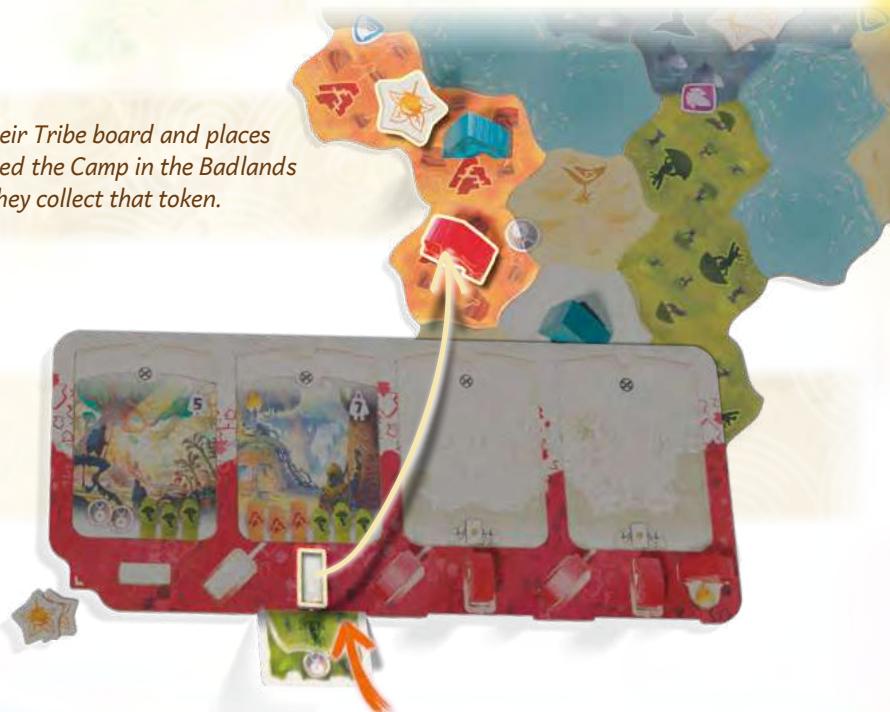
Charlie takes the leftmost Camp from their Tribe board and places it on the destination space. Since they placed the Camp in the Badlands zone, which still contains 1 Berry, they collect that token.

Charlie places a Camp on the game map from the 3rd Camp spot. They then choose a card from their hand and slide it underneath that Camp spot.

Story Tiles
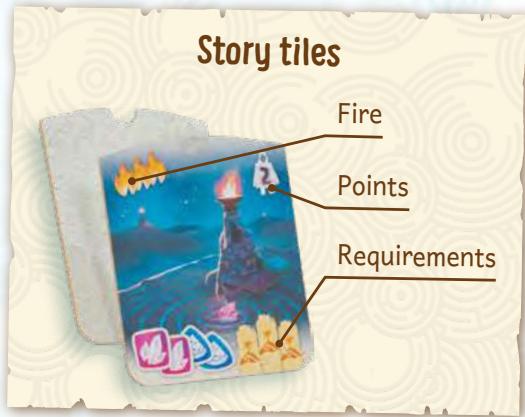
Story tiles are the primary way to score points in the game. To score points from your Story tiles (and to tally their potentialat the end of the game), you must satisfy the Terrain and resource requirements depicted on them. Requirements for each Story tile are checked separately. Each camp and card beneath your player board can be used to satisfy the requirement of multiple Story tiles.
Note: Starting Camps do not count toward any of the Story requirements.
@ If a Story tile depicts a, ormultiple times, you must have placed Camps in that many different zones of that Terrain type.
If the Story tile depictsmultiple times, you must have placed Camps adjacent to that many different Water zones (a single Camp can be adjacent to more than 1 Water zone).
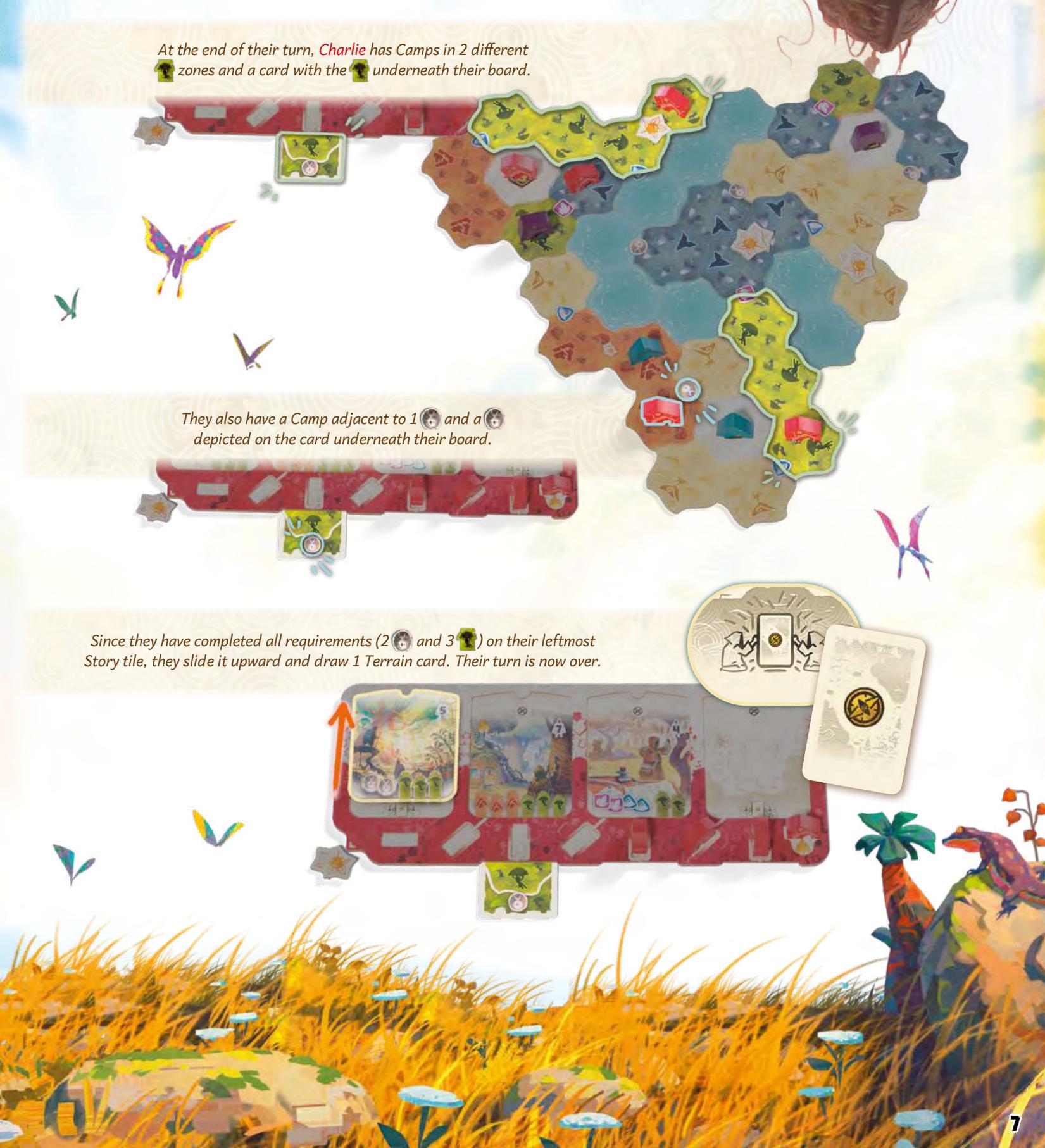
Charlie has 2 Camps in the same Forest zone and adjacent to the same Water zone. Charlie has only 1and 1 Additionally, they have 1.

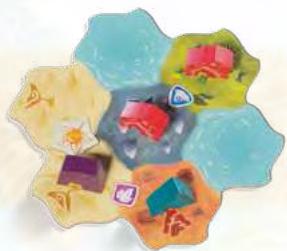
@ If a Story tile depicts a,, ormultiple times, you must have placed Camps on spaces adjacent to that many different icons matching that resource. Each icon only satisfies 1 requirement of that type, regardless of the number of your Camps adjacent to it.
Alix has 1and 1, while Billy has 1,1, and 1 Both players can satisfy requirements using the same Finally, Charlie has 1, 1, 2, and only 1
@ Each Terrain card placed underneath your Tribe board counts as 1 zone of the corresponding Terrain type; If the card has a symbol, it also counts as 1 resource of the corresponding type.

End of Turn
At the end of your turn, check to see if you have met the requirements of your Story tiles.
For each Story tile where all requirements have been met, mark it as completed by sliding the tile upward on your Tribe board. Then draw 1 Terrain card from the draw pile for each Story tile just completed. The player to your left then takes their turn.
END OFTHE GAME
The game ends at the end of a round in which a player places their final Camp. Finish the current round so that each player has had an equal number of turns, and then tally each player's points using the Score Pad. Any Story tiles with unsatisfied requirements are immediately discarded.
Scenario tile scoring works as follows:

Add up the points indicated on each of your completed Story tiles.

Score 1 point for eachyou have from your completed Story tiles, the cards below your Tribe board, and 1 extra if you placed your final Camp (as depicted on the empty Camp space on your Tribe board). Additionally, the player with the mostearns 4 additional points; In case of a tie for the most, all tied players score the 4 points.

Score 4 points for each group of at least 2 connected Camps on the Game Map.

Score 2 points for each Berry token obtained during the game and for eachsymbol visible on the Terrain cards placed underneath your Tribe board.
The player with the most total points wins the game. In the event of a tie, the winner is the player with the most Terrain cards remaining in their hand. If there is still a tie, the victory is shared.
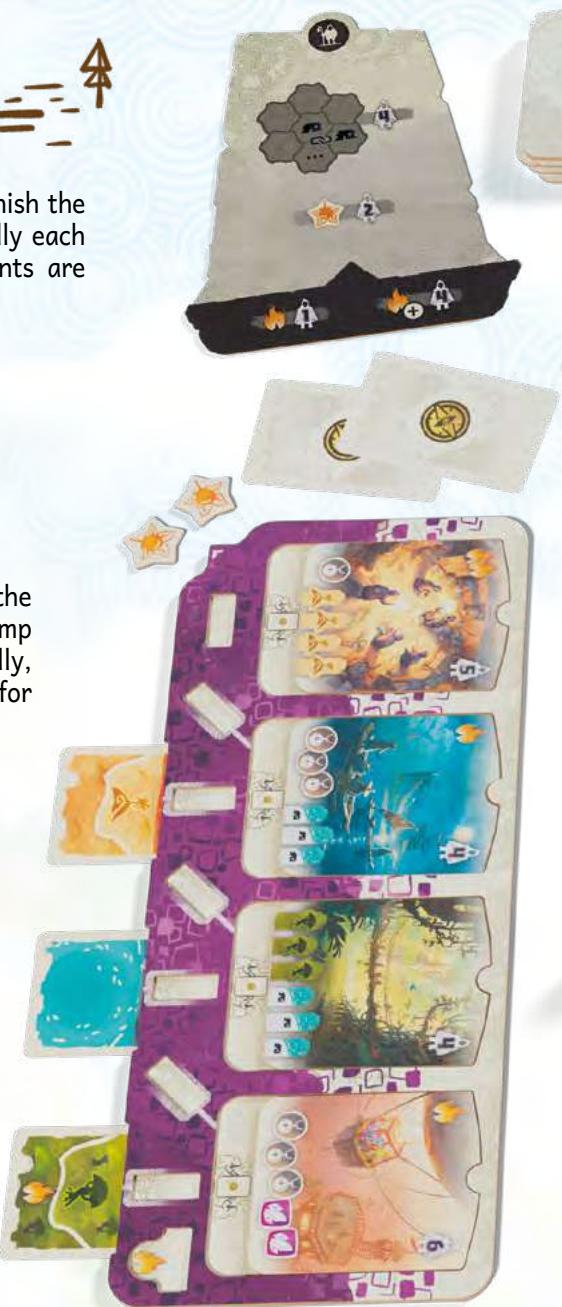

Charlie tallies their points. They have completed 3 Story tiles, but the fourth has unsatisfied requirements, so is ignored and discarded. They score a total of 16 points from the completed tiles (5 + 7 + 4).


They also collected 3 Berry tokens during the game, and have 1symbol showing on one of the Terrain cards placed underneath their board, for a total of 4 Berries; this gives them another 8 points.
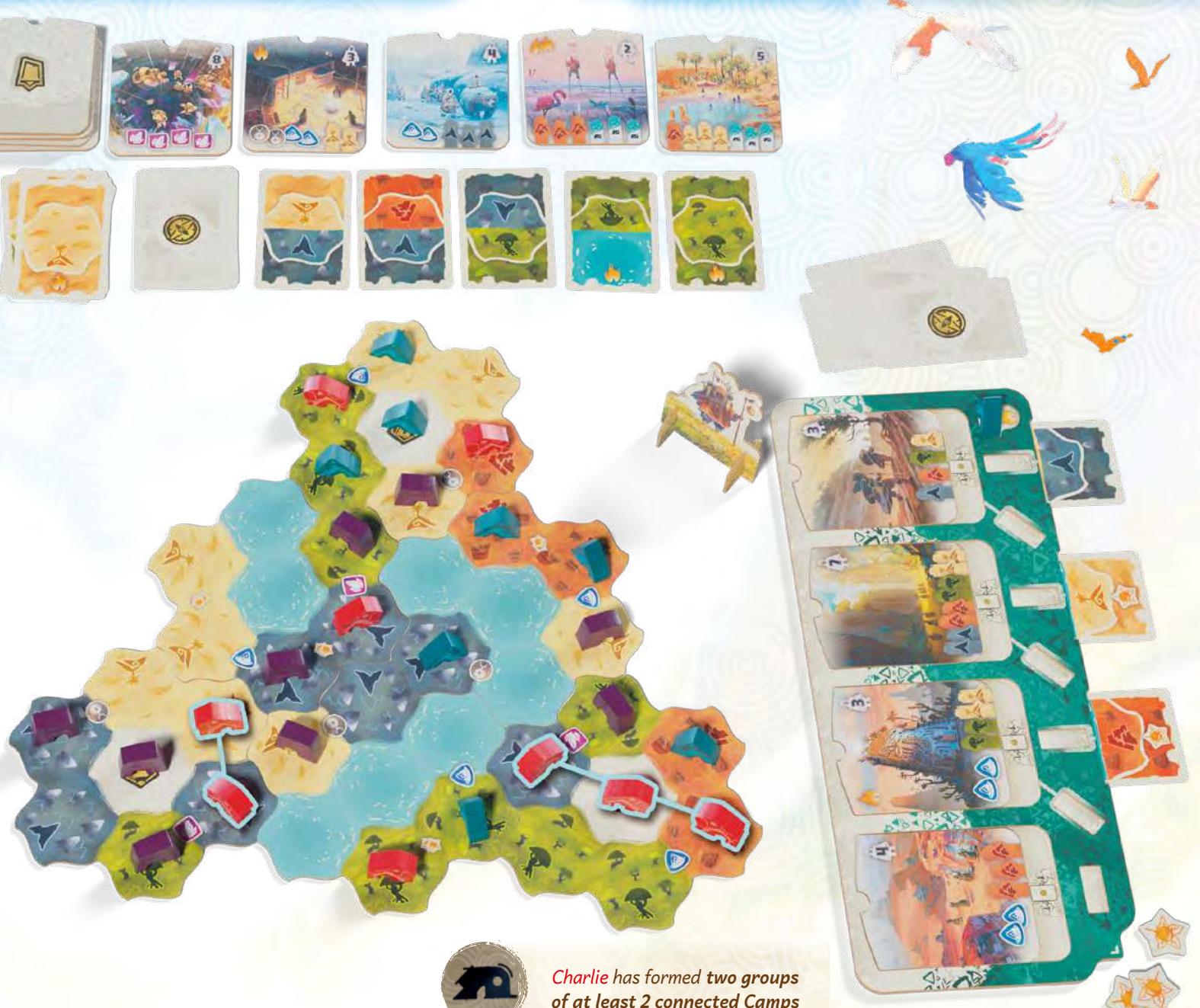
Charlie has formed two groups of at least 2 connected Camps on the Game Map, earning them an additional 8 points (4 points per group).
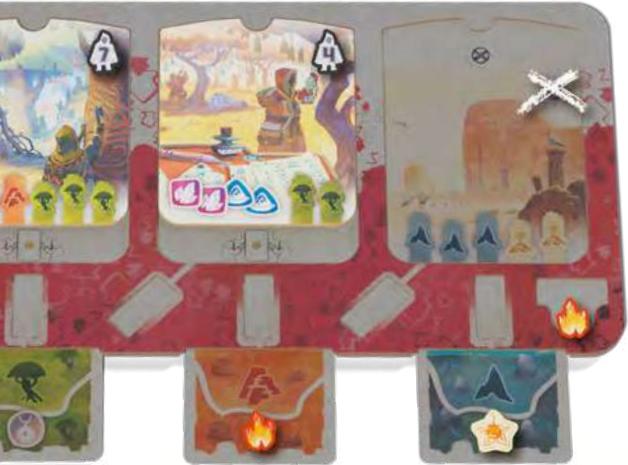

Their totaltally is 3, which includes 1 from a Story tile, 1 from a card placed underneath their board, and 1 from having placed their final Camp. Since Alix has moresymbols than them, Charlie only scores 3 points, and the 4-pointbonus goes to Alix.
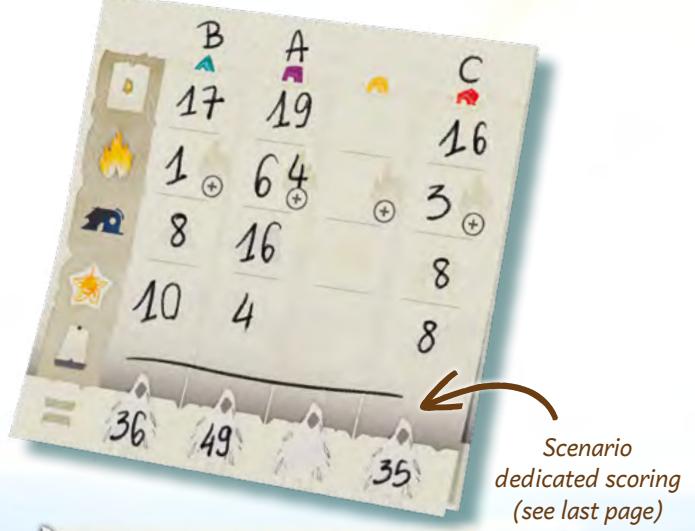

Charlie's total score is 16 + 3 + 8 + 8 = 35 points.
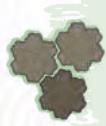
Place the Scenario tile near the play area. The rules for the team game are identical to those of the basic 4-player game. Players form two teams of two, with team members sitting across from each other, so play will alternate between each team. The game concludes when a player places their final Camp, marking the game will finish at the end of the current round. The points for each team are then totaled.

Your team scores the sum of your Story tiles points.

Your team scores the total number ofsymbols for both players, each worth 1 point. The team with
the mostsymbols scores 4 additional
points. In case of a tie for the most both teams score the 4 points.

Your team scores 4 points for every group of 2 or more Camps, with at least, one belonging to one team member and the other to the other team member.

Your team scores 4 points for
each pair of Berries, with one
belonging to one team member and the other to the other team member.
The team with the highest combined score wins the game. In the event of a tie, the winner is the team with the most Terrain cards remaining in their hands. If there is still a tie, the victory is shared.

ADDITIONALSCENARIOS


Dewan contains 3 additional scenarios. When playing one of these scenarios, use the regular game rules, unless stated otherwise. Scenario-specific rules always take precedence over regular game rules.
You can find guidelines on how to set up each scenario on the back of the corresponding scenario tile, which you place near the play area instead of the base scenario tile. The following rules apply to each of the different scenarios.
Create the Draw Pile
At the beginning of the game, after setting up the card row, set aside a number of cards at random and create the draw pile. This number depends on the number of players:
@ In a 2-player game: 6 cards
@ In a 3-player game: 8 cards
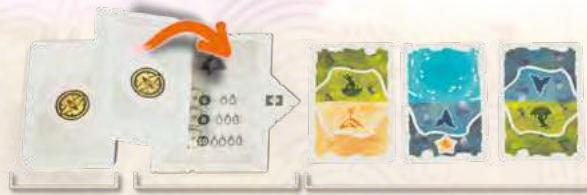
supply
draw pile
card row
@ In a 4-player game: 10 cards
Place the draw pile on top of the Event tile. The remaining cards form the supply and should be placed next to the draw pile.
Triggering Events
Each scenario features a specific event. When a player performs the "Take 2 cards" action, the card row is replenished using cards taken from the draw pile.
When the last card is taken from the draw pile, the event is immediately triggered and resolved by the player.
Then a new draw pile is created by taking cards from the supply (with the same number of cards as above).
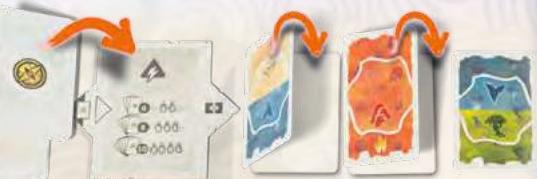
In a 3-player game, Billy performs
the “Take 2 cards” action and replaces them with the last 2 cards of the draw pile. They resolve that event and then create a new draw pile with 8 cards from the supply.
Story Tiles Reward
When a player satisfies the requirements on their Story tile(s), they take the top card(s) from the supply (not the draw pile). Note: If the supply is empty when you need to draw a card, shuffle the discarded cards and place them facedown to create a new supply.
Game Pieces Limit
When an event requires you to place a marker or take a token that is no longer available, ignore that part of the event.

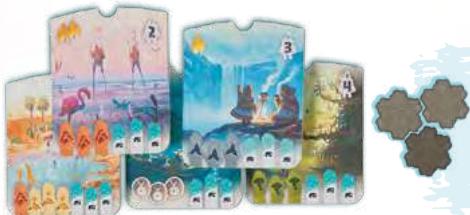
The Downpour
Setup the game as usual, except the Downpour Territory tile should be placed as indicated on the back of the Scenario tile. Place the Water markers near the Game Map. Before building the stack of Story tiles, remove the 5 Story tiles displaying the Water symbol.

Each time the event is triggered, the active player places 1 Water marker onto any free non-Water space that is adjacent to an existing Water space; that space is now considered to be a Water space. If this causes a zone to be split into two, move all Berries there into the larger zone. If both zones are of equal size, divide the berries evenly between the two zones, placing the odd berry (if any) randomly in one of the two zones.

Score points from the completed Story tiles andsymbols as usual.

Score 3 points for each Forest or Mountain zone where you have placed at least 1 Camp.

Score 4 points for each pair consisting of 1 and 16symbol you acquired during the game.
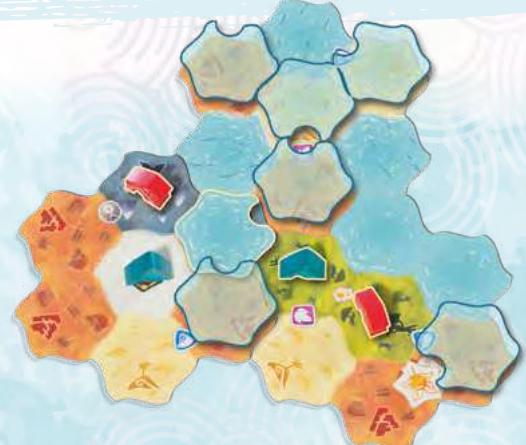
Billy triggered the event, and must place a Water marker. The above image highlights the 6 eligible spaces: They are free, not Water, and are adjacent to a Water space (including the previously-placed Water marker).
The Volcano


Setup the game as usual, except the Volcano Territory tile should be placed as indicated on the back of the Scenario tile. Place the Lava markers near the Game Map.

Each time the event is triggered, the active player places 1 Lava marker onto any free non-Water space that is adjacent to either the volcano or another Lava marker. If this causes a zone to be split into two, move all Berries there into the larger zone. If both zones are of equal size, divide the berries evenly between the two zones, placing the odd berry (if any) randomly in one of the two zones. When placing a Camp, you cannot cross a space containing a Lava marker or the volcano.

Score points from the completed Story tiles andsymbols as usual (includingfor being adjacent to the volcano).

Score 2 points for each Water zone which has at least 1 of your Camps next to it. Score 2 points for each Camp next to the center of an opponent's Starting tile.

Score 3 points for each pair consisting of 1 and 1symbol you acquired during the game.
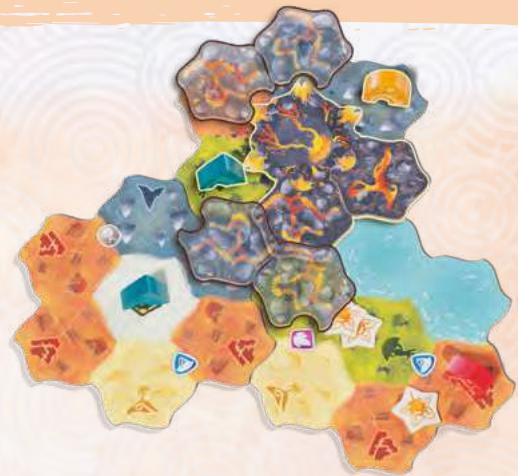
Billy triggered the event, and must place a Lava marker. The above image highlights the 4 eligible spaces: They are free, not Water, and are adjacent to either the volcano or another Lava marker. Billy has 1for being adjacent to the volcano.

Setup the game as usual. Place the Fish tokens near the Game Map.
When vou perform the “Place a Camp" action, you can choose to place your Camp on a Water space. Designate any space in a Water zone as the destination. The final card you discard must be a Water card.
Each Water zone can only contain 1 Camp, which is now a Lake Village. Once a Water zone contains 1 Lake Village, no other Camp can be placed in this Water zone.
Your Lake Villagecan be used as a starting point. In this case, the first card discarded must be a Water card. The next card discarded can be of any Terrain matching a space adjacent to the starting Water zone.
If an opponent crosses a Water zone containing your Lake Village, they must give you a Water card instead of discarding it.
Important: A Lake Village is NOT considered adjacent to the Water zone it occupies.

When the event is triggered, each player with at least 1 Lake Village may discard exactly 1 Terrain card (of any kind) from their hand.
Then, they take 1 Fish token for each Lake Village they have.
Fish tokens are taken in turn order, starting with the player who triggered the event.


Score points from the completed Story tiles andsymbols as usual.
For each Water zone, award 6 points
to the player with the most Camps adjacent to that zone. In case
of a tie, each tied player is awarded 3 points instead.
Lake Villages are NOT adjacent to their Water zones so they are not taken into account for Water requests on Story tiles or Camp adjacency for scoring.

Score 3 points for each pair consisting of 1and 1 symbol you acquired during the game.
Score 3 points for each Fish token acquired during the game.
Dana has placed a Lake Village in Water zone A and another in Water zone B, while Charlie has placed one in Water zone . Each time the event is resolved, they can both discard any 1 card from their hand; if they do, Dana takes 2 Fish tokens, and Charlie takes 1 Fish token.
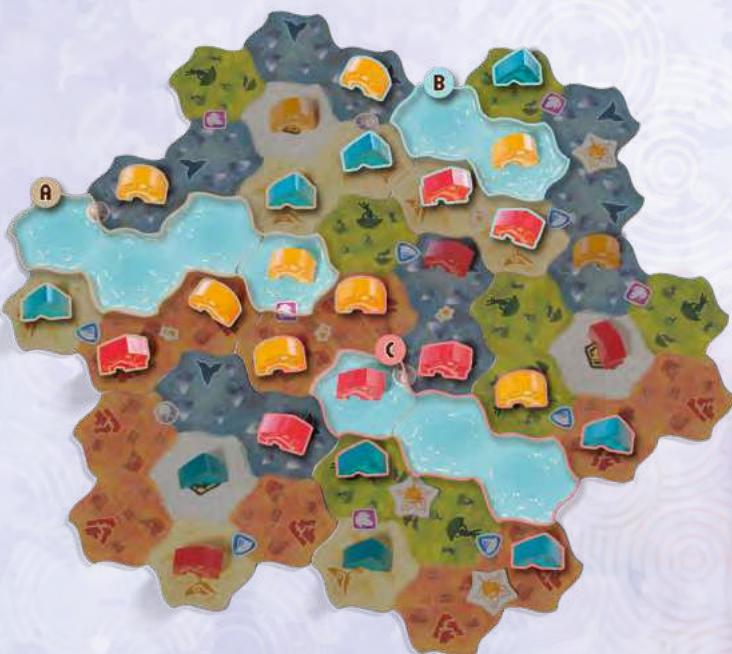
At the end of the game, points are awarded for each Water zone as follows:
-20NE A: Dana has 4 Camps adjacent to this zone (Lake Village does not count). While Billy has only 2 adjacent Camps and Charlie has only 1. Dana scores 6 points.
-Z0NE B: Billy and Charlie are tied, each with 2 Camps adjacent to this zone, so they both score 3 points each.
-20NE : Dana and Billy are tied, each with 3 Camps adjacent to this zone, so they each score 3 points.
Download MarkdownTexts are community-compiled or publicly released by publishers; copyright remains with the original authors. For personal reference only.