
Die Macher
At a glance
Rules, cards and Q&A (Chinese)
The rules, card data and player questions for this game are written in Chinese. Open the Chinese page to read them.
Where to find full rules
Full rules and card lookup are available in the cunlema app at cunlema.cn — pick this game and ask about any rule, card or turn you are unsure about.
Related games
Rulebook text (Markdown)
This game has 2 rulebook Markdown file(s) in our library; 2 rendered inline below — expand to read or download.
rules_en_die-macher_1.md55.9 KB
来源类型:纯文本规则(非 PDF 源,早期抓取/转换产物)
说明:原文未改动,仅调整存放位置与文件名;非 PDF 扫描件,无对应原书 PDF
Die Macher Rulebook | RulesPalRulesPalChatRulebookDie MacherDie Macher Rulebook Table of Contents Table of Contents Game Contents
Tips Regarding These Rules
Short Description of the Game / Aim of the Game The Election Campaign Bid for Starting Player
Party Platform Conference
Shadow Cabinet
Form Coalitions
Buy Media Markers
Organize Party Meetings
Auction Opinion Polls
Convert Party Meeting Markers into Votes
Winning an Election Score Current State
Collect Money
The End of a Round
Aim of the Game
Explanation of the Game's Contents Cards and Tiles Party Policy Cards
Public Opinion Cards
State Cards and Tiles
Shadow Cabinet Cards
Opinion Poll Cards
Contribution Cards
Wooden Pieces
Game Boards State Boards
National Board
Organization Board
Preparation Player's Material
Setting up the Game Boards The State Boards
The National Board
The Organization Board
Course of Play The Preliminary Phase
The Election Campaign Bid for Starting Player
Party Platform Conference
Shadow Cabinet
Forming Coalitions
Buying Media Markers
Organize Party Meetings
Auction Public Opinion Polls
Converting Meeting Markers into Votes
Score the Current State / Collect Money Determine Seats
Decide Election Winner in Current Election
Results of the Election Victory
Increase Party Membership
Pay Out Election Money
End of the Round Set-up for Next Round Special Set-ups
Party Contributions
Game End Seats
Media
Party Membership
Coincidence Between Party Platform and National Opinion
Determine Winner
Variant Rules – Short Game
Tips for Playing Die Macher
Appendix A
Round Summary
Credits
Game Contents
6 Game Boards:
4 State Boards
1 National Board
1 Organization Board
160 Wooden Pieces:
90 Small Cubes (18 x each color)
25 Large Cubes (5 x each color)
45 Flat Blocks (9 x each color)
1 Sheet of Cardboard Tiles:
16 State Tiles
20 Coalition Tiles (4 x each color)
5 Starting Player Tiles
3 Party Membership Payout Tiles
4 Key Issue Tiles
1 "No Coalition" Tile
299 Playing Cards:
16 State Cards
35 Shadow Cabinet Cards (7 x per player)
25 Party Contribution Cards (5 x per player)
42 Public Opinion Cards
56 Party Policy Cards
20 Opinion Poll Cards
105 Money Cards
Also included:
2 Special Dice
1 Pad of Scoring Pages
1 Set of Rules
1 Official Rules Translation CD
Tips Regarding These Rules
This rules booklet may, at first glance, appear quite difficult to understand and make the game seem more complex than it really is. Please don't let this deter you from learning this world class board game. Unfortunately, a game of this complexity requires more than a page or two of rules to describe it and much of the rules include pictures and step-by-step examples to ensure ease of understanding the game flow. This game will keep you interested right up to the final round and guarantees wonderful replay value.
First, read through Section 3: Short Description of the Game / Aim of the Game and look through the game's contents, referring as you do so to Section 4: Explanation of the Game's Contents.
This should enable you to grasp the principal mechanism of the game, which is precisely described in Section 6.2.8: Converting Meeting Markers into Votes. It may well help if you play through the example given, using a State Board. Once you've done this, you will have gained an understanding of the heart of the game and can start playing.
The game is played over 7 rounds, each of which follows the same course. You should play slowly through the first round, working systematically from each section to the next. The importance of each step is described at the start of each section in » italic type «. Then follow the rules for each section. At the end of the game, there is a final scoring round, which decides the winner of the game.
So, take the destiny of your party into your hands and lead them to victory. If you can do it, you will be a true powerbroker, a true "Macher".
Short Description of the Game / Aim of the Game
» As a player, you have the task of leading your party through 7 state elections. Your most important aid in this is money. You need money to place Shadow Cabinet Cards, to buy Media Markers, to buy Election Meeting Markers and to bid on Opinion Poll Cards. You will need to be careful with your money though, because you will not get any more until the end of each round. «
The Election Campaign
Each player will represent one of the 5 traditional German political parties. The parties are:
CDU/CSU - Christian Democratic Union / Christian Social Union
SPD – Social Democratic Party of Germany
FDP – Free Democratic Party
Die Linken – The Left Party
Die Grünen – The Green Party
The game starts with a preliminary phase, which sets up a starting position on the game board. This allows players to see what the first four rounds will look like and do a little pre-planning to set themselves up for the game. Once that is sorted out, the game then officially begins with the first election round. The course of each election round is as follows:
Bid for Starting Player
Party Platform Conference
Shadow Cabinet
Form Coalitions
Buy and Place Media Markers
Organize Election Meetings and Place Markers
Auction Opinion Polls
Convert Party Meeting Markers into Votes
Score Current State / Collect Money
End of Round
Bid for Starting Player
In every round, each player secretly writes down an amount of money on their score sheet. This is their bid for the current round. The player who bids the most amount of money may choose which player is the starting player for the round. In some phases of the game, it is an advantage to start and in others, the last player to play has the advantage. A player may bid zero if they are not particular about who goes first and if all players bid zero, then each player will simply roll a die and the highest roll chooses who goes first.
Party Platform Conference
Each player has a party platform determined by their Party Policy Cards. This is the basis of their political campaign. In some states this platform may not be very popular since the voters have different views about these issues. Changing a party's platform may improve its chances in that state. During this phase, players have the opportunity to do this, but may only change one Party Policy Card per round. The number of coinciding Party Policy Cards to Public Opinion Cards, also called the "Coincidence Rating", is a direct factor in determining the number of votes obtained in that state.
Shadow Cabinet
The politicians in the Shadow Cabinet support the player during the election campaign. Appendix A lists the Shadow Cabinet members associated with each picture. The game includes cards which represent various members of a Shadow Cabinet that allow the player to carry out certain actions to either benefit their campaign or disrupt another player's campaign. The more expensive the card, the more it can affect the outcome in a certain state. The cards offer the following types of actions:
Collect Votes
Cause one issue to become a key issue for that state
Force other players out of the media
Improve the public's opinion towards your party
Worsen the public's opinion towards other parties
Form Coalitions
Two players may form a coalition for a single election in one state. This improves the chances of winning the election since the votes for both parties are counted together. In order to form a coalition, the two parties must have at least two Party Policy Cards in common in their platform. This may be another reason for a player to change a Party Policy Card in the Party Platform Conference phase mentioned above.
Buy Media Markers
Buying Media Markers increases your party's ability to speak directly to the public. As a result, your party has more opportunity to convince the public that your Platform is the correct one for that state. The player who has the plurality of the Media Markers in a state may change one Public Opinion Card in that state. Ideally, the newly chosen Public Opinion Card coincides with a Party Policy Card in your platform, which will earn more votes and improve the chances of an election victory.
Organize Party Meetings
Party Meetings are the basis for the gathering of votes. Each player has only a limited number of Party Meeting Markers, so it is important to divide them between the various states in a planned and timely manner to maximize the number of votes earned.
Auction Opinion Polls
Opinion polls are offered to each highest bidder every round for possible publishing (1 poll auctioned per state). This is a chance for each player to improve the public's opinion towards their party and/or worsen the public's opinion towards other parties. This is called the "Popularity Rating" and it can be either positive or negative. This is a direct factor in determining the number of votes obtained in that state.
Convert Party Meeting Markers into Votes
The conversion of the Party Meeting Markers into votes is given by the following formula:
Votes = Meeting Markers x (Coincidence Rating + Popularity Rating)
So, in order to gain a lot of votes in a state, a party should have a high number of Party Meeting Markers in the state, a positive Popularity Rating and a high Coincidence Rating.
Winning an Election
Score Current State
Once the campaign is over, the number of votes the party received is converted into seats. The votes received also decide which party or coalition has won the state. Seats won are worth victory points which directly lead to winning the game. The winner of the election also gets some further advantages in that they may place a Media Marker on the top of the National Board and, in addition, can influence the National Opinion. Both lead to further victory points at the end of the game. Coincidence between Party Policies and National Opinions can also lead to more Party Membership. For this reason, it is important to try to win some of the state elections. Simply coming in second every round will not get you the bonus points from the Media Markers and National Opinion.
Collect Money
At the end of each round (excluding the 7th), the players receive new cash. The amount of cash that a player receives depends on their success in the preceding election and on their Party Membership (in rounds 1, 3 and 5). This cash enables the player to compete in later elections. However, any player who finds that they have cut things too fine may be able to improve their financial status by taking a contribution from an outside body. This carries a risk, however, in that accepting outside contributions may cause some party members to stop supporting you throughout the election. Once all cash has been paid out, the current round is over.
The End of a Round
At the end of each round of the game (excluding the 7th) a few changes must be made to the boards to set-up for the next round.
Aim of the Game
The game ends after the 7th round. Players get victory points by winning seats in the state elections, having influence over the National Media, having strong Party Membership and having a strong coincidence between your Party Platform and the National Opinion.
Explanation of the Game's Contents
Cards and Tiles
Party Policy Cards
These cards represent the policies that form your party's platform. There are seven policies that are the major issues of this election and they are explained in more detail in Appendix A. The policies with a dark background represent a "NO" or "LESS" policy. The policies with a light background represent a "YES" or "MORE" policy.
Public Opinion Cards
These represent the opinions of the electorate for each of the proposed policies. The opinions with a dark background represent either "NO" or "LESS". The opinions with the light background represent either "YES" or "MORE".
State Cards and Tiles
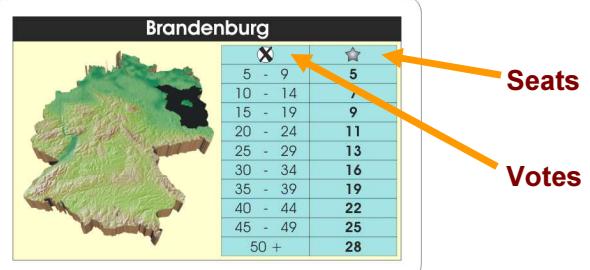
Each State Card and Tile shows a map of Germany and the location of the state within Germany. The State Cards show the relationship between votes and seats won in each state. The left column shows the number of votes a party received in that state and the right column shows the corresponding number of seats won as a result.
The State Tile only shows the maximum number of seats a party can get in a state. It is used for quick reference on the State Boards to help a player decide how much that state is truly worth in the overall campaign.
Shadow Cabinet Cards
The Shadow Cabinet cards allow the player to carry out certain actions to either benefit their campaign or disrupt another player's campaign. The members of the Shadow Cabinet are listed in Appendix A. Each card has:
A picture representing the shadow cabinet member,
An icon of a phone IF this member is able to form coalitions,
The cost of using this card, and
A list of the possible actions that the card can be used for.
Opinion Poll Cards
The Opinion Poll cards can either improve the party's popularity with the public or worsen an opposing party's popularity with the public. Each card has:
A list of possible popularity modifiers for each party,
The number of popularity modifiers that may be applied as a result of publishing the poll, and
The number of dice to roll to determine how much your party membership grows as a result of NOT publishing the results of the poll.
Contribution Cards
These cards show how much money a party may receive by means of contributions from outside sponsors. Each card has:
The amount of the contribution,
The potential loss in party membership as a result of accepting the contribution, and
The potential gain in party membership as a result of declining the contribution.
Wooden Pieces
The 18 small (8mm) cubes in each color represent the Party Meetings. They are called Meeting Markers.
The 5 large cubes (12mm) in each color represent a party's influence with the media. They are called Media Markers.
The flat wooden blocks (12 x 12 x 6mm) are markers for various tables and score tracks on the board. They will show the number of votes won, the popularity of the party and the party membership. They are called Party Markers.
Game Boards
State Boards
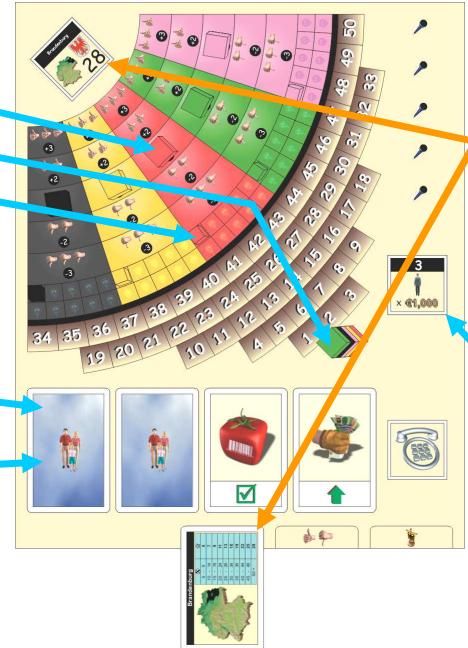
A space for the State Tile to allow players to quickly see the maximum available seats for that state.
A space for the State Card.
A space to place the Opinion Poll Card.
A space to place Shadow Cabinet Cards.
A space to place Coalition Tiles.
A space to place the "Party Membership Pay Out" tile. Note: Only two of the State Boards have this.
The popularity track which indicates how popular or unpopular each party is with respect to the public. This track is influenced by either Shadow Cabinet cards or Public Opinion Poll cards,
Spaces to hold Meeting Markers,
The vote track which indicates who is currently winning the race in each state.
Spaces to hold Public Opinion Cards, and
Spaces for Media Markers.
National Board
Spaces for Media Markers,
The Party Membership track which indicates each party's current Party Membership, and
Spaces for Public Opinion Cards that have become National Opinions, a. Increase in Party Membership indicator for coincidence between Party Policies and National Opinion.
b. End of game victory point indicator for coincidence between Party Policies and National Opinion.
Organization Board
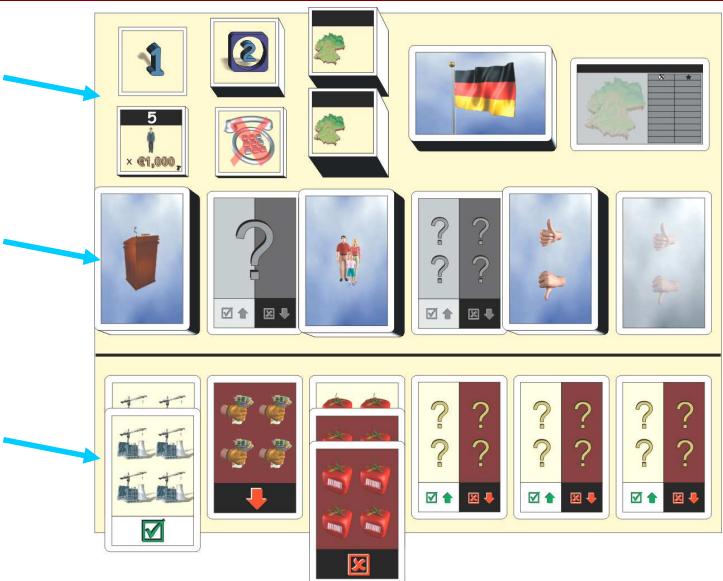
Space for current start player to put their Party Tile so all can see who the start player is at all times,
Holding spaces for: a. Round 5 Party Membership Payout Tile,
b. No Coalition Tile,
c. Key Issue Tiles,
d. Future State Tiles,
Holding spaces / discard spaces for: a. State Cards,
b. Party Policy Cards,
c. Public Opinion Cards,
d. Opinion Poll Cards,
Exchange pool.
Note: Spaces that are greyed out are discard piles.
Preparation
Player's Material
Each player should choose a color and take…
Wooden Pieces
18 Meeting Markers,
5 Media Markers.
Cards
1 Set of 7 Shadow Cabinet Cards.
1 Set of 5 Contribution Cards,
5 Party Policy Cards (Face Up)
These Party Policy Cards are dealt face up to each player. Should a player get two identical or contradictory opinions about the same policy, they should place the most recently dealt card on the bottom of the deck and continue dealing until they have five cards that all pertain to different policies.
For Example: A player is dealt the "Yes to Wage Reductions" card and then the "No to Wage Reductions" card. They must return the most recently dealt card, "No to Wage Reductions", to the bottom of the draw pile and draw another.
3 Party Policy Cards (Face Down)
These Party Policy Cards are dealt face down to each player. For these cards, it is irrelevant whether a player receives identical or contradictory opinions. Once each player has received their three cards, the remaining Party Policy Cards are then shuffled and placed face down on the Holding Space for Party Policy Cards on the Organization Board.
Each player also takes:
4 Coalition tiles in their color,
1 Score Card from the pad, and
€25,000 in game money.
Setting up the Game Boards
Set up the 4 State Boards as shown in the rulebook illustration. Ensure the boards with the space for Party Membership Payout Tiles are diagonally opposite to one another.
The State Boards
State Cards and Tiles
Shuffle the 16 State Cards and place one next to each of the State Boards in the indicated spot. The remaining 12 cards are placed face down on the Organization Board. The matching State Tile is then placed on the State Tile space and the remaining State Tiles are placed on the Organization Board.
Public Opinion Cards
Choose one of the State Boards with a Party Membership Pay Out Tile space on it to be the first electoral state. Deal four Public Opinion Cards, face up, onto each of the spaces provided. If any of the cards have identical or contradictory opinions, place the most recently dealt card on the bottom of the deck and continue dealing until there are four face up cards, all pertaining to different issues.
Each player should put one of their Party Markers on:
the 0 space of the Popularity Scale of their colour and
the 0 space of the Vote Scale.
Each player should put one of their Meeting Markers on:
a Meeting Marker Space of their colour.
This board is now the current election state. The remaining boards, traveling clockwise, will then get:
2nd board: 3 Public Opinion Cards face up and 1 Public Opinion Card face down.
3rd board: 2 Public Opinion Cards face up and 2 Public Opinion Cards face down.
4th board: 1 Public Opinion Card face up and 3 Public Opinion Cards face down.
The 4th board is now the last state in line for elections. In all cases, any identical or contradictory face-up cards are dealt with in the same way as the first board. The remaining Public Opinion Cards are shuffled and placed face down on the Holding Space for Public Opinion Cards on the Organization Board.
Party Membership Payout Tiles
Place the Round 1 Party Membership Payout Tile in the appropriate spot on the 1st board and the Round 3 Party Membership Payout Tile on the 3rd board.
Note: the State Board example illustrated in the rulebook shows the set-up for the 3rd board in line for elections.
The National Board
Each player should put one of their Party Markers on the "5" space of the Party Membership Track.
The Organization Board
Place the remaining Party Platform Cards, Public Opinion Cards, State Cards and all the Opinion Poll Cards, face down, on their appropriate spaces on the Organization Board.
Place the remaining State Tiles, Key Issue Tiles, No-Coalition Tile and Round 5 Party Membership Payout Tile on their appropriate spaces on the Organization Board.
Lastly, deal 6 Public Opinion Cards from the top of the pile, face up along the bottom of the Organization Board. In this situation, duplicate and identical cards are allowed within the Exchange Pool and are simply placed on top of each other but slightly offset so all cards can be seen. These cards are referred to as the exchange pool.
Course of Play
» The real rules start here. The game starts with a first round and then progresses over 7 rounds. Aside from the first round which has the preliminary phase, rounds 1 through 6 follow these phases:
6.2 The Election Round
6.3 Score the Current State / Collect Money
6.4 End of the Round
Round 7 will only consist of Phase 6.3 Score the Current State. «
The Preliminary Phase
» The preliminary phase serves as a chance for players to set themselves up on the State Boards prior to actually starting the game. The players have the opportunity to see the available seats in each state and the public's opinion towards certain issues. This will help players prepare for states where victory could be more difficult to achieve. «
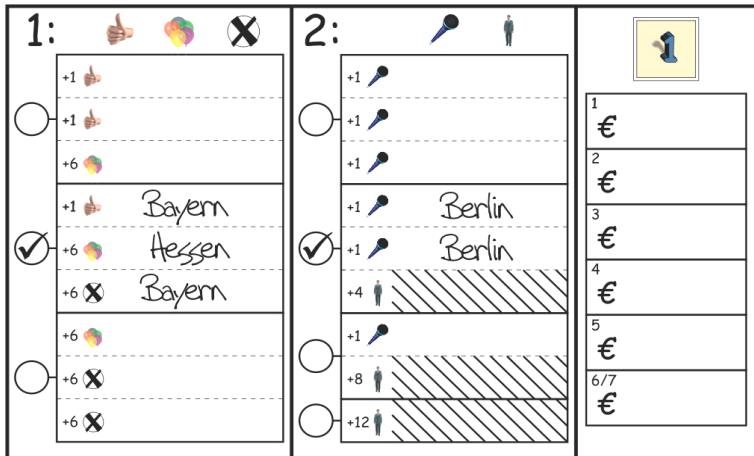
The players each take their scoring card and secretly write down their starting positions on the front. The pad shows two separate columns with 3 and 4 checkboxes in each respectively. Each player chooses ONE option from each column. The options for each column are as follows:
Column 1:
Increase Party Popularity by one,
Gain Party Meeting Markers,
Gain votes.
Column 2:
Gain Media Markers, and
Increase Party Membership
In each of the above cases except for "Increase Party Membership", the player must write down the state in which they wish to get the selected option and the player may choose the same state multiple times.
Example: In the first column, the player has chosen to increase Party Popularity by one and gain votes in Bayern. The player would then move their Party Marker up one on the Party Popularity Scale and place their Party Marker on the "6" of the Vote Track on the Bayern board. The player also chose to gain Party Meeting Markers in Hessen. The player places 6 of their Party Meeting Markers on the spaces provided on the Hessen board.
In the second column, the player has chosen to gain Media Markers in Berlin. The player places 2 of their Media Markers on the spaces provided on the Berlin board. Lastly, the player chose to start the game with increased Party Membership. The player moves their Party Marker to the "9" place on the Party Membership Track.
All actions during the preliminary phase are free.
It is possible, after the preliminary phase, to have more Media Markers in a state than the 5 that are allowed. In this case, the Media markers are simply stacked and count towards determining who has media control in phase 6.2.5. No more media markers may be purchased during that phase but they may be replaced by Shadow Cabinet actions in phase 6.2.3.
The Election Campaign
Bid for Starting Player
In every round, each player secretly writes down an amount of money on their score sheet for the current round as their bid.
The player who bids the highest amount of money pays that amount to the bank and may choose which player is the starting player for the round. The chosen player then places their player token on the "Start Player" space on the Organization Board. In the case of two players bidding the same amount of money, those players secretly write down another amount of money that is AT LEAST as much as their previous bid. Then, if there is still a tie, each player simply rolls a die and the highest roll pays their last bid to the bank and then chooses a starting player as normal.
If all players bid zero then each player simply rolls a die and the highest roll chooses a starting player. In some phases of the game, it is an advantage to start and in others, the last player to play has the advantage. A player may bid zero to save money, or if they do not care who goes first.
Party Platform Conference
» The conference gives each player the chance to change their party's platform. «
Each player has five Party Policy Cards face up in front of them which show the party's current political platform. Each player also has three Party Policy Cards face down in front of them. This phase represents discussions within the party as to what policies they should change within their platform. The starting player goes first and the remaining players follow in clockwise order.
The player picks up their face down cards and looks at them. If the player has less than three cards in hand, they draw cards to bring their hand back up to three. The player may discard as many of these cards as desired, placing them on the Discard Pile on the Organization Board and then draws that many from the top of the Party Policy Cards deck. Now, the player may remove one card from their Party Platform to the discard pile and replace it with one of the Party Policy Cards in their hand, face up. Only one policy per player may be changed in a round.
Shadow Cabinet
» The Shadow Cabinet supports the player during the election campaigns. With the aid of their Shadow Cabinet members, they can carry out certain actions in the states, which may drastically improve their chances of winning. «
The possibilities given by each Shadow Cabinet Card are different. There are some strong cards which offer a larger choice of actions and some weaker cards which are more restricted. These differences are reflected by the price attached to each card and the possible actions that are listed. Some of the cards, however, also have a telephone symbol appearing in the top right corner of the picture on the card. These cards enable a player to form coalitions in the region where they are played (see Forming Coalitions below).
Possible Actions of a Shadow Cabinet Card:
Collect votes. This selection allows a player to move their Party Marker up the Vote Scale in the selected state by the amount indicated.
Key issue. This selection allows a player to designate one issue in the selected state as a key issue in the election OR reduce a previously designated key issue back to a normal issue. The player who played the card should either choose a Key Issue Tile from the pile on the Organization Board and place it on one of the face up Public Opinion Cards in that state or remove a Key Issue Tile already in that state. The purpose of this tile when it is on a Public Opinion Card is to double the importance of this issue when converting Meeting Markers into votes (see Converting Meeting Markers into Votes). Only one Key Issue Tile may be in effect in a state at any time and an issue with a Key Issue Tile on it cannot be removed until it is reduced to a normal issue.
Media. This selection allows a party to strengthen their influence with the media AND weaken another party's. The player using this action must first remove one Media Marker belonging to another player from the board, return it to that player, and pay that player €4,000 for the privilege. The player then places one of their own Media Markers in place of the old one, paying €4,000 to the bank.
Improve own popularity. This selection allows a player to improve the public's opinion towards their party. The player moves their Party Marker up the Popularity Scale in the selected state by the amount indicated. Note that a party's popularity may NEVER be greater than +3.
Worsen another party's popularity. This selection allows a player to decrease the public's opinion towards another party. The player moves another party's Party Marker down the Popularity Scale in the selected state by the amount indicated. Note that a party's popularity may NEVER be less than -3. Control of the media does not protect a player against this action.
The starting player may choose one or more of their Shadow Cabinet cards and place them face down next to the State Board to which they want to apply it. A player may only place one card in each state per round. Once the starting player has placed all the desired cards, the other players follow in clockwise order. Once all players have had a chance to play Shadow Cabinet cards, they are turned face up and each player pays the corresponding amount to the bank. Then, in player order, each player carries out ONE of the actions listed on all the Shadow Cabinet Cards they played. If a player has played a card with a telephone on it, they should now place one of their Coalition Tiles in the appropriate space on the corresponding State Board where the Shadow Cabinet Card was played. All Shadow Cabinet Cards are removed from the game once used and returned to the box. For this reason it is important you use Shadow Cabinet Cards effectively.
Forming Coalitions
» Forming a coalition helps the two parties concerned in the current election. Coalition partners add their votes together, improving their chances of winning the election (see Decide Election Winner in Current Election). Coalitions may only be formed in the current electoral state. «
If there is more than one Coalition Tile on the Coalition Tile Space on the current State Board at this point, the parties whose tiles are there may attempt to form a coalition. A coalition only ever involves two parties though there may be multiple coalitions. Two parties may only form a coalition if at least two of their Party Policy Cards are identical. Such a coalition is voluntary and requires the agreement of both players. However, if at least three of their Party Policy Cards are identical, either party may force a coalition upon the other party. Beginning with the starting player and continuing clockwise, each player may decide if they wish to force a coalition on another player. If the player chooses to force a coalition, that player simply stacks the two Coalition Tiles together. If a player is already involved in a coalition, they may not enter into a second (voluntary or forced). As a reminder of a coalition, players not involved in a coalition should now take back their Coalition Tiles and the players involved in a coalition should leave their Coalition Tiles stacked on the State Board.
Buying Media Markers
» Buying Media Markers makes it possible for a party to have some influence over the opinions of the public in a region. To succeed in this, the party must have a plurality of Media Markers in a state. «
Beginning with the starting player and continuing clockwise, players may buy a Media Marker and place it on the state board of their choice. Each Media Marker costs the player €4,000. If they do not wish to buy a Media Marker, they may pass. This does not prevent them from buying and placing a Media Marker later during this phase. Play continues in this way until all the players have passed successively. This means that one player may continue to buy and place Media Markers even if all the other players have passed.
Media Markers may only be placed on an empty space on a State Board and there are only five spaces on each board. Once all five are full, no further Media Markers may be placed in that state. Once all players have passed, players should check whether any player has a plurality of markers in any region. This means that a player need only have more Media Markers in a state than any other player. Starting with the last state in line for elections and proceeding counter-clockwise, if a player has control of the media in a state, they may EXCHANGE one FACE-UP Public Opinion Card in that state with one in the Exchange Pool on the Organization Board that is neither identical nor contradictory to any face-up cards already on that State Board as explained in the Public Opinion Cards setup. Specifically, this means to take the undesired Public Opinion Card from the State Board and place it in the Exchange Pool. Then, take the desired Public Opinion Card from the Exchange Pool and place it in the empty space on the State Board. In this situation, as in the Organization Board setup above, duplicate and identical cards are allowed within the Exchange Pool and are simply placed on top of each other but slightly offset so all cards can be seen. There will only ever be six cards in the Exchange Pool at any time.
An additional benefit to controlling the media in a state is that the party is protected against the negative effects of published opinion polls as explained in Auction Public Opinion Polls below.
Organize Party Meetings
» Election meetings are the central point for all the work that a party puts into an election. They form the basis for the acquisition of voters and therefore the basis of the election result in the state. «
Beginning with the starting player and continuing clockwise, players buy and place Meeting Markers onto their corresponding spaces on the four State Boards. Each Meeting Marker costs €1,000. They may only place a maximum of four Meeting Markers per state per turn. There are only 10 Meeting Marker spaces per party per state and once all the spaces are full, that party may not place any more Meeting Markers in that state. A party can make space for future turns by converting existing Meeting Markers into votes (see Converting Meeting Markers into Votes).
Auction Public Opinion Polls
» Public Opinion Polls allow a player to improve the public's opinion towards their party and/or worsen the public's opinion towards other parties. However, the bidding on Public Opinion Polls carries a certain amount of risk as they are auctioned off prior to knowing the results. One Public Opinion Poll is auctioned off per round per state. «
Deal one Public Opinion Poll card, face down, to the appropriate space on each State Board. Then, starting with the current electoral state, the starting player may initiate the bidding process on the Public Opinion Poll or pass. The initial bid may not be zero. Bidding continues clockwise and each player must bid a higher amount than the previous player or pass. Players who have passed may not enter the bidding again for that state in this round. The player who makes the highest bid pays that amount of money to the bank and takes the Public Opinion Poll for that state, looks at it and decides whether to publish the results or not. If all players pass, the opinion poll is discarded face down with no effect, and without being revealed.
Publish Public Opinion Poll:
If a player decides to publish the results of a Public Opinion Poll, they may carry out UP TO two of the results of the poll. The party simply moves the Party Markers for the affected party either up or down the Popularity Scale by the amount indicated on the poll. However, if a party has a plurality of Media Markers in a region, it is immune to any negative effects of an opinion poll.
Do Not Publish Public Opinion Poll:
If a party decides not to publish the results of a Public Opinion Poll, it gets to roll two dice and moves its Party Marker up the Party Membership Track by an amount equal to the TOTAL of the two dice added together.
In summary:
Publish: adjust either one or two party's trends an amount indicated on the top half of the card.
Do Not Publish: gain party membership in an amount equal to the total of two dice.
In both cases, the Public Opinion Card is placed on the Public Opinion Card discard pile on the Organization Board FACE DOWN to ensure that unpublished opinion polls remain unseen by other players. The bidding then proceeds to the next electoral state until all four Public Opinion Poll cards have been auctioned off this turn. When there are no more Public Opinion Cards in the draw pile, simply shuffle the discard pile to make a new draw pile.
Converting Meeting Markers into Votes
» This is the central point of the game. The players have the opportunity to convert the work that they have done towards the election into real votes. The players must determine whether it is better to convert their votes now, or if waiting would be a better idea. «
In each state in turn, starting with the 4th region and moving counterclockwise, the players may decide to convert their Meeting Markers into votes. A player may only convert Meeting Markers into votes if they have at least 5 Meeting Markers in a state. The starting player is the first to decide in each region whether they want to convert and the other players follow in clockwise order. When the players arrive at the current electoral state, there is no reason to convert the Meeting Markers into votes since this state will be scored later in the round (see Determine Seats).
The number of votes gained per marker is not always the same. The number is dependent upon the party's Factor, which is a combination of the party's current Popularity Rating and its Coincidence Rating. To calculate Factor, players simply add their party's Popularity Rating to their Coincidence Rating. Players then use the Factor to calculate votes as follows:
Votes = Meeting Markers x Factor
A player need not convert all their markers in a state at this point but instead, convert only a portion of them to keep some available for a later round.
The Popularity Rating is given by the position of the player's Party Marker on the Popularity Scale in that state and can range from +3 to -3.
The Coincidence Rating is determined by the number of Party Policy Cards that are in agreement with the Public Opinion Cards in that state. For every Policy Card that is in agreement with the Public Opinion, the party earns a +1 to Coincidence Rating (+2 if the Public Opinion is a key issue) and for each Policy Card that is in disagreement with the Public Opinion, the party earns a -1 to Coincidence Rating (-2 if the Public Opinion is a key issue). If there are Party Policy Cards whose issues are not reflected in the Public Opinion, those cards are worth 0 to the Coincidence Rating.
In the rulebook's example, the coincidence rating would be +1 and the party's popularity is at +2. The Factor is +3. The party has 8 Meeting Markers in this state so the total votes gained (assuming the player wishes to convert all Meeting Markers) are: +3 x 8 = 24 Votes
A player will always receive a minimum of 1 vote for every 2 Meeting Markers (Factor = 0.5) regardless of how low their Factor actually is. Even if 4 of a player's Party Policy Cards are in complete disagreement with the 4 Public Opinion Cards (-4) and their Popularity is at -3 on the Popularity Scale (total Factor = -7), the player will still have a Factor of 0.5 with which to convert votes with. In this case, a player can only earn 1 vote for each FULL multiple of two Meeting Markers as it is not possible to earn a half vote.
If a party gets 50 or more votes, their Party Marker is left on the 50 space on the Vote Scale. Any votes over 50 are not counted. If a later player also earns a total of 50 or more votes, their Party Marker is placed on top of the first one and the players stay in that order when the state is finally scored. The last player to reach the 50 space is the leading party in the election. Markers which have been converted are returned to the player and may be used in later rounds.
Immediately following marker conversion in each state, if a player has more votes than all other parties COMBINED in the state, they may EXCHANGE one FACE-UP Public Opinion Card in that state with one in the Exchange Pool on the Organization Board that is neither identical nor contradictory to any face-up cards already on that State Board as explained in the Public Opinion Cards setup. This means take the undesired Public Opinion Card from the State Board and place it in the Exchange Pool. Then, take the desired Public Opinion Card from the Exchange Pool and place it in the empty space on the State Board. In this situation, as in the Organization Board setup above, duplicate and identical cards are allowed on the Exchange Pool and simply placed on top of each other but slightly offset so all cards can be seen. There will only ever be six cards in the Exchange Pool at any time.
Score the Current State / Collect Money
» At this point, the election in the current state takes place. It will be won by the party or coalition that gets the most votes «
Determine Seats
Beginning with the starting player and proceeding in clockwise order, players convert all their remaining Meeting Markers in the current state into votes as described in Converting Meeting Markers into Votes. Then, using the State Card on the board, every player converts the number of votes that they have into seats. The number of seats should be noted on the back of the player's score card in the party's column beside the round in which it was scored.
Decide Election Winner in Current Election
The victor in the current election is decided by the number of votes that the parties have earned. The party with the most votes wins.
If more than one party has the same number of votes, then the last party to get to that number of votes is said to have won "by a nose".
If two parties have formed a coalition, the votes for BOTH parties are added together. The coalition wins if it has more combined votes than any single party or other coalition. Totals of more than 50 are allowed for coalitions. If a coalition has the same number of votes as another coalition, the coalition with the highest Party Marker on the Vote Track wins. If there are two or more Party Markers tied for the highest on the Vote Track, then the party or coalition whose Party Marker is on top wins "by a nose".
Results of the Election Victory
» The winner, or winners in a coalition, of each election has the opportunity to influence the National Board, thereby gaining an advantage in the final tally of the scores. «
Single Party Victory
If a single party wins the election by a number of votes (rather than "by a nose"), they may place one Media Marker on the National Board. They may only do this, however, if they have at least one Media Marker on the current State Board. The marker is placed in the row of spaces at the top of the National Board corresponding to the current round. They may also take two Public Opinion Cards from the current state and place them in the National Opinion spaces on the bottom of the National Board. They must place the cards in the first free spaces, starting from the left of the board. There are two conditions in which a player may place a card on a space which already has a card on it when there are still open spaces available:
The player may wish to "secure" a card which is already a National Opinion, making it more difficult to remove from the National Opinion board. To do this, the player places a Public Opinion card from the current state on top of an identical existing card. This secured National Opinion Card can only be removed by a contradictory Public Opinion Card.
The player may wish to remove an existing National Opinion. To do this, the player places a Public Opinion card from the current state on top of a contradictory existing card, even if it is secured. The previous National Opinion card(s) is discarded.
In either of the above cases, there can never be two identical or contradictory opinions on the National Board.
When all 5 National Opinion spaces are full, the player may replace one of the old cards (provided it is not secured) with a Public Opinion Card from the current state. If the card is secured, it can only be replaced by its opposite Opinion Card.
Single Party Victory – By a Nose
If a party wins the election "by a nose", they may still place 1 Media Marker on the National Board as explained above. They may also take one Public Opinion Card from the current state and place it in the National Opinion spaces as explained above.
The party that was beaten "by a nose", may also place a Media Marker on the National Board as explained above, but do not have the opportunity to place a National Opinion card.
Victory by a Coalition
If a coalition wins an election, either by a number of votes or "by a nose", then both parties in the winning coalition may place one Media Marker on the National Board if they had one in that state. Each party may also place one Public Opinion Card from the current state on the National Board as explained above starting with the player that gained the greater number of votes. If both parties in the coalition had the same number of votes, then the player whose Party Marker is on top gets to place first. The coalition or party that lost "by a nose" receives no benefits.
Increase Party Membership
» The parties may now increase their party membership depending on how many of their Party Policy Cards coincide with the National Opinion Cards. «
All players now check if any of their Party Policy Cards match any of the National Opinion Cards. For each matching card, the party moves its Party Marker up the Party Membership Track by an amount indicated above the matching National Opinion Card. Secured opinions are simply treated as if they were normal opinions in this case.
In the rulebook's example, one of the player's Policy Cards matches a National Opinion Card. The player would move their Party Marker up the Party Membership track by two.
Pay Out Election Money
» The parties now get money, which they urgently need to help them win future election rounds. There are two separate pay outs, one based on the seats gained in the current election and one based on Party Membership. «
Seats Gained
The player receives €1,000 for each seat gained in the current election, i.e. if they won 12 seats, they receive €12,000.
Party Membership Payout (Rounds 1, 3 and 5 ONLY)
The players receive €1,000 for each party member. For example, if their Party Marker is currently on the 10 space of the Party Membership Track, they receive €10,000. This money is only paid at the end of rounds 1, 3 and 5.
End of the Round
» At the end of each round, the players will set up for the next election round and consider accepting contributions. «
Set-up for Next Round
At the end of each round, the parties must change a few things in preparation for the next round.
The current State Board is cleared of all cards, which are placed in the discard pile on the Organization Board. All markers are returned to their starting positions as in the State Boards setup.
Draw the top State Card from the pile on the Organization Board and place it on the appropriate space on the recently cleared State Board. Find the corresponding State Tile from the pile and place it on the State Tile space.
Deal four new Public Opinion Cards onto the board, one face-up and three face-down.
Each of the other three State Boards now has one more Public Opinion Card turned face up. If, as a result of this, any of the cards have identical or contradictory opinions (LESS and MORE, or NO and YES, for the same issue), place the most recently turned over card on the bottom of the deck and deal a new one from the Public Opinion Card pile. Continue dealing until each face up card pertains to a different issue. This newly set-up board is now the last state in line for elections and the board with four face-up Public Opinion Cards is now the current state.
End of Round 1
After the current State has been cleared and set-up for round 2, place the Round 5 Party Membership Pay Out tile on the appropriate space of the State Board.
End of Round 3
Set-up for round four is the same except that when dealing the new Public Opinion Cards onto the board, deal two face-up and two face-down. Place the No Coalition Tile on the Coalition Tile space of the State Board. This is to remind players that no coalitions may be formed in the 7th and final round of the game.
End of Rounds 4, 5 and 6
After the current State has been cleared, remove the State Board and return it to the box as it will no longer be used. Continue with step 4 as in phase Set-up for Next Round for each of the next State Boards.
Round 7
This round is very short. Immediately after Round 6, proceed to step Score Current State for the last election.
Party Contributions
» The cash gained from seats and party membership is often not enough to finance a party's plans. The players may, therefore, decide to accept an outside contribution. «
Beginning with the starting player, each player in turn chooses one of their Contribution Cards and places it in front of them. If they intend to accept the contribution, the card is played face-up and if they intend to refuse the contribution, the card is played face-down.
Parties who have played their cards face-up take the amount of money shown on the card from the bank. Taking the money, however, carries the risk of losing party members. Upon accepting the contribution, the player must roll the amount of dice shown below the contribution amount on the card. The player then moves their Party Marker down the Party Membership Track an amount equal to the LARGEST SINGLE NUMBER showing on the dice.
Once all the players who placed cards face-up have played, the players with face-down cards turn them over. By declining the contribution, the party increases in membership. The player must roll the amount of dice shown below the declined contribution amount on the card. The player then moves their Party Marker up the Party Membership Track an amount equal to the TOTAL amount shown on the dice. In addition, the player who declined the largest contribution gets an extra bonus and may roll three more dice. The player then moves their Party Marker up the Party Membership Track an amount equal to the TOTAL amount shown on the dice. This increase in Party Membership is in addition to the increase the party received by declining the contribution. If two or more players each decline the same highest contribution, neither gets this bonus. Used Party Contribution Cards are returned to the box and can no longer be used for the rest of the game.
Game End
» The game ends after the 7th round. There is a final tallying of scores and a winner is determined. «
At this point, each player needs the back side of their Scoring Sheet.
Seats
Players should enter the total number of seats won over the 7 state elections in this row.
Media
Players should enter the sum of the points gained for any Media Markers they have on the National Board. The points for each Media Marker are given in the silver stars. In general, Media Markers placed in later rounds score less than markers placed in earlier rounds.
Party Membership
Players enter their total Party Membership as shown on the National Board at the end of round 7. In addition, the player with the highest total Party Membership gets a bonus 10 points and the player with the second highest total Party Membership gets a bonus 6 points. If two or more players are tied for the highest total Party Membership, the 16 points is divided evenly (rounded down) amongst all the tied players and every other player gets nothing. If two or more players are tied for the second highest total Party Membership, they all receive nothing.
Coincidence Between Party Platform and National Opinion
Players receive victory points for each National Opinion Card that coincides with their Party Policy Cards. The points for each coincidence are given in the silver stars below the National Opinion Cards on the National Board. In addition, there is a row for bonus points gained for coincidence between Party Policy Cards and secured National Opinion Cards. The player gets 5 bonus points for each Party Policy Card that coincides with a secured National Opinion Card.
Determine Winner
Players now sum all of their points and enter the total in the last row. The player with the highest total wins the game.
Variant Rules – Short Game
» These alternate rules have been provided to allow you to play a game over only five electoral states instead of the normal seven. «
In order to play a five round game of Die Macher, certain cards and tiles will have to be removed and the Special Set-ups step has been changed to incorporate a shorter game. Prior to playing a short game, remove all cards and tiles that have a 7 symbol on the card. For each player, remove these cards:
a. €25,000 Shadow Cabinet Card and
b. €50,000 Party Contribution Card.
Then, remove the 10 Public Opinion Poll Cards with the 7 symbol on it and the Round 5 Membership Payout Tile.
Use the following rules for Special Set-ups:
End of Round 1
When dealing the new Public Opinion Cards onto the board, deal two face-up and two face-down. Place the No Coalition Tile on the Coalition Tile space of the State Board. This is to remind players that no coalitions may be formed in the 5th and final round of the game.
End of Rounds 2, 3 and 4
After the current State has been cleared, remove the State Board and return it to the box as it will no longer be used. Continue with step 4 as in phase Set-up for Next Round for each of the next State Boards.
Round 5
This round is very short. Immediately after Round 4, proceed to step Score Current Election for the last state.
Tips for Playing Die Macher
» There is no strategy for this game that will ensure victory, but here are a few tips to help you achieve a high number of Victory Points. «
Don't try to win the game on your own. Coalitions are very useful, especially in catching a player who has taken an early lead. Always keep an eye on your Party Platform, and that of other parties, so that you can form coalitions with them. Don't let political scruples stop you from making a good deal.
Don't try to win every state election. The limited number of markers makes that impossible, even if you have enough money. Let some states go in order to focus on others. Look to see how many total seats are up for election in each state as smaller states offer less seats and may not be worth spending too many resources on.
The last (7th) state is especially important. Quite often, the winner of the game doesn't emerge until this election. You should pay special attention when planning for this election.
The game is characterized by a lack of everything. Players always have either too little cash or Media Markers or Meeting Markers. Be careful when playing to keep some resources back as a reserve, rather than using it all up at the start of the game.
Don't let your fellow parties know how much cash you have.
The game has some elements of negotiation, which require discussion with other players. Negotiations bring interaction into the game, and heighten its dramatic elements, however, no agreements made during the game are binding. It is the player's responsibility to decide how much they should trust the other players and to ensure that any treachery is suitably rewarded.
Appendix A
The seven policy issues (Party Policy Cards and Public Opinion Cards):
Global Terrorism Precautions.
Genetic Engineering.
Economic Redevelopment.
Taxes.
Nuclear Power Development.
Worker's Wages.
Social Security.
The seven Shadow Cabinet members:
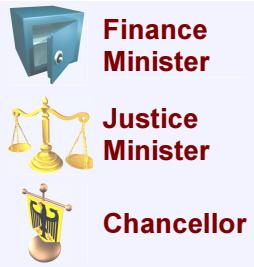
Finance Minister.
Justice Minister.
Backbencher.
Party Whip.
Foreign Affairs Minister.
Speaker of the House.
Chancellor.
Round Summary
Bid for Starting Player
Party Platform Conference
Shadow Cabinet
Forming Coalitions
Buying Media Markers
Organize Party Meetings
Auction Public Opinion Polls
Converting Meeting Markers into Votes
Determine Seats
Decide Election Winner in Current Election
Results of the Election Victory
Increase Party Membership
Pay Out Election Money
Set-up for Next Round
Party Contributions
Credits
Game Design: Karl-Heinz Schmiel
Graphic Design: Rik Falch, Amazing 3-D Graphics, Lyle Schulz
Cover Concept: Nigel Buckle
Cover Design: Lyle Schulz
Production Layout: Rik Falch, Torben Sherwood, Pol Cors
English Rules Editing: Rik Falch, Torben Sherwood, Kevin Nesbitt, Peter Kruijt, Jasen Robillard, Fabrizio Autino
German Language Translation: Robert Watson
French Language Translation: Jasen Robillard
Spanish Language Translation: Pol Cors
Italian Language Translation: Fabrizio Autino
Dutch Language Translation: Peter Kruijt
Valley Games Inc. would like to thank all our customers who made this International reprint of Die Macher possible.
© 2006 Valley Games Inc. Produced under license from Karl-Heinz Schmiel.
Transcribed from the English rulebook of the Valley Games Inc. edition (2006, 3rd edition, "DIE MACHER" — © 2006 Valley Games Inc., produced under license from Karl-Heinz Schmiel).
Download Markdown23411_Die+Macher+Condensed+Rules+by+Liumas+2015-01.md26.6 KB
DIE MACHER CONDENSED RULES BY LIUMAS
Complete rules condensed down to 6 pages, sans Comic Sans.
By popular demand here are the rules I used to create my Die Macher game aids. I did up the rules in August, 2006, and finalized the game aid a couple months later. These rules have been updated to reflect errata issued after Valley Games released the 3rd edition. I no longer follow any online threads on this so if any errata has been issued after 2006 they are not reflected here.
If you use this then give it a Thumbs Up at BGG! This here file is otherwise FREE. It's fun to get Thumbs so go inflate my ego as a small token of appreciation for my effort.
Go here for updates and to give this file a thumb:
BoardBameGeek: Die Macher Condensed Rules by Liumas
GAME Die Macher 1997, 2006 DESIGNER Karl-Heinz Schmiel BGG ID 1
6 pages intended for double-sided printing.
Chris Conboy August 2006, March 2007, October 2007, January 2008, January 2015
Liumas at BoardGameGeek
cconboy@optonline.net
chris@ageofgods.com
The Makers
Object
Players are political parties who get Victory Points by winning seats in state elections, having influence over the National Media, having strong Party Membership,
Die Macher
Party Setup – Each party gets the following:
| 4 Coalition tiles | |
| 1 Score Sheet | |
| €25,000 | |
| 18 Meeting Markers | |
| 5 Media Markers | |
| 9 Party Markers | |
State Boards Setup
Set up all 4 as shown at the bottom left.
➊ Markers: In each state, each party puts:
1 Party Marker on their Popularity Scale (space 0).
1 Party Marker on the Vote Track (space 0).
➋ Public Opinion: Choose a state with a Party Membership Payout tile space to have the 1st election. Deal 4 Public Opinion cards face up to that state. Replace any which are identical or contradictory.
1 Meeting Marker on a Meeting space.
Give the remaining boards, clockwise:

幸 $\pmb { 2 } ^ { \mathsf { n d } }$ Board: 3 face up, 1 face down.
3rd Board: 2 face up, 2 face down.
deal face down
$4 ^ { \mathrm { t h } }$ Board: 1 face up, 3 face down.
Replace any identical or contradictory.
Put the remaining Public Opinion cards, shuffled, on the Organization board.

and having a strong coincidence between their Party Platform and National Opinion. The game ends after the $7 ^ { \mathfrak { t h } }$ election round – most Victory Points wins!
1 Starting Marker
7 Shadow Cabinet Cards
All 4 State Boards

3 Party Policy Cards in hand

5 Contribution Cards
redeal any contradictory card
5 Party Policy Cards face up
➌ State Cards: Shuffle the 16 state cards and place 1 on each State Board with its matching state tile.
Put the remaining state cards on the Organization board face down along with the remaining state tiles.
➍ Payout Tile: Put the Party Membership Payout tiles for round 1 and round 3 on their spaces on the 1st and 3rd board.
National Board Setup

National Media Markers
National Opinion Cards

Organization Board Setup
Tiles: Place the remaining State Tiles, Key Issue Tiles, No-Coalition Tile, and Round 5 Party Membership Payout Tile on the top left.
Draw Piles: Place the Party Policy cards, Public Opinion cards, and Opinion Poll cards as face down draw piles in the center. Put the State cards draw pile in the top right. Each draw pile has a grayed-out discard area next to it.
Exchange Pool: Deal 6 Public Opinion cards face up along the bottom. Duplicate and identical cards are allowed within the Exchange Pool – place these on top of each other but slightly offset so all cards can be seen.
Preliminary Phase
The score sheet has 2 columns, each with 3 or 4 boxes of options. Each party secretly chooses for free ONE box of options from each column by checking its circle, and for each option in the box write down the state for which they want the selected option (Increase Party Membership does not correspond to a state). The same state may be chosen multiple times.
Column 1 Options
Increase Party Popularity +1
Gain Party Meeting Markers

Gain Votes
Column 2 Options
Gain Media Markers
Increase Party Membership
Election Round Sequence
➊ Starting Party Bid
➋ Party Platform Conference
➌ Shadow Cabinet Actions
➍ Form Coalitions
➎ Buy Media Markers
➏ Organize Party Meetings
➐ Opinion Poll Auctions
➑ Convert Party Meeting Markers To Votes
➒ Score Current State (round 7 ends here)
➓ Collect Money
● End Of Round
Beginning of game only – continue from here to the Election Round Sequence
Column 1 Example: This party moves their Party Marker +1 on Bayern’s Party Popularity scale, places 6 Party Meeting Markers in Hessen, and moves their Party Marker to 6 on the Bayern board Vote Track
Column 2 Example: Put 2 of their Media Markers on the Berlin board and move their Party Marker from 5 to 9 on the Party Membership track.
This is the only time in the game when more than 5 Media Markers may be put into a state.
1. Starting Party Bid

Procedure: Each party secretly writes an amount of money on
their score sheet. Highest bidder pays their bid to the bank and chooses which party is the starting party this round. Place the starting party’s Starting Marker on the Organization Board starting party space.
If all parties bid zero then each rolls a die – highest roll chooses a starting party.
Ties: Tied parties secretly bid again. Each must bid at least as high as previously. If still tied then each party rolls 1 die – high roll pays their last bid to the bank and chooses the starting party.
| à |
| €100 |
| 2€ |
| 3€ |
| 4€ |
| 5€ |
| 6/7€ |
The Makers
Die Macher
2. Party Platform Conference
Party Platform: A party’s platform is defined by the 5 Party Policy cards they have face up in front.
Procedure: Beginning with the starting party then continuing clockwise, each party may do the following.
➊ If Party Policy hand size is less than 3 cards then draw to 3 from the draw pile.
3. Shadow Cabinet Actions
Procedure: In turn each party plays up to 4 Shadow Cabinet cards, each face down next to a state, up to 1 card per state per party.
After all cards are placed by all parties, turn them all face up; each party pays the card cost to the bank.
In turn each party carries out 1 action per card for each of their cards. Remove played cards from the game.
Coalition Icon: A telephone symbol in the top right of a card enables a party to join a coalition in that state – place a coalition tile for that party there.

Shadow Cabinet Card Actions

Move your Party Marker up the Vote Track in the state by the indicated amount.

Return another party’s Media Marker from the state to that party and replace it with one of your own. Pay that party €4,000 and pay the bank €4,000.
4. Form Coalitions
Overview: Coalition partners add their votes together in this election. Coalitions may only be formed in the current state, only involving 2 parties – though there may be multiple coalitions. Only parties with a Coalition Tile on the current state board may join a coalition.
Voluntary: 2 parties may form a voluntary coalition if at least 2 of their Party Policy cards are identical. Both parties must agree to form the coalition.
Forced: If at least 3 of their Party Policy cards are identical then a party may force a coalition on another.

➋ Discard as many cards as desired from the hand.
➌ Draw again to a hand size of 3.
➍ Party may now discard a face up Party Policy card and replace it face up with a card from their hand.
Coincidence Rating: The number of coinciding Party Policy cards to Public Opinion cards in a state helps determine the number of votes obtained in that state.


Move your Party Marker up the Popularity Scale in the state by the amount indicated. Popularity may never be greater than +3.

Move another party’s Party Marker down the Popularity Scale in the state by the indicated amount. Popularity may never be less than –3. Control of the media does not protect against this.

Designate 1 issue in the state as a key issue – put a Key Issue tile on 1 of the state’s face up Public Opinion cards.
OR
Remove a Key Issue tile in the state, reducing a Public Opinion card back to a normal issue.
Key Issue: Double the importance of this issue when converting Meeting Markers to votes. Only 1 Key Issue Tile may be in effect in a state at any time. An issue with a Key Issue Tile on it can't be removed until it is reduced to a normal issue.


Procedure: Beginning with the starting party then continuing clockwise, each party decides if they wish to request a voluntary coalition or force a coalition on another. Negotiation and discussion is expected. Stack the Coalition Tiles of the 2 coalition partners together.
A party already in a coalition may not enter into a 2nd, whether voluntary or forced.
Cleanup: Parties not in a coalition take back their Coalition Tiles; parties in a coalition leave their tiles stacked on the Board.
Party with plurality in a state may exchange 1 Public Opinion card
5. Buy Media Markers
Procedure: In turn, each party may buy a Media Marker for €4,000 and place it in any state. A party may pass – this does not prevent them buying a Media Marker later this phase. Continue until all parties successively pass. One party may continue to buy Media Markers even if all others have passed.
Max: Each state has 5 Media Marker spaces – once full no further Media Markers may be placed there.
Media Control: Once all have passed, see if any party has a plurality of markers in each state (more Media Markers than any other). Starting with the last state in line for elections then counterclockwise, a party with control of the media may exchange 1 face up Public Opinion card in the state with 1 in the Organization

Board’s Exchange Pool that is neither identical nor contradictory to any face up cards already in the state. A card with a Key Issue tile may not be exchanged.
How To Exchange: Discard from the game a face up Public Opinion card on the State Board, then take a card from the Exchange Pool and place it in the empty space on the State Board. Draw a new card to bring the Exchange Pool back to its original total. Place duplicates within the Exchange Pool on top of each other but slightly offset. There will be at least 6 cards in the Exchange Pool at any time.
Protection Against Opinion Polls: A party who controls the media in a state is protected against the negative effects of published Opinion Polls there.
| The Makers Die Macher 4 | |||
| 6. Organize Party Meetings Procedure: In turn, each party may buy up to 4 | party – once full a party may not buy any more in that state. Existing Meeting Markers can be converted into | ||
| Meeting Markers per state, for €1,000 each. Max: Each state has 10 Meeting Marker spaces per | votes during Phase 8. | ||
| 7. Opinion Poll Auctions |  | ||
| Setup: Deal 1 face down Public Opinion Poll card to the bottom of each State Board. Bidding: Starting with the current state, the starting party may initiate bidding on the card or pass. Initial bid may not be zero. Bidding continues clockwise until all | Do Not Publish: A party who does not publish rolls 2 dice – move its Party Marker up the Party Membership Track by an amount equal to the dice total. Example | ||
| pass – each party must bid higher than the prior bid or pass. Parties who pass may not bid again in that state. If all pass then discard the card face down with no effect, without being revealed. High Bidder: Pay their bid to the bank then take the | Publish: Adjust either 1 or 2 party's Popularity trends by the amount indicated on the top half of the card for each party. 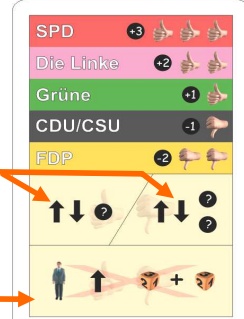 Do Not Publish: Increase party | ||
| Public Opinion Poll card. They look at it secretly and decide whether or not to publish the results. Publish Poll: A party who publishes the results may carry out up to 2 of that poli's results. Move the Party Markers for affected parties up or down the Popularity | membership by an amount équal to the total of 2 dice. Cleanup: Put the Public Opinion card face down on the Organization Board's Public Opinion card discard | ||
| Scale by the amount indicated. A party with a plurality of Media Markers (more than any other) in a state is immune to negative Opinion Poll effects there. 8. Convert Party Meeting Markers To Votes | pile. Bidding then proceeds to the next state until all 4 cards have been auctioned off. Reshuffle the discards as needed to make a new draw pile. | Central Point of the Game! | |
| Procedure: In each state in turn, starting with the 4th state then counterclockwise, each party with at least 5 Meeting Markers decides whether to convert these markers into votes. Starting party decides 1st in each | |||
| state, others follow clockwise. À party may convert some, none, or all of their markers; converted markers return to their party. Stack the Vote marker on top of any party with the same score – last one scored goes on top. Don't convert Meeting Markers in the current state; this state will be scored later this round anyway. |  | ||
| Votes = Meeting Markers x (Coincidence + Popularity) Popularity Rating: Position on the Popularity Scale, ranging from +3 to -3. Coincidence Rating: For each Party Policy card that | |||
| agrees with Public Opinion in the state the party earns +1 Coincidence (+2 if it's a Key Issue). For each Policy that disagrees the party earns -1 Coincidence (-2 if it's a Key Issue). Any Party Policy card which doesn't correspond to any Public Opinion card is worth 0. | |||
| Minimum Meeting Multiplier: A party always receives a minimum of 1 vote for every 2 Meeting Markers regardless of how low their Coincidence + Popularity actually is. Coincidence + Popularity can never go below 0.5; round down any resulting vote fractions. Maximum Votes (50): Any votes above 50 are not | Cleanup – Public Opinion Exchange: In each state immediately after marker conversion, a party with more votes there than all other parties combined may exchange 1 face up Public Opinion card there with 1 in the Exchange Pool on the Organization Board that is | ||
9. Score Current State
The Election!
➊ Determine Seats
Beginning with the starting party then clockwise, convert all remaining Meeting Markers (even if less than 5) in the current state into votes (as in Phase 8).

Votes = Meetings x (Coincidence + Popularity)
Use the state card to convert the number of votes into seats. Note the number of seats on the back of each party’s score sheet.
➋ Decide Election Winner in Current Election
The party with the most votes wins the election. When tied, the last party to get that number of votes wins by a nose (their Vote Track marker will be on top).

Coalitions: The 2 parties in a coalition add together the votes for both parties, possibly totaling more than 50. The coalition wins if it has combined votes more
➌ Election Victory Results
Single Party Victory: A single party who won by a number of votes (not by a nose) may place 1 Media Marker on the National Board. The party must already have at least 1 Media Marker on the current State Board – place that marker on the top row of the National Board corresponding to the current round.
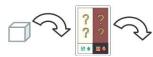
The party may also move 1 or 2 Public Opinion cards from the state to the National Board’s National Opinion row, into the 1st free leftmost space(s). An existing card may be Secured or Replaced, as below.
-
Secure Identical existing National Opinion, making it more difficult to remove. Put a Public Opinion card from the current state on top of an identical existing card. A secured National Opinion can only be removed by a contradictory Public Opinion card.
-
Replace Contradictory existing National Opinion, even if it is secured. Discard the existing card(s) from the game, put the Public Opinion card from the current state into the $1 ^ { \mathfrak { s t } }$ free leftmost space.
In either above case there can never be 2 identical or contradictory opinions on the National Board.
➍ Increase Party Membership
All parties see if any of their Party Policy cards match any National Opinion cards. For each matching card, the party moves its Party Marker up the Party Membership Track by an amount indicated above the matching National Opinion card. Treat secured opinions as if they are normal opinions in this case.

Economic Development
Nuclear Power


Taxes

Genetic Engineering

Wages

War On Global Terrorism

than any other coalition or single party.
A single party in a tie with a coalition will win since the single party’s marker will be higher on the Vote Track.
The coalition/party that lost by a nose does nothing.
If coalitions tie then the coalition whose member has the highest Vote Track marker wins; if still tied then the coalition with the topmost marker wins by a nose.
National Opinions Full: If all 5 spaces are full then the party may replace any one of the cards (if not secured) with an Opinion card from the current state. Remove an existing National card from the game then place the state card into the 1st free leftmost position. A secured card can only be replaced by its opposite.
The party that was beaten by a nose may also place 1 Media Marker on the National Board as above, but may not place a National Opinion card.
Single Party Victory – By a Nose: The party may place 1 Media Marker on the National Board if they had one in the state, as above. They may also move 1 Public Opinion card from the current state to the National Opinion spaces as above.
Victory By Coalition: Each partner may place 1 Media Marker on the National Board if they had 1 in the state, and may also move 1 Public Opinion card from the state to the National Board as above, starting with the party that gained the greater number of votes or, if tied, the party whose Party Marker is on top.
Social Security
Example
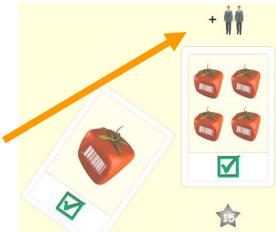
One of this party’s Policy cards matches a National Opinion card. Move their Party Marker up the Party Membership track by 2.

Speaker of the House

Foreign Affairs Minister

Backbencher
| The Makers Die Macher | |||||
| 10.Collect Money not on round 7 Seats Gained Payout: Each party receives €1,000 for | Party Membership Payout (Rounds 1, 3, and 5 only): | ||||
| each seat they just gained in the current election. 11.End Of Round not on round 7 | Each party gets €1,000 for each national party member. | ||||
① Setup For Next Round 1. Discard all cards from the current State Board.  Reset all markers to their starting positions. 2. Draw the top state card from the Organization Board, place it on the cleared State Board along | Special Cases: End Of Round 1: After setup place the Round 5 Party Membership Pay Out tile on its State Board. | ||||
| End Of Round 3: When dealing new Public Opinions to the prior State Board, deal 2 face up and 2 face down (move duplicate/contradictory to Exchange and | |||||
| redeal). Put the No Coalition Tile on its Coalition space (no coalitions may be formed in the 7th and final round) End Of Rounds 4, 5, and 6: After the current state is cleared remove its board from the game. Continue with step 4 above for each of the next State Boards. | |||||
| End Of Round 6: Round 7 is very short. Immediately after setup proceed to Phase 9, Šcore Current State, for the final election. | |||||
The board with 4 face up Public Opinion cards is now the current state, the board with 1 face up is last. Face Down: Each party in turn turns over their card Each party in turn places 1 of their Contribution cards  and rolls the amount of dice shown on the declined in front of themselves – face up if intending to accept contribution amount – increase the Party Membership the contribution; face down if intending to refuse it. Track Marker by the combined total of the dice. The decliner of the largest contribution may roll 3 more dice Face Up: Each party in turn takes the amount of and increase their Party Membership by the total, in money shown on the card from the bank. Roll the addition to the increase already received. No one gets | |||||
| amount of dice shown below the contribution amount – reduce their Party Membership Track Marker by the largest single number showing on the dice. 12.End Of Game Final Score Sheet Scoring 0 Total Seats ② National Media Rating マ宦蛋語語 Enter the total Enter the sum of points for any number of seats 1 | this bonus if the highest declined contributions are tied. Remove used Party Contribution cards from the game. Party Membership Enter total Party Membership as shown on National Board Media Markers, the National Board at the end of round 7. as given in the silver star. Later | ||||
2 25 won over 7 state m 0 elections here. 45 round Media Markers may score 15 less than those placed earlier. 32 6 0 7 23  ∑☆107 Party Platform & National Opinion Coincidence Each of a party's Party Policy cards that coincides with a National Opinion card earns the points given in the silver star below the National card Bonus: Earn +5 bonus points for each coinciding card that is secured. ⑦ Total Score Sum all points and enter the total in the last row. The Party with the highest total wins the game! | Bonus: Highest Party Membership gets +10, party with 2ⁿd highest gets +6. Any who tie get 16 points divided evenly among them (rounded down), all others get nothing. Any | ||||
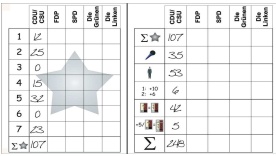 Rules with official FAQ and Errata | parties who tie for 2ⁿd highest get nothing. | ||||
 | |||||
 | |||||
Texts are community-compiled or publicly released by publishers; copyright remains with the original authors. For personal reference only.