
Dominion
At a glance
Rules, cards and Q&A (Chinese)
The rules, card data and player questions for this game are written in Chinese. Open the Chinese page to read them.
Where to find full rules
Full rules and card lookup are available in the cunlema app at cunlema.cn — pick this game and ask about any rule, card or turn you are unsure about.
Related games
Rulebook text (Markdown)
This game has 3 rulebook Markdown file(s) in our library; 3 rendered inline below — expand to read or download.
rules_zh_皇舆争霸_48.md31.1 KB
你是位小國的君主,繼承父母傳下的彈丸之地,坐擁這片滿佈河川與綠意的風光一但這並不能滿足你的野心!你想要更大、更富庶的國土,擴及更遠的江河,以及一望無際的樹林。你想要一統疆域!將你四周的每一吋土地,不論是小領主的領地,或是無主的荒原,通通予以征服,為其上的人民帶來文化與繁榮,並將他們納入旗下。
但且慢!事情沒那麼簡單;其他敵對的君主們,也在打著相同的算盤。你必須搶在他們之前,攻下最多的土地,並在同時修築防禦工事。為此,你會需要招募隨從,大興土木,翻修城堡,並充實國庫。或許,你的父母會對你的努力不以為然,但你的列祖列宗在天之靈,勢必會引以為傲!
遊戲目的
這是款構築套牌的遊戲。玩家各持有一副套牌,代表各自的國土,其中包含玩家的國庫、分數、以及可以執行的行動。在遊戲之初,玩家只有少得可憐的幾塊莊園與幾枚銅錢,但隨著遊戲進行,玩家將可以陸續充實自己的王國,獲得金幣、行省,與更多的國民和國家建設。遊戲結束時,套牌中分數總額最高的玩家獲勝!
遊戲元件
500張纸牌
130張錢幣卡(代表你的國庫)60張銅錢 (1040張銀幣30張金幣 (348張分數卡(代表你的分數)24張莊園12張公國 (3)12张行省(6)
252張王國卡(代表你的國家建設)以下的纸牌各10張:冒險者、官員、地窖、大臣、禮拜堂、議事廳、晚宴、慶典、實驗室、圖書館、市集、義勇軍、礦坑、護城河、錢莊、重建、鐵匠、間諜、小偷、王座、村莊、女巫、伐木工、工作室。另有12張花園。
30張詛咒卡(-1)
33張佈置用纸牌(藍色牌背·每種牌各一·加上1張『移出遊戲』)7張備用纸牌
用分數卡、王國卡與錢幣卡,構築你的套牌。遊戲結束時,套牌中分數總額最高的玩家獲勝!
但請切記,在遊戲進行的途中,分數牌幾無功能。玩家必須在三種牌的數量上取得平衡,才能讓牌庫運作順暢。
遊戲共有25種不同的王國卡,但每次遊戲只會使用其中的10種。這使得每場遊戲都不一樣,增加耐玩度。
說明書右侧提供規則彙整以及特殊情況的解決方案。這些資訊對於已熟悉此遊戲,想進行快速檢索的玩家特别有用。
遊戲準備
1.隨機決定一位起始玩家。若是想連續進行數場遊戲,則每一場新遊戲,皆由前一場遊戲獲勝者左手邊的玩家,擔任新遊戲的起始玩家。若前一場遊戲是以平手作收,則從所有非並列第一的玩家中,隨機選擇一位作為起始玩家。
2.每位玩家拿取7張『銅錢(1〇)』與3張『莊園(1)』,將它們充分洗牌後,面朝下的置於玩家面前,作為他的起始牌庫。之後每位玩家從他的牌庫頂抽5張牌,作為起始手牌。
3.其他不在玩家起始牌庫中的牌,將被整理在桌面中央,稱為『供應區』。請將相同牌名的牌整理成堆,並且依據其類別(行動/錢幣/分數/詛咒/反擊/攻擊等,列示於纸牌下方),分區擺放。藍色牌背的佈置用纸牌,則請放置在對應的牌堆底部,面朝下;『移出遊戲』則放置在一旁,面朝上。
每場遊戲將不會使用到全部500張牌,詳見下述:
錢幣卡:銅錢(1)、銀幣(2)與金幣(3),在每場遊戲中都會被使用。待每位玩家領取起始的7張銅錢後,將剩餘的所有錢幣卡,依據名稱整理成堆,面朝上的置於供應區。
分數卡:莊園(1)、公國(3)與行省(6),在每場遊戲中都會被使用。在三或四人遊戲時,請將三種分數卡,各放置12張到供應區;兩人遊戲時則各放置8張。請將這些牌依名稱整理成堆,面朝上置於供應區。
詛咒卡:詛咒(-1)在每場遊戲中都會被使用。在兩人遊戲時,放置10張詛咒卡到供應區;三人遊戲則放置20張;四人遊戲則放置30張。請將之整理成堆,面朝上置於供應區。
王國卡:除上述三點共七疊卡外,每場遊戲將會使用10種王國卡。請將選用的10種王國卡,各放置10張到供應區。唯一的例外是,若使用『花園』,則放置與分數卡相同數量的『花園』到供應區(兩人遊戲8張,三或四人遊戲12張)。請將這些牌依據名稱分類成堆,面朝上置於供應區。未被選用的王國卡則留於遊戲盒中;它們在本場遊戲中,將不會被使用到。
對於初次接觸的玩家,我們建議第一場遊戲,使用下述10種牌:地窖、市集、義勇軍、礦坑、護城河、重建、鐵匠、村莊、伐木工、工作室。
在之後的遊戲,玩家可以依據任何方式決定選用的紙牌,只要玩家皆同意(範例:從佈置用纸牌中,隨機抽出10張牌)。若進行一系列的遊戲,則在每次新遊戲開始時,每位玩家可以選擇替換掉上一場遊戲使用的一種牌,讓每種牌都有機會被使用到。除此之外,我們在說明書最後,附有組合性較佳的牌組清單,供玩家選擇。
在第一場遊戲開始前,隨機決定起始玩家;之後的起始玩家則由前一場遊戲獲勝者左手邊的玩家擔任。
每位玩家拿取7張銅幣與3張莊園,作為各自的起始牌庫;將之充分洗牌後,抽5張牌作為起始手牌。以下是供應區的陳列範例。實際的擺設,需依據你的桌面空間而定。
錢幣卡


分數卡
移出遊戲
詛咒卡



王國卡
錢幣卡:全部使用。
分數卡:三到四人遊戲·放置三種分數卡各12張:雨人遊戲則各8張。祖咒卡:2/3/4人遊戲使用10/20/30張。王國卡:每場遊戲選用10種王國卡。
遊戲進行
遊戲依順時鐘方向進行,待一個玩家的回合結束後,換他左手邊的玩家進行回合。
回合流程
每個玩家的回合皆包含三個階段,需依據下列順序,依次執行:A.行動階段:玩家可以打出一張行動卡。
B.購買階段:玩家可以購買一張卡。
C.結束階段:玩家必須棄掉所有他打出的牌以及尚未打出的手牌,並從牌庫重抽5張牌。
待玩家進行完以上三個階段後,換他左手邊的玩家進行回合。
A. 行動階段
在行動階段,玩家可以打出一張行動卡;若干行動卡的功能允許玩家打出更多的行動卡。行動卡意指任何在牌底註有『行動卡』的王國卡。在遊戲開始時,基於玩家的起始牌庫中沒有任何行動卡,因此玩家至少有2回合的行動階段,將完全無事可做。
當打出行動卡時,玩家將該牌,從他的手上擺放至他面前,面朝上,朗讀並執行其功能;若該牌有多項功能,則依據其書寫的先後順序,依序結算。
●即使玩家無法執行纸牌上的所有功能,仍可以打出該行動卡。
●若玩家被允許打出多張行動卡,则他必須先结算完先打出的牌上所有的效應後,方能再打出新的行動卡。
各行動卡的詳細敘述,請見後文。所有被打出的行動卡將暫留於玩家面前,待C.結束階段時處理。
行動卡常見術語解釋(若牌上敘述與下文不合,則依循牌上敘述。)
+X個行動:玩家在本次行動階段中,可以額外打出至多X張行動卡。若打出的纸牌允許玩家打出2張以上的行動卡,請留意你尚可打出的行動卡總數;在必要時,可以利用指示物來紀錄。玩家必須結算完先前紙牌的所有效應後,方能再打出新的行動卡。
+X張牌:該玩家立即從牌庫頂抽X張牌,加入其手牌。若是該玩家的牌庫不足X張牌,則先將其現有牌庫抽完,然後將該玩家的棄牌堆洗牌,面朝下重新组成牌庫後,再從新的牌庫抽取剩餘的數量。若仍不足額,則抽到無牌可抽為止。
+X:該玩家在本回合的B.購買階段中,將有額外的X塊錢預算。玩家不會因此獲得額外的錢幣卡,只會暫時性的多出X塊錢可用。 CN
+1次購買:玩家在本回合的B.購買階段中,可以額外購買一張卡。他仍須支付對應金額。
棄牌:『棄牌』意指將牌面朝上的置入棄牌堆;除非特別註明,否則這代表從玩家的手牌中選擇纸牌,置人棄牌堆。玩家在棄牌時,不須向其對手展示他棄掉的牌,僅須公開他棄牌堆最上方的紙牌。若干纸牌要求玩家在棄牌時,向其對手展示其棄掉纸牌的『數量』(範例:地窖)。
玩家依順時鐘順序,依序進行回
合。每個玩家的回合皆包含以下
三個階段,依序執行:
A. 行動階段
B.購買階段
C.結束階段
玩家『可以』打出一張行動卡;這並非強制性的。即使玩家手中有卡,他也可以選擇不出。行動卡將為玩家帶來額外的效果。基於玩家可能在單一回合中打出多張行動卡,請將你打出的行動卡,依據打出的顺序,從左到右依序排列。這將便於玩家追蹤他剩餘的效果。所有打出的牌將在C.結束階段,才會進人棄牌堆。
+X個行動:本回合可额外打出X張行動卡。
+X張牌:立即抽X張牌。這是強制效應;你不能抽少於X張牌,除非無牌可抽。
+X:本回合購買時多X塊錢
+1次購買:本回合購買時可以多 買一張卡。
棄牌:將卡面朝上的置入棄牌堆
移出遊戲:當玩家將牌移出遊戲時,將之放到桌面中央的移出遊戲區,而非棄牌堆。被移出遊戲的紙牌將不會回到供應區,也不能被購買。
獲得:當玩家『獲得』卡時,他直接領取該卡。除非特別註明,否則這意指從供應區取得該卡,並且置人該玩家的棄牌堆。玩家無法在獲得該卡時立即使用之。
展示:當玩家展示卡時,他將其翻到正面,供所有玩家檢視,之後將其覆蓋,並歸還到其原本所在處(除非纸牌有其他指示)。若纸牌要求玩家從牌庫展示纸牌,但該玩家的牌庫數量不足額,則他先展示牌庫剩餘的所有纸牌,之後將該玩家的棄牌堆洗牌,面朝下重新組成牌庫後,再從新的牌庫展示剩餘的數量。
置於一旁:當玩家將牌置於一旁時,除非有其他指示,否則將該牌放置在桌面一側,且忽略該牌效應。要求玩家將牌置於一旁的行動卡,將會指示玩家如何處理被置於一旁的纸牌。
行動階段在玩家不能或不願再打出行動卡時結束。除了註有『反擊卡』的纸牌外,其餘行動卡皆只能在該玩家自己的行動階段中使用。
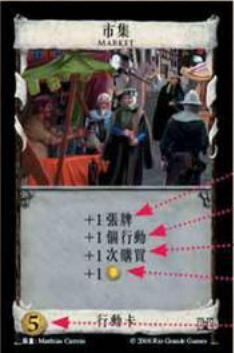
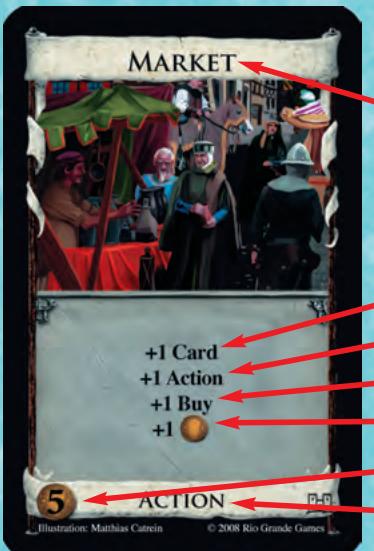
行動卡範例(市集)
立即抽1張卡可以額外打出1張行動卡購買時可多購買1張牌購買時多1塊錢預算購買此卡時要支付的金額
B.購買阶段
在購買階段,玩家可以從供應區購買一張牌;若干行動卡的功能允許玩家購買更多紙牌。玩家可購買任何在供應區的纸牌(包括錢幣卡、分數卡、王國卡甚至詛咒卡),但不得購買在『移出遊戲』區的纸牌。
每張牌的價格標示於其左下角。玩家先從手上打出任意數量的錢幣卡,並將其金額加總,再加上因行動卡獲得的額外金額,為其本回合的預算。之後,玩家可以選擇供應區中任何一張價格不高於預算的纸牌,獲得之,並將它面朝上置入自己的棄牌堆中。購得紙牌的功能將不會在購得的當下生效。
若玩家在本回合被允許購買數張牌,則玩家可以任意分配他的預算。舉例來說,若某玩家有『+1次購買』與6塊錢的預算,他可以先花2塊錢購買『地窖』,將它面朝上的置人棄牌堆;再用剩餘的4塊錢購買『鐵匠』,同樣以面朝上的方式,置人棄牌堆。
所有被打出的錢幣卡將暫留於玩家面前,待C.結束階段時處理。錢幣卡在本遊戲中將被重複使用;雖然他們會在C.結束階段被置人棄牌堆,但它們會被重新洗回牌庫,並重新被抽取使用。因此,錢幣卡不應被視為用過即消失的『鈔票』,而應被視為會持續提供金錢的『資產』。
移出遊戲:將牌放到『移出遊戲』區。
獲得:獲得該卡並置人棄牌堆。
展示:翻開紙牌,之後將其覆蓋並歸還原處。
置於一旁:將牌置於一旁,並依紙牌效應來處理。
玩家可以支付纸牌左下角的價格,購買供應區中的一張牌。
玩家可以使用手上任意數量的錢幣卡,輔以之前打出行動卡上的所有『+XO』。
請將你打出的錢幣卡,依據打出的顺序,從左到右依序排列,並進行加總。
所有打出的牌將在C.結束階段,才會進人棄牌堆。
C. 結束階段
回合進行至此,所有已打出的纸牌(包括行動卡與錢幣卡)應留於桌面上,而所有獲得的纸牌(包括購得的與因行動卡獲得的)應已置入棄牌堆。現在,請依序進行下述三個動作:
1.將所有已打出的紙牌,以及你剩餘的所有手牌,置入棄牌堆。你不須向對手展示你棄掉的纸牌,但你必須公開棄牌堆最上方的纸牌。
2.從牌庫頂重新抽5張牌,成為你下一回合的手牌。若牌庫不足5張牌,則先將你現有牌庫抽完,然後將你的棄牌堆洗牌,面朝下重新组成牌庫後,再從新的牌庫抽取剩餘的數量。
3.本回合結束,换你左手邊的玩家進行他的回合。若想加速遊戲進行,下一個玩家可以在前一個玩家處理他的C.結束階段時,就先開始動作;然而,若干攻擊卡的效應,要玩家等到前一個玩家執行完C.結束階段後,方能結算。
範例
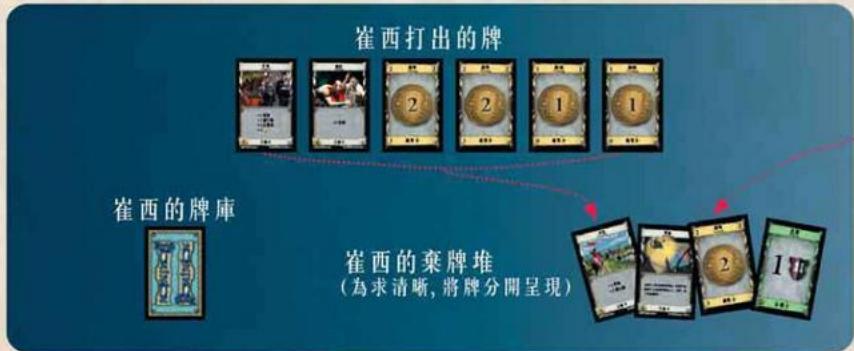
崔西檢視她的5張手牌,包括:『市集』、『鐵匠』、『銀幣(2)』與2張『莊園(1)』。在她的A.行動階段,她先打出『市集』,抽1張牌,抽到第二張『銀幣(2)』。由於市集允許她『+1個行動』,因此她再打出『鐵匠』,抽3張牌;但基於她的牌庫只剩下2張牌,她先將牌庫抽完,再將棄牌堆洗牌,面朝下成為新的牌庫,然後抽剩下的1張牌。她抽到另1張『市集』以及2張『銅錢(1)』。遺憾的是,崔西已經沒有行動了,因此她的A.行動階段結束,進入B.購買階段。
在購買階段,她打出2張『銀幣(2)』與2張『銅錢(1)』,加上『市集』的『+1』與『+1次購買』,得到總計7元的預算且可購買2張牌。她先使用3元預算,購買『村莊』,面朝上置入棄牌堆;再使用剩餘的4元預算,購買『重建』,同樣面朝上置入棄牌堆。最後,在她的C.結束階段,她將她打出的市集、鐵匠、銀幣與銅錢,以及她手上剩餘的1張『市集』與2張『莊園(1)』,皆置入棄牌堆,並重抽5張牌,結束她的回合。
遊戲結束與勝負
在任何玩家回合結束時,若以下任一條件被滿足,則遊戲立即結束:
●供應區的『行省(6)』被取完(即看到底端的佈置用纸牌)
●供應區中有三疊牌被取完(即看到底端的佈置用纸牌)
此時,玩家計算各自在牌庫、手牌以及棄牌堆中的分數總額。總分最高的玩家獲勝;若平手,則其中進行回合次數較少的玩家勝。若仍無法分出勝負,則以平手作收。
玩家將所有已打出的行動卡、錢幣卡,和剩餘的手牌,一併置人棄牌堆。
重抽5張牌。
回合結束,換其左手邊的玩家進行他的回合。
崔西開始時的手牌

在打出『市集』並抽牌後

在打出『鐵匠』並抽牌後
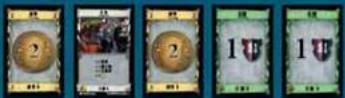

購買『村莊』與『重建』後(購得的牌進入棄牌堆)
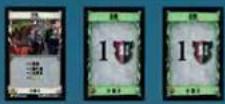
最後將打出的牌以及剩餘的手牌,全數置人棄牌堆。
遊戲结束條件:
1.『行省(6事)』被取完,或
- 任意三疊牌被取完
總分最高的玩家獲勝。
細部規則
●玩家可以計算他自己牌庫的剩餘張數,但不得計算棄牌堆的張數。玩家不得檢視他的牌庫或棄牌堆裡有什麼牌。供應區與移出遊戲區的牌則可以任意檢視之。
●若有紙牌效應會影響數位玩家,且順序會造成差異時,則從正在進行回合的玩家開始,依順時鐘方向,依序對每個玩家結算效應。
●在任何時候,若玩家需要抽取或展示大於牌庫數量的牌,則他必須先將現有牌庫用完後,方可將他的棄牌堆洗牌,面朝下重新組成牌庫,並且抽取或展示剩餘的張數。
●玩家的牌庫數量歸零並非將棄牌堆洗牌、重新組成牌庫的條件;而是當玩家要抽牌或展示纸牌,牌庫已用盡時,才會進行洗牌動作。
王國卡解釋
冒險者:若你的牌庫不足應展示的張數,使得你在展示途中需要將棄牌堆洗牌,請不要將你展示中的牌一併洗入,它們在展示結束時才會進人你的棄牌堆。若你將新牌庫展示完,仍只展示出一張錢幣卡,則你只會獲得該錢幣卡。
官員:若你在打出此卡時,牌庫已經沒有任何牌,則你獲得的銀幣將成為你牌庫中唯一的牌。同理,若有玩家此時的牌庫已經沒有任何牌,則他放回牌庫頂的分數牌,將成為其牌庫中唯一的牌。
地窖:你無法棄掉地窖本身;在你打出地窖的同時,它便已不在你的手牌中。你必須一次選妥要棄的纸牌,將它們同時放進棄牌堆,之後再抽取等量的牌,而不能在看到所抽的牌後,再追加棄牌。若你抽牌途中需要將棄牌堆洗牌,你因地窖所棄的牌,將會被洗回你的牌庫當中。
大臣:你必須決定是否要將牌庫置入棄牌堆後,方能進行之後的動作。
你不能在將你的牌庫放人棄牌堆時,偷偷檢視你的牌庫。
禮拜堂:你無法將這張禮拜堂移出遊戲,但是你可以將你手上的其他張禮拜堂移出遊戲。
議事廳:其他玩家必須抽牌。若該玩家因此必須要將他的棄牌堆洗牌,從之。
晚宴:獲得的牌將置入你的棄牌堆。獲得的牌必須來自供應區。你不能用錢幣卡,或是之前行動的+X效果,來增加所棄纸牌的價格。若你使用『王座』來打出『晚宴』,你將獲得雨張牌,即使你只將晚宴移出遊戲一次。請注意,『獲得牌』與『將晚宴移出遊戲』是兩個獨立的效應;並不是任何將晚宴移出遊戲的效應,都會使你獲得一張牌(例如:禮拜堂)。
慶典:如果你打出了多張慶典,請留意你尚能打出的行動卡張數。以口頭紀錄是個不錯的方法(範例:『我打了1張慶典,還剩2個行動。』『我打了1張市集,還剩2個行動。』『我又打了1張慶典,還剩3個行動。』….)。
玩家可以計算自己的牌庫與供應區的纸牌『數目』。玩家可以檢視移出遊戲區的纸牌,但不得檢視任何牌庫或棄牌堆的牌。
在玩家要抽取或展示牌時,牌庫已經用盡的情況下,才進行洗牌動作。玩家亦可替他左手邊的玩家在洗牌時進行切牌,以確保公平性。



花園:花園是一張分數卡,而非行動卡;除了遊戲結束的加分外,它沒有任何功能。你每有10張牌,你的每張花園便值1分(這包括你在牌庫、棄牌堆以及手上的牌),小數點以下無條件捨去。舉例來說,若你有39張牌,則你的每張花園值3分。請記得,在遊戲準備時,若選用花園,則2人遊戲請放置8張花園到供應區,3或4人遊戲則請放置12張。
實驗室:抽2張牌。你之後可以再額外打1張行動卡。
圖書館:若你的牌庫不足額,使得你在展示途中需要將棄牌堆洗牌,請不要將你置於一旁的纸牌一併洗入;它們要等到你抽滿7張手牌後,才會進入棄牌堆。若你將新牌庫抽完,仍未抽滿7張牌,則抽到你不能再抽為止。你不需要將行動卡置於一旁;你可以選擇要不要如此做。若你在打出圖書館時,手牌已達7張以上,則你將不會多抽任何牌。
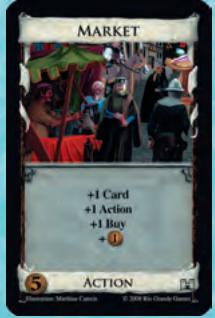
市集:抽1張牌。你之後可以再額外打1張行動卡。在你的購買階段,你可以多買1張牌,且有多1塊錢的預算。
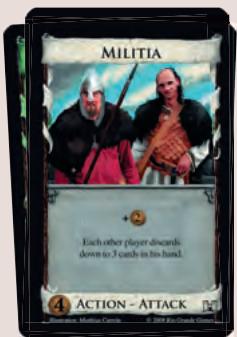
義勇軍:所有被攻擊的玩家將手牌棄到剩3張。若被攻擊的玩家原本便只有3張以下手牌,則他不需棄掉任何手牌。
礦坑:通常狀況下,玩家都是移出『銅錢(1)』取得『銀幣(2)』,或是移出『銀幣(2)』取得『金幣(3)』;但是规則上,你也被允許拿取較移出遊戲纸牌更低價的錢幣卡。你獲得的錢幣卡會直接進入你的手牌,因此你可以當回合便使用之。若你沒有將任何錢幣卡移出遊戲,你將無法獲得任何纸牌。
護城河:攻擊卡意指所有在牌底註明『攻擊卡』的纸牌(通常是『行動一攻擊卡』)。當有其他玩家打出攻擊卡時,你可以在攻擊效應結算前,從你的手上展示此卡,並將之歸還到你手中;若你如此做,則該攻擊卡的效應對你無效。舉例來說,你將不會因『女巫』而獲得詛咒卡,或因『間諜』而必須展示纸牌。護城河只會保護展示它的玩家;其他玩家仍會受該卡的效應影響。舉例來說,若有玩家以『護城河』反擊『女巫』,打出『女巫』的玩家仍會抽2張牌,且其他玩家仍會取得詛咒卡。護城河也可以視同一般行動卡打出,功能為+2張牌。
錢莊:若你未將任何『銅錢(1)』移出遊戲,你將無法取得+3的功能。
重建:你無法將重建本身移出遊戲;在你打出重建的同時,它便已不在你的手牌中(但你可以將你手上的另一張重建移出遊戲)。若你未將任何牌移出遊戲,你將無法獲得任何纸牌。將獲得的纸牌置入你的棄牌堆。你只能從供應區獲得纸牌。你獲得的纸牌,其價格不能大於移出遊戲纸牌價格+2;你不能用錢幣卡,或是之前行動的+X效果,來增加移出遊戲纸牌的價格。你可以獲得與移出遊戲纸牌相同的牌。
鐵匠:抽3張牌。
間諜:間諜會讓所有玩家,包括打出間諜的玩家,展示各自牌庫頂的牌。請注意,展示牌庫頂牌的效果在+1張牌之後才發生。所有牌庫已經沒有牌的玩家此時必須將它的棄牌堆洗牌,重新组成牌庫;若他仍無纸牌可展示,則他不需展示任何牌。若玩家在乎展示的順序,則由打出間諜的玩家先行結算,之後依順時鐘順序進行。被展示而未被置人棄牌堆的牌,將歸還至牌庫頂。



小偷:牌庫只剩1張牌的玩家先展示該牌,再將他的棄牌堆洗牌,面朝下重新组成牌庫,並展示新的1張牌;牌庫已經沒有任何牌的玩家則直接將他的棄牌堆洗牌,然後從新牌庫頂展示2張牌。若玩家仍無足夠的牌可展示,則展示到無牌可展示為止。每個玩家至多只會有一張錢幣卡被移出遊戲或是被打出小偷的玩家取走,由打出小偷的玩家決定。你只能取得當回合被展示的錢幣卡。你對每個玩家展示的牌個別做出決定。將你取得的錢幣卡,置入你的棄牌堆。被移出遊戲的錢幣卡則置入移出遊戲區。
王座:你選擇你手上的另一張行動卡,將其打出,並執行其效果兩次。只有打出『王座』的動作會消耗你本回合可做的行動;用『王座』打出的行動卡不會。請先完整執行完第一次效果後,再執行第二次效果。若你用『王座』打出另一張『王座』,则第二張王座可以執行其效果雨次;因此,你先打出一張行動卡,執行其效果雨次後,再打出另一張行動卡,並執行其效果雨次,而非執行一張行動卡的效果四次。請注意,對於有+1個行動效果的纸牌,連打雨張與用『王座』執行兩次的結果不同。舉例來說,連打雨張『市集』,最後你只能再多打1張行動卡;但用『王座』執行一張『市集』雨次,你將可以再多打2張行動卡。請記得利用之前所提的口頭技巧,追蹤你尚能打出的行動卡數量!你不能在兩次效果中間插入其他的行動卡。
村莊:如果你打出了多張村莊,請留意你尚能打出的行動卡張數。以口頭紀錄是個不錯的方法。
女巫:若剩餘的詛咒卡數目不足,則從你左手邊的玩家開始發詛咒卡,直到發完為止。若你打出『女巫』卡時已沒有詛咒卡,你仍會抽2張牌。其他玩家將獲得的詛咒卡面朝上置人各自的棄牌堆。
伐木工:在你的購買階段,你可以多買1張牌,且有多2塊錢的預算。工作坊:獲得的牌將置入你的棄牌堆。獲得的牌必須來自供應區。你不能用錢幣卡,或是之前行動的+X效果來補差額。
建議模組
玩家可以用任何10種王國卡進行遊戲。以下清單只是我們建議用來強調遊戲某一面向的起始模组:
新手模組:地窖,市集,義勇軍,礦坑,護城河,重建,鐵匠,村莊,伐木工,工作室。
有錢真好:冒險者,官員,大臣,禮拜堂,晚宴,實驗室,市集,礦
坑,錢莊,王座。
玩家互動:官員,大臣,議事廳,慶典,圖書館,義勇軍,護城河,間
諜,小偷,村莊。
價格失衡:地窖,禮拜堂,晚宴,花園,圖書館,小偷,村莊,女巫,
伐木工,工作室。
小鎮廣場:官員,地窖,慶典,圖書館,市集,重建,鐵匠,王座,村莊,伐木工。

作者:Donald X. Vaccarino研發:Valerie Putman與Dale Yu美術與排版:Matthias Catrein中文翻譯:高竹嵐中文排版:Idgie Lo & 彭于庭
我們在此感謝以下測試玩家: Kelly Bailey, Dan Brees, Josephine Burns, Max Crowe, Ray Dennis, David Fair, Lucas Hedgren, Michael M. Landers, W. Eric Martin, Destry Miller, Miikka Notkola, Molly Sherwin, Sir Shufflesalot, P. Colin Street, Chris West, the 6am Gamers, the Cincygamers and the Columbus Area Boardgaming Society.
版權所有 © Rio Grande Games, PO Box 45715, Rio Rancho, NM 87174, USA RioGames@aol.com www.riograndegames.com
©2009-2014新天鹅堡企業有限公司 Swan Panasia Co., Ltd.10660台北市新生南路三段56巷7號1樓 www.swanpanasia.com1F, No. 7, Lane 56, Sec. 3, Xinsheng S. Rd., Taibei City 10660, Taiwan電話:+886(0)2-2369-2527 傅真:+886(0)2-2217-4291Tax Reg. No. 统一編號:13120886 info@swanpanasia.com
港澳獨家代理:
Capstone (Hong Kong) Ltd. www.capstone.hk info@capstone.hk 2/F, 449 Hennessy Road, United Building, Causeway Bay, Hong Kong 香港軒尼詩道449號合群大廈2樓 Tel:+852-2577-5388
中国经销商:智研家文化发展(北京)有限公司www.zhiyanjia.com北京市朝阳区芍药居甲2号院17号楼18号底商 Tel:+86-10-84362070durian_zyj@foxmail.com weibo.com/zhiyanjia
小雪的客厅主题桌游馆 http://xxkt.taobao.com中国南京市白下区户部街33号天之都大厦30层3009-3010TEL:+86-400-013-1210 +86-18951004244 m.hjj@163.com


CAPSTONEBOARDGAME

dominion-intrigue-rulebook-english.md43.0 KB
原文本层提取版本已由本版替换(2026-10-31),正文相似度 0.72
〔图:images/696fcb9d2966bb0bd7dddb5ba5e5df581b49e28e4f3cce3d69dc29a022e34b42.jpg〕
Something's afoot. The steward smiles at you like he has a secret, or like he thinks you have a secret, or like you think he thinks you have a secret. There are secret plots brewing, you're sure of it. At the very least, there are yours. A passing servant murmurs, "The eggs are on the plate." You frantically search your codebook for the translation before realizing he means that breakfast is ready. Excellent. Everything is going according to plan.
Intrigue adds 25 new Kingdom cards to Dominion. There are victory cards that do some new things for you, underlings that give you a choice as to what they do, and a variety of other people and places. These cards can be played with the cards from the basic game or on their own. The rules include how to play a game with up to 6 players. By combining the money and victory cards with those in the basic game, players will have sufficient cards to play with more than 4 players.
GOAL
This is a game of building a Deck. The Deck represents your Dominion. It contains your resources, victory points, and the things you can do. It starts out a small sad collection of Estates and Coppers, but you hope that by the end of the game it will be brimming with Gold, Provinces, and the inhabitants and structures of your castle and kingdom. We recommend that new players begin with the basic game.
The player with the most victory points 📊 in his Deck at game end wins.
CONTENTS
500 cards
130 basic Treasure cards
60 Copper cards
40 Silver cards
30 Gold cards
48 basic Victory cards
24 Estate cards
12 Duchy cards
12 Province cards
258 Kingdom cards
10 each of Baron, Bridge, Conspirator, Coppersmith, Courtyard, Ironworks, Masquerade, Mining Village, Minion, Pawn, Saboteur, Scout, Secret Chamber, Shanty Town, Steward, Swindler, Torturer, Trading Post, Tribute, Upgrade, Wishing Well
12 each of Duke, Great Hall, Harem, Nobles
30 Curse cards
26 Randomizer (placeholder) cards (one of each Kingdom card and 1 blank)
7 blank cards (to create your own Kingdom card - with those from the base game and the blank placeholder from this set, you have enough for a complete set)
1 Trash pile card (used to mark the Trash pile)
The text in the sidebars both summarizes the rules and offers information about specific special circumstances which may occur. These are especially useful for those who know the game and want quick summaries of the rules.
Build your Deck with Victory, Kingdom, and Treasure cards. At the end, the player with the most victory points in his deck is the winner!
Remember, however, that during the game, the basic Victory cards have little or no value, so players must find the right balance among the three kinds of cards to be successful.
The game comes with 25 sets of Kingdom cards, but each game uses only 10 sets. This gives the game a great amount of replayability. So many ways to play - each one different.
Randomly determine the starting player. When playing multiple games, the starting player is the player to the left of the winner of the last game. If there was a tie in the previous game, randomly choose the starting player from the players that didn't win.
Each player takes 7 Copper cards and 3 Estate cards, shuffles his 10 cards, and places them face-down in his player area (the area before him on the table) to form his Deck. Each player draws 5 cards from his Deck as his starting hand.
Players will not use all of the cards in every game. Other than the players' starting Decks, the other cards used in a game of Dominion are called the Supply. These cards are all placed face-up in the middle of the table where all players can reach them. The randomizer card (the card with a different back) can be placed face-down at the bottom of each pile in order to help identify when the pile is empty, or when a pile becomes empty, an unused card can be placed face-down in the space to remind players that a pile of cards from the Supply is depleted. The Trash pile card is also placed near the Supply.
The card types (Action, Treasure, Victory, Curse, Reaction, and Attack) for each card are listed at the bottom of the card. If a card lists more than one card type, then for all purposes it counts as both types. For example, Great Hall is both an Action card and a Victory card at all times.
Copper, Silver, and Gold cards are the basic Treasure cards, and they are available in every game. After each player takes 7 Copper cards, place the remaining Copper cards and all of the Silver and Gold cards in face-up piles in the Supply. The Treasure cards from Dominion and Dominion: Intrigue can be combined, since these cards are intended to be in abundant enough supply to not run out. (If a type of Treasure card does run out, that becomes an empty pile in the Supply, which can be important for game ending conditions.)
Estate, Duchy, and Province cards are the basic Victory cards, and they are available in every game. In a 3 or 4 player game, place 12 Estate cards, 12 Duchy cards, and 12 Province cards in face-up piles in the Supply. In a 2 player game, place only 8 of each Victory card in the Supply. As in the basic game, the Victory cards are scaled based on the number of players and unused Victory cards are returned to the box.
The Curse cards are also available in every game. Place 10 Curse cards in the Supply for a 2 player game, 20 Curse cards for 3 players, and 30 Curse cards for 4 players. As in the basic game, the Curse cards are scaled based on the number of players and any unused Curse cards are returned to the box. Curse cards will most often be distributed to your opponents when you play specific Action cards (like Torturer). If you buy a Curse card, it goes in your own discard pile, like any other gained card.
Now that the basic Victory cards (Estates, Duchies, and Provinces), basic Treasure cards (Copper, Silver, Gold), and Curse cards are on the table, the players select 10 Kingdom cards and place 10 of each in face-up piles on the table (exception: Kingdom Victory cards are scaled to the number of players - 12 of each for a 3- or 4-player game or 8 for a 2-player game).
Players may choose the 10 Kingdom cards in any way that the players agree on. For example, you can use the Randomizer cards (one of each card with a different back) to randomly select 10 Kingdom cards from Dominion: Intrigue to play with. You can combine the Randomizer cards from the expansion together with those from the base game to choose 10 random Kingdom cards. Another option is to randomly choose 5 Kingdom cards from the basic set and 5 Kingdom cards from the expansion to play with. Finally, there are some recommended sets of 10 Kingdom cards at the end of the rules that highlight specific strategies and showcase some of the possibilities with the new cards. Any Kingdom cards not chosen for the game are set aside, as they will not be used in the game.
Choose the starting player for first game randomly. In subsequent games, the starting player is to the left of the previous winner.
Each player starts with 7 Copper and 3 Estate cards; shuffles them and draws 5 as his starting hand.
Below is a sample layout for the supply for a game. Of course, the space you have available will determine your exact layout.
〔图:images/dce42c339453782432e8d986e741055f0135c58b594d8a96fdb1bfa22da9e64c.jpg〕
Trash pile/Curse cards
〔图:images/4eb52f20ae44ce4c747a0f040c3dacb82a582491e38bf1d1252e9a8b0101ff5e.jpg〕
Kingdom cards
12 of each Victory card in 3 or 4 player games; 8 of each Victory card in 2 player games (this includes the special Duke, Great Hall, Harem, and Nobles cards).
Every game has piles for Copper, Silver, Gold, Estate, Duchy, Province, and Curse.
Players choose 10 Kingdom card sets for each game.
TURN OVERVIEW
There are three phases (a, b, and c) to each turn, taken in the order shown:
a) Action phase - the player may play an Action.
b) Buy phase - the player may buy a card.
c) Clean-up phase - the player must discard both played and unplayed cards and draws five new cards.
A player completes all three phases, and then play passes clockwise to the next player.
ACTION PHASE
In the Action phase, the player may play one Action card. Action cards are the Kingdom cards that say “Action” at the bottom of the card. Action cards allow players to do extra things during their turns. Some Action cards give players extra actions, some give extra money to spend in the Buy phase, and so on. Since players do not start the game with any Action cards in their initial Decks of 10 cards, a player will not have any Actions to play during his first 2 turns. Normally, a player may play only one Action card, but this number may be modified by the Action cards that the player plays.
To play an Action, the player takes an Action card from his hand and lays it face-up in his play area. He announces which card he is playing and follows the instructions written on that card from top to bottom. The player may play an Action card even if he is not able to do everything the Action card tells him to do; but the player must do as much as he can. Detailed information about cards is in the card descriptions at the end of these rules. Any Action cards played remain in the player's play area until the Clean-up phase of the turn unless otherwise indicated on the card. Players should not discard the cards prior to the Clean-up phase, unless directed to by the card or another action.
Here are some of the common terms used on the Action cards:
"+X Action(s)" – the player may play X number of additional Actions this turn. +X Action(s) adds to the number of Actions that can be played in the Action phase—it does not mean play another Action immediately. The instructions on the current Action card must be completed before playing any additional Actions. The player must complete all of his Actions before he moves on to the Buy phase of his turn. If a card gives the player more than one additional Action, it is helpful to keep track of the number of Actions he has remaining out loud.
"+X Card(s)" – the player immediately draws X number of cards from his Deck. If there are not enough cards in his Deck, he draws as many as he can, shuffles the Discard pile to form a new Deck, and then draws the rest. If he still does not have enough cards left after forming a new Deck, he just draws as many as he can.
"+X" – the player has X number of additional coins to spend in the Buy phase. The player does not take additional Treasure cards for these coins.
"+1 Buy" – the player may buy an additional card from the Supply during the Buy phase of his turn. +1 Buy adds to your potential Buys, it does not mean to immediately buy a card during the Action phase.
"Discard" – unless otherwise specified, discarded cards come from the player's hand. When a player discards a card, he places the discarded card face-up onto his Discard pile. When discarding multiple cards at once, the player need not show the cards that he is discarding to his opponents. The player may need to show how many cards he is discarding (for example, when playing Secret Chamber). The top card of a player's Discard pile will always be visible.
"Trash" – when a player trashes a card, he places it in the Trash pile, not his Discard pile. Trashed cards are not returned to the Supply and are not available for purchase.
Players take turns in clockwise order. Each turn, the player does the a, b, and c phases in order:
a) Action phase
b) Buy phase
c) Clean-up phase
The player may play one action card if he has one. This is optional, even if the player has an action card, he need not play it. Action cards allow players to do extra things during their turns.
As players may be able and choose to play several action cards in a turn, players should play their action cards left to right in their play areas so they can easily keep track of what and how many extra things they may do.
+ X Action(s): player can play X more Actions in Action phase
If a card gives the player more than one additional Action, he should keep track of the number of Actions he has remaining by counting them out loud.
+ X Card(s): player must draw X more Cards immediately
+ X : player can spend X more
coins this turn
+1 Buy: player may buy 1 more card in Buy phase
Discard: player puts cards face-up in his Discard pile
Trash: player puts card(s) in the Trash pile
"Gain" – when a player gains a card, he takes the gained card (usually from the Supply) and puts it in his Discard pile (unless the card says specifically to put it elsewhere). The player does not get to use the ability of the card when he gains it.
"Reveal" – when a player reveals a card, he shows a card to all players and then returns it to wherever it came from (unless instructed specifically to put it elsewhere). If the player is required to reveal cards from the top of his Deck, and he does not have enough cards, he shuffles in order to reveal the required number of cards.
"Set Aside" – when a player sets aside a card, he places it face-up on the table (unless otherwise indicated) without following any instructions on the card. An Action that requires a player to set aside cards will instruct him on what to do with these cards.
There is one new term introduced in Intrigue:
"Pass" – when a player passes a card to another player, he places that card face down on the table between himself and the other player. The receiving player then takes the card from the table and puts it in his hand. A passed card is not revealed to the other players. A passed card is not considered to be trashed or discarded by the player passing it and it is not considered to be gained by the player receiving it.
The Action phase ends when the player cannot or chooses not to play any more Action cards. Generally, a player can only play Action cards during the Action phase of his turn. However, Reaction cards are an exception to this rule as they can be used at other times.
SAMPLE ACTION CARD (Pawn)
〔图:images/b750abec29076109698c75a215f57e758b99c8f6034afd24675b0642973a4a42.jpg〕
Draw another card immediately
Lets you play another Action during your Action phase
Lets you buy an additional card in the Buy Phase
- Gives you an additional coin to spend in the Buy phase.
Cost to buy the card.
BUY PHASE
In the Buy phase, the player can gain one card from the Supply by paying its cost. Any card that is in the Supply may be purchased (Treasure cards, Victory cards, Kingdom cards, and even Curse cards). The player may not purchase cards from the Trash pile. Normally, a player may buy only one card, but this number may be modified by cards the player has played earlier in his Action phase.
The cost of a card is in the lower left corner. The player may play some or all of the Treasure cards from his hand to his play area on the table and add to their value the coins provided by Action cards played this turn. The player may then gain any card in the Supply of equal or lesser value. He takes the purchased card from its Supply pile and places it face-up onto his Discard pile. He may not use the ability of the card when it is gained. If the player has multiple Buys, he combines Treasure cards and any coins available from Action cards to pay for all of the purchases. For example, if Tyler has +1 Buy and 6 coins provided by two Gold cards, he can buy a Courtyard costing 2 and put it face-up in his Discard pile. Then Tyler can buy an Ironworks with the remaining 4 coins and place that face-up in his Discard pile, as well. If Tyler had chosen to use all 6 coins to buy one card, he could still buy a Copper (for free) with his second buy or choose not to buy a second card. Players do not have to use all or any of their buys.
The Treasure cards remain in the play area until the Clean-up phase. Players will use the Treasure cards multiple times during the game. They are discarded during the Clean-up phase, but the player will draw them again after his Discard pile is shuffled into a new Deck. Thus, Treasure cards can be viewed as a source of income, not a resource that is used up. When played, Coppers are worth 1 coin, Silvers, 2 coins, and Golds, 3 coins.
Gain: the player takes a card and puts it in his Discard pile
Reveal: the player shows card(s) and returns them to where they came from
Set Aside: the player puts cards aside until the instructions indicate where they go
The player can gain one card from the Supply by buying it - paying the cost shown on the card on the lower left. The player pays in coins from Treasure cards (the number on the coin) and from previously played Action cards.
The player may use any combination of Treasure cards from his hand and coins shown on Action cards played this turn.
Any Treasure cards played are placed in his player area from left to right, adding them to any cards previously played this turn.
All these cards will be discarded at the end of the turn, and should not be discarded prior to the Clean-up phase (see below).
CLEAN-UP PHASE
All cards gained this turn should already be in the player's Discard pile. The player places any cards that are in his play area (Action and Treasure cards that were played in the Action and Buy phases) and any cards remaining in his hand onto his Discard pile. The player need not show the cards remaining in his hand to his opponents. Since he places the cards in the Discard pile face-up, his opponents will always be able to see the top-most card of his Discard pile.
Then, the player draws a new hand of 5 cards from his Deck. If there are not enough cards in his Deck, he draws as many as he can, shuffles his Discard pile to form a new face-down Deck, and then draws the rest of his new hand. Once the player has drawn a new hand of 5 cards, the next player may start his turn. Experienced players will find that the next player can begin his turn while the previous player is completing the Clean-up phase. If, however, someone plays an Attack card, each player must complete the Clean-up phase of his previous turn in order to properly resolve the Attack.
SAMPLE TURN
Tracy looks at her hand of 5 cards. She has a Mining Village, a Pawn, a Silver, and 2 Estates in her hand. During her Action phase, she plays the Mining Village to her play area and immediately draws another card.
She draws a Courtyard and puts that card into her hand. The Mining Village also adds two additional available Actions to her Action phase, but she cannot play any more Actions until she finishes resolving the Mining Village. Tracy chooses not to trash the Mining Village for the additional 2 coins (and she realizes she cannot change her mind about this later during her Buy phase).
With the Mining Village resolved, Tracy uses one of the additional actions from the Mining Village to play the Courtyard and immediately draws 3 more cards. She only has 2 cards left in her Deck, so she draws both of these. Then, she must shuffle her face-up Discard pile and form a new face-down Deck in order to draw her 3rd card. Tracy has drawn a Silver and 2 Copper cards. She chooses one of the Estates from her hand and places it back on top of the Deck (as required by the Courtyard).
The Courtyard is now resolved, so Tracy can play another Action (provided by the Mining Village). Tracy plays a Pawn. She chooses +1 Coin and +1 Buy. Tracy is now out of Actions.
For her Buy phase, she plays the 2 Silver cards and the 3 Copper cards to her play area. Combined with the +1 Buy and +1 Coin, Tracy has 8 coins to spend, and she has 2 Buys. Tracy buys a Great Hall for 3 coins and places it face-up on her Discard pile. With 4 of her remaining coins, she buys a Scout and places it face-up on her Discard pile.
Finally, during the Clean-up phase, Tracy discards the Mining Village, the Courtyard, the Pawn, and the Treasure cards that were in her play area. She also discards the other Estate remaining in her hand. Tracy then draws 5 cards from her Deck into her hand to end her turn.
The player places all cards in his play area onto his Discard pile. This will include all Action cards and Treasure cards he played during this turn. He also places all cards left in his hand onto his Discard pile.
Draw 5 cards from his Deck.
If there still aren't enough cards to draw/reveal, he just draws/reveals what he can.
The player's turn is over. Play passes clockwise.
Tracy's hand:
〔图:images/4c96992de0ad622e18bd4a993914b2365e61c159bae62fe7a5ca77501e80c68d.jpg〕
plays Mining Village and draws a card
〔图:images/f193b769e9041810997a6113c1c30b0b011a67b50d950f9c7505a75e2ffb2231.jpg〕
plays Courtyard and draws 3 cards
〔图:images/5123bb9a7310a3c87a0b33bc27e2386c086fbe10d3e79760437f386440a03159.jpg〕
plays Pawn and chooses +1 Coin and +1 Buy
〔图:images/4e054a05565583eb42c58b8604c0a5acc3045963834173f742efa8ec1dd03a2b.jpg〕
Buys Great Hall and Scout for 7
coins
〔图:images/5904edb5b793c167679c5e0d1306c8d024cba79a4e47fd395d7f0362abaedbc3.jpg〕
〔图:images/d5720089d77a91a6e8ec48a510f9f6b7fd3ca63ebecb2ee3d83a6f7594827b3b.jpg〕
discards cards from play area
and then discards the card from
her hand
GAME END
The game ends at the end of any player's turn when one of two conditions is met: the Supply pile of Province cards is empty OR any 3 Supply piles are empty. Each player counts up his victory points 📊 on the cards in his entire Deck (which includes his hand and his Discard pile).
The player with the most victory points wins. If the highest scores are tied at the end of the game, the tied player who has had the fewest turns wins the game. If the tied players have had the same number of turns, they rejoice in their shared victory.
ADDITIONAL RULES
A player is allowed to count how many cards are left in his Deck, but not in his Discard pile. A player may not look through his Deck or his Discard pile. A player may look through the Trash pile, and players may count the number of cards left in any pile in the Supply.
If an ability of a card affects multiple players, and the order matters, resolve that ability for each affected player in turn order, starting with the player whose turn it is.
At any point in the game, if a player has to draw or reveal more cards than are remaining in his Deck, he must draw or reveal as many as he can and then shuffle his face-up Discard pile to form a new face-down Deck. Then, he draws or reveals the remaining number of cards from his newly shuffled Deck. If a player's Deck is empty, he does not shuffle his Discard pile until he needs to reveal or draw a card from his Deck and cannot.
ADDITIONAL RULES FOR INTRIGUE
Some cards in this expansion give a player a choice between two or more options (such as Minion, Nobles, Pawn, Steward, Torturer). The player may pick any choice offered, even if he cannot do what it tells him to do, but once he makes a choice, he must complete as much of it as he can. Specific examples of this rule are given in the descriptions for cards later in the rules.
Some cards allow you to choose to generate coins for the turn. When several choice cards are played in one turn and some of them generate coins, you may want to indicate this somehow in order to remember how many additional coins you have to spend during the Buy phase. For example, you can push the cards that made money up slightly from the line of cards you play.
Some cards in this expansion are both Victory cards and another type as well (Great Hall, Harem, Nobles). These cards are both types for all purposes. Great Hall and Nobles can be played like normal Actions; Harem can be spent like a normal Treasure. At the end of the game, all three contribute to your score. When a card refers to a type of card, it means any card having that type; so, for example, Adventurer will find Harems as well as other Treasure cards; Mine can be used to trade in Silver for a Harem.
Intrigue introduces a second Reaction card, Secret Chamber. Players may reveal multiple Reaction cards in response to a single event. Each Reaction card is revealed and resolved before another Reaction card is revealed. The second Reaction card can be one that was not initially in hand when the first Reaction card was played. For example, a player could reveal Secret Chamber in response to an Attack card and draw a Moat. After the player has completely resolved the Secret Chamber, he can still reveal the Moat in response to the Attack card.
Game end:
1) Province card pile is empty or
2) any 3 Supply piles are empty
Winner: player with most victory points.
A player may count cards in his Deck and the Supply piles. A player may look through the cards in the Trash pile, but not in any Deck or Discard pile.
Shuffle discards when required to draw or reveal and Deck is exhausted. Players may also want to offer their shuffled decks to their left neighbors to cut them to ensure that the shuffle was fair.
When a choice is offered for an action, the player must do as much as he can and cannot later change his choice.
When players play choice cards and choose coins, they may want to find a way to remind themselves that they have coins for later buys.
Cards that are more than one type are more than one type for all purposes!
Players may reveal multiple Reaction cards to a single event, but must completely resolve each before the next is revealed.
RULES FOR PLAYING WITH MORE THAN 4 PLAYERS
If you own both Dominion and Dominion: Intrigue, you can play with more than 4 players. Our recommendation is to use both sets of Treasure, Victory, and Curse cards in order to play 2 separate games (for example, 7 players can play one 3-player game and one 4-player game). Each group can select their own 10 Kingdom cards from both sets to play with.
The following are rules for a single game accommodating 5 or 6 players. Please note that there will be increased downtime with 5 or 6 players, so this is not recommended for new players.
To set up for 5 or 6 players, combine the Treasure cards from Dominion and Dominion: Intrigue. Use 15 Provinces in the Supply for a 5-player game and 18 Provinces in the Supply for a 6-player game. All other Victory card piles (Estates, Duchies, and Victory Kingdom cards) remain at 12 cards per pile. Use 40 Curse cards for a 5-player game and 50 Curse cards for a 6-player game.
In a 5 or 6 player game, the game ends at the end of any player's turn when one of two conditions is met: the Supply pile of Province cards is empty OR any 4 Supply piles are empty.
KINGDOM CARD DESCRIPTION
Baron - You are never obligated to discard an Estate, even if you have one in your hand. However, if you do not discard an Estate, you must gain an Estate (if there are any left); you cannot choose to just get +1 Buy from this card.
Bridge - Costs are 1 coin lower for all purposes. For example, if you played Village, then Bridge, then Workshop, you could use Workshop to gain a Duchy (because Duchy now costs 4 coins due to the Bridge). Then if you played 3 coins, you could buy a Silver (for 2 coins) and an Estate (for 1 coin). Cards in players' decks are also affected. The effect is cumulative; if you Throne Room a Bridge, all cards will cost 2 coins less this turn. Costs never go below 0 coins. For this reason, if you play Bridge and then play Upgrade, you could trash a Copper (which still costs zero, even though you played Bridge) and gain a Pawn (which costs 1 after Bridge is played).
Conspirator – You evaluate whether or not Conspirator gives you +1 Card and +1 Action when you play it. If later in the turn you play more Action cards, you do not go back and reevaluate a Conspirator played earlier. For the purposes of counting actions, if you Throne Room an Action, that's one Action for the Throne Room, one for the selected Action played the first time, and one for the selected Action played the second time. For example, if you play Throne Room on Conspirator, the first Conspirator will be your second Action, and won't give you +1 Card or +1 Action, but the second Conspirator will be your third Action, and you will get +1 Card and +1 Action for that second Conspirator. Action - Victory cards are Actions.
Coppersmith - This just changes how much money you get when playing Copper. The effect is cumulative; if you use Throne Room on Coppersmith, each Copper that you play that turn will produce 3 coins.
Courtyard - You draw cards and add them to your hand before putting one back. The card you put on top of your deck can be any card in your new hand and doesn't have to be one of the 3 you just drew.
Duke - This does nothing until the end of the game, at which time it's worth 1 ⚠ per Duchy you have. This counts all of your cards - your Discard pile and hand are part of your Deck at that point. During set-up, place 12 Dukes in the Supply for a 3- or 4-player game and 8 in the Supply for a 2-player game.
When playing with more than 4 players, separate into 2 groups. Each group selects 10 Kingdom cards from the combined Dominion and Intrigue cards.
A single game for 5 or 6 players is not recommended for new players.
Use 15 Province cards with 5 players and 18 Province cards with 6 players. All other Victory card piles are 12 cards each. Use 40 Curse cards with 5 players and 50 Curse cards with 6 players. Games ends when all Province cards are empty or 4 supply piles are empty.
〔图:images/4ce012dc5862db42d85482813269ad9b8331f44456b3aebde55c5c3315cc1ce8.jpg〕
〔图:images/92eedf829b2706272dac439bf2f60198d6a2a6d7fedad351e8bd4988b2514a59.jpg〕
〔图:images/fa1600f8fed115aa192ea807f92eddcabe9825852445cb54b3f8f3fb20af9ce8.jpg〕
〔图:images/1bd0315804c4e7ec36a9f39142caaad9467bec6f5dc9db72871711a271bfffec.jpg〕
〔图:images/84f0ee553dd19355d268af3ba9c8fb48df9efddb6b8a7545265014dde958908c.jpg〕
〔图:images/b199bd71135bb3bc85887f0940a27597904fac9bd4e5de207e02de0b7e3d3589.jpg〕
Great Hall - This is both an Action card and a Victory card. When you play it, you draw a card and may play another Action. At the end of the game, it's worth 1 Ⓙ, like an Estate. During set-up, place 12 Great Halls in the Supply for a 3- or 4-player game and 8 in the Supply for a 2-player game.
Harem - This is both a Treasure card and a Victory card. You can play it for 2 coins, just like a Silver card. At the end of the game, it's worth 2 ⚪ . During set-up, place 12 Harems in the Supply for a 3- or 4-player game and 8 in the Supply for a 2-player game.
Ironworks - The card you gain must be from the Supply and is put into your discard pile. You get a bonus depending on what type of card you gained. A card with 2 types gives you both bonuses; if you use Ironworks to gain a Great Hall, you will then draw a card (because Great Hall is a Victory card) and may play another Action (because Great Hall is an Action card). Costs of cards are affected by Bridge.
Masquerade - First you draw 2 cards. Next, each player (all at the same time) chooses a card from his hand and places it face down on the table between him and the player to his left. The player to the left then puts that card into his hand. Cards are passed simultaneously, so you may not look at the card you are receiving until you have chosen a card to pass. Finally, you may trash a card from your hand. Only the player who played Masquerade may trash a card. This is not an Attack and cannot be responded to with Moat or Secret Chamber.
Mining Village - You must decide whether to trash Mining Village or not before moving on to other actions or other phases. You get a card and +2 Actions, whether you choose to trash it or not. If you trash it you also get +2 Coins. If you Throne Room a Mining Village, you cannot trash Mining Village twice. You will get +1 Card, +2 Actions, and +2 Coins the first time you play it and trash it and when you play it the second time with the Throne Room you get +1 Card and +2 Actions but cannot trash it again.
Minion - You get +1 Action whichever option you choose. The options are +2 coins, or everything after that - discarding, drawing 4 cards, and other players discarding and drawing. A player who Moats this neither discards nor draws. Other players are only affected by this if they have 5 or more cards in hand. Other players can use Secret Chamber when you play Minion even if they do not have 5 or more cards in hand.
Nobles - This is both an Action card and a Victory card. When you play it, you choose either to draw 3 cards or to get 2 more Actions to use; you cannot mix and match. At the end of the game, this is worth 2 Ⓧ. During set-up, place 12 Nobles in the Supply for a 3- or 4-player game and 8 in the Supply for a 2-player game.
Pawn - First pick any 2 of the 4 options. You cannot pick the same option twice. After picking both, do both, in either order. You may not choose to draw a card, look at the card drawn, and then make your second choice.
Saboteur - Each other player turns over the top cards of his deck until he reveals one costing 3 coins or more. If a player needs to shuffle to continue revealing cards, he does not shuffle in the already revealed cards. If he goes through all of his cards without finding a card costing 3 coins or more, he just discards everything revealed and is done. If he does find a card costing 3 coins or more, he trashes it, and then may choose to gain a card costing at most 2 coins less than the trashed card. For example, if he trashed a card costing 5 coins, he may gain a card costing up to 3 coins. The gained card must be from the Supply and is put into his discard pile, as are his revealed cards. Costs of cards are affected by Bridge.
Scout - If there are fewer than 4 cards left in your deck, reveal all the cards in your deck, shuffle your discard pile (which does not include currently revealed cards), and then reveal the remainder needed. Action - Victory cards are Victory cards. Curse cards are not Victory cards. Take all revealed Victory cards into your hand; you cannot choose to leave some on top. You do not have to reveal the order that you put cards back in.
〔图:images/8b690ef86260a20de8defdc9caf79d5ed8ec3ba8ae2f5cc4ffb9c46aef387498.jpg〕
〔图:images/1c2a7904c4535d0e5bffe6a135a6bc102a888144bcccd17cb7b9eb71660eae48.jpg〕
〔图:images/76e8b5d8c407defc819ae55afa506e724c6c1a1334c0d93429bd09adac3fc74b.jpg〕
〔图:images/f621bda0e358ea87fc0b3d4c94b0526cd7ed0df6c9cb5474c70acc72ff2fa374.jpg〕
〔图:images/0a66aa1480db230c2ecf5889b2b85b454b0be0f1abc98d18cf6dccf1ad268d39.jpg〕
〔图:images/9d27429038121a0f2f9fc9ee239eb5f976d0411accf282d1886d48aa6bddba1d.jpg〕
〔图:images/1a3085430c876dbdd3290eeea4ee1b1b0be0b1c0afbb05bd46c56e9dd42c0847.jpg〕
〔图:images/0e3f0a9cf0be2827435d409cb37e42aacc03e70bebbc5dbe4abe2e7b7664dc2b.jpg〕
〔图:images/4a1800b7b415da60f4da510864347a696033ff758f1a4eaeb8c8dd515f2db588.jpg〕
〔图:images/4a4e9b167e73d2e4186bab0417d2624e5627b36d61838c732abf9f78db3a194d.jpg〕
Secret Chamber - When you play this as an Action on your turn, you first discard any number of cards from your hand, then get 1 coin per card you discarded. You may choose to discard zero cards, but then you will get zero additional coins. The other ability does nothing at that time as it is only used as a Reaction. When someone else plays an Attack card, you may reveal Secret Chamber from your hand. If you do, first you draw 2 cards, then you put any 2 cards from your hand on top of your deck (in any order). The cards you put back do not have to be the ones you drew. You can put Secret Chamber itself on top of your deck; it's still in your hand when you reveal it. Revealing Secret Chamber happens prior to resolving what an Attack does to you. For example, if another player plays Thief, you can reveal Secret Chamber, draw 2 cards, put 2 back, and then you resolve getting hit by the Thief. You can reveal Secret Chamber whenever another player plays an Attack card, even if that Attack would not affect you. Also, you can reveal more than one Reaction card in response to an Attack. For example, after revealing the Secret Chamber in response to an Attack and resolving the effect of the Secret Chamber, you can still reveal a Moat to avoid the Attack completely.
Shanty Town - You get 2 more Actions to use no matter what else happens. Then you must reveal your hand. If you have no Action cards in hand, you draw 2 cards. If the first card you draw is an Action card, you still draw the second card. Action - Victory cards are Action cards.
Steward – If you choose to trash 2 cards and have 2 or more cards in your hand after playing the Steward, then you must trash exactly 2 cards. You may choose to trash 2 cards, even if you only have 1 card left in your hand after playing the Steward; just trash the remaining card in your hand. You cannot mix and match – you either draw 2 cards, get 2 coins, or trash 2 cards.
Swindler - A player with no cards left in his Deck shuffles first; a player who still has no cards does not trash a card or gain a card. If the order matters (such as when piles are running low), resolve Swindler in turn order starting with the player to your left. Gained cards go to discard piles. If a player trashes a 0-cost card such as Copper, you may choose to give him Curse (if there are any left). You can give a player another copy of the same card he trashed. The gained cards have to be ones from the Supply, and you have to pick a card that's left if you can (you cannot pick an empty pile). If there are no cards in the Supply with the same cost as a given player's trashed card, no card is gained by that player. A player who Moats this does not reveal a card from his deck, and so neither trashes a card nor gains a card.
Torturer - Each other player chooses which option to suffer and then suffers it. A player can choose to gain a Curse even when there are no Curses left, in which case he doesn't gain one; and a player can choose to discard 2 cards even if he has no cards in hand or one card in hand (if he has one card, he discards that single card). Gained Curses go to the players' hands rather than their discard piles. If there aren't enough Curses left for everybody, deal them around in turn order starting with the player to your left. When the order matters (such as with very few Curses left), each player makes his decision of which fate to suffer in turn order.
Trading Post - If you have 2 or more cards, you must trash exactly 2 cards and gain a Silver card. The gained Silver card goes into your hand and can be spent the same turn. If the Silver pile is empty, you do not gain a Silver card (but still trash cards if possible). If you only have one card left in your hand and you play Trading Post, you trash the one remaining card but you do not gain a Silver. If you have no cards left when you play this, nothing happens.
Tribute - If the player after you has fewer than 2 cards left in his deck, he reveals all the cards in his deck, shuffles his discard pile (which does not include currently revealed cards), and then reveals the remainder needed. The player then discards the revealed cards. If the player after you does not have enough cards to reveal 2, he reveals what he can. You get bonuses for the types of cards revealed, counting only the different cards. A card with 2 types gives you both bonuses. So if the player to your left reveals Copper and Harem, you get +4 coins and +2 cards; if he reveals 2 Silvers, you just get +2 coins. Curse produces no bonus.
〔图:images/00c3f0bd16be69cf95c4ea160d71e2f10d72b9545cec09775329eb3abbbfd86c.jpg〕
〔图:images/123b2fe2ae8607a800307c3db185d80e8a658d2fd686b9ad720b1b2cd927b5fe.jpg〕
〔图:images/b4200fefdfbac18364ea43ffa32e0b5c50e48e37a1f3c8dad24367c2fc6e5f36.jpg〕
〔图:images/d484c1bf95021138c5f6443d2159d103e25b833752580d0027d6f84deb604603.jpg〕
〔图:images/4b01ec34d70b19a10b2d4b995d2cb1f1e72ecd6612ebdbc5f3de5f4a956de092.jpg〕
〔图:images/bbc6650f305263391d243e204973627104dd33e6fd6dd9c079500be8362c0db1.jpg〕
〔图:images/ad7bb5b8b75f1dfa101aee1f4eb7d066cd0cbeab0227971a14c4bcf5839b375f.jpg〕
Upgrade - Draw a card first. Then, you must trash a card from your hand and gain a card costing exactly 1 coin more than the trashed card. The gained card has to be a card in the Supply, and it goes into your discard pile. If there are no cards available for that cost, you do not get one (you still trashed a card though). If you do not have a card in your hand to trash, you neither trash nor gain a card. Card costs are affected by Bridge. Since Bridge affects the costs of the card you trash and the card you gain, in most cases the Bridge will have no net effect. But since cards cannot go below zero in cost, a Bridge played before an Upgrade would allow you to trash a Copper (cost of zero, even with the Bridge) and gain an Estate (cost of 1 as a result of the Bridge).
Wishing Well - First you draw your card. Then name a card ("Copper," for example - not "Treasure") and reveal the top card of your deck; if you named the same card you revealed, put the revealed card in your hand. If you do not name the right card, you put the revealed card back on top.
RECOMMENDED SETS OF 10
DOMINION: INTRIGUE ONLY
Victory Dance: Bridge, Duke, Great Hall, Harem, Ironworks, Masquerade, Nobles, Pawn, Scout, Upgrade
Secret Schemes: Conspirator, Harem, Ironworks, Pawn, Saboteur, Shanty Town, Steward, Swindler, Trading Post, Tribute
Best Wishes: Coppersmith, Courtyard, Masquerade, Scout, Shanty Town, Steward, Torturer, Trading Post, Upgrade, Wishing Well
DOMINION: INTRIGUE COMBINED WITH DOMINION
Deconstruction: Bridge, Mining Village, Remodel, Saboteur, Secret Chamber, Spy, Swindler, Thief, Throne Room, Torturer
Hand Madness: Bureaucrat, Chancellor, Council Room, Courtyard, Mine, Militia, Minion, Nobles, Steward, Torturer
Underlings: Baron, Cellar, Festival, Library, Masquerade, Minion, Nobles, Pawn, Steward, Witch
Illustration: Matthias Catrein
Developers: Valerie Putman & Dale Yu
Our thanks to our playtesters: Ted Alspach, Kelly Bailey, Dan Brees, Josephine Burns, Max Crowe, Ray Dennis, David Fair, Lucas Hedgren, Michael M. Landers, W. Eric Martin, Destry Miller, Miikka Notkola, Molly Sherwin, Sir Shufflesalot, P. Colin Street, John Vogel, Chris West, the 6am Gamers, the Cincygamers, and the Columbus Area Boardgaming Society.
© 2009 Rio Grande Games; All Rights Reserved
If you have any comments, questions, or suggestions,
please contact us at:
PO Box 45815
Rio Rancho, NM 87043
USA
or by email at:
RioGames@aol.com
〔图:images/cc1943780173de2d6035263ebd0cf2cb4947c8970d2a2fa2f5bb6cd2922c0d02.jpg〕
〔图:images/3aed1a9947258e72b84df0966e17dbeb64c722345778efc42055c338770880eb.jpg〕
please visit our website;
www,riograndegames.com
〔图:images/b3441145ff37114b1b2d81802ac6584cee6d08adb30af11d07562c1bdce3d9a9.jpg〕
Download Markdownc2-dominion-rulebook.md37.8 KB
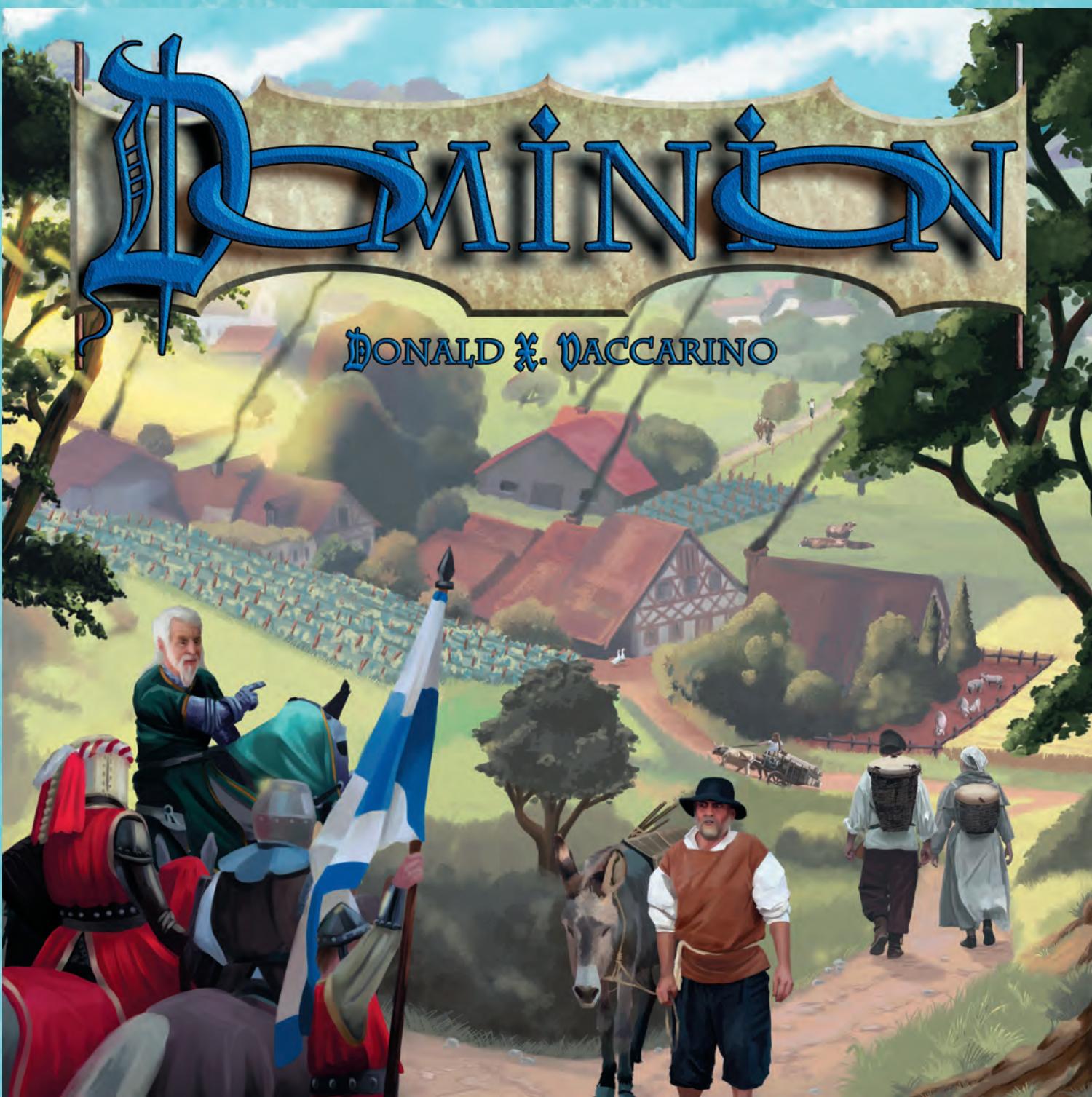
Donald X, Vaccarino
You are a monarch, like your parents before you, a ruler of a small pleasant kingdom of rivers and evergreens, Unlike your parents, however, you have hopes and dreams! You want a bigger and more pleasant kingdom, with more rivers and a wider variety of trees, You want a Dominion! In all directions lie fiefs, freeholds, and feodums, All are small bits of land, controlled by petty lords and verging on anarchy. You will bring civilization to these people, uniting them under your banner,
But wait! It must be something in the air; several other monarchs have had the exact same idea, You must race to get as much of the unclaimed land as possible, fending them off along the way. To do this you will hire minions, construct buildings, spruce up your castle, and fill your treasury. Your parents wouldn't be proud, but your grandparents, on your mother's side, would be delighted,
GOAL
This is a game of building a deck of cards. The deck is your Dominion. lt contains your resources, victory points, and the things you can do. lt starts out a small sad collection of Estates and Coppers, but you hope by the end of the game it will be brimming with Gold, Provinces, and the inhabitants and structures of your castle and kingdom.
The player with the most victory points in his Deck at game end wins.
CLONTENTS
Before the first game, remove the five sets of cards from their wrappings and place them in the card tray. One side of the included inlay suggests a way to organize the cards. The opposite side allows players to create an organization that fits their needs.
500 cards
130 Treasure cards
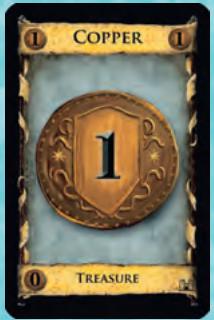
60 Copper
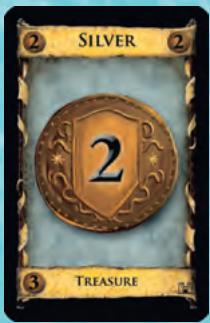
40 Silver
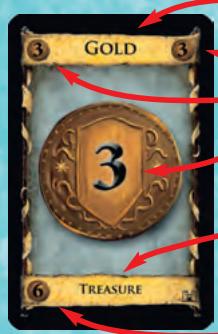
30 Gold
name
value (3 coins)
card type (treasure, yellow)
cost (6 coins)
48 Victory cards

24 Estates
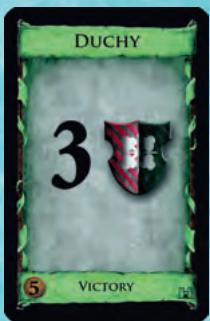
12 Duchies
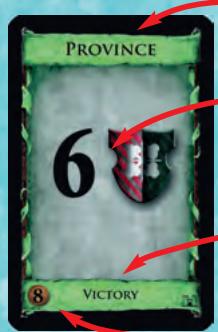
12 Provinces
name
value (6 victory points)
card type (victory, green)
cost (8 coins)
30 Curse cards
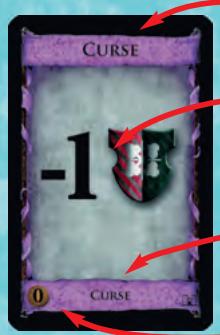
7 blank cards
name
value (-1 victory points)
card type (curse, purple)
cost (0 coins)
32 Randomizer cards

1 Trash card

252 Kingdom cards 24 Action cards (10 of each)
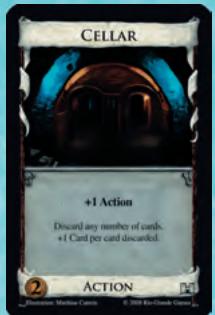
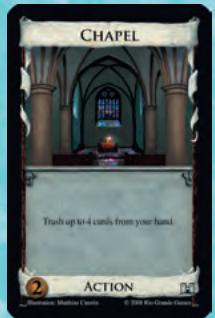

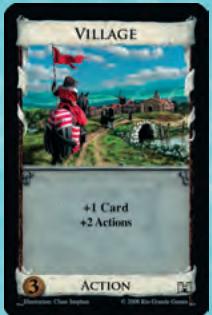

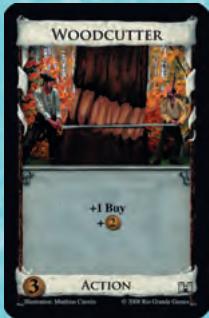
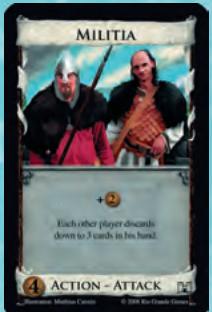


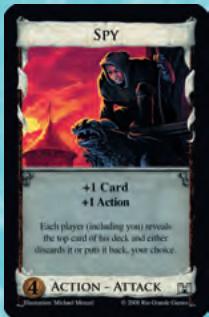
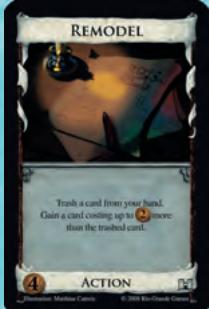
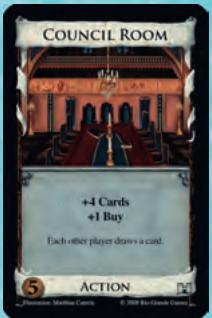


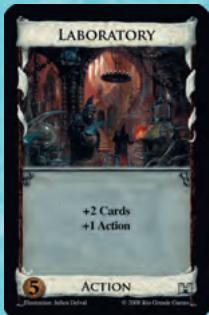
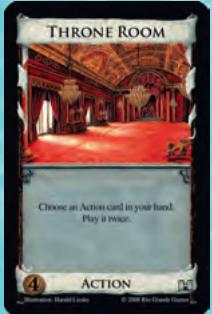



name
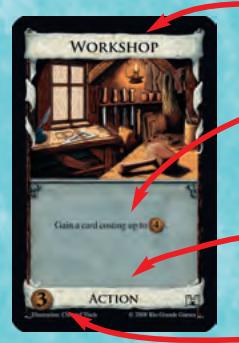
card ability
card type (action, white)
cost (3 coins)
Most kingdom cards are action cards, but there are other kinds.
action-attack
name
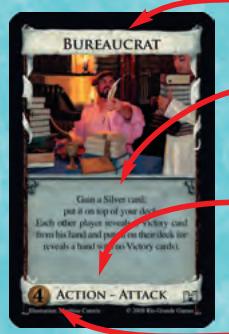
card ability
card type (action-attack, , white)
cost (4 coins)
action-reaction
name
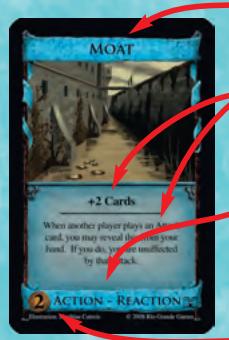
card abilities
card type
(action-reaction,
, blue)
cost (2 coins)
1 Victory card (12)
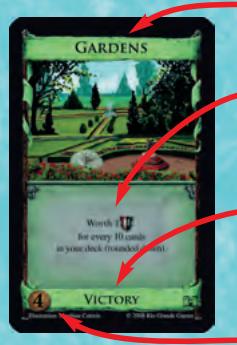
card ability
card type (victory, green)
cost (4 coins)
REPARATION
Place the Treasure cards, Victory cards, Curse cards, and the Trash card in every game (players may place them as shown or in any other arrangement that is convenient for them.
TREASURE CARDS
Copper, Silver, and Gold cards are the basic Treasure cards, and they are available in every game. After each player takes 7 Copper cards, place the remaining Copper cards and all of the Silver cards and Gold cards in face-up piles in the Supply.
VICTORY CARDS
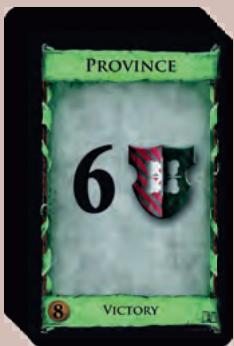
Estate, Duchy, and Province cards are the basic Victory cards, and they are available in every game. After each player takes 3 Estate cards, place 12 each of the Estate, Duchy, and Province cards in face-up piles in the Supply in a 3 or 4 player game. ln a 2 player game, place only 8 of each of these Victory cards in the Supply. Place unused Victory cards back in the box.
CURSE CARDS & TRASH CARD
Place 10 Curse cards in the Supply for a 2 player game, 20 Curse cards for 3 players, and 30 Curse cards for 4 players. Return unused Curse cards to the box. Curse cards are used most often with specific Action cards (e.g. Witch). lf a player buys a Curse card (0 cost), it goes in his own discard pile, like any other gained card. This, of course, will not often occur. The Trash card marks the place where players place cards trashed in the game.
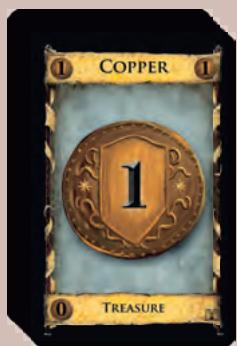

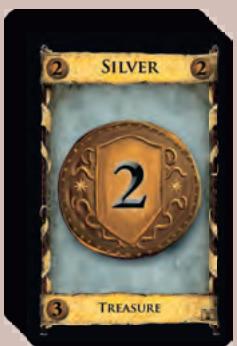
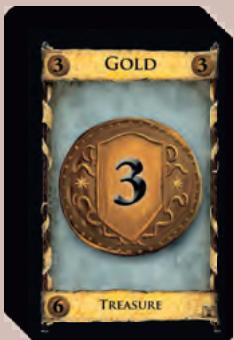
the Supply
Treasure cards
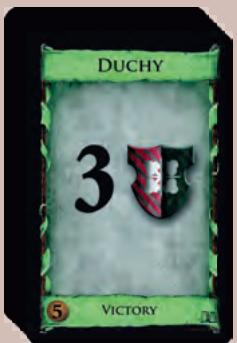
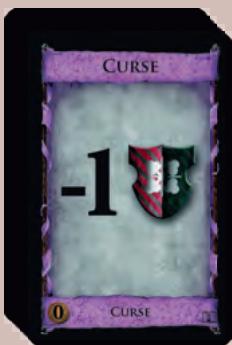
Curse cards
Victory cards
Note: Curse cards are present in every game, however, they are rarely used in the basič game other than with the Witch card.
Trash pile
each player starts with 10 cards;
Each player starts the
game with the same
cards:
7 coppers &
3 estates.
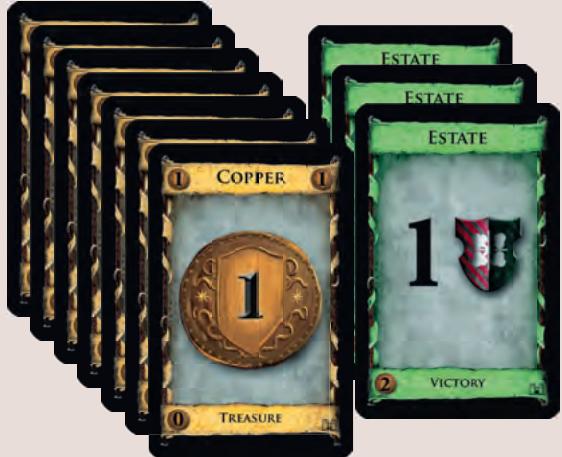
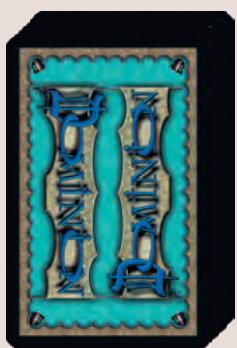
Each player shuffles these cards and places them (his Deck) face-down in his play area (the area near him on the table).
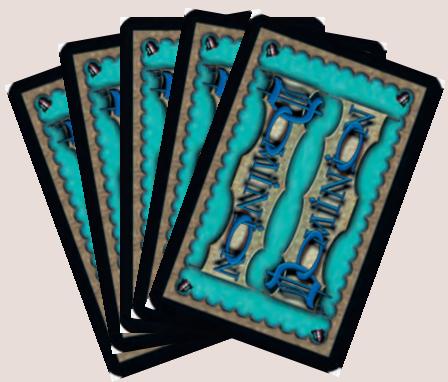
Now, each
player draws
5 cards from
his Deck. These cards are the
player's
hand.
Place 10 sets of the 25 different Kingdom cards next to the Treasure, Victory, Curse, and Trash cards to start each game. Thus, each game can have a different set of 10 cards.
kin cndds

KINGDOM CARDS
In addition to the Trash, Treasure, Victory, and Curse cards that are used in every game, the players also select 10 Kingdom cards and place 10 of each in face-up piles on the table.
Exception: Kingdom Victory card piles (e.g. Gardens) have the same number as the Victory card piles (12 for a 3 or 4 player game and 8 for a 2 player game).
For the first game, we recommend using the following 10 Kingdom cards: Cellar, Market, Militia, Mine, Moat, Remodel, Smithy, Village, Woodcutter, and Workshop. At the end of the rules, we list more suggestions for sets of 10 Kingdom cards. Return Kingdom cards not chosen for the game to the box.
In later games, players can choose the 10 Kingdom cards using any method they agree on.
For example, the players can shuffle the Randomizer cards for all Kingdom cards and draw 10 to select the cards for the game. Or, players can take turns selecting cards.
Players may also use the Randomizer cards as Placeholders to mark the card piles so empty piles are easily seen.
example of a player's play area during the game;

Deck (always face-down)


cards played this turn
Discard pile(always face-up)
STARTING PLAYER
Randomly determine the starting player. When playing multiple games, the starting player is the player to the left of the winner of the last game. If there was a tie in the previous game, randomly choose the starting player from the players that didn't win. Players take turns in clockwise order.
TURN OVERVIEW
Each turn has three phases (A, B, and C) in the order shown: A) Action phase - the player may play an Action. B) Buy phase - the player may buy a card.
C) Clean-up phase - the player must discard both played and unplayed cards and draws five new cards. After a player completes all three phases, his turn ends.
ACTION PHASE
In the Action phase, the player may play one Action card. Action cards are the Kingdom cards that say “Action" at the bottom of the card. Since players do not start the game with any Action cards in their initial Decks of 10 cards, a player will not have any Actions to play during his first 2 turns. Normally, a player may play only one Action card, but this number may be modified by the Action cards that the player plays.
To play an Action, the player takes an Action card from his hand and lays it face-up in his play area. He announces which card he is playing and follows the instructions written on that card from top to bottom. The player may still play an Action card even if he is not able to do everything the Action card tells him to do; but the player must do as much as he can. Furthermore, the player must fully resolve an Action card before playing another one (if he is able to play another Action card). Detailed information about card abilities can be found in the card descriptions at the end of these rules. Any Action cards played remain in the player's play area until the Clean-up phase of the turn unless otherwise indicated on the card.
The Action phase ends when the player cannot or chooses not to play any more Action cards. Generally, a player can only play Action cards during the Action phase of his turn. However, Reaction cards are an exception to this rule as they can be used at other times.
Common terms used on the Action cards;
"+X Card(s)" – the player immediately draws X number of cards from his Deck. lf there are not enough cards in his Deck, he draws as many as he can, shuffles the Discard pile to form a new Deck, and then draws the rest. lf he still does not have enough cards left after forming a new Deck, he just draws as many as he can.
Players choose starting player randomly or based on previous game. Players take turns in clockwise order.
Each turn, the player does the
A, B, and C phases in order:
A) Action phase
B) Buy phase
C) Clean-up phase
The player may play one action card if he has one. This is optional, even if the player has an action card, he need not play it. Action cards will allow players to do extra things during their turns.
As some action cards offer a player additional actions, a player may be able and choose to play several action cards in a turn. Players can play their action cards left to right in their play areas. In this way, they can easily keep track of what and how many extra things they may do. The player will discard these cards in the clean-up phase (see below), and should not be discarded prior to this.
Note; as the players begin the game with no action cards, they will be unable to play action cards for at least the first two turns.
+ X Card(s): must draw X more Cards immediately
"+X Action(s)" – the player may play X number of additional Actions this turn. +X Action(s) adds to the number of Actions that can be played in the Action phase. It does not mean play another Action immediately. The instructions on the current Action card must be completed before playing any additional Actions. The player must complete all of his Actions before he moves on to the Buy phase of his turn. lf a card gives the player more than one additional Action, he may keep track of the number of Actions he has remaining out loud.
"+X" – the player has X number of additional coins to spend in the Buy phase. The player does not take additional Treasure cards for these coins.
"+1 Buy" – the player may buy an additional card from the Supply during the Buy phase of his turn. +1 Buy adds to a player's potential Buys, it does not allow the player to buy a card during the Action phase.
"Discard" – unless otherwise specified, discarded cards are from the player's hand. When a player discards a card, he places the discarded card face-up onto his Discard pile. When discarding several cards at once, the player need not show ali cards he is discarding to his opponents, but player may need to show how many cards he is discarding (for example, when playing the Cellar). The top card of a player's Discard pile is always visible.
"Trash" – when a player trashes a card, he places it in the Trash pile, not his Discard pile. Trashed cards are not returned to the Supply and are not available for purchase.
"Gain” – when a player gains a card, he takes the gained card (usually from the Supply) and puts it onto his Discard pile (unless the card says to put it elsewhere). The player does not get to use the card when he gains it.
“Reveal” – when a player reveals a card, he shows a card to all players and then returns it to wherever it came from (unless instructed specifically to put it elsewhere). lf the player is required to reveal cards from the top of his Deck, and he does not have enough cards, he shuffles in order to reveal the required number of cards.
“Set Aside” – when a player sets aside a card, he places it face-up on the table (unless otherwise indicated) without following any instructions on the card. An Action that requires a player to set aside cards will instruct him on what to do with these cards.
BUY PHASE
In the Buy phase, the player can gain one card from the Supply by paying its cost. Any card that is in the Supply may be purchased (Treasure, Victory, Kingdom, and even Curse cards). The player may not purchase cards from the Trash pile. Normally, a player may buy only one card, but he may buy more if he played certain cards earlier in his Action phase.
The cost of a card is in its lower left corner. The player may play some or all of the Treasure cards from his hand to his play area and add to their value the coins provided by Action cards played this turn. The player may then gain any card in the Supply of equal or lesser value. He takes the purchased card from its Supply pile and places it face-up on his Discard pile. He my not use the ability of the card when it is gained.
+ X Action(s): can play X more Actions in Action phase if a card gives the player more than one additional Action, it is helpful to keep track of the number of Actions he has remaining out loud.
+X: can spend X more coins this turn
+1 Buy: can buy 1 more card in Buy phase
Discard: put cards face-up in your Discard pile
Trash: put card(s) in the Trash pile
Gain: take a card and put it in your Discard pile
Reveal: show card(s) and return them to where they came from
Set Aside: put cards aside until the instructions indicate where they go
The player can gain one card from' the Supply by buying it - paying the cost shown on the card. The player pays in coins from Treasure 'cards (the number on the coin) and from previously paid Action cards.
The player may use any combination of Treasure cards from his hand and coins shown on Action cards played this turn.
| If the player has multiple Buys, he combines Treasure cards and any coins available from Action cards to pay for all of the purchases. For example, if Tyler has +1 Buy and 6 coins provided by two Gold cards, he can buy a Cellar costing 2, placing it face-up in his Discard pile. Then, he can buy a Smithy with the remaining 4 coins and place that face-up in his Discard pile. lf he wants to use all 6 coins to buy one card, he can buy a Copper (for free) with his second Buy or not buy a second card. Players do not have to | Any Treasure cards played can be placed in his player area from left to right, addng them to any cards previously played this turn. |
| use any or all of their Buys. The Treasure cards remain in the play area until the Clean-up phase. Treasure cards will be used multiple times during the game. Although they are discarded during the Clean-up phase, the player will draw them again as his Discard pile is shuffled into a new Deck. Thus, Treasure cards are a source of income, not a resource that is used up when played. When played, Coppers are worth 1 coin, Silvers are worth 2 coins, and Golds are worth 3 coins. | All these cards will be discarded at the end of the turn, and should not be discarded prior to the Clean-up phase'(see below). |
| CLEAN-UP PHASE All cards gained this turn should already be in the player's Discard pile. The player places any cards that are in his play area (Action cards that have been played in the Action phase as well as Treasure cards that have been played in the Buy phase) and any cards remaining in his hand onto his Discard pile. Although the player need not show the cards remaining in his hand to his opponents, since he places the cards in the Discard pile face-up, his opponents | The player places all cards in his play' area onto his Discard pile. Thís will include all Action cards and Treasure cards he played during this turn. He alsoplăces all cards left in his hand onto his Discard pile. |
| will always be able to see the top-most card of his Discard pile. Then, the player draws a new hand of 5 cards from his Deck. lf there are not enough cards in his Deck, he draws as many as he can, shuffles his Discard pile to form a new face-down Deck, and then draws the rest of his new hand. | Draw 5 cards from his Deck. |
| Once the player has drawn a new hand of 5 cards, the next player starts his turn. To speed play, players may begin their turns while previous players are completing their Clean-up phases. When someone plays an Attack card, the players must complete their | The player's turn is over. Play passés člockwise. |
| Clean-up phases in order to properly resolve the Attack. 6AME END | Game end |
| The game ends at the end of any player's turn when either: 1) the Supply pile of Province cards is empty or 2) any 3 Šupply piles are empty. | 1) Province card pile is empty or 2) any 3 Supply piles are empty |
| Each player puts all of his cards into his Deck and counts the victory pointson all the cards he has. | Players count their victory points. |
| The player with the most victory points wins. If the highest scores are tied at the end of the game, the tied player who has had the fewest turns wins the game. lf the tied players have had the same number of turns, they rejoice in their shared victory. | Most victory points wins. Ties go to the player with the fewest turns |
The first few turns - how your first game might go
Shuffle your starting 10 cards (7 Coppers & 3 Estates) and place them face-down as your Deck, Draw the top 5 cārds ’as your starting hand, 1n this example, you have 1 Éstate & 4 Coppers, The rest remain as your Deck,
before e oone
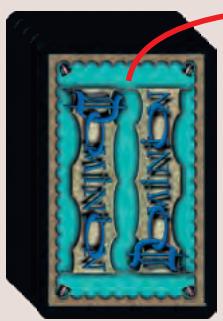
Deck
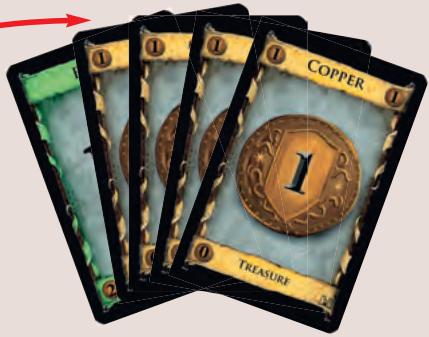
hand cards

card-playing area
Discard pile
1st turn
As you have no action cards to start the game, you skip the action phase and go directly to the buy phase, where you will buy most of your cards, Ýou play 4 Copper cards from your hand to buy a Remodel card (cost = 4 Coins) from the supply, placing it in your Discard pile, from the supply from the
Bu pase

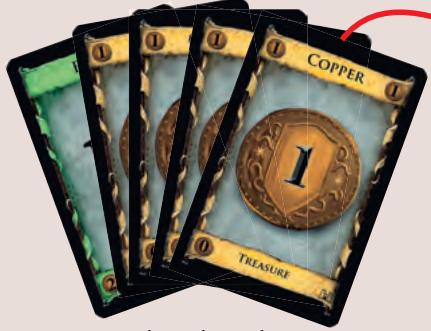
hand cards
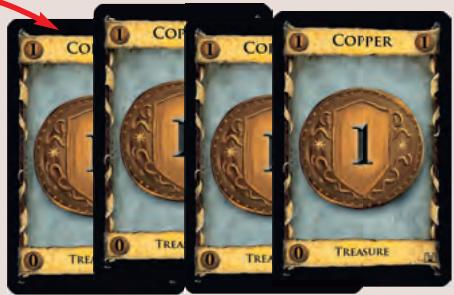
cards played
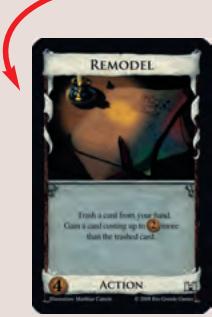
Discard pile
After completing your Buy, you go to the Clean-up phase, Here you place the cards you played on the discard pile and the cards left in your hand there as well.
Cle -ase
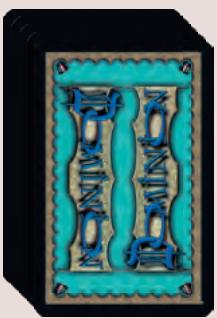
Deck
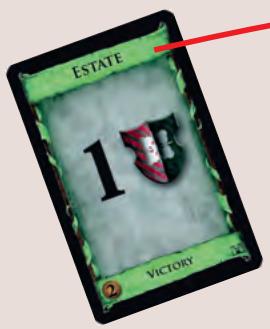
hand cards

cards played
Discard pile
Finally, you draw 5 cards from your Deck for your next turn, This time, you get 2 Estates and 3 Coppers, Your 1st turn is over and the opponent on your left begins his turn,
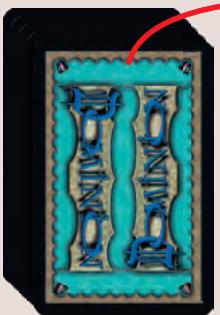
Deck
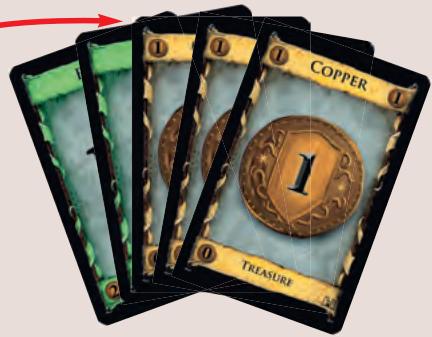
hand cards
card-playing area

Discard pile
2nd turn

3rd turn; continued on the next page

3rd turn (continued)
SAMPLE ACTION CARD
Name of card
Draw another card immediately
Lets you play another Action during your Action phase Lets you buy an additional card in the Buy Phase
Gives you an additional coin to spend in the Buy phase. Cost to buy the card.
Card type (both name and color of banner)
ADDITIONAL RULES
| Each player has his own Dominion, which he builds from cards in the supply. During the game, a player's cards are usually in three parts: his Deck (which he draws cards from), his hand, and his Discard pile. The player draws cards from his own Deck and discards cards to his own Discard pile. When his Deck is exhausted and the player needs to draw or reveal cards from his Deck, he shuffles his Discard pile to reform his Deck. He does not shuffle his Discard pile until he needs to reveal or draw a card from his Deck and cannot. At any point in the game, if a player has to draw | Each player has his own Dominion, built from the cards in the supply. Shuffle only when new cards needed. |
| or reveal more cards than are remaining in his Deck, he must draw or reveal as many as he can and then shuffle his face-up Discard pile to form a new face-down Deck. Then, he draws or reveals the remaining number of cards from his newly shuffled Deck. | A player does not shuffle his discard pile until all cards in his Deck have been drawn or revealed. |
| A player places cards he Buys or otherwise acquires during the game on his Discard pile unless he is specifically directed to place them elsewhere. | Gained cards go on the player's discard pile. |
| At the end of a player's turn, he places all the cards he played and those still in his hand on his Discard pile. | All hand and played cards are discarded at the end of a turn. |
| A player is allowed to count how many cards are left in his Deck, but not in his Discard pile. A player may not look through his Deck or his Discard pile. A player may look through the Trash pile, and players may count the number of cards left in any pile in the Supply. | Players may count cards in Decks and Supply piles and may look at cards in Trash. |
| lf an ability of a card affects multiple players, and the order matters, resolve that ability for each affected player in turn order, starting with the player whose turn it is. | Use turn order to resolve card affects. |
| During each turn, a player is allowed 1 Action and 1 Buy, but may be entitled to more based on Action cards played. The instructions written on all the action cards alter the rules of the game by, for | Player allowed at least 1 Action and 1 Buy. |
| example, allowing the player to draw more cards from his Deck, play more Action cards in the Action phase, use more coins for the Buy phase, Buy extra cards in the Buy phase, and so on. When an Action card allows a player to gain a card costing up to | All Action cards alter the rules in some way. |
| a certain value, he may not add coins from his hand or other action cards to gain a higher-valued card. | Players may not add coins to increase the affect of an Action beyond the instructions. |
KINGDOM CARD DESCRIPTION
Adventurer - If you have to shuffle in the middle, shuffle. Don't shuffle in the revealed cards as these cards do not go to the Discard pile until you have finished revealing cards. lf you run out of cards after shuffling and still only have one Treasure, you get just that one Treasure.
Bureaucrat – lf you have no cards left in your Deck when you play this card, the Silver you gain will become the only card in your Deck. Similarly, if another player has no cards in his Deck, the Victory card he puts on top will become the only card in his Deck.
Cellar - You can't discard Cellar to itself, since it isn't in your hand any longer when you resolve it. You choose what cards to discard and discard them all at once. You only draw cards after you have discarded. lf you have to shuffle to do the drawing, the discarded cards will end up shuffled into your new Deck.
Chancellor - You must resolve the Chancellor (decide whether or not to discard your Deck by flipping it into your Discard pile) before doing other things on your turn, like deciding what to buy or playing another Action card. You may not look through your Deck as you discard it.
Chapel - You can't trash the Chapel itself since it isn't in your hand when you resolve it. You could trash a different Chapel card if that card were in your hand.
Council Room – The other players must draw a card whether they want to or not. All players should shuffle as necessary.
Feast - The gained card goes into your Discard pile. lt has to be a card from the Supply. You cannot use coins from Treasures or previous Actions (like the Market) to increase the cost of the card that you gain. lf you use Throne Room on Feast, you will gain two cards, even though you can only trash Feast once. Gaining the card isn't contingent on trashing Feast; they're just two things that the card tries to make you do.
Festival - If you are playing multiple Festivals, keep a careful count of your Actions. Say how many you have left out loud; this trick works every time (i.e. "l'm playing the Festival and now have two Actions remaining. 1 play a Market and have two Actions remaining. 1 play another Festival and now have three Actions remaining...").



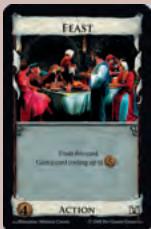

Gardens - This Kingdom card is a Victory card, not an Action card. lt does nothing until the end of the game, when it is worth 1 victory point per 10 cards in your Deck (counting all of your cards - your Discard pile and hand are combined with your Deck before scoring). Round down; if you have 39 cards, Gardens is worth 3 victory points. During set-up, place 12 Gardens in the Supply for a 3 or 4 player game and 8 in the Supply for a 2 player game.
Laboratory – Draw two cards. You may play another Action card during your Action phase.
Library - lf you have to shuffle in the middle, the set-aside cards are not shuffled into the new Deck. They will be discarded when you have finished drawing cards. lf you run out of cards even after shuffling, you just get however many there were. You are not obligated to set aside Actions - you just have the option to do so. lf you have 7 or more cards in hand after you play the Library, you don't draw any cards.
Market – Draw a card. You may play another Action card during your Action phase. During your Buy phase, you may buy an additional card from the supply, and add one coin to the total value of the Treasure cards played.
Militia - The attacked players discard cards until they have only 3 cards in hand. Players who had 3 or fewer cards in hand when Militia was played do not discard any cards.
Mine - Generally, you can trash a Copper card and gain a Silver, or trash a Silver card and gain a Gold. However, you could also trash a Treasure to gain the same Treasure or a cheaper one. The gained card goes in your hand; thus, you can spend it the same turn. If you don't have a Treasure card in your hand to trash, you can't gain anything.
Moat - An Attack card is one that says "Attack" on the bottom line (usually, "Action - Attack"). When someone else plays an Attack card, you may reveal the Moat by showing it from your hand to the other players and then returning it to your hand (before the Attack card resolves). You are then unaffected by that Attack card. You won't gain a Curse because of a Witch or reveal a card to a Spy, and so on. lt's just like you aren't in the game for purposes of resolving that Attack. Moat doesn't stop anything an Attack does to other players or to the player of the Attack; for example, if everyone else Moats a Witch, the person who played it still gets to draw 2 cards. Moat can also be played on your turn as an Action to draw 2 cards.

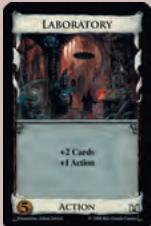
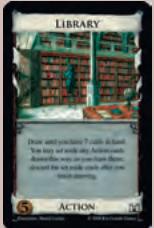
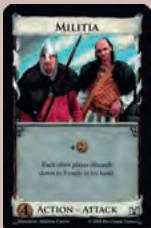
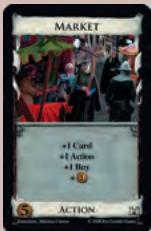
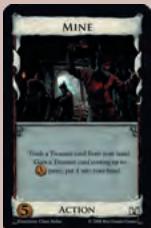
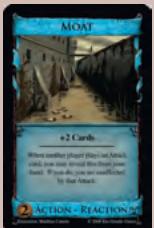
Moneylender - lf you do not have a Copper in your hand to trash, you don't get the +3 coins to spend in the Buy phase.
Remodel - You cannot trash the Remodel as it isn't in your hand when you resolve it (you can trash a different Remodel card from your hand). lf you do not have a card to trash, you cannot gain a card from the Remodel. The gained card goes in your Discard pile. You can only gain cards from the Supply. The gained card need not cost exactly 2 coins more than the trashed card; it can cost that much or any amount less. You cannot use coins from Treasures or previous Actions (like the Market) to increase the cost of the card you gain. You can trash a card to gain a copy of the same card.
Smithy - Draw three cards.
Spy – Spy causes all players, including the one who played it, to reveal the top card of their Deck. Note that you draw your card for playing Spy before any cards are revealed. Anyone who does not have any cards left in their Deck shuffles in order to have something to reveal. Anyone who still has no cards to reveal doesn't reveal one. lf players care about the order in which things happen for this, you do yourself first, then each other player in turn order. Revealed cards that aren't discarded are returned to the top of their players' Decks.
Thief – A player with just one card left reveals that last card and then shuffles to get the other card to reveal (without including the revealed card); a player with no cards left shuffles to get both of them. A player who still doesn't have two cards to reveal after shuffling just reveals what he can. Each player trashes one Treasure card at most, of the attacker's choice from the two revealed cards, and then you gain any of the trashed cards that you want. You can only take Treasures just trashed—not ones trashed on previous turns. You can take none of them, all of them, or anything in between. Put the Treasures you decided to gain into your Discard pile. The ones you choose not to gain stay in the Trash pile.
Throne Room - You pick another Action card in your hand, play it, and play it again. The second use of the Action card doesn't use up any extra Actions you have. You completely resolve playing the Action the first time before playing it the second time. If you Throne Room a Throne Room, you play an Action, doing it twice, and then play another Action and do it twice; you do not resolve an Action four times. lf you Throne Room a card that gives you +1 Action, such as Market, you will end up with 2


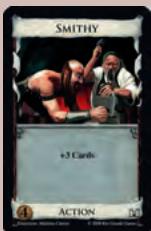
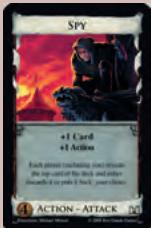
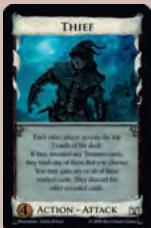
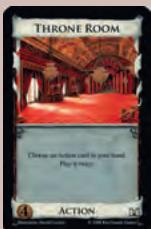
Actions left afterwards, which is tricky, because if you'd just played Market twice you'd only have 1 Action left afterwards. Remember to count the number of Actions you have remaining out loud to keep from getting confused! You cannot play any other Actions in between playing the Throne Roomed Action twice.
Village - If you're playing multiple Villages, keep a careful count of your Actions. Say how many you have left out loud; this trick works every time.
Witch - If there aren't enough Curses left to go around when you play the Witch, you deal them out in turn order - starting with the player after you. If you play Witch with no Curses remaining, you will still draw 2 cards. A player gaining a Curse puts it face-up into his Discard pile.
Woodcutter - During your Buy phase, you add two coins to the total value of the Treasure cards played, and you may buy an additional card from the Supply.
Workshop - The card you gain is put into your Discard pile. lt has to be a card from the Supply. You cannot use coins from Treasures or previous Actions (like the Market) to increase the cost of the card you may gain.
XECOMMENDED SETS OF 10
You can play Dominion with any set of 10 Kingdom cards, but these sets are intended to highlight some interesting card interactions and game strategies.
First Game; Cellar, Market, Militia, Mine, Moat, Remodel, Smithy, Village, Woodcutter, Workshop.
Big Money; Adventurer, Bureaucrat, Chancellor, Chapel, Feast, Laboratory, Market, Mine, Moneylender, Throne Room
Interaction; Bureaucrat, Chancellor, Council Room, Festival, Library, Militia, Moat, Spy, Thief, Village
Size Distortion; Cellar, Chapel, Feast, Gardens, Laboratory, Thief, Village, Witch, Woodcutter, Workshop
Village Square; Bureaucrat, Cellar, Festival, Library, Market, Remodel, Smithy, Throne Room, Village, Woodcutter

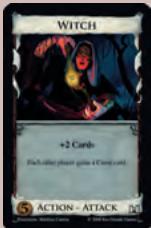
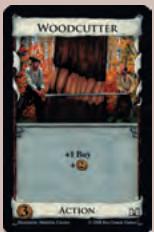
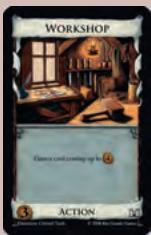
Illustration: Matthias Catrein
Developers: Valerie Putman & Dale Yu
Our thanks to our playtesters: Kelly Bailey, Dan Brees, Josephine Burns, Máx Crowe, Ray Dennis, David Fair, Lucas Hedgren, Michael M. Landers, W. Eric Martin, Destry Miller, Miikka Notkola, Molly Sherwin, Sir Shufflesalot, P. Colin Street, Chris West, the 6am Gamers, the Cincygamers and the Columbus Area Boardgaming Society.

Texts are community-compiled or publicly released by publishers; copyright remains with the original authors. For personal reference only.