
Empires Of The Void Ii
At a glance
Rules, cards and Q&A (Chinese)
The rules, card data and player questions for this game are written in Chinese. Open the Chinese page to read them.
Where to find full rules
Full rules and card lookup are available in the cunlema app at cunlema.cn — pick this game and ask about any rule, card or turn you are unsure about.
Related games
Rulebook text (Markdown)
This game has 1 rulebook Markdown file(s) in our library; 1 rendered inline below — expand to read or download.
EotV-II-EN_01.md114.9 KB
RYAN LAUKAT
EMPIRES
Rule Book
INTRO
The Kurross Empire emerged from the deep, endless pool of space, dark and undetectable. They crushed Earth's paltry fleet within a week, and broke through the great planetary shield that protected the surface. Bright blue oceans turned to an irradiated wasteland as they bombarded the planet, shredding the remnants of thousands of years of human history. Markan, last captain of earth's forces, made a final, desperate attempt to survive, salvaging an abandoned Worldship from hundreds of years past. She took command and headed for the fringe of the galaxy, where there was a chance to gain a foothold, grow in strength, and find new allies for the fight against the Kurross. Earth's long-time enemies, the Zun and Decima Empires, soon followed in their own Worldships, leaving behind decimated worlds and lost family, determined to stake their own claim of the fringe.
In Empires of the Void Il, you have been given a mission to establish a foothold at the fringe of the galaxy for your galactic empire. The game begins when your massive Worldships reach the fringe, where you must explore, wage war, use diplomacy, and construct buildings to gain victory. The fringe is sparsely populated and the few local sentient species are struggling to survive, leaving huge regions of planets open for exploration and colonization. Many species are eager to ally themselves with a powerful empire to gain security and stability in a chaotic and difficult time.
As you explore and interact with planets, you will discover unfolding stories of the fringe. Each inhabited planet is home to a unique alien species, with their own goals, values, and problems. Will you give aid by fighting off pirates, transporting goods, and curing strange diseases? Or will you invade and rule with a cruel hand? This may be your last chance to prepare before the Kurross meet you again.
RULE BOOK CONTENTS
Components.... ...3 A list of all game materials.
Setup...
Instructions on how to set up the game.
Learning the Game........8-25 Instructions on how to play the game. Read this before your first game.
Glossary...... ...26-32 A list of all rules by subject. Reference this when you have a rules question.
Abilities and Cards........33-34 Details and clarifications on specific cards and abilities. Details on game terms and language.
Valka VII Rules..35
Index36

SETUP
1. Choose eight
planets. Each game you must leave out one of these planets: Corzar, Korlo Zan, or Emrok. (Also do not use the planet Valka VII in the standard game. If you wish to use it, see the scenario on p. 35.) Place the unused planets in the box.
-
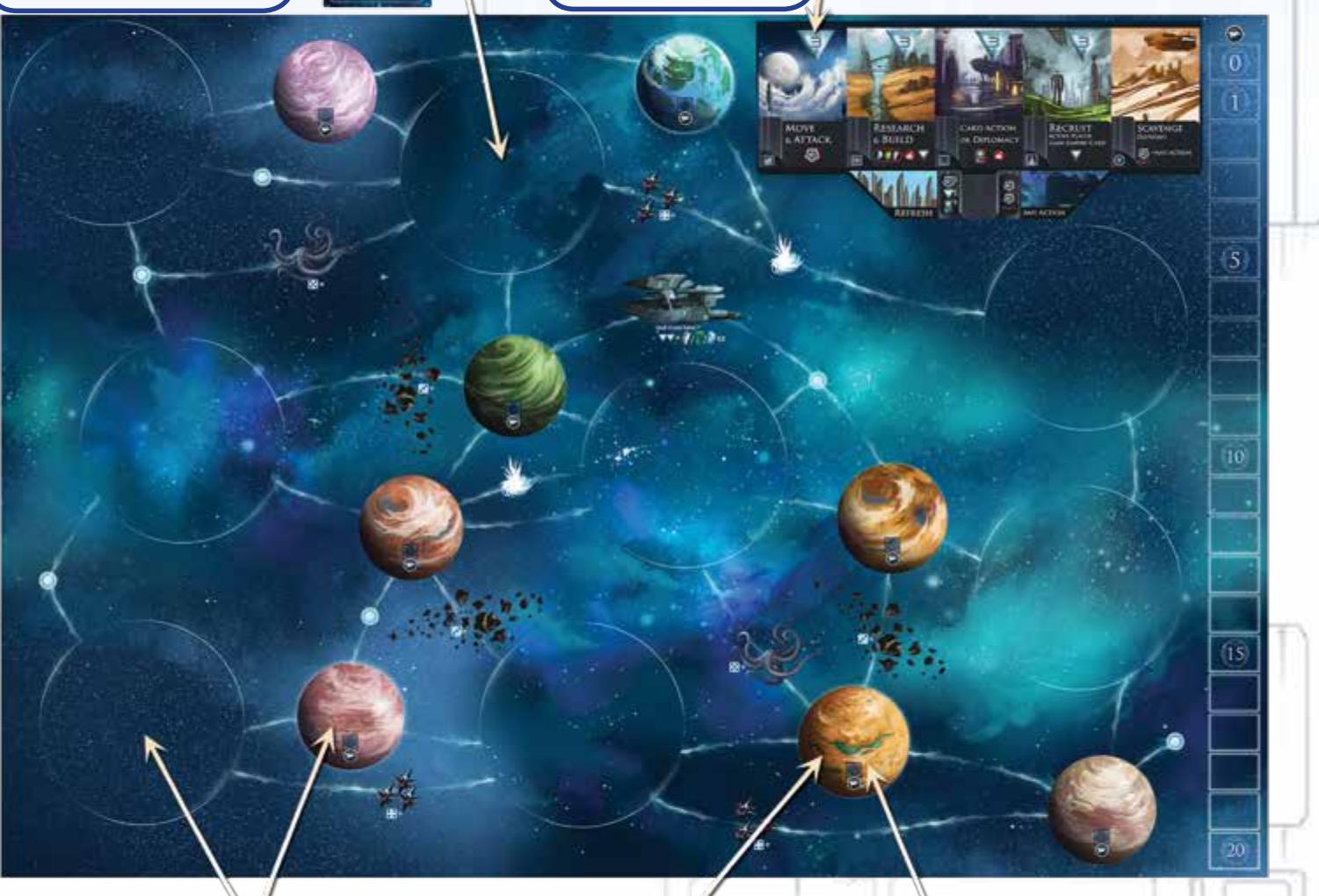
Place the game board in the center of the play area. Randomly place the eight chosen planet tiles face up on the eight empty circles on the board.
-
Put three credits on each action space in order from left to right, according to the number of players. For example, for two players, only the first two action spaces start with three credits. All other action spaces are empty. For five players, all action spaces start with three credits.
5. Shuffle thee
- Place Sarkeen Regency tokens face up on inhabited planets (large) and uninhabited planets (small) of your choice. The number of tokens placed depends on the number of players, as detailed below:
• 2 players
• 3 players
• 4 players
• 5 players
3 inhabited & 3 uninhabited 2 inhabited & 2 uninhabited 1 inhabited & 1 uninhabited Use no Sarkeen Regency Tokens explore tokens in a face down pile. Randomly place one explore token face down on each uninhabited planet (small) that does not have a Sarkeen Regency token.
- Shuffle the goods tokens in a face down pile. Randomly place one goods token face down on each uninhabited planet (small) that does not have a Sarkeen Regency token. On inhabited planets without Sarkeen Regency tokens, place one goods token in orbit face down and one goods token on the surface face up.
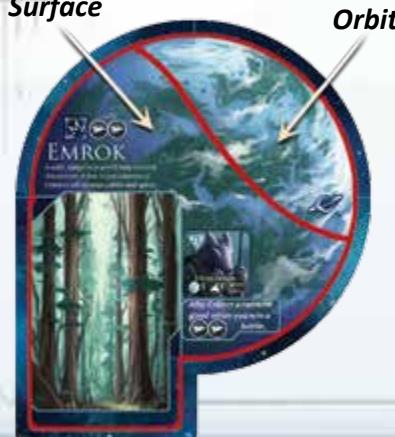
Surface and Orbit regions pictured on page 5.
SETUP
. Each player chooses a faction and takes all of the components that belong to their faction: a player board, influence markers and control cubes in their color, 3 Star Sloops, 6 Starfarers, and their Worldship. See the list of Worldships and the factions they belong to on page 7. The color of a faction is the color of its Worldship.
- Each player places 4 citis, 4 bases, and 4 academies on their player board, as shown below.


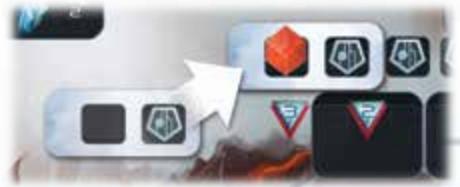
- Each player places one of their control cubes on the starting space on their command track, as shown above. (If playing with two players, each player adds a command track token so that their
Surface
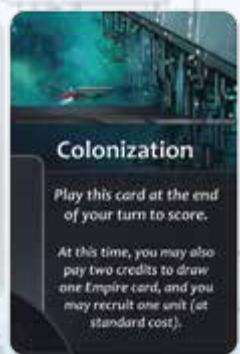
- Each player starts with 5 credits (or 7 in a twoplayer game) and a "Colonization" card.
track is increased by one command.)

- Each player places an influence marker on the "0" space on the victory point track on the board.

SETUP
-
Place the dice, remaining credits, War Bots, various event tokens (including fungus tokens, Anonian warriors, and Heecrix Invaders), and goods tokens (face down) near the board in their own piles. This is the supply
-
Place the lly tokens near the board in a row. Place the 4 allied units for each planet on their respective ally tokens.
-
The power card deck that you will assemble for the game only includes cards for the planets which are on the board and which do not have Sarkeen Regency tokens. All other cards for planets not included in this game session may be placed in the box before assembling the deck.
15.Assemble the basic power card deck. First, ake the seven power cards for each planet on the board that does not have a Sarkeen Regency token. Power cards have a power number and are titled either "Action," "Delivery," or "Mission." Event cards, which have no power number, should be set aside for now.
Once you've gathered the appropriate cards, shuffle them together, place the deck face down, and deal 3 cards to each player.
- Now add event cards to the basic power card deck. Pick one event for each planet on the board that does not have a Sarkeen Regency token. You can pick randomly, but for your first game, choose from the following cards:
(Tan Fu) Hexite Market
(Meezle III) Revitalization Efforts
(Arzos) Merchant Guild Forms
(Emrok) Deep Fungus
(Sentina) Heecrix Invasion
(Silast) Prison Break
(Tan Lok) Dimension Gate
(Korlo Zan) Orbital Vagabond Station
(Corzar) Pirate Outpost
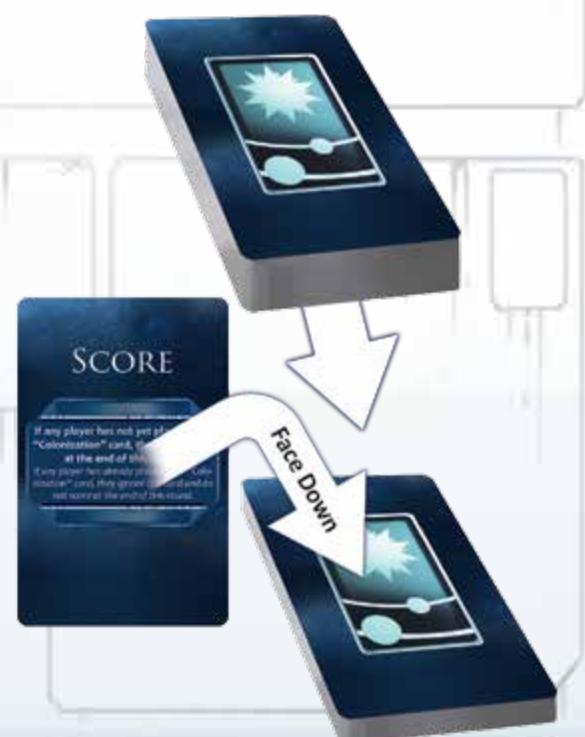
Shuffle the chosen events into the power card deck. Cut the deck roughly in half. Place the score card face down on top of the smaller half. Then place the larger half face down on top of the smaller half to make one deck of cards. The score card will be just below the middle of the deck. The power card deck is now complete! Place all unused event cards in the box.
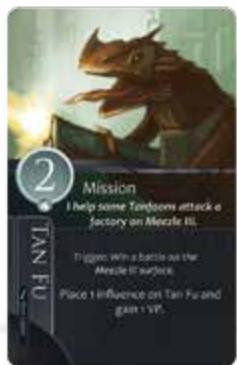
Power Card

Event Card

-
hufle te empire card deck and deal each player t cards. Each player must now choose one of the cards to keep and one to discard. Place the discarded cards in a face up discard pile next to the empire card deck. Keep the chosen card secret from the other players.
-
Give ach player one random good, draw from the suppy.
19.Al players roll die. The player with the highest result is first player and receives the first player card, the commander token, and the action token. Play starts with this player and moves in a clockwise direction around the table.
7
- Players now choose starting locations in rverse turn order, tarting with the last player and continuing in counter-clockwise order. Each player places their Worldship, 1 Starfarer, and 1 Star Sloop on one of the space nodes on the board that is not occupied by another player. These are a player's starting units. Their remaining units stay near their player board and must be recruited during the game to be used.

You've completed setup. You are ready to play!


LEΛRNING THE GAME
This rulebook is divided into two sections: "Learning the Game" and "Glossary." After you read the "Learning the Game" section, you will know enough to start playing the game. The Glossary gives you a reference of the complete rules of the game, organized by subject. You can read that section before playing, or refer to it as you have questions during play.
GOAL
The goal of Empires of the Void Il is to control the fringe of the galaxy! This control is measured in VICTORY POINTS. You will initiate scoring twice in the game. You also collect victory points as you play. You gain one victory point each time you win a battle. Some mission, event, delivery, and action cards also award victory points when completed.
When scoring, you may earn victory points for:
• planets that you control
• allies of your faction
• buildings and technologies on your player board
• empire cards completed
Sometimes victory points are abbreviated as "VP."
PLAYING THE GAME
Empires of the Void Il is played over a series of rounds. Each round consists of the following:
ACTIVE PLAYER ACTION: Each round, the active player chooses and performs one action from the action track on the board.
After this, in clockwise order, each remaining player may do one of the following:
a. FOLLOW: Perform the same action as the active player.
b. REFRESH: Collect income, reset command, and draw power cards up to your hand limit.
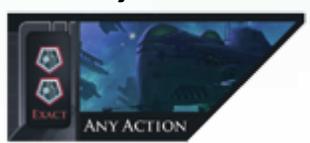
c. ANY ACTION: Pay 2 command to take any action.
Victory Point Symbol

Colonization Card

Active Player: The first player in the round. This player chooses the action for the round and has the commander token. After the round ends, the next player in turn order becomes the active player.
Example: Game Round
Ezekiel is the active player. He chooses the "move and attack" action. Rebecca follows and takes the same action. Gilgamesh pays two command to take "any action" and chooses to perform the "recruit" action.
LEΛRNING THE GAME
When it is your turn to be the active player...
• You take the commander token.
You must choose an action on the action track and move the action token to the corresponding picture on the track.
You cannot choose the same action that was chosen last round. Each round, the token must move to a new action.
• You cannot pass. You must choose an action even if you cannot perform it.
• If you want to refresh as the active player, you must choose the Scavenge action.
If you choose an action with credits on the action space, you take them immediately.
At the end of the round (after all players have had a turn), you pass the commander token to the player on your left, and that player is the new active player for the next round.
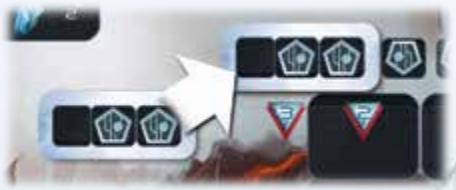
Credits on Actions: Some action spaces have credits on them at the start of the game. This is to encourage players to try different actions early on. Once taken, new credits are not added to the action track.
Credit: Credits are a resource that players use to pay for buildings, units, and
some power cards. Any time a player "gains or
collects income," that player collects credits
according to the track at the top of their em
pire board (described further on pages 22 and 29).
Action Track
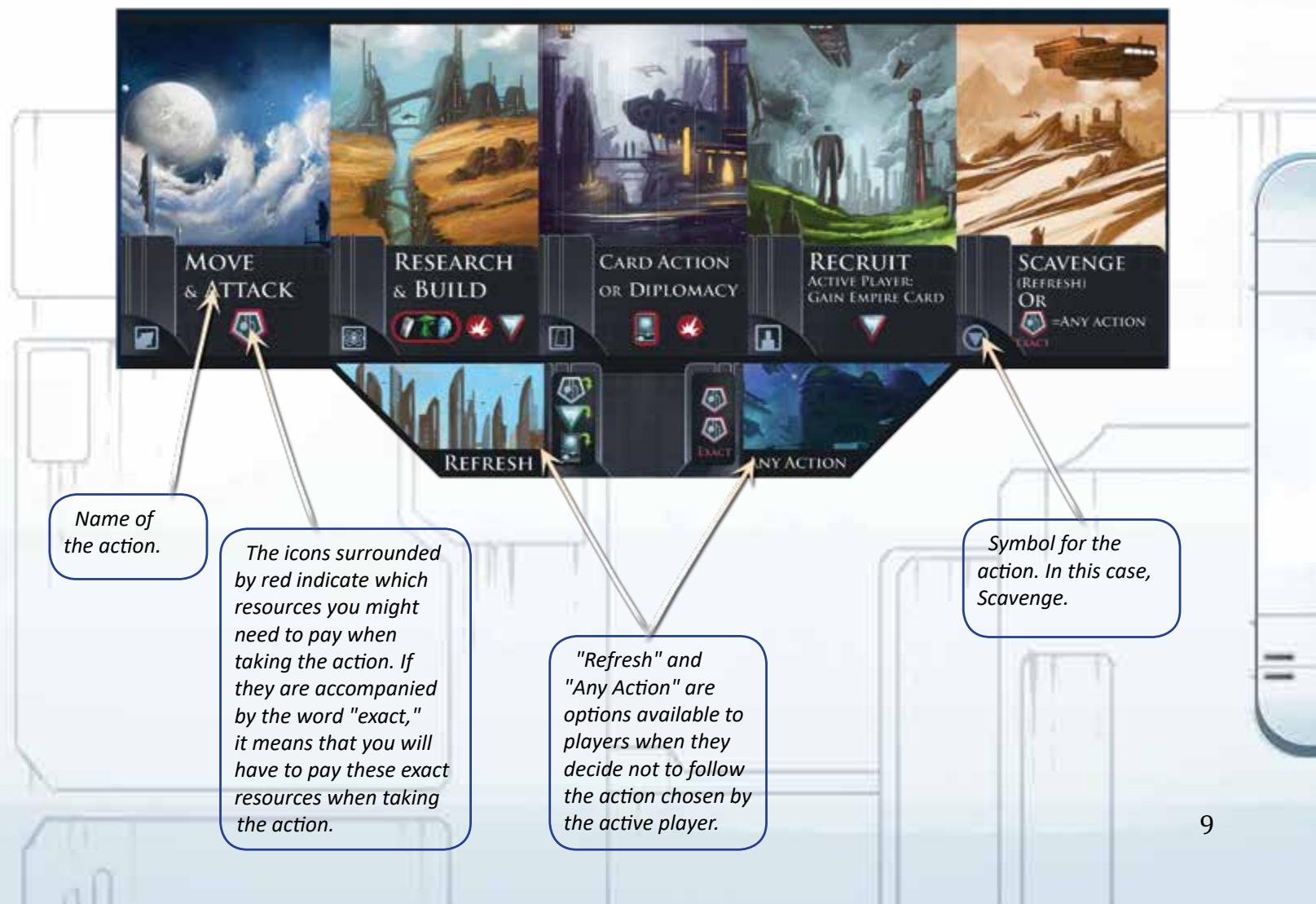
ACTIONS
Each possible action is described below:
ACTION: Move & Attack
This action allows you to move your units around the board.
You may move and/or attack, in that order.
Move
First, choose a number of your units in one region to move. This is called a group. You move this group one region at a time. The group can only move to adjacent regions.
Each time you move out of a region, you must pay one command. The group can move any distance, as long as you pay one command for each region.
The group may pick up any of your units it meets as it moves.
The group may not drop off units and continue moving.
On inhabited (large) planets, all space paths connected to the planet are connected to both planet regions (surface and orbit). This means that you need only pay 1 command to move a group through a large planet. Also, you may leave the planet using any path connected to the planet regardless from which planet region you leave.
A group may pass another player's units without stopping.
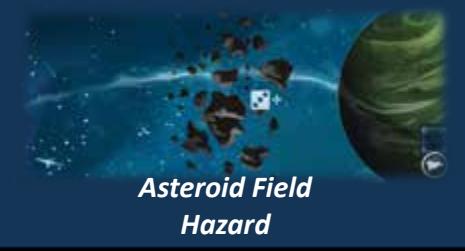
If a group attempts to move over a space path with a hazard, you must roll a die to see if you can pass. If the die is higher than or equal to the die symbol next to the hazard, your group can pass. If not, you must return to the region you just left. You may spend another command on the same move action to try again. (See example on this page.)
Hazard: A hazard is a potential movement blocker on a space path. It could be an asteroid field, space monster, or mine field. Hazards do not count as regions (you cannot stop movement on them). See page 30 for more details.
Unit: A token or figure representing various troops in your forces. A region may hold any number of your units, but a battle is limited to 3 units on each side. Star Sloops, Starfarers, allied aliens, and Worldships count as units. Bases do not count as units.

Region: A space on the board. This can include a node in space, an uninhabited planet, the orbit region of an inhabited planet, the surface region of an inhabited planet, the trade ship, and wormholes. (Hazards, including asteroids, space monsters, and mine fields, do not count as regions.)
Two regions are adjacent if they are connected by a space path or share a border (such as orbit and surface regions of the same planet). Both regions of an inhabited planet have access to all space paths on that planet.
A Space Path
Example: Hazard 2nd Attempt
Sue pays 1 command to leave a planet, (pictured left). She attempts to cross the asteroid field and rolls a 2. The attempt fails and she moves back to the planet. She then (on the same move action) spends 1 more command to retry. She rolls a 4 and moves through the asteroid field to the next adjacent space.
LEΛRNING THE GAME
Ending Movement
You can move a group as far as you want, as long as you have sufficient command. After a group stops moving, what happens next is determined by what is in the region:
Is there a control box with no cube on it? If it is on an uninhabited (small) planet, you can place one of your control cubes there to gain control of the planet. If it is on an inhabited (large) planet, you must have a battle with the alien inhabitants! This is indicated by a battle symbol in the control box. For battle rules see pages 14-15.
Is there a control box with another player's cube on it? If another player has units and/or bases on the planet, you must battle with that player! For battle rules see pages 14- 15. If that player has no units or bases on the planet, you return their cube to them and replace it with one of your own.
Is it a region with no control box? Orbit regions of planets do not have control boxes and may not be controlled by any one player. If other players' units are there, you may choose to attack one of the opponent players, in which case a battle begins immediately. You do not have to attack. If you choose not to attack, your units remain in the region.
• Is there a face-down explore token? If so, turn it face up. It gives a bonus to whoever controls the region. See page 29.
Is there a goods token? If so, after any battles, claim the token and save it for later use. If you take control of the surface of a large planet, you can also claim any goods token in orbit.

Which units can travel in space?
Square-shaped units cannot move over a space path without an accompanying star ship (such as a Worldship or Star Sloop). They cannot exist on a space node, trade ship, or wormhole without a star ship. They can, however, exist in an orbit region without a star ship, and can move between the surface and orbit of a planet without a star ship. (The Virshians are an exception; they can move in space without a star ship.)
If an occasion arises in the game where your units are in space without a star ship, you must immediately move them to your Worldship.
Control: When you move units to a planet's surface and end your movement there, you take control of that planet. Mark planet control with a control cube in the control box of the planet. You do not need to keep units on a planet indefinitely to retain control of it.
Control Box Battle Symbol Control Cube
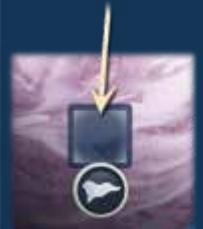

If a control box has a battle symbol in it, you must win a battle with the planet's inhabitants in order to take control of the planet. This does not apply if another player's control cube is already there.
Command: A representation of an empire's capability to move and perform specific actions. You will keep track of your total command with a cube placed on the command track of your player board. Each player starts with 3 command (4 if playing with two players). When you spend command, move your cube to the right a number of spaces equal to the command spent. You may not spend command once you reach the last space on your track. The last space on the track is determined by how many academies you have built. Once you reach the end of your command track, you must reset your command in order to spend it again. See pages 18 and 22.
Example: Movement
Harry chooses to move some of his units from an uninhabited planet he controls. The region contains his Worldship, a Starfarer, and a Star Sloop. He leaves the Star Sloop, taking only the Worldship and the Starfarer. He pays 1 command to move this group to a small planet nearby. He wants to move to the next uninhabited planet, but there is an asteroid field in the way. He pays 1 command, moves his group to the asteroids and rolls a die. He rolls a 3, so he passes the asteroids. (If he had rolled a 1 or a 2, he would have failed to pass the asteroids and he would move back to the empty planet. In that case, he could end movement there, or attempt again to pass the asteroids.) Harry moves to the new planet and ends his movement. Since the control box is empty, he places one of his control cubes there. He reveals and claims the goods token, and reveals the explore token, which gives the controller of the planet +1 credit when collecting income.
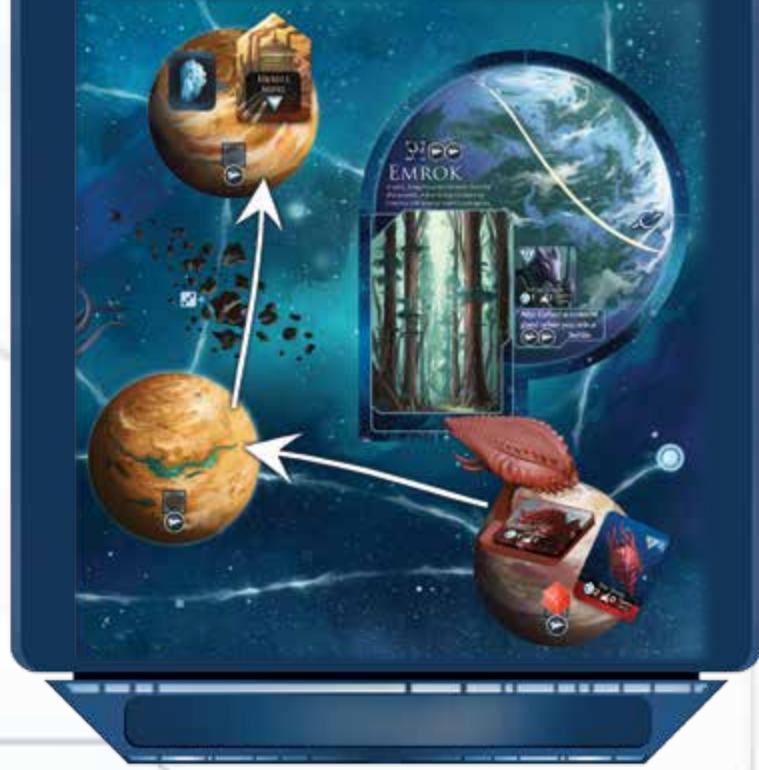
Passing an Opponent's Units: A group may pass another player's units or control cube without stopping. A battle does not automatically begin when passing.
Non-Planet Board Regions Wormholes: All Wormholes are adjacent to each other (connected by a space path). It costs one command to move between wormholes. Multiple groups can rest on wormholes without battling.
Trade Ship: When you end movement on the Trade Ship, you may immediately pay two credits to gain two random goods tokens from the supply. Multiple groups can rest on the Trade Ship without battling.
Space Nodes: Multiple groups can rest on space nodes without battling.
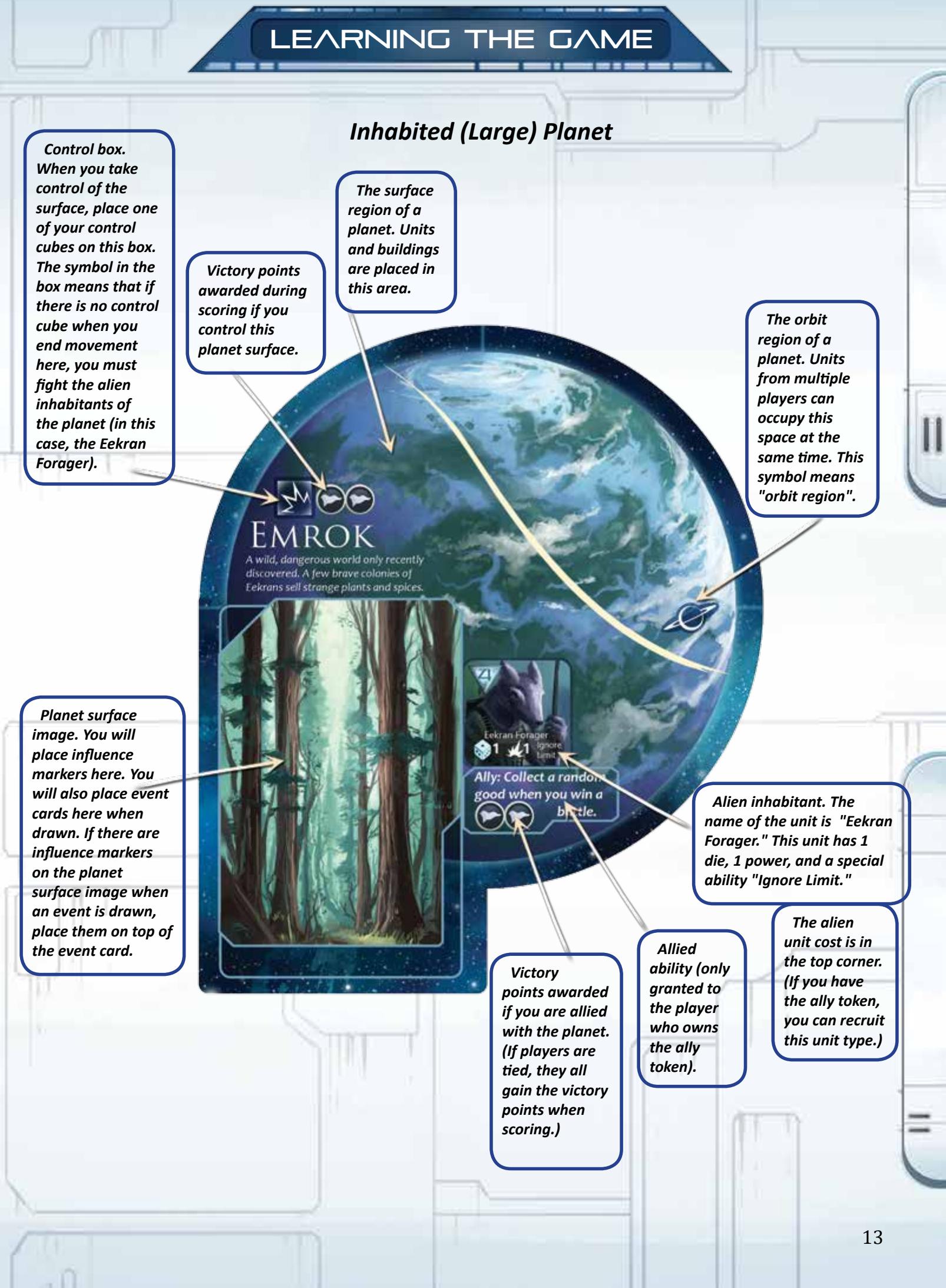
Two types of planets? There are two types of planets in the game, inhabited, which are large tiles that have two regions, and uninhabited, which are small and only have one region.
When you reach an inhabited planet, you can move to either the surface region or the orbit region. Once you end movement in one region, it costs one command to move between planet regions.
The surface region is on the left side of the planet. It contains the alien inhabitants, the ally ability, and a picture of the planet.
The orbit region is on the right side of the planet and contains no control box.
LEΛRNING THE GAME
Attack (Battle)
A battle is a contest between two groups of units owned by different players in the same region, or a contest between a group of units owned by a player and a neutral alien unit. Starting a battle can also be called "attacking.'
If you start the battle, you are called the attacker. The player that you are attacking is called the defender.
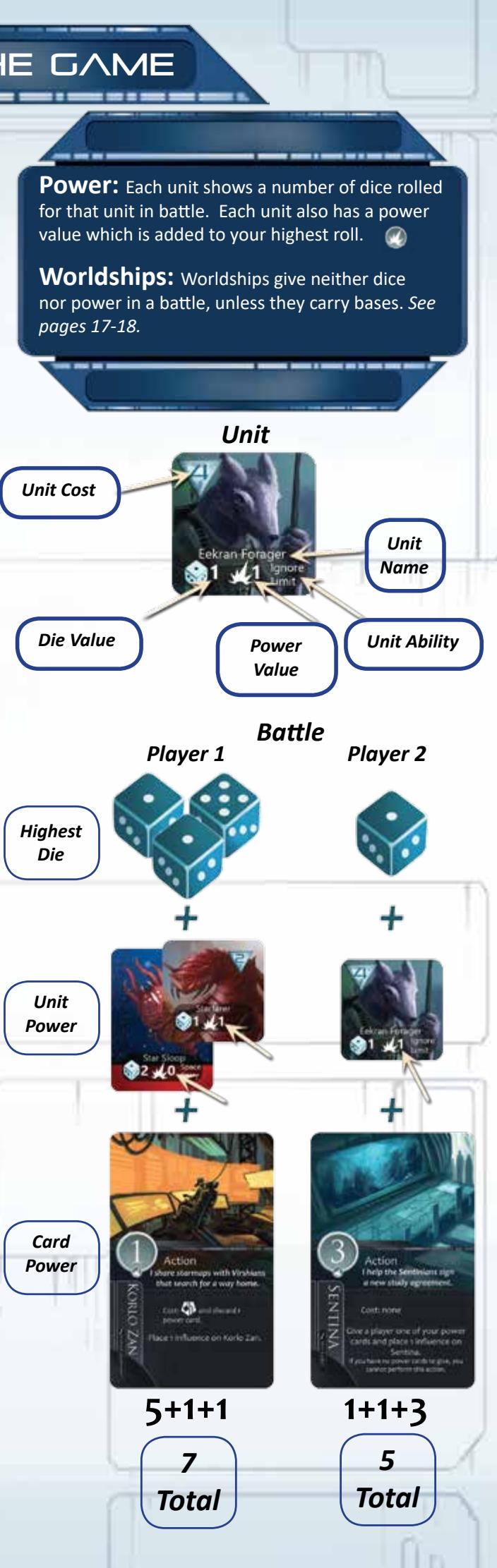
The winner of the battle is the player with the most "power". Each player follows these steps to determine their total power (simultaneously):
Steps of a Battle
1) Choose up to 3 of your units in the region to participate in the battle. (All other units remain on the space during the battle, but may not participate.) Any bases, whether on a planet or on Worldships that you have chosen to use in the battle, do not count toward the 3 unit limit, and may be used in the battle. Bases on the Worldship only count if you are using the Worldship as one of your chosen units.
2) Roll dice equal to the total dice value depicted on your 3 selected units (and any bases) in the region.
3) Take the highest result on one die from all of your rolled dice. This is your starting power. All other die results are ignored. Then add it to the sum of the power value depicted on all of your chosen units (and bases) in the battle.
4) You now must play a power card from your hand (if you can), placing it on the table, face down. When your opponent has also played a card face down (if they can), both cards are revealed simultaneously and you add the power value of your card to your power total.
5) The player with the highest total power (highest die + sum of unit power + power card value) wins the battle. Ties go to the defender. The winner places their control cube on the region (if there is a control box and their cube is not already there), and gains 1 victory point, marking it immediately on the victory point track on the board. The winner discards their played power card.
6) The loser can choose to keep their played power card OR discard it and draw a new card. The loser must also remove their control cube from the region, if it is there.
7) In most cases, units will not be destroyed in battle. The loser must, instead, retreat. They immediately move all of their units from the region to the nearest region containing one of their control cubes (if there are multiple regions that apply, the loser chooses one of them). If there are no regions with their control cube, they must move to the nearest empty space node.
Control of Regions
You earn victory points during scoring for regions that you control. Your control cube stays on a planet even if you leave no units there. It is removed only if another player ends movement there and takes control of the region.
Example: Battle
Harry moves a group that contains his Worldship and 3 Starfarers. He ends his movement on the surface of an inhabited planet that is controlled by Kim, who has a Starfarer and a base there, so a battle begins immediately.
First, Harry chooses 3 units to use in the battle. His Worldship has two bases on it, which means that if he decides to use his Worldship in the battle it would give him 2 dice and 2 power. He decides to use the Worldship and 2 of his Starfarers. Kim will use her Starfarer and her base.
Harry rolls 4 dice for his units, and the highest result is 5. His power from the 3 units is 4 (2 from his Worldship and 1 each from the Starfarers), so his result before playing a card is 5+4=9. Kim rolls 2 dice for her units, and the highest result is 6. Her power from her units is 2 (1 from her Starfarer and 1 from her base), so her result before playing a card is 6+2=8.
Harry plays a 3 power card face down. Kim plays a 4 power card face down. They both reveal the cards at the same time.
Their results are: Harry: 5 (highest die) +4 (power) +3 (card)= 12 Kim: 6 (highest die) +2 (power) +4 (card)= 12
Because Kim is the defender, she wins the battle! She gains 1 victory point immediately, marking it on the victory point track on the board. Harry must retreat to the nearest region that he controls. He moves back to where he started his movement, a small planet with his control cube.
Invading an Inhabited Planet If you attack the surface of an inhabited (large) planet, and it does not contain another player's control cube, the alien inhabitants defend their home! You will battle 1 of the alien units depicted on the region. The player to your left acts as the alien inhabitants: they roll as normal, and add unit power. Then they draw the top card of the power card deck face down as their power card. This card and your power card are revealed simultaneously, as in a normal battle, and a winner is determined. (If you draw an event, draw again until you draw a power card. Read any drawn events after battle.)
If you attack an inhabited planet surface region, you lose all of your influence there whether the region is controlled by another player or is uncontrolled, because the alien inhabitants do not like invaders! This occurs immediately, regardless of the battle outcome.
Sarkeen Regency?
Sarkeen Regency tokens are placed on the board to make the play area smaller depending on the number of players. You can attack them, but they are very difficult to defeat. Learn how to interact with them on pages 26-27 and 32.
Victory Point for Winning a Battle If you win a battle, you always gain 1 victory point, whether you are the defender or the attacker. If an ability or card that you play gives you 1 or more victory points for winning a battle, this is an additional reward to the standard 1 victory point. Be sure to count both!
LEΛRNING THE GAME
ACTION: Research & Build
This action allows you to research new technologies and expand your empire. When you research and build, you place goods on goods slots on your player board (this is called research) and also build any number of buildings from building rows on your player board (this will increase income, command, and hand limit, as well as giving you more victory points).
You may do these actions simultaneously on your turn (for example, you could place a good, build, place another good, then build again).
Research (Place Goods Tokens)
You may place goods tokens on any of the building tracks to decrease the cost of buildings in those tracks. The goods tokens must be placed from left to right. Once a goods token is placed on the left-most goods slot on a building track, all other goods placed in that track must be the same type, and you can no longer place that goods type on any other building tracks. See the diagram on page 18.
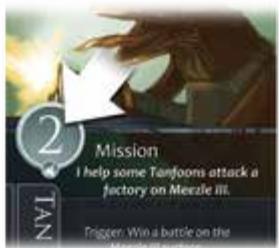
You can place goods on the six technologies in the upperleft corner of the player board to gain special abilities. The goods token placed must match the depicted good, and you must also discard power cards equal to the depicted power cost. You do not need to research technologies in any specific order. Once the good is placed and you have paid the power cost, you gain the ability listed above it, and you will also gain 1 victory point when scoring. For more details on techs, see page 33.
Goods: Goods are collected during game play. They are placed on the building tracks or on technologies on your player board to decrease building cost or research new technologies. When you gain a goods token, place it near your player board (or on the bottom area of the board). You may only place it on a slot on your player board during the research and build action.
Artifacts/Metal/Lifeforms

Power Card
Example: Research on Building Tracks
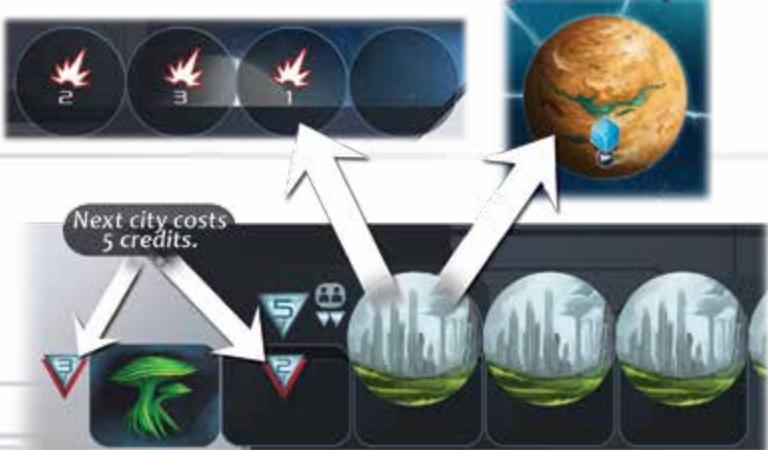
Tom places the lifeforms good token on the first goods slot on the cities track. This means that the cost to build the next city will be 5 instead of 7 credits. If Tom wants to place a lifeforms good on a building track in the future, it will have to be on this one. He could place a total of 5 lifeforms goods on the track by the end of the game.
Example: Research Tech Tom places a lifeforms good token on the "Parasites" technology. He discards a card with 1 power. Now he has the ability to place his parasite token on the board.
LEARNING THE GAME
Build a Building:
1) Choose a building you would like to build. It must be the leftmost in its row.
2) Pay the credit cost to the supply. The cost to build is the sum of all the credit symbols outlined in red to the left of the building token in the same row (before it is removed from the row). Goods can cover up some of these credit amounts, reducing the cost of all buildings in the row. See the diagram on page 18. Buildings are paid for and placed one at a time, meaning that each building has a unique cost, but you may build any number of buildings on your turn.
3) You may only build when you can place the new building on one of two places. First, you may place a building on any planet region you control that does not already have a building, (this means your control cube must be on the planet when you place the building). Second, your Worldship can hold three or four buildings, depending on your race. (Worldship building spaces are located at the top-left corner of your player board and can be used in any order). Once you purchase a building, place it either on your Worldship, or on a planet you control. Some Worldship spaces have a power symbol and number. To build on these spaces, you must also discard a power card or cards with a sum equal to the indicated power in order to place a building there.
When do you pay power?
You pay the power cost for Worldship spaces and technologies only at the end of your turn. Combine the total sum of power cost for everything you built or researched in that turn and then decide which cards to discard from your hand.
You cannot discard cards without using them. When discarding cards for power, follow this rule: You can use multiple cards to pay your total power cost as long as all of them are needed to meet the total.
Example: You need 2 power to build a city on your Worldship, and 2 power to research cloaking. Your total power cost for this turn is 4. You could pay a 4 power card, or a 2 and a 3 together. You could not pay a 4 and a 2, or a 4 and any other card, because the extra card isn't needed to meet the total.

What do buildings do?
When you build a building,
it reveals new symbols on
your player board. These can
include victory points which
you gain during scoring, credits outlined in red that increase the cost of the next building in the row, and various benefits.
Building Benefits
• Cities increase your income.
Bases give 1 die and 1 power to the owner when a battle takes place on the region where the base is located. Bases can also roll and participate in a battle even if other defending units are not present. Bases on a Worldship can participate in any battles in which the Worldship is used. Bases also reveal more action card symbols, increasing your hand limit.
Academies expand your command track. Each immediately adds 1 to your total available command when built.
If you lose control of a region that contains buildings, the buildings are not removed or destroyed. The player who controls the region now controls those buildings, but you retain any benefits from revealed symbols on your player board (for income, command, hand limit, and victory points).
If you lose control of a region with a base, the player who took control of the region now gains the battle benefits of that base (1 die and 1 power).
Each building token removed from a building track reveals one or more victory point symbols. These victory points are counted during scoring.
LEΛRNING THE GAME
Player Board
Power Cost
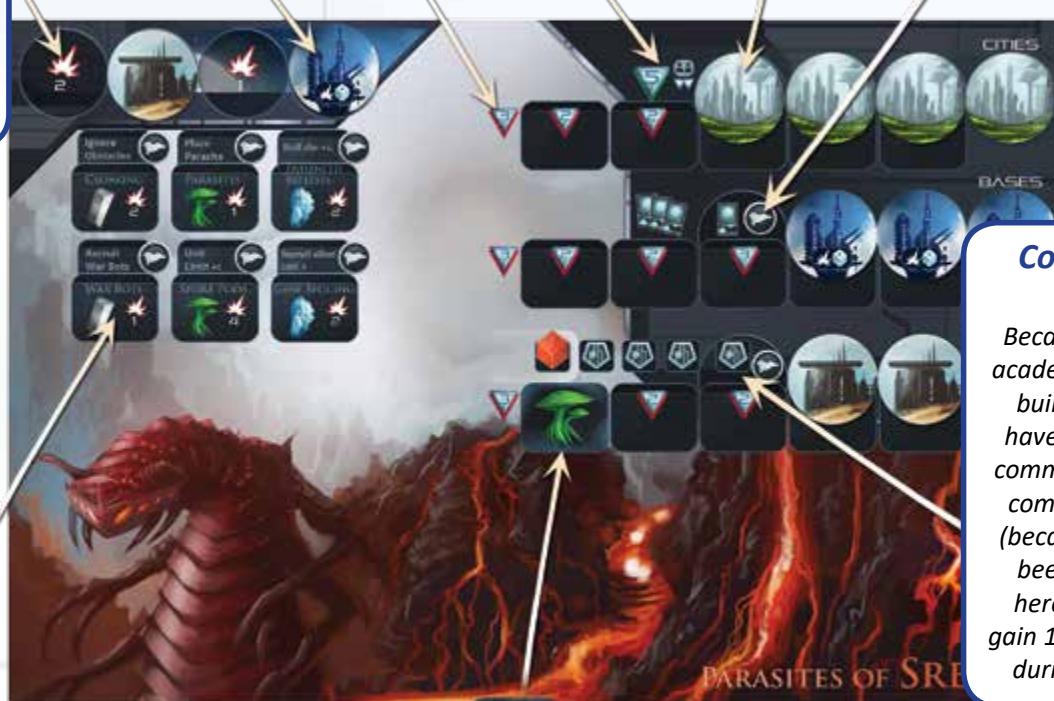
If you wanted to build here, you would have to discard a card or cards worth at least 2 power.
Technologies
These are called technologies. To gain this technology (War Bots), you place a metal goods token here and discard a power card with at least 1 power. Once you gain this tech, you can recruit War Bots units during a recruit action. Researching this technology also gives you 1 victory point during scoring.
Worldship Base
Because this base is built on your Worldship, your Worldship will have 1 die and 1 power if used in battles.
Base cost to build a city. This can't be covered by a goods token.
Income Starting income is 5 credits. If playing with only 2 players, income is 7 credits.
Building
This city costs 7 credits to build. (Building cost is the sum of all visible credits with red outlines to the left of the token on that track).
Hand Limit

Command Track
Because the first base in this row has been built, you now have a hand limit of 4 power cards (instead of the starting hand limit of 3). You also gain 1 victory point during scoring.
Because the first
academy has been built, you now have a total of 4
command on your command track
(because one has been revealed here). You also
gain 1 victory point during scoring.
Goods Tokens on Building Tracks
Placing a lifeforms goods token on this track decreases the cost of all buildings on the track. The next building would cost 7 credits. When
placing goods on building tracks, you must place them from left to right.
Remember, now that lifeforms is the first good in the track, all remaining
goods placed on this track must also be lifeforms. Additionally, lifeforms cannot be placed on either of the other two tracks.
Spending Command
When spending command, move the control cube along the track from left to right. Each time you "reset your command" you move the cube back to the left-most, blank starting space.

If playing with two players, you have one more command on the track (and
must use a command track token to extend the track). Any time an ability in the
game increases your command track (that is not because you built an Academy)
you must use command track tokens to increase it by the appropriate amount. For
example, if you are playing with two players and start with one extra command, and gain an ability in the game that also gives an extra command, your track would need two extra command spaces, so you would place a command track token on your player board that has two extra command on it.
ACTION: Card Action or Diplomacy
Play an action card from your hand, perform a planet event action, OR attempt diplomacy using any of your power cards.
Card Action
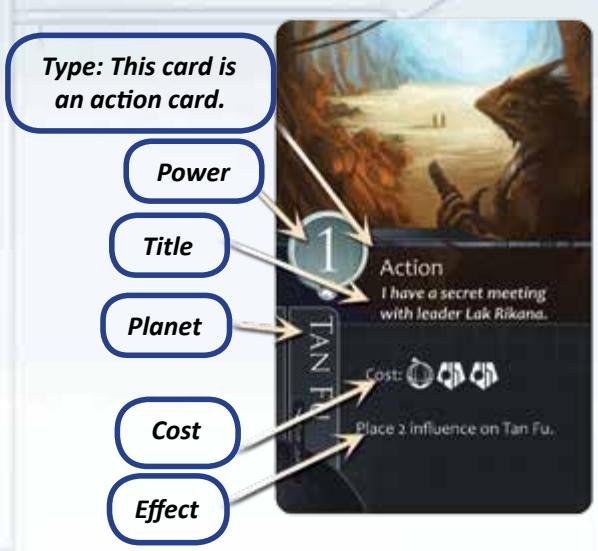
First, pick an action card from your hand to play. The card must say "Action" on the side bar. (There are three types of power cards: the first is action cards, which can be played as actions on your turn. The other two types, delivery cards and mission cards, are played under certain conditions and are described on pages 23-24). When you play the card, reveal it and read the title.
To play a card, you must pay any costs and/or meet any requirements listed on the card.

Presence: You must have at least 1 unit on the surface or orbit region of the associated planet.
Command: You must pay 1 command per command symbol, marking it on your command track on your player board.
• Credit: You must pay 1 credit per credit symbol to the supply.
Goods Token: If the cost has a symbol of a good type, you must pay one unused token of that type to the supply. Goods tokens that have been placed on a building track or on a technology are considered already used and may not be spent.
• Other: There may be other costs or requirements which will be specified on the card in text.
After paying for the card, follow the effect instructions. (For questions about specific action cards, see page 34.)
Influence and Allies
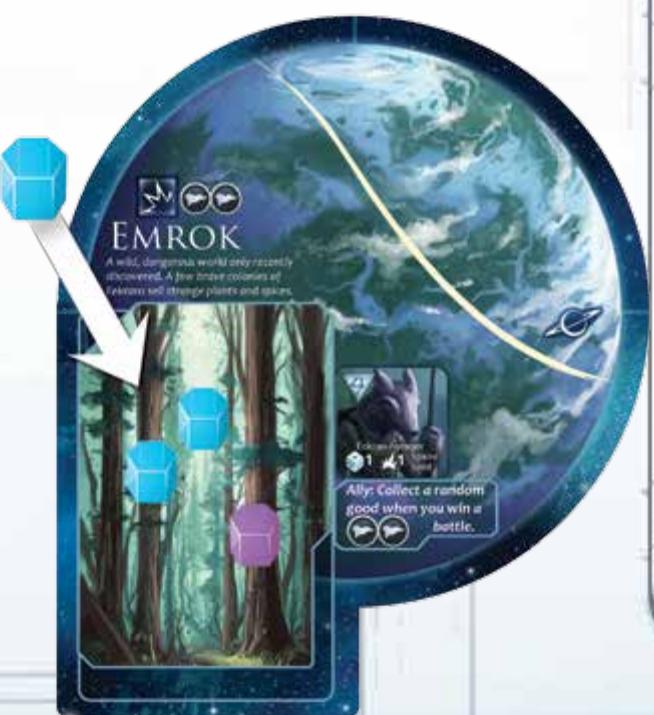
Many cards direct you to place influence on a system. You also place influence when using diplomacy, (described later in this section). Always place any influence tokens on the planet illustration on the game board (pictured right). If there is an event card on this box, influence is placed on top of the event card, on the card illustration, so as not to cover any card text.
If you have the most influence in a system, you are allied with the inhabitants and you immediately claim the appropriate alien ally token and any unused alien unit tokens related to the system. These are placed near your player board.
Power Cards
REMEMBER! Use your card actions, even early in the game! Card actions are the best way to place influence on planets. In many cases you do not even need to have a unit on the specified planet. Gaining allies through influence gives you a lot of victory points, and allows you to recruit powerful units.
LEΛRNING THE GAME
If players are tied for influence on a system, the player who currently controls the ally token retains it. Any opposing player must place AT LEAST ONE MORE influence than the current ally to claim the ally token. An ally token gives a number of benefits to the player who owns it. These are:
When performing the Recruit action, you may recruit the allied alien units. Even if you lose the ally token later, you do not lose any of the alien units you have already recruited.
Each ally token gives a special ability, listed below the picture of the alien unit. The ability applies to you as long as you retain the ally token.
The player with the most influence in each system is also awarded a number of victory points during scoring, as depicted below the allied special ability on the planet tile (see page 13). If multiple players are tied for the most influence, they all gain the victory points.
For questions about specific allied abilities, see pages 33. For questions about specific action card abilities, see page 34.
Unit Cost
Ally Token
Unit Name
Unit Dice, Power, and Ability
Allied Ability
Ally: Collect a random good when you win a
EMROK
Planet Name
Event Card Actions
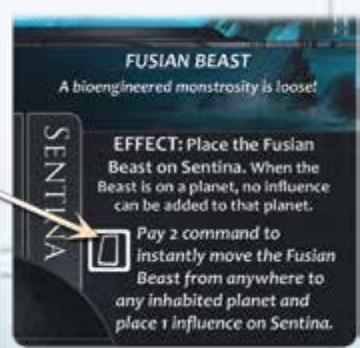
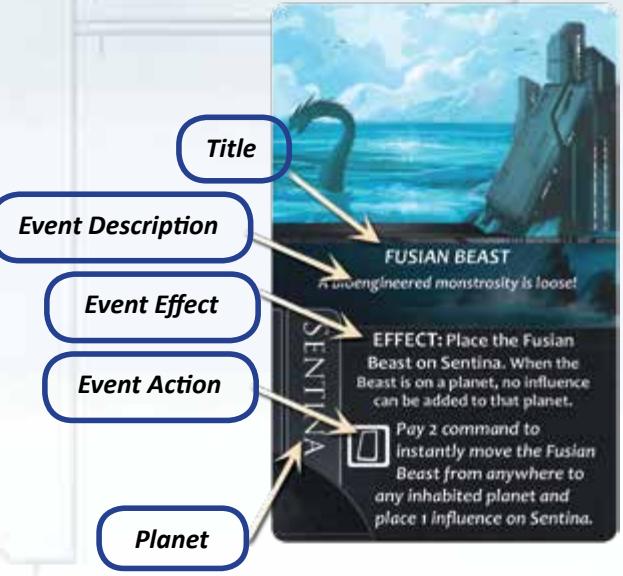
If an event card on a planet has the card action icon (as pictured below), you can perform the described action as your "Card Action or Diplomacy" instead of playing an action card. You do not need to have any units on the planet surface or orbit regions unless the card has the presence icon (see page 19), or says otherwise.
For more details on specific event cards, see page 34.
Example: Action Card Tom plays an action card from his hand and reads, "I purchase stock in one of the five great corporations." He then pays the cost, which is one command (which he marks on his player board) and two credits (which he returns to the supply). He then follows the effect text, placing one of his influence markers on Meezle III. Because he is the only player with influence on Meezle Il, he is allied with the planet and takes the ally token along with any unpurchased unit tokens (Mazron Agents), which he can recruit at a later time.
Influence: Each large planet is inhabited by a unique alien species. To ally with this species, you must gain influence on their planet. Place influence markers on the planet surface image on the game board. When you have the most influence on a planet, you are its ally. You now have the allied ability and may recruit the allied alien units. See page 21.
Example: Event Card Action Megan is the active player and plays an action card. It is now Tom's turn and he decides to follow Megan's action. Instead of playing an action card from his hand, he decides to perform the Fusian Beast action which is currently on the planet Sentina. He pays 2 command and moves the Fusian Beast token to the planet Corzar. He then places an influence token on Sentina.
LEΛRNING THE GAME
Diplomacy
You may attempt to place one influence marker on any system in the game using diplomacy. You do not need to have any units on the planet surface or in orbit.
First, choose any number of power cards from your hand and play them face up. Then roll a die. If the die result is equal to or lower than the sum of the power numbers of all cards played, you place one influence on the system of your choice. If you have more influence on that planet than any other player, claim the ally token, as detailed on pages 19-20.
The cards played do not need to match the system name. Any played cards are discarded, regardless if you succeed or fail. If you fail, you do not place an influence on the system.
For more on card effects and meanings, see page 33.
ACTION: Recruit Units
You may pay for units and place them on the board, which is called "recruiting." You may recruit as many units in one turn as you can afford, paying the unit cost to the supply for each unit you recruit. Unit cost is listed in the upper corner of each unit token.
Once paid for, immediately place recruited units on the board. You can place recruited units on any region that contains your Worldship, or on a planet region that you control that also contains at least one building.
During the recruit action, you may recruit your Starfarers and Star Sloops. Each ally token you own allows you to recruit a new type of unit as well.
Recruiting as the Active Player
If you are the active player and you choose to recruit, you may also draw two cards from the Empire card deck. You look at these cards and choose one of them to keep, discarding the other to an Em-
pire card discard pile face up. You keep Empire cards in your hand secret until you reveal them when scoring. Empire cards can be scored up to two times in the game, and you must meet the requirements for the card at the time of scoring in order to gain the victory points.
Unit

Unit Cost
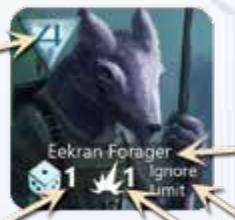
Unit Name
Die Value
Power Value
Unit Ability
No Sarkeen Regency Influence: Planets that have a Sarkeen Regency token cannot hold influence. You cannot add influence to them through either Diplomacy or any card or event action, even if they are defeated.
Note on Diplomacy: This action is not the most efficient way to place influence on planets. It is meant to be a way to place influence on a system even if you do not have a card specific to that planet, and also allows you to get rid of any power cards that you may not want or need for their actions or effects. Because you are not allowed to simply discard cards without using them, this is a good way to refresh your hand if you need new cards.
Example: Diplomacy Anthony wants to place influence on Tan Fu, so he chooses two cards from his hand with powers 2 and 3 (for a total power of 5). He plays them face up on the board and rolls a die. He rolls a 4, which is less than his total power, so he places one influence token on Tan Fu and discards his used power cards. Mel is already allied to Tan Fu with one influence. Anthony is now tied with Mel, so he does not yet claim the ally token. He and Mel would both gain the allied victory points at scoring if still tied.
LEΛRNING THE GAME
ACTION: Scavenge
This action allows you, as the active player, to refresh. This means resetting your command, collecting income, and drawing cards. Normally, the refresh action is reserved for other players as a follow action, but if you choose Scavenge on your turn, you and all other players may refresh. Refreshing is described below. If you choose this action, you must refresh, but other players may choose either to refresh as normal, OR do any action by paying only one command. (Normally, doing any action other than the action chosen costs two command.)
Follow
As a reminder, once the active player has taken their action, all other players decide whether or not to follow that same action.
If you choose to follow, you perform the same action as the active player. If you choose not to follow, you either refresh or take any action at a cost of 2 additional command.
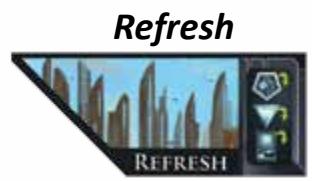
Refresh
If you choose not to follow the active player's action, you may refresh instead. To refresh, you reset your command, collect income, and draw cards.
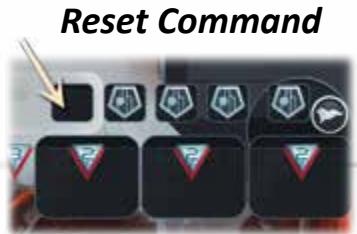
Reset Command
First, reset your command track. Take the cube on the track showing your current command and place it on the left-most, blank space at the start of the command track.
Income
Collect your current income, which is shown at the top of your player board. In the example to the right, you would collect 5 credits (or 7 if playing with two players). If you had built your first city, your income would be 6 credits (or 8 credits if playing with two players). Building cities increases your income.
Your current income is the right-most visible amount on the income track. You do not add amounts from all income symbols on the track.
Some other abilities you gain during the game give you extra income, so be sure to account for these when collecting income. There is no limit to the number of credits you can hold.
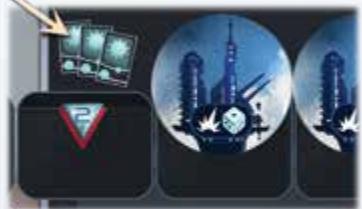
Draw Cards
Draw power cards from the deck up to your hand limit. (Your hand limit is 3 cards at the start of the game, but can be increased by building bases.) You may not discard power cards before drawing, or at any time unless they are used for an action, mission, delivery, combat, or diplomacy.

3 Cards
LEΛRNING THE GAME
Building bases can increase your hand limit. For each card symbol revealed on your player board when a base is built, your hand limit increases by 1.
If the power deck runs out, reshuffle the discard pile to make a new draw pile. This triggers the end of the game, and is described further on page 25.
Drawing Event Cards
If you draw an event card, read the title, event description, event effect, and event action out loud. Then place it on the image of the planet surface on the matching planet tile. If there are any influence markers there, place them on top of the event card. Event card effects are immediate and last as long as the card is on the board.
After you read and play an event card, you should immediately draw again, so that you reach your hand limit.
If you draw an event card during a combat, set it aside and draw again. Once the combat is over, read and play the drawn event cards. Events take effect after the battle is complete.
For questions about specific event cards, see page 34.
Any Action (Non-Active Player)
If you are not the active player, and you choose not to follow or refresh, you may pay two command (in addition to any action costs) to take any action.
MISSIONS (POWER CARDS)
A mission is a type of power card which is not played as a card action. Instead, you play it immediately when you meet the requirements described in the "trigger." You then follow the instructions below the trigger, gain a reward, and discard the mission card. If something you do in the game triggers two of your mission cards at the same exact moment, you may only play only one of them.
Example: Kate has two mission cards with the following triggers: "Build a building on Emrok," and "Build an academy." On her turn, she builds an academy on Emrok. She may only play one of these mission cards for this action, even though she has met the requirements for both. She plays the "Build an academy" card and gains 1 influence on Silast as her reward.
Event Card
Mission Card

LEΛRNING THE GAME
DELIVERIES (POWER CARDS)
A delivery is a type of power card which is not played as a card action. Instead, you play it face up in front of you when you pick up a certain cargo specified on the card. Each delivery has a "pick up" requirement and a "drop off" requirement.
Pick Up: When you end a group's movement at the specified location (orbit or surface), play the card face up on the table near your player board and place a cargo token from the supply with the group on that space. If you begin your turn already at the specified location, you must spend 1 command and a move action to "end movement" there so you can pick up the cargo, even if you don't actually move the group. You do not automatically pick up cargo if you get a delivery card but are already on the pick up location.
Destination: Now you must move the cargo token with a group to a specified location (orbit or surface) to complete the delivery. As soon as the group carrying the cargo ends movement on the specified location, you deliver the token (before any battles or other actions take place). You gain the rewards listed on the delivery card, discard the delivery card and return the cargo token to the supply. You cannot simply move past the specified location to deliver the cargo--you must end movement there.
Any unit can carry cargo, but the cargo cannot be left without a unit to carry it (on a region by itself, for example). A building cannot hold cargo by itself.
Stealing Deliveries: While you hold cargo in a group on the board, if another player attacks that group and wins a battle, they may choose to steal the cargo from you along with the delivery card. Now they can complete the delivery, unless you or another player steals the cargo from them.
Each player may only hold one cargo token at a time (anywhere on the board). You may not have two different groups with two different cargo tokens. If you pick up a new cargo token and you already have one, you must discard your previously played, uncompleted delivery card and undelivered cargo token. If you have one cargo token on the board, and you attack another player to steal their cargo token, you must discard your first cargo token and delivery card if you win the battle. In other words, if you choose to acquire a second cargo token, you are choosing to discard your first along with its delivery card and reward.
COLONIZATION CARD
At the start of the game, you are given a Colonization card. At any point in the game, before the Score card is drawn from the power deck, at the end of your turn, you may choose to discard this card to collect victory points, as detailed on page 25. You do not need to be the active player to do this. You may only use this card once per game. When you play the card, you may also pay two credits to draw an Empire card, and you may recruit one unit (paying the standard unit cost).
Delivery Card

Cargo

Delivery Timing: When a player ends movement to deliver cargo, they must deliver the cargo and gain the rewards before starting a battle there or picking up a good token.
A player may deliver a good and pick up another good on the same turn (if picking up the new good is on the same planet that they delivered to).
LEΛRNING THE GAME
SCORE CARD (POWER DECK)
When the Score card from the power deck is drawn, it signals that, by the end of the round, you must play your Colonization card if you have not already played it. When you draw the Score card, set it aside and then complete your draw as normal. Then continue game play as normal until the round ends (so that all players have had an equal number of turns).
When the round ends, any players who have not yet used their Colonization cards must play them and score VPs. If you have already played your Colonization card, you do not score again at this time.
SCORING
The amount of victory points collected during scoring is determined by the following:
-
Building Tracks: Each building you have built gives one or more victory points, which are revealed when you remove the building token from your player board. (See page 18.)
-
Technologies: Each technology you have researched gives one VP. Also, some technologies give extra VP as their power. (See pages 18 and 33.)
-
Influence: Any inhabited planet where you have the most influence (or are tied) gives victory points. (See page 13.)
-
Control Cubes: Each planet region you control gives you a number of victory points. (See page 13.)
-
Empire Cards: If you have completed the requirements on any Empire cards that you own, reveal the cards now and gain the points. You may keep these cards and score them again on the final scoring if you still meet the listed requirements. (See page 34.)
GAME END
When the last card of the power deck is drawn, this triggers the end of the game. Play continues as normal until the player with the 1st Player card is the new active player. At this point, there is one more normal round of play for each player in the game, (with each player getting one last turn to be the active player). After this, the game ends.
Each player collects victory points at the end of the game according to the scoring rules listed above.
The player with the highest total sum of victory points at the end of the game is the winner!
If players are tied for victory points, the player with the most units on the board wins. If still tied, the player with the most influence on the board wins. If still tied, the player with the most credits wins.
Example: Colonization At the end of Kim's turn, she decides to play her Colonization card. She immediately scores victory points. On her building tracks, she has built a total of 4 buildings, revealing 4 victory points. On the board, she has the most influence on Meezle III, which gives 3 allied victory points. She also controls 3 planet regions, each of which gives 2 points. The total that she collects is 4(buildings) + 3(ally) + 6(planet regions) = 13 victory points.
Colonization Card: Why might you play this before the Score card is drawn from the action deck, which forces you to play it? You might be in a good position (for example, you have many allies), and you know there is a chance that your total victory points might be lower when the Score card is drawn, so you decide to score a little early. You certainly wouldn't want to score too early, but if nearly half of the power card deck has been drawn, you'll know that the Score card is coming soon and you can make a decision accordingly.
GLOSSARY
This section is a Glossary of all the rules for each aspect of the game. You do not need to read this entire section before playing the game. As questions arise, you can search in the appropriate section for answers.
Abilities: Any time an ability in the game (such as on a card or token) conflicts with a rule in this book, the ability takes precedence.
Action Track
Action Spaces: The five actions at the top of the action track are the actions available for the active player to choose on their turn. Other players choose either to follow the action chosen by the active player, or take one of the two actions depicted below the main action track: "refresh" or "any action for 2 credits."
Credits on Actions: At the beginning of the game, place three credits on each action from left to right according to the number of players. These credits encourage players to try different actions early in the game. Once taken, new credits are not added to the action track.
Symbols
The icons surrounded by red indicate which resources you may need to pay when taking the action. If they are accompanied by the word "exact," it means that you must pay these exact resources when taking the action. The potential action costs are not listed in any particular order.
The symbol in the bottom left corner of each action is the iconic representation for the action. It is not something you must pay to perform the action.
Active Player
If you are the active player:
You must choose an action on the action track and move the action token to it (place it on the picture).
You cannot choose the action that was chosen on the previous round (the action which contains the action token).
You cannot pass. You must choose an action, even if you cannot perform it.
If you want to refresh, you must choose the Scavenge action. If the Scavenge action was chosen last round, it is unavailable and you cannot refresh.
If you choose an action that contains a credit, you gain it immediately.
At the end of the round (after all players have had a turn), you pass the commander token to the player on your left, and that player is the new active player for the next round.
Ally Token
Must Exceed Influence to Claim
The player with the most influence claims the ally token. If players are tied, the player that has the token retains it. To claim an influence token from another player, you must place more influence on a planet than they already have there.
When you claim an ally token from another player, you take it from them immediately. When you recruit, you can only rec
Content is long; only the first part is inlined. Download the file or open the rules page for the full text.
Download MarkdownTexts are community-compiled or publicly released by publishers; copyright remains with the original authors. For personal reference only.