
Faiyum
At a glance
Rules, cards and Q&A (Chinese)
The rules, card data and player questions for this game are written in Chinese. Open the Chinese page to read them.
Where to find full rules
Full rules and card lookup are available in the cunlema app at cunlema.cn — pick this game and ask about any rule, card or turn you are unsure about.
Related games
Rulebook text (Markdown)
This game has 2 rulebook Markdown file(s) in our library; 2 rendered inline below — expand to read or download.
rules_zh_法尤姆_24093.md28.1 KB
·12 玫瑰
·2 宫殿
FAiYUM
一款在古埃及背景内的策略游戏
由Friedemann Friese设计
支持1-5人,适合年龄为12岁及以上
游戏背景
翻译 & 排版:陈斌华
这个类似绿洲的法尤姆盆地是 3900 年前人为建造的,它通过扩大与尼罗河相连的巴尔尤瑟夫海峡,形成了一个受管制的洪泛平原。在埃及中王国时期,这片沼泽地在阿蒙尼赫特三世和塞索斯特里斯二世等法老的庇护下慢慢地变成了农田。他们命令他们的顾问建造一个运河和堤坝系统,以开垦被沙漠包围和鳄鱼居住的土地,把它变成埃及的粮仓。
现在,在阿蒙尼赫特三世统治期间,你是法老的顾问,奉命收割货物,修筑道路,建立定居点,并为法尤姆做更多的好事!你得到了必要的人力、资源和金钱,这意味着如果另一位顾问需要使用“你的”道路、农场和其他建筑物,他们可能会这么做,因为你建造的一切都归法老所有。你将拥有的唯一东西是唯一重要的东西:法老的尊重。
《法尤姆》是一款为游戏规划爱好者设计的策略游戏。基本规则很简单:在你的个人弃牌堆上一张一张地打出你的牌。在打完一部分或全部牌后,你会以“反向”的打牌顺序把它们拿回到手上,所以以最好的顺序出牌很重要。新买的牌直接进入你的手中,所以获取和使用它们的时机也很重要。每一张卡牌都有简单易懂的行动,但只有创造出最好的组合“引擎”,你才能成为《法尤姆》的总顾问。
这个游戏的特点是这样一个卡牌机制,让人想起牌库构筑和成功应用于电厂的市场机制。获得越来越多的有价值的牌,使用游戏版图上的建造的建筑来为你添加优势 - 换句话说,为了你的声誉。最后,最狡猾并创造了最棒的卡牌组合的顾问将赢得《法尤姆》的胜利。
游戏配件
一盒《法尤姆》包括:
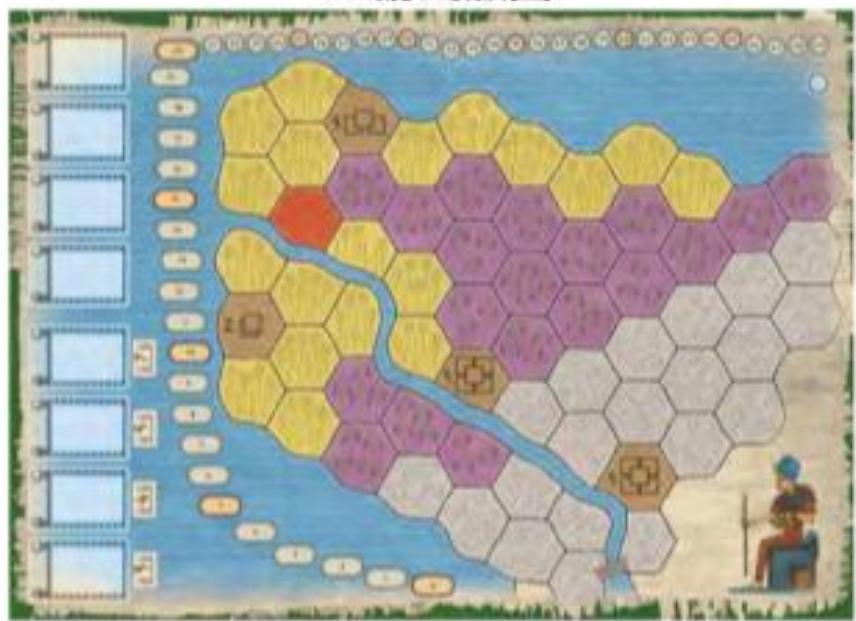
1 游戏版图
- 5 名声圆片(每名玩家各 1 个)
257 木质配件,包括:
·16定居点


·10 工坊
·8城镇

- 10 "5" 元指示物



-26 "1" 元指示物
- 5 "10" 元指示物
·30 工人
·20小麦
·5 扩展
·20 葡萄
·20 石头


50 纸板指示物,包括:


- 5 名声指示物 “50/100”(每人各 1 个)





·15 建筑砖块

50
2 本规则手册和 2 个词汇表(英语和德语)

-4"-1"折扣指示物

•40 道路

•4 桥梁

·2 特大桥梁


·38 鳄鱼

•12 德语和英语版管理概述卡(其中10张用于2-5人游戏,还有2张用于单人游戏)
106 张卡牌,包括:
·25 起始游戏卡,标记着“S”(每人5张)
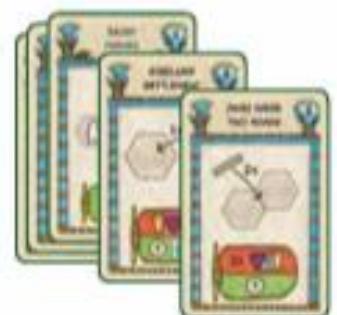
•69 编号游戏卡(56 张蓝色边框和 13 张黄色边框)
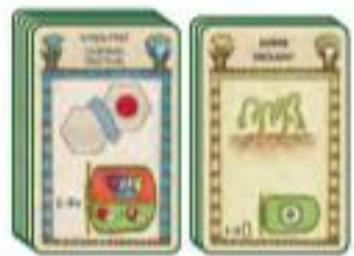
编号卡的号码是从2到128的单独偶数。(我们希望能选择出其不意地出扩展!)


游戏设置
将游戏版图放在桌子上。
A 将一个定居点放在红色区域上,并将一个道路放到2个半岛之间的水坝上
B 在每个小麦(黄色)和葡萄(紫色)区域放置1个鳄鱼。
每名玩家选择一种颜色并拿取匹配颜色的起始卡牌。名声圆片和“50/100”名声标记以及一张管理概述卡。
你需要在你面前预留你的个人游戏区域,将管理概述卡放在游戏区的一侧。在游戏中,你也有一个个人弃牌堆用于放置你打出的卡牌。
D 将你的名声圆片放置名声轨道“0”格,将你的“50/100”名声标记放在名声轨道的终端旁。
E 拿取你的起始卡牌上手。
4 人游戏举例
起始玩家
第四玩家
按如下步骤准备抓牌堆和卡牌标记
F 拿取 13 张黄色边框卡牌并将编号 114-120 的卡牌放在一旁。你现在手中有编号为 122-128 的自然灾害卡片的多个版本。只保留你当前玩家人数列举的 4 张卡牌,并将其余 5 张放回盒子里。将这 4 张卡牌放在编号 114-120 卡牌顶部,然后将其放在一旁。
G 洗混 56 张蓝色边框编号为 2-112 的卡牌,将它们正面朝下放置作为抓牌堆。从抓牌堆顶部抓取12张卡牌,并按编号从低到高正面朝上分类。将8张较低编号的卡牌正面朝上按升序放在卡牌市场区域上,从最低编号开始放在左边,一直向右递增放置。
| 卡牌编号122-128 | |
| 2人游戏 | 6,0,0,0名声 |
| 3人游戏 | 10,6,0,0名声 |
| 4人游戏 | 10,6,3,0名声 |
| 5人游戏 | 10,6,3,1名声 |
给予每位玩家一个机会检查最高的4张正面朝上的蓝色边框卡牌,然后将它们与8张黄色边框卡洗混放在一旁。将这12张卡牌作为单独正面朝上“最后回合”牌堆放在抓牌堆旁边。

在市场对 4 张最低的卡牌降价
① 在 4 张卡牌上各放 1 个红色折扣指示物。
选择一位玩家成为起始玩家!
J 起始玩家拿取 3 元钱,第 2 和第 3 玩家拿取 4 元钱,第 4 和第 5 玩家拿取 5 元。
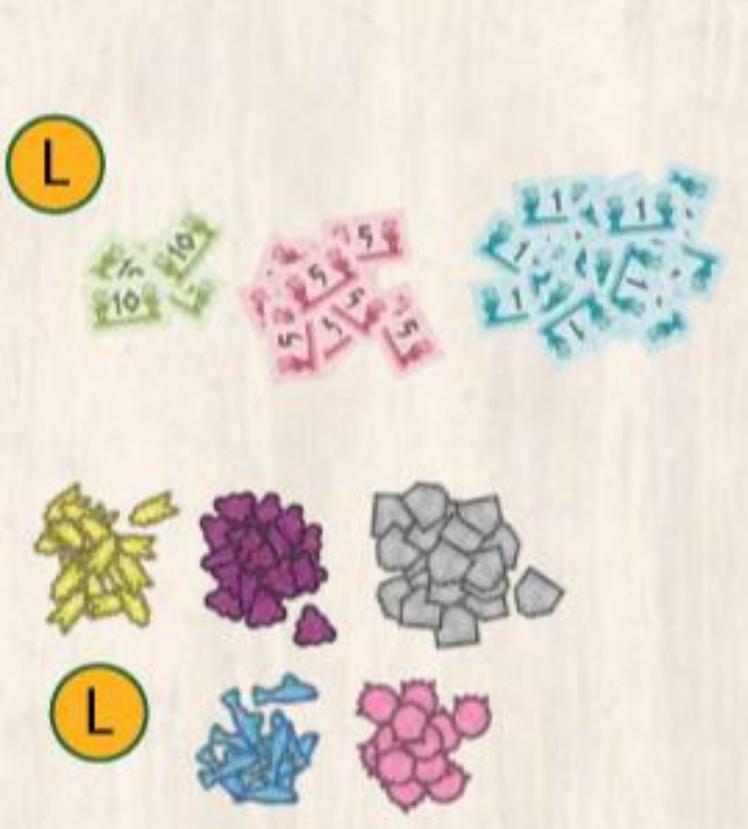
将木质配件和钱币指示物根据其数量是有限还是无限来分别放在游戏版图两旁的供应堆。
K 这些配件是有限的:工人,定居点,城镇,工坊,扩展,道路,桥梁,巨型桥梁,建筑砖块和宫殿。
小麦,葡萄,石头,鱼和玫瑰资源和钱币指示物是无限的,所以如果你需要比供应堆更多的指示物,请使用其他东西来代替。
你现在可以准备开始《法尤姆》!
游戏版图
游戏版图展示了法尤姆的地图,一个卡牌市场和一条名声轨道。
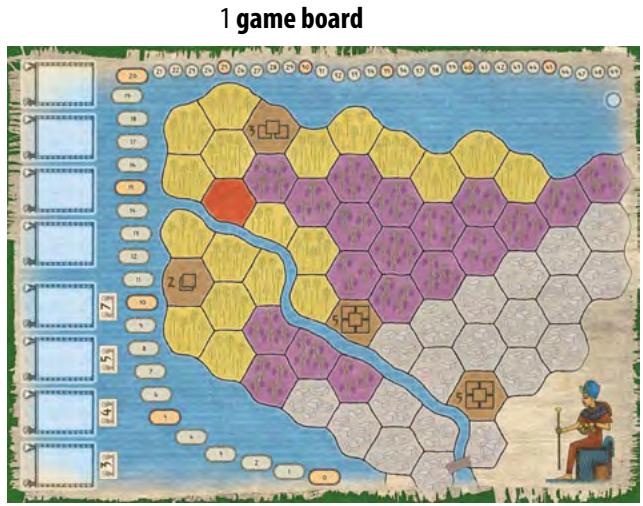
- 巷道将法尤姆分为 2 个单独的半岛,这 2 个半岛只被水坝连接。半岛也被湖泊环绕着。
- 在半岛上的格子可以与其他位于同一个半岛的格子相邻,但与航道对面的格子是分开的。
· 用于葡萄(紫色),小麦(黄色)和石头(灰色)的资源格子是未开垦的;此外葡萄和小麦格子是沼泽区域并且在游戏开始时有鳄鱼在上面。石头区域在更高,干燥的地面上,因此没有鳄鱼。
红色格子是用于定居点的,水坝两边的格子通过道路来连接,4个棕色的建筑区域没有鳄鱼并且已经被开垦。建筑区域展示了将要建造的纪念碑的草图,并用数字表示每个区域可以放置多少块建筑砖块。

·卡牌市场展示了8张卡牌区域,分为2组:4个展示价格的区域用于当前市场内的卡牌,另外4个区域将提供稍后在游戏中可供购买的卡牌。
- 名声轨道展示了你在游戏中获得的名声。
卡牌
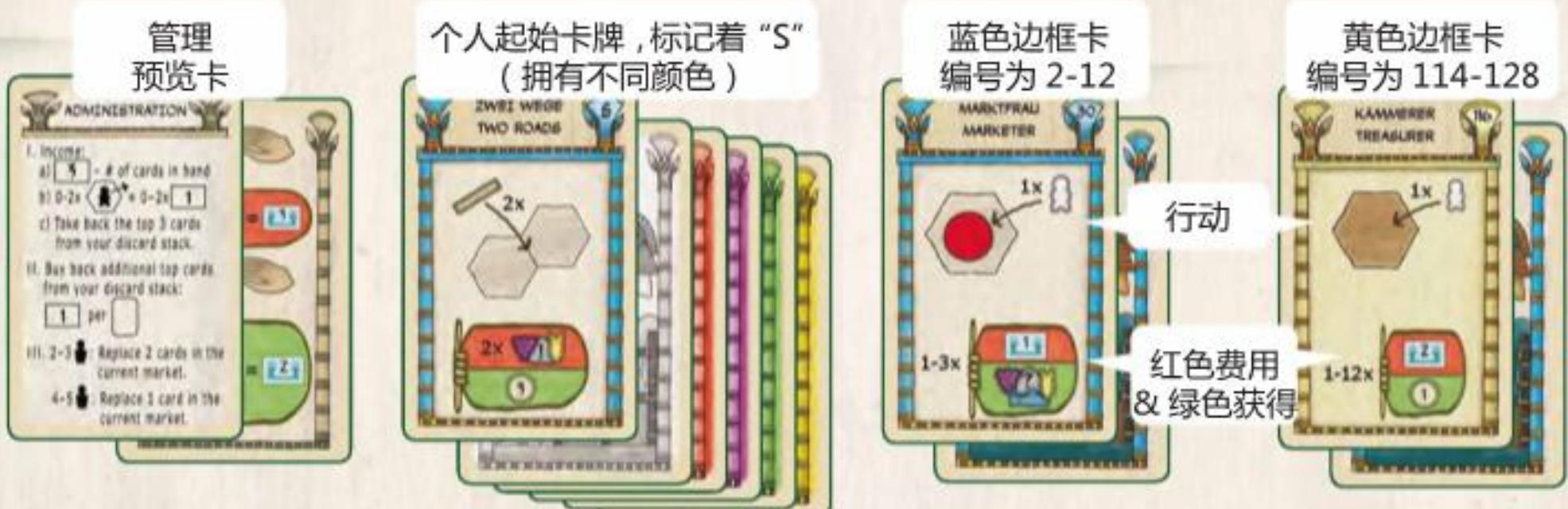
游戏包含 2 种类型的卡牌:
- 管理概述卡展示了你何时使用管理行动。这些卡牌的背面提醒你使用卡牌时的两个一般规则。
- 打出的卡牌分为3组。个人起始卡牌标记“S”的背面颜色是5位玩家的颜色。蓝色边框卡牌和黄色边框卡牌具有相同背面并且列举了从2-128的单独偶数。所有三种类型的卡牌都是以同样的方式打出。
·每种打出卡牌的名字下方描述了一种行动,你必须在打出这张卡牌时执行该行动。如果指示的是红色费用,你必须支付这个费用来执行此行动。如果指示的是绿色获得,你必须在执行这个行动时获得此资源。所有打出的卡牌会在词汇表里有详细描述。
2-5 人游戏 VS 单人游戏
在 2-5 人游戏中,我们已经在前几页解释了游戏准备,并将在下一页解释所有规则。
当进行单人游戏时,你只需要在游戏设置和玩游戏时做一些改变。你可以在本规则手册的最后一页找到这些变更。当你名声轨道上记录你的名声时,在2-5人游戏中使用你的个人“50/100”名声指示物将帮助你记录你获得的所有名声。当进行单人游戏时也是如此,你可以使用2个或更多“50/100”名声指示物。
如何玩这个游戏?
法尤姆的一般规则很简单,但由于卡牌上各种各样的行动,整个游戏变得很复杂。好消息!这些行动都在单独的词汇表中有详细的解释!在学习了一般规则并发现了你的起始牌和当前市场上卡牌的行动后,你就可以开始玩了。然后,每次一张新卡出现在卡牌市场上,你只需要在词汇表中检查它的行动,边走边学。
从起始玩家开始,按照顺时针方向进行,每当轮到你的回合时,执行以下3种行动中的一种:
a) 打出你手上的一张牌:使用卡牌上的行动或从中获得金钱,然后将卡牌正面朝上放在你个人弃牌堆顶。
b) 从卡牌市场购买一张卡牌:在支付了对应价格后,从当前市场拿取 1 张卡牌到你手牌。
c) 执行管理:获得收入,将你弃牌堆顶部的卡牌移到你手牌,然后替换卡牌市场里的卡牌。
持续进行回合直到所有 4 个自然灾害——编号为 122-128 黄色边框卡牌——都被放到卡牌市场最右侧区域为止,此时触发游戏结束。
在你继续学习规则之前,让我们先介绍一下罗纳德。你会在下面几页中看的他,如果罗纳德理解规则,那么每个人都会理解。多年的经验是百分之百的证明!
“是的,罗纳德,真的是每个人。谢谢你(再次)询问。。。”
a) 从你手上打出一张卡牌
在法尤姆中,这不像卡牌构筑游戏,你不会拥有熟悉的个人抓牌堆。取而代之的是,在游戏开始时,你的手上已经拥有所有卡牌并且能一张张打出它们。在你打出一张卡牌后,将其正面朝上放在你的弃牌堆顶部。
玩家通过将一张卡牌正面朝上放进你的游戏区域来从你手上打出一张牌。之后你有2个选择:
- 使用行动:你必须使用卡牌的完整行动来获得资源,金钱,卡牌和(当然)游戏的胜利名声。
“不,罗纳德,你不能只使用部分行动。如果要修建2条道路,则不能只修建1条。另外,你如何在名声轨道上记录1.5的名声?”
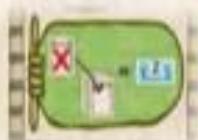
• 获得 \$2。如果你不能或不愿意使用卡牌的行动,则改为获得 \$2,从供应堆拿取金钱。
之后,将卡牌放到你弃牌堆顶部。你必须将这些卡牌按照堆叠的顺序摆放,第一张卡牌放在底部,而最后一张卡牌放在顶部。为了预览这些卡牌,你可以稍微露出卡牌的标题。
当你打出一张卡牌来使用其行动时,遵循这些规则:
- 你放置或建造在游戏版图上的所有东西是所有玩家的共同财产。也就是说,没有一个工人和建筑是你自己的或者说是属于你的。在你放置或建造任何东西后,任何人都能将其视为自己的东西来使用。
“不,罗纳德,就因为你建立了定居点,它不是你的。任何人都可以在那里放置一名工人。
· 资源,金钱和你通过打出卡牌获得的名声是单独属于你的。资源和金钱提供玩家用于行动和新卡牌的支付,而名声关于如何赢得《法尤姆》的胜利。
玫瑰是百搭资源。任何时刻你可以支付资源时,你可以用1个玫瑰代替任何所需的1个字眼。你只能从卡牌绿色方框列举中获得玫瑰。
“是的,罗纳德,你可以用2朵或更多的玫瑰来支付一次行动的费用,而每朵玫瑰都可以代替任何其他所需的1个资源,因为它们是百搭的!”
·卡牌提供4种类型的行动:收获行动,建造行动,贸易和“其他”行动。
· 资源通常来自提供收获行动的卡牌。这些卡牌让你竖直放置工人到未开垦资源区域①。麦田和葡萄区域仍然是沼泽地,到处都是鳄鱼,而石头区域则是在更高、干燥的地面上,因此没有鳄鱼。

当打出这些卡牌时,你获得资源并排干土地来移除上面的鳄鱼。作为提醒,这些卡牌在顶部两边都描绘了一个鳄鱼图标。
“是的,罗纳德,只要这些地方还没有开恳,你可以把这些工人放置在没有鳄鱼资源格子。
- 提供建造行动的卡牌让你开发没有鳄鱼的资源格子。在游戏开始时,起始定居点,4个建筑区域格子,以及2个在水坝上通过道路连接的石头格子都已被开垦。当打出这些卡牌时,你会建造不同建筑,比如定居点,工坊和道路②。你也可以将定居点升级为城镇或者放置建筑砖块到建筑地面上。在格子上的工人不影响建筑物,并保留在受影响的格子上。只要你在一个格子上建造东西,该格子现在就被开垦了,并且你不能在开垦的格子上使用收获行动。每个没有鳄鱼的资源格子可以容纳1定居点或1工坊,但不能容纳这2个建筑。
道路和桥梁通过连接半岛的格子创建了网络。他们要么从定居点或建筑工地开始,要么延伸另一条道路和桥梁,包括游戏开始时在水坝上的道路。道路和桥梁只能在定居点和建筑区域上分支③。
此外,你不能在一个资源格子上建造交叉路口。每当你建造第一个直接连接2个定居点,或2个建筑区域,或1个定居点和1个建筑区域的连接时,你获得1点额外名声。当你通过放置道路或定居点到已经连接的资源格子时你可以这样做。
“是的,罗纳德,当你连接定居点和建筑工地时,你只获得1个额外的名声,而不是每个地方都获得1个名声。第二次或第三次连接它们并不会给你带来任何额外的名声。是的,我们将在词汇表中再次解释这一点!”
- 对于所有提供贸易行动的卡牌来说,你将竖直放置工人在开垦过的格子④。你将在词汇表中找到所有卡牌的详细信息。
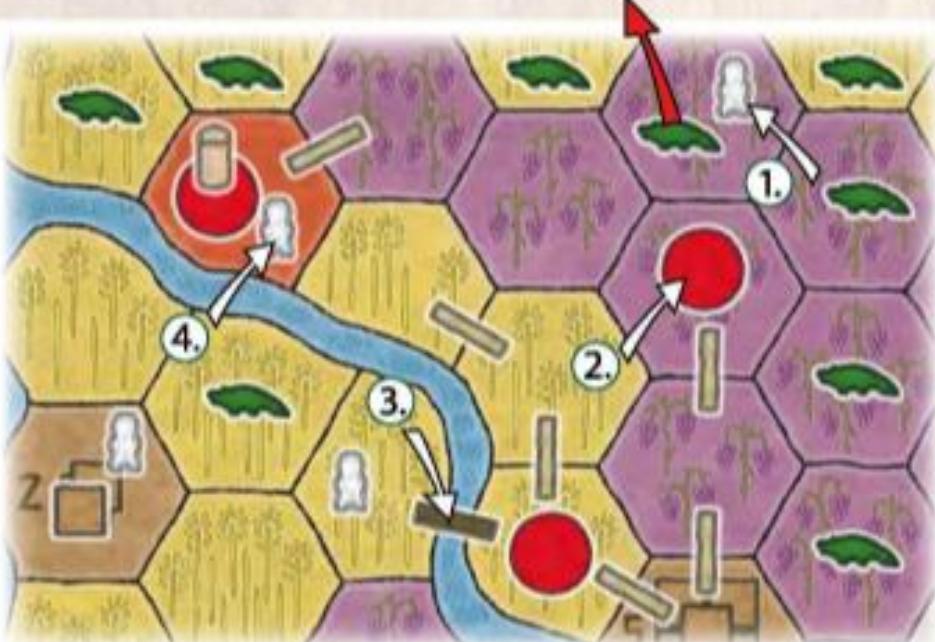
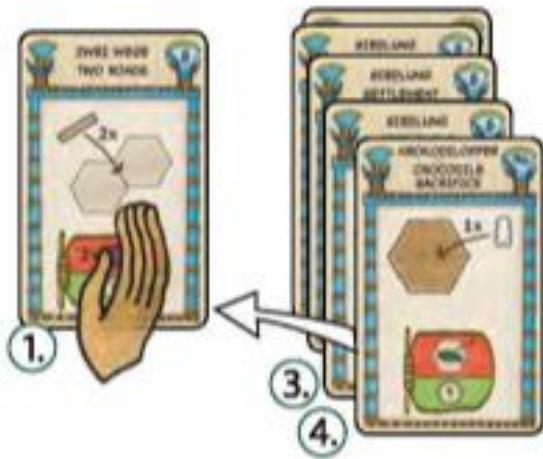
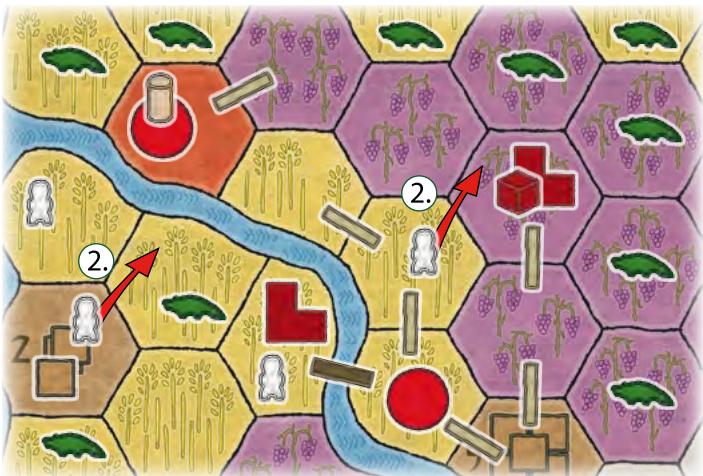
举例,海德薇执行收获行动并放置1个工人到一个未开垦资源格子上来收获1葡萄并移除鳄鱼来获得\$1①。安吉丽卡打出一个建造行动并放置1个定居点到一个没有鳄鱼的资源格子②。由于该格子已经直接连接建筑区域,她获得1额外名声。尼克尔通过另一个建造行动放置了桥梁,为定居点分路③。贝丝打出贸易行动卡并放置工人到定居点上,这里已经升级为城镇④。
- 游戏版图的每个格子至多能放置 1 个工人。所以当你放置一个工人到一个格子上时,该格子会阻碍其他收获或贸易行动直到上面的工人被卡牌行动或管理行动移除为止。
1 每当你需要支付资源时,你可以替代1个所需基础资源——你可以选择葡萄,石头或小麦通过支付\$3来代替。
- 游戏版图的每个格子至多能放置 1 个工人。所以当你放置一个工人到一个格子上时,该格子会阻碍其他收获或贸易行动直到上面的工人被卡牌行动或管理行动移除为止。
“不,罗纳德,你不能用建造定居点所得到的3美元来‘支付’比该行动所需费用少一块石头!”
重要提示:如果卡牌行动与本规则手册中解释的一般规则相冲突,则卡牌的规则始终有效。
b) 从卡牌市场购买一张卡牌
你赢得《法尤姆》的关键是从卡牌市场购买越来越多价值的卡牌来把不同的行动结合在一起。
卡牌市场上展示了8张卡牌,按照它们的编号升序分类。只有最低的4张卡牌称之为玩家可以购买的当前市场。最高的4张卡牌不能在游戏中被购买直到它们被移到当前市场为止。
当你执行这个行动时,从当前市场购买4张卡牌中的其中一张。支付卡牌下方的费用——\$3,\$4,\$5或\$7——然后将卡牌移到你手牌。你可以在之后回合打出这张牌。
如果折扣指示物在所选卡牌上,将卡牌价格降低 $1$ ,这样就只需支付 $2,3,4$ 或 $6$ 。之后将折扣指示物放到当前市场上方以便在下一次管理行动中被任何玩家再次使用。
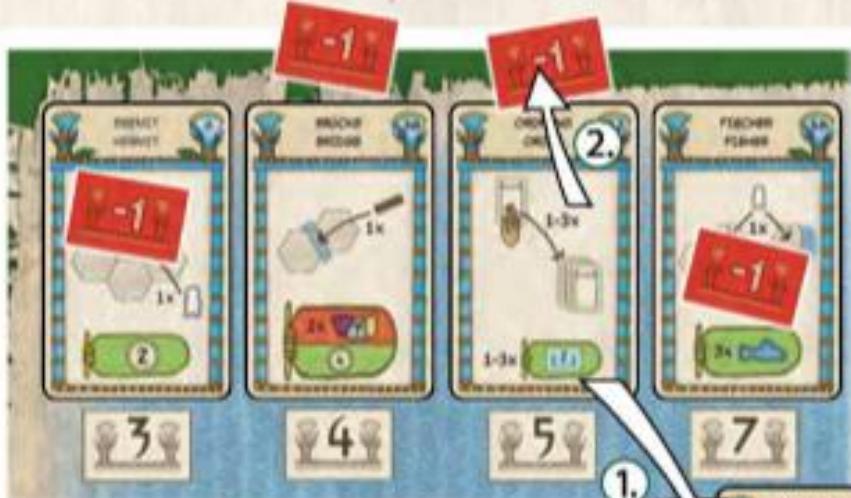
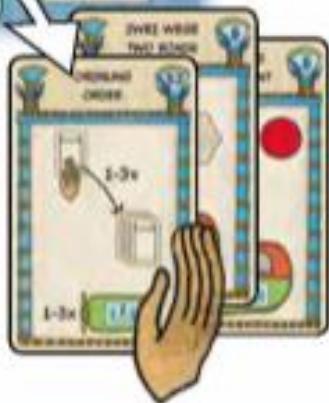
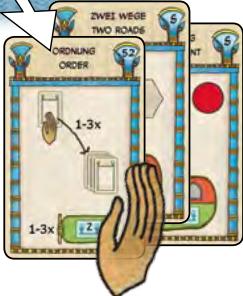
举例:安吉丽卡购买卡牌ORDER ①并将其加入手牌。安吉丽卡支付 \$4 并放置折扣指示物到市场上方②以便用于任意玩家的下次管理行动中。
最后,从抓牌堆抓取卡牌并将其放置在卡牌市场内与
其他 7 张卡牌之中正确的位置以便所有卡牌又按照升序排列在整个卡牌市场内。
c) 执行管理
管理行动让你(可能)获得金钱,并且更重要的是,让你将你弃牌堆的卡牌移回手牌。因此,以最好的顺序出牌是至关重要的,这样你就可以把弱牌留在弃牌堆的底部,只取回更有价值的牌。
当执行管理行动时,执行以下3个步骤。您的管理概述卡提供了一个摘要作为提醒。
I. 获得收入:
a)首先,你获得你手牌数量-\$3数量的钱,从供应堆拿取这些钱币。如果结果是0或负数,则不拿取或支付钱币。“不,罗纳德,你需要失去钱币。最低可能收入是\$0。”
b) 然后,从游戏版图的任一区域移除 0 至 2 个竖立的工人并将他们放回供应堆。每移除 1 个工人就获得 \$1,从供应堆拿取这些钱币。
“是的,罗纳德,通过移除工人,你的队友将首先选择在这些空置格子上放置工人。我打赌他们会说‘谢谢你,罗纳德!’”
“是的,罗纳德,只要游戏版图的所有区域都有足够的工人,你通常会撤走2个工人。
c) 从你的弃牌堆拿取顶部的 3 张卡牌到你的手牌。如果你的弃牌堆少于 3 张卡牌,则拿取全部弃牌。不要改变弃牌堆剩余卡牌的顺序。
II. 购回更多卡牌:
现在你可以从你的弃牌堆顶部购买回来额外卡牌。支付\$1就拿回一张牌到你手上。你可以执行这个操作任意次,而且你并不局限于第一步所获得的收入。不要改变你弃牌堆中剩余卡牌的顺序!
III. 替换卡牌市场内的卡牌:
根据玩家人数,执行以下步骤:
2-3 从当前市场移除含折扣指示物的最低的2张卡牌并将其放回盒子里。
- 如果只有一张卡牌含有折扣指示物,改为在当前市场移除该卡以及另一张不含折扣指示物的最低卡牌。
- 如果没有卡牌含有折扣指示物,改为在当前市场移除2张最低的卡牌。
· 在当前市场内的剩余的每张还未放置折扣指示物的卡牌上放置一个折扣指示物。
·从抓牌堆抓取2张卡牌并将其与卡牌市场的其他6张卡牌按照合适的顺序摆放以便整个卡牌市场的卡牌都是按照升序排列。不要将折扣指示物放到新的卡牌上。
4-5 • 从当前市场移除含折扣指示物的最低的1张卡牌并将其放回盒子里。
- 如果没有卡牌含有折扣指示物,改为在当前市场移除1张最低的卡牌。
· 在当前市场内的剩余的每张还未放置折扣指示物的卡牌上放置一个折扣指示物。
·从抓牌堆抓取1张卡牌并将其与卡牌市场的其他7张卡牌按照合适的顺序摆放以便整个卡牌市场的卡牌都是按照升序排列。不要将折扣指示物放到新的卡牌上。

“是的,罗纳德,你说得对。在游戏中,您可以使用2到3个折扣指示物用在卡牌上。您只会在游戏开始时使用所有4个折扣指示物。”
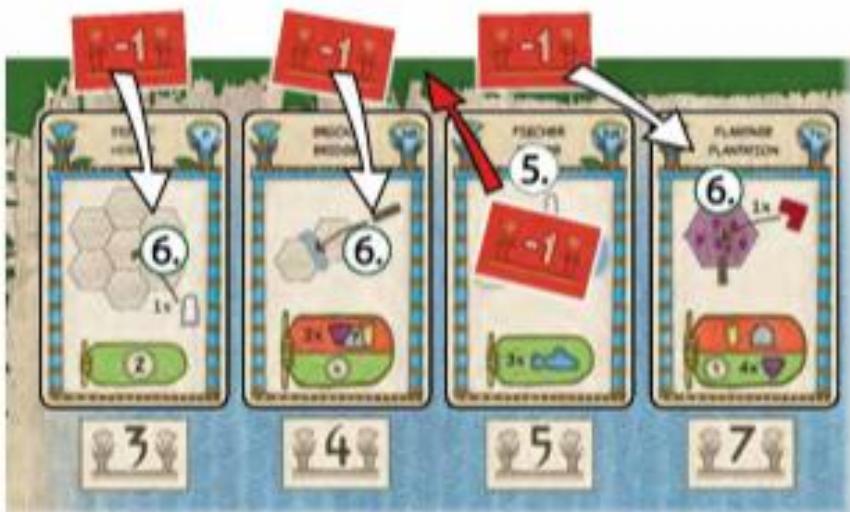
举例:在4人游戏中,安吉莉卡执行管理行动。
在“获得收入”步骤,她因为手上的1张卡牌而获得\$2①。其次,她移除2个工人并且获得另外\$2②。第三步,她拿回她弃牌堆顶部3张牌到手上③。
在“购回更多卡牌”步骤,安吉莉卡支付\$2来从她弃牌堆顶部拿回2张额外卡牌到手上④。
在 “替换卡牌市场内的卡牌” 步骤,她移除 FISHER ⑤,因为该卡含有 1 个折扣指示物(在 2 或 3 人游戏中,她还将移除 HERMIT,因为它是最低的不含折扣指示物的卡牌)。然后她将折扣指示物放到 HERMIT, BRIDGE 和 PLANTATION 上⑥。
安吉莉卡从抓牌堆抓取一张卡牌并将其与卡牌市场的卡牌分类摆放以便所有卡牌按升序排列。她不用在刚抓的卡牌上放置折扣指示物。
你的最后回合和触发游戏结束
在你抓到抓牌堆最后一张卡牌后,继续从“最后回合”牌堆抓牌。除了有行动的卡牌外,这堆牌包含4种自然灾害,即编号122-128的黄色边框牌。自然灾害将最高的行动牌推向了当前的市场。即使你清空了当前的市场,自然灾害仍然留在卡牌市场最右边的区域。你不能购买自然灾害!
继续进行回合直到第 4 张自然灾害出现在卡牌市场。这会触发游戏结束,之后你不能再执
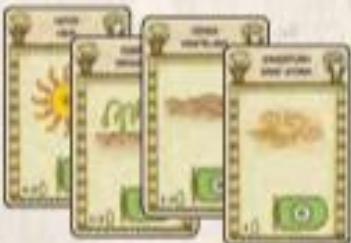
行管理行动。在你的回合中,你现在只能打出一张卡牌,购买一张卡牌或者通过从卡牌市场拿取提供最多名声的自然灾害的方式离开游戏。其他玩家继续进行游戏直到所有人都离开游戏为止。最后一位离开游戏的玩家不会从一张自然灾害卡中获得名声(在5人游戏中,没有第5张自然灾害卡可供最后玩家离开游戏时使用。)
“是的,罗纳德,时机是关键。在正确的时候执行最后的管理行动是至关重要的。有趣的是,你的队友们也知道这一点!”
拥有最多名声的玩家赢得游戏并且自称法老最狡猾的顾问!出现平局时,剩余最多资源和金钱的平局玩家获胜。
单人游戏
当你进行单人游戏时,法老命令你自己负责整个城市化进程。你可以进行单人游戏,在其中你试图打破你的个人最高分数,或者接受法老的挑战并进行一个战役,此时你会试图实现不同的目标和解锁成就,这将帮助你调整你的计划,在多局游戏中使法尤姆城市化!
游戏准备
按照第 2 页和第 3 页的所有步骤以及以下 3 个变更来准备
C 拿取用于单人游戏的管理概述卡
① 不在单人游戏中使用折扣指示物。将它们放回游戏盒子里。
J 开始游戏时使用 \$4。
如何玩?
当你从手上打出打卡牌和从卡牌市场购买新的卡牌时,遵循之前页面上描述的所有《法尤姆》规则。
II. 当从你弃牌堆购回顶部卡牌(超过 3 张则你免费购回),你必须为第一张卡牌支付 \$1,为第二张卡牌支付 \$2,为第三张卡牌支付 \$3,以此类推。
III. 当替换当前市场内的 2 张卡牌时,选择这 2 张卡牌并将其移回盒子里。然后从抓牌堆抓取 2 张卡牌并将其与卡牌市场的其他 6 张卡牌放到合适的编号顺序内以便整个卡牌市场内所有卡牌按照升序排列。
法老的挑战
你可以在一局游戏中进行单人游戏,你的目标是获得最好的分数,或者你可以接受法老的挑战,进行一系列的游戏。在战役开始时,你的第一个目标是获得至少150名声。如果你成功了,你就完成了目标。在你接下来的游戏中,你必须以你喜欢的顺序完成另外六个目标中的一个,根据可用的牌来调整你的决定。如果你再次成功并完成了其他目标之一,那就把它划掉。每局游戏只能完成一个目标,而且在整个战役中,每个目标只能完成一次。
在完成了所有七个目标后,你成功地完成了这场战役,让法老知道你是法尤姆最狡猾的顾问!
起始目标
□ 获得至少 150 名声(战役的起始目标)
进一步目标
□ 放置了3座桥梁。
□ 放置了2座桥梁。
□ 获得至少 250 名声。
☐ 通过建造所有 15 个建筑砖块来完成建筑区域上的所有 4 个纪念碑。
□ 放置了9个工坊。
□ 留下10个或更少鳄鱼在小麦和葡萄格子。
作为奖励,每当你完成一个目标——包括起始目标——你解锁一个成就。成就是按顺序分类的,所以你必须从顶部到底部依次解锁。你可以在战役中所有接下来的游戏中使用每个解锁的成就。
成就
□游戏准备:取代 $4$ 的是,游戏开始时你有 $10$ 。
□ 管理:I.b)取代移除至多2工人,你可以移除至多3工人。
□游戏准备:除了游戏开始时你有\$10外,你还有1鱼和1玫瑰。
□ 管理:I.c) 从你弃牌堆顶部不是拿回 3 工人,而是拿回 4 工人。
□ 从你手上打出一张牌:不是支付 \$3,改为你可以通过支付 \$2 来替代单一的基本资源。
□游戏准备:Ⅲ. 不是从卡牌市场替换2张卡牌,而是只替换1张卡牌。
Author: Friedemann Friese
Graphics & Layout: Harald Lieske
Editing: W. Eric Martin, Linus Wolf, Ronald Hrkać, Christian Frank
Production: Henning Kröpke
Copyright 2020, 2F-Spiele, Bremen/Germany
2F-Spiele
Fedelhören 64
D-28203 Bremen
www.2f-spiele.de

Faiyum Printer Friendly Eng Rules.md31.5 KB

• 2 palaces
• 20 grapes
• 4 “-1” discount tokens
Idea of the game
The oasis-like basin Faiyum was artificially built 3,900 years ago by enlarging the Bahr Yussef channel that connected to the Nile to create a regulated flood plain. During the Middle Kingdom of Egypt, this swampland was slowly changed into farmland under the aegis of pharaohs such as Amenemhet III and Sesostris II. They ordered their advisors to build a system of canals and dikes to reclaim the land surrounded by desert and inhabited by crocodiles to turn it into a granary for Egypt.
Now, during the reign of Amenemhet III, you are the pharaoh’s advisors, commanded to harvest goods, build roads, found settlements, and do much more for the good of Faiyum! You are being supplied with the necessary manpower, resources, and money, which means that if another advisor needs to use “your” roads, farms, and other buildings, they may do so since everything you build is owned by the pharaoh. The only thing you will own is the only thing that matters: the respect of the pharaoh.
Faiyum is a strategic game for enthusiasts of planning games. The basic rules are simple: Play your cards one by one on your personal discard stack. After playing some or all of your cards, you take them back into your hand in “reverse” playing order, so playing cards in the best order is important. Newly purchased cards go directly into your hand, so the timing of getting and playing them is important, too. Each of the individual cards has easy-to-understand actions, but only by creating the best combined “engine” will you be a master advisor of Faiyum.
This game features a card mechanism reminiscent of deck builders and the market mechanism successfully used in Power Grid. Gain more and more valuable cards, and use the structures built on the game board to your advantage — in other words, for your reputation. In the end, the most cunning advisor wh creates the best card combinations will win Faiyum.
game components
Each copy of Faiyum contains:
257 wooden parts, consisting of:
• 5 reputation discs (1 per player)

• 30 workers

• 16 settlements
• 20 wheat

• 8 towns


• 20 stones

• 10 workshops


• 5 expansions

• 12 roses

• 15 building blocks
50 cardboard tokens, consisting of:


• 5 reputation tokens “50/100” (1 per player)

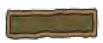


• 2 grand bridges
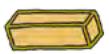
• 38 crocodiles


• 26 “1” money tokens

• 10 “5” money tokens

• 5 “10” money tokens

- 2 rule booklets and 2 glossaries (English & German)
• 12 administration
overview cards in German and English (10 cards for games with 2-5 players, 2 cards for the solo game)

106 cards, consisting of:
• 25 starting playing cards marked “S” (5 per player)
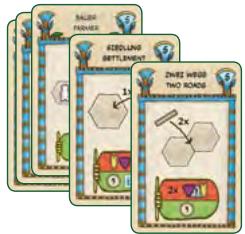
• 69 numbered playing cards (56 blue-bordered and 13 yellow-bordered cards)

The numbered cards show individual even numbers from 2 to 128. (We want to have the option to sneak in expansions!)

Game Set-up

Place the game board on the table.
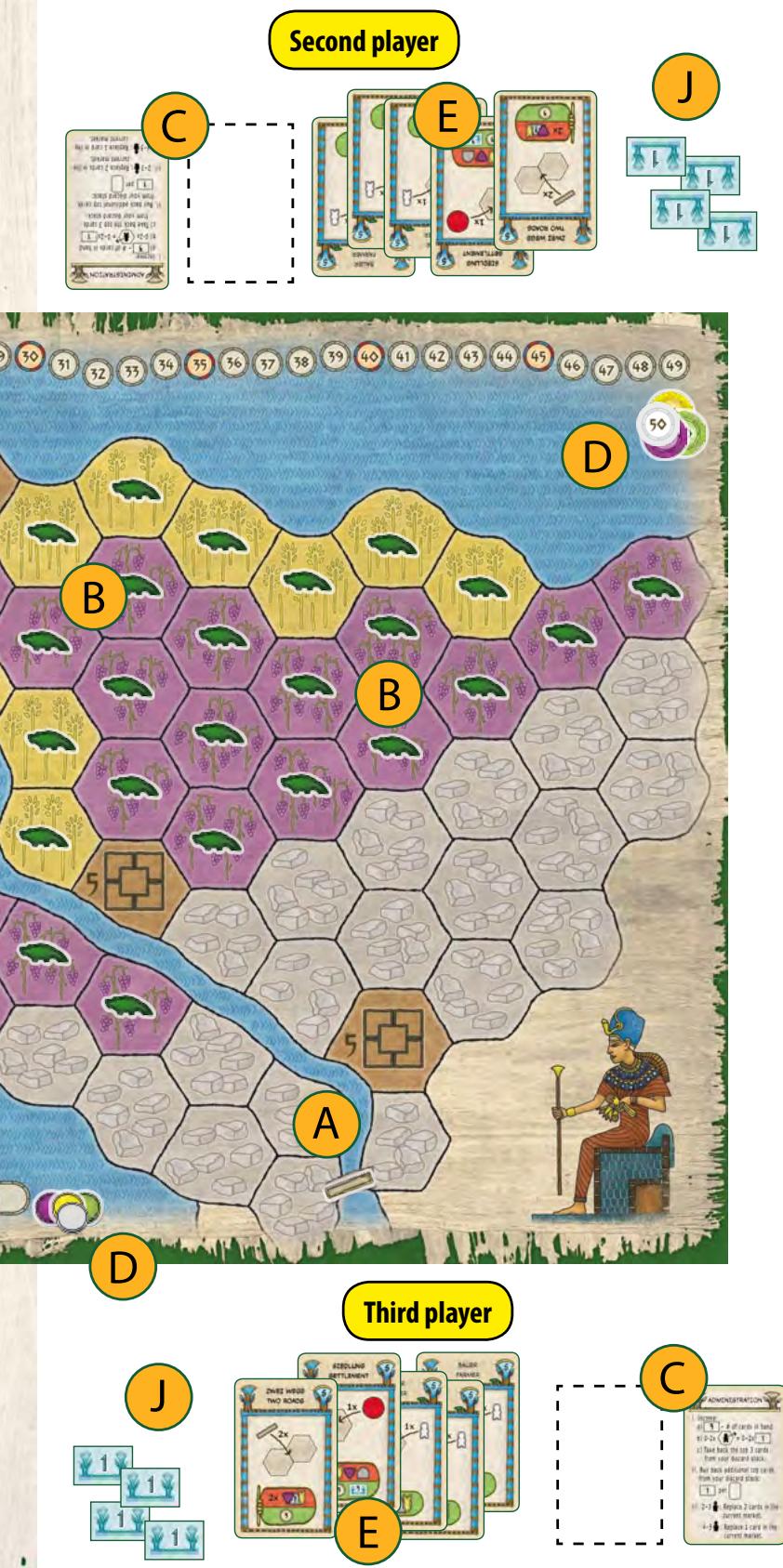
A Place a settlement on the red space and a road on the dam between the two peninsulas.
Place a crocodile on every wheat (yellow)B space and grape (purple) space.

Everybody chooses a color and takes the matching colored starting cards, reputation disc, and “50/100” reputation marker, as well as an administration overview card.
C You need some space in front of you for your personal play area. Place the administration overview card to one side of the play area. During the game, you also have a personal discard stack for your played cards.
Place your reputation disc on the “0” space of the reputation track, and D your “50/100“ reputation marker near the end of the reputation track.
Take your starting cards in hand.E

Prepare the draw pile and card market as follows:
F Take the 13 yellow-bordered cards and set aside the cards numbered 114-120. You now have multiple versions of the natural disaster cards numbered 122-128 in hand. Keep only the 4 cards showing your current number of players, and return the other 5 cards to the game box. Place these 4 cards on top of the cards numbered 114-120, then place them to the side.
Shufle the 56 blue-bordered cards numbered 2-112, and place them face down as a drawG
| cards numbered 122-128 | |
| 2 players | 6, 0, 0, 0 reputation |
| 3 players | 10, 6, 0, 0 reputation |
| 4 players | 10, 6, 3, 0 reputation |
| 5 players | 10, 6, 3, 1 reputation |
pile. Draw the topmost 12 cards, then sort them face up by number from low to high. Place the 8 lowest cards face up in ascending order on the spaces of the card market, starting on the left with the lowest number and continuing to the right as the numbers increase.
H Give everyone a chance to examine the highest 4 face-up, blue-bordered cards, then shufle them with the 8 yellow-bordered cards placed to the side. Place these 12 cards as a separate face-down “final turns” stack next to the draw pile.

Mark down the 4 lowest cards in the market. Place a red discount token on each of these cards.

hoose a player to become the first player!
J The first player takes \$3, the second and third players take \$4, and the fourth and fifth players take \$5.
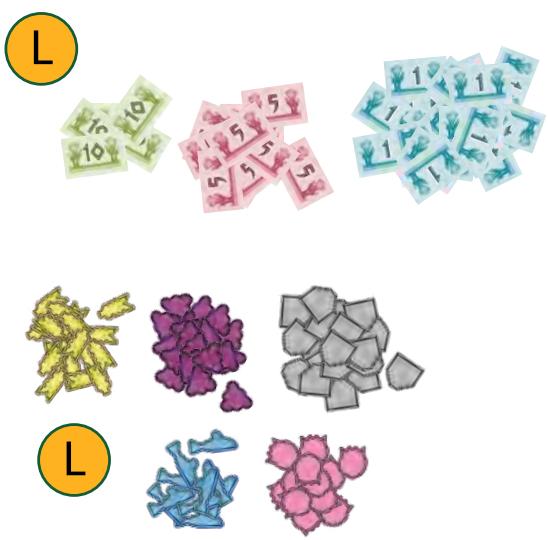

Place the wooden parts and money tokens in separate supply piles on opposite sides of the game board based on whether they are limited or unlimited.
K These components are limited: workers, settlements, towns, workshops, expansions, roads, bridges, grand bridges, building blocks, and palaces.
L The wheat, grape, stone, fish, and rose resources and the money tokens are not limited, so if you need more than are provided, please use something else as standins.
You are now ready to start Faiyum!
The game board
The game board shows a map of Faiyum, a card market, and a reputation track.
• The channel divides Faiyum into two separate peninsulas connected only by the dam. Also, the peninsulas are surrounded by the lake.
• Spaces on a peninsula can be adjacent to other spaces on the same peninsula, but spaces on opposite sides of the channel are always separated.
• The resource spaces for grapes (purple), wheat (yellow), and stones (gray) are undeveloped; additionally, the grape and wheat spaces are swampy and start with crocodiles on them. The stone spaces are on higher, dry ground and thus crocodilefree. The red space for the first settlement, the two spaces on both sides of the dam connected by a road, and the four brown building sites are crocodile-free and already developed. The building sites show rough sketches of the
monuments to be built, with numbers to show how
many building blocks can be placed on each of these spaces.
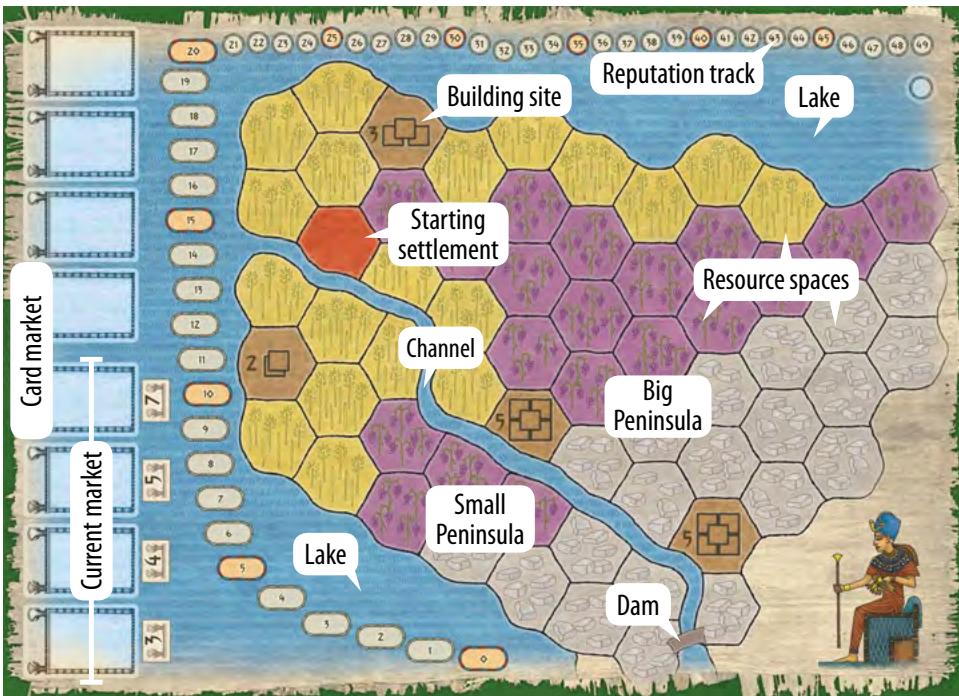
• The card market shows 8 card spaces separated into 2 groups: 4 spaces showing prices for the cards in the current market, and 4 spaces for the cards which will be ofered for purchase later during the game.
• The reputation track shows your reputation gained during the game.
The cards
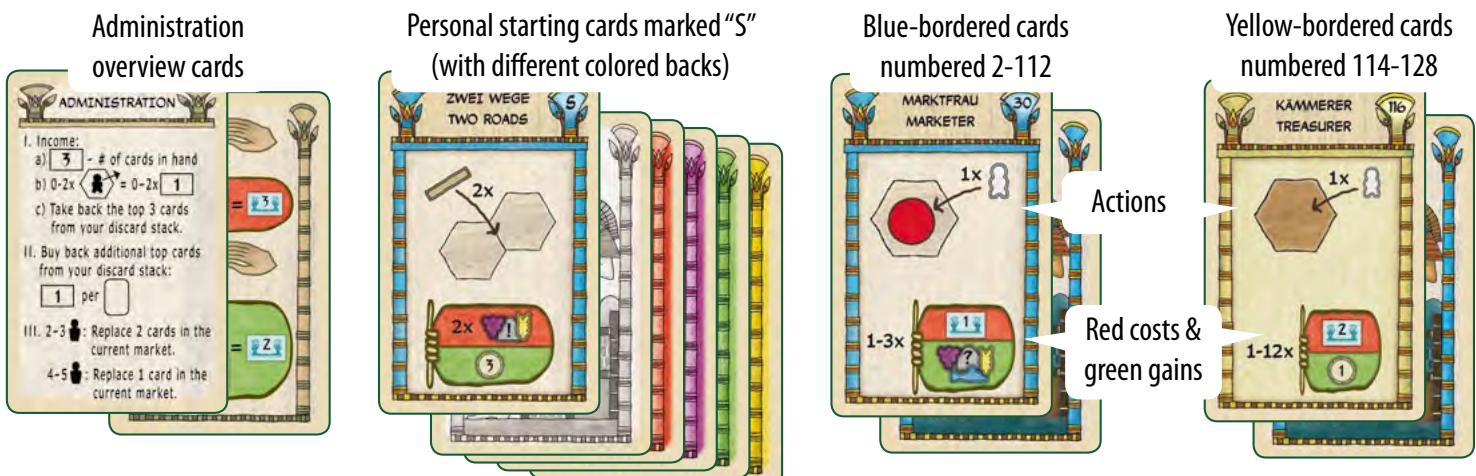
The game contains two types of cards:
• The administration overview cards show the steps you take when using the administration action. The back of these cards reminds you of two general rules in efect when using the playing cards.
• The playing cards are divided in three groups. Personal starting cards marked “S” have colored backs in the five player colors. The blue-bordered cards and the yellow-bordered cards have the same backs and show individual even numbers from 2 to 128. All three types of cards are played the same way.
• Below its name, each playing card depicts an action that you must take when you play this card. If a red cost is depicted, you must pay this cost to take this action; if a green gain is depicted, you must take this gain after taking this action. All playing cards are explained in detail in the glossary.
Playing with 2 to 5 players vs. solo games
For games with 2 to 5 players, we already explained the game preparation on the previous pages and will explain all rules on the following pages.
When playing the solo game, you need to make only a few changes during game set-up and while playing the game. You will find these changes on the final page of this rule booklet.
While tracking your reputation on the reputation track, for games with 2 to 5 players your personal “50/100” reputation token should help you to track all the reputation you gain. When playing the solo game very well, you may need to use two or more of the “50/100” reputation tokens.
How to play
The general rules of Faiyum are easy, but the game as a whole is complex thanks to the wide spectrum of diferent actions on the cards. These actions are all explained in detail in the separate glossary, so good news! After learning the general rules and discovering the actions of your starting cards and the cards in the current market, you can jump into playing. Then, each time a new card shows up in the card market, you need only check its actions in the glossary, learning everything as you go.
Beginning with the first player and continuing clockwise, each time it is your turn, take one of the following three actions:
a) Play a card from your hand: Use the actions on the card or get money for it, then place the card face up on top of your personal discard stack.
b) Buy a card from the card market: After paying the appropriate price, take 1 card from the current market into your hand.
c) Carry out administration: Gain income, take cards from the top of your discard stack into your hand, then replace cards in the card market.
Continue to take turns until all 4 natural disasters — the yellow-bordered cards numbered 122-128 — are placed on the rightmost spaces of the card market, which triggers the end of the game.
Before you continue with the rules, let us introduce Ronald. As you will come to realize on the following pages, if Ronald understands the rules, then everybody will understand them. Years of experience are 100% proof!
“YES, Ronald, really everybody. Thank you for asking (again)...”
a) Play a card from your hand
In Faiyum, unlike in deck-building games, you do not have the familiar personal draw pile. Instead, at the start of the game, you have all your cards in hand and can play them one after another. After you play a card, place it face up on top of your discard stack. Please see an example for playing cards on the following page.
Play a card from your hand by placing it face up in your play area. You then have two choices:
• Use the action: You must use the complete action of the card to gain resources, money, cards, and (of course) game-winning reputation.
“NO, Ronald, you cannot use only part of an action. If the action is to build 2 roads, you cannot build only 1. Besides, how would you record 1.5 reputation on the reputation track?”
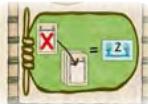
• Gain \$2: If you cannot or do not want to use the card’s action, instead gain \$2, taking the money from the supply.
Afterwards, place the card on top of your discard stack. You must keep the cards in this stack in order, with the first card played at the bottom and the latest card played on top. For an overview of these cards, you can slightly fan out the cards to show their titles.
When you play a card to use its action, follow these rules (please see an example for playing cards on the following page):
• Everything you place or build on the spaces of the game board is common property for all players, that is, none of the workers or structures are yours or owned by you. After you place or build something, anyone can use it for their own benefit.
“NO, Ronald, just because you built that settlement, it is not yours. Anybody can place a worker there.”
• The resources, money, and the reputation you gain by playing cards belong solely to you. Resources and money provide the means to pay for actions and new cards, while reputation matters only when it comes to winning Faiyum.
Roses are wild. Anytime you pay resources, you may replace any needed resource with a rose. You gain a rose only when it is listed in the green box of a card.
“YES, Ronald, you can pay a single action with 2 or more roses, and each rose can then replace any other required resource because they are WILD!”
• The cards ofer four types of actions: harvest actions, build actions, commerce actions, and “other” actions.
• Resources generally come from cards that ofer harvest actions. These cards let you place workers upright on undeveloped resource spaces The wheat and grape spaces are still swampy and full of crocodiles, while the stone spaces are on higher, dry ground and are thus crocodile-free.

When playing these cards, you gain resources and drain the land to remove crocodiles from it. As a reminder, these cards show a crocodile at both top corners.
“YES, Ronald, you can place these workers on crocodile-free resource spaces as long as the spaces are undeveloped.”
• The cards that ofer build actions let you develop crocodile-free resource spaces. At the start of the game, the first settlement, the four building site spaces, and the two stone spaces connected by the road on the dam are already developed. When playing these cards, you build diferent structures, such as settlements, workshops, and roads. You can also upgrade settlements to towns or place building blocks on the building grounds. A worker on a space does not interfere with building and remains on the afected space. As soon as you build something on a space, that space is now developed, and you cannot use harvest actions on developed spaces. Each crocodile-free resource space can hold either a settlement or a workshop, but not both.
The roads and bridges create a network by connecting the spaces of the peninsulas. Either they start in a settlement or on a building site, or they extend another road and bridge, including the road that begins the game on the dam. Roads and bridges can branch out only on settlements and building sites. Thus, you cannot build a junction on a resource space. You gain 1 additional reputation each time you build the first direct connection between a pair of locations (two settlements, two building sites, or a settlement and a building site). A direct connection is defined as one or more connected roads and/or bridges that connect settlements and/or buildings to one another without any intervening settlements and/or building sites. A direct connection may pass through a space with a workshop. You do this by placing a road or a settlement on an already connected resource space.
“YES, Ronald, you gain only 1 additional reputation when connecting settlements and building sites, not 1 reputation for each place. And connecting them a second or third time does not gain you any additional reputation. And YES, we will explain that once more in the glossary!”
• For all cards that ofer commerce actions, you place workers upright on developed spaces. You will find details for all the cards in the glossary.

Example: Hedwig plays a harvest action and places a worker on the undeveloped resource space to harvest a grape and remove the crocodile to gain \$1 . Angelika plays a build action and places a settlement on the crocodile-free resource space . As that space is already directly connected to the building site, she gains 1 extra reputation. With another build action, Nicole places the bridge, branching out of the settlement . Beth plays a commerce action and places a worker on the settlement, which had already been upgraded into a town .
• At most one worker can be on each space of the game board. Thus, when you place a worker on a space, that space is blocked for other harvest or commerce actions until that worker has been removed by a card action or by the administration action.
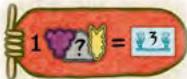
• Each time you need to pay resources, once per action you can replace one of the required basic resources — your choice of grape, stone, or wheat — by paying \$3.
• You cannot use money that you gain during an action to pay the costs of that action or to substitute a single basic resource. You must have all of the money and resources required to pay a cost in hand in order to play that card.
“NO, Ronald, you cannot use the \$3 that you will get for building a settlement to ‘pay’ one stone less than required for the cost of that action!”
• Important: If the card actions contradict the general rules explained in this rules booklet, the rules for the cards are always valid.
b) Buy a card from the card market
Your key to success in Faiyum is buying more and more valuable cards from the card market to cleverly combine the diferent actions on them.
The card market has 8 cards on display sorted in ascending order by their numbers. Only the 4 lowest cards in what’s called the current market are available for you to buy. The 4 highest cards cannot be bought until they slide down into the current market during the game.
When you take this action, buy 1 of the 4 cards from the current market. Pay the price shown below that card — \$3, \$4, \$5 or \$7 — then take that card into your hand. You can play this card on a later turn.

Example: Angelika buys the card ORDER and takes it into her hand. Angelika pays \$4 and places the discount token above the market for use during the next administration action taken by any player.
If a discount token is on the chosen card, reduce that card price by \$1, thus paying only \$2, \$3, \$4, or \$6. Afterwards, place the discount token above the current market as it will be used again in the next administration action taken by any player.
Finally, draw a card from the draw pile and place it in the proper numerical order among the other 7 cards in the card market so that all cards are again in ascending order in the whole card market. The cards keep their discount tokens, so move them together when rearranging the card market.
c) Carry out administration
The administration action lets you (possibly) gain money, and more importantly, lets you take cards from your discard stack back into your hand. Thus, playing cards in the best order is crucial so that you can leave weak cards at the bottom of your discard stack and take back only the more valuable cards.
When taking the administration action, follow these three steps. Your administration overview card gives you a summary as a reminder.
I. Gain income:
a) First, gain \$3 minus the number of cards in your hand, taking the money from the supply. If the result is 0 or negative, do not take or pay any money.
“NO, Ronald, you never lose money. The lowest possible income is \$0.”
b) Then, remove 0 to 2 upright workers from any spaces on the game board and return them to the supply. Gain \$1 for each removed worker, taking the money from the supply.
“YES, Ronald, by removing workers your fellow players will have first pick at placing workers on these empty spaces. I bet they say, ‘Thank you, Ronald!’” “And YES, Ronald, you usually remove 2 workers as long as there are enough workers placed on all spaces of the game board.”
c) Take the top 3 cards from your discard stack into your hand. If less than 3 cards are on your discard stack, take them all. Do not change the order of the remaining cards in your discard stack!
II. Buy back more cards:
Now you can buy back additional cards from the top of your discard stack. Pay \$1 to take a card into your hand. You can do that any number of times, and you are not restricted to the income received in step I. Do not change the order of the remaining cards in your discard stack!
III. Replace cards in the card market:
Depending on the number of players, follow these steps:
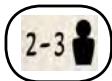
• Remove the lowest 2 cards with discount tokens from the current market and place them in the game box.
• If only 1 card has a discount token, instead remove that card together with the lowest card in the current market without a discount token.
• If no cards have discount tokens on them, instead remove the 2 lowest cards in the current market.
• Place a discount token on each card that remains in the current market that does not already have a discount token.
• Draw 2 cards from the draw pile and place them in the proper numerical order among the other 6 cards in the card market so that all cards are again in ascending order in the whole card market. Do not place discount tokens on the new cards.

• Remove the lowest card with a discount token from the current market and place it in the game box.
• If no card has a discount token, instead remove the lowest card in the current market.
• Place a discount token on each card that remains in the current market that does not already have a discount token.
• Draw 1 card from the draw pile and place it in the proper numerical order among the other 7 cards in the card market so that all cards are again in ascending order in the whole card market. Do not place a discount token on the new card.
“YES, Ronald, you are absolutely right. You use 2 or 3 discount tokens for the cards during the game. You need all 4 tokens only at the start of the game.”
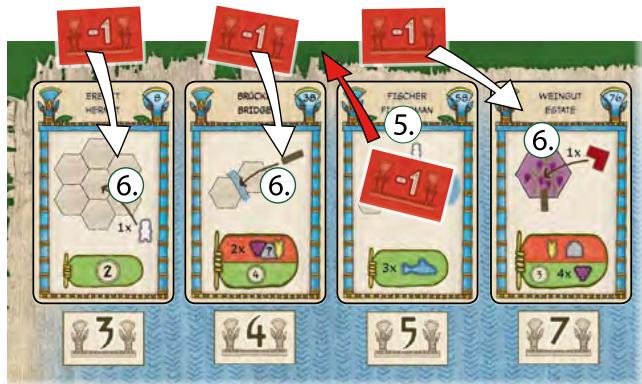
Example: In a game with 4 players, Angelika takes the administration action.

In the “Gain income“ step, first, she gains \$2 as she still has 1 card in her hand . Second, she removes 2 workers and gains another \$2 . Third, she takes back into her hand the top 3 cards of her discard stack .
In the “Buy back more cards” step, Angelika pays \$2 to take 2 additional cards into her hand from the top of her discard stack .
In the “Replace cards in the card market” step, she removes the FISHERMAN as that card still has a discount token. (With 2 or 3 players, she would also remove the HERMIT as it is the lowest card without a discount token.) Then, she places discount tokens on HERMIT, BRIDGE, and ESTATE
Angelika draws a card from the draw pile and sorts it with the other cards of the card market so all cards are again in ascending order. She does not place a discount token on the drawn card.
Your final turns and trigering the end of the game
After you draw the last card of the draw pile, continue to draw cards from the “final turns” stack. Aside from cards with actions, this stack contains 4 natural disasters, that is, the yellow-bordered cards numbered 122-128. The natural disasters push the highest action cards into the current market. The natural disasters remain on the rightmost spaces of the card market, even if you empty the current market. You cannot buy the natural disasters!
Continue to take turns until you place the fourth natural disaster in the card market. This triggers the end of the game, after
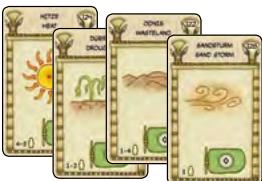
which you can no longer take the administration action. On your turn, you now only play a card, buy a card, or quit the game by taking the natural disaster from the card market that ofers the most reputation. As long as there are cards left in the “final turns” stack, after buying a card you draw a card and place it in the market. The other players continue to play until everyone has quit. The last player to quit gains no reputation from a natural disaster card. (With 5 players, there is no fifth natural disaster for the last player when they finally quit the game.)
“YES, Ronald, timing is the key. Taking your final administration action at the right time is crucial. Funnily enough, your fellow players know this, too!” The player with the most reputation wins the game and can call themselves the most cunning advisor of the pharaoh! In case of a tie, the tied player with more leftover resources and money wins the game.
The solo game
When you are playing solo, the pharaoh commands you to take charge of the whole urbanization yourself. You can either play single games in which you attempt to beat your personal high score or accept the pharaoh’s challenge and play a campaign in which you try to fulfill diferent goals and unlock achievements that will help you adjust your plans in a series of games to urbanize Faiyum!
Game preparation
Follow all steps as described on pages 2 and 3, with these three changes:

Take the administration overview card for the solo game.C

Do not use the discount tokens in a solo game. Return them to the game box.

Start the game with \$4.
How to play
When playing cards from your hand and when buying new cards from the card market, follow all rules of Faiyum as explained on the previous pages.
The only changes are during the Administration action:
II. When buying back the top cards from your discard stack (beyond the 3 you get for free), you must pay \$1 for the first card, \$2 for the second card, \$3 for the third card, and so on.
III. When replacing 2 cards in the current market, instead of removing the two lowest cards, choose any two cards in the current market and return them to the game box. Then, draw 2 cards from the draw pile and place them in the proper numerical order among the other 6 cards in the card market so that all cards are again in ascending order in the whole card market.
The chalenge of the pharaoh
You can play the solo game in single games in which you aim for the best score, or you can accept the challenge of the pharaoh, playing a campaign of several games.
At the start of the campaign, your first goal is to gain at least 150 reputation. If you succeed, you strike of that goal. In your subsequent games, you must fulfil one of the other six goals in whatever order you like, adjusting your decisions depending on the available cards. Again, if you succeed and fulfill one of the other goals, strike it of. You can fulfill only one goal per game, and you can fulfill each goal only once during the entire campaign.
After fulfilling all seven goals, you have finished the campaign successfully, showing the pharaoh that you are the most cunning advisor for Faiyum!
Starting goal
Gain at least 150 reputation (Start of the campaign).
Further goals
Place 3 bridges.
Place 2 palaces.
Gain at least 250 reputation.
Finish all 4 monuments on the building sites by placing all 15 building blocks.
Place 9 workshops.
Leave 10 or fewer crocodiles on wheat and grape spaces.
As a bonus, each time you fulfill a goal — including the starting goal — you unlock an achievement. The achievements are sorted in order, so you must unlock them from top to bottom. You can use each unlocked achievement in all subsequent games of the campaign!
Achievements
Game preparation: Instead of \$4, start the game with \$10.
Administration: I.b) Instead of removing up to 2 workers, you can remove up to 3 workers.
Game preparation: In addition to \$10, start the game with 1 fish, and 1 rose.
Administration: I.c) Instead of taking back the top 3 cards from your discard stack, take back the top 4 cards.
Play a card from your hand: Instead of paying \$3, you can substitute a single basic resource by paying \$2.
Administration: III. Instead of replacing 2 cards in the current market, replace only 1 card.
Author: Friedemann Friese
Graphics & Layout: Harald Lieske
Editing: W. Eric Martin, Linus Wolf, Ronald Hrkać, Christian Frank
Production: Henning Kröpke
Copyright 2020/2021, 2F-Spiele, Bremen/Germany
2F-Spiele Fedelhören 64 D-28203 Bremen www.2f-spiele.de
Download MarkdownTexts are community-compiled or publicly released by publishers; copyright remains with the original authors. For personal reference only.