
Foundations Of Rome
At a glance
Rules, cards and Q&A (Chinese)
The rules, card data and player questions for this game are written in Chinese. Open the Chinese page to read them.
Where to find full rules
Full rules and card lookup are available in the cunlema app at cunlema.cn — pick this game and ask about any rule, card or turn you are unsure about.
Related games
Rulebook text (Markdown)
This game has 2 rulebook Markdown file(s) in our library; 2 rendered inline below — expand to read or download.
rules_zh_Foundations_of_Rome_16998.md13.3 KB
FoR 罗马建成
--欢迎来到罗马,我是 Aurelia(奥里莉亚),并将帮助你学习这些内容。
在我们伟大的国王和奠基者罗慕路斯的召唤下,荣耀属于那些建设住房,建设市场和光荣纪念碑的人们,为
了永恒之城!
让我们开始吧!
游戏简介
通过三回合游戏,你将通过采购土地版上的空位并用他们来建造建筑以竞争罗马最伟大的建筑师。
更加复杂的建筑更难完成建造,但他们会提供更多的荣誉(胜利点)
在游戏结束,荣誉最多玩家是胜利者
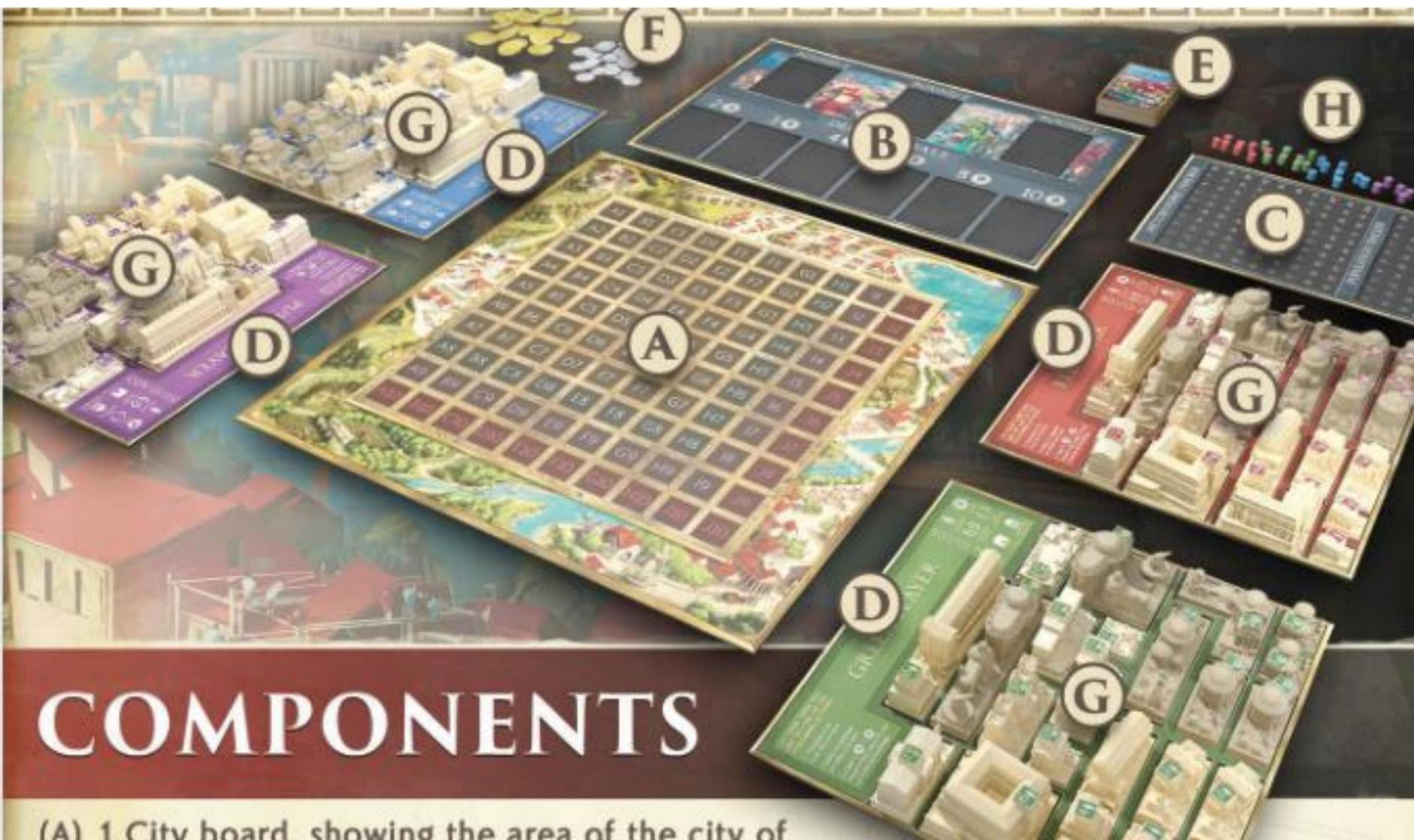
COMPONENTS
(A) 1 City board, showing the area of the city of
组件
A 城市版*1,表示罗马城,分为 100 个空格
B 契约版*1,用于表示哪块空地被卖出
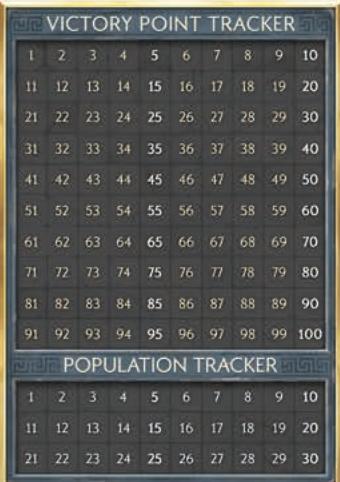
C 计分版*1,用于追踪胜利点和人口
D 双层玩家版*4,
E 契约卡*100
F 钱币*40,包含银币(1)*20 和金币(3)*20
G 建筑*96,每种颜色 24 个,包含 3 种类别
*32 住宅建筑(米色)
*32 商业建筑(灰色)
*32 市政建筑(乳白色)
H 所有权标记*40(每个玩家 10 个)
游戏设置
-
放置城市版,契约版和计分板到中央
-
每个玩家选择一个颜色并拿取对应颜色的玩家版,建筑和所有权标记。放置一个所有权标记到计分版的胜利点轨并放另一个到人口轨。其他 8 个所有权标记放在自己玩家版附近。
-
决定起始玩家。默认是游戏的拥有者选择一位作为起始玩家,也可以选自己。
a. 起始玩家获得 5 元,顺时针顺序每个玩家多获得 1 元。于是,四人游戏中,第一顺位获得 5,第二顺位 6,第三顺位和第四顺位分别获得 7 和 8 元。
b. 放置其他钱币到契约版附近组成银行。
- 当有第五名玩家时(需五人扩充),使用全部版图。当游戏人数变少时版图也使用更少的部分,不使用特定的行或列的空格。依据玩家人数,需要从游戏中移除以下的契约卡:
a. 四人游戏中,移除所有的红色契约卡(行J以及列10),使用 $9*9 = 81$ 个空格;
b. 三人游戏中, 移除所有的红色及紫色契约卡 (行 I 和 J 及列 9 和 10), 使用 $8*8 = 64$ 个空格;
c. 两人游戏中, 移除所有的红色、紫色及蓝色契约卡 (行 H,I,J 以及列 8,9,10), 使用 $7*7 = 49$ 个空格。
-
洗混所有的契约卡并给每个玩家发⑥张。
-
依据玩家所获得契约卡在对应的地方上放置自己的所有权标记,这样,每个玩家还有 2 个余下的标记。
-
将卡牌形成一排放在自己面前。玩家有一个卡堆来放置自己的契约卡这样如果对场上的格子所有权有争议,可以查看卡牌查询。
-
余下的契约卡大致分为三堆。将每一堆分别放在契约版上回合 1,回合 2,回合 3 的地方。
-
将回合 1 的契约卡放出 6 张,放置在契约版 “On Sale” 的位置。
现在你可以开始建设罗马了。
如何游戏
FoR 游戏分为三个回合,每个回合大致相当于城市早期历史上的十年时间。我期待你的伟大成就。
在一回合中,玩家顺序从起始玩家开始并顺时针持续进行,直到这一堆契约牌消耗完毕后该回合结束。在回合结束时,玩家将进行计分,展示在胜利点轨上。在第三回合计分结束后游戏结束。
玩家回合
在玩家回合中,玩家必须选择一个下列行动(获得收入,购买契约,建造建筑)来完成。在你行动完毕后,你的回合结束并由你左手的玩家开始他的回合。
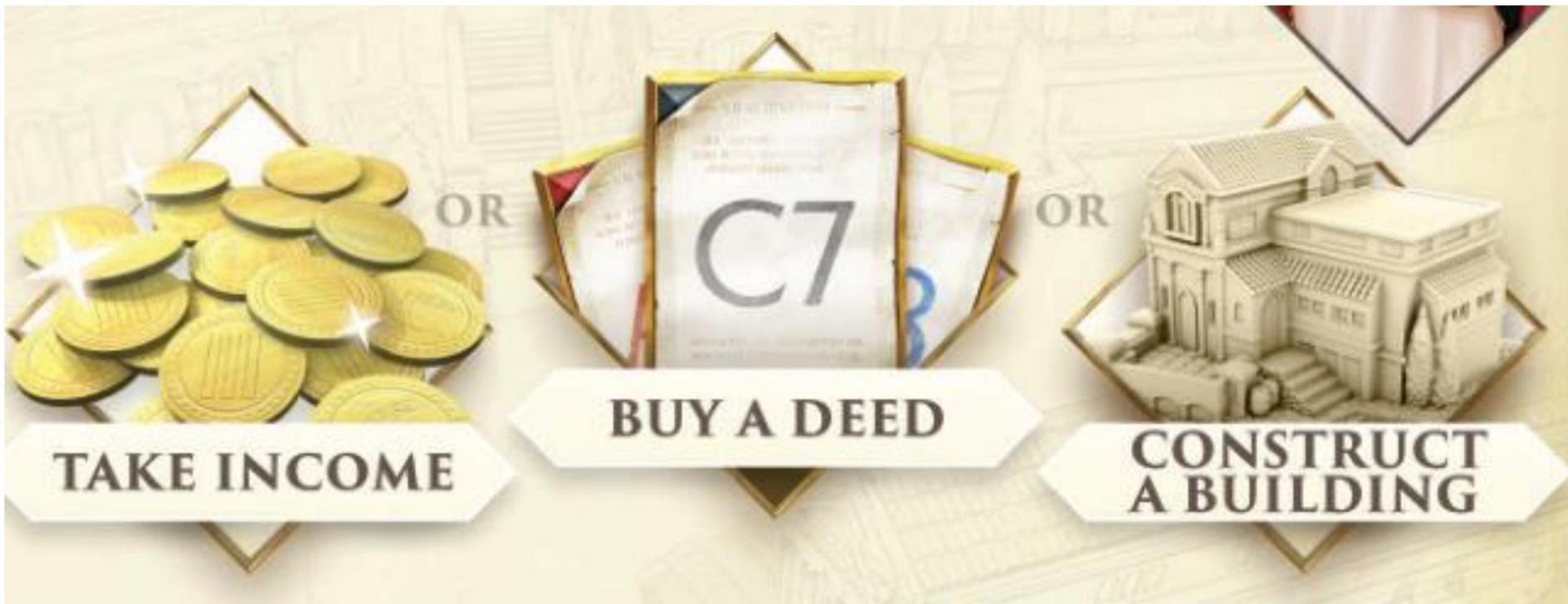
行动:获得收入
你可以向罗慕路斯请愿来获得更多资源。这样做将会从银行获得 5 元。
同时,你也依据你市政建筑上露出的钱币值来获得额外收益。

例子:科尼莉亚决定在她的回合执行获得收入行动。她从罗慕路斯处获得 5 元,并由于她的城市版上的建筑面包坊和工坊额外获得 3 元。于是她从银行拿去总共 8 元。
小贴士
查看你的玩家版来获得你建造了多少提供钱币收入的建筑。对于其他类型的建筑也可以同样如此做。
行动:购买契约
如果你的所有标记物都在城市版上你无法执行该行动。你只能选择获取收入或建造建筑。
你可以通过以下步骤来购买任何一张展示的契约卡:
-
花费你想购买的契约卡所处位置上方的钱币。费用交给银行。
-
拿去该契约卡并加入你的契约卡堆。
-
其他展示的契约卡向左侧移动。
-
使用当前回合的契约卡堆补充一张到卡池中。
-
依据购买的契约卡内容放置己方标志物。

重要,当前回合的最后一张契约卡被购买时,不要立即补充契约卡。先按第八页的回合结束完毕后再补充。
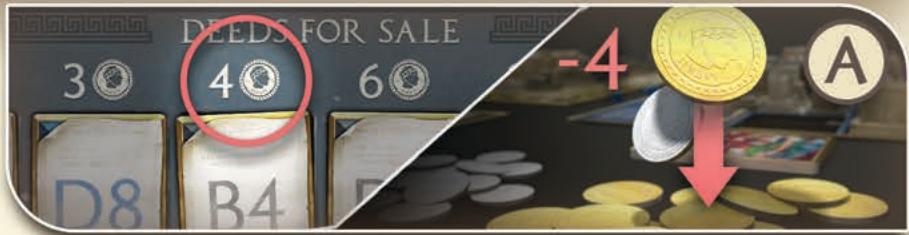
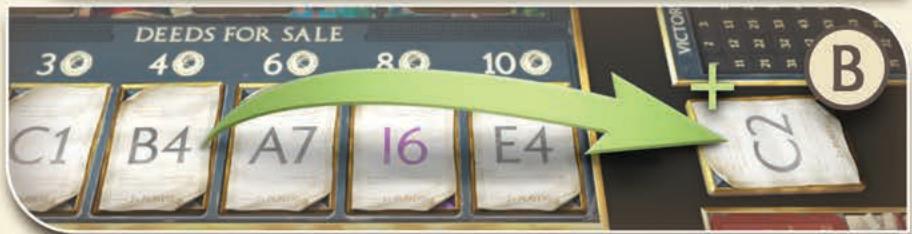
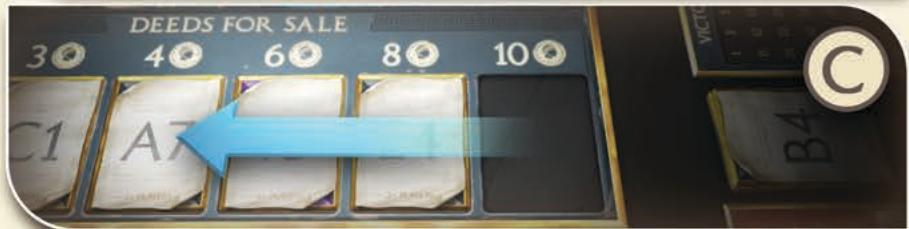
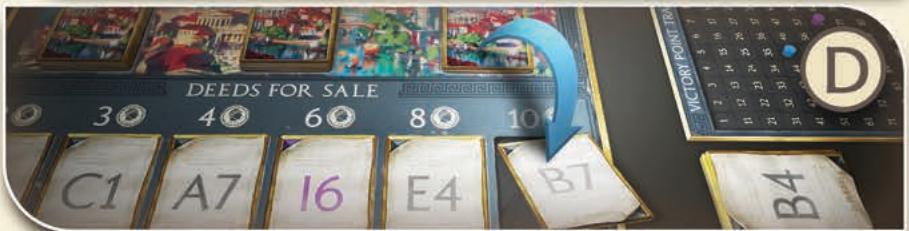
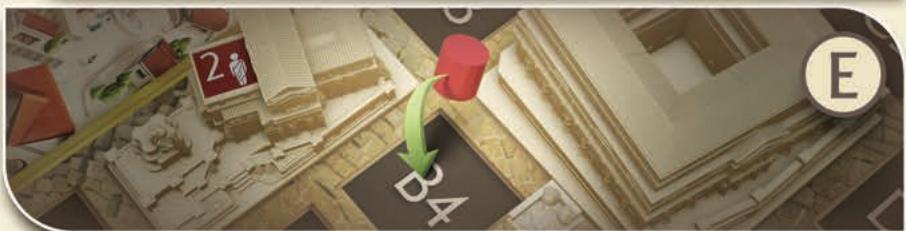
Example: Fabius would benefit from acquiring Lot B4. Fortunately for him, it is available on the Deed Board! He pays 4 coins to the bank (A) and takes the Deed card from the Deed board (B). Then he slides the three higher-priced cards down one space each (C) and turns over a new Deed card from the deck (D), placing it on the 10-coin space. Now he places his Ownership token on Lot B4 of the City board (E).
行动:建造建筑
你只能依据你所有占有的空格来建造建筑。
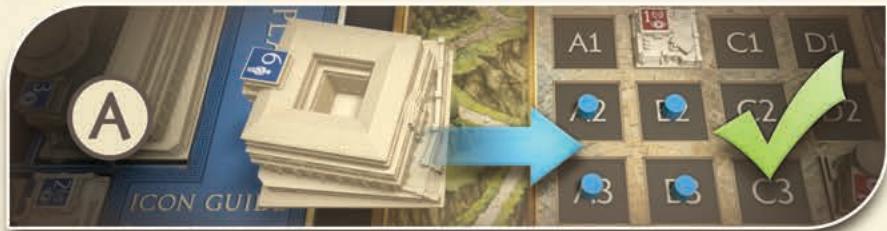
每个玩家在游戏开始有 24 个建筑。建筑拥有不同的形状和大小。为了建筑一个合适的建筑,你必须首先拥有一些满足形状要求的相邻空地来匹配建筑的形状(A)。
建造流程,从供应区选择你的建筑然后放到空地。然后把对应的标记物收回。(B)
你可以使用你的空地没有限制。你也可以使用之前的建筑来进行“翻建”,但是要求是新建筑必须比之前的建筑 size 更大,建筑的种类没有要求。


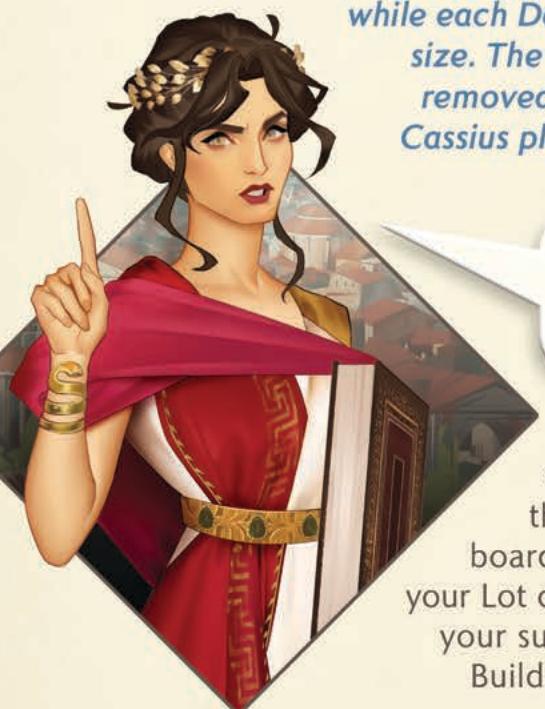
Example: Cassius instead decides to build the Domus Maximus over the top of two Domus' he already built. He can do this because the Domus Maximus is 2-Lots in size,

while each Domus is only 1-Lot each in size. The two smaller Buildings are removed from the City board and Cassius places his Domus Maximus.
你永远无法翻建一个同尺寸或更大尺寸的建筑。于是你无法用 size3 的工匠铺来翻建 size3 的住屋,或 size4 的铸造厂。
如果你翻建你的建筑,从城市版上拿回该建筑,和使用的所有权标记。之后你还可以继续正常建造该建筑。
当翻建你的建筑时,任何属于你的空地依然属于你,即使建筑的形状改变了。
每种建筑的数量有限,你供应区没有的建筑无法继续建造。同时,建造建筑是没有钱币花费的。罗慕路斯提供了建造的材料以及劳工。
回合结束
当当前回合的契约卡堆用完,回合将马上结束。继续进行回合并正常游戏,直到所有的契约卡被玩家购买。
最后一张契约卡被购买时不补充契约卡。
一旦本回合的契约卡被卖空,每个玩家执行最后一个行动来进行获得收入或建造建筑(包含购

买最后一张卡的玩家)

合结束计分
在回合结束,玩家依据住宅建筑中居住的人口和建造的市政建筑,并依据建筑来获得收入。
RESIDENTIAL BUILDINGS
每个玩家计算他们城市版上的人口数量,标识在人口轨上。每个玩家依据人口总数计分,并且人口最多的玩家获得奖励分数,奖励分数如下:



友好平局:当两个或更多玩家在人口数量第一获得平局时,他们均获得奖励分数
如果你建筑中没有人口,那么你无法在回合结束时获得人口分数。

MUNICIPAL BUILDINGS
接下来,你依据城市版上的市政建筑上的图标来获得分数。市政建筑依据与他所相邻的其他建筑(共享一条边)来获得分数。
Awards points for Citizens on adjacent Residential Buildings
Awards points for every two Citizens on adjacent Residential Buildings

Awards points for every Coin on adjacent Commercial Buildings
Awards points for every adjacent Municipal Building
Awards points for every adjacent Building – regardless of type!
依照相邻建筑的人口获得分数
依照相邻建筑的人口/2 获得分数
依照相邻建筑的钱币获得分数
依照相邻的每个市政建筑获得分数
依照相邻的每个建筑(不看种类)获得分数
It does not matter which player owns the adjacent buildings. Your Municipal Buildings provide Victory Points for any adjacent buildings - not just your own!
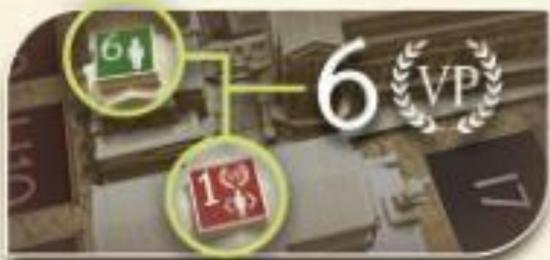
Example: Porcia has built a Resplendent Library, which provides 1 Victory Point per adjacent building with Citizens, regardless of who owns those buildings. In the example shown, Porcia will earn 6 Victory Points from her Resplendent Library during the end of round scoring.


COMMERCIAL BUILDINGS
玩家依照商业建筑的钱币图标来获得金钱(如同获得收入行动,但没有从罗慕路斯处获得的基础 5 元)
同时玩家依照每个商业建筑的左下来获得胜利点。
在回合 3 结束,玩家从商业建筑获得的不是钱而是分数。
补充契约卡
在每个玩家获得分数和钱币后,用下一回合的卡堆来补充卡牌。上一回合最后玩家的左边玩家开始新的一回合。
游戏结束
回合 3 结束后游戏结束。在回合 3 的计分阶段,玩家如正常一样获得分数,但有两点不同:
获得钱币:从商业建筑获得钱币改为获得等量的分数
空的标记物:城市版上的每个未使用的己方标志物获得 1 分
分数最多的玩家成为胜利者。
OPTIONAL RULES
Once you are familiar with the game, and you are ready for a new challenge, you can add any or all of the following optional rules to the game, in any combination you choose!
DEED DRAFTING
If you would like a less random start to the game, you can use this optional rule.
Like the normal game, shuffle the Deed cards and randomly deal six to each player, but deal them all face down. Hold your cards in your hand, hidden from the other players.
Simultaneously, each player chooses one Deed card from their hand and, at the same time, places it face up on the table in front of them. They then place their Ownership tokens on those Lots and add the Deed cards to their own pile.
Next, each player passes the rest of the Deed cards in their hand to the player on their left.
Continue selecting and passing cards until all of them have been chosen. At this point, each player will own six empty Lots on the board, and will have six Deed cards in the pile in front of them.
ADVANCED POPULATION SCORING

After playing a few games, try this alternative. The player with the most population scores Victory Points equal to his population total plus the bonus, just as in the standard game. Each of the other players score Victory Points equal to the number of Citizens of the player in front of them on the Population Track.
Example: It is the end of round 2 and time for scoring. Paul has 13 Citizens, John has 10, Sally also has 10, and Tom has 0.
Paul scores 20 points (his current population + the round bonus of 7 points for having the highest population).
John scores 13 points (John scores points equal to the next Citizen marker ahead of him. Paul is the next player ahead of him on the track, so John scores 13 points for the 13 Citizens which Paul has.)
Sally also scores 13 points, just like John. She is on the same space as John, and ties are friendly.
Tom does not score anything. In order to score you must have at least one Citizen on the track. If he had built just one building with a Citizen he could have scored 10 points for the next player(s) ahead of him on the track (John or Sally with 10 Citizens each).
Download MarkdownFoR_Rulebook_v1.md17.4 KB
FOUNDATIONS
ROME
RULEBOOK

Welcome to Rome!
I am Aurelia, and I will be helping you learn how things work around here!
At the request of our great king and founder, Romulus, it will be your honor to build spacious insulaes, bustling marketplaces and glorious monuments alongside your fellow builders in this, the Eternal City!
Let's get started, shall we?
GAME OVERVIEW
Over three rounds of play, you will compete to be the greatest builder in Rome by purchasing empty Lots in strategic patterns and using them to construct your buildings.
More complex buildings are harder to construct, but they bring their builder even greater glory (in the form of Victory Points).
At the end of the game, the player with the most glory is the winner!

COMPONENTS
(A) 1 City board, showing the area of the city of Rome, divided into 100 vacant Lots.
(B) 1 Deed board, where deeds to the city's lots are sold
(C) 1 Score board, which has a Victory Point and Population tracker.
(D) 4 Double-layer player boards
(E) 100 Deed cards
(F) 40 coins, in denominations of Silver 1's (20x) and Gold 3's (20x)
(G) 96 Buildings, 24 in each player color, of 3 general types:
• 32 Residential Buildings (Beige)
• 32 Commercial Buildings (Grey)
• 32 Municipal Buildings (Ilvory)
(H) 40 Ownership tokens (10 per player)
GAME SETUP
-
Lay out the City board, Deed board and the Score board near each other.
-
Each player chooses a color and takes the player board, buildings, and ownership tokens of their color. Place one of your Ownership tokens next to the Victory Point Tracker on the Score board and another next to the Population Tracker. Keep the remaining 8 Ownership tokens in a supply near your player board.
-
Decide who will be the first player. By default, the owner of the game chooses who it will be, and can choose themselves!
a. The starting player takes a value of 5 in coins. Going clockwise, each player gets 1 more in coins than the previous player. So, in a four-player game, the first player takes a value of 5, the second takes 6, the third 7, and the last player gets 8.
b. Place the rest of the Coins near the Deed board (to create a “bank”).
- When playing with 5 players (requires the 5th Player expansion), you will play on the entire board. When playing with fewer players you will use less of the board,
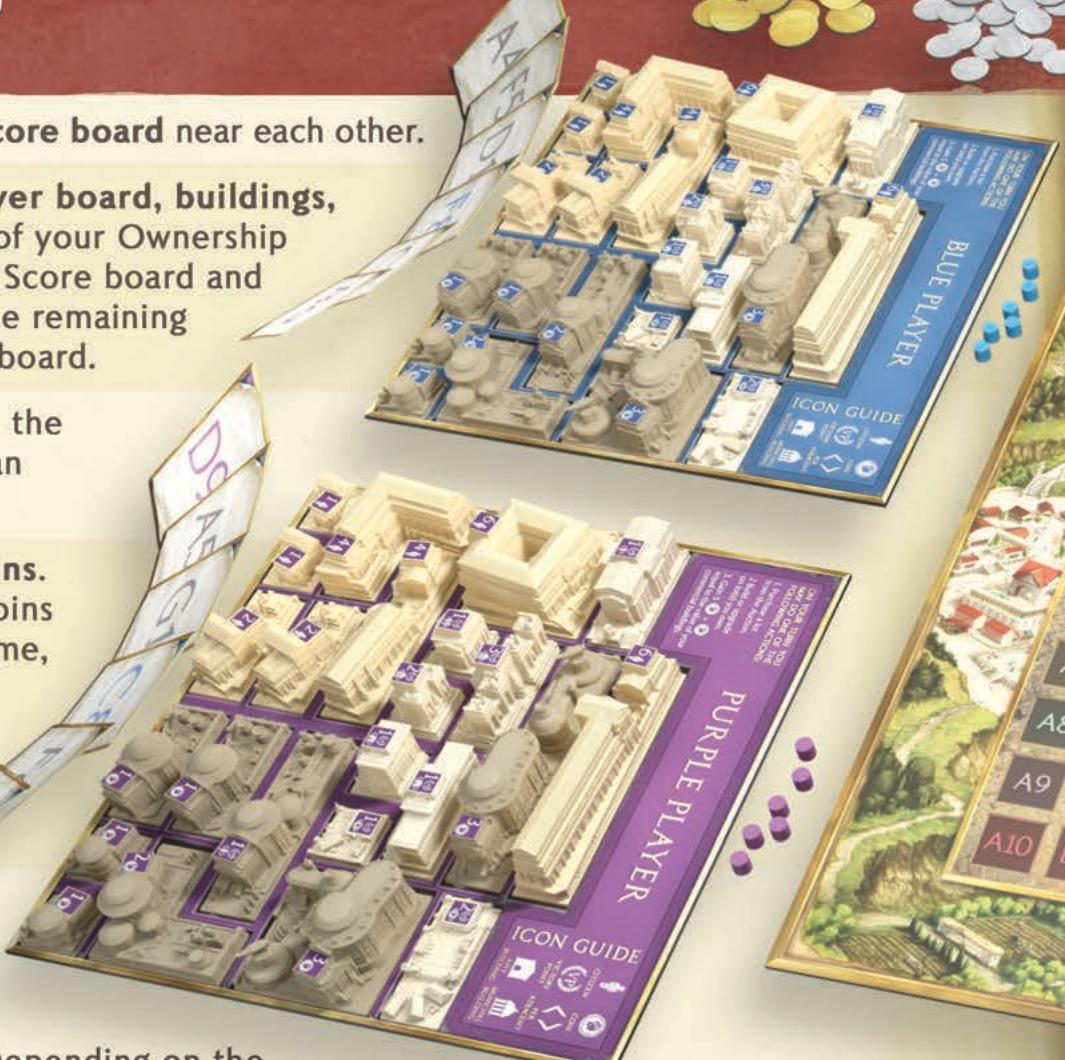
and not use particular rows or columns of Lots. Depending on the number of players, you will need to remove some of the Deed cards from the game:
a. For four players, remove all the Red Deed cards (Column J and Row 10). You will play on a 9x9 layout using 81 Lots.
b. For three players, remove all the Red and Purple Deed cards (Columns I and J and Rows 9 and 10). You will play on an 8x8 layout using 64 Lots.
c. For two players, remove all the Red, Purple, and Blue Deed cards (Columns H, I, J and Rows 8, 9, 10). You will play on a 7x7 layout using 49 Lots.
-
Shuffle the remaining Deed cards together and deal six to each player.
-
Place Ownership tokens of your color on each Lot that appears on the Deed cards you were dealt. At this point, you will have two Ownership tokens left.
-
Then, place your cards in a pile in front of you. Each player has their own pile of Deed cards that they acquire during the game. Should a question arise, players can look at these piles to determine who owns each Lot.

You are now ready to start building Rome!

HOW TO PLAY
Foundations of Rome is played over three rounds, each representing approximately ten years in the early history of the city. I expect to see great things from you in that time!
During a round, the players take turns, starting with the first player and going clockwise. The round continues until the stack of Deed cards for that round (on the Deed board) runs out.
At the end of the round, players will score Victory Points, recorded on the Victory Point Tracker. After the third round scoring is complete, the game ends.
PLAYER TURNS
On your turn, you must choose one of the actions shown below to complete.
After you complete your action, you turn is over and the player to your left begins their turn.


BUY A DEED
TAKE INCOME
CONSTRUCT A BUILDING
ACTION: TAKE INCOME
You may petition Romulus for more resources. Doing so will gain you coins totalling a value of 5 from the bank.
In addition, you also receive coin equal to the total value of coin listed on all your commercial buildings out on the City board.

GGGGGSGGSGGSSSGSCASSGGGGGSGGGGGG
Example: Cornelia decides to take income on her turn. She gets 5 in coins from Romulus, plus 3 in coins for her Bakery and Artisan Studio she has on the City board, so she takes a total of 8 in coins from the bank and adds them to her supply.
Here's a helpful tip!

Look at your player board to quickly tally up how much coin the buildings you've built provide. You can do this for other building types as well!
ACTION: BUY A DEED
You may not take this action if all of your Ownership tokens are already on the City board. You will have to take income or construct a Building instead.
You may purchase any of the Deed cards available on the Deed board by following these steps:
-
Pay the number of coins shown above the Deed you wish to purchase. These coins go to the bank.
-
Take the Deed card from the Deed board and add it to your Deed card pile.
-
Slide the other Deed cards to the left to fill the empty space, if needed.
-
Fill the last spot by turning over the top Deed card from the deck for the current round.
-
Place one of your Ownership tokens on the matching a Lot on the City board.
Important! When the last Deed card for the current round is drawn, do not refill the Deeds For Sale when taking this action until the end of the round (see “The End of the Round” on page 8).
Example: Fabius would benefit from acquiring Lot B4. Fortunately for him, it is available on the Deed Board! He pays 4 coins to the bank (A) and takes the Deed card from the Deed board (B). Then he slides the three higher-priced cards down one space each (C) and turns over a new Deed card from the deck (D), placing it on the 10-coin space. Now he places his Ownership token on Lot B4 of the City board (E).
ACTION: CONSTRUCT A BUILDING

Example: Cassius instead decides to build the Domus Maximus over the top of two Domus' he already built. He can do this because the Domus Maximus is 2-Lots in size,
while each Domus is only 1-Lot each in size. The two smaller Buildings are removed from the City board and Cassius places his Domus Maximus.
You can only construct Buildings on Lots that you own.
Each player has their own supply of 24 Buildings at the start of the game. Buildings come in different shapes and sizes. In order to build one, you must first own a set of adjacent Lots that match the shape of the Building (A).
To build, choose the building you want from your supply and place it on top of the Lots you own. Return your Lot ownership tokens to your supply for later use (B).
You may build on empty Lots you own without restriction. You may also “build over” a Building you constructed earlier, but only if the new Building is bigger than the one you are building over. The type of Building does not matter.
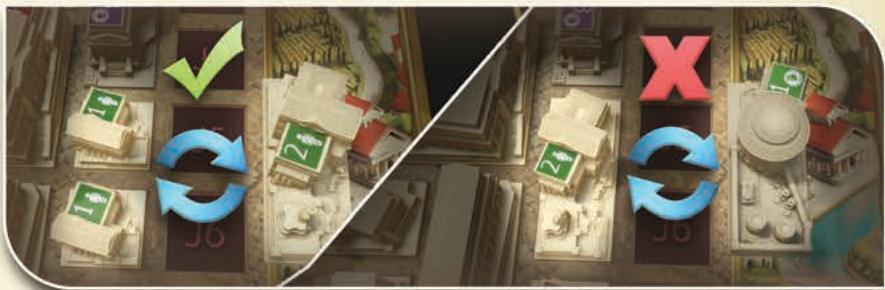
You can never build over a Building of the same size or a larger building. So, you could never build an Artisan Forum (size 3) on top of an Insulae (also size 3), nor a Foundry (size 4).
If you build over one of your Buildings, remove the Building from the City board and return it, and any of your Lot ownership tokens used, to your supply. You may reuse that Building again later as normal.
When building over one of your own buildings, any Lots you own remain owned by you, even if the shape of the building changes.

GSSSGSSSSSSSSSGSGGSSSSSSSSG

There is a limited number of each Building type available! You cannot construct a Building if you do not have one available in your supply.
Also, there is no cost (in Coins) when constructing a Building. Romulus supplies the materials and labor required to build it!
THE END OF THE ROUND
When the current deck of Deed cards runs out, the round will soon come to an end. Continue taking turns and playing normally, including buying Deeds from the Deed board, until all of the Deeds available for purchase have been bought.
Do not refill the Deed board when you buy the final Deed for that round.
Once the Deed board is empty for the round, each player takes one final turn to collect income or build (including the player who purchased the last Deed on the Deed board).
END OF ROUND SCORING
After the round is over, players score Victory Points for the Citizens living in the Buildings they have constructed and for the Municipal Buildings they have built, as well as earning Coins from their Buildings that provide income.

RESIDENTIAL BUILDINGS
Each player counts the number of citizens they have on their Buildings on the City board, marking their total on the Population Tracker. Each player scores Victory Points equal to their population total. Additionally, the player with the most Citizens scores a bonus. That Victory Point bonus changes each round:



Ties are “friendly:” If two or more players are tied for first place on the Population Track, they both get the bonus.
If you have no Citizens on your Buildings, you do not get any Citizen points at the end of the round.
MUNICIPAL BUILDINGS
Next, you receive Victory Points based on values shown in the icons on your Municipal Buildings in the on the City board. Municipal Buildings reward Victory Points dependent on the other buildings directly adjacent to them (share an edge) on the City board.

Awards points for Citizens on adjacent Residential Buildings

Awards points for every Coin on adjacent Commercial Buildings
Awards points for every two Citizens on adjacent Residential Buildings


Awards points for every adjacent Municpal Building
It does not matter which player owns the adjacent buildings. Your Municipal Buildings provide Victory Points for any adjacent buildings – not just your own!

Example: Porcia has built a Resplendent Library, which provides 1 Victory Point per adjacent building with Citizens, regardless of who owns those buildings. In the example shown, Porcia will earn 6 Victory Points from her Resplendent Library during the end of round scoring.
Awards points for every adjacent Building – regardless of type!

COMMERCIAL BUILDINGS
Each player takes 1 value in coins from the bank for each coin symbol on the Commercial Buildings they have constructed on the City board (like the Take Income action, but without getting 5 value in coins from Romulus).
Additionally, players gain a flat amount of Victory Points for each of their Commercial buildings on the City board. The amount of Victory Points a Commercial building is worth is printed on the inside of the player board.

During the third round, players gain Victory Points instead of coins for their commercial Buildings.
OGGGGSSSGGSSSSSSSGSGGSGGSSSGGSS REPLENISH DEEDS
After all players have collected their Victory Points and coins, refill the Deed board using cards from the next round's deck.
A new round begins with the player to the left of the one who took the last turn in the previous round.
END OF GAME
The game ends after the third round. During the third-round scoring, players gain Victory Points as normal through end of round scoring, with two additions:
Collect coins: Instead of collecting coins from their Commercial buildings, each player scores bonus Victory Points equal in value to the number of coins they would have received in the final round.
Empty Lots: You score 1 Victory Point for each Ownership token you have on the City board.
The player who has the most Victory Points is appointed the leader of the new Senate by Romulus, and their name is heralded throughout the illustrious history of Rome!
OPTIONAL RULES
Once you are familiar with the game, and you are ready for a new challenge, you can add any or all of the following optional rules to the game, in any combination you choose!
DEED DRAFTING
If you would like a less random start to the game, you can use this optional rule.
Like the normal game, shuffle the Deed cards and randomly deal six to each player, but deal them all face down. Hold your cards in your hand, hidden from the other players.
Simultaneously, each player chooses one Deed card from their hand and, at the same time, places it face up on the table in front of them. They then place their Ownership tokens on those Lots and add the Deed cards to their own pile.
Next, each player passes the rest of the Deed cards in their hand to the player on their left.
Continue selecting and passing cards until all of them have been chosen. At this point, each player will own six empty Lots on the board, and will have six Deed cards in the pile in front of them.

ADVANCED POPULATION SCORING
After playing a few games, try this alternative. The player with the most population scores Victory Points equal to his population total plus the bonus, just as in the standard game. Each of the other players score Victory Points equal to the number of Citizens of the player in front of them on the Population Track.
Example: It is the end of round 2 and time for scoring. Paul has 13 Citizens, John has 10, Sally also has 10, and Tom has 0.
Paul scores 20 points (his current population + the round bonus of 7 points for having the highest population).
John scores 13 points (John scores points equal to the next Citizen marker ahead of him. Paul is the next player ahead of him on the track, so John scores 13 points for the 13 Citizens which Paul has.)
Sally also scores 13 points, just like John. She is on the same space as John, and ties are friendly.
Tom does not score anything. In order to score you must have at least one Citizen on the track. If he had built just one building with a Citizen he could have scored 10 points for the next player(s) ahead of him on the track (John or Sally with 10 Citizens each).

Game Design:
Emmerson Matsuuchi
Game Development:
Bryan Pope
Project Management:
Walter Barber
Production:
John Rogers
Marketing:
Robert Geistlinger
Proofreading & Editing:
William Neibling
Art Direction:
Stephen Gibson
Graphic Design:
Stephen Gibson
Cold Castle Studios
Building Concept Art & Design:
Jonathan Defresne
Illustration:
Michal Sawtyruk
Damien Mammoliti
Blanca Jiménez
3D Modeling:
Noble Robo Studios
Valerio Buonfantino
Playtesters: Coming soon!
©2020 Arcane Wonders®, LLC. Not suitable for children under 3 years of age due to small parts. THIS PRODUCT IS NOT A TOY. NOT INTENDED FOR PERSONS UNDER THE RECOMMENDED AGE REQUIREMENT. Made in China.
Download MarkdownTexts are community-compiled or publicly released by publishers; copyright remains with the original authors. For personal reference only.