
Galileo Galilei
At a glance
Rules, cards and Q&A (Chinese)
The rules, card data and player questions for this game are written in Chinese. Open the Chinese page to read them.
Where to find full rules
Full rules and card lookup are available in the cunlema app at cunlema.cn — pick this game and ask about any rule, card or turn you are unsure about.
Related games
Rulebook text (Markdown)
This game has 2 rulebook Markdown file(s) in our library; 2 rendered inline below — expand to read or download.
rules_zh_伽利略_41835.md86.3 KB
规则书
中文翻译:陈斌华
欢迎来到 16 世纪和 17 世纪之交!在这个时代,欧洲接受了新的科学思想。
博学的天文学家从用肉眼凝视天空转向使用第一台望远镜。加入他们令人惊叹的天文观测!然而,你必须谨慎行事——教会仍然保持警惕。异端思想将受到严厉惩罚…
配件

4 角色版图

33 探索卡牌
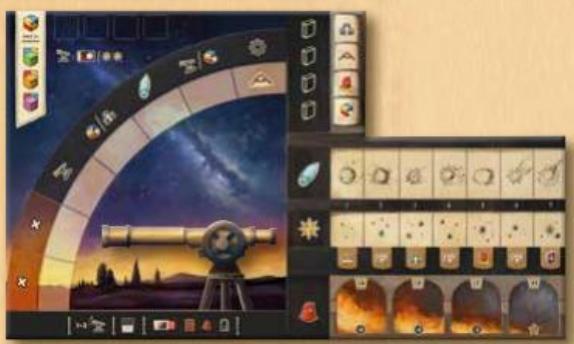
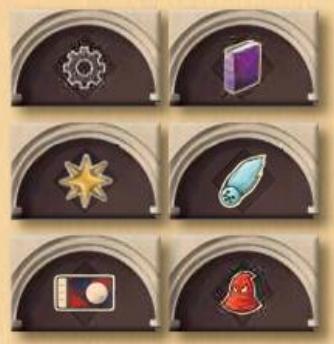
4个带望远镜的玩家版图(请参阅下面的说明,如何在第一场游戏前完成玩家版图)
6 主题板块
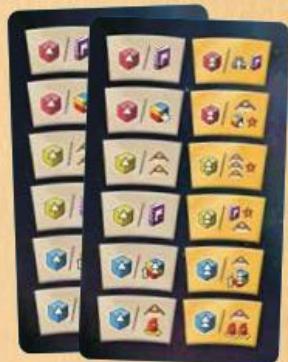
2 帮助卡
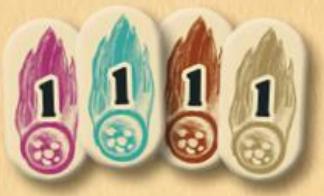
28彗星指示物 (每人7个)
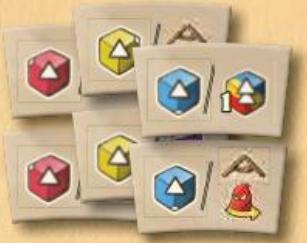
24 行动板块 (每人 6 个)

1 起始玩家指示物
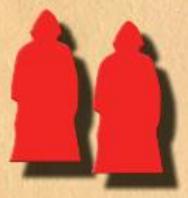
33 审问者指示物

30 骰子(每种颜色 10 个)
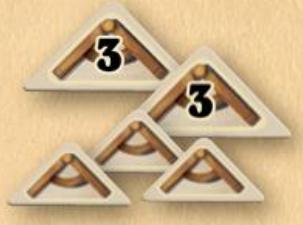
26 小型象限 (1)
8 大型象限 (3)
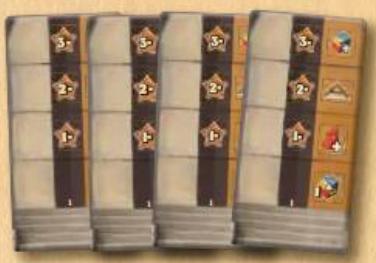
6 双面
大学刻度板块
游戏设置
-
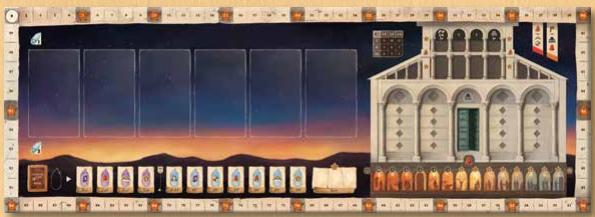
将游戏版图放在桌子中央。
-
将每个玩家计分指示物放在计分轨道 0 的位置。
-
准备探索卡牌的牌库:
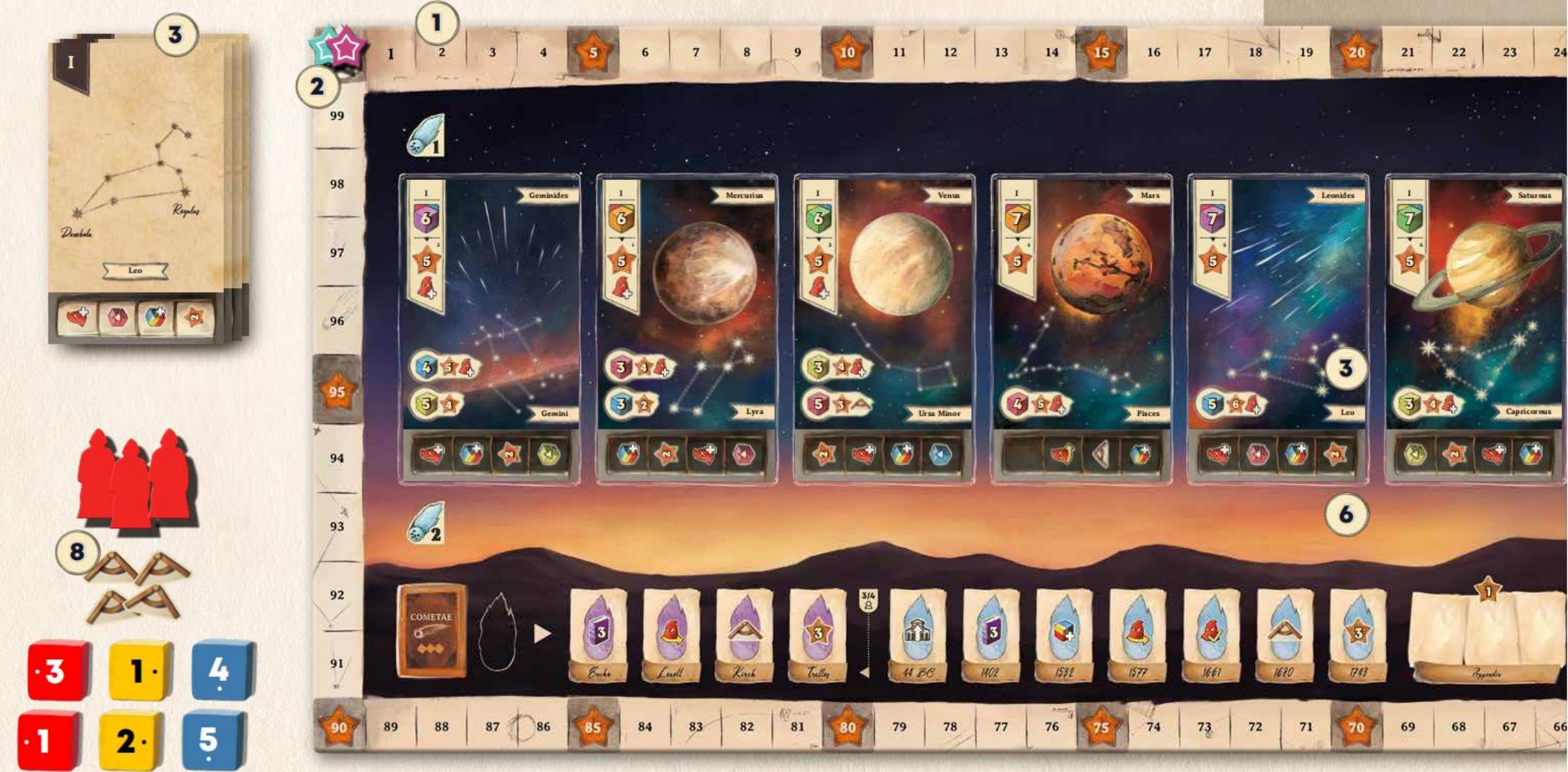
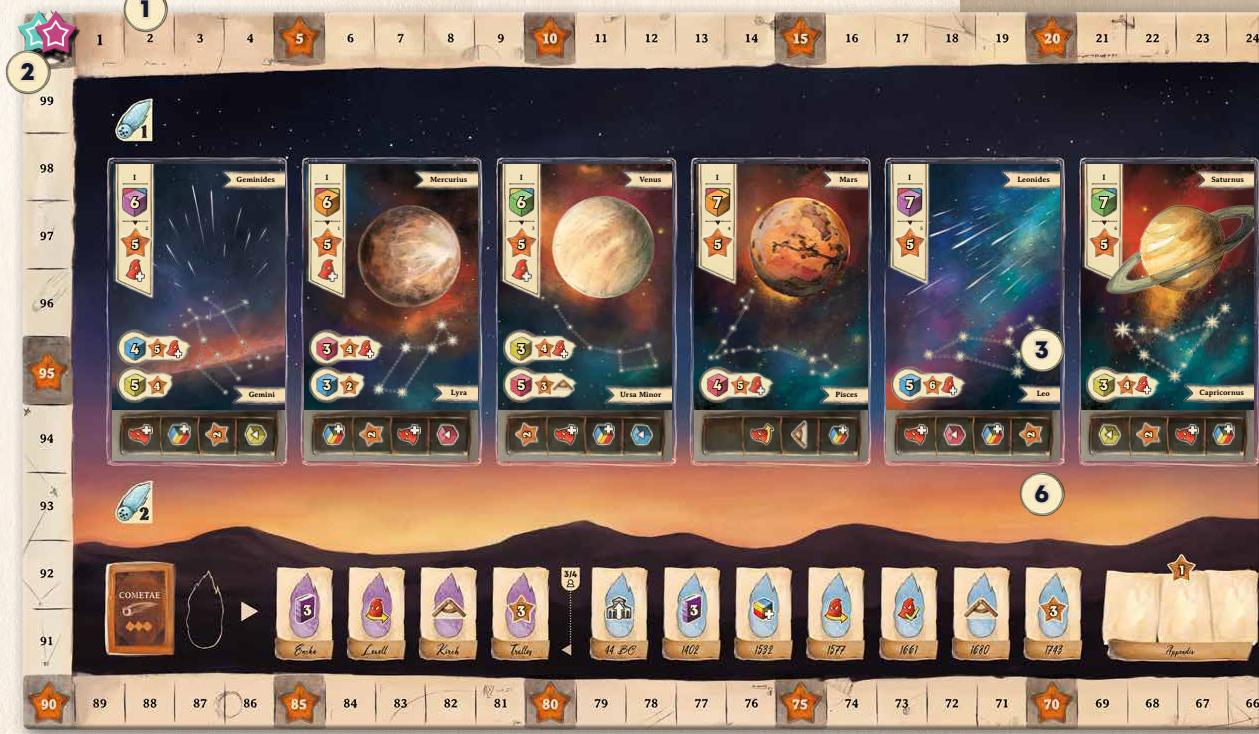
根据表格(*)中的数字从所有三个级别中随机选择卡片。把剩下的卡片放进盒子里。你在游戏中不需要它们。用随机化的卡片创建一牌库。首先将第三级别卡面朝下放在底部,然后是第二级别,然后是第一级别卡放在顶部。把这个牌库放在游戏版图旁边。翻转并将前六张一级卡放在游戏版图上。请参见右侧的示例。
-
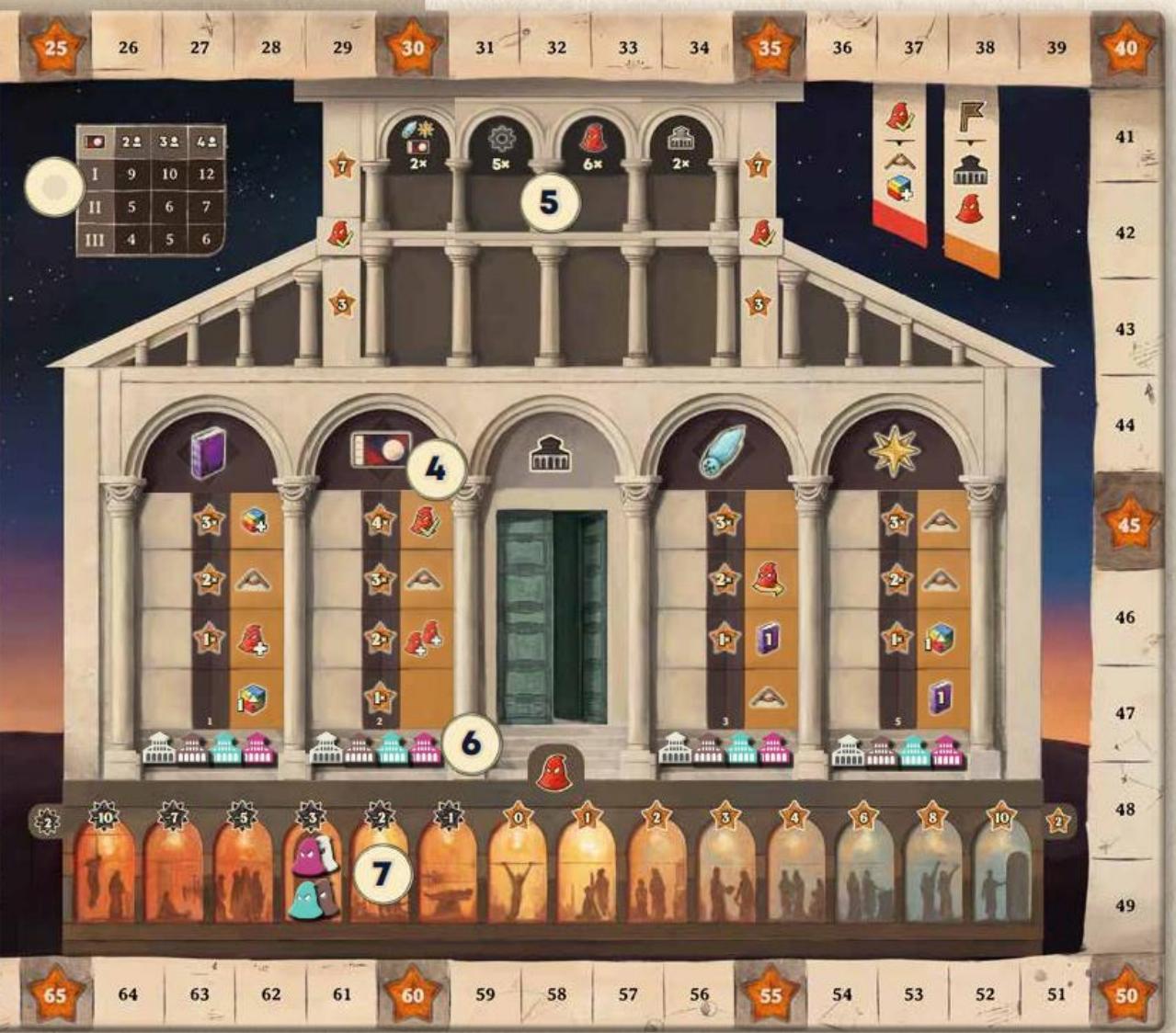
在大学内随机放置 4 块大学刻度板块以及 4 块主题板块(拱门面朝上)。
-
使用剩余的主题板块覆盖大学顶部的(?)区域(壁龛面朝上)。
-
将每位玩家的大学指示物放置每个大学刻度板块的底部。
-
将每位玩家的特别法庭指示物放置声望轨道上。所有的天文学家在(-3)声望开始。
-
创建一个象限,骰子和审问者的供应堆在游戏版图旁。骰子是无限量的,其他资源是有限的。
-
最近观测到星空的玩家将获得起始玩家指示物并先行动。
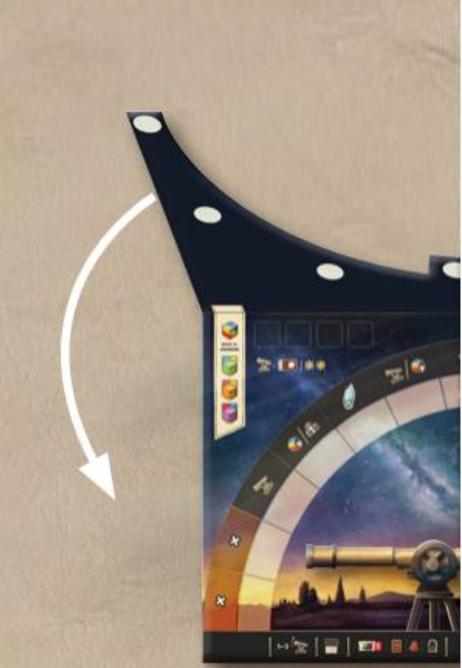
第一次游戏之前,在玩家版图上的白色圆圈上贴上四个贴纸。折叠并按压,使其牢牢固定在一起。

16 书本指示物 (每人 4 个)

16 大学指示物 (每人 4 个)

16 特别法庭指示物 (每人 4 个)

4 计分指示物 (每人 1 个)
28 星座指示物 (每人 7 个)

16 目标指示物 (每人 4 个)

游戏开始前
1 第谷·布拉赫对手板块

用铆钉固定望远镜。确保望远镜运动平稳。
1 第谷·布拉赫书本指示物
主题板块
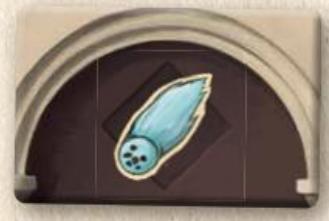
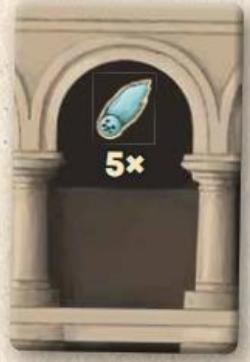
双面主题板块决定了你必须实现哪些目标才能从大学获得分数。一边是拱门,另一边是壁龛。
主题板块
拱门面朝上
单人游戏配件
主题板块
壁龛面朝上
进阶游戏配件
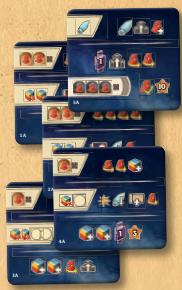
5 单人行动板块


1 焦尔达诺布鲁诺地窖板块

4 尼古拉斯·哥白尼图书馆板块
6 单人移动板块
1 约翰内斯开普勒
特殊行动板块
牌库设置
使用旁边的表格搭建你的探索牌库。这也可以在游戏版图上的(*)处找到。每列显示所需的一级、二级和三级探索卡的数量,具体取决于玩家的数量。

以下是为三名玩家设置探索牌库的示例。始终创建面朝下的牌库,卡片的浅色面朝上。
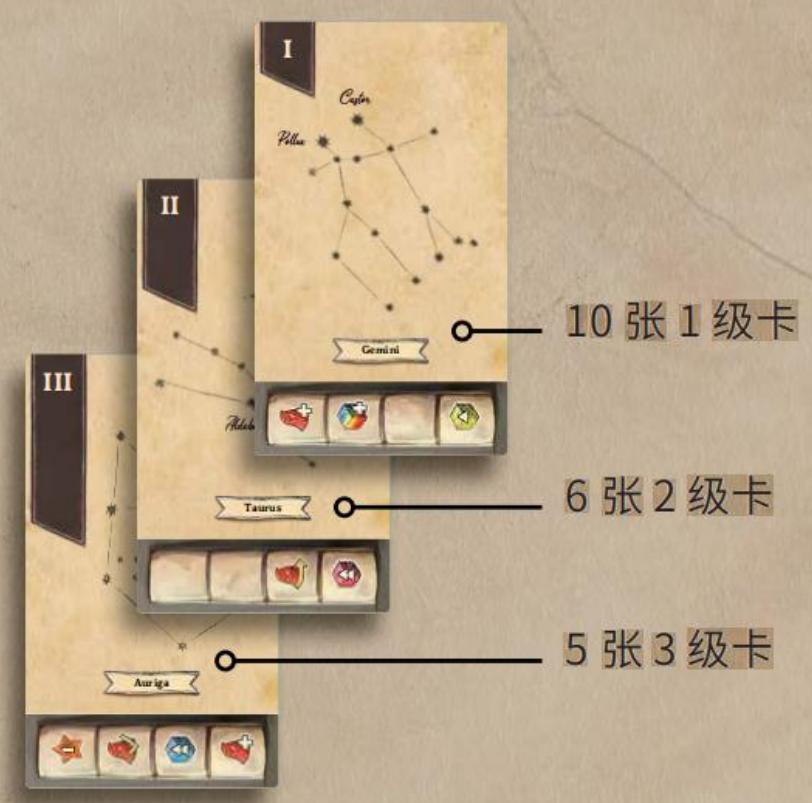
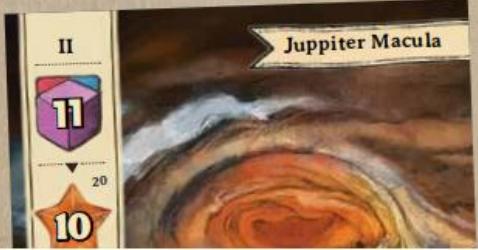
每张卡牌背面提示了其等级以便准备牌库。卡牌正面的等级在其主要目标的观测成本上方可见。
玩家设置
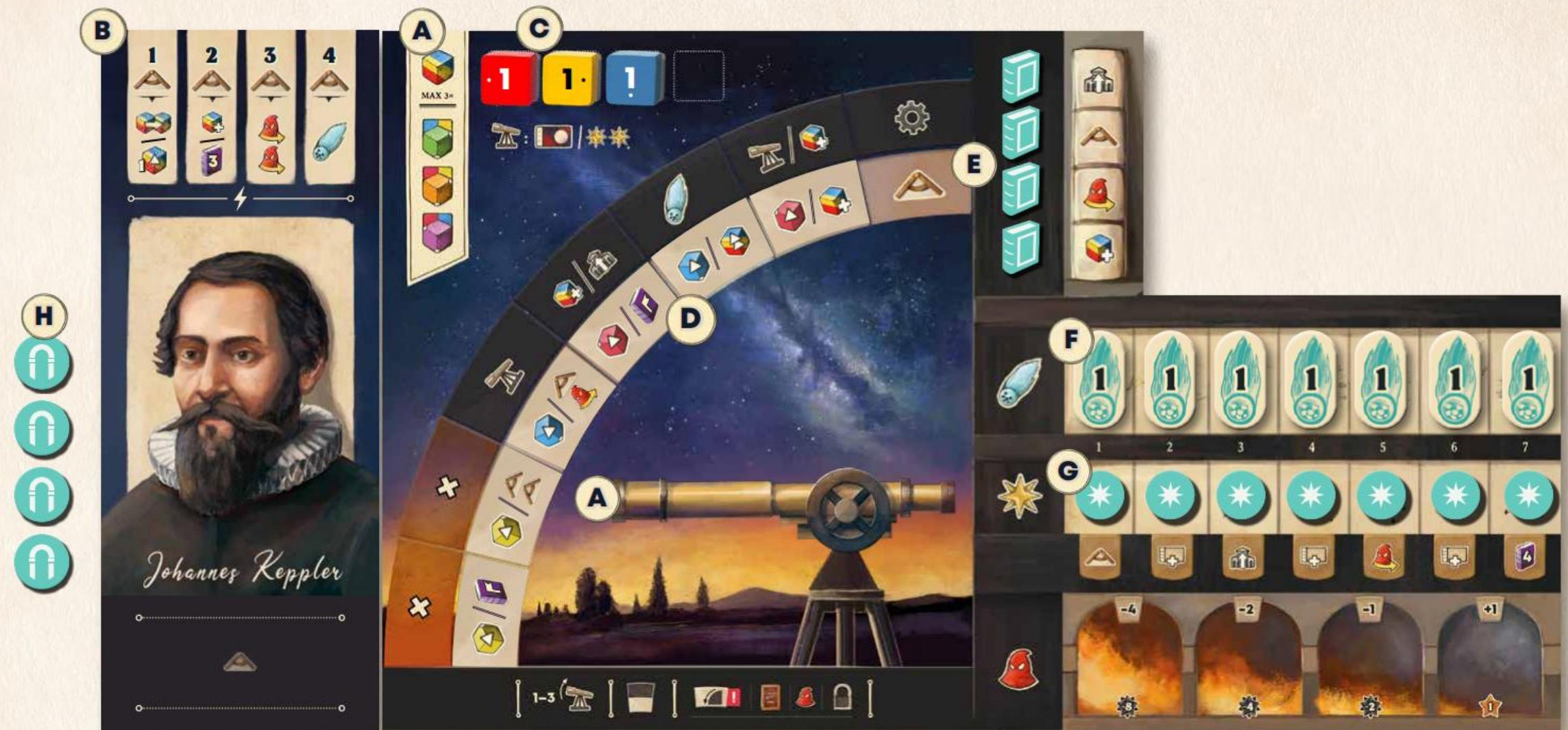
A. 拿一个玩家版图和望远镜,放在你面前。游戏开始时,望远镜指向两个交叉的空格的上面一格。
B. 每位玩家选择一位天文学家。将他的角色板放在玩家版图的左侧。在你的前几场游戏中,使用象限游戏符号面朝上。在你熟悉了伽利略伽利雷之后,试着利用天文学家的特殊能力!(见第 12-14 页。)
C. 每种颜色(红色、蓝色和黄色)取一个骰子,放在玩家版图的左上角。每个骰子从 1 点数开始。
D. 取一组六个行动板块,随机放置在玩家版图的星空上,浅色面朝上。
注意:我们建议你在第一局游戏中随机放置板块,以加快设置速度。在以后的游戏中,尝试选择将板块放置的顺序!
E 将你的 4 书指示物放在图书馆右侧的起始位置。
F. 把你的 7 个彗星标记放在你的彗星区域上。他们从 1 点数面朝上开始。
G. 把你的 7 个星座标记放在星座区域上。
H. 把你的 4 个目标指示物放在你的角色版图附近。
介绍
伽利略伽利雷是一款关于在星空中发现天体的游戏。你扮演一个历史人物,努力成为那个时代最著名的天文学家!但观察天空并不是获胜的唯一途径——写下你的发现和在大学里讲课也是取得成功的途径。

游戏的基本机制是移动你的望远镜,在每一回合选择你的行动。行动可以让你观察天空,在图书馆写作,在大学演讲,并获得其他优势。你的进步是通过围绕版图的轨道上的胜利点数来衡量的。
最近观察星空的玩家作为起始玩家。
然后,游戏围绕桌子顺时针进行。
当最后一张探索卡被放置在游戏版图上时,游戏结束。完成当前回合,这样每位玩家都有相同的回合数。然后进行最后一轮,并计算你的分数(见第 13 页)。胜利点数最多的玩家获胜!
回合结构
每回合有以下 3 个阶段:
1) 移动

在回合开始时,将望远镜向前移动 1 到 3 格。如果你到达星空上的最后一格(升级行动),并且仍然有剩余的移动,则可以进一步移动。
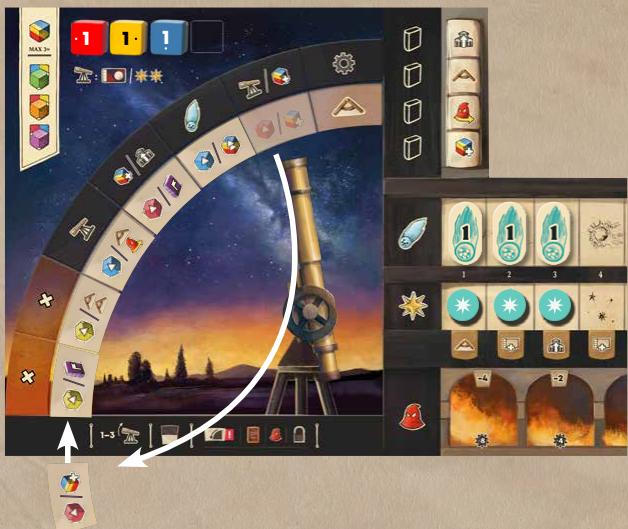
从第一个未被划 X 的格子继续移动(观察行动)。望远镜只能朝着星空的顶端前进,永远不能后退。请参阅右侧的示例。

2) 行动
星空上的每个格子都有一个固定行动和一个移动行动(行动板块)。在行动阶段,你可以选择使用固定、移动和自由行动的顺序(请参阅下面的行动阶段)。

3) 清理
在清理阶段,你将所有行动板块旋转移动 1 个空格,从彗星之书中获得奖励,接受宗教裁判所的审问,并检查大学成就(见第 10 页的清理阶段)。
星空中的每一格都有一个固定行动(暗)和一个移动行动(亮:行动板块)。在行动阶段,你可以在望远镜指向的格子内执行任何行动。你可以选择执行这些行动的顺序。

此外,你可以使用象限指示物进行自由行动。只要你有足够的象限指示物来支付,你就可以执行任意数量的自由行动。

斜线分隔的区域使你可以在两个行动之间进行选择。执行该行动时,你可以选择使用哪个选项。
在执行其他行动之前,包括自由行动,一定要结算完当前的行动。这包括结算完行动中的任何奖励。如果一个行动的奖励也是一个行动,那么在执行其他行动之前,先结算这个奖励。例如,如果“在你的图书馆中写作”奖励你一个讲座行动,你必须在执行自由动作之前结算完这个讲座。
行动阶段
这里有 5 种固定行动:

观察

获得骰子 / 讲座

发现彗星

观察 / 获得骰子

升级
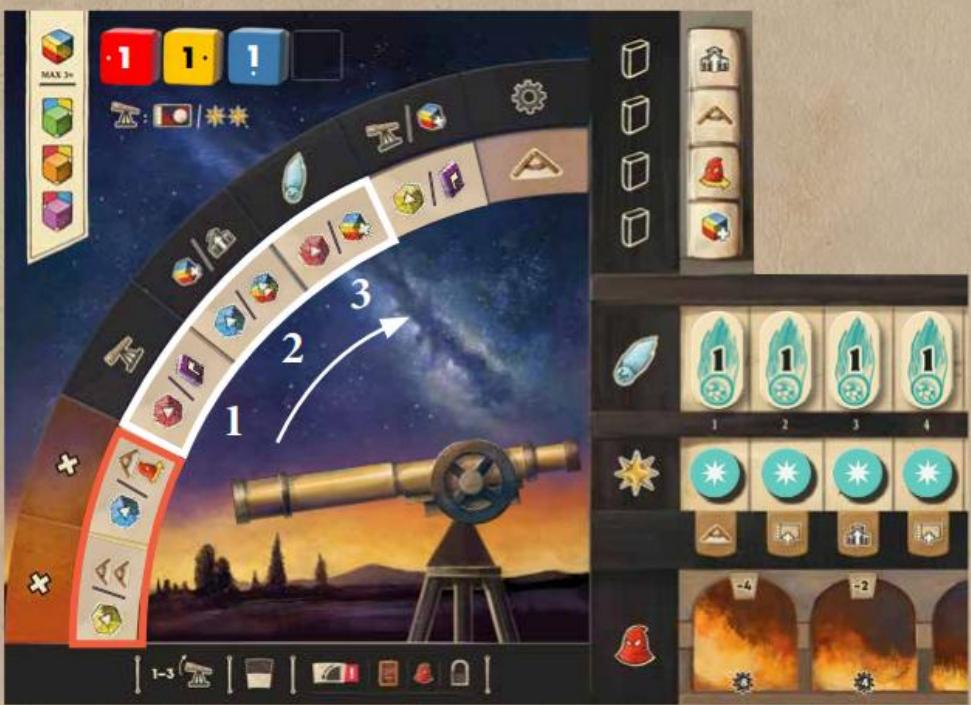
一旦游戏开始,望远镜就无法指向星空中最低的两个区域。望远镜必须沿着星空的其余部分顺时针移动 1 到 3 格。

如果你想将望远镜移动到升级行动之后,它会移动到未被划 X 的最低区域格。
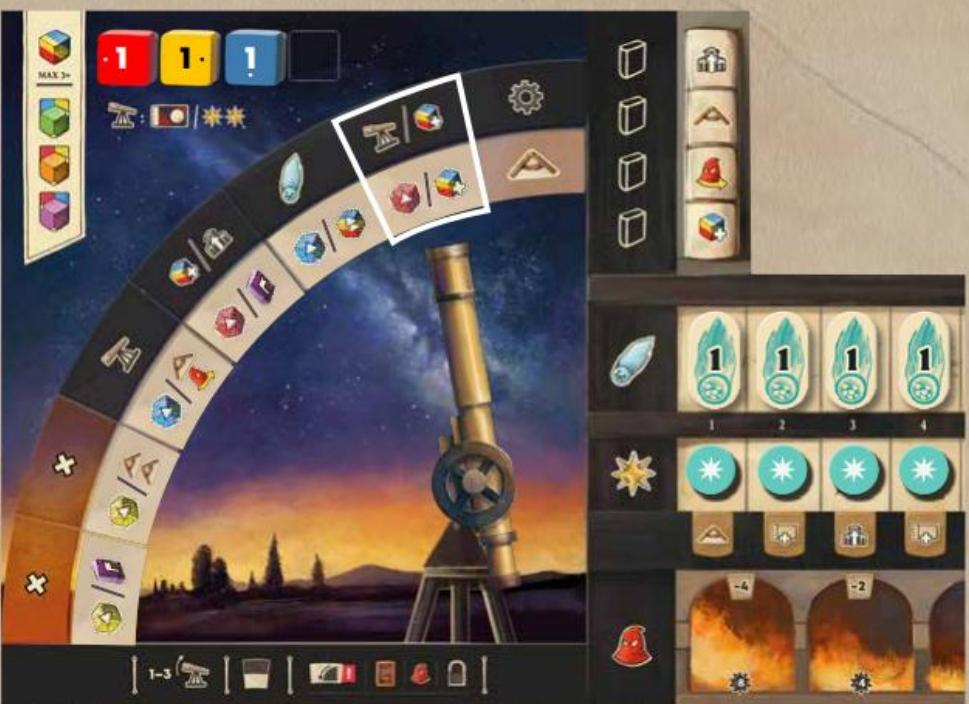
移动望远镜后,你可以选择先执行哪个:固定行动(暗)或移动行动(亮)。
注意:选择行动时,尝试将其从移动行动队列中滑出一点。这有助于提醒你在清理阶段将其移动到星空的底部格子。

观察——你可以选择观察一个主要天体或者至多2个星座。这需要支付来自你玩家版图的观察骰子。
最常用的游戏组件是观察骰子。它们的颜色表示光谱,它们的点数表示观察物体所花费的观察时间。在整个游戏中,你将通过各种行动增加观察骰子的价值。通过花费多种颜色的骰子,你将能够观察到最稀有的天体!
- 观察骰子
玩家版图上最多可以存储四个观察骰子。但是,你一次最多只能有三个相同颜色的骰子。
探索卡上的每个天体都有观察成本。此数字位于卡片左侧的图标中。 图标的颜色表示必须使用的观察骰子的颜色。

主要天体需要 2 种颜色的骰子组合,这会创造出橙色,绿色或紫色。
星座需要单色的投资(黄,红,或蓝)。
观察行动需要从玩家版图上花费骰子。你可以用任意数量的骰子来支付这笔费用。观察星座需要花费单一颜色的骰子,而观察主要天体需要花费两种不同颜色的骰子。颜色组合位于骰子图标的上角和玩家版图的左上条纹中。
你可以花任意数量的骰子来支付观察费用。主要天体的观察成本可以用一种颜色与另一种颜色的任何比例来支付,只要每种颜色至少使用一个骰子。使用观察骰子进行观察后,将其放回储备区。任何超过天体成本的骰子点数都将被没收。
- 观察一个主要天体

支付观察费用后,你将获得主要天体的胜利点数。有些天体还有一个审问者图标(见审问,第12页)。
接下来,将探索卡面朝上放置在你的图书馆中,位于玩家版图的右上角。放置探索卡,使每张卡的图书馆行保持可见(请参阅附近的示例)。图书馆部分(第10页)介绍了如何从探索卡中获得额外奖励。
如果探索卡上有任何星座指示物,请将这些指示物退还给盒子。在这场游戏中,它们将不再被使用。
从探索牌组中抽出一张新牌,并将其面朝上放置在游戏版图上的空白处。

观察时的选项印在玩家版图上。
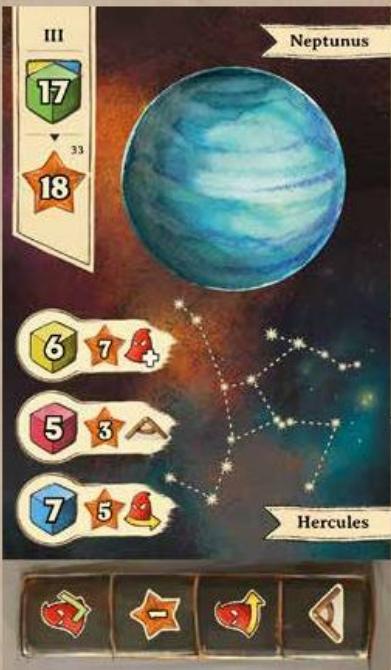
主要天体
星座
每张卡都有一个主要天体和一个或多个星座。你可以在行动过程中选择要观察的对象。
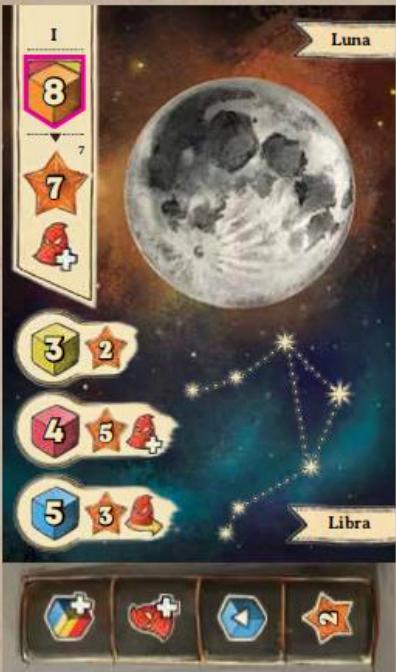
伽利略选择观测月球。月球的观测成本是橙色8,需要红色和黄色骰子的组合。他支付以下观察骰子,把它们还给了储备区
5 · 2 1 ·
伽利略获得游戏版图上的7胜利点数。增加1审问者到他玩家版图地窖最左侧的格子里。

得分后,伽利略将探索卡正面朝上放在他的图书馆,与其他探索卡并排放置。

最后,伽利略用探索牌组中的一张新卡填补了游戏版图上的空白。
· 观察星座
*
你可以通过一个单独的行动观察至多 2 个星座。在完全结算第一个星座之后,再观察第二个。
在支付了星座的观察费用后,拿取你玩家版图最左侧的星座指示物,将其放在你所选的星座上。你获得观察该星座列举的奖励(比如胜利点数)。然后获得你移除指示物区域的奖励。

其中这三个奖励表示“获得一张卡”符号。如果你收到此奖励,请从探索牌组中取一张面朝下的卡,并将其放入你的图书馆中。与从主要天体获得的卡一样,确保图书馆的每一行都保持可见。使用第7个星座指示物后,你将无法再观察任何星座。
木星出现在这个游戏的盒子上,以纪念伽利略在1610年突破性地发现了它的四个最大的卫星。他的观测挑战了盛行的地心模型,并支持日心说。这一科学史上的关键时刻彻底改变了我们对宇宙的理解,并为现代天文学奠定了基础。

获得 1 颗骰子 / 讲座 选择以下一个选项:
- 获得 1 骰子:拿取供应堆任意颜色 1 颗骰子,然后将其放到你玩家版图上。点数为 1 点。
在极少数情况下,玩家的棋盘上已经有 4 个骰子,他们可以用新获得的骰子替换其中一个骰子。将原始骰子归还给供应堆。
- 讲座:将你的一个大学指示物在其刻度板块上向上移动一格。然后,获得版图右侧列出的奖励。一旦你的一个大学指示物达到了刻度板块的顶部,它就不能再移动。

伽利略、布鲁诺、哥白尼和开普勒在大学期间学习了数学、天文学、哲学和神学等学科。他们不同的兴趣和追求后来在科学革命期间融合在一起,重塑了我们对宇宙的理解。
伽利略想观测小熊座。他支付了三个红色观察骰子,分别为3、1和1。

他用最左边的星座指示物来支付小熊座的观测费用。
伽利略获得 3 个胜利点和一个象限标记。他还获得了星座指示物下方列出的奖励——在这种情况下,奖励是执行讲座行动。


玩家版图左上角的图标提醒你,最多可以有三个相同颜色的骰子。但是,你的玩家版图上最多可以存储四个骰子!
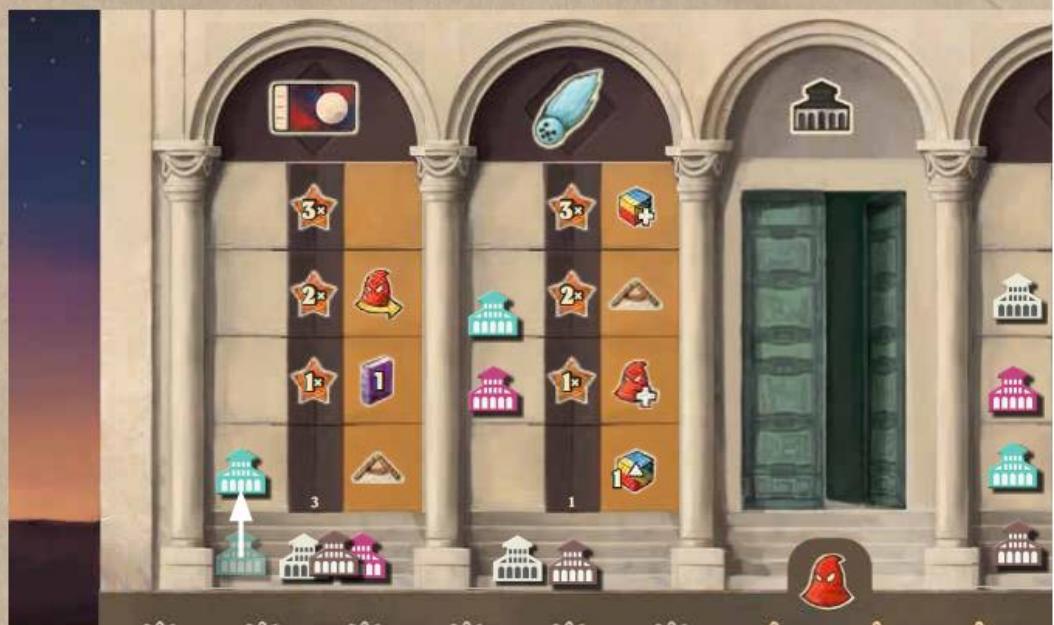
伽利略选择了讲座行动,这样他就可以将他的大学指示物在任何刻度板块上向上移动1格。他选择主要天体刻度。他获得了天平右侧的奖励——在这种情况下,是一个象限指示物。

发现彗星
要发现彗星,请从玩家版图中取出最左侧的彗星指示物,并将其放置在探索卡上方的游戏版图上。“1”面朝上。
- 彗星使用
当你观察时,你可以在游戏版图上使用彗星指示物来降低天体的观察成本。彗星指示物的价值降低了成本。每个指示物每回合只能使用一次。每颗使用过的彗星都必须降低观测成本。换句话说,你不能使用你不需要的彗星。
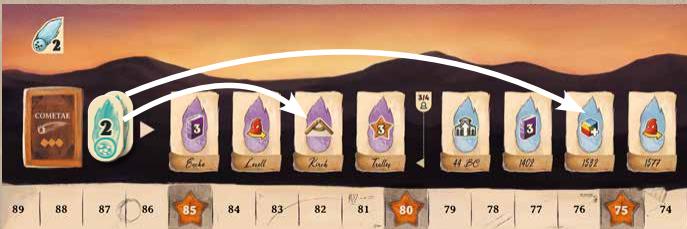
首次使用彗星指示物后,将该指示物移动到探索卡下方的区域。翻转标记,使“2”面朝上。你可以使用彗星指示物来降低你观察到的下一个天体的成本。任何超额的减少都将被没收。
第二次使用彗星指示物后,将该指示物放在彗星之书上。如果你使用多个值为 “2” 的彗星指示物,则每个指示物都会被移动。
注意:当使用彗星指示物降低观测成本时,你仍然需要为对象所需的每种颜色至少花费一个观测骰子。如果你没有所需颜色的骰子,你就不能使用彗星指示物来降低对象的成本。

在 16 世纪和 17 世纪,像约翰尼斯·开普勒这样的天文学家研究彗星,承认彗星的轨道是可预测的,并且普遍存在将彗星与灾难联系起来的迷信;他们的工作,包括开普勒的《彗星》,旨在提供科学解释,而第谷·布拉赫等同时代人则贡献了宝贵的观测数据,为现代彗星科学奠定了基础。

观察 / 获得骰子
从观察行动和获得 1 颗骰子行动中选择一种来执行,与之前描述一致。

升级
选择一个行动板块,并将其翻转到金色升级面。板块不动。星空上升级的行动区域不允许放置行动板块。你将在这里获得一个象限指示物,而不是执行其他移动行动。
注意:在进行第一局游戏之前,先看看行动板块升级面上的行动。升级可以强化基本行动,帮助你比对手的天文学家更快地取得进步。
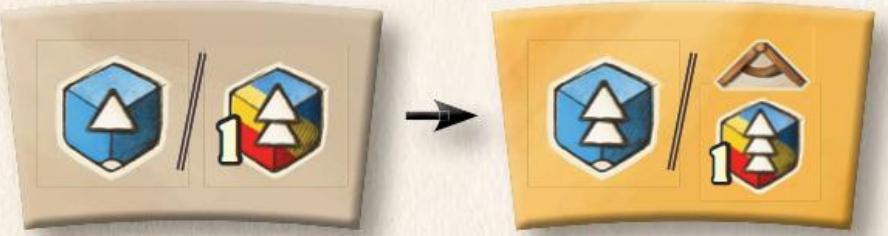
有关升级板块的概述,请参阅规则书背面或帮助卡。
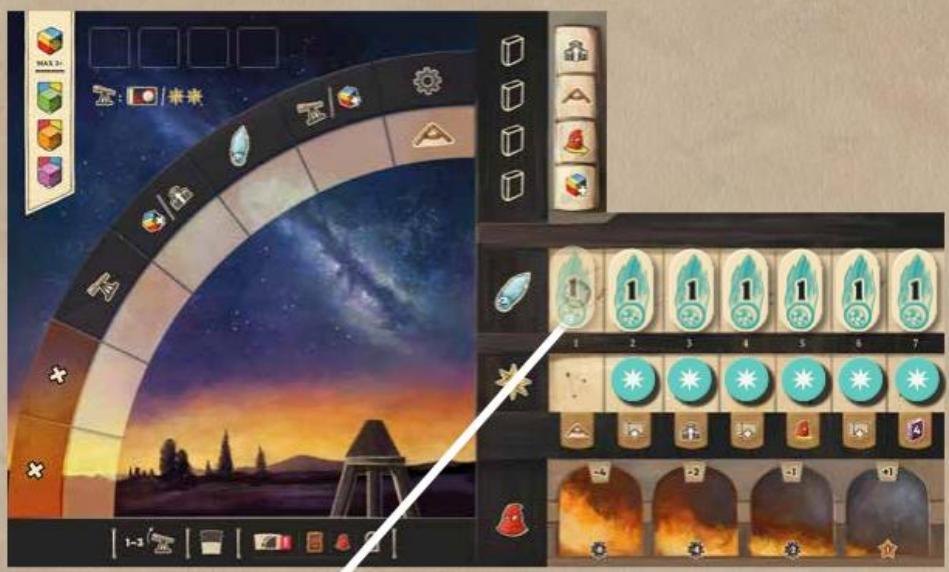

伽利略选择发现彗星。他从自己的版图中取出最左边的一颗彗星,放在游戏版图中探索卡的上方。在伽利略的下一回合,他进行观测。这意味着他有足够的观察骰子来支付观察费用!然后,他将彗星标记移到探索卡牌下面,并将其翻转过来。下一次观测时,伽利略可以用这枚彗星指示物将天体的观测费用减少2。
如果他这样做了, 指示物就会被放在彗星之书上。
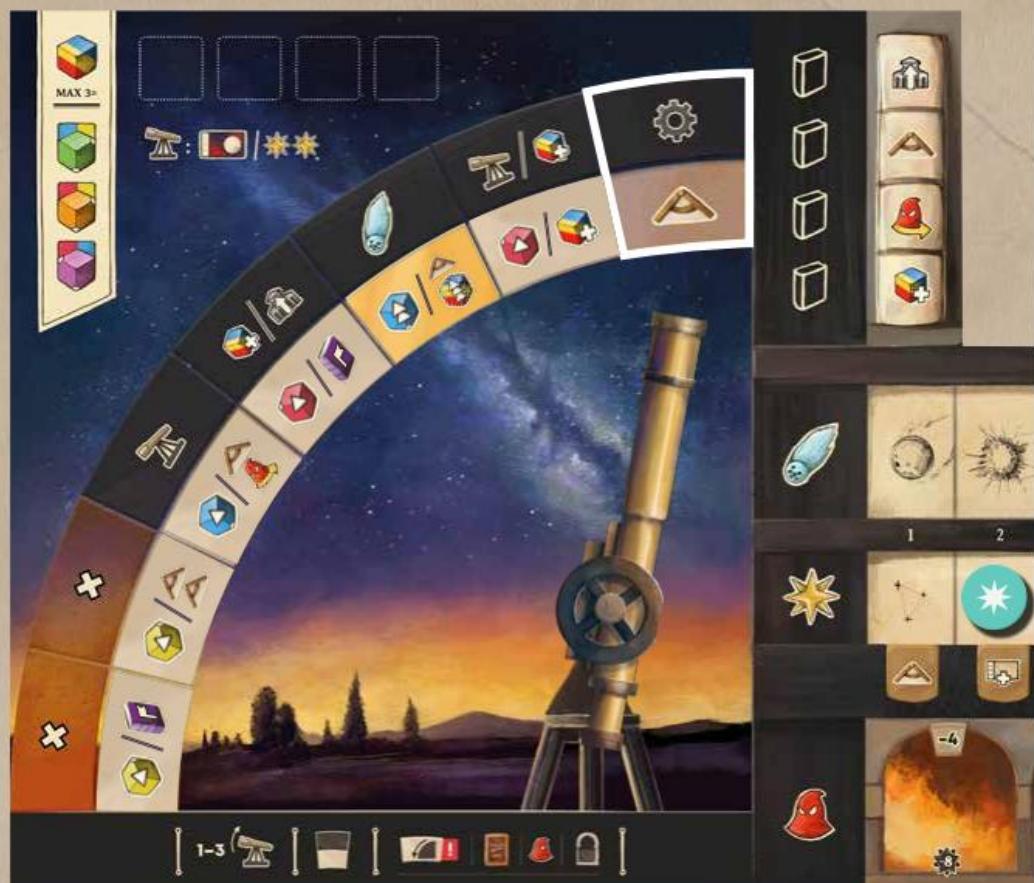
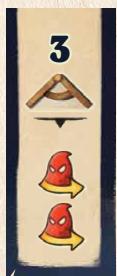
通过升级上图所示的板块,伽利略可以移动 3 个区域,并在下一回合使用它!

移动行动
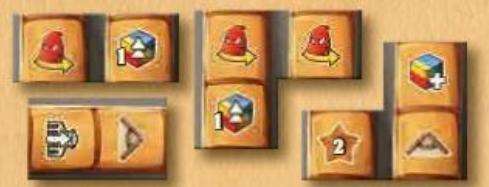
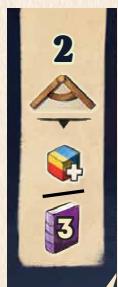
行动板块总是有两个选项可供选择。以下图标用于描述可能的选项:

增加你的所有对应颜色的骰子各 1 点。
增加你的所有对应颜色的骰子各 2 点。
从供应堆获得 1 象限指示物。

说服地窖里的审问者。

提升你的任意 1 颗骰子点数 2 点。

提升你的任意 1 颗骰子点数 3 点。

获得任意颜色的 1 颗观察骰子。

在大学的一块刻度板块上举办讲座。

在你的图书馆的探索卡牌写书。
自由行动
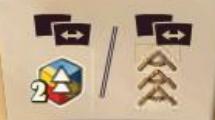
象限指示物可以衡量你的知识水平,帮助你取得重大科学进步。在你的回合中,你可以花费象限指示物执行任何数量的自由行动。一次自由行动需要花费1、2、3或4个象限指示物。在执行其他行动时,你不能使用自由行动。自由行动选项有:
将 1 颗骰子颜色改成其他颜色。点数不变。
获得 1 新的观察骰子。
提升任意 1 颗骰子点数 1 点。
写书 3 格。
说服审问者两次。你可以选择同一个审问者两次,也可以选择两个不同的审问者各一次。

发现彗星。
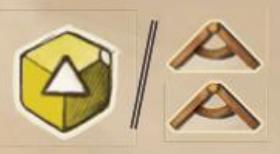
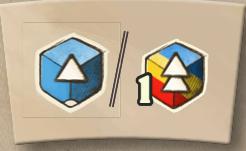
伽利略可以将所有蓝色观察骰增加 1,也可以将单个观察骰增加 2。


: 📄 / 🌟 🌟
伽利略的玩家版图上有三个蓝色骰子和一个红色骰子。使用上面的行动板块,他可以将蓝色骰子增加到3、2、2,也可以将红色骰子增加到5。如果他愿意,伽利略可以将单个蓝色骰子增加2,这样做可以帮助他在下一次观察行动中避免超支。
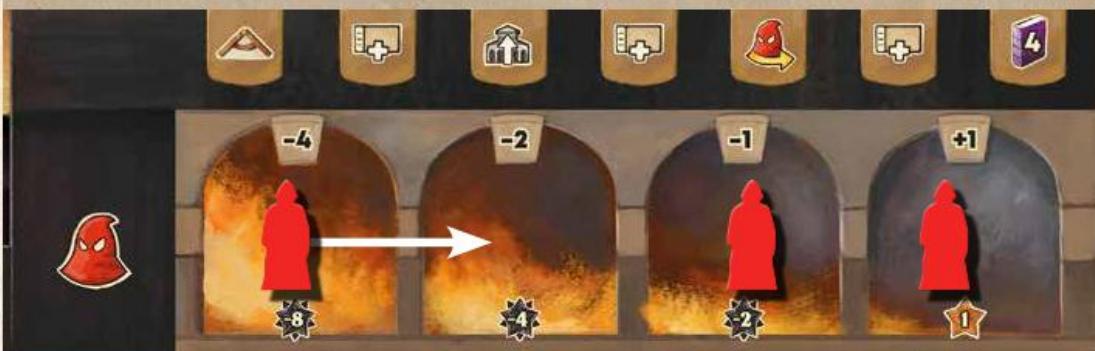
如果你说服一个审问者,你必须将地窖中的一个审问者米宝向右移动1个区域。如果你没有可以移动的审问者米宝,则放弃该行动。
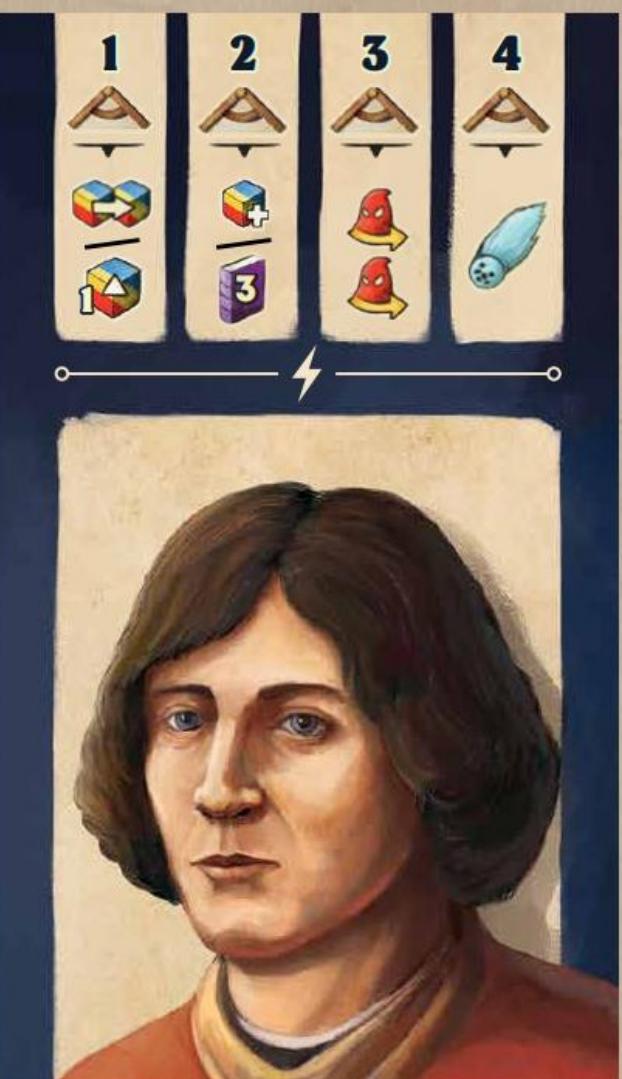
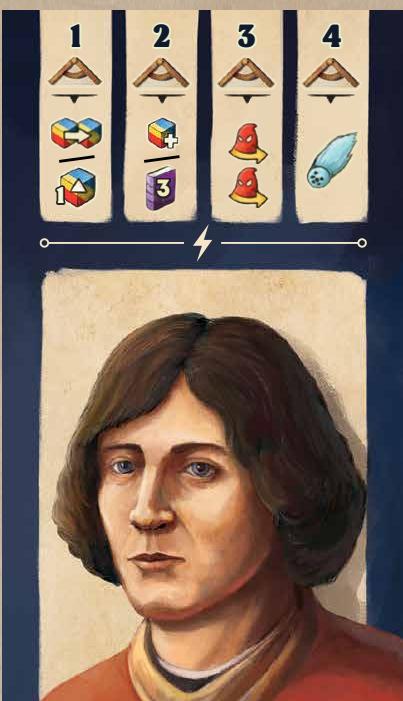
自由行动会列在你的角色版图上,在你的天文学家肖像的上方。
注:如果你想顺利通过审问,请保存你的象限指示物,作为自由行动说服你的审问者。
清理阶段
按以下步骤完成你的回合:

旋转行动板块:移除你本回合在星空中使用的行动班板块。将你其他的行动板块向前移动。然后将你移除的行动板块放到队列的起点位置。
彗星之书:如果书上有彗星指示物,将它们放在任何空置页面上,就能获得所示奖励。每一页只能有一个彗星指示物。多余的彗星指示物可以放在附录 Appendix 中加 1 分。
当进行高级游戏时,有些角色版图有个人彗星之书页面。你可以将彗星指示物放置在彗星之书中的位置。

审问:如果你本回合执行了说服行动 -- 即使是作为另一个行动的奖励 -- 请检查你的地窖是否进行了审问(请参阅宗教法庭,第 12 页)。
检查目标:检查大学顶部,看你本回合是否完成任意目标(见大学,第11页)。
图书馆
每位玩家通过观察主要天体和星座收集到的探索卡,创建自己的图书馆。每次获得一张探索卡时,将其水平放置在你的图书馆旁边,这样就能看到每张卡的四个奖励行。
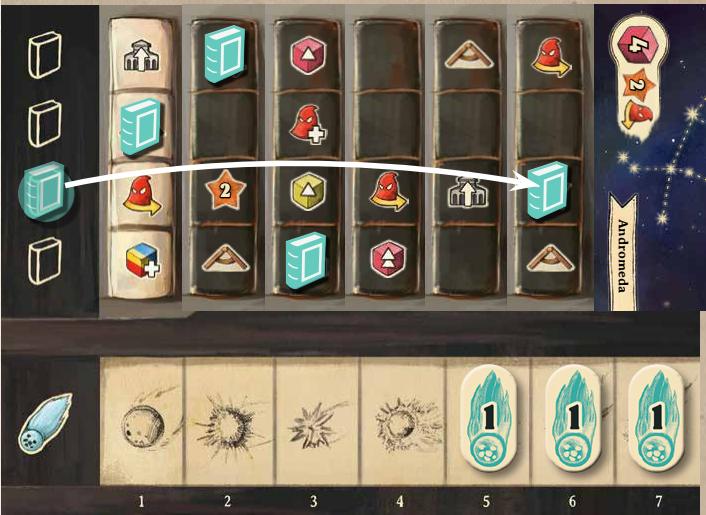
通过写书行动,你可以移动一个书本指示物,如下所示:

完成写书:移动 1 个书本指示物到其所在行的最右格。

部分书写:移动图书指示物的总区域数等于图标的数量。你可以选择任意数量的不同图书标记,只要移动的区域总数不超过写书行动的图标。移动的总格数不超过写书行动的图标。
移动图书指示物后,你将获得所移动的每个区域列出的奖励。如果可能,你必须从左到右逐个获得所有奖励。例如,如果伽利略没有红色观察骰,他就不能增加他的红色骰子。但是,获得审问者图标意味着他必须在地窖中放置一个审问者--即使他并不想要。书本图标只能向右移动。
在文艺复兴时期,天文学家们通过写作、教学和通信来促进科学知识的保存和共享。他们记录了自己的观测、理论和发现。通过促进学术交流,天文学家们为科学进步留下了永恒的遗产。
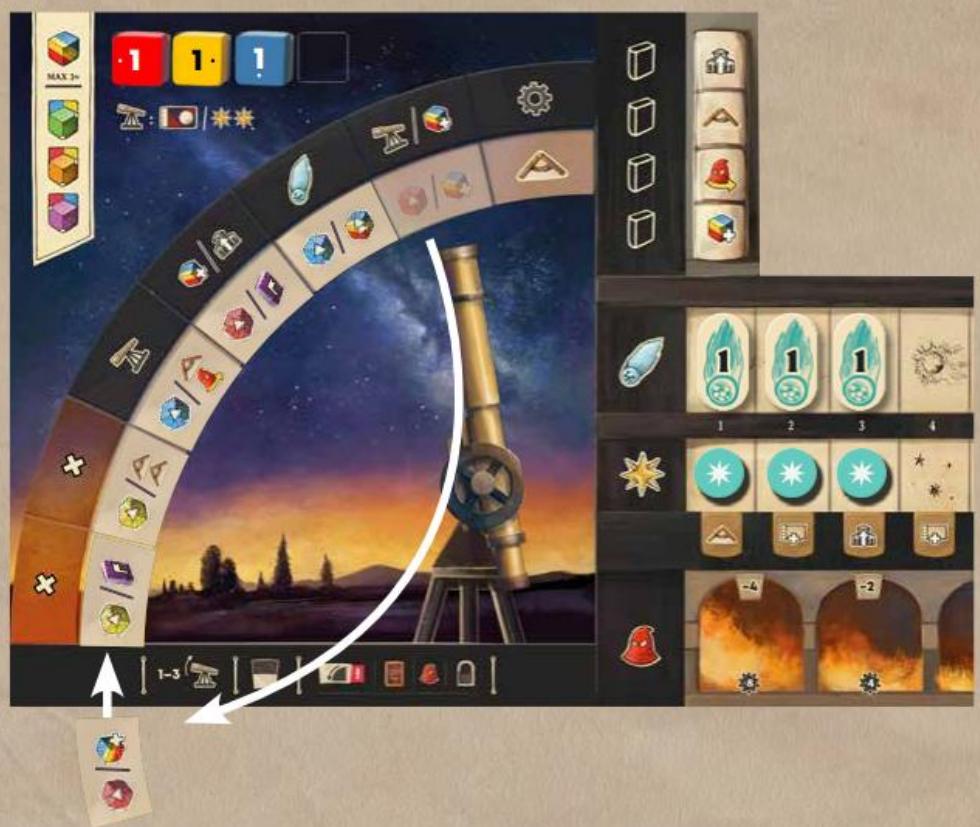
始终推动行动板块,让它们填满整个队列。
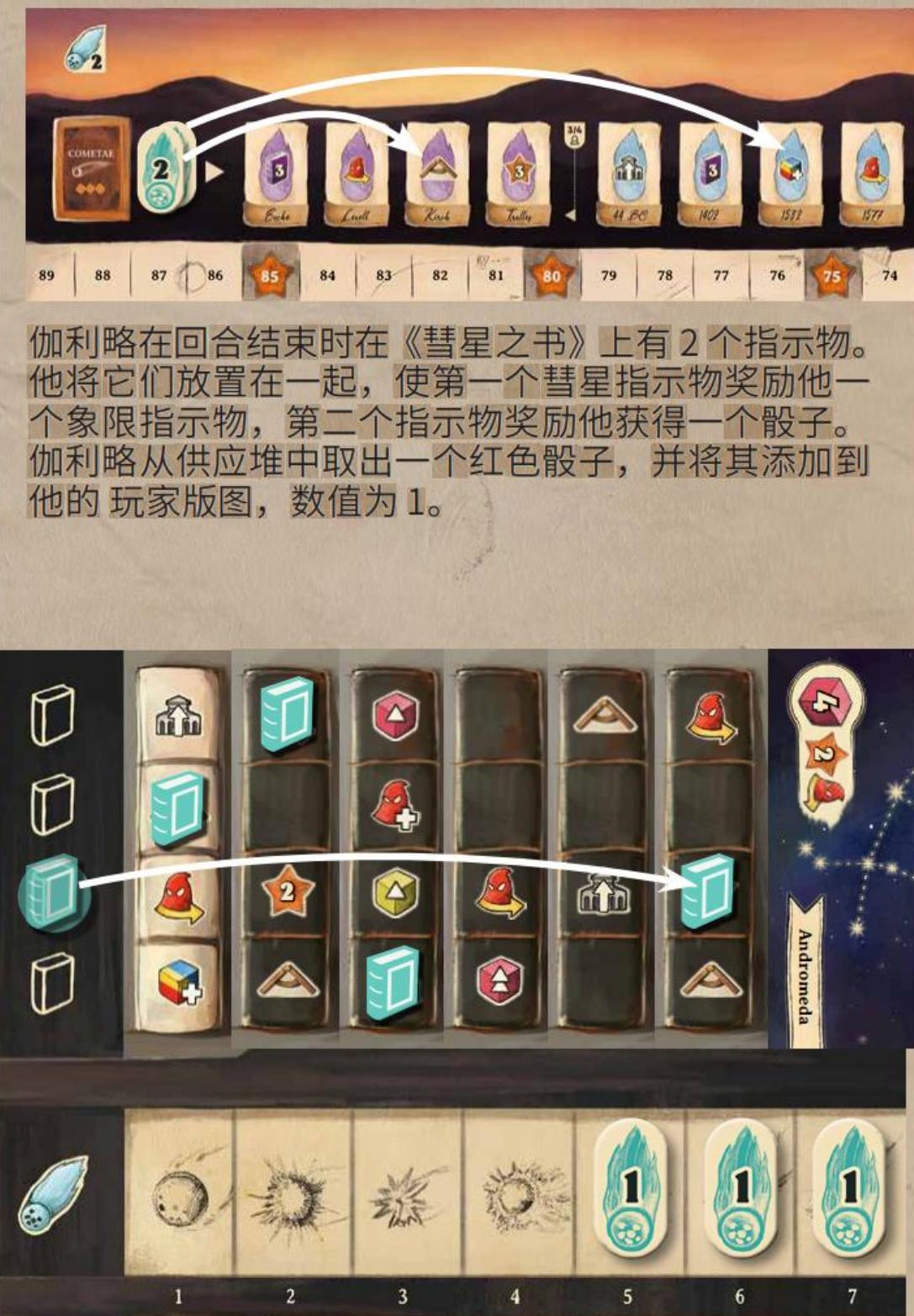
伽利略在回合结束时在《彗星之书》上有2个指示物。他将它们放置在一起,使第一个彗星指示物奖励他一个象限指示物,第二个指示物奖励他获得一个骰子。伽利略从供应堆中取出一个红色骰子,并将其添加到他的玩家版图,数值为1。
玩家使用标有标记的写作行动。他们选择移动最外层的图书指示物,以便从行动中获得尽可能多的奖励:1. 说服地窖中的一名审问者。
-
获得 2 点胜利点数。
-
所有黄色观察骰子点数增加 1 点。
-
再次说服一名审问者
-
在大学讲座。
图书指示物在第六个区域结束,该区域为空白。它不提供任何奖励。请注意,所有奖励都严格按照从左到右的顺序进行结算。
大学
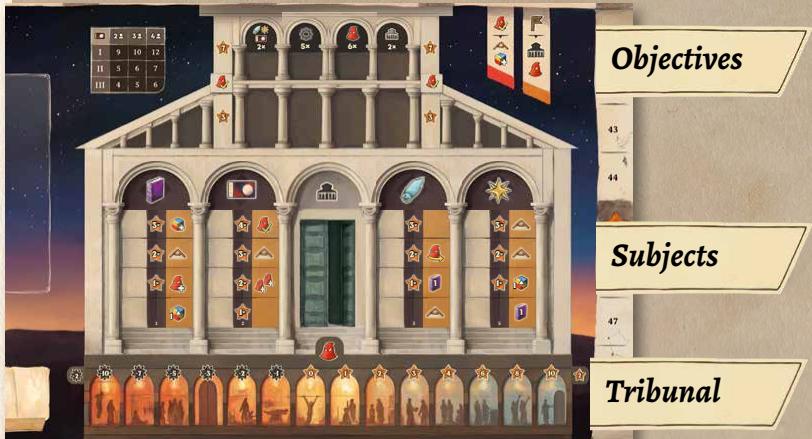
游戏版图的大学有 3 个区域。最上面是你在游戏中可以实现的目标。中间是四个不同主题的刻度板块。在讲座活动中,你可以攀登大学的刻度以获得奖励。你还将在游戏结束时根据你的位置获得胜利分数。大学下面是宗教裁判所可怕的法庭,它追踪你的天文学家的声誉。
目标
除了观察天空,你还可以通过完成大学的目标来获得胜利分数。第一个实现目标的玩家获得7个胜利点,并将他们的一个成就指示物放置在大学顶部的区域中。
达到目标的后续玩家获得 3 个胜利点,并将他们的指示物放置在目标下方的共享区域中。
任何达成目标的玩家都可以选择接受审问者的告别行动作为奖励。
游戏共有 8 个目标。印在大学顶部的两个字母在每局游戏中都有使用。其他成就位于主题板块上。这些板块可以作为成就(壁龛面朝上),也可以确定刻度板块的主题(拱形面朝上)。
壁龛表示你需要完成一个目标多少次才能达成成就,拱门只有在游戏结束时得分的主题。
主题

在大学的中间是成对的主题板块和刻度板块。每次你执行讲座行动,你的大学指示物都会向上移动。游戏结束时,每位玩家根据其大学指示物的位置获得额外的胜利点数。
将你完成主题图块的成就的次数乘以指示物行中的胜利点数。你获得了对应数量的胜利点数。

例如,哥白尼已经观测到四个主要天体。由于他的棕色大学指示物位于第一排,他将 $4 \times 4$ 相乘,得到 16 胜利点。
与此同时,布鲁诺的紫色大学指示物只在第二排。虽然他观察到了6个主要天体,但布鲁诺只得到了12胜利点。也许他在大学应该更努力一点!
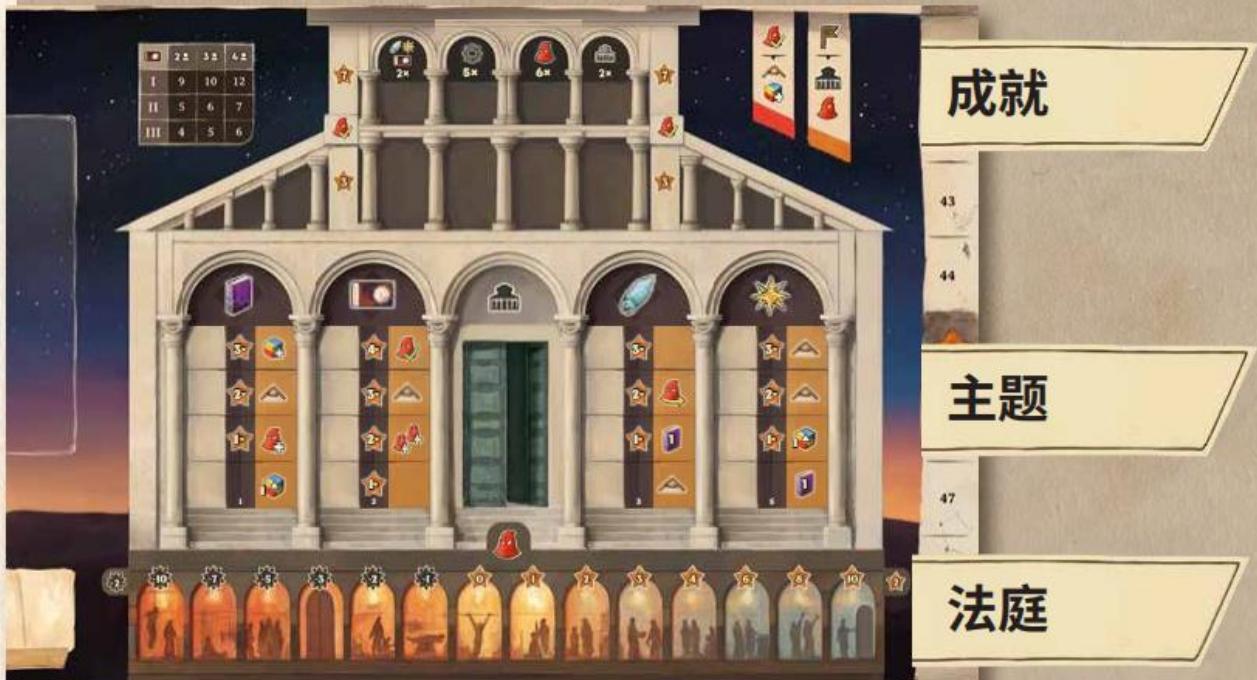
游戏版图的成就是:
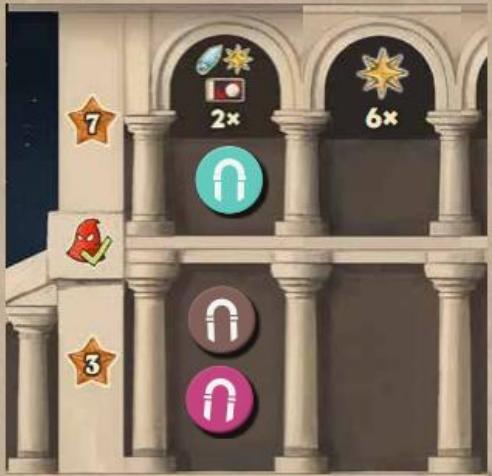
由于伽利略首先观测到了两个主要天体、两个星座和两颗彗星,他将蓝色的成就标记放在了这个壁龛的顶部,并获得了7个胜利点。哥白尼和布鲁诺在伽利略之后实现了这一成就,因此他们都得了3分。这三位天文学家都可以选择执行审问者的告别行动。
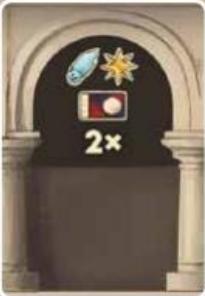
观测到了2个主要天体、2个星座和发现2颗彗星。
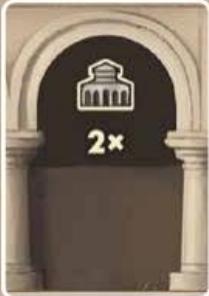
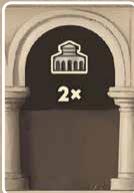
用你的 2 个大学指示物研究到刻度板块的顶部。
主题板块
主题板块用于记录主题(壁龛上面)或成就(拱门上面)。
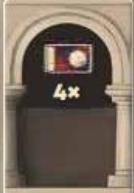
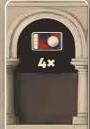
观测 4 个主要天体。
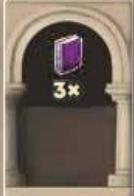

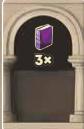
你的图书馆所有书本指示物至少在第3格。

你的地窖曾经有段时间拥有至少6个审问者。

拥有至少 5 块升级过的行动板块。
从你玩家版图至少移除5个彗星指示物。

从你玩家版图至少移除6个星座指示物。
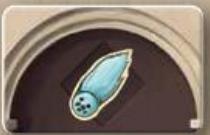

为你图书馆的每个主要天体计分。每个主要天体奖励行具有暗色背景。
分数等于你图书馆中最左侧一个图书指示物移动的格数。
游戏结束时,为你地窖中的每个审问者指示物计分。因审问者的告别行动而被移除的审问者不算数!
为每个升级过的行动板块计分。
为你玩家版图移除的每个彗星指示物计分。
为你玩家版图移除的每个星座指示物计分。
宗教法庭
审问者在游戏中由审问者指示物代表。这些指示物被放置在玩家版图的地窖里,在星座指示物下方。
大多数情况下,当你在大学里观察一个天体或讲座时,你会得到审问者。如果你不让审问者相信你是无辜的,他们会在审问中毁了你的声誉。
以下图标表示涉及宗教裁判所的行动:

获得 1 个审问者:从供应堆拿取 1 个审问者指示物并将其放在你地窖的最左侧格子里。

说服:将地窖中的任何审问者指示物向右移动一格。这提高了审问者对天文学家的看法,使审问更容易。

审问者的告别:从地窖最右侧格子取出一个审问者指示物,并将其归还给供应堆。你可以获得一个骰子,同时获得一个象限指示物。如果你最右侧的地窖区域没有审问者指示物,则此操作将被没收。这一行动始终是自愿的——如果你收到的是奖励,你永远不需要接受。
在写作行动中,审问者的告别是你可以使用的奖励。如果你不想,你不必这样做。
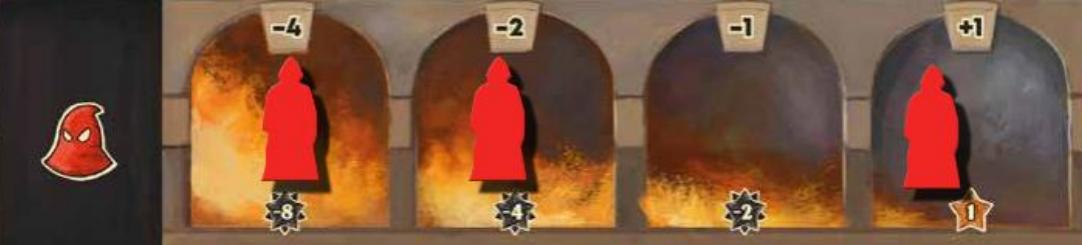
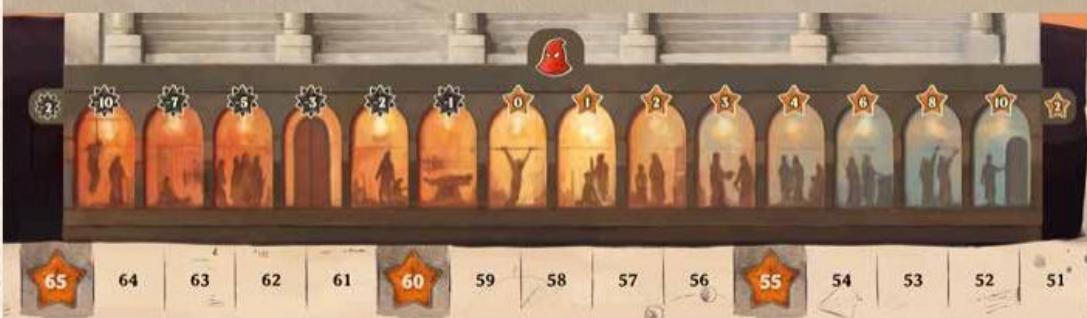
法庭位于大学下面。根据你的最终声誉,法庭将在游戏结束时惩罚或提高你的分数。

始终在地窖的最左侧放置一个新的审问者指示物。在这里,你最有可能失去他们的声誉。
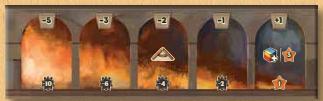
每个玩家版图都有一个地窖来跟踪你的审问者指示物。地窖有四个区域,顶部拱门上有审问者的意见值。这些值在审问期间使用。审问者以下的值在游戏结束计分时结算,在游戏中永远不会解决。
审问
如果你在你的回合内说服了任何审问者,那么在清理阶段就会进行审问。只有当你成功移动了你的一个审问者指示物时,才会发生审问——如果你执行了说服行动,但无法移动指示物,那么你就不会被审问。
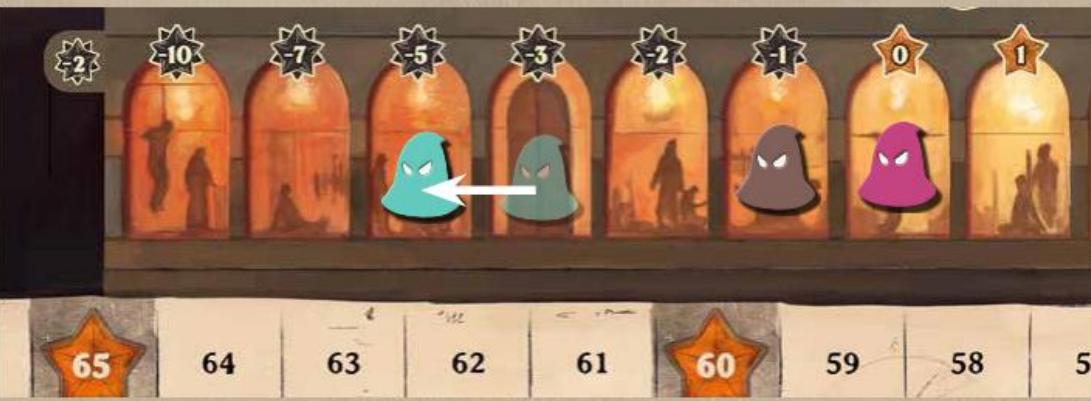
在审问过程中,将地窖中每个审问者指示物的当前值加在一起。然后,根据结果沿声誉轨道移动你的法庭指示物。负面的结果会让你向左移动,降低你的声誉,而正面的结果会使你向右移动,提高你的声誉。
如果你的法庭指示物位于声誉轨道的最左侧或最右侧,并且审问会让你走得更远,你会立即失去或获得2个胜利点。在审问过程中,你通常会移动多少空间并不重要——你只会失去或获得一次分数。

在伽利略时代,教会教义阻碍了知识的发展,导致偏离教会教义的人受到迫害。学者因挑战既定信仰而面临审问、酷刑或处决。伽利略的审判集中体现了质疑宗教权威的风险,突显了持不同政见者的危险。在这种限制性的环境中,创新受到抑制,公开探究也受到阻碍。在宗教正统的严格控制下,对知识的追求充满了危险。



伽利略在他的回合得到了一个审问者。由于他升级了行动板块,他可以选择说服作为他的两次移动行动。他选择将新放置的审问者指示物向右移动两格。在清理阶段,伽利略受到审问,因为他说服了至少一名审问者。
他在第二个空格上的指示物意见值为 -2,在本回合中放置并移动两次的指示物意见值是 -1。然而,他也从游戏早期完全说服的两个审问者指示物中获得 +1+1!所以这次审问的最终结果是 -1。伽利略将他的法庭指示物在声誉轨道上向左移动了一步。
游戏结束
当最后一张探索卡被放置在游戏版图上时,游戏结束。完成当前轮。然后,从起始玩家开始,每个玩家进行最后一轮。那一轮结束后,计算你的胜利分数。得分最高的玩家将成为这个时代最著名的天文学家!
如果在最后一轮游戏中游戏版图上有一个空白点,请从盒子里随机添加另一张三级卡来填补它。
最终计分
大学
大学右上角的旗帜显示了获得额外胜利分数的顺序。为大学计分,然后为审问计分。
每位玩家根据其大学指示物在刻度板块上的进度获得额外分数(见第11页的主题)。
审问
每位玩家根据其玩家版图上剩余的审问者指示物数量以及游戏结束时的声誉获得或失去分数。

在游戏结束时,每个审问者指示物的价值等于其地窖区域底部的数字。黑色图标会减少分数,而最右侧区域中的每个完全说服的审问者都会为你获得1分胜利点。
最后,你的法庭指示物的位置表示你因声誉而获得或失去的胜利点数。
平局
如果两名玩家的胜利点数相等,则观察骰子剩余总和最高的玩家获胜。如果仍然平局,则剩余象限指示物最多的玩家获胜。在极少数情况下,双方仍然保持平局,双方都分享胜利。
100+
如果你的分数超过 100 分,将你的计分标记翻面来在游戏版图上记录。

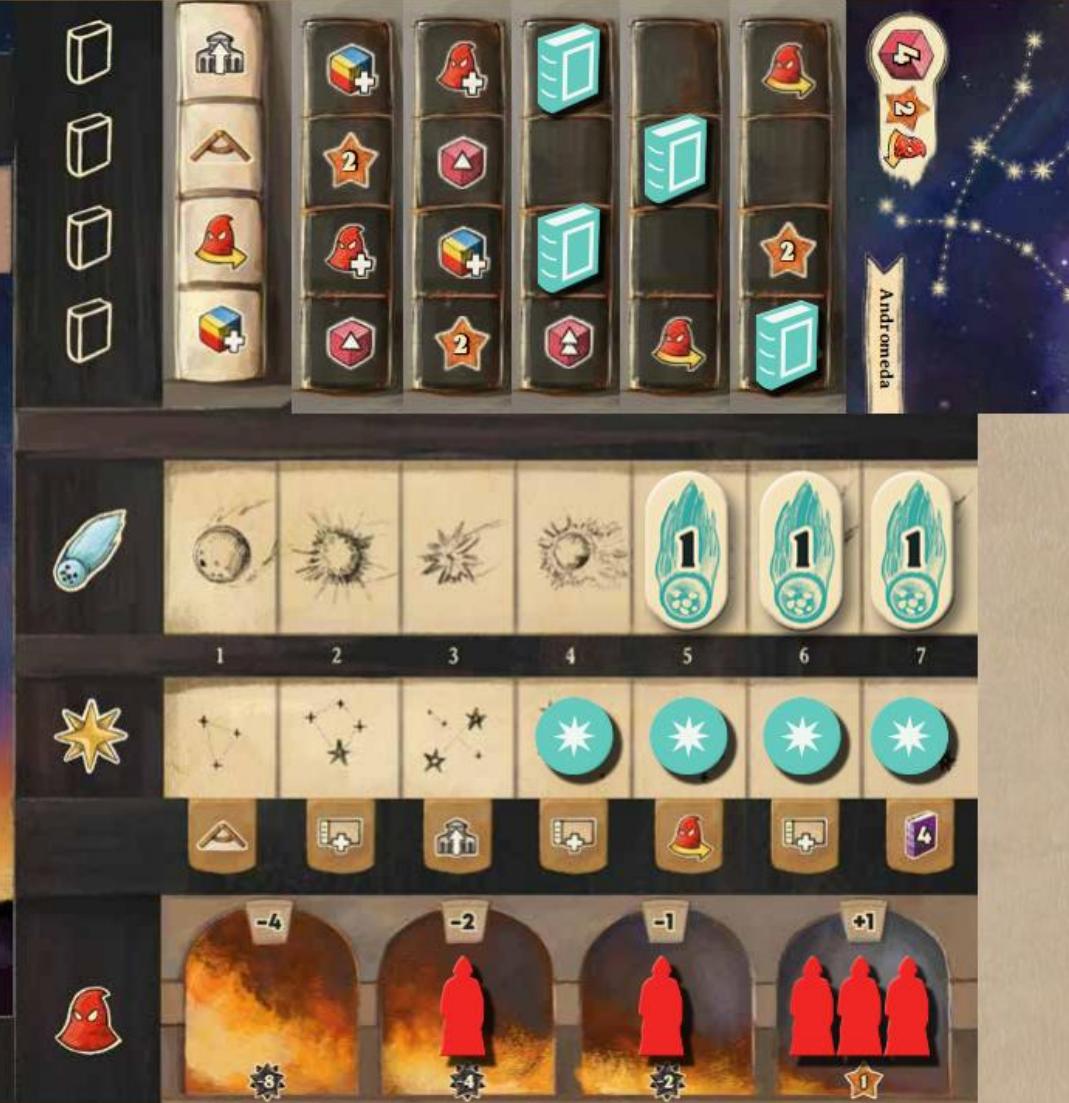
3 位被说服的审问者给伽利略 3 分,但他未说服的审问者分别拿走了 2 分和 4 分。总的来说,伽利略由于他的审问者指示物而失去了 3 个胜利点。他相应地在轨道上移动他的记分指示物。

10 7 5 3 2 1 0 1 2 3 4 6 8
伽利略(蓝色玩家)从大学获得以下胜利点:
1. 观察主要天体 15 分(刻度板块上 3 分 × 主要天体 5 张牌)
2.彗星指示物得4分(刻度板块上得1分×游戏板上放置的4个彗星指示物)
-
星座指示物得 0 分,因为伽利略没有在这条轨道上讲座。
-
在他的图书馆里写书得 8 分(在刻度板块 × 4 上得 2 分,这是他在上面例子中最左边的图书标记)
伽利略在法庭上的声望轨道也得了3分。
进阶模式——特殊能力
为了使伽利略更加多变和具有挑战性,请尝试使用特殊能力。每个角色都有自己独特的天赋,可以最大限度地提高你的发现。在游戏开始时,以任何方式选择你的角色。然后,根据需要获取每个角色的特殊配件。有关每个角色特殊能力的说明,请参阅以下页面。
Galileo Galilei

+1
伽利略 - 伽利莱(1564-1642 年)
伽利略 - 伽利莱 1564 年出生于意大利比萨,是科学史上举足轻重的人物,被誉为现代物理学之父。作为文艺复兴时期的多面手,他在天文学、物理学、数学和哲学方面都有卓越的成就。伽利略在 17 世纪初革命性地使用望远镜,发现了绕木星运行的伽利略卫星,支持了哥白尼提出的日心说模型,挑战了当时流行的地心说世界观。
尽管伽利略做出了开创性的贡献,但由于他支持日心说,他遭到了天主教会的强烈反对。1633年,他受到罗马宗教裁判所的审判,被判犯有异端罪,并被迫放弃自己的观点。然而,这场冲突并没有削弱他的持久影响力。伽利略强调实证和科学方法,为现代观测天文学和物理学奠定了基础,影响了后来的科学巨匠,如艾萨克-牛顿。他的遗产作为科学勇气和在逆境中追求知识的象征而经久不衰。
特殊能力:
伽利略是著名的伟大天文学家,他极大地增强了望远镜的功能。他的特殊能力可以让他更有效地观测星座。
伽利略有一页个人彗星之书。当这一页被覆盖时,他将获得两个象限指示物。
每次伽利略执行观测行动时,他都可以多观测一个星座。他可以观测一个主要天体外加一个星座,或者用同一行动观测三个星座。
约翰内斯 - 开普勒(1571-1630 年)
约翰内斯 - 开普勒出生于 1571 年,作为数学家和天文学家,他的开创性工作重塑了我们对天体运动的认识。他根据第谷 - 布拉赫(Tycho Brahe)的观测,特别是对火星的观测,在 17 世纪初提出了行星运动的三大定律。这些定律描述了行星围绕太阳的椭圆轨道,取代了以前的地心说,为预测天体运动提供了更精确的框架。
开普勒定律是现代天体力学的基石,影响了后来的科学思想,特别是艾萨克-牛顿的思想。开普勒强调经验观察和数学的严谨性,为科学方法树立了新的标准,标志着科学革命的关键时刻。
2
特殊能力
开普勒对透镜和光学的精通促进了望远镜的发展。他的特殊能力可以让他更好地利用行动板块,包括他自己的特殊板块。
开普勒有一块特殊的行动板块。游戏开始时,他将这张板块放在星空的最后一个区域(升级行动板块的左边)。在他的角色版图上放置一张他的基本行动板块。每当开普勒使用他特殊板块上的移动行动时,他就会获得以下独特行动:
-
交换他的玩家版图上两块行动板块的位置。
-
将玩家版图上的行动板块与角色版图上的一块板块互相交换。
Nicolaus Copernicus

Giordano Bruno
尼古拉斯 - 哥白尼(1473-1543年)
尼古拉斯-哥白尼 1473 年出生于波兰,他于 1543 年出版的开创性著作《论天体的旋转》 (De revolutionibus orbium coelestium) 重塑了我们对宇宙的认识。
他挑战了当时流行的地心说模式,提出了将太阳置于太阳系中心的日心说。哥白尼的革命性见解为天体运动提供了更简单的解释,为科学革命铺平了道路,并影响了约翰内斯-开普勒和伽利略-伽利莱等后来的天文学家。他的贡献标志着我们对宇宙的认识发生了关键性的转变,对科学探索产生了持久的影响。
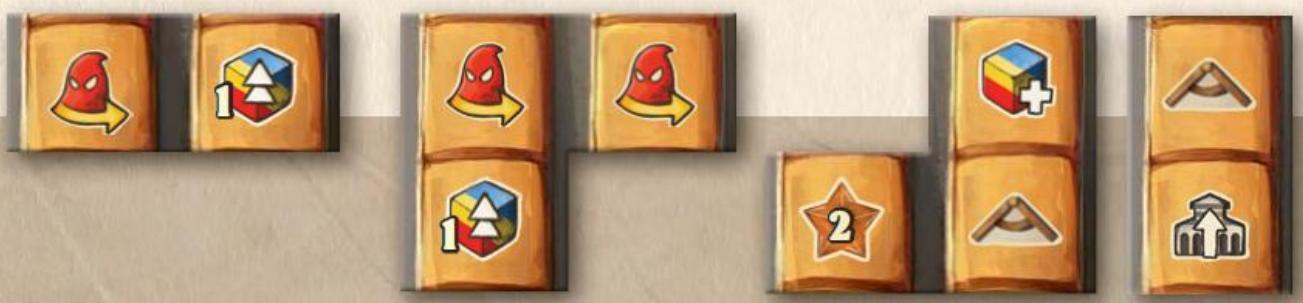
特殊能力:
哥白尼是一位杰出的天文学家和数学家,对日心说模型做出了最重要的贡献,并广泛从事行星运动的数学建模工作。这体现在他的特殊能力上,代表了他对自己图书馆的深入参与。
哥白尼有一页个人的彗星之书。当它被覆盖时,他可以劝说两个不同的审问者指示物两次(每个指示物最多移动两格)。
作为一个自由行动,每回合一次,哥白尼可以将他的一个特殊板块放入他的图书馆中,替换它们所覆盖的奖励。这一自由行动不会消耗任何象限指示物。
他的每块特殊板块都不能遮盖书本指示物。这些板块不能延伸出图书馆 -- 它们必须适合哥白尼探索卡的可用行列。你可以使用这些双面板块的任何一面,但不要将它们倒置。
焦尔达诺 - 布鲁诺(1548-1600 年)
焦尔达诺 - 布鲁诺出生于 1548 年,是意大利哲学家和宇宙学家,他的思想突破了传统思想的界限。布鲁诺超越哥白尼,提出了一个拥有无数世界的无限宇宙,主张宇宙多元化。然而,他大胆的理论与天主教会的教义相冲突,导致他在 1600 年因异端邪说而被谴责和处死。布鲁诺超越社会规范的探索意愿使他成为追求知识的殉道者,他大胆的思想在科学探索史上留下了不可磨灭的印记,强调了知识自由和挑战主流信仰的勇气的重要性。
特殊能力

布鲁诺的异端观点使他与宗教裁判所的交往极为困难,最终导致了他的死亡。正因为如此,布鲁诺在地窖中更难完全说服宗教审问者。不过,如果他成功了,回报也是巨大的!
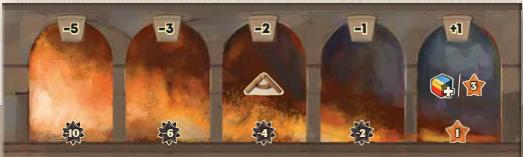
布鲁诺有两页个人彗星之书。当其中一页被覆盖时,布鲁诺可以劝说四次,根据自己的喜好进行分配。当另一页被覆盖时,布鲁诺可以升级他的一块行动板块。
布鲁诺还有一块特殊的地窖板块,它可以覆盖他玩家版图上的地窖。这块板块有五个区域,使他说服审问者更具挑战性。不过,每次有审问者标记移动到该区域时,他都会获得板块上显示的奖励。
单人游戏
在单人游戏中,你的对手是第谷 - 布拉赫(Tycho Brahe),他是一位以高质量望远镜闻名于世的天文学家。你的目标是获得比他更多的分数。和往常一样,当探索牌库的牌用完时,游戏结束。
设置
为准备一副双人游戏的探索卡牌。
-
将第谷的角色版图放在桌上。
-
将玩家版图放在旁边,对折,使望远镜朝下。
-
将第谷的特殊图书版图放在玩家版图上,使其覆盖所有四个图书馆区域。
-
在第谷的玩家版图上放置彗星指示物和星座指示物。
-
给第谷三个随机颜色的观测骰子。第谷从不关心观测骰子的数值。
-
在第谷的玩家版图附近,按任意顺序摆放第谷的五块行动板块,蓝色一面朝上。将第谷的望远镜标记放在最左边的板块下方。
-
洗混第谷的行动板块,并将它们组成一副牌。
-
将第谷的大学指示物放在大学的底部,将他的法庭指示物放在声望轨道上,将他的分数指示物照常放在分数轨道上。
游戏流程
在单人游戏中,始终使用天文学家角色版图中列出其特殊能力的那一面。游戏总是从玩家开始,而不是从第谷开始。像往常一样先进行自己回合,然后再轮到第谷进行回合。
首先,翻开第谷移动板块最上面的板块。这决定了第谷移动的距离。他的望远镜总是从左到右移动。如果到达最右边的板块,则将指示物放回左边,然后继续移动(就像望远镜在玩家版图上一样)。
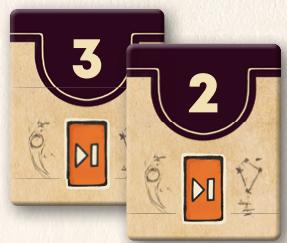
第谷有三种移动板块:
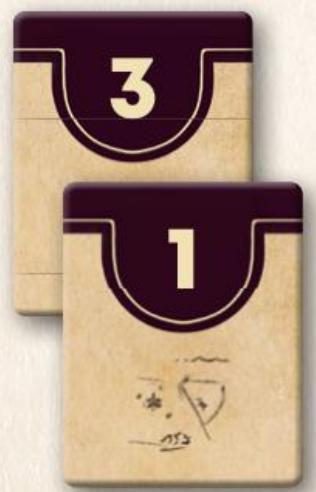
第谷的指示物移动指定步数。
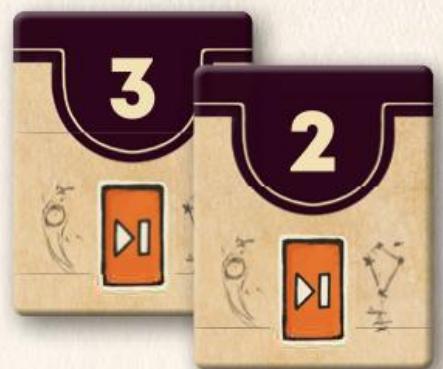
第谷指示物移动指定步数。如果到达升级后的行动板块,指示物会提前停止。

升级第谷指示物当前所在的板块。如果已经升级,则升级距离第谷当前位置右侧最近的板块。
移动后,第谷会评估他的行动板块。他每次评估一行,从板块顶端开始。他每回合只触发一行。
如果第谷满足该行左侧亮框中的条件,他就会采取该行的行动。如果不符合条件,他就跳到下一行,重复这个过程。最下面一行始终是无条件的,这意味着第谷可以始终执行该行动。
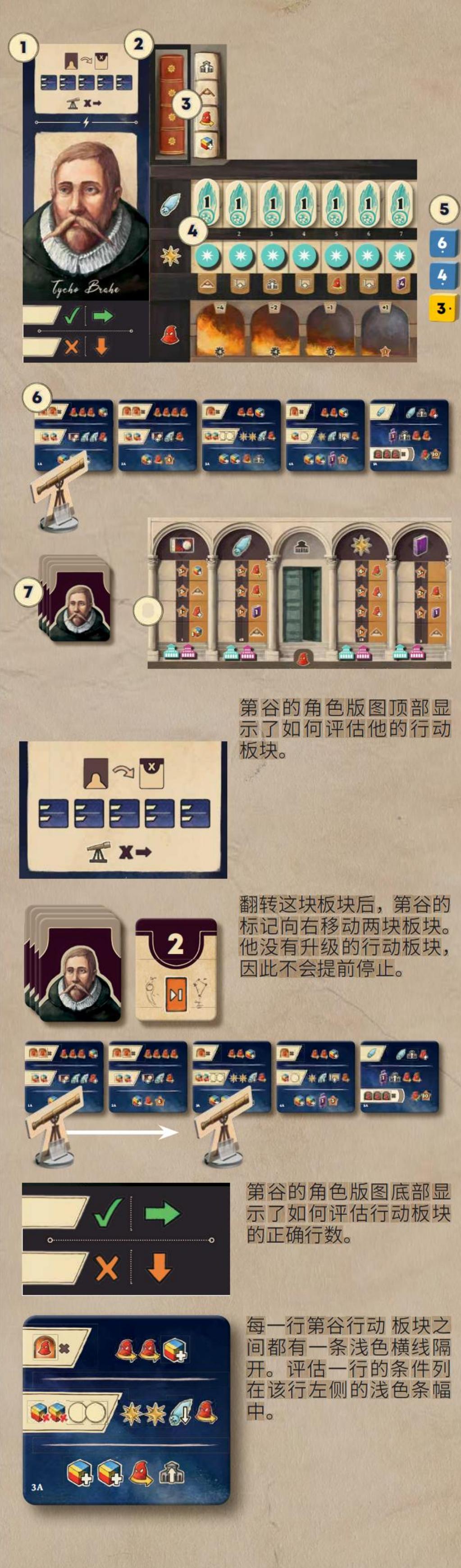
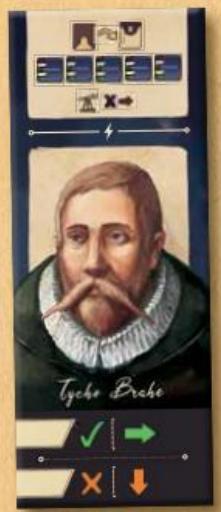
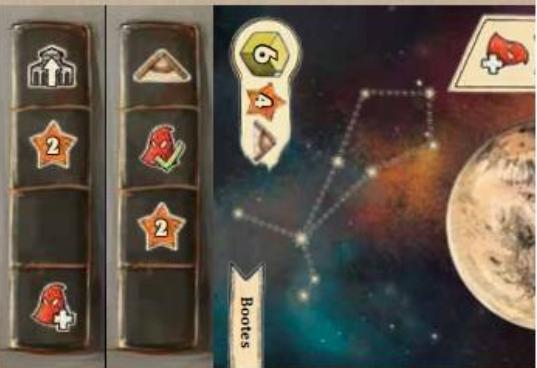
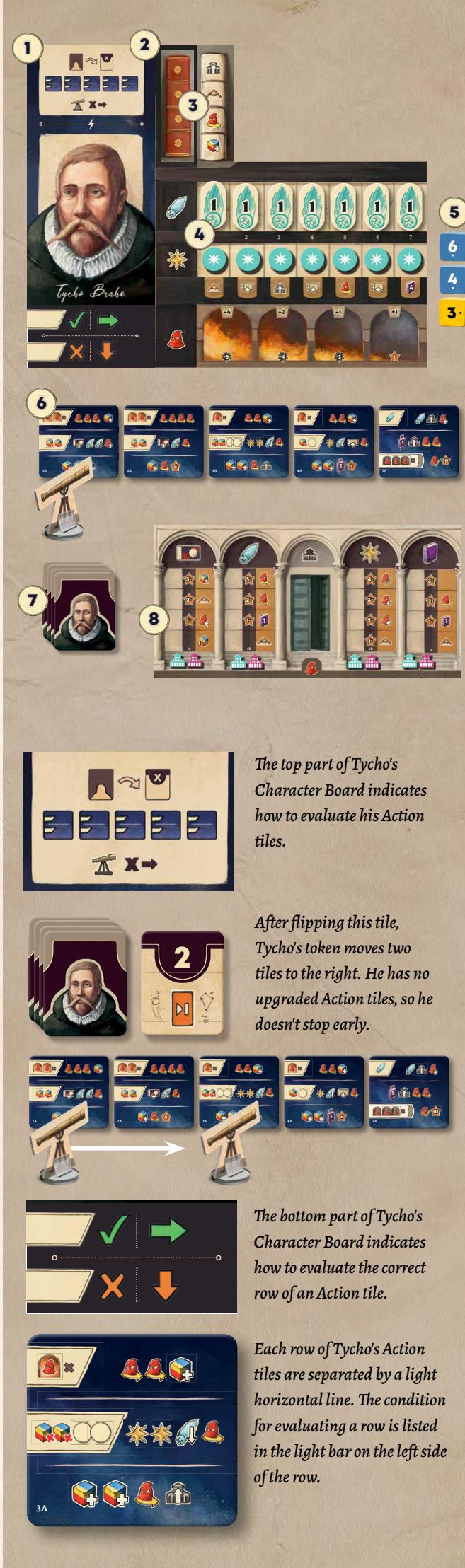
第谷的角色版图顶部显示了如何评估他的行动板块。
翻转这块板块后,第谷的标记向右移动两块板块。他没有升级的行动板块,因此不会提前停止。
4A
第谷的角色版图底部显示了如何评估行动板块的正确行数。
+ +
★ ★ ★ ★ ★ ★ ★ ★ ★ ★ ★ ★ ★ ★ ★ ★ ★ ★ ★ ★ ★ ★ ★ ★ ★ ★ ★ ★ ★ ★ ★ ★ ★ ★ ★ ★ ★ ★ ★ ★ ★ ★ ★ ★ ★ ★ ★ ★ ★ ★ ★ ★ ★ ★ ★ ★ ★ ★ ★ ★ ★ ★ ★ ★ ★ ★ ★ ★ ★ ★ ★ ★ ★ ★ ★ ★ ★ ★ ★ ★ ★ ★ ★ ★ ★ ★ ★ ★ ★ ★ ★ ★ ★ ★ ★ ★ ★ ★ ★ ★ ★★★★★★★★★★★★★★★★★★★★★★★★★★★★★★★★★★★★★★★★★★★★★★★★★★★★★★★★★★★★★★★★★★★★★★★★★★★★★★★★★★★★★★★★★★★★★★★★★★★★★★★★★★★★★★★★★★★★★★★★★★★★★★★★★★★★★★★★★★★★★★★★★★★★★★★★★★★★★★★★★★★★★★★★★★★★★★★★★★★★★★★★★★★★★★★★★★★★★★★★★ ★★★★★★★★★★★★★★★★★★★★★★★★★★★★★★★★★★★★★★★★★★★★★★★★★★★★★★★★★★★★★★★★★★★★★★★★★★★★★★★★★★★★★★★★★★★★★★★★★★★★★★★★★★★★★★★★★★★★★★★★★★★★★★★★★★★★★★★★★★★★★★★★★★★★★★★★★★★★★★★★★★★★★★★★★★★★★★★★★★★★★★★★★★★★★★★★★★★★★一一★★★★★★★★★★★★★★★★★★★★★★★★★★★★★★★★★★★★★★★★★★★★★★★★★★★★★★★★★★★★★★★★★★★★★★★★★★★★★★★★★★★★★★★★★★★★★★★★★★★★★★★★★★★★★★★★★★★★★★★★★★★★★★★★★★★★★★★★★★★★★★★★★★★★★★★★★★★★★★★★★★★★★★★★★★★★★★★★★★★★★★★★★★★★★★★★★★★★★★一一 ★★★★★★★★★★★★★★★★★★★★★★★★★★★★★★★★★★★★★★★★★★★★★★★★★★★★★★★★★★★★★★★★★★★★★★★★★★★★★★★★★★★★★★★★★★★★★★★★★★★★★★★★★★★★★★★★★★★★★★★★★★★★★★★★★★★★★★★★★★★★★★★★★★★★★★★★★★★★★★★★★★★★★★★★★★★★★★★★★★★★★★★★★★★★★★★★★★★★★!!★★★★★★★★★★★★★★★★★★★★★★★★★★★★★★★★★★★★★★★★★★★★★★★★★★★★★★★★★★★★★★★★★★★★★★★★★★★★★★★★★★★★★★★★★★★★★★★★★★★★★★★★★★★★★★★★★★★★★★★★★★★★★★★★★★★★★★★★★★★★★★★★★★★★★★★★★★★★★★★★★★★★★★★★★★★★★★★★★★★★★★★★★★★★★★★★★★★★★★!! ★★★★★★★★★★★★★★★★★★★★★★★★★★★★★★★★★★★★★★★★★★★★★★★★★★★★★★★★★★★★★★★★★★★★★★★★★★★★★★★★★★★★★★★★★★★★★★★★★★★★★★★★★★★★★★★★★★★★★★★★★★★★★★★★★★★★★★★★★★★★★★★★★★★★★★★★★★★★★★★★★★★★★★★★★★★★★★★★★★★★★★★★★★★★★★★★★★★★★招投标 ★★★★★★★★★★★★★★★★★★★★★★★★★★★★★★★★★★★★★★★★★★★★★★★★★★★★★★★★★★★★★★★★★★★★★★★★★★★★★★★★★★★★★★★★★★★★★★★★★★★★★★★★★★★★★★★★★★★★★★★★★★★★★★★★★★★★★★★★★★★★★★★★★★★★★★★★★★★★★★★★★★★★★★★★★★★★★★★★★★★★★★★★★★★★★★★★★★★★★一二★★★★★★★★★★★★★★★★★★★★★★★★★★★★★★★★★★★★★★★★★★★★★★★★★★★★★★★★★★★★★★★★★★★★★★★★★★★★★★★★★★★★★★★★★★★★★★★★★★★★★★★★★★★★★★★★★★★★★★★★★★★★★★★★★★★★★★★★★★★★★★★★★★★★★★★★★★★★★★★★★★★★★★★★★★★★★★★★★★★★★★★★★★★★★★★★★★★★★★招投标★★★★★★★★★★★★★★★★★★★★★★★★★★★★★★★★★★★★★★★★★★★★★★★★★★★★★★★★★★★★★★★★★★★★★★★★★★★★★★★★★★★★★★★★★★★★★★★★★★★★★★★★★★★★★★★★★★★★★★★★★★★★★★★★★★★★★★★★★★★★★★★★★★★★★★★★★★★★★★★★★★★★★★★★★★★★★★★★★★★★★★★★★★★★★★★★★★★★★★一二 ★★★★★★★★★★★★★★★★★★★★★★★★★★★★★★★★★★★★★★★★★★★★★★★★★★★★★★★★★★★★★★★★★★★★★★★★★★★★★★★★★★★★★★★★★★★★★★★★★★★★★★★★★★★★★★★★★★★★★★★★★★★★★★★★★★★★★★★★★★★★★★★★★★★★★★★★★★★★★★★★★★★★★★★★★★★★★★★★★★★★★★★★★★★★★★★★★★★★★-%★★★★★★★★★★★★★★★★★★★★★★★★★★★★★★★★★★★★★★★★★★★★★★★★★★★★★★★★★★★★★★★★★★★★★★★★★★★★★★★★★★★★★★★★★★★★★★★★★★★★★★★★★★★★★★★★★★★★★★★★★★★★★★★★★★★★★★★★★★★★★★★★★★★★★★★★★★★★★★★★★★★★★★★★★★★★★★★★★★★★★★★★★★★★★★★★★★★★★★-% ★★★★★★★★★★★★★★★★★★★★★★★★★★★★★★★★★★★★★★★★★★★★★★★★★★★★★★★★★★★★★★★★★★★★★★★★★★★★★★★★★★★★★★★★★★★★★★★★★★★★★★★★★★★★★★★★★★★★★★★★★★★★★★★★★★★★★★★★★★★★★★★★★★★★★★★★★★★★★★★★★★★★★★★★★★★★★★★★★★★★★★★★★★★★★★★★★★★★★➢★★★★★★★★★★★★★★★★★★★★★★★★★★★★★★★★★★★★★★★★★★★★★★★★★★★★★★★★★★★★★★★★★★★★★★★★★★★★★★★★★★★★★★★★★★★★★★★★★★★★★★★★★★★★★★★★★★★★★★★★★★★★★★★★★★★★★★★★★★★★★★★★★★★★★★★★★★★★★★★★★★★★★★★★★★★★★★★★★★★★★★★★★★★★★★★★★★★★★★➢ ★★★★★★★★★★★★★★★★★★★★★★★★★★★★★★★★★★★★★★★★★★★★★★★★★★★★★★★★★★★★★★★★★★★★★★★★★★★★★★★★★★★★★★★★★★★★★★★★★★★★★★★★★★★★★★★★★★★★★★★★★★★★★★★★★★★★★★★★★★★★★★★★★★★★★★★★★★★★★★★★★★★★★★★★★★★★★★★★★★★★★★★★★★★★★★★★★★★★★ ★ ★★★★★★★★★★★★★★★★★★★★★★★★★★★★★★★★★★★★★★★★★★★★★★★★★★★★★★★★★★★★★★★★★★★★★★★★★★★★★★★★★★★★★★★★★★★★★★★★★★★★★★★★★★★★★★★★★★★★★★★★★★★★★★★★★★★★★★★★★★★★★★★★★★★★★★★★★★★★★★★★★★★★★★★★★★★★★★★★★★★★★★★★★★★★★★★★★★★一一 ★ ★★★★★★★★★★★★★★★★★★★★★★★★★★★★★★★★★★★★★★★★★★★★★★★★★★★★★★★★★★★★★★★★★★★★★★★★★★★★★★★★★★★★★★★★★★★★★★★★★★★★★★★★★★★★★★★★★★★★★★★★★★★★★★★★★★★★★★★★★★★★★★★★★★★★★★★★★★★★★★★★★★★★★★★★★★★★★★★★★★★★★★★★★★★★★★★★★★★招投标 ★ ★★★★★★★★★★★★★★★★★★★★★★★★★★★★★★★★★★★★★★★★★★★★★★★★★★★★★★★★★★★★★★★★★★★★★★★★★★★★★★★★★★★★★★★★★★★★★★★★★★★★★★★★★★★★★★★★★★★★★★★★★★★★★★★★★★★★★★★★★★★★★★★★★★★★★★★★★★★★★★★★★★★★★★★★★★★★★★★★★★★★★★★★★★★★★★★★★★★!! ★ ★★★★★★★★★★★★★★★★★★★★★★★★★★★★★★★★★★★★★★★★★★★★★★★★★★★★★★★★★★★★★★★★★★★★★★★★★★★★★★★★★★★★★★★★★★★★★★★★★★★★★★★★★★★★★★★★★★★★★★★★★★★★★★★★★★★★★★★★★★★★★★★★★★★★★★★★★★★★★★★★★★★★★★★★★★★★★★★★★★★★★★★★★★★★★★★★★★★一二 ★ ★★★★★★★★★★★★★★★★★★★★★★★★★★★★★★★★★★★★★★★★★★★★★★★★★★★★★★★★★★★★★★★★★★★★★★★★★★★★★★★★★★★★★★★★★★★★★★★★★★★★★★★★★★★★★★★★★★★★★★★★★★★★★★★★★★★★★★★★★★★★★★★★★★★★★★★★★★★★★★★★★★★★★★★★★★★★★★★★★★★★★★★★★★★★★★★★★★★-% ★ ★★★★★★★★★★★★★★★★★★★★★★★★★★★★★★★★★★★★★★★★★★★★★★★★★★★★★★★★★★★★★★★★★★★★★★★★★★★★★★★★★★★★★★★★★★★★★★★★★★★★★★★★★★★★★★★★★★★★★★★★★★★★★★★★★★★★★★★★★★★★★★★★★★★★★★★★★★★★★★★★★★★★★★★★★★★★★★★★★★★★★★★★★★★★★★★★★★★➢ ★ ★★★★★★★★★★★★★★★★★★★★★★★★★★★★★★★★★★★★★★★★★★★★★★★★★★★★★★★★★★★★★★★★★★★★★★★★★★★★★★★★★★★★★★★★★★★★★★★★★★★★★★★★★★★★★★★★★★★★★★★★★★★★★★★★★★★★★★★★★★★★★★★★★★★★★★★★★★★★★★★★★★★★★★★★★★★★★★★★★★★★★★★★★★★★★★★★★★★ ★ ★ ★★★★★★★★★★★★★★★★★★★★★★★★★★★★★★★★★★★★★★★★★★★★★★★★★★★★★★★★★★★★★★★★★★★★★★★★★★★★★★★★★★★★★★★★★★★★★★★★★★★★★★★★★★★★★★★★★★★★★★★★★★★★★★★★★★★★★★★★★★★★★★★★★★★★★★★★★★★★★★★★★★★★★★★★★★★★★★★★★★★★★★★★★★★★★★★★★一一 ★ ★ ★★★★★★★★★★★★★★★★★★★★★★★★★★★★★★★★★★★★★★★★★★★★★★★★★★★★★★★★★★★★★★★★★★★★★★★★★★★★★★★★★★★★★★★★★★★★★★★★★★★★★★★★★★★★★★★★★★★★★★★★★★★★★★★★★★★★★★★★★★★★★★★★★★★★★★★★★★★★★★★★★★★★★★★★★★★★★★★★★★★★★★★★★★★★★★★★★招投标 ★ ★ ★★★★★★★★★★★★★★★★★★★★★★★★★★★★★★★★★★★★★★★★★★★★★★★★★★★★★★★★★★★★★★★★★★★★★★★★★★★★★★★★★★★★★★★★★★★★★★★★★★★★★★★★★★★★★★★★★★★★★★★★★★★★★★★★★★★★★★★★★★★★★★★★★★★★★★★★★★★★★★★★★★★★★★★★★★★★★★★★★★★★★★★★★★★★★★★★★!! ★ ★ ★★★★★★★★★★★★★★★★★★★★★★★★★★★★★★★★★★★★★★★★★★★★★★★★★★★★★★★★★★★★★★★★★★★★★★★★★★★★★★★★★★★★★★★★★★★★★★★★★★★★★★★★★★★★★★★★★★★★★★★★★★★★★★★★★★★★★★★★★★★★★★★★★★★★★★★★★★★★★★★★★★★★★★★★★★★★★★★★★★★★★★★★★★★★★★★★★一二 ★ ★ ★★★★★★★★★★★★★★★★★★★★★★★★★★★★★★★★★★★★★★★★★★★★★★★★★★★★★★★★★★★★★★★★★★★★★★★★★★★★★★★★★★★★★★★★★★★★★★★★★★★★★★★★★★★★★★★★★★★★★★★★★★★★★★★★★★★★★★★★★★★★★★★★★★★★★★★★★★★★★★★★★★★★★★★★★★★★★★★★★★★★★★★★★★★★★★★★★➢ ★★★一一★★★★★★★★★★★★★★★★★★★★★★★★★★★★★★★★★★★★★★★★★★★★★★★★★★★★★★★★★★★★★★★★★★★★★★★★★★★★★★★★★★★★★★★★★★★★★★★★★★★★★★★★★★★★★★★★★★★★★★★★★★★★★★★★★★★★★★★★★★★★★★★★★★★★★★★★★★★★★★★★★★★★★★★★★★★★★★★★★★★★★★★★★★★★★★★★★★一一 ★ 指 ★★★★★★★★★★★★★★★★★★★★★★★★★★★★★★★★★★★★★★★★★★★★★★★★★★★★★★★★★★★★★★★★★★★★★★★★★★★★★★★★★★★★★★★★★★★★★★★★★★★★★★★★★★★★★★★★★★★★★★★★★★★★★★★★★★★★★★★★★★★★★★★★★★★★★★★★★★★★★★★★★★★★★★★★★★★★★★★★★★★★★★★★★★★★★★★★★★★★★新冠肺炎★★★★★★★★★★★★★★★★★★★★★★★★★★★★★★★★★★★★★★★★★★★★★★★★★★★★★★★★★★★★★★★★★★★★★★★★★★★★★★★★★★★★★★★★★★★★★★★★★★★★★★★★★★★★★★★★★★★★★★★★★★★★★★★★★★★★★★★★★★★★★★★★★★★★★★★★★★★★★★★★★★★★★★★★★★★★★★★★★★★★★★★★★★★★★★★★★★★★★★新冠肺炎新冠肺炎新冠肺炎新冠肺炎新冠肺炎新冠肺炎新冠肺炎新冠肺炎新冠肺炎新冠肺炎新冠肺炎新冠肺炎新冠肺炎新冠肺炎新冠肺炎新冠肺炎新冠肺炎新冠肺炎新冠肺炎新冠肺炎新冠肺炎新冠肺炎新冠肺炎新冠肺炎新冠肺炎新冠肺炎新冠肺炎新冠肺炎新冠肺炎新冠肺炎新冠肺炎新冠肺炎新冠肺炎新冠肺炎新冠肺炎新冠肺炎新冠肺炎新冠肺炎新冠肺炎新冠肺炎新冠肺炎新冠肺炎新冠肺炎新冠肺炎新冠肺炎新冠肺炎新冠肺炎新冠肺炎新冠肺炎新冠肺炎新冠肺炎新冠肺炎新冠肺炎新冠肺炎新冠肺炎新冠肺炎新冠肺炎新冠肺炎新冠肺炎新冠肺炎新冠肺炎新冠肺炎新冠肺炎新冠肺炎新冠肺炎新冠肺炎新冠肺炎新冠肺炎新冠肺炎新冠肺炎新冠肺炎新冠肺炎新冠肺炎新冠肺炎新冠肺炎新冠肺炎新冠肺炎新冠肺炎新冠肺炎新冠肺炎新冠肺炎新冠肺炎新冠肺炎新冠肺炎新冠肺炎新冠肺炎新冠肺炎新冠肺炎新冠肺炎新冠肺炎新冠肺炎新冠肺炎新冠肺炎新冠肺炎新冠肺炎新冠肺炎新冠肺炎新冠肺炎新冠肺炎新冠肺炎★★★★★★★★★★★★★★★★★★★★★★★★★★★★★★★★★★★★★★★★★★★★★★★★★★★★★★★★★★★★★★★★★★★★★★★★★★★★★★★★★★★★★★★★★★★★★★★★★★★★★★★★★★★★★★★★★★★★★★★★★★★★★★★★★★★★★★★★★★★★★★★★★★★★★★★★★★★★★★★★★★★★★★★★★★★★★★★★★★★★★★★★★★★★★★★★★★★★一一 ★ ★★★★★★★★★★★★★★★★★★★★★★★★★★★★★★★★★★★★★★★★★★★★★★★★★★★★★★★★★★★★★★★★★★★★★★★★★★★★★★★★★★★★★★★★★★★★★★★★★★★★★★★★★★★★★★★★★★★★★★★★★★★★★★★★★★★★★★★★★★★★★★★★★★★★★★★★★★★★★★★★★★★★★★★★★★★★★★★★★★★★★★★★★★★★★★★★★★★新冠肺炎新冠肺炎★★★★★★★★★★★★★★★★★★★★★★★★★★★★★★★★★★★★★★★★★★★★★★★★★★★★★★★★★★★★★★★★★★★★★★★★★★★★★★★★★★★★★★★★★★★★★★★★★★★★★★★★★★★★★★★★★★★★★★★★★★★★★★★★★★★★★★★★★★★★★★★★★★★★★★★★★★★★★★★★★★★★★★★★★★★★★★★★★★★★★★★★★★★★★★★★★★一一 指 ★★★★★★★★★★★★★★★★★★★★★★★★★★★★★★★★★★★★★★★★★★★★★★★★★★★★★★★★★★★★★★★★★★★★★★★★★★★★★★★★★★★★★★★★★★★★★★★★★★★★★★★★★★★★★★★★★★★★★★★★★★★★★★★★★★★★★★★★★★★★★★★★★★★★★★★★★★★★★★★★★★★★★★★★★★★★★★★★★★★★★★★★★★★★★★★一一 ★★★★★★★★★★★★★★★★★★★★★★★★★★★★★★★★★★★★★★★★★★★★★★★★★★★★★★★★★★★★★★★★★★★★★★★★★★★★★★★★★★★★★★★★★★★★★★★★★★★★★★★★★★★★★★★★★★★★★★★★★★★★★★★★★★★★★★★★★★★★★★★★★★★★★★★★★★★★★★★★★★★★★★★★★★★★★★★★★★★★★★★★★★★★★★★★★★★★★一 ★★★★★★★★★★★★★★★★★★★★★★★★★★★★★★★★★★★★★★★★★★★★★★★★★★★★★★★★★★★★★★★★★★★★★★★★★★★★★★★★★★★★★★★★★★★★★★★★★★★★★★★★★★★★★★★★★★★★★★★★★★★★★★★★★★★★★★★★★★★★★★★★★★★★★★★★★★★★★★★★★★★★★★★★★★★★★★★★★★★★★★★★★★★★★★★★★★★一一 ★★★★★★★★★★★★★★★★★★★★★★★★★★★★★★★★★★★★★★★★★★★★★★★★★★★★★★★★★★★★★★★★★★★★★★★★★★★★★★★★★★★★★★★★★★★★★★★★★★★★★★★★★★★★★★★★★★★★★★★★★★★★★★★★★★★★★★★★★★★★★★★★★★★★★★★★★★★★★★★★★★★★★★★★★★★★★★★★★★★★★★★★★★★★★★★★★★★★★★一 每一行第谷行动 板块之间都有一条浅色横线隔开。评估一行的条件列在该行左侧的浅色条幅中。
第谷的行动板块上的条件

第谷的地窖拥有 2 个或更多未被说服的审问者指示物。
✗
第谷拥有 3 个或更多完全被说服的审问者指示物。
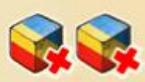
第谷必须支付 2 个任意颜色的观察骰子。一些板块需要 3 颗骰子。

第谷必须支付 2 个任意颜色的观察骰子,并且游戏版图上必须至少有两个可以被发现的星座点。
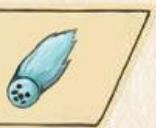
第谷必须至少拥有 1 彗星指示物在其玩家版图上。
第谷的行动板块的效果

放在第谷的一个彗星指示物到游戏版图上。

将第谷的一个彗星指示物向下移动(1 到 2,或 2 到彗星之书)。将彗星指示物放在彗星之书最左边的两名玩家区域。第谷永远不会从彗星之书中获得奖励。

第谷拿取任意颜色的 1 颗骰子。
将第谷的书本指示物向右移动指定步数。第谷永远不会从其图书馆获得奖励。

将第谷的一个大学指示物向上移动一个区域。他优先移动第谷满足条件次数最多的刻度板块。如果出现平局,第谷会移动最左边的大学指示物。第谷永远不会从大学获得奖励。
向右移动第谷地窖里的一个审问者指示物。他优先考虑最能改善审问结果的移动。
移除一个完全被说服的审问者指示物。
第谷获得图标指定的胜利点数。

将第谷最左边的星座指示物放在探索卡上,该探索卡上有价值最高的星座。第谷获得该星座的胜利点数,并忽略卡上的其他奖励。如果出现平局,第谷选择最左边的星座。从玩家版图上移除星座指示物不会获得奖励。
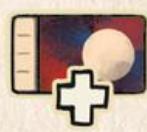
将主要天体得分最高的探索卡放入第谷图书馆。第谷会获得该天体的胜利点数,并忽略卡上的其他奖励。像往常一样替换探索卡。

将探索牌库顶部的卡牌放置到第谷的图书馆,浅色面朝上。

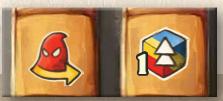
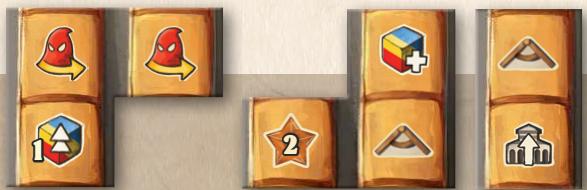
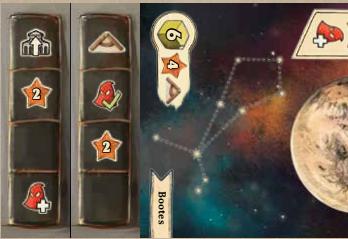
现在轮到第谷,你正在评估这张行动板块。第谷的玩家版图上没有彗星指示物,所以他不能进行最上面一行的行动。

第谷将他的图书指示物在图书室中移动一个区域。他还将两个审问者指示物移动一次,因为这样在下一次审问中获得的负分最少。

由于第谷已经放置了他的所有 7 个彗星指示物,他优先考虑移动他在这个主题的大学指示物。

我们还需要结算这个奖励条件,它包含在这块板块的最下面一行中。
由于第谷没有三个完全被说服的审问者,所以他不会采取这个条件右边的额外行动。如果他这样做了,第谷就会移除他的一个审问者指示物,并获得10点胜利分。
×
注: 该条件用圆括号标出, 因为它是部分条件! 如果第谷满足此条件, 他就能为底部行的行动带来额外奖励。
单人游戏结束
当抽到最后一张探索卡时,单人游戏结束。结束当前轮。然后,每位玩家像基本游戏一样进行最后一轮。像评估其他玩家一样评估第谷在大学和宗教裁判所的得分。
单人游戏的额外规则
- 如果第谷移动了审问者指示物,那么在他的回合结束时就会进行审问。这会像往常一样移动他的法庭指示物。
- 第谷只能从他的行动板块、观测星座和主要天体以及终局计分中获得胜利点数!
- 第谷可以在大学中实现目标。当他实现目标时,像往常一样放置一个成就标记。第谷会从成就中获得胜利点数,但不会获得审问者的告别行动作为奖励。
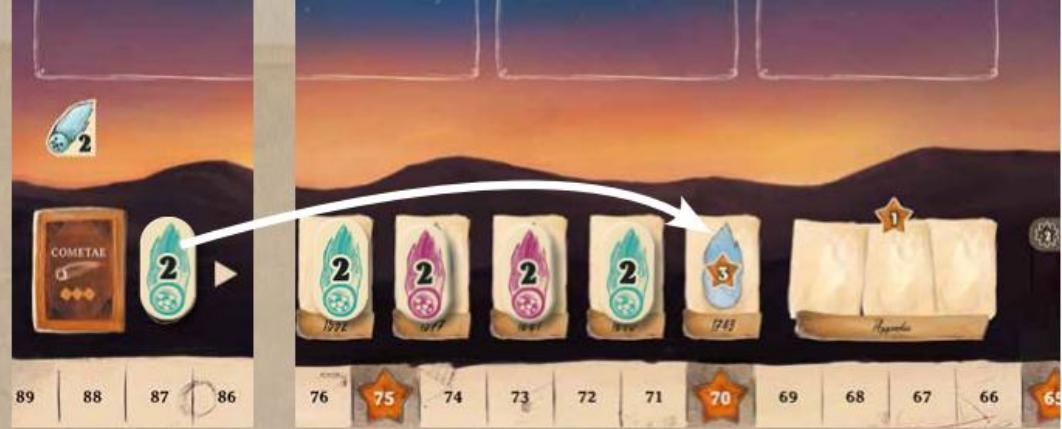
如果第谷把他的彗星放在彗星之书的页面上,他将得不到任何奖励,甚至连分数也没有。
第谷在图书馆写书时不会获得任何奖励,包括写书步骤的积分。
附录
色盲帮助
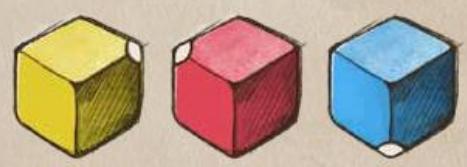
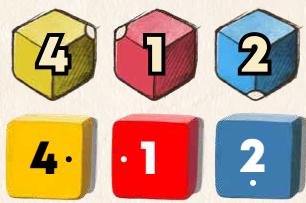
每个观察骰的表面数字旁都有一个点。游戏图标的一角也以同样的方式涂成空白。这是为了帮助色盲者识别骰子的颜色。
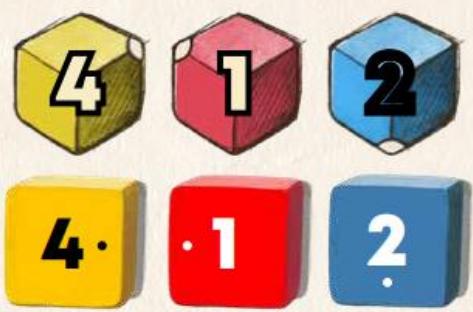

组合骰子上标有支付观察费用所需的两种颜色。
黄色骰子 - 点在右侧
红色骰子 - 点在左侧
蓝色骰子 - 点在数字下面
记住审问
试试这个小窍门,记住你是否在自己的回合中移动了审问者指示物。

获得审问者指示物时,将其平放。

每次你执行一个说服行动时,在移动审问者之前竖起你的审问者指示物。
在清理阶段,检查你的地窖中是否有一个或多个直立审问者指示物。如果有,审问者就会审问你!之后确保将指示物平放。
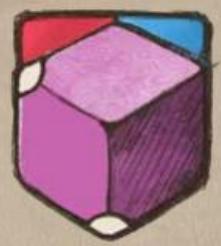
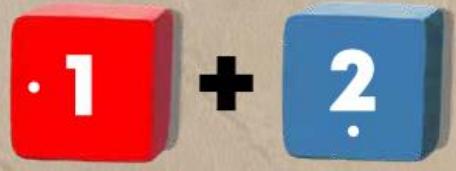
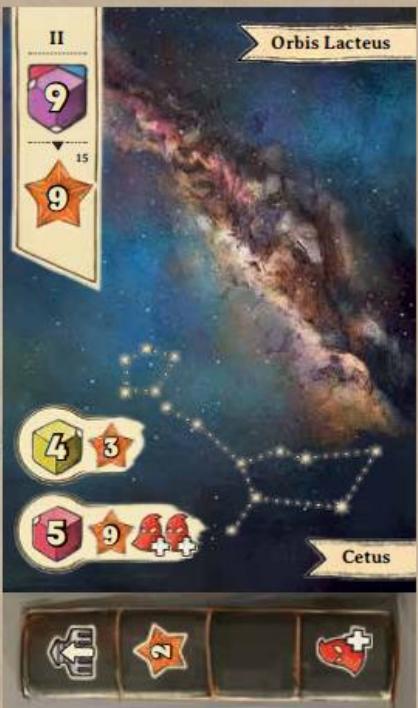
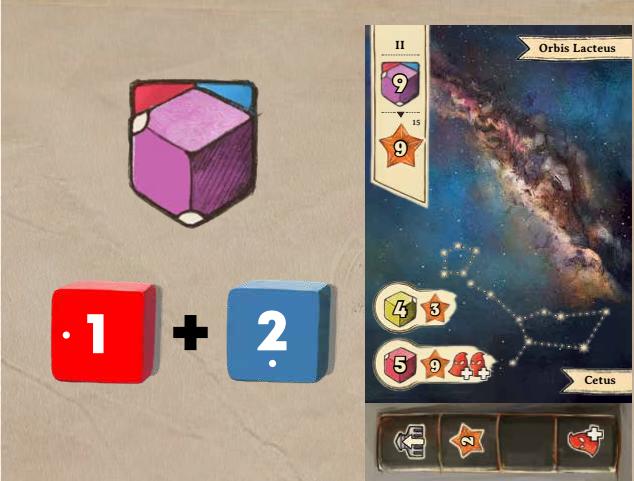
当你观察 Orbis Lacteus 时,必须同时使用红色和蓝色观察骰子。紫色图标上的点表示这一点,并与红色和蓝色骰子面上的点相匹配。
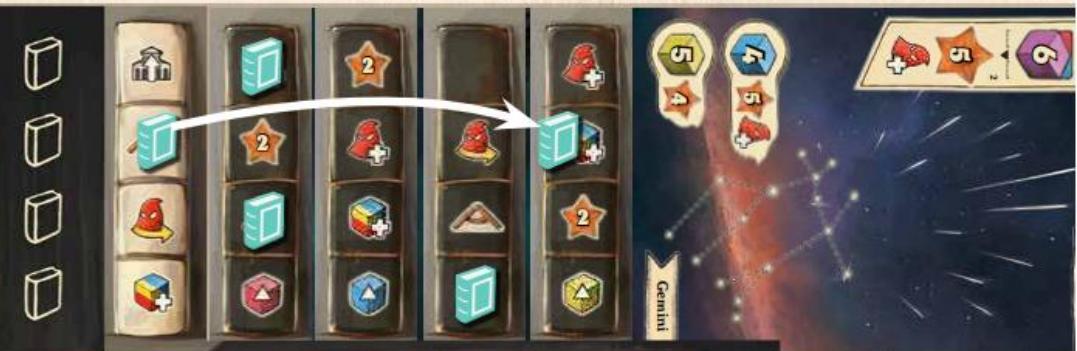
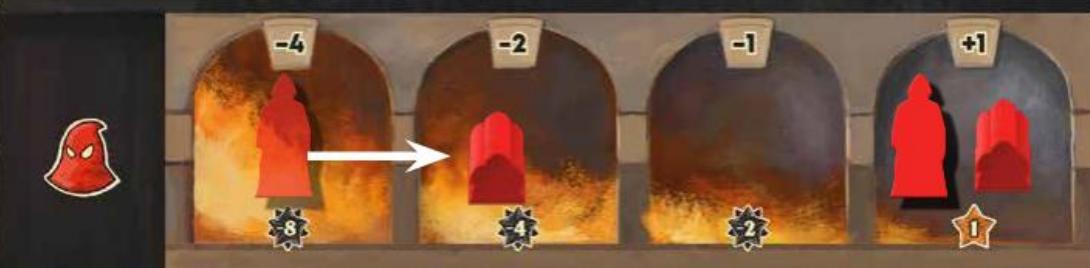
伽利略的写书行动为他赢得了 2 点胜利点数和一个审问者指示物,让他说服一次,然后获得一个骰子。他竖起新的审问者指示物,然后向右移动一步。
在清理过程中,伽利略看到自己有两个立着的审问者指示物。看来要进行审问了!尽管移动了两个审问者,但伽利略知道审问只进行一次。之后,他将审问者指示物平放。

Tomáš Holek Game Designer
Tomas has been designing board games since 2010. Now, fourteen years later, he is on the verge of publishing ambitious games with various companies. He loves designing games, and is a prolific creator. Themes of the cosmos and scientific discovery are close to his heart, and are combined in this game. Tomas often designs Euro games, but is not afraid to explore any board game genre or mechanic. Aside from board games he is interested in good quality teas, and other hobbies.

Pink Troubadour would like to thank Planetum for their advice on this game's historical accuracy.
www.planetum.cz
Planetum is a brand of the contributory organization Observatory and Planetarium Prague.

Michal Peichl
Illustrator, Graphic designer, Game Designer
Michal is a board game enthusiast who began in the board game industry as an illustrator and graphic designer in 2017. After getting deeper into the industry, he soon began designing his own games—a few of them already published! Michal continues combining graphic skills with game development, now mainly in connection with Pink Troubadour. He is known for working on Delicious Games' titles. In his free time, Michal plays drums in a hardcore metal band.
On the Depiction of Objects
In Galileo's time, astronomers could not see distant objects in clear detail as they are depicted on the Discovery cards. Our characters viewed them as small dots of light.
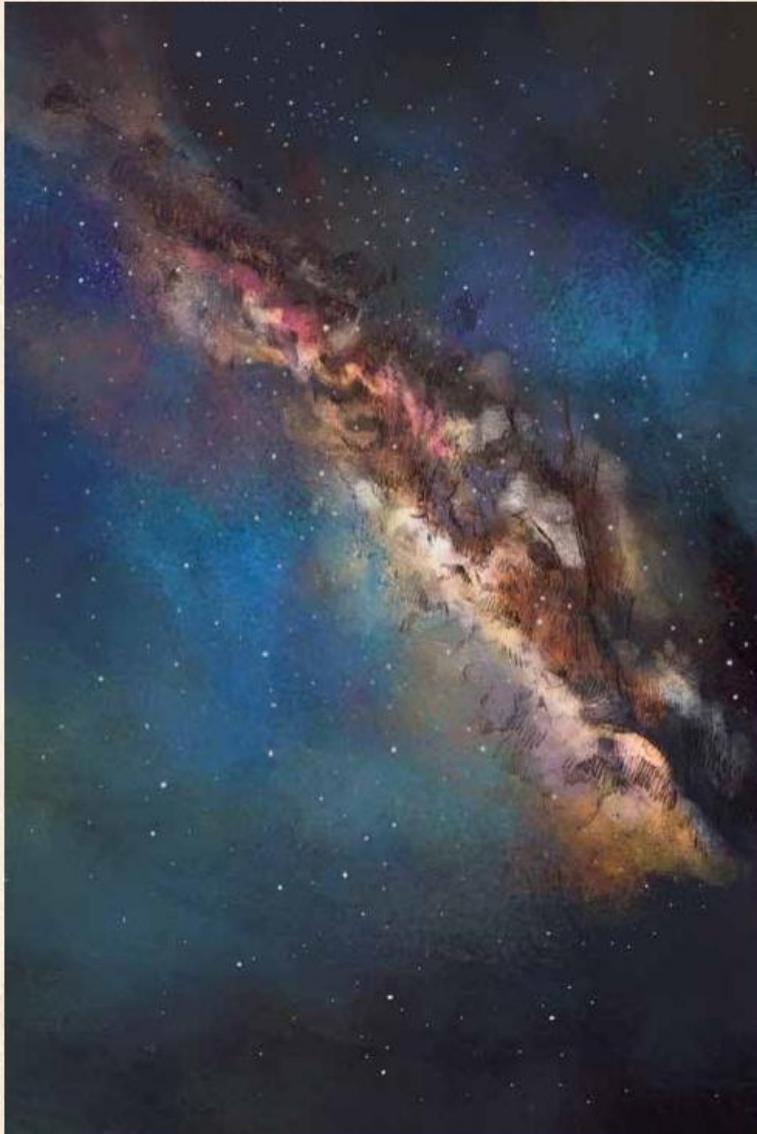
We chose to stylize the Major Objects' illustrations based on their hand-drawn depictions by the historical astronomers. We hope this makes the game's art immersive!

Mars 火星

The Triffid Nebula 三叉星云
The Milky Way 银河系

图标

获得 1 骰子: 从供应堆拿取任意颜色的 1 颗骰子。设置点数为 1。


提升你所有对应颜色的骰子点数 1 点。

提升你所有对应颜色的骰子点数 2 点。

提升一颗单独骰子点数 3 点。

主要天体需要支付两种颜色至少 1 颗观察骰子(此时是蓝色和红色)。

写书:移动你的书本指示物到该图书馆行的末端。
写书:移动你的任意一个书本指示物,其步数等同于图标里的数字。
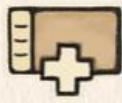
拿取探索牌库顶部的卡牌,然后添加到你图书馆,以浅色面朝上放置。

获得 1 个审问者:从供应堆拿取 1 审问者指示物,将其放在你地窖的最左侧格。

说服:向右移动你地窖里的任意一个审问者指示物一格。

审问者的告别:从你地窖最右侧格移除一个审问者指示物,然后将其放回供应堆。你获得1骰子,并获得1象限指示物。

获得等同于该图标数字的胜利点。
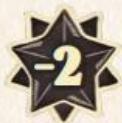
失去等同于该图标数字的胜利点。

讲座:向上移动你的一个大学指示物一格,然后获得板块右侧的奖励。
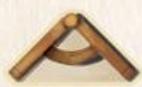
获得供应堆的一个象限指示物。

主要天体。

升级:选择你的一个行动板块,将其翻面刀金色已升级面。

观察:你可以选择观察一个主要天体或至多2个星座。这需要支付你玩家版图上的观察骰子。

审问值:你地窖里的审问者会在审问期间影响你的声誉。
基础和升级过的行动板块






Game Designer: Tomáš Holek
Illustrator & Graphic Designer: Michal Peichl
Development: Tomáš Holek, Michal Peichl, Milan Zborník, Petr Plášil
Editor: Austin Conrad
Solo Game Playtester: Ruda Malý
Playtesters: Jindřich Pavlásek, Petr Vojtěch, Vladimír Suchý, Ladislav Pospěch, Ruda Malý, Štěpán Peterka, the attendees of the Brnohrani Convention 2023, KDH Počátky, Pavla Plášilová, RexHry, Radek Boxan, Josef Ševců, Vlaada Chvátil, Tomáš Uhlíř, Vítek Vodička, Miroslav Felix Podlesný, Regina Urazajeva, Radka Mužíková, Tomáš Volný, Ondra Černoch, Michal Zborník, Olga Zborníková, Jakub Rýpar, Karolína Röschová, Adam Španěl, Petr Čáslava
In memory of Kája Hamšík, who knew what others did not.

Galileo - Rulebook V5 WEB.md67.1 KB

Rulebook
Welcome to the turn of16th and 17th century! In this era Europe embraced new scientific ideas. Learned astronomers shifted from gazing at the heavens with the naked eye to using the first telescopes. Join them in their awe-inspiring astronomical observations! However, you must exercise caution—the Church remains vigilant. Heretical ideas shall be severely punished..
Components

4 Character Boards

33 Discovery cards
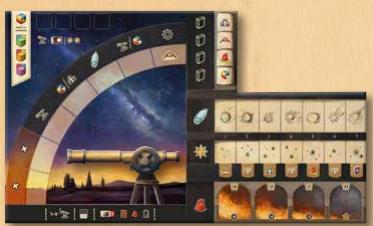
4 Player Boards with telescope (see the instructions lower how to finish the player board before the first game)
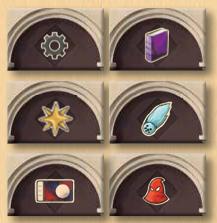
6 Subject tiles

2 Help cards

28 Comet tokens (7 per player)

24 Action tiles (6 per player)

1 First player token
32 Inquisitor figures
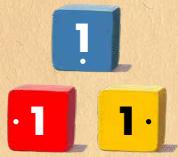
30 Dice (10 in each of the three colors)

26 small quadrants (1) 8 big quadrants (3)
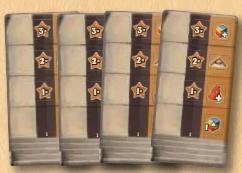
6 Double-sided university Scale tiles
Game Setup
-
Place the Game Board in the middle of the table.
-
Place each player's Score token on the o space on the score track.
-
Prepare a deck of Discovery cards:
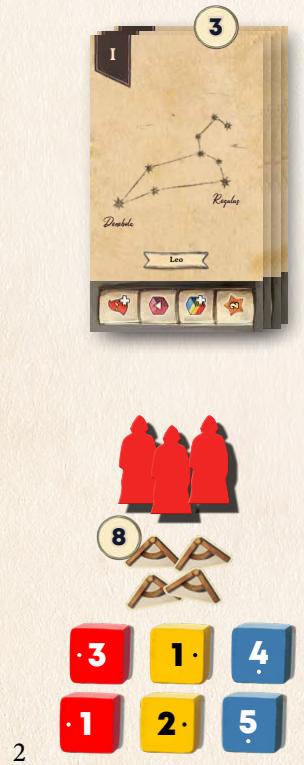
Select at random cards from all three tiers based on the numbers in the table (). Put the rest of the cards in the box. You won't need them during the game. Create a deck with the randomized cards. Begin by placing the Tier III cards face-down on the bottom, followed by the Tier II cards, then the Tier I cards on top. Place this deck next to the game board. Flip over and place the top six Tier I cards onto the game board. See the example on the right.
-
Place at random four University Scale tiles in the university, and four Subject tiles above them (arch side up).
-
Use the remaining two Subject tiles to cover the (?) spaces at the top of the university (niche side up).
-
Place each player's University token on the stairs beneath each University Scale tile.
-
Place each player's Tribunal token on the Reputation track. All astronomers begin at (-3) Reputation.
-
Create a supply of quadrants, dice, and inquisitors next to the Game Board.
Dice are meant to be limited resource, other resources are unlimited.
- The player who observed the starry sky most recently gets the First player token and goes first.
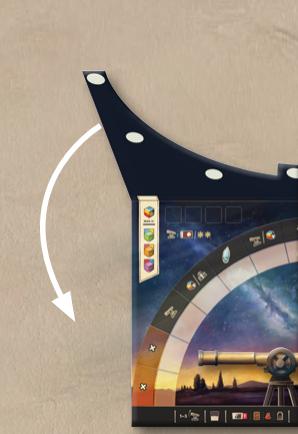
Before the first game, put four stickers on the white circles on the player board. Fold it and press so it holds firmly together.

16 Book tokens (4 per player)


16 University tokens (4 per player)
4 tribunal tokens (1 per player)

4 score tokens (1 per player)

28 constellation tokens (7 per player)

16 Objective tokens (4 per player)
1 Game Board
Solo components

5 Solo action tiles
1 Tycho Brahe opponent tile
1 Tycho Brahe book token
Advanced game components
1 Giordano Bruno Cellar tile


6 Solo movement tiles
4 Nicolaus Copernicus Library tiles
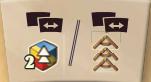
1 Johannes Keppler special action tile
Before the First game

Attach the telescope with the rivet. Make sure the telescope movement is smooth.
Subject Tiles
The double-sided Subject tiles determine which objectives you must achieve to score points from the university. One side shows an arch, and the other shows a niche.
Subject tile Arch side up
Subject tile Niche side up

Deck Setup
Use the adjacent table to build your Discovery deck. This is also found at (*) on the game board. Each column indicates the number of Tier I, Tier II, and Tier III Discovery cards required, depending on the number of players.
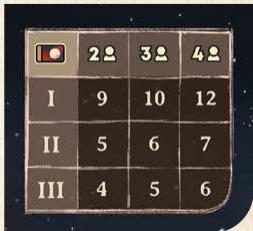
Here's an example of setting up the Discovery deck for three players. Always create the deck face-down, with the light side ofthe cards facing up.
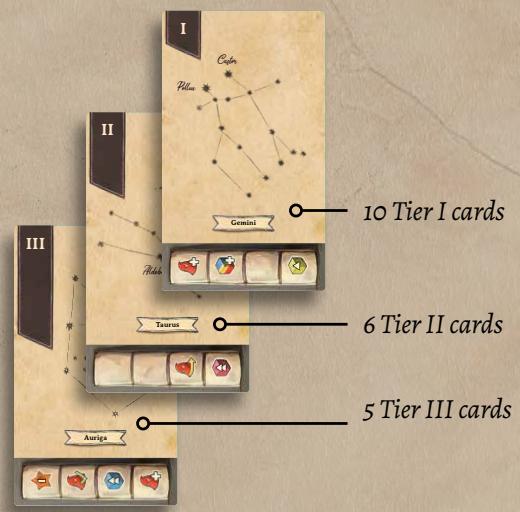
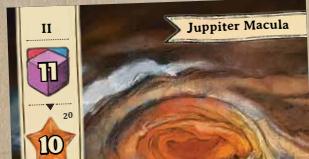
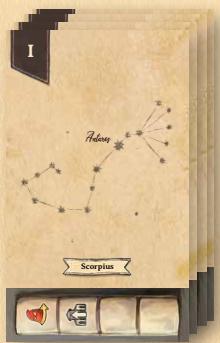
Each card's back side shows its tier to help prepare the deck. On the front side, the card's tier is visible above the observation cost for its Major Object.

Player Setup
A. Take one Player Board and telescope, and place it in front of you. At the start of the game, the telescope is pointing at the upper of the two crossed-out spaces.
B. Each player chooses an astronomer. Place his Character Board to the left of your Player Board. For your first few games, play with the quadrant symbol side facing up. After you're familiar with Galileo Galilei, try playing with the astronomers' special abilities! (See pages 12–14.)
C. Take one die of each color (red, blue, and yellow), and place them in the upper left corner of your Player Board. Each die begins at 1.
D. Take a set of six Action tiles, and randomly place them on your Player Board's starry sky with the light side facing up.
Note: We suggest placing the tiles at random during your irst game to quicken setup. In later games, try choosing which order to place the tiles in!
E. Place your four Book tokens on the starting spaces to the right of your library.
F. Place your seven Comet tokens on your comets spaces. They begin with the 1 side facing up.
G. Place your seven Constellation tokens on the constellation spaces.
H. Place your four Achievement tokens near your Character Board.

Introduction
Galileo Galilei is a game about discovering celestial objects in the starry sky. You play as a historical figure trying their best to be the most famous astronomer of the era! But observing the heavens is not the only way to win—writing about your discoveries and lecturing in the university are also ways to get ahead.
The game's basic mechanic is moving your telescope to select your actions each turn. Actions allow you to observe the heavens, write in the library, lecture at the university, and gain other advantages. Your progress is measured by victory points on the track circling the Game Board.
The player who observed the starry sky most recently goes first.
Then, play proceeds clockwise around the table.
The end of the game is triggered when the last Discovery card is placed on the Game Board. Finish the current round, so that each player has had the same number of turns. Then play one last round, and count up your score (see page 13). The player with the most victory points wins!
Each turn is played in the following three phases:

1) MOVEMENT
At the beginning of your turn, move your telescope forward 1 to 3 spaces. If you reach the last space on the starry sky (the Upgrade action) and still have movement remaining, you may move further. Continue moving from the first space which is not crossed out (the Observe action). The telescope can only move forward toward the top of the starry sky, never backward. See the example to the right.
2) ACTIONS
Each space on the starry sky has a fixed action and a moving action (the Action tile). During the action phase, you may choose in what order you use fixed, moving, and free actions (see Action Phase, following).
3) CLEANUP
During the cleanup phase, you rotate your Action tiles by 1 space, gain rewards from the Book of Comets, are interrogated by the Inquisition, and check for university achievements (see Cleanup Phase, page 10).
Each space in the starry sky has a fixed action (dark) and a moving action (light; the Action tile). During the action phase, you may take any actions in the space at which your telescope points. You may choose in which order to perform these actions.
In addition, you may spend Quadrant tokens to take free actions. You can take as many free actions as you wish, provided you have enough Quadrant tokens to pay for them.

Spaces divided by a slash give you a choice between two actions.
When taking that action you get to pick which option to use.
Always resolve your current action before taking another action, including free actions. This includes resolving any rewards from the action. If one of the action's rewards is also an action, resolve that reward before making other actions. For example, if Writing in your Library rewards you with a Lecture action, you must resolve that Lecture before taking a free action.
Action Phase
There are five fixed actions:

OBSERVE

GAIN A DIE / LECTURE

SPOT A COMET


OBSERVE / GAIN A DIE
UPGRADE
Movement phase examples
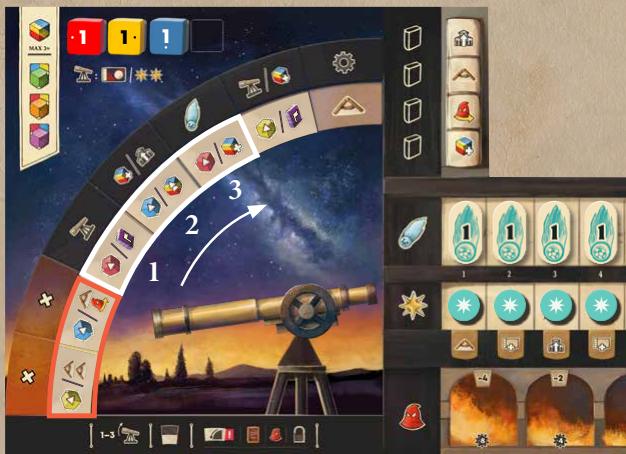
Once the game begins, the telescope can't point at the two lowest spaces on the starry sky. The telescope must move 1 to 3 spaces clockwise along the rest of the starry sky.
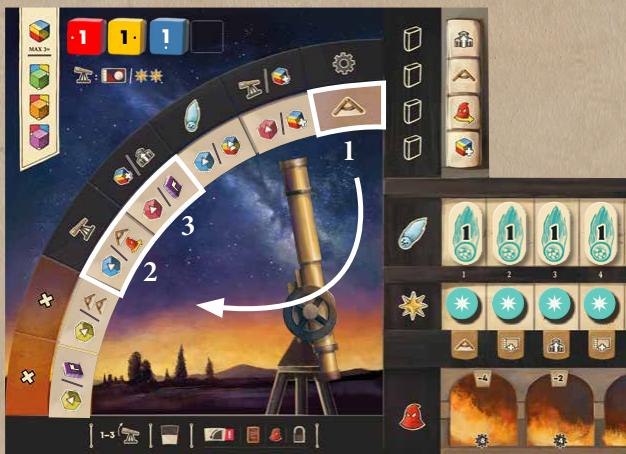
Ifyou want to move the telescope past the Upgrade action, it moves to the lowest section which is not crossed out.
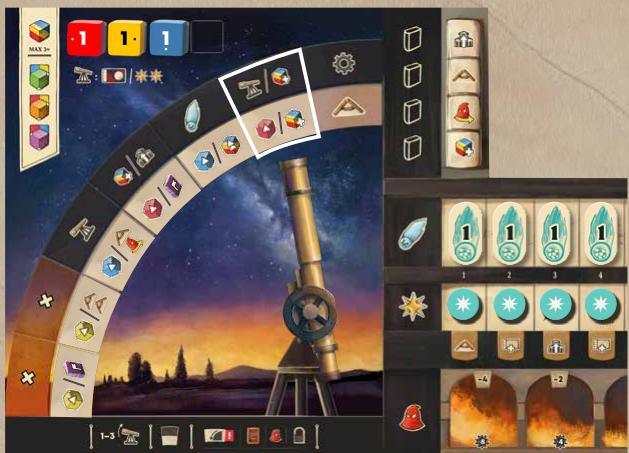
After moving the telescope, you may choose which to play first: the fxed action (dark) or the moving action (light).
Note: When selecting an action, try sliding it a little out of the moving actions queue. This helps remind you to move it to the bottom space of the starry sky during the Cleanup Phase.

OBSERVE – You can choose to observe either a Major Object or up to two constellations. This requires spending observation dice from your Player Board.
• Observation Dice
The most commonly used game components are the observation dice. Their color indicates the light spectrum, and their value indicates the observation time spent to observe an object. Throughout the game, you'll increase the value of your observation dice through various actions. By spending dice of multiple colors, you'll be able to Observe the rarest celestial objects!
You can store up to four observation dice on your Player Board. However, you may only have up to three dice of the same color at once.
Each object on a Discovery card has an observation cost. This number is in the icons on the left side of the card. The icon's color indicates the color of observation die which must be spent.

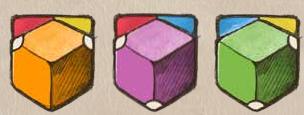
Constellations require dice of a single color (yellow, red, or blue).
Major Objects require a combination of two colors which create orange, green, or purple.
The Observe action requires spending dice from your Player Board. You may use any number of dice to pay this cost. Observing a constellation requires spending dice of a single color, while observing a Major Object requires spending dice of two different colors. The color combinations are provided in the upper corners of the die icon, and in the upper-left stripe of the Player Board.
You may spend any number of dice to pay observation costs. A Major Object's observation cost may be paid with any ratio of one color to the other, so long as at least one die of each color is used.
Return observation dice to the supply after using them to Observe. Any value in excess of the object's cost is forfeited.
• Observing a Major Object

Each card has a Major Object and one or more constellations. You choose which object to Observe during your action.
After paying the observation cost, you gain the Major Object's victory points.
Some objects also have an inquisitor icon (see The Inquisition, page 12).
Next, place the Discovery card face-up in your Library, on the top-right of your Player Board. Place your Discovery cards so that each card's library row remains visible (see the nearby example). Gaining additional rewards from your Discovery cards is described in the Library section (page 10).
If any Constellation tokens were on the Discovery card, return those tokens to the box. They won't be used any more during this game.
Draw a new card from the Discovery deck, and place it face-up in the blank space on the Game Board.

Your options when Observing are printed on your Player Board.
Major Object
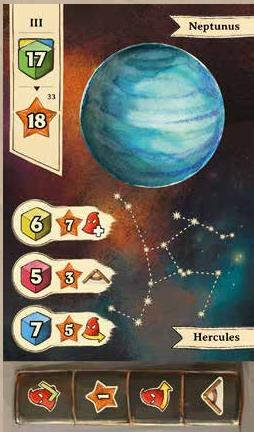
Constellation
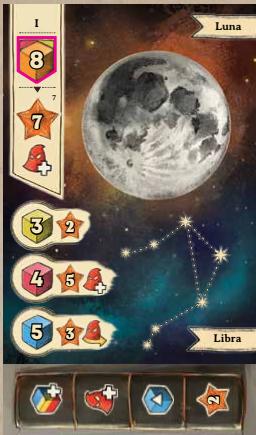
Galileo chooses to Observe Luna. Luna's observation cost is Orange 8, requiring a combination of red and yellow dice. He spends the following observation dice, returning them to the supply.

Galileo gains 7 victory points on the Game Board, and adds an inquisitor to the leftmost space of the cellar on his Player Board.
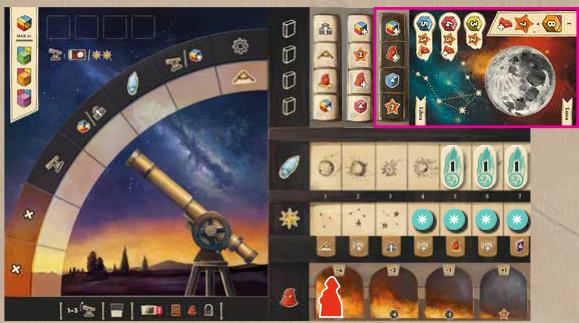
After scoring, Galileo puts the Discovery card in his Library face-up next to the rest of his Discovery cards.
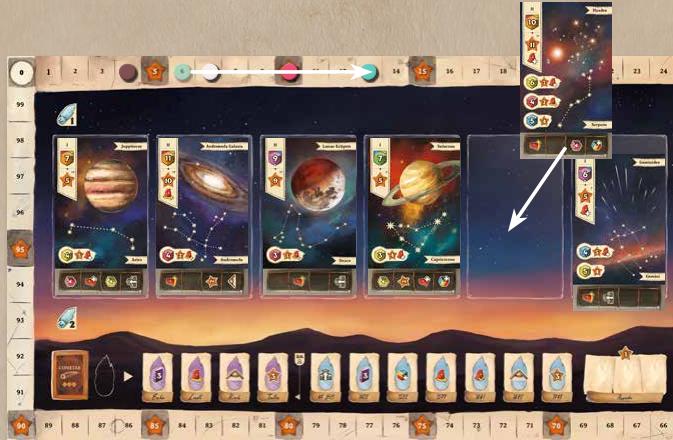
Finally, Galileo flls the blank space on the Game Board with a new card from the Discovery deck.
• Observing a Constellation

You may Observe up to two constellations as a single action. Resolve the first constellation completely before Observing the second.
After paying the constellation's observation cost, take the leftmost Constellation token from your Player Board, and place it on the constellation you've chosen. You gain any listed rewards for Observing that constellation (such as victory points). Then, gain the reward listed for the space from which you removed your token.

Three of these rewards indicate a "gain a card" symbol. If you receive this reward take a card face-down from the Discovery deck, and place it in your Library. As with the card gained from a Major Object, make sure each row of your Library remains visible.
After using your seventh Constellation token, you can't Observe any more constellations.

Jupiter appears on this game's box as a tribute to Galileo Galilei's groundbreaking discovery ofits four largest moons in 161o. His observations challenged the prevailing geocentric model, and supported the heliocentric theory. This pivotal moment in scientific history revolutionized our understanding ofthe cosmos, and laid the foundation for modern astronomy.

GAIN A DIE / LECTURE
Pick one of the following options:
Gain a Die: Take one die of any color from the supply, and put it on your Player Board. Its value is 1.
On the rare occasion that a player already has 4 dice on their board, they may replace one of their dice with the newly gained die. Return the original die to the supply.
Lecture: Move one of your University tokens up one space on its Scale tile. Then, gain the reward listed on the right-hand side of the tile. Once one of your University tokens has reached the top of the Scale tile, it can't move any further.
Galileo, Bruno, Copernicus, and Kepler studied subjects such as mathematics, astronomy, philosophy, and theology while at university. Their diverse interests and pursuits later converged to reshape our understanding ofthe cosmos during the Scientific Revolution.
Galileo wants to Observe Ursa Minor. He pays three red observation dice with the values 3, 1, and 1.
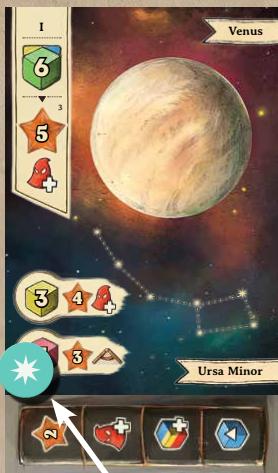
He covers Ursa Minor's observation cost with his leftmost Constellation token.
Galileo gains 3 victory points, and a Quadrant token. He also gains the reward listed below his Constellation token—in this case, the reward is taking the Lecture action.
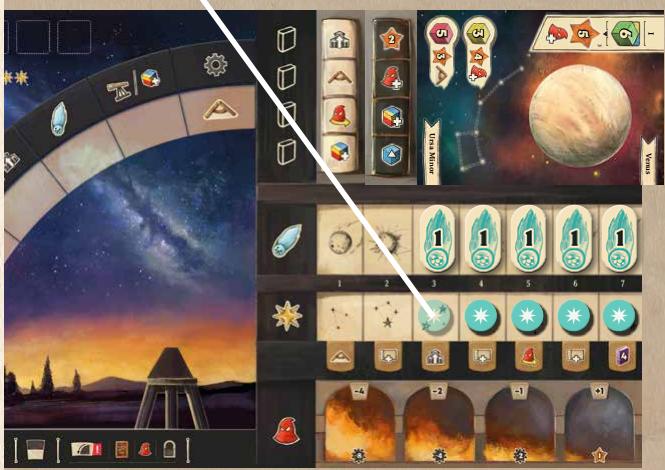

The icon at the top-left ofyour Player Board is a reminder that you can have up to three dice of the same color. However, you can store up to four dice on your Player Board!
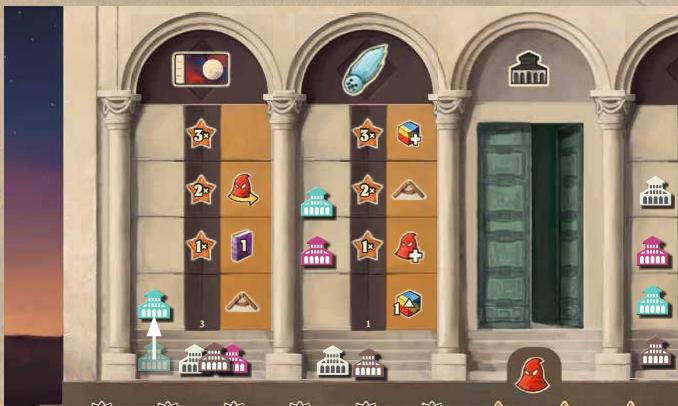
Galileo chose the Lecture action, so he can move his University token up 1 space on any Scale tile. He chooses the Major Object scale. He gains the bonus on the right side of the scale—in this case, one Quadrant token.

SPOT A COMET
To spot a comet, take the leftmost Comet token from your Player Board, and place it on the Game Board above the Discovery cards. The “" side should be face-up.
• Comet Usage
When you Observe, you may use Comet tokens on the Game Board to reduce the observation cost of an object. The cost is reduced by the Comet token's value. Each token may be used only once per turn. Each used comet must reduce the observation cost. In other words, you can't use the comets you don't need.
After using a Comet token for the first time, move that token to the space below the Discovery cards. Flip the token over, so that the "2" side is face-up. You may use that Comet token to reduce the cost of the next object you Observe. Any excess reduction is forfeited.
After using a Comet token for the second time, place that token on the Book of Comets. If you use multiple Comet tokens with a value of “2," each of those tokens is moved.
Note: When reducing the observation cost with Comet tokens, you still have to spend at least one observation die of each color the object requires. Ifyou don't have a die of the required color, you can't use a Comet token to reduce the object's cost.

In the 16th and 17th centuries, astronomers like Johannes Kepler studied comets, acknowledging both their predictable orbits and the prevailing superstitions associating them with disaster; their work, including Kepler's De Cometis, aimed to provide scientifc explanations, while contemporaries such as Tycho Brahe contributed valuable observational data, laying the groundwork for modern comet science.

OBSERVE / GAIN A DIE
Choose between taking the Observe action and the Gain a Die action, as described previously.

UPGRADE
Choose one of your Action tiles, and flip it to the golden upgraded side. The tile does not move. The Upgrade action's space on the starry sky does not
allow an Action tile to be played. Instead of taking a moving action, you gain one Quadrant token.
Note: Before your first game take a look at the actions on the upgraded side ofyour Action tiles. Upgrades reinforce the basic actions, and help you progress more quickly than your rival astronomers
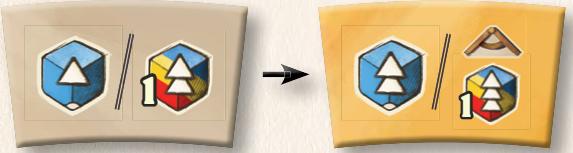
See the back of the rules or the help card for an overview ofthe upgraded tiles.

Galileo chooses to Spot a Comet. He takes the leftmost comet from his Player Board, and places it on the Game Board above the Discovery cards.
On Galileo's next turn, he Observes. He uses his Comet token to reduce the object's observation cost by 1. This means he has just enough observation dice to pay the cost! Then, he moves the token below the Discovery cards, and flips it over. Next time he Observes, Galileo can use this Comet token to reduce the object's cost by 2. Ifhe does, the token is then placed on the Book ofComets.
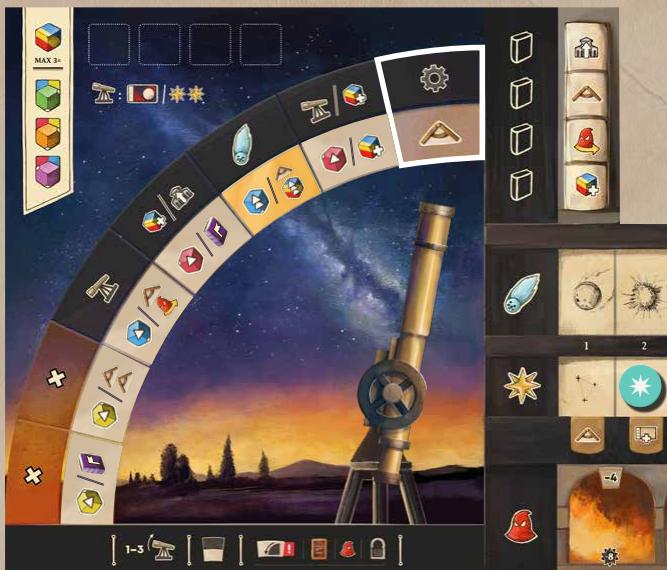
By upgrading the tile shown above, Galileo can move 3 spaces and use it on his next turn!


Moving actions
Action tiles always have two options to choose from. The following icons are used to describe possible options:


Increase all of your observation dice of the given color by 1.


Increase all of your observation dice of the given color by 2.

Gain one Quadrant token from the supply.

Persuade an inquisitor in your cellar.

Increase any single of your dice by 2.

Increase any single of your dice by 3.

Gain an observation die of any color.

Lecture on one of the university's Scale tiles.

Write in your Library of Discovery cards.
Free actions
Quadrant tokens measure your knowledge, and can help you make significant scientific progress. You may spend Quadrant tokens to take any number of free actions during your turn. A free action costs 1, 2, 3, or 4 Quadrant tokens. You can't use a free action while in the process of resolving another action. The free action options are:

Change the color of one die to another color. The value remains the same.
Increase any single die by 1.
Persuade an inquisitor twice. You may choose the same inquisitor twice, or choose two different inquisitors.
Gain a new observation die.
OR
Write 3.

Spot a Comet.
Galileo can either increase all of his blue observation dice by 1, or increase a single observation die by 2.


Galileo has three blue dice and one red die on his Player Board. Using the Action tile above, he can increase the blue dice to 3, 2, 2, or he can increase the red die to 5. Ifhe wants, Galileo could instead increase a single blue die by 2—doing so could help him avoid overspending on his next Observe action.

Ifyou Persuade an inquisitor, you must move one Inquisitor token in your cellar 1 space to the right. Ifyou have none which can be moved, the action is forfeited.
The free actions are listed on your Character Board, above your astronomer's portrait.
Note: Ifyou want to pass an Interrogation smoothly, save your Quadrant tokens to Persuade your inquisitors as a free action.
Cleanup Phase
Complete your turn by taking the following steps:

ROTATE ACTION TILES: Remove the Action tile you played this turn from the starry sky. Move the rest of your Action tiles forward. Then, put the removed tile at the beginning of the queue.

BOOK OF COMETS: If you have any Comet tokens on the book, place them on any empty pages and gain the shown rewards. Each page may only have one Comet token. Excess Comet tokens may be placed in the Appendix.
When playing the advanced game, some Character Boards have a personal Book of Comets page. You can instead place a Comet token there where you would normally place one in the Book of Comet.

INTERROGATION: If you took a Persuade action this turn—even as the reward for another action—check your cellar for interrogation (see The Inquisition, page 12).

CHECK OBJECTIVES: Check the top of the university to see if you've completed any objectives this turn (see University, page 11).
Library
Each player creates their own Library from Discovery cards they've collected by observing Major Objects and constellations. Each time you gain a Discovery card, place it horizontally alongside your library section so that each card's four rewards rows are visible.
The Write action allows you to move a Book token as follows:

Complete writing: Move one Book token to the rightmost space in its row.
Partial Writing: Move your Book tokens a total number of spaces equal to the icon's number. You may choose any number of different Book tokens, so long as the total number of spaces moved does not exceed the Write action's icon.
After moving your Book token, you gain any rewards listed for each space you moved through or to. You must take all rewards if possible, one by one from left to right. For example, if Galileo doesn't have a red observation die he can't increase his red dice. However, the Gain an Inquisitor icon means he must put an inquisitor in his cellar even ifhe doesn't want one.
Book tokens can only move to the right.
During the Renaissance, astronomers advanced the preservation and sharing of scientific knowledge through writing, teaching, and correspondence. They documented their observations, theories, and discoveries. By fostering scholarly exchange, the astronomers left a lasting legacy of scientiic progress.
Always push the action tiles so they fill the whole queue.
Galileo had two tokens on the Book of Comets at the end of his turn. He places them so that the irst Comet token rewards him with a Quadrant token, and the second rewards him with Gain a Die. Galileo takes a red die from the supply and adds it to his Player Board with a value ofı.
A player uses the Writing action, marked with a flag. They choose to move their outermost Book token in order to gain as many rewards as possible from the action:
-
Persuade one inquisitor in their cellar.
-
Gain 2 victory points.
-
Increase their yellow observation dice by 1.
-
Persuade an inquisitor again.
-
Lecture in the university.
The Book token ends on the sixth space, which is blank. It offers no reward. Note that all rewards are evaluated in strict order from left to right.
University
The Game Board's university has three sections.
At the top are the objectives you can achieve during the game. In the middle are four Scale tiles for four different Subjects. During the Lecture action, you can climb the university's Scales to gain rewards. You'll also score victory points at the end of the game based on your position. Below the university is the Inquisition's dreaded Tribunal, which tracks your astronomer's Reputation.
Objectives
In addition to observing the heavens, you can score victory points by completing the university's objectives. The first player to achieve an objective scores 7 victory points and places one of their Achievement tokens in the space at the top of the university.
Subsequent players who achieve the objective score 3 victory points, and place their token in the shared space below the goal.
Any player who achieves an objective may choose to take the Inquisitor's Farewell action as a reward.
There are a total of8 objectives in the game. The two printed at the top of the university are used in each game. The other objectives are on the Subject tiles. Those tiles may serve as an objective (niche side up), or to determine a Scale tile's subject (arch side up).
Niches indicate how many times you need to complete a goal in order to achieve the objective and archs have just the subject that will be scored at the end of the game.
Subjects

In the middle of the university are paired Subject tiles and Scale tiles. Each time you take the Lecture action, your University token moves up
the scale. At the end of the game, each player scores additional victory points based on the position of their University tokens. Multiply the number of times you completed the Subject tile's objective by the victory points in your token's row. You gain that many victory points.

For example, Copernicus has observed four Major Objects. Since his brown University token is in the top row, he multiplies 4 × 4, and scores 16 victory points.
Meanwhile Bruno's purple University token is only on the second row. Although he observed six Major Objects, Bruno only scores 12 victory points. Maybe he should have worked a little harder at university!

The Game Board's objectives are:
Since Galileo observed two Major Objects, observed two constellations, and spotted two comets rst, he places his blue Achievement token at the top ofthis niche and scores 7 victory points. Copernicus and Bruno achieved this objective after Galileo, so they both score 3 victory points. All three astronomers have the option to take the Inquistor's Farewell action.

Observe two Major Objects, Observe two constellations, and Spot two comets.
Reach the top of the Scale tile with two ofyour University tokens.
Subject Tiles
The Subject tiles are used to track either subjects (niche up) or objectives (arch up).
Observe four Major Objects.

Have all ofyour Book tokens on at least the third space ofyour Library.
Have at least six Inquisitor tokens in your cellar at one time.


Have at least five upgraded Action tiles.
Have at least five Comet tokens removed from your Player Board.
Have at least six Constellation tokens removed from your Player Board.



Score for each Major Object in your Library. Each Major Object's reward row has a dark background.
Score equal to the spaces moved by the leftmost Book token in your Library.
Score for each Inquisitor token in your cellar at the end of the game. Inquisitors removed with the Inquisitor's Farewell action don't count!
Score for each upgraded Action tile.
Score for each Comet token removed from your Player Board.
Score for each Constellation token removed from your Player Board.
The Inquisition
The Inquisition is represented in the game by Inquisitor tokens. These tokens are placed in the cellar on your Player Board, beneath your Constellation tokens. Most often, you gain inquisitors when you Observe an object or Lecture in the university. If you don't Persuade the inquisitors of your innocence, they'll ruin your Reputation during interrogation.
The following icons indicate actions involving the Inquisition:

Gain an Inquisitor: Take an Inquisitor token from the supply, and put it on the leftmost side of your cellar.

Persuade: Move any Inquisitor token in your cellar one space to the right. This improves the inquisitor's opinion of your astronomer, and makes interrogation easier.

Inquisitor's Farewell: Remove one Inquisitor token from the rightmost space in your cellar, and return it to the supply. You get to Gain a Die, and also gain one Quadrant token. If you have no Inquisitor tokens on your rightmost cellar space, this action is forfeited. This action is always voluntary—if you receive it as a reward, you are never required to take it.
During the Writing action, Inquisitor's farewell is a reward you may use. You don't have to do it if you don't want to.
Interrogation
If you Persuaded any inquisitors during your turn, then there is an interrogation during the Cleanup Phase. Interrogation only happens if you successfully moved one of your Inquisitor tokens—if you took the Persuade action but couldn't move a token, you aren't interrogated that turn.
During the interrogation, add together the current value of each Inquisitor token in your cellar -4. Then, move your Tribunal token along the Reputation track by the result. A negative result moves you leftward and reduces your Reputation, while a positive result moves you rightward and improves your Reputation.
If your Tribunal token is at the furthest left or right side of the Reputation track and an interrogation would make you move further, you instead lose or gain 2 victory points immediately. It doesn't matter how many spaces you would normally move during that interrogation—you just lose or gain the points once.

During Galileo's time, Church doctrine hindered knowledge development, leading to persecution for those deviating from it. Scholars faced interrogation, torture, or execution for challenging established beliefs. Galileo's trial epitomized the risks of questioning religious authority, underscoring the dangers for dissenters. In this restrictive environment, innovation was stifled, and open inquiry discouraged. The pursuit ofknowledge was fraught with peril under the tight grip of religious orthodoxy.
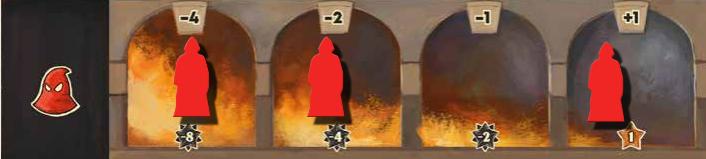
Each Player Board has a cellar to keep track ofyour Inquisitor tokens. The cellar has four spaces with the inquisitor's opinion value on the top arch. These values are used during an interrogation. Values below Inquisitors are resolved during the end-game scoring and never during the game.
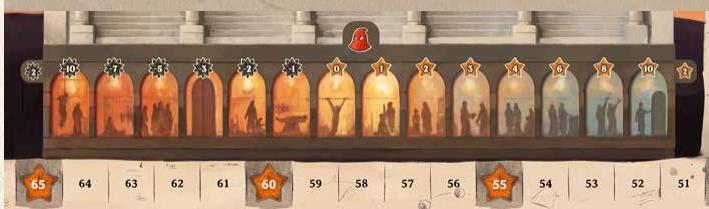
The Tribunal lies below the university. Depending on your final Reputation, the Tribunal will penalize or improve your score at the end of the game.

Always place a new Inquisitor token in the leftmost space ofyour cellar. Here, you're at the greatest risk oflosing Reputation from them.
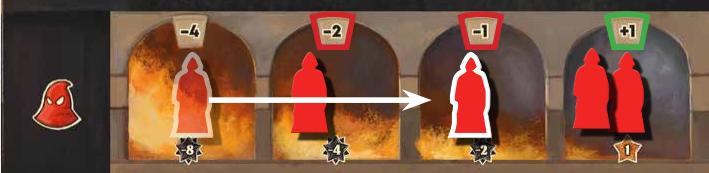

Galileo has acquired an inquisitor during his turn. Thanks to his upgraded Action tile, he has the option to Persuade twice as his moving action. He chooses to move the newly placed Inquisitor token two spaces to the right. During the
Cleanup Phase, Galileo is interrogated because he persuaded at least one inquisitor this turn.
He scores -2 for the token on the second space, and –1 for the token he placed and moved twice this turn. However, he also gets +1 from both ofthe Inquisitor tokens he fully persuaded earlier during the game! This interrogation's result is -1. Galileo moves his Tribunal token one step to the left on the Reputation track.

End of game
The end of the game is triggered when the last Discovery card is placed on the Game Board. Finish the current round. Then, starting with the first player, each player takes one final turn. After that round is complete, count up your victory points. The player with the most points becomes the most famous astronomer of the age!
If there is a blank spot on the Game Board during the final round, add another random Tier III card from the box to fill it.
Final scoring
The flag to the upper-right of the university shows the sequence of scoring additional victory points. Score for the university, and then for the inquisition.
UNIVERSITY
Each player gains bonus points based on the progress of their University tokens along the Scale tiles (see Subjects, page 11).
INQUISITION

Each player gains or loses points based on how many Inquisitor tokens remain on their Player Board, and based on their Reputation at the end of the game.
At the end of the game, each Inquisitor token is worth points equal to the number on the bottom ofits cellar space. Black icons subtract points, while each fully persuaded inquisitor in the rightmost space gains you 1 victory point.
Finally, your Tribunal token's position indicates how many victory points you gain or lose due to your Reputation.
Ties
If two players have an equal number of victory points, the player with the highest remaining sum of their observation dice wins. If there is still a tie, the player with the most remaining Quadrant tokens wins. In the rare case that there is still a tie, both players share the victory.
100+
If you gain over 1oo victory points, congrats! Flip your Score token over and keep counting along the Game Board.


Three convinced inquisitors give Galileo 3 victory points, but his unconvinced inquisitors take away 2 points and 4 points respectively. Overall, Galileo loses 3 victory points due to his Inquisitor tokens. He moves his Score token down the track accordingly.

Galileo (blue) gains the following victory points from the university:
-
15 points for observing Major Objects (3 points on the Scale tile × 5 cards from Major Objects)
-
4 points for Comet tokens (1 point on the Scale tile × 4 Comet tokens placed on the Game Board)
-
o points for Constellation tokens, since Galileo didn't Lecture on this track
-
8 points for writing in his Library (2 points on the Scale tile × 4, his leftmost Book token in the above example)
Galileo also scores 3 points for his Reputation, standing before the Tribunal.
Advanced mode - Special abilities
To make Galileo Galilei more variable and challenging, try using the special abilities. Each character has his own unique talent to maximize your discoveries. At the start of the game, choose your character in any manner. Then, take each character's special components as needed. See the following pages for an explanation of each character's special ability.

Galileo Galilei (1564-1642)
Galileo Galilei, born in 1564 in Pisa, Italy, is a pivotal figure in the history of science, hailed as the father of modern physics. A polymath of the Renaissance, he excelled in astronomy, physics, mathematics, and philosophy. Galileo's revolutionary use of the telescope in the early 17th century led to the discovery of the Galilean moons orbiting Jupiter, supporting the heliocentric model proposed by Copernicus and challenging the prevailing geocentric worldview.
Despite his groundbreaking contributions, Galileo faced significant opposition from the Catholic Church due to his support for heliocentrism. In 1633, he was tried by the Roman Inquisition, found guilty ofheresy, and forced to recant his views. This conflict, however, did not diminish his lasting impact. Galileo's emphasis on empirical evidence and the scientific method laid the groundwork for modern observational astronomy and physics, influencing subsequent scientific giants like Isaac Newton. His legacy endures as a symbol of scientific courage and the pursuit ofknowledge in the face of adversity.
Special Ability:
Galileo was renowned as a great astronomer, and signiicantly enhanced the telescope's capabilities. His special ability allows him to Observe constellations more efficiently.
Galileo has one personal Book of Comets page. When it is covered, he gains two Quadrant tokens.
Any time Galileo takes the Observe action, he may Observe an additional constellation. He may Observe a Major Object plus one constellation, or three constellations with the same action.
Johannes Kepler (1571-1630)
Johannes Kepler, born in 1571, reshaped our understanding of celestial motion through his groundbreaking work as a mathematician and astronomer. His thoughts based on Tycho Brahe's observations, particularly focused on Mars, led to the formulation of three laws of planetary motion in the early 17th century. These laws, describing the elliptical orbits of planets around the Sun, replaced previous geocentric theories and provided a more accurate framework for predicting celestial movements
Kepler's laws served as the cornerstone of modern celestial mechanics, influencing subsequent scientific thought, notably that ofIsaac Newton. Kepler's emphasis on empirical observation and mathematical rigor set a new standard for the scientific method, marking a pivotal moment in the scientific revolution.
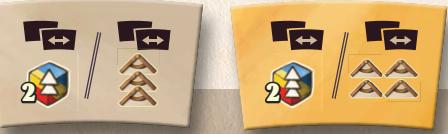
Special Ability:
Kepler's proficiency with lenses and optics contributed to the advancement of telescopes. His special ability allows him to better utilize Action tiles, including his own special tile.
Kepler has a special Action tile. At the beginning of the game, he places this tile on the last space on the starry sky (to the left of the Upgrade action). Place one of his basic action tiles on his Character Board. Whenever Kepler uses the moving action on his special tile, he gains the following unique action:
-
Swap the position of two Action tiles on his Player Board.
-
Swap an Action tile on his Player Board with the tile on his Character Board.

Nicolaus Copernicus (1473-1543)
Nicolaus Copernicus, born in 1473 in Poland, reshaped our understanding of the cosmos with his groundbreaking work, De revolutionibus orbium coelestium (On the Revolutions of the Celestial Spheres), published in 1543. He challenged the prevailing geocentric model, introducing the heliocentric theory that positioned the Sun at the center of the solar system. Copernicus's revolutionary insight provided a simpler explanation for celestial motion, paving the way for the scientific revolution and influencing subsequent astronomers like Johannes Kepler and Galileo Galilei. His contributions marked a pivotal shift in our perception of the universe, initiating a lasting impact on scientific inquiry.
Special Ability:
Copernicus, an outstanding astronomer and mathematician, made the most significant contributions to the heliocentric model and extensively engaged in mathematical modeling of planetary motion. This is reflected in his special ability, representing his deep involvement with his library.
Copernicus has one personal Book of Comets page. When it is covered, he may Persuade two different Inquisitor tokens twice (each token moves up to two spaces).
As a free action, once per turn, Copernicus may place one of his special tiles into his Library, replacing the rewards they cover. This free action does not cost him any Quadrant tokens. Each of his special tiles can't cover up a Book token. These tiles may not stick out of the Library—they have to fit into the available rows from Copernicus Discovery cards. You may use any side of these double-sided tiles, but do not place them upside down.
Giordano Bruno (1548–1600)
Giordano Bruno, born in 1548, was an Italian philosopher and cosmologist whose ideas pushed the boundaries of conventional thought. Going beyond Copernicus, Bruno proposed an infinite universe with countless worlds, advocating for cosmic pluralism. His bold theories, however, clashed with the doctrines of the Catholic Church, leading to his condemnation and execution for heresy in 16oo. Bruno's willingness to explore beyond societal norms made him a martyr for the pursuit ofknowledge, and his daring ideas left an indelible mark on the history of scientific inquiry, emphasizing the importance ofintellectual freedom and the courage to challenge prevailing beliefs.
Special Ability:
Bruno's heretical views made his interactions with the Inquisition extremely difficult, and eventually led to his death. Because of this, it is more difficult for Bruno to fully persuade inquisitors in his cellar. However, if he succeeds the rewards are significant!
Bruno has two personal Book of Comets pages. When one is covered, Bruno may Persuade four times, divided as he sees fit. When the other is covered, Bruno may Upgrade one of his Action tiles.
Bruno also has a special cellar tile which covers up the cellar on his Player Board. It has five spaces, making it more challenging for him to Persuade inquisitors. However, he gains the tile's shown rewards each time an Inquisitor token moves onto that space.
Solo Game
In the solo game your opponent is Tycho Brahe, an astronomer renowned for his high-quality telescopes. Your goal is to earn more points than him. As usual, the game ends when the Discovery deck runs out of cards.
Setup
Prepare a deck of Discovery cards for a two-player game.
-
Place Tycho's Character Board on the table.
-
Place a Player Board next to it, folded in half so that the telescope is facing down.
-
Place Tycho's special Book token on the Player Board so that it covers all four Library spaces.
-
Place the comet tokens and constellation tokens of any other color than yours on Tycho's Player Board.
-
Give Tycho three observation dice of random colors. Tycho never cares about an observation die's value.
-
Near his Player Board, place Tycho's five Action tiles in any order with the blue side facing up. Place Tycho's telescope token below the leftmost tile.
-
Shuffle Tycho's Movement tiles, and make a deck out of them.
-
Place Tycho's University tokens at the bottom of the university, his Tribunal token on the Reputation track, and his Score token on the score track as usual.
Gameplay
During the solo game, always use the side of your astronomer's Character Board which lists their special ability. The game always begins with the player, never Tycho. Take your turn as usual, then play out Tycho's turn.
First, flip the top tile of Tycho's Movement deck. This determines how far Tycho moves. His telescope figure always moves from left to right. If it reaches the rightmost tile, return the token to the left and continue moving (like the telescope does on your Player Board).
Tycho has three types of Movement tiles:

Tycho's token moves the specified number of steps.
Tycho's token moves the specified number of steps. Ifit reaches an upgraded Action tile, the token stops early.
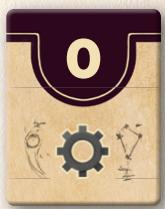
Upgrade the tile on which Tycho's token is currently located. Ifit's already upgraded, upgrade the nearest tile to the right of Tycho's current position.
After moving, Tycho evaluates his Action tile. He evaluates one row at a time, beginning from the top of the tile. He triggers only one line each turn.
If Tycho meets the condition in the light frame on the left side of the row, he takes that row's action. If he doesn't meet the condition, he skips to the next row and repeats this process. The bottom row is always unconditional, meaning Tycho can always take that action.
Conditions on Tycho's Action Tiles

Tycho's cellar has two or more unpersuaded Inquisitor tokens.

Tycho has three or more fully persuaded Inquisitor tokens.
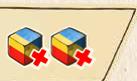
Tycho must spend two observation dice of any color.
Some tiles require three dice.

Tycho must spend two observation dice of any color and there must be at least two constellation spots on the Game Board which can be discovered.

Tycho must have at least one Comet token on his Player Board.
Effects on Tycho's Action Tiles

Place one of Tycho's Comet tokens on the Game Board.

Move one of Tycho's Comet tokens downward (1 to 2, or 2 to the Book of Comets). He prioritizes tokens with a value of 2. Place Comet tokens on the leftmost available page of the Book of Comets in the section for two players. Tycho never receives rewards from the Book of Comets.
Tycho gains one observation die of any color.
Move Tycho's Book token to the right by the specified number of spaces. Tycho never receives rewards from his Library.
Move one of Tycho's University tokens up by one space. He prioritizes the Scale tile whose condition Tycho fulfills the most times. In case of a tie, Tycho moves the University token on the leftmost scale. Tycho never receives rewards from the university.
Move an Inquisitor token in Tycho's cellar to the right. He prioritizes movement which best improves the results of an interrogation.
Remove one fully persuaded Inquisitor token.
Tycho gains the amount of victory points specified in the icon.
Place Tycho's leftmost Constellation token on the Discovery card with the available constellation of the highest value. Tycho gains the constellation's victory points, and ignores any other rewards on the card. In case of a tie, Tycho chooses the leftmost constellation. Tycho does not gain rewards due to removing a Constellation token from his Player Board.

Place the Discovery card with the highest score for its Major Object into Tycho's Library. Tycho gains that object's victory points, and ignores any other rewards on the card. Replace the Discovery card as usual.

Place the top card of the Discovery deck into Tycho's Library, with the light side facing up.

It's Tycho's turn, and you're evaluating this Action tile. Tycho's Player Board is out of Comet tokens, so he can't take the top row's actions. Tycho instead does the bottom row's actions.

Tycho moves his Book token by one space in his Library. He also moves both Inquisitor tokens once, since this gains him the least negative points during the next interrogation.
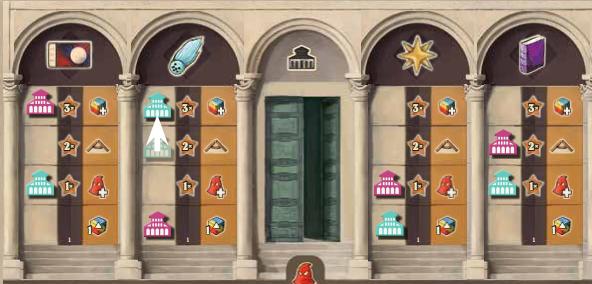
Since Tycho has placed all seven ofhis Comet tokens, he prioritizes moving his University token for that subject.
We still need to resolve this bonus condition, which is included in this tile's bottom row.
Since Tycho doesn't have three fully persuaded inquisitors, he doesn't take the additional actions to the right of this condition. Ifhe did, Tycho would remove one ofhis Inquisitor tokens, and score 10 victory points.
②②②×
Note: This condition is marked by a rounded bar because it is a partial condition! It provides Tycho with an additional bonus for the bottom row's action if he meets this condition.
End ofthe Solo Game
The solo game ends when the last Discovery card is drawn. Finish the current round. Then, each player takes one final turn as in the basic game. Evaluate Tycho's score from the university and the Inquisition as he was any other player.
Additional Solo Game Rules
If Tycho moved an Inquisitor token, then he has an interrogation at the end of his turn. This moves his Tribunal token as usual.
Tycho only gains victory points from his Action tiles, from Observing constellations and major objects and from the end-game scoring!
Tycho can achieve objectives in the university. When he does, place an Achievement token as usual. Tycho gains victory points from the objectives, but does not get to take the Inquisitor's Farewell action as a reward.

IfTycho places his comet on the page of book of comets, he won't get any rewards, not even the points.
Tycho does not get any rewards including the points from the writing steps in his library when he covers it.
Appendix
Colorblind help
Each observation die's face has a dot next to the number. The game's icons have one corner painted blank in the same manner. This is to help colorblind persons identify a die's color.
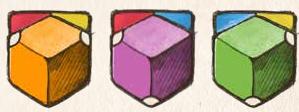
Yellow Die – dot on the right Red Die- dot on the left Blue Die – dot under the number
Combined dice are marked for the two colors required to pay their observation cost.
Remembering Interrogation
Try this trick to remember whether or not you've moved an Inquisitor token on your turn.
![
Content is long; only the first part is inlined. Download the file or open the rules page for the full text.
Download MarkdownTexts are community-compiled or publicly released by publishers; copyright remains with the original authors. For personal reference only.