
Got Five
At a glance
Rules, cards and Q&A (Chinese)
The rules, card data and player questions for this game are written in Chinese. Open the Chinese page to read them.
Where to find full rules
Full rules and card lookup are available in the cunlema app at cunlema.cn — pick this game and ask about any rule, card or turn you are unsure about.
Related games
Rulebook text (Markdown)
This game has 1 rulebook Markdown file(s) in our library; 1 rendered inline below — expand to read or download.
GOT FIVE_RULES EN.md6.7 KB
Yoann Levet
COMPONENTS
GOT FIVE! is a game of logic and deduction.
M

GOAL OF THE GAME

z60 tiles in 5 colours. Each tile is unique, displaying a number on the front from 1 to 60 and showing 1, 2 or 3 dots.
Be the first to work out and correctly guess your 5 hidden numbers, using the clues revealed over the course of the game!


z4 stands: each with 5 tile slots and a categorisation zone with 6 notches.

z4 screens

z4 game boards
z4 erasable markers

SETUP
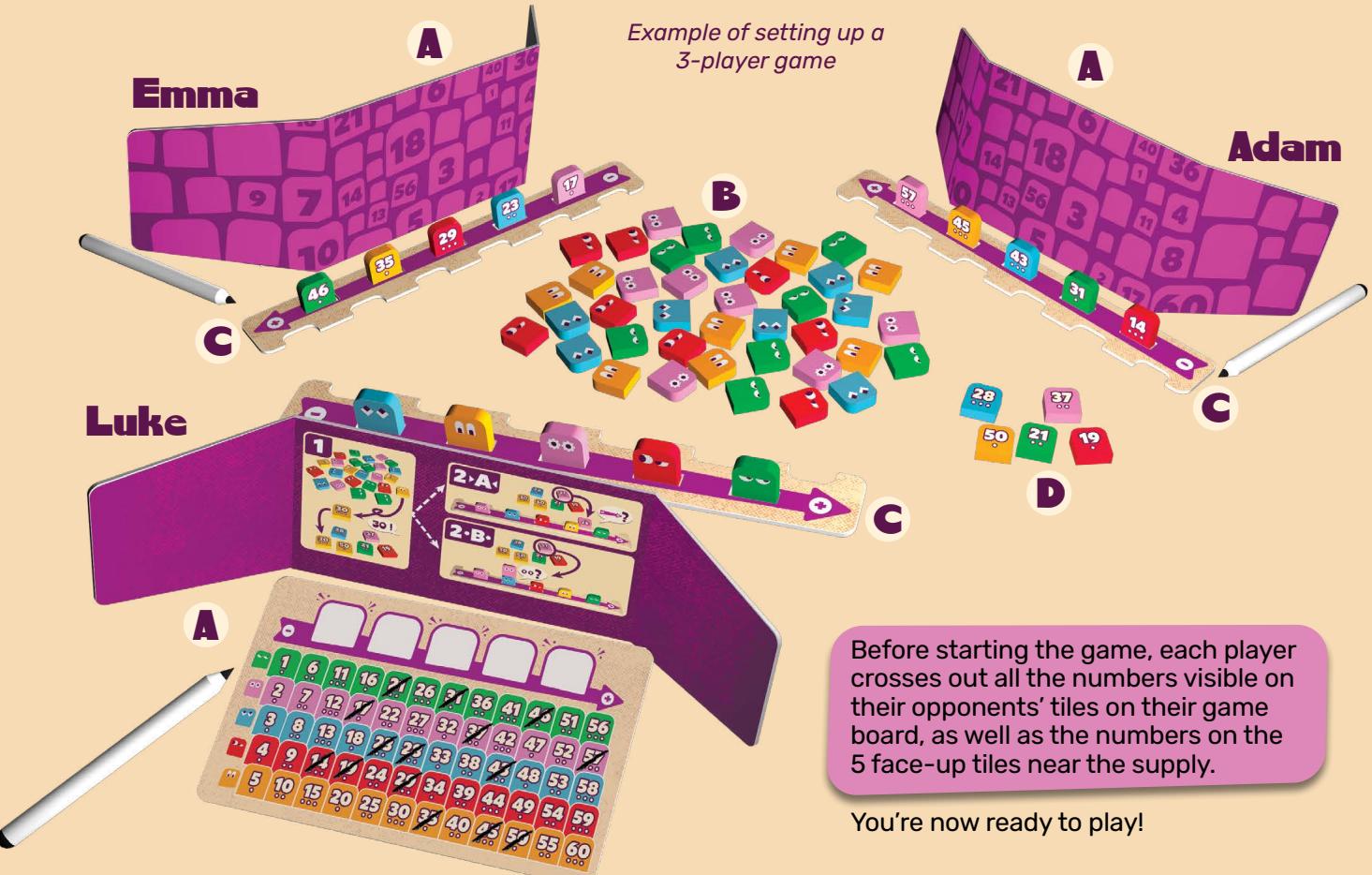
A. Each take 1 screen, 1 game board and 1 marker. Place the screen in front of yourself and the board and marker behind your screen so other players can’t see them.
Your board shows all 60 tiles in the game, including their colour, number and number of dots.
B. Gather the 60 tiles in the centre of the playing area and shufle them face down: they form the supply.
C. Each take 1 stand and place it in front of your screen so the other players can see it. Make sure the arrow is pointing towards your right.
h For games of fewer than 4 players, return any unused components to the box.
Each draw 1 tile of each of the 5 colours at random from the supply, without looking at their numbers. Place them in front of your stand with their numbers facing away from you and towards the other players.
IMPORTANT!
Throughout the game, you must never look at the numbers on the 5 tiles on your stand, nor read out the numbers shown on your opponents’ tiles.
Now ask 1 of your opponents to put your 5 tiles into the slots on your stand: they must arrange them in ascending order, in the direction of the arrow, placing the smallest number near the symbol and the largest number near the symbol.
D. Finally, nominate a player to draw 1 tile of each colour at random and place them face up near the supply.

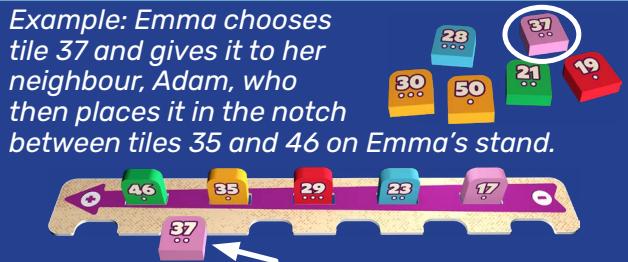
Example of 5 tiles placed in order on a stand
HOW TO PLAY
Youngest player starts. Beginning with the starting player and continuing in a clockwise direction, each player plays their turn by carrying out the following 2 actions in order: 1. REVEAL A TILE, then 2. ASK FOR A CLUE.
1. REVEAL A TILE
Draw 1 face-down tile of a colour of your choice from the supply. Flip it face up, announce its number out loud, then place it with the 5 other tiles already face up near the supply.
2.ASK FOR A CLUE

Select any 1 tile from those face up near the supply (there will always be 6 to choose from). Use it to ask your neighbour for either 1 of the following 2 clues: CATEGORISE or COMPARE.
CATEGORISE
Ask 1 of the players next to you to categorise the tile you have chosen in relation to the 5 tiles on your stand. To do this, your neighbour must place this tile, flat and face up, in 1 of the 6 notches in your categorisation zone. They must place the tile so that it fits into the ascending order of the tiles on your stand.
z Each tile placed in this way remains visible to everyone until the end of the game.
z After several rounds of play, if the notch in question already contains 1 or more tiles, place the newest tile below those already there, making sure that all tiles remain visible.
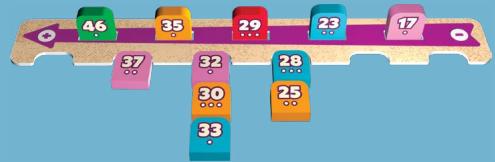
OBOCOMPARE
Take the tile you’ve chosen and place it above 1 of the 5 tiles on your stand. The colours don’t have to match.
2 tiles have the same number of dots. Your neighbour must answer your question with a simple “Yes” or “No”.
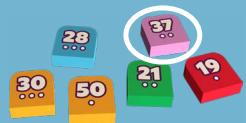
Example: Emma chooses tile 37 and places it on top of the blue tile on her stand. She asks Luke if these 2 tiles have the same number of dots: Luke compares them and answers “Yes”.

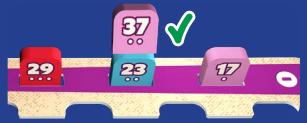
Place the tile you chose face up between your stand and your screen, in line with the tile it was compared with.

Emma places tile 37 between her stand and her screen, in line with her blue tile.
z Tip: if your neighbour responds with a “No”, place the tile at an angle.
z Each tile placed in this way remains visible to everyone until the end of the game.
z Your turn is now over, and the player on your left goes next. You can use your game board to cross out any numbers you think you can rule out according to any deductions you can make.
h Use the 5 white boxes at the top of your board to write down the numbers of your 5 tiles as you make your deductions.
h Refer to the direction of the arrow to remind yourself to put the numbers in the correct, ascending order.
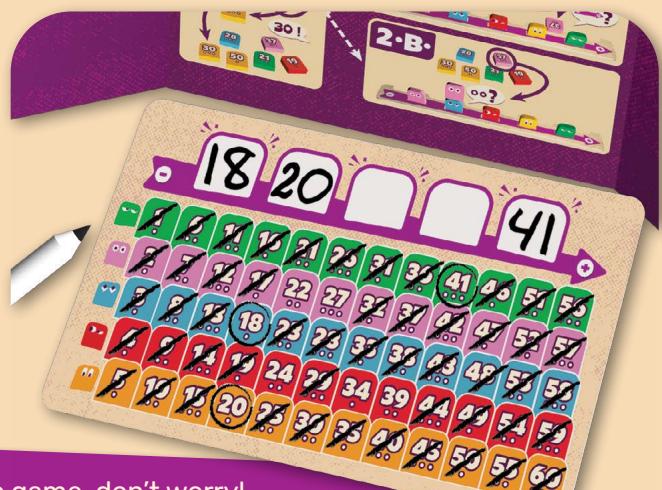
“Oh no! I made a mistake...”
If you think you’ve made a mistake at any time during the game, don’t worry!
You can easily rub out what’s on your game board and re-do your deductions from square one. All the tiles revealed during the game remain visible to everyone, so it’ll take you no time to re-do your deductions and get back into the game!
END OF THE GAME
You have a single chance to declare your 5 numbers and find out whether you’ve identified them correctly. You can announce your guess at any time during the game, even if it’s not your turn.
To do this, shout out “GOT FIVE!”. Then one by one and in ascending order, list your guesses for the 5 numbers on your stand.
Your opponents must then confirm whether your guesses are right:
z If you guessed your 5 numbers correctly, you win the game immediately – CONGRATULATIONS!
z If you made 1 or more mistakes in your guess, you lose the game – WHAT A SHAME! Watch from the sidelines to find out who wins!
¨ If all but 1 of the players make a mistake in their guesses, the last player who has not yet made a guess automatically wins the game.
Download MarkdownTexts are community-compiled or publicly released by publishers; copyright remains with the original authors. For personal reference only.