
Habitats
At a glance
Rules, cards and Q&A (Chinese)
The rules, card data and player questions for this game are written in Chinese. Open the Chinese page to read them.
Where to find full rules
Full rules and card lookup are available in the cunlema app at cunlema.cn — pick this game and ask about any rule, card or turn you are unsure about.
Related games
Rulebook text (Markdown)
This game has 1 rulebook Markdown file(s) in our library; 1 rendered inline below — expand to read or download.
BGT-Habitats-Rulebook.md12.0 KB
HABITATS
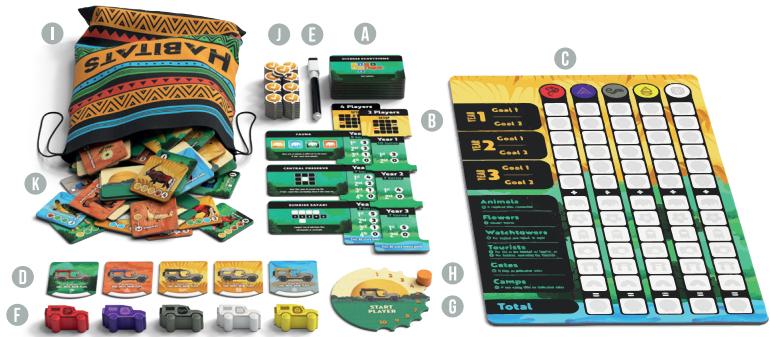
Components
A 15 Goal Tiles B 2 Year Tracks C 1 Score Board 0 5 Player Entrance Tiles E 1 Dry Erase Marker
5 Player Jeeps
G 1 Turn Tracker
H 1 Turn Marker 1 Tile Bag
0 50 Score Markers
134 Preserve Tiles
76 Animals, 20 Flowers
12 Gates, 8 Tourists,
6 Dual Habitat Tiles,
8 Watchtowers, 4 Campsites
Zebras need grassland, gorillas need forest, crocodiles need water, ants need desert, and warthogs need a little bit of everything! Your duty as a wildlife ranger is to provide the habitats necessary for the animals in your African wildlife preserve to thrive. You will also be building watchtowers, access gates, campsites, and tourist spots to stand out as the best preserve in Africa.
Setup
-
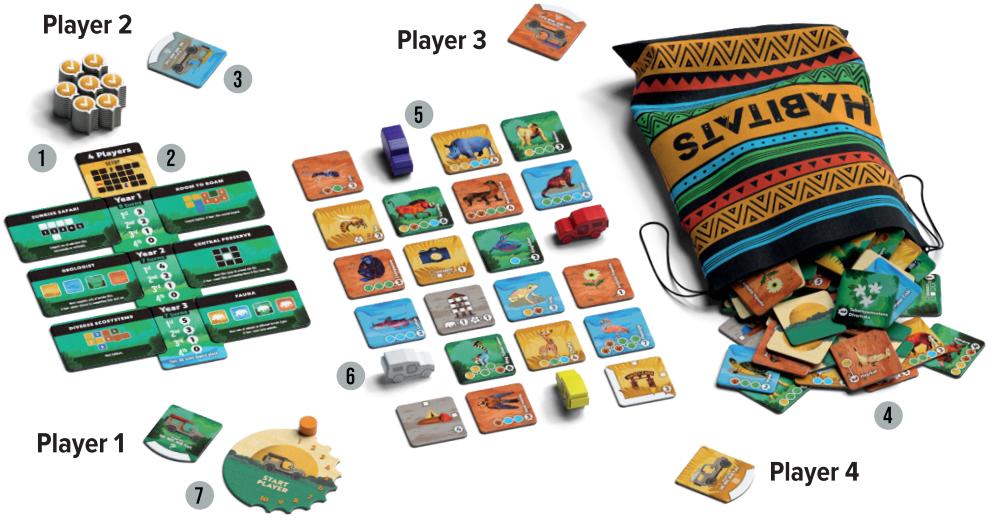
Choose the correct Year Track for the number of players.
-
Place 6 Goal Tiles in the notches on the Year Track. One on each side of each year.
-
Each player takes an Entrance Tile.
-
Mix all the Preserve Tiles in the bag.
-
Draw Preserve Tiles from the bag and make a faceup grid as shown on the Year Track to form the market. (4x4, 4x5, 4x6, 4x7, in a 2/3/4/5 player game).
-
Place each player's jeep in the empty spaces of the market as shown on the Year Track. Make sure they are facing the directions shown. Direction is important for gameplay.
-
The player who most recently fed an animal is the start player. They take the Turn Tracker and Turn Marker.

Grassland

Water

Forest

Desert





Gameplay
The game is played over three years, each lasting the number of turns as indicated on the year marker. Turns proceed clockwise. Each turn you will “Take, Drive, Draw, Place”.
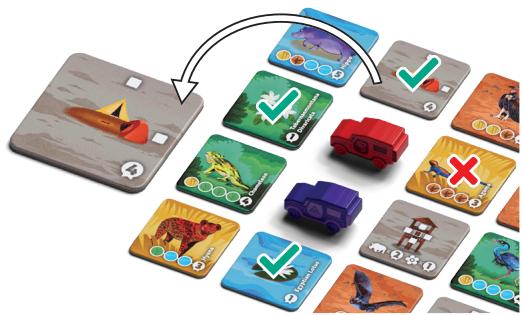
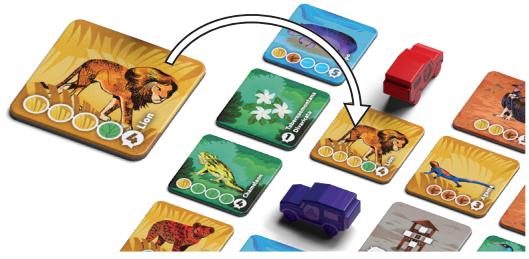
1. Take a Preserve Tile
from directly in front of or on either side of your jeep. You may NOT take the Preserve Tile behind your jeep unless you have no other legal tile to take.
If a jeep is in one of your legal spots to take from, you may take the next tile in that direction.
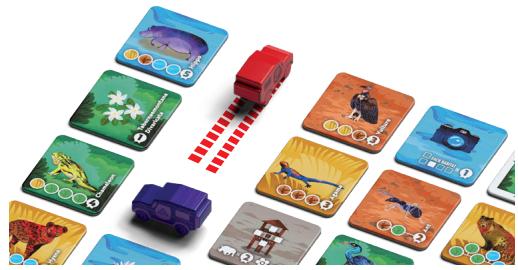
2. Drive Your Jeep
into the newly empty space, orienting it such that it is driving away from the space it previously occupied.
3. Draw a Preserve Tile
from the bag and place it in the spot your jeep just left.
4. Place the Preserve Tile
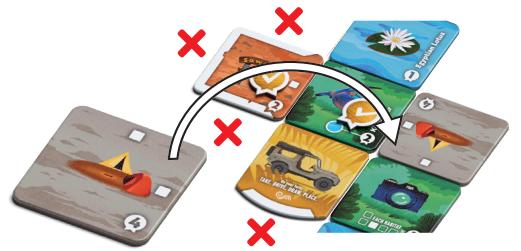
you took in step 1 in your Preserve. It must be placed next to an adjacent tile. Tiles with white borders represent the edge of your preserve. No tiles may be placed adjacent to those borders.
In Habitats, adjacent always means orthogonally adjacent, never diagonally.
Camps, Gates, and Watchtowers may be rotated in any direction when placed in a player's preserve.
The start player uses the Turn Tracker to track how many turns they have taken.
Habitats
Tiles are considered to be part of a “Habitat” if they have the same terrain type and are adjacent. Grey background tiles have no terrain type and cannot form a habitat.
Some Preserve Tiles have two terrain types and can extend multiple habitats.
Year End
After each player has completed the number of turns shown on the Year Track, the year ends and that year's two Goal Tiles are scored.
Each Goal Tile specifies a criteria. Score points based on how you rank against your opponents. The exact number of points is shown on the Year Track. In case of a tie, all tied players score the lower point value.
Record players scores on the score board, then reset the turn tracker and play the next year, continuing clockwise in the same turn order.
Game End
After Year 3 is scored, score end game points.
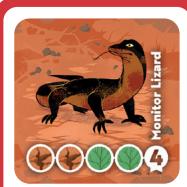
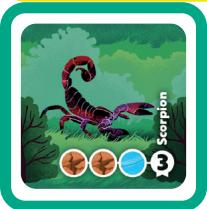
Animals have required terrain icons.
The Animal scores the points on the tile only if it is adjacent to Habitats that contain the required terrains. The terrain on the animal tile itself does not count.
The Bee, Bumblebee, and Butterfly are slightly different because they require adjacent Flowers instead of terrain. They can be adjacent to the flowers or a group of flowers that are adjacent to each other.
Watchtowers score the points shown for each scoring Animal or Flower in the designated tiles. Remember you can rotate the tile any direction when adding it to your preserve.
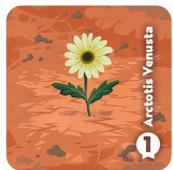
Flowers always score 1 point.
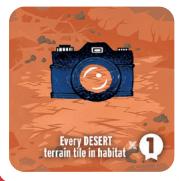
Tourists score based on having tiles of the same terrain type.
Gates score the points on the tile only if all sides without a white border have a tile adjacent to them.
Camps score the points on the tile if every indicated adjacent side has a non-camp tile.
Place Score Markers on Animal, Gate, or Camp tiles when you satisfy their scoring conditions to keep track of which tiles will score.
The player with the most points wins. If tied, all tied players win.
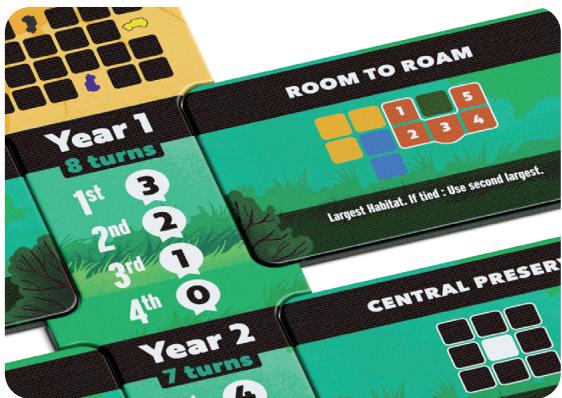
| Players | ||||
| 1 | ||||
| Tiles in largest habitat | 4 | 3 | 3 | 1 |
| Points | 3 | 1 | 1 | 0 |
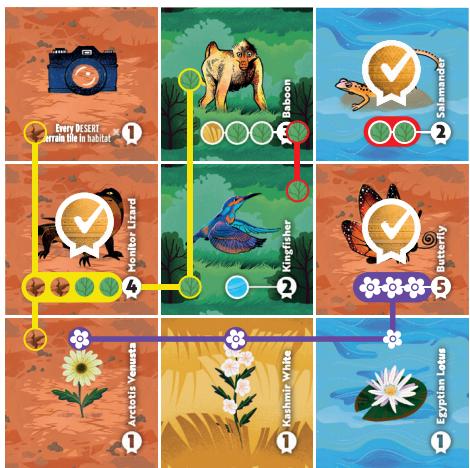
The scoring markers above show which animal tiles are scoring. The colored line identifies each tiles habitat requirements and each tile that makes up the habitat.

Endless diagonal line

Endless orthogonal line

Eight tiles surrounding

Four tiles adjacent

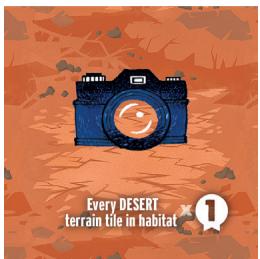
1 point for each tile in the Habitat with the Tourist.
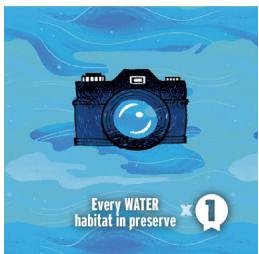
1 point for each separate Habitat, matching the Tourists terrain, in your Preserve
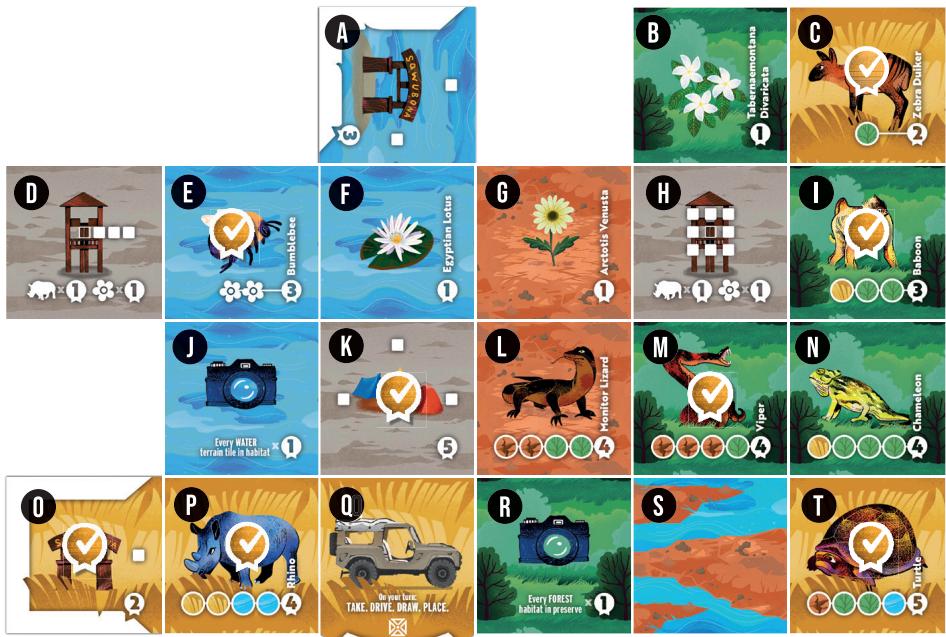
A The gate's requirement is NOT met. There is an adjacent tile on the required bottom edge (F), but not on the required right edge. All other edges are white borders and tiles cannot be placed adjacent to those edges.
B Flowers always score 1 point.
C This animal's habitat requirement of 1 forest terrain is met by the adjacent 1 tile forest habitat (B) and the 3 tile forest habitat (I,N,M). Tile C is adjacent to a forest habitat total of 4.
0 This watchtower scores 4 points. In its line of sight there are 2 scoring animals (E,I) and 2 flowers (F,G).
E This animal's habitat requirement of 2 flowers is met by the adjacent 2 tile flower habitat (F,G). Flowers are the only tile in the game that can form habitats across terrain types.
Flowers always score 1 point.
Flowers always score 1 point.
This watchtower scores 5 points. In the eight surrounding spaces there are 3 scoring animals (C,I,M) and 2 flowers (B,G). The animal tiles L and N do not add points for the watchtower because their habitat requirement is not met.
This animal's habitat requirement of 1 grassland terrain and 2 forest terrain is met by the adjacent 1 tile grassland habitat (C) and the adjacent 2 tile forest habitat (M,N). Tile I is adjacent to a grassland habitat total of 1 and a forest habitat total of 2.
0 This tourist scores 4 points. 1 point for each water tile in its habitat including the tile itself (A,E,F,J).
K This camp's requirement is met because the indicated left right, and top sides have adjacent tiles (J,F,L) that are not camps.
This animal's habitat requirement of 2 desert terrain and 2 forest terrain is NOT met. It is adjacent to a 3 tile forest habitat (I,M,N) and a 1 tile forest habitat (R), but is only adjacent to a 1 tile desert habitat (G). An animal cannot count its own terrain type for its habitat requirement.
This animal's habitat requirement of 3 desert terrain and 1 forest terrain is met by the adjacent 2 tile forest habitat (I,N) and the adjacent 2 tile desert habitat (G,L) and also the 1 tile desert habitat formed by the dual terrain tile below it (S). Tile M is adjacent to a desert habitat total of 3 and a forest habitat total of 2. An animal's habitat requirement can be fulfilled from 1 or more habitats of the same terrain type.
N This animal's habitat requirement of 1 grassland terrain and 3 forest terrain is NOT met. It is adjacent to a 2 tile forest habitat (I,M) and a 1 tile grassland habitat (T), because an animal cannot count its own terrain type for its habitat requirement and therefore cannot fulfill its forest habitat requirement.
0 The gate scores because there is a tile on the required right edge (P). All other edges are white borders and tiles cannot be placed adjacent to those edges.
This animal's habitat requirement of 2 grassland terrain and 2 water terrain is met by the adjacent 2 tile grassland habitat (O,Q) and the adjacent 4 tile water habitat (A,E,F,J). Tile P is adjacent to a grassland habitat total of 2 and a water habitat total of 4. Your starting tile counts as a terrain type for fulfilling habitat requirement.
0 This is your starting tile. It does not score, but counts as a terrain type for fulfilling habitat requirements. No tiles may be placed directly below it on the curved white border.
R This tourist scores 3 points. 1 point for each forest habitat in your preserve. Your preserve has 3 forest habitats; a 1 tile forest habitat (B), a 3 tile forest habitat (I,M,N), and another 1 tile forest habitat (R).
This is a dual terrain tile. It does not score, but can fulfill the requirements of both terrain types for adjacent animals and also extend the habitats of any adjacent tiles of either terrain type.
This animal's habitat requirement of 1 desert terrain, 2 forest terrain, and 1 water terrain is met by the adjacent 1 tile desert habitat (S), the adjacent 3 tile forest habitat (I,M,N), and the adjacent 1 tile water habitat (S). Tile T is adjacent to a desert habitat total of 1, a forest habitat total of 3, and a water habitat total of 1. Dual terrain tiles can satisfy the habitat requirements of multiple terrain types for adjacent animals.
Credits
Designer: Corné Van Moorsel Desiyner. cune vun mvursei
Illustration: Dominque Ramsey, Daniel Profiri Graphic Design: Luke Adams, Anca Gavril Consulting: Michael Dunsmore, John Brieger 3D Artist: Filip Gavril
Download MarkdownTexts are community-compiled or publicly released by publishers; copyright remains with the original authors. For personal reference only.