
Heul Doch Mau Mau
At a glance
Rules, cards and Q&A (Chinese)
The rules, card data and player questions for this game are written in Chinese. Open the Chinese page to read them.
Where to find full rules
Full rules and card lookup are available in the cunlema app at cunlema.cn — pick this game and ask about any rule, card or turn you are unsure about.
Related games
Rulebook text (Markdown)
This game has 1 rulebook Markdown file(s) in our library; 1 rendered inline below — expand to read or download.
Heul Doch Mau Mau.md5.5 KB
Heul Doch! Mau Mau (Go Ahead and Cry! Mau Mau) - 3-6 Players
Object – Have the most points on your discard pile at the end of the game.
Preparation
Mix all 98 number cards well and place them in the middle of the table as a face-down draw pile. If playing with the special cards, add those in as well. [House rule – If playing with 3, 4, or 6 randomly remove 2 cards to ensure that players will receive an equal number of turns.]
In turn, each of you gets 1 random card from the pile and puts it face up in front of you. This is the first card of your personal discard pile.
In addition, everyone receives 4 more cards from the stack, which she takes in his hand so that only she can see them.
The handkerchief is provided should anyone feel the need to cry during the game.
Gameplay
The biggest crybaby is the first player, after which play will continue in a clockwise direction.
On your turn, you must play one of your had cards. This card should ideally go on your own pile, because it will bring you points at the end of the game. That being said, to do this the card must match either the color or number of the top card in your stack… For example, if you have a red 5, it can be placed on any red card or any 5.
But beware! If can make a legal play on the stack of your immediate neighbor to your left or right, then you have to put it on their stack instead whether you like it or not. In practice you are always trying to pick cards from your hand that match your stack but do not match your neighbors’ stacks.
If a played card would work on either neighbors’ stacks, then you can decide which neighbor to play it on. You never need to pay attention to those stacks not belonging to your immediate neighbors or yourself.
If you can’t or don’t want to play on a neighbor’s stack you do have a second option… You can put any of your four cards (the color or number does not matter) face down on your own stack so that the gray crying onion is showing. On this gray crying onion, any face up card can be played next round, unless, of course, it fits one of your neighbors’ stacks… then you must still play the card on their stack.
Additional Rules:
- You may choose to play a gray crying onion on your own stack even if you have matching cards in your hand.
- You may play a gray crying onion on top of a gray crying onion if you want.
- You can never play anything on an opponent’s gray crying onion.
- You are expressly not allowed to look in your own discard pile during the game. As such, you should recall how many gray crying onions you have in your stack.
At the end of your turn, draw the top card from the draw pile so that you have 4 cards in your hand once again. Once the draw pile runs out, stop drawing cards, but continue to play until all cards have been played.
Game End
The game ends after the last player places their very last card. Now everyone should count the number of crying gray onion cards in their pile. This number will invalidate all cards of that number from their stack. If someone has more than 7 gray onions, 7 + the corresponding number over 7 will be invalidated (e.g. with 9 gray onions, 7 and 2 are both invalidated).
Once invalidated cards are removed, the value of the stack is calculated, with each card being worth the number of points printed on it (e.g. a 5 is worth 5 points). The player with the highest sum is the winner! If there is a tie, the winner is the player who lost more points due to the gray onion cards.
The Special Cards
For more variety, mix in the 12 special cards at the game’s start. If you receive one as your discard pile starter, simply shuffle it back into the pile and draw another card.
You can play a special card instead of a numbered card on your turn. They are played to the middle of the table on a separate discard pile. Then you do their action.
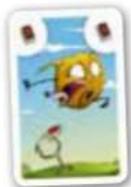
If you play the "catapult", the player with the highest number in front of them must discard it to the central discard pile with the catapult.
neighbor rule!). ).
If several of players (possibly including yourself!) Have the highest numeric value, they must all discard their cards. If, as a result, someone no longer has a card on their discard pile, this is considered as if crying gray o nion had been issued to him, (i.e. next time he is allowed to play any card -- keep in mind the
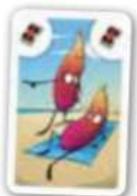
If you play the "beach towel", you exchange the top card of your discard pile with the top card of any player. These may also be howl! Onions.
If you do not have a card at this time (see "Catapult"), your opponent will not get a card from you. Attention: This does not pay attention to whether the two cards exchanged can be legally played on any discard pile or not.
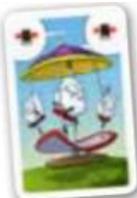
If you play the "Carousel", you decide whether the top card of all discard piles is to be passed one place to the left or to the right.
If a player has nothing in front of him (see "Catapult"), the affected neighbor will not receive a new card, but must pass on his top card anyway. Again, no further concern is given as to whether the exchanged cards fit on any discard pile or not.
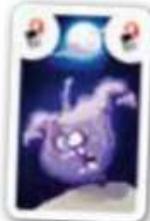
If you play the "werewolf", then all players (including you!) Must turn over the top card of their discard pile, i.e. a number card becomes a gray crying onion or vice versa!
Download MarkdownTexts are community-compiled or publicly released by publishers; copyright remains with the original authors. For personal reference only.