
Hues And Cues
At a glance
Rules, cards and Q&A (Chinese)
The rules, card data and player questions for this game are written in Chinese. Open the Chinese page to read them.
Where to find full rules
Full rules and card lookup are available in the cunlema app at cunlema.cn — pick this game and ask about any rule, card or turn you are unsure about.
Related games
Rulebook text (Markdown)
This game has 1 rulebook Markdown file(s) in our library; 1 rendered inline below — expand to read or download.
Hue_and_Cues_Rules (1).md5.4 KB
OF COLORS AND CLUES RULES BY SCOTT BRADY the GAMES
Hue - a gradation or variety of color; tint Cue - a hint or guiding suggestion
Overview:
How well can you describe a color? In Hues and Cues, players will take turns giving one- and two-word hints to get the other players to guess a specific color on the game board. Players score points based on how close they get to the correct color, and the cue giver scores points based on the accuracy of the guesses.
Set-Up:
-
Place the board in the center of the play area.
-
Give each player three pieces of the same color. • One should be placed to the left of the score track, with the player keeping the other two.
-
Shuffle the color cards to form a face-down draw pile.
-
Set the scoring frame off to one side.
Components:
• 1 Game Board
• 100 Color Cards
• 30 Player Pieces (3 each in 10 colors)
• 1 Scoring Frame
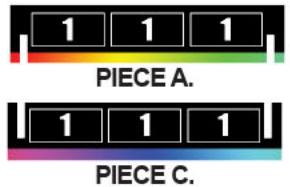
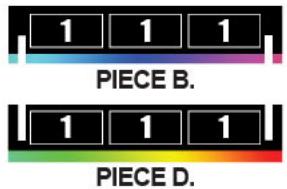
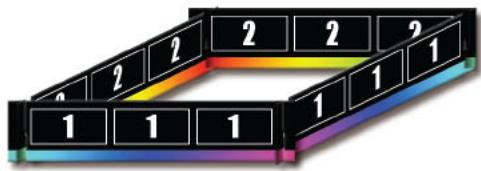
If this is your first time playing, assemble the scoring frame as shown. Sliding pieces A and B onto C and D with fronts (side with 1's) facing outward and Backs (sides with 2's) facing inward. Once intact it may be stored assembled in the game box.
They may choose to pass on their second cue or give a another one-word cue. (See additional rules.)
5. Second Guesses: This time in
counterclockwise order, players make a second guess by placing their remaining piece on any unoccupied space on the board.
Scoring:
After all guessing players have made their second guess, the cue giver reveals the color by placing the scoring frame onto the board so that the color on the card is in the center. Use the letter and number coordinates on the card to ensure it is aligned properly. Points are awarded as follows:
• Thie clle gīver receives one point for each piece that is within the scoring frame. In a 3 player game the cue giver scores
2 points per piece in the scoring frame
• Guessers receive points based on how close they are to the correct color.
• If a player guessed the color exactly, they receive three points.
• Each other piece within the scoring frame, but not on the exact color, receives 2 points.
• Each piece on a space adjacent to the outside of the scoring frame (including diagonally) is worth one point. Track the points by moving each player's piece the appropriate number of spaces on the scoring track. The cue giver can earn a maximum of nine points. Any individual guesser can earn a maximum of five points– three for a correct answer and two for their other piece being within the frame.
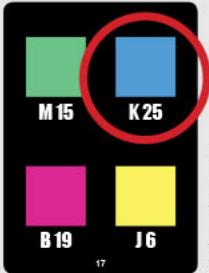
Gray player chooses color and gives their two cues. All players have made their guesses.
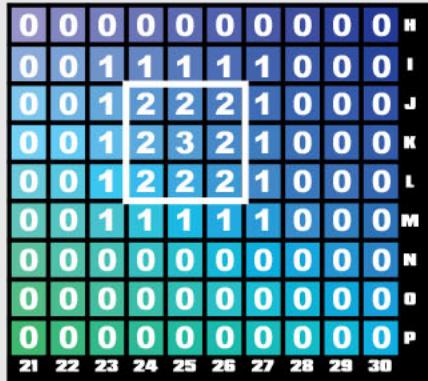
Scoring Diagram based on chosen color
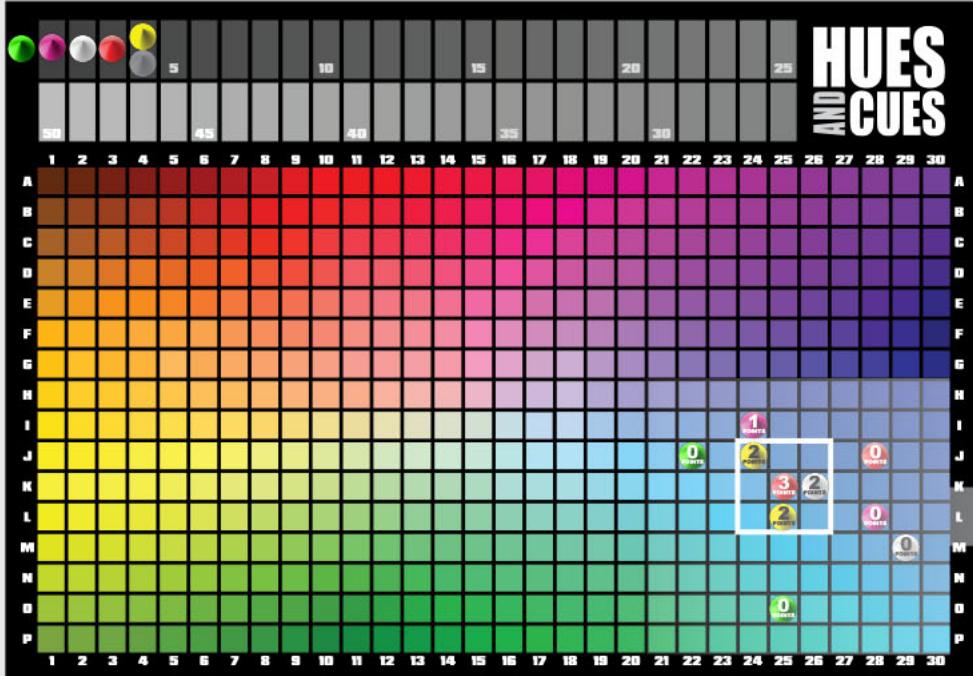
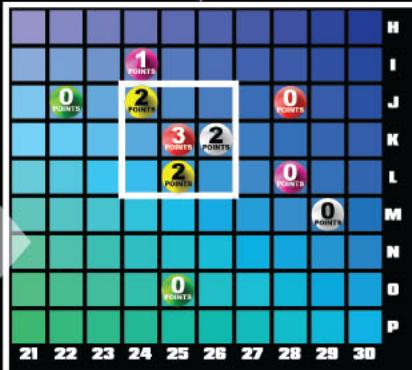
Example:
After all players have made their
guesses scoring is as follows:
Gray receives 4 points
Yellow receives 4 points
Red receives 3 points
White receives 2 points
Pink receives 1 point
Green receives 0 point
Starting a New Round:
All guessing pieces are returned to their owners. The next player in clockwise order becomes the cue giver and draws a new card from the deck.
Game End:
For games with 3-6 players, the play continues until each player has been the cue giver twice. If playing with 7 or more players, each person will be the cue giver once. After all players have taken their turn at being a cue giver (once or twice), the person with the highest total score is the winner. If there is a tie play additional rounds, skipping the tied players as Cue giver, until one of the tied players takes the lead.
Additional Rules:
After the first round of placing pieces, if the giver is happy with their score (because it was accurate enough to get a lot of near-correct answers), they may strategically elect to pass on their second cue, preventing other players from placing their second piece. In this case, scoring happens immediately.
Variant Rules:
If you are playing with younger gamers we recommend letting players select any color from the board to provide cues. Prior to giving the first cue, the active player should write down the letter and number for the location of their chosen color, but keep it secret from the other players. This approach helps players who may have a difficult time creating cues for certain colors.

TheOP.Games
GAMES

Game Designed by Scott Brady | Development and Testing by The OP
The Op and USAOPOLY are trademarks of USAopoly, Inc. © 2020 USAopoly, Inc. All Rights Reserved. Designed,
manufactured & distributed by USAopoly, Inc., 5999 Avenida Encinas, Ste. 150, Carlsbad, CA 92008.
MADE IN USA. Colors & parts may vary from those pictured.
WARNING: Choking Hazard - contains small parts. Not suitable for children under 36 months.
Customer Support: 1-888-876-7659 (toll free) or customersupport@usaopoly.com
Download MarkdownTexts are community-compiled or publicly released by publishers; copyright remains with the original authors. For personal reference only.