
Hyperborea
At a glance
Rules, cards and Q&A (Chinese)
The rules, card data and player questions for this game are written in Chinese. Open the Chinese page to read them.
Where to find full rules
Full rules and card lookup are available in the cunlema app at cunlema.cn — pick this game and ask about any rule, card or turn you are unsure about.
Related games
Rulebook text (Markdown)
This game has 3 rulebook Markdown file(s) in our library; 3 rendered inline below — expand to read or download.
rules_zh_北方乐土_624.md50.2 KB
ANDREA CHIARVESIO • PIERLUCA ZIZZI
HYPERBOREA
極北傳說

中文規則書 翻譯/排版:小柴
一款探索、文明,以及征服的2-6人遊戲
Andrea Chiarvesio 及 Pierluca Zizzi 設計
一個古老的文明使用魔法水晶來當作它們的主要能量,它們統治著許珀耳玻璃亞的神話國度。隨著時間的推移,許珀耳玻璃亞人開始變得貪婪,為了尋找地下深層的力量使得水晶變得不穩,導致地震、突變、乾旱,以及洪水接踵而來。許珀耳玻璃亞人越挖越深,只有少數明智的法師預見了無可以避免的災難,創建了一個牢不可破的魔法屏障。當未加以利用的魔法能量從地底釋出,許珀耳玻璃亞文明會在一天之內被摧毀殆盡,只有有魔法屏障能阻止整片土地上生命的死亡。生活在許珀耳玻璃亞外部小據點的倖存者現在被屏障給封鎖在外。水晶的一切被宣告禁止了解,因為它太危險了,或只是被遺忘。
幾個世紀以來,六個競爭的王國從許珀耳玻璃亞文明的灰燼中誕生:軍國主義的紅色公國;翡翠王國和它的死亡弓箭手;瘋狂崇拜生命女神的紫色母系氏族;擅於外交和商業的金色男爵王國;由組織效率很高的社會所組成的珊瑚王權,以及隱蔽而且神秘的天體王朝。
不同王國之間脆弱的和平維持的時間並不長久。有一天,魔法屏障突然崩毀了。一整片新的土地出現在六個王國前面,有許多遺跡及城市可以去發現和探索,許多古老的許珀耳玻璃亞人變成無害但不祥的鬼魂,不過仍非常嚇人。每個王國現在把它最好的戰士和探險家送到許珀耳玻璃亞,為了是要統治他們的對手,但誰能戰勝一切?是殘暴的力量,還是深刻理解的科學?是失落的遺跡裡發現珍貴的文物,還是奪回長期以來失落的城市?
身為派系的其中一位領導人,只有你可以帶領你的人民在許珀耳玻璃亞找回最終的霸主地位!
遊戲配件
6個中央六角板塊
30個邊境六角板塊

6個家園板塊(每個都是由3個六角板塊組成,而且有兩面:中立以及種族)
中立

種族
6個玩家圖板(每個玩家一個)
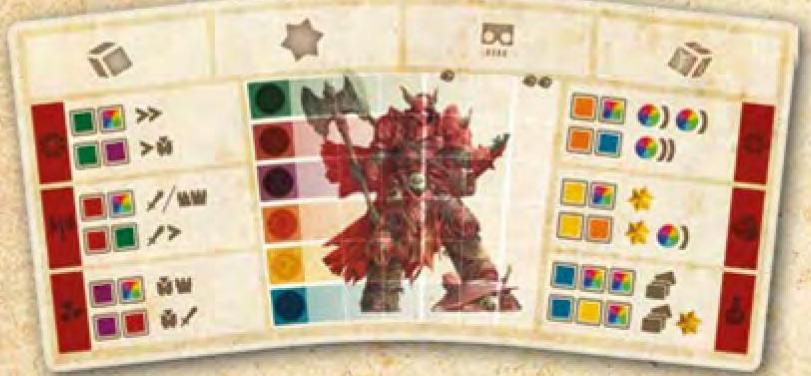
36個發展標記(每種顏色6個)

6個布袋(每個玩家一個)
180個木製文明方塊(24個紅色—戰爭、24個綠色—探索、24個紫色—生長、24個藍色—科學、24個橘色—進展、24個黃色—交易、36個灰色—消耗)
12個種族板塊(每個種族2個板塊)

60個種族模型(每個種族10個,6種不同的顏色)
1 8個鬼魂模型(灰色)
48個堡壘指示物(每種顏色8個)

64 張進階科技卡
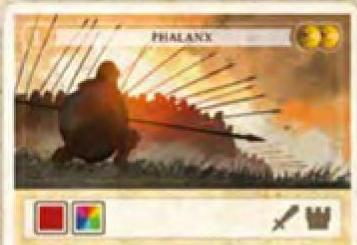
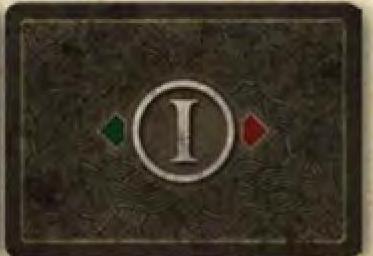
72個遺跡指示物(12個金色背面;40個銀色背面;20個銅色背面)



72個寶石,代表分數
6個目標板塊

1個計分本
1 本規則書
遊戲開始前
玩極北傳說的方式有很多種。
首先,玩家應該要根據觸發遊戲結束的條件數量(短版1個、一般2個、長版3個),協議要玩短版、一般,或者長版的遊戲。接著,極北傳說可以進行「入侵」的遊戲(所有玩家從相同的家園開始),或者進行「種族之戰」的遊戲(每個玩家有一個不同的家園,以及不同的起始能力)。
如果你第一次玩極北傳說,我們強烈建議你玩短版或一般的「入侵」遊戲。
遊戲設置
設置時,按照以下步驟執行:
1、分發配件
2、決定起始玩家
3、地圖設置
4、選擇一個額外的文明方塊,並且設置發展標記
5、翻開開放的進階科技卡
6、準備開始
1、分發配件
發給每個玩家一個種族。選擇的方式可以讓玩家直接指定種族或指定顏色,或者隨機抽取家園來決定。少於6人進行遊戲時,剩餘的家園放回遊戲盒中,遊戲中不會再用到。
家園
每個家園板塊有兩面:
A)中立居民(所有的家園板塊都相同)
B)種族(每個家園板塊不同)
進行種族戰爭的遊戲才這麼做
如果你決定隨機抽取家園,把中立的那面朝上洗混,然後讓每個玩家挑一個。
發給每個玩家:
· 1個選定種族的家園
· 1 個選定種族的玩家圖板
· 10 選定種族的模型
· 1 個對應顏色的布袋
· 6個發展標記
· 6個文明方塊(每種顏色一個,灰色除外):(1紅、1綠、1紫、1藍、1橘,以及1黃)
2、決定起始玩家
隨機決定起始玩家。
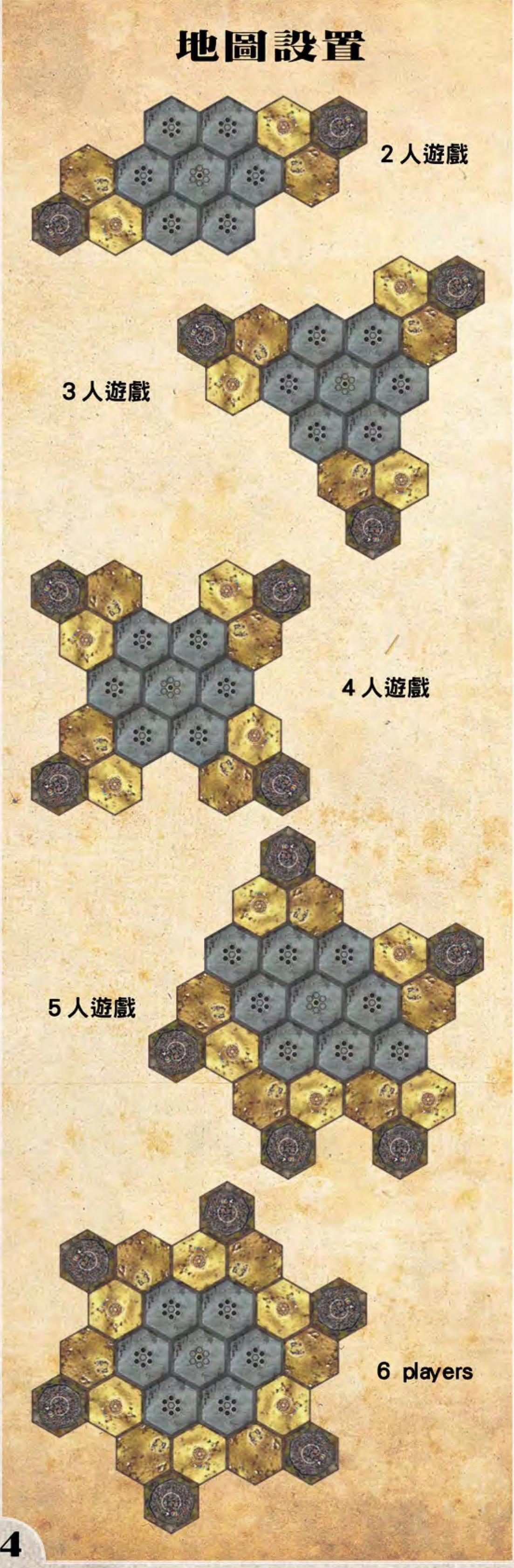
3、地圖設置
隨機從六個中央六角板塊中抽取一個,然後把它正面朝下放到場中央。隨機抽6個邊界六角板塊,並把它們正面朝下繞著中央六角板塊放置。

板塊說明
5人遊戲時,隨機抽2個額外的邊界六角板塊,然後把它們正面朝下放在地圖的兩側(見下一頁的圖示說明)。
每個家園有三種地形,其中一個標有首都。每個玩家必須把他們的家園與地圖拼接在一起,如下一頁的圖示。
每個玩家把他種族的3個模型放到含有首都的六角板塊上。這些模型必須放在城市外面。
地圖設置
2人遊戲
3人遊戲

沙漠
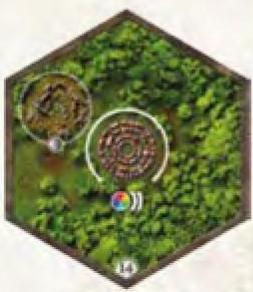
森林
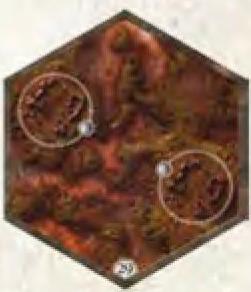
地形種類
沼澤
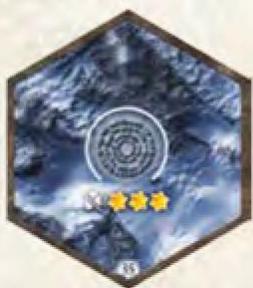
山脈
遺跡指示物
把遺跡指示物根據背面分類:銅色、銀色,以及金色,然後各自洗混。每個可見的遺跡區域放置2個對應符號的遺跡指示物。遺跡指示物必須正面朝下組成一個小的指示物堆,放到正面朝上板塊上的遺跡區域(現階段只有家園是正面朝上的,所以你只把銅色或銀色遺跡指示物放在一些家園六角板塊上;之後你會把銀色遺跡指示物放在邊境六角板塊上,以及/或者把金色遺跡指示物放在中央六角板塊上)。
重要:中央六角板塊的每個遺跡區域放置3個金色遺跡。

金色遺跡

銀色遺跡

銅色遺跡
遺跡區域

遺跡指示物
當隱藏的六角板塊翻開(戰爭之霧)
遊戲開始時,中央六角板塊及邊境六角板塊是正面朝下放置。之後遊戲中,玩家的模型會進入一個六角板塊,該板塊與一個正面朝下的六角板塊相鄰。當模型一進入一個六角板塊,該板塊與一個或多個正面朝下的六角板塊相鄰,把隱藏的六角板塊翻到正面。立刻在翻開的六角板塊上,隨機放置正面朝下的遺跡指示物(對應的遺跡指示物符號),並放置鬼魂模型(每個城市一個,並放在每個遺跡指示物堆上)。註記:鬼魂模型不會放在位於家園的城市或遺跡上。
選擇性的規則:你也可以改成遊戲開始時就讓整個地圖都翻開。如果是這樣,遊戲設置時只需要把所有的六角板塊都朝上放置,並且立刻放置遺跡指示物以及鬼魂模型。
進行種族戰爭的遊戲才這麼做
每個玩家現在選擇(隨機,或者挑選)兩個種族板塊中背面對應他們家園描繪符號的其中一個,然後使用效果。

(但不能放在多色
種族插圖
種族板塊說明
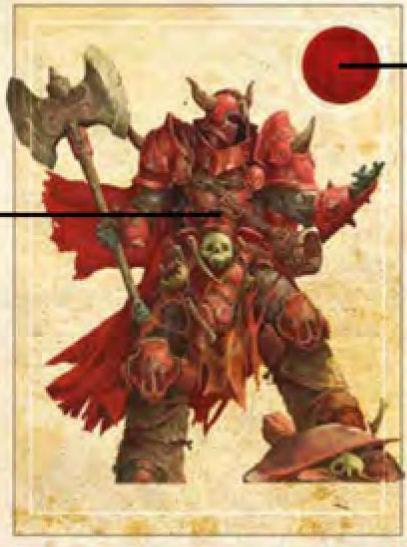
種族效果
種族符號
4、選擇額外的文明方塊並設置發展標記
每個玩家拿取 1 個他們所選顏色的額外文明方塊(除了灰色以外),並把他們擁有的所有方塊放到布袋中。

科學
每個玩家接著把發展標記放在他們玩家圖板上的發展區域,每排一個。發展區域有6排顏色,每排代表以下的區域:

交易

進展

生長

戰爭

探索
種族效果列表
紅色公國

板塊 A:啟動任何一個有攻擊效果的科技時,個多色方塊。
物正面朝上放到他們的種族板塊上。每個指示物會給予以下其中一個效果:堡壘/攻擊/遠距攻擊。玩家可以在遊戲過程中輪到他的回合時花費這些指示物。
翡翠王國


花費
天體王朝

金」或「外交」該種族的符號)束條件的5個進一個灰色方塊。

板塊 A:玩家 1 個該種族符號的堡壘指示物正的種族板塊上。這個指示點數。玩家可以在他的回示物,但直到下一次重置。當玩家執行回合回合結,這個指示物放回板塊上
他們接著會產生塊」效果。
板塊 B:玩家移動時忽略地形種類的額外移動
板塊 A:遊戲開始時,
玩家擁有進階科技「煉
(這些科技的右下角標有
。這不會算在觸發遊戲結
階科技中。玩家不會獲得
板塊 B:任何時候玩家產生一個科學效果時,個免費的「抽 2 個方
珊瑚王座

板塊A:輪到你的回合時,玩家可以使用一個多色及一個灰色的方塊消滅一個灰色方塊,並且獲得1分(甚至可以用同一個灰色方塊產生這個效果)。

板塊 B:玩家可以把灰色方塊放在橘色區域上(區域上)。
金色男爵

板塊 A:玩家遊戲一開始獲得 2 分。

板塊 B:輪到玩家的回合,他們可以扣 1 分產生以下其中一個效果:攻擊/2×移動/三次發展/3×抽方塊
紫色母系氏族

鬼魂時,玩家可以把它們轉變成他自己的其中一個模型,而不是殺掉它。在這種情況下,鬼魂模型放回遊戲盒中,而不是放到玩家圖板上的「墓園」,而且遊戲結束計分時不會算在內。

板塊 B:遊戲開始時,
玩家擁有進階科技「前
哨站」(這個科技的右下角標有該種族的符號)。這不會算在觸發遊戲結束條件的5個進階科技中。玩家不會獲得一個灰色方塊。
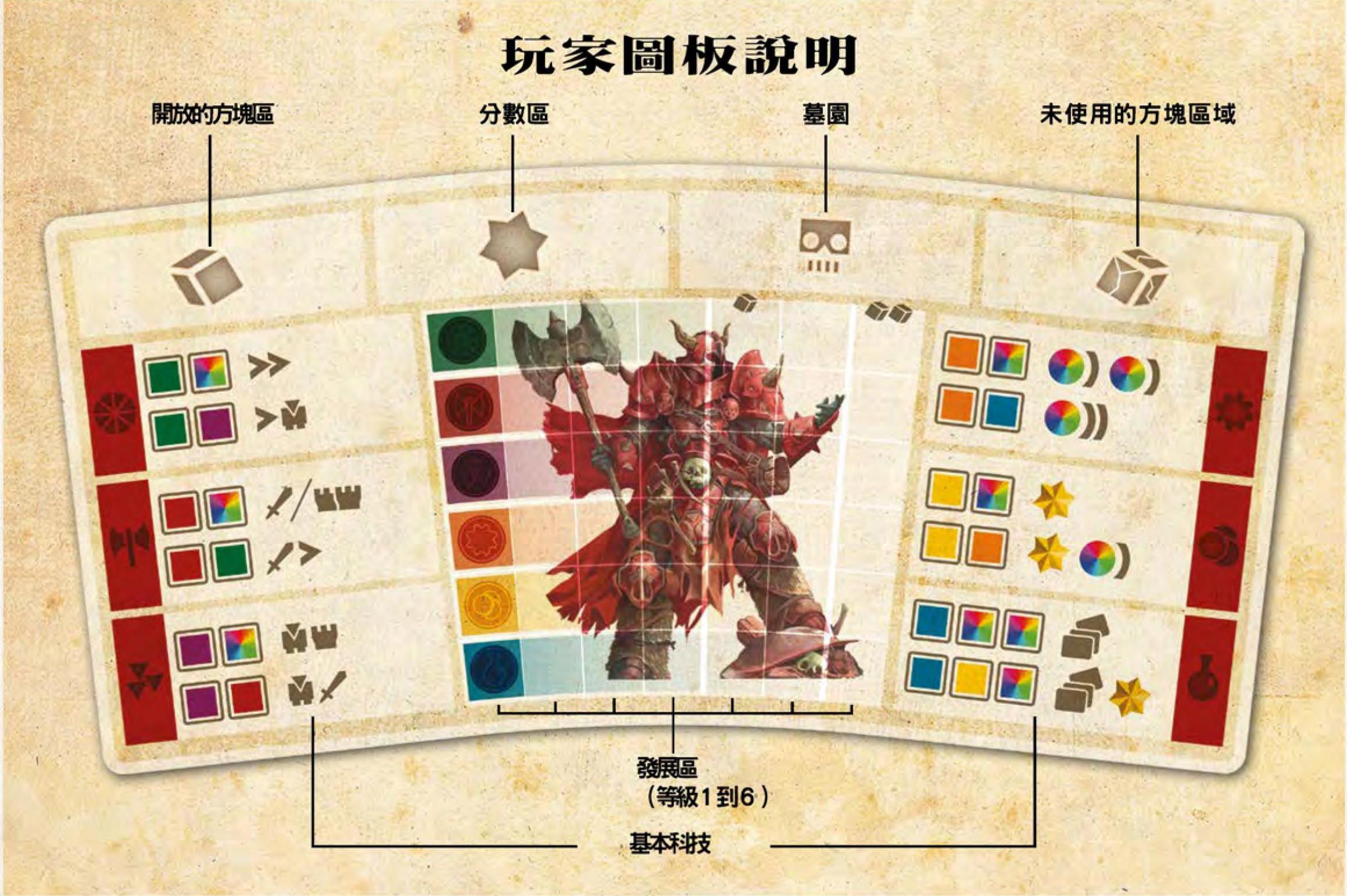
每個玩家根據以下規則放置他們的標記:
· 等級 3 放置 1 個標記
· 等級 2 放置 1 個標記
· 等級 1 放置 1 個標記
- 等級 0 放置 3 個標記
5、翻開開放的進階科技卡
把 6 4 張進階科技卡根據四種不同的種類分成四疊,每疊 1 6 張進階科技卡:
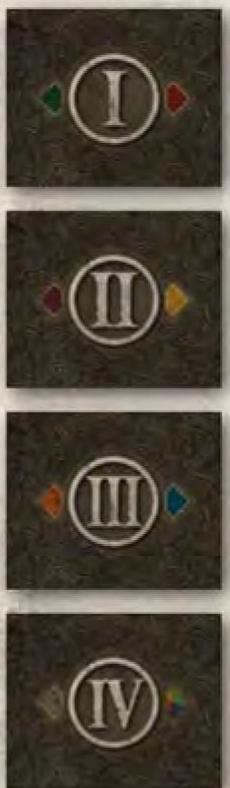
牌庫Ⅰ:探索與戰爭
牌庫Ⅰ:交易與生長
牌庫 | | |:進展與科學
牌庫ⅠV:轉換與更新洗混每個牌庫後,從每個牌庫抽2張卡片,並把它們正面朝上放在地圖旁。如此一來,總是會有每個牌庫2張,總共8張正面朝上的進階科技卡開放給玩家。在每張卡片上放置一個灰色方塊,作為提醒獲得這張卡片的玩家。這個灰色的方塊會放在玩家圖板上的「未使用方塊區」。
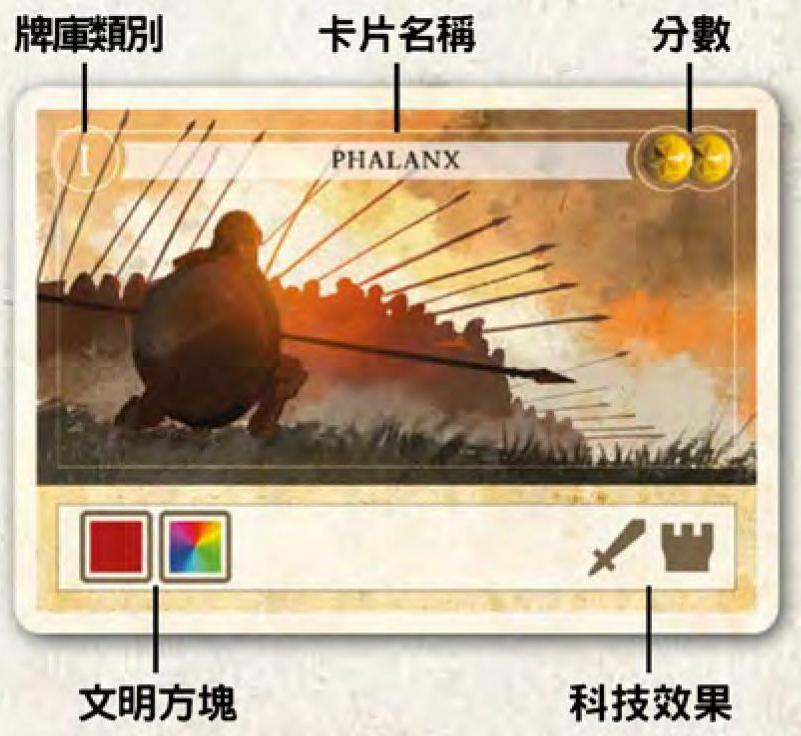
進階科技卡的說明
6、準備開始
每個玩家隨機從他們自己的布袋裡抽三個文明方塊(抽的時候不能看布袋裡),然後放到玩家圖板上「開放的方塊區」。
遊戲進行
玩家輪流進行回合,直到事前決定好的觸發遊戲結束條件數量在一個玩家的回合中達成(短版1個、一般不同的2個,或者長版所有3個)。當觸發遊戲結束時,其他的玩家將進行最後一個回合,在那之後宣告遊戲的勝利者。
一個玩家的回合
輪到玩家的回合時,玩家以任意順序執行多個他們想要或希望做的行動,直到他們宣告回合結束。玩家的回合一開始,你必須檢查以下這些項目:
移除堡壘指示物
該玩家擁有的堡壘指示物如果仍在場必須要移除。見「基本科技效果」的章節來了解更多細節。

少於3個模型
玩家進場的模型不能少於3個。如果發生這種事,玩家把新的模型免費從他們的供應區放到標有首都的六角板塊上,以補足總共有3個模型在場上。
回合開始的效果
所有標有的卡片產生它們的效果。
強制行動
玩家的回合過程中,他們必須把「開放的方塊區」上的文明方塊拿來:
- 放在玩家圖板的基本科技上,或者放在獲得的進階科技卡上;
- 或者,放在玩家圖板上的「未使用方塊區」。
玩家圖板上,每個基本科技有兩組啟動區。每張進階科技卡只有一組啟動區。
第1組啟動區
第2組啟動區

如果放置方塊時,玩家完成基本科技的一組啟動區或者進階科技的啟動區,這個科技就會啟動,而玩家會獲得這個科技帶來的獎勵(見啟動基本科技或進階科技)。如果玩家不想(或不能,例如有灰色方塊)放置一個或多個文明方塊到他們其中一個科技上,他們必須在回合結束階段時把方塊放到「未使用方塊區」。玩家在回合結束時,「開放的方塊區」不能存放任何的方塊。
玩家在他們的回合時不必一定要完成一組啟動區,他們可以只放置一個或多個方塊,然後在之後的回合完成這組啟動區。

選擇性的行動
輪到玩家的回合時,他們也可以執行一個或多個以下的行動:
· 啟動一個或多個城市;
· 探索一個或多個遺跡;
· 升級他們的文明。
選擇性的行動之後的章節會詳細說明。
一個行動產生的效果(強制或選擇性)必須在玩家的回合結束階段前使用。效果可以累積,而且可以由玩家決定使用的順序。
當玩家準備好結束回合時,他們必須宣告結束回合,並進行回合結束階段(見第10頁說明)。
請注意:放置文明方塊的強制行動不必同時進行完,而且可以與選擇性行動交替進行,例如:玩家可以啟動一個城市(並獲得獎勵)、接著放置一個文明方塊,不完成一組啟動區、升級他們的文明、啟動第二個城市(獲得獎勵,但還不使用)、放置另外2個方塊到一個科技並啟動它(並獲得獎勵,把這個獎勵和從城市獲得的獎勵一起使用)、探索一個遺跡,然後最後宣告結束他的回合,進行回合結束階段。
啟動基本科技或進階科技
每個科技有一組或兩組有色的啟動區,可以放置文明方塊。單色的啟動區只能放置對應顏色的文明方塊。
多色的啟動區可以放置任意顏色的文明方塊,除了灰色(消耗)的文明方塊以外,灰色的文明方塊只能放在灰色的區域。(遊戲開始時,玩家不會擁有任何灰色方塊;遊戲稍後才會得到灰色方塊)。
一旦一組啟動區完成,而且全都放滿方塊,這個科技啟動並產生對應的效果(見遺跡、科技,以及城市效果的完整列表,以及科技、遺跡或城市產生的效果敘述)。
基本科技(每個玩家圖板上所印的)有兩組不同的啟動區,因此可以根據啟動哪一組產生兩個不同的效果,如下所列:
探索

綠色+任意色=移動+移動
綠色+紫色=移動+模型
戰爭
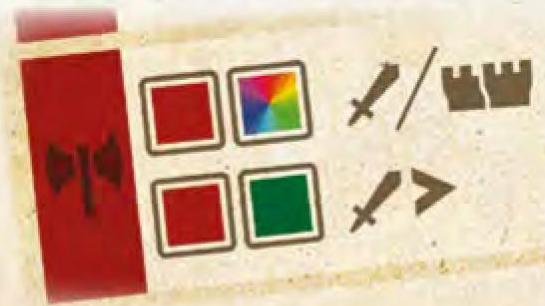
紅色+任意色=攻擊或堡壘+堡壘
紅色+綠色=攻擊+移動
生長
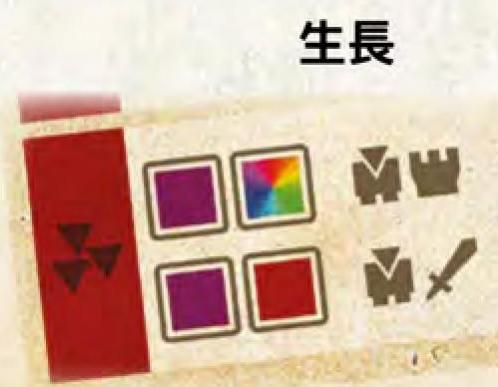
紫色+任意色=模型+堡壘
紫色+紅色=模型+攻擊
進展
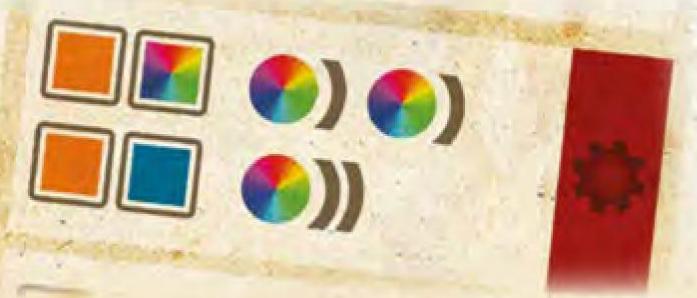
橘色+任意色=發展不同的兩排1個等級
橘色+藍色=發展同一排2個等級
交易
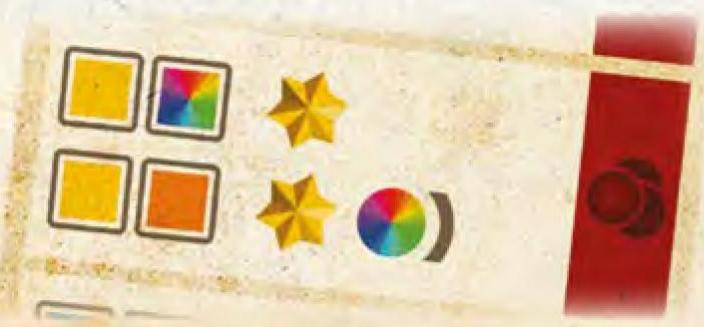
黃色+任意色=1 分
黃色+橘色=1 分+發展 1 個等級
科學
图 1
藍色+任意色+任意色=進階科技卡
藍色+黃色+任意色=進階科技卡+1分
玩家不必一定要使用所有啟動的科技所產生的效果,他們可以決定不要使用產生的效果。有時他們不能使用這些效果(在這種情況下,效果喪失)。
在任何情況下,玩家必須在完成啟動區的當回合立刻使用這些效果:不能保留這些效果,在之後的回合使用。
重要:一旦玩家挑選玩家圖板上基本科技的其中一組啟動區後,如果他想啟動該基本科技,玩家必須完成該啟動區,他不能使用另一組啟動區。完成啟動區不是強制的;玩家就只是不能使用另一組啟動區。
啟動城市
為了啟動一個城市,玩家必須把他其中一個模型放到城市,並立刻獲得對應的獎勵。只有在城市是空的狀態,也就是沒有其它的模型(玩家自己的、對手的,或者是一個鬼魂)在該城市時,這樣的行動才能執行。
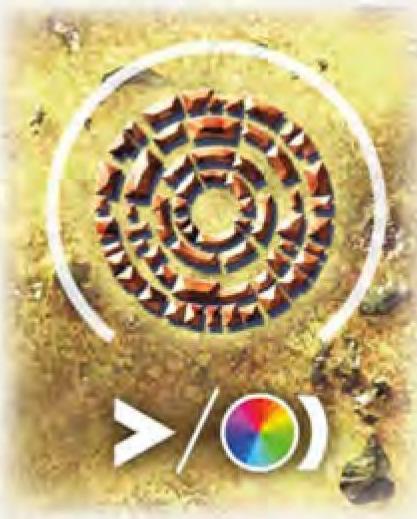
啟動一個城市不必移動點數,而且可以在玩家回合的任何時候執行(在啟動一個科技之前或之後,或者在探索遺跡之前或之後)。直到下一次重置前,城市中的模型不能離開城市(見回合結束階段的說明)。啟動一個城市會產生對應的效果(見遺跡、科技,以及城市效果的說明)。記住:城市、遺跡,以及科技的效果可以累積,而且可以在玩家回合結束前,以玩家喜歡的順序使用。
玩家不必一定要使用城市產生的效果;他們可以決定不要使用這些效果(如果是這樣,這些效果喪失)。
探索遺跡
為了探索一個遺跡,玩家必須移動他其中一個模型到遺跡區,拿取最上面的遺跡指示物。接著玩家祕密的察看指示物的效果,並決定是否立刻使用這個遺跡指示物,或者先留起
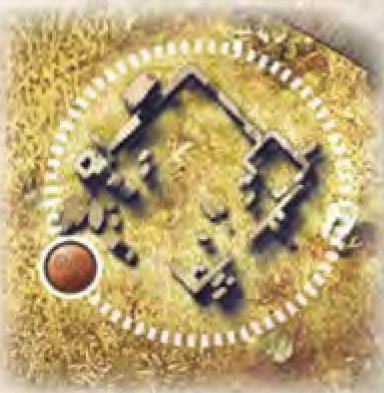
來之後使用。如果玩家決定使用它,翻開這個指示物讓所有玩家看到,並獲得對應的獎勵,然後棄掉這個指示物(見遺跡、科技,以及城市的效果說明)。玩家可以不必立刻使用一個遺跡指示物,他可以保留這個遺跡指示物,放到他們玩家圖板上的分數區,然後之後再使用,可以在同一個回合使用,或在未來的回合使用。
重要:遊戲中,玩家任何時候只能保留一個遺跡指示物。因此,如果玩家已經有一個舊的遺跡指示物,並且想要保留新的遺跡指示物,他必須立刻使用舊的遺跡指示物。
為了探索一個遺跡,它必須要是空的,也就是說上面沒有任何模型(玩家自己的、對手的,或者是一個鬼魂),而且上面必須至少還有一個遺跡指示物。一個沒有遺跡指示物的遺跡不能探索:把這個區域視作不再存在。探索一個遺跡,就如同啟動一個城市,可以免費移動,而且可以在玩家回合的任何時候進行(啟動一個科技之前或之後,或者啟動一個城市之前或之後)。就如同模型在城市中,在下一次重置前,模型不能離開遺跡(見回合結束階段)。
重要:用來探索一個遺跡或者啟動一個城市的模型在重置前是「冰凍」的狀態。這樣的模型基本上是不能用的,而且不能移動或做任何事。它們仍然受放置一個堡壘到該六角板塊而得到保護(見基本科技效果章節的「堡壘」說明)。
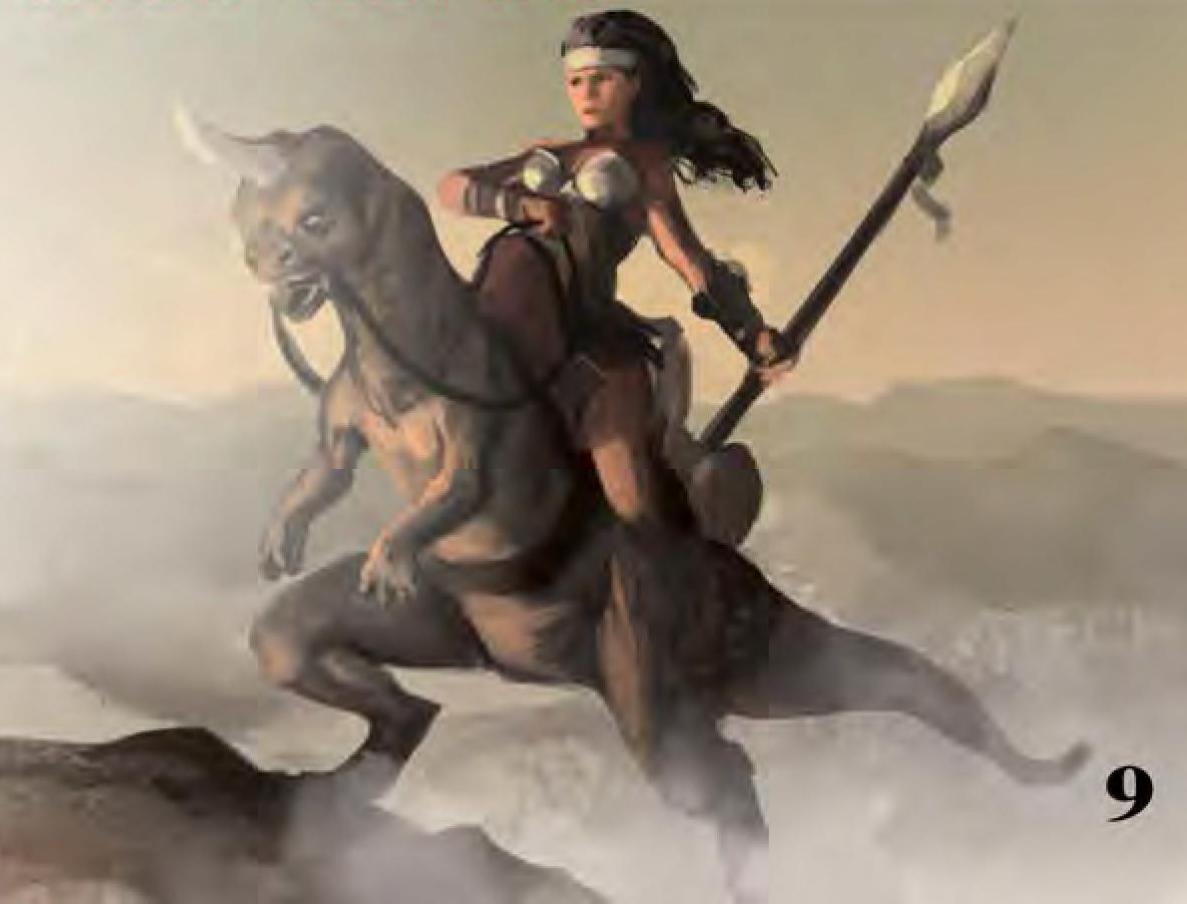
升級文明
輪到玩家的回合時,玩家可以透過城市、科技,或者遺跡的啟動所獲得的發展效果,來增加發展標記的等級。
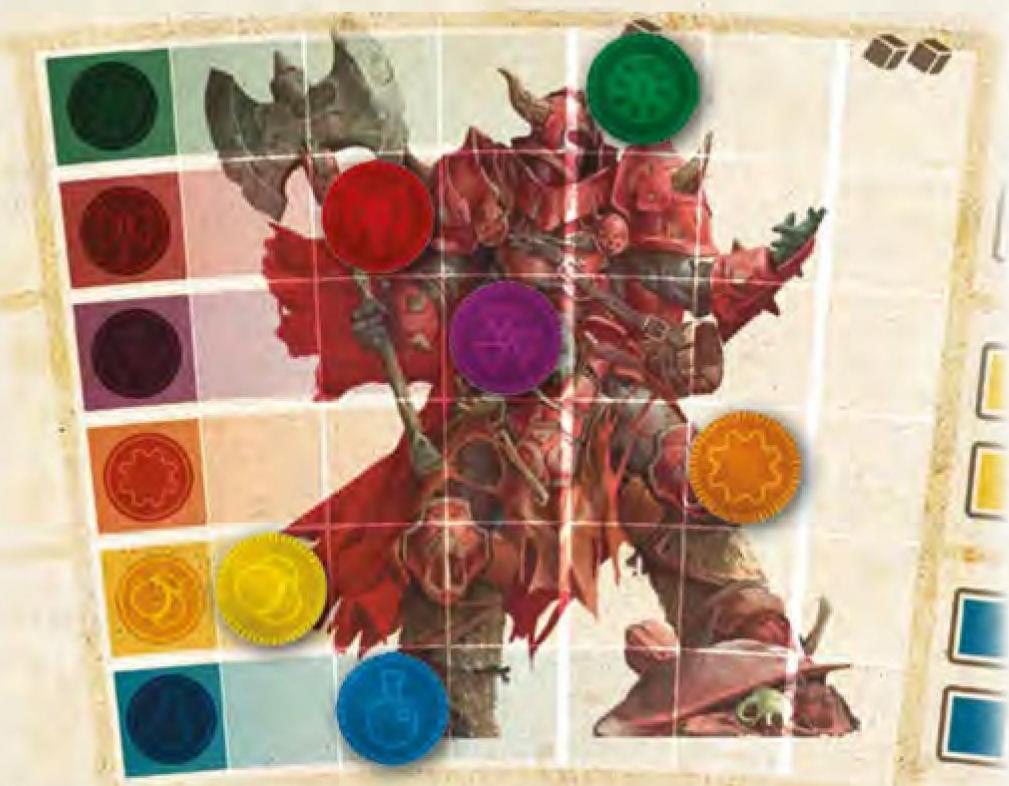
玩家回合的任何時候(回合結束階段前),玩家可以把其中一個抵達等級4(或5)的發展標記放回等級0。如此一來,玩家立刻從一般供應區拿取1個對應顏色的文明方塊並放到他的布袋中。
相同的方式,玩家可以把其中一個抵達等級6的發展標記放回等級0,在這種情況下,玩家立刻從一般供應區拿取2個對應顏色的文明方塊並放到他的布袋中。
如果對應顏色的文明方塊耗盡了,「升級文明」的行動沒有任何效果(或者只有部分效果,這種情況例如說,玩家可以放2個文明方塊到布袋中,可是一般供應區只剩下1個)。
重要:升級文明可以在玩家回合的任何時候進行,可以在啟動一個科技、城市,或者遺跡之前或之後,但一定要在回合結束階段之前執行(就如同啟動一個城市或探索一個遺跡)。
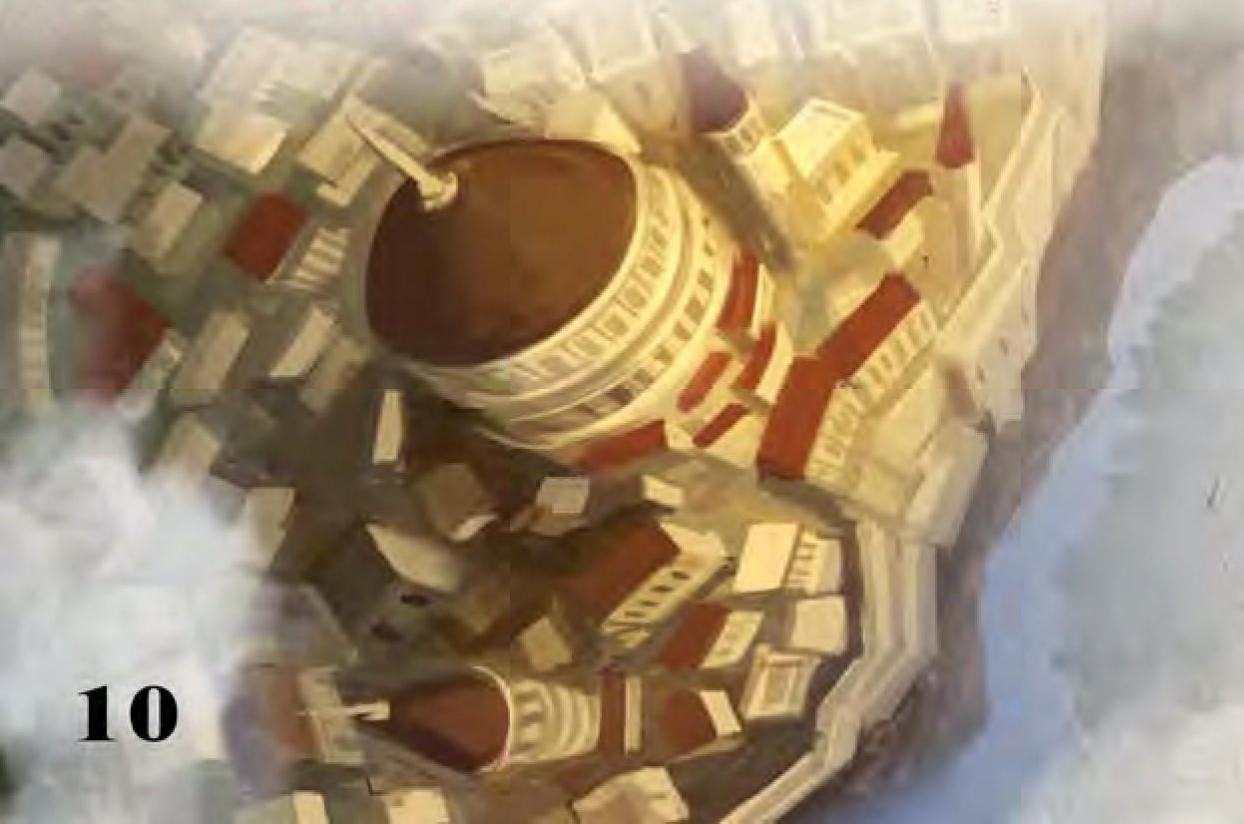
回合結束階段
一旦玩家宣告想要結束回合,玩家第一件要做的事是把所有玩家圖板上還在「開放的方塊區」上的所有方塊放到「未使用方塊區」,接著:
A)如果玩家還有方塊在布袋中,他必須從布袋中隨機抽最多3個,並把它們放到「開放的方塊區」。如果玩家只有1個或2個方塊在布袋中,則全都抽出來。
B)或者,如果玩家布袋裡沒有任何方塊,玩家立刻執行一次重置。
重置
當玩家執行一次重置時,他們按照以下順序執行:
- 玩家在城市中的模型移到城市外部(還在同一個六角板塊內),然後在該玩家接下來的回合,就可以再次自由移動。
- 玩家在遺跡中的模型移到遺跡指示物疊的外部(還在同一個六角板塊內),然後在該玩家接下來的回合,就可以再次自由的移動。
- 所有在「未使用方塊區」的方塊(包含剛透過獲得一張進階科技卡所得到的灰色方塊),以及啟動科技上的所有方塊都放到布袋中。這不適用於有連續效果的科技上(見下面說明)。
- 放在科技上還沒有完成的方塊,或者已經啟動,然後因為一個「方塊復原」效果而有部分方塊耗盡(見進階科技與遺跡效果列表中的「方塊復原」敘述),這些方塊可以留在科技上,或者放回布袋中:由玩家決定這些方塊如何處置。
- 放在連續科技上的方塊(見連續的效果說明),可以留在科技上,或者放回布袋中:由玩家決定這些方塊如何處置。
- 最後,玩家洗混布袋中的方塊,並隨機抽3個方塊放到「開放的方塊區」。
玩家在結束他們的回合結束階段後,回合輪到下一個順位的玩家。
策略提示:細心的玩家總是會維持布袋中有正確數量的方塊,因為只抽一個方塊(或甚至兩個方塊)將導致資源的使用比較沒有效率。
範例:丹尼斯剛結束他的回合,而且他知道他還1個方塊在布袋中。實際上他有一個發展標記在等級4(藍色),一個發展標記在等級6(紫色)。如果他不做任何事,並進行回合結束階段,他只能抽1個方塊,而且這會讓他下一個回合的行動選項受到限制。在宣告他的回合結束前,他選擇不升級生長區域的文明,反而移動紫色標記到等級0。這意指他可以把2個額外的紫色方塊放到他布袋中(從一般供應區拿取)。他藍色的標記不動,因為他不希望袋子裡有4個方塊,因為那會讓他的袋子在抽完方塊後又只剩下1個方塊。接著,他進行回合結束階段,然後把袋子裡的3個方塊都抽出來;他下個回合可能要重置他的布袋,因為已經空了。
遊戲結束的條件
短版的遊戲中,任何玩家在結束他的回合後可以達成其中一個以下的條件:
1、他的分數區有12分*或12分以上的分數(*2人遊戲時,這個條件變為15分);
2、獲得第五個進階科技;
3、把他們最後一個模型放到地圖上;

他們立刻獲得對應的目標板塊,然後結束他們的回合(如果他們達成另一個回合結束的條件,該玩家也可以獲得其它對應的目標板塊)。
所有的其他玩家可以進行他們的回合(而且,如果他們達成其中一個遊戲結束的條件,他們也可以獲得對應的目標板塊)。
請注意:即使每個回合結束條件的板塊只有2個,在很罕見的情況下有兩個以上的玩家達成相同的條件,所有的玩家仍然獲得該目標板塊(用其它東西替代一下)。
接著,遊戲結束,玩家進行計分,宣告遊戲的勝利者。
一般遊戲中,遊戲結束要達成的條件是這三個的其中2個。可以由同一個玩家達成,或是由兩個或兩個以上不同的玩家達成。遊戲在第二個條件達成後結束。
長版遊戲中,3個遊戲結束的條件都要達成。遊戲在第三個條件達成後結束。
計分及遊戲結束
所有玩家把他們布袋中的文明方塊都拿出來,然後計算最終分數,把以下所列的分數都加起來:
1、遊戲過程中獲得的分數:「分數區」裡每個寶石1分。
2、玩家殺死的鬼魂:
1 個鬼魂 = 1 分
2 個鬼魂 = 3 分
3 個鬼魂 = 6 分
第三個鬼魂以上的每個鬼魂:+1 分
3、玩家殺死的對手模型:
每個殺死的模型1分。一個對手的第二個或接下來的模型只有在完整的一組對手的模型被該玩家殺死時才會有分數。
(見第12頁的攻擊說明)。
4、文明方塊:
每個玩家擁有的文明方塊1分(除了灰色方塊以外)。
5、目標板塊:
每個擁有的目標板塊 2 分。
6、進階科技的分數:
根據卡片右上角所印的數值獲得分數
7、控制的領地:
每個控制的家園六角板塊1分
每個控制的邊境六角板塊2分
每個控制的中央六角板塊4分
如果一個六角板塊上有該玩家多數的模型,則該六角板塊視為被該玩家控制(例如:藍色玩家有2個模型在中央六角板塊,而該板塊上有一個鬼魂以及紅色玩家的1個模型:藍色玩家控制這個六角板塊,並且獲得4分)。
最高分的玩家獲勝,如果平手,則控制最多六角板塊的玩家獲勝(是板塊數量,不是板塊分數)。如果還是平手,則最多方塊的玩家獲勝(灰色除外)。如果還是平手,則順位較後的玩家獲勝。
遺跡、科技,以及城市 效果
基本科技效果說明
移動

移動是用來把玩家地圖上的模型做移動。每個移動效果會為當前玩家產生1點移動點數。把1個模型從一個六角板塊移動到一個相鄰的六角板塊花費1點移動點數。不過,有些地形種類會花費額外的移動點數進入或離開:
· 為了進入森林,需要花費1點額外的移動點數。
· 為了進入沼澤,需要花費1點額外的移動點數。
· 為了進入山脈,需要花費1點額外的移動點數。

例外:在相同地形種類的兩個六角板塊之間移動不需花費要額外的移動點數。
可以把一個模型在多個六角板塊上移動,為每個移動支付移動點數的費用。
重要:一個模型進入有對手玩家模型的六角板塊,而對手玩家的模型沒有在一個城市或一個遺跡裡,則玩家的模型這回合必須要停止移動。如果玩家想要在同一個回合再次移動,他需要殺死阻擋在這個六角板塊上的敵人,然後才可以再次移動。
記住,一旦模型進入一個六角板塊,該六角板塊與一個正面朝下的六角板塊相鄰,則把隱藏的六角板塊翻開(見第4頁「戰爭之霧」)。
攻擊

攻擊是用來殺死地圖上對手的模型或鬼魂的模型(不能殺玩家自己的模型)。每個效果為當前玩家產生1點攻擊點數。為了使用一點或多點攻擊點數,玩家的一個模型必須在含有一個或多個敵人的模型(對手的模型或鬼魂的模型)的六角板塊。每點攻擊點數(除了被一個堡壘吸收的以外,見後述),玩家可以把地圖上的一個鬼魂或對手的模型移除,並把它放到他自己玩家圖板上的「墓圓」。每個對手或鬼魂的模型在遊戲結束時會有分數。
如果玩家殺死的玩家模型顏色已經出現在他殺死過的模型中,則這個模型會還給擁有的玩家,該玩家把它放到自己的供應區。當這件事發生時,如果玩家每個對手的模型都已經殺死一個(也就是每個玩家顏色的模型一組),當他歸還這個模型時,他可以立刻從一般供應區拿取1個寶石。
堡壘

堡壘是用來保護模型免於受到對手的攻擊。每個堡壘可以讓玩家拿取一個他所屬顏色的堡壘指示物,並把它放到其中一個有他自己模型的六角板塊上。每個堡壘指示物可以吸收一點由對手產生的攻擊點數,然後這個堡壘指示物就會被移除。如果對手攻擊一個六角板塊中一個或多個模型,該板塊上有一個或多個堡壘,則殺死模型前必須要先移除這些堡壘指示物。
重要:堡壘進場的時間只會停留到玩家下一個回合開始,而且它們只能保護所屬玩家顏色的模型。
模型

玩家可以把一個模型從一般供應區放到地圖上。模型必須放在玩家含有一個城市的其中一個家園板塊上(城市外部)。
進階科技卡

當前玩家可以拿取一張進階科技卡。之後可以用文明方塊放滿啟動區並啟動這個科技(可以在獲得卡片的同一個回合啟動)。挑選進階科技卡之前,玩家必須從4個牌庫其中之一抽2張新的進階科技卡,以替換同一個牌庫前的2張當前開放的卡片,把替換的2張卡片放回牌庫的底部。玩家不必一定要選其中一張新的進階科技,他可以從八張正面朝上的卡片中挑選。
當玩家拿取一張新的進階科技後,他同時也會獲得放在上面的灰色文明方塊。灰色文明方塊會在下一次重置時放到玩家的布袋中。直到下一次重置前,玩家會把灰色方塊放到玩家圖板上的「未使用方塊區」。在玩家拿取進階科技卡後,從同一個牌庫翻開一張新的進階科技卡,然後把一個灰色方塊放到這張卡片上。
發展三級

任何進階科技卡的右上角印有一定數量的寶石,遊戲結束時這些寶石會帶來分數。
發展
每個發展效果可以讓當前玩家根據顯示的符號數量提升它一排發展的等級1級。
發展一級


2×發展
發展符號

如果倍數顯示在發展符號上(例如 2×、3×,或 4×,依此類推),玩家可以把這個發展效果用在不同排、同一排,或者這兩者的組合。如果發展的效果必須用在某一排,而這一排沒有足夠的空間可以升級,則額外的效果喪失。
寶石

每個寶石效果可以讓當前玩家獲得1個寶石,值1分。如果寶石符號上有出現一個數字,則獲得等同於該數字。
寶石數量等同於該數字。
進階科技效果說明
有些進階科技會顯示灰色啟動區。只有灰色方塊可以放在這些區域(代表消耗)。
進階科技卡上的符號:
任何時候你產生一個效果時,你實際產生的是後者的效果。

範例:>> = 雙成:任何時候你產生一點移動點數時,你產生一個飛行的移動點數。

任何時候你產生一種效果時,你產生額外的獎勵效果。這可以在一個回合裡進行多次。限制是每次啟動只多額外的一點。所以,如果啟動一個科技可以產生兩分,則只產生額外的1分,不是2分。
範例: $\Rightarrow +1$ 讀成:任何時候你產生攻擊點數時,你多產生額外的一點攻擊點數。

把描繪在這個符號的效果用在所有相鄰的對手上。這個符號裡的效果必須用在當前玩家至少有一
個模型所在的六角板塊上,而該板塊或相鄰的板塊上有任何玩家的模型。

範例:x2讀成:2次發展,而且所有相鄰的對手必須執行一次負向發展。
移除行動。總共有三種可能的情況:
1、移除一個方塊:受影響的玩家從可見的方塊中(玩家圖板上或進階科技卡上)移除一個非灰色的方塊,然後把它放回一般供應區。這個方塊也可以是用於產生這個效果的方塊,如果可能的話。

2、移除一個模型:受影響的玩家必須從地圖上移除一個模型,並把它放回到玩家的供應區。他可以選擇要移除哪一個六角板塊上的模型。

3、移除一個寶石:受影響的玩家從他的玩家圖板移除1個寶石
,並把它放回一般供應區。
這個效果通常伴隨其它效果,只有在「移除」效果可以執行時才會發生。

重要:如果玩家移除一個方塊來獲得一個不同的方塊,新的方塊取代移除方塊的位置,即使新的方塊因為顏色的關係不可能出現在那裏。
範例:讀成:移除一個非灰色的方塊來獲得1分。
除了基本科技可以看到的效果,進階科技或遺跡可能會產生以下特殊的效果:
複製

每個「複製」效果可以讓當前玩家把一個新的模型直接放到至少有一個他自己模型的六角板塊上,而不用把模型放到他家園有城市的其中一個六角板塊上。
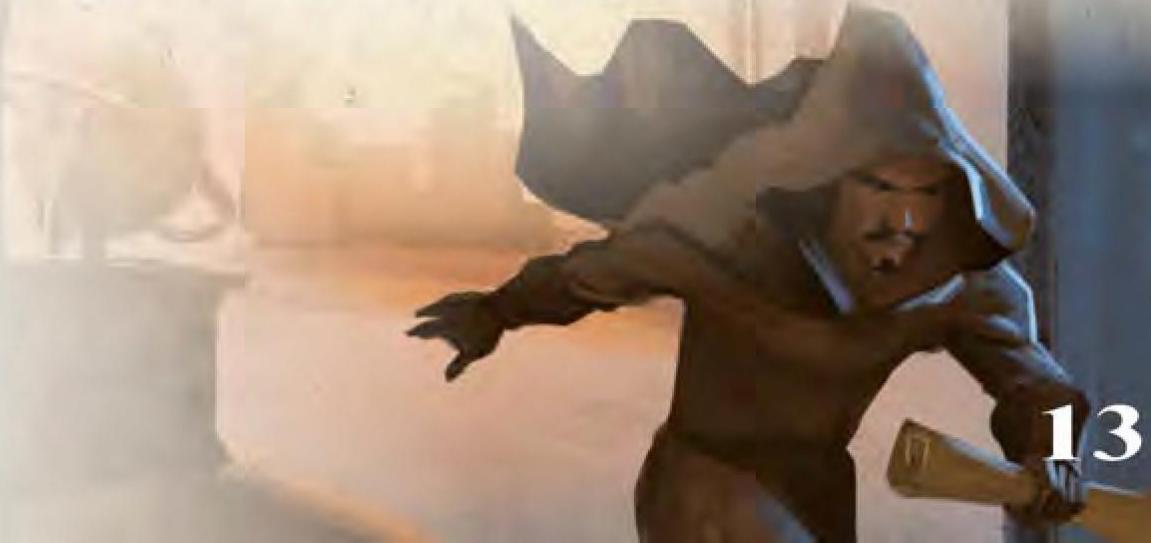

抽方塊

每個「抽方塊」的效果可以讓當前玩家從布袋裡抽一個方塊,並把它放到「開放的
方塊區」。這些方塊必須放在他玩家圖板上的基本科技,或者放在獲得的進階科技卡,或者放在他玩家圖板上的「未使用方塊區」。
如果這個符號的右上角出現一個數字,這個數字代表玩家應該抽多少個方塊。如果袋子裡的方塊少於應該抽的數量,則玩家就只能抽這麼多。
方塊生產

玩家從供應區拿取一個顯示顏色的方塊,然後立刻把它放到他們的布袋中。如果這個符號是個多則玩家可以挑選想要的顏色。
方塊回收

並把它放回布袋中。
每個「方塊回收」的效果讓當前玩家從他玩家圖板或進階科技卡上拿取一個方塊,袋中。
註記:如果是從之前啟動的一個科技上拿取這個方塊,這個科技可以再次被啟動,玩家可以再放另一個可用的方塊到這個區域,因為這個區域上面沒有方塊佔據。
問諜

每個「間諜」效果可以讓玩家立刻產生由對手控制的一效果。
飛行

每個「飛行」效果為當前玩家產生1點飛行移動點數。為了把一個模型從一個六角板塊移
動到一個相鄰的六角板塊,這需要花費1點飛行移動點數,可以無視兩個六角板塊之間的地形種類。此外,一個使用飛行的模型在進入(或離開)一個城市或遺跡外部有對手模型的六角板塊時,不會被強迫停止移動。
遠距攻擊

每個「遠距攻擊」效果可以讓當前玩家產生1點遠距攻擊點數。
每個遠距攻擊點數可以讓玩家移除位於與玩家模型所在位置相鄰的一個六角板塊上一個鬼魂或一個對手的模型。
註記:和攻擊效果比較,遠距攻擊的效果在殺死模型時不會產生分數;鬼魂放回遊戲盒中,而模型則放回所屬玩家的供應區。
負向發展

這個效果讓受影響的玩家必須降低其中一個發展標記一個等級。
如果所有的發展標記都在發展區的0等級,則忽略這個效果。受影響的玩家可以決定要降低哪個標記的等級。
連續的科技

有些進階科技標有「無限」的符號在啟動區,一旦啟動就會產生連續的效果(效果持續到遊戲結束)。有些連續效果會在回合一開始產生一個效果。
重要:重置時,放在有連續效果的進階科技卡上的方塊不會放回布袋中。

種族列表
紅色公國
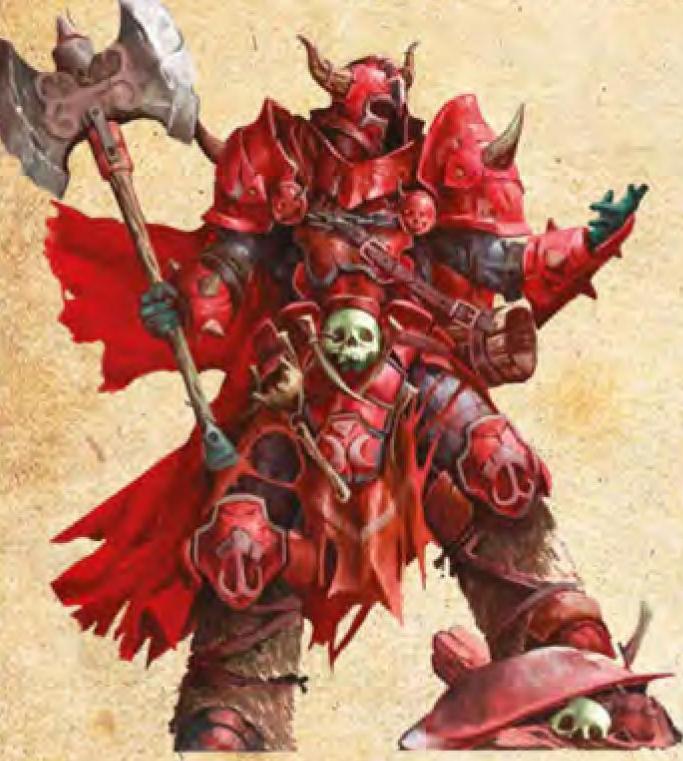
只有一個許珀耳玻璃亞人的先進軍事前哨站從摧毀大陸的魔法天啟中倖存。紅站成為倖存者初期的避難處,但是人民與士兵之間的緊張關係,以失調、無政府狀態,以及基本上來說就是一個「倖存者適者生存」的社會迅速升級。這種關係一直持續到公爵克里斯擊敗了所有其它集團的首腦,並以相當簡單的規則建立了他自己的公國:每三年「公國競賽」會在紅站的廣場舉行(後來有個競技場就以此目的而建造)。勝利者會成為公爵,並披戴紅色披風(權力與貴族的象徵)直到下一次的競賽來臨,在那天來臨錢,所有公國裡的人都必須服從他(或她,因為目前為止有一些公爵夫人有得到這個頭銜),否則他們會被處死。這個殘酷的系統證明非常有效,而且披著緋紅披風的戰士(只有公爵可以披紅色的)是個不可小覷的力量。同時,並不是所有人的目標都是掌握公國的權力,而且許多居民把自己投入到比較不會流血的職業,讓公國公平的在商人、農夫、科學家,以及建築師之間共享。
翡翠王國
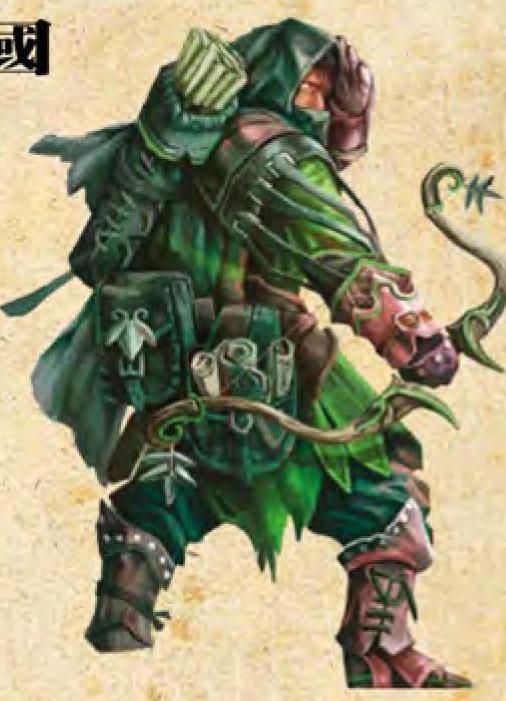
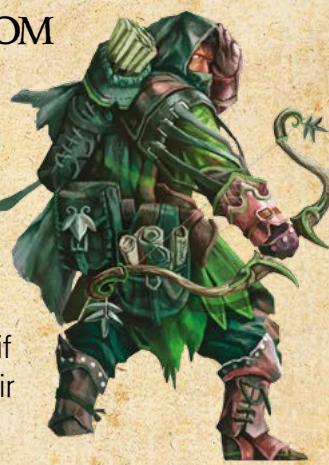
當魔法天啟襲擊許珀耳玻璃亞,幾十名的工人及研究人員正忙著在一個大的、未開發的森林建立一個前哨站。倖存者學會如何與森林和諧共處,把被破壞的文明隔絕開來,在森林中狩獵,並收集食物來存活。它們是六個王國裡人口最少的,雖然他們自稱是個王國,但嚴格來說並不是。翡翠王國事實上是他們追隨與崇拜的靈魂,而且是聲稱受到森林靈魂啟發的長老會在制訂政治的決策。他們是優秀的追捕者和無與倫比的弓箭手;要進入他們的森林,進行違反意志的接觸是不可能的,只要你敢踏入他們的領地,他們一定會找到你(並在你意識到之前,用翡翠之箭結束你的生命)。

紫色母系氏族
很少有人知道紫色母系氏族的誕生由來,只能推測死亡災難過後的初期,少數的倖存者了解到人類在滅亡的邊緣,生命變得比以往還要神聖,而且生命女神的崇拜開始蔓延,並因此集結越來越多的追隨者。女人,做為生命的孕育者,總是受到最高的尊重和關心,因此,狂熱崇拜演變到最後導致母系氏族的崛起。現在可以肯定的是,紫色母系氏族是一支不容忽視的力量,不只人數戰勝了其他王國,紫色人民也有優秀的耕植、鍛造、戰鬥技能、魔法醫療,以及好幾個世紀以來崇拜生命發展出來各種形式的複製能力;這使得戰爭中要讓母系氏族有所損耗,無論有多少的紫色戰士臣服於紅色披風的鐵斧、珊瑚騎士的寶劍,或者天體的閃電以及另外兩個王國之下,基本上在戰役中幾乎是不可能贏過母系氏族的。
金色男爵
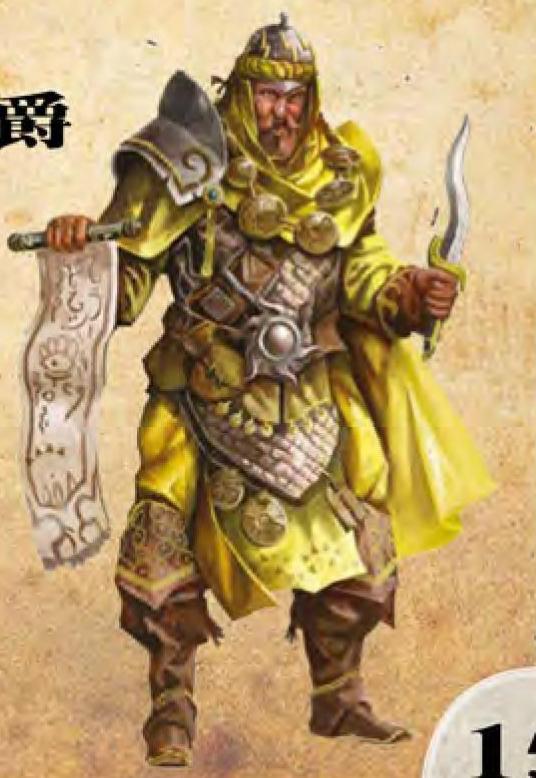
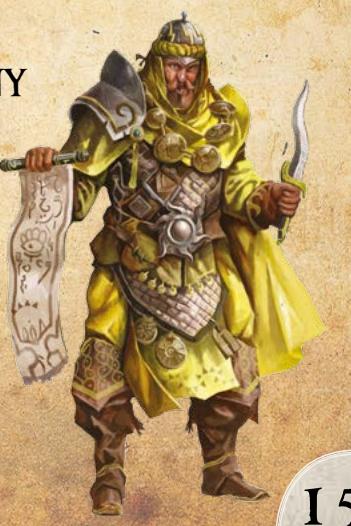
大部分許珀耳玻璃亞以外的地區實際上都是荒漠,這使得要在魔法屏障之外存活相當困難。資源,甚至是食物及水源是稀少的,所以一些遊牧部落中,善於交易與戰鬥的人類族群開始組織起來(主要是為了自衛,游牧的襲擊者說來就來)。如果不是因為男爵坦尼斯,游牧的部落將註定會是與其它五個王國不相干的緩衝國。坦尼斯是個令人難以置信的熟練外交家、詭計多端的戰士,以及天生的領導者,幾年前他把各部落統一於他的旗幟與閃亮的鍍金鎧甲之下。此後,男爵的財富與權力與日俱增,直到成為六個王國當中最具影響力的王國。要是沒有男爵這個外交家,各個王國之間的緊張關係將會淪為公開的衝突
珊瑚王座

舊的許珀耳玻璃亞社會是高度階級制的。強力的巫師佔有階級的主導地位,而地位和財富則大多由家族(以及程度上受到魔法技能及知識較小的家族)所決定,並不是所有人都同意。有一些人認為人類的權利是生而平等的,而且應該賦予相等的機會和公平共享的財富。他們稱自己是「珊瑚人」,而且就如同珊瑚從相互依存和彼此連結取得它們的力量,所以珊瑚人沒有國王或巫師來統治。他們是少數的,他們的信仰從未有機會成為真實。災難過後,有一些「珊瑚主義者」存活下來,群聚在一起,並嘗試根據他們的原則設計一個從書本而來含有珊瑚教義,稱作珊瑚王座的社會。即使理論上所有的珊瑚主義者在王國的法律面都是平等的,但實際上珊瑚主義的其中一個軍種—珊瑚騎士,有高於其他珊瑚主義者的影響力和地位。他們努力地想要把他們的信仰和教義延伸到外部,有時透過宣傳和傳教,但通常他們都是透過蠻力來達成。
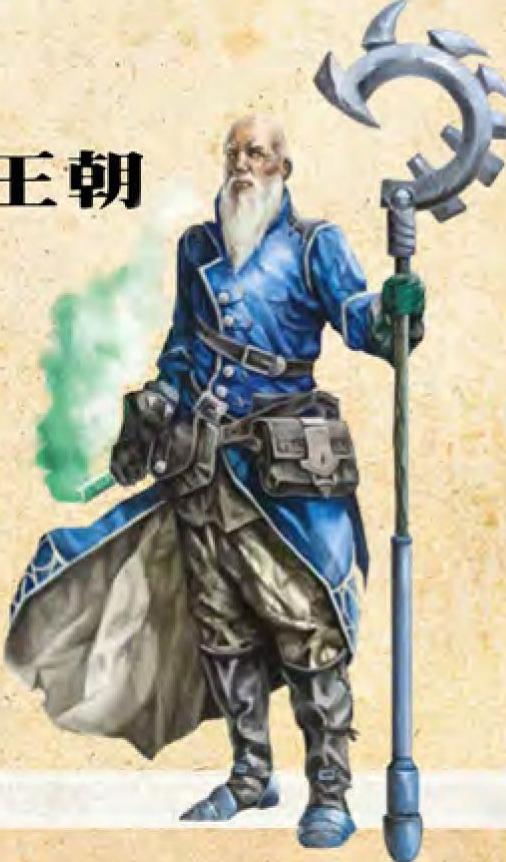
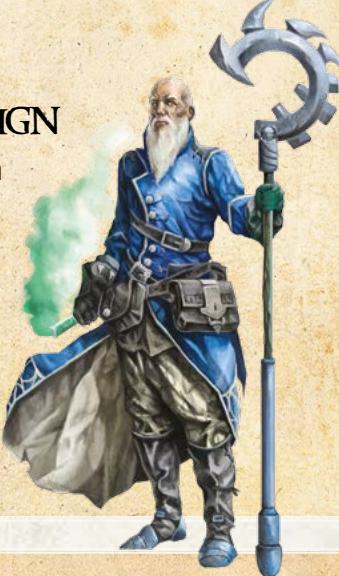
天體王朝由科學家和巫師統治,他們試圖不斷的找回失去的許珀耳玻瑞亞知識。天體王朝是人口最少也最隱蔽的,他們以巫術的力量補強人數的不足。他們能夠在戰鬥中召喚並使強大的元素力量屈服,並且一直在找尋隱藏的知識和新技術,可以證明他們是一個不可阻擋的力量。雖然他們是由一位天體國王所領導,不過他們還是透過每四年舉行一次的選舉來選出政務官。選舉結果通常是最明智以及最好學的天體人當選,但為了四年後運作一個王朝每日管理的需求,國王通常會預留一個新的候選人,以確保統治的平衡。
天體王朝
銘謝
game design : Andrea Chiarvesio and Pierluca Zizzi
additional design : Maurizio Vergendo
additional content and editing: Massimo Bianchini
graphic design : Alessandro Rossi
rulebook layout : Mario Brunelli
cover art: Federico Musetti
interior art : Miguel Coimbra (Cards), Fabio Gorla (Races), Roberto Pitturru (Tiles) and Giacomo Tappainer (Concept Design)
senior character sculptor : Lorenzo Giusti (www.greebo.it)
art direction : Massimo Bianchini
project managing : Luca Cattini
executive producers : Massimo Bianchini, Luca Cattini, Giovanni Intini, Riccardo Sandroni, Massimo Tolazzi and Maurizio Vergendo

Distributed by: Asmodee
20 Gateway Drive (Suite 400)
PLATTSBURGH, NY 12901 USA
www.asmodee.com
www.marabunta-games.com


STERION
Asterion Press s.r.l.
Via Martiri di Cervarolo 1/B
42015 Correggio (RE) - ITALY

Yemaia s.r.l
Via Giulio e Corrado Venini, 42
20129 Milano (MI) - ITALY
playtesting and support: Isabella Fattori, Pierluigi "Pigi" Guarini, Alex Rizzatto, Michele Ciani, Roberto Pestrin, Giovanni Bernardis, Mattia Pellegrini, Boucha Miani, Mattia De Colle, Hjalmar Hach and Francesco Zan.
playtesters : Katiuscia Adami, Mauro Adriano, Maurizio Belluardo, Mirko Bindinelli, Luca "Ash" Bobbio, Fabio Boero, Nestor Borgo, Antonio Borrelli, Nicola Calisi, Danilo Callegari, Davide Capraro, Michael Cepile, Pietro Cremona, Massimo Cressano, Lorenzo Cudicio, il Cuoco, Paolo D' Andreis, Ivano D' Aronco, Mattia Davolio, Jacopo De Luca, Emanuele Degano, Alessio Elpi, Carlo Feragotto, Federico Fieni, Dennis Floreano, Alessandro Gariup, Cinzia Gasperini, Alessandro Gelosini, Luca Gelosini, Giampiero Giacomini, Gianco, Danilo Guasco, Andrea Incerti, Angela Lavarini, Roberto Lega, Marco Legato, Andrea Ligabue, Alessandro Luciani, Luca Malaguti, Luca Marinatto, Alan Mattiassi, Giovanni Michelotti, Mattia Michelotti, Andrea "Mix" Missana, Paola Mogliotti, Francesco Mondini, Marco "Morsac", Giancarlo Nicolò, Sonia Palumbo, Barbara Parutto, Mario Pascoli, Fabio Pavarotti, Chiara Pezzi, Dario Pinese, Marco Pizzolini, Barbara Polidori, Alessandro Prete, Pietro Quadrelli, Andrea Ratti, Ale Ro', Roberto Rua, Paolo Ruffo, Mario Sacchi, Mariano Sacco, Massimo Salvador, Fiorenzo Sartore, Alessandro Seren Rosso, Sirio Smeriglio, Federica Tinelli, Fabio Tiraboschi, Francesco Tomiato, Alessandro Tonon, Christian Varini, Denise Venanzetti, Stefano Venturini, Jacopo Vuga, Daniel Willis, Manlio Zaninotti, Christian Zoli, Giampiero Zorzi, Gabriele Zuttion, all the guys from Quarta Dimensione of Udine, and last but not least the guys from Bari: Daniele Monterisi, Garzone, Fabio Giannace, Danilo Laterza, Robba Pasqua and Vincenzo Chieppa.
Download MarkdownHYPERBOREA_rulebook_ENG.md53.5 KB
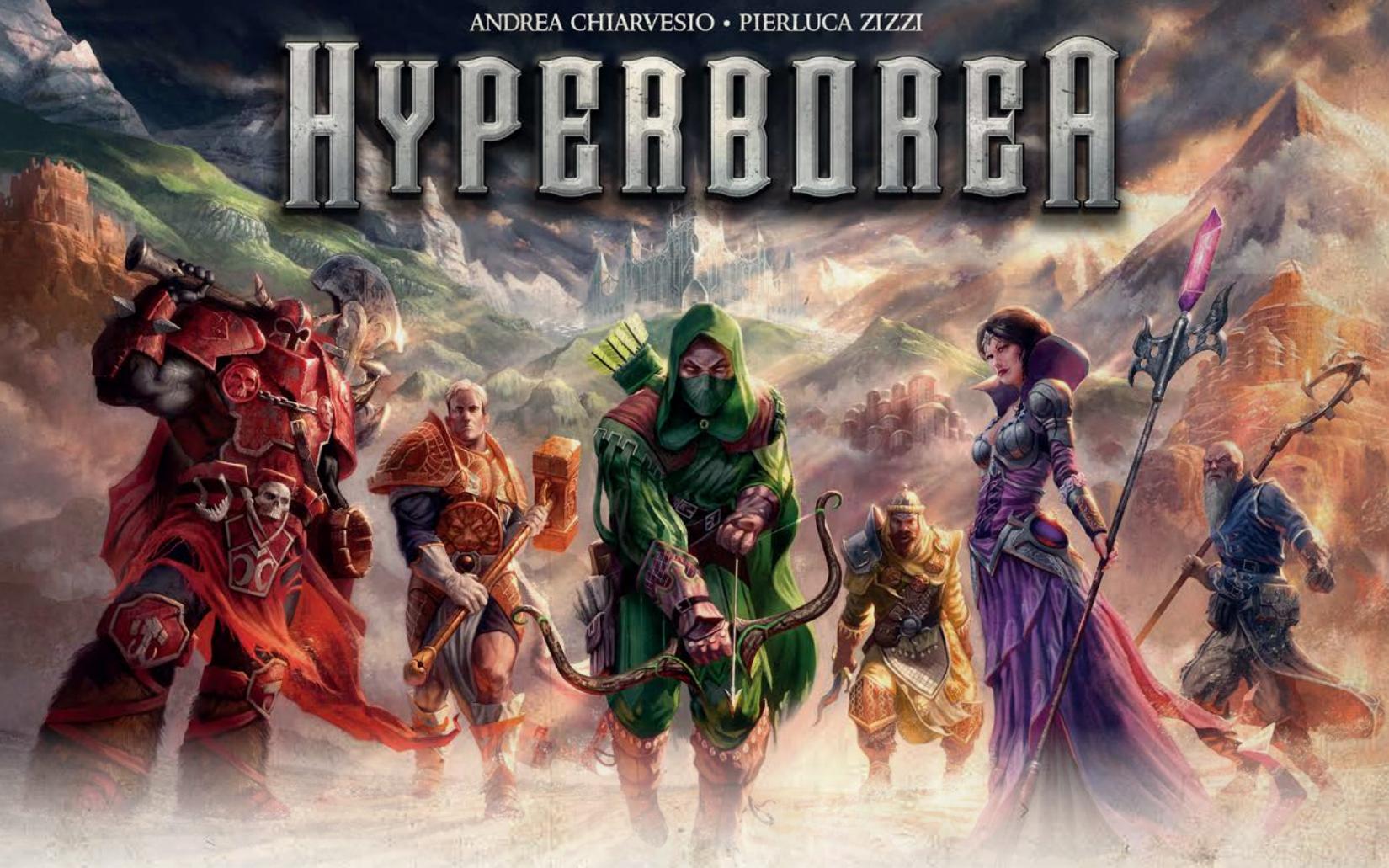
A GAME OF EXPLORATION, CIVILIZATION AND CONQUEST FOR 2 TO 6 PLAYERS BY ANDREA CHIARVESIO AND PIERLUCA ZIZZI
RULEBOOK
The mythical realm of Hyperborea was ruled by an ancient civilization that used magical crystals as their main source of energy. With time, the Hyperboreans became greedy, and their search for power in the deep made the crystals unstable, causing earthquakes, mutations, droughts and floods. Hyperboreans just dug deeper, and only a few wise mages, foresee ing the inevitable, built an unbreakable magical barrier. When the unharnessed magical energy was unleashed from the deep, the Hyperborean civilization was destroyed in a single day, only the magical barrier preventing the disappearance of life from the whole land. The survivors living in the small outposts outside Hyperborea were now sealed out by the barrier. The knowledge of crystals was declared forbidden it was because too dangerous, or simply forgotten.
Over centuries, six rival realms were born from the ashes of the Hyperborean civilization: the militarist Red Duchy, the Emerald Kingdom and its death-delivering archers; the Purple Matriarchy fanatically worshipping the goddess of life; the skilled diplomats and merchants of the Golden Barony, the Coral Throne with its efficiently organized society and finally the secluded and enigmatic Celestial Reign.
The fragile peace between the different realms was not intended to last. One day, the magical barrier suddenly collapsed. A whole new land stood in front of the six kingdoms, still haunted by the old Hyperboreans turned into harmless but ominous ghosts, full of ruins to discover and cities to explore. Each realm is now sending its best warriors and explorers to Hyperborea in order to achieve dominance over their rivals, but which will prevail? Brutal strength or deep understanding of science? The discovery of valuable artifacts in the lost ruins or the retaking of long, lost cities?
Only you, as the leader of one of the factions, can lead your people to the ultimate dominance over Hyperborea!
CONTENTS
• 6 Central Hexagon Tiles
• 30 Borderland Hexagon Tiles

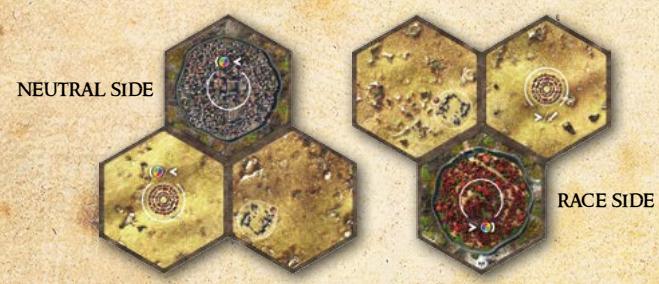
6 Homeland Tiles (each one made up of 3 hexagons and printed on two sides: Neutral and Race side)
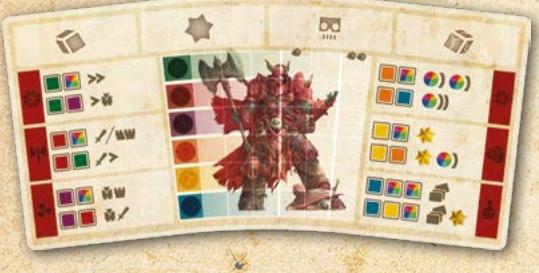
• 6 Player Boards (one per player)
• 36 Development Markers (6 in each color)

• 6 Cloth Bags (one per player)
180 Wooden Civilization Cubes (24 Red – Warfare, 24 Green – Exploration, 24 Purple – Growth, 24 Blue – Science, 24 Orange – Progress, 24 Yellow – Trade, 36 Grey – Waste)
• 12 Race Tiles (2 tiles per Race)
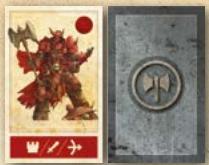
• 60 Race Miniatures (10 miniatures per Race in 6 different colors)
• 18 Ghost Miniatures (in gréy)
48 Fortress Tokens (8 in each color)

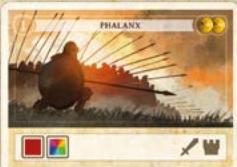
• 64 Advanced Technology Cards
• 72 Ruin Tokens (12 with golden back, 40 with silver back, 20 with bronze back)



• 72 Gems, representing Victory Points (VP)
• 6 Objective Tiles

• 1 Scoring Pad
• This Rulebook

BEFORE YOU START
There are several ways to play Hyperborea.
First of all, players should agree if they want to play a short, regular or long game, according to the number of end-of-game conditions they must trigger to end the game (1 in a short, 2 in a regular or all 3 in a long game).
Then, Hyperborea can be played as an “Invasion" game (where all players start from identical Homelands), or as a “Race War" game (where every player starts with a different Homeland and one individual starting ability).
If this is your first game at Hyperborea, we highly suggest you play a short or regular "Invasion" game.
GAME SETUP
During setup, perform the following steps in order:
-
Assign components
-
Determine first player
-
Mapmaking
-
Choose the extra Civilization Cube and set the Development markers
-
Reveal the available Advanced Technology Cards
-
Get ready to start
1. ASSIGN COMPONENTS
Assign one Race to each player. This can happen by open choice of Race or color, or by random draw of the Homeland. For games with less than 6 players, the remaining Homelands are put back into the box as they will not be used during the game.
Homelands
Each Homeland has two sides:
A) Neutral population side (the same for all Homelands) B) Race side (different for every Homeland)
RACE WAR GAMES ONLY
If you decide to randomly draw the Homelands, shuffle them with the Neutral side visible and have each player choose one.
Give each player:
The Homeland of the chosen Race
• 1 Player Board of the chosen Race
• 10 Miniatures of the chosen Race
• 1 Cloth Bag of the corresponding color
• 6 Development markers
• 6 Civilization Cubes (one for each color, excluding grey): 1 red, 1 green, 1 purple, 1 blue, 1 orange and 1 yellow

2. DETERMINE FIRST PLAYER
Randomly choose the first player.
3. MAPMAKING
Randomly draw one of the six possible Central Hexagon tiles and place it face-down at the center of the table. Randomly draw 6 Borderland Hexagon tiles and place them face-down around the Central Hexagon.
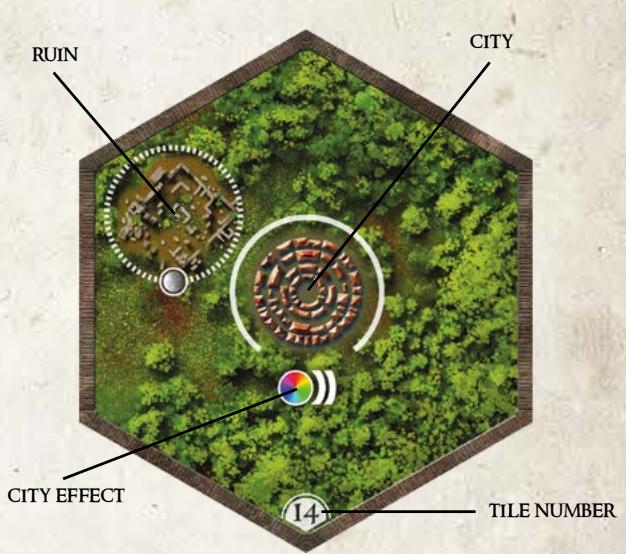
ANATOMY OF A TILE
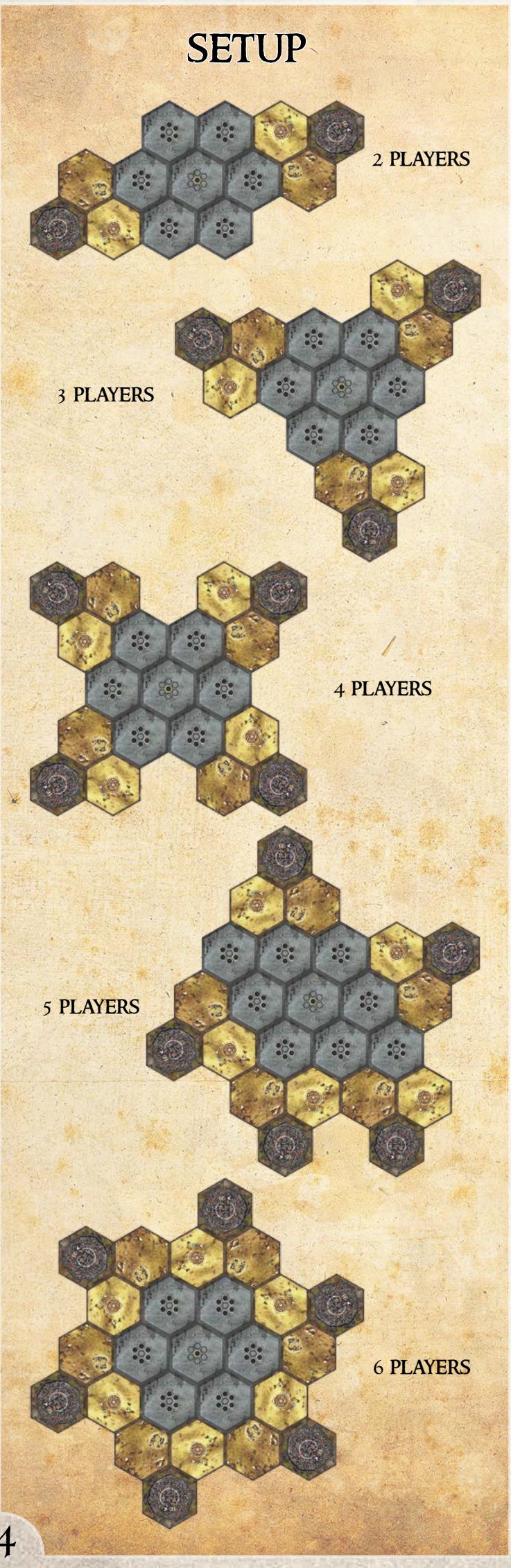
In a game with 5 players, randomly draw 2 extra Borderland Hexagon tiles and place them face-down on two opposite sides of the map (see diagram on next page).
Each Homeland consists of three territories, one of which is marked as a Capital City. Every player must connect their Homeland to the map, as shown on the diagrams on the next page.
Every player places 3 miniatures of their Race in the hexagon containing the Capital City. These miniatures must be placed outside of the city.
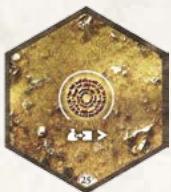
DESERT
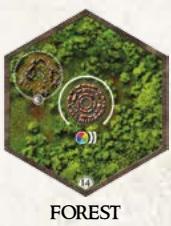
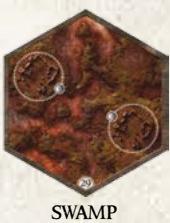
TERRAIN TYPE
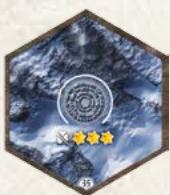
MOUNTAIN
Ruin tokens
Sort the Ruin tokens according to their back: bronze, silver and gold, then shuffle them separately. Place 2 random Ruin tokens on every visible Ruin space designated by the corresponding icon. Ruin tokens must be placed face-down, creating a small pile, on top of the Ruin space on the face-up tiles (at this stage only Homelands are face-up, so you are placing only the bronze or silver Ruin tokens on some Homeland Hexagons; later on you will place silver Ruin tokens in Borderland Hexagons and/or golden Ruin tokens in the Central Hexagon).
IMPORTANT: On the Central Hexagon place 3 golden Ruins on every Ruin space.

GOLD RUIN TOKENS

SILVER RUIN TOKENS

BRONZE RUIN TOKENS
RUIN SPACE

RUIN TOKENS
When hidden hexagons will be revealed (Fog of War) The game starts with the Central Hexagon and the Borderland Hexagons face-down. Later in the game, miniatures will enter into hexagons adjacent to a face-down hexagon. As soon as a miniature enters a hexagon adjacent to one or more face-down hexagons, turn the hidden hexagons and place them face-up. Immediately place in the revealed hexagons the random face-down Ruin tokens (over the corresponding Ruin symbols) and also Ghost miniatures (one in each city and on each Ruin stack). Note that no Ghost miniatures are ever placed in cities or Ruins that are located in the Homeland.
Optional rule: You can instead choose to play with the whole map visible from the very beginning. In this case, simply place all hexagons face-up and immediately place Ruin tokens and Ghost miniatures during setup.
RACE WAR GAMES ONLY
Each player now chooses (randomly or by choice) one of the two Race tiles whose back corresponds to the symbol depicted on their Homeland and applies the effects.

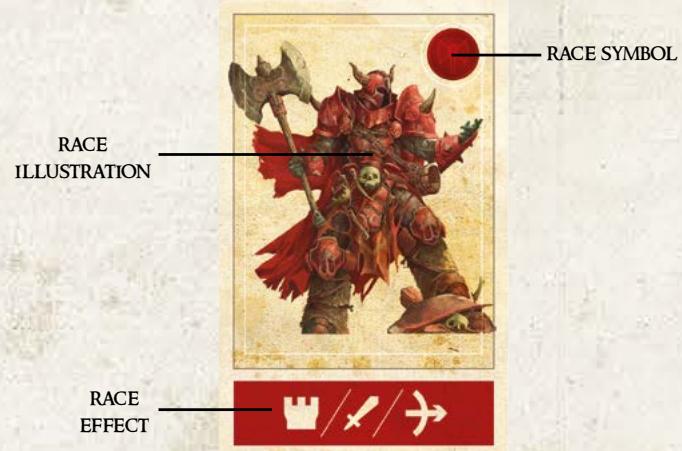
ANATOMY OF A RACE TILE
4. CHOOSE THE EXTRA CIVILIZATION CUBE AND SET THE DEVELOPMENT MARKERS
Each player takes 1 extra Civilization Cube of the color of their choice (except grey) and places all cubes in their possession inside the bag.
Each player then places the Development markers in the Development Area of their Player Board, one per row. The Development Area has 6 colored rows, each representing the following fields:


SCIENCE
TRADE


PROGRESS
GROWTH


WARFARE EXPLORATION
RACE EFFECT LIST
RED DUCHY

fect costs the player one fewer multicolor cubes. ne fewer multicolor cubes.
Tile A: Activation of any technologies that possess the Attack ef-

Tile B: The player puts 2 Fortress tokens with the symbol of the race face-up on their Race tile. Each token grants one of the following effects: Fortress/Attack/Ranged Attack. The player can spend those tokens during the game, at any moment during their turn.
EMERALD KINGDOM
Tile A: The player puts 1 Fortress token with the symbol of the race face-up on their Race tile. This token grants 1 movement point. The player can spend this token at any moment during their turn, but only once until the next Reset. When the player executes the end-of-turn phase and resets, the token is put back on the tile.

Tile B: The player ignores terrain penalties for Movement.
CELESTIAL REIGN

Tile A: The player starts the game with an Advanced Technology chosen between “Alchemy" and “Diplomacy" (these technologies are marked by the Race symbol in the bottom right corner). This doesn't count toward the end-ofgame condition of 5 Advanced Technologies. The player doesn't get a grey cube.

Tile B: Any time the player generates a science effect, they then Cube Drawing" effect.
CORAL THRONE

Tile A: During their turn, the player can use a multicolor and a grey
cube to eliminate one grey cube and to gain 1 VP (it can
even be the same grey cube used to generate this effect).

Tile B: The player can use grey cubes on the orange spaces (but d spaces).
GOLDEN BARONY

Tile A: The player starts the game with 2 VP.

Tile B: During their turn, the player can sacrifice 1 VP to generate
one of the following effects: Attack/2x Movement/Triple develop/3x Cube Drawing.
PURPLE MATRIARCHY

X→ Ti : Wer t layer exte Ghost, instead of killing that Ghost they can convert it into one of their own miniatures. In such a case, the Ghost miniature goes back in the box and not on the “graveyard" on the Player Board and will not count in the endof-game Victory Point scoring.

Tile B: The player starts the game +1 with the Advanced Technology "Outposts" (this technology is marked by the Race symbol in the bottom right corner). This doesn't count toward the end-of-game condition of 5 Advanced Technologies. The player doesn't get a grey cube.
ANATOMY OF A PLAYER BOARD
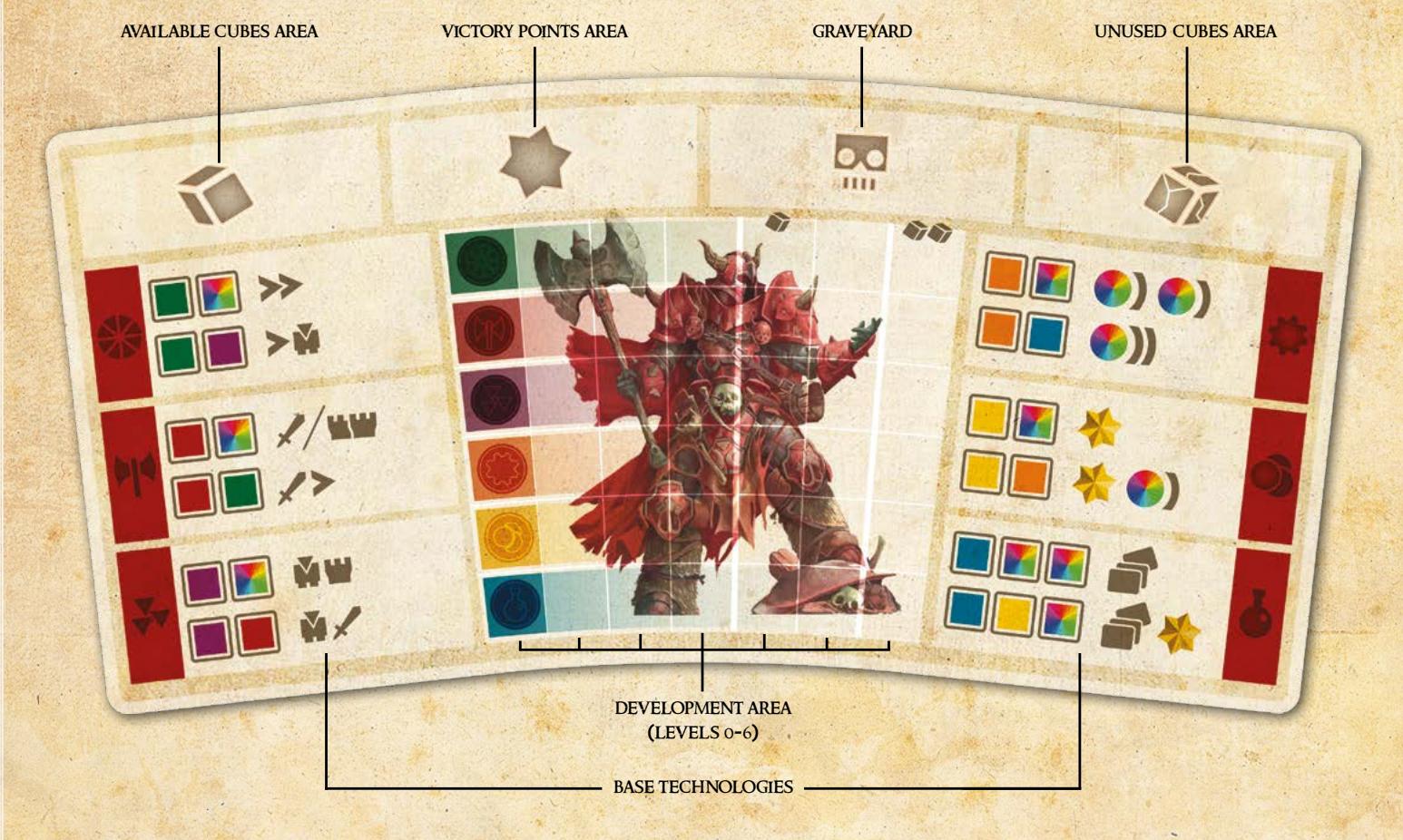
Each player places their markers according to this rule:
• 1 marker at level 3
• 1 marker at level 2
• 1 marker at level 1
• 3 markers at level 0
5. REVEAL THE AVAILABLE ADVANCED TECHNOLOGY CARDS
Divide the 64 Advanced Technologies in four decks of 16 Advanced Technology Cards each, based on the four different types:

Deck I: exploration and warfare
Deck II: trade and growth

Deck IlI: progress and science

Deck IV: conversion and renewal
After shuffling each deck separately, draw the first 2 cards from each deck and place them face-up close to the map. This way, there will always be 8 Advanced Technology Cards face-up available for the players, 2 from each deck. Place a grey cube on each of them, as a reminder for the player that will gain the card. This grey cube will be placed on the "unused cubes area" on the Player Board.
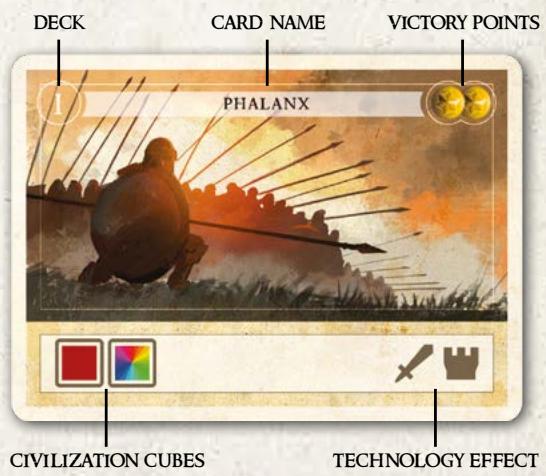
ANATOMY OF AN ADVANCED TECHNOLOGY CARD
6. GET READY TO START
Each player draws (without looking in the bag) three random Civilization Cubes from their own bag and places them on their Player Board in the "available cubes area".
HOW TO PLAY
The players alternate playing turns until the pre-set number of end-of-game conditions trigger during a player's turn (one in a short, two different in a regular or all three in a long game). When that happens, the other players will play a last single turn and after that, a winner will be declared.
A PLAYER'S TURN
During their turn, a player performs as many actions as they can/wish, in any order they like, until they declare the end of their turn.
At each start of a player's turn you must check the following things:
Remove Fortress tokens
Fortress tokens owned by the player that are still in play must be removed. See "Fortress" in the BASE TECHNOLOGIES EFFECTS section for more details.

Less than 3 miniatures
A player can never have less than 3 miniatures in play. If that happens, they place new miniatures for free from their reserve into the hexagon with their Capital City to reach a total of 3 miniatures available.
Beginning of the turn effects
All cards that have generate their effects.
MANDATORY ACTIONS
During their turn, the player must place the Civilization Cubes which are present in their “available cubes area" either:
• on their Base Technologies on their Player Board or on the acquired Advanced Technology Cards;
• or in the "unused cubes area" on their Player Board.
On the Player Board, each Base Technology has two sets of activation spaces.
Each Advanced Technology Card has only one set of activation spaces.
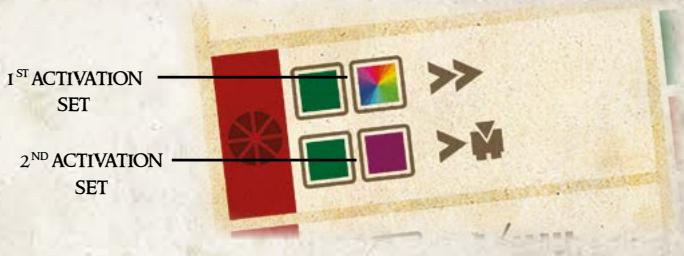
If, when placing the cubes, the player completes one set of activation spaces on the Base Technology or the single set of activation of the Advanced Technologies, the technology gets activated and the player gains the benefits (see ACTIVATING BASE OR ADVANCED TECHNOLOGIES).
If a player doesn't want (or cannot, for instance with the grey cubes) to place one or more Civilization Cubes on one of their technologies, they will have to place it in the "unused cubes area" during the end-of-turn phase. A player can't store any cubes on their “available cubes area" at the end of their turn.

OPTIONAL ACTIONS
During their turn, the player can also do one or more of the following actions:
• activate one or more cities;
explore one or more ruins;
• upgrade their civilization.
Optional actions are described in detail in later sections.
Every effect generated by an action (mandatory or optional) must be spent during the player's turn, before their end-of-turn phase. Effects can be accumulated and can be spent in the order chosen by the player.
When the player is ready to end the turn, they must announce it and execute their end-of-turn phase (see page 10).
Please note that the mandatory placement of the Civilization Cubes doesn't have to be done all at the same time, and can be alternated with optional actions, as in the following example: a player can activate a city (and reap the benefits), then place a single Civilization Cube without completing a set, upgrade their civilization, activate a second city (obtaining the benefits, but without spending them yet), place another 2 cubes on a technology, activating it (and obtaining the benefits, spending them together with the benefit obtained from the cities), explore a ruin and finally declare to have finished their turn, proceeding to the end-of-turn phase.
ACTIVATING BASE OR ADVANCED TECHNOLOGIES
Every technology possesses one or two sets of colored activation spaces that can host the Civilization Cubes. Single-colored activation spaces can host only the Civilization Cubes of the corresponding color.
Multicolored activation spaces can host cubes of any color, except grey Civilization Cubes (waste) which can only be placed on grey spaces. (At the beginning of the game, players do not possess grey cubes; they will be obtained later on in the game).
Once one set of activation spaces is completed and entirely occupied by cubes, the technology is activated and the corresponding effect is generated (see RUINS, TECHNOLOGIES AND CITIES EFFECTS for a complete list and description of effects that are generated by technologies, ruins or cities).
BaseTechnologies (the ones printed on each Player Board) possess two separate sets of activation spaces and therefore they can generate two different effects according to which set is activated, as follows:
EXPLORATION
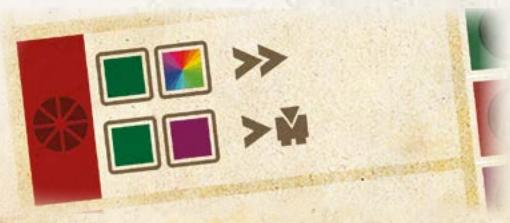
GREEN + MULTICOLOR = Movement + Movement GREEN + PURPLE = Movement + Miniature
WARFARE

RED + MULTICOLOR = Attack OR Fortress + Fortress RED + GREEN = Attack + Movement
GROWTH
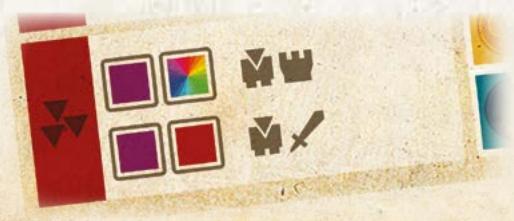
PURPLE + MULTICOLOR = Miniature + Fortress PURPLE + RED = Miniature + Attack
PROGRESS
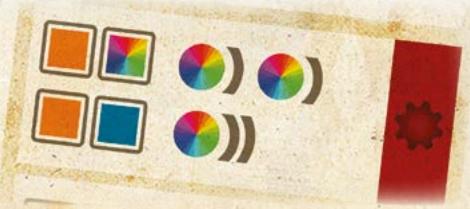
ORANGE + MULTICOLOR = 1 Develop on each of 2 different rows ORANGE + BLUE = 2 Develops on the same row

YELLOW + MULTICOLOR = 1 VP YELLOW + ORANGE = 1 VP + 1 Develop
SCIENCE

BLUE + MULTICOLOR + MULTICOLOR = Advanced Technology Card BLUE + YELLOW + MULTICOLOR = Advanced Technology Card + 1 VP
The players are not forced to spend all the generated effects from activated technologies, they can simply decide not to spend them. Sometimes they may not be able to use them (in such cases, the effects are lost).
In any case, they must use them immediately during the turn in which they completed the sets of spaces: they cannot store effects to use them in a later turn.
IMPORTANT: Once a set has been chosen on the Base Technology of the Player Board, the player must complete that set if he wants to activate that Base Technology. He cannot use the other set. It is not mandatory to complete the set; a player simply cannot use the other set.
ACTIVATING CITIES
To activate a city the player must move one of their miniatures inside the city itself and immediately gain the corresponding benefits. Such action is possible only if the city is free, i.e. if there is no other miniature inside (either their own, of an opponent player, or a Ghost).
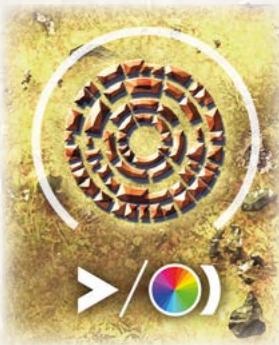
Activating a city does not require movement points and can be done at any time during a player's turn (before or after the activation of a technology or the exploration of a ruin). The miniatures inside a city cannot leave the city until the next Reset (see END-OF-TURN PHASE).
Activating a city generates the corresponding effects (see RUINS, TECHNOLOGIES AND CITIES EFFECTS). Remember: The effects of cities, ruins and technologies can be accumulated and can be spent by the player in the order they like before the end of the turn.
The players are never forced to spend the effects generated by the cities; they can simply decide not to spend them (if so, they are lost).
EXPLORING RUINS
To explore a ruin the player must move one of their miniatures inside that ruin space, taking the topmost Ruin token. Then the player secretly looks at the effects and decides whether to use the Ruin token immediately
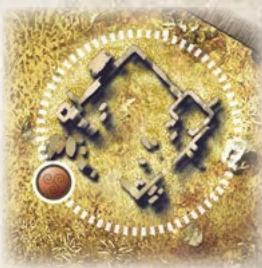
or to store it for later use. If the player decides to use it, the token is revealed to all players and the corresponding benefits are gained, then the token is discarded (see RUINS, TECHNOLOGIES AND CITIES EFFECTS).
A player doesn't have to use a Ruin token immediately - a player can keep the Ruin token in the VP area of their board and use it later, during the same turn or even a future turn.
IMPORTANT: A player can store only one single Ruin token at any moment during the game. Therefore, if a player already has one Ruin token stored, explores another Ruin and wants to store the new token, he must immediately play the old one.
To explore a ruin, it must be free, that is, without any miniature (from their own supply, from another player, or from a Ghost) and it must still contain a Ruin token. A depleted ruin can't be explored: treat its space as if it doesn't exist anymore.
Exploring a ruin, like activating a city, is a free move and can be done at any time during a player's turn (before or after the activation of a technology or a city).
Just like the ones inside cities, miniatures inside a ruin cannot leave the ruin or do anything until the next Reset (see END-OF-TURN PHASE).
IMPORTANT: Miniatures used to explore a ruin or activate a city are "frozen" until the Reset. Such miniatures are basically useless, and can't move or do anything. They can still be protected by placing a Fortress in the hexagon (see "Fortress" in the BASE TECHNOLOGIES EFFECTS section).

UPGRADING THE CIVILIZATION
During their turn, a player may increase the level of the Development markers through the develop effects obtained through the activation of cities, technologies or ruins.

At any time during their turn (but before the end-of-turn phase), a player may reduce to level 0 one of their Development markers which has reached level 4 (or 5). In this case the player immediately puts 1 Civilization Cube of the corresponding color into their bag, taking it from the reserve.
In the same way, the player may reduce to level 0 one of their Development markers which has reached level 6. In this case, the player immediately puts 2 Civilization Cubes of the corresponding color inside their bag, taking them from the reserve.
If the Civilization Cubes of the corresponding color are depleted, the "upgrading the civilization" action has no effect (or has a partial effect, in the case where two Civilization Cubes should have been added and only one of that color is left in the reserve).
IMPORTANT: Upgrading the civilization can be done at any time during a player's turn, before or after having activated a technology, a city or a ruin but before the end-ofturn phase (just like activating a city or exploring a ruin).
END OF TURN PHASE
Once a player has declared that they want to end the turn, the first thing for that player to do is to move all cubes still present in the "available cubes area" into the 'unused cubes area" of the Player Board. Then:
A) If the player still has cubes inside the bag, he must draw up to 3 random cubes from their bag, and place them in the "available cubes area". If the player only has 1 or 2 cubes inside the bag, they still draw them all.
B) Or, if the player has no more cubes inside the bag, the player immediately performs a Reset.
RESET
When a player performs a Reset, they do the following:
The players' miniatures inside the cities are moved to the outside (they remain in the same hexagon) and they will be free to move again during the following turns of that player.
The players' miniatures inside the ruins are moved off the stack (they remain in the same hexagon) and they will be free to move again during the following turns of that player.
All cubes in the “unused cubes area" (including grey cubes just obtained with an Advanced Technology Card) and cubes in technologies that were activated must be placed inside the bag.
This does NOT apply to technologies with continuous effect (see below).
Cubes placed on technologies that have not been completed, or that have been activated and then partially depleted due to a "cube restoration" effect (see "Cube Restoration" description in the list of Advanced Technologies and ruins effects), may be left on the technologies or put back into the bag: it's up to the player to decide what to do for each of these cubes.
Cubes placed on continuous technology (see CON-TINUOUS EFFECTS) may be left on the technologies or put back into the bag: it's up to the player to decide what to do for each of these cubes.
Finally the player shuffles the cubes inside their bag and draws 3 random cubes placing them in their "available cubes area".
After a player has finished their end-of-turn phase, the turn goes on to the next player.
Strategy tip: Careful players will always manage to have the right number of cubes inside the bag, since drawing just one cube (or even two) will likely result in a less effective use of their resources.
Example: Denise has just finished her turn and she knows she still has 1 cube in the bag. She actually has one Development marker at level 4 (blue) and one Development marker at level 6 (purple). If she does nothing and proceeds to end her turn, she will only draw 1 cube, and this would leave her with very limited options on her next turn.
Before declaring the end of her turn, she instead upgrades her civilization in the growth area, and she does so by moving the purple marker back to level 0. This means she can put 2 extra purple cubes inside her bag (from the reserve). She leaves the blue marker untouched because she doesn't want to have 4 cubes in the bag, because that would mean being back to only 1 cube left in the bag after drawing. Then she completes the end-of-turn by drawing all the 3 cubes left in her bag; next turn she will likely Reset since her bag is now empty.
END OF GAME CONDITIONS
In a short game, anytime a player, during their turn, can fulfill one of the following conditions:
-
Has 12* or more Victory Points in their "Victory Points area" (* with 2 players this condition is set at 15 Victory Points);
-
Obtains their fifth Advanced Technology;
-
Puts their last miniature on the map;

they immediately gain the corresponding Objective tile and then conclude their turn (if they fulfill other end-ofgame conditions, that player would also get the other corresponding Objective tiles).
All other players will be allowed to play their turn (and, should they fulfill one of the end-of-game conditions, they would also obtain the corresponding Objective tile).
Please note that even if there are only 2 tiles for each endof-game condition, in the unlikey event that more than two players fulfill the same conditions all of them still have the right to get an Objective tile (mark it somehow).
Then the game ends, players proceed to scoring and the winner is determined.
In a regular game, the end-of-game conditions to be fulfilled must be 2 out of the possible three. They can be fulfilled by the same player or by two or more different players. The game ends after the second condition has been fulfilled.
In a long game, all 3 end of game conditions must be met.
The game ends after the third condition has been fulfilled.
SCORING AND END OF THE GAME
All players extract their Civilization Cubes from their bag and count their final score adding all the following:
- Victory Points earned during the game: 1 VP per Gem present on the “Victory Points area"
2. Ghosts killed by a player
1 Ghost = 1 VP
2 Ghosts = 3 VP
3 Ghosts = 6 VP
Every Ghost beyond third: +1 VP
3. Enemy miniatures killed by a player
1 VP per enemy miniature killed. The second or successive miniature of an enemy is worth VP only if a complete set of enemy miniatures has been killed by that player (see ATTACK on page 12)
4. Civilization Cubes
1 VP per cube owned (excluding grey cubes)
5. Objective tiles
2 VP for each Objective tile owned
- Victory Points for Advanced Technologies According to the value in VP printed on the card in the top right-hand corner
7. Control of territories
1 VP each for controlling Homeland Hexagons
2 VPs each for controlling Borderland Hexagons
4 VPs for controlling the Central Hexagon
A player controls a hexagon if the relative majority of miniatures in that hexagon belongs to that player (example: the blue player has 2 miniatures inside the Central Hexagon, while there is one Ghost and the red player has one miniature: the blue player controls the hexagon and gains 4 Victory Points).
The player with the most total VP is the winner. In case of a tie, the player who controls the most hexagons (in terms of number, not in terms of VP value) wins. If there is still a tie, the player who owns the most cubes (grey excluded) wins. In case of further tie, the player who played last in turn order, wins.
RUINS, TECHNOLOGIES AND CITIES EFFECTS
BASE TECHNOLOGIES EFFECTS IN DETAIL
MOVEMENT
Movement is used to move the miniatures of the players around the map.
Each Movement effect generates 1 movement point for the active player.
Moving 1 miniature from one hexagon to an adjacent hexagon costs 1 movement point.
However, some type of terrain costs extra movement to
enter or exit a hexagon:
• To enter a forest hexagon costs 1 additional movement point.
• To exit a swamp hexagon costs 1 additional movement point
• To enter or exit a mountain hexagon costs 1 additional movement point.
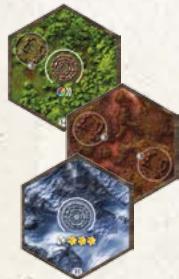
EXCEPTIoN: Moving between hexagons of the same type costs no extra movement cost.
It is possible to move one single miniature throughout several hexagons, paying the movement point cost for each Movement.
IMPORTANT: If a miniature enters a hexagon where there are miniatures that belong to other players, that are not inside a city or a ruin, the miniature must interrupt its movement for the turn. If the player wants to move this miniature again in the same turn, he needs to kill the blocking enemies on the hexagon before moving again.
Remember that as soon as a miniature enters a hexagon adjacent to a face-down hexagon, turn the hidden hexagon and place it face-up (see page 4, "Fog of War").
ATTACK

Attack is used to kill opponent miniatures or Ghost miniatures on the map (it cannot be used to kill the player's own miniatures). Each
effect generates 1 attack point for the active player.
To use one or more attack points the player must have a miniature in the hexagon containing one or more enemy miniatures (either Ghost miniatures or opponent miniatures).
For every attack point (unless absorbed by a Fortress, see below), the player can remove from the map one Ghost or opponent miniature and then put it on the "Graveyard" on their Player Board. Each opponent or Ghost miniature will be worth Victory Points at the end of the game.
If a player kills an opponent miniature of a color already present amongst their killed miniatures, this miniature is given back to the owner who puts it back in their reserve. When this happens, if the player has already killed one miniature per enemy opponent (i.e. the player has completed a set of one killed miniature per enemy), they immediately get 1 Gem from the reserve when they give the miniature back.
FORTRESS

The Fortress is used to protect miniatures from attacks of opponents.
Each Fortress allows the player to take a Fortress token of their color and place it on one of the hexagons in which they have their own miniatures. Every Fortress token can absorb one attack point generated by an opponent, and is then removed.
If an opponent attacks one or more miniatures in a hexagon with one or more Fortress tokens, the Fortress tokens must be removed first, before killing the miniatures.
IMPORTANT: Fortresses stay in play only until the beginning of that player's next turn and they only protect the miniatures of their own player's color.
MINIATURE

The player can put into play one miniature from the reserve.
The miniature must be placed in one hexagon of the player's Homeland that contains a city (outside the city).
ADVANCED TECHNOLOGY CARD

The active player is entitled to get one Advanced Technology Card, which could then be activated by filling the spaces with Civilization Cubes (even
in the same turn in which this card has been obtained).
Before choosing the Advanced Technology, the player may draw 2 new Advanced Technology Cards from the top of one of the 4 decks in order to replace the 2 currently available from the same deck, which are placed on the bottom of the deck. The player is not forced to choose one of the new technologies but can choose between all the eight face-up cards.
After the Advanced Technology is acquired the player must reveal a new Advanced Technology from the same deck that became available and put a grey cube on it.

Any Advanced Technology Card has depicted a number of gems on their top-right hand corner. These gems will be worth VP at the end of the game.
DEVELOP
For each develop effect, the active player may advance the level of one of their markers on one Development row, according to the number of icons present.
SINGLE DEVELOP

TRIPLE DEVELOP

2X DEVELOP
DEVELOP ICONS

If a multiplier appears on the Development symbol (ex. 2x, 3x or 4x etc.) the player may apply the develop effects on different rows or on the same row or a combination of the two. If the develop effect must be applied on a single row and there aren't enough spaces available, the extra effects are lost.
GEM

For each Gem effect, the active player gets 1 Gem, worth 1 Victory Point. If a number appears on the gem symbol, the number of gems
gained is equal to that number.
ADVANCED TECHNOLOGIES AND RUINS EFFECTS IN DETAIL
Some of the Advanced Technologies display grey activation spaces. Only grey cubes may be placed in these spaces (representing waste).
Symbols on the Advanced Technology Cards:
Any time you generate one effect, you actually generate this effect instead.

Example: is read: any time you generate a movement point, you generate a flying movement point instead.

Any time you generate one type of effect, you generate an additional bonus effect. This can be done sev
eral times during a turn. The limit is one additional point per
activation. So if two VP are generated with the activation of
one technology, only 1 additional VP is generated, not 2.
Example: is read: any time you generate attack points, you generate one additional attack point.

Apply the effect depicted inside the symbol to all adjacent opponents. The effect included in this icon must be applied to any
players who possess at least one miniature in the same hexagon or on an adjacent hexagon where the active player has at least one miniature.
Example: x2 is read: two develop and all adjacent opponents must perform one negative develop.
Remove action. There are three possible cases:
- Remove a Cube: the affected player sacrifices a non-grey cube from the visible ones (either on their Player Board or their

Advanced Technologies) and puts it back in the general supply. The cube can even be the very one used to generate this effect, if possible.
2 Remove a Miniature: the affected player must remove a miniature from the map and puts it back in their reserve. He can choose the hexagon from which the miniature is removed.

- Remove a Gem: the affected player removes 1 Gem from their Player Board and puts it back in the general supply.
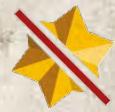
This effect is usually followed by other effects, which will occur only if the "remove" effect was possible.
IMPORTANT: In the case where a player removes a cube to gain a different cube, this new cube is positioned in place of the removed cube, even if it would not be possible due to color requirement.
Example: is read: remove one non-grey cube in order to gain 1 VP.
In addition to effects already seen in Base Technologies, Advanced Technologies or ruins may also generate the following special effects:
CLONING

For each "cloning" effect, the active player may place a new miniature directly on any hexagon in which they already have at
least one miniature, instead of placing it in one hexagon of their Homeland with a city.
CUBE DRAWING

For each "cube drawing" effect, the active player draws one cube from the bag and places it in the “available
cubes area".
Those cubes must be placed either on their Base Technologies on their Player Board, on the acquired Advanced Technology Cards or in the "unused cubes area" on their board.
If one number is present on the top-right corner of the icon, this number specifies how many cubes the player should draw. If there are fewer cubes in the bag than those he should draw, he just draws those that are available.
CUBE GENERATION

The player takes a cube from the reserve of the depicted color and immediately places it into their bag. If the icon is a multicolor cube, the player may choose the color. y choose the color.
CUBE RESTORATION

For each "cube restoration" effect, the active player takes one single cube from anywhere on their Player Board
or the Advanced Technology Cards and puts it back into the bag.
Note: If the cube is taken from a technology that was previously activated, the technology can be activated again, by placing another valid cube in the space that was thus freed.
ESPIONAGE

For each "espionage" effect, the active player may immediately generate the same effect of an Advanced Technology controlled by an opponent.
FLY

Each "fly" effect generates 1 flying movement point for the active player.
To move a miniature from one hexagon to
an adjacent hexagon consumes 1 flying movement point, regardless of the type of terrain of the two hexagons. Furthermore, a miniature that uses flying is not forced to interrupt its movement when it enters (or leaves) a hexagon where there are enemy miniatures on the outside of cities or ruins.
RANGED ATTACK

Each “Ranged Attack" effect generates 1 ranged attack point for the active player.
For every ranged attack point the player may remove one Ghost or one opponent miniature located on a hexagon adjacent to where the player possesses one or more miniatures.
Note: Contrary to the Attack effect, the Ranged Attack effect does not generates VP for the kill; the Ghost is put back in the box, while the miniature is placed back in the original owner's reserve.
NEGATIVE DEVELOP

This effect forces the affected player to decrease a level of one of the Development markers. If all Development markers are on the zero space of the Development area, this effect is ignored. The affected player gets to decide which marker to decrease.
CONTINUOUS EFFECTS

Some Advanced Technologies, marked by the "infinite" symbol inside the activation spaces, once activated generate continuous effects
(effects that last until the end of the game). Some of these continuous effects generate one effect at the beginning of the turn .

IMPORTANT: During Reset, the cubes placed on the Advanced Technologies with continuous effect are not placed back into the bag.

THE REALMS
THE RED DUCHY
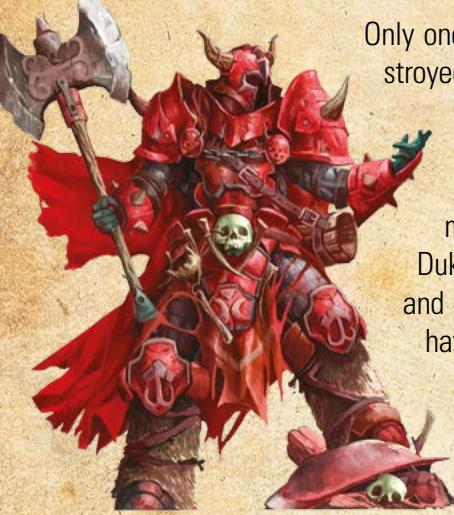
Only one advanced military Hyperborean outpost was spared by the magical apocalypses that de
stroyed the mainland. Redpost become a shelter for the early survivors, but the tension between civilians and soldiers quickly escalated in disorders, anarchy and basically a "survival of the fittest" society. That is, until Duke Khoris defeated in combat all the other gang leaders and established his Dukedom based over very simple rules: every three years the "Duchy Tournament" is held in Redpost main plaza (later an arena was built to the purpose). The winner is the Duke, and the bearer of the Red Mantle (symbol of power and nobility) until the next tournament and up to that day every man in the Duchy must obey him (or her, since quite a few Duchesses have earned the title so far), or they will be put to death. This brutal system proved itself quite effective and the warriors with the crimson mantle (only the Duke can wear the red one) are a force not to be underestimated. In the meantime, not everyone aims for the Duchy, and many inhabitants devoted themselves to less bloody occupations, giving the Duchy its fair share of merchants, farmers, scientists and architects.
THE EMERALD KINGDOM
When the magical apocalypse struck Hyperborea, a few dozen workers and researchers were busy establishing an outpost in a big, unexplored forest. Left to themselves and with no link with the destroyed civilization, the survivors learned to live in harmony with the forest, hunting and collecting food to survive. The smallest among the six realms in population, with the possible exception of the Celestials, they aren't technically a kingdom, even if they call themselves as such. The Emerald King, indeed, is the spirit of the forest they follow and worship, and a council of elders, said to be inspired by and bonded with the forest soul, makes political decisions. They are excellent trackers and unmatched archers, and it is impossible to entèr their forest and contact them against their will, but if you dare to make a few steps in their territory, they will surely find you (and may end your life with their emerald-eathered arrows, before you can even realize it).

THE PURPLE MATRIARCHY
Very little is known about the birth of the Purple Matriarchy. It can be only hypothesized that in the early
days after the death-bringing calamity, the few survivors realized that humanity was on the very verge
of extinction, so life become more sacred than ever and the Cult of the Life Goddess began to spread and
gather more and more followers. Women, as givers of life, were kept in the highest respect and consid
eration. Thus the Matriarchy started, as an evolution of such fanatical worship. What is certain is that
now the Purple Matriarchy is a force to be reckoned with. Not simply overcoming the other realms with
their numbers, the purple people have excellent farming, crafting and fighting skills, and the magical healing and cloning abilities developed in centuries of worshipping life in all its forms make a war of attrition against the Matriarchy basically impossible to win. It doesn't matter how many purple warriors fall to the the axes of the crimson mantles, the swords of the coral knights or the lightning of a celestial-two more will take his or her place within seconds
THE GOLDEN BARONY
Most of the territories outside Hyperborea are actually desert. That made survival difficult for the few left out of the magical barrier. Resources, even food and water, were scarce, so small groups of people started organizing themselves in nomadic communities, skilled in both trading and fighting (mostly for self-defense, but nomadic raiders weren't unheard-of). Nomadic tribes would have been forever fated to be irrelevant buffer states between the other five realms if it wasn't for Baron Thannis. An incredibly skilled diplomat, crafty warrior and natural leader, a few years ago he reunited the tribes under his banner and his shiny gilded armor. Since then, the wealth and power of the Barony have only increased until it is the most influential of the six realms. Without the Barony diplomats the underlying tensions between the realms would already have degenerated into an open conflict.
THE CORAL THRONE
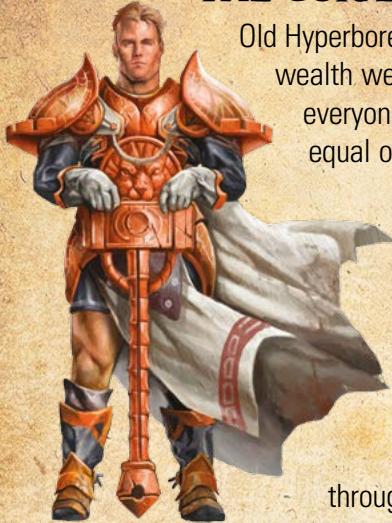
ld Hyperborean society was highly class-based. Powerful wizards were the dominant caste, and status and wealth were determined mostly by family (and to a lesser degree by magical skills and knowledge). Not everyone agreed. A few people thought that all humans were born with equal rights and should be given equal opportunities and a fair share of the common wealth. They referred to themselves as "the coral people", and just as corals take their strength from their interdependence and connections, so did the coral people with no kings or wizards to rule. They were a minority, however, and their beliefs never had a chance to become real. After the disaster, a few "corallists" survived, gathered together, and tried to design a society according to their principles, which became what now is called the Coral Throne, from the name of the book that contains the teachings of corallism. Even if in theory all corallists are equal in front of the laws of the realm, in reality the coral knights, the military branch of the corallists, have a higher influence and status than the other corallists. They strive to extend their beliefs and teachings to the outsiders, sometimes throùgh propaganda and proselvtism. but more often with brute strenath.
THE CELESTIAL REIGN
Ruled by scientists and wizards, the Celestial Reign tries constantly recover the lost Hyperborean knowledge. The least populous and the most secluded, they make up for what they miss in numbers with the strength of their techno-wizardry. Able to conjure and bend the very forces of the elements in battle, and always looking for hidden knowledge and new technologies, they might prove to be an unstoppable force. While they are lead by a Celestial King, the office is gained through elections held every four years. The choice usually falls to the wisest and most studious celestial, though after four years of managing the day-to-day requirements of running a government, the king usually steps aside for a new candidate, to ensure balance in the reign.
CREDITS
GAME DESIGN: Andrea Chiarvesio and Pierluca Zizzi
ADDITIONAL DESIGN: Maurizio Vergendo
ADDITIONAL CONTENT AND EDITING: Massimo Bianchini
GRAPHIC DESIGN: Alessandro Rossi
RULEBOOK LAYOUT: Mario Brunelli
COVER ART: Federico Musetti
INTERIOR ART: Miguel Coimbra (Cards), Fabio Gorla (Races), Roberto Pitturru (Tiles) and Giacomo Tappainer (Concept Design)
SENIOR CHARACTER SCULPTOR: Lorenzo Giusti (www.greebo.it)
ART DIRECTION: Massimo Bianchini
PROJECT MANAGING: Luca Cattini
EXECUTIVE PRODUCERS: Massimo Bianchini, Luca Cattini, Giovanni Intini, Riccardo Sandroni, Massimo Tolazzi and Maurizio Vergendo
Distributed by: Asmodee 20 Gateway Drive (Suite 400) PLATTSBURGH, NY 12901 USA www.asmodee.com www.marabunta-games.com


STERION
Asterion Press s.r.l. Via Martiri di Cervarolo 1/B 42015 Correggio (RE) - ITALY

Yemaia s.r.l
Via Giulio e Corrado Venini, 42 20129 Milano (MI) - ITALY
PLAYTESTING AND SUPPORT: Isabella Fattori, Pierluigi "Pigi" Guarini, Alex Rizzatto, Michele Ciani, Roberto Pestrin, Giovanni Bernardis, Mattia Pellegrini, Boucha Miani, Mattia De Colle, Hjalmar Hach and Francesco Zan.
PLAYTESTERS: Katiuscia Adami, Mauro Adriano, Maurizio Belluardo, Mirko Bindinelli, Luca “Ash" Bobbio, Fabio Boero, Nestor Borgo, Antonio Borrelli, Nicola Calisi, Danilo Callegari, Davide Capraro, Michael Cepile, Pietro Cremona, Massimo Cressano, Lorenzo Cudicio, il Cuoco, Paolo D'Andreis, Ivano D'Aronco, Mattia Davolio, Jacopo De Luca, Emanuele Degano, Alessio Elpi, Carlo Feragotto, Federico Fieni, Dennis Floreano, Alessandro Gariup, Cinzia Gasperini, Alessandro Gelosini, Luca Gelosini, Giampiero Giacomini, Gianco, Danilo Guasco, Andrea Incerti, Angela Lavarini, Roberto Lega, Marco Legato, Andrea Ligabue, Alessandro Luciani, Luca Malaguti, Luca Marinatto, Alan Mattiassi, Giovanni Michelotti, Mattia Michelotti, Andrea “Mix" Missana, Paola Mogliotti, Francesco Mondini, Marco “Morsac", Giancarlo Nicolò, Sonia Palumbo, Barbara Parutto, Mario Pascoli, Fabio Pavarotti, Chiara Pezzi, Dario Pinese, Marco Pizzolini, Barbara Polidori, Alessandro Prete, Pietro Quadretlli, Andrea Ratti, Ale Ro', Roberto Rua, Paolo Ruffo, Mario Sacchi, Mariano Sacco, Massimo Salvador, Fiorenzo Sartore, Alessandro Seren Rosso, Sirio Smeriglio, Federica Tinelli, Fabio Tiraboschi, Francesco Tomiato, Alessandro Tonon, Christian Varini, Denise Venanzetti, Stefano Venturini, Jacopo Vuga, Daniel Willis, Manlio Zaninotti, Christian Zoli, Giampiero Zorzi, Gabriele Zuttion, all the guys from Quarta Dimensione of Udine, and last but not least the guys from Bari: Daniele Monterisi, Garzone, Fabio Giannace, Danilo Laterza, Robba Pasqua and Vincenzo Chieppa.
Download Markdown简繁检索对照.md1.6 KB
120788_119788_hyperborea — 简体/繁体检索对照
本游戏的规则书是繁体中文原文。用户用简体提问时,把关键词按下面这张表转成繁体再去 grep 原文,命中率最高。
回答时用简体或繁体都可以,但引用的原文保持繁体。
简体 → 繁体 对照(按该游戏原文出现频率排序,共 60 字)
| 简体 | 繁体 | 原文出现次数 |
|---|---|---|
| 个 | 個 | 393 |
| 块 | 塊 | 217 |
| 动 | 動 | 108 |
| 这 | 這 | 87 |
| 进 | 進 | 79 |
| 们 | 們 | 71 |
| 区 | 區 | 71 |
| 遗 | 遺 | 62 |
| 游 | 遊 | 61 |
| 时 | 時 | 61 |
| 迹 | 跡 | 61 |
| 戏 | 戲 | 60 |
| 启 | 啟 | 59 |
| 数 | 數 | 58 |
| 会 | 會 | 58 |
| 后 | 後 | 58 |
| 阶 | 階 | 55 |
| 种 | 種 | 54 |
| 发 | 發 | 52 |
| 结 | 結 | 48 |
| 来 | 來 | 46 |
| 开 | 開 | 45 |
| 并 | 並 | 44 |
| 点 | 點 | 39 |
| 图 | 圖 | 39 |
| 为 | 為 | 38 |
| 对 | 對 | 36 |
| 标 | 標 | 35 |
| 产 | 產 | 35 |
| 获 | 獲 | 34 |
| 国 | 國 | 32 |
| 应 | 應 | 32 |
| 级 | 級 | 32 |
| 从 | 從 | 31 |
| 当 | 當 | 30 |
| 该 | 該 | 29 |
| 须 | 須 | 29 |
| 选 | 選 | 28 |
| 击 | 擊 | 27 |
| 记 | 記 | 26 |
| 说 | 說 | 25 |
| 则 | 則 | 24 |
| 组 | 組 | 24 |
| 战 | 戰 | 23 |
| 园 | 園 | 22 |
| 张 | 張 | 21 |
| 与 | 與 | 21 |
| 见 | 見 | 20 |
| 颜 | 顏 | 20 |
| 垒 | 壘 | 20 |
| 两 | 兩 | 18 |
| 让 | 讓 | 18 |
| 许 | 許 | 17 |
| 决 | 決 | 17 |
| 额 | 額 | 17 |
| 号 | 號 | 17 |
| 于 | 於 | 16 |
| 还 | 還 | 16 |
| 随 | 隨 | 15 |
| 红 | 紅 | 15 |
Texts are community-compiled or publicly released by publishers; copyright remains with the original authors. For personal reference only.