
Imperium: Horizons
At a glance
Rules, cards and Q&A (Chinese)
The rules, card data and player questions for this game are written in Chinese. Open the Chinese page to read them.
Where to find full rules
Full rules and card lookup are available in the cunlema app at cunlema.cn — pick this game and ask about any rule, card or turn you are unsure about.
Related games
Rulebook text (Markdown)
This game has 1 rulebook Markdown file(s) in our library; 1 rendered inline below — expand to read or download.
imperium-horizons-rulebook.md165.8 KB
IMPERIUM
HORIZONS
A GAME BY NIGEL BUCKLE AND DÁVID TURCZI
ILLUSTRATED BY
MIHAJLOTHE MICO'DIMITRIEVSKI
RULEBOOK
O+TOSR
Game Design: Nigel Buckle and Dávid Turczi
Game Development: Neo Teng Whay and Anthony Howgego
Rules editing: Dávid Turczi and Simon Strange
Testing engineer: Mark Hutchinson
Lead testers: Mark Hutchinson, Noralie Lubbers, Joshua Potter, Jace Ravensburg, Simon Strange, Neo Teng Whay
Additional testing: Laurens van der Beek, Rafael Bertolini, Fiona Buckle, Martin Butcher, Chuck Case, Rob Frasca, Kacper Frydrykiewicz, Duy Huynh, Frank de Jong, Calpurnio Pison, Moritz Schönherr, Luis Serrano, Marco Teti, Pieter Jan Tiersma, Lars Toft, Ádám Turczi, István Turczi, Andrew Wilkins, Timothy Wilkins, Trix Wilkins, Abigail Wilkins, Bryson Yuzyk, Carl Zee
Blind testing: Ammon Anderson, Hendri Adriaens, Daren Baldock, Bonnie Beyea, Devlin Hutchins
Historical and Cultural Consultants: Zain Alam, Christienne L. Hinz
First published in Great Britain in 2024 by OSPREY GAMES
Bloomsbury Publishing Plc
Kemp House, Chawley Park, Cumnor Hill, Oxford OX2 9PH, UK
29 Earlsfort Terrace, Dublin 2, Ireland
1385 Broadway, 5th Floor, New York, NY 10018, USA
OSPREY GAMES is a trademark of Osprey Publishing Ltd
© Nigel Buckle and Dávid Turczi, 2024. This edition © 2024 Osprey Publishing Ltd
All rights reserved.
www.ospreygames.co.uk
For more information or replacement parts, email info@ospreygames.co.uk
24 25 26 27 28 10 9 8 7 6 5 4 3 2 1

CONTENTS
INTRODUCTION...........4
USING THIS RULEBOOK 5
FOR OWNERS OF IMPERIUM: CLASSICS
AND IMPERIUM:LEGENDS 5
REPLACEMENT CARDS 5
CORE CONCEPTS........
CONCEPT 1: DECK CYCLING
CONCEPT 2:RESOURCES
CONCEPT 3: ACTIONS AND EXHAUSTS...6
CONCEPT 4: GAINING NEW CARDS... 6
CONCEPT 5: FAME AND GLORY
COMPONENTS..........
CARD ELEMENT BREAKDOWN
SETUP
PLAYER SETUP 10
COMMONS SETUP 12
FLOW OF PLAY...........14
THE‘ACTIVATE'TURN 14
TAKING ACTIONS 14
RESOLVING AND
INTERPRETING CARD TEXT 14
USING EXHAUST ABILITIES. 15
THEINNOVATE'TURN 15
THEREVOLT'TURN. 15
CLEAN-UP 15
RESHUFFLING YOUR DRAW DECK 16
SOLSTICE 16
GAME END ....... 17
SCORING
COLLAPSE
THE FAME DECK...
EXAMPLE TURN..........18
OPTIONAL RULES &
GAMEPLAY VARIANTS. 24
PRACTICE MODE (SOLO). 24
LOWERED AGGRESSION VARIANT 24
QUICK SETUP VARIANT. 24
PRECIOUS CARDS VARIANT. 24
SHORT VARIANT. 25
TRADE ROUTES EXPANSION 26
SOLO RULESET 28
SETUP 29
HOW TO PLAY.. 29
CHANGES TO GAMEPLAY
DURING SOLO PLAY. 30
GAME END.... 32
DIFFICULTY LEVELS. 32
CAMPAIGN MODE.. 33
EXAMPLE BOT TURN. 34
KEYWORDS. ...36
CARD-SPECIFIC NOTES. 40
NATION
DESCRIPTIONS ...... 41
RULES TO REMEMBER 49
CAMPAIGN LOGS....... 50
SOLO MODE TRADE
ROUTE TABLES ......... 52
Formidable adversaries are arrayed against you. Opportunities waiting to be uncovered. Your people stand ready. History beckons.
Welcome to Imperium: Horizons. In your hands lies the destiny of one of the most storied peoples of history. As new opportunities open up, you must explore new lands, preside over dramatic scientific and cultural advances, and lead your people to become a cultural force. Expand too rapidly and unrest will bring your civilisation to its knees; build up too slowly and you might find yourself a mere footnote in the annals of history.
HISTORICAL NOTE
Imperium is a game that is based heavily in the history of peoples from all across the world in the time period 3000 BCE – 1000 CE. Historical accuracy has been a core value throughout development of this game, but the very mechanic of deck-building is inherently abstract, and the notion of a linear and inexorable rise of nations into empires is a knowing misrepresentation of actual events.
The original Imperium (Classics and Legends) games used identical Barbarian/Empire State cards for all nations. In Horizons, we introduce a number of new nations who, for a variety of thematic and historical reasons, fit even less into that overly simplistic paradigm than the ones before. However, in order to maintain mechanical and rules compatibility between all versions of the game, we have continued to use the original blue and red symbols, even when the words Empire' and Barbarian' would not correspond to the historical context depicted.
It is our hope that all versions of Imperium help to spark interest in the ancient world, and the peoples who lived in it. It is mechanically useful for a card game to make sweeping generalisations with words like 'Barbarian', 'Civilised', 'Nation' or 'Advance' - but real history is much more nuanced and complicated, and our game terms are most certainly never meant to pass judgement on others. Where possible we have used names, places, people, and thematic elements lifted directly from historical records – but every deck in this game falls well short of capturing the richness and complexity of real people and real history. So, if the themes and references in Imperium interest you, we highly encourage you to pursue that interest in other forms outside of the game!
THEME & MECHANICS
Playing Imperium is meant to parallel the way in which leaders – despite being powerful and in charge – are constantly forced to deal with shifting challenges and opportunities. You can't simply harvest when it's convenient - you need to wait for the proper season. You can't simply invent something on demand – you must wait until your thinkers have the idea. You can't meet new people or explore new lands until those opportunities arise – and you might be competing with other nations for them. These themes are represented both by the effects of the cards and by where they are played.
In Imperium, the cards available to you in your nation's deck represent your current civilisation state. Your nation's higher-powered cards, which you slowly unlock through the game, represent your potential in the future.
The internal disorder in your civilisation and opposition to the current leadership are represented by Unrest cards that have no function and clog up your deck during the game. One way they are added to your deck is through adding new cards from the Market, as change and new ideas always result in some resistance which you must deal with. In other cases, Unrest might represent general malcontents or troublemakers sent by your opponent.
The cards in your Play area in front of you are the focus of your current leaders or government. The most prominent part of your Play area is usually the Regions in which your civilisation has settled. When a Region goes from your deck to your Play area, it becomes something that is in active use, as opposed to Regions still in your deck or hand, which are yours to claim but you have yet to develop.
Abandoning or Recalling a region doesn't remove it from your civilisation – it just means that it is no longer available to tax or improve. When you play the Glory card, which requires you to Abandon three Regions in play, it represents your government focusing on some new (glorious) activity – such as building statues or hosting celebrations – as opposed to productive governance. Hence your regional infrastructure suffers from lack of attention and Resources.
Regions can also have cards Garrisoned in them by tucking cards underneath. That doesn't constitute a military defence – it represents your civilisation pushing something (a problem, or something you can't yet use) out into the provinces and leaving it to be addressed later (if at all). History is like a permanent Garrison under your Power card. With very few exceptions, cards in History can never be used again, though they are still counted during Scoring. Most civilisations place cards into History to thin their decks, and cards with powerful effects are often limited to a single use by putting themselves in History once they've been played – thematically representing a great leader who achieved a lot in one lifetime but, compared to the length of a civilisation, vanished rather quickly.
Of course, it is very possible to play Imperium without considering how the mechanical actions of the game might be interpreted as a historical sandbox. But we think it's a good deal more fun that way. And if you notice the parallels between theme and effects on cards, you might find it easier to conceptualise a strategy too.
USING THIS RULEBOOK
Imperium is a game meant to be played many times. It has a large number of possible game combinations available in each box (especially Horizons) and it can be daunting to learn the rules while also choosing between so many options and reading so many exceptions to the rules.
The best way to learn to play is to select a simpler civilisation deck which interests you (see their Complexity rating: the lower, the simpler). With that deck selected, go through the Player setup sequence, and then do the Commons setup. Next read the How to Play section – including Clean-up and Scoring - and finally the Core Concepts section. You might need to refer back to the Clean-up and Reshuffling sections a few times, and certain unique civilisation elements might seem confusing at first, but it's always better to press on through to get a sense of the game start-to-finish. If you teach the game to new players, we suggest you let them read the Core Concepts first (or walk them through the concepts yourself), and then guide them through a few turns with open hands, to understand their options.You might also enjoy playing along with the Example Turn, to get a sense of the strategic considerations.
Once you understand the basics, the Keywords section is designed to be the chapter of this book that you turn to for specific rules questions and clarifications. Words that are underlined, bold, and in italics are always Keywords, and we encourage you to look them up when encountering them for the first time. Even something as simple as Look (see page 38) or Take (see page 40) can have rule clarifications attached. All players should be able to refer to the Keywords section during play.
If you're learning the game solo, we recommend you try the Practice Mode variant to start (see page 24). This is a solo game variant with a streamlined opponent. The full Solo Mode (see page 28) has opponent-specific rules that add a lot of flavour and unique challenges once you understand the mechanics. The Practice Mode can also be used later, to familiarise yourself with a civilisation you have never played before.
The Classics and Legends boxes each come with a set of Commons cards. Horizons has its own set of new Commons cards, some of which have or icons. Theicon indicates which cards should be removed for a Lowered Aggression game (see page 24). Keeping them in play preserves the distribution of cards found in Classics and Legends. Thecards are “trade friendly" alternative cards, allowing players to create different sorts of games. When using the Commons cards from Horizons, include either the cards marked or the cards markedbut not both! For your first game you should use6 as thecards rely on new rules and concepts introduced as part of the Trade Routes expansion.
The Trade Routes expansion, included in Horizons (see page 26), introduces even more ways for players to interact and gain Resources. Some of the new civilisations require that Trade Routes be used, but any civilisation (even those from Classics & Legends) may use Trade Routes. We think you'll eventually want to use the expansion more often than not.
Rules pertaining only to the Trade Routes expansion are highlighted with a blue background throughout these rules.
Rules pertaining to the solo mode are highlighted with a pink background throughout these rules.
FOR OWNERS OF IMPERIUM: CLASSICS AND LEGENDS
Welcome back. Imperium: Horizons is the same Imperium game you learned before. The rulebook has been rewritten for clarity, so you might want to give it a read, but our intention is that no rules have fundamentally changed – there is nothing you have to unlearn. We have however added some REMINDERS for those rules that players tend to miss or forget.
A new Resource, Goods, has been added; the restrictions on when you can Develop your cards have been adjusted to fit the new civilisations; a new keywordEnd of Solstice' appears on a few cards; and for solo players a new keyword Resolve' appears on some Bot State cards, but we are confident you will pick these up in no time. Once you have had a chance to familiarise yourself with the new Commons deck, check out the new Trade Routes expansion included in this box, which will introduce a lot of new mechanisms and is compatible with everything that came before.
You can use all Classics and Legends civilisations with the Horizons Commons deck. You can use all Horizons civilisations with the Classics and Legends Commons decks, but some may require the Trade Routes expansion (see page 26).
If you should find minor contradictions between this rulebook and (especially earlier printings of) the Classics/Legends rulebook, this rulebook reflects our current intentions and should be used going forward.
REPLACEMENT CARDS
Important! Before you play for the first time, identify all the 49 replacement cards included in Horizons. Their card numbers start with 1 or 2 (since they're meant to replace cards in Classics and Legends) and are identical to the reference number of the card they are meant to replace (even if the card's name might have changed) except with an extra X' in their code. For example, 2REG3X/14 Peak is meant to replace 2REG3/14 Mountain in the Legends box, while 1CAR2X/23 City of Carthage is meant to replace the card of the same name in the Carthaginians deck in the Classics box.
• If you do not own Classics and/or Legends, keep these cards in the box, as you do not need them (for now).
• If you do own Classics and/or Legends, replace the matching cards with these, permanently. (You can throw away the originals if you want; you will never need them again.)
Most of these cards serve to integrate new icons and strategies introduced in Horizons to the Commons decks of Classics and Legends, while some cards are meant to adjust the balance of certain nations or strategies both in isolation and when mixed with Horizons.
CORE CONCEPTS
Imperium is a complex game, but it is built up from a collection of less complex core concepts. Understanding these core concepts will not only help you learn and teach the game, but it also will provide you with a solid foundation for understanding how the more complex civilisations break or adjust these expectations. Take all text on cards literally, and don't assume things not mentioned on the cards (or explicitly mentioned in these rules). When in doubt, refer to the keywords section.
CONCEPT ONE:DECK CYCLING
Imperium is a deck-building game, which means that each nation begins with the same, roughly ten cards every game. Over time you add or remove cards from your deck, reshuffling your Discard pile when your deck is empty so that you can always Draw a new hand of cards at the end of each turn.
Imperium gives most civilisations a deck of Nation cards, the bottom card of which is their Accession card. Usually when you are about to reshuffle your Discard pile to form a new deck, you put the top card of your Nation deck into your Discard pile first – effectively increasing your deck size by one each time you shuffle (see Reshuffling Your Draw Deck', page 16).
Contrasting with the Nation deck is your stack of Development cards. Once your Nation deck is empty and you need to reshuffle again, you have the opportunity to Pay the Development cost on any of the cards in your Development area, and add it to your Discard pile. These are often big point cards or strategy-defining advantages, so adding the right Development card to your deck at the right moment (and being able to Pay its Development cost!) is a big deal, strategically.
Most civilisations are desperate to get some or all of their and cards, so cycling through your deck as fast as possible is often an important focus of the game. However, each civilisation in Imperium is unique, and all of the guidelines here are bent and/or broken in at least a few cases.
CONCEPT TWO: RESOURCES
The game has four Resources: Materials Population Progress and Goods . In most cases, Region cards are the source of Resources, either directly or through card effects as with the card Prosperity. The various icons on cards thematically representing the properties of lands you hold are frequently tied to Resource generation effects.
Resources may be located in the Supply shared by all players, a player's Resource pool, or on cards in the players' areas. Resources may be moved around in a number of ways through the keywords Gain (see page 38), Place (see page 39), and Pay (see page 39). Resources on cards (whether yours or the Market's) are not available to be paid or moved, and do not count as yours during Scoring (unless explicitly noted otherwise).
Resource tokens are not meant to be limited. You may use the higher denomination tokens (5s and 10s) to make change any time as convenient. When resolving the Pay keyword, some Resources may be converted for others (see page 36). This is however not true for the Move keyword, or any other time that is not explicitly permitted by an effect.
CONCEPT THREE:
ACTIONS AND EXHAUSTS
During most of your turns, you will take a number of Actions and Exhaust abilities depending on the number of and tokens you have. This will normally be 3 tokens and 5Xtokens but can vary
Your 3 tokens are used to track Actions as you take them. The most common Action is simply playing a card from your hand. Putting a into play, using an Attack card (see page 36), and Returning an Unrestcard are all examples of Actions.
x tokens are used to track Exhaust effects that trigger only once per turn, found on cards that stay in play in front of you (see In-play cards on page 38). Exhaust effects often generate Resources, interact with icons, or Draw cards. Some civilisations change the default number ofX tokens you use during play.
xtokens are also used to mark if you add a new card to your deck during a reshuffle – this prevents players from repeating the effect and thus adding multiple cards to their deck in a single turn. But remember that it also ties up one of yourX tokens, thus reducing your available× tokens for the rest of your turn. At the end of your turn you remove allx tokens before Drawing a new hand of cards – so there is always a full set ofXtokens available during your end-of-turn Draw/Reshuffle, when it is most common to add a new Nation or Development card to your deck. (See Reshuffling Your Draw Deck' on page 16.)
CONCEPT FOUR:
GAINING NEW CARDS
In Imperium, new cards almost always go directly into your hand. It is very common to spend an Action adding a new card into your hand, and then spend your next Action playing that card! There are four ways to gain cards.
The most common method is using the Acquire effect (see page 36) to gain a card from the face-up Market row of five cards. Some Acquire effects specify that only certain suits may be Acquired, and others might allow you to Acquire any of the five cards. In all cases, when you Acquire a Market card you also Take anyunderneath it and any Resource tokens on it. All Market cards except cards will have a underneath them. Cards Acquired from the Market are immediately replaced, such that there are always five available.
The second most common (and more powerful) method to gain cards is via a Break through effect. This can be used in two distinct ways:
-
Gain a card and any Resources from the Market row (just like Acquire), but any is put back on the Unrest pile instead of taking it into your hand.
-
Dig into one of the face-down Small decks and take the first card of the appropriate suit you find.
Take and Find (see page 38) are effects which directly move cards into your hand (or elsewhere, as specified).
CONCEPT FIVE:
FAME AND GLORY
Many cards give victory points, but the largest gains come from cards in the Fame deck. Deciding how often you want to access that deck for points is a core decision for all players of Imperium. Somecards are worth ten victory points or more, but taking them often comes at a heavy cost, which can set you back several turns.
The most common way to gaincards is with the card Glory, which requires that you Abandon (place in your Discard pile, see page 36) three cards in play. Those lost regions require Actions to be put in play again, thicken your deck and make it take longer to cycle in new Nation/Development cards, and do not provide you Resources while they are out of play. Weighing up when to play Glory is then a tough choice to make.



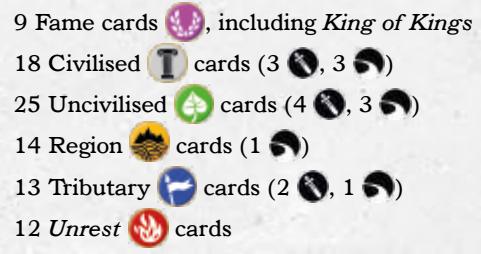
32 Bot State cards

COMPONENTS
COMMONS CARDS
14 NEW CIVILISATION DECKS
23 Abbasids cards

23 Aksumites cards5

29 Martians cards
29 Cultists cards

24 Gupta cards5
25 Inuit cards
24 Japan cards
27 Magyars cards
28 Mayans cards
29 Polynesians cards

24 Sassanids cards

24 Taino cards
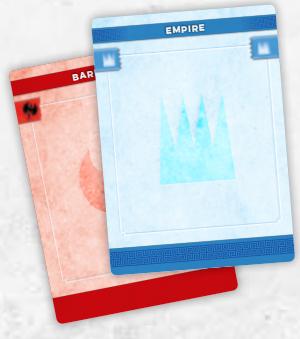
4 State cards
ADDITIONAL CARDS
27 Tang cards
23 Wagadou cards

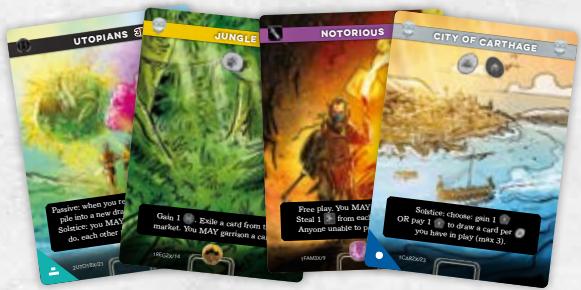
49 Updated cards for replacing cards in Classics and Legends
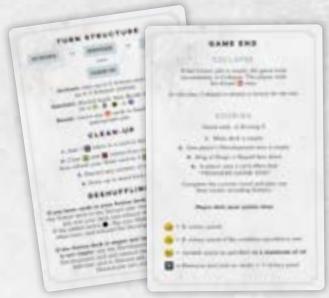
2 Quick Reference cards
261 TOKENS
21 Exhaustion tokens
18 Action tokens
6 Slot markers


48 Materials tokens

48 Population tokens

48 Progress tokens

36 Goods tokens
1 Fame card (Welcoming)
14 TRADE ROUTE EXPANSION CARDS
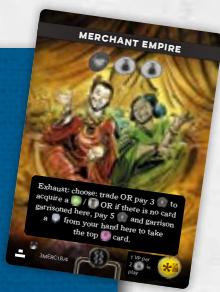
4 Merchant/Merchant Empire cards
9 Trade Route

4 Player organisers in two parts

1 Market board in three parts

4 King of Kings tokens

1 Six-sided die

1 Solstice token

20 Cultist tokens



3CIV1/18
ABB: Abbasids AKS: Aksumites ART: Arthurians ATL: Atlanteans CAR: Carthaginians CEL: Celts CUL: Cultists EGY: Egyptians
CIV: Civilised cards FAM: Fame cards MERC: Merchant cards REG: Region cards TRI: Tributary cards TRO: Trade route cards UNC: Uncivilised cards UNR: Unrest cards
/#: card reference
GRE: Greeks
GUP: Guptas
INU: Inuits
JPN: Japan
MAC: Macedonians
MAG: Magyar
MAU: Mauryans
MAY: Mayans
MIN: MinoansMRT: MartiansOLM: OlmecsPER: PersiansPOL: PolynesiansQIN: QinROM: RomansSAS: Sassanids
SCY: Scythians TAI: Taino TAN: Tang UTO: Utopians VIK: Vikings WAG: Wagadou
CARD ELEMENT BREAKDOWN
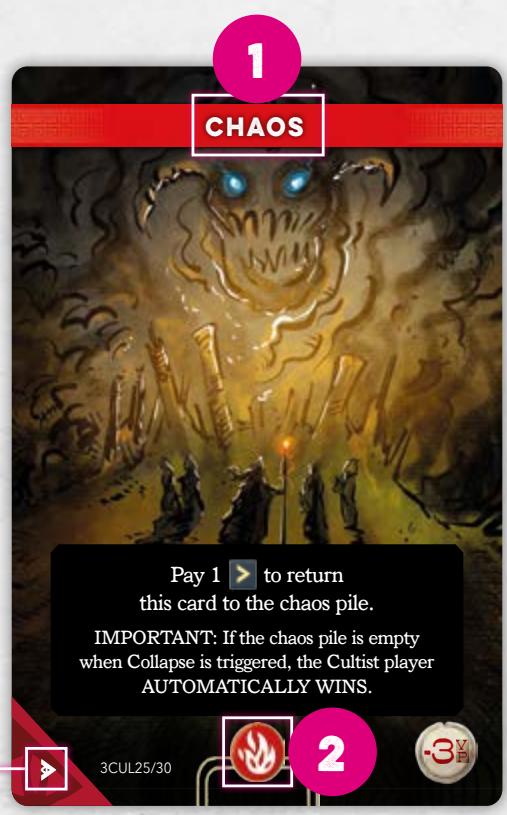
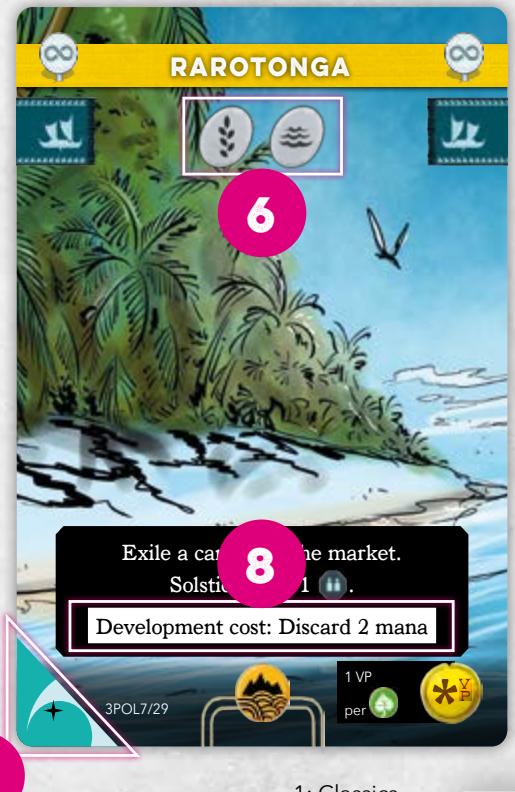
1. Card name: the name of the card.
- Suit icon: most cards have a suit icon. These are essential when you gain new cards from the Market and are frequently referenced by other cards.
SUIT ICONS
Region: areas under your nation's control.
Uncivilised: traditional cultural technologies and customs.
T Civilised: highly structured or centralised technologies and customs.
Tributary: peoples who have pledged loyalty to your nation.
Fame: memorable deeds of your nation.
Unrest: internal strife and disorder in your nation.
Gadget: dangerous items of curious origins, brought by the Martian civilisation.
Power: the fundamental rules of the nation you are playing. Side A is Advanced, side B is Basic.
Trade Routes: hubs of commerce allowing trade between nations.
-
Banner: the colour of the banner behind the card's name matches the card's suit. These are particularly important during setup. Cards without a suit have a grey banner. Cards with multiple suits use the banner colour appropriate for setup.
-
Header icon:andcards remain in play.Kcards affect other players. Power cards have anAand aBside.
-
State symbol(s): many cards have a state symbol such as or . The Polynesians and Cultists have their own unique symbols. You cannot play a card that has a state symbol unless your current State card matches (at least one of) the symbol(s) shown on the card. Some cards show two state symbols, meaning your current State cards must match at least one of the symbols shown.
-
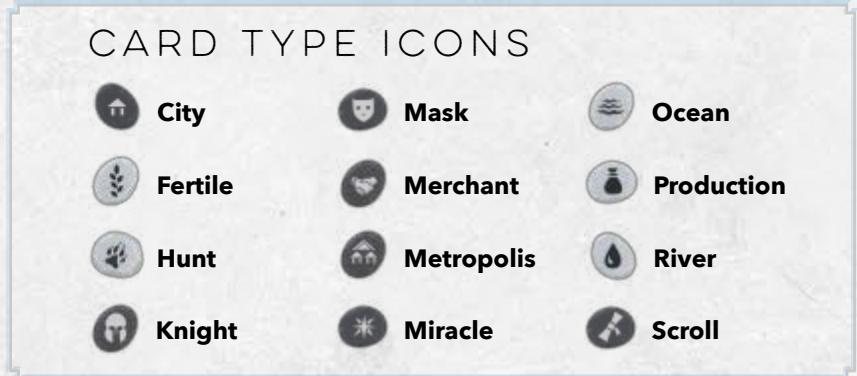
Card type icon: some cards have card type icons that have no innate effect but may be referenced by other cards. For example, the card River Raiders, grants 2 VP for eachicon in your possession at the game's end.
-
Effect text: details what the card does and when it is activated. See page 14 for how to read this text.
-
Development cost: cards have a Development cost, usually a quantity of#,①, and/orEtokens that you have to spend to Developit.
-
Nation colour: the colour of this corner indicates that the card is part of a specific Nation's deck. Cards without a coloured corner are part of the “Commons" cards used in every game. (This is useful for sorting your cards after each game.)
-
Starting location: the symbol on the nation colour indicates where the card starts during setup:
STARTING LOCATIONS
In play: in your Player area
Nation: in the Nation deck
Accession: at the bottom of the Nation deck
Development: in the Development area
→ Supply: in the Unrest pile
Chaos: a deck of special havoc for the Cultist player
-
Player count: cards with a 3+ aren't used in a solo or two-player game. Cards with a4 aren't used in a solo, two-, or three-player game.
-
Expansion: cards with aare only used when playing with the Trade Routes expansion (see page 26). Cards with aandsymbol cannot be used in the same Commons deck (see step 3 of the Commons setup on page 13).
-
Card number: a number reference for the card. If the first digit of the reference is a 1, the card is from the Classics box. If it's a 2, it is from the Legends box. Cards from the Horizons box begin with a 3.
-
Victory points: how many victory points the card is worth at the end of the game, if any. Cards with a X icon are worth X points. Cards with a?or icon are worth a variable number of victory points, as specified on the card. Cards with a Xx icon are worth negative X points.
Note that if this is your first-time learning Imperium, don't be intimidated by references to more complicated civilisations, or civilisations that are not even in this box! Just ignore them, along with any mention of the Trade Routes expansion, as it is intended for experienced players.

PLAYER SETUP
Each player takes the following steps:
- Choose a nation and take all the associated cards, as indicated by the colour in the bottom left corner. Before choosing a nation, you should look at the Nations' chapter for an overview of the different decks.
If you are not playing with Trade Routes, you may not choose one of the 6 nations with theicon.
-
Take a Player organiser, slot the pieces together and lay them in front of you.
-
Place your singlecard in front of you, underneath your Player organiser. You can place it either side up, but you cannot change this later in the game. This is your Power card. For new players, we recommend playing with the B side up (B for Basic, A for Advanced).
-
Place any other cards below your Power card, if you have any. Only the Arthurians, the Cultists, the Polynesians, and the Utopians have additionalcards.
If you're playing as the Arthurians, place King Arthur's Court face up below your Power card.
If you're playing as the Cultists, put Research the Ceremony on top of Ceremonial Gathering and place them below your Power card. The top card in this pile is your ceremony card.
If you're playing as the Polynesians, place Mana face up below your Power card.
If you're playing as the Utopians, put Visions of Shangri-La on top of Gates of Shangri-La and place them below your Power card. The top card in this pile is your journey card.
5. Place a State card with theside up underneath your Player organiser.
If you're playing as the Atlanteans, instead place your State card with the side up.
If you're playing as the Cultists, place your State card with theside up, on top of your custom State card that has the Corruptedside up.
If you're playing as the Inuit, use their custom State card with the Summerside up.
If you're playing as the Martians, use their custom State card with the Alienside up.
If you're playing as the Polynesians, use their custom State card with the Isle-boundside up.
If you're playing as the Taino, use their custom Free Tribes State card (it's identical on both sides).
If you're playing with the Inuit, the Martians, the Polynesians, or the Taino, return your regular (Barbarian/Empire) State card to the box.
6. Take 3tokens, and 5 tokens (unless your card indicates otherwise). Place these tokens on your State card.
If you're playing as the Cultists, Inuit, Polynesians, Taino, or Utopians, use a base of 3 X tokens instead of 5 X , as indicated on their card.
If playing with Trade Routes, give each player an additionalXtoken.
If playing with Trade Routes, take a Merchantscard (they are identical) and place it face-up (with the Merchants side showing) below your State card.
- Place all the cards face up above the Player organiser. This is your Development area. For most nations, the cards are your Development cards.
For the Arthurians, these are your Quest cards. When quest cards are in the Development area, they are considered to be impending quests for your Quest area.
The Cultists, Vikings and Utopians do not have any
Development cards.
- Place the card face up above your Player organiser. For most nations, the card is your Accession card.
The Atlanteans, the Cultists, the Inuit, and the Utopians don't have a card.
- Shuffle the cards into a face-down deck and place it perpendicular across the top of the card. This is your Nation deck.
The Atlanteans, the Cultists, the Inuit, and the Utopians do not have a Nation deck.
- Take a King of Kings token, 3, 20, and 1E. The,0, and Etokens form your initial Resource pool (tokens may also be added here). The King of Kings token should be placed next to your Resource pool with the lighter side facing up.
If there is a Martian player, give them an additional 20 or 25 è, as indicated on their card.
If playing with Trade Routes, give each player 1 instead of the 1>.
- Put aside any → cards. They will be used in step 6 of the Commons setup. Only include 3+ and4 cards if playing with that many players or more, otherwise return them to the box. All → cards are cards.
The Arthurians, Celts, Cultists, Guptas, Inuit, Magyars, Martians, Mayans, Olmecs, Polynesians, Qin, Tang, Utopians, and Vikings have cards.
-
Shuffle all remaining cards (the cards from your civilisation which have no icons in the lower left corner) into a face-down deck and place it below your Player organiser. This is your Draw deck.
-
If you're playing as the Cultists, place all Chaos cards below your Draw deck to form the Chaos pile. Only include3+ and 4 cards if playing with that many players or more, otherwise return them to the box.
-
Leave a space next to your Draw deck for a face-up Discard pile, and a larger area to the right for your Play area where your In-play cards will be placed.
-
Draw (see page 37) five cards from your Draw deck to form your starting hand.

COMMONS SETUP
-
Place the remaining8, , X, and tokens on the table, easily accessible to all players. This is the Supply.
-
Place the Market board in the middle of the table, easily accessible to all players. For a normal game, place it so that the side without icons is showing.
If you are playing with Trade Routes, place the Market board so that the side with the icon is showing.
- Select a set of Commons cards (all cards without a Nation colour). You may use the cards from Classics, Legends, or Horizons.
If you are playing with Trade Routes, you must use the cards with theicon in the Horizons Commons deck. To do so, you must remove all cards with theicon from the deck.
- Sort all the Commons cards by the colour of their banner. In most cases a card's banner colour corresponds to the suit icon at the bottom: and Some cards use multiple suit icons, and during the game they count as cards of both suits. During setup however, the banner colour takes precedence.
If using nations and commons cards from different boxes, check if any of the cards have the same name as one of the players' chosen nations. For each card that does, replace it with a random card from a different set of commons cards. If the new card shows a3+ or a 4 and you're playing with fewer than the indicated number of players, or if it has the same name as one of the players' chosen nations, draw a different replacement card instead.
5.If you are playing with three players, remove all 4 Commons cards from the game. If you are playing with two players, remove all 3+ and4 Commons cards with from the game.
-
Place all thecards face up, below the icon on the Market board. This is the Unrest pile. Include any → cards put aside by the players during step 10 of their player setup. These can be in any order. Leave space to the right of the Unrest pile for the Exile pile.
-
Place thecard King of Kings with the side showing, above the icon on the Market board.
-
Shuffle the remaining Famecards into a face-down deck and place it on top of the King of Kings card, perpendicular to it. This is the Fame deck.
If playing with Trade Routes, shuffle the Welcoming card into the Fame deck. (The Trade Routes expansion increases the size of the Fame deck by one card!)
- Remove cards from the top of the Famedeck and return them to the box unseen until thedeck has the indicated number of face-down cards (excluding King of Kings), appropriate for the player count, as listed below.
If playing without Trade Routes:
2 players – 6 cards | 3 players – 7 cards | 4 players – 8 cards
If playing with Trade Routes, increase the final deck size by 1.
(steps 10–12), the number of cards in each depends on the number of players:
2 players – 6 cards | 3 players – 7 cards | 4 players – 8 cards
-
Shuffle the cards. Place the appropriate number of cards in a facedown Small deck above the icon on the Market board. This is the Region deck. Set aside the othercards for now.
-
Shuffle the cards. Place the appropriate number of cards in a facedown Small deck above the icon on the Market board. This is the Uncivilised deck. Set aside the othercards for now.
-
Shuffle theTcards. Place the appropriate number of cards in a facedown Small deck above the icon on the Market board. This is the Civilised deck. Set aside the other Tcards for now.
-
Shuffle the cards. Place one card face up on the bottom of each of the Small decks (Region, Uncivilised, and Civilised, created in steps 10–12). Then, if playing with 3 players, remove one of the remaining cards (without looking at it) from the game. If playing with 2 players, remove two. Set aside the remaining cards for now.
-
Shuffle all the remaining and all the cards to form the Main deck. Place the Main deck face down to the left of the Civilised deck, above the on the Market board. Placing the deck horizontally helps to make it distinct from the other decks.
If playing with Trade Routes, shuffle the remaining cards into the Main Deck.
-
Draw one card from each of the Region, Uncivilised, and Civilised decks and place each card face up, below the Market board opposite its respective deck. Draw two cards from the Main deck and place them face up side-by-side below the Market board opposite the deck. Together, these five cards form the Market.
-
Place acard from the Unrest pile underneath each card in the Market that is not a
-
Add a token on each card in the Market with a white banner.
-
Decide which player will go first. Play passes to the left. Place the Solstice token as if it were a player between the last player and the first. The position of the Solstice token acts as a reminder that everyone simultaneously resolves their Solstice effects (see page 16) after the last player's turn, but before the first player begins a new round.
FLOW OF PLAY
The game is played over an indeterminate number of rounds. Each round starts with the player to the left of the Solstice token taking the first turn. Turn order proceeds to the left. Play continues until either Scoring or Collapse is triggered, which signals the end of the game (see page 17).
In each turn, you will declare what type of turn you are taking:
ACTIVATE
OR
INNOVATE
OR
REVOLT
Once you have finished resolving one of the above turns, you will Clean-up (see next page).
After you have cleaned up, the player to your left takes their turn. If the Solstice token is between you and the player to your left, all players resolve all their Solstice effects before beginning the next round. Solstice is always the last thing to happen each round (see page 16).
THE‘ACTIVATE'TURN
When you take an Activate turn, you can take Actions (see page 36) and use Exhaust abilities (see page 37) in any order and in any combination. When you cannot or no longer want to take Actions or use Exhaust abilities, you will move on to Clean-up. Players typically Activate on most turns of the game, unless very specific circumstances make it beneficial to Innovate or Revolt.
TAKING ACTIONS
To take an Action, first set aside atoken from your State card. If you have no tokens on your State card, you may not take an Action. (For the main exception, see Free play on page 38.)
The most common type of Action is to play a card from your hand into your Play area and resolve its effects according to the card text. Any other effect that costs an Action will be explicitly noted.
If a card has a State symbol such asor, you can only play it from your hand if your State card shows the same symbol.
A few cards in the Cultists' deck show two State symbols; your State card needs to show one of them to be allowed to play such a card.
Cards where the first line of text starts with Exhaust, Passive (see page 39), or Solstice have no immediate effects when played. These are allcards.
cards have a Commerce effect, which resolves when you play the card (see page 37).
When a card is played, resolve all effects as much as possible (see below for guidance), including resolving any responding triggered effects such as Passive abilities or deck reshuffling (see Reshuffling Your Draw Deck' on page 16). Afterwards, place the card in your Discard pile unless the card indicates that it should be placed elsewhere. If a card has a it remains in your play area after you play it.
The cards have the special icon instead of8. Like cards with remain in your play area after being played. However, they are NOT cards, and are not affected by things which specify
Many cards have keywords. These are explained in detail in the Keywords section (see page 36) and are denoted in-text as bold, italics, and underlined.
RESOLVING AND INTERPRETING CARD TEXT
When resolving card text (whether from a played card, Passive effect, Solstice effect, or Exhaust effect) there are a few important principles which should help you make sense of even the most complex cards.
-
Each sentence should be resolved individually, starting with the first sentence.
-
Each sentence should be resolved as much as possible. Text immediately following MAY is always optional, everything else is always mandatory.
-
If no part of a card's text can be resolved, you cannot play that card.
-
If a card does not explicitly state where it should go after resolving, it goes to your Discard pile. This does not apply tocards.
This also does not apply tocards.
-
Anything that comes before "to" is a cost. As in “Do X to gain Y" (X is the cost, Y is the result). You may Pay (see page 39) a cost, even if the text's effect cannot be resolved or the resolution is uncertain.
-
Anything involving “"Pay" or “Move Resources" is a cost, even if not followed by a "to".
-
If some or all of the mandatory costs on a card cannot be resolved, you cannot play that card or trigger that effect.
-
Always fully resolve the cost(s) before beginning to resolve the rest of the effect.
-
If you Pay a cost (optional or not), you must resolve the result (as much as possible).
Some Resources can be substituted for others. See the keywords section, page 39, for rules on substitutions.
USING EXHAUST ABILITIES
You can only use an Exhaust ability on your own Activate turn, unless the card specifies otherwise. You can never use Exhausts during Solstice, or during Revolt or Innovate turns.
To use an Exhaust ability, choose a card with the Exhaust keyword that does not have a X token on it. This can be an In-play (see page 38) card, or it can be your Power card. Move a × token from your State card onto that card. If you have no× tokens on your State card, you may not use an Exhaust ability. If a card already has aX token on it, you may not use the Exhaust ability shown on that card.
You may use an Exhaust ability on an In-play card with a state symbol such asor, regardless of which symbol is showing on your State card.
Once you have placed yourx token, fully resolve the effect indicated after the Exhaust keyword. Some Exhaust abilities specify a cost. If you cannot Pay the specified cost, you may not use that Exhaust ability.
If an Exhaust ability responds to an effect you or another player resolves (such as “when an opponent Takes..."), the Exhaust ability happens as soon as the triggering effect is finished. If that effect is triggered by a card with multiple sentences, the response ability happens after the sentence with the triggering effect is finished, but before the next sentence begins.
THE'INNOVATE'TURN
An Innovate turn allows you to Break through (see page 36) for a card, at the expense of not doing anything else. During an Innovate turn you take no Actions and may not use any Exhaust abilities. Instead, do the following:
-
Place all the cards in your hand into your Discard pile.
-
Break through for a or (see page 36).
Note that you may not use the Innovate turn to Break through for acard.
- Move on to Clean-up.
Note that cards with Passive abilities will still trigger on an Innovate turn.
THE‘REVOLT'’TURN
A Revolt turn allows you to permanently remove a number of cards from your deck without spending Resources, at the expense of not doing anything else. During a Revolt turn you may take no Actions and use no Exhaust abilities. Instead, do the following:
- Return (see page 39) any number ofcards from your hand to their proper pile(s). This will normally be the Unrest pile.
2. Move on to Clean-up.
Note that cards with Passive abilities will still trigger on a Revolt turn.
CLEAN-UP
At the end of your turn, complete the Clean-up steps in order. Once you've completed step 1, the next player can start their turn while you complete the rest of your Clean-up.
- Add 1from the Supply to any card in the Market. This represents the natural development of ideas and general progression of time.
If you're playing as the Carthaginians, Cultists Power B, Guptas, Qin, Tang or the Wagadou, add the token(s) indicated on your Power card, instead of 12
- Remove all of yourAandXtokens from all cards in your Play area, your Nation deck, your Development area, and your Power card. Then reset your State card to have 3Dtokens and 5Xtokens on your State card.
If you're playing as the Cultists, Inuit, Polynesians, Taino, or the Utopians, only place 3Xtokens.
If you're playing with the Trade Routes expansion, place an additionalXtoken (6 or 4, depending on the nation).
-
You may Discard (see page 37) any number of cards from your hand into your Discard pile.
-
Draw (see page 37) cards from your Draw deck up to your hand size. Your default hand size is five, but it can be modified by effects in the game. If you already hold cards equal to or exceeding your hand size, don't Draw any cards. However, you are never forced to Discard down to your hand size.
As cycling through your deck is your main way of gaining access to your nation's ,, and cards, it's often a good idea to Discard most or all leftover cards at the end of your turn.
RESHUFFLING YOUR DRAW DECK
If you need to Draw a card and your Draw deck is empty, shuffle your Discard pile to make a new Draw deck. Resolve this immediately when triggered, even on another player's turn. Before you reshuffle, determine whether you should add a new card from your Nation deck or Development area to your Discard pile.
In order to add new cards to your deck when reshuffling, you must have aX token available and at least one card in your Nation deck or Development area. TheX token is used to mark that you have added a card via reshuffle this turn.
If you already have aX token on your Nation deck or Development area, or if you have noX tokens left on your State card (because you have already used them all during your turn), you may not add a card during reshuffle, and should begin at step 3 below.
Note that you will always have unused× tokens if the reshuffle happens during Clean-up, as the second step of Clean-up is to return all your×tokens to your State card. This is when most reshuffles happen.
- If you have at least one card (including your card) in your Nation deck: Place the top card of your Nation deck in your Discard pile, then move ax token from your State card onto your Nation deck (or into your Development area, if your Nation deck is now empty).
If you placed your card into your Discard pile: Flip your State card to its other side. Move on to step 3.
- If you have no cards in your Nation deck (not even your card) but at least one card in your Development area: You may Pay the Development cost shown on any one of your face-up Development cards to Develop it (see page 37). Place that card in your Discard pile. If you do, move aXtoken from your State card into your Development area. If you cannot Pay the Development cost of any remaining card, you cannot Develop.
3.Shuffle your Discard pile to form a new Draw deck.
-
Resolve any “when you reshuffle" effects now – see the Cultist and the Utopian Power cards
-
Draw cards until you reach your hand limit as normal.
Some cards instruct you to "Draw the top card of the deck if able". These effects never trigger a reshuffle. If your Draw deck is empty when you use an “if able" effect or it becomes empty during an "if able" effect, do not Draw further cards and do not reshuffle your deck.
Some civilisations never have a Nation deck (so they never resolve step 1), or never have a Development area (so they never resolve step 2), or never have either (so they always go to step 3)!
SOLSTICE
When all players have finished a turn, Solstice begins. The Solstice token sits between the last player and the first player to remind you of this.
During Solstice, each player must resolve all Solstice effects in their Play area, their Power card, and possibly their State card. These effects can be resolved simultaneously by all players.
Note that in those extremely rare situations when the order of resolution does matter (usually this is possible when the game is nearing a Collapse), the players resolve their Solstice effects in turn order.
Solstice effects must be resolved as much as possible unless the card specifies that it is optional.
If you have multiple effects which need to resolve simultaneously, you choose the order in which to activate or resolve them. This will most frequently happen with Solstice effects but can happen at other times as well.
If a card has a Solstice effect which allows or forces “each other player" to do something, each player resolves that effect independently, as part of their own Solstice phase, in the order of their choice relative to their own effects.
If you have a card marked ‘End of Solstice', that effect must be resolved last, after all your other Solstice effects.
Once all players have resolved all their Solstice effects, the next round of player turns begins.
REMINDER: All players should perform their Solstice effects simultaneously.
REMINDER: You may never spend Actions or use Exhaust effects during Solstice.


GAMEEND
The game ends when either Scoring or Collapse is triggered. Scoring is triggered if one of the following conditions is met:
- There are no more cards in the Main deck
2.A player Develops the last card in their Development area or meets the Scoring condition of their Nation
-
The King of Kingscard is flipped face down (see below)
-
A player uses a card effect that “TRIGGERS GAME END"
Collapse is triggered immediately if there are ever no cards left in the Unrest pile, even if Scoring has already been triggered!
SCORING
When Scoring is triggered, complete the current round and Solstice as normal.
Then play one final round, including resolving the Solstice.
All players add up their victory points.
Leave cards where they were when the game ended as you score, as some ? cards and cards score differently depending on their location.
Score every card in your Hand, Play area, Draw deck, Discard pile and History (see page 38)/Legends (see page 46)/Flooded (see page 42) pile, as well as for your Power card. Do not score for un-played cards still in your Nation deck or your Development area.
If you have multiple cards that score for having certain card types or Resources, they can all score on the same cards or Resources.
A card with a X or X scores or subtracts victory points equal to the number indicated.
A card with a ? scores the number of victory points indicated if the condition specified has been met. Otherwise, it scores no points.
A card with a scores a variable number of victory points,
as specified on the card. You can never score more than 10
points from a card. Resources on cards do not count
cards such as Moneylenders or Mercenaries.
After checking your cards, count the number oftokens in your Resource pool. Everyin your Resource pool is worth 1 victory point. tokens on cards are not scored.
The player with the most victory points wins.
In the case of a tie, the tied players share the victory.
REMINDER: cards are limited to a maximum of 10 victory points each, even your card.
COLLAPSE
When Collapse is triggered, the game ends immediately, without completing the current Action. In the rare case of Collapse triggering during an effect where multiple players receive Unrest, and there is not enough Unrest to be given out, the player who triggered the effect (active player, or the card's owner during Solstice) decides who gets them.
Count the number ofin your Hand, Play area, Draw deck, Discard pile, and History. The player with the fewest wins. (Cards still in your Nation deck, or the Cultist's Chaos pile do not count.)
Exception: if a Cultist player has an empty Chaos pile at the time Collapse is triggered, they win immediately.
In the case of a tie, the tied players calculate their scores as per normal Scoring.
The highest score wins.
THE FAME DECK
When an effect (such as Glory) allows you to manipulate the deck, King of Kings always remains on the bottom. So long as there are any cards above King of Kings, Look, Gain, and Draw effects refer only to those face-down cards and not King of Kings.
When returning a card to thedeck after completing one of these actions, return it to the top of the deck without shuffling.
If King of Kings is the onlycard left, then any effect which would Draw or Gain acard resolves King of Kings instead. You can never resolve King of Kings until this point.
King of Kings is always placed Side A up during setup. The first time it is resolved during a game, it is flipped to the B side. No player may resolve King of Kings more than once per game. The player who resolved the A side cannot resolve the B side. To track this, any player who resolves King of Kings should flip their King of Kings token as a reminder.
EXAMPLETURN
You are playing as Japan in a three-player game against a Taino and a Magyar player. At the moment, you are a Barbarian state. It is the start of your third turn, and you are the last player in the round (before Solstice). You have three Actions to plan out, so let's examine your five cards in hand.
Glory is a very strong card, but it requires you to have three Regions in play, and you have only one. You do have a second region in your hand – Kansai – which you can plan to play this turn. Still, it's unlikely that you'll be able to use Glory soon.
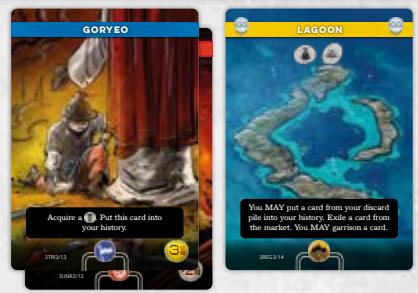
Prince Shotoku Taishi is a uniquely powerful card which is placed into History after just one use, so let's make the most of him: he can Find one of two very strong cards from your Nation deck as well as Return Unrest or allow you to Free play a late-game, Empireonly card. Looking at the Metropolis in the Market, a plan involving this second option forms...
①

MARKET


DEVELOPMENT AREA +
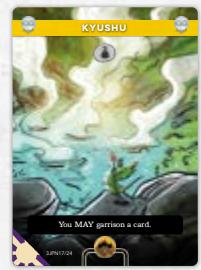
ACCESSION AND NATION POWER CARD
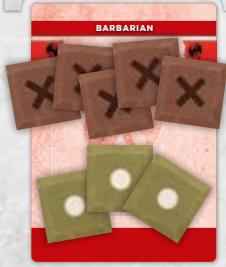

CARDS IN PLAY
PLAYER AREA

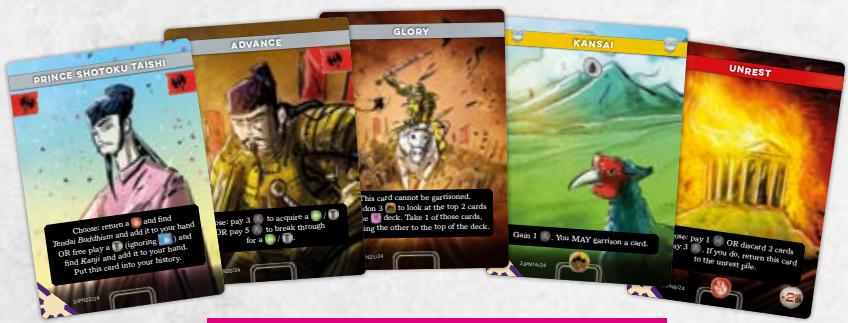
CARDS IN HAND

2 Then you use aatoken to play Advance, Paying 3eto Acquire the Metropolis, along with all three tokens currently on it and the Unrest underneath it. (In the future you could spend thisas 2e through substitutions (see page 39) – so in effect the net cost of this Action was only 1e!)
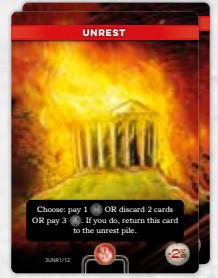
A new card is placed in the Market – Mercenaries – and a new Unrest is placed underneath it. This leaves only 1 Unrest in the Unrest pile, so the game is in danger of Collapse!
Finally, you add Advance to the discard pile.


⑤
You Free play the Metropolis (ignoring itssymbol), then find Kanji out of your Nation deck adding it to your hand and shuffling the rest of your Nation deck - except your card - afterwards. You place Prince Shotoku Taishi in your History.
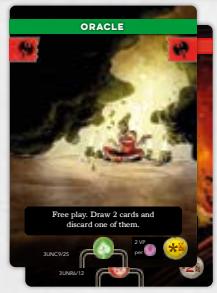
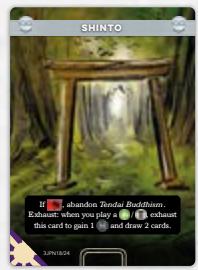
As you played Metropolis, aTcard, you can also Exhaust Shinto to gain 1and Draw 2 cards. You Draw Clans and another Unrest.
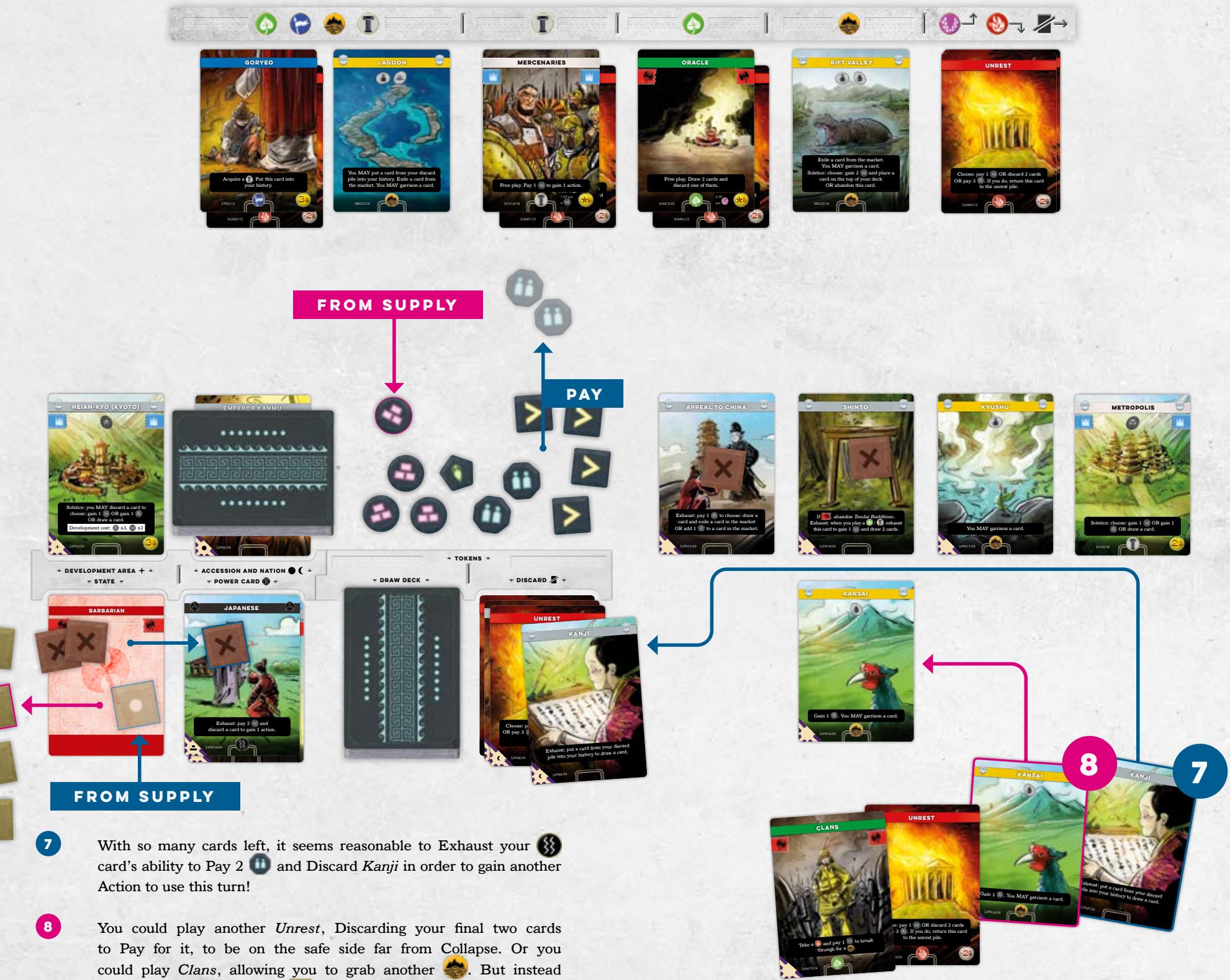
You could play another Unrest, Discarding your final two cards to Pay for it, to be on the safe side far from Collapse. Or you could play Clans, allowing you to grab another .But instead you opt to use your bonusDto play the Region Kansai, gaining 16and getting you closer to the 3-Region threshold necessary for a future play of Glory. You have the option to Garrison (see page 38) Clans or an Unrest, but you choose not to.

Next, you need to decide which cards to Discard before Drawing back up to your hand size of 5. There are 3 cards still left in your deck, so you opt to Discard Unrest A and keep only Clans in your hand. This means you need to Draw 4 new cards, but after Drawing the last three of your Draw deck you need to reshuffle your Discard pile: you place a Xtoken on your Nation deck and flip the top card (Nara) into your Discard pile Then you shuffle the Discard pile and create a new Draw deck from which you take your final card D
Since you were the last player of this round, all players now move on to the Solstice. Your new Metropolis gives the option to gain 1, 1 ①, or Draw 1
Content is long; only the first part is inlined. Download the file or open the rules page for the full text.
Download MarkdownTexts are community-compiled or publicly released by publishers; copyright remains with the original authors. For personal reference only.