
In The Shadow Of The Emperor
At a glance
Rules, cards and Q&A (Chinese)
The rules, card data and player questions for this game are written in Chinese. Open the Chinese page to read them.
Where to find full rules
Full rules and card lookup are available in the cunlema app at cunlema.cn — pick this game and ask about any rule, card or turn you are unsure about.
Related games
Rulebook text (Markdown)
This game has 1 rulebook Markdown file(s) in our library; 1 rendered inline below — expand to read or download.
In the Shadow of the Emperor - Instructions.md21.3 KB
In the Shadow of the Emperor (Im SchaƩen des Kaisers)
von Ralf Burkert
OBJECTIVE
In the Shadow of the Emperor takes place in medieval Germany. We represent noble families, vying for power by placing family members in posiƟons of influence, and aƩempƟng to claim the Emperorship and the Electorates, which grant votes for the next Emperor.
THE TEACH
The board has several secƟons. In the top leŌ is the “Thaler Track”, that keeps track of player’s money (thalers). Across the top is the Heiliges Römisches Reich, which contains the Emperor’s Throne” and the “Round Track”, as well as showing the emperor’s bonus for the current round. On the right, we have spaces for the victory point cards.
The rest of the board shows the seven Electorates. Each electorate has a space at the top for the current Elector (the noble who holds the vote for the electorate), and it shows the elector’s privilege. Beneath this, we have aristocrat spaces for nobles/knights who vote for the elector, ciƟes (which provide influence and income), and some electorates have castles, which can only hold knights in them.

3 Cities
Each player chooses a color and takes the corresponding playing material:
Each of player has a few diferent kinds of game pieces:
Nobles show a single baron on one side, and a married couple on the other. The numbers around the outside show the current age of the noble. These tokens can be placed in the aristocrat spaces, to gain influence in an electorate, and they can also be promoted to Elector or Emperor (with some limitaƟons).
Knights can either be placed in a castle or an empty aristocrat space. A knight in an aristocrat space can be bumped out by a noble, in certain circumstances, but can also potenƟally be promoted to a noble. A knight in a castle cannot be bumped, but also cannot be promoted while in the castle.
CiƟes when built in electorates increase your influence, earn VPs, and extra income.
Imperial CiƟes are placed by the Emperor at certain Ɵmes during the game. They provide addiƟonal influence for the current Emperor, but do not provide income.
Taler is used to mark the amount of money you currently have. The chip, placed on the side of the thaler track at the beginning of the round, shows how much money you started with, in case you need to re-count in the middle of Phase 4: AcƟons.
Vote card is used to indicate your vote in the case of an elecƟon. Sword indicates a vote for the Rival, while the other side indicates a vote for the current Emperor.
Round marker and Emperor pawn look the same. One goes to round track, to indicate current round. Other given to the current Emperor, to indicate them as the start player.
AcƟon cards are purchased during Phase 4: AcƟons.
SETUP

7 Nobles: The tiles show a Baron on one side and a Couple on the other. The four numbers of 15, 25, 35, and 45 are their ages.


The following parts are placed on the game board:
1 Player Aid

1 Round Marker: placed on space 1 of the round track.
The Victory Point cards are placed on the spaces sorted by numerical value.
The following parts are placed next to the game board:

NOTE: Separate the AcƟon Cards into 13 stacks. Each stack must contain cards of the same type, OR use the Player AcƟon Board and Player Cubes instead. When playing with 2-3 players, not all AcƟons cards are used, see Appendix.
Randomly decide on a Start Player. They are the current Emperor and get the Emperor Pawn and place an Imperial City onto a City in any Electorate of his choice.
The visible tower symbolizes 1 power point for Emperor
Using the Placement Aid the players place Nobles on the game board. The current age of a Noble is the number at the top of the Noble Ɵle. StarƟng with the Emperor and proceeding clockwise, the players place Nobles:

1) The Emperor places a Baron of age 45 on the Emperor Throne. All other players place a Baron of the same age on a free Elector space in any available Electorate.
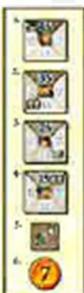
2) All players place a Couple of age 35 on a free aristocrat space in any Electorate.
3) All players place a Baron of age 25 on a free aristocrat space in any Electorate.
4) All players place a Couple of age 15 on a free aristocrat space in any Electorate.
5) All players place a Knight on a free aristocrat or castle space in any Electorate.
6) All players place their Taler Marker on number 7 on the dark-blue side of the Taler Track and their Chip marker on the number 7 on the light-blue side of the Taler Track.
Each player now has 4 Nobles and 1 Knight placed on the board. Phases 1, 2, and 3 are skipped during the first round, therefore the game starts at Phase 4 (AcƟons).
GAMEPLAY
Game is played over 5 Rounds with 8 Phases each. Phases 3 and 4 start with the Emperor (Start Player) and play goes in clockwise order. During other Phases, player order doesn’t maƩer.
PHASE 1: INCOME
Players receives a base income of 6 talers and may potenƟally receive extra income:
1 Taler for each of his CiƟes on the board
1 Taler for each opponent’s City where he is an Elector
2 Talers if he is the Elector for the Sachsen Electorate
Move both the taler marker and the cardboard chip to the appropriate number on the thaler track. Players can only have a maximum of 12 Talers, therefore, players should prioriƟze spending Talers or risk forfeiƟng rest. Imperial CiƟes do not earn income for the Emperor.
PHASE 2: AGING
StarƟng with the Emperor’s Throne and ending with Böhmen, players will adjust ages of nobles. Each noble who is age 45 are returned to player’s supply. If Emperor removed, then the Emperor player must take one of his Nobles (Baron or Couple) from the board (but not an Elector) and place him on the Emperor’s Throne. If unable, he uses a Baron of age 45 from his supply. All other nobles are rotated 90 degrees clockwise (adding 10 to their age). If an elector is removed from the board, they are not replaced at this Ɵme.
PHASE 3: DESCENDANTS
StarƟng with the Emperor, each player compares the number of pink and blue acƟon cards that they purchased in the previous round. AŌer this phase is resolved, all acƟon cards are returned to the stock piles.
If more blue cards than pink cards, you have a son: place a single baron counter, at age 15, in an empty aristocrat space on the board. If all aristocrat spaces in an electorate are full, then they can bump a knight out of an aristocrat space in that electorate and claim it. However, they cannot bump a noble.
If equal or more pink cards than blue cards, you have a daughter. You may propose marriage to an opponent’s (specific) single baron on the board. If the player accepts, they turn that baron over to the “couple” side, keeping the same age, and you get 1 VP. If they decline (or if you choose not to propose marriage), your daughter joins a convent, and you get 1 thaler. Your daughter cannot marry your own baron.
If a player has no AcƟon cards in front of him, he does not have a descendant.
PHASE 4: ACTIONS
StarƟng with the Emperor, and going clockwise, each player has the opƟon to either buy and use an acƟon card, use an elector’s privilege, or pass. This proceeds unƟl everyone has passed.
Buy and Use an AcƟon: Each acƟon costs a certain number of thalers, shown in the gold circle in the top right of the card. The phase that each acƟon takes efect is shown in the top leŌ of the card. Cards that take place in Phase 4 happen immediately, while the efects of those that happen in Phases 5 or 6 are determined at the beginning of those phases. If an acƟon card purchased, acƟon must be performed. If you cannot perform acƟon, then card can’t be purchased. If you purchase a card, and something happens aŌerwards so that you would no longer be eligible to purchase the card, you sƟll gain the efect of the card. There are only a certain number of each acƟon card. If there are no more of an acƟon card leŌ, then you cannot buy that acƟon.
NOTE: "Knight" acƟon card is always available to any player who has not passed yet.
NOTE: "Rival" acƟon card instantly ends Phase 4 for that player. Emperor may not take.
NOTE: "Grey Eminence" acƟon card can only be taken by the Elector of Brandenburg.
Elector’s Privilege: A player can use the privilege of one of his Electorates that he is an Elector of, move him onto the space depicƟng the privilege, to indicate that it has been used. See appendix for an explanaƟon of the Elector’s Privileges.
Pass: Once a player has passed, he may take no more acƟons this phase.
PHASE 5: NEW ELECTORS
For each Electorate, players count their Power Points. The Power Points come from Knights (1 Point), CiƟes (1 Point), Nobles (Baron = 1 Point, Couples = 2 Points), and Imperial CiƟes (1 Point, but only for current Emperor). The player with the most Power Points in an Electorate is the new
Elector of that Electorate. If there is a Ɵe for the most Power Points, Emperor selects amongst the Ɵed players the new Elector of that Electorate.
Elector Remains: player who keeps his Elector does not get any VPs, excepƟon for Mainz, player gets 1 VP for keeping Mainz.
Old Elector Replaced: New Elector gets 2 VPs and replaces Old Elector with one of his Nobles from that Electorate. The Old Elector is placed in a free aristocrat space in that Electorate, otherwise returned to player’s supply. Religious Electorates of Trier, Mainz, and Köln can only have a Baron (not a Couple) be the Elector of these Electorates.
Old Elector Replaced But No New Elector Available: Old Elector is moved to a free aristocrat space and Elector space leŌ vacant. No player gets VPs and the Electorate cannot take part in the next Elect Emperor, if an elecƟon takes place this round.
PHASE 6: ELECT EMPEROR
This phase takes place only if a player bought the card “Rival” during Phase 4. Using the vote cards, everyone (who control at least one vote, Emperor and Rival always take part in elecƟon regardless if they have no votes) must cast all of their votes either for the current Emperor (the side without the sword) or the Rival (the side with the sword). The Emperor and Rival must vote for themselves. If the Rival has more votes than the Emperor, they take control of the Emperor’s Throne, otherwise the current Emperor holds on to power. Each player (other than the Emperor and Rival) who voted for the winner of the elecƟon gets 1 VP.
The voƟng procedure follows:
1) Each player calculates his total votes. Each Electorate that he is an Elector of gives him 1 vote, however Böhmen receives 2 votes instead of 1 vote. The following AcƟon cards can modify a player’s votes: “Pope”, “Church Influence”, and “ExcommunicaƟon” (these are the blue acƟon cards displaying 1-3 thumbs), see appendix for more informaƟon.
2) Each player places his Vote card in front of him, so it displays “For the Emperor” OR “Against the Emperor” side. Players hide their vote card with their hand so the other players can not see which side is selected.
3) The current Emperor and his rival must vote for themselves.
4) All voƟng players must vote, no player may pass.
5) When all players make their decisions the Vote cards are revealed, the votes are counted, and the new Emperor is declared.
Determine winner and award VPs as follows:
If a Ɵe OR current Emperor gets most votes, they remain on the Emperor’s Throne.
If the Rival gets most votes he becomes the new Emperor.
o He takes the Emperor marker and places one of his Nobles from the board (Baron or Couple) on the Emperor’s Throne, but cannot move an Elector from
one of his Electorates. If he has no Nobles on the board, he must use a Baron of age 45 from his supply.
o The old Emperor is removed from the Emperor’s Throne and is placed in any free aristocrat space. If no free space in the chosen Electorate, a Knight is replaced.
Award VPs to the players who voted for the winner, except for the winning candidate.
PHASE 7: EMPEROR’S ACTIONS
The Emperor executes the acƟons displayed under the Round Track for the current round.

Round 1: 2 Victory Points AND place or may move an Imperial City
Round 2: 2 Victory Points AND place or may move an Imperial City
Round 3: 2 Victory Points AND place or may move an Imperial City AND receive 1 Taler
Round 4: 1 Victory Point AND receive 2 Talers
Round 5: 1 Victory Point
NOTE: Emperor places or moves 1 Imperial City to any free City space on the board.
PHASE 8: NEXT ROUND OR GAME END
The Round marker is moved one posiƟon to the right on the Round Track and a new round starts at Phase 1, unless this is the 5th Round, see End of Game.
END OF GAME
The game ends aŌer the fiŌh round. All players now count their Victory Point cards and the player with the most VPs wins the game. There is no Ɵebreaker.
APPENDIX – ACTION CARDS
 | "Rival" (cost: 0 Talers | 1 card)Player becomes the rival for the Emperor's Throne and takes no further actionsin Phase 4: Actions. This card cannot be taken by the current Emperor. |
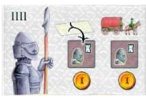 | "Knight" (cost: 1 Taler | 1 card)Player places a new OR moves an existing Knight to a free aristocrat or castlespace. Action is always available to any player who has not passed yet. |
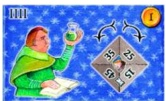 | "Doctor" (cost: 1 Taler | 3 cards for 4P, 2 cards for 3P, 1 card for 2P)Player EITHER reduces age of his noble by 10 years OR increases opponent by10 years. A Noble that is rotated past age 45 returns to that player's supply. |
 | "Move" (cost: 1 Taler | 2 cards) |
| Player moves 1 Noble to another Electorate. Electors and Emperor cannot bemoved. If no empty aristocrat space, a Knight (of any player) can be replaced. | |
 | "Indulgence" (cost: 2 Taler | 1 card)Player collects one 1 VP. |
 | "Pope" (cost: 1 Taler | 1 card)Player has 1 extra vote in Phase 6: Elect Emperor. |
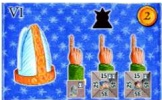 | "Church Influence" (cost: 2 Taler | 1 card)Placed in a Religious Electorate, all Nobles/Knights of an Elector's color provide1 extra vote each in Phase 6: Elect Emperor. Elector tile does not get an extravote. Play card in an Electorate, regardless if you benefit from card or not. |
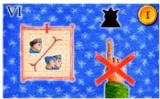 | "Excommunication" (cost: 1 Taler | 1 card)Select a Secular Electorate to be excluded during Phase 6: Elect Emperor. Playcard in an Electorate, regardless if you benefit from card or not. (If both"Church Influence" and " Excommunication" in play, execute in player order). |
 | "Permit" (cost: 3 or 5 Taler | 4 cards for 4P, 3 cards for 3P, 2 cards for 2P)Player places a Baron of age 15 for 3 Taler OR a Couple of age 15 for 5 Talerfrom his supply into a free aristocrat space in any Electorate. If no emptyaristocrat space, a Knight (of any player) can be replaced. |
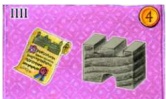 | "Ordinance" (cost: 4 Taler | 3 cards for 4P, 2 cards for 3P, 1 card for 2P)Player places one of his Cities on a free City space in any Electorate. Gain 1 VPfor first and second Cities built, third City built gains player 2 VPs. |
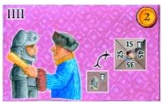 | "Promotion" (cost: 2 Taler | 1 card)Player swaps one of his Knights in an aristocrat space, not a castle, for a Baronof age 15 from his supply. The Knight is returned to player's supply. |
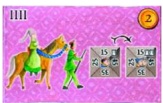 | "Foreign Daughter" (cost: 2 Taler | 1 card)Player flips one of his Barons to Couple side without changing the age. TheElector of a Religious Electorate cannot be changed. |
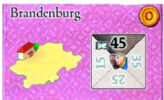 | "Grey Eminence" (cost: 0 Taler | 1 card)Only Elector of Brandenburg player may take card. At beginning of Phase 5:New Electors, he can place a Baron of age 45 from his supply beside an Electorin any Electorate. Player gets 1 bonus Power Point in that Electorate. Baron willbe removed in Phase 2: Aging. Baron can never become an Elector or Emperor. |
APPENDIX – ELECTOR PRIVILEGES
An Elector’s Privilege can only be used by the player who is the Elector of that Electorate. If the posiƟon is empty, no one can use that privilege. When a Privilege is used, the Elector Ɵle is moved on the Privilege space indicaƟng that the acƟon has been taken. In the beginning of the next round all moved Ɵles are placed in their Elector space.
| Trier: in Phase 4: Actions, buy and perform an action card for Phase 4 only. | |
 | Köln: in Phase 4: Actions, perform the “Doctor" action card for free. |
| V4 | 8 | Mainz: at end of Phase 5: New Electors, get 1 VP. | ||
| mTIE | 38 | Rhein: in Phase 4: Actions, as a free action place a new Baron of age 15 to afree aristocrat space in any Electorate. | ||
| 1② | 30 | Sachsen: in Phase 1: Income, gain 2 extra Talers. | ||
| m国 | 2日 | Brandenburg: in Phase 4: Actions, buy “Grey Eminence" card and perform theaction in Phase 5: New Electors. | ||
| VI | 38 | Böhmen: in Phase 6: Elect Emperor, receive 2 votes instead of 1. | ||
2 PLAYER SETUP & RULES
For a game with two players, a religious and a secular Electorate are excluded from the game.
1) Take the 3 “Doctor” cards from the AcƟon cards. The three religious Electorates are depicted on the back. The cards are shufled face down and an Electorate is drawn.
2) The 4 “Permit” cards are selected from the AcƟon cards. The four secular Electorates are depicted on the back. The cards are shufled face down and an Electorate is drawn.
3) These 2 drawn Electorates are not played and are each covered with a voƟng card.
AddiƟonally, the AcƟon cards that have 3 or 4 heads on the back are removed from the game. Players can purchase AcƟon cards that they cannot or do not want to use. However, players must pay for these cards in full. Otherwise, everything stays the same as in a four player game.
3 PLAYER SETUP & RULES
For a game with three players, all the AcƟon cards that have 4 heads on the back are removed from the game. Otherwise, everything stays the same as in a four player game.
Download MarkdownTexts are community-compiled or publicly released by publishers; copyright remains with the original authors. For personal reference only.