
John Company
At a glance
Rules, cards and Q&A (Chinese)
The rules, card data and player questions for this game are written in Chinese. Open the Chinese page to read them.
Where to find full rules
Full rules and card lookup are available in the cunlema app at cunlema.cn — pick this game and ask about any rule, card or turn you are unsure about.
Related games
Rulebook text (Markdown)
This game has 2 rulebook Markdown file(s) in our library; 2 rendered inline below — expand to read or download.
rules_zh_John_Company_4213.md51.4 KB

兴衰史
于18世纪崛起的垄断贸易
以及为命运抗争的家族
翻译/排版:Lieber

A GAME OF SNAKES and LADDERS authored by COLE WEHRLE.
Published by
PHIL EKLUND
and his illustrious venture
SIERRA MADRE GAMES.
A. 通用规则
A1. 概述
游戏过程中,所有玩家共同运营公司,玩家将晋升各自家族成员在东印度公司的职位,希望借此扩大家族财富,提升他们在上流社会的声誉。
每场游戏因公司的表现而不同。公司通常会尝试在印度建立有利可图的贸易关系和政治立足点,但其目标在很大程度上取决于玩家。
A2. 学习游戏
《约翰公司》是一款沙盒游戏,这意味着玩家们在游戏过程中可能仅会探索游戏的一小部分内容。学习游戏最好的方法是设置一场模拟游戏并完成前两个回合的游戏,在需要时查阅相关规则。进行游戏教学时,仅需要有一名玩家熟悉全部的规则。许多游戏机制可以在游戏开始后被说明。
在此规则书中,容易被忽视的内容均以粗体字标示。示例和提示均以斜体字标示。描述特定游戏概念的术语均以姚体字标示,并在首次使用时被定义。被引用的规则均配有标题,如竞选行动(F7)或采购办事处(F5)。
紫色文本为仅适用于2或3人游戏的规则。
A3. 地区和辖区
游戏中有8张地区牌,代表了现今巴基斯坦、印度和孟加拉国组成的区域。
每张地区牌包括几个重要元素。
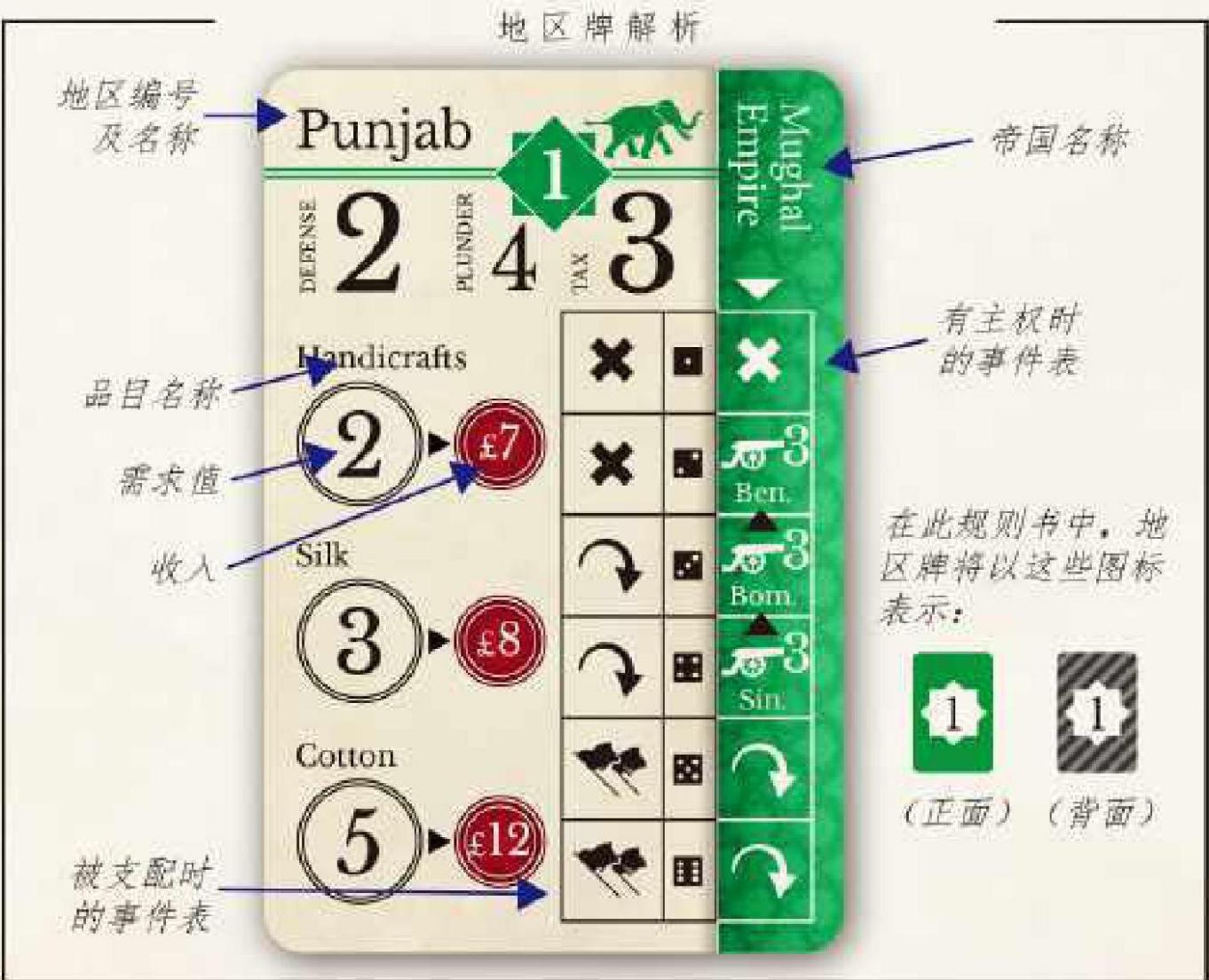
此外,各个地区有不同的经济状况、政权状况和贸易状况,这些状况由地区牌实际的摆放方式指示。
经济状况:即一个地区是繁荣的或是萧条的。地区牌的两面分别为繁荣面(普通)和萧条面(灰色并印有条纹),一个地区的经济状况由地区牌向上的一面指示。
政权状况:即一个地区是被支配的或是有主权的。一个地区能够被其他地区或东印度公司支配。被支配的地区及其支配者组成一个帝国。对被支配的地区牌,其事件表的右侧部分被支配者覆盖;对有主权的地区牌,其事件表的右侧部分是可见的。
贸易状况:即一个地区对不列颠贸易是开放的或是不开放的。不开放的地区牌被摆放至版图的左侧;开放的地区牌被摆放至版图上方三个辖区之一的顶部。
从历史上看,为了促进在印度的贸易,东印度公司采用辖区制度。每个辖区均为一个完全独立的行政单位。在《约翰公司》中,一个辖区包括公司办事处(辖区办事处官员,F7)、办事处资产(资金、船和货物)、军队以及对其开放的地区。
辖区通过成功的开放贸易行动(F7)和军事行动(F7)扩大。这些行动还设立了公司用于管理其新领土的地方办事处(总督办事处与居民办事处)。辖区可能因起义或征服(H2)而缩小。若某个辖区旁没有地区牌,则其被废除并将不会被再次使用。
A4. 印度平衡
在《约翰公司》中,八个地区的总体稳定性由版图左下角印度平衡条上的标记指示。该标记将始终位于三个空格中的一个:有序(左侧)、平衡(中间)或混乱(右侧)。发生事件时,根据印度平衡的状态掷骰子。处于有序状态的场合,掷两个骰子并取最小值;处于混乱状态的场合,掷两个骰子并取最大值;处于平衡状态的场合,仅掷一个骰子。
| 印度平衡 | 有序 | 平衡 | 混乱 |
| 掷骰数量 | 2 | 1 | 2 |
| 结果取值 | 最小值 | 结果 | 最大值 |
在游戏过程中,印度平衡可能发生变化。这些变化被称为倾斜。当发生倾斜时,印度平衡条上的标记向倾斜的方向移动。若标记已位于倾斜方向的空格中,则其不移动。
A5. 办事处和为公司工作
游戏中,玩家们会获得和失去对东印度公司办事处的控制。玩家的家族成员(方块)通过晋升在公司中移动。通常,文职人员首先被晋升为高级官员,然后被晋升为行政官员。当某位玩家控制某个办事处时,其将其一个方块摆放至该办事处旁的官员槽位。该方块被称为官员并将允许其拥有者控制公司行为的各个方面。
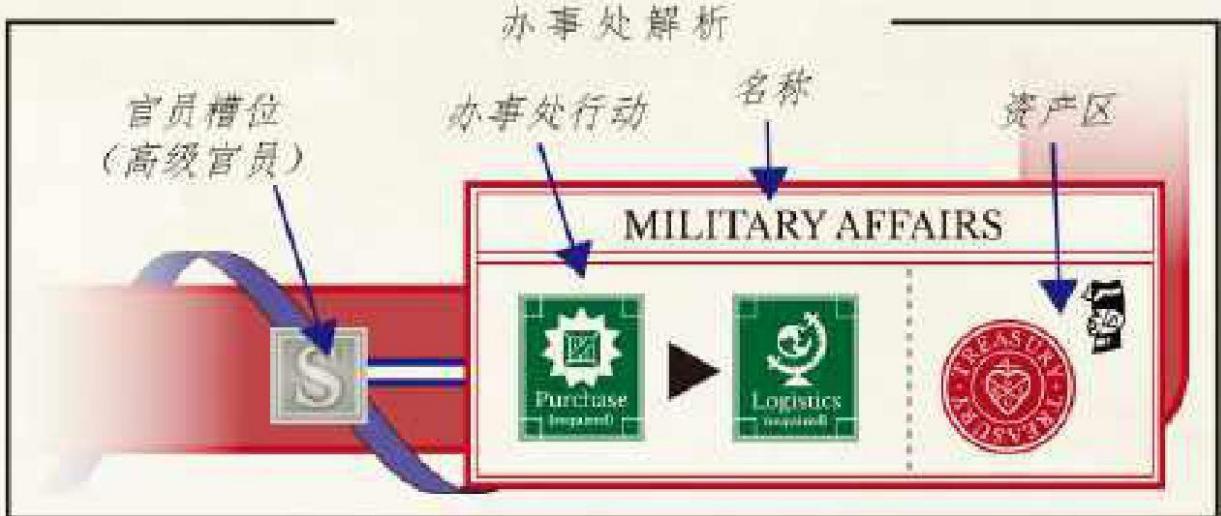
通常,官员因裁员(H3)离开公司,这是游戏主要的计分机制。玩家们并不完全掌控此过程。但是,一位玩家在公司中拥有的家族成员越多,其某些家族成员越可能因裁员离开。当某个官员因裁员离开公司时,其拥有者可以将其移动至奖励牌上,以资金换取分数和特殊能力。通常,官职越高,资金和分数的转换率越有利。
A6. 资金流
在《约翰公司》中,资金流动及其位置至关重要。资金必须始终位于一个家族的资产区(玩家面前)或一个办事处的资产区(见下方图标)。公司通过其在印度的贸易将大量资金引入游戏中。玩家们可以通过分红(G6),或将他们的家族成员摆放至各主要办事处并从公司活动中获得暴利,来获取这些资金。每当玩家领取奖励、执行家族行动或执行公司行动时,部分资金离开游戏。
A7. 谈判 & 承诺

玩家们可以在游戏中自由进行讨论和谈判,尽管玩家对未来行动的承诺可以不被兑现。以下物品可以被赠予其他玩家:
家族拥有的资金和船。
供应区的方块(它们成为人质,见下文说明)。
家族牌上的人质。
家族拥有的货物和公司失去垄断地位(I3)后的股份。
作为谈判内容的一部分,玩家可以将其供应区中的一个或多个方块赠予其他玩家。这些方块由对方玩家持有,被称为人质。游戏结束时,玩家每有一个人质被其他玩家持有,即失去2分。下列任意一种情况下,一个人质必须被放回其拥有者的供应区:
† 人质的拥有者向持有人质的玩家支付£2。
†人质的拥有者优先晋升持有人质的玩家的一个家族成员,且优先于至少一位其他玩家。
人质的持有者放回人质。若该人质的拥有者持有对方的人质,则将其中一个放回。
示例:德鲁需要资金,但他并没有。他向其他玩家借£5。查斯乐意借给他,但前提是德鲁将四个人质抵给他。德鲁同意了。若德鲁没能在游戏结束前赎回这些人质,他将失去8分。

A8. 消耗
某些游戏配件可能在游戏过程中被消耗。当某个配件被消耗时,其必须被摆放至对应区域。被消耗的配件不能被使用,直至下次刷新(H5)后。
B. 配件
B1. 游戏配件
每盒《约翰公司》包含以下配件(未按比例绘制):
游戏版图

6 张家族牌

8张地区牌



5
5个状态标记方块
8张地方办事处牌
木质大象
[NO TEXT]
5
The quick brown fox jumps over the lazy dog.

19张晚报牌
后垄断牌
e单
[Unreadable]
EP
[Unreadable]
©有
①
©甲
eP
©非
©
CIP
[Unreadable]
①
①非
甲
中
中
C39
[Unreadable]
18张奖励牌
P
P
P
P
P
P
P
P
P
P
P
P
P
P
P
P
P
P
30艘船
30个货物
当然还有此规则书

圆片,30个白色、15个红色、15个蓝色、20个黑色

10个骰子
£3
£10

B2. 配件数量上限
若玩家们用尽了船、货物或钱,可以寻求一些替代品。但是,家族方块的数量受严格限制(E3)。
C. 设置
C1. 选择一个场景
从K章节所列场景中选择一个。这些设置规则适用于“早期公司”场景(K2),其他场景在此基础上可能有所调整。
2或3人游戏时,使用琼斯家族(C4、F3、K1)。
C2. 版图、奖励和事件
将版图摆放至桌面中央。随机抽六张奖励牌,正面向上在版图底部摆成一排。
“被撤销的垄断(Monopoly Revoked)”和“取消贸易垄断权(Revoke Monopoly)”在此场景中不被使用,将这两张牌以外的所有晚报牌洗混,组成晚报牌堆,正面向下摆放至版图右上角。
分别将一个状态标记方块摆放至:
股价条“4”的空格。
游戏回合条“1”的空格。
公司收入条“0”的空格。
印度平衡条中间的空格。
版图右下角的议会图标。
将一个黑色圆片摆放至驻华商务总监(SUPERINTENDENT OF TRADE IN CHINA)办事处(F9)的官员槽位。
C3. 家族牌、资金和方块
每位玩家拿取一张家族牌(家族面向上摆放至各自面前)和起始资产£5。
家族能力。每张家族牌均有一个独特的能力,只要家族面向上即有效。
每位玩家选择一个颜色,并根据玩家人数拿取对应数量的方块,摆放至玩家家族牌的上方。这些方块即玩家的起始方块。
| 玩家人数 | 2 | 3 | 4 | 5 | 6 |
| 起始方块数 | 8 | 7 | 6 | 5 | 5 |
然后,每位玩家另外拿取12个方块,摆放至玩家家族牌的下方。这些方块组成玩家的供应区。将剩余方块放回盒中。
随机选择一位玩家,所有玩家从该玩家开始,按顺时针顺序依次将一个起始方块摆放至任意空置的官员槽位(蓝色丝带穿过的空格)。所有玩家均已摆放一个起始方块后,从最后一个摆放的玩家开始,按相反顺序重复此过程,直至所有官员槽位均已摆放起始方块。
当一个方块被摆放至一个行政办事处(金色空格)时,额外将1个同颜色的起始方块摆放至董事会(COURT OF DIRECTORS)。

公司所有的官员槽位均已摆放起始方块后,玩家们为每个剩余的起始方块掷一个骰子,并将起始方块摆放至掷骰结果对应的资源区。
将方块摆放至船坞(SHIPYARD)资源区时,摆放至任意列中数字最大的空格(将方块摆放至某个印有“5”的空格时,其上方印有“6”的空格中必须已有方块)。
将方块摆放至军官(OFFICER)或船长(CAPTAIN)资源区时,将玩家供应区中的一个方块摆放至文职人员(WRITER)资源区。
每当一个方块被随机摆放至董事会时,董事长(CHAIRMAN)必须立即从银行拿取£4收入(G5)并分配至任意办事处。
教学提示:首次游戏的场合,玩家摆放起始方块时,沿丝带摆放至下一个空置的官员槽位。
C4. 配件供应区和起始公司资产
将货物、船、图片摆放至游戏版图旁。
在各办事处的资产区分别摆放£5。
在各辖区分别摆放两艘船。将六艘船摆放至船坞资源区的指定位置,将十个货物摆放至工厂(FACTORY)资源区的指定位置。
C5. 地区牌
参考下图摆放地区牌。
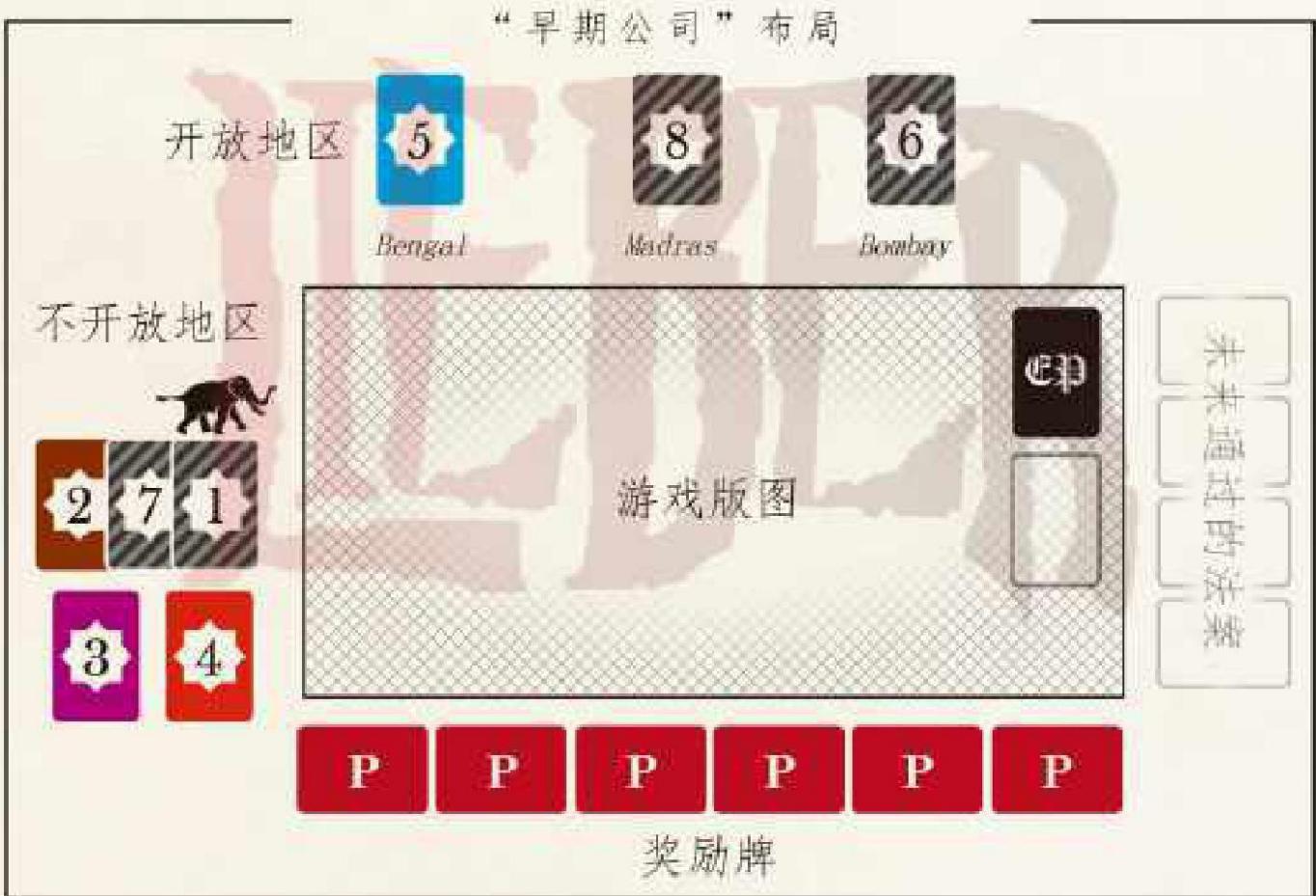
将地方办事处牌摆放至游戏版图旁。
将大象摆放至旁遮普(Punjab)地区牌上。
现在可以开始游戏了。
D. 游戏流程
D1. 回合结构
每个回合包含四个阶段:
家族阶段:所有玩家从董事长开始,依次进行一个家族行动。
公司阶段:填补官员槽位后,所有办事处从船舶采购(SHIPS PURCHASING)办事处开始依次运作。
贸易阶段:获得并分配收入。
晚报阶段:展示并结算一张新的晚报牌。
E. 家族阶段
E1. 概述
所有玩家从控制董事长办事处的玩家开始,按顺时针顺序依次进行一个家族行动。若董事长办事处的官员槽位空置,则从上一位控制董事长办事处的玩家开始。
E2. 家族行动
每个回合中所有玩家均必须执行一个家族行动。选择一个资源区,并将一定数量的方块摆放至其中。若该资源区的名称旁印有费用,则玩家摆放方块前必须向银行支付费用,且必须从其家族资产区中支付。被摆放的方块的名称就是其所在资源区的名称(被摆放至船坞资源区的方块即代表一个船坞)。

某些资源区有额外的限制条件:
船坞 $^{2}$ 和工厂:将方块摆放至船坞和工厂资源区时,必须摆放至其中的空格。将方块摆放至某个印有“5”的空格时,其上方印有“6”的空格中必须已有方块。
股份 $^{3}$ :将方块摆放至股份资源区的费用等于当前的股价。由董事长立即将支付的费用分配至各办事处。若董事长办事处的官员槽位空置,则将支付的费用摆放至董事长办事处,在选出新董事长后立即分配。
文职人员、军官和船长:玩家每个回合中可以将一个或两个方块摆放至这些资源区中的一个。2或3人游戏的场合,玩家每个回合中可以将至多三个方块摆放至这些资源区中的一个。
庄园(MANOR):玩家每个回合中仅可以将一个方块摆放至庄园资源区。
E3. 方块管理
玩家受其供应区中方块数量的限制。当某位方块已耗尽的玩家需要摆放一个或多个方块时,其必须改为使用其在任意奖励牌上或庄园资源区中的方块。若其在奖励牌上和庄园资源区中均没有方块,则不必在该回合中执行家族行动。
E4. 琼斯家族行动(仅限2或3人游戏)
每位玩家均执行一个家族行动后,琼斯家族将方块摆放至资源区。2人游戏的场合,掷4个骰子;3人游戏的场合,掷2个骰子。然后为琼斯家族选择一种未被使用的颜色,为每个骰子,将该颜色的一个方块摆放至掷骰结果对应的资源区(正如C3)。但是与C3不同的是,将方块摆放至船长或军官资源区时,不将方块摆放至文职人员资源区。若琼斯家族的方块耗尽,则再选择一种未被使用的颜色。将琼斯家族获得的资金支付给银行。琼斯家族的船长会以银行的资金购买位于最左侧的船。琼斯家族将方块摆放至船坞资源区时,摆放至位于最左侧的、印有“6”的空格,若该空格中已有方块,则摆放至位于最左侧的、印有“5”的空格。琼斯家族将方块摆放至股份资源区时,董事长立即从银行拿取等于当前股价的资金,分配至各办事处。注意:琼斯家族在设置时不摆放方块。
F. 公司阶段
F1. 概述和办事处行动
公司阶段中,公司各办事处将有机会执行行动。首先由董事长填补官员槽位。然后,所有办事处从船舶采购办事处开始,沿红色公司轨依次运作。地方办事处在对应辖区办事处运作后按设立的顺序运作(由最早设立的地方办事处先运作)。当某个办事处运作时,必须按印有的顺序结算其行动。蓝色和黑色行动均是可选的,其中蓝色行动需要进行判定(F2):绿色行动是强制的。若某个行动有费用,则必须以该办事处的资金支付。
F2. 判定和结果
蓝色行动需要进行一次判定 $^{5}$ 以决定行动是否成功。进行判定时,由一位玩家掷骰,掷骰数量等于该行动的强度值减判罚值(判罚值请见各行动的说明)。掷骰结果中,仅最小的点数生效。1或2点判定为成功;3或4点没有效果;5或6点判定为失败,对应的官员立即被放回其拥有者的供应区中。没有官员的办事处在此回合中不能继续运作。只要判定未失败,蓝色行动可以被多次执行。
F3. 填补官员槽位
公司阶段开始时,填补所有空置的官员槽位。从董事长办事处的官员槽位开始,沿蓝色丝带依次填补官员槽位。地方办事处的官员槽位在对应辖区办事处的官员槽位被填补后按设立的顺序填补。罕见情况下官员槽位无法被填补,则对应办事处在此回合中不能运作。
琼斯家族不参与投票,家族成员不能被提名为董事长,官员不能被晋升。
董事长选举:董事会选出一位玩家成为新的董事长。由前任董事长先进行提名。所有在董事会中有至少一个方块的玩家均可以被提名。提名后,所有玩家(从被提名的玩家开始,按顺时针的顺序)依次可以选择是否以其在董事会中的所有方块支持被提名的玩家。每个方块提供一票。被提名的玩家可以选择不支持自己。若被提名的玩家获得支持票的数量超过董事会中方块数量的50%,则董事长选举结束,被提名的玩家成功获选,将其在董事会中的一个方块摆放至董事长办事处的官员槽位;否则,由上一位进行提名的玩家左侧的玩家进行提名。若所有玩家均已进行提名,但均未成功获选,则由前任董事长从未成功获选的玩家中选择一位成为新的董事长。新董事长必须立即将董事长办事处的资金分配至各办事处。
其他办事处的官员槽位按以下规则填补:
行政官员槽位:由董事长将位于高级官员槽位(印有灰色“S”)的方块移动至行政官员槽位。若高级官员槽位中均没有方块,则董事长将文职人员直接移动至行政官员槽位。
地方办事处的官员槽位:由对应辖区办事处的官员将文职人员或任意军队中的军官移动至地方办事处的官员槽位。
采购办事处的官员槽位:由商务总监(DIRECTOR OF TRADE)将文职人员移动至采购办事处的官员槽位。
裙带关系:当填补除董事长以外官员的槽位时,玩家们可能因裙带关系而被惩罚。若某位玩家晋升其自己的家族成员而非其他玩家的家族成员时,其必须分别将其供应区中的一个方块作为人质赠予每位至少有一个候选家族成员的玩家。琼斯家族在场的场合,改为两个方块。
示例:在一场4人游戏中,董事长科尔从船舶采购办事处将其一个家族成员晋升为马德拉斯辖区的行政官员。查斯在其他办事处有高级官员。由于科尔没有晋升查斯的高级官员,其必须给查斯一个人质。
F4. 董事长和贷款行动
董事长可以在公司阶段的任何时候执行一次贷款行动。
贷款行动:董事长将一个黑色圆片摆放至董事会,并立即将£5分配至各办事处。每个回合的贸易阶段(G3)中,董事会中每有一个黑色圆片,公司需支付£1。此贷款永远无法偿还。

F5. 采购办事处
采购办事处包括船舶采购办事处、货物采购(GOODS PURCHASING)办事处和军务(MILITARY AFFAIRS)办事处。这些办事处均有采购行动,除此之外军务办事处还有调配行动。
采购行动:采购办事处采购尽可能多的船和货物。船舶采购办事处和货物采购办事处均将采购的船和货物移动至商务总监办事处;军务办事处将采购的货物移动至任意辖区的军队中,这些货物代表炮。
采购船:每个回合均有6艘船能够被采购。各艘船的价格即为其下方未被遮盖的最大的数字。价格最低的船必须被优先采购。一艘船被购买后,其下方每个船坞的拥有者从银行获得获得£1。

船的价格
第1艘船的价格为£4(黄色玩家和橙色玩家各获得£1)。
第2艘船的价格为£4(黄色玩家获得£2)。
第3艘船的价格为£5(黄色玩家获得£1)。
第4艘船的价格为£6。
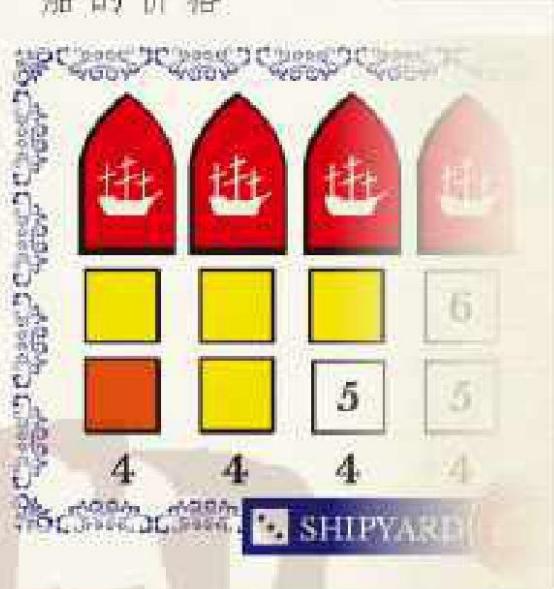
采购货物:每个回合均有10个货物能够被采购。若某个货物的下方没有工厂,则其价格为£3;若某个货物的下方有工厂,则其价格请见弃牌堆顶部的晚报牌的右上角。若弃牌堆中没有牌(例如在游戏早期),则其价格为£2。若弃牌堆顶部的晚报牌的右上角印有红色“X”,则表示仅能采购下方没有工厂的货物。价格最低的货物必须被优先采购。若采购货物的下方有工厂,则办事处向该工厂的拥有者支付费用;若采购货物的下方没有工厂,则办事处向银行支付费用。

调配行动(军务办事处):将军务办事处的所有军官和炮移动至任意辖区的军队中。若某个军队中已有三个军官,则旧的军官(回合开始时已存在于军队中的军官)必须被替换为新的军官。将被替换的军官放回其拥有者的供应区。若无法将所有军官均摆放至军队中,则将剩余的军官放回拥有者的供应区。此行动中,军务办事处的官员可以在征得某辖区的官员的同意后,将该辖区的炮移动至另一个辖区。
F6. 商务总监

调配行动(商务总监办事处):以任意顺序向商务总监办事处的所有船长提供采购船舶的机会。若某位船长同意,则其家族采购一艘船(正如F5,但可以选择采购任意船),将采购的船摆放至商务总监办事处,将该船长摆放至该船上;若某位船长反对或没有船能够被采购,则将其放回其拥有者的供应区。然后,商务总监必须将商务总监办事处的所有货物和船(无论船上是否有船长)分配至任意辖区。此行动中,商务总监可以在征得某辖区的官员的同意后,将该辖区的货物和船(无论船上是否有船长)移动至另一个辖区。
船上的船长:若某艘船上有船长,则该船即为对应家族的船。船和船上的船长视为一个配件,且始终一起移动。家族的船可以被赠予其他玩家。此情况下以新的方块(从供应区中拿取)替换旧的船长,将旧的船长放回其拥有者的供应区。
F7. 辖区办事处官员
每个辖区均有三个行动,且均需要进行判定(F2)。军事行动能够支配新的地区(若该地区是不开放的,则变为开放的)并设立新的办事处(总督办事处与居民办事处):开放贸易行动能够将不开放的地区牌移动至对应辖区;航行行动能够完成对应地区的订单以使公司获得收入,为家族获得辖区奖励(G2)。
军事行动:从军事行动图标旁的列表中选择一个目标。辖区办事处的列表中仅印有一个地区;总督办事处的列表中印有多个地区。印有的地区只要未受公司支配,即能够被选择为目标。计算军事行动的强度值。执行军事行动的办事处可以从对应辖区的军队中选择并消耗任意数量未被消耗的军官、炮。每消耗一个军官或炮,使强度值+1。被消耗的配件将在晚报阶段(H5)结束时刷新。办事处还可以雇用雇佣军以增加军事行动的强度值,每支付£2,使强度值+1。军事行动的判罚值等于目标的防守值(DEFENSE)。若目标为某个帝国的一部分,则判罚值等于该帝国所有地区的防守值之和。

胜利:若判定(F2)成功,则目标地区被征服,从现在开始被公司支配,且变为开放的。将地区牌移动至对应的辖区。将对应的地方办事处牌摆放至地区牌上,仅遮盖事件表右侧的部分。对应的官员槽位将在下个公司阶段开始时被填补。若被征服的地区是某个帝国中的支配者,则该帝国中所有被支配的地区均变为有主权且不开放的。
掠夺:若军事行动成功,则该辖区军队中每个军官的拥有者从银行获得等同于该地区掠夺值(PLUNDER)的资金,无论该军官是否已消耗。
示例:马德拉斯辖区办事处的官员查斯想要执行军事行动。马德拉斯辖区军队中有一个炮和两个德鲁的军官。查斯消耗炮和两个军官以使强度值+3。马德拉斯萧条时的防守值为1,因此军事行动的掷骰数量为2。若成功,则设立马德拉斯地方办事处,且德鲁因其两个军官从银行获得£6(掠夺)。
开放贸易行动:先决定此行动的强度值,每支付£1,使强度值+1。此行动没有判罚值。选择一个不开放且有主权的地区。若判定(F2)成功,则目标地区变为开放的,将目标地区移动至对应的辖区(A3),被该地区支配的所有地区保持被支配的状态。

航行行动:先决定此行动的强度值,每支付£1,使强度值+1。此行动的判罚值等于该辖区中的地区数量-1。若判定(F2)成功,则该辖区办事处的官员可以完成该辖区中任意数量的订单。完成一个订单时需要消耗该辖区中指定数量的货物和/或船,数量等于订单的需求值。6订单能够以任意顺序被完成,
但一个辖区中已消耗的货物不能多于已消耗的船。完成一个订单后,将一个黑色圆片摆放至该订单的需求值上,并根据订单对应的收入增加公司收入条的示数。注意:这些黑色圆片将在刷新时被移除。

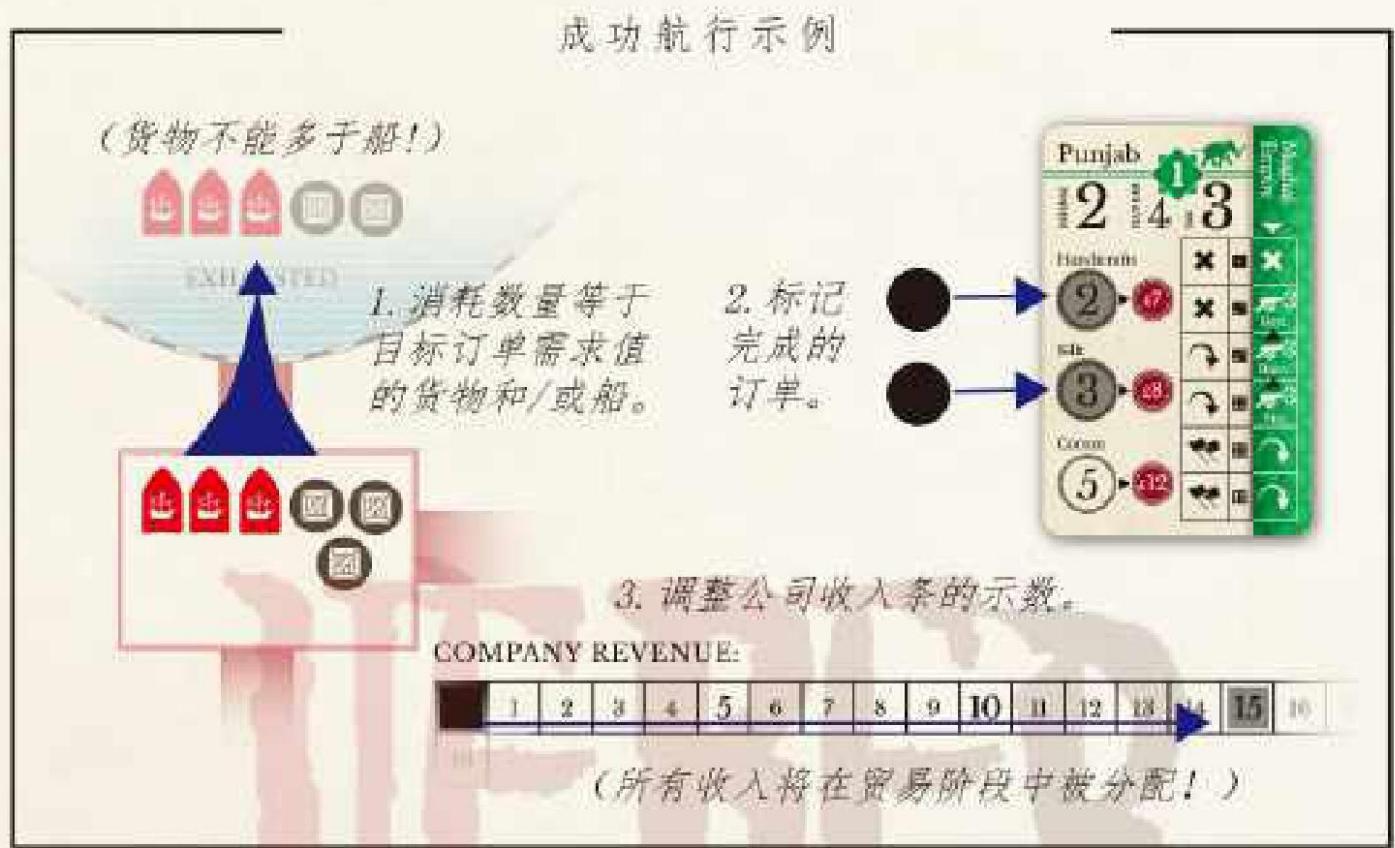
F8. 地方办事处
地方办事处分为两种类型:总督办事处与居民办事处。这些办事处在军事行动(F7)征服某个地区时被设立。公司阶段中,总督办事处可以执行军事行动和投资行动;居民办事处仅可以执行投资行动。
投资行动:尝试使对应地区变为繁荣的。先决定此行动的强度值,每支付£1,使强度值+1。此行动没有判罚值。若判定(F2)成功,则将对应地区牌翻面至繁荣面,将牌上的黑色圆片保留在相对的位置。将大象摆放至此地区牌上,印度平衡
向有序方向倾斜。繁荣地区的办事处不能执行投资行动。提示:投资行动能够调整大象的移动路线,这可能是保护玩家投资、降低关键市场萧条或崩溃风险的有效方法。

F9. 驻华商务总监办事处
国内事件“对华贸易(Trade with China)”在晚报阶段被展示时,设立驻华商务总监办事处。移除该办事处官员槽位上的黑色圆片。该办事处类似于辖区办事处,填补官员槽位时由董事长将文职人员直接移动至该办事处的官员槽位。商务总监可以将船分配至该办事处。公司阶段中,该办事处可以执行航行行动(F7)并完成办事处旁印有的订单。该办事处有资格结算辖区奖励(G2)。注意:由于仅有一个地区,该办事处执行航行行动时始终没有判罚值。
G. 贸易阶段
G1. 概述
贸易阶段中,玩家们获得个人收入。然后,董事长必须以公司收入支付费用,并将公司剩余的所有收入分配至各办事处和/或分红。将公司收入分配至某家族/办事处时,先减少公司收入条的示数,然后家族/办事处从银行拿取资金。
G2. 玩家收入
玩家收入来自多个方面,且总是从银行拿取。
税收:各地方办事处获得等同于对应地区当前税收值(TAX)的资金。若某位玩家控制该办事处,则其可以立即将此回合中的部分税收收入转移至其家族资产区或对应辖区办事处的资产区。
辖区奖励:控制辖区办事处的玩家获得等同于该辖区中完成订单数量的资金。
走私:玩家每在一艘船上有船长,获得£2。
其他收入:奖励牌“投资银行(Investment Bank)”和“南海公司(South Seas Firm)”如牌面说明提供额外收入;塞克斯(Sykes)家族和帕克斯顿(Paxton)家族的家族能力同样提供额外收入。
G3. 公司费用
董事长现在必须以公司收入支付费用。支付费用时,减少公司收入条的示数。公司必须向银行支付以下费用:
贷款利息:董事会中每有一个黑色图片,支付£1。
军队维护费:辖区中每有一个炮或军官,支付£1。
跨国贸易费7:每在一艘船上有船长,支付£1。
公司必须向家族支付以下费用:
愤怒的股东:公司股价为3的场合,若可能则必须分红(G6)。不能紧急贷款以分红。若无法分红,则启用紧急财政援助(J3)
G4. 紧急贷款
若公司无法支付费用,则执行足够次数的紧急贷款以支付剩余费用,每次执行紧急贷款获得£5。正如贷款行动(F4),每获得£5,将一个黑色圆片摆放至董事会。剩余的资金必须立即被分配至各办事处。此回合中无需为新的贷款支付贷款利息。
G5. 分配剩余收入
公司支付费用后,董事长必须将公司剩余的所有收入分配至各办事处和/或分红。将收入分配至办事处时,直接从银行拿取资金,摆放至办事处的资产区图标上,然后减少公司收入条的示数。
G6. 分红
公司支付费用后,董事长可以将公司剩余的收入用于分红。每次分红的费用等于董事会中的股份(方块)数量。董事会中每个方块的拥有者从银行获得£1,然后减少公司收入条的示数。可以进行多次分红。若多次分红,则股价上涨一级;若没有分红,则股价下跌一级。
H. 晚报阶段
H1. 展示和结算
将晚报牌堆顶部的一张牌正面向上摆放至弃牌堆,然后结算。每张晚报牌的结算包含三个步骤:印度事件
(H2)、裁员(H3)、国内新闻(可能是国内事件或拟议法案,H4)。
H2. 印度事件
注意:首次游戏时,可以跳过印度事件,直接进行H3。

每个回合中印度均会发生一定数量的事件。哪个地区发生事件取决于大象的移动。大象移动的次数即当前晚报牌印有的大数字。大象每次均向地区编号较大的下一个地区移动(例如从1号地区旁遮普移动至2号地区马拉地),除非起义或征服改变移动路线。大象位于8号地区马德拉斯的场合,其下一次移动将移动至1号地区旁遮普。大象移动至一个地区后,该地区发生一个事件。
大象移动至一个地区后,掷骰以决定发生的事件。印度平衡处于有序状态的场合,掷两个骰子并取最小值;处于混乱状态的场合,掷两个骰子并取最大值;处于平衡状态的场合,仅掷一个骰子。查阅地区牌的事件表以确定发生的事件。
结算一个事件后,若仍有事件有待结算,则大象继续移动。
订单中止:当一个地区变为不开放的地区时,其地区牌上的所有订单中止。对应辖区的官员(若官员槽位空置,则改为前任官员)立即从辖区移除数量等同于已完成订单需求值之和的船(尽可能移除,无论是否已消耗),将它们放回供应区。移除有船长的船前,必须优先移除没有船长的船。
事件-征服:当前地区尝试征服图标下方印有的目标地区。若目标地区已被当前地区支配,则改为尝试沿黑色箭头征服下一个未被支配的地区。若所有地区均已被支配,则此事件视为事件-现状。结算此事件时,比较其强度值(图标旁印有的数字)与目标地区及其支配的所有地区的防守值之和。若强度值较大,则目标地区被成功征服,从现在开始被当前地区支配,贸易状况(A3)变为与当前地区一致。注意:这可能导致某个地区从一个辖区移动至另一个辖区,也可能导致某个地区变为不开放的地区并使订单中止。若被征服的地区是某个帝国中的支配者,则该帝国中所有被支配的地区均变为有主权且不开放的。成功征服的场合,若此回合中仍有事件有待结算,则大象的下一次移动将移动至有主权且地区编号最小的地区(不包括当前地区)。

目标地区在一个辖区中的场合:该辖区办事处可以选择并消耗该辖区的、未被消耗的炮和军官以增加该地区的防守值。每消耗一个炮或军官,使防守值+1。办事处还可以雇用雇佣军以增加防守值,每支付£2,使防守值+1。
目标地区被公司支配的场合:不再使用其印有的防守值。该地区的地方办事处(若官员槽位空置,则改为对应的辖区办事处)可以选择并消耗对应辖区的、未被消耗的炮和军官以增加该地区的防守值,或雇用雇佣军。若该地区被征服,则将一个黑色圆片摆放至地方办事处的官员槽位。该办事处将在裁员(H3)结束时被废除。
废除辖区:当某个辖区中的最后一个地区变为不开放的地区时,将一个黑色圆片摆放至该辖区办事处的官员槽位。该办事处将在裁员(H3)结束时被废除。若此时有七个或更多地区均为不开放的地区,则游戏结束(J4)。
事件-翻面:将当前地区牌翻面。若翻至萧条面,则订单中止,且印度平衡向混乱方向倾斜;若翻至繁荣面,则印度平衡向有序方向倾斜。

事件—起义:当前地区变为有主权且不开放的地区,订单中止,且印度平衡向混乱方向倾斜。若当前地区被公司支配,则将一个黑色圆片摆放至地方办事处的官员槽位。该办事处将在裁员(H3)结束时被废除。若此回合中仍有事件有待结算,则大象的下一次移动将移动至被支配且地区编号最小的地区。

警力值:起义的地区被公司支配的场合,若地方办事处的警力值达到触发起义的掷骰点数,则起义失败。警力值默认为0,选择并消耗对应辖区的、未被消耗的炮和军官可以增加警力值,每消耗一个炮或军官,使警力值+1;每支付£2,使警力值+1。若起义失败,则印度平衡不向混乱方向倾斜,且不改变大象的移动路线。
事件-崩溃:当前地区订单中止,且印度平衡向混乱方向倾斜。
事件-现状:印度平衡向有序方向倾斜。
H3. 裁员
为每个官员掷一个骰子,若掷骰结果大于或等于对应的抗压值,则该官员离开公司,将其移动至官员槽位的上方。
抗压值:
■ 董事长,4+
行政官员,5+
高级官员,6
为所有官员分别掷骰后,每个离开公司的官员均可以选择获得一个与官员等级对应的奖励或被放回拥有者的供应区,从董事长开始,沿蓝色丝带依次结算。选择获得奖励时,玩家向银行支付某张奖励牌印有的费用,然后将离开公司的官员移动至该奖励牌上。注意:董事长属于行政官员。
奖励能力:某些奖励牌会为在牌上有方块的玩家提供特殊能力。这些能力的使用时机请见奖励牌的描述。玩家使用某个一次性能力后,将其方块移动至奖励牌右侧以标示。
有黑色圆片的官员槽位 $^{8}$ :若某个官员槽位上有黑色圆片,则在为该位置的官员掷骰时视掷骰结果为“6”,该官员必须离开公司,且获得奖励时必须额外支付£2罚金。该官员离开公司后,废除对应办事处,将该办事处的所有船、货物、船长、资金放回对应供应区。若该办事处为地方办事处,则将对应地方办事处牌放回地方办事处牌堆;若该办事处为辖区办事处,则将黑色圆片保留在官员槽位上,以表示不再填补该官员槽位。
H4. 国内新闻
每张晚报牌的底部均印有一个国内事件或拟议法案。
国内事件:其中6张晚报牌印有国内事件,会触发一次性效果。国内事件始终生效。
拟议法案:其中13张晚报牌印有拟议法案,会调整游戏规则。所有被通过的法案的效果均是累积的。
投票:投票前,董事长(若董事长办事处的官员槽位空置,则改为前任董事长)将一个状态标记方块摆放至投票条(右下角)上以指示拟议法案的民意支持票数。然后,所有玩家从董事长开始按顺时针的顺序依次投票。某位玩家投票时,根据其政治影响力增加或减少等量的支持票数。玩家的政治影响力等于其船坞、工厂数量以及选择支付的资金量之和。一个拟议法案的支持票数不能低于-10或高于10。所有玩家均投票后,若拟议法案的支持票数高于0,则其被通过,将其摆放至版图右侧,其在剩余的游戏中持续生效。
H5. 刷新
为下个回合重新设置版:
移除各地区牌上的所有黑色图片。
将消耗的船放回对应辖区或私人公司资产区(13);将消耗的货物放回供应区。已消耗的炮和军官变为未消耗的。
将船长资源区中的方块移动至商务总监办事处。
将军官资源区中的方块移动至军务办事处。
将船坞资源区中的船补至六艘;将工厂资源区中的货物补至十个。
将游戏回合条上的状态标记方块向右移动一格。
I. 解除管制
注意:此部分规则不适用于“早期公司”场景,新手可以跳过,从J1开始阅读。
I1. 概述
公司可能因国内事件“被撤销的垄断(Monopoly Revoked)”或拟议法案“取消贸易垄断权(Revoke Monopoly)”失去垄断地位。这将导致几个重要的结果。
启用紧急财政援助,且公司破产条件改变(见J3)
辖区办事处的官员不再能执行开放贸易行动(F7)
将有船长的船交给船长的拥有者。将船长放回玩家的供应区。现在玩家面前的船即为对应家族的船。取消走私(G2)和跨国贸易费(G3)。
将船长资源区中的方块放回拥有者的供应区。将后垄断牌摆放至船长资源区。
琼斯家族的船:若掷骰结果为“6”,则琼斯家族自动采购位于最左侧的船,然后立即拍卖该船。所有玩家从董事长开始按顺时针顺序依次竞标。玩家可以随意提高出价或弃权。某位玩家弃权后,即不能重新参与到该船的竞标中。竞标持续进行至仅剩一位玩家未弃权。
I2. 调整家族阶段
除上述调整以外,玩家们可以执行任意个家族行动。正如标准的家族阶段,所有玩家从董事长开始,按顺时针顺序依次执行一个家族行动,但是玩家们会持续执行多轮行动,直至所有玩家均弃权。新增四个家族行动:采购船舶或货物、建立私人公司、对外贸易和弃权。每位玩家在每个回合中仅可以执行每个无需支付费用的行动(对外贸易、弃权、文职人员、军官)各一次。
采购船舶或货物:当某位玩家执行此行动时,其可以采购一至两艘船或一至两个货物,不能采购一艘船和一个货物。2或3人游戏的场合,玩家可以采购至多三艘船或至多三个货物。采购船和货物的步骤正如F5所述,但玩家无需优先采购价格最低的船和货物,且采购的船和货物为家族所拥有,不将它们移动至商务总监办事处。
建立私人公司(仅限家族):若某位玩家没有私人公司,则其可以支付£3以将其家族牌翻面为私人公司牌,家族拥有的所有船和货物(包括以后获得的)均成为私人公司的资产。私人公司获得执行“对外贸易”行动的能力,且弃权时可以航行并结算对外贸易。
对外贸易(仅限私人公司):玩家可以将任意数量的船摆放至一个有主权且不开放的地区,并在这些船上各摆放一个方块以标示。在最后一个回合中不能执行此行动。
弃权:某位玩家弃权后,在此回合中即不能再执行家族行动。若已建立私人公司,则可以立即航行,然后必须结算对外贸易(见15)。
航行:若玩家已建立私人公司,则其可以立即执行航海行动(F7)。此航海行动正如公司的航海行动,但是判罚值等于航行的目标地区数量-1。完成某个订单时,将供应区中的一个方块摆放至对应的需求值上,将消耗的船和货物移动至私人公司牌的顶部,将订单收入摆放至私人公司牌上。
结算对外贸易:为每个有当前玩家的至少一艘船的地区分别进行一次判定(F2),强度值为该地区船的总数(包括其他玩家的船),没有判罚值。若判定成功,则董事长将该地区移动至任意可用的辖区,被该地区支配的所有地区保持被支配的状态。该地区所有船的拥有者从银行获得等同于该地区掠夺值的资金(摆放至对应私人公司的资产区),然后将这些船放回对应私人公司的资产区,将船上的方块放回玩家供应区。若判定失败,则将该地区的所有船放回供应区。
I3. 私人公司
私人公司的资产区独立于对应家族的资产区。玩家可以随时将资金从其家族的资产区移动至其私人公司的资产区,但不能将资金从其私人公司的资产区移动至其家族的资产区。若某位玩家已建立公司,则其家族拥有的船和货物成为私人公司的资产。私人公司的资金仅可以被用于航行、采购船和货物、分红(I4)。
寻求投资者:任何时候,玩家可以向其他玩家(投资者)提供其私人公司的股份(以10%为单位)并接受或拒绝该玩家的出价。该玩家可以向那家私人公司提供货物、船或资金,也可以向那家私人公司的拥有者提供资金或人质。若接受,则投资者将一个方块摆放至私人公司牌上的对应空格。如A7所述,这些股份可以在玩家间随时交换和买卖。注意:寻求投资者可能导致私人公司的拥有者变更(见下文)。
敌意收购:任何时候,若某位玩家拥有某家私人公司最多的份额,则其可以发起敌意收购,将该私人公司的资金、船、货物转移至其拥有的私人公司。若其未建立私人公司,则先将其家族牌翻面为私人公司牌,且该私人公司的前任拥有者将私人公司牌翻面为家族牌;若其已建立私人公司,则必须通过谈判合并(见下文)。该私人公司的前任拥有者将一个方块摆放至现任拥有者私人公司牌上对应的空格,以指示其拥有的股份。
合并:任何时候,玩家们可以通过谈判将任意数量的私人公司合并至一个私人公司,该私人公司的总份额不能超过100%。其他被合并的私人公司必须将所有资金、船、货物转移至该私人公司,然后将私人公司牌翻面为家族牌。合并时,可以在征得某位玩家的同意后,降低其股份。若对合并方案有任何分歧,则不会发生合并。
敌意收购示例:查斯和德鲁各拥有科尔公司30%的股份,科尔拥有剩下的40%股份。经过谈判,德鲁收购了查斯在科尔公司的股份,因此拥有科尔公司60%的股份。未建立公司的德鲁发起敌意收购。科尔失去对其公司的控制权,将其公司拥有的所有资金、货物和船转移至德鲁的公司。科尔将其私人公司牌翻面为家族牌。德鲁将其家族牌翻面为私人公司牌。然后科尔将一个方块摆放至德鲁私人公司牌40%的空格。请注意,若德鲁已建立公司,他可能不希望发起敌意收购,因为科尔可能要求在合并后保留其40%的股份。
合并示例:查斯拥有其公司100%的股份;德鲁拥有其公司90%的股份;科尔拥有德鲁公司剩余10%的股份。三位玩家试图合并两家公司而进行谈判。科尔要求保留其10%的股份。查斯要求保留其50%的股份。德鲁同意将其股份减少至40%,以便保留科尔的10%。查斯将是新公司的拥有者。德鲁公司的资金、船和货物将转移至查斯的公司,德鲁将私人公司牌翻面为家族牌。请注意,由于合并发生在查斯和德鲁的公司,因此科尔的公司(若有的话)不会受到影响。
I4. 分红与公众期望
贸易阶段开始时,每个私人公司必须向其股东支付红利。每个私人公司的分红金额均必须大于或等于由开放地区数量决定的公共期望值(见下表)。根据分红表来支付红利,该表将大于或等于0.75的小数取整为1,将小于0.75的小数取整为0。向股东支付红利后,私人公司的拥有者获得剩余分红资金。若无法支付最小分红金额,则该私人公司破产,以其全部资金进行支付,将其私人公司牌翻面为家族牌,将其所有船和货物放回供应区。注意:除了在最后一个回合中,玩家们可以自由地将资金从家族资产区转移至私人公司资产区,以增强私人公司满足公众期望的能力。
公众期望值
| 开放地区数量 | 1 | 2 | 3 | 4 | 5 | 6 | 7 | 8 |
| 最小分红金额 | £2 | £5 | £7 | £10 | £14 | £19 | £27 | £38 |
由于3个地区为开放的,Benyon & Co 公司必须至至少以£7分红。
Benyon & Co 公司有两个股东,各有30%股份。公司资产区有£12。公司分红金额可以介于£7至£12间。
如何使用分红表
| 10% | 8 | 18 | 28 | 88 | 48 | 58 | 68 | 78 | 88 | 98 |
| 20% | 4 | 9 | 14 | 19 | 24 | 29 | 34 | 39 | 44 | 49 |
| 30% | 3 | 6 | 10 | 13 | 16 | 20 | 23 | 26 | 30 | 33 |
| 40% | 2 | 5 | 7 | 10 | 12 | 15 | 17 | 20 | 22 | 25 |
| 50% | 2 | 4 | 6 | 8 | 10 | 12 | 14 | 16 | 18 | 20 |
| 1 | 2 | 3 | 4 | 5 | 6 | 7 | 8 | 9 | 10 |
红利
若分红金额介于£7至£9,则每个股东获得£2;若分红金额大于或等于£10,则每个股东获得£3。无论哪种情况,公司的拥有者均获得剩余分红资金。
I5. 游戏结束时私人公司的分数
在最后一个回合中,任何私人公司均可以支付£3+航行行动判罚值(F7)以使其航行行动自动判定为成功。若该航行行动的收入大于或等于公众期望值,则全部转换为分数(1:1),并根据份额分配给股东。在最后一个回合中,玩家不能从私人公司获得任何资金。
示例:科尔的公司有两个股东,查斯拥有30%的股份,德鲁拥有10%的股份。在最后的贸易阶段中,科尔公司的航行行动获得£14收入。德鲁将获得1分,查斯将获得4分,科尔将获得剩余9分。
J. 胜利
J1. 游戏结束
第6回合或第10回合(战役模式)的裁员步骤结束后,游戏结束。分数最高的玩家赢得游戏。若平局,则平局玩家中在奖励牌上有最多方块的玩家赢得游戏。若仍平局,则平局玩家中拥有最多资金的玩家赢得游戏。
公司破产(J3)或暴动(J4)时,游戏同样结束。
J2. 分数和人质
玩家每拥有一个股份方块即获得1分,每拥有一个庄园即获得2分。玩家因通过裁员(H3)摆放至奖励牌上的方块获得对应的分数。奖励牌上的六边形图标中印有的数字即为该牌上每个方块价值的分数。玩家每有一个人质被其他玩家持有,即失去2分。
J3. 紧急财政援助和公司破产
股价为3的场合,当股价即将下跌时,启用紧急财政援助。首先,减少股份。若某位玩家在董事会中仅有一个方块,则将其放回供应区;若某位玩家在董事会中有多于一个方块,则仅保留其中一个方块,将其余方块均放回供应区。然后,将股价重新设为3。最后,所有行政官员(注意:董事长属于行政官员)必须离开公司并可以获得奖励,但获得奖励时必须向银行额外支付£2。
解除管制后启用紧急财政援助:若公司失去垄断地位,则紧急财政援助不会导致减少股份。
公司破产:紧急财政援助减少股份后,若董事会中没有方块,则游戏结束。每个行政官员的拥有者在计分时失去3分。
解除管制后公司破产:公司失去垄断地位的场合,若在回合结束时至少存在一个私人公司,则游戏将在一个回合后结束,且将跳过公司阶段。
J4. 暴动
第3回合后,若在刷新步骤(H5)结束时有七个或更多地区均为不开放的地区,则游戏立即结束。每个辖区办事处官员、地方办事处官员及董事长的拥有者在计分时失去3分。
Download MarkdownJohn Company FINAL Rules (with bleed).md96.9 KB
C oOW C 60 6 60 4609
THE RISE & FALL OF
JOHN COMPANY,
AN HONORABLE MONOPOLY THAT ROSE TO PROMINENCE IN THE EIGHTEENTH CENTURY AND THE FAMILIES THAT FOUGHT TO CONTROL ITS FORTUNES.

A GAME of sNAKEs and LADDERs authored by COLE WEHRLE.
Published by PHIL EKLUND
and his illustrious venture SIERRA MADREGAMES.
This game is dedicated to my wife Cati whose encouragement brought the project to life and to Chris Contreras and all the games we didn't have a chance to make.
INDEX
Angry Shareholders, 15
Attrition, 18
Bailout, 22
Balance of India, 4
Campaign Action, 13
captains: acquisition, 9 ships ownership, 13 interlopers and country trade 15
Chairman: election, 10 debt, 11 hiring responsibilities, 11 Debt Action, 11 allocation of revenue, 14-15
Check, 10
China Office, see Superintendent of Trade in China
closed, 4
Collapse (event), 18
Company Failure, 22
Company Phase, 10-14
Conquest (event), 17
Cube Management, 9
Debt: action, 11 expense, 15 emergency loans, 15
depressed, 4
Deregulation, 19-22
Director of Trade: hiring responsibilities, 11 Logistics Action, 12
Disrupted Orders: defined 16-17, in Conquest and Revolt 17, in Flip and Collapse, 17-18
Dividends: company, 16 firms in post-monopoly, 21
Domestic Event, 18
dominated, 4
Elephant: setup, 8 movement, 16 conquest redirect, 17 revolt redirect, 17
Eliminated Offices, 18
Emergency Loans, 15
empire: defined, 4 defense, 13, 17 fragmentation, 13
Evening Post, 16-19
Events in India, 16-18
Exhaustion, 6
Family Action, 9
Family Phase, 9-10
firm: establishment of, 20 operation, 20-22
Flip (event), 17
gun: purchasing and moving to armies, 12 exhaustion in Campaign, 13 defense, 17 police, 17-18
Hostile Takeovers, 20
Invest, 14
Investment Bank, 15
Jones Family action, 10 hiring and nepotism, 11 general rules, 23
Laws, 18
Mergers, 21
Military Affairs: Purchasing Goods, 12 Logistics Action, 12
Military Upkeep, 15
Mutiny, 22
Nepotism, 11
officeholder: defined, 4-5 removal after failure, 10 attrition and scoring, 18 eliminated offices, 18
officer: acquisition, 9 deployment, 12 exhaustion in Campaign, 13 defense, 17 police, 17-18
Open Trade, 13
open, 4
Piece Limits, 6
Plunder, 13
Political Power, 18
presidency: definition, 4 acquisition of goods ships, and guns, 12,
Campaign action, 13 dissolution, 17 President: control of presidency, 4 hiring responsibilities, 11 Campaign Action, 13 Open Trade, 13 Sail Action, 14 Presidential Bonus, 15 Prizes: scoring, 18 powers, 18 Promise: defined, 5 victory point penalty, 22 prosperous, 4 provincial offices: defined, 4 action/attrition order, 10 creation, 13 Invest, 14 police, 17-18 public expectations, 21 Purchasing Offices: Purchasing Ships, 12 Purchasing Goods, 12 Refresh, 19 Regions and Presidencies, 3-4 Revolt (event), 17-18 Sail, 14 Seek Investors, 20 South Seas Firm, 15 sovereign: defined, 4 loss of dominions, 13 target for open trade, 13 Status Quo (event), 18 Superintendent of Trade in China: creation, 14 Sail, 13 Tax, 15 term, 3 tilt, 4 Trade Phase, 15-16 Turn Structure, 8 Vacancies, 10-11
A₁. Overview
Over the course of the game, players will advance the members of their family through positions in the East India Company, hoping to improve their family's wealth and their reputation in polite society.
The character of each game of Fohn Company is determined by the performance of the Company, which is jointly operated by all the players. The Company will usually attempt to establish a profitable trade and a political foothold in India, but its goals are largely dependent upon the players.
A2. Learning the Game
Fohn Company is a sandbox game, meaning players may only explore a small fraction of the game during the course of play. The best way to learn the game is simply to set up a mock game and work through the first two game turns, referencing the relevant rules as they are needed. When teaching the game only one player needs to be familiar with all of the rules. Many systems can be described after the game has begun
In this booklet, easy to miss rules will be in bold. Examples and reminders will be in italics. TERms that describe specific gameplay concepts are rendered in small capitals and will be defined the first time they are used. Rules that are referenced, such as the Campaign Action (F7) or Purchasing Office (F5), will use a title case. The first reference to a rule in each paragraph will also include a citation to that rule.
Rules that refer to the two or three player game only are printed in purple.
A3. Regions and Presidencies
There are eight region cards that represent an area comprising modern-day Pakistan, India, and Bangladesh.
Each region card has several important elements.
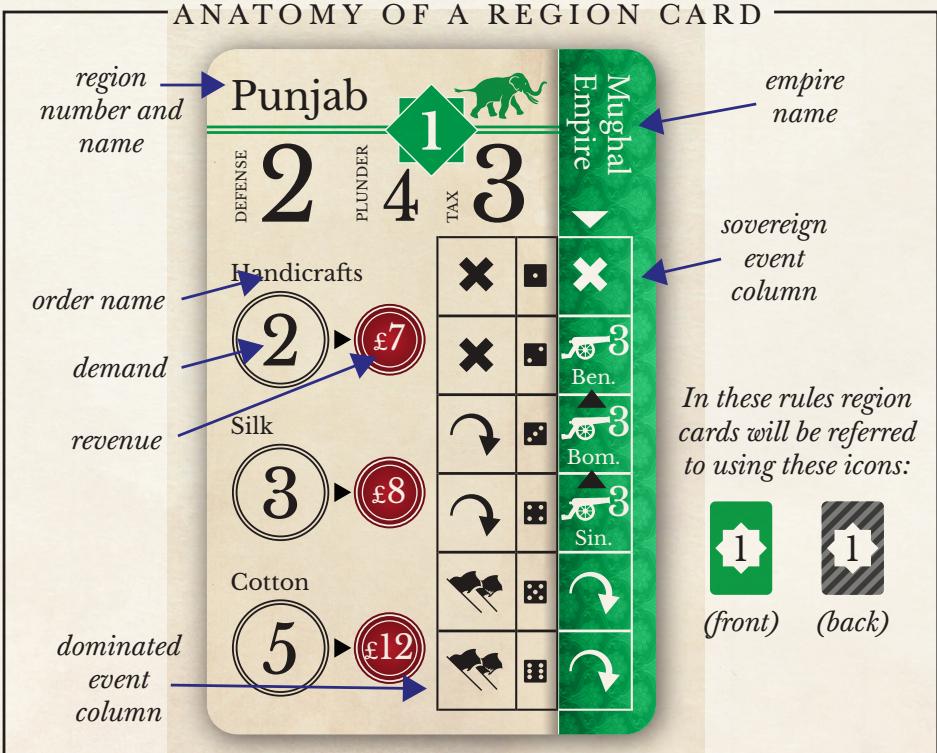
In addition, each region has an economic status, a political status, and a trade status, which are indicated by the physical placement of the card.
Economic status: A region is either PROsPEROUs or DEPRESSED. The economic status of a region is indicated by which side of the card is face up, either the PROsPERoUs side (plain) or the DEPRESsED side (greyscale with striped watermark).
Political status: A region is either DOMINATED or sOVEREIGN. A region can be DoMINATED by another region or the Company. DoMINATED regions and their dominator are collectively referred to as an EMPIRE. When a region is DoMINATED, the right column of its event table is covered by the dominator. SovEREIGN regions have the right column of their event table clearly visible.
Trade status: A region is either OPEN or CLOsED to British trade. CLOsED regions are placed to the left of the board. Regions that are opEN are placed above the board near one of the three PREsIDENCIES.
Historically, to facilitate the trade in India, the Company used a system of PRESIDENCIES. Each PRESIDENCY was a fully independent administrative unit. In Fohn Company, a PREsiDENCY refers to the Company office (called a President, F7), its holdings (money, ships, and goods), its army, and any regions opened by that PRESIDENCY.
PREsiDENcIEs grow through successful Open Trade Actions (F7) and Campaign Actions (F7). These campaigns also create PRovINCIAL OFFICES (Governors and Residents) that the Company uses to manage its new territory. A PREsIDENCY can shrink through Revolt or Conquest (H2). If a PREsI-DENcY is ever without a region, it is eliminated and will never be used again.
A4. The Balance of India
The general stability of the eight regions in Fohn Company is indicated by the marker on the Balance of India track at the bottom left of the board. The marker will always be on one of three spaces: order (left), equilibrium (center), or chaos (right). When an event occurs, the status of the Balance of India is used to determine the event. During order, two dice are rolled and the lowest result is used. During chaos, two dice are rolled and the highest result is used. During equilibrium, only a single die is rolled to determine the event.
| The Balance of India | Order | Equilibrium | Chaos |
| Number of Dice Rolled | 2 | 1 | 2 |
| Result | Lowest | Result | Highest |
The Balance of India may change over the course of play. These changes are called TILTs. When a TILT occurs, the marker on the Balance of India track moves towards the direction of the TiLT. If the marker was already in the space it TILTED towards, it does not move.
A5. Offices and Working for the Company
Throughout the game, players gain and lose control of offices within the East India Company. A player's family members (cubes) move through the Company via promotion. In general, writers are promoted first to senior offices and then to executive offices. When a player controls an office, they place one of their cubes on the slot associated with that office. This cube is known as the oFFICEHOLDER and will allow its owner to control different aspects of the Company's behavior.

Most commonly, OFFICEHoLDERs leave the Company through Attrition (H3), which is the primary scoring mechanism in the game. Players do not have full control of this process. However, the more family members a player has in the Company the more likely it is that some will be lost to Attrition. When an OFFICEHOLDER leaves the Company due to Attrition, the owning player may move that cube onto a prize card, exchanging money for victory points and special abilities. In general, the higher the rank of the office, the more favorable the exchange rate between money and victory points.
A6. Cash Flow
In Fohn Company, money moves and its location matters. Money must always be located in a family treasury (near a player) or an office treasury (see icon below). The Company brings most of the money into the game through its trade in India. Players may earn a share of this money through Dividends (G6) or by placing their family members in various key offices and profiteering from the Company's activities. Money leaves the game when players claim prizes, take family actions, or perform Company actions. REASUR
A7. Negotiations & Promises

Players are free to discuss the game and negotiate during play. Players are not held to any promises of actions on future phases or game turns, but may give each other the following items:
Family money and family-owned ships.
Family cubes from their stock (these become PRomisEs, which are described below).
PRoMISES on their family card.
Family-owned Goods and firm shares after loss of monopoly (I3).
PRomIsEs. As part of a negotiation, a player may offer one or more cubes from their stock. These cubes are held by the player accepting the offer and are now called pRomIsEs. At the end of the game, players lose two victory points for each of their PRoMIsEs held by another player.¹ A PRoMIsE must be returned to its owner player if, at any time:
† You pay the player holding the PRomIsE cube £2.
† You show hiring preference by promoting the player holding the PRoMIsE over at least one other player.
† The holder returns the PRomisE. If you have one of the holder's PROMISEs, it is returned to him.
Example: Drew needs money but has none. He asks the other players if anyone would be willing to loan him £5. Chas agrees if Drew will give him four promises. Drew agrees. If Drew cannot get these promises back by the end of the game, he will lose eight victory points.



6 player cards
6 sets of 20 family cubes
A8. Exhaustion
Certain game pieces may be exhausted throughout play. When a piece is exhausted, it must be moved to the corresponding exhausted holding box. Exhausted pieces cannot be used until after the next Refresh (H5).
B.COMPONENTS
B₁. Game Components
Each copy of Fohn Company includes the following (not drawn to scale):
game board


8 region cards



5 status marker cubes
8 provincial office cards
wooden elephant

19 evening post cards
post-monopoly card

18 prize cards
30 wooden ships
30 wooden goods

30 white, 15 red, 15 blue, and 20 black disks


B2. Piece Limits
If players run out of ships, goods, or money some substitute should be found.
However, family cubes are strictly limited (E3).
C.SETUP
C₁. Choose a Scenario
Choose a scenario from those listed in section K. These setup rules refer to the Early Company scenario (K2) and may be adjusted by the other scenarios.
If playing with two or three players, use the Jones Family (C4, F3, Ki).
C2. The Board, Prizes, and Events
Place the board in the center of the table. Deal out six random prize cards face-up and place them in a row at the bottom of the board.
Shuffle all of the Evening Post cards except the “Monopoly Revoked" and "Revoke Monopoly" cards which are not used in this scenario. Place the Evening Post deck on the board facedown on the top right of the board.
Place a status marker cube on the:
“4" space of the share price track.
“1" space of the game turn track.
“o" space of the Company revenue track.
Center space of the Balance of India.
Picture of parliament on the bottom right side of the board.
Place a black disk on the officeholder slot of the China Office (F9).
C3. Family Cards, Money, and Cubes
Give each player a player card to place in front of them (family side face-up) and a starting treasury of £5.
Family Powers. Each of the six player cards has a unique benefit that is active as long as the family side of that player card is face-up.
Each player chooses a color and takes a number of cubes determined by the player count. These are the player's starting cubes. Place these cubes above the player's family card.
| Number of Players | 2 | 3 | 4 | 5 | 6 |
| Starting Cubes | 8 | 7 | 6 | 5 | 5 |
Then, each player takes an additional 12 cubes of their color and places them below their family card. These cubes form the player's stock. Any remaining cubes are returned to the box, unused.
Starting with a random player and proceeding clockwise, each player places one of their starting cubes on any available vacancy (the empty squares along the blue ribbon). Once each player has filled a vacancy, repeat the process in the reverse order, with the player who previously placed last taking the next turn. Continue until all vacancies are filled.
When a cube is placed on an executive office (denoted by a gold square), an additional starting cube of that color is placed on the Court of Directors.

After all vacancies in the Company are filled, players roll one die for each of their remaining starting cubes and place the cube in the resource box corresponding to the die roll.
Shipyard cubes can be placed in the highest empty slot in any column e.g. the “6” slot must be filled in any column before the “5” slot.
Cubes placed on officer or captain resource boxes provide a bonus cube from the player's stock in the writer resource box.
For each cube randomly placed in the Court of Directors, the Chairman must immediately allocate £4 from the bank to any of the office treasuries as if it were revenue (G5).
Teaching Note: For a first game, consider setting up the game before the players arrive. For starting offices have each player “select" the next office along the ribbon and place cubes according to the rules above.
C4. Piece Stock and Starting Company Assets
Place the goods, black disks, ships, and the bank near the area of play.
Place £5 on each office with a treasury icon.
Place two ships on each PREsIDENCY. Place six ships on the ship slots in the shipyard resource box and ten goods on the good slots in the factory resource box.
C5. Region Cards
Place the regions as indicated below.
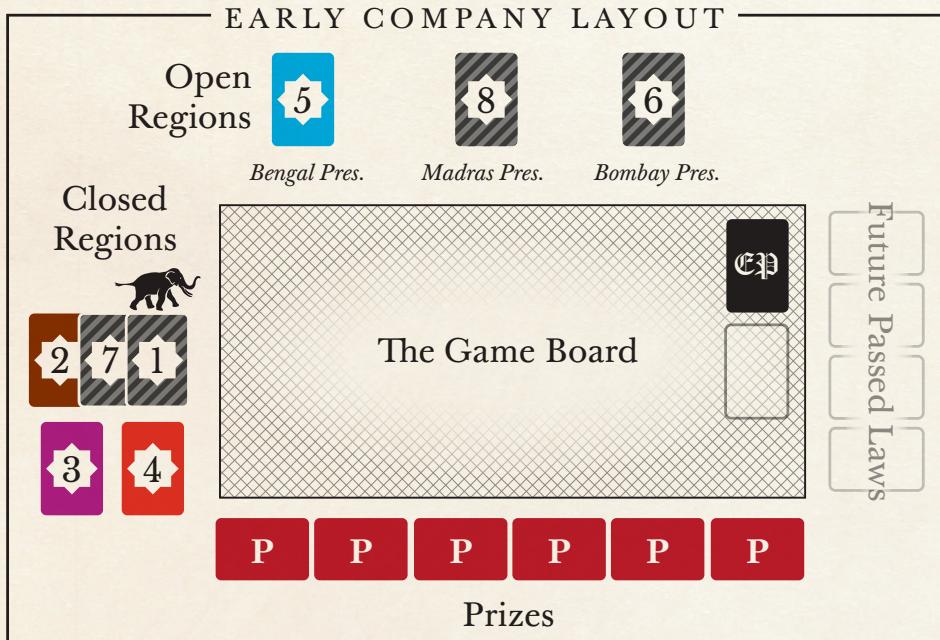
PRovINCIAL OFFICES should be placed near the area of play.
Place the Elephant on the Punjab region card.
The game is now ready to begin.
D.SEQUENCE OF PLAY
Di. Game Turn Structure
Every game turn consists of four phases:
Family: Beginning with the Chairman, each player takes a single family action.
Company: After filling any vacancies, each office in the Company operates, beginning with Ship Purchasing.
Trade: Revenue is generated and allocated.
The Evening Post: A new event card is revealed and resolved.
E₁.General
Beginning with the player controlling the Chairman office and proceeding clockwise, each player takes a single family action. If the Chairman office is currently vacant, begin with the player who was most recently Chairman.
E2. The Family Action
Each game turn all players must take one family action. Choose a single family resource box and place a number of cubes on it. Some resource boxes require players to pay a cost to the bank for each cube. If there is a cost, it is listed next to the name of each resource and must be paid from the family treasury. When placed, cubes take the name of whatever resource box they are placed on e.g. a cube in the shipyard resource box is now referred to as a shipyard.
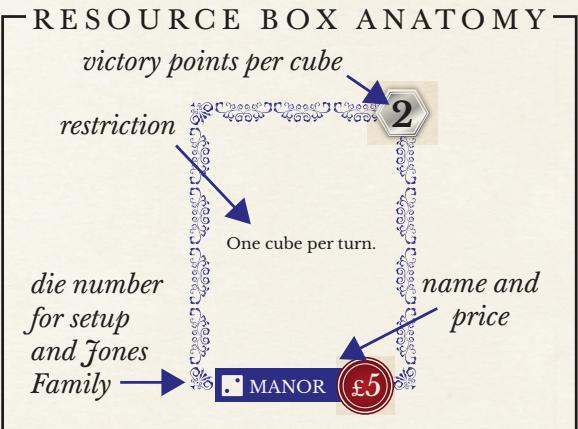
Some resource boxes have additional restrictions detailed below:
Shipyards² and Factories. Cubes in the shipyard and factory resource boxes must be placed within the outlined squares. A player may only place a shipyard cube in a “5" slot if the “6" slot above it is occupied.
Shares.3 The cost of this action depends on the current share price. The total cost for the action should be given to the Chairman for immediate allocation to Company treasuries. If the Chairman office is vacant, the money is placed on the Chairman box and will be allocated immediately after the election of the new Chairman.
Writers, Officers, and Captains. A player may place one or two cubes in one of these boxes. If playing with two or three players, players may place up to three cubes in one of these boxes.
Manors. A player may place only one cube in the manor resource box per game turn.
E3. Cube Management
Players are restricted by the cubes in their stocks.4 If a player without remaining cubes needs to place one or more cubes, that player must use their cubes on any prize card or the manor resource box. If a player cannot remove any such cubes, they are excused from having to take a family action that game turn.

E4. The Jones Family Action (2/3 players only)
After each player has taken a family action, the Jones Family places cubes in family resource boxes. With two players, roll 4 dice. With three players, roll 2 dice. Then, using an extra color of cubes, place a cube in the family resource box corresponding to each die roll (as in C3). However, unlike C3, cubes placed in either the captain or officer resource boxes do not spawn bonus writers. If the Jones Family runs out of cubes, use another extra set of cubes. Any money generated by Jones Family cubes should be paid to the bank. Captains belonging to the Jones Family purchase a ship if one is available, using funds from the bank and will purchase the leftmost available ship. Any Jones Family cubes placed on shipyards should take the leftmost “6" slot and, if these are all filled, should take the leftmost “5" slot. If the Jones Family places a share cube, the bank gives the Chairman money equal to the current share price for immediate allocation. Note: The Fones Family does not place cubes during setup.
F.COMPANY PHASE
F1. Overview and Office Actions
In the Company Phase, Company offices are given the opportunity to take actions. The Chairman begins the phase by calling the Company to order and filling any vacancies. Then, following the red Company track starting with the Ship Purchasing office, each office is given the opportunity to act. PRovIN-CIAL OFFICEs act after their corresponding Presidents in order of formation (oldest office acting first). When an office acts, it must resolve its actions in the order indicated on the office. Blue and black actions are optional with blue actions requiring a Check (F2), as described below. Green actions are mandatory. If an action has a cost, the cost must be paid using funds from the acting office.
F2. Checks and Consequences
Blue actions require a Check⁵ to see if the action is successful. To perform this Check, a player rolls as many dice as the "strength" of the action minus any penalty (penalties are described in each individual action). Of the dice that are rolled, only the lowest die counts. A roll of 1 or 2 is a success. A roll of 3 or 4 has no effect. A roll of 5 or 6 is a failure, and the OFFICEHOLDER is immediately returned to that player's stock of unused pieces. A vacated office has no further opportunities to act this game turn. Any blue action may be taken more than once as long as the Check has not failed.
F3. Filling Vacancies
Fill all vacant positions at the start of the Company Phase. First, fill the Chairman position, followed by the remaining vacancies in the order of their position along the blue ribbon on the board. PRovINcIAL oFFICEs are filled after their corresponding President in the order of their creation. In the rare instance that a vacancy cannot be filled, the office remains open this game turn and is skipped during the Company Phase.
The Jones Family does not vote, nor can be nominated to be Chairman, nor do their cubes in the Court of Directors count for determining the number of votes needed for a majority. Jones Family officers are never promoted.
Chairman Election. The Court of Directors selects a player to be the new Chairman. The former Chairman makes the first nomination. Any player with at least one cube in the Court of Directors may be nominated. After a nomination is made, each player (clockwise starting with the nominee)

may choose to support the nominee with all their cubes in the Court or not. Each cube provides a single vote of support. Nominees may choose to not support their own nomination. If a nominee receives support from more than 5o% of the cubes in the Court, the Chairman election is over. The successful nominee moves one of their share cubes from the Court of Directors to the Chairman office. If the nomination fails, the player to the left of the previous nominator makes the next nomination. If after all players have made a nomination, the Court fails to agree upon a nominee, the former Chairman decides who of the failed nominees becomes the new Chairman. The newly elected Chairman must immediately allocate any money from share purchases to Company offices with treasuries.
Other offices are filled according to the following rules:
Executive offices are filled by the Chairman, who promotes any cube on a senior office (grey S) to the new executive office. If there are no senior OFFICEHOLDERs, the Chairman can promote any writer directly to the executive office.
PRovINCIAL OFFICES are filled by their corresponding President, who promotes any writer or officer in any army to the office.
PuRCHAsING OFFICES are filled by the Director of Trade, who promotes any writer to the office.
Nepotism. When filling any office, except the Chairman, players are penalized for Nepotism. If a player promotes their own cube over another player's cube, the promoting player must give one of their cubes from their stock as a PRomisE to every player with at least one eligible candidate. If playing with the Jones Family, two promise cubes should be given for every instance of nepotism.
Example: In a four player game, Cole as Chairman promotes his own cube from Ship Purchasing to the Madras Presidency. Chas had cubes in the other senior offices. Because Cole passed up Chas, he must give one promise to Chas.
F4. The Chairman and the Debt Action
Once, at any point during the Company Phase, the Chairman may take the Debt Action.
Debt Action. When taken, the Chairman places a black disk on the Court of Directors and immediately allocates £5 to treasuries in the Company. Each black disk on the Court of Directors costs the Company £i each game turn during the Trade Phase (G3). This debt can never be repaid.
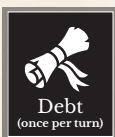
F5. Purchasing Offices
All three PURCHAsING OFFICEs (Ship Purchasing, Goods Purchasing, and Military Affairs) have the Purchase Action. The Military Affairs Office also has the Logistics Action. All actions on Purchasing Offices are mandatory.
The Purchase Action. PuRCHAsING OFFICEs purchase as many ships or goods as they can afford. Ship Purchasing and Goods Purchasing give what they purchase to the Director of Trade. The Military Affairs Office assigns the purchased goods to any of the PREsiDENcY armies. These goods are now referred to as GUNS.
Purchasing Ships. Six ships are available for purchase each game turn. The price of a ship is indicated by the highest uncovered number below the ship. The cheapest ships must be purchased first. If a ship has one or more shipyards below it,

the owners of the shipyards receive £i from the bank for each of their shipyards below the purchased ship after the ship is bought.
Purchasing Goods. Ten goods are available for purchase each game turn. The price of a good without a player factory is always £3. If there is a fac-
PRICE OF A SHIP

tory cube below the good, refer to the Evening Post card on top of the discard pile. The price is listed on the top right. If there is no card in the discard pile (e.g. at the start of the game) the price is £2. If the price is re-
placed with a red “X" only goods without player factories can be purchased. The cheapest goods must be purchased first. If there is a factory cube below a purchased good, its price is paid from the office's treasury to the player owning the factory. If there is no factory cube, the price is paid to the bank.

The Logistics Action (Military Affairs). Move all officers and GuUNs in this office's holdings to any PREsiDENCY army boxes. If an army has three officers, an old officer (stationed there at the start of the game turn) must be replaced by a new officer. Replaced officers return to their owner's stock. If not all officers can be placed, any remainder are returned to their owner's stock. During this action, the Military Affairs Office may transfer GuNs from one PREsIDENCY to another with the owning President's permission.
F6. Director of Trade
The Director of Trade must take the Logistics Action.

The Logistics Action (Director of Trade). In any order, the Director of Trade offers each captain in this office's holdings the opportunity to buy a ship. If the captain agrees, their family purchases a ship (as in F5, but may choose any available ship) and gives the ship to the Director of Trade, placing their captain cube on top of the ship. If the captain declines, or no ships are available, the captain cube is returned to its owner's stock. Then, the Director of Trade must assign any goods and ships (with or without captains) on their office to any of the three PREsIDENCIEs. During this action, the Director of Trade may also transfer ships (with or without captains) and goods from one PREsIDENCY to another with the owning President's permission.
Captains on Ships. Captains are placed on ships to indicate family ownership. Once a captain is on a ship, the two are treated as one piece and are always moved together; however ownership may change as part of a negotiation. In this case the new owner's cube (taken from their stock) replaces the current captain, returning the original captain's cube to its owner.
F7. Presidents
There are three Presidents with three optional actions each, all requiring a Check (F2). The Campaign Action can be used to dominate new regions (opening them if they were cLosED) and create new Company Offices (governorships and residencies). The Open Trade Action adds CLosED regions to the corresponding PREsiDENCY. Finally, the Sail Action allows Presidents to complete orders on regions in their PREsiDENcY to generate revenue for the Company and a Presidential Bonus (G2) for their family.
The Campaign Action. Select a target from those listed next to the Campaign Action icon. Presidents have only one listed target. Governor cards list multiple targets. Any listed region can be targeted as long as it is not dominated by the Company. Calculate the strength of the attack. The Office taking the Campaign Action may choose any number of unexhausted officers/GuNs in
the PREsIDENCY army to use in the attack e.g. a governor within the Madras Presidency may use that presidency army. Each officer/ GuN exhausted increases the strength by one. After the attack, these pieces are considered exhausted and will be refreshed at the

end of the Evening Post phase (H5). The strength of a Campaign Action can be boosted by hiring mercenaries. Every £2 spent increases the strength of the attack by one. The penalty for this action is equal to the defense of the target. If attacking any part of an EMPIRE, the penalty is the sum of every region's defense in that EMPIRE. Note: While Presidents only have one target, Campaign Actions on provincial offices offer more options.
Victory. If the Check (F2) is successful, the region is conquered and is now DoMINATED by the Company and oPEN for trade. Move the region to the PREsIDENCY associated with the President or governor that took the Campaign Action. Create the corresponding PRovINCIAL OFFICE and place it on the region's card, covering only the right event column. This office will be filled at the start of the next Company Phase. If the conquered region was the sOVEREIGN of an EMPIRE, all DOMINIONS of that EM-PIRE become SOVEREIGN and CLOSED.
Plunder. If the attack is successful, the families that control cubes in the victorious army (officers) receive money from the bank equal to the region's plunder value for each cube present. Exhausted and unused officers still receive plunder.
Example: Chas is the President of Madras and wishes to campaign there. There is a gun and two of Drew's officers in the Madras army. He exhausts the gun and both officers for a strength of three. Depressed Madras has a defense of one so the modified strength of the action is two. If he is successful the Governor of Madras will be created and Drew will take £6 from the bank for his two officers (plunder).
The Open Trade Action. The President may attempt to open new regions to British trade, which brings a region or EMPIRE to a PREsIDENCY. First, determine the strength of the action. Every £i allocated to the action increases strength by one. There is no

penalty for this action. Choose a target that is both cLosED and sovER-EIGN. If the Check (F2) is successful, the target becomes oPEN. Move the region and its EMPIRE into the acting President's PRESIDENCY (A3).
The Sail Action. The President may attempt to fill any number of orders on regions in their PREsiDENCY. Determine the strength of the action. Every £i allocated to the action increases strength by one. The penalty to perform this action is one less than the total number of regions in the presidency e.g.
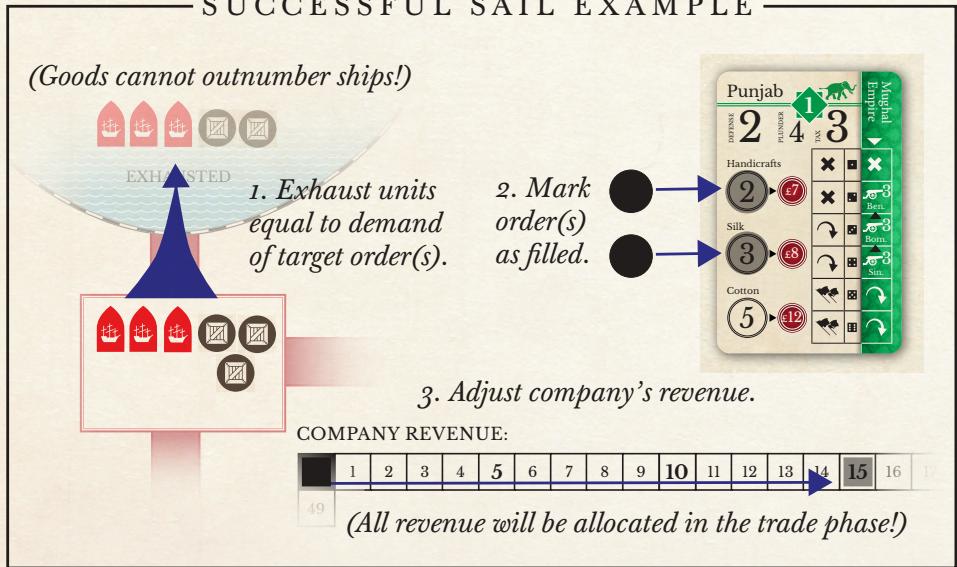
to take this action in a three-region presidency the President faces a penalty of two. If the Check (F2) is successful, the President may fill orders. To fill an order, exhaust a number of goods and/or ships in this PREsIDENcY equal to the order's demand.⁶ Orders may

be filled in any order, but there can never be more goods than ships exhausted in a PREsıDENcY. After an order is filled, place a black disk on the order's demand and increase the Company's revenue on the revenue track by the amount indicated on the order. Note: These disks will be removed during refresh.
SUCCESSFUL SAIL EXAMPLE
F8. Provincial Offices
There are two types of PRovINCIAL OFFICEs: governorships and residencies. These offices are created when a region is conquered during a Campaign Action (F7) and are filled by the associated President. During their turn in the Company Phase, governors may take the Campaign Action. Both governors and residents may take the Invest Action.
The Invest Action. Using this action, a PRovINCIAL OFFICE attempts to end depressions in its region. Determine the strength of the action. Every £i
allocated to the action increases strength by one. There is no penalty for this action. If the Invest Action is successful, flip over the region card to the PRosPERous side, with any black disks maintaining their relative position. Place the Elephant in this region

and the Balance of India TILTs towards order. The Invest Action can not be used in PRosPERous regions. Strategy: The invest action allows players to reroute the Elephant, which can be an effective way to protect their investments and lower the chance of depression or collapse in key markets.
F9. Superintendent of Trade in China
This office, known also as the China Office, is created whenever the Domestic Event card "Trade with China" is revealed during the Evening Post phase. Remove the black disk on the associated senior office. This office behaves like a PRESIDENCY and is filled by the Chairman who promotes any writer to the office. It can be allocated ships by the Director of Trade and is eligible for the Presidential Bonus (G2). During its turn in the Company Phase, it may take the Sail Action (F7) and fill the orders printed on the board near the office. Note: Because it has only one region, the China Office will never pay a penalty to Sail.
G.TRADE
G1.Overview
During the Trade Phase players generate personal revenue. Then, the Chairman must pay expenses and allocate all remaining Company revenue to Company Offices and/or dividends. Any money paid with company revenue to players or offices should be taken from the bank after lowering the revenue track by the amount paid.
G2. Player Revenue
Player revenue is generated in several ways and always comes from the bank.
Tax. Place money equal to the current tax value of their regions on each PRovINCIAL OFFICE that currently exists. If a player occupies that office, he may transfer any portion of this game turn's tax revenue to his family's treasury or the region's PREsIDENCY immediately.
Presidential Bonuses. The family controlling each PREsIDENCY takes money equal to the number of fulfilled orders on regions in that PRESIDENCY.
Interlopers. Each family takes £2 for each of their ships with a captain.
Other Revenue. The "Investment Bank" and "South Seas Firm" prizes provide additional revenue as described on the card. The Sykes and Paxton families also generate revenue according to their special powers described on their family cards.
G3. Company Expenses
The Chairman must now pay expenses using the revenue gained from filling orders. As expenses are paid, the Chairman should adjust the revenue marker on the revenue track.
The following expenses are paid to the bank:
Debt Service. Pay £1 for each black disk on the Court of Directors.
Military Upkeep. Pay £1 for each GUN and officer in a PREsIDENCY.
Country Trade.7 Pay £1 for each captain on a ship.
The following must be paid to family treasuries:
Angry Shareholders. If the Company share price is at "3," a Dividend (G6) must be paid if possible. Emergency Loans cannot be used to pay this dividend. If the dividend cannot be paid, a Bailout occurs (J3).
G4. Emergency Loans
If Company expenses cannot be met, take enough £5 emergency loans to cover the remaining expenses. As with the Debt Action (F4), add a black disk to the Court of Directors for each £5 taken. Any portion "left over"must be immediately allocated to any Company treasuries. Any new loans do not need to be paid for until next game turn. As with black disks gained through the Debt Action, these can never be repaid.
G5. Allocating Remaining Revenue
After paying expenses the Chairman must allocate all remaining revenue. Revenue may be sent to Company offices or paid out as Dividends (G6). When sending revenue to offices, place money from the bank directly on the holdings of any office with a treasury symbol. Then update the revenue track to indicate how much revenue remains to be allocated. This money may be spent during the next Company Phase.
G6. Dividends
After paying expenses, the Chairman may choose to pay dividends with remaining Company revenue. The cost of paying one dividend is equal to the number of shares (cubes) on the Court of Directors. £1 from the bank is given to each player per cube they have in the Court of Directors. Then, update the revenue track to indicate how much revenue remains to be allocated. Multiple dividends may be paid. If more than one dividend is paid, increase the share price one space. If no dividend is paid, the share price falls one space.
H.EVENING POST
H₁. Reveal and Resolve
Draw the top card from the Evening Post deck and place it faceup on top of the discard pile. Then resolve the events. Each Evening Post card has three steps: Events in India (H2), Attrition (H3), and Local News which will either be a Domestic Event or a Proposed Law (H4).
H2. Events in India

Note: For players learning the game and those playing it for the first time, Events in India may be skipped. Continue with H3.
Each game turn there are a number of Events in India. The region where these events take place depends upon the movement of the Elephant. The Elephant moves as many times as indicated by the large number on the game turn's Evening Post card. Unless redirected by Conquest or Revolt, the Elephant's moves are dictated by each region's number and it will move to the next higher region e.g. from Punjab (1) the Elephant moves to Maratha (2), and if the Elephant is in Madras (8), its next move will be to Punjab (1). An event occurs in each region the Elephant visits.
When the Elephant moves to a new region roll the event dice to determine the event. Use the highest roll if the Balance of India is chaos or the lowest roll if the Balance of India is order. Roll only a single die if the Balance of India is in equilibrium. Consult the region card's current event column to determine which of the events occurs.
After resolving the event, if additional events remain to be resolved, the Elephant continues its move and another event occurs.
Disrupted Orders. Whenever a region becomes CLosED, any orders on it are DisRUPTED. The President (or former President if vacant) associated with the order immediately removes as many ships as the demand of each filled order (if possible) from either the PREsıDENcY's holdings or those ships it has exhausted, and returns them to the stock. Ships without captains must be removed before those with captains.
Event: Conquest. The acting region attempts to conquer the target region, listed below the Conquest event icon. If the target region has already been conquered by the acting region, follow the black arrow to the first unconquered region and attempt to conquer that region instead. If all regions are DoMINATED, the event should be treated as a Status Quo event. To resolve the event, compare its strength (the number next to the cannon) to the target's defense. The target's defense is the sum of its defense value and that of all of its dominions. If the Conquest strength is greater, the target region becomes DoMINATED by the acting region and takes the acting region's Trade Status (A3). Note: This may cause a region to move from one presidency into another or make a region closed, which disrupts any orders on it. If the sovEREIGN of an EMPIRE is conquered, all regions previously dominated by that EMPIRE become sOVEREIGN and CLOsED. When Conquest is successful, and if further events remain to be resolved this game turn, the Elephant will next move to the lowest-numbered soVEREIGN region (not including this region).

Regions within a Presidency. If attacked, the corresponding President may allocate unexhausted GUNs or officers in the PREsIDENCY to boost the region's defense. Each GuN or officer allocated increases the defense by one and is exhausted. The President may also hire mercenaries that increase the defense by one for every £2 spent.
Regions Dominated by the Company. Regions DoMINATED by the Company no longer use their written defense values. Instead, if attacked, the PRovINCIAL OFFICE of the region (or President if vacant) may allocate unexhausted GUNs or officers in the PREsIDENCY to the defense and may hire mercenaries as described in the previous rule. If a region DomiNATED by the Company is conquered, place a black disk on the PROVINCIAL OFFICE's current OFFICEHOLDER. This office will be eliminated at the end of Attrition (H3).
Dissolution of Presidency. If a PREsiDENcY's last region becomes CLosED, place a black disk on that PREsIDENCY's current OFFICE-HoLDER. The office will be eliminated at the end of Attrition (H3). If seven or more regions are now CLosED the game may end (J4).
Event: Flip to Depressed / Flip to Prosperous. Flip the region card. If flipped to DEPRESsED, any completed orders are DISRUPTED. Additionally, the Balance of India TıLTs towards chaos. If the region was flipped to PRosPERoUs, the Balance of India TILTs towards order.

Event: Revolt. The region becomes sovEREIGN and cLosED. Any completed orders are DIsRUPTED. If a region DOMINATED by the Company revolts, place a black disk on that PRoVINCIAL OFFICE's current OFFICE-HOLDER. This office will be eliminated. If a PRESIDENCY loses its last region, the corresponding PREsIDENCY is eliminated (see Dissolution of Presidency). The Balance of India TILTs towards chaos, and, if further events remain to be resolved this game turn, the Elephant will move to the lowest-numbered DOMINATED region if possible.

Police. Revolts can be canceled in Company-DoMINATED regions if the PRovINCIAL OFFICE can equal the result of the event die roll that triggered the Revolt with the strength of its Police. The strength of its Police starts at zero and increases by one for each GuN or officer it exhausts from the PREsiDENCY and each £2 it spends. If a Revolt is canceled by the
Police, the Balance of India does not TILT towards chaos and the Elephant is not redirected.
Event: Collapse. Any completed orders are DisRuPTED.
The Balance of India TILTs towards chaos.

Event: Status Quo. The Balance of India TILTs towards order.

H3. Attrition and Claiming Prizes
Roll a die for each filled office. If the result is equal to or higher than that office's stress threshold, the oFFICEHOLDER will vacate the office. Shift the OFFICEHOLDER above their slot to indicate this.
Stress thresholds:
Chairman, 4+
Executive Offices, 5+
Senior Offices, 6
After all attrition dice have been rolled, each
vacating cube may score one prize of that office's rank or be returned to its owner's stock. Prizes are claimed starting with the Chairman and following the blue ribbon. Pay the cost indicated on the prize card to the bank and then move the cube from the vacated office to the prize card. Note: The Chairman is treated as an executive office.
Prizes Powers. Some prizes provide players with special benefits. All information relating to the timing of these benefits can be found on the prize. If a one-time-use power is used, move the prize cube to the right side of the card.
Offices with a Black Disk.8 Offices with a black disk automatically roll a “6" and must vacate. In order to score an office with a black disk, the player must pay a penalty of £2 in addition to the cost of the prize. After removing the oFFICEHOLDER, the office is eliminated. Eliminated offices should return all ships, goods, captains, and money to the appropriate stocks. Eliminated PROVINCIAL OFFICES placed with the other unused PROVINCIAL OF-FicE cards. Eliminated offices on the board should keep the black disk placed on the OFFICEHoLDER slot to indicate that the vacancy can no longer be filled.
H4. Local News
All Evening Post cards have either a Proposed Law or Domestic Event at the bottom of the card.
Domestic Event. Six Evening Post cards have Domestic Events that trigger one-time effects. Domestic Events always take effect.
Proposed Law. Thirteen Evening Post cards have a law that changes the rules of the game. All effects of passed laws are cumulative.
Voting. Before voting, the Chairman (or former if vacant) should place a status marker on the voting track (bottom right) to indicate the proposal's popular support. Then, starting with the Chairman and proceeding clockwise, each player votes. When a player votes, they either increase or decrease the proposal's current support by their total PoLITICAL PowER, which is the sum of shipyards, factories, and any money they choose to spend. A proposal's support cannot go below -1o or above 1o. After one round, if the proposed law ends with support greater than o, it passes and is placed to the right-hand side of the board, remaining in effect for the rest of the game.
H5. Refresh
The board state is reset for the next game turn. In general, pieces move along the black arrows. Specifically:
In each region, remove any black disks on completed orders.
Exhausted ships are returned to their PREsIDENCY or owning firm (I3). Exhausted goods are returned to the stock. Exhausted GuNs and officers are unexhausted.
Cubes in the captain resource box move to the Director of Trade Office.
Cubes in the officer resource box move to the Military Affairs Office.
Place a ship on each empty ship slot in the shipyard resource box. Then, place a good on each empty good slot in the factory resource box.
Move the marker on the game turn track forward one space.
I.DEREGULATION
Note: These rules do not apply to the Early Company scenario, and can be skipped by new players. Continue with F1.
I₁. General
The Company may lose its monopoly as a consequence of the “Monopoly Revoked" Domestic Event or the "Revoke Monopoly" law. This has several important immediate consequences.
Bailouts and Company Failure are modified (see J3).
Presidents can no longer take the Open Trade Action (F7).
Any ship with a captain is given to the player owning the captain. Captains are returned to the player's stock. Ship ownership is now indicated by the ship's position in front of its owner. Interlopers (G2) and Country Trade (G3) no longer occur.
Any cubes on the captain resource box are returned to their owners. Place the “Post Monopoly" card directly on the captain resource box.
Jones Family Ships. On a roll of a "6," the Jones Family automatically purchases the leftmost available ship. That ship is then immediately auctioned to the highest bidder. Bidding starts with the Chairman and proceeds clockwise. Players may increase the high bid by any increment or may pass. Once a player passes they may not reenter the bidding for that ship. Bidding continues until all but one player have passed.
I2. Altered Family Action Phase
In addition to the changes listed above, players may take as many family actions as they would like. As with the regular Family Phase, play begins with the Chairman and proceeds clockwise. Each player takes a single family action, but players continue to take actions over multiple rounds until all players have passed. Four new family actions are added: Buy Ships or Goods, Establish Firm, Trade Mission, and Pass. Players may only take each action without a cost (Trade Mission, Pass, Writer, Officer) once per game turn.
Buy Ships or Goods. When a player takes this action, they may purchase one or two ships or goods. They may not purchase one ship and one good. If playing with two or three players, players can purchase up to three of either. Ship and goods purchasing follows the same procedure as outlined in F5 with the exception that players do not need to purchase the most inexpensive ship or good and that they are given to the purchaser, not the Director of Trade.
Establish Firm (families only). If a player does not own a firm, they may pay £3 to flip over their family card. Once a family becomes a firm, any ships or goods that belong to that family (or that will be gained later) are considered the property of the firm. Firms gain the ability to take the Trade Mission Action and may Set Sail and Resolve Trade Missions when they Pass.
Trade Mission (firms only). A player may place any number of ships on one sovEREIGN CLosED region. For each ship sent on a trade mission, the owning firm must place a single cube on top of the ship to indicate ownership. Players may not take this action on the last game turn.
Pass. Once a player passes they can take no further family actions that game turn. Firms that pass may immediately Set Sail and then must resolve any Trade Missions (see I5).
Set Sail. If the player is a firm, they may immediately take the Sail Action (F7). The Sail Action action follows the same structure as the Company action, but the player action's penalty is determined by the number of opEN regions the firm wishes to sail to minus one. Completed orders are indicated by placing a cube from the firm owner's stock on the demand circle and any exhausted goods and ships should be placed above that player's firm card. Place all revenue from orders on the firm card.
Resolve Trade Missions. For every region where the player's firm has at least one ship on a trade mission, make a Check (F2) with the total of ships in the trade mission (including other players' ships) as the Check's strength. There is no penalty. If successful, the Chairman adds that region to any of the available Presidencies. Any DoMINIoNs remain attached to their sovEREIGNs. Each ship on the region earns money from the bank equal to the plunder of the Region (given to the firm that owns the ship). Then return these ships to their owners. When the ship returns to its owner, cubes indicating ownership are returned to the player's stock. If the Check was a failure, all ships on that region are lost and returned to the stock.
I3. Firms
Firms maintain a separate treasury from the family that owns the firm. A player may transfer funds from their family to their family's firm at any time, but funds may not be freely transferred from the firm to the family. Any ships or goods belonging to a player owning a firm are owned by the firm. A firm's treasury may only be spent to Set Sail, Buy Ships and Goods, and pay dividends (I4).
Seek Investors. At any time a player may offer up a portion of their firm's revenue (in io% increments) to the other players at the table and may accept or reject any bid for that share. Once accepted, the bidding player places a cube(s) on the appropriate space of the firm card. Potential investors may offer any combination of goods, ships, or money to the firm as well as money or PRoMisEs to its owner. As per A7, these revenue shares can be exchanged and bought and sold among players at any time. Note: Seeking investors may lead to a transfer of firm ownership (see below).
Hostile Takeovers. At any time, if another player ever secures the largest share of the firm's revenue, that player may initiate a Hostile Takeover. The firm's treasury, ships, and goods should transfer to the new player and the previous owner should place a cube representing their share of that Company's revenue on the new owner's firm card. If the new owner's family card has not yet flipped, flip it to the firm side, and the former owner's firm card should revert to the family side. If the new owner already has a firm, a merger must be negotiated in order for the Takeover to occur (see below).
Mergers. At any time, players may consolidate any number of firms through a negotiated merger. A negotiated merger can only ever create a single firm, and the total ownership of that firm cannot exceed ioo%. Any other firms involved in the merger must transfer their treasuries and any of their ships and goods to the remaining firm and then revert to their family side. During the merger a shareholder's stake may be lowered with that shareholder's consent. If there is a tie among shareholders to determine who is the owner, all of the tied players must agree on who will own the firm. If there is any disagreement on the terms of the merger it will not occur.
Example of a hostile takeover: Chas and Drew both own 30% each of Cole's firm's revenue. By default, Cole then owns the uncommitted 40%. Drew purchases Chas's share during a negotiation, giving him 6o% of Cole's firm. Drew, who has no firm, chooses to initiate a hostile takeover. Cole loses control of the firm, surrendering any goods or ships that he owns to Drew. Cole flips his firm card back to the family side. Drew flips his card from the family side to the firm side. Cole then places a cube on the 4o% space of Drew's family card. Note that if Drew already had a firm, he may not want to initiate the takeover as Cole would likely demand that his 40% share would be preserved in the merger.
Example of a merger: Chas is the sole owner of his firm. Drew owns 9o% of his firm and Cole owns the remaining 10% of Drew's firm. The three owners attempt to negotiate a merger of the two firms. Cole refuses to be bought out and demands that his 1o% share be preserved. Chas agrees to take a 50% stake of the consolidated firm. Drew agrees to cut his stake to 40% so that Cole's 10% is preserved. Chas will be the owner of the new firm. The treasury, ships, and goods of Drew's firm are transferred to Chas's firm and Drew's firm card is flipped to its family side. Note that because the merger was between Chas's and Drew's firms, Cole's firm (if he had one) would be unaffected
I4. Payouts and Public Expectations
At the start of the Trade Phase, each firm must pay out a portion of its treasury to its owner(s). Each firm must match or exceed PuBLIC ExPECTATIONs determined by the number of open regions (see table below). Shares are paid out according to the payout chart listed on the board, which rounds up any fraction of 3/4ths or more to the nearest whole number. The firm's owner takes whatever revenue remains after paying their shareholders. If they cannot make the minimum payment, the firm fails. It pays out its entire treasury. The firm card then reverts to its family side, and all goods and ships owned by the firm are returned to the stock. Note: Except on the last turn, players can transfer money freely from their family to any firms to increase a firm's ability to keep up with public expectations.
PUBLIC EXPECTATIONS
| No. of Open Regions | 1 | 2 | 3 | 4 | 5 | 6 | 7 | 8 |
| Minimum Payout | £2 | £5 | £7 | £10 | £14 | £19 | £27 | £38 |
HOW TO USE THE DIVIDEND TABLE
3 regions are open so the firm Benyon & Co. must pay at least £7 to meet public expectations.
Benyon & Co. has two shareholders at 30% each and £12 in its treasury.
The firm must pay out between £7 and £12.
| SHAREveen | 10% | 8 | 18 | 28 | 38 | 48 | 58 | 68 | 78 | 88 | 98 |
| 20% | 4 | 9 | 14 | 19 | 24 | 29 | 34 | 39 | 44 | 49 | |
| 30% | 3 | 6 | 10 | 13 | 16 | 20 | 23 | 26 | 30 | 33 | |
| 40% | 2 | 5 | 7 | 10 | 12 | 15 | 17 | 20 | 22 | 25 | |
| 50% | 2 | 4 | Content is long; only the first part is inlined. Download the file or open the rules page for the full text.Download Markdown Texts are community-compiled or publicly released by publishers; copyright remains with the original authors. For personal reference only. |