
Kitara
At a glance
Rules, cards and Q&A (Chinese)
The rules, card data and player questions for this game are written in Chinese. Open the Chinese page to read them.
Where to find full rules
Full rules and card lookup are available in the cunlema app at cunlema.cn — pick this game and ask about any rule, card or turn you are unsure about.
Related games
Rulebook text (Markdown)
This game has 1 rulebook Markdown file(s) in our library; 1 rendered inline below — expand to read or download.
Kitara_Rulebook_EN_Light.md16.3 KB
RiTaRA
Rules
"Listen, Omugenzi, to the story of Kitara.
Many centuries ago, the vast Kitara Empire prospered in the lands around the Great Lakes of Africa. The Abachwezi kings gave their people beautiful architecture, skilled metalwork, and large herds of Ankole cattle.
Their reign was a time of unity and peace, but after three generations the Abachwezi disappeared. Their empire fragmented into small, warring kingdoms.
Now the people look sadly upon the ruins of the Abachwezi's oncesplendid palaces and cry for Kitara, the Empire of Light, to be made whole once more.
Overview and Goal of the Game
You are the ruler of an independent Kingdom. Your dream is to reunify the Empire of Kitara. However, you know that your rivals have the same ambition.
During your turn, you expand your realm by drafting one of the available Kingdom cards; cards can give you new recruits, movement, and Prosperity Points. Force your enemies to retreat, feed your herds, protect the bountiful savannas, and use the mystical powers of the Abachwezi ruins to prove your worth to the people.
The end of the game is triggered when the first Age 5 card is revealed. The player with the most Prosperity Points will become the new Ruler of Kitara!
Contents
2 boards (one that is double-sided)
20 wooden pieces in each of the 4 player colors (10 Warrior pawns, 5 Master-Animal pawns, 3 Hero pawns, 1 Prosperity Point marker, 1 Movement marker)
1 First Player marker
4 Kingdom sheets
2 Kingdom card decks
(36 Blue Kingdom cards and 36 Red Kingdom cards)
39 Hero tokens
1 fabric bag

Game Elements and Setup
1.Boands
Unfold the board and place it in the middle of the table. Make sure you play with the board and side that corresponds to the number of players in your game by referring to thesymbols. Leave the other board in the box.
Example: for a 4-player game, use the board with this symbol:
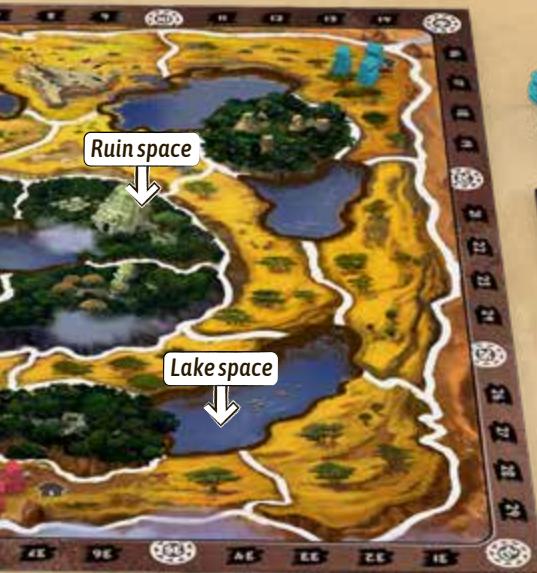
Each board has spaces outlined in black or white. Players' starting spaces are indicated with a. There are three types of spaces: Ruins and Savannas outlined in white; Lakes outlined in black. The Prosperity Track runs around the edge of the board.
2.Pawns and Markens
Randomly give a player the First Player marker. They will take the first turn. Choose a color and take all of the pieces in that color (10 Warrior pawns, 5 Master-Animal pawns, 3 Hero pawns, 1 Prosperity Point marker, 1 Movement marker), placing them in front of you to create your personal pool.
Place your Prosperity Point marker on the 0 space of the Prosperity Track.
Then, starting with the first player and going clockwise, place 3 of your Warrior pawns on an unoccupied starting space(). Keep your other pawns in front of you for now.
Warrior Master-Animal Hero
These pawns let you take control of spaces on the board and receive their benefits.
The Movement marker is used to track how many spaces you have moved during your turn.


The First Player marker reminds everyone who had the first turn of the game.
This marker is used to mark your score on the track that surrounds the game board.

3.Kingdom Sheetsand Cands
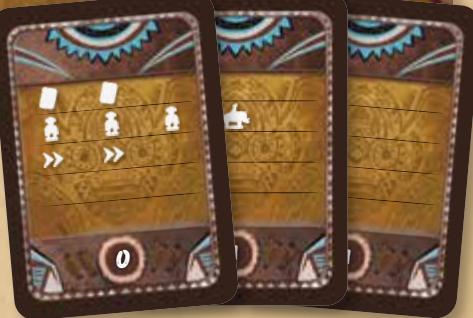
Take the Kingdom sheet of your player color and place it in front of you. Then take a Starting Kingdom card (marked with a 0) and place it to the right of your sheet.


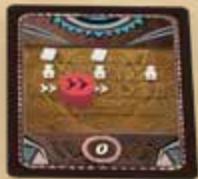

The Kingdom Sheet is a reference for the card symbols, the effects of the different pawn types, and the turn phases. The starting Kingdom card provides your initial pawns, movement ability, and ability to choose new cards; all starting cards are identical. Your display of cards next to this sheet is referred to as your Kingdom.
Choose 1 of the 2 Kingdom card decks to play with (Blue or Red) and put the other back in the box. Sort the chosen deck into separate piles by the Age number at the bottom of the card . Shuffle each pile of cards separately; then stack them face down, in order, so that the 5-pile is on the bottom and the 1-pile is on the top. Place the assembled Kingdom deck near the board and deal a row of 6 face-up Kingdom cards to the left of the deck. Gameplay is different with each deck: For your first game, we recommend playing with the Blue deck.
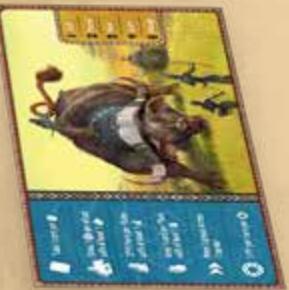
Symbols on the Kingdom cards are divided into 4 rows (with a 5th row on cards in the Red deck). The symbols in each row are used in a different phase of your turn. The more symbols there are in a row, the more powerful the card. Kingdom cards become more powerful as you draft from later Ages. The number at the bottom of the card shows which Age the card belongs to.
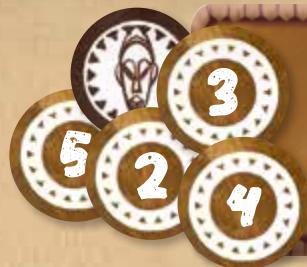
These tokens show Prosperity Points ranging from 2 to 5 on one side.
The bag lets you draw them at random.
Gameplay
A game of Kitara is played over a series of rounds until an Age 5 card is revealed. Complete the current round (so all players have the same number of turns), then each player takes one final turn. In 2- or 4-player games, each player will have 7 turns. In 3-player games, each player will have 9 turns. Play each round going clockwise, starting with the first player.
OVERVIEW OF A TURN
On your turn, play the following 5 phases in this order. Then, the player to your left takes their turn.
-
DRAFT
-
SCORE
-
RECRUIT
-
MANAGE
-
MOVE
1.Draft
Choose 1 Kingdom card to draft from among the face-up cards next to the deck (see Drafting a Card, below).
DRAFTING A CARD
Each symbol in the top row of your Kingdom cards gives you 1 additional choice when drafting a card.
Count the number of symbols in your Kingdom. This is the number of cards you may choose from, starting from the left (furthest from the deck).
Example: on the first turn of the game, you have 2 symbols on your starting card, so you may choose either the first or second card from the left.
Place this card in your Kingdom to the right of the cards you already have.
Slide the remaining face-up cards left, to fill the empty space in the row. Then draw a card from the deck, and add it face-up to the right end of the row.

Then move on to the RECRUIT PHASE.
2.Recnuit
The second-row of your drafted card will have 0-3 pawn symbols. Take each pawn indicated by the drafted card's symbols from your supply and place them in any board spaces you already occupy.
Example: you drafted a card with 1 warrior symbol. You take 1 Warrior pawn from your supply and place it on a savannah space already occupied by your pawns.
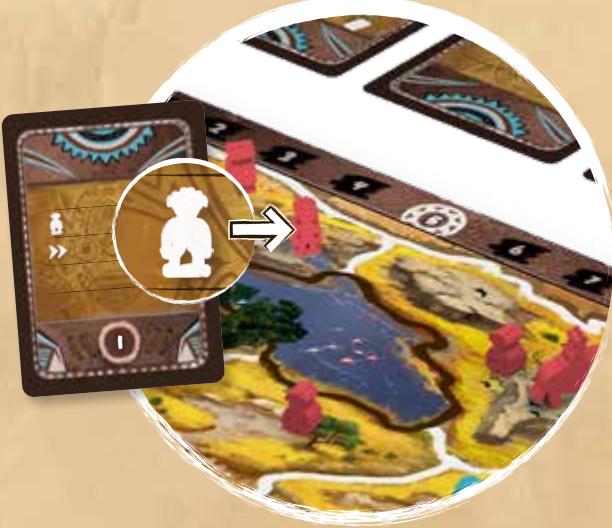
If all of your pawns of the matching type are on the board, then skip placing pawns of that type when recruiting.
Note: You only recruit using the symbols on your NEW card—NOT the cards already in your Kingdom.
Continue on to the MOVE PHASE.
3.Move
The third row of the cards in your Kingdom will have a number ofsymbols. Eachsymbol allows you to make 1 movement. You are not required to use all of your moves.
At the start of the Move Phase, place your Move marker on the leftmost symbol on the cards in your Kingdom. After each move you make, move this marker onto the nextsymbol to the right. This will help track how many moves you have taken this phase.
Attacking and Retreating occur during the Move Phase (see next page). When you have used all of yoursymbols, or do not want to make any more moves, continue to the SCORE PHASE.


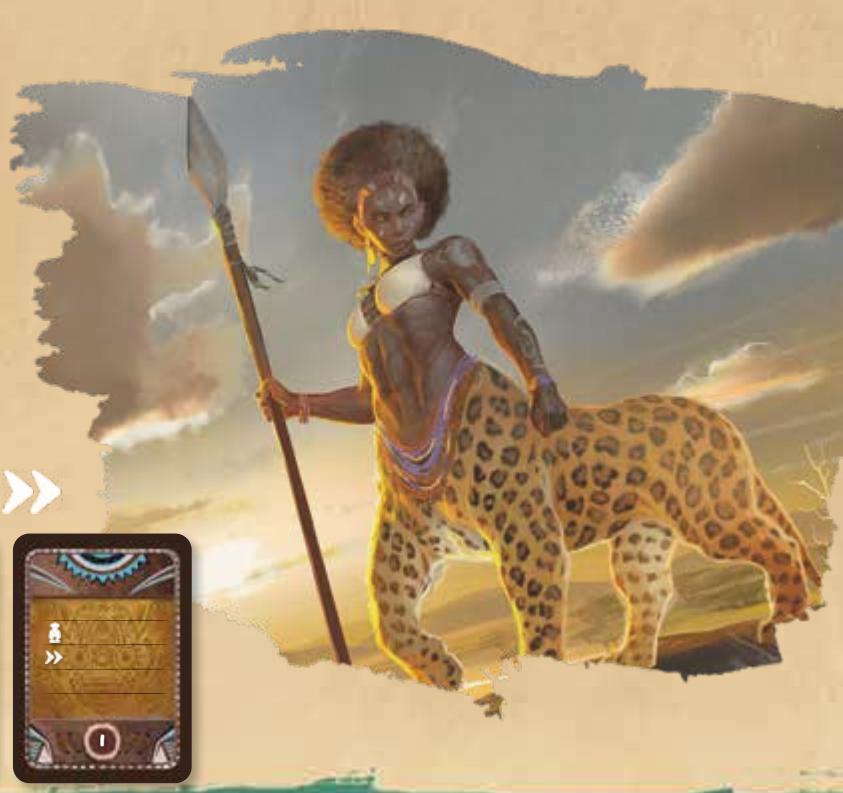
MOVEMENT
A move action consists of moving 1 or more pawns as a group from 1 space to an adjacent space on the board. A Movement must always follow these rules:
All pawns that are moving must move across the same white border from 1 space to 1 adjacent space. Pawns may never move across black borders (Lakes).
Pawns may make multiple moves in the same turn, or different groups can be moved with different move actions, or a combination of the two. It's up to you.
Your pawns may only move onto a space occupied by another player's pawns if you are able to Attack (see next page)
You must complete each move action before starting another.
It is not necessary to move all of the pawns in a space—you may move some and leave others behind.
ATTACK
An Attack occurs whenever you move pawns into a space occupied by an opponent's pawns. To make an attack, your attacking group of pawns must be larger (at least 1 more) than the occupying group of your opponent's pawns. All pawn types (6 ) can be used to attack, and each pawn type adds 1 to the size of your attacking force.
You cannot attack an opponent's space if it is the only space they currently occupy.
All attacks that meet the conditions above succeed automatically.
If you attacked with a group that included at least 1 Hero pawn, draw 1 Hero token randomly from the bag; look at the number on the token without showing it to the other players, and place it number-side down on the table, next to your Kingdom sheet.
The opposing pawns in the attacked space must now retreat (see Retreat, below) You may now resume making moves, including additional attacks.
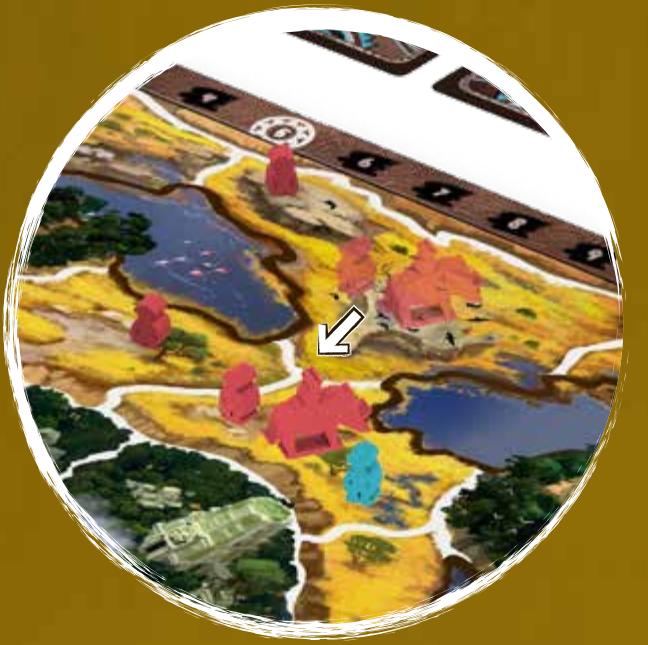

RETREAT
When you force an opponent to retreat, that opponent must move all pawns from the attacked space to the closest space they still occupy (crossing the fewest white borders possible).
Pawns may retreat through spaces occupied by other players' pawns without Attacking, but pawns may not move across black borders (Lakes) when retreating.
If multiple occupied spaces are equally close, the retreating player may choose which space to retreat to. However, all pawns must retreat to the same space.

4.Scone

The fourth row on the cards in your Kingdom will have a number of symbols. Score 1 Prosperity Point for eachsymbol on your cards.
Mark all points you scored on the Prosperity Track.

Look at all of the Hero tokens you drew this turn, without showing them to the other players. Keep only 1 of the highest value tokens (only 1 token if tied for highest), placing it face-down on your Kingdom sheet. Return the other tokens you drew that turn to the bag. Then move on to the MANAGE PHASE.
5.Manage
Each card in your Kingdom represents people who must be fed. If the card is not fed, those people get angry and leave your Kingdom.
Each Savanna space you occupy with at least 1 Warrior pawn lets you feed (keep) 1 card at the end of your turn. Determine the total number of cards you can feed; if you have more cards than you can feed in your Kingdom, then you must discard cards until your Kingdom has only the number of cards you can feed. For each pawn symbol on the Kingdom cards you discard, you must remove 1 of your pawns of the corresponding type from the board and place it back in your supply. Pawns can be removed from any of your occupied spaces.

have to be fed and cannot be discarded.
Then the player to your left takes their turn, starting with the DRAFT PHASE. In 2-player games only, at the end of your turn, discard the leftmost card from the drafting row next to the deck. Move the remaining 5 cards down and reveal the top card from the deck, which you place as far right as possible, just to the left of the deck.
End of the Game
If, during the Draft Phase, you reveal an Age 5 card, the end of the game is triggered. Continue to play until all players have played the same number of turns (that is, until the player to the right of the first player ends their turn). Finally, each player takes one last turn.
Final Scoring
Reveal all of your Hero tokens, add up the Prosperity Points shown, and mark the points gained on the Prosperity Track.
Each player gains 2 Prosperity Points for each card still in their Kingdom. The player with the most Prosperity Points wins the game! If there is a tie, the player with the most Hero tokens wins. If there is still a tie, they share the victory.

SPECIAL THANKS TO:Shannon Applecline, Gaëtan Beaujannot, Jessica Blair, Cedric Blaise, Heather Boshears-Robbins, Cordell Brown IIl, David Brown, David Boyd, Amy Crook, Evan Denbaum, Michael Economy, Dan Fernandez, Anna Gee, Terrence Gee, Jason Green-Lowe, Tyler Goble, Jos Harrington, Carmen Ho, James, Nick Klumpp, Brent Knudson, Brian Knudson, Eric Lyttle, Mak (Daddy) Mak, David McCracken, Mark Meuser. Daniel O’Neill, David O'Sullivan, Sam Owens, Haley Pitoni, Christina Robinson, Robert Rossney, Chris Ruggiero, Chris Specker, Jon Spinner, Mitchell Stein, David Stansel-Garner, MacKenzie Stuart, Tyler Wallpole, and Martine Wargnier.
DESIGNER: Eric B. Vogel
ILLUSTRATOR:Miguel Coimbra
AGENCY:Forgenext
PROJECT MANAGER: Ludovic Papaïs
GRAPHIC DESIGNER: Vincent Mougenot

EDITOR:Xavier Taverne
TRANSLATION: Danni Loe
PROOFING: William Niebling, Stephen Vargo and Stephan Brissaud
DESIGNER'S NOTE:
The simplicity of Kitara's game design is deceptive;I have worked on this game's development, off-and-on, for 10 years, and it continued to evolve throughout that time. Ultimately, it took a great deal of research and collaboration with the production team at lELLO to arrive at the perfect setting for this game. We knew we wanted the game to have an Afro-Fantasy setting, and so I reviewed the literature looking for a historical/mythological setting that was suitable to adapt the design to. After reviewing a couple of possible settings, we settled upon the ancient Kitara Empire, also called the Chwezi Empire.
Scholars differ as to whether the ancient Kitara empire was historical or mythological (Doyle, 2006; Uzoigwe, 2012). The empire may have covered most of the interlacustrine region of Central-East Africa for an unknown period, up until the 14th or 15th century AD. According to legend, the empire was consolidated from an older loose confederation by the Abachwezi dynasty of kings, who had mystical powers and who introduced important new technologies and practices to the region. According to legend, the Abachwezi kings were later angered by the disobedience of their people and vanished into the great lakes. Their empire then fragmented into several kingdoms, including the still-extant kingdom of Bunyoro-Kitara in western Uganda. Kingdoms in the region tried to enhance their prestige by associating themselves with the Kitara Empire and the Abachwezi in a variety of ways. Although the notion of kingdoms fighting over Kitaran ruins is an invention of mine, Ankole cattle raiding was an important aspect of warfare between kingdoms in the region for centuries. Bunyoro-Kitara and neighboring kingdoms fought to re-establish the regional dominance of the ancient Kitara Empire throughout the pre-colonial era.
Texts are community-compiled or publicly released by publishers; copyright remains with the original authors. For personal reference only.