
Kokopelli
At a glance
Rules, cards and Q&A (Chinese)
The rules, card data and player questions for this game are written in Chinese. Open the Chinese page to read them.
Where to find full rules
Full rules and card lookup are available in the cunlema app at cunlema.cn — pick this game and ask about any rule, card or turn you are unsure about.
Related games
Rulebook text (Markdown)
This game has 2 rulebook Markdown file(s) in our library; 2 rendered inline below — expand to read or download.
rules_zh_科科佩利_24817.md22.9 KB

背面:
猎人
游戏配件
- 192 张仪式卡
正面:16 种仪式,每种 12 张
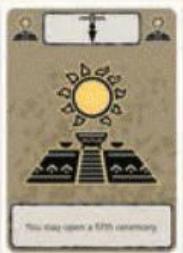
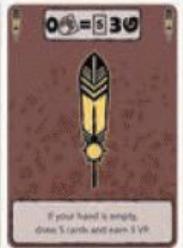
太阳
鹰羽
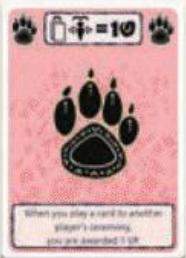
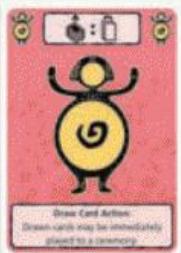
爪

展示玩家的颜色。每位玩家在16种仪式中分别有3张自己颜色的卡牌。

诞生
战士
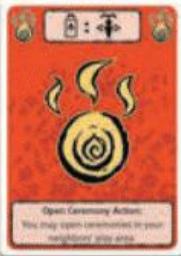
火
蜘蛛女
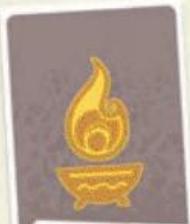


花瓶
蛇舞
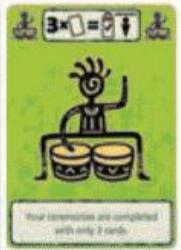
鼓手

天母

萨满
鳄鱼

酋长
乌龟

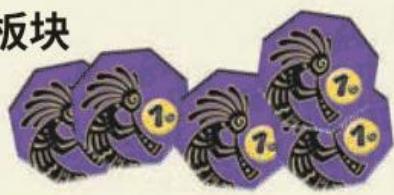
- 16 个选择板块

背面
35x1VP

·24 张叩叩佩利卡

- 80个胜利点板块

背面

15x3VP
15x10VP
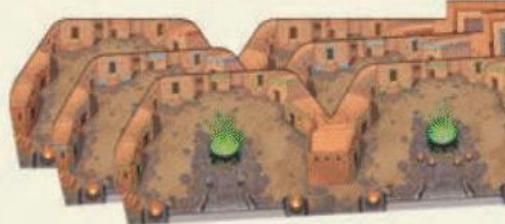
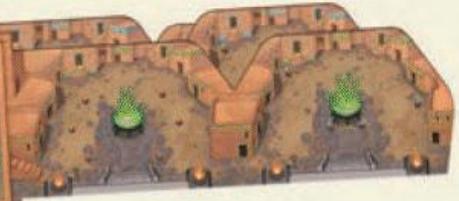
·4个村庄版图
背面展示玩家的颜色每位玩家各拥有6张叩叩佩利卡

15x4VP

正面: 叩叩佩利 (百搭卡)


- 1 个起始玩家标记


每位玩家各 1 个

· 12 个游戏结束板块

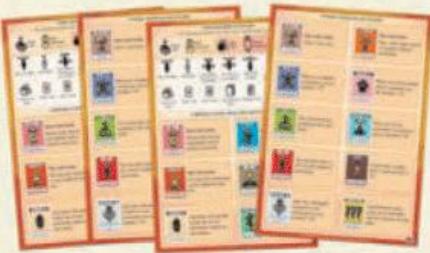
- 4 张能力摘要(双面)
·1 本规则书
游戏内容和游戏目标
每位玩家起始时拥有自己的一个牌库,这个牌库由仪式卡和叩叩佩利卡组成,并且每个人还拥有含4个区域的村庄。每个仪式每一个已经开启的仪式,只要仪式还在场上,都会赋予拥有者一种强大的能力。卡牌可以在你的游戏区的任何区域打出,其中不仅包括你的村庄,还包括你邻居的两个区域。
游戏的目标是通过利用独特的礼仪能力组合和完成仪式来尽可能获得更多胜利点,这些都会奖励完成仪式的玩家。仪式有一系列的能力,这将授予新的方式得分或扩大玩家选择如何最好地发挥他们的卡牌。这盒游戏包含的仪式比一局游戏里能够使用的仪式还要多,每一局游戏都有一个独特的挑战。
当一个玩家的抽牌堆中没有剩余卡牌或完成了一定数量的仪式时,游戏结束。胜利点最多的玩家获胜。
设置:以 4 人游戏为例

选择仪式
按照背面朝上的方式洗混 16 个选择板块,然后随机选取 10 个板块。这些被选取的板块讲决定哪些卡牌会在游戏中被使用;将剩余的板块放回盒子里。
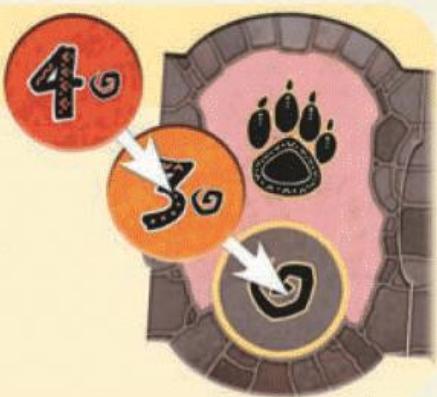
将所选取的板块平摊在游戏区域的中央。在每个板块上放置 1 个 3 胜利点板块,之后在上面再放置 1 个 4 胜利点板块。所有剩余胜利点板块堆叠在游戏区域内作为公共供应堆。
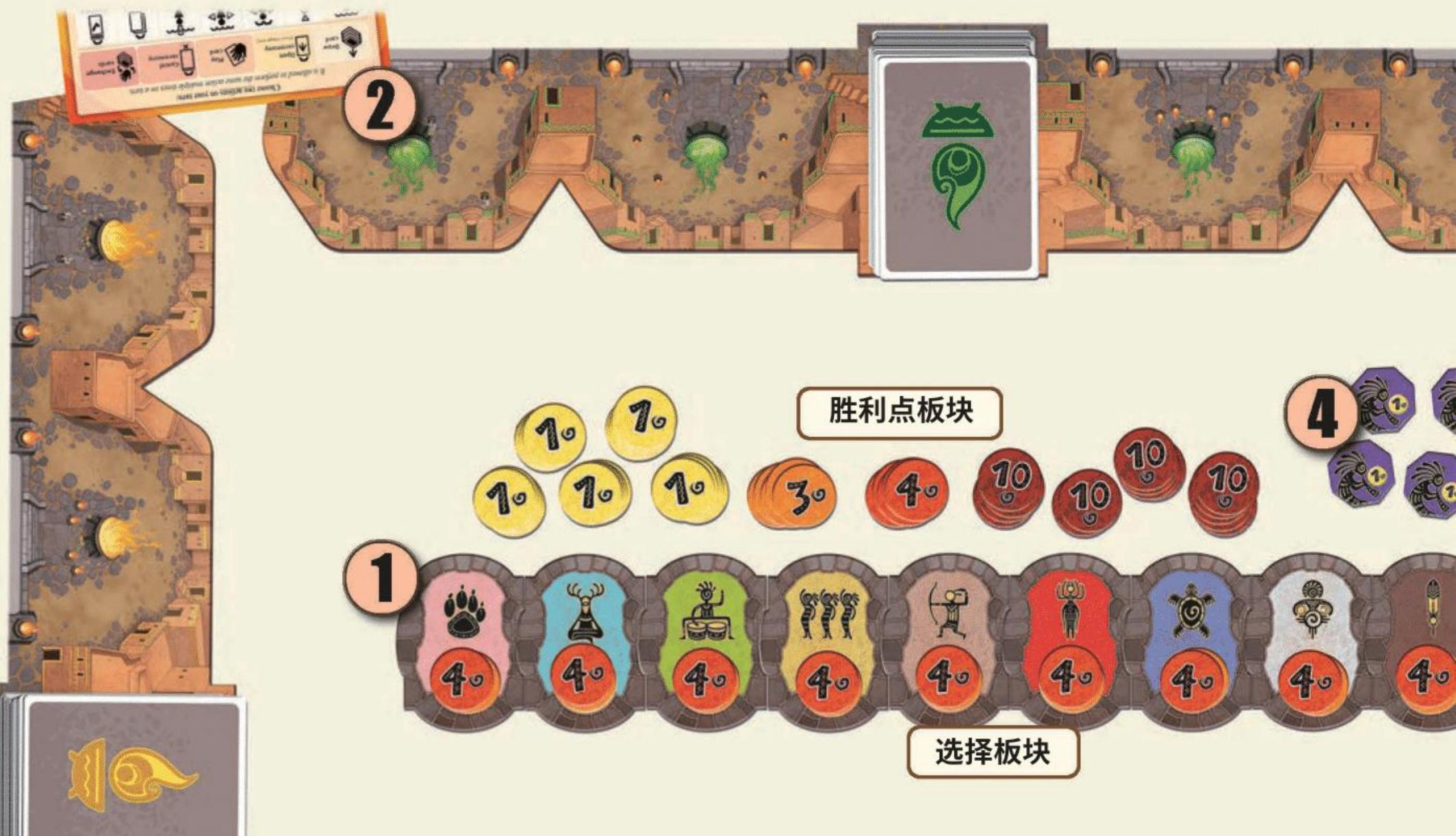
红色玩家的游戏区域
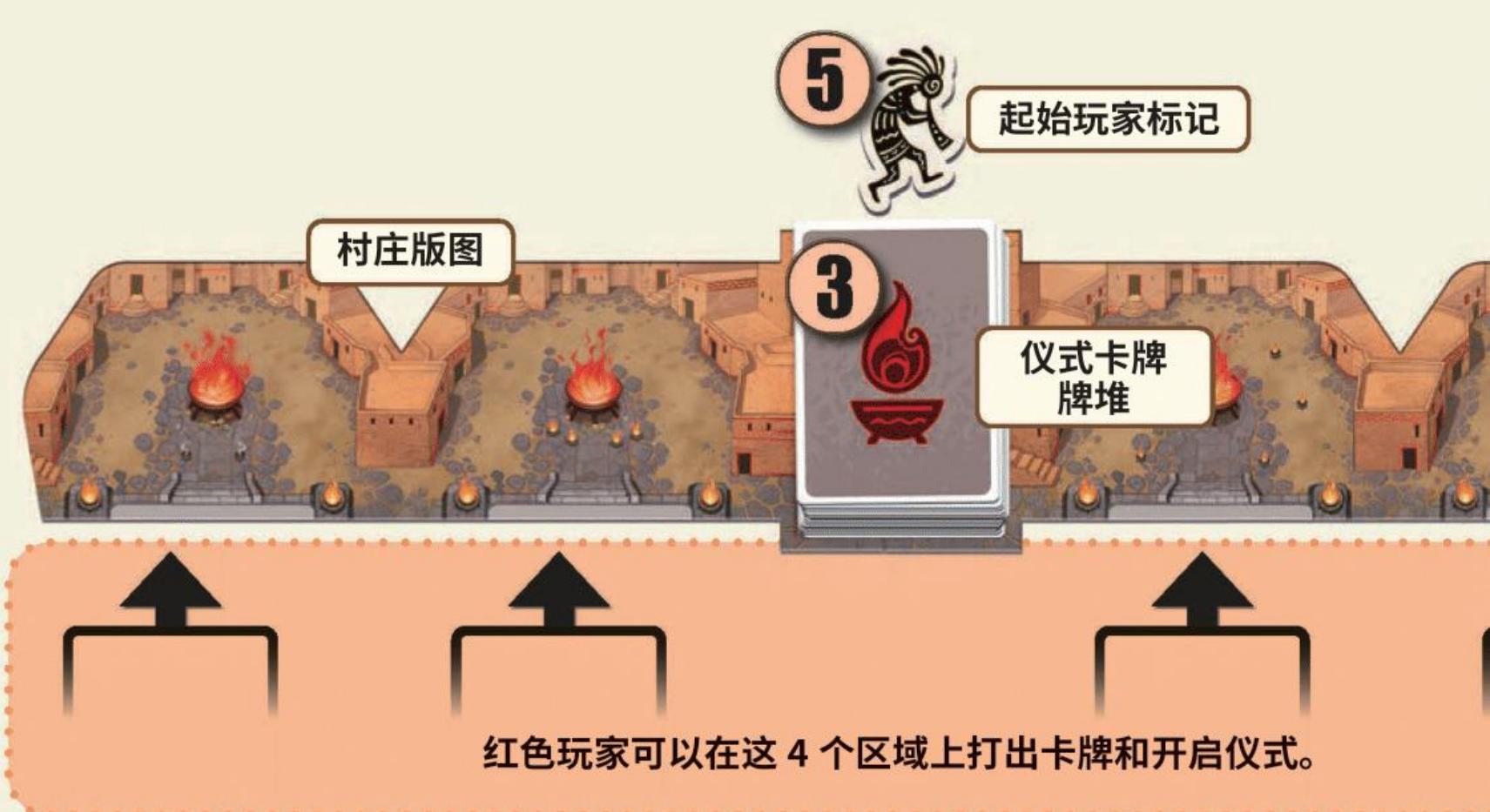
起始玩家标记
第一局游戏:对于你的第一次游戏来说,我们强烈建议使用这个图片描绘的选择板块(仪式)而不是随机抽取它们。这是特别适合学习游戏的玩法。



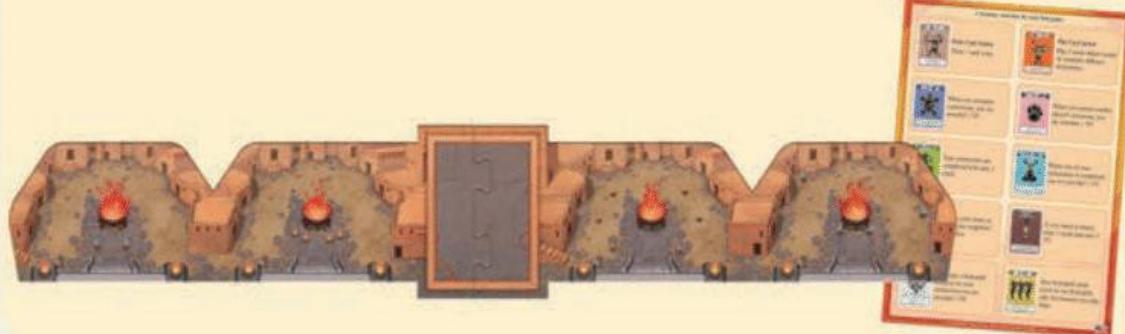
村庄版图和能力摘要
每位玩家拿取一块村庄版图并将其放到自己面前,将一张描述了所有卡牌能力和插图的参考表放在一旁。
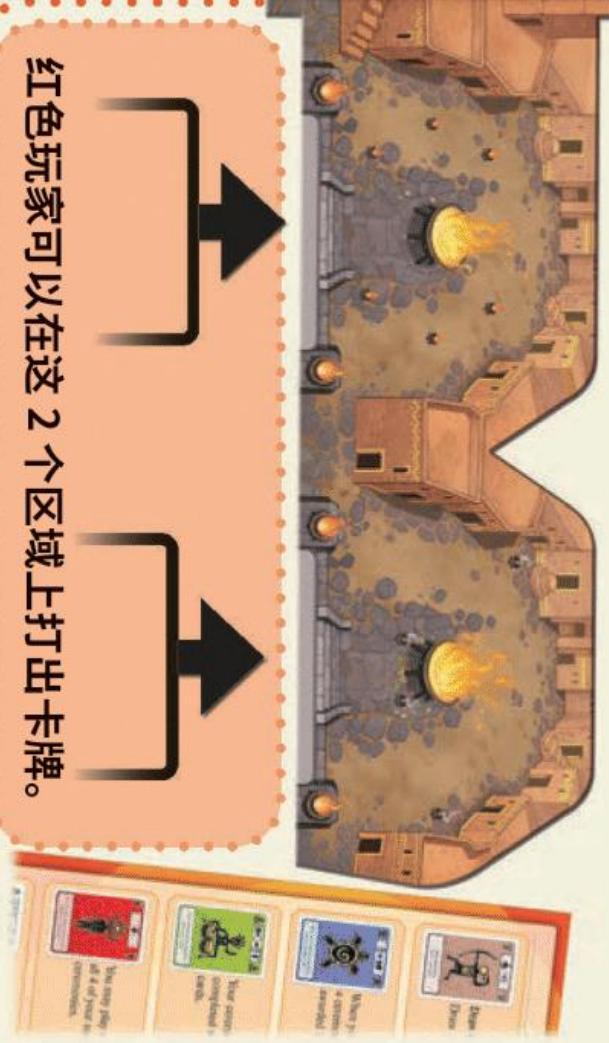
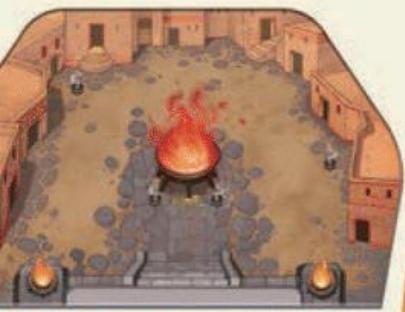
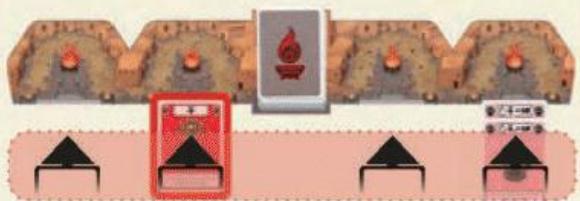
红色玩家可以在这 2 个区域上打出卡牌。

准备卡牌牌库
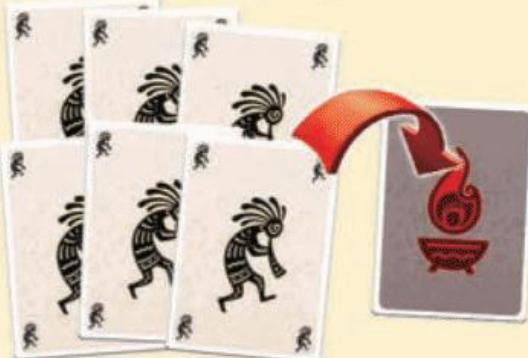
每位玩家从 10 种仪式中拿取每种仪式卡 3 张,然后拿取玩家颜色的 6 张叩叩佩利卡,然后将这些卡牌洗混来构建一个 36 张卡牌的牌库。
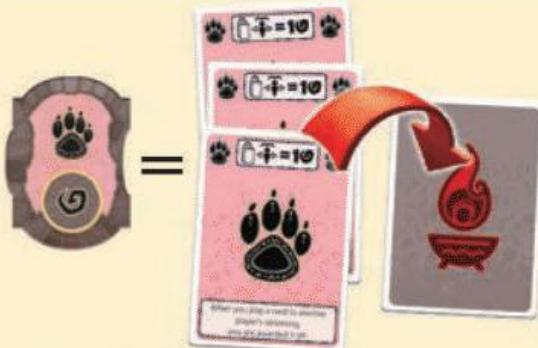
这个牌库应该被放在村庄版图的中央。最后每位玩家从其抓牌堆抓取5张卡牌作为起始手牌。
所有的其他卡牌都不会在这局游戏中被使用。

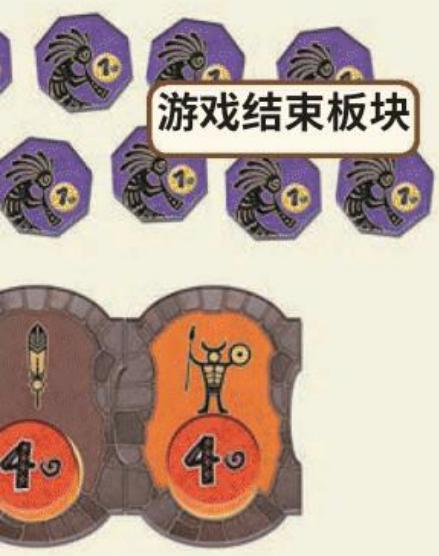
游戏结束板块
根据玩家人数堆叠对应数量的游戏结束板块:
2人游戏:3人游戏:
10 游戏结束板块
9 游戏结束板块
任何剩余的板块都不会在游戏中使用,将它们放回盒子里。

决定起始玩家
随机决定一位玩家成为起始玩家,并给予他起始玩家标记。

游戏区域
每位玩家的游戏区域由自己版图的 4 个区域以及左边和右边对手村庄版图的最近的 2 个区域组成,一共是 8 个区域。
当玩家打出卡牌时,遵循以下限制(除非有仪式能力的修改):
- 玩家只能开启自己村庄版图上的仪式。
- 玩家不能开启自己游戏区域内已被开启的仪式。
- 玩家只能在自己游戏区域内扩大仪式。
游戏流程
叩叩佩利的游戏会进行若干轮。在每一轮游戏中,起始玩家开始其回合,其他玩家按照顺时针方向轮流进行回合。
在玩家回合中,当前玩家通常执行 2 个行动。玩家的每个行动可以有 5 种选项:
a) 抓取卡牌

b) 开启仪式

c) 打出卡牌

d) 取消仪式

e) 交换卡牌
此时允许玩家在同一个回合内执行多次相同的行动。
注意:只有在游戏的第一轮,起始玩家和其左边的一位玩家只能执行一个行动。
在执行了玩家的所有行动后,玩家必须将超出 5 张的卡牌放到抓牌堆底部,将这些卡牌按照任意顺序正面朝下放置。
奖励:从手牌打出所有卡牌
如果玩家完全没有手牌,则它立即获得 1 胜利点并抓取 3 张卡牌。
这个动作会立即执行并且不视为一个行动。
当至少有一位玩家的抓牌堆被用光时,或者最后一块游戏结束板块被放置到选择板块上时,游戏会在这一轮结束时结束,

在游戏结束时拥有最多胜利点的玩家获胜!如果出现平局,则平局玩家共享胜利。


5 种选项为:
a) 抓牌
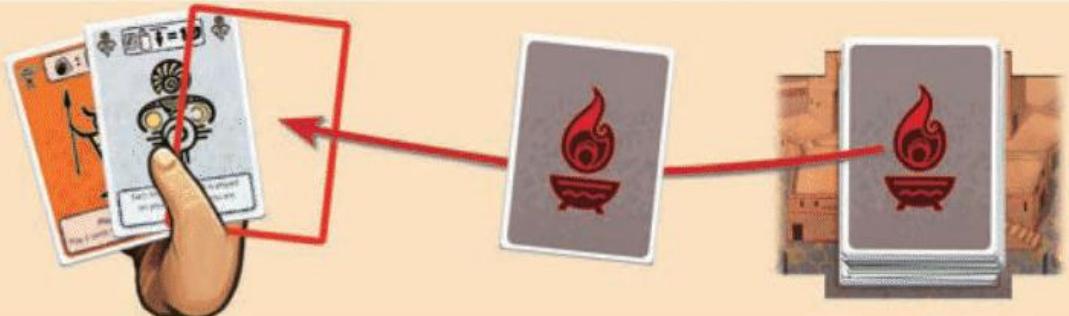
玩家从抓牌堆抓取顶牌,并将其加入手牌。
b) 开启仪式(只能在自己村庄内)
玩家必须在自己村庄内拥有一个空置区域才能执行此行动。为了开启一个仪式,玩家从手牌拿取一张仪式卡(而不是叩叩佩利卡)并将其放到空置区域内。
重要提示:如果玩家的游戏区域内已经有一个完全相同的仪式,则玩家无法开启这个相同的仪式。
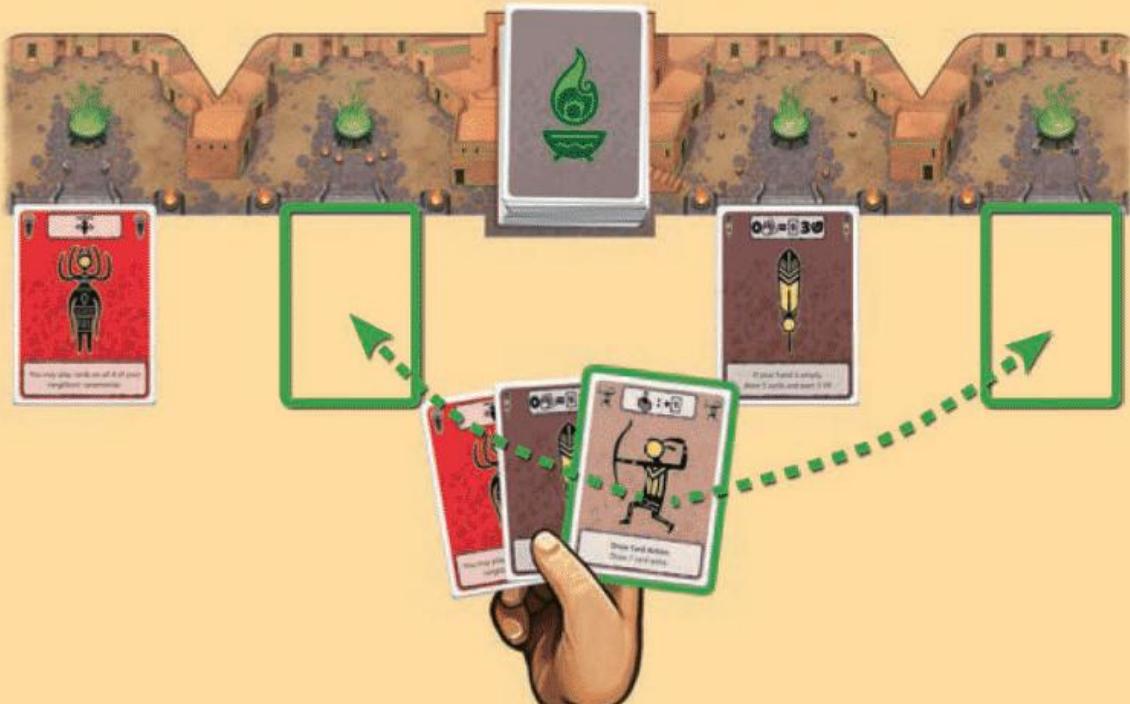
卡牌能力:
举例:绿色玩家的村庄版图上有2个空置区域来开启猎人仪式。在开启仪式之前,他必须确定是否有另一张猎人仪式在其游戏区域内。
当一个仪式被开启时,它会立即授予开启村庄的玩家一个特殊能力。只要仪式一直在村庄版图上,这种特殊能力就会一直存在。每个仪式都会赋予一种特殊能力,这在卡牌上和游戏规则书末尾有描述。
重要提示:如果有一种能力与基础游戏规则矛盾,则卡牌上的规则会优先于基础规则!
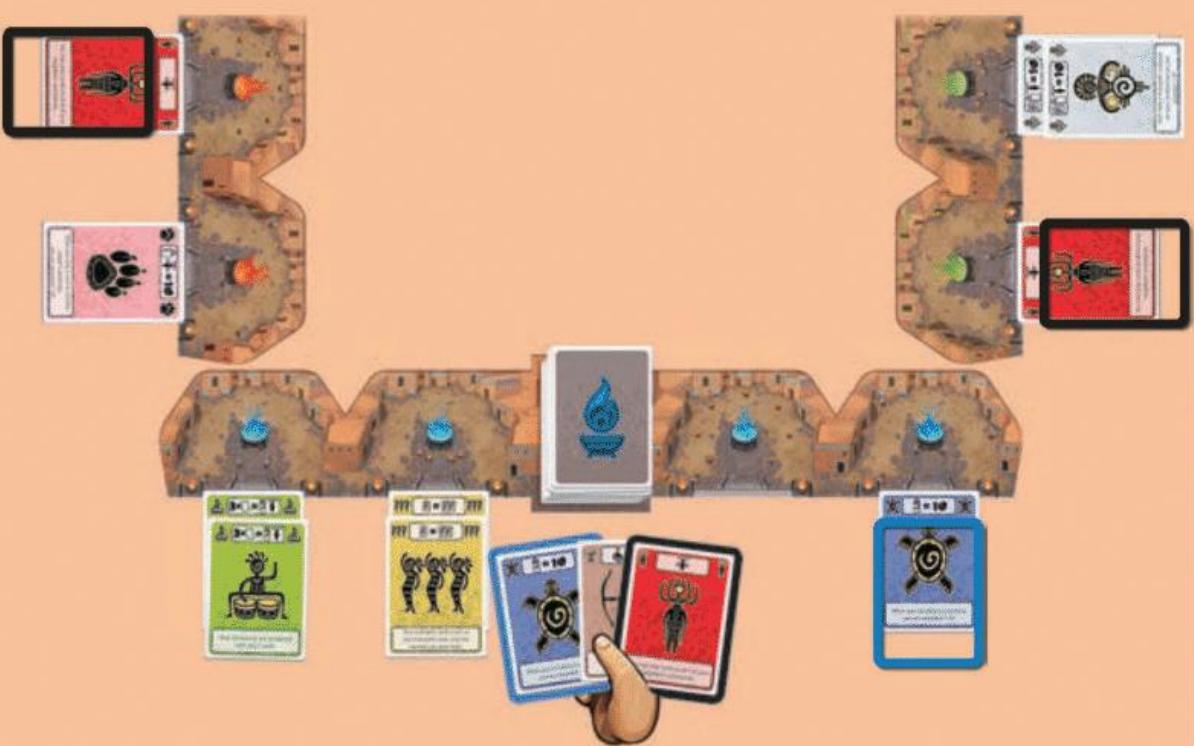
举例:蓝色玩家可以扩大他自己的乌龟仪式或者打出蜘蛛女到其邻居的仪式上,因为这两个仪式都在其游戏区域内。
c) 打出卡牌(游戏区域)
玩家从手牌中选择并打出一张卡牌到其游戏区域内已经开启的仪式上。这张卡牌必须与已在场上的仪式卡匹配。
叩叩佩利卡是百搭卡牌,这类卡牌可以打出放在任何仪式上。
当打出第 2 或第 3 张卡牌到仪式上时,该仪式被扩大。
最后,打出第 4 张卡牌到仪式时会完成仪式,这会让玩家获得胜利点并将该仪式从玩家村庄版图上移除。

扩大一个仪式
玩家可以扩大其游戏区域内任意位置的一个现存的仪式。
为此,玩家将一个匹配的仪式卡或叩叩佩利卡(百搭卡牌)放到对应的仪式上。
卡牌必须错开堆叠,这样才能清楚地知道在仪式上打了多少张牌。
扩大一个仪式没有必要的后果,但可能是出于战略原因,基于能力或需要完成你或对手的仪式。
完成一个仪式
通过在一个仪式上打出第 4 张卡牌,该仪式被完成了。立即执行以下步骤:
1) 如果可能的话, 打出第 4 张卡牌的玩家从匹配完成仪式的选择板块上获得顶部的胜利点板块。
如果他拿取 3 胜利点板块,则将游戏结束标记放到选择板块上。
如果一个游戏结束标记已经在选择板块上,则该玩家改为获得1胜利点。
2)所完成仪式的拥有者(也就是仪式所在的村庄版图拥有者)拿取仪式的所有卡牌并将其按照任意顺序放到弃牌堆。如果他不是当前玩家(这会发生在你完成另一位玩家的仪式时),他也会获得1胜利点。
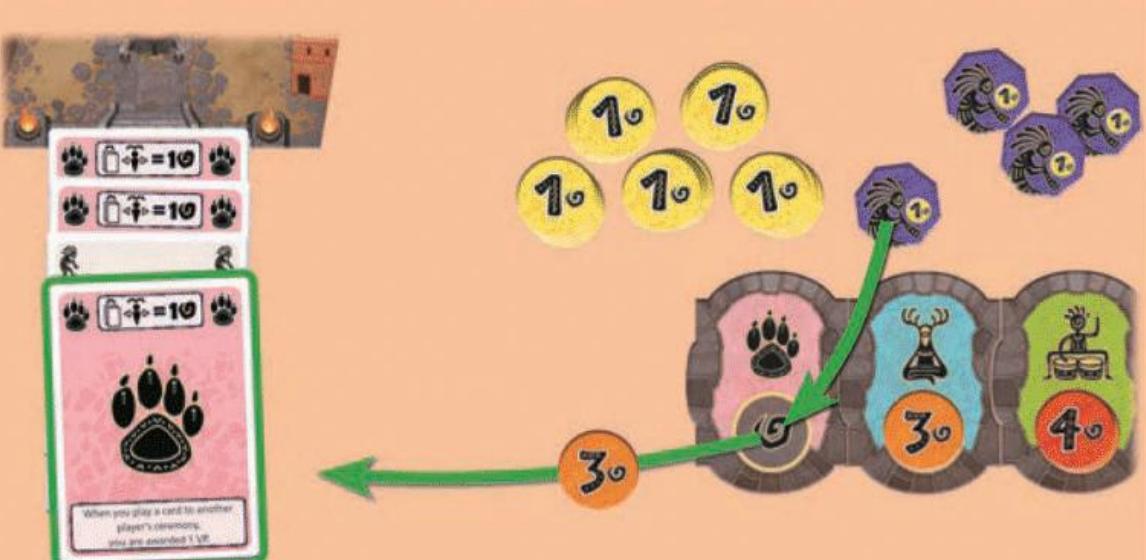
举例:玩家完成了爪的仪式并从选择板块上拿取剩余的 3 胜利点板块,将游戏结束板块替换到原位置。

举例:由于绿色玩家已经完成了黄色仪式,黄色玩家从供应堆获得 1 胜利点。
d) 取消仪式
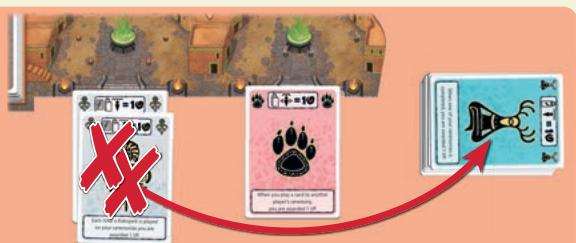
玩家选择自己村庄版图上的一个仪式并将该仪式的所有卡牌以任意顺序放到弃牌堆上。
e) 交换卡牌
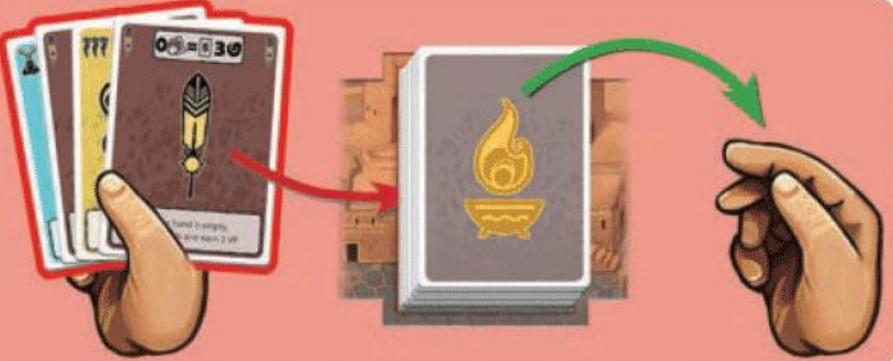
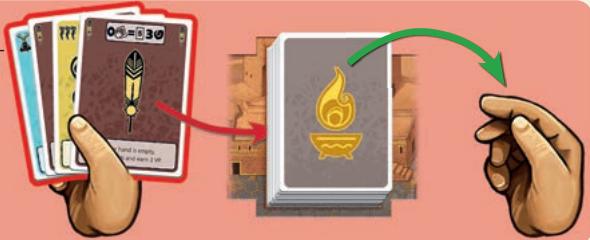
玩家拿取所有手牌并将其按任意顺序放到抓牌堆底部。然后他从抓牌堆顶部抓取相同数量的卡牌。

游戏结束和最终计分
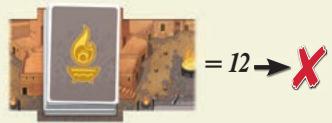
当至少有一位玩家的抓牌堆被用光时,或者最后一块游戏结束板块被放置到选择板块上时,游戏会在这一轮结束时结束。此时进行最终计分,玩家从以下内容获得额外胜利点:
1) 所有玩家将剩余手牌放到弃牌堆顶部, 然后减去抓牌堆卡牌数量的分数。
一位或多位拥有最少卡牌的玩家获得 5 胜利点。一位或多位拥有第 2 少卡牌的玩家获得 3 胜利点。所有其他玩家不会获得任何东西。玩家抓牌堆可能会出现 0 张卡牌。
2) 玩家的仪式上每有一种自己的图腾在上面(无论有多少张卡牌)就获得 1 胜利点。
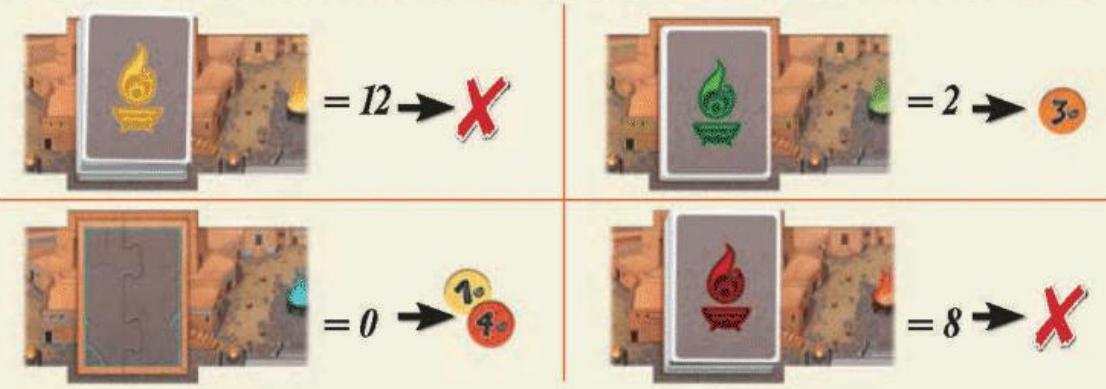
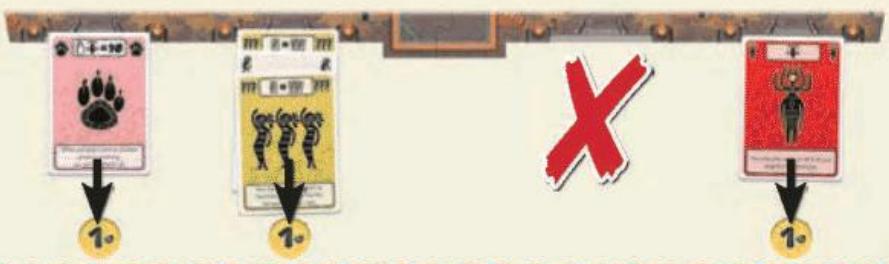
所有玩家统计各自胜利点——包括游戏中获得的,以及在最终计分获得的。拥有最多胜利点的玩家获胜。分数出现平手时,平局玩家共享胜利。
2人游戏的变动
10 块游戏结束板块放到选择板块旁。每位玩家的仪式数量和游戏区域变动如下:
- 每位玩家可以在其村庄版图上开启 5 个仪式而不是 4 个仪式。第 5 个仪式区域在抓牌堆下方。
- 玩家的游戏区域包括其 5 个仪式区域,以及其他玩家村庄版图的每个仪式区域,除了抓牌堆下方的仪式之外。
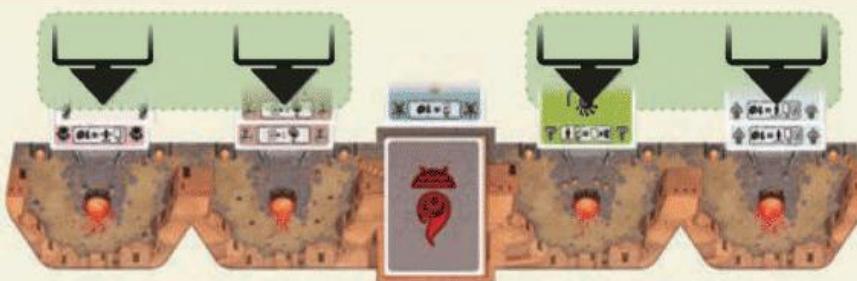
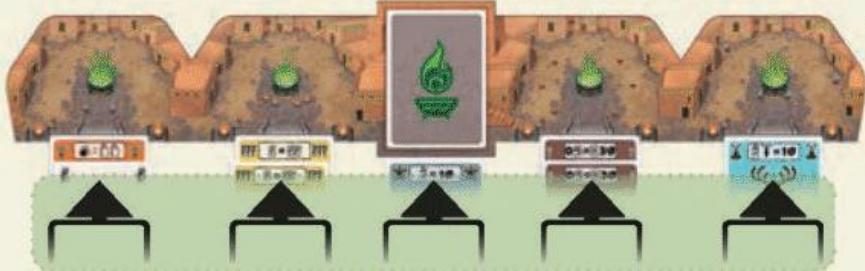
举例:绿色玩家可以打出卡牌到所有仪式,除了其他玩家抓牌堆下方的一个仪式外。
游戏变体
玩家可以决定每局游戏中至多打出 12 张仪式,来让游戏更具战术性。
在设置时,选择 1 或 2 个额外选择板块。
从以下表格选择正确数量的游戏结束板块。
| 11 选择板块: | 12 选择板块: | |
| 2 人时: | 11 游戏结束板块 | 12 游戏结束板块 |
| 3/4 人时: | 10 游戏结束板块 | 11 游戏结束板块 |
其余游戏规则不变。
仪式卡概述
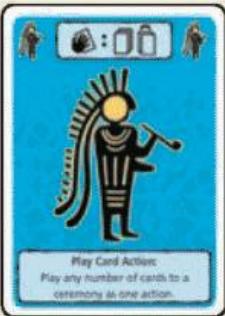
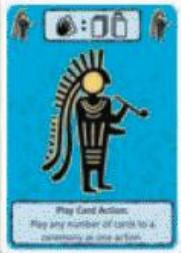
>酋长<
打出卡牌行动:打出任意数量的卡牌到一个仪式作为一个行动。
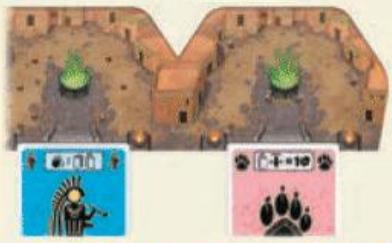
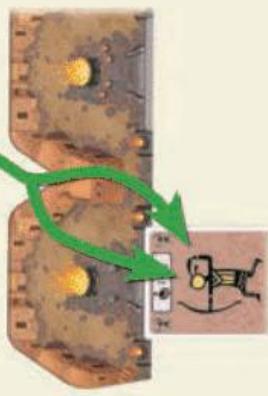
注意:你在一个仪式上玩的每一张牌都被认为是单独获得胜利点或其他效果。
举例:绿色使用酋长能力并打出猎人和叩叩佩利作为一个行动到其邻居的仪式。每张打出的卡牌因为爪子仪式而获得1胜利点。

诞生<
抓取卡牌行动:
抓取卡牌可以立即打出到一个仪式上。
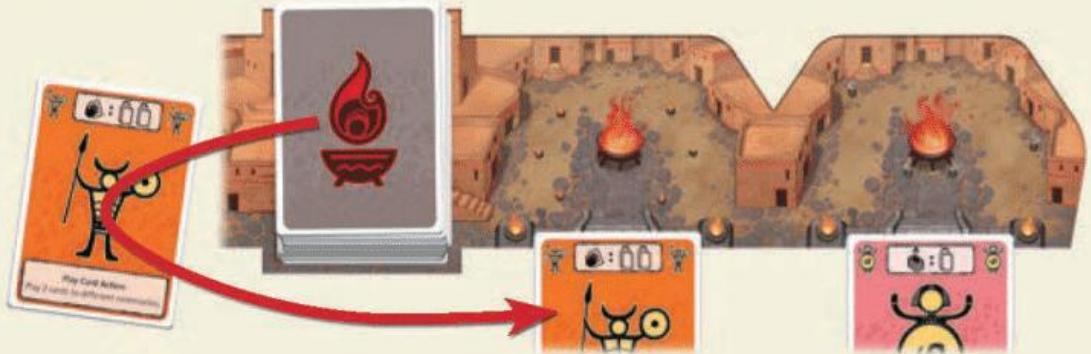
诞生 & 猎人的组合:在这种情况下,玩家可以从不同或相同仪式抓取和打出卡牌。
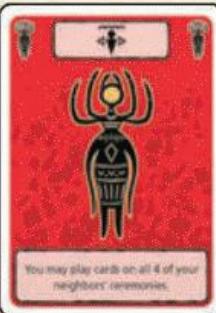
> 蜘蛛女 <
你可以打出卡牌到你邻居的所有 4 个仪式上。
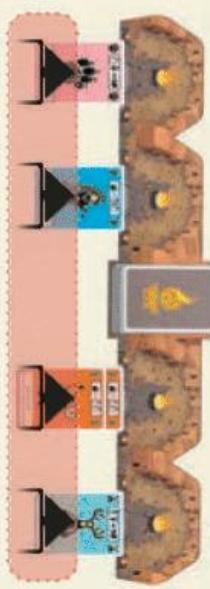
红色玩家的游戏区域
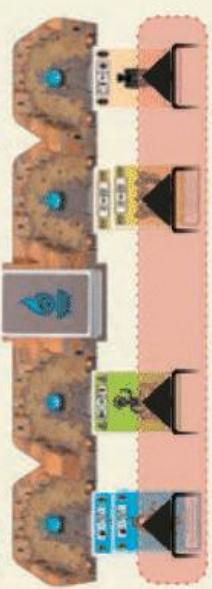
注意:当开启一个仪式时,只有普通的游戏区域能使用。而蜘蛛女能在玩家打出卡牌到邻居时放大游戏区域。
2 人游戏:你可以打出卡牌到其他玩家的所有 5 个仪式(拥有太阳仪式则是 6 个)
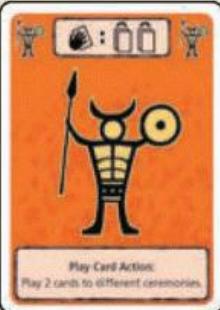
战士 <:
打出卡牌行动:
打出 2 张卡牌到不同的仪式上。
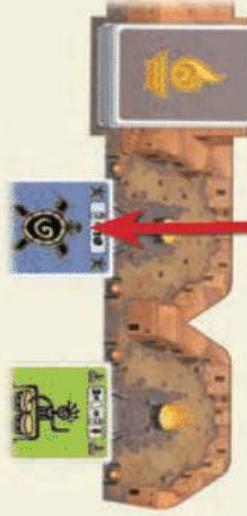
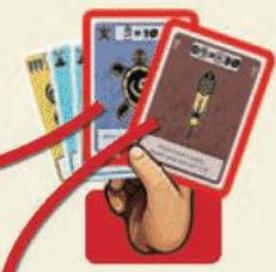
注意:你不能使用酋长和战士组合来打出2张不同的仪式。战士只允许打出刚好2张不同的卡牌到仪式上。

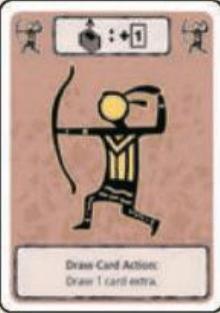
猎人<:
抓取卡牌行动:
抓取一张额外卡牌。

>火<:
开启仪式行动:你可以在你邻居的游戏区域内开启仪式。
注意:你只能在邻居的非游戏区域的版图上开启仪式(见第2-3页)。
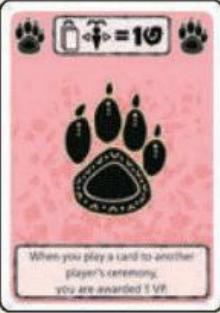
> 爪子 <:
当你打出一张卡牌到另一位玩家的仪式上时,你获得1胜利点奖励。
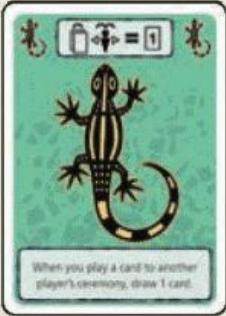
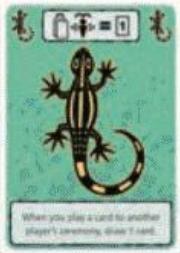
>鳄鱼<:
当你打出一张到另一位玩家的仪式上时,你抓取一张卡牌。
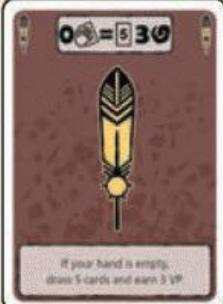
>鹰羽<:
如果你的手牌用光,抓取 5 张卡牌并获得 3 胜利点。
注意:你抓取 5 张卡牌并获得 3 胜利点,而不是抓取 3 张卡牌并获得 1 胜利点。
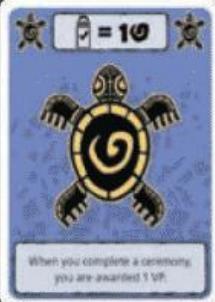
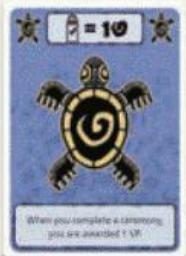
>乌龟<
当你完成一个仪式时,你获得奖励的1胜利点。
注意:无论你是在你的村庄版图上或你邻居的村庄版图上完成一个仪式,你都会获得1胜利点。如果你完成你的乌龟仪式,你也会获得1胜利点。
> 花瓶 <
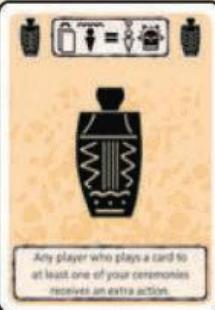
打出卡牌到至少你的一个仪式的玩家获得额外一个行动。

举例:1)蓝色打出乌龟到他邻居(红色)的仪式上,因为花瓶而获得额外的1个行动。
2)蓝色玩家将花瓶打到邻居(红色)不会获得额外的行动。
注意:无论玩家在一回合内打出多少张卡牌到该玩家的仪式,该玩家只能从每位开启花瓶仪式的玩家那里获得额外一个行动。额外的行动可以用于任意5种选项。
>太阳<
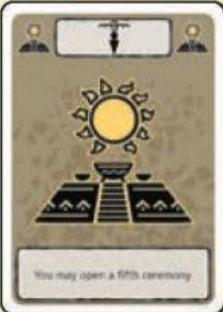
你可以开启第 5 个仪式。

注意:第 5 个仪式必须是你抓牌堆下方开启。这个仪式属于你的游戏区域,也属于你左右邻居的游戏区域。第 5 个仪式会留在场上直到完成或者弃置,无论太阳仪式是否依旧在场上。
举例:红色玩家由于他的太阳仪式而开启了第5个仪式。他在其抓牌堆下方开启了萨满仪式。
2 人游戏:你也可以在抓牌堆下面开启第 6 个仪式。抓牌堆下面的仪式都不属于其他玩家的游戏区域。
> 天母 <

每当叩叩佩利被打出放到你的仪式上,你获得1胜利点奖励。
注意:无论你或你的一个邻居是否打出一个叩叩佩利到你的一个仪式上,你都会获得1胜利点奖励。
>鼓手<

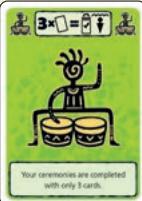
你的仪式只需 3 张卡牌就能完成。
蓝色玩家
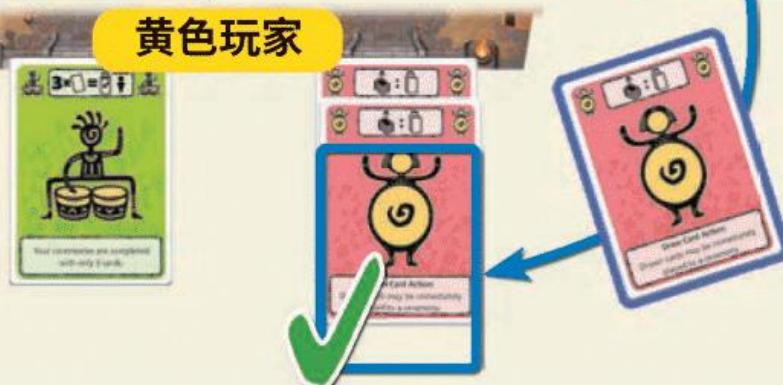
举例:蓝色玩家打出“诞生”仪式卡到其邻居(黄色)仪式,通过3张卡牌来完成它,因为黄色玩家拥有开启的鼓手仪式。
重要提示:当开启鼓手仪式时,当前由3张卡牌组成的仪式不会自动完成。仪式只有在卡牌打在上面时完成。这些3张卡牌的仪式还需要第4张卡牌来完成。
>萨满<

当你的一个仪式被完成时,你获得奖励的 1 胜利点。
黄色玩家
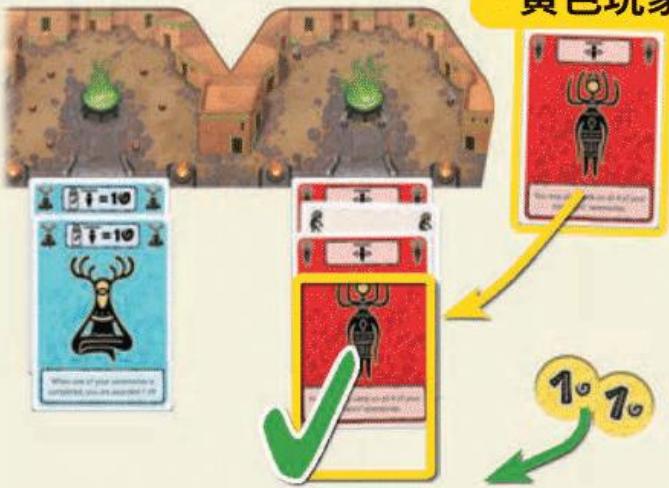
举例:黄色玩家从绿色玩家中完成蜘蛛女仪式,绿色玩家因此获得2胜利点,其中一点是因为他的仪式被另一位玩家完成,另一点是因为它是萨满。
注意:无论你或者你的一个邻居完成你的一个仪式,你都会获得 1 胜利点奖励。如果萨满仪式被完成,你依旧获得 1 胜利点奖励。
>蛇舞<

只有在你打出叩叩佩利卡时,你的 1 张叩叩佩利卡视为 2 张叩叩佩利卡。
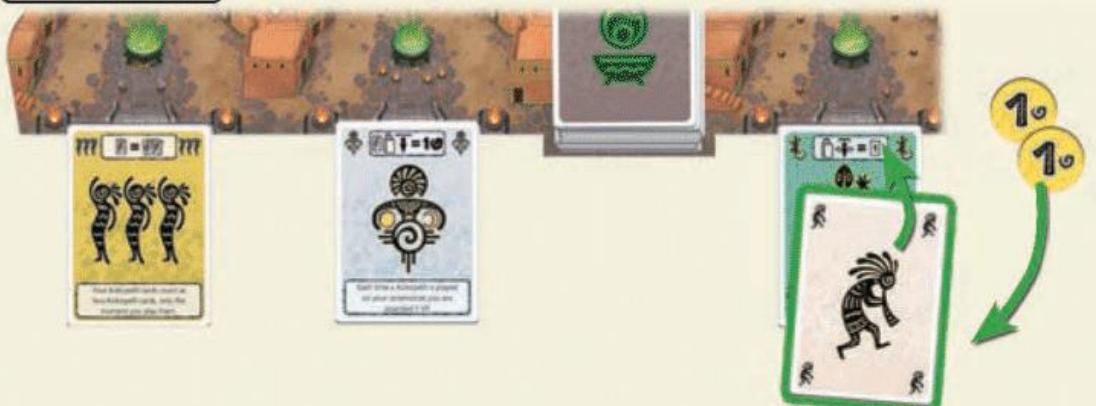
举例:绿色玩家打出叩叩佩利到其仪式,因为蛇舞和天母能力而获得2胜利点。

Kokopelli Rules EN.md23.6 KB

Front side: 12x each of the 16 ceremonies

A game by Stefan Feld for 2 - 4 players aged 8 years and older
Game Components
• 192 ceremony cards
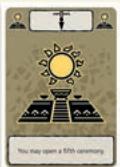
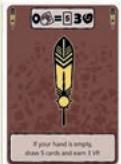
Sun
Eagle Feather
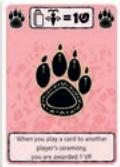
Reverse sides:
Paw
Shows the player colors. For each player there are 3x of each of the 16 ceremonies.
Birth
Hunter
Warrior

Fire

Spider Woman
Vase

Snake Dance

Drummer
Lizard

Mother of Heaven
Shaman

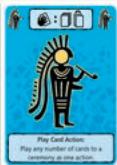
Chieftain

Tortoise
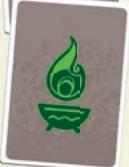
• 24 Kokopelli cards

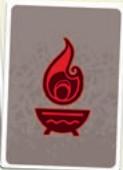

Reverse side shows the player color. There are 6 Kokopelli cards per player.

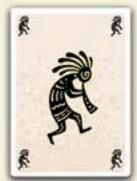
Front side:
Kokopelli (wild card)
• 16 selection tiles

Reverse side:

• 80 victory point tiles
Reverse side:


35x 1VP,
15x 3VP,


15x 4VP,
1 for each player

15x 10VP
• 4 village boards



• 12 Game End tiles

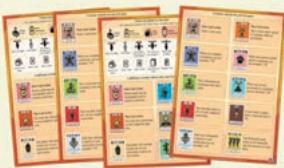
• 4 ability summaries Double sided

Game Concept and Object of the Game
Each player starts with their own deck of cards, composed of ceremony and Kokopelli cards, along with a Village with 4 spaces. Each ceremony which has been opened grants the owner a powerful ability as long as the ceremony is in play. Cards may be played anywhere in your play area, which includes not only your Village but two spaces of your neighbor's as well.
It is the object of the game to gain as many victory points as possible by utilizing the unique combination of ceremony abilities and by finishing ceremonies, which awards point to the player who finished it. Ceremonies have a range of abilities which will grant new ways of scoring points or expand the player's options on how to best play their cards. The game includes more ceremonies than are used in each game, yielding a unique challenge every game.
The game ends, when one player has no more cards left in their draw pile or a certain number of ceremonies have been finished. The player with the most victory points is winner of the game.
Setup – Example for 4 players

Select ceremonies
Shuffle the 16 selection tiles reverse side up and randomly select 10 tiles. These selection tiles will determine which cards will be used in the game; the remaining tiles should be returned to the game box.
Arrange the selected tiles in the center of the gaming area. On each tile place a 3 victory point tile followed by a 4 point tile on top of it. All remaining victory point tiles should be stacked in the play area as a common supply.

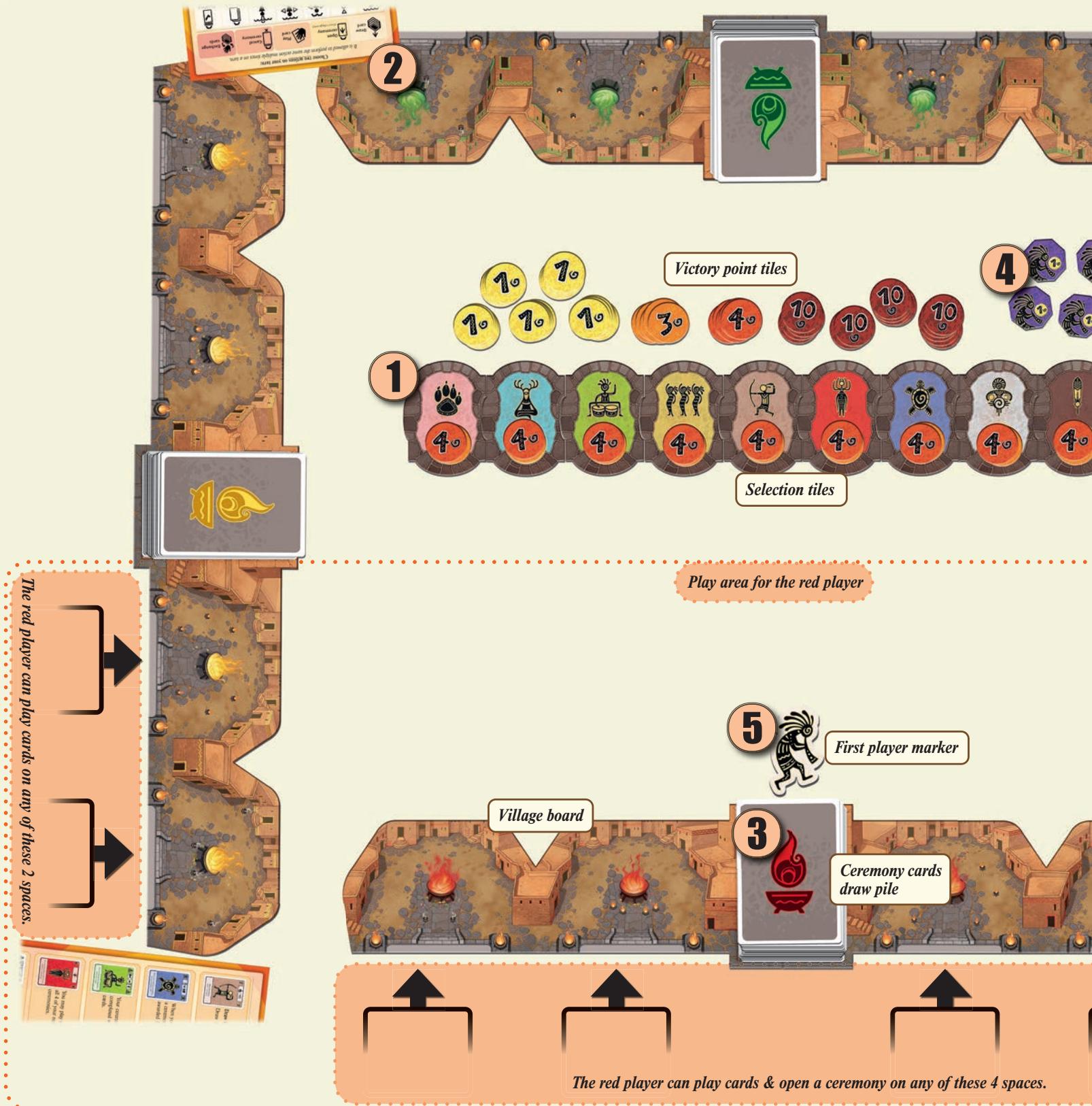
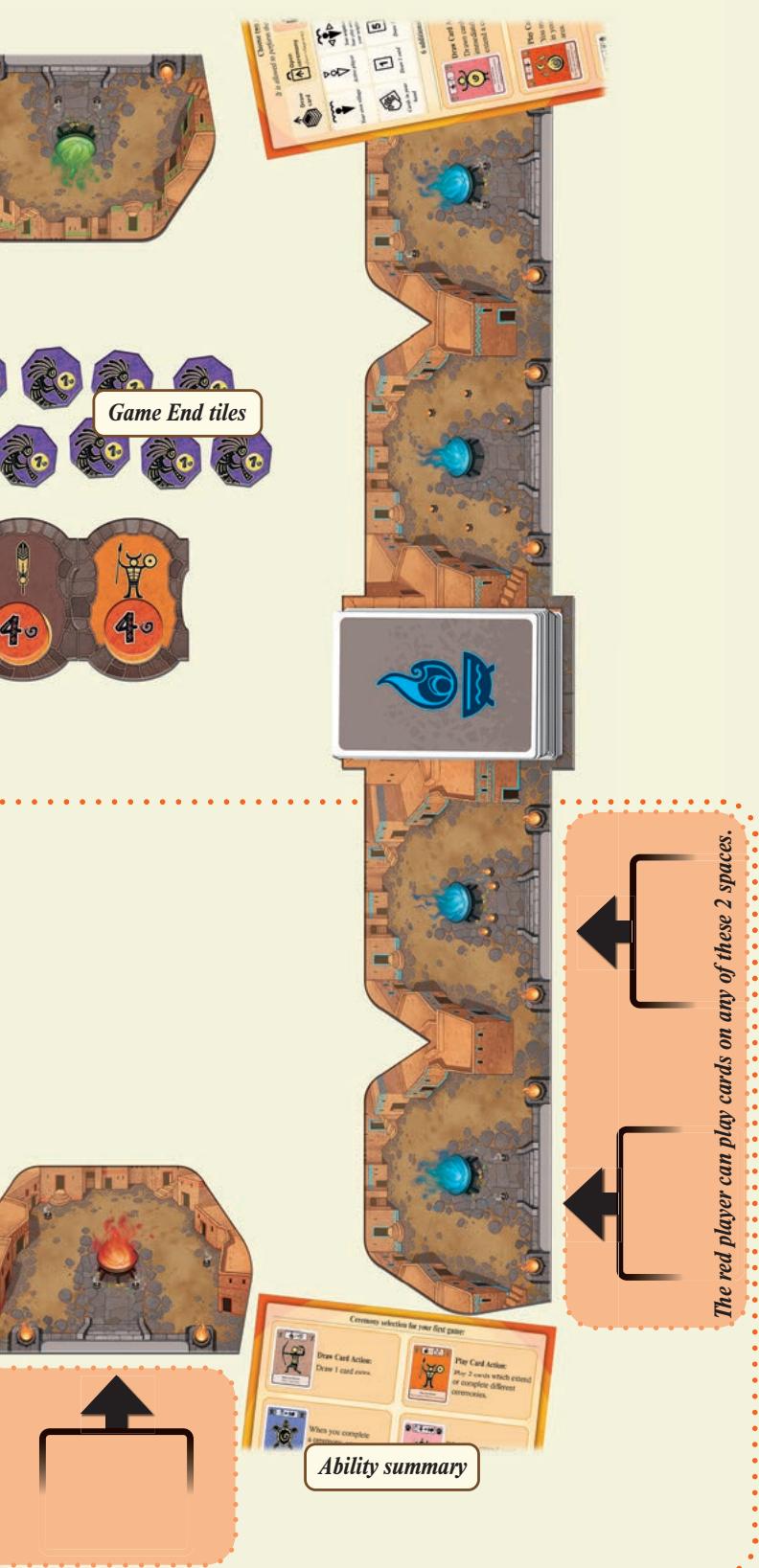
First game: For your first game, we strongly recommend using the selection tiles (ceremonies) depicted in this illustration instead of drawing them randomly. This composition is especially well suited to learn the game.


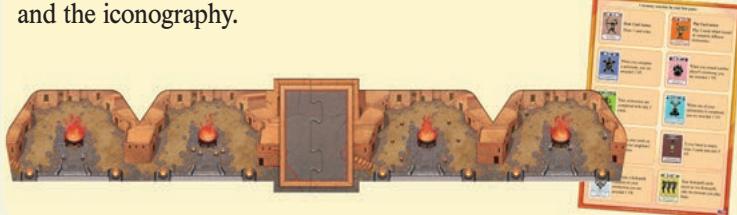
Village boards and ability summaries
Each player takes a Village board and places it in front of them, along with a reference sheet which describes all of the card abilities and the iconography.

Prepare card decks
Each player prepares their deck by taking 3 ceremony cards of each of the 10 ceremonies along with 6 Kokopelli cards in their player color, then shuffles these cards together to form a 36 card player deck.
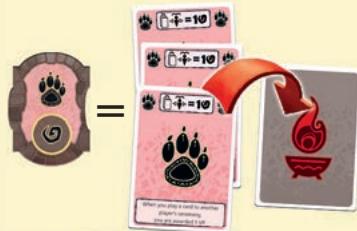
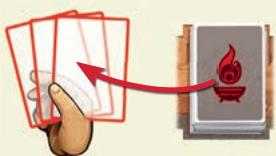
This deck should be placed in the middle of the village board. Finally, each player draws 5 cards from their draw pile as a starting hand.

All other cards are not used for this game.

Game End tiles
Stack a number of Game End tiles next to the selection tiles, depending on the player count:
| 2 players: | 10 Game End tiles |
| 3/4 players: | 9 Game End tiles |
Any remaining tiles are not used for this game, return them to the game box.

Determine the First Player
Determine a first player randomly and give them the first player marker.

The Play Area
Each player’s play area consists of the 4 spaces of their village board as well as the two closest spaces of their left and right opponent’s village board, for a total of 8 spaces.
The following restrictions apply when playing cards (unless modified by a cceremony ability):
• A player may only open ceremonies on their own Village board.
• A player may not open a ceremony that has already been opened in their play area.
• A player may only extend ceremonies in their play area.
Game Play
Kokopelli is played over a series of game rounds. During each game round, the first player begins and the other players follow in clockwise direction.
On their turn, the active player always performs two actions. For each action, they choose one of these 5 options:
a) Draw card | b) Open ceremony | c) Play card | d) Cancel ceremony | e) Exchange cards
It is allowed to perform the same action multiple times on a turn.
Note: In the first game round only, both the first player and their left neighbor may perform one action only.
After performing all their actions, the player must return cards in excess of 5 to the bottom of their draw pile, placing them face down in the order of their choosing.
Bonus: Playing all Cards from Hand
If the player ever has no cards in their hand, they immediately score 1 victory point and draw 3 cards.
This should be done immediately and does not count as an action.
The game ends at the end of a game round that at least one player's draw pile is exhausted, or the last Game End tile has been placed on a selection tile.

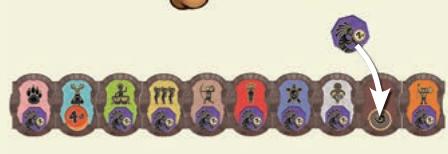
The player with the most victory points at the end of the game is the winner! In case of a tie for the most points the tied players share the victory.
The 5 options in detail:
a) Draw card
The player draws the top card from their draw pile into their hand.
b) Open ceremony (Own Village only)
The player must have an empty space in their village to perform this action. To open a ceremony, the player takes a ceremony card (not a Kokopelli card) from their hand and places it in the empty space.
Important: A player may not open a ceremony if an identical ceremony already exists in their play area.
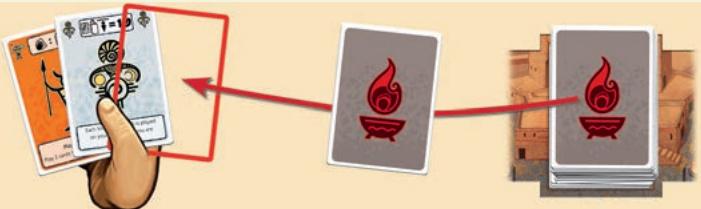
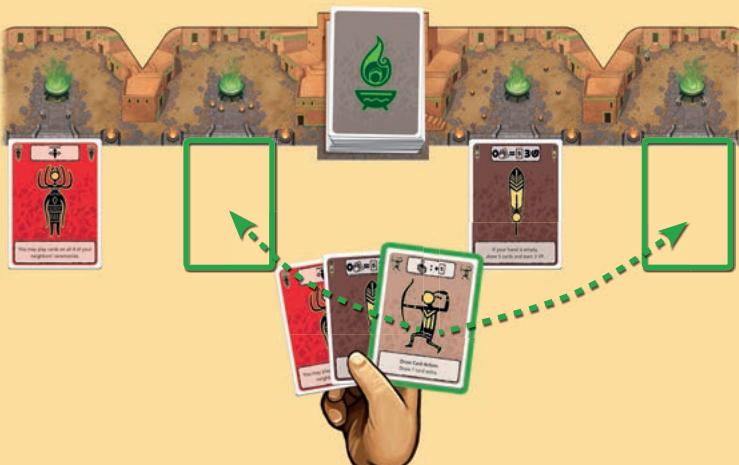
Card Abilities:
Example: The green player has two free spaces on their village board to open the Hunter ceremony. Before opening, they have to check if another hunter ceremony is not already in their play area.
When a ceremony has been opened, it immediately grants a special ability to the player whose Village is has been opened in. This special ability will remain as long as the ceremony remains on the Village board.
Each ceremony grants a different special ability, which are described on the card and detailed at the end of the manual.
Important: If an ability contradicts the basic rules of this game, the rules on the card override the basic rules!
c) Play card (Play area)
The player chooses a card from their hand and plays it to an already openend ceremony in their play area. The card has to match the ceremony card(s) that it is played on.
Kokopelli cards are wild and can be played on any ceremony.
When playing the second or third card to a ceremony, the ceremony is extended.
Finally, the ceremony is finished by playing the fourth card, which will score victory points and remove the ceremony from the player's Village board.
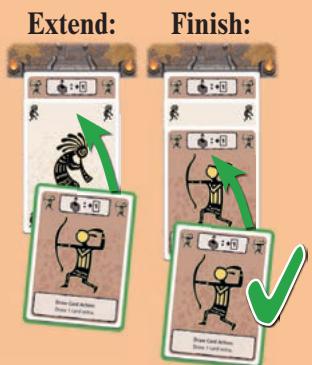
Extend a ceremony
The player may extend an existing ceremony anywhere in their play area.
In order to do so, the player places a matching ceremony card or a Kokopelli card (which acts as a wild card) onto the appropriate ceremony.
Cards should be stacked offset so that it is apparent how many cards have been played on the ceremony.
Extending a ceremony has no necessary consequences, but may be done for strategic reasons based on an ability or the need to finish yours or an opponent's ceremony.
Finish a ceremony
By playing the fourth card on a ceremony, that ceremony is finished. Immediately perform the following steps:
1) The player who played the fourth card claims the top victory point tile from the selection tile that matches the finished ceremony, if one is available.
If they take the 3 victory point tile, a Game End marker is placed on the selection tile.
If a Game End marker is already on the selection tile, they take 1 victory point instead.
whose Village board the ceremony was on) takes all cards of the ceremony and places them in their discard pile in any order they like. If they are not the active player (this happens when you finish another player's ceremony), they also receive 1 Victory point.
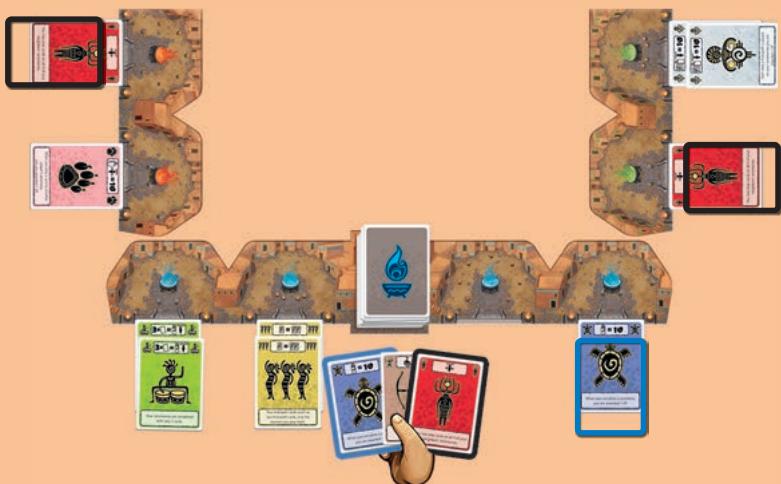
Example: The blue player can either extend their own Tortoise ceremony or play the Spider Woman on either of their neighbor's ceremonies, since both ceremonies are within their play area.
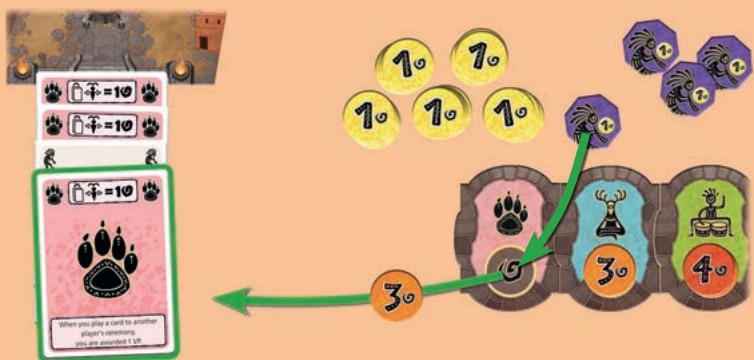
Example: The player finishes the Paw ceremony and takes the remaining 3 VP tile from the selection tile, replacing it with a Game End tile.

Example: Since green finished yellows ceremony, yellow gains 1 VP from the supply.
d) Cancel celebration
The player chooses one ceremony on their Village board and places all cards of that ceremony on their discard pile in any order they like.
e) Exchange Cards
The player takes all of their hand cards and places them under their draw pile in any order. Then they draw the same number of cards from the top of the draw pile.
Game end and final scoring
The game will end at the end of a game round in which at least one player's draw pile is exhausted, or the last Game End tile was placed on one of the selection tiles. Final scoring then takes place, with players earning additional victory points as follows:
1) All players put their remaining hand cards on their discard pile and count the number of cards of their draw pile.
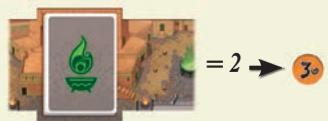
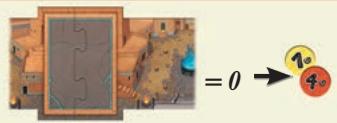
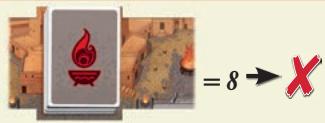
The player or players with the fewest cards gain 5 victory points. The player or players with the second fewest cards gain 3 victory points. All other players gain nothing. Zero cards in a player's draw pile is the lowest number possible.
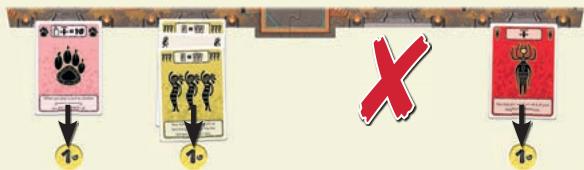
2) For each of their own totem boards with a ceremony at it (no matter how many cards) the player gains 1 victory point.
All players total their victory points – those gained during the game, and those gained during final scoring.
The player with the most victory points is the winner of the game. In case of a tie for the most points the tied players share the victory.
Changes for two players
At set-up stack 10 Game End tiles next to the selection tiles. The number of ceremonies and the play area for each player is changed:
Each player can open 5 instead of 4 ceremonies on their village board. The fifth space is underneath the draw pile.
The play area of a player includes their 5 ceremonies as well as every ceremony of the other player's village board, except the ceremony under the draw pile.
Players may decide to play with up to 12 ceremonies per game, making the game more tactical.
Game variant
At setup just choose 1 or 2 extra selection tiles.
Select the correct number of Game End tiles from the following table.
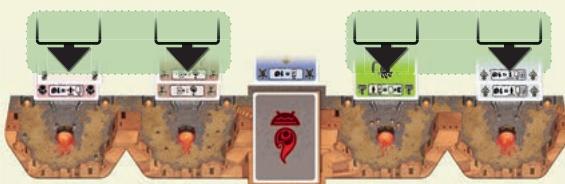

Example: Green can play cards to all ceremonies, except the one ceremony under the draw pile of the other player.
| 11 Selection Tiles: | 12 Selection Tiles: | |
| 2 players: | 11 End Game Tiles | 12 End Game Tiles |
| 3/4 players: | 10 End Game Tiles | 11 End Game Tiles |
The rest of the rules remain unchanged.
Overview of ceremony cards
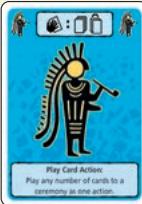
CHIEFTAIN<
Play any number of cards to a ceremony as one action.
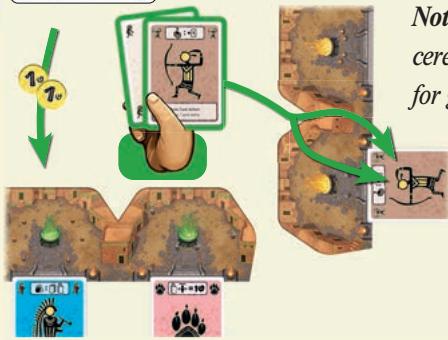
Note: Each card you play on a ceremony is considered individually for gaining VP or other effects.
Example: Green uses the chieftain ability and plays the hunter and the Kokopelli in one action to their neighbor's ceremony. For each played card, they gain 1 VP due to their Paw ceremony.

>BIRTH<
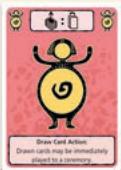
Draw Card Action:
Drawn cards may be immediately played to a ceremony.
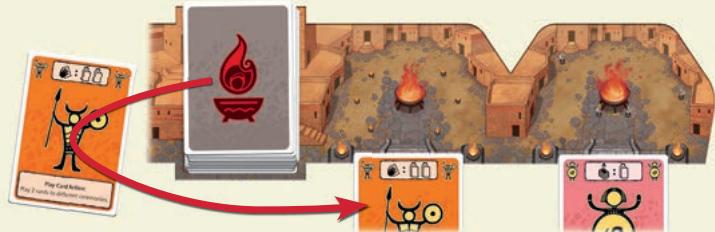
Birth & Hunter combination: In this case, the player may play both drawn cards to different or the same ceremony, if possible.
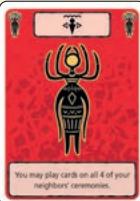
> SPIDER WOMAN<
You may play cards on all 4 of your neighbors' ceremonies.
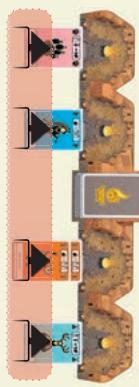
Play area for the red player
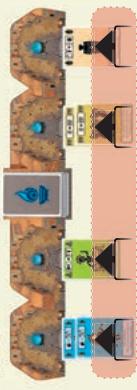

Note: When opening a cremony only the normal play area is considered, the Spider Woman only enlarges the play area when playing a card to a ceremony of a neighbor.
Two player: You can play cards to all 5 ceremonies (6 with Sun ceremony) of the other player.
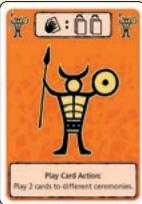
WARRIOR<
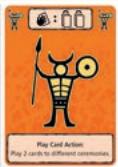
Play Card Action: Play 2 cards to different ceremonies.


Note: You cannot combine the Warrior with the Chieftain to play multiple cards to two different ceremonies. The Warrior only allows to play exactly two cards to different ceremonies.
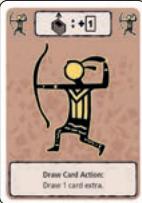
HUNTER<
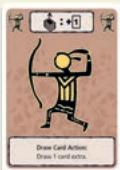
Draw Card Action: Draw 1 card extra.
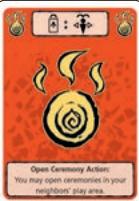
>FIRE<
Open Ceremony Action:
You may open ceremonies in your neighbors' play area.
Note: You can only open ceremonies on a neighbor's board that is not present in their play area (see page 2-3).
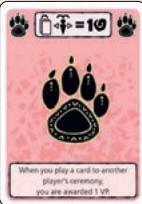
>PAW<
When you play a card to another player's ceremony, you are awarded 1 VP.

> LIZARD<
When you play a card to another player's ceremony, draw 1 card.
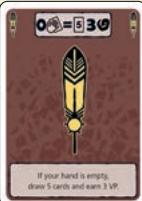
EAGLE FEATHER
If your hand is empty, draw 5 cards and earn 3 VP.
Note: You draw 5 cards and gain 3 VP instead of 3 cards and 1 VP as normal.
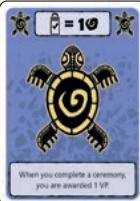
>TORTOISE<
When you complete a ceremony, you are awarded 1 VP.
Note: You are awarded the 1 VP regardless if you finish a ceremony on your village board or on one of your neighbor's village boards. If you finish your Toirtoise ceremony you are also awarded 1 VP.
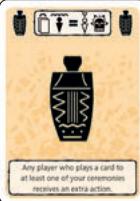
>VASE<
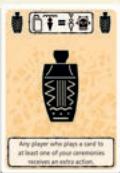
Any player who plays a card to at least one of your ceremonies receives an extra action.
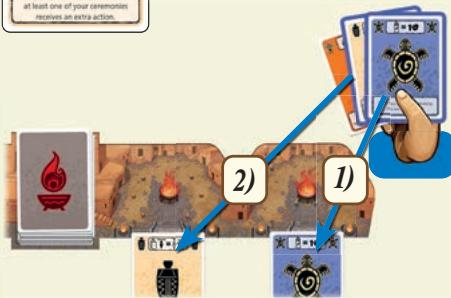
Example: 1) Blue plays the Tortoise on their neighbor's (red) ceremony, thus gaining an extra action because of the vase.
2) Blue plays the vase onto their neighbor's (red) vase not gaining another extra action.
Note: A player can gain only one extra action per player who has openend a Vase ceremony. No matter how many cards they play to that player's ceremonies on a turn. The extra action can be used for any of the 5 options.
>SUN<
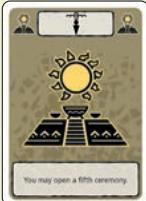
You may open a fifth ceremony.
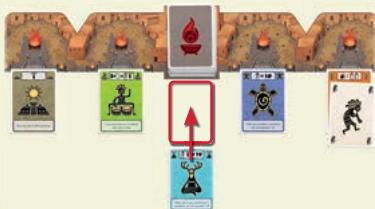
Example: Red can open a fifth ceremony due to their sun ceremony. They open the shaman ceremony beneath their draw pile.
Note: The fifth ceremony must be opened beneath your draw pile. This ceremony belongs to your play area as well as your left and right neighbor's play area. The fifth ceremony stays in play until it is finished or discarded, regardless if the Sun ceremony is still in play or not.
Two player: You may open a six ceremony also under the draw pile. Both ceremonies under the draw pile do not belong to the other player's play area.
MOTHER OF HEAVEN <
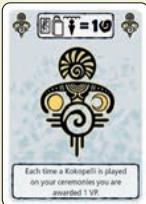
Each time a Kokopelli is played on your ceremonies you are awarded 1 VP.
Note: You are awarded 1 VP regardless if you or one of your neigbors plays a kokopelli on one of your ceremonies.
>DRUMMER
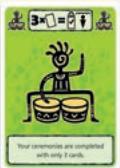
Your ceremonies are completed with only 3 cards.
Player blue
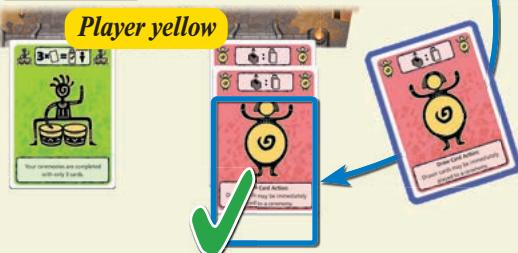
Example: Blue plays the birth ceremony card to their neighbor's (yellow) ceremony finishing it with 3 cards, since yellow has the drummer ceremony opened.
Important: Ceremonies that currently consist of three cards are not automatically finished, when the Drummer ceremony is openend. A ceremony is only finished when a card is actively played on it. In these cases the ceremonies are finished normal with the fourth card.
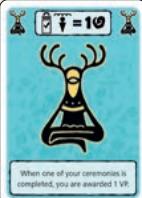
>SHAMAN<
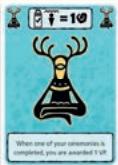
When one of your ceremonies is completed, you are awarded 1 VP.
Player yellow

Example: Yellow finishes the Spider Woman ceremony from green. Green therefore gains 2 VP, one because their ceremony was finished by another player and one because they have the shaman.
Note: You are awarded 1 VP regardless if you or one of your neighbors finishes one of your ceremonies. If the Shaman ceremony is finished you are still awarded 1 VP.
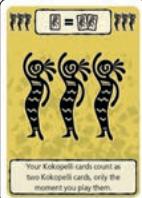
>SNAKE DANCE <
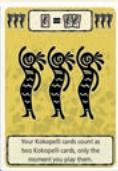
Your Kokopelli cards count as two Kokopelli cards, only the moment you play them.
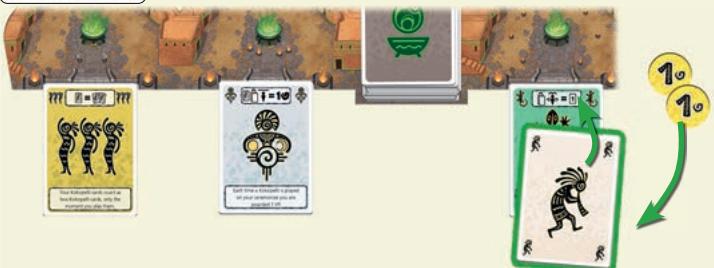
Example: Green gains 2 VP for playing the Kokopelli to their ceremony since they have the Snake Dance and the Mother of Heaven ability.

Texts are community-compiled or publicly released by publishers; copyright remains with the original authors. For personal reference only.