
Lacuna
At a glance
Rules, cards and Q&A (Chinese)
The rules, card data and player questions for this game are written in Chinese. Open the Chinese page to read them.
Where to find full rules
Full rules and card lookup are available in the cunlema app at cunlema.cn — pick this game and ask about any rule, card or turn you are unsure about.
Related games
Rulebook text (Markdown)
This game has 1 rulebook Markdown file(s) in our library; 1 rendered inline below — expand to read or download.
Lacuna rulebook.md4.0 KB

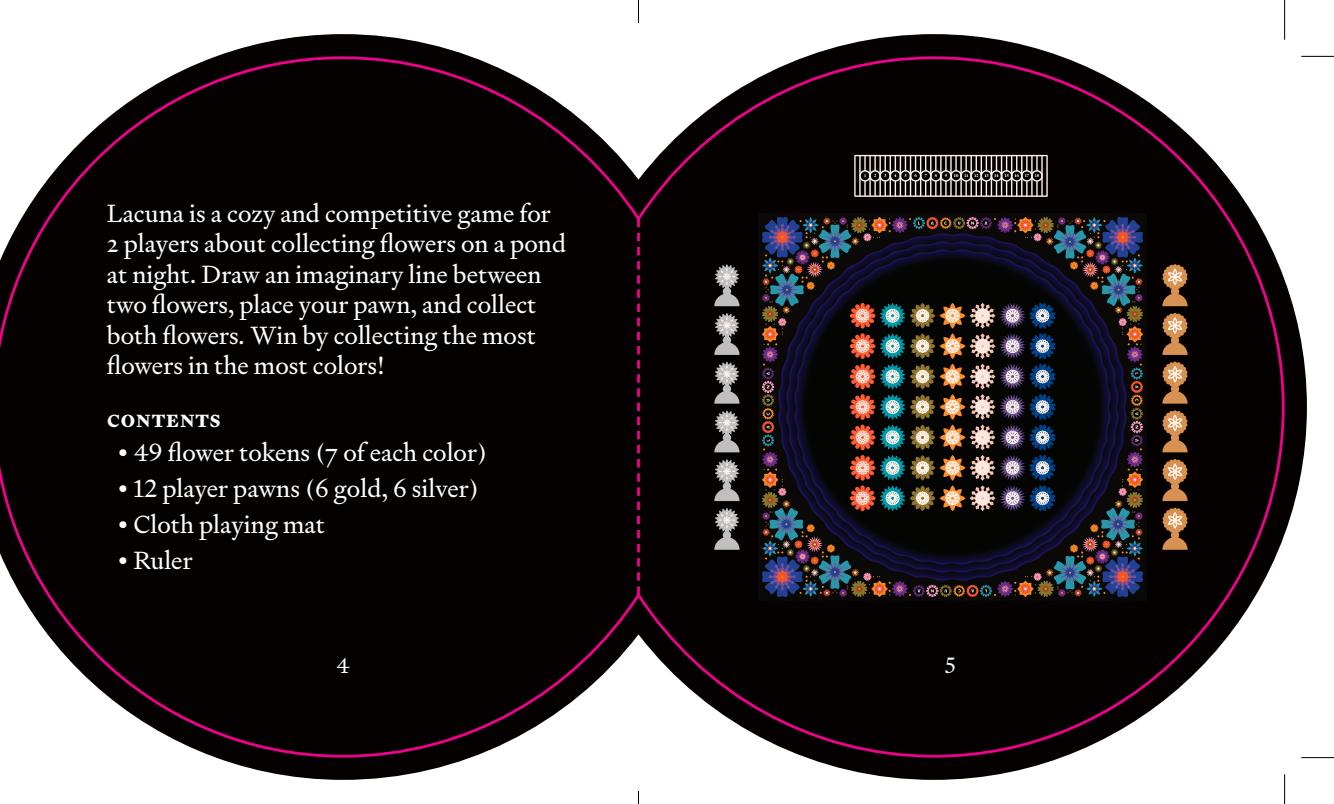
SETUP
Each player takes a set of 6 pawns of the same color. Randomly determine a starting player. This player takes 1 flower of their choice and puts it aside in their scoring area.
Pour all the other flower pieces randomly from the container onto interior circle of the mat (on the blue waves is OK). If flowers fall outside the area, just toss them randomly back in. Distribute the flower pieces as evenly as your can without clumping, using your hands to spread them out as needed.

HOW TO PLAY
Players take turns placing their pawns until all 12 pawns are on the mat.
To place a pawn, choose 2 flowers of the same color that you can trace an imaginary straight line between that is unblocked by other flowers or pawns. Place one of your pawns anywhere along that line, then pick up those 2 flowers and put them of to the side in your scoring area.
Note that a pawn does not have to be placed at the line’s midpoint: it can be anywhere along the line, as long as the center of the pawn stays on this imaginary line.
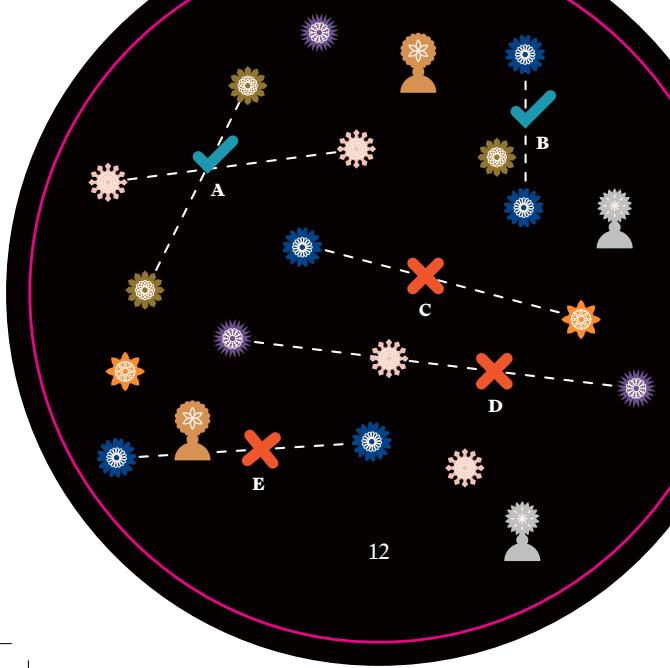
A. If you place your pawn at the intersection of two sets of flowers, you may only pick up one set of flowers (2) not both (4).
B. Since the green flower doesn’t block the line connecting the midpoints of these two blue flowers, this is a valid placement.
C. These flowers aren’t the same color.
D. Flowers are the same color, but the line connecting their midpoints is blocked
E. Flowers are the same color, but a previously placed pawn blocks the line connecting their midpoints.
Play continues until the players have each placed their 6 pawns (12 pawns will be on the mat). You’ll notice that there are still unclaimed flowers on the mat.
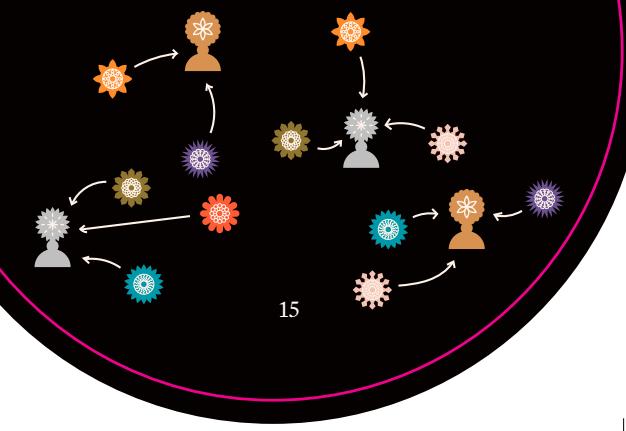
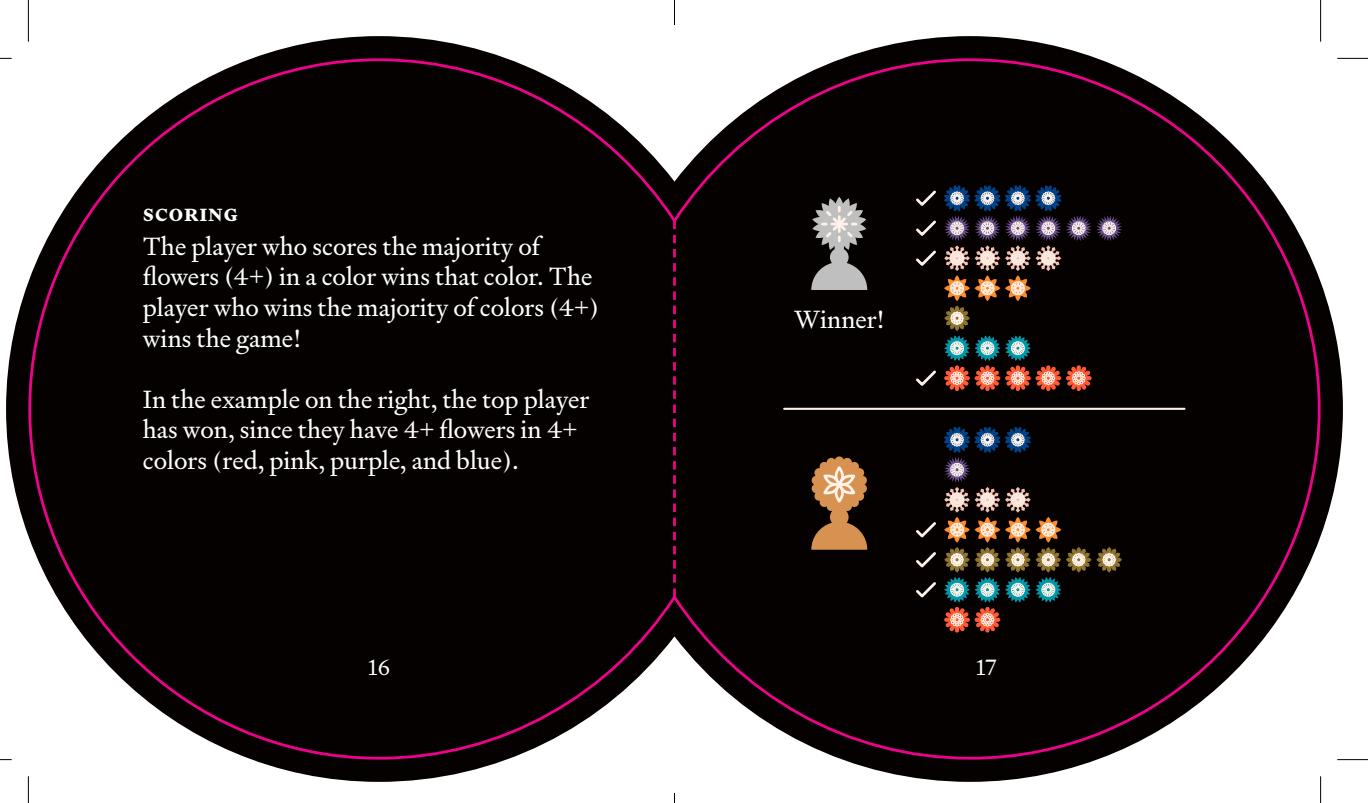
The second part of the game happens automatically. For each flower remaining on the mat, determine which player has a pawn closest to that flower. This player takes the flower and puts it into their scoring area.
Whenever a flower isn’t obviously closer to one player’s pawn, consult with the other player—and feel free to use the ruler. We’ve found this part of the game works best as a conversation of sorts (“This is mine, right?”), but if you’d like more structure, resolve each color formally, one at a time.
What if a flower is equidistant between two pawns?
If a flower is exactly as far from each player’s closest pawn—even after using the ruler to measure it—look at each player’s second closest pawn to break the tie. In the rare case that those are also the exact same distance from the flower, repeat this with each player's third closest piece, etc.
Can I pick up four flowers if I place my pawn at the intersection of two pairs?
No, you can only ever pick up 2 flowers per pawn you place. Though note that placing a pawn there does block future placements, so it might be good strategy to still do it!
Can I clean the playing mat? Yes! Please hand wash cold with mild detergent and air dry.
Can I move a flower slightly to make space to place my pawn?
No, you are never allowed to move flowers or previously placed pawns. If your pawn will displace any flowers or other player pawns, you may not place it there.
But if this happens accidentally, there is no penalty. Just don’t place there.
What counts as an “unblocked straight line” between two matching flowers?
You must be able to visually trace a straight line between the center points of the two chosen flowers. If it’s ambiguous, you can turn the ruler on its side and line it up with the two flower centers to check.
Texts are community-compiled or publicly released by publishers; copyright remains with the original authors. For personal reference only.