
Leaf
At a glance
Rules, cards and Q&A (Chinese)
The rules, card data and player questions for this game are written in Chinese. Open the Chinese page to read them.
Where to find full rules
Full rules and card lookup are available in the cunlema app at cunlema.cn — pick this game and ask about any rule, card or turn you are unsure about.
Related games
Rulebook text (Markdown)
This game has 1 rulebook Markdown file(s) in our library; 1 rendered inline below — expand to read or download.
Rulebook-web quality.md31.5 KB
RULEBOOK


1-4 Players

30-45 Minutes

10+ Age
COMPONENTS
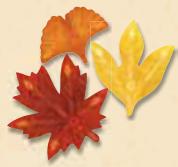
32 Leaf Tiles

36 Leaf Cards

58 Acorn Tokens

25 Sun Tokens
48 Animal Cards

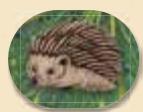
1 Start Player Token
60 Mushroom Tokens

1 Season Marker
GAME OVERVIEW
After the hot sun of summer,
the nights cool and the trees come
alive with color. The autumn wind
shakes leaves from the trees, creating
a dazzling pattern of shapes and colors
on the forest floor. This layer of leaves
provides an important habitat for
forest animals and mushrooms. In the game Leaf, players embody the
spirit of the wind, guiding leaves to the forest
floor and connecting them to the tips of other
leaves. With each connection, players may grow mushrooms, attract animals, gain sunlight, or climb the mighty tree.
When winter arrives, players collect acorns for hibernated animals, groups of mushrooms, and their squirrel's position on the tree. The player with the most acorns made the greatest contribution to the forest's health and wins!

1 Animal Mat
1 Leaf Mat
1 Tree Board
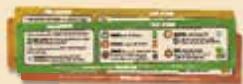
4 Player Aids
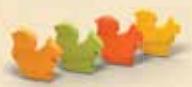
4 Player Squirrels

13 North Wind Solo Mode Cards
SETUP
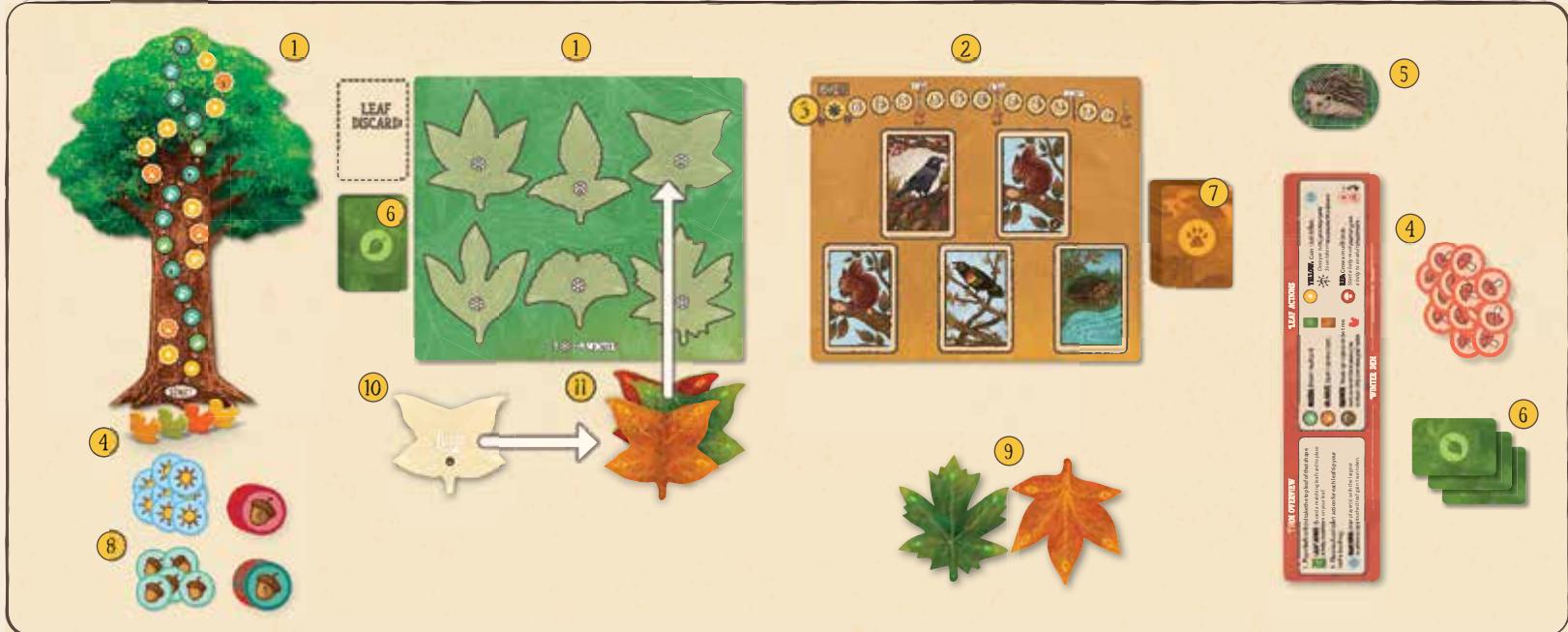
PLAY AREA SETUP
-
Place the tree board and leaf mat at the edge of the play area, leaving the center of the play area open.
-
Place the animal mat with the correct side up based on player count (1-2 or 3-4) at the edge of the play area.
-
Place the season marker on the starting space on the season track at the top of the animal mat according to player count (the number inside the squirrel icon).
-
Each player chooses a color, takes the matching player aid and 15 mushroom tokens, and places their squirrel on the start space at the base of the tree.
-
Give the first player token to the player who most recently was in a forest.
-
Shuffle the leaf deck and deal cards face-down to each player according to the player count and turn order, then place the deck face-down next to the leaf mat. 2 PLAYERs -3 cards each
3-4 PLAYERs – 2 cards to the 1st and 2nd players, 3 to the
3rd and 4th player (if playing).
-
Shuffle the animal deck and place it face-down next to the animal mat. Place 5 animal cards face-up into the spaces on the animal mat.
-
Place the acorn and sun tokens within reach of players.
LEAF PILES SETUP
-
Find the starting leaves, indicated with aon the back. Place them in the center of the play area with two leaf tips touching as shown.
-
Separate the top leaves of each leaf shape, indicated with aon the back. These will be placed on top of the piles in step 11.
Optional: Advanced players may instead choose to shuffle them in with the other leaves to create a randomized start.
- Sort the remaining leaves into face-down piles based on shape. Randomize each pile and then place them face-up onto the matching spaces on the leaf board. Place the top leaves face-up on top of each pile.
TURN OVERVIEW
On each turn, you will play a leaf card from your hand, take the top leaf tile of that shape and place it onto the forest floor (central play area). You will then take one action for each tip of your leaf that is touching the tip of another leaf.
STEPS OF A TURN
1. CHOOSE A LEAF
Play a card from your hand face-up into the discard pile and take the top leaf of the type shown.
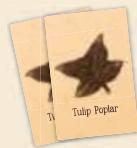

Leaf Boost: You may discard a matching leaf card to place a baby mushroom onto the leaf you are placing.
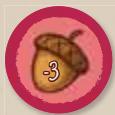
No Cards: If you have no leaf cards at the beginning of your turn, gain a -3 acorn token and draw 2 leaf cards, then play a card.
Empty Leaf Pile: You may play a card that matches an empty leaf pile. If you do, choose the top leaf of any pile.
2. PLACE THE LEAF
Place the leaf flat on the playing surface without overlapping any other leaves and connecting at least 2 of its tips to the tips of leaves already in play.
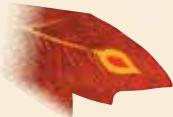
Leaf Tips: A leaf tip is any of the highlighted points of the leaf, including the stem.
LEAF PLACEMENT EXAMPLE
Cleo places the red leaf. It connects to 2 orange tips (the stem and a point), 1 yellow tip, and 2 brown tips. Cleo gains 5 actions (2 orange, 1 yellow, and 2 brown).
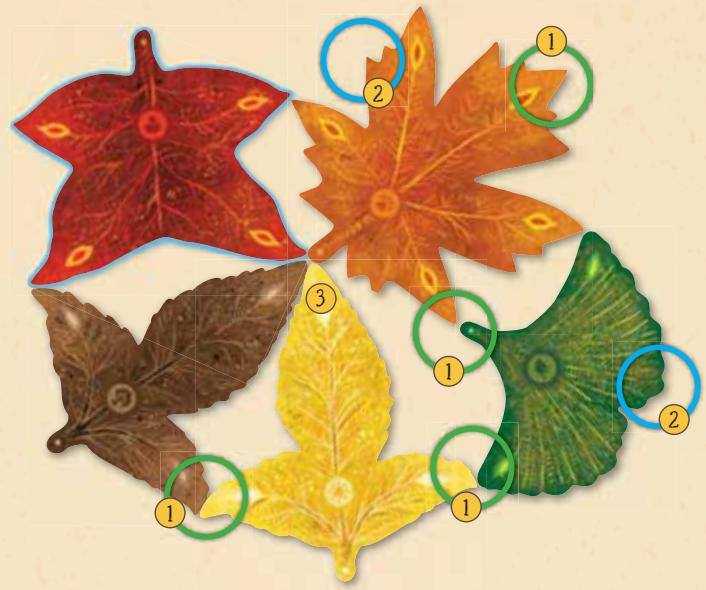
LEAF CONNECTION RULES
-
Only stems and leaf tips marked with highlights count as connections (examples circled in green).
-
These points (circled in blue) are not considered to be leaf tips and cannot be connected.
-
When a leaf tip connects with another tip, it also connects to all tips that tip connects to. In the above example, the red tip is connected to the yellow tip even though they are not touching.
-
Players may correct shifting that has occurred, but all tips must connect as they did when placed.
-
It should be apparent when leaf tips connect, but if there is any doubt, leaf tips are connected if they are within the thickness of the edge of an acorn token (about 2 mm).
3. CHECK FOR MUSHROOM REACTIONS
Other players may gain reactions from your leaf placement. Each of the largest mushrooms on an adjacent leaf rewards its player with one sun token from the supply.
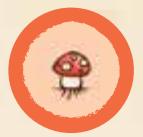

Baby Mushroom
Adult Mushroom
You do not gain reactions from your own leaf placement.
Adjacent Leaves: Leaves are adjacent when at least one tip is connected.
4. TAKE LEAF ACTIONS
For each leaf tip that the placed leaf is connected to, take 1 action of that tip's color. You may take these actions in the order of your choosing. For details on the different actions, see LeafActions on pages 5-6.
IMPORTANT: The color of the leafyou place does not determine the actions you take, only the leaves you connect to.
No Action Rule: If you would gain no benefit from a leaf action, you gain 1 acorn token instead.
For instance, if your squirrel cannot move, because it is in the top space, or the spaces above it are all occupied.
5. ADVANCE THE SEASON (OPTIONAL)
Once per turn, you may discard 3 sun tokens to move the season marker forward one space and gain the number of acorn tokens shown in the destination space. See Advancing the Season on page 7 for more detail.
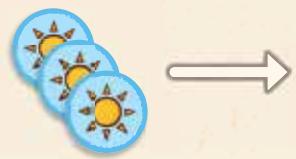

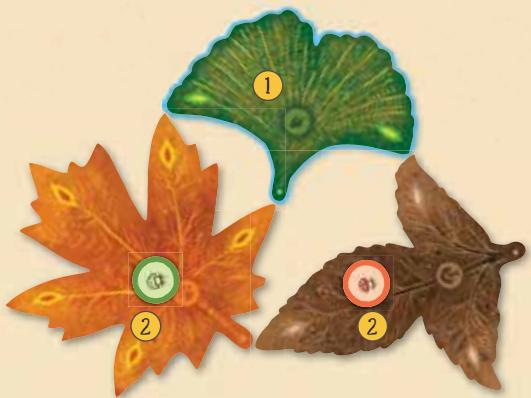
MUSHROOM REACTION EXAMPLE
-
Sam (theplayer) plays the green leaf.
-
Cleo (theplayer) and Hera (the player) each take a sun token.
For a more detailed example, see Extra Examples on page 9.
END OF TuRN
When you have finished your turn:
Refill empty animal card spaces on the animal mat.
The next player in clockwise order begins their turn.

Each leaf has an icon that matches its color, denoting which action its tips grant. Each action is detailed here and on the player aid, next to its icon. When taking actions, you may take them in the order of your choosing.
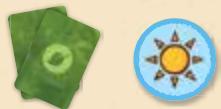
GREEN Draw One Leaf Card

If the leaf deck is empty, shuffle all discarded leaf cards to form a new deck. There is no limit to the amount of leaf cards you may have in your hand.
BROWN

YELLOW Gain One Sun Token

There is no limit to the amount of sun tokens you may have. You may only spend 3 sun tokens to advance the season track once per turn.
Move Your Squirrel
Move your squirrel one space and gain the reward of the space that you land on.
If you would move onto a space occupied by another player, instead skip that space and move into the next open space.
If you would advance past the top space, instead, don't move, and gain 1 acorn.
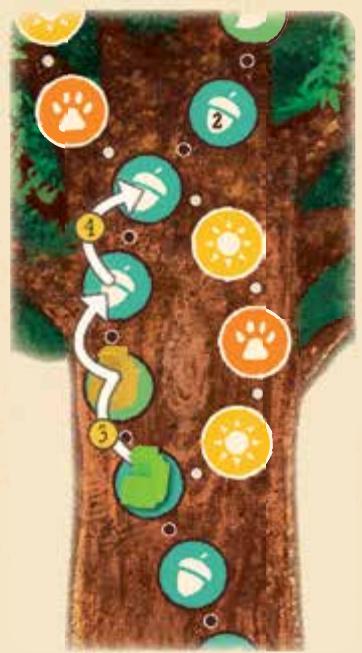
When you come to a branching path, choose which path to take, and stay on that path until the next intersection.
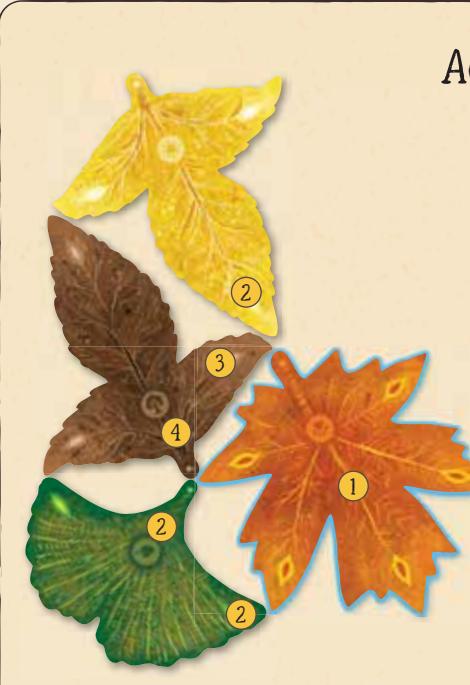
ACTION EXAMPLE: GREEN, YELLOW, AND BROWN
-
Cleo (theplayer) plays the orange leaf, connected to 2 green tips, 2 brown tips, and 1 yellow tip.
-
Cleo draws 2 leaf cards (1 for each green tip), and gains 1 sun token (for the yellow tip).
-
Cleo moves her squirrel 1 space for the first brown tip, choosing to take the left path on the tree. Because her destination space is occupied by the yellow squirrel, she skips that space and moves to the next space. Cleo collects 1 acorn.
-
Cleo moves her squirrel again for the second brown leaf tip, and collects 1 more acorn.
业+
RED Grow a Mushroom

Add one of your baby mushrooms to a leaf, or grow one of your baby mushrooms to an adult mushroom by flipping over the mushroom token.
You may add a baby mushroom to any leaf that does not already have one of your mushrooms.
Multiple players may have mushrooms on the same leaf, but each player may only have one mushroom per leaf.
ORANGE Gain One Animal Card

You may choose a face-up animal card from the animal mat, or draw the top card of the animal deck, and place it in your Forest (the area above your player aid).
If the animal has an acorn icon, gain an acorn token.
The empty spaces on the animal mat are only refilled at the end of your turn.
ACTION EXAMPLE: RED AND ORANGE
-
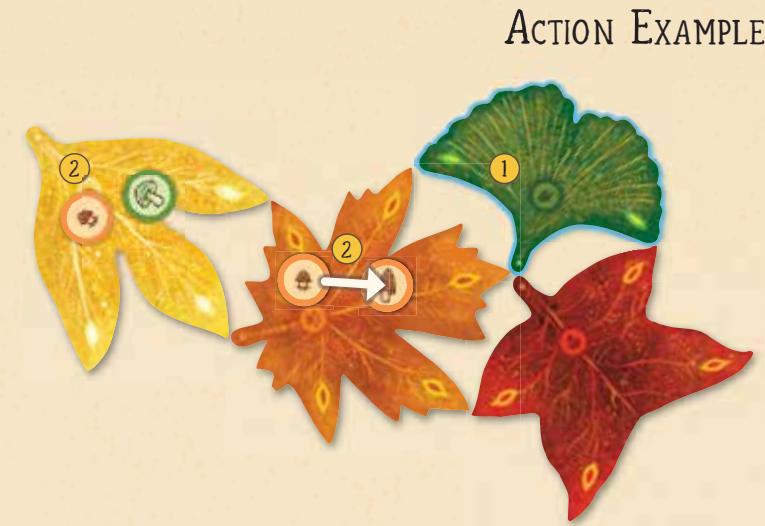
Maria (theplayer) plays the green leaf connected to two orange tips and two red tips.
-
Maria has two red actions. She chooses to place a baby mushroom on the yellow leaf, and then grow her baby mushroom on the orange leaf into an adult mushroom.
-
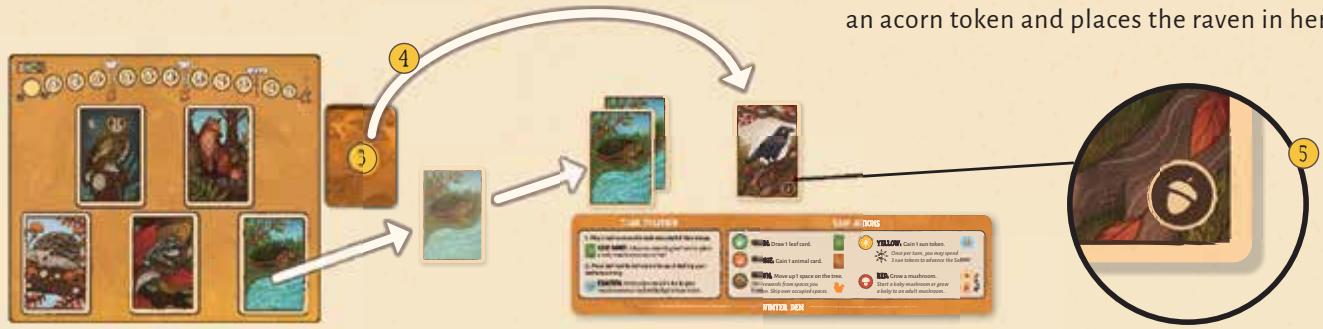
Next, Maria takes one orange action, choosing the turtle from the available animals, placing it into her Forest (above her player aid) with the two existing turtles.
-
Finally, Maria takes her second orange action. There are no face-up animals she wants, so she decides to draw a card from the top of the animal deck, hoping for another turtle.
-
Maria draws a raven card with an acorn on it, so she takes an acorn token and places the raven in her Forest.
ADVANCING THE SEASON
The season track is at the top of the animal mat. Players will collectively advance the season marker along the season track by spending sun tokens.
ADVANCING THE SEASON
Once per turn, you may discard 3 sun tokens to move the season marker forward one space and gain the acorns shown in the destination space.
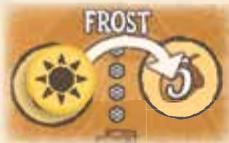
FROST
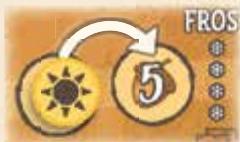
When the season token crosses a Frost line, each player immediately chooses one type of animal to hibernate and moves all animals of that type from their Forest to their Winter Den (below their player aid).
WINTER DEN
Only animals in Winter Dens will score at game end. Thus, each player will only be able to score a maximum of 3 sets of animals in a game. All animals of the same type score as a single group, even if added during different Frosts.
WINTER
Winter may begin in one of two ways:
When the season marker crosses the Winter line.
When the third leaf pile is depleted.
When Winter begins, there is no immediate Frost. Instead, continue playing until all players have taken an equal number of turns. Then there is one final Frost before the game ends.
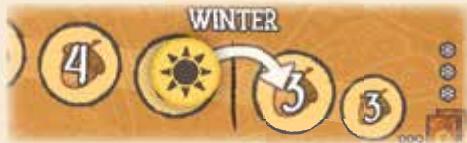
When the season marker is in tne first Winter space, players may still advance the season once per turn and gain 3 acorns. However, do not move the season marker.
IMPORTANT: If Winter begins by depleting the third leaf pile, leave the season marker in its current position. If a player advances the season, they move the season marker one space to the right and gain the rewards shown. If a Frost line is crossed, resolve it normally.
FROST AND HIBERNATION EXAMPLE
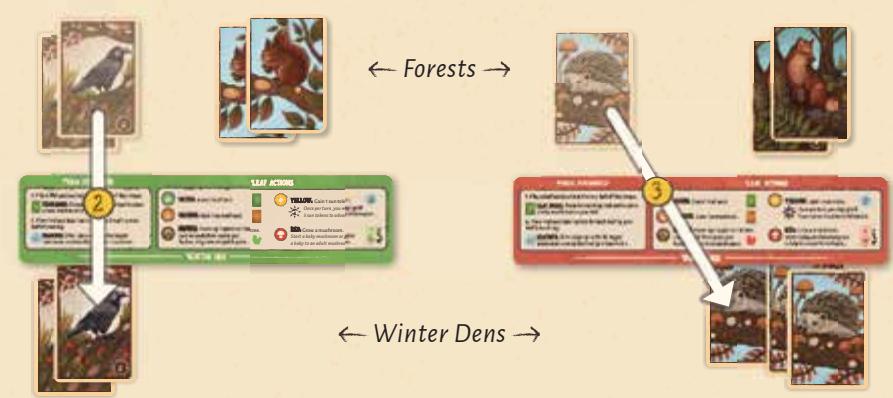
-
On her turn, Cleo (theplayer) spends 3 sun tokens to move the season marker, crossing the second Frost line. Cleo takes the 4 acorn reward, and then each player hibernates one group of animals.
-
Cleo decides to hibernate her 2 raven cards and moves them to her Winter Den.
-
Hera (the player) hibernates her single hedgehog, adding it to the 2 hedgehogs she hibernated in the first Frost. Hera hopes to find one more fox card before the final Frost at the end of the game.
GAME END
The game ends when it is Winter and all players have taken an equal number of turns and resolved the final Frost. Players gain acorns according to the rules below.
TREE
The player whose squirrel is highest in the tree gains 6 acorns. The second highest on the tree gains 3 acorns.
MUSHROOMS
Groups of adult mushrooms that are on adjacent leaves grant you acorns based on the group size.
| 1 | 115 | 2 | 3 | 4+ |
| 3 | 8 | +1EÁCH |
Baby mushrooms do not connect groups of adult mushrooms, and do not contribute to scoring.
Each animal and mushroom past the third in a group adds 1 acorn, so a 5-mushroom group is worth 10 acorns.
ANIMALS
Each type of animal in your Winter Den grants you acorns based on the number of animals of that type in your Winter Den. Animals in your Forest do not score.
| 兴 | 1 | 2 | 3 | 4+ |
| 15 | 3 | 6 | +10EÂCH |
SUN AND LEAF CARDS
Gain 1 acorn for each 2 sun tokens and/or leaf cards (one of each may also be combined to gain an acorn).
THE WINNER
The player with the most acorns has contributed the greatest amount to the renewal of the forest and wins!
In case of a tie, the player with the most leaf cards and sun tokens wins. Ifstill tied, the victory is shared.
-
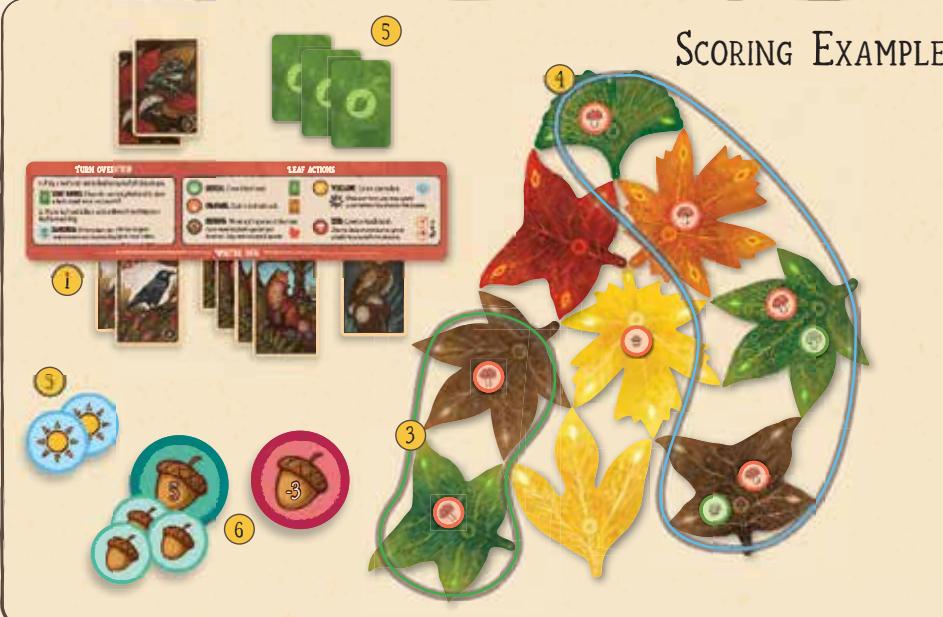
Hera (the player) is scoring. First, she gains acorns for the animals in her Winter Den. She gains 3 for the 2 ravens, 7 for the 4 foxes, and 1 for the owl. She doesn't gain any acorns for her frogs.
-
Hera's squirrel is second highest on the tree (not shown), so she gains 3 acorns.
-
Hera's small group of 2 adult mushrooms (circled in green) grants her 3 acorns.
-
Hera's large group of 4 adult mushrooms (circled in blue) grants her 9 acorns.
-
Hera has 3 leaf cards and 2 sun tokens for a total of 5. She takes 2 acorns (her extra does not count).
-
Hera counts her acorns, and subtracts 3 for her -3 token, for a total of 33 acorns!
EXTRA EXAMPLES
MUSHROOM REACTION EXAMPLE Ⅱ
-
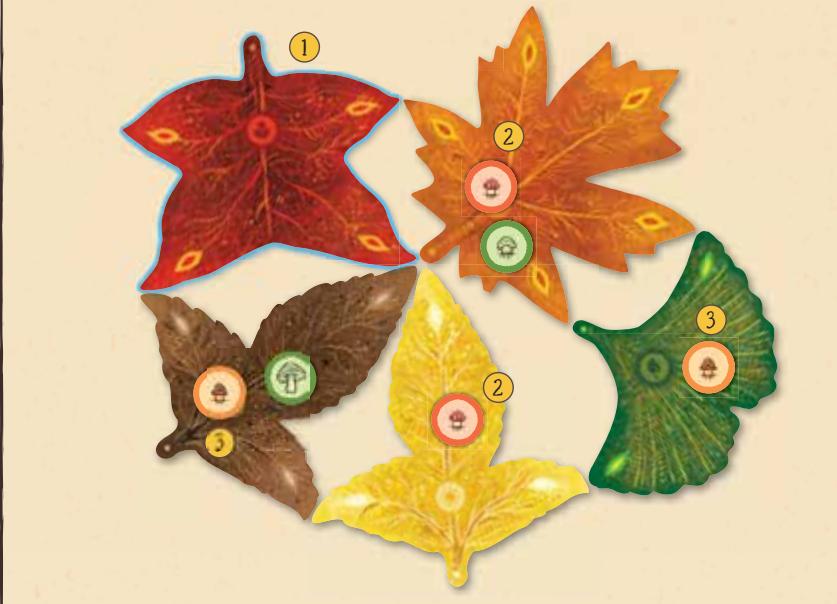
Cleo (theplayer) places the red leaf. She receives one sun token for touching the yellow leaf, but no sun tokens for mushroom reactions, because she placed the leaf.
-
Hera (the player) receives two sun tokens: one for her baby mushroom on the yellow leaf, and one because she is tied for the largest mushroom on the orange leaf.
-
Maria (theplayer) receives no sun tokens because her mushroom on the brown leaf is smaller than Cleo's, and the green leaf is not adjacent to the placed leaf.
ACTION EXAMPLE: BRANCHING PATHS
-
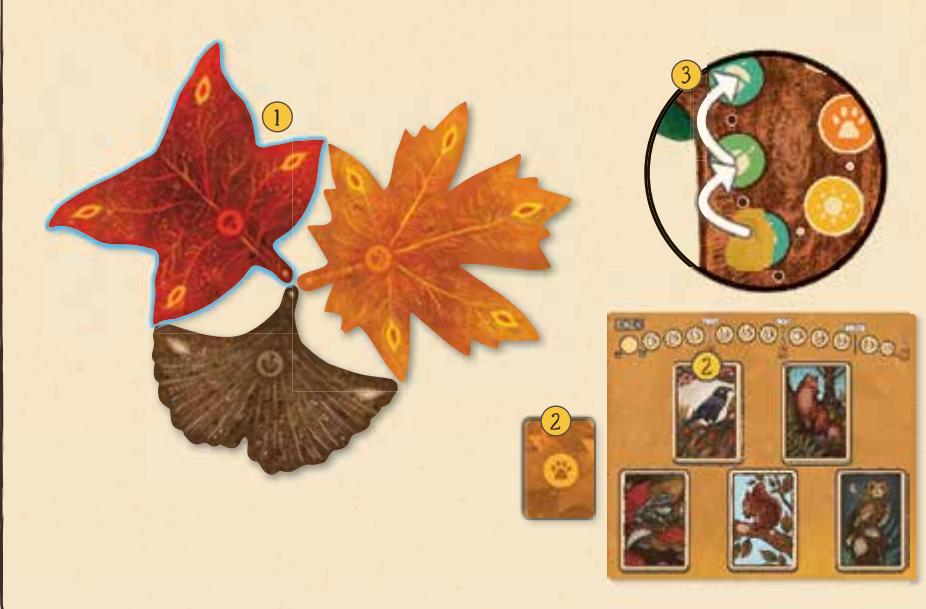
Maria (the player) plays the red tulip poplar leaf connected to 2 orange tips and 2 brown tips.
-
Maria has one raven already, and uses her first orange action to take the raven from the animal mat. She uses her second orange action to draw from the top of the deck and draws her third raven.
-
Maria takes her brown actions next. She was planning to take the right path to gain a sun token and an extra animal, but since she already has 3 ravens, she chooses the left path and receives a leaf card and an acorn.
SOLO RULES
SETUP
-
Choose one player color to be the North Wind. Set up the game for two players, except that the North Wind receives: one sun token, two random animal cards, no leaf cards, and the season marker starts on the 1-player space.
-
Shuffle the North Wind cards and place them in the North Wind's play space.
-
The human player is the first player.


NORTH WIND TURN
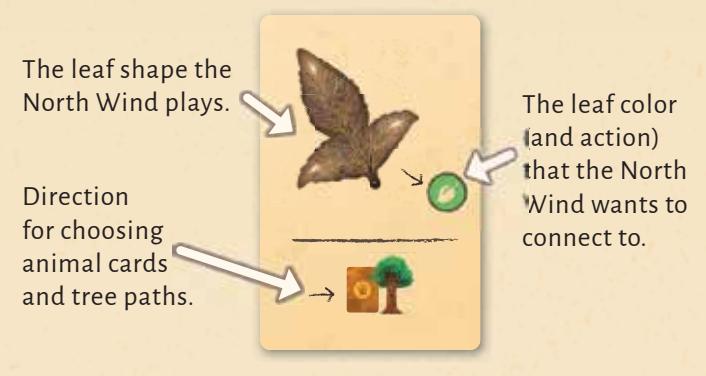
- Reveal the top North Wind card and take the matching leaf. If that leaf pile is empty, continue revealing cards until you reveal an available leaf.
If the Reshuffle card is drawn, immediately shuffle all the cards into the deck, then continue revealing.
- Place the leaf, prioritizing these requirements in this order and attempting to satisfy as many as possible:
A. Connect to as many leaf tips that match the leaf color/action shown on the card as possible.
B. Connect to the most number of tips total.
C. Connect to the least number of leaves with mushrooms of the human player.
If there are multiple leaf placement options for the North Wind, prioritize connecting to leaves in this order: red, orange, brown, yellow, green.
Leaf Boost: If the North Wind's leaf connects to 3 or fewer leaf tips, they place a baby mushroom on the played leaf.
SOLO CARD DIAGRAM
-
Take the North Wind's actions, following modified rules (see North Wind actions on the next page).
-
At the end of their turn, if the North Wind has 3 or more sun tokens, they spend 3 to advance the season.
Making Decisions for the North Wind: If the North Wind has multiple equally good choices, the human player chooses what they think will be best for the North Wind.
SOLO RULES CONTINUED
NORTH WIND ACTIONS
YeLlow: Gain 1 sun token.
GrEEN: Gain 1 acorn token.
RED: Before 1st Hibernation:
- For the first action, place a baby mushroom on the played leaf. For additional red actions place a baby mushroom on the adjacent leaf with the most open tips. If all adjacent leaves have mushrooms, grow 1 to adult.
Open tips are ones that can be connected to future leaves.
RED: After 1st Hibernation:
-
Grow baby mushrooms to adults, prioritizing making groups of 3 connected adult mushrooms.
-
If there are no baby mushrooms, place a baby mushroom on a leaf adjacent to the largest group of mushrooms that has less than 3.
NORTH WIND LEAF PLACEMENT EXAMPLE

ORAnGE: Gain 1 animal card. The North Wind prioritizes animals in this order, attempting to satisfy as many requirements as possible:
-
Matches animals the North Wind has in their Forest, prioritizing making groups of 3.
-
Animals with acorn icons.
If there are multiple possible choices, the North Wind will take the 1st animal from top left () or bottom right (), depending on the arrow on their card.
If there are no animals that meet either requirement, the North Wind will draw the top animal from the deck.
BrowN: Move up 1 space on the tree. If the North Wind is at a fork in the path, choose the path in the direction of the arrow on their card.
-
The North Wind's card instructs it to place a sweetgum leaf connecting to as many red leaf tips as possible. It takes the top sweetgum leaf (green) and evaluates three placements:
-
The North Wind could connect to 2 red tips here, but only 1 other tip.
-
The North Wind could connect to 2 red leaf tips and 2 other tips here, but it would also connect to a leaf with the human player's mushroom.
-
The North Wind can connect to 2 red leaf tips here, and 4 total leaf tips, so it chooses this placement.
SOLO RULES CONTINUED
FROST
The North Wind will hibernate their largest group of animals. In case of a tie, they will prioritize the group with the fewest matching animals on the animal mat.
SCORING
If the North Wind has more animals remaining in its forest than you, they gain 1 acorn for each animal in excess of your total.
DIFFICULTY
You may adjust the difficulty level by changing the North Wind's starting resources:
Easy: 1 sun token, no animal cards.
Hard: 2 sun tokens, 3 animal cards drawn randomly.
ACHIEVEMENTS
Track your achievements when you play against the North Wind. When you win a game, check off up to two achievements that you completed. Only one achievement from each group may be checked off for each win. Fill as many acorns as you can!
ANIMALS
A set of 4, 3, 2 animals in your Winter Den.
A set of 5 of the same animal in your Winter Den.
A set of 6 of the same animal in your Winter Den.
All 8 different animals in your Forest and/or Winter Den.
6 or more animals with acorns.
9 or more animals with acorns.
SQUIRREL
3 or more spaces above the North Wind's squirrel.
5 or more spaces above the North Wind's squirrel.
7 or more spaces above the North Wind's squirrel.
Higher than both 2x acorns on tree.
At the top of the tree.
LEAF AND SUN
2 or more sun tokens.
5 or more sun tokens.
3 or more distinct leaf cards in hand.
5 distinct leaf cards in hand.
No empty leaf piles.
No leaf cards in hand and no sun tokens.
MUSHROOMS
5 adult mushrooms.
Two groups of 3 adult mushrooms.
7 adult mushrooms.
4 or more unconnected adult mushrooms.
2 or fewer adult mushrooms.
FOREST FACTS

Fox
Vulpes vulpes
Habitat: Woodlands, wetlands, and brushy fields.
Foxes make up to 28 different vocalizations, including a distinct chattering noise called a “gekker” used when encountering a rival.
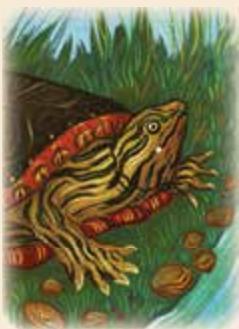
Turtle
Chrysemys picta
Habitat: Bodies of water ranging from small ponds and bogs to large lakes and rivers.
You can tell a turtle's gender by the noise it makes: males grunt and females hiss.
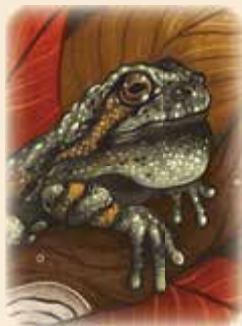
Tree Frog Dryophytes versicolor
Habitat: Forests. They leave the trees only to breed in woodland ponds and swamps.
Frogs don't drink water, they absorb water through their skin.
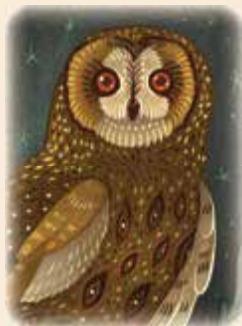
0wl
Strix occidentalis
Habitat: Hardwood and coniferous forests, woodlands and canyons.
A group of owls is known as a parliament when at rest and a silence when in flight.

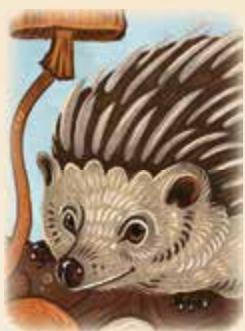
Hedgehog Erinaceus europaeus
Habitat: Woodland edges and hedgerows.
Hedgehogs search for food at night, seeking out a selection of insects, plant material, and occasionally small mammals.
Squirrel

Tamiasciurus hudsonicus
Habitat: Rainforests, polar regions, and arid deserts.
Millions of trees are accidentally planted by squirrels that bury nuts and then forget where they hid them.
Red-winged Blackbird
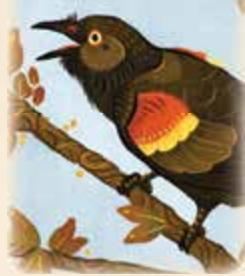
Agelaius phoeniceus
Habitat: Marshes, brushy swamps, and hayfields.
Red-winged blackbirds keep their brilliant red shoulder patches hidden much of the time, but display them boldly when singing.
Raven
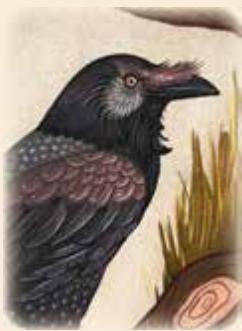
Corvus corax
Habitat: Woodlands, coniferous forests, and rocky coastlines.
Ravens have been known to imitate wolves and foxes to attract them to a potential meal, of which the raven gets the leftovers.
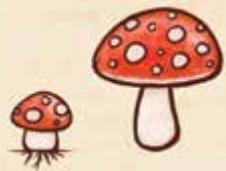
Fly Amanita Amanita muscaria

Morel Morchella esculenta
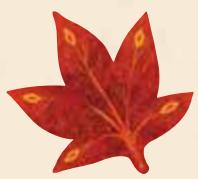
Sweetgum Liquidambar styraciflua
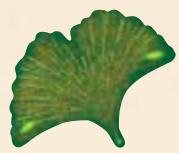
Ginkgo Ginkgo biloba

This mushroom is one of around 60 species that can be found growing in a fairy ring pattern, which in folklore was attributed to the dancing of fairies or elves. They are highly poisonous to humans.
Silver Maple Acersaccharinum
Of the 13 known species of morels in North America, four grow abundantly after fire. What triggers the prolific growth after fire is still an ecological mystery.
American sweetgum seeds are eaten by eastern goldfinches, purple finches, sparrows, mourning doves, northern bobwhites, wild turkeys, and a host of other local wildlife.
The ginkgo tree is one of the most ancient species, unchanged for the past 51 million years, with the earliest leaf fossils dating from 270 million years ago.
Silver maple sap is only half as sweet as that of sugar maple (Acer saccharum), but with patient boiling it yields a delicious pale syrup.
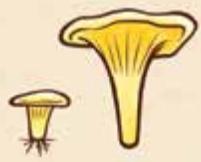
Chanterelle Cantharellus cibarius
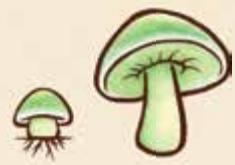
Verdigris Agaric Stropharia aeruginosa
Chanterelles form a symbiotic relationship with the roots of trees, helping them to absorb water and nutrients, while the trees provide the fungi with nourishment.
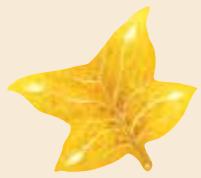
Tulip Poplar Liriodendron tulipifera
One of the very few blue-green fungi, this mushroom likes to grow under hardwoods and conifers, or on woody debris.
Tulip poplars produce so much nectar that often a bee can fill up on a visit to a single flower instead of having to visit many flowers.
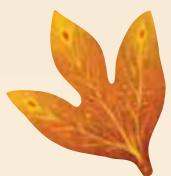
Sassafras Sassafras albidum
The roots and root bark of sassafras have been used to perfume soap, make sassafras tea, and was the original root used to flavor root beer.

The trident maple can live for about 100 years and is home to a bevy of insects, including several sphinx moth species and the eastern boxelder bug.
Acer buergerianum
HELPFUL RULES TO REMEMBER
No Actions from Played Leaf: You only gain actions from the leaves you connect to, not from the leaf you play.
Empty Leaf Pile: You may play a card that matches an empty leaf pile. If you do, choose the top leaf of any type. You may boost that leaf by discarding a card that matches the card you played.
No Leaf Cards: If you have no leaf cards at the beginning of your turn, gain a -3 acorn token and draw 2 leaf cards. Then continue your turn as normal.
Adjacent Leaves: Leaves are adjacent when at least one tip is connected.
Mushroom Reactions: Players do not gain reactions from their own leaf placements. Only players with the largest mushroom (adult mushrooms are larger than baby mushrooms) on a touched leaf gain sun tokens.
Cold Snap: At the end of the last player's turn, if there are 3 or more empty leaf piles, the game ends.
Refilling Animals: The animal mat is only refilled at the end of a player's turn.
No Action Rule: If you would gain no benefit from a leaf action, you instead gain 1 acorn token.
CREDITS
Artist: Angela Rizza Game Design: Tim Eisner
Graphic Designer: Angie Knowles
Project Manager: Amber O'Neill
Additional Artwork: Angie Knowles (tree board, icons, tokens) Lead Developer: Ben Eisner Kickstarter Help: Co O'Neill
Additional Development: Alara Cameron, Sen Foong Lim, Scott Caputo, Corey Coleman, Mike Deich, Tekela Fisher.
We would like to give thanks to these friends for their playtesting and support of Leaf:
Ryan Swisher, Ryan Spangler, Evan Halbert, Ryan Mauk, Scott Biersdorf, Stephen Karmol, Anna Deich, Crystal Schmidt, Melissa
Caputo, Keith Eisner, Debe Edden, Marty Butzen, William Bloeden, Mac Nelson, Taran Kratz, Chase Van Epps, Mohammad Ali,
Alex Hart, lan Lake, Adrian Koester, Julie & Jason Maxfield, Phoenix Bruner, Mike, Rick, Eric, T.C., Noah Kolman, Davey, Kelson,
Jen, Davey, Chris, Paul, Ty James, Peter Scmidt, Sam Martinez, Benji Rei, Micah Thomas, Nik Muggli, and Adam Wiedenheft and many others!
Many thanks to our fantastic copy editors and proofreaders: Tamara, Isabella Wong, Andrew Gilpin, Anita Polak, Abigail Dufault, Tegan Unnikrishnan, Laura Pollock, Michael Miller, Brittany Gélinas, Zsófia Kőszegi-Nagy, Andrei Steopan, Mellisa Kiser, Brian Tanner, Robbie Coleman, Simon Wyatt, Meryl Green, Warren Prasuhn, Shannon & Kevin Meller, TruckDrivinGamer, Kelly Miller, Jon Lachelt, Rachael Robbins, Kraig, Riley Bąkowska, Alistair Davidse, Annabelle Legg, Sara Lakin, John Colter, Eric Wagner, Benedict Slabik, Kaitlyn Yaws, Graham Falconer, Jackie Borozan, Talitha May, Jeff Buckner, Mark Ace Ramos, Marvin Herzan, and Katy Spence!
Download MarkdownTexts are community-compiled or publicly released by publishers; copyright remains with the original authors. For personal reference only.