
Legend Of The Five Rings Ccg
At a glance
Rules, cards and Q&A (Chinese)
The rules, card data and player questions for this game are written in Chinese. Open the Chinese page to read them.
Where to find full rules
Full rules and card lookup are available in the cunlema app at cunlema.cn — pick this game and ask about any rule, card or turn you are unsure about.
Related games
Rulebook text (Markdown)
This game has 9 rulebook Markdown file(s) in our library; 3 rendered inline below — expand to read or download.
Rulebook-L5R-TwentyFestivals-adv_rulebook.md39.7 KB

Advanced Rulebook

Advanced Rules
THIS IS NOT A COMPLETE RULEBOOK!
You should consult it after reading through the Basic Rules (also found in your Twenty Festivals starter). Between them, the two booklets present the complete rules of the Legend of the Five Rings (L5R) card game. The complete, Comprehensive Rules document can be found at rules.l5r.com.
Maximum Hland Size
Players have a maximum hand size of eight. After drawing all cards at the end of your turn, if you have more cards in hand than the maximum, you must choose and discard cards from your hand until you no longer have too many. Some effects may change a player's maximum hand size.
Provinces
Each province has a separate Province Strength stat, based on the Stronghold's Province Strength plus any modifiers from Sensei and other effects.
Personalities
Chi Death Rule
If a Personality's Chi is ever zero, destroy him immediately.
Clan +lonor Rule
Players can lose Honor from their own cards, from other players' cards, or from the Rulebook (that is, when their Personality dies dishonorably; see p. 16). After a player loses Honor from another player's card, or from the Rulebook, for the rest of the game he or she ignores Honor Requirements on Personalities with his or her own Clan Alignment.
Dead Personalities
Personalities that are destroyed are treated differently from Personalities that are merely discarded (for example, from a Province). Turn dead Personalities 90 degrees in the discard pile, or create a separate pile for dead Personalities.
Advanced Card types
In addition to the Dynasty types—Personalities and Holdings—and Fate types—Followers, Items, and Strategies—introduced in the Basic Game, L5R has a number of other card types.
Sensei
A Sensei is a card that you may start with in play, representing a revered master whose teachings have influenced you. You may only have one Sensei in play, you start with it in play, and the choice of Sensei is part of your deck construction. Like your Stronghold, the Sensei does not go into the Dynasty or Fate deck and is neither a Dynasty nor Fate card.
- Sensei -

A Sensei will usually have one or more Clan Alignment restrictions, such as “Scorpion Clan," or "Crane • Dragon." You may only start with a Sensei that matches your Stronghold's Clan Alignment, or with an "All Clans" Sensei.
A Sensei modifies your Stronghold. It has modifiers for Province Strength, Gold Production and Starting Family Honor which always modify the Stronghold's stats. A Sensei may also have traits and abilities that apply to you and that work like those of a Stronghold.
Event
Events represent important happenings in Rokugan. While they are face up in your Provinces, and only then, you can use their abilities. They are discarded once their abilities are used, unless the ability puts them into play. Apart from its abilities, an Event may have traits in its text box, and these apply while in play.
e(eeee060

Spell
Spells are attachments. They represent magic scrolls used by a Shugenja (a person trained in the magic of Rokugan). Spells have no Force or Chi modifiers. They will only attach to a Shugenja, and their abilities can only be used (“cast") if attached to a Shugenja. (see also Cast, p. 26).
Ring
Ring cards represent understanding of the mystic elements. They can be discarded from the hand to use their ability, or put into play when you meet the special conditions of the text in their trait. When in play, their ability can be used without having to discard them.
Actions
The Basic rules introduced Limited, Open, Battle and Dynasty actions. The full game has two more types of action: Engage and Interrupt.
C Engage actions are taken in a special action round during a battle, before either player has the chance to take Battle actions. See p. 54.
Interrupts are announced during another action—either yours or another player's—at the point after costs are paid and before the action's effects start to resolve. Interrupts may refer to the original action as "the action" (for example, “The action cannot move Personalities.") If an Interrupt modifies an action's effects, this only applies to the action
Color, Flavor & Reminder Text
Because Legend of the Five Rings tells a story, abilities on some cards may have a sentence of descriptive phrasing such as The snow blocks travel. Such phrasing is for color only and is put in italics to indicate this.
Text in (parentheses and italics) is a short, informal reminder of what the card does according to the rules.
Descriptive text in italics without parentheses is flavor text, and also has no bearing on the rules.
being interrupted, not to subsequent actions that turn.
You may play as many Interrupts as you wish to a single action, but you may not play an Interrupt during another Interrupt action.
Hlow Long Do things Last?
Some effects are instantaneous, and marked by physical changes to the game components, such as bowing cards, changing their location, adding tokens, and changes to Family Honor. These changes do not wear off by themselves.
Other effects involve changes that are ongoing. That is, they last until a certain point in the game, and are not physically marked by the game components.
Some examples of ongoing effects include stats such as “Give a target attacking Personality +2F," or giving a card the trait, “This Personality will not bow."
All ongoing effects last until the end of the current turn, unless they give a different duration.
As with Battle actions, Engage and Interrupt actions taken during a battle are subject to the Rules of Presence and Location, as described in the Basic Rulebook (see Basic Rulebook p. 57).
Recruit & Equip
Some actions tell you to "Recruit" or “Equip" a card. When this happens, pay the cost of the card entering play (usually indicated by the action's own * Gold cost), and apply the effects of the Recruit or Equip player action.
Traits
Text in a card's text box can be keywords, an ability (starting with boldface words such as "Open:" or "Ninja Battle:") or flavor text (italicized text (see p. 11) that is only descriptive and not used in the game). Game-relevant text that is not part of any of these is a trait.
Targeting
An action's required targets (for example, “target your Holding” or “bow a target Samurai") must be chosen before paying the action's costs. This allows Interrupts, Invest effects and other things to take place knowing what the action is targeting.
Optional targets (“you may target...") and targets chosen by other players are instead chosen as effects resolve.
Things triggered by targeting (such as “after an action targets...") respond to targeting in action resolution, not the initial choice of targets.
Some traits are triggered by other things happening, for example, "After this card enters play, lose 3 Honor". A trait is not like an action, though:
A trait is not optional; you must apply the effects whenever the trigger is met.
A trait can be triggered when its card is bowed.
A trait's effects are not restricted to once per turn.
A trait without a trigger on a card, such as "Your Samurai each have +1F," has a continuous effect that is "always on" while the card is in play.
The Imperial Favor
The Imperial Favor is a resource that gives great political advantage to those who call upon it. It is represented by an object that starts the game uncontrolled. When it becomes controlled, its controller places it in his or her home, visible to all players. Twenty Festivals Starter Decks include a card that you can use to represent the Imperial Favor. If you control the Favor, you may discard it, and then it becomes uncontrolled. Discarding the Favor is required for certain actions, including (but not limited to) the following two Favor player abilities:
Favor Political Limited: Discard the Imperial Favor and a card to draw a card.
Favor Political Battle: Discard the Imperial Favor to move home a target attacking enemy Personality.
Lobbying
This player ability lets you take the Imperial Favor, vying to win the favor of the Empress by reminding her of your family's high deeds and standing.
Lobby
Political Limited: If you have higher Family Honor than each other player, bow your target unbowed Personality with 1 or more Personal Honor to take the Imperial Favor.
Dishonorable Personalities
Some things can dishonor a Personality, disgracing him or her in the eyes of Rokugan. Turn the Personality card 180 degrees upside down to show this dishonorable state.
A dishonorable Personality has a maximum of zero Personal Honor.
After a Personality is destroyed while dishonorable, the player who last controlled
- Dishonorable -
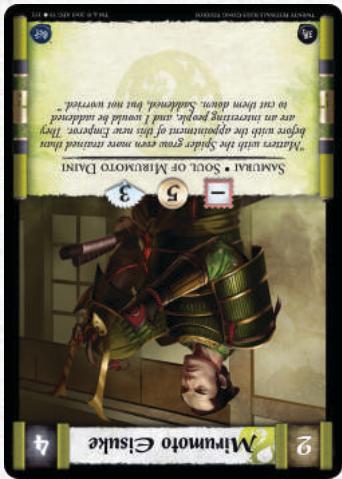
him loses Honor equal to the Personality's printed Personal Honor. (This loss does not come "from a card," but from the Rulebook.) A destroyed dishonorable Personality remains dishonorably dead even in the discard pile.
Dishonorable Personalities remain dishonorable until an effect "rehonors" them (restores them to honorable status). Turn the card right side up again to represent the rehonoring.
Sometimes an honor gain will rehonor a Personality. Specifically, substitute rehonoring for Honor gain:
C Before a player gains Honor from an action or trait that targeted or came from one or more of his or her dishonorable Personalities.
Before a player gains Honor for attaching a card to his or her dishonorable Personality.
Before a player with any dishonorable Personalities in his or her army gains Honor from destroying enemy cards in battle resolution. In a tied battle, all dishonorable Personalities in an army are rehonored before being destroyed, and their army's leader gains no Honor.
In these cases, the honor gain will not happen, and instead the Personality or Personalities will be restored to honorable status.
Battles
Engage Segment
Engage actions represent especially wellprepared or rapid maneuvers in battle. The Engage Segment is an action round of Engage actions, starting with the Defender, that comes before Battle actions are taken in the Combat Segment. Once both players have passed consecutively on Engage actions, the Engage Segment ends and the Combat Segment begins.
Attacking Multiple Provinces
In the Basic Game, the Attacker only chooses one Province to attack, creating a battlefield there. In the Advanced Game, after the Attacker declares an attack, a battlefield is created at each of the Defender's Provinces.
When the Attacker and Defender assign, they may assign any of their legal units to any of these battlefields. A battle is then fought at each of these battlefields, with the Attacker choosing one by one which battle to fight, until all the battlefields have been fought at. Often, these battles will be at empty battlefields, and "fighting" them is a mere formality.
In each battle, go through the Engage, Combat and Resolution segments in order. The steps after a battle also happen before the next battle begins, including units returning home.
Units left at a battlefield after the battle ends return home, bowing if they were attacking. This also happens to units that find themselves at an already-resolved battlefield at the end of the Attack Phase.
"No Second Battle"
There is one additional rule restricting effects during a battle. A Personality who has already been in an attacking army during a battle resolution in the current Attack Phase will not move to a battlefield again during that Attack Phase.
Advanced Victory Conditions
In addition to the military and honor victories supported in the Basic Game, there are two other ways to win a game of L5R.
Dishonor Victory
If a player's Family Honor is -20 or below at the end of his or her turn, he or she loses.
Enlightenment Victory
You win immediately if you control five Rings with five different element keywords (Air, Earth, Fire, Water and Void). You have seen the emptiness behind the so-called "victory" in war and court, and become an enlightened master.
Deck Building
You can expand and change your starter deck by trading for or buying other cards. Follow these rules to build a legal play deck in the Twenty Festivals 40/40 format:
C The Dynasty and Fate decks must each have at least 40 cards. Your Stronghold and Sensei do not count toward this minimum, and copies of those cards may not be included in the Fate or Dynasty decks.
All cards in the play deck (including the Stronghold and Sensei) must feature thesymbol in the lower left hand corner of their most recent printing (MRP). Older printings of the cards may be used (see also "Soul of ...", p. 41), but in all L5R formats, cards are considered to have the stats and text of their MRP. If you use older cards, you're responsible for knowing these differences and communicating them to your opponent.
You can have no more than three copies of any card, by title, in your decks.
6 You can have no more than one copy of each Unique card, by title, in your decks.
Note that Experienced cards (p. 31) are an exception to the last two rules.
Game terms & Keywords
In alphabetical order, this section lists rules associated with specific game terms and keywords that are not mentioned in the basic rules. After this, we present a number of fine points in the rules.
Absent: An ability with the Absent keyword may be used during battle even if you control no units at the current battlefield.
Active Player: The player whose turn it is.
Additional actions: Additional actions granted by effects are taken immediately after the current action resolves. If the type of additional action is not specified, it is the type appropriate to the current action round—Limited in your Action Phase, Open in any player's Action Phase, Engage in the Engage Segment and Battle in the Combat Segment.
Armor: A Personality cannot have more than one Armor attached.
Cannot: These words mean that an effect is prevented (see p. 38).
Cast: When you take an action from a Spell attached to a Personality (usually a Shugenja) the Personality with the Spell attached in question "casts" the Spell and is the "caster."
Cavalry: The Cavalry keyword is relevant to the following ability which all players have:
Absent Engage: Target your unbowed Personality in a Cavalry unit at any location. Move him to the current battlefield.
A "Cavalry unit" is one in which the Personality and all Followers, if any, have the Cavalry keyword (see Units, p. 46).
Challenge: See Duel, Basic Rulebook, p. 69.
Clan Alignment: A characteristic of a Personality or Stronghold shown by the mon, or animal symbol, at the top left of the card. See Basic Rulebook, p. 11, for list of Clans and mons. A player has the Clan Alignment of his or her Stronghold. Keywords indicating minor clans, such as "Bat Clan," are not Clan Alignments.
Combining: A way to use similar actions from cards in the same unit to create a larger strength effect. Fear effects, Ranged Attacks and Melee Attacks can each be combined, but only with other effects of the same kind (that is, Ranged and Melee Attacks cannot combine with each other, etc.) To explain this rule we'll use the term “attack effect" to refer to the particular effect you are combining, whether Fear, Ranged or Melee. After you have paid the costs of an initial action that creates an attack effect from a card in a unit, as an Interrupt to that action, you take an action from another card in the same unit that creates another attack effect of the same kind. Then resolve that action's effects; instead of creating a separate attack effect, add the strength of that attack effect (with any modifications) to the strength of the original attack effect. The original attack effect may only target a card that it, as well as each of the combining actions, could target. All other characteristics of the attack effect come from the original. You may combine more than one attack effect with the same initial action.
Conqueror: Cards in a Conqueror Personality's unit do not bow returning home after a battle.
Contribute: A Personality or Follower contributes Force when its Force is added into its army's total Force. This is part of a battle's resolution, but can also happen when an army's total Force is calculated for other reasons. Bowed Personalities and Followers do not contribute Force.
Control: You gain control of a card when you bring it into play; only cards in play are "controlled." You will normally keep control of the card while it remains in play. However, an attachment is always controlled by its Personality's controller. Some effects may change control of a card between players. Immediately after a player successfully takes control of another player's card:
C If the card is at a battlefield, it goes to the new controller's side of the battlefield, attaching to one of his Personalities if necessary;
Otherwise, it enters the new player's home. Neither of these changes in location is movement.
Copy: Some effects may copy a keyword, trait or stat from one card to another. If a stat is copied, set the copying card's stat to the current value of the copied card's stat (see Set, p. 40). A card cannot copy its own text or stats.
Courage: All players have the following ability relevant to the Courage keyword.
Repeatable Interrupt: Discard a Courage card from your hand to give one of the action's Fear effects +2 or -2 strength.
Courtesy: Traits starting with "Courtesy:" have an effect that is not applied if you went first this game.
Created Cards: Some effects may create cards in addition to the cards included in decks. You may use pieces of paper, facedown spare cards, or other objects to keep track of these. If an effect that creates a card gives no value for a stat the card type normally has, that stat's base value is zero. Exception: Created Personalities have a “-“ Honor Requirement. Created attachments attach to a Personality as part of their creation effect. Other cards you create enter play in your home, and cards created during a battle join your current army, attaching to a Personality if necessary. When a created card leaves play, it ceases to exist.
Dead, Destroy: See Personalities, p. 4.
Destined: After your card with the Destined keyword enters play, draw a Fate card.
Discard: To put a card in its Dynasty or Fate discard pile. "Discard a card" by itself means "discard a Fate card from your hand." If an effect requires you to “discard" the Imperial Favor, this means that you give up control of the Favor and it becomes uncontrolled.
Discarded: The state of a card that is in a discard pile and is not dead.
Discipline: A special trait on Strategies, appearing with a Gold cost icon. You may play a card with the Discipline trait from your discard pile for one of its actions, paying the Gold cost in the icon as an additional cost of the action (or adding the Gold cost to the action's if it already has a Gold cost). After the action ends, remove the card from the game. Keep in mind that abilities can be used only once per turn, meaning that Discipline abilities normally can't be used from the discard pile on the same turn you used them from your hand.
Do Not, Does Not: These phrases in a card effect means that another effect is prevented (p. 38).
Draw: To put the top card of your Fate deck into your hand.
Duel: See Basic Rulebook, p. 69.
Element Keyword: One of the five keywords representing the mystic elements of Rokugan: Air, Earth, Fire, Water and Void.
Enemy: Referring to the player on the opposing side to you during a battle (the “enemy leader"), and to cards in units he or she controls. Cards not in units, such as Holdings, Terrains or Regions, are not "enemy cards."
Exchange: When an effect exchanges two stats, note their current values. Then, simultaneously set each stat to the noted value of the other one (see Set, p. 40).
Expendable: After a card with the Expendable keyword is destroyed, the player who controlled it last draws a card.
Experienced: Some cards have the Experienced keyword, sometimes followed by a number representing the card's experience level. A card with “Experienced" and no number has experience level of one. A Personality without Experienced has experience level zero. Any number of single Cards with the same title but different experience levels may be included in a deck. During the Dynasty Phase, you may bring an Experienced Personality into play normally, or you may overlay him onto one of your Personalities in play with the same title, but lower experience level, as a Dynasty action. When you overlay, you do not need to meet Honor Requirements or pay costs, but you do need to meet other requirements and restrictions, including Loyal (p. 36). An overlaying card replaces its less experienced version without entering play, and the less experienced card is removed from the game without leaving play. On overlaying, the new card keeps all states, ongoing effects, attachments and tokens of the old card, and is considered to be the same card.
Fear: An effect that follows similar rules to Ranged and Melee Attacks (p. 36 and 39). A Fear effect has a numerical strength (example:
Fear 4). “Fear X" is shorthand for the effect "Target an enemy Follower or Personality without Followers, and bow it if it has X or lower Force." Fear effects from cards in the same unit can be combined with each other. See Combining, p. 26.
Focus, Focus Effect: Terms used in dueling.
See Basic Rulebook, p. 71.
Fortification: When brought into play, Holdings with the Fortification keyword are attached to the Province they entered play from, or to any of your Provinces if they were not brought in from a Province. Keep the Holding card under any card in the Province, in the same way an attachment is kept under its Personality. They are destroyed if the Province is destroyed. During a battle, Fortifications are at their Province's battlefield, and their abilities can only be used if the Fortification is at the current battlefield.
Home: The location in front of a player's provinces where cards normally enter play, as opposed to battlefields.
Home (keyword): An ability with the Home keyword may be used during battle even if the card it is on is at home.
Honorable: A Personality who is not dishonorable. "Honorably dead" refers to such a Personality who is dead. See p. 16.
Infantry: This term refers to a Personality or Follower who does not have the Cavalry keyword. It is not itself a keyword.
Invest: This is a trait that starts with "Invest" and a Gold cost (for example, "Invest2:"). Before you pay the cost of an action that will bring into play a non-Strategy Invest card, you may permanently add the Invest cost to the card's Gold cost, and get the benefit of the Invest effect (for example, "Gain 1 Honor") after the card enters play. Invest costs on Strategies, instead, allow an optional extra Gold cost of the action to be paid in order to add the Invest effects at the end of the action's effects.
Kensai: A Kensai Personality can attach two Weapons if neither of them is Two-Handed. See Weapon (p. 44).
Kharmic: A keyword that can appear on Dynasty or Fate cards, and allows you to pay 2 Gold to cycle them from your hand or Province. Specifically, all players have the following ability relevant to Kharmic cards:
Kharmic Repeatable Limited,②: Discard a Kharmic cārd from your hand to draw a card, or discard a Kharmic card from your Province to refill the Province face-up.
Leader: The Attacker or Defender in a battle. You are the friendly leader; the other player is the enemy leader. This term is more relevant to the multiplayer rules (see Online Rules, p. 50).
Legacy: Players have the following ability relevant to Legacy Holdings:
Dynasty, * : Remove a card in your hand from the game to search your deck and Provinces for a Legacy Holding and Recruit it. If you fail to find one, you lose the game.
Location: An area holding cards in play. Each battlefield and each player's home is a separate location.
Look: To inspect a face-down card without showing it to anyone else or changing its position (for example, in a deck).
Loyal: A Personality with the Loyal keyword cannot join a player who does not share a Clan alignment with the Personality, either by entering play or by taking control.
May Not: See Prevention, p. 38.
Melee Attack: These follow the same rules as Ranged Attacks (p. 39), representing destruction from close-range combat. Melee Attacks may be combined with other Melee Attacks.
Move: An effect that moves a Personality changes his position from one location to another. Effects that move a Personality to a battlefield always move him into his controller's side there. Assigning to battlefields, and returning home from them, is not moving.
Multiplayer: A keyword telling you that a card is most useful (or only useful) in a multiplayer game. See Online Rules, p. 50.
Naval: All players have the following ability relevant to Naval cards:
Engage: If you are the Attacker, you have the first opportunity to take a Battle action, which must come from a card in a Naval Personality's unit. Passing that action does not count toward ending the action round.
Negate: A term that indicates a prevention effect (p. 38). "Negate an action" means to prevent all the action's effects and targeting, from the time the negation is applied.
Opposed: A card, side or army is opposed at a battlefield if there are one or more units in the enemy army.
Opposing: "Opposing" refers to cards at the same battlefield, on different sides.
Overlay: See Experienced, p. 31.
Own: You own all cards that were originally in your play deck and that you brought into play from outside the game, including cards you created. Cards you own can never go into another player's decks or discard piles; they always go to yours instead.
Permanent: A permanent effect refers to an effect whose duration lasts until the end of the game. Permanent effects can still be negated, ended, and changed by other effects.
Prevention: A prevention effect is one that uses language such as "negate," "cannot," "does not" or “will not". While a prevention effect lasts, it makes another effect or type of effect fail to happen whenever it would occur.
When an ongoing type of effect is prevented (for example, "Negate all Force bonuses on him"), this only suppresses existing effects for as long as the prevention lasts; it does not prevent new ones from applying. When an instant type of effect is prevented (for example, “Negate his destruction") this prevents new effects of that type for as long as the negation effect lasts.
Ranged Attack: A Ranged Attack represents a military effect that destroys at a distance, such as archers' arrows or a magical fiery bolt. "Ranged X Attack", where X stands for a number, is shorthand for the text "Target an enemy Follower or Personality without Followers, and destroy it if it has X or lower Force." A Ranged Attack action is one with a Ranged Attack effect.
Rehonor: See p. 16.
Repeatable: An ability with the Repeatable keyword may be used any number of times per turn.
Reserve: The following player abilities are relevant to the Reserve keyword:
Absent Repeatable Battle,*: If he would be opposed, Recruit your target Reserve Personality (into the current battlefield).
Repeatable Battle, * : If it would be opposed, Equip a target Reserve attachment to your target Personality (at the current battlefield).
Resilient: Once per game per card, before the first time battle resolution destroys a card with the Resilient keyword, negate that destruction.
Reveal: To turn a face-down card face up.
Search: To look through a deck or other area for a card of a specified kind. After you search a deck, you must reshuffle it after you take any card(s) you searched for.
Seppuku: An act of ritual suicide. If an effect directs a Personality to commit seppuku, apply the following effects: "Rehonor the Personality, then destroy him; these effects will not be negated."
Set: When a stat is set to a particular value, give it a bonus or penalty such that it reaches the new value.
Show: To display the face of a face-down card to all other players, then return it to its facedown state.
Shugenja: A person trained in the magic of Rokugan. See Spells, p. 9.
"Soul of ...": This is a keyword that includes another Personality's title, showing that the current character is a descendant or disciple of the older character. "Soul of" Personalities are equivalent to the older card for deck construction purposes. You may use a copy of the older card from a previous edition as a proxy for the "Soul of" version (see Deck Building, p. 24).
Switch: When an effect switches the locations of two units, each one simultaneously moves to the location of the other. If one movement is negated, the other one is also negated.
Tactician: All Tactician Personalities have the following ability, known as “Tactical Advantage."
Tactical Advantage
Battle: Discard a card to give this Personality a Force bonus equal to the Focus Value of the discarded card.
This ability cannot be removed or copied from the Tactician Personality.
Terrain: A Strategy with the Terrain keyword represents the ground on which a battle is fought. Most Terrains have a Battle ability that puts them into play at the current battlefield. After a battle ends, discard any Terrain at its battlefield.
Tireless: An ability with the Tireless keyword may be used even if the card it is on is bowed.
Token: A marker in the game. You may use beads, pieces of paper, or other distinct objects as tokens. Tokens may have a keyword (such as Corruption). They may also give a stat bonus or penalty (such as -1C) to whatever they are on. This bonus or penalty is considered to come from the last effect that placed the token on the card or area. Tokens are not cards. They are removed from the game if the card they are on leaves play.
Transfer: To re-attach a card or token from one card or province to another. You do not need to pay the costs of a transferred card again, but you do need to meet any restrictions on attaching.
Unaligned: Refers to a Personality, player or Stronghold without a Clan alignment. It is not itself a keyword.
Unique: A player cannot bring into play or take control of a Unique card if he or she already controls a Unique card with the same title (but see Experienced, p. 31). If a player takes control of a unit with a copy of a Unique attachment he or she already controls, discard the new attachment. The Unique keyword also restricts deck construction. See Deck Building, p. 22.
Unstoppable: Players, other than the player taking the action, may not Interrupt actions with the Unstoppable keyword.
Weapon: A Personality can have only one Weapon attached. Exception: See Kensai, p. 35.
Will Not: This phrase in a card effect means that another effect is prevented (p. 38).
Special Circumstances
The following rules are for situations that may sometimes arise in advanced play.
Keywords
Keywords on abilities also apply to their cards—so, for example, a Strategy with a Political ability is a Political Strategy. Keywords on cards do not apply to their abilities—an ability on a Ninja card is not a Ninja ability unless it says so (for example, "Ninja Battle:".)
In Play & Out of Play
Cards must be in play—that is, in your home or at a battlefield—to be legal targets, unless the targeting says or implies otherwise. To use its abilities, a card must either be in play, be an Event played from your Province, or be a Strategy or Ring played from your hand. Abilities that break this rule will say that they can be used from a different area (for example, "If this Follower is in your hand...")
If a card is both out of play and face-down (including returning to the hand), it "forgets" ongoing effects on it, and other changes such as whether its abilities have been used.
Bonuses, Penalties & Stats
Bonuses are effects from cards or player abilities that say they increase a stat. The added Force and Chi from the relevant modifier stats on Items are modifiers, not bonuses, but if an Item says "This Personality has +2F while opposed," that counts as a bonus.
All stats, except for Family Honor and Honor Requirement, have a minimum value of zero.
If you need to know a stat's value at any time, apply all current bonuses and penalties first, then apply any minimum or maximum value.
Example: If a card with 2 Force gets a -3F penalty, apply the penalty, then the basic minimum of zero. This means that the card's Force is zero for all purposes, not -1. If it then gets a +2F bonus, apply the bonus, the penalty, and the minimum, so that it now has 1 Force.
Units
References to a unit's keyword—for example, "A Cavalry unit"—mean a unit where the Personality and each Follower in it (if any) all have that keyword. For example, a unit with a Cavalry Personality and a non-Cavalry Follower would not be a Cavalry unit, because of the Follower.
Effects that do something to a unit—for example, bow or destroy—have their effect on each card in that unit.
If a Personality leaves play, all his or her attached cards leave play in the same way.
Simultaneous Things
As a general rule, if two or more things appear to happen simultaneously, the player whose turn it is decides in what order they happen. More detailed rules covering this issue are found in the Online Rules (see p. 50).
An exception is Interrupt actions, because they are taken at their player's choice. If more than one Interrupt can be triggered at the same time, use a special action round. The active player has the first opportunity to play an Interrupt to that action or pass, followed by the other player, and then the active player has another opportunity. The action round continues until both players pass consecutively.
End of turn
References to drawing extra cards “at the end of the turn" change the normal end-of-turn draw; they do not create a separate card draw exactly when the turn ends.
Empty Decks
If either the Dynasty or Fate deck runs out of cards, nothing special happens, except that there are no more cards left in the deck. Provinces that cannot be refilled still exist. Use markers to represent them.
Separate Effects
Each of an action's or trait's effects is separate, and will happen even if the other effects fail to happen. For example, if an action says "Battle: Straighten your target Personality and move him home," if he is already unbowed you can still take the action; the straightening fails, but he still goes home.
Exceptions
Some cards describe an effect happening "to" do something else (for example, "Discard a card to gain 1 Honor.") If the first effect fails (for example, discarding a card with no cards in hand), the second thing (gaining Honor) does not happen.
Likewise, if a card says to do something "after" or "as" something else happens (for example, "As he moves, bow him"; "After he is dishonored, gain 1 Honor") , the second thing doesn't happen if the first thing fails to happen.
In the second example here, if an already dishonorable Personality is dishonored, the 1 Honor gain does not happen, because he does not go from the honorable to dishonorable state.
Targeting can cause the remaining effects in an action to fail if it is not met, but targeting is not itself an effect (see Actions, p. 10).
Online Rules
Visit http://rules.l5r.com for errata and Comprehensive Rules, plus variant rules for 3 or more players, draft, sealed deck and more. Rules questions can be asked and officially answered at the L5R CCG Rules Questions forum (http://www.alderac. com/forum/).
The Comprehensive Rules is a resource for tournament judges and players, a printable document available online. They cover rare situations and questions such as:
When can I play a card even though it will have no effect (Good Faith Rule)?
Does a created card have a “printed" Force?
Does destruction for having zero Chi come from a card or the Rulebook? What about destruction from a Ranged Attack?
Complete turn Sequence
-
Action Phase. Straighten your bowed cards and reveal cards in Provinces. Then take an action round: your Limited and Open actions, your opponent's Open actions.
-
(Optional) Attack Phase. You may declare an attack. Assign your unbowed Personalities to attack your opponent's Provinces. Your opponent assigns unbowed Personalities to defend.
At each Province (Attacker decides order):
Defender, then Attacker, take a round of Engage actions.
Combat Segment: Defender, then Attacker, take a round of Battle actions.
Resolution: Side with most total Force wins, not counting bowed Personalities and Followers. Destroy all cards on the losing side, or all cards if tied; each player gets 2 Honor for each enemy card destroyed this way. Destroy the Province if the Attacker's total Force was greater than the Defender's total Force plus Province Strength.
Attacking units return home, then bow.
- Dynasty Phase. Bring Personalities and Holdings into play. Discard face-up Dynasty cards. Draw cards up to your hand size limit (eight).
Action Phase Abilities
Cycle
Limited: If it is your first turn, choose one or more face up cards in your Provinces. Put them on the bottom of your deck in any order. (Refill the empty Provinces face down.) Then, turn all cards in your Provinces face-up.
Equip
Repeatable Open, *:Attach a target attâchment card, with Gold Cost equal to the amount you paid, from your hand to your target Personality.
Lobby
Political Limited: If you have higher Family Honor than each other player, bow your target unbowed Personality with 1 or more Personal Honor to take the Imperial Favor.
Imperial Favor
Favor Political Limited: Discard the Imperial Favor and a card to draw a card.
Kharmic
Kharmic Repeatable Limited,②: Discard a Kharmic card from your hand to draw
a card, or discard a Kharmic card from your Province to refill the Province face-up.
Attack Phase Abilities
Engage Segment
Cavalry
Absent Engage: Target your unbowed Personality in a Cavalry unit at any location. Move him to the current battlefield.
Naval
Engage: If you are the Attacker, you have the first opportunity to take a Battle action, which must come from a card in a Naval Personality's unit. Passing that action does not count toward ending the action round.
Combat Segment
Imperial Favor
Favor Political Battle: Discard the Imperial Favor to move home a target attacking enemy Personality.
Reserve
Absent Repeatable Battle,*: If he would be opposed, Recruit your target Reserve Personality (into the current battlefield).
Repeatable Battle, *: If it would be opposed, Equip a target Reserve attachment to your target Personality (at the current battlefield).
tactical Advantage
Battle: Discard a card to give this Personality a Force bonus equal to the Focus Value of
the discarded card. (This is an ability granted by the rules to each Tactician Personality.)
Dynasty Phase Abilities
Recruit
Repeatable Dynasty,*: Bring into play a target face-up Personality or Holding from your Province with Gold Cost equal to the amount you paid, paying 2 more Gold if the Personality has a Clan Alignment but does not have your Clan Alignment. (Holdings enter play bowed.)
Once during your own turn, after you announce a Recruit action or an action with Recruit as an effect, you may choose to Proclaim the Personality being Recruited. If he has your Clan Alignment, gain Honor equal to his Personal Honor after he enters play
Discard
Repeatable Dynasty: Discard a face-up card from one of your Provinces. (Refill it face down.)
Legacy
Dynasty, *: Remove a card in your hand from the game to search your deck and Provinces for a Legacy Holding and Recruit it. If you fail to find one, you lose the game.

07.md20.1 KB
Allen, Bob, and Cindy Go to War: A Sample Attack Phase
When his Attack Phase begins, Allen declares an attack against Cindy. Both Allen and Cindy invite Bob to ally with them. During the Infantry Maneuvers Segment, Allen assigns his Ogre Bushi (6F/4C) to attack Cindy's leftmost Province, which has a strength of 6. Bob wants to help attack, but he holds back on assigning any of his Cavalry units so he can see how Cindy plans to defend first. Cindy assigns her Togashi Teijo (3F/3C), who has a Dai Tsuchi (+3F/+0C), and her Tamori Chieko (1F/3C), who has Ashigaru Archers (0F), to defend her leftmost Province. During the Cavalry Maneuvers Segment, Bob sees that Allen may have some trouble and decides to help by assigning his Shinjo Shirasu (3F/2C) with a Daikyu (+0F/+0C) and some Light Mounted Infantry (1F) to attack the same Province. Bob now gains 2 Honor for allying.
Now that all units are assigned, Allen, being the Attacker, decides which battle will be fought first. He chooses the one with all the units. The battle begins, with an initial total of 10 Force on the attacking side and 7 on the defending side.
The Battle Action Segment begins. Cindy, being the Defender, has the first opportunity to act. She begins by bowing her Ashigaru Archers for a Ranged 2 Attack against Bob's Light Mounted Infantry. The Light Mounted Infantry only has 1 Force, so the ranged attack destroys it. Since the Ashigaru Archers are bowed, they no longer add their Force to their unit — but since they have 0 Force to begin with, this is no real loss.
Allen sits on Cindy's left, so he gets the next action. The attacking army is still ahead, but Allen is greedy. He wants to destroy the Province as well as Cindy's army, so he plays Destiny Has No Secrets on his Ogre, raising it to an impressive 8F/6C. Allen also has to show the rest of his hand to play that action, and he does so, revealing that the one card left in his hand is another Destiny.
Bob is not as greedy as Allen. He sees the attacking army is ahead, and is comfortable with that. He passes.
Cindy does not pass. She plays Twisted Forest from her hand. Twisted Forest is a Delayed Terrain that will reduce the Force of Allen's Ogre to 0 just before the battle resolves. That will give the attacking army only 3F.
Play moves to Allen, who finds himself shy of options. He could play his second Destiny Has No Secrets on his Ogre, raising it to 10F, but that would still be reduced to 0 because of when Delayed Terrains resolve. If Destiny were playable on any Personality, he could play it on Shirasu and help his ally out, but Destiny's wording only allows him to play it on his own Personalities. Allen saves the second Destiny for another turn and reluctantly passes.
Bob, fortunately, has a trick up his sleeve. He bows his Daikyu for a Ranged 3 Attack at Togashi Teijo, then reacts by paying 1 Gold to play Tsuruchi Technique and raise that attack's strength by 3. This gives him a total of 6, which is just enough to destroy Teijo. Now, even if no one gets rid of Twisted Forest, the attacking army will still outforce the defenders by 3 to 1.
But Cindy is not out of tricks. She bows Chieko, who happens to be a Shugenja, to play the Kiho Fist of the Earth and "bow an opposing Follower or an opposing Personality without Followers" — in this case, Shirasu. Now neither unit will add any Force to their armies, which is a bigger loss for the 3F Shirasu than for the 1F Chieko.
It's back to Allen, who is still in as bad a position as he was before. Allen passes. So does Bob, and then Cindy, because they are out of useful actions. Twisted Forest resolves, reducing the Ogre's Force to 0, and then the Resolution Segment begins.
On the attacking side, we have a 0F Ogre Bushi and a bowed Shinjo Shirasu, who adds no Force to the army. On the defending side, we have a bowed Tamori Chieko, who also adds no Force. The battle is a tie! All remaining cards in both armies are destroyed. Cindy gains 3 Honor for the three cards in the attacking army at the end of battle, and Allen gains 2 Honor for the two cards in the defending army. Since the attacking army did not outforce the defending one by more than 6 points, the 6-strength Province is not destroyed.
The battle is now resolved. Cindy puts her Twisted Forest into her discard pile. If Allen or Bob had any surviving units, they would now return to their controllers' homes, bowed. If any of Cindy's units had survived, they would have remained at that Province until the entire Attack Phase was over.
After conducting very brief, uneventful battles at Cindy's other Provinces, the Attack Phase ends and Allen moves into his Dynasty Phase.
Optional Rules
Many standards of play include one or more of these optional rules.
Alternate Starting Method
Players add the Focus value of a random cut from their Fate decks to their Starting Family Honor before determining who will go first. In the event of a tie, the tied players continue to cut and add to their running totals until one player is highest. These increases are only used to determine who goes first; no actual Honor is gained.
Diamond Storyline Simulation
To play a game that echoes the events in the Diamond Edition storyline, follow these restrictions: Use only cards and Strongholds printed with the Rokugani symbol for "diamond" in the lower left corner. For the most part, this limits you to cards that appear in Diamond Edition, and later expansions. In the case of cards reprinted from earlier sets, you may use either old or new copies, but remember that the second Cardinal Rule is always in effect. In the case of "Soul of…" Personalities, copies of the original Personality or a different "Soul of…" with the same original may also be used; however, they are played by the latest incarnation's printing in all ways, including all changes to stats, abilities, and title.
Glossary
ability — Text on a card or Stronghold or from the rulebook prefaced by "Limited," "Battle," "Open," or "Reaction." Synonymous with "action."
active player — The player whose turn it is.
army — One or more units either attacking or defending a Province. All units on one side are one army, regardless of who controls them.
assign — Order to attack or defend a Province during a Maneuvers Segment. Different from moving.
bow — Turn a card sideways to indicate that it cannot use its sections or be assigned to battle.
caster — The Shugenja or Monk performing an action on a Spell or Kiho. For Rituals, only the primary Shugenja is the caster.
Cavalry — A unit in which the Personality and all attached Followers have the Cavalry trait. A player can assign a Cavalry unit to a battle during the Cavalry Maneuvers Segment (as well as during Infantry Maneuvers). If any Follower or the Personality does not have the Cavalry trait, the unit is Infantry.
challenge — Invite another Personality to duel. A duel does not begin unless and until the challenged Personality accepts the challenge. A player's own Personalities cannot challenge each other.
Chi — A Personality's inner strength. This value determines how well a Personality can duel and the strength of many magical effects the Personality can produce. A Personality dies if his Chi drops to 0.
conditional — Dependent upon another player's decision.
consecutive — Targeted and resolved one at a time. When effects such as ranged attacks occur consecutively, you wait until each one resolves before picking a target for the next.
controller — The only player who may use a card's abilities or assign it to battle. A card's controller is the player who brought it into play, unless a card or rule states otherwise. A Personality's controller controls all cards in that unit.
Courtier — A Personality adept at the politics of the Imperial Court.
Creature — An animal-like character. Cards printed with the Mujina or Ratling trait are Creatures. All Creatures are Nonhuman.
Diplomat — See Courtier.
dishonor — Invert to signify shame.
Double Chi — A trait causing cards focused by its Personality in a duel to add their Focus values twice to the duel's statistic.
draw — Take the top card of your deck into your hand.
Elemental effect — An effect closely tied to the five elements that make up the world. There are no special rules for creating Elemental effects.
Elemental Rings — Cards that represent the five elements that make up all things: Air, Earth, Fire, the Void, and Water.
Enlightenment Victory — Winning the game by having all five Elemental Rings in play.
face-down — The orientation of all cards in a player's Fate and Dynasty decks, as well as unrevealed Dynasty cards in players' Provinces and cards in players' hands. Some effects allow you to play cards face-down as well.
Faction — A group of families and other characters united by a common cause or leader. A Faction's alignment trait might not contain the word "Clan," and a trait with the word "Clan" might not be a Faction. See also Minor Clan.
Family Honor — Your running Honor total influenced by actions in the game. Family Honor represents the esteem in which the people of Rokugan hold your family. If you ever have under –19 Family Honor, you immediately lose the game. If you begin your turn with 40 or more Family Honor, you win the game by an "Honor Victory."
Fear — An ability of some cards to panic opponents in battle. Fear bows all Followers with Force less than or equal to the Fear strength in one other target unit in the same battle. A card with a Fear ability can use it once per battle and does not bow to use it. Undead cards are immune to Fear.
fealty — Loyalty to a Faction. An action that gives one or more Personalities your Faction's trait, regardless of your Faction, is called "swearing fealty." Swearing fealty is a permanent change.
focus — Concentrate and build your Chi during a duel to defeat your opponent.
Force total — For a unit: The sum of the Force values of the Personality and all of his Followers. A bowed Follower does not add its Force, and a bowed Personality stops all the cards in the unit from adding Force, giving the unit a Force total of 0. For an army: The sum of the Force totals for its units.
Fortification — A Holding attached to the Province from which it came into play. Typically, a Fortification makes a Province harder to destroy. You cannot attach more than one copy of each Fortification to each Province. Unlike other Holdings, Fortifications do not enter play bowed.
Gold-producing Holding — A Holding that can "produce" Gold. A Holding that can only lower cards' Gold costs, "pay the entire Gold cost" of a card, or "put a card into play without Gold cost" is not a Gold-producing Holding.
hand — Cards drawn from a Fate deck but not yet played. Such cards are considered face-down.
home — The area of the table above a player's Provinces, containing the player's Stronghold, Holdings, and unassigned units.
Honor Victory — Winning the game by having 40 or more Family Honor when your turn begins.
Human — A Personality or Follower who is not Nonhuman. Many traits implicitly make a card Nonhuman, including Creature, Naga, and Oni.
immune — Unaffected by a given effect, although such effects may still target it. For example, Fear effects do not bow Followers that are immune to Fear.
Infantry — The default maneuverability for Personalities and Followers. A card is Infantry unless it has the Cavalry trait. A unit is Infantry unless the Personality and all attached Followers have the Cavalry trait.
innate ability — An ability on a Shugenja card. Abilities on other cards are not "innate." Innate abilities do not create Spell effects.
in the game — All cards owned by all players who have not yet been eliminated, including those in play, in decks, in discard piles, and in hands. Excludes only those which have been "removed from the game" or "discarded from play".
in turn — In the order in which players would normally play, usually decided by seating position and the standard clockwise progression of the game.
join — Come under control of. A Personality who will not join a player of a given Faction will not enter play from that player's Provinces, and such a player cannot take control of the Personality from another player.
Kiho — An Action card that creates Spell effects.
Maho — An effect based on evil practices forbidden by the Emperor. There are no special rules for creating Maho effects.
Military Victory — Winning the game by being the sole player remaining.
Minor Clan — A trait that includes the word "Clan" but isn't one of the Great Clans, such as "Boar Clan." Minor Clans do not count as Factions.
move — For a battle: Change location while a battle is being fought. Different from assigning, which is done before the battle.
Mujina — Trickster animals that have plagued the Empire for years. Mujina are Creatures.
non-Experienced — Without an Experienced or Inexperienced trait.
numeral — A number written using digits. The entire number, including any "+" or "–" sign, is one numeral.
Oni — Terrible monsters from the Shadowlands that have little use for concepts like honor. All Oni are Nonhuman and Shadowlands.
opposing — For a card or unit: In the opposite army from the card or unit. For a player: "An opposing player" is any player who controls opposing cards. "The opposing player" is either the Attacker or Defender, depending on whether you are on the Defender's side or on the Attacker's side, respectively.
opponent — In the general sense, any player other than yourself. For a duel: the other Personality or player in the duel. For a battle: see "opposing".
owner — The player whose deck a card was in when the game began, regardless of whether it is in play or who currently controls it. Cards and tokens created during the game are owned by their creator.
permanent(ly) — For the rest of the game. This does not mean the effect can never be negated, modified, or overwritten.
Personal Honor — A Personality's intrinsic honor. Different from Family Honor.
play deck — A player's Dynasty deck and Fate deck together.
Political action — An action that influences Rokugani politics. There are no special rules for taking Political actions.
primary Shugenja — The Shugenja to which a Ritual Spell being cast is attached. The primary Shugenja is the Ritual's only caster, regardless of how many other Shugenja also participate in the Ritual.
Province — An area on the table representing a family's ancestral territory. The goodwill and favors from your Provinces' people give you the opportunities represented by your Dynasty cards.
Province Strength — The maximum strength attack that a Province can survive. If an attacking army's extra Force in a battle exceeds the Strength of the Province it is attacking, the Province is destroyed, along with all cards in it and attached to it. A Faction's Stronghold lists the starting Strength of its Provinces.
Ranged X Attack — In a battle, an attack for which you bow a card with a Ranged Attack to destroy an opposing Follower, or Personality with no attached Followers, with Force less than or equal to X.
Ratling — A race of rodent-people from the area of the Shadowlands. Though not renowned for prowess in battle, Ratlings fight for a low price. Cards printed with the Ratling trait are Creatures.
Region — A card attached to and defining the Province from which it entered play. Regions reflect aspects of their Provinces' lands and grant special abilities. Each Province can have only one Region. All Regions that are not Unique are Singular.
remove from the game — Utterly removed from play, never to return. A card "removed from the game" does not go to the discard pile; set it aside in a new, separate pile. Removing a card from the game is not considered destruction.
requirement — With respect to bringing Personalities or Followers into play, shorthand for "Honor requirement."
restriction — An effect governing whether or not a player may bring a card into play.
Retainer — A Holding that represents a special resident of your fief. Retainers are not Personalities. They enter play bowed, like most Holdings.
Ritual — A type of Spell which multiple Shugenja may participate in casting.
seppuku — Ritual suicide that absolves a person of any past misdeeds. A Personality who dies from any seppuku card or effect always dies honorably and becomes Honorable Dead.
Shadowlands card — A card with the Shadowlands trait. Shadowlands characters live apart from the Empire, recognizing no law or code of ethics. Unlike with other Factions, the Shadowlands trait does not signify alignment with the Shadowlands Faction.
Shugenja — A magician/priest. Mastery of magic requires years of study and a strong Chi. Only a Personality with this trait can have Spells attached.
simultaneous (ranged attacks) — Targeted all at once, then resolved. You must select all targets for simultaneous ranged attacks before resolving any of them.
"Soul of…" — A Personality card functionally identical to another card already in print but that represents a different Personality in the storyline. "Soul of…" cards count together with their older cards against any deck construction card limits.
Spirit — Immaterial being. A Spirit is not Nonhuman (nor does it have any other unprinted trait) unless the card says so.
Singular — Limited to one in play by each player.
straighten — Turn a card upright to indicate that it is ready to take an action.
Stronghold — The card representing your family's ancestral home. It is not considered a card or a Holding. It lists your Starting Family Honor and your Provinces' Strength. Your Stronghold can bow to produce Gold or create effects.
Tactical — See Tactician.
Tactician — A renowned master of the battlefield. Only Tactician Personalities may perform Tactical actions. A Personality may perform one Tactical action per battle.
Terrain — A Battle action that determines the kind of land on which a battle is fought. You cannot play a Terrain if there is already one in play. Immediate Terrains resolve when played. Delayed Terrains resolve when the Battle Action Segment ends.
turn — The sequence of events from the time a player becomes the current player to the instant the player yields the table to the next player. A reference to a duration of one or more turns counts only the current player's turns.
Unaligned — Not affiliated with any of the Factions that have a significant presence in the courts of Rokugan. Any Personality with the Unaligned trait is an Unaligned Personality, no matter what other traits he has. "Unaligned" and "not aligned with any Faction" are not equivalent.
unconditional — See conditional.
Undead — A card with "Necromancer," "Skeletal," "Skeleton," "Undead," or "Zombie" in the title or boldfaced trait text. If a card is Undead, it is considered to have the Shadowlands trait as well (but not necessarily Nonhuman). Undead cards are immune to Fear.
unit — A Personality and all of the Personality's attached cards.
variable — Not known until the time it is used or needed. For example, the Gold cost of a card that allows its player to pay any amount of Gold for it is variable, while the Force of a Personality that depends on the number of Followers she has is not.
your — Controlled by you. (Cards not in play have no controller.)
Yu — "Heroic courage." The strength to fulfill one's duty even in death. Cards with the Yu trait may destroy opposing cards during the resolution of a battle that their army has just lost.
Download Markdown05.md17.7 KB
Sequence of Play in Detail
This section covers a turn's phases, summarized in "Sequence of Play: A Quick First Glance." They also appear on the back of this rulebook for easy reference.
1. Straighten Phase
Straighten your Stronghold and all of your cards in play.
2. Events Phase
Do the following for each of your Provinces, going from left to right:
If there is a face-down card in the Province, turn it face-up.
If the card in the Province is an Event, it immediately resolves if a copy has not resolved previously this game. Then, whether it resolves or not, discard it, replace it with your Dynasty deck's top card, face-down, and skip to the next Province.
If the card in the Province is a Region, you may immediately pay any costs and bring it into play attached to the Province if the attachment is legal. If the Region is legal and has no costs (and most do not), you must bring it into play. If you do not bring the Region into play, discard it and replace it with your Dynasty deck's top card, face-down.
3. Action Phase
Starting with the active player and going clockwise, each player must either take a single action or pass. The active player may take Limited and Open actions; all other players may take Open actions only (and all players may play some Reactions — see "Reactions"). Players may take these actions both as Action cards from their hands and on cards in play. The following things are other Limited actions the active player may take:
Attach an Ancestor, Follower, Item, or Spell to one of his Personalities. This targets the Personality.
Move attached cards between two or more of his unbowed Personalities, bowing the Personalities first as a cost. This targets every card bowed and moved.
Once per turn, lobby for the Imperial Favor (see "Lobbying for the Imperial Favor").
The Action Phase continues until all players pass consecutively. A player who passes may take an action later that phase if the opportunity reaches him again, but he cannot "go back" and take one last action if the phase ends before that point, because everyone else passed.
4. Attack Phase (Optional)
This phase has five segments:
Declaration Segment
Infantry Maneuvers Segment
Cavalry Maneuvers Segment
Battle Action Segment
Resolution Segment
You are not required to attack. You can attack only once per turn, and you can attack only one opponent per attack. You can only attack a player's Provinces; you cannot attack a Stronghold or Personalities directly.
A section on Terrains follows the "Battle Action Segment" section, and a section about things that happen after a battle follows the "Resolution Segment" section. For an example Attack Phase, see "Allen, Bob, and Cindy Go to War: A Sample Attack Phase."
4.1. Declaration Segment
Declare which player you are attacking. That player is the Defender. You are the Attacker.
The Attacker and then the Defender may now invite other players to assist them in the upcoming battle, as attacking or defending allies. They may invite as many or as few of the other players as they wish, including players already invited by the other side.
During the Maneuvers Segments, a player invited to ally may assign any number of his own units to the armies of the inviting player. A player need not ally if asked. A player may ally only if invited and cannot ally with both the Attacker and the Defender in the same Attack Phase. When first invited, players need not state their intentions to send units; they may remain silent or may lie about their intentions.
A player who allies gains 2 Honor when he first assigns at least one unit during a Maneuvers Segment. A player may gain this Honor only once per Attack Phase. A player cannot gain this Honor by moving a unit into an army once battles begin.
4.2. Infantry Maneuvers Segment
There are two basic types of units: Infantry and Cavalry. Personalities and Followers are Infantry unless they have the Cavalry trait. A Personality and his attached Followers must all have the Cavalry trait for the unit to be Cavalry. Infantry units which do not assign during this segment may not assign at all.
Each Cavalry unit may also assign in this segment, or it can wait for the Cavalry Maneuvers Segment. Players cannot assign units led by bowed Personalities. Once a unit is assigned to a battle, it cannot voluntarily go home or move to another battle.
The Attacker declares which, if any, units attack and assigns them simultaneously to the Defender's Provinces in any combination.
Once the Attacker assigns units, other players may become attacking allies, if the Attacker invited them to do so during the Declaration Segment. Starting with the player to the Attacker's left and going clockwise, each invited player has one chance to likewise assign one or more of his units to attack the Defender's Provinces, simultaneously and in any combination, regardless of where the Attacker and other allies have already assigned their units.
Example: Allen attacks Bob; both invite Cindy and David to ally. Allen assigns two Infantry units to Province 1 and one to Province 2. Cindy joins the attack, assigning an Infantry unit to attack Province 3. She gains 2 Honor.
Next, the Defender declares which units defend and which Province each unit defends. Again, the Defender can assign units to his own Provinces in any combination, including no units at all and regardless of where players have assigned attacking units.
Once the Defender assigns units, other players may become defending allies, if the Defender invited them to do so during the Declaration Segment. Starting with the player to the Defender's left and going clockwise, each invited player has one chance to likewise assign one or more units to defend the Defender's Provinces.
Example: Bob assigns an Infantry unit to defend Province 1. David joins the defense, assigning one Infantry unit to defend Province 1 and one Infantry unit to defend Province 2. He gains 2 Honor.
4.3. Cavalry Maneuvers Segment
This segment immediately follows the Infantry Maneuvers Segment and follows the same process, except that players can assign only Cavalry units to attack or defend. This is the last chance for an invited player to ally and the last chance for any player to "assign" units; any units joining a battle after this point "move" into the battle instead.
Example: Allen assigns a Cavalry unit to attack Province 4. Cindy also assigns a Cavalry unit to attack Province 4. She already gained Honor for allying (see the example above), so she does not gain it again.
4.4. Battle Action Segment
Once players assign all of the chosen units to battle, the battles begin. One battle occurs at each of the Defender's Provinces, whether the Province has units assigned to it or not. (Card effects might allow units to enter unitless battles.) The last two segments of the Action Phase, Battle Action and Resolution, resolve separately for each battle; the Attacker determines the order in which battles are handled as the Attack Phase progresses.
Once the Attacker has chosen a battle to resolve, the Battle Action Segment begins. Starting with the Defender and going clockwise, each player must either take one Open action, take one Battle action, or pass (see "Actions"). The Battle Action Segment continues until all players pass consecutively.
Actions have extra restrictions during the Battle Action Segment. Even if an action is of an appropriate type to be played during the Attack Phase, it must satisfy all of the relevant restrictions below, or it is not legal. The exact same rules apply equally to both Battle and Open actions during the Attack Phase.
A player can take a Battle or Open action only if he is involved in the current battle. This is called the Rule of Presence. To satisfy this condition, the player must either: Currently have at least one unit in the battle, or
Gain a unit in the battle as an unconditional result of the action (for example, using Tireless Assault to move one of his own units from his home into the current, empty army).
A player can take only Battle and Open actions associated with the current battle. This is called the Rule of Relevance. In particular, the action needs to satisfy at least one of the following conditions: It comes from a card or token at the battle.
It moves or creates a card or token in the battle.
It targets or directly affects a card or token in the battle, the Province under attack, or the battle itself.
A player can take an action that refers to an "opposing" card or "this battle," or that includes an implicating phrase such as "another attacking card" or "the Province this card is defending," only if the card on which the action is printed is in the current battle. This includes Fear (see "Creating Fear") and Ranged Attacks (see "Making Ranged Attacks"). Players can take actions without such a phrase no matter where their cards are located, provided they meet all other restrictions. This rule applies to all action types.
A Terrain cannot be played if a Terrain is already in play.
A player can take a Battle action on a Fortification or Region only during a battle at its own Province.
Example 1: Earthquake, a Spell, reads: "Elemental Earth Battle: Bow this Shugenja to bow an opposing Personality." The caster must be at the current battle to take this action.
Example 2: Burning Smoke, a Spell, reads: "Battle: Bow this Shugenja to give a Personality –4F." The Spell does not say "opposing Personality," so its caster can cast it from outside of a battle. If the caster does so, however, he must cast it on someone in the battle, to satisfy the Rule of Relevance. If the caster wants to cast it on someone outside of the battle, he must be in the battle to do so.
Units may move into Provinces whose battles have already resolved.
A player can move units into another player's army only if (1) the second player invited the first to ally and (2) the first player has not had any units in the second player's opponent's army at any time during this Attack Phase.
Terrains are a special type of Action card that reflect the ground over which the armies fight and the many tactics they employ to use it to their advantage. As such, only one Terrain can be in play for a battle at a time.
Terrains stay in play until destroyed, which can happen because of a card effect, because they get "replaced," or when the battle ends.
Terrains fall into two different categories: Immediate and Delayed. Immediate Terrains take effect when played, just like any other Action card, but their effects end when they are destroyed. Delayed Terrains, on the other hand, do not take effect until immediately before the Battle Action Segment ends (though they still prevent players from playing other Terrains) and their effects have normal durations (typically, until the turn ends). Since the battle doesn't end until all players pass, players typically cannot take Open or Battle actions after a Delayed Terrain resolves.
4.5. Resolution Segment
The Attacker and the Defender add up the Force totals of all of their units to determine the winner of the battle. These totals are calculated once and once only for each battle. Destroying or changing the Forces of cards in the battle after these totals are computed has no effect on the battle's outcome.
The Force of a unit is the Force of its Personality plus the total Force of all of its Followers. A partially or completely bowed unit fights at less than peak effectiveness. Its total Force might be lower based on the following rules. These rules hold true any time at which you need to know a unit's or army's Force total, not just during battle resolution:
A bowed Follower does not add its Force to its unit.
No cards add to the Force of a unit when the unit's Personality is bowed, giving the unit a total Force of 0.
Being bowed does not affect any Follower or Ancestor bonuses with a "+" sign or Item bonuses of any kind, since these already add directly to the Personality's stats instead of to the unit's.
Being bowed does not affect total Chi.
Being bowed does not change a card's own Force. It alters only unit and army Force totals. Effects that work with the Force of an individual card, such as ranged attacks, use that card's actual Force whether it's bowed or not.
If the Defender's Force total exceeds the Attacker's:
Destroy all attacking units. The Defender gains Honor equal to twice the number of cards just destroyed in the attacking army. Every card counts, including Follower tokens (but no other type of token, since only Follower tokens count as cards), "non-military" cards like Spells, and less-experienced cards under Experienced ones. Cards destroyed earlier in the battle do not count for this gain.
If the Attacker's Force total equals the Defender's:
If both sides have units left in the battle, destroy all units in the battle, even if the Force totals are both 0. (Do not destroy an unopposed army with a Force total of 0.) The Attacker and Defender each gain Honor equal to the number of cards just destroyed in the other's army.
If the Attacker's Force total exceeds the Defender's:
Destroy all defending units. The Attacker gains Honor equal to twice the number of cards just destroyed in the defending army.
If the attacking army's Force total exceeds (not equals) the defending Force total plus the Province's Strength, destroy the Province and all cards attached to it at the same time as the defending army. Put any cards that were in a Province into the discard pile and slide the neighboring Provinces together to close the gap. The Attacker does not gain Honor for destroying Provinces or the cards attached to them.
Honor gained from a battle is a single Honor gain, regardless of the number of cards destroyed. The gain always goes to the Attacker or Defender (or both, in a tie), no matter how much of the army consists of his own units and how much of it is allies'.
If, during the Resolution Segment, one side has no units left in the battle, the battle is not a "victory" over an opposing army. This is true even if the defending army is the one absent and the Attacker has sufficient Force to destroy the Province. There is no winner or loser, and the player with units gains no victory bonuses. Battle resolution is the only time the phrase "destroying an army" is satisfied.
The battle has now resolved. All surviving attacking and allied units (including defending allies) return to their controllers' homes, bowed. The Defender's units do not bow; they remain in their Provinces until the Attack Phase ends.
If this is the very last battle of the Attack Phase, any attacking and allied units that moved into other Provinces and are still there go home bowed now as well.
Some effects allow players to act before the Defender, including "before the Defender's first action," "before any other actions," and "immediately after a battle begins." The player to the Attacker's left has the first chance to take one of these, then other players may take them, going clockwise.
A reference to "an opponent" in relation to a battle means "a player with units in the opposing army." A reference to "your opponent" or "the opponent" in this context means either "the Attacker" or "the Defender," as appropriate, regardless of whether or not the player has units present.
An action which refers to "this battle" always refers to the battle currently being resolved. In addition, if the card it appears on is of a type which can be in battles (such as a Personality), the card must be in the current battle for the action to be legal.
The battle has now resolved, or perhaps a card's effect ended it without resolution. Either way, destroy any Terrain still in play for the battle (even indestructible Terrains). Players may now take Reactions to the resolution or end of battle.
If other battles have not yet resolved, the Attacker chooses one of them and another Battle Action Segment and Resolution Segment occur. Otherwise, the Attack Phase is over.
5. Dynasty Phase
You may bring face-up Holdings and Personalities into play from your Provinces during this phase. You must satisfy each card's requirements and pay its costs. After you bring into play all of the cards you want, you can discard any or all face-up cards still in your Provinces, signaling the end of your Dynasty Phase.
Once you bring a card into play or discard one from a Province, immediately fill the Province with a face-down card from the top of your Dynasty deck. If you have no cards left in your Dynasty deck, place a marker in the Province to remind yourself and the other players that the Province has not been destroyed. If you somehow get cards in your Dynasty deck again, refill empty Provinces from left to right. You incur no penalty when you run out of cards — except, of course, that you can't bring any more into play! No player may take Limited, Open, or Battle actions during the Dynasty Phase.
6. End Phase
Draw the top card from your Fate deck and add it to your hand, unless the deck is depleted. If this puts you above your maximum hand size of eight cards, discard cards of your choice to bring you back down to your maximum hand size. To signal the end of your turn, it is honorable to bow to the next player and say, "The table is yours."
Download MarkdownTexts are community-compiled or publicly released by publishers; copyright remains with the original authors. For personal reference only.