
Longhorn
At a glance
Rules, cards and Q&A (Chinese)
The rules, card data and player questions for this game are written in Chinese. Open the Chinese page to read them.
Where to find full rules
Full rules and card lookup are available in the cunlema app at cunlema.cn — pick this game and ask about any rule, card or turn you are unsure about.
Related games
Rulebook text (Markdown)
This game has 1 rulebook Markdown file(s) in our library; 1 rendered inline below — expand to read or download.
huc_15_5740_LONGHORN_2015_rules_sc.md67.7 KB
LONGHORN

8+ 15 2
1870 – Somewhere deep in Texas
The rearing of Longhorn cattle from northern Mexico is booming. It has now become a major source of income for the Texan farmers and at the same time has attracted cattle thieves of all kinds.
The players assume the roles of two particularly feared outlaws: Eagle Perkins and Jessie Artist By rd.
The aim of the game is simple: to steal cattle (and a few gold nuggets if possible) to see who can amass the most money by the end of the game… or to get your opponent arrested by the sherif!
Equipment
• 9 location tiles
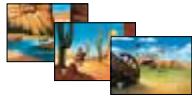
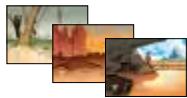
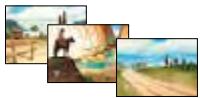
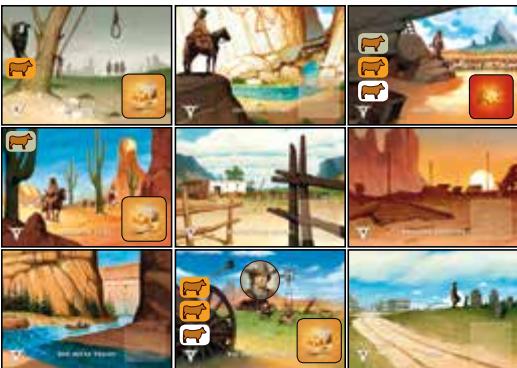
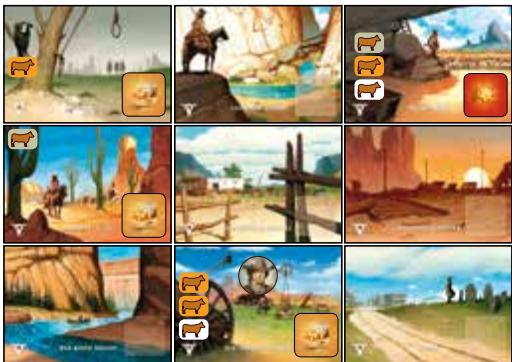
On each tile, an icon shows the number of cows at that location at the start of the game and has an area where you can place your Action tokens.
• 19 Action tokens


x1

x2
x2


x1


x1
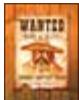
• 2 Wanted tokens (one per player) + 1 Outlaw token (one side per player)


Front

Back
• 36 wooden cows (9 in each of the four colours)

Mise en place
• Both players jointly decide which outlaws they will play.
They place the corresponding Wanted token in front of them.
• Mix up the 9 location tiles and place them at random on the table to form a 3x3 square.
• Mix up the Action tokens. Pick 9 of them, and place them one by one, in the area provided for this purpose on each of the locations. Important: If the Sherif token is present, it must always be placed on Nugget Hill. If necessary, swap its position with the token already placed randomly on Nugget Hill.
• Next, mix up the wooden cows and place the stated number of cows on each of the locations in a random manner.
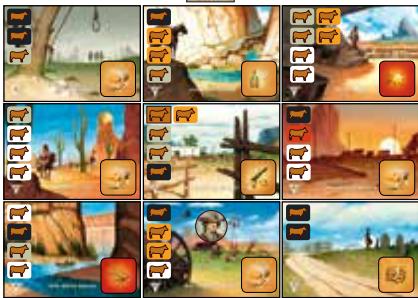
• Decide who will play first by throwing the Outlaw token in the air (as you would a coin). The side facing upwards shows which player will begin. His opponent chooses the starting location from among those containing four cows (Cherokee Spring, Dagger Flat, Maverick Junction, Red River Valley, Kid Cooper’s Ranch) and places the token on this location.

The game can now begin. Be wild!
Gameplay
The Outlaw token shows which of the two opponents will play. When it's his turn, this outlaw must:
1- Steal cattle
2- Move and turn over the Outlaw token
1- Stealing cattle:
In the location in which he is placed, the player chooses a colour and MUST steal all of the cattle of this colour. He places these cattle in front of him. These form his herd,
the value of which he calculates at the end of the game. If the location contains no more cattle at the end of this raid, then the player MUST apply the efect shown on the Action token present at the location.
The possible effects of Action tokens:

Gold nuggets: the token is kept in front of the player. At the end of the game, it is worth the number of \$ shown: ranging from \$200 to \$500.

Branding iron: discard the token and take all of the cattle of the same colour on one of the orthogonally adjacent locations. Add these cattle to your herd. Important: if you empty a new square thanks to the branding iron, the Action token present in this square will have no efect. It is simply put back in the box.

Epidemic: discard the token. Choose a colour and remove from the board all of the cows of this colour still present there. This type of cow will therefore be worth nothing at the end of the game.

Sheriff: if you have to take this token the sherif captures you and you immediately lose the game.

Snake oil: This legendary elixir enables you to play again right away. The player discards
the token then moves the Outlaw token
as per the basic rules but does not turn
it over: it's his turn to play once again.

Ambush: discard the token and immediately steal from your opponent (your choice) either a gold nugget token taken at random from those in his possession or two cows of the same colour.

Rattlesnake: the rattlesnake causes panic in the herd. Discard the token then take a cow from each of the colours in your possession and lay them out as you wish on the orthogonally adjacent locations (you can place all of the cattle on just one of these locations if you wish).
2- Move and turn over the Outlaw token
The player MUST then move the Outlaw token to another location situated a number of squares away equal to the number of cows he has just stolen. When moving from one location to another, the move must always be performed vertically or horizontally, with no return travel between two locations.
At the destination location, the outlaw token is turned over onto its other side, indicating that it's the opponent's turn to play.
Important: if all the locations situated at a distance determined by the number of stolen cattle are empty, then the game is over and all that remains is to add up the points. But if at least one of the locations situated at this distance contains cattle, then you must move the token to one of these locations.
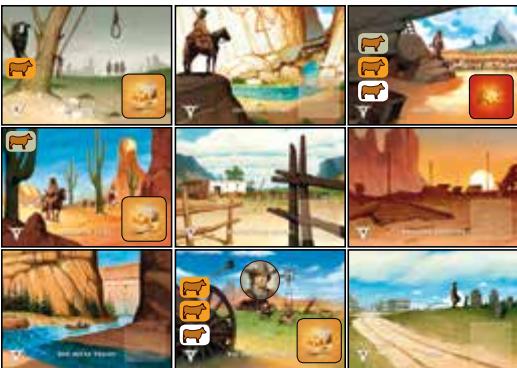
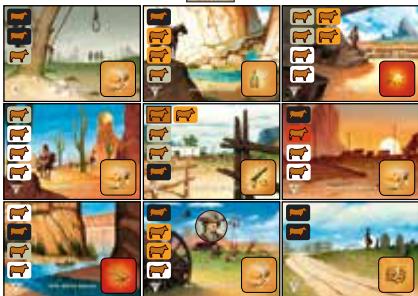
In the example shown above, Eagle Perkins has a choice: either he can steal the beige cow, which will bring the game to an end as all other locations one square away (Blackstone Corral, Red River Valley, Tulsa) are empty, or he steals the two Orange cows, and he is then obliged to have his opponent play at Dagger Flat, which is the only location containing cows situated exactly 2 squares away.
The special characteristics of dangerous locations: locations containing yellow Action tokens (Rattlesnake – Sherif) are considered as dangerous. Consequently you cannot have the same player play twice in succession at the same dangerous location if other possibilities exist.

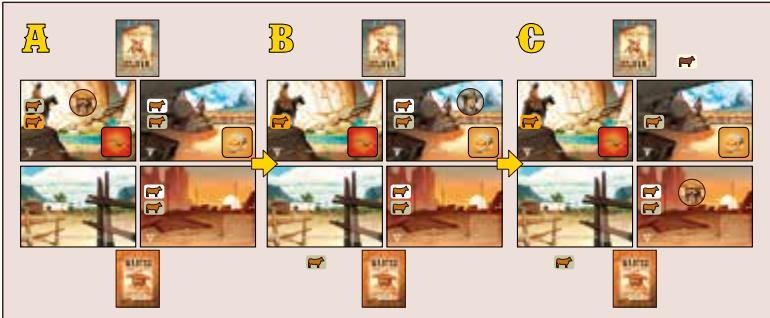
Example: A- Eagle Perkins is at Cherokee Spring. He steals a grey cow and makes Jessie Artist Byrd play at Nugget Hill. B- Jessie Artist Byrd steals a white cow. He must therefore move the Outlaw token by one square. But he can't return right away to Cherokee Spring because it's a dangerous location. C- He therefore makes Eagle Perkins play at Maverick Junction.
The end of the game:
The game can end with one of three diferent scenarios:
1-If an outlaw is forced to activate the sherif token, he immediately loses the game.
2-If an outlaw manages to get 9 cows of the same colour, he immediately wins the game. (Important: if conditions 1 and 2 are met at the same time, then only condition 1 will be taken into account).
3-All of the locations situated the number of squares away determined by the last cattle raid are empty. Each player then calculates the value of his herd and adds the value of his gold nuggets. The richest player wins!
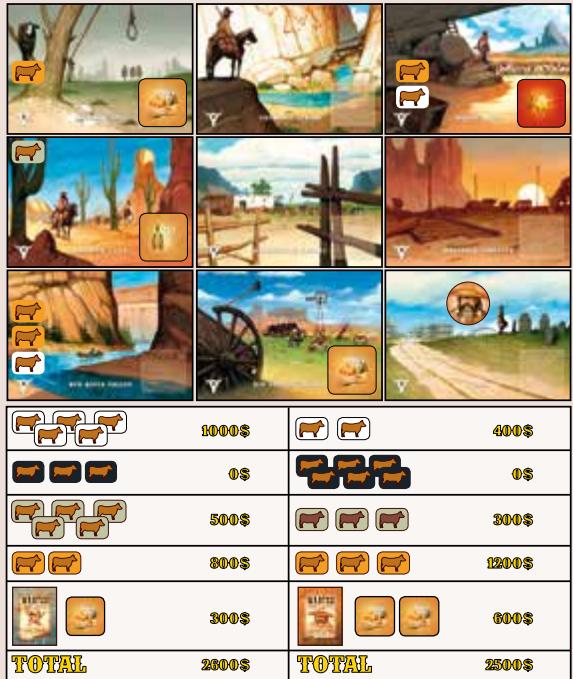
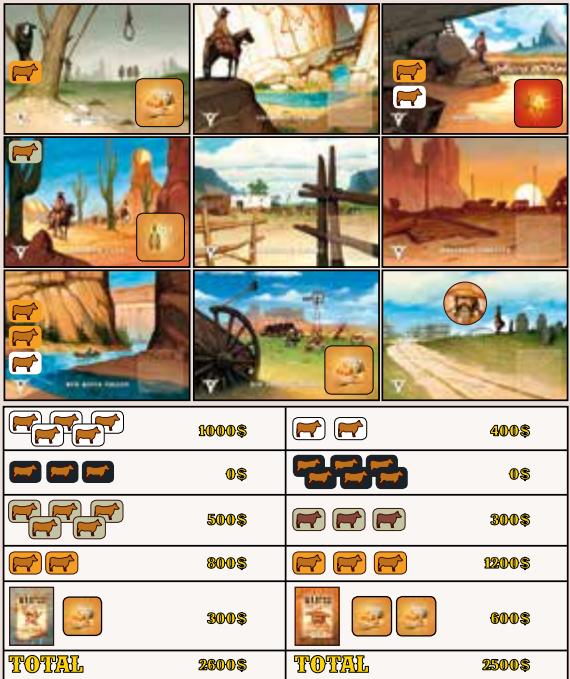
To calculate the value of the herd: each cow in your possession earns you \$100 for each cow of the same colour still present on the central board!
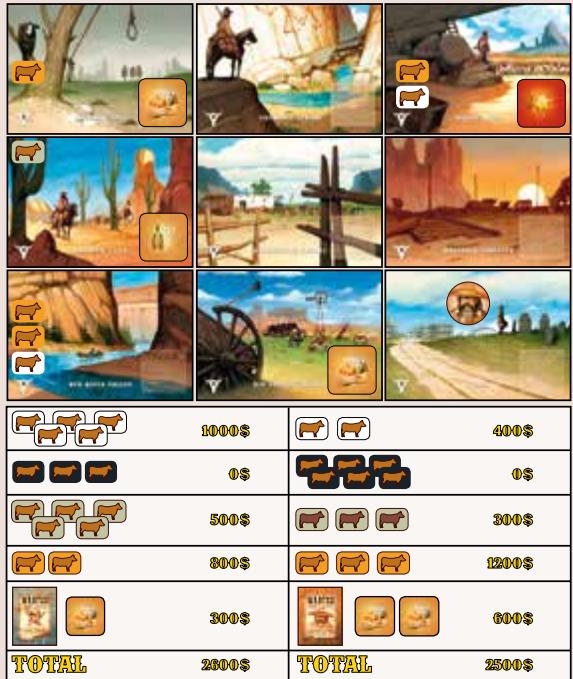
In the example shown below, each beige cow earns you \$200 (there are two left on the board), the brown ones aren't worth anything (there are none left), the red ones are worth \$100 (there's only one left), and the orange ones are worth \$400 (there are 4 left).
8+ 2
1870 : Quelque part au Texas
L’élevage de Long Horn, ces vaches venues du nord du Mexique, bat son plein. C’est devenu une belle source de revenus pour les fermiers texans, attirant la convoitise des voleurs de bétail de tous poils.
Les joueurs incarnent deux hors-la-loi particulièrement redoutés : Eagle Perkins et Jessie Artist Byrd.
Leur objectif est simple : voler du bétail (et quelques pépites si possible) pour se constituer le plus gros pactole à la fin de la partie... ou bien se débrouiller pour que l’adversaire se fasse capturer par le Sherif !
Matériel
• 9 tuiles territoires

Sur chaque tuile, une icône indique le nombre de vache présent sur le territoire en début de partie, et possède un emplacement destiné à accueillir les jetons Action. • 19 jetons Action


x1

x3
x2


x1


x1
• 2 jetons Wanted (un par joueur) + 1 jeton Hors-la-loi (une face par joueur)


recto

verso
• 36 vaches en bois (9 dans chacune des quatre couleurs)

Mise en place
• Les deux joueurs décident d’un commun accord lequel des hors-la-loi ils incarnent.
Ils placent devant eux le jeton wanted correspondant.
• Mélangez les 9 tuiles territoires, et placez-les aléatoirement sur la table, de sorte à former un carré de 3*3
• Mélangez les jetons Action. Piochez-en 9, et placez-les un par un, sur l’emplacement prévu à cet efet sur chacun des territoires.
Important : Si le jeton Sherif est présent, il est obligatoirement placé sur Nugget Hill. Echangez si nécessaire sa position avec celle du jeton placé aléatoirement sur Nugget Hill.
• Mélangez ensuite les vaches en bois, et placez aléatoirement le nombre de vaches indiqué sur chacun des territoires.
• Déterminez le premier joueur en lançant le jeton hors-la-loi en l’air (comme une pièce de monnaie). La face visible indique quel joueur va débuter. Son adversaire choisit le terrain de départ parmi ceux contenant quatre vaches (Cherokee Spring, Dagger Flat, Maverick Junction, Red River Valley, Kid Cooper’s Ranch) et place le jeton sur ce territoire.


La partie peut maintenant commencer. Be wild !
Déroulement de la partie
Le jeton hors-la-loi indique lequel des deux adversaires doit jouer. Lors de son tour, ce hors la loi doit :
1- Voler du bétail
2- Déplacer et retourner le jeton hors-la-loi
1- Voler du bétail :
Sur le terrain où il est placé, le joueur choisit une couleur, et DOIT voler toutes les vaches de cette couleur. Il place ces vaches devant lui. Elles constituent le troupeau
dont on calculera la valeur en fin de partie. Si, à l’issue de ce vol, le territoire ne contient plus aucune vache, alors, le joueur DOIT appliquer l’efet du jeton action présent sur ce terrain.
Effets des jetons action :

Pépites : le jeton est conservé devant le joueur. En fin de partie, il rapportera le nombre de \$ indiqué : de 200 à 500 \$

Fer rouge : défaussez le jeton, et prenez sur un des terrains adjacents orthogonalement toutes les vaches
d’une même couleur. Ajoutez ces vaches à votre troupeau. Important : si vous videz une nouvelle case grâce au fer rouge, le jeton action présent sur cette case est sans efet. Il est simplement remis dans la boite.

Epidémie : défaussez le jeton.
du plateau toutes les vaches de cette couleur encore présentes. Ce type de vache ne rapportera donc rien en fin de partie.

Sheriff : si vous devez prendre ce jeton… le sherif vous capture et vous perdez immédiatement la partie.

Snake oill : le fameux elixir permet de rejouer immédiatement. Le joueur défausse le jeton, puis déplace le jeton hors-la –loi en respectant les règles de base, mais ne le retourne pas : c’est encore à lui de jouer.

Embuscade : Défaussez le jeton et volez immédiatement à votre adversaire, selon votre
choix, soit un jeton pépites pris au hasard parmi ceux qu’il possède, soit deux vaches d’une même couleur.

Crotale : Le serpent à sonette provoque une panique dans
le troupeau. Défaussez le jeton, puis prenez une vache de chacune des couleurs que vous possédez et répartissez-les comme vous le souhaitez sur les terrains voisins orthogonalement (vous pouvez placez toutes les vaches sur un seul de ces terrains si vous le souhaitez)
2- Déplacer et retourner le jeton hors-la-loi
Le joueur DOIT ensuite déplacer le jeton hors-la-loi vers un autre territoire distant d’un nombre de cases égal au nombre de vaches qu’il vient de voler. Lors de ce déplacement, le passage d’un terrain vers un autre se fait toujours en vertical ou en horizontal, sans jamais efectuer d’aller-retour entre deux terrains.
Sur le terrain d’arrivée, le jeton hors-la-loi est retourné sur son autre face, indiquant que c’est à l’adversaire de jouer.
Important : Si tous les territoires situés à la distance indiquée par le nombre de vache volées sont vides, alors la partie est terminée et on passe au décompte des points. Mais tant qu’au moins un des territoires situés à cette distance contient des vaches, alors, on doit déplacer le jeton vers un de ces territoires.

Dans l’exemple ci-dessus, Eagle Perkins a le choix : soit il vole la vache beige, ce qui met fin à la partie car tous les territoires à une case de distance (Blackstone Corral, Red River Valley, Tulsa) sont vides, soit il vole les deux vaches oranges, et il est alors obligé de faire jouer son adversaire à Dagger Flat, qui est le seul territoire contenant des vaches situé à exactement deux cases de distance.
Spécificité des territoires dangereux : Les territoires contenant des jetons action jaunes (Crotale / Sherif) sont considérés comme dangereux. Un joueur qui quitte un territoire dangereux ne peut pas y être renvoyé dès son tour suivant, sauf s'il n'y a pas d'autre possibilité de mouvement valide.
Exemple : A- Eagle Perkins est à Cherokee Spring. Il vole une vache grise et fais jouer Jessie Artist Byrd à Nugget Hill. B- Jessie Artist Byrd vole une vache blanche. Il doit donc déplacer le jeton hors-la-loi de une case... mais il ne peut pas retourner tout de suite à Cherokke Spring car c’est un territoire dangereux. C- Il fait donc jouer Eagle Perkins à Maverick Junction.
Fin de partie :
La partie prend fin dans trois situations diférentes :
1-Si un hors-la-loi est obligé d’activer le jeton Sherif, il perd immédiatement la partie.
2-Si un hors-la-loi réunit les 9 vaches d’une même couleur, il gagne immédiatement la partie. (important : si les conditions 1 et 2 sont réunies en même temps, alors on ne prend en considération que la condition 1).
3-Tous les territoires éloignés du nombre de case indiqué par le dernier vol de bétail sont vides. Chacun calcule alors la valeur de son troupeau, et ajoute la valeur de ses pépites. Le plus riche l’emporte !
Pour calculer la valeur du troupeau : chaque vache possédée rapporte 100 \$ pour chaque vache de même couleur encore présent sur le plateau central !
Dans l’exemple ci-dessous, chaque vache beiges rapporte 200 \$ (il en reste deux sur le plateau), les marrons ne valent rien (il n’y en a plus), les rouges valent 100 \$ (il n’en reste qu’une), et les oranges valent 400 \$ (il en reste 4)
x2

1870 – En algún lugar que Texas
La cría de Long Horn, esas vacas procedentes del norte de México, alcanza su punto álgido. Se ha convertido en una gran fuente de ingresos para los ganaderos tejanos, lo cual atrae la codicia de toda clase de cuatreros.
Los jugadores encarnan a dos forajidos particularmente temidos: Eagle Perkins y Jessie Artist Byrd.
Su objetivo es muy sencillo, robar ganado (y si es posible, algunas pepitas de oro ) para acumular el mayor botín posible al final de la partida …. ¡O arreglárselas para que el adversario sea capturado por el Sherif !
Material
• 9 cartones de territorios
En cada cartón, un icono indica el número de vacas que hay en el territorio al principio de la partida, y existe una zona destinada a las fichas Acción. • 19 fichas Acción • 19 fichas Acción


x1


x1


x1
• 2 fichas Wanted (una por jugador) + 1 ficha Forajido (una cara por jugador)


recto

verso
• 36 vacas de madera (9 en cada uno de los cuatro colores)

Preparación
• Los dos jugadores deciden de común acuerdo a qué forajido encarnan. Colocarán ante ellos la ficha wanted correspondiente.
• Mezclar los 9 cartones de los territorios y colocarlos aleatoriamente sobre la mesa, para que formen un cuadrado de 3*3
• Mezclar las fichas Acción. Robar 9 y colocarlas una por una en el lugar previsto a tal efecto en cada uno de los territorios.
Importante: Si la ficha Sherif aparece, debe estar colocada en Nugget Hill. En caso necesario cambiar su posición por la de la ficha colocada aleatoriamente en Nugget Hill.
• A continuación mezclar las vacas de madera y colocar aleatoriamente el número de vacas indicado en cada uno de los territorios.
• Determinar el primer jugador lanzando al aire la ficha forajido (como una moneda) La cara visible indicará el jugador que debe comenzar. Su adversario elegirá el terreno de salida entre los que contienen cuatro vacas (Cherokee Spring, Dagger Flat, Maverick Junction, Red River Valley, Kid Cooper’s Ranch) y colocará la ficha en ese territorio.
Ejemplo:

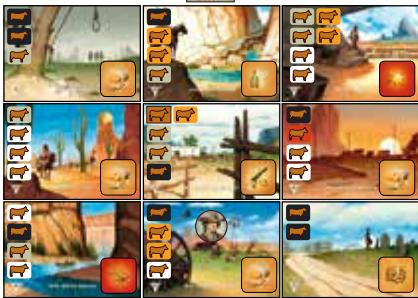
Ya puede comenzar la partida. ¡Be wild !
Desarrollo de la partida
La ficha forajido indica cuál de los dos adversarios debe jugar. En su turno, este forajido debe:
1- Robar ganado
2-Desplazar y girar la ficha forajido
1- Cuatrero:
En el territorio donde está colocado, el jugador elige un color, y DEBE robar todas las vacas de ese color, colocándolas delante de él. Estas vacas constituyen la manada cuyo
valor se calculará al final de la partida. Si al final de este robo, el territorio no contiene ninguna vaca más, entonces el jugador DEBE aplicar el efecto de la ficha acción presente en ese terreno.
Efectos de las fichas acción:

Pepitas de oro: la ficha se mantiene delante del jugador. Al final de la partida, arrojará el número de \$ indicado: de 200 a 500 \$

Hierro candente: deshágase de le ficha, y tome en uno de los terrenos adyacentes ortogonalmente todas las vacas de un mismo color. Añada estas vacas a su manada. Importante: si usted va hacia una nueva casilla gracias al hierro candente, la ficha acción presente en esta casilla queda sin efecto. Sencillamente vuelve a la caja.

Epidemia: deshágase de ficha. Elija un color y suprima del tablero todas las vacas
de este color que aún estén presentes. Éste tipo
de vaca no reportará nada al final de la partida.

Sheriff : si se ve obligado a tomar esta ficha… el sherif le captura y usted pierde inmediatamente la partida.

Snake oill: el famoso elixir permite volver a jugar inmediatamente, el jugador se deshace de la ficha, a continuación mueve la ficha forajido respetando las reglas básicas, pero no la gira: sigue su turno de juego.

Emboscada: Deshágase de la ficha y robe inmediatamente a su adversario, a su elección, una ficha de pepita de oro tomada al azar entre las que posea o dos vacas de un mismo color.

Serpiente: la serpiente de cascabel provoca un pánico en la manada. Deshágase de la ficha, a continuación tome una vaca de cada uno de los colores que posea y repárta las como desee en los terrenos vecinos ortogonalmente (usted puede colocar todas las vacas en uno solo de esos terrenos si lo desea)
2- Mover y girar la ficha forajido
El jugador DEBE mover a continuación la ficha forajido hacia otro territorio que diste en un número de casillas equivalente al número de vacas que acaba de robar. Durante este movimiento, el paso de un terreno a otro se realiza siempre en vertical o en horizontal, sin realizar jamás una ida y vuelta entre los terrenos.
En el terreno de llegada, la ficha forajido debe mostrar su otra cara, indicando que es el turno del adversario.
Importante: Si todos los territorios situados a la distancia indicada por el número de vacas robadas están vacíos, la partida finaliza y se pasa al recuento de puntos. Pero mientras exista un territorio situado a esta instancia que contenga vacas, se debe mover la ficha a uno de ellos.
En el ejemplo anterior, Eagle Perkins tiene las siguientes opciones: robar la vaca beige, lo que pondrá fin a la partida ya que todos los territorios a una casilla de distancia (Blackstone Corral, Red River Valley, Tulsa) se encuentran vacíos, o robar las dos vacas naranjas, y entonces obliga a jugar a su adversario en Dagger Flat, que es el único territorio con vacas situado a dos casillas exactamente.
Peculiaridades de los territorios peligrosos: Los territorios que contienen fichas acción amarillas (Serpiente / Sherif) se consideran peligrosos. Por eso está prohibido hacer jugar a un jugador dos veces seguidas en el mismo terreno peligroso si existen otras posibilidades.

Ejemplo: A- Eagle Perkins está en Cherokee Spring. Roba una vaca grisea y obliga a jugar a Jessie Artist Byrd en Nugget Hill. B- Jessie Artist Byrd roba una vaca blanca. Entonces debe mover la ficha forajido una casilla. Pero no puede volver enseguida a Cherokke Spring, ya que es un territorio peligroso. C- Debe jugar Eagle Perkins en Maverick Junction.
Final de la partida: La partida finaliza en tres situaciones diferentes:
1- Si un forajido se ve obligado a activar la ficha Sherif pierde inmediatamente la partida.
2- Si un forajido reúne las 9 vacas de un mismo color, gana inmediatamente la partida. (importante: si las condiciones 1 y 2 se cumplen al mismo tiempo, sólo se tendrá en cuenta la condición 1).
3- Todos los territorios alejados del número de casillas indicado por el último robo de ganado están vacíos. Cada uno calculará entonces el valor de su manada, y añadirá el valor de sus pepitas de oro ¡El más rico gana!
Para calcular el valor de la manada: cada vaca poseída reporta 100 \$ por cada vaca del mismo color todavía presente en el tablero central.
En el ejemplo siguiente, cada vaca beige reporta 200 \$ (quedan dos en el tablero), las marrones no valen nada (no queda ninguna), las rojas valen 100 \$ (sólo queda una), y las naranjas valen 400 \$ (quedan 4.)

8+ 15 min 2
1870 – Da qualche parte nel Texas
L’allevamento di Long Horn, una razza bovina originaria del Nord del Messico, è molto prospero. È diventato una bella fonte di guadagni per gli allevatori texani, attirando le brame dei ladri di bestiame di ogni sorta.
I giocatori incarnano due fuorilegge particolarmente temibili: Eagle Perkins e Jessie Artist Byrd.
Il loro obiettivo è semplice: rubare bestiame (e magari anche qualche pepita d’oro) per mettere insieme il malloppo più grosso alla fine della partita… o anche darsi da fare perché l’avversario si faccia catturare dallo scerifo!
Materiale
• 9 carte territorio

Su ciascuna carta, un’icona indica il numero di vacche presenti sul territorio all’inizio di partita ed è presente uno spazio destinato ad accogliere i gettoni Azione.
• 19 gettoni Azione


x1


x2


x1


x1
• 2 gettoni Wanted (uno per giocatore) + 1 gettone Fuorilegge (una faccia per giocatore)


recto

verso
• 36 vacche in legno (9 in ciascuno dei quattro colori)

Preparazione
• I due giocatori decidono di comune accordo quale fuorilegge vogliono personificare. Pongono davanti a sé il gettone Wanted corrispondente.
• Si mescolano le 9 carte territorio, e si dispongono a caso sul tavolo, in modo da formare un quadrato 3 × 3
• Si mescolano i gettoni Azione. Se ne pescano 9, e si dispongono uno per uno, nello spazio apposito su ciascuno dei territori.
Importante: Se il gettone Scerifo è presente, deve essere obbligatoriamente collocato su Nugget Hill. Se necessario, si può scambiare la sua posizione con quella del gettone collocato casualmente su Nugget Hill.
• Si mescolano successivamente le vacche in legno, e si dispone in modo casuale il numero di vacche indicato su ciascuno dei territori.
• Si determina il primo giocatore lanciando il gettone Fuorilegge in aria (come si farebbe con una monetina). La faccia visibile indica quale giocatore dovrà iniziare. Il suo avversario sceglie il terreno di partenza tra quelli contenenti quattro vacche (Cherokee Spring, Dagger Flat, Maverick Junction, Red River Valley, Kid Cooper’s Ranch) e piazza il gettone su questo territorio.


La partita può ora cominciare. Be wild!
Svolgimento della partita
Il gettone Fuorilegge indica di quale dei due avversari sia il turno. Al suo turno, questo fuorilegge deve:
1- Rubare bestiame
2-Spostare e girare il gettone fuorilegge
1- Rubare bestiame:
Sul terreno in cui si trova, il giocatore sceglie un colore e DEVE rubare tutte le vacche di questo colore. Colloca queste vacche davanti a sé. Esse costituiscono la mandria di
cui verrà calcolato il valore alla fine della partita. Se, in seguito a questo furto, il territorio non contiene più alcuna vacca, allora il giocatore DEVE applicare l’efetto del gettone Azione presente su questo terreno.
Effetti dei gettoni Azione:
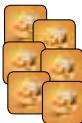
Pepite: il gettone viene conservato davanti al giocatore. In fine di partita, si conterà il numero di \$ indicato: da 200 a 500 \$

Ferro incandescente:
scartare il gettone e prendere su uno dei terreni adiacenti ortogonalmente tutte le vacche di uno stesso colore. Aggiungere queste vacche alla propria mandria. Importante: se si libera una nuova casella grazie al ferro incandescente, il gettone Azione presente su questa casella è privo di efetto. Viene semplicemente rimesso nella scatola..

Epidemia: scartare il gettone. Scegliereun colore ed eliminare dal tavolo di gioco tutte le vacche di questo colore ancora presenti. Questo tipo di vacca non conterà quindi nulla alla fine della partita.

Sceriffo: se si deve prendere questo gettone… Lo scerifo vi cattura e perdete immediatamente la partita.

Snake oil: il famoso elisir permette di rigiocare immediatamente. Il giocatore scarta il gettone, poi sposta il gettone fuorilegge rispettando le regole di base, ma non lo rivolta: spetta ancora a lui giocare.

Imboscata: scartare il gettone e rubare immediatamente al proprio avversario, a scelta, o un gettone Pepite preso a caso tra quelli che possiede, o due vacche di uno stesso colore.

Crotalo: il serpente a sonagli provoca panico nella mandria. Scartare il gettone e poi prendere una vacca di ciascuno dei colori che s possiedono e ripartire le vacche come si vuole sui terreni vicini ortogonalmente (se si desidera, si possono collocare tutte le vacche su uno solo di questi terreni)
2- Spostare e rivoltare il gettone Fuorilegge
Il giocatore DEVE successivamente spostare il gettone fuorilegge verso un altro territorio distante di un numero di caselle uguale al numero di vacche che ha appena rubato. Nel corso di questo spostamento, il passaggio da un terreno all’altro deve avvenire sempre in verticale o in orizzontale, senza mai efettuare un movimento di andata e ritorno tra due terreni.
Sul terreno di arrivo, il gettone fuorilegge viene girato sulla sua altra faccia, per indicare che tocca all’avversario giocare.
Importante: se tutti i territori situati alla distanza indicata dal numero di vacche rubate sono vuoti, allora la partita termina e si passa al conteggio dei punti. Ma, fintanto che almeno uno dei territori situati a questa distanza contiene vacche, si deve spostare il gettone verso uno di questi territori.
Nell’esempio qui sopra, Eagle Perkins ha la scelta: può rubare la vacca beige, il che mette fine alla partita poiché tutti i territori a una casella di distanza (Blackstone Corral, Red River Valley, Tulsa) sono vuoti, o può rubare le due vacche arancioni, ed è allora obbligato a fare giocare il suo avversario a Dagger Flat, che è il solo territorio contenente vacche situato a esattamente due caselle di distanza.
Territori pericolosi: i territori contenenti gettoni Azione gialli (Crotalo/Scerifo) sono considerati come pericolosi. Per questo, non si può fare giocare uno stesso giocatore due volte di seguito sullo stesso territorio pericoloso se vi sono altre possibilità.

Esempio: A- Eagle Perkins è a Cherokee Spring. Ruba una vacca grigia e fa giocare Jessie Artist Byrd a Nugget Hill. B- Jessie Artist Byrd ruba una vacca bianca. Deve quindi spostare il gettone fuorilegge di una casella… Ma non puoi tornare subito a Cherokee Spring, dato che questo è un territorio pericoloso. C- Fa quindi giocare Eagle Perkins a Maverick Junction.
Fine partita:
La partita finisce in uno di questi tre casi:
1- Se un fuorilegge è obbligato ad attivare il gettone Scerifo, perde immediatamente la partita.
2- Se un fuorilegge riunisce le 9 vacche di uno stesso colore, vince immediatamente la partita (importante: se le condizioni 1 e 2 sono soddisfatte simultaneamente, allora si prende in considerazione solo la condizione 1).
3-Tutti i territori distanti del numero di caselle indicato dall’ultimo furto di bestiame sono vuote. Ciascuno calcola allora il valore della sua mandria e aggiunge il valore delle sue pepite. Il più ricco vince!
Per calcolare il valore della mandria: ciascuna vacca posseduta rende 100 \$ per ciascuna vacca dello stesso colore ancora presente sul plateau centrale!
Nell’esempio qui sotto, ciascuna vacca beige rende 200 \$ (ne restano due sul tavolo), le marroni non valgono nulla (non ve ne sono più), le rosse valgono 100 \$ (ne resta una sola), e le arancioni valgono 400 \$ (ne restano 4)

x2

8+ 15 min 2
1870 – Irgendwo in Texas
Die Longhorn-Zucht, besteht aus Rindern des nördlichen Mexikos, und ist auf ihrem Höhepunkt angekommen. Sie hat sich für die texanischen Farmer zu einer lukrativen Einkommensquelle entwickelt und weckt Begehrlichkeiten von unzähligen Viehdieben aus dem ganzen Land.
Die Spieler verkörpern zwei besonders gefürchtete Banditen: Eagle Perkins und Jessie Artist Byrd. Ihr Ziel ist einfach: Sie wollen Vieh stehlen (und wenn möglich ein paar Nuggets), um am Ende der Partie den größten Batzen zu haben. Oder es zumindest so einrichten, dass der Gegner vom Sherif festgenommen wird!
Ausstattung
• 9 Gebietsplättchen

Auf jedem Gebietsplättchen ist anhand des Aufdrucks angegeben, wie viele Rinder sich zu Beginn des Spiels auf dem Gebiet befinden. Des Weiteren besitzt das Gebiet eine Ablagefläche für die Aktionsplättchen.
• 19 Aktionsplättchen


x3


x1


x1
• 2 "Wanted" Plättchen (eines für jeden Spieler) + 1 Banditenchip (eine Seite je Spieler)

Vorderseite

Rückseite
• 36 Holzrinder (9 in jeder der vier Farben)

Aufstellung
• Die beiden Spieler entscheiden einvernehmlich, welchen Banditen sie verkörpern wollen. Sie legen das entsprechenden "Wanted" Plättchen vor sich ab.
• Die 9 Gebietsplättchen werden nach dem Zufallsprinzip mit der Vorderseite nach oben auf den Tisch gelegt, so dass sie ein Quadrat aus 3 x 3 Plättchen bilden. • Die Aktionsplättchen. Die Spieler ziehen 9 Plättchen und legen sie einzeln
nacheinander ofen auf die entsprechende Stelle jedes Gebiets.
Wichtig: Das Sherif-Plättchen gehört immer, wenn vorhanden, auf Nugget Hill. Sollte bereits ein anderes Plättchen auf Nugget Hill abgelegt worden sein, ist dieses gegen das Sherif-Plättchen auszutauschen.
• Dann werden die Holzrinder gemischt und in der angegebenen Anzahl nach dem Zufallsprinzip auf allen Gebieten aufgestellt.
Es wird bestimmt, wer das Spiel beginnt. Dazu wird der Banditen-Chip in die Luft geworfen (wie eine Geldmünze). Die sichtbare Seite zeigt an, welcher Spieler beginnt Sein Gegner wählt das Startgebiet aus den Gebieten mit vier Rindern aus (Cherokee Spring, Dagger Flat, Maverick Junction, Red River Valley, Kid Cooper’s Ranch) und legt den Chip auf diesem Gebiet ab.

Die Partie kann jetzt beginnen. Be wild!
Ablauf der Partie
Der Banditen-Chip zeigt an, wer von den beiden Spielern spielen muss. Der Bandit, der an der Reihe ist, muss:
1. Vieh stehlen,
2. den Banditen-Chip verschieben und umdrehen.
1. Vieh stehlen:
Der Spieler wählt auf dem Gebiet, auf dem er sich befindet, eine Farbe, und MUSS alle Rinder mit dieser Farbe stehlen. Er stellt diese Rinder vor sich auf. Sie bilden die
Herde, deren Wert am Ende der Partie gewertet wird. Wenn sich auf dem Gebiet nach dem Diebstahl kein Rind mehr befindet, MUSS der Spieler tun, was das Aktionsplättchen zeigt, das sich in diesem Gebiet befindet.
Handlungen, der Aktionsplättchen verlangen:

Nuggets: Das Plättchen vor den Spieler. Am Ende der Partie erhält er die angegebene Summe in \$: 200 bis 500 \$

Brandeisen: Wird dieses Plättchen aktiviert kassiert, man alle Rinder derselben Farbe auf einem der bena-
chbarten Gebiete ein. Diese Rinder gehören ab jetzt zu der Herde des Spielers. Wichtig: Wenn der Spieler mit dem Brandeisen ein neues Feld abräumt, muss das Aktionsplättchen auf diesem Feld nicht erfüllt werden. Es wird ganz einfach in die Schachtel zurückgelegt.

und nimmt alle Rinder mit dieser Farbe, die noch auf den Gebietsplättchen vorhanden sind aus dem Spiel. Diese Rinder bringen am Ende der Partie keine Punkte.

Sheriff: Wenn der Spieler dieses Plättchen aktivieren muss, wird er vom Sherif verhaftet und hat damit die Partie verloren.

Schlangenöl: Mit dem berühmten Saft spielt man sofort noch einmal. Der
Spieler legt das Plättchen in die Schachtel und verschiebt unter Einhaltung der Regeln den Banditen-Chip, dreht ihn aber nicht um, denn er spielt ja noch weiter.

Falle: Wird dieses Plättchen aktiviert, stiehlt er seinem. Gegner sofort wahlweise
entweder irgendein Nugget-Plättchen oder zwei Rinder mit derselben Farbe.

Klapperschlange: Die Klapperschlange löst in der
Herde eine Panik aus. Wird dieses Plättchen aktiviert, nimmt sich der Spieler ein Rind in jeder Farbe, die er selbst besitzt, und verteilt diese Rinder beliebig auf den im rechten Winkel benachbarten Gebieten (Man darf auch alle Rinder auf einem Gebiet abstellen.)
2. Den Banditen-CHIP verschieben und umdrehen
Danach MUSS der Spieler den Banditen-Chip auf ein anderes Gebiet setzen, das genau so viele Felder entfernt ist, wie er Rinder gestohlen hat.
Diese Wanderung von einem Gebiet zum anderen erfolgt immer vertikal und horizontal, wobei ein Hin- und Zurück zwischen zwei Gebieten verboten ist.
Auf dem Ankunftsgebiet wird der Banditen-Chip umgedreht, was bedeutet, dass jetzt der Gegner spielen muss.
Wichtig: Wenn alle Gebiete, die sich im Abstand der Anzahl der gestohlenen Kühe befinden, leer sind, ist die Partie zu Ende, und es wird abgerechnet. Wenn aber auf mindestens einem der Gebiete, das sich in diesem Abstand befindet, Rinder weiden, ist der Chip auf eines dieser Gebiet zu versetzen.

Im obigen Beispiel hat Eagle Perkins die Wahl: Entweder, er stiehlt das farbene beige Rind, und die Partie ist beendet, da alle Gebiete mit einem Feld Abstand (Blackstone Corral, Red River Valley, und Tulsa) leer sind , oder er stiehlt die zwei orangefarbenen Rinder und muss seinen Gegner auf Dagger Flat spielen lassen, was das einzige Gebiet mit Rindern in einem Abstand von zwei Feldern ist.
Besonderheit der gefährlichen Gebiete: Gebiete mit gelben Aktionsplättchen (Klapperschlange / Sherif) gelten als gefährlich. Aus diesem Grund darf derselbe Spieler nicht zweimal hintereinander auf demselben gefährlichen Gebiet spielen, wenn es andere Möglichkeiten gibt.

Beispiel: A. Eagle Perkins ist in Cherokee Spring. Er stiehlt ein berauscht Rind. Danach muss Jessie Artist Byrd in Nugget Hill spielen. B. Jessie Artist Byrd stiehlt ein weisse Rind. Er muss den Banditen-Chip ein Feld verrücken... kann aber nicht sofort nach Cherokke Spring zurück, da das ein gefährliches Gebiet ist. C. Er löst das Problem dadurch, dass er Eagle Perkins in Maverick Junction spielen lässt.
Ende der Partie:
Die Partie ist zu Ende, wenn eine der drei folgenden Situationen eintritt:
-
Wenn ein Bandit das Sherif-Plättchen aktivieren muss, verliert er die Partie sofort.
-
Wenn ein Bandit die 9 Rinder derselben Farbe hat, gewinnt er die Partie sofort. (Wichtig: Wenn Punkt 1 und Punkt 2 gleichzeitig eintreten, zählt nur Punkt 1.)
-
Alle Gebiete, die so viele Felder entfernt sind, wie beim letzten Diebstahl Rinder gestohlen wurden, sind leer: Jeder Spieler berechnet den Wert seiner Herde und addiert den Wert seiner Nuggets. Der Reichste gewinnt!
Wertung der Herde: Jedes Rind, das der Spieler besitzt, bringt 100 \$ für jedes Rind derselben Farbe, das sich noch in einem der 9 Gebiete befindet!
Im nachfolgenden Beispiel bringt jedes beigefarbene Rind 200 \$ (auf den Gebieten sind noch 2 beigefarbene Rinder), die braunen Rinder bringen nichts (keine braunen Rinder mehr in den Gebieten), die roten Rinder bringen 100 \$ (nur 1 rotes Rind), und die orangefarbenen Rinder haben einen Wert von 400 \$ (4 verbliebene orangefarbene Rinder auf in den Gebieten).


1870 – Ergens in Texas
De fokkerij van de Long Horn, die de naam draagt van een koe afkomstig uit het noorden van Mexico, draait volop. Het is een mooie inkomstenbron geworden voor de boeren uit Texas, maar intussen wordt de hebzucht aangewakkerd van vee-dieven. De spelers spelen de rol van twee bijzonder gevreesde boeven: Eagle Perkins en Jessie Artist Byrd.
Hun doelstelling is eenvoudig: vee stelen (en zo mogelijk enkele goudklompen) om aan het einde van het spelj over de grootst mogelijke goudmijn te beschikken.. of ervoor zorgen dat de tegenstander gevangen wordt genomen door de Sherif!
Materiaal
• 9 tegels met grondgebied


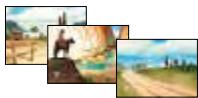
Op iedere kaart vermeldt een icoon het aantal koeien dat bij aanvang van het spel aanwezig is op het grondgebied, en is voorzien van een ruimte die is bedoeld voor de Actie kaartjes.
• 19 Actie kaartjes


x1


x3
x2
x2


x1

x2


x1
• 2 Wanted kaarten (één per speler) + 1 Boevenmunt (één zijde per speler)
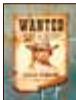
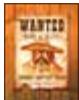

Recto

Verso
• 36 houten koeien (9 per kleur, vier kleuren in totaal)

Voorbereiding
• De twee spelers spreken gezamenlijk af aan welke boef zij gestalte zullen geven.
Zij leggen de bijbehorende wanted kaarten voor zich neer.
• Meng de 9 grondgebied tegels, en leg ze willekeurig neer op de tafel, zodat er een vierkant van 3*3 wordt gevormd.
• Meng de Actie kaartjes beneden gericht. Trek 9 Actie kaartjes, en leg ze één per één, op de hiertoe bedoelde ruimte op alle grondgebieden.
Belangrijk: Als het Sherif kaartje aanwezig is, wordt het noodzakelijkerwijze op Nugget Hill gelegd. Verwissel het indien nodig met het kaartje dat toevallig op Nugget Hill is gelegd.
• Meng vervolgens de houten koeien, en zet het op ieder grondgebied vermelde aantal koeien willekeurig neer.
• Bepaal welke speler begint door de boevenmunt op te gooien (zoals een muntstuk). De zichtbare muntzijde geeft aan welke speler begint. Zijn tegenstander kiest het startveld uit de velden die vier koeien bevatten (Cherokee Spring, Dagger Flat, Maverick Junction, Red River Valley, Kid Cooper’s Ranch) en legt de boevenmunt op dit grondgebied.


De partij kan nu beginnen. Be wild !
Verloop van de partij
De boevenmunt wijst aan welke van de twee tegenstanders moet spelen. Als hij aan de beurt is moet deze boef:
1- Vee stelen
2- De boevenmunt verplaatsen en omdraaien
1- Vee stelen:
De speler kiest op het veld waar hij zich bevindt een kleur, en MOET alle koeien van deze kleur stelen. Hij zet deze koeien voor zich neer. Zij vormen de kudde waarvan de
waarde aan het einde van de partij wordt berekend. Als het grondgebied na deze diefstal geen enkele koe meer bevat, MOET de speler de uitwerking van het op dit veld aanwezige Actie kaartje toepassen.
Uitwerkingen van de actie-kaartjes:
Goudklompen: het kaartje wordt beneden voor de speler bewaard. Aan het einde van de partij levert het kaartje het aantal vermelde \$ op : van 200 tot 500 \$.

Rood hoefijzer: doe het kaartje weg, en steel op één van de loodrecht aangrenzende velden alle koeien van
dezelfde kleur. Voeg deze koeien toe aan uw kudde. Belangrijk : als u een nieuw veld leeg maakt dankzij het rode hoefijzer, heeft de op dit veld aanwezige actie kaartje geen uitwerking. Het wordt simpelweg teruggelegd in de doos.

Epidemie: doe het kaartje weg. Kies een kleur en verwijder alle nog aanwezige koeien van deze kleur van het spelbord. Dit type koe levert dus niets op aan het einde van de partij.

Sheriff: als u op dit kaartje stuit… de sherif neemt u gevangen en u verliest de partij onmiddellijk.

Snake oill: de vermaarde elixer maakt het mogelijk onmiddellijk opnieuw te spelen. De speler doet het
kaartje weg, en verplaatst de boevenmunt vervolgens met inachtneming van de basisregels, maar keert de munt niet om : hij is nog steeds aan de beurt.

Hinderlaag: Doe het
kaartje weg, en steel onmid dellijk bij uw tegenstander,
naar keuze : een willekeurig kaartje goudklompen uit de goudklompkaartjes die hij bezit, of twee koeien van dezelfde kleur.

Sakka-snekie: De ratelslang zorgt voor paniek in de kudde. Doe het kaartje weg, en pak vervolgens een koe van iedere kleur die u bezit en verdeel ze naar wens over de loodrecht aangrenzende velden (u mag de koeien allemaal op hetzelfde veld zetten als u dit wilt).
2- De boevenmunt verplaatsen en omdraaien
De speler MOET de boevenmunt vervolgens verplaatsen naar een ander grondgebied, waarvan de afstand uitgedrukt in aantal vakken overeenkomt met het aantal koeien dat hij zojuist heeft gestolen. Bij deze verplaatsing vindt de overgang van een veld naar een ander veld altijd verticaal of horizontaal plaats, zonder heen en terug te reizen tussen twee velden. Op het veld van aankomst wordt de boevenmunt omgedraaid naar de andere zijde, wat betekent dat de tegenstander aan de beurt is.
Belangrijk : Als alle grondgebieden die zich bevinden op de door het aantal gestolen koeien vermelde afstand leeg zijn, komt de partij tot een einde, en worden de punten geteld. Maar zolang ten minste één van de op deze afstand liggende grondgebieden koeien bevat moet de boevenmunt worden verplaatst naar één van deze grondgebieden.

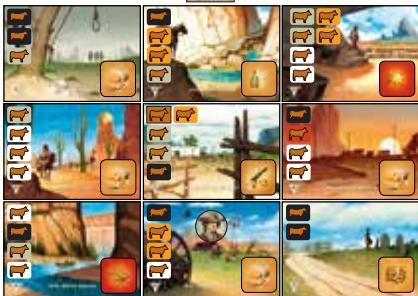
In het voorbeeld hierboven heeft Eagle Perkins de keuze uit : het stelen van de beige koe, waardoor de partij wordt beëindigd, want alle op een afstand van één vak gelegen grondgebieden (Blackstone Corral, Red River Valley, Tulsa) zijn leeg, of het stelen van de twee orange koeien, waarna hij vervolgens verplicht is zijn tegenstander te laten spelen bij Dagger Flat, het enige grondgebied dat koeien bevat, en op een afstand ligt van precies twee vakken.
Specifieke eigenschappen van de gevaarlijke grondgebieden: De grondgebieden die gele actie kaartjes bevatten (Sakka-snekie / Sherif) worden als gevaarlijk beschouwd. Het is dientengevolge niet noodzakelijk dezelfde speler twee keer achtereenvolgens te laten spelen op hetzelfde gevaarlijke grondgebied als er andere mogelijkheden bestaan.
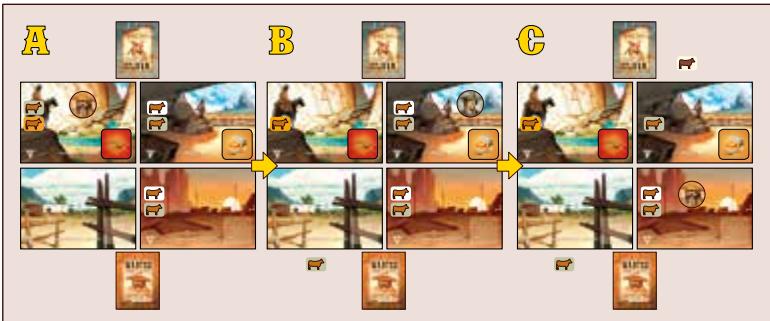
Voorbeeld: A- Eagle Perkins is in Cherokee Spring. Hij steelt een grijze koe en laat Jessie Artist Byrd spelen in Nugget Hill. B- Jessie Artist Byrd steelt een witte koe. Hij moet dus de bovenmunt één vak verplaatsen.. maar hij kan niet meteen terugkeren naar Cherokee Spring, want dit is een gevaarlijk grondgebied. C- Hij laat dan ook Eagle Perkins spelen in Maverick Junction.
Einde van de partij:
De partij komt tot een einde in de drie volgende situaties:
1- Als een boef verplicht is het Sherif kaartje te activeren, verliest hij onmiddellijk de partij.
2- Als een boef de 9 koeien van dezelfde kleur verzamelt, wint hij de partij onmiddellijk. (belangrijk : als er tegelijkertijd wordt voldaan aan de voorwaarden 1 en 2, wordt uitsluitend voorwaarde 1 in aanmerking genomen).
3- Alle grondgebieden die liggen op een afstand van het aantal door de laatste diefstal van vee vermelde vakken zijn leeg. Iedereen berekent de waarde van zijn kudde, en voegt de waarde toe van zijn goudklompen. De rijkste speler wint het spel!
Het berekenen van de waarde van de kudde : iedere koe die je bezit levert 100 \$ op voor iedere koe met dezelfde kleur die nog op het centrum van het spelbord aanwezig is!
In het voorbeeld hieronder, levert iedere beige koe 200 \$ op (er staan er nog twee op het spelbord), de bruine koeien leveren niets op (er staan geen bruine koeien meer op het spelbord), de rode koeien zijn 100 \$ waard (er is nog één rode koe over), en de oranje koeien zijn 400 \$ waard (er zijn er nog 4).


8+ 山 15 min 2
1870 – Algures no Texas
A criação de Long Horn, estas vacas vindas do norte do México, está no auge. Tornouse numa bela fonte de rendimentos para os agricultores texanos, atraem a cobiça dos ladrões de gado de todos os tipos.
Os jogadores incarnam dois fora-da-lei particularmente temidos: Eagle Perkins e Jessie Artist Byrd.
O seu objectivo é simples: roubar gado (e algumas pepitas se possível) para obter o maior pecúlio no final do jogo... ou então desenrascar-se para que o adversário se deixe capturar pelo Xerife!
Material
• 9 placas territórios
Em cada placa, um ícone indica o número de vacas presentes no território no início do jogo e possui um local destinado a acolher as fichas Acção.
• 19 fichas Acção


x1


![](images/fed583998fe5e32a1a102970fae13dc8197a70e576cfd79c126790
Content is long; only the first part is inlined. Download the file or open the rules page for the full text.
Download MarkdownTexts are community-compiled or publicly released by publishers; copyright remains with the original authors. For personal reference only.