
Magic Realm
At a glance
Rules, cards and Q&A (Chinese)
The rules, card data and player questions for this game are written in Chinese. Open the Chinese page to read them.
Where to find full rules
Full rules and card lookup are available in the cunlema app at cunlema.cn — pick this game and ask about any rule, card or turn you are unsure about.
Related games
Rulebook text (Markdown)
This game has 13 rulebook Markdown file(s) in our library; 3 rendered inline below — expand to read or download.
Super Realm Living Rules v1_321aWith Bookmarks.md1012.2 KB
Super Magic Realm Rules
INTRODUCTION
Welcome to the SUPER MAGIC REALM.
Super Magic Realm is an expanded reboot of the Avalon Hill game Magic Realm by Richard Hamblen. It is a game of fantasy adventuring, set in a land filled with monsters, fabulous treasures, great warriors and magicians. The scene is set in the ruins of a mighty kingdom, now inhabited by sparse nomads, groups of natives, and swarms of monsters. Beneath it all are the rich remnants of a magical civilization, scattered and lost across the map.
To this scene come the adventurers to make a name for themselves in this promising field. Swordsman and Dwarf, Magician and Sorceror, the humans and the half-humans, all come seeking to loot the legendary riches of a lost civilization. Now you can play the part of one of these adventurers, stepping into an unknown Realm of magic and monsters, battles and treasures.
Each player will take on the role of one of the major characters in the game. You will control where he goes, what he tries to do, how he handles himself in combat, and much more. In the course of the game you will run into truly deadly monsters, tribes of humans ranging from old friends to sworn enemies, and treasures of value that will give them special powers.
Super Magic Realm is a complex game designed to recapture the suspense and desperate struggles of fantasy literature. The game creates a complete fantasy world, where each game is a new adventure with a new map where everything lies hidden at new locations. By the end of each game, many things will be discovered, but many of the treasure troves won’t be uncovered, many of the spells will not be learned, and many of the monsters and natives might never be met. The result is an extremely unpredictable game full mysteries to be uncovered, surprises to be met, and a different experience to be had each time it is played. You will find this like no other board game you have ever played.
And now, into the Super Magic Realm.
Release 1.321a: 6/19/2024
HEX TILES
LEDGES(green side up)

GROTTO (enchanted side up)
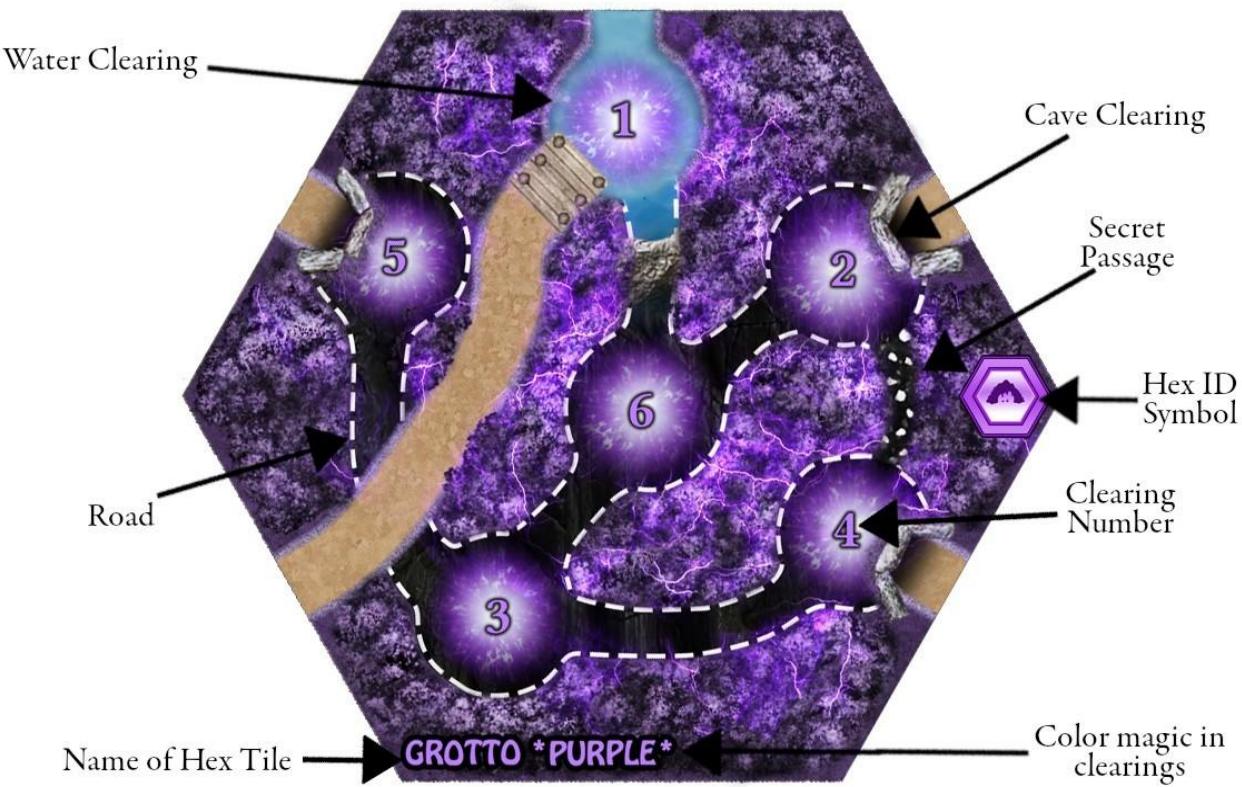
Table of Contents
1.0 Introduction to the Super Magic Realm Rules 7
1.1 For Those Who Have Played Previous Editions 7
1.2 List of Changes from Previous Editions 7
1.3 List of Super Realm Additions 8
1.4 For Those New to the Game 8
1.5 Definitions 9
2.0 A Guide to the Playing Pieces 12
2.1 The Map 12
2.2 Map Chits 12
2.3 Dwellings 12
2.4 Denizens 13
2.4.2 Monsters 13
2.4.3 Natives 14
2.4.4 Travelers 14
2.5 Belongings and Spell Cards 15
2.5.1 Horses 15
2.5.2 Weapons 15
2.5.3 Armor 16
2.5.4 Treasure Counters 16
2.5.5 Treasure Cards 16
2.5.6 Spells 17
2.5.8 Set Up Card 17
2.5.9 Character Pieces 17
2.5.10 Personal History Pad 18
3.0 Prepare for Play 20
3.1 Step 1: Setting Up the Set Up Card 20
3.2 Step 2: Constructing the Map 21
3.3 Step 3: Selecting Characters 22
3.4 Step 4: Selecting Quests 23
3.5 Step 5: Selecting Spells 23
3.6 Step 6: Starting Location 23
3.7 Step 7:Placing Map Chits 24
3.8 Step 8:Revealing Dwellings 25
Chart of Appearances 26
Chart of Clans 27
Setup Chart for Treasures Within Treasures, Artifacts, Spell Books Scrolls and Visitors 28
4.0 Game Mechanics 29
4.1 Rolling Dice 29
4.2 Action Chits 29
4.2.3 Fatigue 29
4.2.4 Wounds 30
4.3 Belongings 30
4.2.14 Weapons 31
4.3.15 Armor 31
4.3.16 Horses 31
4.4 Treasure Cards 32
4.5 Magic 34
4.5.2 Magic Chits 35
4.5.10 Spells 36
4.5.14 Artifacts, Scrolls, Books and Rings 36
4.5.16 Curses, Mesmerizes, Wishes and Power of the Pit 38
4.5.17 Transmorphization Spells 39
4.5.18 Spells That Alter Weight 40
4.5.19 Spell Effects and Interactions 41
4.5.20 Stopping, Nullifying and Ending Spells 42
4.5.21 Duplicate Spells 42
4.5.22 Conflicting Spells 42
4.5.23 Spellbreaking 43
4.6 Clans, Travelers and Quests 43
4.6.1 Clans 43
4.6.3 Travelers 44
4.6.9 Quests 44
Printable Personal History Pad 45
5.0 Turn Summary 46
Daily Sequence of Play 46
5.1 Beginning a New Day 46
5.2 Daylight 46
5.3 Sunset 47
5.4 Evening 47
5.5 Midnight 47
5.6 Resolving Combat in a Clearing 47
6.0 Beginning a New Day 49
6.1 Day Advancement 49
6.2 Birdsong 49
6.3 Sunrise 51
7.0 Daylight 52
7.1 Determining Turn Order 52
7.2 Beginning of a Phase 52
7.3 The MOVE and FLY Activity 56
7.4 The HIDE Activity 60
7.5 The SEARCH Activity 60
7.6 The TRADE Activity 65
7.7 The HIRE Activity 67
7.8 The REST Activity 70
7.9 The ALERT Activity 70
7.10 The ENCHANT Activity 71
7.11 The FOLLOW Activity 72
7.12 The CACHE Activity 74
7.13 End of Activity/Phase – Blocking 75
7.14 End of Phase – Completing Quests 76
7.15 End of Turn – Prowling Denizens 76
7.16 Ending a Turn 77
7.17 Monsters 77
7.18 Natives 78
Summary of Denizen Appearance 79
8.0 Evening 81
8.1 Sunset and Start of Evening 81
8.2 Determining Combat Order 81
8.3 Evening (Combat) 79
8.4 Initial Placement of Denizens 81
8.5 Battling Natives 82
8.6 Start of Round 83
8.7 Lure Step 83
8.8 Random Assignment Step 84
Confrontation Chart 85
8.9 Charging Step 85
Denizen combat Sheet 86
8.10 Deployment Step 87
8.11 Action Step 87
8.13 Assignment Step 92
8.13 Melee Step 94
8.14 Resolving Attacks 103
8.14 Spoils of Combat 107
8.15 Ending Combat in a Clearing 110
9.0 Midnight 110
9.3 End of Month Regeneration 111
10.0 Ending the Game 112
10.1 Time Limit 112
10.2 Character Deaths and Restarts 112
10.3 Winning the Game and Scoring 113
10.4 Scoring 113
10.5 Quest Clarifications 114
11.0 Advanced Rules
11.1 Severe Wounds 117
11.2 Bounty Hunter 117
11.3 Scattered Horses 117
11.4 Protected Leaders 117
11.5 Thematic Roving Natives 118
11.6 Sentimental Value 118
11.7 Credit 118
11.8 Grounded Missions and Tasks 118
11.9 Regrouping 118
11.10 Selling 118
Selling Table 119
11.11 Seasons and Weather 119
Calendar of Seasons 121
11.12 Survival Tactics 123
12.0 Optional Rules 124
12.1 Flying Activities 124
12.2 Optional Abilities 124
12.3 Stealing 124
12.4 Hiring Unused Characters 125
12.5 Development 126
12.6 Extended Development 127
12.7 Dual Wielding 128
12.8 Dragon Heads 128
12.9 Easier Spell Learning 128
12.10 Range Setup 128
12.11 Events 129
12.12 Commerce 129
Commerce Table 130
12.13 Cornered 130
List of Characters 131
List of Horses 250
List of Treasures Within Treasures Horses 251
List of Armor 252
List of Weapons 253
List of Monsters 254
List of Native Statistics 257
Treasure Table 263
List of Treasures 271
Treasures Within Treasures 271
Substitute Cards 273
Birdsong Cards 274
Daylight Cards 275
Using Tables Cards 277
Sunset Cards 278
Altering Action Chits 278
Boots Cards 279
Gloves Cards 279
Weapons and Armor Cards 279
Altering Counters 280
Combat Effects 280
Color Source Cards 281
Artifacts, Spell Scrolls, and Spell Books 282
Magic Rings 282
Treasures With Spells 283
List of Spells 285
List of Tables 304
List of Hexes 313
Index 321
1.0 Introduction to the Super Magic Realm Rules
1.1 For Those Who Have Played Previous Editions
For those who have played any edition of Magic Realm, take heed, as this is a completely expanded and revamped version of the game that not only adds a considerable amount of content, but also makes changes to many of the rules from those editions of the game, from minor to significant. It is best to read through the rules and start as if approaching an entirely new game. You may also be wondering why I would make a completely new rulebook for this version of the game rather than just a simple expansion rulebook that lists what is added, and list the new and revised rules as optional rules. Especially when the format of it is similar to the unofficial third edition rules. There are several reasons.
First, I believe the first edition rules have many aspects to them that are superior to the unofficial third edition rules and the official second edition rules. At the same time, the first edition rules aren’t adequate at explaining everything. It also required an official errata, of which certain portions were errata’d even further afterwards (portions of which extend into the 2nd and 3rd edition rules). In addition, there are aspects of the 1st edition rules that needed improvement beyond a simple errata. The 2nd and 3rd editions attempted to do this, and they succeeded in some areas, but failed in others.
Second, the 1st edition was made on the basis that there would be expansion kits to make the realm into a full vision the designer Richard Hamblen had in mind that never came to fruition, thus aspects of the vision had to be scrapped for the 2nd edition rules, while hints as to what could’ve been expanded were left unfulfilled in the 1st edition. This Super Magic Realm version of the game system attempts to rectify those issues by incorporating mechanics and components by expanding upon those “hints” and actually making use of them (ex: the 1st edition states the existence of a Maximum $\mathbf { \epsilon } ^ { \prime } \mathbf { X } ^ { \prime }$ weight which is never utilized in either that edition or the 2nd edition; but the Super Magic Realm does utilize that weight class). The Super Magic Realm also takes into account the issues that many have attempted to rectify over the years regarding gameplay and rules issues in the 1st, 2nd, and 3rd edition.
Third, taking into account many of the discussions that have been had about the game over the years, regarding what should be improved, what has been improved, and what has been changed for the worse between various editions, I believe it wise to make something that acts as both an expansion and a remake of the rules that combines the best of three worlds between the various editions, and incorporate some new rules which are intended to rectify things that have been changed for the worse, and to alter rules and mechanics that have need of improvement. Some aspects of this have been mentioned by the original designer Richard Hamblen himself (ex: alterations to the combat system).
While I cannot hope to achieve all that Hamblen had intended for a full definitive version of the game system, I can hope to improve the system in the best way possible by my standards, while attempting to appease those who are veterans to the game, by giving them a lot more to experience.
1.2 List of Changes from Previous Editions
Excluding various changes and errata that the $2 ^ { \mathrm { n d } }$ and $3 ^ { \mathrm { r d } }$ editions of the rules made to certain components and rules, and excluding the list of additions this version of the game makes, and excluding spells that have been rolled back to how they worked in $1 ^ { \mathrm { s t } }$ edition, here is a list of changes to the components present in earlier versions of the game:
1) Scroll of Nature is renamed to Book of Nature.
2) Scroll of Alchemy renamed to Book of Alchemy.
3) Seven League Boots has an alteration.
4) Dragon Essence has an alteration.
5) Crystal Ball has an alteration.
6) Lost Keys has an alteration.
7) Map of Ruins has an alteration.
8) Power Gauntlets has an alteration.
9) Exorcise spell card has an alteration.
10) Lightning Bolt spell card has an alteration.
11) Absorb Essence spell card has an alteration.
12) Ask Demon spell card has an alteration.
13) Pentangle spell card has an alteration.
14) Dissolve spell card has an alteration.
15) Guide Spider or Octopus spell has been renamed and altered.
16) Deal with Goblins spell has been renamed and altered.
17) Campaign, visitor, and mission chits have been removed/replaced. Don’t worry, they’re still in the game, they just appear differently.
18) The Setup Chart has been replaced.
19) Lancers III Pony has been replaced.
20) Rogues IV, V, VI, and VII have been replaced.
21) Soldiers III has been replaced.
22) The Combat Sheets have been replaced.
23) Personal History Pads have been replaced.
1.3 List of Super Realm Additions
The following is completely new to the game, not to be found in the original base game in any $1 ^ { \mathrm { s t } } , 2 ^ { \mathrm { n d } } , \mathrm { o r } 3 ^ { \mathrm { r d } }$ edition, not including new spells, treasures, tiles, and denizens:
1) New combat sheets, which take into account the parry rule, and make denizens more unpredictable.
2) Travelers, of which Missions, Campaigns, and Visitors make up. There’s a new type of chit called Nomads, which can be hired for a single day to grant an ability. Lastly, there are also Tasks, which can be picked up like missions but for a different cost and purpose.
3) Eight new characters. (Note: This version of the Rules includes many player-created characters. The List of Characters now numbers 109.)
4) Certain native groups have natives which can cast spells and provide a one-use-per-day color chit.
5) Most native groups are a part of one of four clans. Attacking a native group in one clan often negatively affects your relationship with all groups in that clan.
6) Four roving native groups normally appear in 6- clearing tiles, and don’t belong to any clan, and are Enemy to most characters.
7) A new “water” clearing type can be found in several of the new tiles.
8) Victory conditions have been revamped into a new system, where each player draws Quest cards and gains/removes VP for completing them. Completing missions, campaigns, tasks, and discovering sites also rewards you with VP.
1.4 For Those New to the Game
It is recommended you only use this rulebook for reference, and start learning the game using the Tutorial Scenarios series, beginning with Tutorial #1 and proceeding from there until you complete the final tutorial. The rules in this rulebook should be used as a reference guide to clarify a rule that isn’t entirely clear in the tutorials, or when needing to clarify or acquire all the necessary information when playing the full game beyond the tutorials. Or when intending to play with the Advanced and Optional rules.
There is much to learn in this game. It is best if you proceed slowly rather than attempt to take it all in at once.
1.5 Definitions
Active Chits – Chits that are neither wounded, fatigued, or tied up with a spell. They are readily available for the character to use in combat, for looting, and for moving, among other things.
Action Chits – These can be Fight, Move, Magic, or special chits that characters start the game with. Depending on the chit, and certain spells or abilities that affect the chit, they can be either Active, Fatigued, Wounded, or tied up in a spell.
Armor – Refers to any helmet, breastplate, shield, or suit of armor counter.
Assigned – Refers to a denizen that is assigned to attack another individual; indicated by being an Attacker on a denizen’s or character’s combat sheet, being the Target on a denizen’s sheet, or being the Defender on his own sheet attacking a Target also assigned to him.
Attention Chit – The action chit which has the character symbol on one side, and “Attention” on the other.
Beast – A Frog, Squirrel, Bird, Eagle, Lion, or Dragon created by the Transform spell.
Belonging – See Item.
Bewitched – An individual who has a spell cast on him. While the spell remains cast on him, he remains bewitched by that spell, even when it is inert or nullified.
Campaigns – Traveler chits that can be picked up by characters or hired leaders, and change a character’s trading relationships while it is held.
Castable Spell – A recorded spell the character has the corresponding magic chit type for. The character can possess the magic chit type in the form of one of his Action Chits, or with a treasure that acts as the corresponding magic chit type (example: Diamond Ring acts as a VII chit). Or with an artifact, spell book, or spell scroll the character holds that has an awakened spell card that’s the same as his recorded spell, and can be used to cast it. Or by using a cast-able recorded spell, or an artifact or book or scroll that can cast an awakened spell he has recorded, that can transform one of his action chits into the magic chit type needed to cast the 9
recorded spell (Example: Witch’s Brew, Faerie Lights, Elemental Spirit). If the Mage’s Staff is active in his belongings, all his recorded spells are cast-able.
Caster – Individual capable of casting a magic spell, and/or supplying a color. Native casters are natives who can cast spells, and/or can supply a color while hired, as indicated on the native counter and List of Natives. Individuals who are not capable of casting spells at the start of the game are not considered casters (ie a character must have a magic chit as one of his twelve Action Chits in order to be defined as a caster).
Cave Clearing – A dark clearing that is in a cave.
Character – One of the 24 adventurer types that can be played by a player. Described on the character cards.
Character Chits – See Action Chits.
Chit – Small square counters, including action chits, sound chits, warning chits, site chits, Lost City and Lost Castle chits, Monster Roll, Native Roll, Day (Turn), weather chits, traveler chits, and cache chits.
Clan – A group composed of multiple native groups.
There are four clans in the game.
Clearing – One of the multiple circle spaces on a tile. It has a number in the middle of it.
Combat Chits – See Action Chits.
Controlled Monster – A monster controlled by a character. The monster has its activities written down by the character controlling it, and it gets a turn just like a character and hired leader.
Counter – Any game piece other than the hex tiles, character cards, and chits. Represents a monster, horse, armor, weapon, native, or character.
Creature – A beast or monster.
Denizen – A monster or native of the Magic Realm.
Enchanted Cards – A card that is a magic color source, which emits a color magic just like an enchanted clearing would. Automatically supplies magic to all inert spells and energizes them.
Garrison Natives – Native groups that start out on the map at a dwelling, including the Order, Guard, Soldiers, Rogues. Peasants, Mages, Pagans, and Summoners.
Gold Counters – Armor, horse, and weapon counters that are placed on the Treasures Within Treasures section of the Setup Chart at the start of the game.
Guide – A character, hired leader, or controlled monster that other characters, hired leaders, or controlled monsters are Following.
Hired Monsters – Monsters hired by a character. Hired monsters can only be assigned by the hiring character to follow an individual, and play just like underlings.
Hired Leaders – The HQ of each native group. When hired, the HQ gets a turn just like a character. Controlled monsters also play like hired leaders.
Hireling – Any denizen who is hired by a character, including hired leaders, underlings, and hired monsters.
Individual – Refers to any character or denizen.
In Play Chits – Any chit that can be played during Daylight or Evening for any purpose. Includes regular action chits that are not fatigued or wounded and enchanted color chits.
Item – Refers to any weapon or armor counter, any horse counter, and any treasure card. Any of these in an individual’s inventory is called a belonging.
Map – See Realm.
Melee Section – Refers to the red boxes where denizens are positioned on the Character Combat Sheet, or the Denizen Combat Sheet.
Minion – Any native or monster that is hired or controlled by a character.
Missions – Green traveler chits that can be picked up by characters or hired leaders.
Monster Weapon Counter – Refers to the counter that comes with certain Tremendous monsters. The Dragon Head for each Dragon, the Club for each Giant, the Stinger for each Scorpion, the Vine for each Giant Pod.
Mountain Clearing – A clearing that has ridges drawn around it, with dashed lines circling the clearing number.
Native – A member of a native group which can be hired, traded with, or battled.
Nomads – Individuals that are orange traveler chits. Can be hired, but not traded with or battled.
Out of Play Chits – Action chits that are unavailable for use during Daylight or Evening activities. Includes fatigued chits, wounded chits, and magic chits dedicated to spells.
Pacify – While pacified by a character due to a spell or treasure or ability, non-controlled denizens cannot block the character at the end of a phase during the day, or attack him during the evening. They can still block as the result of a Meeting Table roll made in the middle of an activity, such as TRADE or HIRE.
Player – A person who plays one of the characters. A distinction between the character and the player is made in some rules.
Prowling – The denizens that are prowling each day are those in the row corresponding to the day’s Monster and Native Roll. Prowling denizens will move from the Appearance Chart to the playing board if summoned by game chits, and prowling monsters will move within their hex tile when characters and hired leaders finish their turn.
Quests – Distinct from the Quest campaign. This refers to Quest cards. Each Quest Card has a unique quest on them that must be accomplished by the player who holds it in order to score the Victory Point value listed on the bottom of the card.
Realm – Also known as the game map or game board. Formed by the tiles, which are placed adjacently together during setup. This board is where counters and chits are placed and moved in or near tile clearings where counters can interact. The realm refers to all
clearings and roadways, and any components that are placed and moved on them.
Red Chit – Sound chit, Site chit, or Lost chit, with a clearing number indicating where the denizens are summoned.
River – Refers to all water clearings linked to each other by water routes.
River Tile – Any map tile that has a water clearing on it. This does allow a tile to be a river tile, and its other type at the same time. For example, it is both a Cave tile and a River tile if it contains two cave clearings and at least one water clearing. This distinction is primarily important during map setup.
Roadway – Any road, tunnel, secret path, hidden passage, or water route that exists between two clearings.
Roving Native – Just like a Native, except it appears in the wild like a monster. They can appear from a Patter or Lost red chit.
Sound Chit – Any red chit that is Patter, Howl, Roar, Slither, or Flutter.
Tasks – Purple traveler chits that can be picked up by characters.
Tiles – Also known as Hexes or Map Tiles. Refers to one or more of the 40 hexagonal tiles that make up the realm that counters and chits are placed and moved on.
Travelers – Chits representing Nomads, Visitors, Missions, Campaigns, or Tasks.
Underlings – Hired natives who are not leaders (HQs) or controlled monsters. Underlings do not get turns of their own and can only follow characters or hired leaders.
Visitors – Blue traveler chits. Can be traded with, but not hired or battled.
Woods Clearing – Any clearing that is not a cave, mountain, or water clearing.
2.0 A Guide to the Playing Pieces
Note: The playing pieces shown here are not always as they appear in the computer version of the game.
2.1 The Map
2.1.1 Tiles: The hexagonal Tiles show the terrain of the Realm. The green side of each tile is the front or “normal” side; the varicolored reverse side is the “enchanted” side. The “enchanted” side stays face down unless the tile is enchanted during the game (usually by a character in an Enchant phase).
1) The tiles are put side by side, green side up, to create the realm. When assembled, the map shows a mountainous forest, dotted with clearings and caves that are interconnected by a network of roadways and the river. Underground caves and tunnels are pictured in black. The various types of terrain are illustrated in the figure prior to the Table of Contents.
2) When a tile is “enchanted” side up, the tile itself automatically supplies an unlimited supply of color magic to everyone on that tile (see Rule 4.5.13). The green side of the tile does not supply color magic.
2.1.2 Clearings: Most of the game takes place in the circular clearings. The characters start the game in the same clearings with the Dwellings and move from clearing to clearing following the roadways. Each clearing contains a yellow numeral, so it can be identified by its number and tile. For example, “Nut Woods 2” (or the abbreviation “NW2”) identifies the clearing labeled “2” on the Nut Woods tile. There are four types of clearings: black underground clearings are cave clearings or “caves”; light brown clearings surrounded by grey mountain ridges with dashed lines circling the clearing number are “mountain” clearings; light blue clearings are water clearings; and all other clearings are “woods” clearings.
1) The clearings are connected by five kinds of roadways: black underground “tunnels”, light brown “open roads”, dark brown “hidden paths”, greyspeckled black “secret passages”, and the light blue “river”. There are no crossroads or forks between clearings – open roads run over tunnels without connecting to them, and bridges show where one road crosses over another road without connecting to it. Roadways connect from tile to tile. Roadways that run off the map edge are only used for leaving the realm (see Rule 10.3.2). Note: “Mine openings” just show where open roads go underground to become tunnels. They do not affect play.
2.2 Map Chits
The map chits are put on the tiles face down to secretly define what is in each tile.
1) Each red bordered Site chit marks a treasure site. The number on the chit indicates the clearing where the site is located, and the name on the chit identifies the site. Example: The tile containing the “Hoard” chit contains the Hoard site in clearing “6”.
2) The red Sound chits identify the sounds of the wild (sounds made by monsters or roving natives) and mark a clearing where monsters or roving natives can appear. The number on the chit indicates the clearing, and the word on the chit implies which monsters can appear there. The red Lost City, Lost Castle, Lost Palace, and Lost Fortress chits signify large concentrations of Sound and Site chits. They identify regions thick with monsters and/or treasure.

Red site and sound chits. Left to right: back of chit, Patter sound chit that goes to clearing 5, Hoard site chit that goes to clearing 6, Lost Castle chit that goes to clearing 1.
3) Yellow Warning chits represent other clues that identify nearby monsters or dwellings. The letter (or symbol) on each chit defines the type of tile where it is put: “V” for Valley tiles, “H” for Hills tiles, “W” for Woods tiles, “S” for Stream tiles, “C” for tiles with caves, and “M” for Mountain tiles, “F” for Forest tiles (acting as thick Woods), and “R” for Ruins tiles. Note that the symbol on the back of each chit corresponds to the symbol on the tile. The Warning chits imply monsters that can appear in any clearing in the tile.

Back side to yellow warning chits. Left to right: Mountain ‘M’ tile warning chit, Valley ‘V’ tile warning chit.

Front side to some yellow warning chits.
2.3 Dwellings
1) The Dwelling counters represent buildings and campsites inhabited by humans.
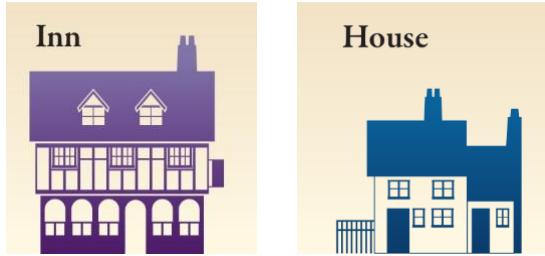
Inn and House dwelling counters.
2.4 Denizens
2.4.1 The monster, native and visitor pieces represent the “denizens” who live in the Realm. The monster and native counters represent the monsters and humans pictured on them. The numbers, letters, and stars on these counters are combat values.
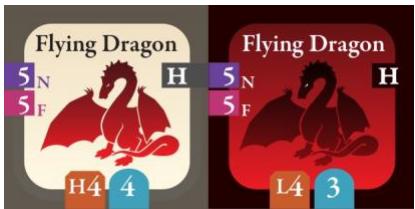
Armored monster, “H” heavy weight and vulnerability, 5 notoriety and 5 fame bounty. Light side has heavy attack at 4 speed, 0 length, 4 move speed. Dark side has light attack at 4 speed, 0 length, 3 move speed.
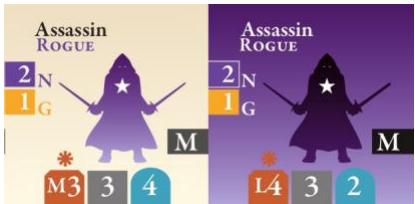
Unarmored native, “HQ” indicates he’s a native leader, “M” medium vulnerability, 2 notoriety and 1 gold bounty. Light side has medium attack with one sharpness star at 3 speed, 3 length, 4 move speed. Dark side has light attack with one sharpness star at 4 speed, 3 length, 2 move speed.
1) The letter on the right side of each counter defines the counter’s vulnerability. The letter on the bottom area of each counter defines the strength and harm inflicted by its attack, and any stars are “sharpness stars” that add to the damage it inflicts. The number with this letter defines his attack speed. The number to the right of this defines the length of his attack; higher numbers mean longer length. And the other number on the bottom right side of the counter defines his maneuver or move speed. The speed numbers show how much time it takes the denizen to complete an attack or a move. Lower numbers mean faster actions.
2) Each counter has a light side and a darker side. Each side of the counter shows different combat values (except for Maximum weight monsters, which only have one side). Each monster or native always uses the values that are face up at the moment. Monsters and natives that are not hired or controlled are always light side up during Daylight. They flip over only during combat.
2.4.2 Monsters:
Each monster counter represents the monster pictured on the counter. The size of each monster counter, as well as the letter on the right side of the counter, signifies the size and “vulnerability” of the monster – the largest counters are the largest, and toughest, monsters. The monster’s “vulnerability” is the damage that must be inflicted on it to kill it, and is the same as its size and its move or flying strength. The counters from largest to smallest are “X” for Maximum, “T” for Tremendous “H” for Heavy, and “M” for Medium monsters. There is no monster at “L” for Light (there are natives who are), nor “-” for Negligible.
1) The List of Monsters identifies each monster and lists its size, weapon and weapon length, method of attack, Fame bounty, Notoriety bounty, and whether it is armored, and shows the combat values on both sides of each monster. The Fame bounty and Notoriety bounty are used to determine the points a character gets for killing the monster.
2) Most monsters have a weapon length of zero (“tooth/claw”), and attack by striking. If the monster has a weapon, head or club, its weapon and weapon length are listed (Exception: Ogres have a club of length zero). Demons, Imp, Vampire, and Succubus attack using spells on their light side, but use tooth/claw on their red side.

Unarmored monster, “T” tremendous weight and vulnerability, 6 notoriety and 6 fame bounty. Dark side has maximum attack at 5 speed, 0 length, 4 move speed.
3) The red side of the ‘T’ monster counters has a special meaning: it shows the monster’s combat values when it picks up an enemy to rip him apart! ‘T’ monster
4) counters are normally turned red side down, and other monster counters (including club and head counters) are normally turned lighter side up. These counters turn over only during combat, and when combat ends they turn normal side up again.
5) The Dragons, Trolls, Serpents (including Vipers), Skeletons, Gargoyles, Vampire, Anomalies, Alligator, Scorpions, Golems, Colossus, and Titan are the only armored monsters. These monsters are protected by armor in all directions; every attack that hits one of them hits armor and loses one sharpness star. A monster’s armor cannot be damaged or destroyed while the monster lives (Exception: Minotaur Shield can be damaged and destroyed).
6) Some of the monsters have two counters: each Giant has an extra counter that pictures a club. Each ‘T’ Dragon has an extra counter that pictures its head. Each Giant Pod has an extra counter that pictures its vine.
7) The ‘T’ Scorpion has an extra counter that pictures its stinger. Each extra counter moves with its monster, but it attacks separately, with its own combat values. The extra counters cannot be attacked; the only way to kill one of them is by killing the monster it belongs to.
8) The Minotaur has an extra counter that pictures a shield. It moves with the monster, but it doesn’t attack. Rather, it blocks damage similar to a character shield (see Rule 8.13.9.3).
9) The Skeleton Knight has an extra counter that pictures a horse. It moves with the monster the same way a horse moves with a native (see Rule 8.13.9.3).
10) Flying Values: Some monsters have “flying values” instead of move values (see the List of Monsters), and other denizens and characters can acquire flying values by magic or treasures. Flying values, like move values, consist of a strength letter and a move time. When a character or denizen has a flying strength that will carry him, he can use it to fly. Flying monsters always fly. They fly when they charge in combat, and when hired or controlled they fly when they move.
2.4.3 Natives:
Each native counter represents the native pictured on the counter. The List of Natives identifies each type of native and indicates his Gold bounty, Notoriety bounty, weapon length, method of attack, weight, move strength, vulnerability, whether he is armored, and the basic “wage” that determines how much recorded gold it costs to hire him. Each native has the weapon length, method of attack and armor implied by the picture on his counter. Except for the Knights, each native’s move strength and vulnerability equal his weight. The Knights have Heavy weight but Tremendous move strength and
vulnerability.
1) The natives are divided into twenty-four groups, with certain groups belonging to one of the four clans. Each native counter has an identity code (or “ID code”) that identifies him and the group he belongs to.
2) The first clan is composed of the Zealots (“Z” ID code), Peasants (“PS), Patrol (“P”), Soldiers (“S”), Guard (“G”), and Order (“O”).
3) The second clan is composed of the Summoners (“SN”), Aborigines (“A”), Pagans (“PN”), Woodfolk (“W”), Lancers (“L”).
4) The third clan is composed of the Bashkars (“B”), Hunters (“H”), Company (“C”), Coven (“CV”), and Rogues (“R”).
5) The fourth clan is composed of the Mercenaries (“M”), Conjurors (“CN”), Mages (“MG”), and Enchanters (“EN”).
6) The roving natives don’t belong to any clan. They are the Bandits (“BD”), Dwarves (“D”), Elves (“E”), and Cultists (“CL”).
7) The ID code on each native counter identifies the native and his group. The first letter identifies his group, and the rest of the code identifies him within the group: the leader of the group has the “HQ” code, and his underlings are identified by numbers.
8) The leader of a native group is special – he is the only native of the group who trades, tracks the amount of gold, fame, and notoriety he acquires, and he is the only one who can do activities on his own.
9) The other numbers, letters, and symbols on each native are his combat values. The harm letter and sharpness stars define the harm he inflicts when he hits. The number with the harm letter defines his attack time and the other number is his move time. The Table of Natives lists all the natives in each native group and their combat values, including those of their horses.
2.4.4 Traveler Chits:
The traveler chits come in 5 types: Campaigns, Missions, Nomads, Visitors, and Tasks.
1) The Campaigns are red. They represent a messenger or demagogue with the authority to start a campaign. See Rule 7.2.6.
2) The Missions are green. They represent a helpless group of people who are on a mission. They can be picked up for a Notoriety cost and delivered to a specified dwelling. They are described in Rule 7.2.5.
3) The Nomads are orange. They represent individuals who are gifted at special tasks, which can be used to assist characters, for a price. They are described in Rule 7.2.8.
4) The Visitors are blue. They represent sage or magician
or collector who is visiting the Realm.
5) The Tasks are purple. They represent an individual of great influence who wishes to explore dangerous locations. They can be picked up for a Fame cost, and will provide a good deal on an exchange with any native group. They are described in Rule 7.2.4.g.

Traveler chits, left to right: back of chit, mission chit, visitor chit, campaign chit, nomad chit, task chit.
2.5 Belongings and Spell Cards
The weapon counters, armor counters, treasure cards, and round horse counters are “belongings” the characters can own; the weapons, armor and Treasure cards are “items” that must be carried. Spell cards represent information that can be learned.
Belongings carried by a character must be either “active” or “inactive”. Active items are available for immediate use by the character; inactive items must be activated before they can be used. Active and inactive items should be kept apart, preferably keeping active items to the left of the character card, and inactive items to the right of the character card.
2.5.1 Horses
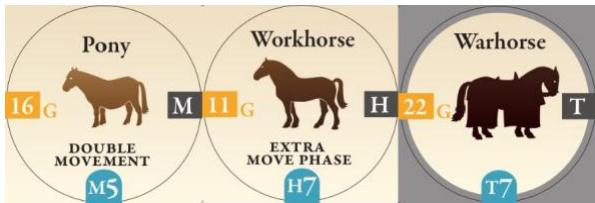
1) Each horse counter represents the horse pictured on it. There are three types of horses: ponies, workhorses and warhorses as shown on the List of Horses. When a character has a horse active, he is riding it. Inactive horses are being led and represent pack horses. Each horse counter has the weight and vulnerability letter, and the time number, shown on the side of the counter that is face up at the moment.
2) The round horse counters are mounts that the characters can obtain and ride during the game. Hired natives can never use the round horse counters. They can use only their own native horses. The square horse counters are the personal mounts of the natives and cannot be used by the characters (Exception: see Control Horse in the List of Spells).
3) Each native horse belongs to the native with the matching ID code.
4) The letter on each horse counter defines its strength, and the number defines the time it takes to move. Each side of the counter shows different values; the darker colored side is turned up when the horse is “galloping”, and the light colored side is turned up when the horse is “walking”. The horse always has the values that are face
up at the moment.
5) Each native and native horse counter is always light side up except during combat or when it is hired.
2.5.2 Weapons
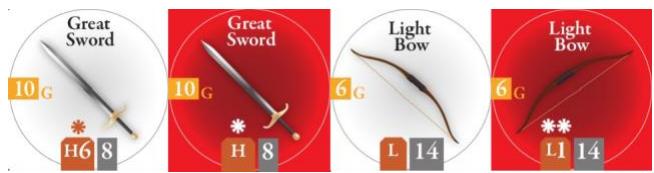
1) Each weapon counter is identified by the image on the counter. The List of Weapons identifies each weapon and defines its weapon length and its method of attack. Certain treasure cards also function as weapons, and their attributes are listed on the card or in the List of Treasures.
2) Each weapon has a length value from 0 to 18. Numbers with higher values indicate longer weapons.
3) The letters, numbers, and symbols printed on the weapons define how they function in combat.
4) The number on a weapon is its attack time, which defines how much time it takes the weapon to complete an attack (lower numbers mean faster attacks).
5) The letter on the weapon defines the weight of the weapon and also defines the harm it inflicts when it hits, measured in the same levels as weight (“L” for Light, and so on). Special: When unalerted side up (with no letter), a Spear inflicts Negligible harm. It still has Medium weight.
6) Each sharpness star on the weapon adds one level of harm, but when the weapon hits armor one of the sharpness stars does not count (additional stars increase the damage normally). Example: A Light weapon with two sharpness stars inflicts Heavy damage normally, Medium damage against armor.
7) Each weapon counter with a sharpness star with a purple background indicates the weapon only receives that sharpness star if supplied with purple magic.
8) There are two methods of attacking: by striking (“striking weapons”) and by missile (“missile weapons” or Attack spells). The weapon’s method of attack modifies the harm it inflicts: missile weapons must roll on the Missile Table to adjust the harm level, and striking weapons gain one harm level when they are played with excessive Fight strength. The method of attack is listed on the List of Weapons.
9) hereA weapon counter is “alerted” when the red side of the counter is face up. When the other side is face up, it is “unalerted”. Each counter starts off with the unalerted side face up. Only active weapons can be alerted; when inactive, sold, cached, or abandoned, a weapon must have its unalerted side face up. Weapons can attack with either side up, but most weapons are more effective when the alerted side is face up. Note: Weapon cards cannot be alerted. Weapon cards stay face up whenever they are active and always have the values shown on the card. 10) Weapon counters are placed unalerted side up just before the start of each day. They remain unalerted side up unless they are alerted during the day using an Alert phase or at certain times during combat. Whichever side is face up, it must keep that side face up until the counter is turned over again in an Alert phase or by hitting or missing in combat.
2.5.3 Armor:
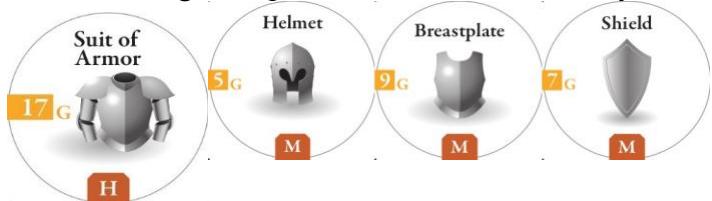
1) Each armor counter represents the armor pictured on it. There are four kinds of armor: helmets, breastplates, shields, and suits of armor.
2) Each armor card and counter displays a letter that defines the armor’s weight and toughness. This toughness defines the amount of harm needed to affect the armor – the armor ignores attacks that inflict less harm. Example: A Medium shield is unaffected by Light harm.
3) Certain Treasures Within Treasures (TWT) armor have two weight letters, one normal, one with a purple background. The armor has the normal letter weight value unless supplied with purple magic, in which case it will have the purple background weight value until Midnight.
4) Each armor counter is turned “intact” side up at the start of the game. When damaged it is turned “Damaged” side up, and it remains damaged side up until it is repaired, sold to an unhired native leader, or destroyed. While damaged, it protects its owner normally.
2.5.4 Treasure Counters
The eight gold weapon counters are labeled the Bane Sword, Truesteel Sword, Living Sword, Devil Sword, Sun Sword, Golden Axe, Crystal Bow, and Moon Bow. The ten gold armor counters are labeled Gold Helmet,
Silver Breastplate, Jade Shield, Regal Shield, Violet Breastplate, Lilac Helmet, and the Tremendous Suit of Armor, Opal Helmet, Onyx Breastplate, and Quartz Shield. These are all valuable “treasure counters”; the other weapons and armor counters are ordinary items. The pony labeled “L2” on one side and “L4” on the other, the workhorse labeled “H4” on one side and “T6” on the other, and the war horse labeled “T3” on one side and “T5” on the other are also treated as treasure counters; the other horses are ordinary.
2.5.5 Treasure Cards:
Treasure cards represent a variety of items including weapons, armor, boots, gloves, other clothing, jewelry, potions and more. Each Treasure card represents the item named on the card. Cards with a gold background are “Large Treasures” with obvious value; cards with light background are “Small Treasures” that are less valuable (or less obvious about their value). Cards with a red border are “Great Treasures.”
1) Each Treasure card has a letter that defines its weight and a number that defines its Gold price. The phrase in the center of the card indicates what it can be used for in the game. The List of Treasures explains how each Treasure card is used, and the Table of Treasures provides statistics for each Treasure card, such as Fame, Notoriety, Gold price, weight, spell type, Magic type, large and Great Treasures, and other information found on the Treasure card.
2) Some Treasure cards also have a Notoriety value and a Fame value or Fame reward. A Fame value is identified by the number in front of a magenta background. A Fame reward, if any, is identified by the name of a native group above the Fame value.
3) Colors and Roman numerals (or symbols representing magic types) signify Enchanted cards with color magic or cards with Magic types that function in a limited way like a Magic chit. Each Enchanted card supplies the color named on it to every character in its clearing. The characters can use cards with a Magic type printed on them to cast spells.
4) The twelve cards labeled “P1” to “P12” in red (or have a dark brown background color) are Treasures Within Treasures cards (or “TWT” cards) that contain other treasures. Details on how they work can be found in the List of Treasures.
Left to right: treasure card back, small great treasure (note the red border indicating it’s great), TWT, large treasure.
2.5.6 Spells:
1) The Spell cards signify magic spells. Each Spell card displays the name of the spell and summarizes its qualities. It identifies the Magic type and color magic needed to cast the spell and specifies the target(s) it can be cast on, and it summarizes the spell’s effect and its duration (how long it remains in effect). The List of Spells explains each spell in detail.

2.5.7 Artifacts and Spell Books:
Each Artifact contains one Spell card, each Spell Scroll contains two spell cards, and each Spell Book contains four Spell cards. Each Artifact, Spell Scroll and Spell Book card can be used as a Magic chit that is limited to casting the Spell card(s) contained in that Artifact, Scroll or Book. The red Roman numeral (or magic symbol type) on each card identifies the type of Magic chit it can be used as.
2.5.8 The Set Up Card
The Set Up Card is used to hold pieces that are hidden somewhere on the map or that are just too bulky to keep on the map. Most of the denizens and items start the game on the Set Up Card and move to the map during play. The Appearance Chart contains denizens that can appear on the map. The Treasure Locations and Treasures Within Treasures sections contain treasures hidden at the Site chits; the characters can obtain these treasure by discovering and looting the Site chits. The Dwellings, Garrisons and Visitors sections contain items owned by the natives and visitors; the characters can obtain these by going to the natives and visitors and trading with them. 1) Each box in the Lost Castle, City, Palace, and Fortress sections holds the type of monster(s) pictured in the box. The large number in the box indicates the number of monsters in the box; boxes that contain no number contain only one monster.
2) Each box in the Treasure Locations section holds the treasure cards and Spell cards listed in the box, plus the monster pictured in the box. These treasures, spells and monsters are all hidden in clearings on the map.
3) Each pair of boxes in the Dwellings section holds the native group named in the rectangle, plus all of the items owned by that group. The natives (and any horses they are riding) are put in the square box; the large number in the box shows how many natives there are in the group. Any items owned by the group (including round horse counters) are put in the rectangular box.
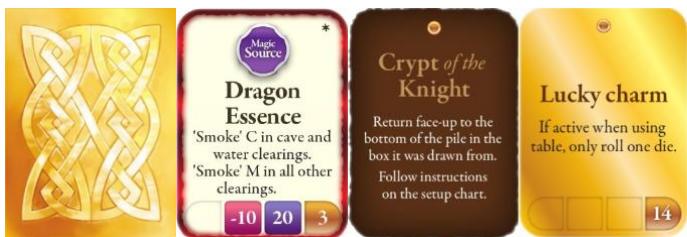
4) Each box in the Garrisons section holds the items owned by the native group named on the box. The native group itself is on the map, at the Dwelling pictured in the box.
5) Each box in the Visitors section holds the items and spells owned by the visitor named on the box.
6) The boxes in the Artifacts and Spell Books section hold Spell cards that have been inscribed on items and books.
7) Each box in the Treasures Within Treasures section holds extra treasures and spells that are hidden within one of the Treasure Locations boxes.
8) The Day (Turn) chit is put on the Daily Record track to identify the turn that is in progress. Note: If the optional Seasons/Weather rules are being used (see Advanced Rule 11.11), one of the four Weather chits and one of the six red number chits are also put on this track to keep track of the weather.
2.5.9 Character Pieces
Each character has one Character card, one character counter, one Attention chit and 12 action chits (Exception: the Witch has a “Familiar” counter as well). There’s also an optional turn order chit that each character comes with. Note: the description of character cards, counters, and chits is based on components from the original official game as released; components may differ in reprints and redesigns.
1) The character card provides a quick reference to the character. The front of the card names and pictures him, and shows the symbol that identifies all of his personal pieces. The back summarizes his qualities and lists the items he starts the game with. Each character is explained in detail in the List of Characters.
2) His Weight/Vulnerability defines his weight and vulnerability. His Special Advantages are special rules that apply only to him.
3) The Development section outlines the four stages he went through to become what he is. It shows the name, weapons, armor and spells he had at each stage, and the action chits he gained at each stage. The character is already at his fourth stage when the game begins. The earlier stages are used only with the optional Development Game rules (see Rule 12.5).
4) The bottom of the card shows the trading relationships that affect how he trades with visitors and native leaders.
5) The character’s character counter is the hexagon counter that shows his symbol. It is darker colored on the back “hidden” side, lighter colored on the front “unhidden” side. A character’s counter is turned dark side up when he is hidden, light side up when he is not hidden.The character’s Attention chit is the chit that shows his symbol on one side and is blank on the other.
6)

Amazon character counter, front and back.
7) The character’s Attention chit is the chit that shows his symbol on one side and is blank on the other.

The left is the face of the Amazon’s attention chit, the right is the back of her attention chit.
8) These are optional turn order chits used for randomly determining turn order when an opaque bag or cup is unavailable.

9) The character’s action chits are the twelve chits that show his symbol on one side and either Move, Fight, Duck, Berserk, or Magic on the other side. He plays these chits to do actions in the game. The values on each chit define its qualities.
10) The word on each chit defines what actions it can do. Move and Duck chits are used to move and maneuver, Fight chits are used to attack, Magic chits are used to cast spells and do enchantments, and the Berserk chit causes a fighting frenzy.
11) The number on each chit defines the time needed to do
18
that action; lower numbers mean faster actions.
12) The asterisks on each chit show the extra effort needed to do that action; two asterisks show twice as much effort as one asterisk, and chits with no asterisks require no extra effort at all.
13) The letter on each Move, Fight, Duck and Berserk chit defines its strength. Magic chits have no strength.
14) The Roman numeral (or symbol) on each Magic chit defines its magic type. The eight types of Magic chits are used along with the colors of magic to cast spells.
2.5.10 Personal History Pad
1) Each character takes one sheet of the Personal History Pad and uses it to keep a record of his status throughout the game. As each day is played he records the information for that day on the line for that day.
2) The front of the sheet contains a large Turn Record area, a Trading Relationships area, and an area for taking notes. The back of the sheet contains a Discoveries list, Victory Requirement areas, and information on Victory Points.
3) At the start of the game he copies his trading relationships from his Character card; and he records the Victory Points he needs to win the game in his Victory Requirements box, distributing the points as he wishes among the five categories. He must record any changes in trading relationships that occur during the game, and add or deduct VP when necessary. He must reveal his current trading relationships whenever he is asked. His Quest cards and VP distributions are secret and need not be revealed.
4) The Turn Record is divided into nine “Activities” columns, and one “Find Enemies” column. It is ruled into 56 rows, grouped into two “lunar months” of 28 turns (ie Days) each. During the game, the character records his activities in the row for that turn. Note: Each Personal History sheet shows enough turns for a two-month game, but the game can run for a longer or shorter duration; game length is not bound by the size of the Personal History sheet.
5) Each character has Fame, Notoriety, and Gold points that he can gain or lose during play. He keeps a record of these values in the Fame, Notoriety, and Gold sections at the top of the History Pad, which can be written and erased and updated as the game goes on.
6) His recorded Fame and recorded Notoriety both start at zero. They can increase or decrease without limit, and they can fall below zero – he can record negative Fame points and negative Notoriety points.
7) His Fame represents how much he is admired (negative points show how much he is despised), and his Notoriety represents how much he is feared (negative points show how much he is scorned). These values are not secret: he must reveal his recorded Fame and his recorded Notoriety whenever he is asked.
8) His Gold points show the value of the coins and loose jewels he is carrying (there are no game pieces for gold and jewels). Recorded gold never weighs anything (1arge values represent valuable jewels). Each character must keep his recorded gold secret until the end of the game. He starts the game with 10 points of recorded gold, and it can increase without limit.
Important: His recorded gold can never fall below zero he cannot spend gold he does not have.
9) He records discoveries by crossing them off his Discoveries list, which lists every treasure site in the game, and in the Find Enemies column of his turn Record.
10) Each hidden path and secret passage is identified by the clearings it connects; roadways that are on different sides of the same tile are different roadways that are listed separately. If a character discovers one of these hidden paths or secret passages, they must make a note of it on their Personal History Pad. Example: The secret passageway “Borderland (green) $4 { - } 5 ^ { \dag }$ is the secret passageway connecting clearing 4 with clearing 5 on the green side of the Borderland tile. There is also a different “Borderland (enchanted) $4 { - } 5 ^ { \dag }$ secret passageway on the enchanted side of the tile. Be sure to distinguish which side of the tile you discovered the hidden path or secret passage on.
11) Each Site chit, and seven of the twelve TWT cards are listed under “Discoveries.”
12) On any turn in which a character discovers “Hidden enemies” by rolling on a Search Table, he checks the “Find Enemies” column.
13) He uses the Character Combat sheet for combat and magic. He uses the Melee Section to resolve his attacks and maneuvers during combat.
14) He records the spells he can use in any empty space for a notes section on his Personal History sheet. Each character starts the game with a limited number of spells, and he can obtain more by learning them or buying them 15) from visitors or natives.
16) At the start of the game, the Spell cards are set up on the Set Up Card to specify where new spells can be acquired. When a character acquires a spell, he records the spell on his sheet and leaves the Spell card for others to find.
3.0 Prepare for Play
STEP 1:
3.1 Setting Up the Set UP Card
All of the Treasure cards, Spell cards, weapon counters, armor counters, horse counters, native counters and monster counters (except the four Ghosts) are put in the boxes on the Treasure Set Up Card. Put aside the twelve Dwelling counters, the four Ghosts, and the forty traveler chits. The Ghosts and Dwellings are put directly on the map in Step 6.
3.1.1 Preparation
Sort the pieces into groups.
1) Sort the monster counters according to the picture on each counter and the size of the counter. Turn the Tremendous monster counters red side down, and turn each of the other monster counters so that the lighter side is face up. Keep each Dragon’s head counter with its Dragon, each club counter with its Giant, each vine counter with the Giant Pod, each stinger counter with the tremendous Scorpion, the Minotaur Shield with the Minotaur, and the Skeleton Knight Horse with the Skeleton Knight.
2) Sort the native counters into the twenty-four native groups; each native’s group is identified by the first one to two letters in its ID code (or by the name on the counter). Keep each square horse counter with the native who has the matching ID code (or group name). Turn each counter so its lighter side is face up.
3) Put the gold-colored treasure counters aside. Sort the grey armor counters into helmets, breastplates, shields and suits of armor.
4) Sort the round horse counters into warhorses, workhorses and ponies. Find the gold warhorse, workhorse, and pony, and put these three horses with the gold-colored treasure counters.
5) Sort the Treasure cards into one group of twelve Treasures Within Treasures cards (these cards are numbered “P1” to “P12” in red print, or have a brown background), one group of 46 “Large Treasures” (each Treasure card that has a gold background is a “Large Treasure”), and one group of 94 “Small Treasures” (each Treasure card that has a plain light background is a Small Treasure). Keeping the groups separate, turn each group face down and shuffle it.
6) The Roman numeral (or symbol) at the bottom of each Spell card defines the card’s type. Divide the Spell cards into eight groups by putting all the Type I cards in one group, all the Type II cards in another group, and so 7) on. Keeping the groups separate, turn each group face down and shuffle it.
3.1.2 Placement
Put the pieces on the Set Up Card one section at a time, in the order presented below, starting with the Treasures within Treasures. Each box indicates the pieces that are placed in that box. When directed to put a Treasure card in a box, pick the card at random from the specified pile and put it in the box without looking at it. All Treasure cards are set up secretly, face down, so no one knows which cards are in
Content is long; only the first part is inlined. Download the file or open the rules page for the full text.
Download Markdown08.md115.6 KB
8.0 Evening
All combat takes place in the Evening, one clearing at a time. When combat takes place in a clearing, monsters and unhired natives can attack the characters spontaneously, the characters can attack natives, monsters, or each other, and the characters can use their hired natives to fight monsters, natives, and other characters. Combat can cause a character to fatigue or wound action chits, it can damage or destroy his armor, it can kill his horse, and it can kill him. During combat, characters can also cast spells; this is the only time when spells can be cast.
The characters, natives, and monsters fight by doing "rounds of combat", each representing one exchange of blows or spells, including preparations and after effects. Each round consists of an Encounter Step, a Melee Step, and a Fatigue Step. The characters and denizens in the clearing repeat the rounds of combat until there are no characters or hired natives left in the clearing, or until there are two consecutive rounds in which nothing is killed, damaged, destroyed, fatigued or wounded, and no Tremendous monsters are red side up. At the end of the last round, characters in the clearing can rearrange belongings and trade.
8.1 Sunset and Start of Evening
8.1.1 Sunset: At the beginning of Sunset, all Day spells cast during the Evening of the day before expire, and their associated Magic chits fatigue. Characters put to sleep by the Flowers of Rest awake refreshed, with all their fatigued chits activated. Note: All of the spells that allow monsters to be controlled are Day spells, and expire just before combat begins! Careful planning of Daylight activities is needed if you wish to avoid combat with your previously controlled monsters.
8.1.2 Determining Combat Order: During Sunset the players take one Attention chit from each clearing that contains one or more characters or hired leaders and then they mix these chits together blank side up.
a. Take only one Attention chit per clearing with characters present, regardless of how many characters there are in that clearing.
b. Combat takes place in clearings that contain hired leaders even if no characters are present. When taking one Attention chit from each clearing, take a leader's chit if there is no character in the clearing.
c. Combat does not take place in clearings that contain only underlings, monsters, and/or unhired natives. No attention chits are taken for these clearings and no Evening activities take place there.
8.1.3 Evening: During the Evening, the attention chits that were mixed together during Sunset are picked in random order, and when a clearing's chit is picked the individuals in that clearing do their activities. When all of the chits have been drawn, Evening ends. No evening activities take place in clearings without attention chits.
a. If there are no monsters, hostile natives, or hostile characters in a clearing when it takes its turn, no fighting takes place, but the characters in the clearing still do at least two rounds of combat in which they can run away, cast spells, activate items, or do nothing. Following these two rounds, characters, hired leaders, and controlled monsters can trade with each other and rearrange their belongings.
b. When a clearing's attention chit is chosen, only the characters and denizens in that clearing take part in rounds of combat; play stops in the other clearings, and the characters and denizens in those clearings do nothing. Note: To speed up play, at Sunset the players can agree to do combat in all of the clearings simultaneously, but only if all of the players agree to it. If even one player vetoes it, then combat is done in one clearing at a time.
c. Only the characters and denizens who are in the clearing can attack or be attacked. If a character has hired natives in the clearing but is not there himself, he can use his hired natives to fight during combat but he himself cannot attack and he cannot be attacked.
8.1.4 Initial Placement of Denizens:
a. At the beginning of combat in a clearing, all unhired natives and monsters in the clearing start with their counters light side up. Tremendous monsters are turned red side down and their heads and clubs are light side up. These counters turn over only during combat, and when combat ends they turn light side up again.
b. At the beginning of combat, put hired monsters and natives that are hidden to one side to identify them, since hired denizens can turn dark side up in combat even if unhidden. Hidden denizens are put aside until they enter the battle and become unhidden. At the end of combat, hidden denizen counters will be turned dark side up and unhidden denizen counters will be turned light side up. During combat, hired and controlled monsters fight just like hired natives. Exception: Tremendous monsters (see rule 8.4.7c).
8.2 Battling Natives
8.2.1 During combat, characters and their hirelings can attack unhired natives and the unhired natives can also initiate an attack spontaneously. Unhired natives that are fighting characters and their hirelings are said to be "battling" those characters and hirelings.
a. Natives do not start fighting automatically – they start fighting only when something causes them to start fighting: when they are lured or attacked, when they are chosen as the target of any spell, or when they roll to battle a character at the beginning of combat.
b. Unhired natives fight as groups: when one unhired native starts fighting, all of the unhired natives of his group in that clearing also start fighting. Important: A hired native does not count as part of his group. When he starts fighting, his group does not start fighting, and he is not obliged to start fighting when his group starts fighting. Hired natives fight only as directed by the character who hired them.
c. Each unhired native group fights specific characters: it might battle all of the characters in its clearing, but more often it will battle some characters and not others. Whether a group is battling a character is defined separately for each group and character: different groups can battle different characters at the same time in the same clearing. Each character is attacked by only those groups that are battling him in that clearing that evening.
d. Once a group starts battling a character, it keeps battling him until combat ends in the clearing. Battling does not carry over from day to day – when combat ends, the group stops battling until something happens to make it start battling again on another day.
8.2.2 When combat begins in a clearing, each character in that clearing must roll on the Meeting Table to see if the unhired native groups in that clearing will battle him. He must roll even if he is hidden. He must also roll if he has hirelings in that clearing, even if he is not present himself. Note: No combat takes place in clearings with only monsters, unhired natives and underlings. However, if combat starts in a clearing because other characters or hired leaders are present, characters who have only underlings in that clearing still must roll for battling natives.
a. The character rolls once for each group that has any unhired natives in the clearing. He finds his result in the Meeting Table that matches his trading relationship with the group using any of the character's die-roll modifiers that apply to the Meeting Table. If he is in the clearing, he can "buy drinks" before rolling to make the group one level friendlier.
b. If he rolls "Block/Battle" for a group, or if he rolls "Insult" or "Challenge" and does not pay the penalty points, then that group battles him and his hirelings for the rest of the evening. If he rolls any other result, the group is not battling him (and the result has no other effect). His result applies only to that group. He rolls only once per group per day, at the very start of combat. Note: Meeting Table "Block/Battle" rolls start battles only during the Evening. Rolls during Daylight cause blocking, not battles.
8.2.3 A character or his hirelings can cause a group to start battling him in other ways:
a. When a character specifies an unhired native as a target of a weapon attack or any spell, lures an unhired native into attacking, or assigns a hireling to lure or attack an unhired native, then that native's group starts battling him. Note: The native's group starts battling only if the native being lured or attacked is unhired.
b. Natives that are battling a character will also attack his hired and controlled natives and monsters, even if the character is not in the clearing himself. Battling does not carry over from clearing to clearing: a group that is battling a character and his hirelings in one clearing does not automatically battle him in other clearings.
c. Battling natives fight like monsters, except that they attack only those characters and hirelings that they are battling.
8.2.4 Characters never roll for battling natives once rounds of combat begin in a clearing. If hired natives become unhired in the middle of combat (due to treachery or the death of their hiring character), the characters in the clearing do not have to roll to see if they are battled by the newly unhired natives.
8.3 Encounter Step
8.3.1 At the start of the Encounter Step, all horses belonging to unhired natives are turned "walking" side up in clearings where combat is taking place (they will use their "galloping" side in the Melee Step). When combat takes place in a woods or mountain clearing, each native must always use his native horse, if he has one. Characters cannot choose to play hired natives without their horses. In cave clearings, horses cannot be used.
8.3.2 The character who had the first turn during Daylight on this game day is the "first character"; if a hired leader or controlled monster had the first turn, the hiring or controlling character is the first character. During the Encounter Step, when the characters take turns they start with the first character and go to the left, skipping anyone who is not taking part. The turns start with the first character even if he has been killed or is not in the clearing. Note: For Internet games, it may be more convenient to go in the order in which individuals took their turns during Daylight.
8.3.3 Uncontrolled and unhired natives and monsters that are already assigned to characters as a result of previous rounds of combat remain assigned to those characters when the new round of combat starts. Red-side-up Tremendous monsters also remain assigned to their targets from one round to the next (see Rule 8.6.1).
8.3.4 Luring: Starting with the first character and going to the left, each character in turn can take monsters and unhired natives onto the Melee Section of his Personal History sheet voluntarily, "luring" them into attacking him. He can take any or all of the unhired denizens in the clearing, including unhired denizens that are assigned to other characters, and place them in one of the red boxes on his Melee Section. Comment: This tactic is often used in cooperation with other characters: one character takes several monsters and plays his best maneuver, allowing others to play their best attacks against the monsters.
a. A character cannot remove denizens from his Melee Section or put denizens on other Melee Sections – he can only take denizens onto his own sheet.
b. A hidden character can lure denizens onto his sheet, but if he does so he instantly becomes unhidden.
c. Luring with Hirelings: When he takes his turn to lure, a character can also cause his hirelings to lure. The character can lure denizens with his hirelings even if he himself doesn't lure.
c.1) Controlled or hired monsters act like hired natives: they can lure attackers, they cannot be lured, and so on. In the following sections, the term "hireling" will be used to refer to hired natives, hired monsters, and controlled monsters alike.
c.2) Each hireling can lure one attacker by taking an unused Melee Section and putting the hireling who is luring in the red "Charge and Thrust" box and the lured denizen in the "Thrust" attack circle. The hireling who is luring is the defender and owner of the Melee Section, and the denizen who is lured is the attacker.
c.3) If a hidden hireling lures a denizen, the hireling becomes unhidden.
d. Hired natives, hired or controlled monsters, denizens that are assigned to hired natives, and red-side-up Tremendous monsters cannot be lured. A monster or battling native who has been lured by a hireling cannot be lured away by other characters or natives.
e. When a character or his hireling lures an unhired native, the unhired native's group begins battling him and his hirelings.
f. If a spell prohibits a character from specifying an unhired or uncontrolled denizen as a target, he can still lure it (unless the spell specifies otherwise), and it can be assigned to him randomly. Note: The restriction on the character does not affect his hirelings. They can lure and attack the individual normally.
g. A character and his hirelings can lure pacified natives into attacking (which breaks the spell used to pacify them).
8.3.5 Random Assignment: After characters and their hirelings finish luring, all of the remaining unassigned monsters and battling natives in the clearing are assigned to attack unhidden targets in the clearing. Monsters and unhired natives cannot be assigned to a hidden character or hireling.
a. Each monster or battling native in the clearing that is unassigned after luring is assigned to a character at random. The players specify which denizen is being assigned; each character rolls two dice and uses the number rolled on the higher die as his result. Characters who tie for high result roll again to break the tie.
a.1) A character must roll only if he is unhidden and in the clearing, or if he has an unhidden hireling in the clearing. He must roll for a battling native only if it is battling him. A spellcaster who has cast a pacification spell on a denizen does not have to roll for that denizen.
a.2) Die roll modifiers do modify these rolls, and results greater than "6" are allowed – they are not converted to "6". Exception: If the character is not in the clearing, his die roll modifiers do not affect his die rolls.
a.3) The character who rolls highest must assign the attacker to himself, if he is unhidden and in the clearing; otherwise, he must assign it to one of his unhidden hirelings. There is no limit to the number of attackers that can be assigned to a hireling randomly.
b. Monsters and battling natives that have no unhidden targets remain unassigned. If all of the characters and hirelings in the clearing are hidden, the denizens remain unassigned and the round of combat continues.
c. When a monster or native is assigned to attack a target, put the attacking counter on the target's Melee Section. If the target is a character, put the attacker in one of the red boxes on his Melee Section. If the target is a denizen, give the target an unused Melee Section and put him in the red "Charge and Thrust" box, and put the attacker in the "Thrust" attack circle.
8.3.6 Deployment and Charging: During this step, characters can assign their unassigned hirelings to attack targets. Hirelings that are left unassigned or that become unassigned after Deployment cannot attack this round. If the character himself is in the clearing, he can also play a Move chit to "charge" another character. These actions can be taken in whatever order the character chooses, and hirelings are deployed one at a time.
a. Deployment: Starting with the first character and going to the left, each character in turn can assign each of his hirelings that is not already being attacked to attack one character, monster, or native by putting it on its target's Melee Section. Each hired native who has a horse must always be played with his horse (except in caves). He cannot choose to dismount.
a.1) When a hireling is assigned to attack a character, it is put in a red box on his Melee Section, like a monster, and it limits the action chits the character can play during the Encounter Step.
a.2) When one denizen is assigned to attack another denizen, the denizen who is being assigned is termed the "attacker" and the denizen being attacked is the "defender." The attacker and defender are put on an unused Melee Section to resolve the combat. The defender is the "owner" of the Melee Section and is put in the "Charge and Thrust" red box. The attacker is put in the "Thrust" attack circle. Each Melee Section can have only one owner: each defender gets his own Melee Section.
a.3) When additional denizens are assigned to attack a defender, they join the attackers on the defender's sheet. Stack the attackers up in order in the "Thrust" attack circle so that the last attacker is on top.
a.4) During Deployment, characters can turn each of their hirelings (including native horses) either side up, as they choose, anytime the hireling is placed as an attacker on another sheet (Exception: Tremendous Monsters, see rule 8.4.7c). Hirelings who are defenders on their own sheets will be positioned either side up later in the round when the hiring character plays his Attacks and Maneuvers.
a.5) When an attacking denizen is itself attacked by another denizen, the attacking denizen is removed from the sheet it was on and becomes a defender on its own sheet.
a.6) Special: When the last attacker on a defending denizen's sheet is removed, leaving the denizen alone on its sheet, then the denizen leaves his sheet and becomes the newest attacker on the ex-attacker's sheet. Deployment Example: The Amazon's hired Lancer lures a heavy Troll onto his sheet. During Deployment, the Berserker assigns his hired Rogue to attack the Troll. The Troll becomes the defender on its own sheet and the Rogue is placed either side up as the attacker in the Thrust circle. Now alone on his sheet, the Lancer is moved to the Troll's sheet as the last attacker, and placed on top of the Rogue in the Thrust circle. The Amazon can turn the Lancer and his horse either side up when they move to the new sheet. If the Berserker instead played his Rogue to attack the Lancer, the Lancer would remain on his own sheet and the Troll and the Rogue would both be his attackers; in the Melee Step the Amazon would select one of them as the Lancer's target.
a.7) A denizen who is being attacked by one or more other denizens must attack one of the denizens who is attacking it. It cannot attack a character, and it cannot attack a denizen who is not on its sheet. Note: This rule does not apply to characters. Characters may defend on their own sheet and simultaneously attack on a target's sheet. Attacks by characters do not affect who the denizen attacks.
a.8) Tremendous monsters that are red side up do not change targets when they are attacked by other denizens. A red-side-up Tremendous monster can attack a character while it is being attacked by a denizen. If a red-side-up Tremendous monster is assigned to a character when it is attacked by a hireling, the monster is put on its own Melee Section but it picks no target: it continues to attack the character as if it were in the matching red box on his sheet. If all of the attackers leave the monster's sheet, the monster returns to the character's sheet.
a.9) If a character deploys a hired or controlled denizen against an unhired native, all members of that native group in the clearing battle the character and his hirelings for the rest of the day.
b. Charging: A character can charge another character by playing a Move chit and placing his Attention chit on his target's Melee Section. The Attention chit functions like a monster counter, with the move time shown on the Move chit; it restricts the action chits that the target character can play during the Encounter Step. Characters cannot charge denizens. Comment: The most common use of charging is to prevent the target from running away.
b.1) Charging counts as the character's action for the Encounter Step – he cannot do any other action that Encounter Step. The Move chit counts towards his fatigue and effort limit, and it is subject to the normal restrictions. A character cannot charge if a Tremendous monster is red side up on his sheet. Otherwise, the Move chit he plays is not limited by the denizens on his sheet.
b.2) Charging specifies the character's target for the round. He cannot change targets during the Melee Step.
b.3) If a spell prohibits a character from specifying a certain individual as a target, he cannot charge that individual.
b.4) A character transmorphized into a flying beast, with a Fly chit, or using the Magic Carpet can use his flying values like move values to charge during his Deployment. When he charges, he stays in the clearing. He cannot ride a flying steed to charge.
c. Hidden Targets: A character can charge a hidden character only if he has found hidden enemies that day, and a hireling can be deployed against a hidden character only if he is a hired leader who has found hidden enemies that day. Underling and monsters can never be assigned to hidden targets. A hidden character who is charged or has a hired leader deployed against him immediately becomes unhidden; the charging character or deployed leader also becomes unhidden. Example: The Amazon has found hidden enemies. She charges the hidden Druid. She can then deploy her hired Patrol against the unhidden Druid. If the Patrol HQ had found hidden enemies but the Amazon had not, she could deploy the Patrol HQ against the Druid and then charge him after he became unhidden.
8.3.7 Encounter Actions: After all of the denizens have been assigned, starting with the first character and going to the left, each character who did not charge this round can do one action. If he can play the required chit, he can either: 1) play a Fight chit or active Gloves card and turn his active weapon counter over, alerting or unalerting it; 2) play a Move chit, Fly chit, or active Boots card, horse, or Magic Carpet to run or fly away; or 3) play a magic chit (or Artifact/Spell Book) to cast a spell.
a. The monsters, natives, and Move chits (from charging players) on his sheet limit the action chits he can play. Each native who is riding a native horse uses the move time shown on the horse counter, not his own move time. Explanation: Each denizen or charging character's move time defines the time before the denizen or character reaches the character trying to complete the action. If he plays a Move or Fight chit that ties or exceeds (or a Magic chit that exceeds) this time, the charging individual reaches him and interrupts the action before he can complete it.
a.1) He can play a Fight, Move, or Fly chit, Boots or Gloves card, horse, or Magic Carpet only if its time number is less than the move time of all of the denizens and Move chits on his sheet.
a.2) He can play a Magic chit only if its time number is less than or equal to the move times of all the denizens and Move chits on his sheet. Alerted Magic chits, Artifacts, and Spell Books have a completion time of "0" and cannot be interfered with.
b. He can play a Fight chit only if its strength is equal to or greater than the weight of his active weapon.
c. He can only play a chit or item to run or fly away if its carrying capacity is sufficient to carry himself and everything he is carrying. Exception: If he is leading a packhorse, the packhorse can carry any of his inactive items that do not exceed the packhorse's carrying capacity. The items the packhorse carries must already have been inactive at the start of the round.
d. If he does not charge or play an action chit, the character can either: 1) activate one belonging and/or deactivate one belonging; or 2) abandon any of his belongings in the clearing. Denizens and charging characters do not interfere with these actions.
e. Hirelings never do actions. They never run away.
8.3.8 Running or Flying Away
a. Running Away: When a character plays a Move chit, Boots card or horse as his action during an Encounter Step, he "runs away". The character is not required to play a Boots card or horse, even if it is active; he can play a Move chit instead.
b. When a character runs away, he immediately moves onto one of the roadways that leads out of his clearing, taking all of his belongings with him. If he moved into the clearing that day, he must run onto the roadway he used to enter the clearing; if this roadway has vanished or has turned into a hidden roadway he cannot use, he cannot run away that day. If he started the day in the clearing and never left, he can run onto any roadway that he is able to use for movement, including ones that lead to mountain or cave clearings. (Example illustration: the Captain runs away from a Tremendous Dragon, moving halfway towards a neighboring clearing.)
c. The character takes no further part in combat that day. He removes any denizens that are on his sheet and leaves them behind in the clearing: they are now unassigned and cannot be assigned to new targets until the next round of combat. Note: If the character played a Move chit with two asterisks, he fatigues normally at the end of the round.
d. The character ends the day on the roadway, between clearings. While between clearings he cannot block or be blocked, he cannot rearrange or abandon belongings and he cannot trade with other characters.
d.1) He must start his turn on the next day by moving to one of the clearings at either end of the roadway. He must use a Move phase to move to a clearing, even if he moves back to the clearing he ran out of; if he moves to a mountain clearing he must use two Move phases to move. He does not have to play a Move chit to carry items during this move – the Move chit he played to run away has already paid for what he is carrying.
d.2) A character who runs out of a cave toward a non-cave clearing can record Sunlight phases on his next turn, as long as he does not enter a cave clearing.
d.3) If a character is on a roadway when it vanishes or turns into a hidden roadway that he has not discovered, he is put in the forest. He must start his next turn by moving back to the clearing he just ran out of.
e. Flying Away: Each character can use his flying values to "fly away" (instead of running away) as his action during the Encounter Step. (Example illustration: the Witch King flies away from two Heavy Trolls, flying halfway towards a neighboring tile.)
e.1) When he flies away, he ignores non-flying move times. The only denizens and Attention chits on his Melee Section that can stop him from flying away are those that fly, and red-side-up Tremendous monsters, which are impossible to run or fly away from (see Rule 8.4.7d.2).
e.2) Instead of moving onto a roadway, his counter is put half in the tile he is in, and half in an adjacent tile of his choice (both tiles can supply color magic to him). He must start his next turn with a Fly phase to fly into either tile and land, even if his flying values vanished at Midnight. He must land, but if he still has flying values he can take off again (assuming he is not blocked).
f. Special Movement: A character transmorphized into a beast can run away onto a roadway or into the forest, as he chooses. If he runs into the forest, he must start his next turn with Move phases to move to any clearing in his tile. While in the forest, he is supplied with color magic by the whole tile.
g. If a character runs out of a clearing on the same day that he used special movement (flying or walking the woods) to enter that clearing, he can run onto any roadway that enters the clearing.
h. A character can run or fly out of his clearing even if no monsters are present. Rounds of combat are done in every clearing that contains characters even if no monsters are present (the rounds will end after two uneventful rounds), and during these rounds the characters can run away or do other actions.
8.3.9 Activating and Casting Spells: During the Encounter Step, spells are cast that later come to life and have their effects during the Melee Step. In addition, Permanent spells can be activated by playing a color chit.
a. Activating Permanent Spells: When it is his turn to do an action in the Encounter Step, each character can use his color chits to energize Permanent spells. When a color chit energizes a spell, the chit fatigues and reverts to being a normal Magic chit. He can play any number of color chits at the same time, but each color chit can energize only one spell before it fatigues.
a.1) The character energizes a spell only if the spell's target is in his clearing and he plays a chit that supplies the color magic required by that spell. If there are several spells requiring that color in his clearing, he can energize any one he wants. He has total control over his color chits: he is never forced to play a chit to energize a spell, even if he is the target. He can energize other spells in the clearing without energizing his own, if he wishes.
a.2) Playing color chits does not count as his action – he can also charge, run or fly away, activate/deactivate or abandon items, or do an action. Playing a color chit is not limited by Move chits, monsters, or natives on the character's sheet.
a.3) He can play color chits without energizing spells, if he wishes. Each chit fatigues and reverts to being a Magic chit.
b. Casting Spells: As his action during the Encounter Step, each character can play a Magic chit in the presence of the correct color magic to cast one of his recorded spells.
b.1) The only time that a character can cast spells is during rounds of combat in his clearing. He cannot cast spells at other times of day or when combat is being resolved in other clearings.
b.2) Each character can cast one spell per round of combat.
b.3) To cast a spell, a character must play a Magic chit when it is his turn to do an action during the Encounter Step. He puts the Magic chit in the spell box (on his Melee Section) that belongs to the spell. The Magic chit must be the same type as the spell (the Magic chit and spell must show the same Roman numerals) and the spell must be supplied with the color of magic it requires, or the Magic chit cannot be played to cast that spell. A character who plays a Magic chit to cast a spell is referred to as a "spellcaster".
b.4) The time number on the Magic chit is the spell's "completion time", the time it takes to complete the spell. Lower numbers mean faster spells. Alerted Magic chits automatically have a time number of zero instead of the number printed on the chit.
b.5) He can play a Magic chit only if its time number is less than or equal to the move time of every monster, native or Attention chit on his sheet. If the Magic chit is alerted, its time number is "0". Red-side-up Tremendous monsters do not automatically stop the playing of Magic chits. A spellcaster can play a Magic chit while a red-side-up monster is on his sheet, as long as the monster's move time is greater than or equal to the Magic chit's time number. Important: Notice that a Magic chit (unlike other action chits) is not stopped by move times that equal its time number.
b.6) The color magic can be supplied by any of the sources of color, including the map tile, the seventh day of the week, the Chapel or an Enchanted card anywhere in the clearing. The spellcaster can use one of his own color chits to supply the color magic, but he cannot use another character's color chits, even if that other character is willing.
b.7) A color chit counts only as a source of color magic – the time number and effort asterisks on the chit are ignored. The effort asterisks do not count towards the spellcaster's effort limit.
c. Artifacts and Spell Books: As his action during an Encounter Step, a character can play an active Artifact or Spell Book like a Magic chit, and use it to cast one of its awakened spells, with a time number of "0". To play the item he puts it and the Spell card it is casting in one of his vacant spell boxes, face up. This counts as his action for that Encounter Step. If he has no vacant spell boxes, he can play the cards anywhere on his sheet. Note: Spell cards that are in treasure site boxes or that are owned by visitors cannot be cast. They can only be learned.
c.1) He can play only one Artifact or Spell Book per round, and it can cast only one of its Spell cards each time it is played. He can play the item and Spell card only if the item is active, the Spell card is awakened, and both the item and spell card have the same Magic type. Example: The Good Book can be used to cast its two Type I Spell cards, but it cannot cast its two Type VII Spell cards.
c.2) The spell must be supplied with the proper color magic as explained above, or the Spell card cannot be played.
c.3) The item and Spell card remain committed to the target(s) until the spell ends. Until then, the item must stay face up, like an Enchanted card, even if it is sold or abandoned. Neither the item nor the Spell card can be played again while they are committed, but the Spell card (and the item's other Spell cards) can be learned by Reading Runes while they are committed.
c.4) Each Artifact or Spell Book can be used only once per Evening. Once it is played, it cannot be played again that day. When a spell cast by an Artifact or Spell Book ends, the Artifact or Spell Book cannot be used again until the start of the next Evening: if it ends during an Evening the item cannot be used again until the next Evening, but if it ends at Sunset or before, the item can be used during the Evening of that day.
c.5) The Artifact or Spell Book itself functions as the "spellcaster" of the spell. The character who currently owns the item controls the effects of the spell. Important: If no one owns the item, the spell is nullified (but not broken) until another character owns the item or the spell expires. Example: If the spell controls monsters, the owner of the item controls the monster. If no character has the item, the monsters are uncontrolled.
c.6) The spell cannot be broken by killing the current owner of the item – the item itself is really the spellcaster, and it cannot be killed. A spellbreaking spell used in the item's clearing can break the spell.
d. Spells cast by a spellcaster, Artifact, or Spell Book do not go into effect immediately; they go into effect after targets have been selected in the Melee Step.
8.4 Melee Step
8.4.1 Native Horses: At the start of the Melee Step, all native horses being ridden by unhired natives turn dark side up, and all native horses being ridden by hired natives turn over. Native horses keep this new side face up throughout the rest of the combat round.
8.4.2 Selection of Targets: Next, targets for uncontrolled denizens are determined, and the characters select targets for their own attacks and spells. Unhired natives and monsters cannot target each other, and the visitors cannot attack nor be attacked.
a. Uncontrolled Denizens: A monster or unhired native on its own sheet (a defender being attacked) automatically attacks the denizen who was most recently put on its sheet: as each attacker is put on its sheet it is stacked in the "Thrust" attack circle, with the most recent attacker on top. The only attackers on its sheet at this point are hirelings previously assigned during Deployment. At the start of the Melee Step the attacker on top of the stack becomes the defender's target. The defending denizen is put in the red "Charge and Thrust" box and its head, club or horse is put in the red "Dodge and Swing" box. The targeted attacker is placed in the area of the Maneuver boxes, and the remaining attackers stay in the "Thrust" attack circle (the attackers will be repositioned by their controlling characters later in the round).
b. Characters: The characters in the clearing (including hidden characters) and the characters with hirelings in the clearing mix their Attention chits together blank side up. The chits are picked randomly, one at a time, and when a chit is picked its owner takes his turn. He selects the target for each of his hirelings who is on its own sheet, and if he is in the clearing he puts his Attention chit on his own target. The character also positions his hirelings who are on Melee Sections owned by uncontrolled denizens.
b.1) If a character is not in the clearing but is taking part in combat because of his hirelings, he picks no target for himself.
b.2) When a hidden character or hireling specifies a target or is specified as a target of an attack or a spell, he and his target are instantly unhidden. Note: See Ambush optional Rule 10.A.2 for exceptions.
b.3) A character is not obliged to pick a target; he can leave his chit unplayed if he wishes, but if he does so he cannot attack a target that round. If a hidden character leaves his chit unplayed, he remains hidden.
b.4) If a character charged this round, the only target he can attack is the character he charged.
b.5) A character can select a hidden target only if he has found hidden enemies that day. Note: Characters and hired natives can stop hiding voluntarily at any time.
b.6) A character may select a target that is on another sheet, even if there are attackers on his sheet.
b.7) If a spell prohibits a character from specifying a certain individual as a target, he cannot specify that individual as the target of an attack or spell. Note: The restriction on the character does not affect his hirelings. They can lure and attack the individual normally.
c. If a character is attacking with a weapon, when his Attention chit is picked he puts it on the denizen or character he is attacking. To specify another character as his target, the character puts his Attention chit on the target's Melee Section, by the Attack circles. To specify a monster or native as his target, he puts his chit on the target's counter. He can put his chit on any denizen or character in the clearing, including denizens and monsters that are unassigned or that are assigned to other characters. Being named as a target does not affect the denizen – it is not re-assigned to attack the character that is attacking it. Note: When there is no possibility of confusion, the players may simply announce their targets.
d. If a character has cast a spell in the Encounter Step, when his Attention chit is picked he puts it on the appropriate target for the spell. If his spell has multiple targets, he announces all the targets and places his Attention chit on one of them. He must specify the sort of target required by his spell, or the spell is broken before it goes into effect. The various sorts of targets are outlined below, and are described more precisely on the List of Spells.
d.1) When he specifies characters, denizens and items as targets, the spellcaster is limited to targets that are in his clearing. A "character" target can be any character, including the spellcaster himself. A "monster" or "Demon" is the monster specified in the spell. An "individual" can be any character, native, or monster, unless specified otherwise by the spell.
d.2) A "multiple" target is any assortment of characters, natives and/or monsters that the spellcaster chooses. A "human group" is either one native group, or all of the Giants in the spellcaster's clearing, or all of the Ogres in his clearing. A "Goblins" target must include all of the uncontrolled Goblins in his clearing, and a "Bats" target must include all of the uncontrolled Bats in his clearing.
d.3) A "clearing" target must be the spellcaster's clearing (the spell affects everyone in the clearing), a "hex" target must be his hex tile (the spell affects everyone in that tile), and a "hex/human" target can be either his hex tile or a character or hired leader in his clearing. A "one Sound" target can be any face-up Sound chit anywhere on the map.
d.4) A "weapon" target can be any active or inactive weapon counter owned by anyone in the spellcaster's clearing, or any native, Goblin, Ogre, or club counter in his clearing. An "artifact" target must be an Artifact or Spell Book the spellcaster owns and has active. A "Magic chits" target can be any or all of the spellcaster's own active Magic chits (only the chits he specifies are affected by the spell).
d.5) A "spell" target can be any spell whose spellcaster or target is in the spellcaster's clearing (including spells in effect in his tile generally). The target spell must already be in effect – it cannot be a spell that is being cast in the current round.
d.6) When a spellcaster specifies a character or denizen as his target, he and his target are instantly unhidden; if he specifies anything else as his target (such as a weapon, spell, Magic chit, hex tile, etc.), he remains hidden. He can specify a hidden target only if he has found hidden enemies that day. Exception: He can always cast a spell on himself, even if he is hidden and has not found hidden enemies; however, he still becomes unhidden when the spell is cast. Note: See the Ambush optional Rule 10.A.2 for circumstances under which a spellcaster may cast a spell and remain hidden.
d.7) When a spellcaster specifies an unhired native as the target of any spell, that native's group instantly starts battling him (see Rule 8.2.3). When the spellcaster specifies one of his hired natives as the target of any spell, all of his hired natives belonging to that native group instantly rebel (see Rule 8.4.2g). Exception: The Benevolent Spells optional Rule 10.C.2 allows some spells to be cast on hirelings without causing them to rebel.
e. Hirelings: When his Attention chit is chosen, each character chooses targets for his hirelings who are on their own Melee Sections. A hireling who is being attacked by denizens must choose a target from among the attackers on his sheet; if there are no denizens on his sheet, he does not choose a target. He cannot choose not to attack, choose a target on another sheet, or attack a character (even if the character has targeted him). The character puts the hireling's target in the Maneuver boxes and puts the other attackers in the Attack circles. He will secretly position his hireling in one of the red squares later in the round when he plays his Attacks and Maneuvers.
f. At the same time that a character selects targets for himself and his hirelings, he also positions his hirelings who are on Melee Sections owned by uncontrolled denizens. He cannot turn any counters over. The defending denizen is in the red "Charge and Thrust" box with its head/club/horse in the "Dodge and Swing" box. Its target can be put in any Maneuver square, and the remaining attackers can be put in any Attack circles; they do not have to fill all the circles. Each native horse can be put in the same circle or square with its rider, or a different one. Each character positions only his own hirelings. He does not position hirelings who are on Melee Sections owned by other characters or their hirelings.
g. Treachery: When a character specifies one of his own hired natives as a target for himself or one of his hirelings, all members of the target's group that are currently under hire to that character instantly "rebel", no matter where they are on the map. Hirelings also rebel if they are chosen as the target of any spell (Exception: Benevolent Spells optional Rule 10.C.2). Natives hired by other characters and natives in other groups are not affected. The rebels instantly become unhired and the character loses Fame points equal to the Notoriety bounty of each rebel.
g.1) Rebels cannot attack nor be attacked by monsters and unhired natives. All such attacks are instantly cancelled.
g.2) Rebels are automatically battling all characters and hirelings who are attacking them or who they are attacking.
h. Breaking Pacification Spells: A spell that pacifies or controls a group of denizens is instantly broken when the spellcaster specifies one of the spell's targets as a target for himself or one of his hirelings. When the spell is broken, all of the targets revert to normal behavior.
h.1) If any of the spellcaster's hirelings are assigned to attack any of the spell's targets at the moment when the spell goes into effect, then the spell is stopped from going into effect. The spell is cancelled.
h.2) When the spellcaster assigns a hireling to attack one of the spell's targets, or when he specifies one of the spell's targets as his own target for a spell or attack, then the spell is broken.
8.4.3 Spell Activation and Cancellation: When all of the characters have specified their targets, the spells that have been played come to life and start working in the order defined by their completion times (lower time numbers first). All spells with a completion time of zero come to life first, then all spells with a completion time of "1", and so on. Spells with equal time numbers start working simultaneously. All of the spells start working before the characters play their attacks and maneuvers.
a. Each spell's completion time is equal to the time number on the Magic chit that was played to cast it; alerted Magic chits automatically have a time number of zero instead of the number printed on the chit. A Spell card cast by an Artifact or Spell Book also has a completion time of zero.
b. Important: When characters cast spells on each other, faster spells interrupt and cancel slower spells. When a spellcaster casts a spell on a character who is casting a slower spell, the spellcaster's spell stops the target from completing his spell. When the spellcaster's spell starts working he compares the completion time of his spell to the completion time of his target's spell. If the spellcaster's completion time is lower, the target's spell is cancelled. If the times are equal or the target's time number is lower, the target's spell is not cancelled.
b.1) The target's spell is cancelled only if he himself was named as one of the spellcaster's targets. For example, spells aimed at a clearing cannot interrupt characters in that clearing, and spells aimed at a spell cannot interrupt the character on whom that spell is cast.
b.2) The target's spell is cancelled regardless of the effect caused by the spellcaster's spell. Any spell that is aimed at a character stops him from completing a slower spell. Exception: The Demons and Imp cast their spells as attacks during the Melee Step, not as actions in the Encounter Step. Their spells cannot stop a character's spell and his spell cannot stop theirs. Note: The Power of the Pit optional Rule 10.C.4 modifies this exception.
b.3) The characters must be careful to implement their spells in the order of their completion times. If the spellcaster's spell is itself cancelled by someone else before it starts working, it cannot cancel his target's spell.
b.4) If a character's spell is cancelled before it goes into effect, the Magic chit he played fatigues. Its effort asterisks still count towards his effort limit for the round. He leaves his Attention chit on his target – he can still attack with a weapon if he chooses, but he cannot change targets.
c. The spell remains on its target(s) until it ends by expiring or being broken. Until then, both the spell and its Magic chit remain committed to the target it is affecting. The spell cannot be cast again and the Magic chit cannot be used in any way until the spell ends. When a spell is committed to a target, it is said to be "bewitching" that target. Note: The Enhanced Magic optional Rule 10.C.1 modifies this rule.
c.1) The Magic chit that was played to cast the spell is used to symbolize the spell's effects. When the spell goes into effect, the spellcaster takes back his Attention chit and puts the Magic chit on the target to represent the effect of the spell. When the spell ends, the Magic chit returns to its owner and fatigues. If the spell was cast by an Artifact or Spell Book, the Spell card is put on the target (in place of a Magic chit) to represent the effect of the spell, and it returns to the Artifact or Spell Book when the spell ends. Alternatively, any unused chit may be placed on the target instead of the Spell card to represent the effects of the spell.
c.2) The spellcaster notes the targets of the spell in its spell box. While the spell remains in effect, he cannot use the spell box (nor erase its spell). When the spell ends, he crosses off the note and he can use the box again. If he has duplicates of the spell in other boxes, each duplicate is treated as a separate spell: the duplicates can be cast separately by playing separate Magic chits in separate rounds of combat.
c.3) Unless the spell's description specifies otherwise, the spellcaster does not have the option to break his spell arbitrarily. He cannot simply take back his Magic chit and end the spell.
8.4.4 Spell Effects in Combat: When a spell starts working, its special effects start affecting the target(s). The List of Spells indicates the effects caused by each spell. Certain spells affect combat in special ways, described below.
a. Attack Spells: Most spells take effect immediately. However, when a character casts an Attack spell, it attacks like a weapon, and must hit by undercutting or matching directions as would a weapon. When Attack spells hit, they hit armor and horses normally, like weapons. All other spells inflict their effects directly on the target, ignoring his armor and horse; they are not stopped by armor or horses. Damage from Attack spells occurs at the same time as damage from normal weapons. When all of the attacks have been resolved, the spell expires. An Attack spell must attack in the same round it is cast. It cannot be saved and used in a later round. If not used, it expires at the end of the Melee Step.
b. Pacification Spells: Pacification spells cause denizens to act like unhired natives who are not battling the spellcaster: they stop attacking and blocking him and his hirelings, but they continue to block and attack other characters normally. When the spell goes into effect, all of its targets who are assigned to attack the spellcaster or his hirelings become unassigned. The spellcaster does not roll to see if they battle him. Special: Different spellcasters can cast duplicates of the same spell to pacify the same denizens at the same time. Note: If any of the spellcaster's hirelings are assigned to attack any of the spell's targets at the moment when the spell goes into effect, then the spell is stopped from going into effect. The spell is cancelled.
c. Controlling Monsters: When a spell that controls monsters goes into effect, it can control only those monsters who are not already controlled. Monsters that are already controlled remain under their owner's control. When the spell goes into effect, the spellcaster can cancel the assignments of any or all of the target monsters. He cannot assign the monsters to new targets until the next round. Note: Leaving a monster assigned to one of his hired natives constitutes "treachery" against the native (see Rule 8.4.2g).
d. Preventing Attacks: If a spell prohibits a character from specifying a target, and he has already played a charge against that target, his charge is cancelled. If he has already specified that individual as his target, his specification of that target is cancelled and he cannot specify a new target until the next round (if he also had other targets, he keeps them). Note: The restriction on the character does not affect his hirelings. They can continue to attack the individual normally.
e. If the spell forbids a denizen from attacking a target it is already assigned to, the denizen becomes unassigned and it cannot be assigned to a new target until the next round. If it is a Tremendous monster, it turns red side down.
8.4.5 Playing Attacks and Maneuvers: After all of the spells have started working or have been cancelled, the characters secretly play their attacks and maneuvers to resolve weapon attacks and Attack spells by comparing attack direction and speed with maneuver direction and speed.
a. A character cannot attack with a weapon or Fight chit in the same round that he successfully casts a spell. He can play a maneuver normally. If a character's spell was cancelled before it started working, he can play a normal attack. The only target he can attack is the target where his Attention chit is located. If this target is not a character or denizen, he cannot attack.
b. An attack represents a single blow that is coming at the target from a specific direction. Each attack has a direction and a time number (or attack time). There are three attack directions: Thrust (straight ahead), Swing (from side to side) and Smash (downwards). The attack time defines the amount of time before the blow hits; lower numbers represent faster attacks.
c. A maneuver represents a move in one direction to evade attacks that are coming from the other directions. Each maneuver has a direction and a maneuver time. The three maneuver directions are Charge (straight ahead), Dodge (sideways) and Duck (downwards). The maneuver time defines the amount of time before the target completes his maneuver; lower numbers mean faster maneuvers.
d. During the Melee Step each character can make one attack against one other character or denizen, and each denizen makes one attack against one character or another denizen. (Exception: Attack spells can attack multiple characters or denizens.) Each character and denizen can also do a defensive maneuver to avoid enemy attacks.
e. Character Attacks and Maneuvers: Each character can play an attack, a maneuver and his armor, if he has armor active. He can choose not to play an attack or maneuver if he wishes, but if he has a shield or other armor active he must play it. All of the characters make their plays secretly, concealing their Melee Sections from each other. When they have finished they reveal their plays simultaneously. The plays cannot be changed once they are revealed.
e.1) To attack with a weapon, a character puts his active weapon and a Fight chit in one of the Attack circles on his Melee Section. His attack is always directed against the target he placed his Attention chit on at the beginning of the Melee Step. The circle he chooses defines his attack direction: each circle names the direction it represents and the maneuver it intercepts. His attack time equals the time number printed on his weapon; if his weapon has no time number, his attack time equals the time number on the Fight chit.
e.2) To play a maneuver, a character puts a Move chit in one of his Maneuver squares. The square he chooses defines his maneuver direction: each square names the direction it represents. His maneuver time equals the time number on the Move chit.
e.3) Once the plays have been revealed, a character's weapon counter and attack chit may be moved onto his target's Melee Section to assist in resolving combat accurately.
f. Playing Restrictions: There are limits on the action chits that a character can play during combat. However, the monsters or natives on his sheet do not restrict what chits he can play during the Melee Step.
f.1) One Use: Each action chit can be played only once per round. At the end of each Encounter Step and Melee Step, each character puts the action chits he played in the Used This Round box on his Melee Section. These chits stay in the Used This Round box until the end of the round, when he gets them back to use in the next round of combat.
f.2) Effort Limit: Each character can play no more than a total of two effort asterisks per round of combat. If he plays a chit that causes his asterisks for the round to total more than two, then the play is cancelled. Example: If the White Knight plays his Move H4** chit to maneuver, he cannot play his Fight T5* chit to attack. Magic chits are also subject to the effort limit: if the Druid plays his Magic II3* chit to cast a spell, he cannot play a Move L2** chit to maneuver.
f.3) Strength Restrictions: The character's items limit the action chits he can play. He can play a Fight chit only if its strength equals or exceeds the weight of his active weapon. He can play a Move chit only if its strength equals or exceeds the weight of every item he is carrying (this does not include inactive items being carried by a pack horse). If he plays a chit that has insufficient strength, he must cancel the play – during the Melee Step he does not have the option of abandoning the over-weight item(s). Example: The Black Knight cannot use his Move M4 chit to maneuver as long as he has his Heavy armor (even if inactive). To use his Medium Move chits to maneuver in the Melee Step, he would have to abandon his armor and any other Heavy items he was carrying during the Encounter Step.
g. Illegal plays are cancelled and have no effect, and the chits that were played are put in their owner's Used This Round box. They cannot be played again that round and their effort asterisks do count towards their owner's effort limit and fatigue.
h. Weapons: Weapons can be used only if they are active. Important: Each character is limited to one active weapon (counter or card). He can own any number of weapons, but only one at a time can be active. Monsters and other denizens cannot use the weapon counters and cards. He can use his active weapon whether it is alerted or unalerted (alerted weapons usually have better combat values). When a character has a weapon active when he plays a Fight chit to attack, he must play the weapon in the attack. Combat characteristics of alerted and unalerted weapons are shown in the List of Weapons.
h.1) If his weapon has a time number, this number must define his attack time – he does not have the option to use the chit's time number instead. If his weapon has no time number, then the time number on his Fight chit defines his attack time.
h.2) Each time a weapon hits in combat, it must be turned unalerted side up. Each time it attacks and misses, it must be turned alerted side up. In place of an attack, a character can play a Fight chit during the Melee Step without specifying a target; if he does so, he can turn his weapon either side up at the end of the round. This is normally done to alert a weapon for a later round of combat.
h.3) If he does not have an active weapon, he can attack with a Fight chit alone. Explanation: He is assumed to own a dagger that he uses when no better weapon is available. The dagger does Negligible harm with one sharpness star and no time number. He cannot use this dagger when he has a weapon active – he must play the weapon.
i. Armor: During combat, each character must put all of his active armor pieces in the ovals on his Melee Section. He cannot put inactive armor on his sheet. Each active armor pi
Content is long; only the first part is inlined. Download the file or open the rules page for the full text.
Download Markdown07.md106.8 KB
7.0 Daylight
The characters take their turns in random order each day. During Daylight the chits are picked one at a time, and when a character's chit is picked he does the activities he recorded for his phases that day. When all characters have made their moves, Daylight ends at Sunset.
7.1 Determining Turn Order
7.1.1 During Daylight the Attention chits that have been mixed together are picked one at a time, randomly, and when a character, hired leader, or controlled monster's chit is picked he takes his turn. He does his phases in the order he recorded them, and when he does each phase he does the activity he recorded for that phase.
7.1.2 Even if hidden the previous day, each character, hired leader, and controlled monster is automatically unhidden when he starts to take his turn. When his attention chit is picked, his counter is turned tan or light side up. Note: All of the characters are hidden at the start of the game and become unhidden at the start of their turn on Day 1.
7.2 Beginning of a Phase
At the beginning of every phase, certain actions can be taken before he does his recorded activity. These actions can be done in any order.
7.2.1 Trading with Other Characters, Hired Leaders, and Controlled Monsters: Each character, hired leader, and controlled monster can trade with other characters, hired leaders, and controlled monsters at the start of any of his phases. The other characters, hired leaders, and controlled monsters in his clearing can trade with him but they cannot trade with each other during his turn. He can also trade with them at the beginning of one of their phases.
a. They can trade with each other only when they are in the same clearing. They can give away or exchange belongings, gold, and information for whatever price they agree on (they are not bound by the Gold prices on the items). They cannot exchange recorded Fame or recorded Notoriety.
b. Individuals can trade with each other even if some or all of them are hidden. They do not have to have found hidden enemies to trade with hidden individuals. Hidden individuals can trade without becoming unhidden.
c. Characters, hired leaders, or controlled monsters that are following may also trade with other characters, hired leaders, or controlled monsters in the clearing whenever the guide they are following begins a phase.
d. Individuals cannot trade while flying or walking the woods, or while on a roadway. Individuals also cannot trade or exchange information while blocked.
7.2.2 Rearranging Belongings: Each character, hired leader, and controlled monster can rearrange his belongings at the start of each phase of his turn.
a. When a character rearranges his belongings he can activate, deactivate, or abandon each belonging he owns, as long as he obeys the rules governing that belonging.
b. Hired leaders and controlled monsters can abandon belongings, but cannot activate or deactivate them. Exception: Enchanted cards remain activated when they are carried by hired leaders and controlled monsters.
c. Any characters, hired leaders, or controlled monsters that are following may also rearrange their belongings whenever the guide they are following begins a phase.
d. Individuals who are flying cannot rearrange their belongings, except that they can abandon items. To determine where the abandoned item lands, the player rolls one die (unmodified) for the tile he is in at the start of his phase, and the item lands in the clearing that matches the number he rolled (even if it is a cave). If the tile has no clearing with this number, he keeps rolling until he rolls a number matching a clearing on the tile.
e. Individuals cannot rearrange belongings while walking the woods, or while on a roadway. They also cannot rearrange their belongings if they are blocked.
f. Individuals cannot rearrange their belongings at other times of day or when other individuals or clearings are taking their turns.
7.2.3 Activating Spells: Each character can activate certain types of spells at the beginning of any phase, subject to the restrictions below.
a. Protection from Magic creates a special chit for later use, which is put with the target's inactive items and is handled like an item. While inactive it has no effect, but the target can activate it exactly as if it were an item.
a.1) If he activates the chit at the start of a phase of his turn, the spell affects him until that phase ends; at the end of the phase, the spell expires.
a.2) If a character cannot rearrange belongings, he cannot activate the chit.
b. At the start of any phase, each character can use his color chits to energize Permanent spells. Once a color chit is used to energize a spell, it immediately reverts to being a normal magic chit and fatigues. He can play as many color chits as he chooses, but each color chit can energize only one spell before it fatigues (see Rule 4.6.7h).
c. He can play color chits without energizing spells, if he wishes. Each chit reverts to being a magic chit and fatigues.
d. He cannot play a color chit if he is on a roadway, in the woods, or flying at the start of the phase.
7.2.4 Picking Up Mission and Campaign Chits: Each time a character starts a phase of his turn, he can take any mission and campaign chits that are in his clearing, subject to the rules governing each chit. He puts it with his active belongings. Hired leaders and controlled monsters cannot take these chits.
a. A character can have no more than one campaign chit at a time. A character can have one or both of the mission chits (Food/Ale and Escort Party) whether he has a campaign chit or not.
b. When a character takes a mission or campaign chit, he must pay a certain cost in recorded Fame and/or Notoriety, and he commits himself to complete a task within a certain time limit. When the time limit runs out, or the character completes the task, or he is killed, the chit is put in his clearing and can be taken again by anyone. The character must keep the chit until then, unless he abandons it according to Rule 7.2.4j.
c. When a character takes a chit, he must immediately subtract its cost from his recorded values. Important: He cannot take a chit if he has negative Fame or Notoriety points, or if paying for the chit would cause him to have negative Fame or Notoriety points.
d. If the character completes the task within the time limit, he regains the Fame and Notoriety points he paid to take the chit (he gets back the chit's cost). If he fails to complete the task within the time limit, or if he fails to complete the task before the game ends, then he gets no points back and he must pay the chit's cost again, as a penalty for failing.
e. The mission chits (Food/Ale and Escort Party) represent bands of hapless travelers who are going to a specific Dwelling and who will pay for an escort.
e.1) Each mission chit costs 5 Notoriety points. When a character takes a mission chit, his task is to deliver it to a particular Dwelling within 14 days. When he takes the chit, he counts the number of clearings along the shortest route from his clearing to the Dwelling, using any roadways. When he delivers the chit, he collects 2 Gold points for each clearing he counted as his reward. He must count along the shortest route to define the price he is paid, including hidden paths and secret passages if they shorten the route, but he is not obliged to follow this route when he moves. Special: If, when he picks up the chit, there is currently no legal route to the Dwelling it must be delivered to (or the Dwelling is not yet on the board), he collects 30 Gold points as his reward once he delivers it.
e.2) When a character picks up the Food/Ale chit anywhere except at the Inn, his task is to take it to the Inn. When a character picks up the Food/Ale chit at the Inn, his task is to take it to the House.
e.3) When a character picks up the Escort Party chit anywhere except at the Chapel, his task is to take it to the Chapel. When a character picks up the Escort Party chit at the Chapel his task is to take it to the Guard house.
e.4) To complete his task, he must move into the Dwelling's clearing while he is carrying the chit; when he enters the clearing the task is instantly completed, he collects his reward and regains the Notoriety points he paid, and the chit is put at the Dwelling. Note: Destinations for the mission chits and the reward for delivery vary by Season if playing with Seasons/Weather.
f. The campaign chits represent troublesome individuals who are trying to foment a military campaign in the Magic Realm. The cost and time limit of the campaign chits vary from chit to chit. When a character takes a campaign chit, certain native groups become his "partners" while other groups become his "foes". His task is to kill all of his foes.
f.1) The time limit for the War, Conquer, Quest, and Revolt chits is the end of the game. Note: In a game lasting more than one month, the time limit for these chits is 28 days.
f.2) The time limit for the Pillage and Raid chits is 14 days, counting the day that the character takes the chit as the first day. The character has until Midnight of the fourteenth day to complete the task, or the end of the game, whichever comes first.
f.3) The Quest chit costs 20 Notoriety points. When a character takes the Quest chit, his partners are the Order and his task is to kill all of the Dragons and Flying Dragons, of all sizes, in the game (including Dragons that are transmorphized into other beings, but not other beings that are transmorphized into Dragons).
f.4) The Pillage chit costs 10 Notoriety points. When a character takes the Pillage chit, his partners are the Bashkars and his foes are the Patrol and the Soldiers.
f.5) The Raid chit costs 8 Fame points. When a character takes the Raid chit, his partners are the Lancers and the Woodfolk, and his foes are the Bashkars and Rogues.
f.6) The Revolt chit costs 35 Notoriety points. When a character takes the Revolt chit, his partners are the Lancers, Woodfolk, Bashkars, and Rogues, and his foes are the Soldiers, Guard, Patrol, and Company.
f.7) The War chit costs 10 Fame points and 15 Notoriety points. When a character takes the War chit, his partners are the Soldiers, Guard, and Patrol, and his foes are the Company, Bashkars, and Rogues.
f.8) The Conquer chit costs 40 Notoriety points. When a character takes the Conquer chit, his partners are the Soldiers, Guard, Patrol, and Company, and his foes are the Woodfolk, Lancers, Bashkars, and Rogues.
g. A character can take a campaign chit only if one or more of its foes are on the map. He cannot take a campaign chit when all of its foes are out of play or are on the Set Up Card. Note: Natives in the Garrisons boxes always count as being on the map (not the Set Up Card).
h. When a character takes a campaign chit, it modifies his trading relationships with his partners and foes. The chit adds two levels of friendliness to his trading relationship with each group of partners, and he must always use the Enemy column when he rolls on the Meeting Table for his foes (he cannot buy drinks for foes).
h.1) If a campaign chit raises a character's trading relationship above the Ally level, he keeps track of the extra levels but they do not affect his die rolls. Example: When an Ally of the Order takes the Quest chit, he still uses the Ally column to trade with them. The extra levels of friendliness only allow him to accept extra boons from the Order.
h.2) These modifications last only while the character is carrying the campaign chit. When he puts the chit back on the map, he subtracts two levels of friendliness from his ex-partners and his foes revert to their normal relationships.
i. A character's campaign is complete when all of his foes are killed at the same time, whether he killed them himself or they were killed by others. His task is complete only if he has no foes on the map or on the Set Up Card. Note: If his foes regenerate, he has to kill them again in order to complete his campaign.
j. A character has the option to abandon a campaign any time that none of his foes are on the map (for example, if native foes have regenerated and returned to the Set Up Card). He can abandon his campaign while some foes are still alive, as long as they are all on the Set Up Card. When he abandons his campaign he does not get back the cost of the chit, but he does not have to pay the cost again. He just puts the campaign chit in his clearing.
7.3 The Move Activity
The game is played in the clearings on the map. The characters move from clearing to clearing by following the roadways, either walking or riding horses. Characters can also use magic to fly or walk the woods to travel between clearings.
7.3.1 Normal Movement: Each character, hired leader, or controlled monster uses the Move activity to move from clearing to clearing. He can record several Move phases to move several clearings in the same turn.
a. He must follow the roadways when he moves, and he must end every move in a clearing. He cannot stop on the road between clearings, and he cannot move off the roads into the forest. Each time he moves he goes onto a roadway out of his clearing and moves along this roadway until he enters another clearing, which completes his Move phase. The roadway can be an open road, tunnel, bridge, secret passage, or hidden path, but it must run from the first clearing to the second without passing through any other clearings.
a.1) He can move along open roads, bridges, and tunnels freely.
a.2) He cannot move along a hidden path or secret passage until he has discovered it using the Search activity or learned its location from other players. Once he has discovered a hidden path or secret passage, he can move along it as if it were an open road for the rest of the game.
a.3) If he comes to a place where his roadway runs over or under another roadway, he must stay on the roadway he is using. He cannot change roadways where a tunnel runs under an open road, and he cannot change roadways where an open road runs under a bridge.
a.4) Leaving the Map: A character can move along a roadway to a map edge in the same way he moves to a clearing (he records "Edge" as the clearing he is moving to). When he does the activity he leaves the game (see Rule 9.2.2b).
b. When an individual does the Move activity he must move to the clearing he recorded, if it is connected to his clearing by a roadway he can use. If he cannot move to the clearing he recorded, he forfeits this phase.
c. Normally, it requires one Move phase to move one clearing, with the exceptions listed below.
c.1) Climbing Mountains: To enter a mountain clearing, he must do two Move activities on consecutive phases of the same day. He does not move at all until he does the second Move, whereupon he moves all the way to the mountain clearing. He must do two Move activities each time he enters a mountain clearing, even when he is moving from another mountain clearing. He needs only one Move phase to move from a mountain clearing to a woods or cave clearing. Note: If playing with the Seasons/Weather optional rule (Rule 10.E.1), the number of Move phases required to move into a mountain clearing may vary by Season.
c.2) Entering Caves: He cannot enter (or be in) a cave clearing on the same day he uses a Sunlight phase. Example: The Black Knight has already used two Basic phases to move to two woods clearings. He cannot move into a cave on his third phase because the third phase would be a Sunlight phase.
d. A character can do an extra Move phase that is limited to certain clearings only if he starts the Move in one of those clearings. Example: The Captain can use the extra phase he gets at Dwellings to leave a Dwelling, but he cannot use it to move to a Dwelling.
e. Carrying Items: When a character moves out of a clearing, he must have a Move chit active (or an active horse or Boots card), which defines the weight of the items he can carry with him. The character does not have the option to cancel a legal recorded move just because he is forced to abandon something. He must make the move and abandon the item.
e.1) Weapons, armor and Treasure cards are "items" that have to be carried. When a character moves from clearing to clearing his horses move with him automatically, but his weapons, armor and Treasure cards move with him only if he has an active Move chit with enough strength to carry them.
e.2) A character may also use an active horse or Boots card in place of a Move chit.
e.3) The strength letter on the Move chit defines the heaviest weight he can carry. He can carry any number of items, as long as each item's weight is less than or equal to this strength. He must abandon all items whose weight exceeds this strength when he moves. The letter on each item defines its weight. Example: If the Black Knight has only "M" (Medium) Move chits active, he can carry his "M" (Medium) Mace and shield but he must abandon his "H" (Heavy) suit of armor. If he has a Heavy Move chit active, he can carry his suit of armor too.
e.4) If he does not have an active Move chit (or horse or Boots card), he can move and he can carry any number of items with "Negligible" weight, but he must abandon all heavier items. He does not need to have a Move chit to carry himself, his horses, nor items with Negligible weight.
e.5) A character can own any number of items regardless of their weight, as long as he stays in the same clearing. He must "carry" items only when he moves from clearing to clearing.
f. Boots cards display the word "MOVE", a strength letter and a time number. When a character has a Boots card active, he can use it in place of a Move chit with the strength and time number shown on the card to carry items when he moves.
f.1) A character can have a Boots card active only if its strength equals or exceeds the weight of the character and every item he owns. If he obtains an item whose weight exceeds the card's strength, he must instantly deactivate the Boots card or abandon the item.
f.2) A character can never have more than one Boots card active at a time.
g. A hired leader's move strength defines the weight of the items he can carry. Move strengths for natives are listed in the List of Natives. A controlled monster's weight/vulnerability defines the weight of the items it can carry.
h. A character or hired leader acting as a guide can use the strength of the underlings who are following him, whether their hiring character approves or not. He can use their move strength to carry items as he moves instead of an active Move chit or Boots card, or in the case of a hired leader, in place of his own move strength.
i. Pack Horses: A character, hired leader, or controlled monster can assign inactive items to his inactive horses. The horses carry these items, reducing the weight that the individual has to carry. Inactive horses that are carrying items are "pack horses" that automatically follow the individual when he moves.
i.1) Horses are described on the List of Horses. Each horse counter has the strength letter and time number shown on the side of the counter that is face up at the moment.
i.2) A pack horse can carry any number of items, as long as its strength will carry the weight of each item. Items being carried by a pack horse are treated like any other inactive items, except they are put to one side with the horse counter. When an individual rearranges his belongings, he can rearrange the items being carried by his horses.
i.3) When an individual does Move phases, his pack horses automatically follow him, even when he does extra Move phases that exceed the horse's normal movement. Pack horses (and the items they are carrying) are left behind when an individual does a Fly phase. When a pack horse is left behind, or when its owner is killed, the horse and the items it is carrying are abandoned in the clearing normally.
i.4) When a character uses a Move chit to move from clearing to clearing he does not have to carry the items being carried by his pack horses. Similarly, when he activates a horse or Boots card it does not have to carry the items being carried by his pack horses. This allows him to ride a fast, weak horse while a slow, strong horse carries his heavy items. Example: The Swordsman could activate a pony while he uses a warhorse to carry his heavy items. He can use the pony's extra Move phases during his turn and he can use its faster movement in combat, and the warhorse automatically keeps up with him.
i.5) Pack horses can carry items even in caves, as they are always inactive.
7.3.2 Riding Horses: When a character has a horse active, he is riding it.
a. A character can have only one horse active at a time, and he can have a horse active only if its strength letter equals or exceeds his weight and the weight of every item he is carrying (except those items being carried by pack horses). If the horse counter has different strengths on the front and back sides, he may use the strength letter on either side to fulfill this requirement. If he obtains an item whose weight exceeds his horse's strength, he must instantly deactivate the horse or abandon the item. Note: A character can have a Boots card and a horse active at the same time.
a.1) A character cannot have a horse active when he is in a cave. When an active horse enters a cave it is instantly deactivated, and can only be used as a pack horse.
a.2) A character can use an extra Move activity caused by a horse to enter a cave, but the horse is instantly deactivated when it arrives in the cave. The horse cannot be ridden while it is in the caves – the character cannot use it to move out of a cave clearing.
b. Certain active horses give their rider extra Move phases. To use these phases, he must have the horse active when he records the extra phase during Birdsong and he must have it already active at the beginning of the phase in which he plans to use it during Daylight. He cannot activate the horse and use its bonus Move in the same phase. Example: A horse's bonus phase cannot be used immediately after leaving a cave, because in order to use a bonus phase the horse must have been active at the start of that phase (prior to the rearranging belongings step where the horse can be activated).
b.1) Warhorses do not give their riders any extra Move phases.
b.2) Workhorses give their riders one extra Move phase per day.
b.3) A pony doubles his rider's movement. For each Move phase he gets from other sources, he can record a second Move phase due to the pony following that Move phase. Each extra Move phase caused by a pony must be preceded by a Move phase that was not caused by the pony. Move phases caused by the pony must alternate with other Move phases, and the pony cannot cause the first Move in the turn. The Move phases need not be consecutive; other phases can intervene.
c. When a character is riding a horse, he can use it instead of a Move chit to carry items when he moves, as long as all the items he is carrying are equal to or lower weight than the horse's move strength. Horses do not have to be carried. Whenever a character moves, all of his horses automatically move with him, even when he does an extra move.
d. Transmorphized characters cannot ride horses.
e. Hired natives cannot ride the round horse counters. They can only ride their own native horses (square horse counters). Controlled monsters cannot ride horses.
e.1) Hired natives receive the same extra Move phases for their own horses as do characters.
e.2) Hired natives and their horses must follow the same rules regarding caves as characters. They cannot ride their horses while in caves. They can ride their horses to enter a cave but not to leave a cave. Hired leaders cannot record extra phases due to their horses while in a cave.
7.3.3 Flying: Some monsters have "flying values" instead of move values (see the List of Monsters), and characters and other denizens can acquire flying values through magic. Flying values, like move values, consist of a strength letter and a move time. When a character or denizen has a flying strength that will carry him, he can use it to fly.
a. The Fly Activity: When a character has flying ability and wishes to use it, he records and uses the Fly activity rather than the Move activity. When a character or denizen does the Fly activity, he moves from tile to tile without following the roadways or entering the clearings. He must either fly within his own tile without leaving, or move from tile to adjacent tile without skipping over any tiles. He can fly directly from a clearing (even a cave clearing) to his own tile or any adjacent tile.
a.1) To record each Fly activity, he records "FL" and the tile he will fly to. He can record "FL" and any tile he chooses even if he has no flying values at the moment. When he does the Fly phase, if he is able to do the Fly activity he must fly to the tile he recorded, otherwise he forfeits that phase. His counter is put on the forest in that tile, away from the clearings.
a.2) To do the Fly activity, he must meet both conditions explained below. If he fails either condition, the activity is cancelled. 1) He must have flying strength (a Fly chit, his own transmorphized flying values, a flying steed, or the Magic Carpet) that is able to carry him. 2) He must be in the tile he recorded, or in a tile that is adjacent to the tile he recorded.
a.3) When he flies, he instantly becomes unhidden and he must abandon his untransmorphized horses and any items his flying strength cannot carry. While flying he cannot block or be blocked.
a.4) A follower can follow a flying guide only if the follower is able to fly. Otherwise, he is left behind.
a.5) Individuals can fly in and out of caves freely; it is assumed that they are using chimneys leading to the surface.
b. Landing: When an individual stops doing the Fly activity, he must land. He must land before doing any other activity (he cannot do other activities while flying) and he must land at the end of his turn. He cannot land in between consecutive Fly phases (except when he lands after flying away during combat, see 8.3.8e2). Note: The Flying Activities optional rule (Rule 10.A.3) allows certain activities to be done while flying.
b.1) He rolls one die (unmodified) and lands in the last tile he flew to, in the clearing that matches the number he rolled (even if it is a cave). If the tile has no clearing with this number, he keeps rolling until he rolls a clearing on the tile. Special: If he lands in a cave after using a Sunlight phase during his turn, the remaining phases of his turn are cancelled.
b.2) When an individual lands, he can block and be blocked normally.
b.3) A flying character or denizen must land at the end of his last phase during Daylight. He cannot continue flying during the Evening.
c. A character or non-flying denizen can gain flying ability in four ways: by using a magical Fly chit created by a spell, by being transmorphized into a flying monster or beast, by riding a flying steed, or by riding the Flying Carpet.
d. Certain spells, such as Broomstick, create special Fly chits that allow individuals to fly around the board instead of walking or riding from clearing to clearing.
d.1) When such a spell is cast it has no immediate effect, but it has a delayed effect. The spell's Magic chit becomes a special Fly chit with the flying strength and time number defined by the spell (it has no effort asterisks). The target can play this Fly chit like a Move chit during his turn, and when he plays it he flies. A Fly chit created by a spell remains in existence indefinitely, until it is used. The Fly chit can be used for multiple consecutive Fly phases, but expires as soon as the flier lands.
d.2) When a denizen is the target of the spell, he can use the Fly chit in place of his own move values.
d.3) If the target cannot rearrange belongings at the beginning of a phase, he cannot play the Fly chit that phase.
e. If a character is transmorphized into a flying monster or creature, he must use the Fly activity instead of the Move activity. He can move normally only by following a guide who is moving normally.
f. Hired or controlled monsters that fly must also use the Fly activity instead of the Move activity when they move. They can move normally only by following guides who are moving normally.
g. When a controlled Bat or Flying Dragon follows a character, the character can ride the monster and fly during his turn. He can ride the monster only if its flying strength can carry him. He can also ride a transmorphized character or denizen who is following him, if its flying strength can carry him. A character cannot ride another character who is using a Fly chit to fly.
g.1) Only characters can ride monsters. Hired or controlled denizens cannot ride monsters.
g.2) The only monsters that can be ridden are the Bats and Flying Dragons. The Winged Demon and the other monsters cannot be ridden.
g.3) The flying strength of a monster is the same as its weight/vulnerability, and its speed is the move time shown on the side of the counter that is face up at the moment. The flying values of flying creatures are given in the Transform Table.
g.4) A transmorphized character can ride flying monsters only if he is transmorphized into a Goblin, Ogre, Imp, or Heavy Troll. If he is transmorphized into anything else, he cannot ride flying monsters.
g.5) If his steed stops following him, he and the steed must land (in the same clearing).
h. The Flying Carpet is considered to have a permanent flying spell on it, which can be energized using Purple magic. A character who owns the Flying Carpet may use it repeatedly and without limit to fly during the day, as long as he and his belongings do not exceed its weight limit, and as long as it is supplied with Purple magic. If he uses a Purple Magic chit to energize the Flying Carpet, it remains energized for the whole day, regardless of how often he lands.
7.3.4 Walking the Woods: When transformed into a beast that "walks the woods", a character or denizen can move from clearing to clearing within a tile without following the roadways. He can record and do a Move to any clearing in his tile. He must follow the roadways normally when he moves from one tile to another.
a. When he moves, his horses move with him.
b. When a beast moves from clearing to clearing, a follower can follow it only if he is also a beast or if the clearings are connected by a roadway. If the clearings are joined by a hidden path or secret passage, everyone who is following the beast discovers it.
7.4 The Hide Activity
7.4.1 A character, hired leader, or controlled monster uses the Hide activity to try to hide. To record a Hide activity, he records "H". When he does the Hide activity he rolls the dice and consults the Hide Table to find his result. Important: Once he hides successfully he remains hidden. He does not have to roll for any additional Hide phases he has recorded – he automatically remains hidden.
7.4.2 A character's counter is placed tan side up when unhidden and green side up when hidden. A hired or controlled denizen's counter is placed light side up when unhidden and dark side up when hidden.
7.4.3 A character, hired leader, or controlled monster who hides successfully remains hidden until he starts his next turn, unless he is revealed by being blocked during Daylight, being targeted in combat, selecting a target in combat (note: see rule 10.A.2 Ambushes), flying, or voluntarily becoming unhidden. He can choose to stop hiding at any time.
Becoming Unhidden — a hidden individual becomes unhidden when:
He starts his next turn.
He is blocked during Daylight.
He uses the Fly activity.
He lures a denizen in combat.
He charges another character or is charged in combat.
He deploys or is deployed against in combat.
He is targeted in combat.
He selects a target in combat.
He casts a spell with a character or denizen as his target.
He fails an Ambush Hide roll (optional rule).
He picks up a dropped belonging from his clearing (optional rule).
He suffers the Squeak Curse.
He voluntarily becomes unhidden. A hidden individual may stop hiding at any time.
7.4.4 Characters, hired leaders, and controlled monsters can continue to do activities while they are hidden. They remain hidden as they move, search, trade, hire, etc.
7.4.5 Underlings become unhidden at the beginning of the day and can hide only by following a guide who hides successfully.
7.5 The Search Activity (including Enhanced Peer Activity)
7.5.1 A character, hired leader, or controlled monster uses the Search activity to search. To record a Search activity, he records "S". When he does the activity he states where he is searching and specifies the Search table he will use. Then he uses the table he specified to find his result.
7.5.2 The places where the individual can search depend on the clearing that he is in, and what is in that clearing. The table that he can choose depends on where he is searching and what he is searching for. There are eight Search tables: Peer, Locate, Loot, Reading Runes, Magic Sight, and three Treasure Within Treasure Site card tables. Note: Hired leaders and controlled monsters cannot use the Reading Runes and Magic Sight tables.
7.5.3 The individual does not have to specify where he is searching and the table he will use until he does the activity, just before he rolls the dice. He can roll the dice only once, on one Search table, per Search activity.
7.5.4 Peer and Locate: The hidden paths, secret passages and treasure sites are considered to be concealed in the clearings where they are located. Individuals must "discover" these roadways and sites before they can use them.
a. He can discover a hidden path, secret passage, or treasure site by searching in the clearing where it is located, using the Peer and Locate search tables. (They can also be discovered by Spying [4.5.6] on characters who use the paths or passages, or loot the site.) Each treasure site can be discovered in the clearing indicated by its Site chit. Each hidden path and secret passage can be discovered in either clearing it runs into; when an individual discovers one end of the roadway he discovers the whole roadway. He can discover only those roadways that are on the side of the tile that is face up.
b. The only clearing he can search is the clearing he is in. Important Exception: If he is in a mountain clearing, he can use the Peer Table to search any woods or mountain clearing in his tile or any adjacent tile (he cannot search from a mountain into a cave). He must use the Peer Table, he can search only one clearing and he must specify the clearing before rolling the dice.
c. If an individual gets a secret look at map chits through a Clues result, no one else sees them. Finding a Site chit in this way does not "discover" the site; the number on the chit just identifies the clearing that contains the site. If he finds a substitute chit, he can either exchange it or put it back without revealing it; if he exchanges the Lost City or Lost Castle for its five chits, he gets a secret look at the five chits.
d. When he discovers a roadway or treasure site, he is the only one who discovers it; it remains concealed from others, who must discover it on their own if they wish to use it. He does not have to admit whether he actually discovers a treasure site. He must reveal what he rolled, but he does not have to reveal whether there is a treasure site chit in his clearing.
e. Once an individual discovers a hidden path, secret passage or treasure site, he never has to discover it again. He keeps a record of each discovery by crossing it off the Discoveries list on his Personal History sheet.
e.1) Once he has discovered a hidden path or secret passage, he can use it for movement for the rest of the game.
e.2) Once he has discovered a treasure site, he can search it for treasure whenever he is in its clearing.
f. The Peer or Locate tables cannot be used to discover Treasures Within Treasures Site cards (the only way to discover a Treasures Within Treasures Site card is by drawing the card while looting or by learning its location from another individual).
g. Finding hidden enemies allows the individual to spy on hidden individuals when they are in the same clearing with him (see 4.5.6 Spying), and to block them. This ability remains in effect for the rest of the day, in each clearing he moves to. When an individual finds hidden enemies, he records this result in the Find Enemies column of his Turn Record.
g.1) Finding hidden enemies is not retroactive. He starts spying on hidden individuals at the moment he rolls the result.
g.2) The "Hidden enemies" result expires at Midnight of each game day. At the start of each day, no one can spy on hidden individuals.
h. Hired leaders and controlled monsters have their own Personal History sheet, and record their discoveries just like characters, by crossing them off the Discoveries section of their sheets.
h.1) The hiring character looks at any map chits the hired leader or controlled monster finds, but any other discoveries the hired leader or controlled monster makes are crossed off his own list, not the character's. The character cannot use these discoveries until they have been transferred to him, as described in 7.7.2a.1.
h.2) When a hired leader or controlled monster finds "Hidden enemies", check off the "Find Enemies" column on his own sheet, not the character's. This result cannot be transferred.
i. Enhanced Peer Activity: A character can record and do the Enhanced Peer activity only when he is enabled to by a Special Advantage, spell, or Treasure card. The Enhanced Peer activity allows characters to Peer into clearings in other areas of the board. To record an Enhanced Peer activity, he records "P" and the clearing he is searching. He identifies the clearing by its number and the tile it is on. When he does the activity he rolls the dice and consults the Peer Table to find his result. He cannot use any other Search table. The Phantasm and Familiar also record (normal) Peer activities using a "P", as their Search phases are also limited to Peers.
7.5.5 Looting Treasures: The treasures are hidden within the treasure site chits. Each Site chit has a box in the Treasure Location section of the Set Up Card that contains the Treasure cards that are hidden at that site. To obtain these treasures, a character, hired leader, or controlled monster must search the site. Each time he searches successfully, he takes one treasure from the site's box. Searching for treasures is termed "looting". Individuals can also loot abandoned piles of belongings in a clearing.
a. To obtain treasures, an individual must: 1) identify a Site chit so he knows where to look for a site; 2) discover the site using the Locate Table or from another individual by Spying (4.5.6) or trading (7.2.1); and 3) loot the site to take treasures from its box, using the Loot Table.
b. If he is in the same clearing with a treasure site he has discovered or a pile of abandoned belongings, he can loot it (search it for treasures). He must declare exactly which site or pile he is looting before he rolls the dice.
b.1) He can loot a pile of abandoned belongings any time he is in its clearing; he can loot a treasure site only if he has crossed it off his Discoveries list.
b.2) When he loots a face-down Site chit, or a Treasures Within Treasures Site card that is in a box that belongs to a face-down Site chit, he must turn the Site chit face up and show it to all the other players (if the chit has not yet been put in its clearing he can look through the chits in the tile to find it). Then he turns the Site chit face down and puts it in the clearing where the site is located.
c. When an individual loots a Site chit or a pile of belongings, he uses the Loot Table. His result indicates which treasure he gets, counting from the top of the pile. If his result is larger than the number of items in the pile, he gets nothing. Example: If he rolls a "1" and a "3", he gets the third item from the top. If there are only two items in the pile, he gets nothing.
d. Certain conditions must be met to loot certain sites. If an individual cannot meet the conditions, he cannot loot the site.
d.1) A character must fatigue chits to loot the Cairns and Pool. This reflects the effort needed to search these sites. He can use any chits showing an asterisk, including Magic chits. He cannot use any horses or items. Hired leaders, controlled monsters, and characters transmorphized into creatures or monsters can loot these sites without paying a penalty. Looting a Treasures Within Treasures site at the Pool or Cairns does not require fatiguing asterisks; instead, the rules and special search tables pertaining to those sites are used.
Tearing apart the Cairns: He must fatigue one asterisk each time he rolls to loot the Cairns box, whether he gets an item or not.
Wading and diving in the Pool: He must fatigue one asterisk each time he takes an item from the Pool box, whether he keeps it or not. He does not have to pay if he failed to get an item. Finding a Treasures Within Treasures site at the Pool does not count as getting an item.
d.2) To loot the Vault or Crypt of the Knight, a character must either have the Lost Keys card active (to open doors) or he must play a piece with Tremendous strength (to break down doors). He can use a Fight chit, a Move chit, a Duck chit, a Berserk chit, a horse, a Gloves card, or a Boots card, as long as it has Tremendous strength. He can also use the T strength of any of his followers. If he plays an action chit, it is fatigued. He can use a T strength attack created by the Wish for Strength; he cannot use any other spell with T strength to open these sites. A hired native, controlled monster, or transmorphized character can loot these sites if they have T move or fight strength.
Prying into the Crypt: He must use the Lost Keys or Tremendous strength each time he rolls to loot the Crypt of the Knight, whether he gets an item or not.
Opening the Vault: The Vault cannot be looted until someone uses the Lost Keys or Tremendous strength to open it. This penalty is paid only once per game – once the Vault is open anyone can loot it. It cannot be closed again.
e. When an individual draws an Enchanted card, a Site card, the Mouldy Skeleton or the Remains of Thief, he must reveal it instantly (see the List of Treasures). When he draws any other card he keeps it secret until he activates it.
f. As soon as a character loots an item, he can decide to activate it, keep it inactive, or abandon it in the clearing. Native leaders and controlled monsters can choose whether to keep or abandon an item, but cannot activate or deactivate items. If the item is an Enchanted card, it activates automatically, and it energizes permanent spells after he decides whether to keep it or abandon it.
g. Three of the cards hidden at the treasure sites are Treasures Within Treasures Site cards that identify minor treasure sites (see the List of Treasures). Each minor site contains the treasures that are in its box in the Treasures Within Treasures section of the Set Up Card.
g.1) When an individual draws a Treasures Within Treasures Site card he crosses it off his Discoveries list, and thereafter he can loot it like any other treasure site. The only way to discover one of these sites is by drawing its Site card, or by learning its location from another individual.
g.2) After being drawn, the Site card is turned face up and is put back in the box it came from, at the bottom of the other treasures in that box. This gives others a chance to draw the card and discover the site.
g.3) When an individual uses a Search Phase to loot a Treasures Within Treasures Site card, he must use its special table instead of the Loot Table (see the List of Treasures).
7.5.6 Reading Runes and Learning Spells: When a character does the Search activity, he can specify an Artifact, Spell Book, or Site chit and use the Reading Runes Table to try to learn one of its spells. He can specify an Artifact or Spell Book only if he owns it and has it active. He can specify a Site chit only if it is in his clearing and he has discovered it.
a. Each Spell card in the Spell Books, Artifacts and Treasure Locations sections belongs to the Artifact, Spell Book or Site chit named above its box. Each Spell card remains secret until it is found during the game.
b. He can try to learn only one spell per Search activity. He can specify only one item or site, and he must try to learn the topmost Spell card in its box on the Set Up Card. Exception: If he specifies an Artifact or Spell Book with awakened Spell cards, he can specify one of its awakened cards instead of the top card in its box. The card he specifies remains face down and secret.
c. He rolls the dice and consults the Reading Runes Table to find his result, as explained on the table.
c.1) If he "awakens" a Spell card, he looks at it; if it belongs to an Artifact or Spell Book he puts it with its item, but if it belongs to a Site chit, he puts it back in its box, underneath any other Spell cards in that box.
c.2) If he rolls a "learn" result, he can record the spell only if he has a Magic chit of the type needed to cast that spell; the Magic chit can be active, inactive or enchanted, as long as it has the proper Roman numeral.
c.3) If he neither learns nor awakens the Spell card, he does not look at it and he leaves it on top of the Spell cards in its box.
d. When a character learns a spell from a site he does not take its spell card – he records the spell on his sheet and leaves the spell card for others to find.
e. Each character records spells he learns in the "Spells" boxes on his sheet. He records one spell per box and notes its name, Magic type, the color magic it requires and where he got it. He keeps his spells secret until he uses them (he covers the spells when he uses the Melee Section). He can use only those spells that he has recorded. Note: Hired leaders and controlled monsters cannot record spells.
f. A character can learn only one spell from each Spell card. He cannot duplicate a spell that he has already recorded from a Spell card – he cannot learn the same spell twice. He can record a spell that duplicates one of his starting spells. Example: If he starts the game with the Persuade spell, he can record it again, in a separate box, when he finds the "Persuade" Spell card and learns the spell.
g. The number of spells a character can record is limited by the number of boxes he has. He can erase old spells to make room for new spells, if he wishes, but he loses the spells he erases. He can use spells only when they are recorded on his sheet.
h. When a character has an Artifact or Spell Book active, he can look at its awakened Spell cards. He does not "learn" the spells by looking at the cards, he just learns what spells the item contains. He cannot look at cards that are still on the Set Up Card.
7.5.7 Magic Sight: Magic Sight is caused by the "Disembodied" Special Advantage, the Phantom Glass Treasure card, and the World Fades spell. When a character is affected by one of these causes, each time he does a Search phase he must use the Magic Sight Table instead of the Peer, Locate, Loot, and Reading Runes tables. He has no choice – he must use the Magic Sight Table instead of the others.
a. Magic Sight affects him only when he does the Search activity (he still uses the Peer Table when he does the Peer activity), and it does not affect the Treasures Within Treasures Site card tables. When he loots a Treasures Within Treasures Site card he still must use its special table.
b. Magic Sight is self-canceling; when a character is affected by two causes of Magic Sight they cancel each other out and he must use the normal tables. When he is affected by all three, he must use Magic Sight again. Example: The Witch King uses Magic Sight normally. When he is bewitched by an active World Fades spell, he stops using Magic Sight and searches normally. If he then activates the Phantom Glass, he starts using Magic Sight again.
c. When a character uses the Magic Sight Table, he can find hidden enemies only if they have spells or certain belongings. On a "Spells" result he finds everyone who has spells recorded, on a "Counters" result he finds everyone who owns a weapon, armor or horse counter, including all natives, Goblins, Ogres, and Giants. On a "Treasure Cards" result, he finds everyone who owns Treasure cards. The character notes on his sheet which types of hidden enemies he can see; other hidden enemies remain hidden to him. He loses sight of these hidden enemies if he loses his Magic Sight, or if they dispose of the spells or belongings that enable him to see them. Note: If a character has found hidden enemies earlier in the day without using Magic Sight, he keeps that result when he starts using Magic Sight, and can still block, spy on, and attack all hidden enemies normally.
d. When a character rolls a "Counters" or "Treasure cards" result, he can also take one belonging from any Site chit he has discovered in his clearing or from a pile of abandoned belongings in the clearing. On a "Counters" result he takes the top counter (weapon, armor, or horse) in the pile. On a "Treasure cards" result he takes the top Treasure card. Note: He must still follow the restrictions listed in Rule 7.5.5d to loot the Cairns, Pool, or Vault. Specifically, the Vault must be opened using T strength before he can take any items from it using Magic Sight. Similarly, he must fatigue chits when looting the Pool or Cairns. However, he only fatigues a chit when he actually takes an item from the Cairns, not every time he rolls on the Magic Sight Table in a clearing with the Cairns. Explanation: Unlike the Loot Table, not every Magic Sight result would involve searching the Cairns, and he also has the choice to take items from other locations, such as a treasure pile in the clearing.
e. A "Spells" result allows him to learn one spell without awakening it. He can specify an Artifact or Spell Book he has active, or a Site chit (with Spell cards) that he has discovered in his clearing, look at all of the Spell cards that belong to that item or site (without changing their order) and choose the one he learns. He looks at the cards after specifying the item or site.
f. The only way he can discover hidden paths and secret passages is by rolling a "1", which allows him to choose any result from the Peer or Locate tables. If he rolls a "1", he can only choose results from the Peer or Locate tables; he cannot choose a result from the Magic Sight Table.
7.6 The Trade Activity
7.6.1 When a character or hired leader trades with native leaders and visitors, he can get recorded gold by selling belongings to them, and he can spend recorded gold to buy their belongings. Each native leader and visitor owns the belongings in his box on the Set Up Card, and he always has these belongings with him, ready to trade (his methods for transporting these belongings are not represented in the game). Natives and visitors also have an unlimited amount of gold to spend (this gold is not recorded anywhere, it just appears when they buy something).
a. The leader of each native group is the only one who can trade, even when the group is scattered. When he is killed, no one in the group can trade.
b. Characters cannot trade with hired leaders using a Trade phase. When a leader is hired, his group's belongings become unavailable for trading and he has only the gold and items he has acquired since being hired, if any.
c. A hired leader can use the gold and belongings he has acquired to trade on behalf of the hiring character, using the character's trading relationships. Any belongings he obtains are put with the belongings he is carrying and any gold he obtains is recorded on his sheet, but they belong to the hiring character. Any boons he accepts or repays affect the character's trading relationships. Controlled monsters cannot trade with native leaders or visitors.
7.6.2 Each belonging has a basic Gold price that defines how much recorded gold the natives and visitors will pay for it; this price is also used to set the price when they sell it. Each Treasure card shows its own Gold price, and the List of Weapons, List of Armor, and List of Horses show the prices for each weapon counter, armor counter, and horse counter, respectively.
a. The Visitor Prices list defines special prices that visitors use to buy or sell certain Treasure cards. When trading with a visitor, use these special prices instead of the prices on the cards.
b. The List of Armor lists special prices for damaged armor. When selling damaged armor, use the price listed for damaged armor. When natives or visitors buy armor they instantly repair it. It is immediately available to be bought back from them for its full, "intact" price. This is the only way that armor can be repaired (other than a Make Whole spell).
7.6.3 A character or hired leader uses the Trade activity to trade with native leaders and visitors. To record a Trade activity, he records "T". When he does the Trade activity he specifies one native leader or visitor in his clearing and states whether he is buying or selling. Note: Individuals can trade while hidden. Think of them as hooded figures making deals off in the shadows.
a. He can specify any unhired native leader or visitor in his clearing, regardless of who he traded with previously that day, but he can specify only one native leader or visitor. He cannot specify a character, hired leader, or controlled monster – these individuals trade with each other as explained in Rule 7.2.1.
b. He can either buy or sell during each Trade activity, but he cannot both buy and sell in the same activity. Exception: He can use items to make up part or all of the purchase price when he buys.
c. He has the option to cancel the Trade phase instead of using it, if he wishes.
7.6.4 Selling: Natives and visitors always buy everything that is offered them. A character or native leader can sell any number of belongings at the same time. He gets the basic Gold price for each belonging he sells. He must reveal each card he sells, to verify its price. Everything he sells is put in the buyer's box in the order of the counter size, and each item is put underneath any items of the same type already in the box. Example: A character sells a treasure, horse, and sword to a native group that already has two treasures. The new treasure goes on the bottom, beneath the two existing treasures, the horse counter goes immediately above the treasures, and the sword (the smallest counter) goes on the top of the pile. The character or hired leader does not look at the buyer's cards and he does not use the Meeting Table. (Selling and buying procedures are modified by the Commerce optional Rule 10.D.2.)
7.6.5 Buying: A character or native leader can buy only one belonging per Trade activity. He gets a secret look at all of the seller's Treasure cards, and then he specifies the belonging he will try to buy; if he specifies a Treasure card, he leaves it face down and secret (once he looks at the seller's cards, he must specify something and roll on the Meeting Table, even if he does not intend to actually buy it). Special: If, when he looks at the native's or visitor's items, he finds an Enchanted card, that card turns face up and immediately begins radiating color magic.
a. He rolls the dice and finds his result on the Meeting Table, in the column that shows his current trading relationship with the seller; when he buys from an Ally he uses the "Ally" column, and so on. If the seller is not listed among his trading relationships, he uses the Neutral column. Hired leaders use the hiring character's trading relationships. Example: The Black Knight uses the Ally column to buy from the Company, and the Neutral column to buy from the Bashkars (who are not listed on his Character card). Special: If a spellcaster has cast a Persuade spell that is still in effect, he uses the trading relationship defined by the spell rather than his normal trading relationships.
b. Before buying from a native leader, a character or hired leader can "buy drinks" for the leader's group. Buying drinks costs him one Gold point for each member of the group in the clearing (both hired and unhired), but it makes the native group one level friendlier – he uses the Meeting column that is one level friendlier than the column he would normally use. He can buy drinks only for natives, not visitors, and he can buy drinks only once per phase, just before he rolls the dice. The effect ends at the end of the phase – he must use the normal column if he trades with the group again (unless he buys drinks again).
c. If he rolls a Price result he can buy the belonging for the indicated price, or he can end the activity by buying nothing and paying nothing. He can pay part or all of the price in belongings, valuing each belonging at its basic Gold price (the seller keeps any overpayment – he does not give change). He cannot buy if paying the price would cause his recorded gold to drop below zero.
d. "No Deal" or "Block/Battle" results mean the seller refuses to sell. "Block/Battle" means the seller also blocks the character or hired leader.
e. If a character or hired leader accepts a boon (after rolling a "Boon" result), it costs him no gold but the seller becomes one level less friendly to him until the boon is repaid. In effect, he pays for the boon with the lost level of friendliness, as if the level were an item with the same Gold price as the boon. Example: If the Black Knight takes a boon from the Company, they drop from Ally to Friendly and he uses the Friendly column to buy from them thereafter. If he takes another boon from them they drop to Neutral, and so on. Special: If a spellcaster using the Persuade spell takes a boon from the natives, it subtracts from his permanent trading relationship with the group, not the relationship caused by the spell. The relationship caused by the spell never changes.
e.1) To regain the lost level of friendliness, the character or hired leader must use a Trade phase to buy it back exactly as if it were an item with the same Gold price as the boon. Important: He gets only one chance to buy back the lost level of friendliness. If he fails to purchase it on his first roll on the Meeting Table, it is lost permanently. If he does purchase it, he regains the level of friendliness.
e.2) He notes each change in friendliness in the trading relationships section of his Personal History sheet. Any changes in friendliness resulting from trades by a hired leader affect the trading relationships of the hiring character.
f. A character or hired leader must reveal each Treasure card that he actually obtains, whether he buys it or gets it as a boon.
7.6.6 Certain Treasure cards specify a Fame reward: a nati
Content is long; only the first part is inlined. Download the file or open the rules page for the full text.
Download MarkdownTexts are community-compiled or publicly released by publishers; copyright remains with the original authors. For personal reference only.