
Magic: The Gathering
At a glance
Rules, cards and Q&A (Chinese)
The rules, card data and player questions for this game are written in Chinese. Open the Chinese page to read them.
Where to find full rules
Full rules and card lookup are available in the cunlema app at cunlema.cn — pick this game and ask about any rule, card or turn you are unsure about.
Related games
Rulebook text (Markdown)
This game has 1 rulebook Markdown file(s) in our library; 1 rendered inline below — expand to read or download.
Magic-The-Gathering-Rulebook.md93.6 KB
MAGIC
Basic Rulebook
Ignite Your Spark
In the Magic™ game, you are counted among the elite spellcasters of the Multiverse—the Planeswalkers. Some are friends and others are foes. All wield terrifying magic and command armies of creatures torn from the endless planes of reality. Your deck of cards represents all the weapons in your arsenal. It contains the spells you know and the creatures you can summon to fight for you. Customize your own Magic deck, then challenge your friends to see whose spark burns the brightest!
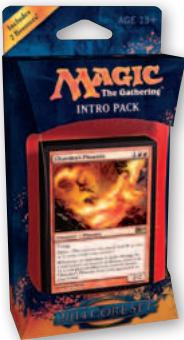
Trading card games like the Magic: The Gathering® game combine collectable cards with a strategy game. Start your collection with an intro pack and begin battling immediately with a ready-to-play deck.
Once you’ve gotten a handle on how to play, customize your deck using cards from booster packs, starting with the ones included in your intro pack.
You don’t know what cards you’ll get in a Magic booster pack. You just start a collection and trade with other players to get the cards you want. You can find stores where Magic cards are sold at Wizards.com/Locator.
The best part about a trading card game is that it’s always changing. You design and build your own unique decks, and each Magic game you play is different. New Magic expansions are released a few times a year, and
each new expansion brings new ways to stupefy and defeat your opponents. Check out MagicTheGathering.com for daily articles, insider information, and news about upcoming sets!

Contents
Section 1: The Basics
Five Colors of Mana . . . . . . . . .
Parts of a Card . . . . .
Card Types . . .
Game Zones . 8
Section 2: The Building Blocks
Making Mana. . . . . .
Spells . . . 10
Abilities . . 12
Attacking and Blocking . . . 13
Building Your Own Deck . . 15
The Golden Rule . . 15
Section 3: Playing a Game
Get a Deck . . . 16
Get a Friend . . . 16
Start the Game . . 16
Parts of the Turn . . 17
The Next Turn . 18
The Ever-Changing Game 18
Section 4: Different Ways to Play
Limited Formats . . 19
Multiplayer Variants . 20
Section 5: Glossary . 21
Questions? . . . 34
Section 1: The Basics
The Magic: The Gathering game is a strategy game played by two or more players, each of whom has a customized deck of Magic cards. Over the course of the game, each player will take turns playing cards such as lands (which enable you to play your other cards), creatures, sorceries, and other spells. Each player starts at 20 life. When you reduce your opponent to 0 life by attacking with creatures and playing spells, you win!
Five Colors of Mana
Only one thing unites the infinite planes of the Multiverse: mana, the energy that fuels all magic. The five colors of mana are imbued in the land itself, and a Planeswalker with a connection to a place can call upon its mana from across the sea of Æther between worlds.
Each color of mana fuels a different kind of powerful magic for you to command. For example, red spells have oR in their costs, and tapping (turning) a Mountain gives you oR that you can spend to cast spells. It’s up to you whether to master one color or all five.
White
White is the color of law, order, and structure. The sprawling Plains, populated by soldiers, clerics, and angels, provide white mana. You send coordinated armies of smaller creatures into battle to teach the enemy a lesson.
Green
Green magic is about growth, life, and brute force. The Forests overflow with green mana, which represents the pulse of nature. You empower your creatures with the predatory might of nature and dominate through sheer size.
Red
Red magic erupts with fire, frenzy, and storms of rock and lava. Red mana comes from Mountains and volcanoes. You act quickly and recklessly, channeling your wild emotions to summon mighty dragons or crush the ground your enemies walk on.

Blue
Blue magic relies on trickery and manipulation. Islands provide blue mana, the color of the deep sea and the endless sky. You work behind the scenes, controlling your environment completely before making a move.
Black
Black magic is about death, disease, and power at any cost. Black mana comes from dank Swamps, where things fester and rot. You are as selfish and twisted as the undead creatures and unspeakable
horrors you command.
Card Name
Type Line
This tells you the card’s card type: artifact, creature, enchantment, instant, land, planeswalker, or sorcery. If the card has a subtype or supertype, that’s also listed here. For example, Shivan Dragon is a creature, and its subtype is the creature type Dragon.
Text Box
This is where a card’s abilities appear. You may also find flavor text printed in italics (like this) that tells you something about the Magic world. Flavor text has no effect on game play. Some abilities have italic reminder text to help explain what they do.
Collector Number
The collector number makes it easier to organize your cards. For example, “154/249” means that the card is the 154th of 249 cards in its set.

Flying
oR: Shivan Dragon gets +1/+0 until end of
The undisputed master of the mountains
Mana Cost
Mana is the main resource in the game. It’s produced by lands, and you spend it to cast spells. The symbols in a card’s upper right corner tell you the cost to cast that spell. If the mana cost reads o4oRoR, you pay four mana of any kinds plus two red mana (from two Mountains) to cast it.
This symbol tells you which Magic set the card is from. This version of Shivan Dragon is from the Magic 2014 core set. The color of the symbol tells you the card’s rarity: black for common cards, silver for uncommons, gold for rares, and red-orange for mythic rares.
Power and Toughness
Expansion Symbol
Each creature card has a special box with its power and toughness. A creature’s power (the first number) is how much damage it deals in combat. Its toughness (the second number) is how much damage must be dealt to it in a single turn to destroy it. (A planeswalker card has a different special box with its loyalty here.)
Card Types

Every Magic card has one or more types. A card’s type tells you when you can play the card and what happens to the card after you do.
Sorcery
A sorcery represents a magical incantation. You can cast a sorcery only during a main phase of one of your own turns. You can’t cast it when another spell is on the stack. (You’ll learn about phases and the stack in a bit.) A sorcery has its effect—in other words, you follow the instructions on the card—then you put it into your graveyard, which is the game term for your discard pile.

Enchant Mountain
Enchanted Mountain is a 7/7 red Giant creature with haste. It’s stil a land.
Some days you stand to greet the horizon.
Other days the horizon stands to greet you.
Jaime Jones
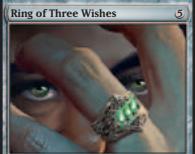
Ring of Three Wishes enters the battlefield with three wish counters on it.
o5, oT, Remove a wish counter from Ring of Three Wishes: Search your library for a card and put that card into your hand. Then shuffle your library.
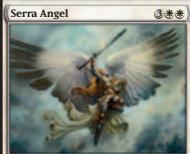
Flying
Vigilance (Attacking doesn’t cause thi creature to tap.)
Fol ow the light. In its absence, fol ow her.
Instant
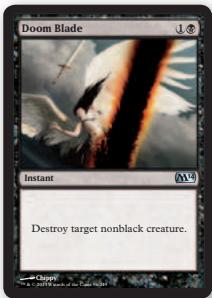
An instant is just like a sorcery, except you can cast it just about any time you want, even during your opponent’s turn or in response to another spell. Like a sorcery, an instant has its effect, then you put it into your graveyard.
Enchantment
An enchantment represents a stable magical manifestation. An enchantment is a permanent. This means two things: you can cast one only at the time you could cast a sorcery, and after you cast one, you’ll put it on the table in front of you, near your lands. (Most players keep their lands closer to them, then put their other cards closer to the middle of the table.) The card is now on the battlefield. A card on the battlefield is called a permanent because it sticks around permanently (well, unless something destroys it).
Some enchantments are Auras. An Aura enters the battlefield attached to a permanent and affects that permanent while it’s on the battlefield. If the enchanted permanent leaves the battlefield, the Aura is put into its owner’s graveyard.
Artifact
An artifact represents a magical relic. Like an enchantment, an artifact is a permanent, so it’ll stay on the battlefield affecting the game. Most artifacts are colorless, so you can cast one no matter what kinds of lands you have.
Some artifacts are Equipment. You can pay to attach an Equipment to a creature you control to make that creature more powerful. If an equipped creature leaves the battlefield, the Equipment doesn’t—the creature drops it and it remains on the battlefield.
Creature
Creatures fight for you. They’re permanents, but unlike any other kind of permanent, creatures can attack and block. Each creature has power and toughness. Its power (the first number) is how much damage it deals in combat. Its toughness (the second number) is how much damage must be dealt to it in a single turn to destroy it. Creatures attack and block during the combat phase.
Unlike other types of permanents, creatures enter the battlefield with “summoning sickness”: a creature can’t attack, or use an ability that has oT in its cost, until it has started your turn on the battlefield under your control. You can block with a creature or activate its other abilities no matter how long it’s been on the battlefield.
Artifact creatures are both artifacts and creatures. They’re usually colorless like other artifacts, and they can attack and block like other creatures. An artifact creature can be affected by anything that affects artifacts, as well as anything that affects creatures.
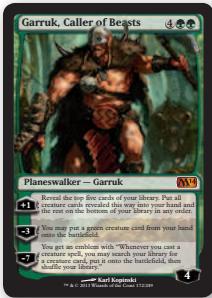
Planeswalker
Planeswalkers are powerful allies you can call on to fight by your side. You can cast a planeswalker only at the time you could cast a sorcery. They’re permanents, and each one enters the battlefield with the number of loyalty counters indicated in its lower right corner.
Each planeswalker has loyalty abilities that are activated by adding or removing loyalty counters from the planeswalker. For example, the symbol ! means “Put one loyalty counter on this planeswalker” and the symbol 3 means “Remove three loyalty counters from this planeswalker.” You can activate one of these abilities only at the time you could cast a sorcery and only if none of that planeswalker’s loyalty abilities have been activated yet that turn.
Your planeswalkers can be attacked by your opponent’s creatures (if so, you can block as normal), and your opponents can damage them with their spells and abilities instead of damaging you. Any damage dealt to a planeswalker causes it to lose that many loyalty counters. If a planeswalker has no loyalty counters, it’ put into your graveyard.
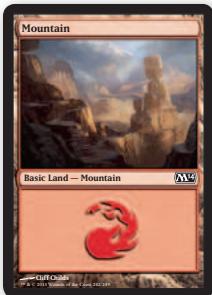
Land
Although lands are permanents, they aren’t cast as spells. To play a land, just put it onto the battlefield. This happens immediately, so no player can do anything else in response. You can play a land only during one of your main phases while the stack is empty. You can’t play more than one land a turn.
Most lands have abilities that make mana. You’ll use lands to make the mana you need to pay for spells and abilities.
Each basic land has a mana ability that makes one mana of a particular color. Plains make white mana (oW), Islands make blue mana (oU), Swamps make black mana (oB), Mountains make red mana (oR), and Forests make green mana (oG). Any land other than these five is a nonbasic land.

Opponent

Since the Magic game doesn’t have a game board, zones are the areas of play that exist on your table.
Here’s what a game in progress looks like. In this example, there aren’t any exiled cards, and no spells are on the stack. (When you put a spell on the stack, you take the card from your hand and put it in the middle of the table until it finishes resolving.)
HAND
16 life left


LIBRARY

GRAVEYARD




LIBRARY
GRAVEYARD
You 18 life left
HAND
Library
When the game begins, your deck of cards becomes your library (your draw pile). It’s kept face down, and the cards stay in the order they were in at the beginning of the game. No one can look at the cards in your library, but you can know how many cards are in each player’s library. Each player has his or her own library.
Hand
When you draw cards, they go to your hand, just as in most other card games. No one except you can look at the cards in your hand. You start the game with seven cards in your hand, and you have a maximum hand size of seven. (You may have more than seven cards in your hand, but you must discard down to seven at the end of each of your turns.) Each player has his or her own hand.
The Stack
Spells and abilities exist on the stack. They wait there to resolve until both players choose not to cast any new spells or activate any new abilities. Then the last spell or ability that was put onto the stack resolves, and players get a chance to cast spells and activate abilities again. (You’ll learn more about casting spells and activating abilities in the next section.) This zone is shared by both players.
Battlefield
You start the game with nothing on the battlefield, but this is where the action is going to be. On each of your turns, you can play a land from your hand. Creatures, artifacts, enchantments, and planeswalkers also enter the battlefield after they resolve. You can arrange your permanents however you want (we recommend putting lands closest to you), but your opponent must be able to see all of them and tell whether they’re tapped. This zone is shared by both players.
Graveyard
Your graveyard is your discard pile. Your instant and sorcery spells go to your graveyard when they resolve. Your cards go to your graveyard if an effect causes them to be discarded, destroyed, sacrificed, or countered. Your planeswalkers go to your graveyard if they lose all their loyalty counters. Your creatures go to your graveyard if the damage they’re dealt in a single turn is equal to or greater than their toughness, or if their toughness is reduced to 0 or less. Cards in your graveyard are always face up and anyone can look at them at any time. Each player has his or her own graveyard.
Exile
If a spell or ability exiles a card, that card is put in a game area that’s set apart from the rest of the game. The card will remain there forever, unless whatever put it there is able to bring it back. Exiled cards are normally face up. This zone is shared by both players.
Section 2: The Building Blocks
This section describes the actions that you’ll take during a game. You’ll learn how to make mana, which is the resource you need to cast spells. You’ll learn how to cast a spell, as well as how to use abilities. You’ll also learn how to attack and block with your creatures. The section finishes with a brief description of how to build your first deck and an explanation of the game’s “Golden Rule.”
Making Mana
To do just about anything else in the game, you first need to be able to make mana. Think of mana as Magic money—it’s what you use to pay most costs. Each mana is either one of the five Magic colors or is colorless. When a cost requires colored mana, you’ll see colored mana symbols (Wo for white, Uo for blue, Bo for black, Ro for red, Go for green). When any kind of mana can be used to pay the cost, you’ll see a symbol with a number in it (like 2o).
Where does mana come from? Nearly every land in the game has an ability that produces mana. Basic lands just have a large mana symbol in their text boxes to show this—you can tap one of them to add one mana of that color to your mana pool. (Your mana pool is where mana is stored until you spend it.) Other lands, as well as some creatures, artifacts, and spells, may also make mana. They’ll say something like “Add G o to your mana pool.”
Mana that you’ve made doesn’t last forever. At the end of each step or phase of the turn, any unused mana in your mana pool disappears. This doesn’t happen often because usually you’ll only make mana when you need it to cast a spell or activate an ability.
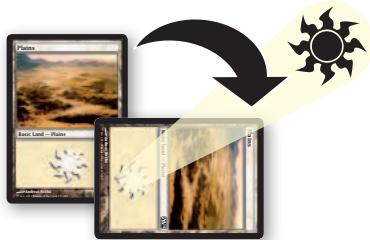
| BASIC LAND TYPE | CAN BE TAPPED FOR | |
| Plains | (white) | |
| Island | (blue) | |
| Swamp | (black) | |
| Mountain | (red) | |
| Forest | (green) |

Tapping
To tap a card is to turn it sideways. You do this when you use a land to make mana, when you attack with a creature, or when you activate an ability that has the oT symbol as part of its cost (oT means “tap this permanent”).
When a permanent is tapped, that usually means it’s been used for the turn. You can’t tap it again until it’s been untapped (straightened out).
At the beginning of each of your turns, you untap your tapped cards so you can use them again.

Now that you can make mana, you’ll want to use it to cast spells. All cards except lands are cast as spells. You can cast sorceries, creatures, artifacts, enchantments, and planeswalkers only during one of your main phases when there’s nothing else on the stack. Instants can be cast at any time.
Casting a Spell
To cast a spell, take the card you want to cast from your hand, show it to your opponent, and put it on the stack. (The stack is the game zone where spells live. It’s usually in the middle of the table.)
There are a few choices that you need to make right now. If the spell is an instant or sorcery and says “Choose one —,” you choose which of the options you’re using. If the spell is an instant or sorcery and it has a target, you choose what (or who) that target is. Aura spells also target the permanents they’ll enchant. If the spell has Xo in its cost, you choose what number X stands for. Other choices will be made later, when the spell resolves.
Target
When you see the word “target” on a spell or ability, you have to choose one or more things for the spell or ability to affect. You’ll be able to choose only certain kinds of things, such as “target enchantment” or “target creature or player.”

You choose the targets for a
spell when you cast it, and you choose targets for an activated ability when you activate it. If you can’t meet the targeting requirements, you can’t cast the spell or activate the activated ability. Once you choose targets, you can’t change your mind later.
When the spell or ability resolves, it checks the targets to make sure they’re still legal (they’re still there, and they match the requirements stated by the spell or ability). If a target isn’t legal, the spell or ability can’t affect it. If none of the targets are legal, the spell or ability is countered and does nothing at all.
Now check what the spell’s cost is. Tap your lands to produce the mana necessary to pay that cost, and pay it. Once you do that, the spell has been cast.
Responding to a Spell
The spell doesn’t resolve (have its effect) right away—it has to wait on the stack. Each player, including you, now gets a chance to cast an instant or activate an activated ability in response. If a player does, that instant or ability goes on the stack on top of what was already waiting there. When all players decline to do anything, the top spell or ability on the stack will resolve.
Resolving a Spell
When a spell resolves, one of two things happens. If the spell is an instant or sorcery, it has its effect (in other words, you follow the instructions on the card), then you put the card into your graveyard. If the spell is a creature, artifact, enchantment, or planeswalker, you put the card on the table in front of you, near your lands. The card is now on the battlefield. Any of your cards on the battlefield is called a permanent because it sticks around permanently (well, until something happens to it). Many permanents have abilities, which is text on them that affects the game.
After a spell or ability resolves, both players get the chance to play something new. If no one does, the next thing waiting on the stack will resolve (or if the stack is empty, the current part of the turn will end and the game will proceed to the next part). If either player plays something new, it goes on top of the stack and the process repeats.
Turn the page to see examples of spells on the stack.
Examples of Spells on the Stack

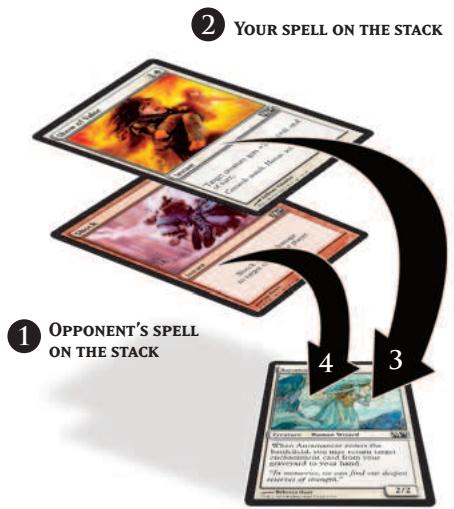
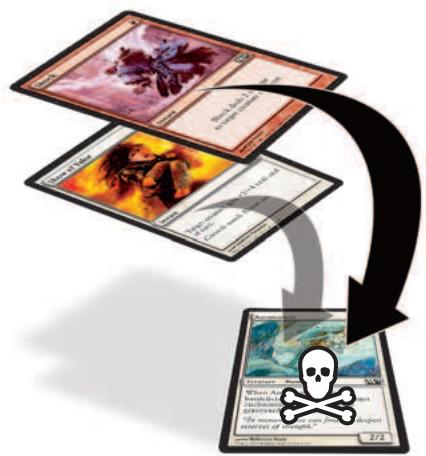
Your opponent casts Shock targeting your Auramancer, a 2/2 creature. The Shock goes on the stack.

You respond to the Shock by casting Show of Valor on your Auramancer. Show of Valor goes on the stack, on top of Shock.

You and your opponent both decline to do anything else. Show of Valor resolves, making the Auramancer 4/6 until the end of the turn.

Then the Shock resolves, dealing 2 damage to the pumped-up Auramancer. That’s not enough to destroy it.
Your creature on the battlefield
The Shock goes on the stack on top of Show of Valor so it resolves first. It deals 2 damage to Auramancer—enough to destroy it! When the Show of Valor tries to resolve, its only target is no longer on the battlefield, so it’s countered (it does nothing).
What would happen if the Show of Valor were cast first?
Abilities
As you start to accumulate permanents on the battlefield, the game will change. That’s because many permanents have text on them that affects the game. This text tells you a permanent’s abilities. There are three different kinds of abilities a permanent can have: static abilities, triggered abilities, and activated abilities.
Static Abilities
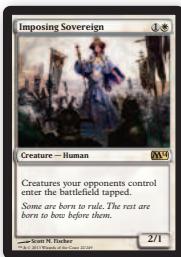
A static ability is text that is always true while that card is on the battlefield. For example, Imposing Sovereign is a creature with the ability “Creatures your opponents control enter the battlefield tapped.” You don’t activate a static ability. It just does what it says.
Triggered Abilities
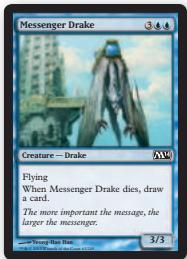
A triggered ability is text that happens when a specific event occurs in the game. For example, Messenger Drake is a creature with the ability “When Messenger Drake dies, draw a card.”
Each triggered ability starts with the word “when,” “whenever,” or “at.” You don’t activate a triggered ability. It automatically triggers whenever the first part of the ability happens. The ability goes on the stack just like a spell, and resolves just like a spell. If the ability triggers but then the permanent the ability came from leaves the battlefield, the ability will still resolve.
You can’t choose to delay or ignore a triggered ability. However, if the ability targets something or someone but you can’t choose a legal target for it, the ability won’t do anything.
Activated Abilities
An activated ability is an ability that you can activate whenever you want, as long as you can pay the cost. For example, Blood Bairn is a creature with the ability “Sacrifice another creature: Blood Bairn gets +2/+2 until end of turn.”
Each activated ability has a cost, then a colon (“:”), then an effect. Activating one works exactly like casting an instant spell, except there’s no card to put on the stack. The ability goes on the stack just like a spell, and resolves just like a spell. If you activate an ability but then the permanent the ability came from leaves the battlefield, the ability will still resolve.
Some activated abilities contain the oT symbol in their costs. This means that you must tap the permanent to activate the ability. You can’t activate the ability if the permanent is already tapped.
Keywords
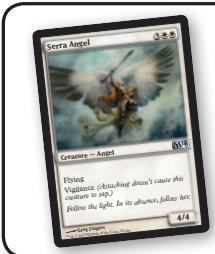
Some permanents have abilities that are shortened to a single word or phrase. Many of these have reminder text that gives you a brief description of the ability’s effect. Keyword abilities in the core set include deathtouch, defender, enchant, equip, first strike, flash, flying, haste, hexproof, indestructible, landwalk (such as swampwalk or forestwalk), lifelink, protection, reach, trample, and vigilance. Most of these are static abilities, but keyword abilities can also be triggered abilities or activated abilities. Detailed explanations of each of these abilities can be found in the glossary at the end of this rulebook.

The primary way to win the game is to attack with your creatures. If a creature that’s attacking your opponent isn’t blocked, it deals damage equal to its power to him or her. It doesn’t take that many hits to drop your opponent all the way from 20 life to 0!
The middle of each turn is the combat phase. (You’ll learn about the parts of the turn in a bit.) In your combat phase, you choose which of your creatures will attack, and you choose who or what they will attack. Each one can attack your opponent or one of your opponent’s planeswalkers, but not any of his or her creatures. You tap the attacking creatures. They all attack at the same time, even if they’re attacking different things. You can attack with a creature only if it’s untapped, and only if it was on the battlefield under your control when the turn began.
Your opponent chooses which of his or her creatures will block. Tapped creatures can’t be declared as blockers. For blocking, it doesn’t matter how long the creature has been on the battlefield. Each creature can block only one attacker,
but multiple blockers can gang up on a single attacking creature. If that happens, the attacking player orders the blockers to show which is first in line for damage, which is second, and so on. Creatures don’t have to block.
After all blockers are chosen, combat damage is assigned. Each creature—both attackers and blockers—deals damage equal to its power.
• An attacking creature that isn’t blocked deals damage to the player or planeswalker it’s attacking.
• An attacking creature that is blocked deals damage to the blocking creatures. If one of your attacking creatures is blocked by multiple creatures, you decide how to divide its combat damage among them. You must assign at least enough damage to the first blocking creature in line to destroy it before you can assign damage to the next one in line, and so on.
• A blocking creature deals damage to the attacker it’s blocking.
If damage is dealt to your opponent, he or she loses that much life!
If damage is dealt to your opponent’s planeswalker, that many loyalty counters are removed from it.
If a creature is dealt damage equal to or greater than its toughness over the course of a single turn, that creature is destroyed and goes to its owner’s graveyard. If a creature takes damage that isn’t lethal, that creature stays on the battlefield, but the damage doesn’t wear off until the turn ends.
Turn the page to see an example of combat.
Example of Combat

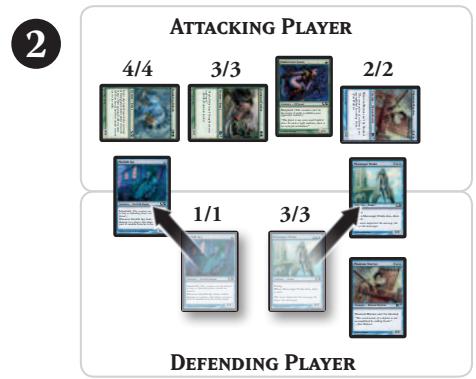

Declare Attackers
The attacking player attacks with his three biggest creatures and taps them. He doesn’t attack with the smallest because it’s too easy to destroy, and it might be useful for blocking on the opponent’s next turn.
Assign Blockers
The defending player assigns blockers to two of the attackers and lets the third attacker through. Blocking choices are up to the defender.
Combat Damage
The unblocked attacker deals 3 damage to the defending player. The blocked attackers and the blockers deal damage to each other. The smaller creatures die and the bigger creatures live.
You play a Magic game with your own customized deck. You build it yourself using whichever Magic cards you want. There are two rules: your deck must have at least 60 cards, and your deck can’t have more than four copies of any single card (except for basic lands). The rest is up to you, but here are some guidelines:
Lands. A good rule of thumb is that 40% of your deck should be lands. A 60-card deck usually has about 24 lands.
Creatures. Creatures account for 15 to 25 cards in a typical 60-card deck. Choose creatures that have a variety of mana costs.
Low-cost creatures are potent early on, but high-cost creatures can quickly win a game once they enter the battlefield.
Other cards. Artifacts, enchantments, planeswalkers, instants, and sorceries round out your deck.
After you play with your new deck for a while, you can start to customize it. Take out cards you don’t feel are working well and add new cards you want to try. The best part about trading card games is being able to play with whatever cards you want, so start experimenting!
Once they build up their collections, Magic players often choose to build different decks for different formats. Formats are defined by what cards can be played in them. The most popular Magic format is called Standard. It uses only the newest sets the game has to offer. The current block, the block that was released the previous October, and the most recent core set are all legal to play in a Standard deck. Standard events are available all year, worldwide. When you’re ready to start exploring other Magic formats, go to Wizards.com/MagicFormats fo more information.
When a Magic card contradicts the rulebook, the card wins. For example, the rules say creatures enter the battlefield untapped. But Imposing Sovereign is a creature that says “Creatures your opponents control enter the battlefield tapped.” Imposing Sovereign changes the rules as long as it’s on the battlefield. One of the things that makes the Magic game fun to play is that there are individual cards that let you break almost every rule.
Section 3: Playing a Game
Now that you know the elements of the game and how to perform the main actions, it’s time to walk through a turn. This section describes what happens in each part of a turn. In a typical game, you’ll skip many of these parts (for example, nothing usually happens in the “beginning of combat” step). An actual Magic game is pretty casual, despite how complex the structure may seem.
Get a Deck

You’ll need your own Magic deck. You’ll also need a way to keep track of both players’ life totals, as well as small items to use as counters or tokens.
When you’re first getting started, you may want to pick up a ready-to-play deck, such as an intro pack or event deck, or borrow a deck from a friend. After you’ve built up your collection, try building your own deck using the guidelines on page 15.
Get a Friend

To play a game, you’ll need an opponent! Your opponent will play against you using his or her own deck.


Each player starts at 20 life. You win the game by reducing your opponent to 0 life. You also win if your opponent has to draw a card when none are left in his or her deck, or if a spell or ability says that you win.
Decide which player will go first. If you’ve just played the same opponent, the loser of the last game decides who goes first. Otherwise, roll a die or flip a coin to see who gets to decide.
Each player shuffles his or her deck, then draws a hand of seven cards to start. If you don’t like your opening hand, you can mulligan. Shuffle your hand back into your deck and draw a new hand of six cards. You can keep doing this, drawing a hand of one fewer card each time, until you decide to keep your cards.
Below are the parts of a turn. Each turn proceeds in the same sequence. Whenever you enter a new step or phase, any triggered abilities that happen during that step or phase trigger and are put on the stack. The active player (the player whose turn it is) gets to cast spells and activate abilities, then the other player does. When both players in a row decline to do anything and nothing is waiting to resolve, the game will move to the next step or phase.
With each part of the turn is a description of what can happen during that part, if it’s your turn.
1. Beginning Phase
A. UNTAP STEP
You untap all your tapped permanents. On the first turn of the game, you don’t have any permanents, so you just skip this step. No one can cast spells or activate abilities during this step.
B. UPKEEP STEP
This part of the turn is mentioned on a number of cards. If something is supposed to happen just once per turn, right at the beginning, an ability will trigger “at the beginning of your upkeep.” Players can cast instants and activate abilities.
C. DRAW STEP
You draw a card from your library. (The player who goes first skips the draw step on his or her first turn to make up for the advantage of going first.) Players can then cast instants and activate abilities.
2. Main Phase
You can cast any number of sorceries, instants, creatures, artifacts, enchantments, and planeswalkers, and you can activate abilities. You can play a land during this phase, but remember that you can play only one land during your turn. Your opponent can cast instants and activate abilities.
3. Combat Phase
A. BEGINNING OF COMBAT STEP
Players can cast instants and activate abilities. This is your opponent’s last chance to cast spells or activate abilities that stop your creatures from attacking.
B. DECLARE ATTACKERS STEP
You decide which, if any, of your untapped creatures will attack and which player or planeswalker they will attack. Then they do so. This taps the attacking creatures. Players can then cast instants and activate abilities.
C. DECLARE BLOCKERS STEP
Your opponent decides which, if any, of his or her untapped creatures will block your attacking creatures, then they do so. If multiple creatures block a single attacker, you order the blockers to show which is first in line for damage, which is second, and so on. Players can then cast instants and activate abilities.
D. COMBAT DAMAGE STEP
Each attacking or blocking creature that’s still on the battlefield assigns its combat damage to the defending player (if it’s attacking that player and wasn’t blocked), to a planeswalker (if it’s attacking that planeswalker and wasn’t blocked), to the creature or creatures blocking it, or to the creature it’s blocking. If an attacking creature is blocked by multiple creatures, you divide its combat damage among them by assigning at least enough damage to the first blocking creature in line to destroy it before assigning damage to the next one in line, and so on. Once players decide how the creatures they control will deal their combat damage, the damage is all dealt at the same time. Players can then cast instants and activate abilities.
E. END OF COMBAT STEP
Players can cast instants and activate abilities.
4. Main Phase
Your second main phase is just like your first main phase. You can cast every type of spell and activate abilities, but your opponent can only cast instants and activate abilities. You can play a land during this phase if you didn’t during your first main phase.
5. Ending Phase
A. END STEP
Abilities that trigger “at the beginning of your end step” go on the stack. Players can then cast instants and activate abilities.
B. CLEANUP STEP
If you have more than seven cards in your hand, choose and discard cards until you have only seven. Next, all damage on creatures is removed and all “until end of turn” and “this turn” effects end. No one can cast instants or activate abilities unless an ability triggers during this step.
Now it’s your opponent’s turn. That player untaps his or her permanents and goes from there. After that player is done, it will be your turn again. Keep going until a player is reduced to 0 life. As soon as a player has 0 life, the game ends immediately and the other player wins!
The Ever-Changing Game

You know everything you need to play a Magic game. But what kind of game will you play? Appropriately enough for a game with so many options, there are lots of different ways to play. Everyone can start on equal footing with brand-new cards rather than build decks in advance from the cards in their collections. You can even play with a bunch of friends, not just one.

Limited Formats

In Limited play, each player builds his or her own deck on the spot out of a number of booster packs. In other words, your deck is made from a limited card pool. Each deck must contain at least 40 cards (rather than the usual 60 for a Constructed deck). The only cards you can play with are the ones opened in those packs, plus any number of basic land cards. (A 40-card deck should have about 17 lands and about 15 creatures.)
Sealed Deck (any number of players)
In this Limited format, you build a deck out of brand-new booster packs. Each player opens six 15-card boosters and builds a 40-card deck using the cards from his or her packs and any number of basic lands.
Booster Draft (4 to 8 players)
In this Limited format, instead of just opening your cards and building a deck, you and the other players at the table select (draft) the cards for your decks. Each player at the table starts with three unopened 15-card booster packs.
At the start of a booster draft, each player opens a pack and picks the card he or she wants from it. (You can’t see the cards that the other players draft.) Then each player passes the rest of the pack to his or her left. You pick up the pack that was passed to you, select a card, and pass the rest to your left. This process continues until all the cards have been drafted. Next, each player opens a second pack, but this time, you pass the pack to your right. After all those cards are drafted, you open the third pack and pass to the left again. Use your picks and any number of basic lands to build your 40-card deck.
You can play a Magic game with more than two players in it. There are dozens of different ways to do so. Some of the most popular are Two-Headed Giant and Commander, which can be played using only traditional Magic cards from your collection. Other multiplaye variants use oversized cards or a special die to provide a unique experience for your play group.
Two-Headed Giant
In a Two-Headed Giant game, you and a teammate play against another two-person team. You and your teammate can show each other your hands and discuss strategy. Your team has a shared life total that starts at 30, you and your teammate have a shared turn, and your team’s creatures attack the other team as a group. But you continue to have your own individual library, control your own permanents, spend your own mana, and so on.
Commander
In a Commander game, each player’s deck is led by the legendary creature of his or her choice—fittingly, that’s the deck’s commander. The rest of the deck is a specially crafted arsenal of creatures, artifacts, and other spells, designed to reflect the personality of that commander and take advantage of his or her strengths. A Commander game is best enjoyed as a Free-for-All game among 3–6 players, although two-player games are also common. Find out more about this grassroots, player-built format at MTGCommander.net.
Planechase
The Planechase variant adds a deck of oversized plane cards that set the location for your multiplayer battles across the Multiverse. The planes have abilities that alter the rules of the game. If you don’t like your current surroundings, you can try to planeswalk by rolling the planar die, but be prepared for the occasional chaotic result!
Archenemy
In an Archenemy game, one player starts with 40 life and an extra deck of oversized scheme cards. That player is known as the archenemy. The other players play as a team and try to defeat the archenemy.
Tips
In a multiplayer game, the first time a player takes a mulligan, he or she draws a new hand of seven cards rather than six cards. Subsequent hands decrease by one card as normal.
In a Two-Headed Giant game, the team who plays first skips the draw step of their first turn. In all other multiplayer games, no player skips the draw step of his or her first turn.
Learn more about these and other Magic formats at Wizards.com/MagicFormats.
Section 5: Glossary
o1, o2, o3, and so on, oX
One of these generic mana symbols in a cost means “this many of any type of mana.” For example, o2 in a cost means you can pay two mana of any type, such as oR and oG, or oU and oU, or oR and one colorless mana, and so on. (If oX is in a cost, you get to choose what number the X stands for.)
These symbols are also found in some abilities that produce mana, like “Add 1o to your mana pool.” In this context, 1o means “one colorless mana.” You can’t use colorless mana to pay for colored mana costs.
oW (white mana)
One white mana. Tapping a Plains makes oW. A card with oW in its mana cost is white.
oU (blue mana)
One blue mana. Tapping an Island makes oU. A card with oU in its mana cost is blue.
oB (black mana)
One black mana. Tapping a Swamp makes oB. A card with oB in its mana cost is black.
oR (red mana)
One red mana. Tapping a Mountain makes oR. A card with oR in its mana cost is red.
oG (green mana)
One green mana. Tapping a Forest makes oG. A card with oG in its mana cost is green.
oT (tap)
This symbol means “tap this card” (turn it sideways to show that it’s been used). It appears in activation costs. You can’t pay a oT cost if the card is already tapped. Also, remember that you can’t pay your creature’s oT costs until the creature starts your turn on the battlefield under your control.
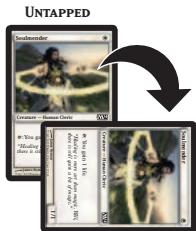
Tapped
oh1, oh6, and so on
Hybrid mana symbols represent a cost that can be paid with either of two colors. For example, a cost represented by the oh1 symbol can be paid with one white mana or one blue mana. It’s both a white and a blue mana symbol, and a card with oh1 in its mana cost is both white and blue.
H/H
Instead of numbers, some creatures have stars for their power and toughness. This means the creature’s power and toughness are set by an ability it has rather than being fixed numbers. For example, Nightmare has an ability that reads “Nightmare’s power and toughness are each equal to the number of Swamps you control.” If you control four Swamps when Nightmare enters the battlefield, it will be 4/4. If you play more Swamps later on, it will get even bigger.
Ability
Any text on a permanent (except reminder text and flavor text) tells you the permanent’s abilities. There are three kinds of abilities a permanent can have: activated abilities, static abilities, and triggered abilities. Unless they say otherwise, abilities “work” only while the permanent they’re on is on the battlefield. Once a triggered ability triggers or an activated ability is activated, it will resolve unless it’s countered; it doesn’t matter what happens to the source of the ability once the ability goes on the stack. See “Activated Abilities” on page 12.
Activate
You activate an activated ability by putting it on the stack. You activate an ability just as you cast a spell: announce it, choose its targets, and pay its activation cost. See “Activated Abilities” on page 12.
Activated ability
One of the three kinds of abilities a permanent can have. An activated ability is always written in the form “cost: effect.” See “Abilities” on page 12.
Active player
The player whose turn it is. The active player always gets the first chance to cast spells and activate abilities.
Additional cost
Some spells say they have an additional cost. To cast that spell, you must pay both the mana cost in the upper right corner of the card and its additional cost.
Archenemy
A one-on-many multiplayer variant that features oversized scheme cards.
Artifact
A card type. See “Artifact” on page 6.
Artifact creature
This is both an artifact and a creature. See “Creature” on page 6.
Attack
How your creatures deal damage to your opponent. During your combat phase, you decide which, if any, of your untapped creatures will attack, and which player or planeswalker they will attack, then they all do so at once. Attacking causes creatures to tap. Creatures can attack only players or planeswalkers, not other creatures. Your opponent then gets a chance to block your attacking creatures with his or her own creatures. See “Attacking and Blocking” on page 13.
Attacking creature
A creature that’s attacking. A creature is attacking from the time it’s declared as an attacker until the combat phase ends, unless it’s somehow removed from combat. There’s no such thing as an attacking creature outside of the combat phase.
Aura
A special type of enchantment that can be attached to a permanent (or sometimes a player). Each Aura has the keyword “enchant” followed by what it can be attached to: “enchant creature,” “enchant land,” and so on. When you cast an Aura spell, you choose one of the right kind of permanent to target. When the Aura resolves, it’s put onto the battlefield attached to that permanent (it’s not targeting it anymore). If an Aura is ever attached to something that doesn’t match its enchant ability—or attached to nothing at all—it’s put into its owner’s graveyard.
Basic land
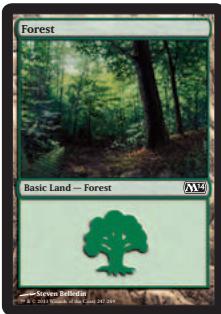
There are five basic lands. Plains make Wo (white mana). Islands make Uo (blue mana). Swamps make Bo (black mana). Mountains make Ro (red mana). Forests make Go (green mana). They each say “basic” on their type line (basic is a supertype). Lands other than these five are called nonbasic lands.
When building a deck, you can include any number of basic lands. You can’t have more than four copies of any other cards in your deck.
Basic land type
Each basic land has a subtype, which appears after “Basic Land —” on its type line. These are the “basic land types,” which are the same five words as the basic land names. Some nonbasic lands also have basic land types. Any land with a basic land type has an activated ability that makes one mana of the appropriate color, even if it doesn’t say so in the text box. For example, every Forest has the ability “To: Add Go to your mana pool.”
Battlefield
A game zone. See “Battlefield” on page 8.
Block
To stop an attacking creature from damaging you or one of your planeswalkers by having it fight one of your creatures instead. After your opponent attacks with one or more creatures, you can have any number of your untapped creatures block. Each one can block one attacking creature. You can have two or more of your untapped creatures gang up and block a single attacking creature. If an attacker is blocked, it will deal its combat damage to the creature blocking it instead of to the player or planeswalker it was attacking. Blocking is optional. See “Attacking and Blocking” on page 13.
Blocked creature
An attacking creature that’s blocked by at least one creature. Once a creature is blocked, it stays blocked for the rest of the combat phase—even if all the creatures blocking it leave combat. In other words, once a creature is blocked, there’s no way for it to deal damage to the player or planeswalker it’s attacking (unless the attacking creature has trample). There’s no such thing as a blocked creature outside of the combat phase.
Blocking creature
A creature assigned to block an attacking creature. If a creature blocks an attacker, the attacker deals its damage to the blocker instead of to the player or planeswalker it’s attacking. Once a creature blocks, it stays a blocking creature for the rest of the combat phase—even if the creature it’s blocking leaves combat. There’s no such thing as a blocking creature outside of the combat phase.
Booster, booster pack
A pack of randomly assorted Magic cards. When you want to add more cards to your collection, this is what you’ll get. Most 15-card booster packs contain one rare or mythic rare card, three uncommon cards, and eleven common cards, including one basic land card. Find stores where Magic cards are sold at Wizards.com/Locator.
Booster Draft
See “Limited Formats” on page 19.
Card type
Every card in your deck has at least one card type: artifact, creature, enchantment, instant, land, planeswalker, or sorcery. A card’s type is printed under its illustration. Some cards, like artifact creatures, have more than one type. Some cards also have subtypes, such as “Goblin” and “Warrior” in “Creature — Goblin Warrior,” or supertypes, such as “basic” in “Basic Land — Forest.”
Cast
You cast a spell by putting it on the stack. Different kinds of spells can be cast at different times, but the things you have to do to cast a spell are always the same: announce it, choose its targets (and make certain other choices right away), and pay its cost. See “Spells” on page 10.
Choose one —
When you see the phrase “Choose one —” on a card, you have to choose one option on the card when you cast it. You can’t change your mind and choose something else later on, even if your first choice doesn’t work out.
Color
The five Magic colors are white, blue, black, red, and green. If a spell
or ability tells you to choose a color, you must choose one of those five. A card’s color is determined by its mana cost. For example, a card that costs 1oUo is blue and a card that costs RoWo is both red and white. Cards with no colored

their mana costs, like most artifacts, are colorless. (Colorless is not a color.) Lands are also colorless.
Some effects can change a spell or permanent’s color. For example, “Target creature becomes blue until end of turn.” The new color replaces the previous colors, unless the ability says otherwise.
Colorless
Lands and most artifacts are colorless. Colorless is not a color. If something tells you to choose a color, you can’t choose colorless.
Combat
In general, combat means attacking, blocking, and all the stuff that happens during a combat phase.
Combat damage
Damage dealt by creatures due to attacking and blocking. A creature deals combat damage equal to its power. This damage is dealt during the combat damage step. Any other kind of damage doesn’t count as combat damage, even if it’s dealt as the result of a creature’s ability during combat.
Combat damage step
See “Parts of the Turn” on page 17.
Combat phase
See “Parts of the Turn” on page 17.
Command zone
A game zone used for objects that affect the game but aren’t permanents. Some planeswalkers create emblems that go here, and some multiplayer variants use this zone for their oversized cards.
Commander
A casual variant in which each player’s deck is led by a legendary creature.
Concede
To stop playing a game and give your opponent the victory. You can concede a game at any time (usually if you realize you won’t be able to avoid losing). When you concede, you lose the game.
Constructed
A group of play formats that use decks you build in advance. A Constructed deck must have at least 60 cards, and it can’t have more than four copies of any single card (except for basic lands). Standard is the most popular Constructed format.
Continuous effect
An effect that lasts for some duration. These are different from one-shot effects, which just happen once and don’t have a duration. You can tell how long a continuous effect will last by reading the spell or ability it came from. For example, it might say “until end of turn.” If the continuous effect comes from a static ability, it lasts as long as the permanent with the ability is on the battlefield.
Control
You control spells you cast and permanents that entered the battlefield on your side. You also control abilities that come from permanents you control.
Only you can make decisions for things you control. If you control a permanent, only you can activate its activated abilities. Even if you put an Aura on your opponent’s creature, you control the Aura and its abilities.
Some spells and abilities let you gain control of a permanent. Most of the time, this means the card will move from your opponent’s side to yours. But for Auras or Equipment attached to other cards, the controller changes but it doesn’t move.
Controller
A spell’s controller is the player who cast it. An activated ability’s controller is the player who activated it. A permanent’s controller is the player who cast it—unless another spell or ability changes who controls it. A triggered ability’s controller is the player who controlled the source of the ability when it triggered.
Converted mana cost
The total amount of mana in a mana cost, regardless of color. For example, a card with a mana cost of 3oUoUo has a converted mana cost of 5. A card with mana cost RoRo has a converted mana cost of 2.
Cost
A cost is something you have to pay to take another action. You must pay a cost to cast a spell or activate an activated ability. Sometimes a spell or ability will also ask you to pay a cost when it resolves. You can’t pay a cost unless you can pay all of it. For example, if an activated ability’s cost (the part before the “:”) tells you to discard a card and you have no cards in your hand, you can’t even try to pay it.
Counter a spell or ability
To cancel out a spell or ability so it has no effect. If a spell is countered, it’s removed from the stack and put into its owner’s graveyard. Once a spell or ability starts to resolve, it’s too late to counter it. Lands aren’t spells, so they can’t be countered.
Counter on a permanent
Some spells and abilities tell you to put a counter on a permanent. The counter marks a change to the permanent that lasts for as long as it’s on the battlefield. A counter usually changes a creature’s power and toughness or tracks a planeswalker’s current loyalty. You can use anything you want as counters: glass beads, dice, or whatever.
Creature
A card type. See “Creature” on page 6.
Creature type
This tells you what kind of creature a creature is, such as Goblin, Elf, or Warrior. You find creature types in the middle of the card after “Creature — .” If a creature has more than one word after the dash, the creature has all of those creature types.
Some spells and abilities affect multiple creatures with a certain type. For example, Predatory Sliver reads “Sliver creatures you control get +1/+1.” All creatures you control with the Sliver creature type, including Predatory Sliver, get the bonus.
Damage
This is what knocks down a player’s life total, lowers a planeswalker’s loyalty, and destroys creatures. Attacking and blocking creatures deal damage equal to their power. Some spells and abilities can also deal damage. Damage can be dealt only to creatures, planeswalkers, or players. If a creature is dealt damage equal to or greater than its toughness in one turn, it’s destroyed. If a planeswalker is dealt damage, that many loyalty counters are removed from it. If a player is dealt damage, it’s subtracted from the player’s life total.
Damage is different from losing life. For example, Dark Favor is an Aura with the drawback “When Dark Favor enters the battlefield, you lose 1 life.” That loss of life isn’t damage, so it can’t be prevented.
Deathtouch
A keyword ability seen on creatures. Deathtouch is an ability that causes a creature to deal an exceptionally lethal form of damage to other creatures. A creature dealt any amount of damage by a creature with deathtouch is destroyed. If your creature with deathtouch is blocked by multiple creatures, you can assign as little as 1 damage to each of the blocking creatures!
Deck
At least 60 cards of your choice, well shuffled. (Limited formats in which players build their decks as part of the event allow 40-card decks.) To play a Magic game, you must have your own deck. Once the game starts, your deck be
Content is long; only the first part is inlined. Download the file or open the rules page for the full text.
Download MarkdownTexts are community-compiled or publicly released by publishers; copyright remains with the original authors. For personal reference only.