
Mandala Stones
At a glance
Rules, cards and Q&A (Chinese)
The rules, card data and player questions for this game are written in Chinese. Open the Chinese page to read them.
Where to find full rules
Full rules and card lookup are available in the cunlema app at cunlema.cn — pick this game and ask about any rule, card or turn you are unsure about.
Related games
Rulebook text (Markdown)
This game has 1 rulebook Markdown file(s) in our library; 1 rendered inline below — expand to read or download.
mandala_rules_EN_website.md14.5 KB
RULEBOOK
INTRODUCTION
Welcome to Mandala Stones, a game of tranquility and beauty! Arrange colorful stones to create a stunning work of art together with your friends. However, while there are many creators, there can be only one winner. Influence artists, positioning them cleverly on the main board, to form towers out of collected Stones, which you then display onto the mandala board at an opportune moment to score Victory Points.
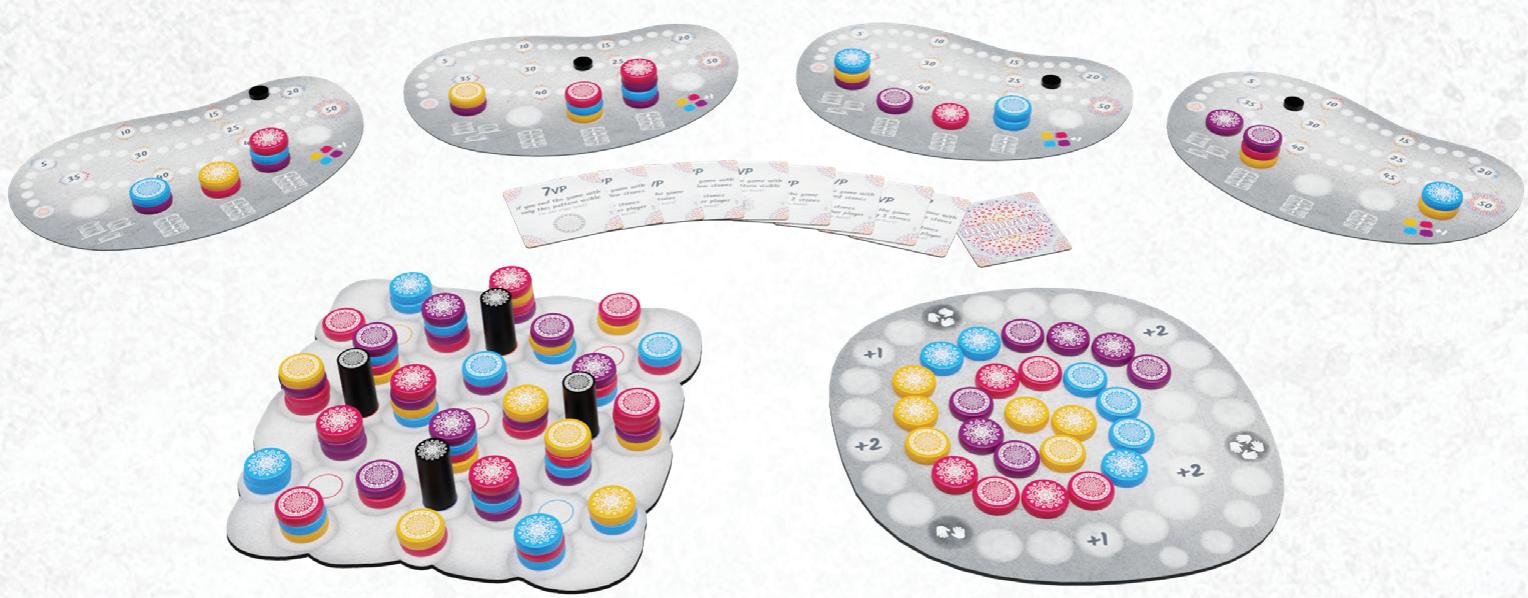
OO·GAME COMPONENTS ·O
Your copy of Mandala Stones contains the following components:

4 PLAYER BOARDS
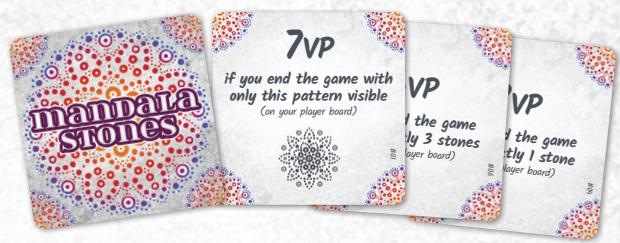
10 OBJECTIVE CARDS

I MAIN BOARD
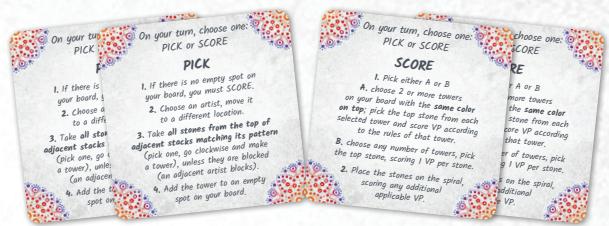
4 REFERENCE CARDS

96 STONES (24 in each of four colors)

I MANDALA BOARD
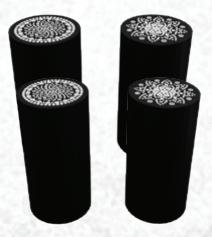
4 ARTISTS


4 SCORING MARKERS

I COTTON BAG
4 +50 VP MARKERS

SETUP
Before your first game, carefully punch out all cardboard components.
•OO MAIN BOARD SETUP©O
Place the main board in the middle of the table, within easy reach of all players. Add all Stones to the cotton bag. Draw Stones, one at a time, from the bag and place 4 onto each space marked withon the main board, forming stacks.
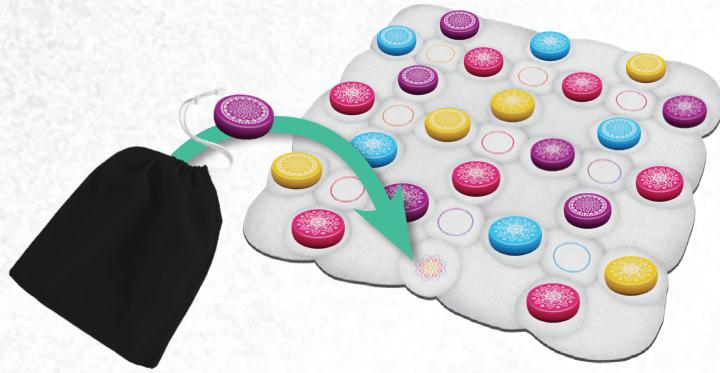
Place a random Artist onto each of the four circle spaces shown below.

•O MANDALA BOARD SETUP©
Place the Mandala board next to the main board. It is empty at the start of the game and will be filled with Stones as the game progresses.

PLAYER SETUPO
Give each player a reference card, a player board, and a scoring marker. Place your scoring marker on the space on your player board, marking the start of the Victory Point track. During the game, whenever you score any Victory Points, mark them by advancing your marker on this track. When you exceed 50 Victory Points, take a “+50 VP"marker and reset your scoring marker to the initial position on the Victory Point track before advancing the marker further.
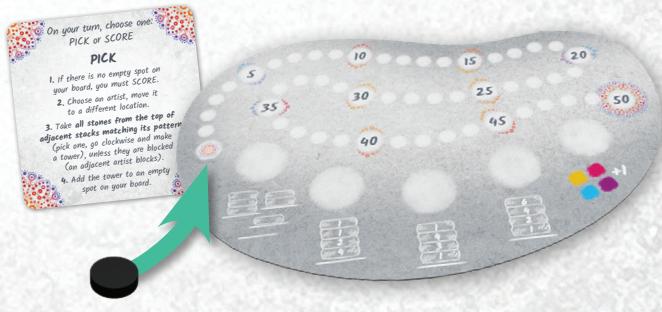
Shuffle all Objective cards without looking at them and deal 2 to each player. You may look at your own Objective cards at any time but should keep them hidden from the other players.
You are now ready to play Mandala Stones!
OO· PLAYING THE GAME ·OO
Randomly select a starting player. Mandala Stones is played over a number of rounds. Each round, beginning with the starting player and continuing clockwise around the table, every player will take one turn. The game will conclude at the end of the round during which the end-game condition is triggered, thus giving all players an equal number of turns. The player with the most Victory Points is the winner.
PLAYER TURNO
On your turn, you must perform one of two possible actions: PICK or SCORE. The handy reference card will remind you of the rules governing each action.
PICK
Note: If there are no empty spaces on your player board, you are not allowed to take the PICK action, therefore you must SCORE.
Choose one Artist and move it to a different position. You can move the Artist to any empty circle space on the main board. Then, take all the Stones from the top of the four adjacent stacks that are:
not adjacent to any other Artists and
match the pattern of the Artist you selected.
You must be able to take at least one stone!

In the image above, the indicated Artist was moved to the depicted position. You are not allowed to take the yellow Stone as it does not match the pattern of the Artist. You are also not allowed to take the blue Stone, as it is adjacent to another Artist. You must thus take the red and purple Stones.

Once you have identified which Stones you are allowed to take, you must decide which Stone to take first. Starting with this Stone, proceeding clockwise, around the Artist, take each allowed Stone, placing them on top of each other, to form a tower with the first Stone on the bottom, until you have taken all the Stones you were allowed to take.
Note: When taking Stones, you are not allowed to skip any of the allowed Stones. You must always take all of the Stones you were allowed to take.
After you have finished taking all the Stones, you must place the tower on any empty space on your player board. You may not rearrange the order of the Stones within the tower.


mandaLa sTones
Example:

In the image above, the placement of the Artist allows you to take the red, blue, and purple Stones. The order in which you take them depends on which Stone you decide to take first:
1.

2.

3.

From left to right, the images show the possible towers built when starting with: (1) the red Stone (taking, in order: red, blue, and purple); (2) the purple Stone (taking, in order: purple, red, and blue); and (3) the blue Stone (taking, in order: blue, purple, and red).
Important! In rare cases you may be unable to move an Artist in a way that allows you to take any Stones. In such a case you must select to SCORE instead. If you are also unable to SCORE, the game ends immediately.
SCORE
Decide whether to score a color or to score any top stones.
Score a color
Choose a color shared by the top Stones of at least 2 towers on your player board. Their patterns do not matter, as long as the Stones themselves are of the same color. When choosing this scoring option, you must always score all towers that share the selected color.

Example:
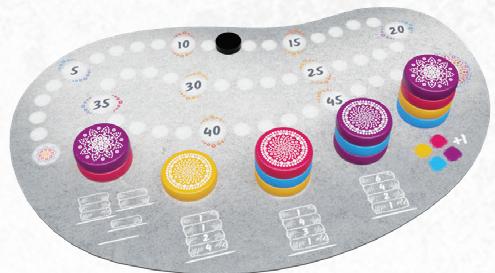
In the image above, you may only choose to score purple, as there is only one top Stone each of yellow and red. Since you must score all towers that share the selected color, you must score all three purple towers.
Score each such tower individually, according to the rule depicted next to it on your player board:
Important! Always score the applicable towers on your player board from left to right!
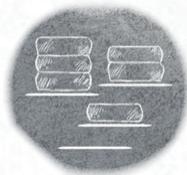

Tower Rule: score 1 Victory Point for each different height among all towers on your player board. Note: The colors of their top Stones do not matter. “Zero"(an empty space) is a valid height.
Tower Rule: score Victory Points depending on the current height of this tower. A tower consisting of 1/2/3/4 Stones scores you 4/2/1/1 Victory Points.
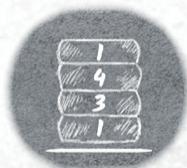
Tower Rule: score Victory Points depending on the current height of this tower. A tower consisting of 1/2/3/4 Stones scores you 1/3/4/1 Victory Points.
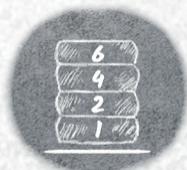
Tower Rule: score Victory Points depending on the current height of this tower. A tower consisting of 1/2/3/4 Stones scores you 1/2/4/6 Victory Points.

Tower Rule: score Victory Points equal to the number of differently colored Stones in this tower plus 1. 1/2/3/4 different colors scores you 2/3/4/5 Victory Points.




Example:
Let's score the purple color on the player board from the previous example! You score and receive the following:
Tower 1. 4 Victory Points (as you have towers of heights 1, 2, 3, and 4)
Tower 4. 4 Victory Points (height 3 tower)
Tower 5. 5 Victory Points (as there are 4 different colors in this tower)
Your combined score is 13 Victory Points!

After scoring the color, remove all of the top Stones of the towers scored and place them on the Mandala board in any order, starting from the first unoccupied space nearest the center of the Mandala board and proceeding clockwise and outward.

As you place the Stones, they may end up covering spaces with special markings:

These are Victory Point spaces. If you cover one of them, immediately receive the depicted Victory Points.

If you cover a space showing a number of hands equal to the number of players, the end of the game has been triggered. (Spaces depicting fewer hands than the number of players are treated as if they had no special marking.) If the Mandala board becomes full, simply set excess scored Stones aside until the game ends.
Example (continued):
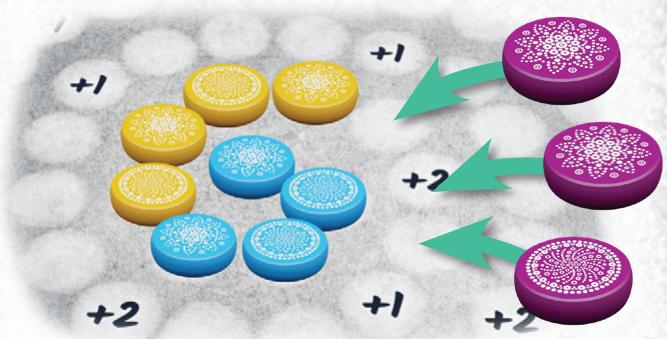
Having scored 13 Victory Points, you remove the purple Stone from the top of each of the towers you scored and place them on the Mandala board. Placing the Stones one by one, your second Stone covers the
"+2" space, which gives you 2 Victory Points. 6
Score any top Stones
When scoring any Stones, select any number of Stones from the tops of your towers, and score 1 Victory Point for each selected Stone. The individual colors and patterns of these Stones do not matter. Then, remove each selected Stone and place them on the Mandala board in any order.

Example:

You decide to use the option of scoring any Stones and select the towers with purple, yellow, and blue Stones on top. You score 3 Victory Points and remove the Stones, leaving you with four towers now topped by red Stones (ready for a much stronger color scoring on a future turn).

Note: Stones removed from your player board after choosing to score any top Stones are placed on the Mandala board following the same rules as when scoring a color.
GAME END


The game will end in one of two ways:
If a Stone is placed on the Mandala board covering a space showing a number of hands equal to the number of players — finish the round, thus giving all players an equal number of turns.
If any player is unable to take any Stone with a PICK action and is unable to SCORE, end the game immediately!
Note: To make sure that everyone has played an equal number of turns, remember that the last player to play is the one sitting to the immediate right of the player who started the game.
No matter how the game ended — in player order, each player should reveal their Objective cards, select one of them, scoring the indicated number of Victory Points if the Objective was met.
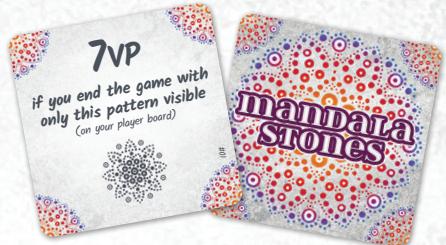
The player with the most Victory Points is the winner. In case of a tie, the tied player who was first in turn order wins.
CREDITS

Game Design: Filip Głowacz
Game Development: Andrei Novac, Błażej Kubacki, Małgorzata Mitura, Rainer Åhlfors
Graphic Design: Zbigniew Umgelter
English Rules: Rainer Åhlfors, Błażej Kubacki
Rulebook DTP: Agnieszka Kopera
Play Testing: Anita Sokołowska, Anna Czarnacka, Bartosz Folta, Błażej Husarski, Daniel Dubel, Iwona Jaworowska, Jasiek Łuszczki, Jimmy Durden, Kinga Ślusarczyńska, Konrad Sass, Konrad Sulżycki, Krzysztof Jurzysta, Łukasz Juras, Łukasz Włodarczyk, Maria Jóźwik, Mateusz Myrcha, Robert Plesowicz, Weronika Nogaś, Weronika Rędziniak.
Board&Dice would also like to thank the following people for their invaluable feedback and support:
Ben Seipert, Daryl Andrews, Derek Jonson, Jeremy Salinas, Ken Grazier, Mike Murphy, Scott Morris, Nick Murphy, Steph Hodge, Tommy Aikens, Vince Vergonjeanne.

Board and Dice
Executive Manager: Andrei Novac
Operations Manager: Aleksandra Menio
Head of Marketing: Filip Głowacz
Head of Sales: Ireneusz Huszcza
Art Direction: Kuba Polkowski
Development Lead: Błażej Kubacki
Important! We prepare each copy of the game with great care. Regrettably, mistakes can still happen. Therefore, during setup, please make sure that you are not missing any elements. This will ensure that your experience is not spoiled by a missing component. If you notice any damaged or missing components, contact us via the customer support form found at https://boardanddice.com/customer-support/
Download MarkdownTexts are community-compiled or publicly released by publishers; copyright remains with the original authors. For personal reference only.