
Masons
At a glance
Rules, cards and Q&A (Chinese)
The rules, card data and player questions for this game are written in Chinese. Open the Chinese page to read them.
Where to find full rules
Full rules and card lookup are available in the cunlema app at cunlema.cn — pick this game and ask about any rule, card or turn you are unsure about.
Related games
Rulebook text (Markdown)
This game has 2 rulebook Markdown file(s) in our library; 2 rendered inline below — expand to read or download.
rules_en_masons_21791.md12.2 KB
来源类型:纯文本规则(非 PDF 源,早期抓取/转换产物)
说明:原文未改动,仅调整存放位置与文件名;非 PDF 扫描件,无对应原书 PDF
Masons Rulebook | RulesPalRulesPalChatRulebookMasonsMasons Rulebook Table of Contents Table of Contents Contents
Preparation
Goal
Playing the Game
Build a Wall
Roll Dice
Score Score — Playing Cards
Turn End
Scoring Example
Game End
The Guild Cards
Contents
30 wooden towers in 3 colors
60 wooden houses in 5 colors
15 wooden palaces in 5 colors
33 wooden walls
4 scoring markers
2 house dice
60 guild cards
1 tower die
1 game board
Boundary lines and wall lines: The boundary lines separate areas marked with different coats-of-arms (see Guild cards on page 6). Each boundary line is also a wall line.
Preparation
Place the game board in the middle of the table. Place the walls, 3 dice, towers, houses, and palaces as supplies next to the board. Shuffle the 60 Guild cards and deal 6 cards to each player as his starting hand. Place the remaining cards as a face-down supply next to the board. Each player places his scoring marker next to space 1 of the scoring track.
Goal
The Masons try to establish cities on the game board. The guild cards each offer different building advantages to those who play them. Whenever a city is completed (completely enclosed by walls), it is scored and each player may play 1 or 2 cards from his hand to enhance his score. Sometimes, however, it is best for a player to hold back from scoring as others, playing after him could execute a card swap to gain advantage of his play. Thus, the player who chooses the right moment to spring into the lead will show himself to be a successful mason!
Playing the Game
The players choose a starting player. He starts and play continues clockwise around the table. On a player's turn, he executes the following steps in the order shown below:
Build a wall: the player takes a wall from the supply and places it on any unoccupied wall line on the game board.
Roll dice: the player rolls all 3 dice. Depending on the result, he must next place 0, 1, or 2 towers as well as 1 or 2 houses.
Score: if the wall placement encloses a city, players may score by playing cards. Each player draws 1 Guild card from the supply. Players in last place may swap cards.
Turn end: the player hands the dice to the next player, signaling the end of his turn.
NOTE! If a player rolls the dice before he places the walls, he loses 1 point (moves his marker back 1 space on the scoring track) as a penalty. Then he places the wall and rolls again. A player cannot move back past space 1 on the scoring track.
Build a Wall
A wall may be placed on any unoccupied wall line. It need not be placed next to an existing wall, but may not be placed within a completed city!
The player begins his turn by placing a wall from the supply on any unoccupied wall line on the board.
Example for a turn later in the game: the player places wall A.
Roll Dice
Tower: the tower die determines which color of tower the player must place at an empty tower space at an end of the wall he just placed. If both ends of the just-placed wall have empty tower spaces, the player chooses freely from the supply which color of tower to place on the second end of the wall. If there are no more towers of a required color, the player may choose freely from those available in the supply. When a player places a wall between two towers, he does not roll the tower die.
The player rolls the tower die and places a black tower on the lower tower space at the end of the wall. He may choose freely for the tower at the other end and chooses to place a gray tower there.
Houses: the two house dice determine which house colors the player must place on the two landscape spaces next to the just-placed wall. If the player placed the wall at the edge of the board, he still rolls 2 dice, giving him two choices for the house placement in the single landscape space. When the player rolls a "?", he has free choice of house color for that die. If the house color required is not available, the player may choose the color freely from those available.
Left: the player rolls a house die and a "?" die and places a red house on the landscape space on the right side of the wall. As the second die is "?", he may choose freely the color of the house for the other side and places there a green house. Right: as the player placed the wall at the edge of the board, he places only 1 house.
Palaces: Whenever a city is completed, for each set of 2 houses of the same color, the player replaces the 2 houses with a palace of the same color, returning the houses to the supply. This is done before the city is scored. If there are no more palaces of the required color in the supply, the houses remain.
The player places a wall, completing a city. He then placed a red house on that landscape space (he rolled a red house die). As there are 2 red houses in the completed city, the player replaces the 2 houses with a red palace.
Score
At this point in the player's turn, if his wall placement completed a city (completely enclosed one or more landscape spaces in walls), all players may score by playing cards (see Score — Playing Cards below).
There follows more information on completed and connected cities.
3 examples of completed cities.
Note: after a city is completed, it cannot be divided. When a completed city is comprised of several landscape spaces, players can reorganize the houses in the city to make scoring easier.
The houses for this city were arranged by landscape space for ease of scoring.
Whenever the just completed city borders directly (has at least 1 common wall) to a previously completed city, the player may connect one of any such bordered cities to the one just completed. To do so, the player removes all walls the two cities have in common, returning them to the supply. The result is a larger city with the outer walls of the two previous cities. A player may not connect the new city to two or more previously completed cities.
The player places wall A and completes city 1. He has now 3 options:
He can connect cities 1 and 2 by removing walls B and C.
He can connect cities 1 and 3 by removing wall D.
He can leave city 1 unconnected to either city 2 or 3, leaving all walls as is.
For the sake of clarity, the houses, palaces, and towers are removed for the example!
Note: When a city is completed, remove any towers and walls completely within the city and return them to the supply.
Starting with the situation on the left, the player places a wall to complete the city. He removes wall A and tower B from the city (see right) and puts them back in the supply.
Score — Playing Cards
Now the players may score: beginning with the player who placed the wall completing the city and continuing in clockwise order, each player must place 1 or 2 cards from his hand on the table. Each player scores as he places cards. He then discards the cards face-up on the discard stack (next to the supply) and draws 1 card from the supply, adding it to his hand. This means that when a player plays 2 cards, he reduces his hand size.
Instead, a player may discard 1 card from his hand, scoring no points, but draws 2 cards from the supply, adding them to his hand. Thus, a player increases his hand size.
When the supply is exhausted, shuffle the discard stack and place it face-down as the new supply.
Please see the scoring example below. See the descriptions of the Guild cards in The Guild Cards.
When all players have scored (or chosen not to) and drawn cards, the player whose scoring marker is in last place on the scoring track may discard as many hand cards as he chooses and draw replacement cards from the supply. He chooses the cards to discard first, then discards them, then draws the replacements. If several players (even all) are tied for last place, all these players may choose to replace their hand cards (beginning with the active player and continuing clockwise).
Both yellow and green are ties for last place on the scoring track. Each may discard cards from his hand and draw replacements from the supply.
Turn End
The player ends his turn by handing the dice to his left neighbor.
Scoring Example
Player A places a wall that completes city X and scoring follows for all players.
You may compare the following Guild cards with their descriptions in The Guild Cards!
Player A plays these 2 cards for scoring:
The just-completed city has 7 landscape spaces. A scores 9 points.
There are 5 towers on the game board not part of completed cities and standing on the shore. A scores 10 points.
Player B plays only 1 card:
There are 6 walls on the game board not part of completed cities. B scores 6 points.
Player C plays these 2 cards:
There are now 4 completed cities on the game board. C scores 4 points.
There are 6 rose houses on the game board not in completed cities. C scores 6 points.
Player D plays these 2 cards:
There are 7 houses in the region with the pictured coat of arms. D scores 7 points.
The just-completed city (X) has 7 towers. D scores 7 points.
Game End
As soon as the last wall, the last tower, the last palace, or the last house is placed on the game board, the game ends.
If the placement of the last wall completes a city, the players score as normal.
If no city is completed with the placement of the last piece of a kind (ending the game), each player may choose an already completed city, play 1 or 2 cards, and score. Cards played for scoring need not refer to the completed city chosen.
The player who has the most points is the winner! If players tie with the most points, the player among them with the most cards left in his hand wins! If there is still a tie, those tied rejoice in their shared victory!
The Guild Cards
The following Guild cards refer only to the just-closed city:
Four cards, one for each size threshold (1/2/3, or 7+ landscape spaces): if the completed city has 1, 2, or 3 landscape spaces, the player scores 6, 7, or 8 points. Or, if the completed city has 7 or more spaces, the player scores 9 points.
If the just-closed city has houses and palaces of 2 or 3 different colors, the player scores 4 points. If the city has houses and palaces of 4 or 5 colors, the player scores 7 points.
Three cards, one each for a white, a black, and a gray tower: for each white or black or gray tower in the just-completed city, the player scores 2 points.
For each palace in the just-completed city, the player scores 1 point. For each house, the player scores no points.
Five cards, one for each house/palace color: for each palace in the just-completed city of the indicated color, the player scores 3 points. For each house in this color, the player scores 1 point.
For each tower in the just-completed city, regardless of color, the player scores 1 point.
The following Guild cards refer to houses, towers, and walls on the game board, but not in any completed city (also not a part of any closed city):
Five cards, one for each house color: for each house in the indicated color, the player scores 1 point.
Three cards, one for each of the three coat-of-arms regions: for each house in the indicated region, the player scores 1 point.
For each tower, the player scores 1 point.
Three cards, one each for a white, a gray, and a black tower: for each white or gray or black tower, the player scores 2 points.
For each tower that stands on the shore, the player scores 2 points. For all other towers, the player scores no points.
For each wall, the player scores 1 point.
This card belongs to neither of the above two groups:
For each completed city, the player scores 1 point.
The author and publisher thanks the following for their help playtesting the game: Giuseppe Baù, Fabrizio Berger, Giuseppe Borziello, Marina Canciani, Alessandro Colovini, Federico Colovini, Dario De Toffoli, Giulia Franceschini, Stefano Mondini, Karl-Heinz Schmiel, Lucio Spampatti, Massimo Spampatti, Massimo Tonizzo, Hannes Wildner, Alex Weiß, Dario Zaccariotto, Stefania Zambenedetti, Gregor Abraham and especially Dieter Hornung.
© 2006 Hans im Glück Verlags-GmbH. If you have comments, questions, or suggestions, please write us at [email protected] or Rio Grande Games, PO Box 45715, Rio Rancho, NM 87174.
Download MarkdownMasons - rules in brief v1.md3.8 KB

Setup
• Shuffle the 60 guild cards and deal 6 to each player. Place remaining face-down by board.
• Put scoring marker for chosen player colors by space 1 of the scoring track
• Pick a start player, play clockwise
Playing a Turn
On your turn, execute the following steps in order: build a wall, roll dice, score
• If a player rolls dice before placing a wall, -1 VP penalty. Then place a wall & roll again
• Build a Wall: place a wall on any unoccupied wall line [not in a completed city]
Roll Dice: the Tower die determines color of tower that must be placed at an empty end of the wall placed. If both ends unoccupied, player chooses tower color to place at other end. If no towers of required color available, choose from those available. If placing a wall between 2 existing towers, do not roll tower die

• Houses: the 2 House dice determine the house colors that must be placed on either side of the wall just placed. If placing by board edge, choose which rolled color to place in single space. Die with ? gives player choice of color. If the rolled color not available, choose from those available
• Palaces: when a city is completed [fully enclosed], for each set of 2 houses of same color, replace houses with palace of same color, returning houses to supply [if no palaces of that color, houses remain]
• Score: you may now merge 1 city bordering the city just completed by removing all walls the 2 cities have in common, returning to supply. Remove any towers and walls completely within city & return to supply
• If a city was completed, beginning with the active player, clockwise, each player must play 1 or optionally 2 cards from hand to the discard pile. Score each card based on board state & draw 1 card from stack
• Instead of playing cards, players can discard 1 card & draw 2 from supply. Shuffle discards if draw pile empty
• The player(s) then in last place may discard cards from hand and draw replacements. Tie for last: all tied players can discard and replace cards from hand. Then next player clockwise beings turn
End Game & Scoring
• When the last wall, tower, palace, or house is placed, the game ends
• If placement of last wall completes a city, score as normal. If no city completed, each player may choose 1 already completed city, play 1 or 2 cards, and score
• Most VP wins. Tie: most cards left in hand
Card Examples
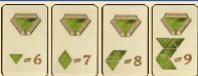
Receive VP for size of town enclosed
If town contains houses or palaces of 2/3 different colors, +4 VP. If it contains 4/5 different colors +7 VP

For each white or grey or black tower within the town +2 VP
For each tower within the town, regardless of the color +1 VP
+1 VP for each palace in the town, but none for houses
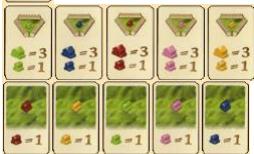
For each palace of the indicated color +3 VP, for each house of the indicated color +1 VP
For each house of the indicated color +1 VP
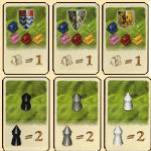
For each house in the indicated region +1 VP

For each tower +1 VP
For each white, grey or black tower +2 VP


For each tower which is located at the coast +2 VP

Texts are community-compiled or publicly released by publishers; copyright remains with the original authors. For personal reference only.