
Millennium Blades
At a glance
Rules, cards and Q&A (Chinese)
The rules, card data and player questions for this game are written in Chinese. Open the Chinese page to read them.
Where to find full rules
Full rules and card lookup are available in the cunlema app at cunlema.cn — pick this game and ask about any rule, card or turn you are unsure about.
Related games
Rulebook text (Markdown)
This game has 1 rulebook Markdown file(s) in our library; 1 rendered inline below — expand to read or download.
MillenniumBlades-Web-Rulebook.md76.3 KB
COMPLETE GAME RULES
MILLENNIUM BLADES CCG SIMULATOR CARD GAME
The Story so Far...
In a world very much like our own, Millennium Blades is the world's most popular collectible card game. Continuously in print for more than a thousand years, the game has seen countless expansions and untold billions of cards in circulation.
Players from around the world and from all walks of life seek to become world champions by mastering duels and collecting the game's rarest and most coveted cards. Still others live by the game, building financial empires by dealing, speculating, and trading in the aftermarket. Many are content simply to play for fun and meet new friends.
Your very own Millennium Blades Legend is about to unfold! What will be your path to glory? With your starter deck in hand and a dream in your heart, the time has come to step boldly into the world of Millennium Blades!

“Millennium Blades is adapted
from a game played thousands of
years ago by Celtic Druid-Kings. Except
that they dueled with real monsters
and spells and used them to fight
aliens from another dimension."
DESIGNER'S FOREWORD
We've all been touched by the magic of collectible card games. When I was about fourteen, a friend gave me my first Magic: the Gathering Deck, and from that day, there was no turning back. After spending countless hours and dollars on the hobby and having my gripes and disappointments along with elations and inspirations, I've come to look back fondly on those days. While I don't have the time to collect and play that I used to, I remember well the magic that brought these games to life for me and my friends so many years ago. I've tried my best to capture that magic in Millennium Blades.
Millennium Blades is much different than any game I've ever made, and it's likely to be very different from anything you've ever played. I hope that it captures the emotions of playing a collectible card game: excitement, desperation, discovery, hope, dread, and camaraderie.
Most of all, I hope you have fun playing Millennium Blades!
D. Brad Talton Jr. Millennium Blades Designer
DESIGNED BY
D. BRAD TALTON JR.
LEAD ILLUSTRATOR
FÁBIO FONTES
COLORIST
ANA GARCIA
SUPPORTING STAFF
JOSHUA VaN LANINGHAM
MICHAEL ROBLES
CHRISTOPHER SMITH
SAMUEL TAPPER
PROOFREADING BoB NoLan , JosHUa Van LANINGHAM, MEMBERS OF THE LEVEL 99 GAMES PLAYTESTING FORUMS
PLAYTESTERS
Ty Arnold, Kier Arnold, Bo King,
Trey Chambers, Peter Bemis, John Kirk, Chris Smith, Michael Robles, Joshua
Van Laningham, Samuel Tapper, Reagan McClellan, JR Honeycutt
SPECIAL THANKS
Arcane Wonders, CGC Games, Jasco Games, Kyy Games, Most Mondays Games, Black
Box Games, Portal Games, Jared Roswurm,
Miguel Duran, Arthur Tebbel, Michael Salt, Chris Wilson, Yeh Fang, Salvador Bernadó Sala, Nicholas Baker, Josh Herreshoff, Jared Ridinger, Benjamin Liu, Jonah Nan, Cristophe Mouchel, Raymond Polacek, Robert Campbell, Eric Brown, Simon To,
Anthony Gascon, Caleb Key, Wesley Taylor,
Bryan Emborsky, Steven Durst, Alex Johnson, Jason Sherlock, Matthew Davison, Matt Stevens, Cory Jones, Tanya Seward ... and all of our Backers on Kickstarter!
WANT TO SKIP THE RULEBOOK?
Millennium Blades, all characters, logos, card designs, graphic designs, and information in this rulebook are © 2015 by Level 99 Games LLC
COMPONENTS
5 Player Boards
2 Central Market Boards (Aftermarket, Store)
6 Starter Decks (9 cards each)
1 Core Set (118 cards)
11 Expansion Sets (12 cards each)
9 Premium Sets (12 cards each)
8 Master Sets (12 cards each)
4 Bronze Promo Sets (6 cards each)
3 Silver Promo Sets (6 cards each)
3 Gold Promo Sets (6 cards each)
6 Pro Player Card Sets (5 cards each)
6 Character Cards
36 Friendship Cards
2 Meta Card Sets (6 cards each)
10 Oversized Venue Cards
1 Punchsheet
800 Millennium Dollar Money Slips
80 Sticker Slips
1 VP Score Pad
15 Wooden Cube RP Trackers (5 colors)
Some assembly required
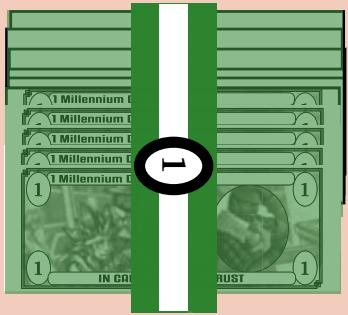
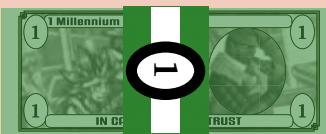
Before your first game, you should assemble the Millennium Dollars Money Wads. To do this, form stacks of 5 copies of identical bills. Take two stacks of 5, press them together so the printed sides face outward, and wrap them with one of the appropriate strips of sticker paper from the sticker sheet.
Using whole stacks of Millennium Dollars brings to life the feeling of buying and selling expensive collectible trading cards on the aftermarket!
CORE SET



6 STARTER DECKS



11 ExPANSION SETS





9 PREMIUM SETS




8 MASTER SETS


10 PROMo SETS

6 PRO PLAYER CARD SETS


2 META SETS
GAME SETUP
-
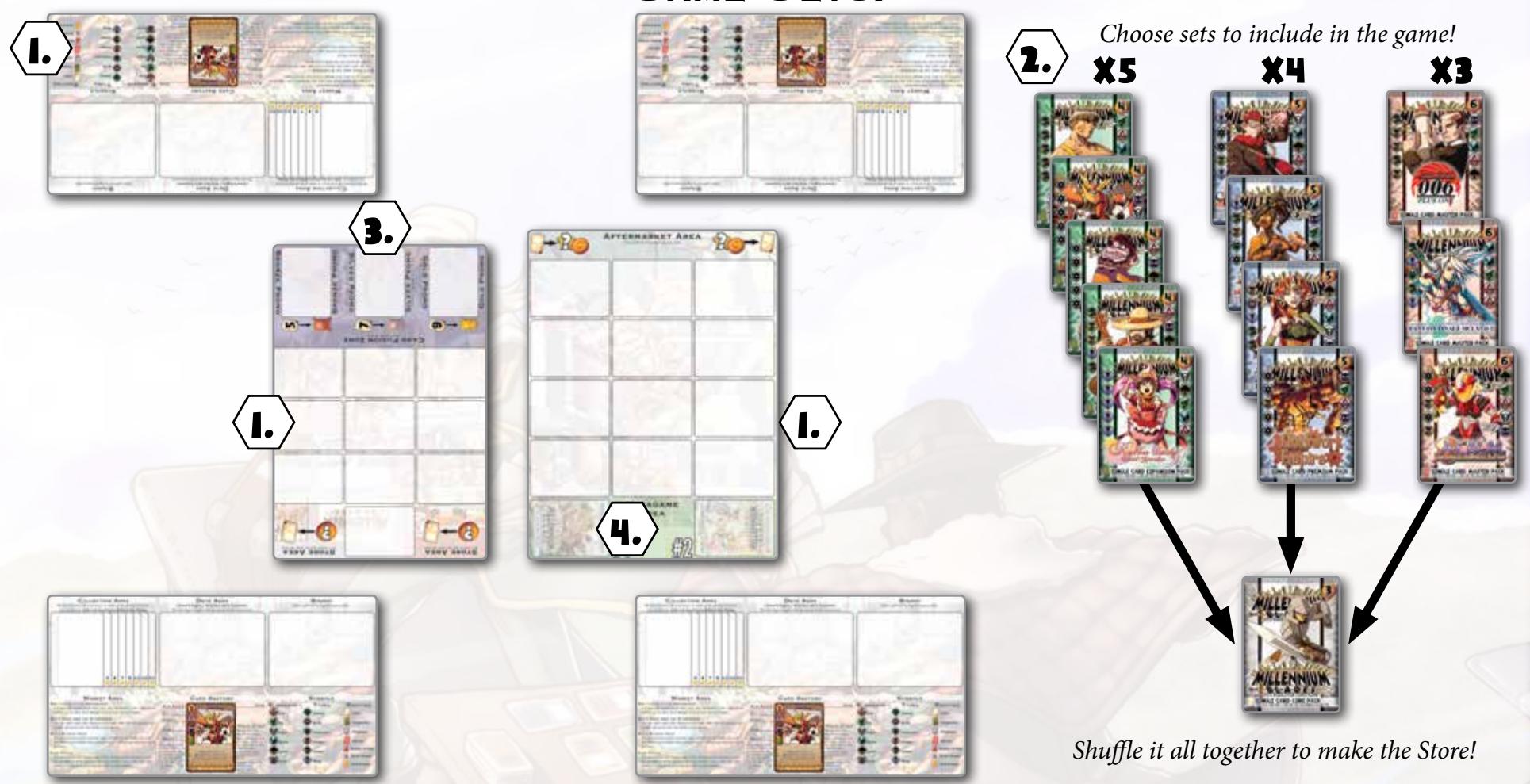
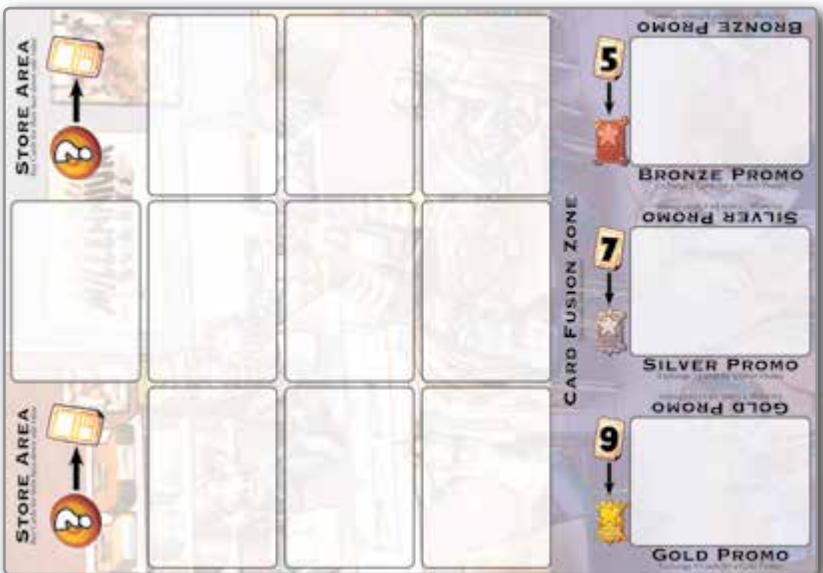
Table Setup. Find a large table and set out player boards for each of your players in the game, then place the Store and Aftermarket Mats in the middle of the table. Make sure that each player has about 3-6 inches between his area and the central boards, but not too much more, as players will need to reach around the table quite a bit and should be able to reach both central boards easily.
-
Set Selection. Take the Core set, five Expansion Sets, four Premium Sets, and three Master Sets of your choice. Shuffle all thirteen of these together to form the Store.
-
Set Aside Promos.* Choose two sets of Bronze and Silver Promos, and one set of Gold Promos, for a total of five sets. Place one of each type of set in the Card Fusion Area, and set the other two aside to use as Prize Support later on.
-
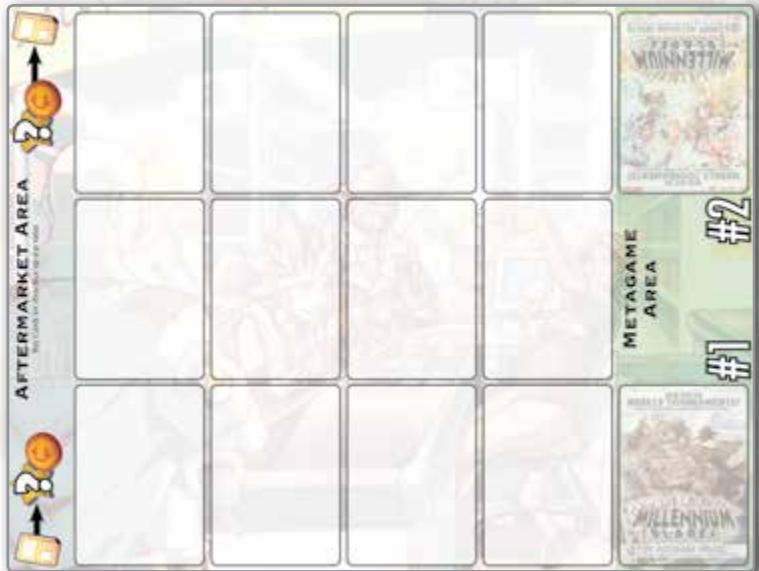
Setup Metagame. Shuffle the 2 stacks of Metagame Cards separately, then place them into their slots on the Aftermarket Board.
-
Distribute Starting Items. Give each player a starter deck, either randomly or of their choice, 3 cards from the top of the store deck, a Character Card**, either randomly or of their choice, 3 Sell Markers of a color (4 if there are only three players), and 6 Friendship cards of their character.
-
Supplies. Set up a bank of Millennium Dollars where players can reach them, but where they won't accidentally be mixed in with a player's own possessions.
*Backer Bonus Promo Rule. If you backed Millennium Blades and have a Backer Card in the game, you can start with that card in your collection. If you do, each other player gets a random card from that card's Set in their collection.
** Playing without Characters. In your first game, you may choose to leave out character powers. In this case, players should still pick a character, but ignore their character's Deckbuilding and Tournament powers.
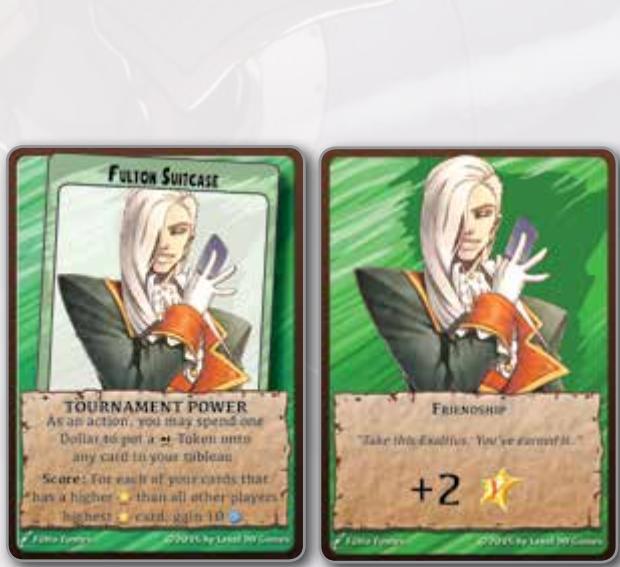
Each player gets the Character Power Card and all Friendship Cards for their chosen character.
OVERVIEW
Millennium Blades is played over a series of rounds. Each round has two parts, a Deckbuilding Phase and a Tournament Phase.
In the Deckbuilding Phase, you will receive new cards, as well as being able to buy, sell, trade, and collect. After a certain time limit passes, this phase ends and a tournament will begin.
In the Tournament Phase, you will play the deck you've built and try to collect more Ranking Points (RP) than the other players.
Players will gainVictory Points (VP) by placing highly in the tournaments, collecting valuable sets, helping out the other players, and amassing wealth by dealing through the game's Aftermarket.
At the end of the last round, whoever has the most VPs is declared the winner of the game!
These rules assume a 3-5 player group. For the 2 player rules, check the Variants section on page 14.
A pack of Millennium Blades cards actually comes with 15 cards. The commons and uncommons have been abstracted out of the game as Deck Boxes. All Singles you acquire are rare or better.
First Game Setup
For your first game of Millennium Blades, we recommend these sets, and that you play without Character Powers:
Expansion: Fists of Steel, Obari as Hell, Rubber Ducky Maid Crusaders R, 1001 Nights, Gno-Man's Land.
Premium: Cards Magica, AD 2400, Clockwork Empire, Pandora's Box Opened.
Master: Symphony of Destruction, Galactic Caboose, 006 Plus One.
Fusion Promo: Legend of Final Badass, Princess Blade, Elemental Dragon Lords.
Prize Support: Elemental Blades, Sealed Vaults.
GAME FLOW
(Optional) Pre-Release Tournament
Deckbuilding Round 1
Tournament Round 1
Deckbuilding Round 2
Tournament Round 2
Deckbuilding Round 3 (if no Pre-Release)
Tournament Round 3 (if no Pre-Release)
Starting the Game
If you're new to Millennium Blades, we recommend starting out by playing a Pre-Release Tournament.
The Pre-Release Tournament is an optional tournament round that is played before the game starts. This is primarily designed to give new players an opportunity to learn how decks are played, so that they can evaluate cards and build decks during the Deckbuilding Phase.
If all of your players have played Millennium Blades before, you can skip the Pre-Release Tournament and move to the first round of Deckbuilding.
Pre-Release Tournament
This tournament is just like a normal tournament, except for a few slight changes.
-
There is no Deckbuilding Phase. Players play with only their starter decks.
-
No Metagame is revealed during this tournament, and character powers are not used.
-
There are very few points awarded for this tournament.
-
If you choose to do a pre-release tournament, skip the third round of deckbuilding and the third tournament later on in the game, so that there are still only three tournaments in the game.
“A card game is an equation. There are trillions of combinations of cards to construct a deck, and millions of constructions operated by millions of agents. But the system is a nite one, and so it is ultimately solvable." - “Power Creep” Proposal Document
DESIGNER'S NOTE
(On Mistakes and Mis-plays)
Even though Millennium Blades seems like a game of calculation and full information on the surface, it's actually a game of mental dexterity and skill.
In many games of strategy, we allow players to go back and correct a mistake or to replay a card when they have miscalculated. It is critical that you do not allow players to correct their mistakes in Millennium Blades.
Millennium Blades is about dividing the limited resources of your brainpower among a variety of tasks, and weighing where to best invest this resource. There's not enough time to do everything, and so you’ve got to make decisions about where to use your best cards and where to invest your time and attention.
Making a critical mis-play, forgetting to turn in a collection, or neglecting to include a key card in your deck are mistakes just like missing a shot in soccer or dropping a catch in baseball-you can't step back and correct these things. Instead, renew your focus, and resolve not to make the same mistake next round. The game has been built so that you don't have to play every move perfectly to win the game, and you'll have a better experience if you just move on from mistakes, rather than trying to fix them.
Cards move quickly, and there are many copies of each card floating around. You’re better off attempting to sell or trade for a card another player wants than to withhold it or fuse it. They’re probably going to get it one way or another, after all.
STORE BOARD
AFTERMARKET BOARD
YOUR PERSONAL AREA

Store
Buying packs from your friendly local game store is the easiest way to get new cards for your collection!
Cards in the Store are face-down, so you will only know what set they are from when you buy them. Will this pack have the card you've been searching for, or will it set you on the path of pursuing an unforeseen strategy?
Card Fusion
The Millennium Blades Player Rewards Program allows you to recycle your old, useless cards into shiny new promotional cards.
Card Fusion is costly to use (5 cards for Bronze, 7 for Silver, and 9 for Gold), and the cards you spend on it cannot be recovered later. 'The advantage of exceptionally powerful promotional cards is difficult to ignore, so try it out! Like Master Grade Cards, Promo Cards work best when you build your deck around them, so one or two is enough.
Aftermarket
Seek out wealth or hard-to-find cards by dealing in the Aftermarket!
Unlike the Store, cards in the Aftermarket are bought and sold face-up, so you know exactly what you're going to get.
You can interact directly with the Aftermarket, and the bank pays you right away when you put cards on sale, not when other players buy them. You can browse through the Aftermarket and buy cards by paying their costs to the bank directly.
Metagame
In competitive card gaming, the meta is always changing, and so you will need to watch the metagame as you play.
Each round, the metagame will shift. The Metagame gives significant bonuses if you can incorporate it into your deck. Don't ignore it!
Deck
You will have the opportunity to build your deck freely during the Deckbuilding Phase, including any cards that you feel will be useful to you. More cards will become available each round, increasing your options and the number of potential decks you can construct.
Collections
Building your collections is a necessary step in becoming the most prestigious Millennium Blades player among your friends. You can build collections during the Deckbuilding Phase. Collections you turn in will be lost, so be careful about what you include!
Binder
The Binder is where you keep your cards that are not being used in your deck or collections. You can also trade cards from your binder with other players, in exchange for money, friendship, or other cards.
CARD DATA
-
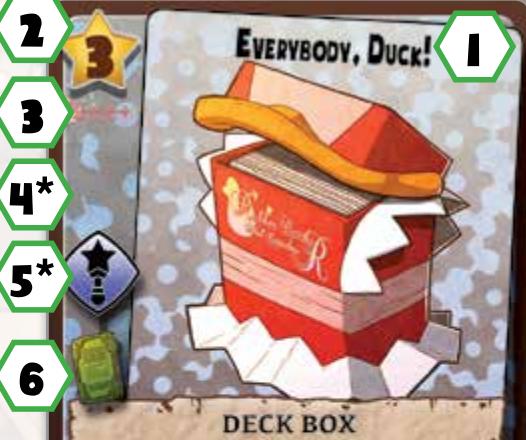
Card Name - The name of the card.
-
Star Rating - Star Ratings range from 1-10, but usually just 1-8. They are used in collecting and dueling.
-
Set - The logo of the set the card comes from.
-
Element - There are 6 Elements, usually used in triggering effects and building sets.*
-
Type - There are 6 Types, usually used in triggering effects and building sets.*
-
Rarity - The rarity level of the card.
-
Effect Text - The effect of the card.
-
Flavor Text - Some cards have flavor text in italics. This has no effect on gameplay.
SINGLES
Singles are the key cards that make up your deck. They are the power cards that make everything work.
Singles vary in power and usefulness. Lower power, more universal singles are found in the Core Set, while very powerful and hard-to-use singles are found the Master Sets.
DECK BOXES
Deck Boxes represent the engine of your deck, and help to unify the theme and capabilities of your deck.
One Deck Box can be included with your deck. Usually this will give you a secondary scoring option, which forms a foundation for the cards you choose to include. If you don't know where to start, look at the Deck Boxes available to you and try to find cards that will make one of them work exceptionally well.
Deck Boxes come in the core set, but more powerful ones are generally found in Expansions, Premium, and Master Sets!
ACCESSORIES
Accessories are items that you can use to protect or enhance your deck. Most accessories are found in the Core Set, but several other sets contain them as well.
* Accessories and Deck Boxes do not often have Elements (4) or Types (5). Those that do not have one of these symbols cannot be used as part of a collection.

Score: Gain 25 if there is no card in your tableau with a higherthan this one.
His sécret technique is-to build his cast far away from enemy lines. By this method, he only fights when bored.
Score: Choose a SET. For each single from that SET in your tableau, gain 8 Birds of a feather... 8
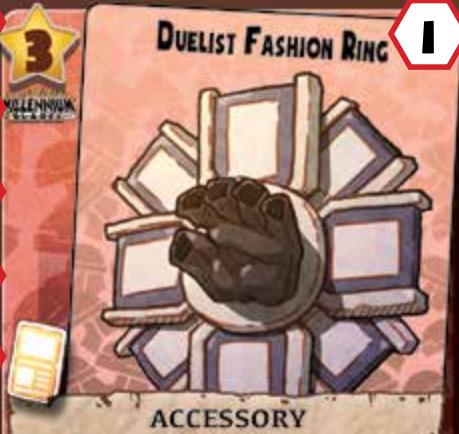
Action: Each player who has a Duelist Fashion Ring in their binder. accessory slot or hand gains 10 . gotta get one., gotta get one now. 8 2 coolest duelist. gotta get one now... Fabio Fontes 20 15 by Level 99 Games
ELEMENTS

Fire


Water
Air


Earth
Light

Dark
TYPES

Animal

Myth

Construct

Citizen

Soldier

Mage
Some cards have multiple Types or Elements.
RARITIES

Core

Expansion

Premium

Master

Bronze Promo*

Silver Promo*

Gold Promo*
* “Promo" refers to any rarity of Promo card.
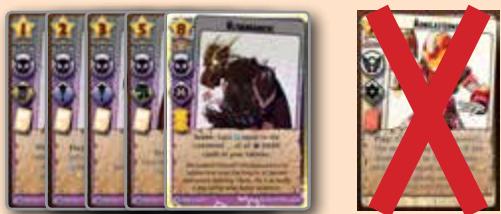
DECKBUILDING PHASE
The Deckbuilding Phase is a real-time phase. This means that once the phase begins, players can take any actions they want, as much or as little as they want, until time runs out.
Setup the Phase
-
All players should flip their player boards to the Deckbuilding Side, and combine all their cards together into the Binder Area.
-
Give each player 30 Millennium Dollars of income.
-
Deal each player 6 cards from the top of the Store Deck (without paying for them). These are added to the players' binders facedown, and cannot be looked at until time starts.
-
Place the top 9 cards of the store facedown into the Store Area, so there are 10 cards showing (including the one on top of the Store)
-
Make sure each player has all of their Sell Markers.
-
Discard any revealed Metagame cards out of play. Reveal a new Elemental Metagame Card.
-
Set a Timer for 7 minutes, and begin!
Setting your Priorities
There are a lot of things to do in the limited Deckbuilding Time. Here's a list of things in the order they will score you Victory Points, so you can prioritize your time.

Build Your Deck - Winning Tournaments provides more Victory Points than any other source.
Make Your Collection - Collections provide a significant number of points, and you can turn in one per Deckbuilding Phase.
Help Friends - Friendship Points are valuable, and you can earn them by helping friends.
Amass Wealth - Millennium Dollars are worth 1 VP per 4 dollars at the end of the game. Try to sell cards that other players will buy to keep your personal wealth increasing.
Discards
During tournaments, discarded cards go to your binder, and you still own them.
Cards that are discarded “to the Store Discard" may reappear later on during the game.
Cards that are discarded “to the Box” or “removed from the game” are placed back into the game box and will never come back into play.
YOUR PERSONAL AREA
You can freely move cards around in your personal area in order to sort them for use in your Deck or Collection, or to be saved for later in your binder. You can move cards as often as you want, and separate them in any ways you like.
The only thing that is important is that at the end of the timer, you know which cards are in your deck for the tournament, which are in your collection, to be returned to the box for points, and which cards are in your binder, to be saved for later use.
Build your Deck
The Deck Area can contain up to eight singles, up to one Deck Box, and up to two Accessories.
During a Tournament, you will typically only play 6 cards, so use the extra two slots to put in backup cards in case you need to change strategy mid-tournament
You can take cards out of your deck to make room for new ones just as easily by returning them to your binder.
You may only have one copy of any card in your deck!
Pro Tip: Stacking your deck's cards in the order you plan to play them can save you a lot of time in the tournament step!
Deckbuilding Actions
While the timer runs, players may begin taking any of the following actions, as quickly and as often as they wish:
-
Build your Deck.
-
Make a Collection.
-
Buy a Pack from the Store.
-
Fuse cards from your hand to obtain a Promo.
-
Sell a card to the Aftermarket.
-
Buy a card from the Aftermarket.
-
Trade with other players.
Make your Collection
Your Collection is made up of 2-8 cards, each having at least one matching symbol with all the others, and each having a different star rating than all the others.
At the end of the round, your Collection will be returned to the box and you will be awarded points.
You can only build one collection per Deckbuilding Phase. Don't miss out on this important opportunity to score victory points!
A collection ofDark Cards. The card on the right could not be part of this collection, because it doesn’t match the element of the collection.

A collection ofSoldier Cards. The card on the right could not be part of this collection, because it already has a 4-STAR card.
THE SToRE
Buy a Pack from the Store
Experience the thrill of blind packs! Buy new cards without knowing what you’re going to get!
Pay Millennium Dollars equal to the buy cost (the number in its top right) of any facedown card you want (including the top of the Store) to the bank, then take that card from the store area and place it in the binder area of your board.
Replenish the store area by dealing a card from the top of the Store into the center of the table face-down. If the Store runs out of cards, shuffle the store discard together to form a new deck.

Fulton decides to buy a 5-cost Clockwork Empire card. He pays 5 Millennium Dollars to the bank, then adds the card to his Binder. Now he can flip it over and ind out what it is!
Sell to the Aftermarket
Place any card from your binder and one of your Sell Markers into a slot in the Aftermarket. Then take Millennium Dollars equal to that card's Star Rating from the bank. The Aftermarket has no card limit in this phase.
If you have no Sell Markers (because they are already in the Aftermarket or were used for Card Fusion), you cannot sell more cards.
The Aftermarket stops accepting cards for sale in the final 6-minutes before the tournament. This is to ensure that everyone has adequate time to buy cards.
Once your card is on sale in the Aftermarket, you cannot buy it back or remove it from sale!
THE AFTERMARKET

The 5 Fusion Cards are returned to the box and a Bronze Promo Card is acquired from the top of its Promo Deck.
Card Fusion
Convert unwanted junk cards into powerful promotional cards.
Choose to do a Bronze, Silver, or Gold Card Fusion. Select the appropriate number of cards from your binder (5-Bronze, 7-Silver, or 9-Gold) and place them in the box. Then take a card from the appropriate pile in the Card Fusion Area. Place one of your Sell Markers on the pile.
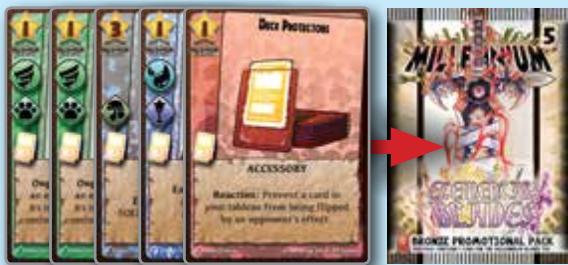
You cannot perform more than one Card Fusion of each type per round, and you cannot perform Card Fusions if you have no Sell Markers left.
Buy from the Aftermarket
Choose a card from the Aftermarket with another players’ Sell Marker on it and pay Millennium Dollars equal to that card's Star Rating into the bank. Return the Sell Marker on the card to its owner.
Add your new card to your binder.
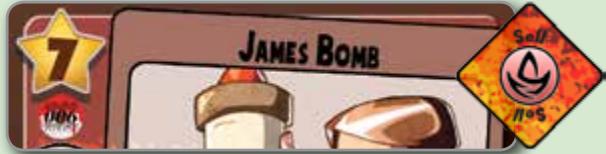
Selling James Bomb to the Aftermarket would get you seven dollars right away from the bank. Anyone who wants to buy him later would pay that same amount into the bank.
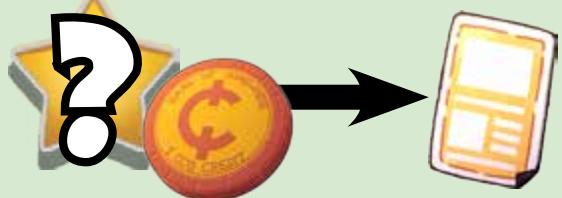
YOUR FRIENDS Trade with Players
You can always Trade with other players directly, without using the Aftermarket. However, any trades made between players must be equal value trades. That is, the total of all Star Ratings and Millennium Dollars must be equal on both sides of the trade.
If you are making a trade that clearly benefits one side more than the other, you may wish to ask the other side for Friendship in addition to the other trade items.
Friendship Cards are worth extra Victory Points at the end of the game. You can't score them yourself, but you can give them to another player who helps you out with a good trade or a rare card. You may not score more than 6VP from a single player's Friendship Cards.

If Fulton wants Morrey's Evil Helbane card, he's got to match its value with money and cards of his own.

Deques really needs Cardine's promotional Soul Caliper card for a combo in his deck, but they both know it's more valuable than an even trade. Since agreeing to make this trade is really a favor from Cardine to Deques, Deques offers a Friendship Card in addition to the even trade.
When time runs out...
After the first 7-minute timer expires, deal each player 6 more cards from the store deck, then reveal the top card of the Type Meta stack.
Set another 7-minute timer. After this timer expires, the Aftermarket stops accepting new cards for sale (players may still buy cards, but they cannot sell them anymore), and set another 6-minute timer.
After the final 6-minute timer expires, the Deckbuilding Phase ends, and the tournament begins.
The whole thing looks sort of like this..
Get new cards and cash!
Reveal Elemental Meta 7-Minute Timer
Get more cards!
Reveal Type Meta 7-Minute Timer
Last Call to sell cards 6-Minute Timer
End the Deckbuilding Phase
Timers in Millennium Blades are relaxed. If you see a player scrambling to finish something they started, all players can agree to offer a short grace period by starting a new 3-minute timer.
If a player has not even started on an endeavor (ex: "Oh man, I totally forgot to make a collection!") it's probably best to just move on to ending the phase.
“This card press is the anvil upon which we will forge the blades for a new generation of heroes!” - Shamans of the Midwest CEO
“What do I play? Ha! I don't play card games. I play markets. Stocks. Commodities. Where you may see an 9-Star Exaltius the Untenable, I see a emergent market, ripe for speculation.
- Fulton Suitcase, in an interview for Top Tier, Top Dollar Magazine
END OF DECKBUILDING
When the final 6-minute timer sounds, the round ends. Follow these steps to clean up and get ready for the tournament...
-
In any order, players should each turn in a maximum of one collection for Victory Points.
-
All loose cards that are not part of a player's deck are moved to their owners' binders.
-
Put all cards from the store and the Aftermarket into the Store Discard Pile.
SCORING COLLECTIONS
When a collection is scored, place it in the box and award Victory Points based on the size of the collection.
Collection Points
| Cards | 2 | 3 | 4 | 5 | 6 | 7 | 8+ |
| VictoryPoints | 2 | 4 | 7 | 9 | 12 | 16 | 21 |
Personal Space & Etiquette
You should never touch cards on another player's player board.
When a player reveals a new card from the Store, that player has the first chance to buy that card, if he or she wishes.
If two players both want to buy the same card from the Store or Aftermarket, give priority to the player with fewer Victory Points.
It's fine to stop the timer for a moment, if a player asks for a rules explanation or needs something clarified.
“A card game is a form of personal expression. You take what you believe about the world-everything
you want to say and everything you
want to prove-and you build it into
a deck, and then you put your world
view into direct competition with your
opponent. And at the end of the game, you know exactly who is right." - Deques Applenti

TourNament PHase
The Tournament Phase is a turn-based phase. Players will take turns in clockwise order around the table, each making a single turn. The tournament ends when no players are able to take any more turns.
Setup the Phase
-
All players should flip their player boards to the Tournament Side. They should set their binder cards off to the side of the play area, and take the cards in their decks into their hands.
-
Each player should set their current RP to zero.
-
Each player should set out their Accessories and Deck Box onto the allotted spaces on the tournament board. All Singles remain in your hand.
-
Turns begin with whichever player placed highest in the previous tournament (or whoever most recently opened a booster pack in real life, in case of a tie or the first game round) and proceeds clockwise.
Illegal Decks
It's possible that players may accidentally bring more cards than they are allowed to the tournament. Randomly remove cards from the player's deck to their binder until it is below the 8-card limit.
Tournament Turns
On a player's turn, he or she may take one Action and must play one Single, in either order. If the player is unable to play a Single, they cannot take an Action, and instead Passes.
A player will be unable to play a single if he or she has no cards in hand, or if his or her entire tableau is filled already. Once all players pass in succession, the tournament ends.
Use an Action (Optional)
Actions usually show up on Accessories, but any card might have one. Actions are always denoted by the “Action:" keyword. To use an action, perform the text on the card, then flip the card face-down. You can use one action per turn, either before or after playing a Single.
Play a Single (Required)
On your turn, you must play a Single if you are able. Place the Single face-up in the next open left-most slot of your singles area.
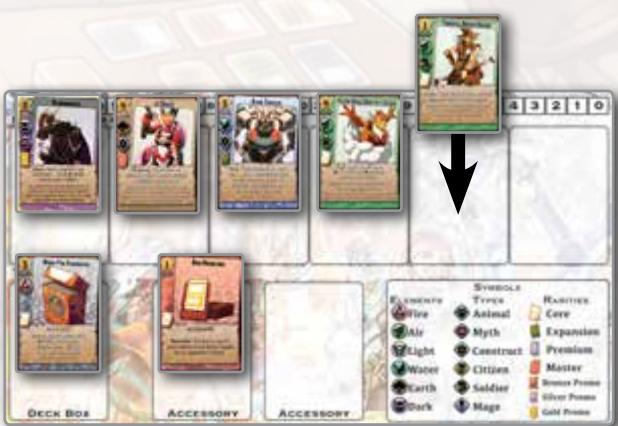
The Ranking Points Track simulates your performance over a multi-round tournament.
Ranking Points
Most cards give you Ranking Points (RP) or disrupt your opponents as they try to score RP. At the end of the tournament, your placement is determined by your total RP.
Top Card
The right-most face-up card on a player's play area is called the Top Card. This card is used for clashes (explained on the next page), and also activates its Top effects.
If there are face-down cards on the right edge of your tableau, your Top Card is the face-up card closest to the right edge.
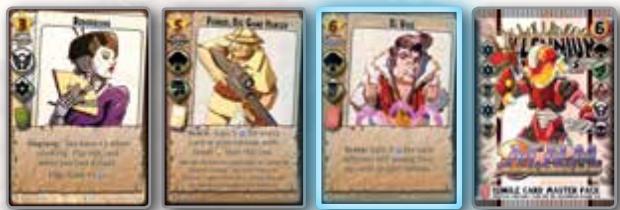
Because her right-most card has been flipped down, El Vice is now Shur's Top Card. If all her cards are face-down, she has no Top Card.
Face-Down Cards
Face Down cards have no STAR RATING, ELEMENT, or TYPE. They still count as cards (ex: gain 5 for each card to the left of this one), but do not have any text or attributes.
YoUr TouRNamEnT ArEa
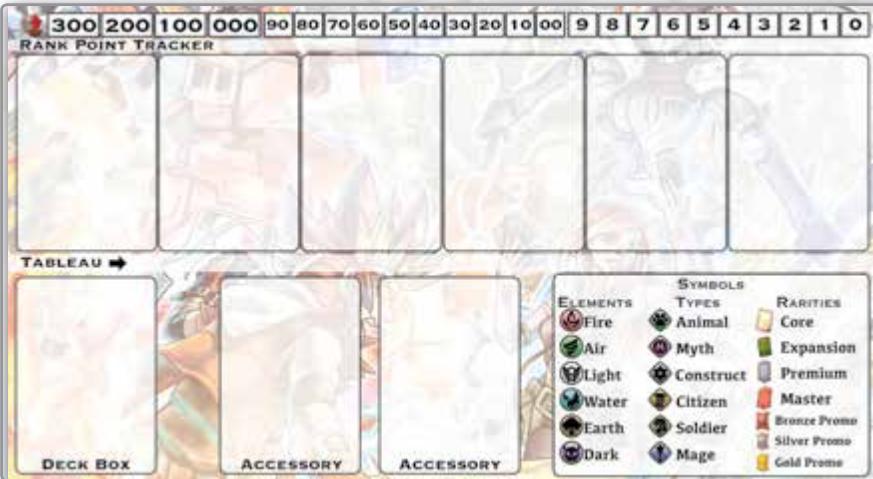
Tableau
Singles you play during the tournament will be placed into these slots, called the Tableau. Always place singles in the left-most available slot in this area.
Deck Box Area
There is a slot reserved on the Tournament Board for your Deck Box. It starts face-up in play. A card cannot affect or target your Deck Box unless it specifically says it can.
Accessories
There are two slots reserved for your accessories on the Tournament Board. Both of your Accessories start face-up in play. A card cannot affect or target your Accessories unless it specifically says it can.
Effects on Cards
Each kind of card may have different effects. These effects fall into a few broad categories, and follow the same notation as Actions, but with different timing words on them.
Play - Play effects are activated right away when a card comes into play. Perform the Play Effect on the card when you play it from your hand. Cards with Play effects are considered "in play" for the purposes of effects when their effect is resolving.
Next - Next effects trigger on the next card you play, no matter whose turn it is or what slot in your tableau you play it to.
Flip - Flip effects are activated when a card is flipped face-down.
Ongoing - Ongoing effects keep on working continuously as long as the card is face-up in your tableau.
Top - Top effects work as long as the card with the Top effect is the right-most face-up card in your tableau. If other cards get flipped down or if you can rearrange cards, you can keep your best Top effects for multiple rounds.
Top Effects can also affect your opponents quite often, and are good for disruption.
Score - Score effects are activated during the end of the tournament, and usually let you score additional Ranking Points. Activate all of the Score effects (of face-up cards) in your tableau (going left to right), then your Deck Boxes, then Accessories, then the Metagames. Since Score effects primarily just earn you points, activation order rarely matters.
Reaction - Reaction effects are activated whenever the relevant condition on the effect is met. When you activate a Reaction, the card that triggers it is flipped face-down. You always have the option of not using your own Reaction Effects, just like with Actions.
Besides Reactions, other Effects are Not Optional, and must be used at the correct time.
Top>Ongoing>Play>Next>Score is the order of what effects take priority over other effects. The player whose turn it is gets the first opportunity to use Flip or Reaction effects, with that opportunity passing clockwise.
General Rules
A few effects show up frequently on cards. These are explained here.
Discard a Card - The card is discarded to the owner's Binder (unless another location is specified). Cards discarded to the binder are unavailable for the rest of the tournament.
Reveal a Card from your hand - The card is shown from your hand to all players, then returned to your hand.
Reveal a Face-down card - The card is picked up and shown to all players, then placed face-down again in the same slot.
Flip a Card - Flipped cards are turned facedown. While a card is face-down, it has no attributes (Star Rating, Rarity, Element, Type, Set, etc), and is considered a blank card for all purposes. "Flip a Card" does not allow you to flip cards face-up, and you must choose a faceup card to flip down when selecting a target for these effects.
In general, effects cannot target face-down cards, unless they specifically say otherwise.
Cannot be flipped - If you have cards that are protected from flipping, you cannot choose one of those cards when an opponent forces you to choose and flip one of your cards.

Example: Shur must “flip her highest card". Since her highest card is protected by Orella (adjacent cards cannot be flipped by opponents effects), there are no legal targets for the effect, and she can ignore it.
If she were instructed to "flip a card of her choice", she would have to choose Orella, since the other two cards cannot be flipped and are thus not legal choices.
Clashing
Many cards in the game will instruct you to clash with an opponent, or with all players. If clashing with another player, choose a player with a Top Card. In a multi-player Clash, each player who has a Top Card is able to participate in the Clash.
Each player in the clash reveals the top card of the Store (starting with whoever initiated the clash and moving clockwise) add the Star Rating of the card revealed in the clash and the Star Rating of your Top Card. If one player has a higher total than any other player, that player is the winner, and all other players are the losers. If there is a tie for the highest total, then the clash is a tie.
Put all cards revealed this way into the Aftermarket. If there is no space left (max. 12), discard all cards in the Aftermarket to the Store Discard before adding any new cards.
In a tie, neither player wins nor loses. If a clash does not have at least two participants (due to not having Top Cards), then the clash does not occur.
8+6=14
10+3=13
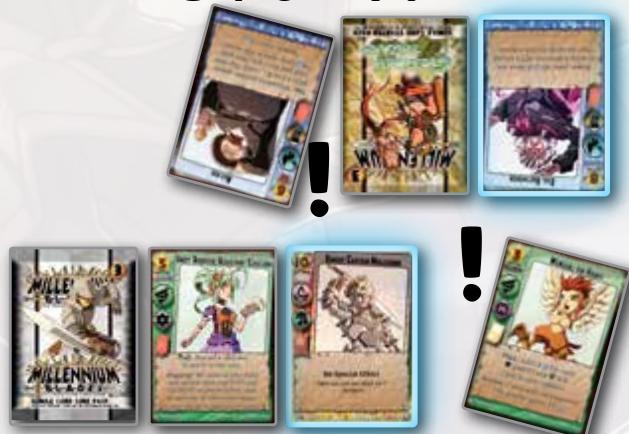
Example: Deques uses his Salamander, Volcanic Lizard (flipping it down) to trigger a clash with Cardine, using his Top Card: Knight Captain Malcombe (10). Her Top Card is Evil Beethoven (8). Deques reveals the top card of the Store and it's a 3. Cardine reveals a 6. Deques' total is 13 and Cardine's is 14, so she wins the clash.
They put both of the cards revealed in the clash into the Aftermarket Area, to be available for sale during the next round.
Set Specific Keywords
Many sets use special Keywords to describe their effects. When you see a keyword, its effects are always the same. On most cards, the keyword's full text is printed out.
Mimicry - A card with Mimicry has the Element and Type symbols of a face-up card to its immediate left instead of its own. This effect ends if the card to its left is flipped. This effect continues to work during scoring.
Blast Off - Action: You may flip this card to put 3+1 STAR tokens on the next card you play.+1 STAR tokens increase a card's Star Rating by 1 each. Blast Off also has a PLUS variation that adds even more +1 STAR tokens!
Scurry - Play: You may insert this card anywhere into your tableau. When you do this, you will shift some of your cards to the right to make room.
Anvil Drop - Action: Flip a card in another player's tableau with a lowerthan this card.
Thwomp! - Play: If the card to the left has a lowerthan this one, flip it and gain.
Aftermarket Space
Remember that the Aftermarket works differently depending on the phase. During
Deckbuilding there is no limit to the number of cards that can be in it. During Tournaments, the Aftermarket has a limit of 12 cards. If a card or cards would be placed in the Aftermarket and cause it to go over this limit, discard all cards in the Aftermarket to the store discard, then place the new card or cards in the Aftermarket.
Ending the Tournament
The tournament ends when all players are unable to take further turns.
-
Each player should activate all Score effects of face-up cards, starting with Singles in your tableau, then the Deck Box, then Accessories, and finally the Metagame Cards. Every Player activates the Metagame Score effects for themselves.
-
Award VP for each player based on the Tournament VP chart for your current round (regardless of your total number of players). Players place in the tournament according to the number of Ranking Points (RP) they've accumulated. If two or more players tie, add up and divide between them the VP for all places they would win. (Example: in a 3-way tie for second, add up and divide evenly the points for second, third, and fourth place, rounded down). Keep track of VP on the score sheet.
-
Reveal a complete set of Promo Cards, based on the Prize Support column of the Tournament VP Chart. Players get one of these randomly.
-
If this is the first or second round, place all cards into their owners' binders, then flip over all play mats to return to the Deckbuilding Side. Return all players' Sell Markers to them.
-
If it is round three, proceed to final scoring.
Tournament VP Chart
| Round | 1st Place | 2nd Place | 3rd Place | 4th Place | 5th Place | Prize Support |
| Pre-Release | 7 | 5 | 4 | 3 | 2 | None |
| Round 1 | 21 | 15 | 12 | 9 | 6 | Bronze |
| Round 2 | 28 | 20 | 16 | 12 | 8 | Silver |
| Final Round | 42 | 30 | 24 | 18 | 12 | None (Game End) |
GAMe END
When the game ends, players should total up all of their Victory Points ( VP) and see who is the Ultimate Millennium Blades Champion.
Total up these points:
-
Tournament VPs for each round.
-
CollectionVPs for each round.
-
Remaining MoneyVPs, at a rate of 4 Millennium Dollars to 1VP, rounding down.
-
Friendship CardVPs collected from other players.
The player who has the most VP is declared the winner!
In case of a tie, the winner is whoever had the most VP from tournaments. If the game is still a tie, then whoever had the mostVP from Collections, followed by Money and then Friendship breaking ties in that order.
Infinite Loops
Infinite Loops are very rare, but theoretically possible. If you manage to cause an Ininite Loop (a set of mandatory effects that cannot be stopped), you are immediately removed
from the tournament, but you score VP as though you had won first place (this
doesn’t prevent another player from actually
winning rst place through normal means).
After this, all your tournament cards (hand, tableau, box, and accessories) are returned
to the box, and you gain Millennium Dollars
equal to their total sell value. You do not gain Millennium Dollars if it is the last round.
“Shouting your card names triumphantly as you slam them down into your tableau makes them even more powerful and intimidating.
VARIANTS & OPTIONS
Want more Millennium Blades? This section gives players who are experienced with the game a ton of new ways to change the experience and replay Millennium Blades!
Character Powers
There are six main characters in Millennium Blades, and you can take on their personas to specialize your play style.
To use characters, just bring in the relevant character cards. Each card has two sides, a Deckbuilding side and a Tournament side, giving you new powers during each phase. Familiarize yourself with both sides before the game begins, and show the relevant side during each phase.

Turn-Based Mode
You can play Millennium Blades as a turnbased game as well by following these rules. In turn based mode, there is only one phase, which is a combination of both tournament and deckbuilding phases. This mode can be played by 2-5 players. Friendship is not used in this mode.
-
Setup the store deck as usual.
-
Determine who will be first player, and deal each player 7 cards. Each player gains 30 Millennium Dollars, and has a maximum
hand size of 7 cards.
-
Reveal both metas at the game start.
-
Choose two Bronze Promo Sets and one Silver Promo Set to be fusable during the game. Gold Promos are not fusable in this mode.
-
Choose one Silver Promo Set and one Gold Promo Set to be given out during scoring and set these aside.
On a player's turn, he must perform exactly one of these actions:
-
Buy a card from the store or from the Aftermarket (he must have fewer than 7 cards to do this).
-
Sell a card to the Aftermarket (if he has sell markers remaining).
-
Fuse cards from his hand into a promo using normal card fusion rules. Since your hand size is 7, Gold Promos are not available to fuse in this mode.
-
Add a card from his hand to a collection. The collection's type/element is declared at the moment you add the first card to it. You may have two collections at a time-one based on element, and another based on type.
-
Play a card from his hand into his tableau, or as a deck box or accessory, following all rules as in a tournament.
-
Score his tableau and collection.
As in a normal game, players can use "Action:" effects before or after doing their main action for the turn.
Scoring is the only new action available to players in this mode. To Score, follow these steps:
-
Activate all Score effects on cards in your tableau, in the meta, and on your Accessories and Deck Box.
-
Gain 10 RP for each card in your collections.
-
Record your finalRP on a score sheet or other device, then reduce your RP back to zero.
-
Discard your tableau, deck box, hand and collection to the store discard. You may choose to discard or keep your accessories.
-
Choose and place one of the Metas onto the bottom of the deck. Replace it with a new one immediately from the same pile.
-
Draw a new hand of 6 cards, gain 30 more Millennium Dollars, and retrieve any used Sell Markers.
-
If this is your first time scoring, gain a random silver promo from out of play. If this is your second time scoring, gain a random Gold Promo instead.
Now you're able to start working on your second deck. After a player scores for the third time, he is out of the game.
After all players have scored three times, total up theirRP across all three rounds. This total score is your score for the game.
The highest totalRP wins!
Duel Mode
Duel mode is a 2 player variant for Millennium Blades. It is played over 3 rounds. The winner is determined by who wins best 2 out of 3 tournaments.
Mode Differences:
All rules and actions in this mode are the same as in normal rules, unless otherwise stated.
Friendship is not used in this mode.
Each player may form two collections during the Deckbuilding Phase: one Elemental collection and one Type collection. Instead of gainingVP from them, these are converted toRP and are added to your totalRP at the end of the Tournament Phase at a rate of 10RP per card.
Additionally, each player has 6 Sell Markers to use in this mode (use two different kinds of Sell Markers for this). Trading is available to players, but trades must still be even.
The first player to win two tournaments is declared the winner of the game!
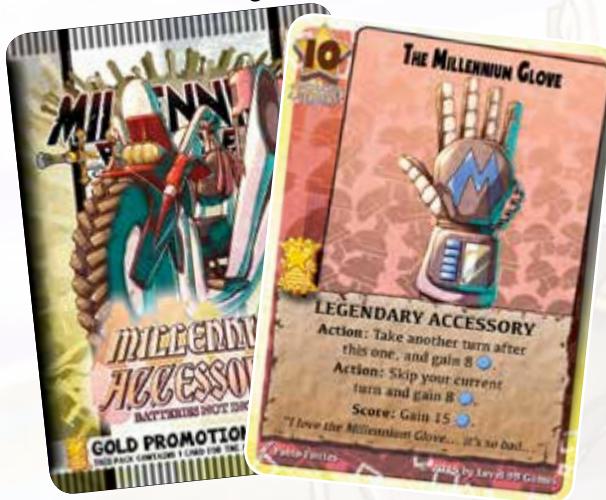
Millennium Accessories
The Millennium Accessories are the world's most powerful accessories, wreathed in legend. If you are playing with a less-experienced player, you can give that player a random Millennium Accessory as a handicap.
Alternatively, if all players are equally experienced, and want to raise the power curve of the game, they can draft the Millennium Accessories at the game start.
Free Market Mode
Free Market Mode is an optional rule for advanced players who are very confident in their card evaluation abilities.
With Free Market Mode, players may make uneven trades. That is, both sides of a trade do not need to match up in terms of Millennium Dollars and Star Ratings.
Though it seems like a simple change, this mode gives veteran players a massive advantage over less experienced players, so be careful when using this optional rule.
“When I build a new deck, it's like writing a new song. I have all these different pieces that are meaningless on their own, but then you arrange them together and add a big idea, and you’ve created something unique and awesome. - Deques Applenti, in an interview for Pure Deck Designer Magazine
Draft Mode
Draft Mode is an optional rule for advanced players who want more control over the cards they receive each round
Draft Mode replaces the random cards at the start of the Deckbuilding Phase (Deckbuilding Setup, Step 3).
When Deckbuilding begins, deal each player 6 cards from the Store. Players then draft these cards, going clockwise until each player has claimed six cards (take one card from your set of 6, then pass the rest to the player on your left).
After the first 7-minute timer ends, repeat this process, this time passing cards counterclockwise.
Liquidation Mode
Liquidation Mode is an optional rule for advanced players who want to see a lot more variety in decks.
During set up, put 2 additional Expansion, Premium, and Master sets into your store deck. At the end of each tournament round except the last, players return all the cards in their decks to the box (including deck boxes and accessories), and receive Millennium Dollars equal to the combined Star Ratings of all the cards liquidated in this way.
When playing in Liquidation Mode, money only provides half as manyVPs (1VP per 8 Millennium Dollars).
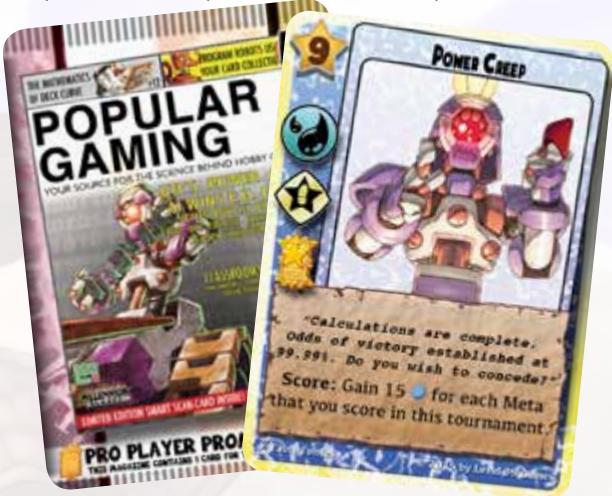
Pro Player Cards
When playing with characters, you can introduce Pro Player Cards. Pro Player cards have their own Type.
During rounds 1 and 2, when a player scores first place in the tournament, give each player (including himself) a copy of his Pro Player Card.
If a player who won the first tournament also wins the second one, give the 2nd place player's Pro Player card to all players instead.
Venues
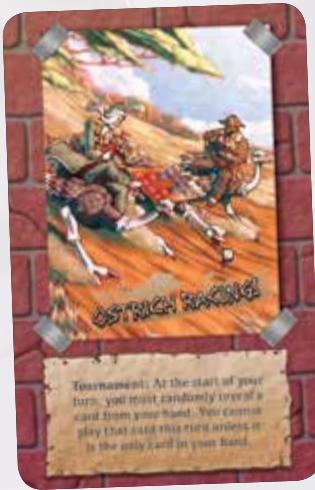
There's no need to play in the same game store every week! Why not go to the museum, or play on the edge of an active volcano?
Shuffle together the Venue Deck and place it beside the Metagames. When you start the Deckbuilding Round, also reveal the top card of the Venue Deck. It will have rules to follow for the Deckbuilding Phase, Tournament Phase or both. Discard it when the tournament ends.

DEQUES APPLENTI
USA, 19, Musician (Drummer) Specialty: Deckbuilding Why he plays: For expression
Deques is the drummer for an American Indie Band, Heart of the Decks, who creates epic music to duel by during tournaments. He's well-known in the Millennium Blades scene for his unique and often bizarre deck concepts which have swept aside the tournament meta and turned the game on its head more than once. When he's not touring with his bandmates you can usually find Deques at his apartment on a Friday Night, hosting a draft tournament party with about twenty friends from the local store scene.
Deques specializes in building unique concept decks. He can include extra deck boxes and accessories in his tournament kit, giving him additional scoring and defense options during the game. These options allow him to safely play decks which would normally be very vulnerable to disruption, and to score them in multiple ways. His ability to play decks that would be impossible for other characters to pull off makes him an especially interesting character.

CARDINE KOLLECKTA
Russia, 15, Artist Specialty: Collecting Why she plays: For discovery
An art student in Russia, Cardine has achieved fame among the international Millennium Blades community for her custom-painted cards and for sculpture integrating cards. Her work has been featured on a number of promotional cards in the game, and she is always on the lookout for rare gems scrounged from attics, thrift shops, and estate sales.
Cardine is a balanced character who starts the game with extra advantages in the form of some rare promo cards and who can acquire rare cards from card fusion more easily than other players. These rare cards form a strong core to Cardine's deck, giving her an advantage over slower players in the early rounds of the game. During tournaments, she can re-score some of her cards, doubling down on the most effective plays in her arsenal.

FULTON SUITCASE
Norway, 37, Investment Banker Specialty: Buying Why he plays: For profit
An investment banker by trade, Fulton has recently taken to speculating on the futures of cards in the Millennium Blades Aftermarket. His considerable personal wealth allows him to buy and sell large quantities of identical singles, effectively controlling the price of specific cards. Fulton enjoys the game itself, but he plays primarily to understand the value of the cards and to inform his investments. Getting close to the action by playing in the pro tour gives him an edge against other investors when speculating on what next season's chase cards will be.
Fulton's abilities primarily shine during the deckbuilding phase, where he receives extra money and is able to peek at store cards before buying them. This helps him maximize the returns on what he purchases from the store and create a better deck more quickly than other players. During gameplay, he can use leftover money to boost the value of his cards, giving him an edge in clashes and during scoring.

MORREY CAARDMAAN
France, 44, Game Store Chain Owner Specialty: Selling Why he plays: For business
Hailing from France, Morrey is the founder and owner of Revanche ("Rematch" in America and t
Content is long; only the first part is inlined. Download the file or open the rules page for the full text.
Download MarkdownTexts are community-compiled or publicly released by publishers; copyright remains with the original authors. For personal reference only.