
Mykerinos
At a glance
Rules, cards and Q&A (Chinese)
The rules, card data and player questions for this game are written in Chinese. Open the Chinese page to read them.
Where to find full rules
Full rules and card lookup are available in the cunlema app at cunlema.cn — pick this game and ask about any rule, card or turn you are unsure about.
Related games
Rulebook text (Markdown)
This game has 2 rulebook Markdown file(s) in our library; 2 rendered inline below — expand to read or download.
rules_zh_门卡乌拉_3509.md11.7 KB
埃及考古(Mykerinos)中文规则

翻译:Mobileg,Mar. 2009
游戏设计:Nicolas Oury
出版时间:2006
BGG 排名:189(2009 年 3 月)
游戏人数:2\~4人
游戏时间:45 分钟
适合人群:10 岁+
游戏类型:考古
游戏机制:区域控制
游戏背景:
1 个多世纪前的 1899 年,大量的欧洲人痴迷于埃及古文物。为了寻求冒险的刺激和荣耀,很多人组成考古队伍来到埃及,在茫茫荒漠中追寻被埋藏的宝藏。
玩家在游戏中扮演由资助人赞助的考古学家们,来到埃及挖掘这片宝藏,并把这些宝物带回博物馆,以装饰博物馆中最富有声望的展厅。在游戏最后,博物馆将开办一个盛大的展览,获得最高声望值的玩家(通过挖掘宝物并在高声望的展厅中展出)获得游戏胜利。
游戏配件:
1 个游戏版图
36 张地形(正面)和资助人(反面)卡
100 个考古学家方块
19 个玩家标志(包括一个起始玩家标志和 6 个+50 的积分标志)
5 个资助人标志
1 份规则书
游戏初始设置:
● 游戏版图放置在桌上。
● 不同颜色的考古学家方块放在版图旁,他们组成公共库。
- 每个玩家选择一种颜色,并拿取 2 个相关颜色的玩家标志,放在版图外圈的声望值积分轨道上(0 分处)和右上方的略过轨道旁。
- 随机选择一个起始玩家,他负责随机的放置 5 个资助人标志在博物馆 5 个方向的顶端的圆圈里。
重要概念:
● 地形/资助人卡:36 张卡片中有 35 张是双面的,正面为地形,反面为资助人。另有一张只有一面为地形卡。下图为 6 张地形卡。
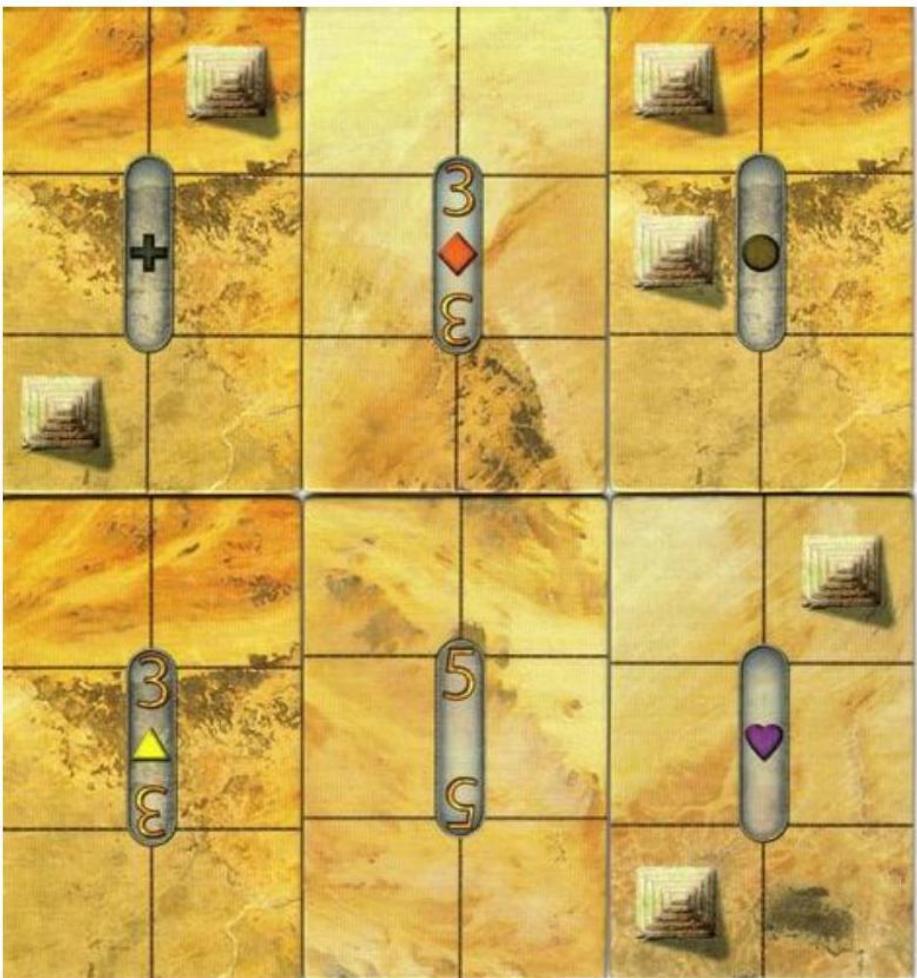
- 每张地形卡由 6 块空间组成, 玩家可以在空间中放置考古学家方块来获得区域的控制权。地形卡的有些空间处有金字塔存在, 标志这个空间不能放置方块 (例外: 使用资助人 Lord Lemon)。在地形卡中央, 有一个椭圆形标志, 标志中间的符号分别代表反面不同资助人。标志上下两则如果有数字, 则代表玩家在赢得这块卡片后可以直接得到的声望值。
- 区域(area):2 张地形卡片组成一个区域,计算玩家在考古区的势力以区域为单位(参见第三阶段:勘查)。前三个季节使用 4 个区域,第 4 季使用 6 个区域。
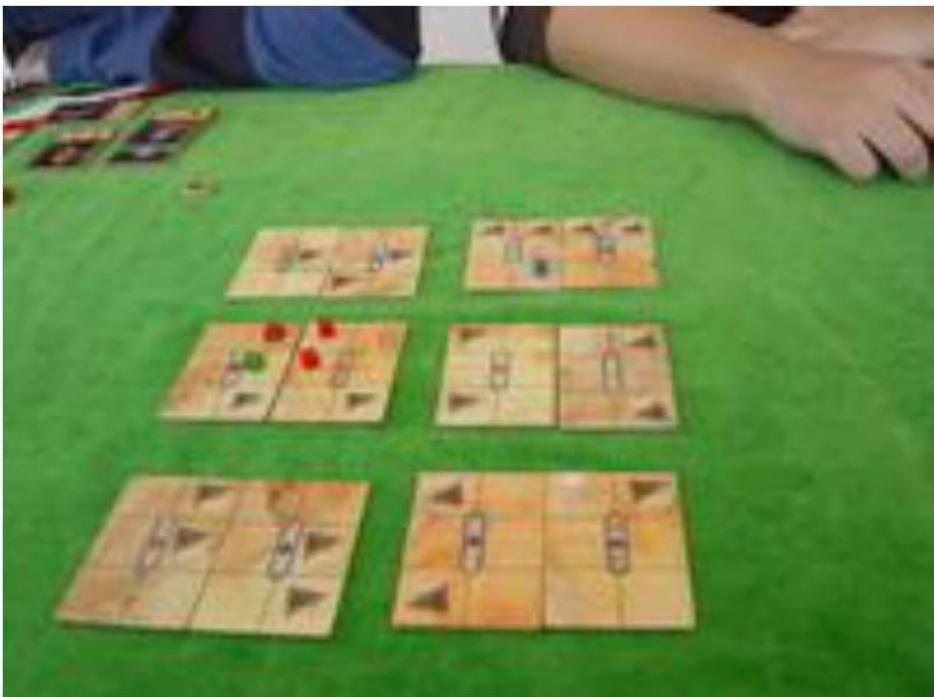
● 考古区(Region):每个季节中所有的考古区域集合,组成考古区。如下图:第 4 季 6 个区域组成考古区。
- 相邻空间(Adjacent Space):指整个考古区中所有横向或纵向(对角斜向不算)紧挨着的两个空间。包括不同区域之间的。
游戏摘要:
整个游戏分为 4 个季节。每个季节中,玩家通过放置考古学家方块在考古区域中来获得对该区域的控制。在每个季节的行动结束时,取得区域控制领先的玩家,可以选择得到 1 张卡片(在后面的季节使用反面资助人的特性)或者去博物馆预约一个展厅。
游戏进程:
游戏按时间分为 4 个季节,每个季节又都分为 3 个阶段。
第一阶段:季节开始
在每个季节的开始,每个玩家从公共库拿取自己颜色的考古学家方块,数量按如下规则:
3(2)人游戏:11个方块
- 4人游戏: 8个方块
如果公共库中没有足够的考古学家方块,玩家便拿取所有剩下的标志。从公共库取得标志组成玩家自己的个人库。
然后由起始玩家从洗过的地形卡中拿出该季节需要的地形卡(8 张或 12 张),并组合成为整个考古区。
第二阶段:挖掘行动
从起始玩家开始,按顺时针方向,玩家依次选择下面 4 个行动中的 1 个:
A) 新的挖掘
玩家从个人库中拿取一个考古学家方块放置在考古区里空闲的空间上,有金字塔标志的空间不能放置。
B) 扩展一个之前的挖掘
玩家从个人库中拿取两个考古学家方块,选择一个之前自己已经放置的方块,把这两个中的第一个放置在他的相邻处;然后再把第二个放置在刚放置的方块的相邻处。任何一个放置,都不能选择有金字塔标志的空间。
C) 略过
玩家可以选择略过,将自己在略过轨道旁的玩家标志移动至略过轨道上最小数字的位置上。同时,该玩家的第二阶段结束。
D) 使用一个资助人卡牌
这个行动开始于第二季节。在玩家行动时,可以选择横置(标志已经使用,不能在本季节再次使用)一张属于自己的资助人卡,表示适用该资助人的特性。具体如下:
a) Lady Violet
玩家可以从公共库拿取一个考古学家方块到个人库,然后执行上面的行动 A 或 B。如果公共库没有方块可拿,则不能选择 Lady Violet。
b) Lord Lemon
玩家可以选择在行动 A 时放置一个方块在金字塔上,或者在行动 B 时放置其中一个方块在金字塔上(不能两个都放在金字塔上)。
c) Sir Brown
玩家可以放置一个考古学家方块(个人库)在博物馆,从而来预约一个展厅。(注意,必须遵循预约规则,参见第三阶段:预约展厅)
d) Mrs. Blackmore
玩家可以在行动 A(新挖掘)后,再多放置一个考古学家方块在相邻处。该位置不能有金字塔。
e) Colonel Tangerine
玩家可以在行动 B(扩展挖掘)后,再多放置一个考古学家方块在后一个方块的相邻处。该位置不能有金字塔。
注意,只剩一个玩家没有略过时,他只能进行最后一个行动,然后进入第三阶段。
第三阶段:勘查
在此阶段,将逐个勘查玩家在各区域(两张地形卡)的影响力。根据结果,玩家将拿取卡牌或预约博物馆的展厅。
- 勘查区域:
按照玩家在第二阶段放置的考古学家方块的数量,依次勘查每个区域的玩家的影响力,得到排名。如果玩家在一个区域中没有方块,他将不计入该区域的排名。
如果有多个玩家的考古学家方块数量持平,那么将根据略过标志来排定。越早略过的玩家排名靠前。
区域排名第一的玩家必须选择:
-
拿取两张卡牌中的一张(参考拿取卡牌)。
-
用公共库的一个考古学家方块,预约一个博物馆的展厅(参考预约展厅)。如果公共库中没有剩余的考古学家方块,他便不能选择预约展厅。
然后,区域排名第二的玩家选择:
-
拿取剩下的卡牌,或者选择一张卡牌(如果第一的玩家选择了预约展厅)
-
预约展厅(同上)
注意:在极端情况下,一个区域可能只有一个玩家放置了标志,那么该玩家只能作为排名第一的人来选择行动。
对排名第三或第四的玩家来讲,他们只能选择拿取卡牌(如果还有的话)。如果没有卡牌剩下,他们就不能做任何事。(第三第三名不能预约博物馆)
当一个区域勘查完毕后,所有该区域考古学家方块放回公共库,进入下一个区域勘查。
- 拿取卡牌:
玩家拿取地形卡,如果地形卡中央有数字标记,那么该玩家立刻得到相同数值的声望值,移动积分轨道上的玩家标志。然后,将该卡牌翻面至资助人,以便在下一季使用。
- 预约展厅:
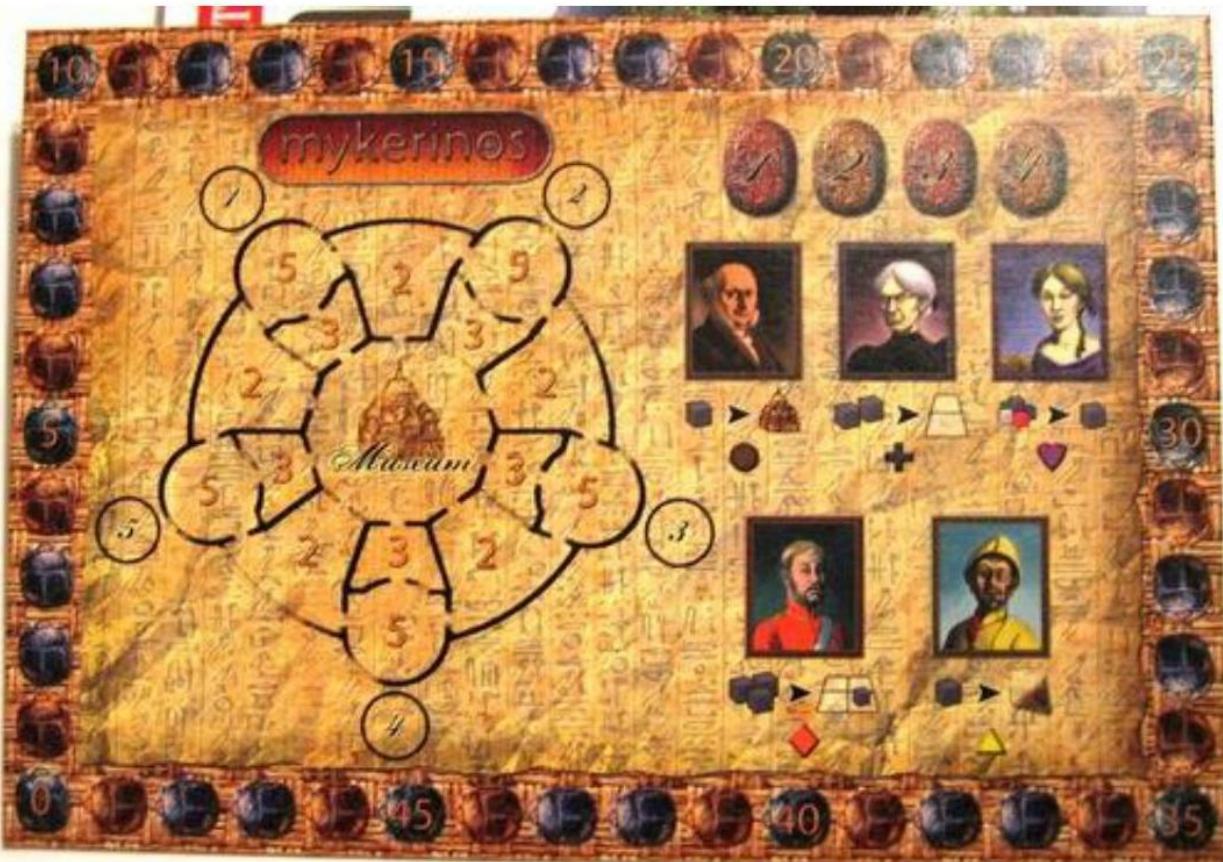
博物馆的构造由中间向 5 个方向展开,见上图。每个方向上连接着两个展厅,里层展厅标记为 3,外层展厅标记为 5。每个方向都在游戏初通过资助人标志代表了一个资助人。在每两个方向之间,另有一个标记为 2 的展厅,它们同时属于两边的两个方向,并且和标记为 5 的展厅是相通的。
展厅的数字标记代表着这个展厅的价值, 在最后的展出阶段会根据每个玩家手中的资助人数量加权得到每个玩家的声望值。注意: 每个展厅只能放置一个考古学家方块。
每当玩家想预约展厅时,他们可以:
-
放置考古学家方块在空闲的 “2” 或 “3” 展厅
-
或者放置考古学家方块在 “5” 展厅,尽当与之相邻的 “2” 或 “3” 展厅已经放置了自己的方块。
- 第三阶段结束:
当所有区域勘探完毕,第三阶段结束。此时:
-
略过轨道上的最后一个玩家成为下一季的起始玩家。
-
清空略过轨道。
-
把所有横置的资助人卡放正,即玩家可以在下一季继续使用它们。
-
新的一个季节开始。
注意:玩家保留没有用完的方块,他们可以在下一个季节继续使用。
游戏结束:
游戏在第四季结束时,博物馆将举办展览,同时计算所有玩家的声望值。
- 博物馆展览
通过举办展览,玩家根据自己的资助卡和预约的展厅得到相应的声望值。从方向 1 到 5,依次计算每个玩家的所得到的声望值。计算方法如下:
-
如果玩家预约的展厅为 5,那么玩家每有一张相关方向的资助人卡就可以得到 5 个声望值。
-
如果玩家预约的展厅为 3,那么玩家每有一张相关方向的资助人卡就可以得到 3 个声望值。
-
如果玩家预约的是两个方向之间的展厅 2, 玩家可以选择在两个方向中选择一个资助人,每张卡片得到 2 个声望值。
-
如果玩家没有预约某个资助人方向上的展厅,也没有预约与它相邻的展厅 2,那么每张资助人卡只能得到 1 个声望值。
-
如果玩家在一个方向上预约了多个展厅(包括展厅 2),对每张资助卡而言,万家只能选择一个最高声望值的展厅。
注意: 有一张地形卡背面没有资助人 (正面标志为 5 分), 他将不计入展览阶段的计分。
- 收集系列
如果玩家收集全所有 5 个资助人卡,那么将获得额外的 5 个声望值。
根据版图外圈几分轨道上的声望值积分,最高的玩家获得游戏胜利。如果有多个玩家分数持平,那么在个人库中拥有方块多的玩家获胜。如果继续持平,他们同时获得胜利。
二人游戏变体:
二人游戏将采用三人游戏规则, 只是加入一个中立玩家, 这个中立玩家由两个玩家共同控制。中立玩家不会得到声望值, 他只是用来阻碍对手的发展。
在每个季节开始时(第一阶段),两个玩家得到 11 个自己的考古学家方块,同时还得到 4 个中立玩家颜色的方块。在略过轨道上,中立玩家的标志放置在 2 号位置上。也就是说,两个玩家中,现略过的一方必然是获得所有持平(包括和中立玩家)的胜利,而后略过的玩家则相反。
在挖掘阶段(第二阶段),玩家除了可以放置自己的方块外,还可以选择放置中立方块。中立方块的放置可以选择行动 A(新的挖掘),也可以选择行动 B(扩展)。但是,作为中立玩家的挖掘,不能使用玩家拥有的资助人的特性。
在勘查阶段(第三阶段),如果中立玩家获得某个区域前两位的排名,他只能选择拿取卡牌,不能到博物馆预约展馆。拿取卡牌的规则如下:
● 如果中立玩家排名第一,那么由排名第三的玩家(或是那个没有排名的玩家)来选择拿去哪张卡牌。
● 如果中立玩家排名第二,那么有排名第一的玩家来选择拿去哪张卡牌。
● 中立玩家获得的卡牌将从游戏中移除。
● 如果只有中立玩家获得排名,那么 2 张卡牌将都被移除。
Download MarkdownMykerinos English Rules.md22.7 KB
Mykerinos - English Rules
Game design by Nicolas Oury – Illustrations by Arnaud Demaegd – Layout by Cyril Demaegd
FAQ & Forum : www.ystari.com
Contents
1 game board
36 'terrain / patron' cards
100 ‘archaeologist' cubes (25 for each color: blue, red, green and white)
• 19 marker disks for the players (including 1 “first player” marker and 6 “+50” score markers)
● 5 'patron' markers (1 orange, 1 black, 1 brown, 1 yellow, 1 purple)
this booklet
Once upon a time...
Goal of the game
- For more than a century, the European public has been fascinated by Egyptology, and the discoveries of Denon, Champollion, Petrie and others.
Seeking adventure and glory, teams of archaeologists search the sands of Egypt for hidden treasures.
The players embody archaeologists working for patrons. They excavate the land of Egypt to find precious artifacts, which will adorn the most prestigious rooms of the Museum. At the end of the game, the Museum organizes a great exhibition. The player who has earned the most prestige (by discovering things and getting advantageous places in the Museum) wins the game.
Setup
• The board is placed on the table.
Multi-colored cubes are placed next to the board. They constitute the general stock.
Each player chooses a color, takes the corresponding two marker disks, then places one of these disks on space 0 of the score track (1), and the other one next to the passing scale (4).
One player, chosen randomly, starts the game: they take the five patron' markers and place them randomly, one by one, in the circular spaces of the five wings of the Museum (3).
Game principles
The game is divided in four seasons. During each season, the players excavate a region of Egypt by placing their men in the various excavation areas of the region. At the end of the season, once the excavating is done, the best ranked archaeologists may either claim a parcel of land or send their men out to prepare the final exhibition at the Museum.
Each parcel of land is placed in a patron's tutelage. By claiming a parcel, a player earns the right to appeal to the patron and to use the patron's specific power in the course of subsequent seasons.
The Museum is divided in several rooms of varying prestige. The players can book these rooms by sending men into the Museum. They must choose carefully among the different wings, while watching their opponents progress.
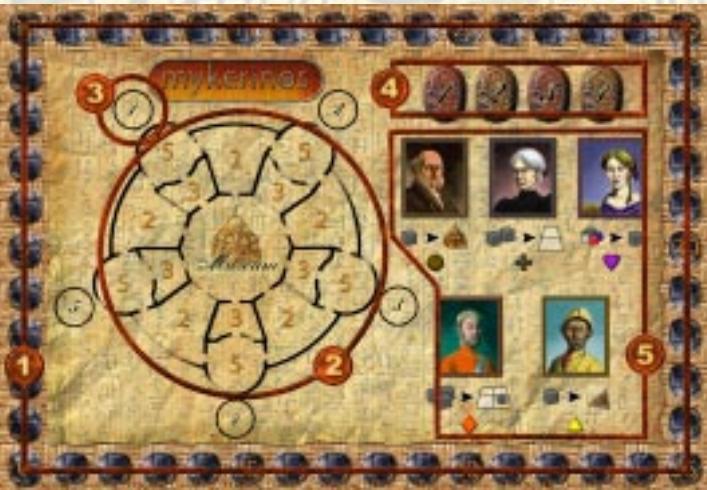
-
Scoring track
-
Museum
-
Museum wing
-
Passing scale
-
Patrons
35 out of the 36 cards feature a parcel of land on the front, and a patron on the back. The last card also features a parcel, but there is no patron on its back.
Parcels: Parcels are pieces of land on which players can place their cubes to carry out excavations. Each parcel is divided in six spaces that may be empty or contain a pyramid. Spaces containing a pyramid are obstacles; players cannot place cubes on them. What is more, at the center of each parcel, there is a cartouche with information on it. The cartouche indicates the degree of prestige of the parcel: some cards have no figure on them, some have a 2, a 3 or a 5, which represent the prestige points the players will score if they own the parcel. At the center of the cartouche, a sign indicates the patron to whom the parcel is allotted.
Regions: At the beginning of each round, a new region – composed of parcels – is set up (see fig.1; also see Phase 1). The region is a game board. It is made up of areas (fig.2), which are groups of two parcels. NB: Parcels have no up and no down; they may be placed in either direction.
The various areas which make up a region may be separated by a space to make them easier to differentiate. However, areas are considered adjacent. Thus, two spaces which are side-by-side orthogonally (but not diagonally) on two different cards are considered adjacent (fig.3). What is more, cartouches are not considered as obstacles. As a consequence, two spaces separated by a cartouche are considered adjacent.
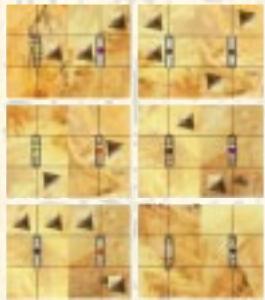
Fig. 1 : a region
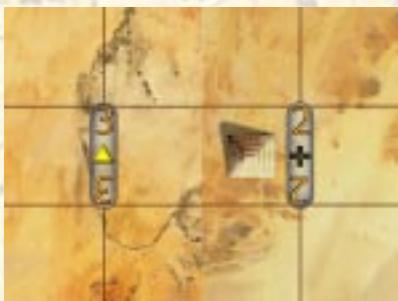
Fig. 2: an area

Fig. 3 : adjacent spaces
Progress of the game
The game is divided into four seasons; each season is divided into three phases.
Phase 1 – New season
At the beginning of each round, players get cubes of their color from the general stock. Each player places their cubes before them. Thus, they take:
● 11 cubes in 3-player games
● 8 cubes in 4-player games
If there are not enough cubes in the general stock, the player can only take what is left.
The cubes that were taken from the general stock make up the player's personal stock.
Then, the first player builds up the region to be excavated during this season: the player shuffles the pile of cards and sets up the region as shown on the right (parcel sides up).
Phase 2 – Excavations
Starting with the first player and going clockwise, each player may in turn choose one action among the four actions below:
A) Start a new excavation
The player takes a cube from their personal stock and places it on a free space of their choice in the region which is being excavated. It is impossible to place a cube on a space containing a pyramid.
B) Extend a pre-existing excavation
The player takes two cubes from their personal stock. They place the first cube on a free space, horizontally or vertically adjacent to a space already containing one of their cubes. Then the player places the second cube on a free space, horizontally or vertically adjacent to the space where they have just placed the first cube. These cubes cannot be placed on a square containing a pyramid.
C) Pass
The player passes. They place their marker disk on the first free space of the passing scale (that is, the space with the smallest number still available). Phase 2 is over for this player. This is the only action available when a player has no cube left in their personal stock.
D) Appealing to a patron
This action is available from the second season on, thanks to the parcels the players will get during Phase 3 of the first season (see Phase 3).
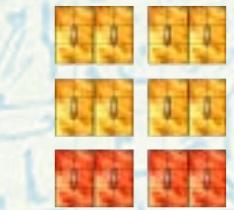
Setting up the region: in seasons 1, 2 and 3, eight parcels are arranged to form four areas (two lines with two areas per line – see the yellow cards on the diagram). In season 4, twelve parcels are arranged to form six areas (three lines with two areas per line - see the yellow cards AND the red cards on the diagram – also see fig.1 on the previous page).

Blue starts a new excavation. They can place their cube on spaces A or B (empty spaces), but not on C or D (which already contain cubes), nor on E or F (because of the pyramids).
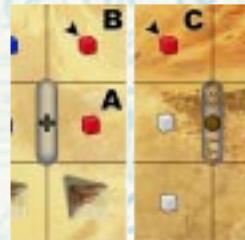
Red extends one of their existing excavations (space A) by placing a red cube on B, then another one on C

Green passes, by putting a marker disk on the first free space of the passing scale (here, space 1, since Green is the first to pass).
Thanks to their financial means, the five patrons can help the players with their specific powers.
At their turn, the player tilts the card featuring the patron they are interested in. Then, the player acts as indicated (see below). A given player may only tilt one card per turn. A tilted card cannot be used again during the same season, but a player may appeal to the same patron several times in the same season (as long as the player has cards left to tilt, with the patron on them).
a) Lady Violet
The player takes a cube their color from the general stock and places it in their personal stock. Then, the player carries out action A (start a new excavation) or action B (extend a pre-existing excavation). If the player has no cubes left in the general stock, they cannot carry out this action.
b) Lord Lemon
The player may start a new excavation by taking a cube from their personal stock and placing it on a space containing a pyramid (action A), OR extend an existing excavation by placing one of the two cubes of their personal stock on a space containing a pyramid (action B).
c) Sir Brown
The player sends one of their men out to reserve a room in the Museum. Instead of playing in the region, they place a cube from their personal stock into the Museum (make sure you follow the Museum placing rules (see Phase 3 – Placing cubes in the Museum).
d) Mrs. Blackmore
The player may start a new excavation by placing two cubes from their personal stock instead of one. The player puts the first cube on a free space of their choice, and the second cube on a free space, horizontally or vertically adjacent to the first cube. These cubes cannot be placed on a space containing a pyramid.
e) Colonel Tangerine
The player may extend an existing excavation by placing three cubes from their personal stock instead of two. The player places the first cube on a free space, horizontally or vertically adjacent to a space already containing a cube their color. Then the player places the second cube on a free space, horizontally or vertically adjacent to the first one, and the third cube on a free space, horizontally or vertically adjacent to the second cube. These cubes cannot be placed on a space containing a pyramid.
When there is only one player left (that is, when the other players have passed), that player may only carry out one action. Then, the game moves on to phase 3.
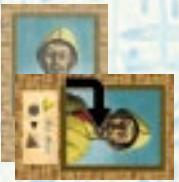


Blue tilts a card featuring Lord Lemon. Then Blue extends one of his/her own excavations by putting a cube on A (pyramid) and B. Since A already contains a pyramid, it is impossible for Blue to place his/her second cube on space C.
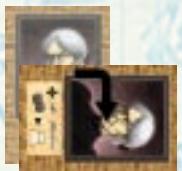
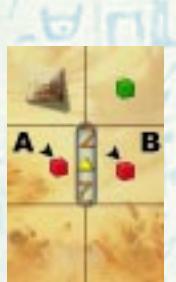
Red tilts a card featuring Mrs. Blackmore, and puts one cube on A and the other one on B, which is adjacent to A.
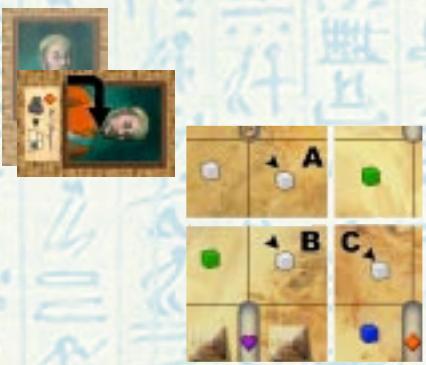
White tilts a card featuring Colonel Tangerine. Then, White extends one of his/her excavations by placing three cubes on spaces A, B and C.
Phase 3 - Survey
During this phase, the players will claim parcels and book rooms in the Museum for the final exhibition.
Survey of the areas
Count areas one by one, starting with the one in the top left-hand corner of the region. Count line by line, from left to right.
In each area, players are ranked according to the total number of cubes they have placed. The player who has the highest number of cubes in the area comes first, the player with the second highest number comes second, and so on. Players who have placed no cubes in the area are not ranked.
Draws: If two players or more have placed the same number of cubes in the area, take a look at the passing scale to settle the draw and rank them. In this case, the player who occupies the space with the lowest figure (that is, the player who passed first) wins the draw.
The player who is ranked first in the area must choose among the following two actions:
Take one of the two parcel cards which make up the area (see claiming a parcel).
Book a room in the Museum by placing one of their cubes from the general stock (see Placing cubes in the Museum). This action is impossible if the player has no cubes left in the general stock.
Then, the player who is ranked second must choose among the following two actions:
Take the remaining parcel card (if the first player has taken the other card) or one of the two parcel cards (if the first player has placed a cube in the Museum).
Book a room in the Museum by placing one of their cubes from the general stock. This action is impossible if the player has no cubes left in the general stock.
Be careful: in rare instances a player may be alone in an area. In such a case, the player ONLY scores as the first ranked player.
If there are cards left once the first and second players have made their choice (that is, if at least one of them has booked a room in the Museum), the player who is ranked third and possibly the one who comes in the fourth position may take the remaining parcel(s). They may not go to the Museum.


Areas are counted following the order shown above.
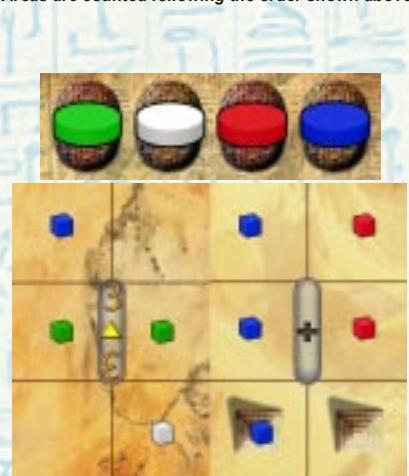
Survey of an area: in this area Blue is ranked first with four cubes, Red and Green both have two cubes, and White has one cube. Green passed before Red, so Green occupies a better place on the passing scale, and is consequently ranked second. Red is ranked third. White comes fourth.
Blue must choose between the two cards and the Museum. He/she chooses the leftmost card, which has a value of 3, so Blue moves his/her marker up three spaces along the score track. Then, Blue places the card before him/her with the patron side up. From the next turn on, Blue will be able to activate Lord Lemon's help.
Green may choose between the remaining card and the Museum. He/she chooses to place a cube in the Museum (see next example).
Being ranked third, Red cannot go to the Museum, so he/she takes the remaining card. Since there is no number on it, Red's score marker does not move. Red places the card before him/her with the patron side up. From the next turn on, Red will be able to activate Mrs. Blackmore's help.
Since there are no cards left, White earns nothing. All the cubes are put back into the general stock, and the survey of the next area starts.
Finally, discard excess cards in the area (put them back into the box). All the cubes that were played in the area are put back into the general stock. Move on to the next area.
Claiming a parcel
The player takes the card. If there are points on the cartouche (2, 3 or 5 points), the player immediately earns the corresponding number of prestige points, and moves the marker accordingly on the score track. Finally, they turn the card patron side up and place it in front of them.
Placing cubes in the Museum
The Museum is divided into one central room and five wings.
Each wing is composed of two rooms (a room with a ‘3' value opening onto another room with a '5' value), and is dedicated to the discoveries of a specific patron.
In between wings, there are rooms with a '2' value. These rooms belong to the two wings that surround them. They open onto the ‘5'-valued rooms of these wings.
The higher the value of a room is, the more prestige points the room will yield during the final exhibition. Each room may contain no more than one cube.
Whenever a player puts a cube in the Museum, they may either:
• place it in any free ‘2' or ‘3' room,
● or place it in a ‘5' room adjacent to a ‘2' or ‘3' room they already control.
End of the phase
When all the areas have been surveyed, the phase is over. Then:
● The last player on the passing scale becomes the first player of the next season.
• The passing scale is emptied.
● Patron cards that were tilted during phase two are set straight (so, players will be able to use them again in the next season).
A new season begins.
Players keep the cubes they have not used during this season; they will be able to use them in the next season.

Placing cubes in the Museum: Green places a green cube from the general stock into the Museum. It is Green's first cube in the Museum, so rooms with a '5' value are not available. It is also impossible for Green to put a cube in rooms that are already occupied, so he/she decides to place a cube in the room situated between the wings of Lord Lemon and Mrs. Blackmore.
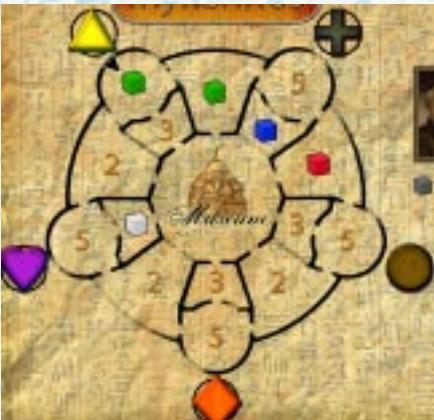
Placing cubes in the Museum (cont'd): While surveying another area, Green chooses to place another cube in the Museum. Since there already is a green cube between Lord Lemon's and Mrs. Blackmore's wings, both '5'- valued rooms are now available. Green may also choose to put a cube in any unoccupied room with a value of 2 or 3. Finally, Green decides to place a man in Lord Lemon's room '5', which, from now on, is not available to other players.

End of the game
The Game ends at the end of the fourth season. Points are counted:
Exhibition at the Museum
During the exhibition, the players earn points according to the number of cards they own in relation to the places they occupy in the Museum.
For example, the place a player occupies in Lord Lemon's wing will affect the value of the 'Lord Lemon' cards they own. Thus, each card will yield from 1 to 5 prestige points.
To count points in the Museum, start with wing number 1, and through to wing number 5. For each wing, a player earns points according to the number of corresponding 'patron' cards they have, and according to the position of the player in the rooms:
● If the player is in room '5', they earn five prestige points per card they own.
● If the player is in room ‘3', they earn three prestige points per card they own.
If the player is in a room adjacent to the wing (room ‘2’), they earn two prestige points per card they own.
If the player is neither in any room of the wing, nor in any room adjacent to the wing, they only score one point per card they own.
● If the player is in several of the above rooms, for each card they own, they earn the number of points corresponding to the room with the highest figure.
Series
For each series of five different ‘patron' cards they own, a player scores five points.
The player who has the most prestige points wins the game. In case of draw, the player who has the most cubes in their personal stock wins. If this causes a new draw, the tied players share the win.
NB: there is a parcel card (the 5 points card) which is not affiliated to any patron. This card does not yield any museum or series points at the end of the game.
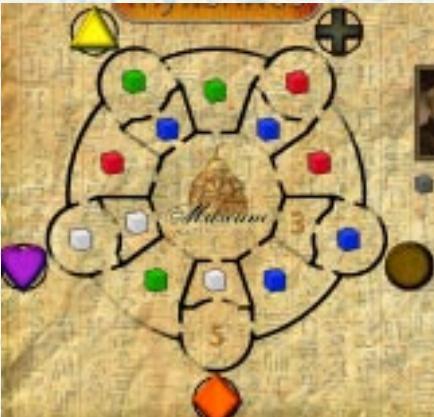
Final exhibition at the Museum: by the end of the fourth season, Blue owns the cards shown above. According to the position of his/her cubes in the Museum, Blue scores:
• Three points per 'Lord Lemon' card, that is six points
• Three points for his/her only 'Mrs. Blackmore' card • Five points per 'Sir Brown' card, that is fifteen points
• Two points per 'Colonel Tangerine' card, that is four points
• One point for his/her 'Lady Violet' card.
Series: Blue has a full series of different 'patron' cards. Consequently, Blue score five points.
2-player games
The rules of the 3-player game still apply, but a neutral player is played collectively by both players. This neutral player does not score points; however, players will be able to use it to block their opponent.
At the beginning of each season (Phase 1), each player takes 11 of their own cubes and 4 cubes of a same neutral color. Choose a passing disk the same color for the neutral player and place it on space 2 of the passing scale. As a consequence, during the game, the first player who will pass will always win the draws opposing them to the other player and the neutral player, whereas the player who will not pass first, being ranked third on the scale, will always lose the draws.
During the excavation phase (Phase 2), the player plays normally, then they may use their neutral cubes to start a new neutral excavation (action A), or extend a pre-existing neutral excavation (action B), following the cube placing rules. The neutral player cannot benefit from the patrons' powers.
During the survey phase (Phase 3), when the neutral player is ranked first or second in an area, it must automatically choose a card (in other words, it never places cubes in the Museum). The card is chosen according to the ranking in the area:
● If the neutral player is ranked first, the player who is ranked third (or the unranked player, if both players are not in the area) chooses the neutral player's card.
If the neutral player is ranked second, the player who is ranked first chooses the neutral player's card.
● The cards chosen by the neutral player are permanently discarded.
● If the neutral player is alone in an area, both cards are permanently discarded.
Hints
● Manage your stock of cubes wisely: cubes that are left unused by the end of a season can be used in the next season. Thus, a player who saves up more cubes than their opponents will have more at their disposal for the next season, which will especially be useful for the fourth season, when the game region is larger.
● Do not fight uselessly: remember the first two players of each area are sure to earn something (either a parcel of a place in the Museum). Its is therefore useless to accumulate cubes in an area where you are only threatened by one opponent, or to try and beat an opponent at all cost when both parcels are interesting.
● Keep the Museum in mind: if you place no cube in the Museum, your cards will only yield one point, which is not sufficient to win the game. Try and secure an access to the Museum with a ‘Sir Brown' card, or “sacrifice” a few parcels (even strong ones) at the right time (for instance, when there are only two players in the area, and the card you are sacrificing will not be of benefit to anyone).
● Pass carefully: if you stop placing cubes too early, you run the risk of seeing other players take your majorities. Conversely, it is useless to waste cubes if you think the situation is safe enough, all the more so since being the first to pass will make you win every draw.
Thanks
The author would like to thank Anne, Cyril, Raphi, William, Dom, Thomas, Manu, Thomas & Julia, Manu, Nicolas & Julie, Adrien & Lydie, Nathalie, and all the testers for their insightful suggestions.
Download MarkdownTexts are community-compiled or publicly released by publishers; copyright remains with the original authors. For personal reference only.