
Ogre
At a glance
Rules, cards and Q&A (Chinese)
The rules, card data and player questions for this game are written in Chinese. Open the Chinese page to read them.
Where to find full rules
Full rules and card lookup are available in the cunlema app at cunlema.cn — pick this game and ask about any rule, card or turn you are unsure about.
Related games
Rulebook text (Markdown)
This game has 2 rulebook Markdown file(s) in our library; 2 rendered inline below — expand to read or download.
rules_en_ogre_5206.md28.6 KB
来源类型:纯文本规则(非 PDF 源,早期抓取/转换产物)
说明:原文未改动,仅调整存放位置与文件名;非 PDF 扫描件,无对应原书 PDF
Ogre Rulebook | RulesPalRulesPalChatRulebookOgreOgre Rulebook Table of Contents Table of Contents Notes on the Pocket Edition of Ogre
1.00 Introduction
2.00 Map
3.00 Counters
4.00 Turns
5.00 Movement
6.00 Combat
7.00 Ending the Game
8.00 Optional Rules
9.00 Scenarios
Format for Ogre Record Sheets
Combat Results Table Explanation of CRT Results
Illustration
About Ogre
Notes on the Pocket Edition of Ogre
This edition was created in response to popular demand during the 2012 Kickstarter project. A lot of people missed the version of the game that you could, literally, carry in your pocket. We decided to go all the way back to the first edition of Ogre and keep the game experience the same, with slightly updated rules and slightly better components. The suggested retail price, when this edition goes on general sale in 2013, will be the same $2.95 that the first edition cost in 1977.
This edition is formatted like the very first printing of Ogre, back in 1977. The cover is the original Winchell Chung art, and the typography is as close as we could get to the original. The map uses the original ultra-crude designer art. The counters are a cleaned-up version of my 1977 pasteups, most based on shrunk-down silhouettes of Winch's original unit drawings. These are two-sided; the first printing's counters were blank on the back.
The rules are not the 1977 version. To take advantage of decades of play experience, we started with the Fifth Edition rules and updated a bit more.
We added counters for the variant Command Posts suggested in the first edition. We fought off the temptation to add any units that were not mentioned in the original edition. Once you start, where do you stop?
I hope you like this re-creation of the game that started my career. It's been an interesting 35 years.
— Steve Jackson
1.00 Introduction
This game includes this rulebook, the map, and 140 two-sided counters.
1.01 General. In its basic version, Ogre is a two-player game representing an attack by a cybernetic fighting unit – the Ogre – on a strategic command post guarded by an armor battalion. Other scenarios may involve more than two players, and/or several Ogres. Playing time is between 30 minutes and 1 hour for the basic game.
1.02 Setup. Before playing Ogre for the first time, read the rules over once quickly to get the "feel" of the game. Then set up the map and counters for the basic scenario (below) and go over the rules again. By reference to the rules, the map, and the counters, you should be able to resolve any apparent ambiguities. Once you feel you have fully understood the movement and combat rules, you can begin play.
1.03 Basic (Mark III) Scenario. This represents an Ogre attack on a heavily-guarded command post. The defense sets up first. The defending player gets 20 points of attack strength (see Section 6.02) of infantry, and 12 armor units. Each Howitzer the defender takes counts as two armor units. These units are set up in the obstructed area of the map (see Sections 2.01.3 and 2.01.4), as is the command post. In addition, all but 20 attack strength points of the defender's force must set up on or behind a line drawn between the two crater hexes at the map edges. All units are face-up.
The attacking player takes a single Ogre Mark III and moves first, entering anywhere on the south end of the map.
Victory conditions are as follows:
All defending units destroyed: complete Ogre victory.
Command post destroyed and Ogre escapes from the bottom of the map: Ogre victory.
Command post and Ogre destroyed: marginal Ogre victory.
Command post not destroyed, but Ogre escapes: marginal defense victory.
Command post survives, Ogre destroyed: defense victory.
Command post and at least 30 attack points of defense force survive: complete defense victory.
1.04 Advanced (Mark V) Scenario. Play is identical to the basic scenario, except (1) the defense gets 30 points of infantry and 20 armor units (again, Howitzers count double); (2) all but 40 attack points of this force must set up on or behind the line; (3) the attacking Ogre is a Mark V; (4) for a total victory, the defender must destroy the Ogre while preserving his CP and at least 50 attack points of his force.
1.05 Solo Play. Ogre plays very well as a solo game in these two scenarios – that is, one person can play both sides. With experience, it is possible to vary strategies; i.e., "programming" the Ogre to charge straight in (in which case the defending force should be smaller, for balance) or committing the defense to a static strategy and using hit-and-run tactics with the Ogre (in which case the defending force should be enlarged). The possibilities are unlimited.
1.06 Play Balance. The basic and advanced scenarios, as well as those in Section 9, have been extensively playtested. However, the Ogre is easier to "pick up" than the defense for most players. The balance on both scenarios has been set to take this into account. In particular, the basic scenario assumes that both players are new to the game. If both sides use optimum tactics, the defender should be able to win the basic (Mark III) scenario with the forces given; removing two armor units will make the sides about even for an experienced defender.
In a perfect scenario, victory should go to the more skillful player, regardless of who takes which side. By adjusting the amount of armor units allowed to the defender, it is easy to "handicap" the game to make up for different levels of experience. In a tournament game, it is suggested that each round consist of two games, with each player attacking once and defending once.
2.00 Map
2.01 General. The map is divided into hexagons, or "hexes," each of which represents an area 1,500 meters across. Each turn represents 4 minutes. Terrain features on the map are:
2.01.1 Craters. Hexes containing craters are impassable. No unit may move into or over a crater. Units may fire over craters. The small cracks around craters do not affect movement.
2.01.2 Ridges. The heavy markings along some hexsides indicate obstructions. Only Ogres and infantry may cross ridge hexsides. Units may fire over ridges.
2.01.3 Clear Area. This is the area free of craters and ridges – the hexes with numbers ending in 17 through 22.
2.01.4 Obstructed Area. This is the top part of the map – the hexes with numbers ending in 01 through 16.
2.02 Leaving the Map. No unit may move off the map unless a scenario specifically calls for it to do so. It may be assumed that the top and sides of the map are bounded by swamp and impassable; the bottom of the map is a river which only Ogres may enter. Ogres may leave the map by entering the river, but may not re-enter the game.
3.00 Counters
All counters are backprinted. The reverse side of an armor unit counter shows that unit in a disabled state. Ogre, CP, and infantry counters have different values on front and back, for flexibility of play.
3.01 Armor Unit Counters. Each has a symbol and name which show its type, and four numbers which indicate its capabilities; attack strength and range (see Section 6.02), defensive strength (see Section 6.03), and movement points (see Section 5.01). There are four kinds of armor unit:
Heavy Tank – A Main Battle Tank.
Missile Tank – A lightly armored missile-firing crawler.
Ground Effect Vehicle (GEV) – A highly mobile armed and armored air-cushion vehicle. Each GEV may move twice per turn.
Howitzer – A fixed-position heavy missile cannon.
3.02 Infantry. These counters come in three types, representing one, two, or three squads of infantry, armed with conventional and antitank weapons and using powered suits which greatly increase their mobility and provide some radiation and shrapnel protection. They have the same four stats described for armor units.
3.03 Command Post. A strategic communications center. It is immobile and has an attack and defense strength of zero; that is, any attack automatically destroys it, and it may be rammed by an Ogre without damage to the Ogre. A player whose command post is lost has lost the game, but may continue to fight and inflict damage on his opponent (see Section 1.03).
3.04 Ogre Counters. Two types of Ogre are represented in this game. The Mark V is larger and more formidable than the Mark III.
The capabilities of the Ogres are not shown on the counters; they change throughout the game as the Ogre is damaged, and are shown on the Ogre record sheet (see below).
4.00 Turns
4.01 General. Ogre is played in turns. The precise sequence for each turn depends on the scenario being played. During his turn, each player may move any or all of his units, and fire with any or all of them, as long as each unit fires only once and (except for GEVs) moves only once.
4.02 Turn Sequence. The turn sequence for the basic (and advanced) scenario is:
Ogre moves
Ogre fires
Defender's armor units disabled the previous turn become un-disabled
Defender moves
Defender fires
Defender moves GEVs their second (3-hex) movement phase
4.03 Multiplayer Sequences. A scenario involving more than two players will use a similar sequence, with players moving in the same order each turn. Each attacking player, in turn, moves and resolves combat; then each defending player, in turn, moves and resolves combat. Players on the same side may take their fire phase together to combine fire.
5.00 Movement
5.01 General. The number in the top right-hand corner of each standard counter is the number of "movement points" that unit has – the maximum number of hexes it may move per turn. For example, an "M2" unit may move up to two hexes per turn. Movement points may not be accumulated from turn to turn. A unit never has to move. A disabled unit (see Combat Results Table) may not move until it recovers.
5.02 Stacking. Units may not be stacked; that is (with the exceptions noted below) only one unit at a time may occupy each hex.
5.02.1 Combining Infantry. The basic infantry counter is the 3-squad counter. Two or three 1-squad counters, or a 1-squad and a 2-squad counter, may occupy a hex together, since they are still the equivalent of one 3-squad counter.
5.02.2 Movement Through Other Units. Any unit may move through a hex occupied by a friendly unit, as long as the two do not end the turn on the same hex. No unit may move through a hex occupied by an enemy unit, except as described under Section 5.03 (Ramming), below.
5.03 Ramming. An Ogre may damage or destroy enemy armor units by ramming. Ramming a unit is accomplished by moving onto or through its hex.
5.03.1 Ramming Armor Units. Any immobile armor unit (i.e., a Howitzer or any disabled unit) is destroyed if rammed. Any other armor unit is disabled on a die roll of 1-3, and destroyed on a die roll of 4-6. The Ogre player rolls the die immediately upon ramming. If the armor unit is only disabled, the Ogre may expend one more movement point, stay in that hex, and ram again.
An Ogre loses two tread units (see Section 6.05) for ramming a Heavy Tank, and one tread unit for ramming any other armor unit.
5.03.2 Movement After Ramming. If an Ogre still has movement left after ramming, it may continue to move. However, if loss of tread units due to the ram reduced the Ogre's movement points, it may move only the reduced number of hexes that turn. Example: a Mark V with 41 remaining tread units moves one hex and rams a Missile Tank. Its tread units are reduced to 40, so its movement is reduced to 2; it may move only one more hex that turn.
5.03.3 Ramming CPs. An Ogre may ram a CP, destroying it. Since the CP has no defense strength, the Ogre is unhurt.
In a scenario in which the CP has a defense strength (e.g., Section 8.05), the Ogre loses a number of tread units equal to the base defense value of the CP.
5.03.4 Ogres Ramming Ogres. In scenarios with several Ogres, one Ogre may ram another by moving onto its hex. The ramming Ogre then immediately ends its movement for that turn in the last hex it occupied before ramming.
An Ogre which rams a larger Ogre loses five tread units. An Ogre which rams a smaller Ogre, or one the same size, loses three tread units.
The damage done to the Ogre which was rammed is determined by a die roll. The ramming player rolls two dice if his (ramming) Ogre is a Mark III, and four dice if his (ramming) Ogre is a Mark V. The total on all the dice is the number of tread units lost by the Ogre which was rammed. Example: A Mark V rams a Mark III. The Mark V automatically loses 3 tread units. Four dice are thrown. The total shown is 12, so the Mark III loses 12 tread units. On its own move, the Mark III rams back. It automatically loses 5 tread units. Two dice are thrown for an 8, so the Mark V loses 8 tread units.
Only tread units are lost to ramming attacks.
5.03.5 Limit on Ramming. An Ogre may ram no more than twice per turn, or one enemy Ogre per turn.
5.03.6 Armor Units Ramming Ogres. An armor unit may ram an Ogre by moving onto its hex. The Ogre loses one tread unit automatically; the armor unit is destroyed.
5.03.7 Other Ramming. In the basic Ogre game, armor units may not ram each other. Infantry can never be rammed.
5.04 Infantry Overruns. An Ogre may not ram infantry, but it may move onto or over an infantry hex as though the infantry were not there. If the Ogre has any antipersonnel weapons left, the infantry unit is automatically reduced by one strength point. An Ogre may choose to expend another movement point, stay in the same hex, and reduce the infantry again.
5.05 GEV Double Movement. A GEV may move twice per turn – once (up to 4 hexes) before combat, when all other units move, and once (up to 3 hexes) after combat.
5.06 Ogre Movement Points. An Ogre begins the game with 3 movement points. This may be reduced by damage to its tread units as the game progresses (see Section 6.05).
6.00 Combat
6.01 Sequencing. A fire phase occurs after each movement phase (except for GEV second-phase movement).
6.02 Combat Factors. Each standard counter carries a Combat Factor expressed as two numbers separated by a slash – e.g., 4/2. The first number shows the unit's attack strength; the second shows its range – that is, the maximum number of hexes at which that unit may attack.
6.03 Defense Strength. Each standard counter also has a defense strength in the top left-hand corner – e.g., D2.
6.04 Ogre Combat Factors and Defense Strengths. An Ogre has a number of different weapons, each with its own attack strength, range, and defense strength. These are shown on the Ogre record sheet (see below).
6.05 Ogre Tread Units. These units represent the state of the Ogre's treads and motors. Damage (i.e., reduction of tread units) slows the Ogre. A Mark V begins with 60 tread units; a Mark III begins with 45. When an Ogre's tread units are reduced to 2/3 their original total, the Ogre's movement is reduced from 3 to 2. When the tread units are reduced to 1/3 their original total, the Ogre has only 1 movement point – that is, it can only go one hex per turn. When the Ogre's tread units are all gone, the Ogre can no longer move. It can still fire at anything within range. The Ogre does not expend tread units simply by moving.
6.06 Attacks. In general, each attack is resolved by comparing attack and defense strengths of the units involved, and then rolling a die. Specifically: For each attack, all attack strengths involved are totaled, and then compared with the defense strength of the target in ratio form. This ratio is then rounded off in the defender's favor to one of the ratios shown on the Combat Results Table (CRT). In other words, the target of the attack, be it Ogre or standard unit, gets the benefit of the rounding-off. Examples: 2 attack points against 1 defense point would be a "2-1" attack. 2 attack points vs. 2 defense points = 1-1. 3 attack points vs. 2 defense points = 1-1 also. 2 attack points vs. 3 defense points = 1-2. 6 attack points vs. 1 defense point = 6-1 (treated as 5-1; see the CRT). Once the ratio is determined and rounded off, the attacker rolls the die and consults the proper column of the CRT to find the result. Results are applied immediately.
6.07 Combining Attacks. Any number of units and/or Ogre weapons may combine their attack strengths into an attack on any single target except Ogre tread units.
6.08 Multiple Attacks. Any number of successive attacks may be made against any unit or Ogre weapon in one turn, provided that each attacking unit or weapon fires only once.
6.09 Multiple Targets Forbidden. An attack must be made against one target only – either a given unit, or a given weapon (or number of tread units) on an Ogre. An attack strength may never be divided between targets. A Missile Tank could fire at 1-1 on one Ogre secondary battery, but not at 1-2 on two secondaries at once.
6.10 Weapons. It is assumed that most weapons are heavy rapid-fire railguns using tactical nuclear shells, effectively capable of fire in any direction. Each standard unit may apply its attack strength once per turn. Each Ogre weapon may apply its attack strength once per turn until it is destroyed. However:
6.10.1 Antipersonnel Weapons. Ogre antipersonnel weapons are effective only against infantry and the CP. No infantry unit may be attacked more than once per turn by antipersonnel. When all AP weapons are gone, an Ogre can no longer reduce an infantry unit's strength by 1 by entering its hex.
Note: Any weapon may be used against infantry. AP weapons are useless against anything but infantry and CPs.
6.10.2 Missiles. Each Ogre missile is a one-shot weapon. Once used (or if destroyed before firing), it is gone.
6.11 Attacks on Ogres. Any unit firing on an Ogre must specify the target it is attacking – either one specific weapon or the Ogre's tread units.
6.11.1 Attacks on Ogre Weapons. When a weapon is the target, the attack strength of the attacker(s) is compared with the defense strength of the weapon attacked. Example: A Missile Tank (attack strength 3) could fire on a gun from the secondary battery at 1-1, a missile at 1-1, an AP gun at 3-1, or a main battery at 1-2. A Howitzer could attack a secondary at 2-1, and so on. An 'X' result on the CRT means the target weapon is destroyed. 'D' results do not affect Ogres.
6.11.2 Attacks on Ogre Treads. If the Ogre's tread units are the target, the attack is always at 1-1 odds. In other words, after the attack is announced, the attacker rolls the die, and on a roll of 5 or 6 ('X' at 1-1 on the CRT), the Ogre loses a number of tread units equal to the attack strength used. Each unit attacking treads must do so individually. Thus, a successful Heavy Tank attack on treads would cost an Ogre 4 tread units.
6.12 Timing. A player may make his attacks in any order and may observe the results of each attack before announcing and carrying out the next, in order to most efficiently use his strength. However, a player must always announce what he is attacking, what he is attacking with, and the odds, before rolling the die – i.e., "All right, I am now attacking that Missile Tank there, with three guns from the secondary battery, which is a 4-1."
6.13 Destroying Ogres. An Ogre is not destroyed until all its weapons and tread units are gone. However, a lone, immobile Ogre is helpless; a game may be ended at that point.
6.14 Combat in Same Hex. If an Ogre ends its movement in the same hex with an enemy unit, combat between them occurs as though they were in adjacent hexes.
6.14.1 Starting Turn in Ogre's Hex. In the unlikely event that the Ogre ends its turn in a hex with an enemy unit, stays in that hex through its next turn, yet never destroys the enemy unit, that unit will recover normally if it was disabled. It must leave the Ogre's hex, and may move and attack normally on its turn.
7.00 Ending the Game
7.01 Regular Games. The game ends when the attacking force, whatever it may be, is destroyed or withdraws from the bottom of the map.
7.02 Time Limit Games. Rather than play until one force is annihilated, the players may wish to decide in advance to play for a specific time or number of turns. At the end of this period, if no set of victory conditions given in Section 1.03 has been met, the defender wins a marginal victory.
8.00 Optional Rules
8.01 General. These rules may be used to add interest and complexity when the basic form of the game is fully mastered. They may be used singly or in combination.
8.02 Command Crawler. Instead of the CP, give the defender a mobile Command Crawler with movement of M1.
8.03 Mines. The defender has a predetermined number of mines; he places them in whatever hexes he wishes, recording the hex numbers elsewhere. Any unit entering a mine hex rolls a die. The mine explodes on a roll of 5 or 6 for an Ogre (roll a die to determine how many tread units are lost) or on a roll of 6 for any other unit ('X' result for armor, 'D' for infantry). An exploded mine is destroyed.
8.04 Camouflage. The defender has an entrenched and well-camouflaged position. The attacker(s) can detect the presence of each unit, but not its nature. All defense units (except the CP) are represented by coins at the beginning of a game. The units are listed, by hex number, on a sheet of scratch paper. As soon as any defending unit moves or fires, it is replaced by the proper counter and moves normally thereafter.
8.05 Hardened CP. Assign the CP a defense strength of 1 or 2. A 'D' result stops a hardened CP from moving for a turn (if it was mobile) but has no other effect. A second 'D' before it recovers will destroy it. This can make the Ogre's mission much harder.
9.00 Scenarios
Enough counters have been provided to allow variations on the scenarios below, as well as wholly new battles using both conventional forces and Ogres on each side.
Unless specific victory conditions are given in a scenario, the players should work out their own victory levels before beginning play, by analogy with the victory conditions given for the basic scenario (see Section 1.03).
9.01 Mark III on Defense. The defending player takes one Ogre Mark III (anywhere in the obstructed area), and 12 armor units and 15 points of infantry (behind the line). The attacker takes an Ogre Mark V.
9.02 Mark IIIs Attacking. Substitute two Mark IIIs for the Mark V in the advanced scenario, and give the defender two more armor units. (This makes a good three-player game.)
9.03 Ogre Defending. Reverse the roles. The attacker takes a standard-unit force from the basic or advanced scenario and enters the bottom of the map to destroy a command post guarded by a "watchdog" Ogre and a conventional force equivalent to half the attacking force. Any attacking unit, regardless of type, may leave the bottom of the map to escape.
9.04 Duel. This scenario uses no CPs or other units; it is simply a combat between Ogres. The size of the forces and the number of players are variable – combat may be two-way, three-way, etc. A unit may move off the map, but may not re-enter. The object is to survive and hold the field.
Format for Ogre Record Sheets
Mark V
6 Missiles (6/5, D3) — 6 boxes to check off
2 Main Battery (4/3, D4) — 2 boxes to check off
6 Secondary Battery (3/2, D3) — 6 boxes to check off
12 Antipersonnel (1/1 vs. infantry or CP only; D1) — 12 boxes to check off
60 Tread Units — 60 boxes to check off, in three rows of 20: the first row marks "movement drops to M2," the second "movement drops to M1," the third "movement drops to M0"
Mark III
2 Missiles (6/5, D3) — 2 boxes to check off
1 Main Battery (4/3, D4) — 1 box to check off
4 Secondary Battery (3/2, D3) — 4 boxes to check off
8 Antipersonnel (1/1 vs. infantry or CP only; D1) — 8 boxes to check off
45 Tread Units — 45 boxes to check off, in three rows of 15: the first row marks "movement drops to M2," the second "movement drops to M1," the third "movement drops to M0"
Make one record sheet for each Ogre.
The circles after each weapon type represent the number of those weapons that the Ogre has to start with; that is, a Mark V begins with six missiles, two main battery guns, and so on. Check off a gun when it is destroyed, a missile when it is destroyed or fired, and the proper number of tread units – that is, the same number as the attacker's attack strength – when an attack on treads gets an "X" result. Thus, the record sheet will always reflect the combat status of the Ogre.
The numbers in parentheses after the Ogre weapons correspond to the attack and defense factors on standard counters. For instance, a main battery gun (4/3, D4) has an attack strength of 4, a range of 3 hexes, and a defense strength of 4 when fired upon. The D3 defense strength of a missile is its defense before firing. Once a missile is fired, it cannot be attacked – but it can be attacked before it is fired, hence the defense strength.
Combat Results Table
Combat odds are always rounded off in favor of the defender. Attacks at less than 1 to 2 are always NE. Attacks at 5 to 1 or better are an automatic X.
Explanation of CRT Results
NE: "No effect." The unit attacked is undamaged.
D: Four possible results, depending on the unit attacked.
An Ogre is undamaged.
An infantry unit has its strength reduced by 1. If its strength is 1 to start with, it is eliminated.
An armor unit (or mobile CP with defense strength) is disabled. The counter is flipped over; it can neither move nor fire next turn. It remains disabled until the end of the enemy's next fire phase.
A disabled armor unit is destroyed if it receives a second "D" result.
X: If the unit attacked is an Ogre, the part of the Ogre that was attacked is destroyed. Mark it off the Ogre record sheet. If the defender was another unit, it is eliminated. A regular CP has no defense strength, and is destroyed by any attack.
Illustration
This is a section of the map and an example of an Ogre record sheet for an actual game. The Ogre has fired both its missiles; it has lost 2 secondary battery guns, 3 antipersonnel weapons, and 22 tread units – so it is down to 2 movement points. If it is the Ogre's fire phase, it could (for instance) fire the main battery against the GEV at 0510 (2-1), one secondary on the Heavy Tank (1-1), one secondary on the GEV at 0110 (1-1), 3 AP on the infantry 3 (1-1) and 2 AP on the infantry 1 (2-1). It cannot fire on the Howitzer or the Missile Tank; they are out of its range.
The Ogre could also combine its fire; for instance, it could, instead of the above attacks, use both secondaries on the GEV at 0110 (3-1) and then, if it wished, fire on that same GEV again with the main battery (2-1). Or it could fire both secondaries and the main all together (5-1 – a sure kill).
If it is the defending player's fire phase, he might (for instance) fire the Heavy Tank against the main battery (1-1), Missile Tank against one of the secondaries (1-1), GEV at 0110 against a main battery (1-2), adjacent infantry units against treads (always at 1-1), and Howitzer against a secondary (2-1). The infantry at 0308 and the GEV at 0510 are out of range and cannot fire.
The defense would also have the option of combining fire from the various units in order to get improved odds.
If it is the beginning of the Ogre's movement phase, it could go to 0108 (ramming the Heavy Tank), 0308 (running over two infantry units), or any other non-crater hex within 2 hexes of its present position.
About Ogre
The command post is well-guarded. Tanks, armed hovercraft, missile cannon, infantrymen in powered armor – all with one mission: to defend that vital spot. And your mission is to go in and destroy it. Alone.
But when those defenders see you, they'll wish they were somewhere else. Because you're not a man. You're a thinking machine – the deadliest device on any battlefield.
You're the Ogre.
Ogre is a tactical ground combat game set late in the 21st century. In 2085, armored warfare continues, faster and deadlier than ever. Hovercraft, tanks, and powered infantry slug it out with tactical nuclear devices. But the most feared weapon of all needs no human guidance. It's the giant cybernetic tank called the Ogre.
The basic version of Ogre gives one player a force of infantry and armor to defend his command post. The other player has only one unit – but it's an Ogre. It's an even match . . .
Advanced games allow solitaire or multiplayer action, with Ogres on both sides.
Components include:
8" x 13" game map
140 unit counters
Illustrated rulebook
Download MarkdownBGG-zilla.md8.5 KB
BGG-zilla
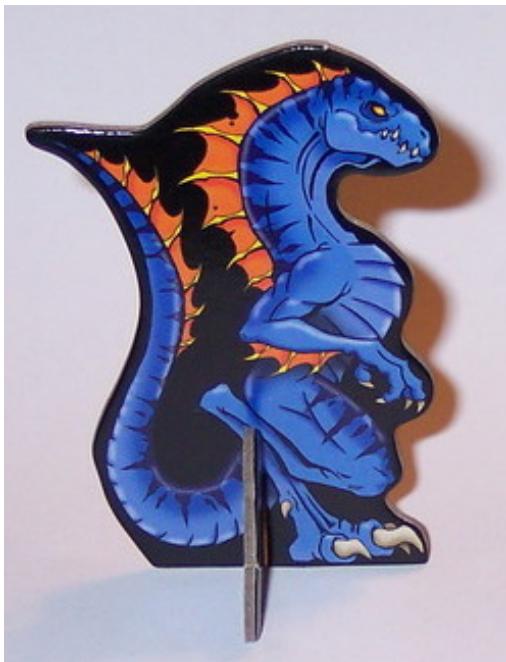
This is a modification of variant Ogre Miniatures rules, originally written by John M.
Hurtt and published in Pyramid Classic #1, now adapted for Ogre Sixth Edition.
Movement
It begins at M3 with 60 “Body Points”. It decreases by M1 for every 20 points lost (i.e. it becomes M2 at 40 Body Points remaining; M1 at 20 Body Points remaining; and it is destroyed at zero Body Points remaining).
Movement, once decreased via a loss of Body Points, may be recovered if Body Points are regenerated back up past the 20-point thresholds (see below).
- It moves as an Ogre, except for in swamp terrain:
o Swamp – When in a swamp, the creature must roll one die. On a 1 or 2, it cannot move that turn.
- It can move into craters at a cost of 2 movement points.
- It can move in water as per an Ogre. It may surface or dive at any time during its turn.
- It may not ram.
It may be rammed; follow the same rules as ramming an Ogre. The creature should be considered a size 9 unit for calculating rams by Ogres. Any resulting damage is taken off of the Body Point total.
Combat
It has two modes of attack: a Breath Weapon (a ranged attack) and a Physical Attack (an overrun attack).
- Breath Weapon
o The Breath Weapon is a beam or cone of radioactive plasma, powered by “Energy Points”. Each Energy Point (EP) expended increases the Attack Strength by 1, to a maximum of 8.
o Attack Strength varies from 1 to 8, dependent upon total Energy Points expended during the attack.
o Range one hex. It may increase the range to two hexes at twice the Energy Point cost for the attack.
o It may attack with the Breath Weapon as many times as it wishes during a Fire Phase, as long as it has Energy Points. It may re-target a victim surviving an attack of its Breath Weapon in the same Fire Phase (assuming enough Energy Points remain).
o The Breath Weapon has no spillover effect.
o It can use the Breath Weapon from a crater.
o It can use the Breath Weapon while in water, but not against submerged units.
o The Breath Weapon may be used in both overrun combat and during the Fire Phase in the same turn, provided it has enough Energy Points for both.
- Physical Attack
o The Physical Attack consists of stomping on, and/or thrashing with its tail, the target unit. This is at Attack Strength 4 and is performed as an overrun combat.
o It may attack once per Fire Round with either its Breath Weapon or a Physical Attack.
o Neither the Breath Weapon nor the Physical Attack is doubled in an overrun.
o No spillover effect.
o It may conduct overrun combat while submerged, but may not use its Breath Weapon while underwater.
It may only be attacked while underwater as per an Ogre (i.e. being rammed by another submerged unit; by Marines; or by (all at half strength) Howitzer, Mobile Howitzer or Ogre Missile attacks).
- Body Points
o Body Points are similar to Tread Units. Speed drops as they are destroyed. Once they reach zero, it is killed (and may not regenerate – see below).
o Any single attack against Body Points of less than 20 Attack Strength is automatically at 1-1 odds. A successful attack destroys the number of Body Points equal to the Attack Strength used.
o Any single attack against Body Points of 20 or more Attack Strength is automatically at 2-1 odds. A successful attack destroys the number of Body Points equal to the Attack Strength used.
o Attacks against it while it is in a Town are calculated at half strength (round down) for determining odds and damage done.
o There are no other terrain bonuses to combat.
o It ignores “D” results. Only an “X” destroys Body Points.
o AP Guns have no effect on it.
o It may regenerate Body Points with stored energy by expending Energy Points. However, if its Body Points drops to zero or lower at any time, it is killed and may not regenerate.
Energy Points
The creature begins with 60 Energy Points, unless otherwise specified by the scenario.
Energy Points may be used to power its Breath Weapon at a cost of one EP per point of Attack Strength used in the attack, to a maximum of eight per attack.
Energy Points may be used to regenerate Body Points at a cost of one EP per Body Point recovered.
o Body Points may be regenerated at any point during a turn, even between enemy attacks.
Once out of Energy Points, it may not use its Breath Weapon or regenerate Body Points.
- It may replenish its Energy Points in a number of ways.
o For every successful attack against it, it will replenish its Energy Points by half the attack strength (round down) used against it during that attack. Attacks by Cruise Missiles are handled separately (see below).
o It may absorb energy from a Reactor. For every structure point (SP) of damage done to a Reactor, it absorbs one Energy Point. This damage must be done by a Physical Attack against the Reactor to absorb energy.
o It may absorb energy from destroyed Ogres by ripping into the reactor core. Whenever it destroys an Ogre in overrun combat, or spends a full turn without moving in the same hex as an Ogre destroyed in any other way except by a Cruise Missile, it absorbs a number of Energy Points equal to the Ogre’s size class. This may only be done once to any individual destroyed Ogre.
o It may absorb energy by spending a full turn in any recently created crater. It receives one Energy Point per full turn spent in a crater. Craters already on the map should not be considered recent unless the scenario specifies otherwise, but any created during a game would apply.
o In a campaign game, it regenerates one Energy Point per hour. This would be of negligible tactical effect during a game.
o Optional rule: It may absorb one Energy Point for every Attack Strength point of armor or infantry destroyed with its stomp/tail Physical Attack during overrun combat.
It may not absorb more than its starting amount of Energy Points. Any extra are lost.
Cruise Missiles
It may attempt to use its Breath Weapon to shoot down a Cruise Missile, in the same manner as a Laser Tower. It has a base to-hit roll of 9+ on two dice and gets the same distance bonuses for the distance the Cruise Missile has traveled.
It may use its Breath Weapon to strike at a Cruise Missile up to four hexes away.
It may expend up to eight Energy Points to increase its chance of shooting down the Cruise Missile. By expending four Energy Points, it gains +1 to its roll; for eight Energy Points expended, it gains +2.
Successful attacks by a Cruise Missile do damage based upon the distance the creature is from the detonation:
o 4+ hexes away – No effect.
o 3 hexes away – No damage, but it absorbs a roll of one die of Energy Points.
o 2 hexes away – Roll two dice for damage to Body Points, but it also absorbs a separate roll of two dice of Energy Points.
o 1 hex away – Four dice of damage; absorbs three dice of Energy Points.
o Direct hit – Eight dice of damage; absorbs four dice of Energy Points. It is also knocked down. It must spend one movement point to stand back up prior to moving elsewhere.
If it receives an amount equal to or greater than its remaining Body Points in damage, it is killed. The Body Points lost are calculated before the Energy Points absorbed.
If it is underwater when the Cruise Missile detonates, treat it as two hexes further away.
BGG-zilla Record Sheet
Energy Points
Total Energy Points at start of turn
Energy spent on Breath Weapon
Energy spent on healing Body Points
Attack
- Breath Weapon: ATK variable (1 to 8). RNG 1 (RNG 2 @ 2x EP cost). RNG 4 vs. Cruise Missiles.
- Physical Attack: ATK 4. RNG overrun only.
Defense
Total Energy Points at end of turn
Energy absorbed
- All attacks of less than 20 Attack Strength points are rolled at 1-1 odds.
OOOOO OOOOO OOOOO OOOOO M1 - Any single attack of 20 or more Attack Strength points is at 2-1 odds.
- It ignores any “D” result.
OOOOO OOOOO OOOOO OOOOO Dead
Body Points M3
OOOOO OOOOO OOOOO OOOOO M2
_ points
_ points
_ points
+ _ points
_ points
Rules for the creature going “berserk” as well as advice for playing it either as a smart or dumb creature, plus some scenario ideas and a nifty introductory vignette, all may be found in the original article in Pyramid Classic #1, which is available as a pdf on Warehouse 23 (http://www.warehouse23.com/products/pyramid-classic-number-01).
Copyright © 1993, 2017 by Steve Jackson Games Incorporated. Ogre, the distinctive likeness of the Ogre, and the pyramid logo are registered trademarks of Steve Jackson Games Incorporated. All rights reserved.
Download MarkdownTexts are community-compiled or publicly released by publishers; copyright remains with the original authors. For personal reference only.