
Paku Paku
At a glance
Rules, cards and Q&A (Chinese)
The rules, card data and player questions for this game are written in Chinese. Open the Chinese page to read them.
Where to find full rules
Full rules and card lookup are available in the cunlema app at cunlema.cn — pick this game and ask about any rule, card or turn you are unsure about.
Related games
Rulebook text (Markdown)
This game has 1 rulebook Markdown file(s) in our library; 1 rendered inline below — expand to read or download.
26740 Paku Paku GB.md7.4 KB

For 2 – 8 players ages 8 and up.
Author: Antoine Bauza - Illustration: Agence Cactus Design: Agence Cactus, Kreativbunker (game instructions) Editor: Annette Ulmer, Jean-Baptiste Ramassamy
The honor of a panda is measured by the circumference of his belly. (Entirely made-up, old Chinese proverb)
Every year the fattest panda bears from all across Asia, hardened from years of training, gather together for the competition of life and rice balls. Because everyone knows: There can only be one for whom no plate is too full, whose belly is as powerful as his will, and who is as skilled as he is voracious!
Contents


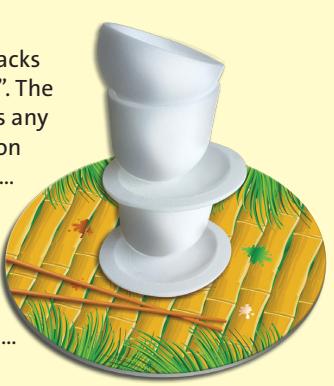
24 pieces of tableware (8 plates, 8 bowls and 8 cups)
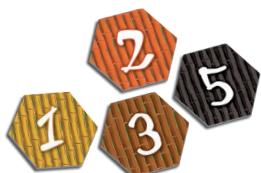
40 penalty point tiles with the values 1, 2, 3 and 5
Object
Get the fewest penalty points by passing your dice to the next player as quickly as possible. Everyone rolls at the same time—it will get quite hectic! As soon as a player has 10 or more penalty points, the game is over. The player with the fewest penalty points wins.
Setup
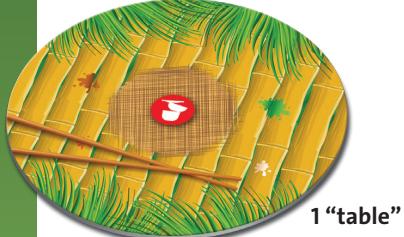
Put the penalty point tiles, the “table” and the 24 pieces of tableware in the middle of the table well within everyone’s reach.
Distribute the dice evenly
The youngest player takes the 5 dice and distributes them to each player as evenly as possible.
Example: In a 3-player game, 2 players receive 2 dice each and 1 player receives 1 die. In a 7-player game, 5 players receive 1 die each, while 2 players receive no die at the beginning of the game.
Now the game can begin!
How to play
“Paku Paku!” is Japanese and means “fill your belly as fast as possible”.
Together, count to 3 and then call out “PAKU PAKU!” All the players who have dice now begin to roll them.
A hungry panda bear waits for no one! (not from Confucius, 5 BC)
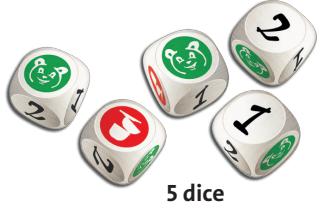
Rolling the dice: In PAKU PAKU everyone begins together, but then each player rolls as fast as they can. The objective is to roll as many laughing pandas as fast as possible, to be able to pass the die or dice along to the player on your left. But it’s not so easy. The sides of the dice have the following meaning:
Everyone begins at the same time, rolling the dice as fast as possible.


Ate rice balls, panda is happy! Pass along this die right away!
The empty dishes are stacking up in front of you! For every die with a red stack of dishes you have to stack one piece of tableware!
Stacking dishes!
The first player who has to stack something, stacks any tableware piece of his choice on the “table”. The next player, who has to stack something, stacks any tableware piece on top of the first one, and so on until the stack of dishes comes tumbling down.
Game variation for skilled architects:
Stack only difering tableware pieces on top of one another, if possible: For example, a plate can only be stacked on top of a cup or a bowl. This will make the stack much less stable.
Panda’s belly may soon be full? That, or nothing at all happens with these dice yet.
Take all dice that show either a number or a stack of dishes and roll them again, etc. until a player shouts: “Paku, stop!”
Example:
- Daniel rolls 3 dice and gets one green panda, one red stack of dishes and a 1.

- Quickly, he hands the die with the green panda on it to the player to his left.

3. He then stacks one tableware piece of his choice on top of the stack of dishes, being careful to not let it fall over 1
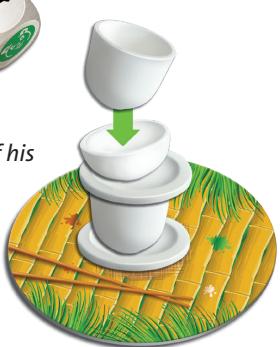
4. He then takes the die with the red stack of dishes and the die with the number “1”, and rolls them again, etc.

It is of course entirely possible that the player on the right passes on a die with the laughing green panda on it, even though the other player already has one or more dice in front of them . The new die that this player just received must now be rolled along with the other dice until that player rolls the laughing panda.
There will be several bumps in the road, paved with penalties and rice balls. (The path of the panda warrior, non-historical work from the 8th century)
As soon as a player has at least 5 (for a 2- or 3-player game), 4 (for a 4- or 5-player game) or 3 (for a 6- to 8-player game) dice in front of them or if the player knocks over the stack of dishes, everyone who sees it yells, “Paku, stop!” and the game is momentarily interrupted. The unlucky panda must now roll all the dice that are in front of them. The player adds up all the numbers rolled and receives the corresponding number of penalty points. The player then removes the stack of dishes from the middle, distributes all the dice evenly among all the players including themselves, etc.
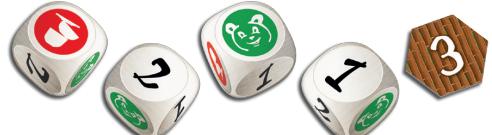
You didn’t roll a number? You’re lucky! No penalty points for you! Example: Philipp rolls the 4 dice in front of him and gets a laughing panda, a stack of dishes, a 1 and a 2. He receives 3 penalty points.
Penalty points: Roll the dice in front of you, add the numbers and take the corresponding number of penalty points.
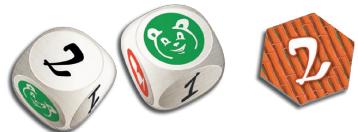
Example: The stack has fallen over on André. He rolls the 2 dice that are in front of him and he gets a 2 and a laughing panda. He takes 2 penalty points.
Tip for particularly brave pandas: Keep the stack of dishes right where it is for more risky fun!
The wise panda council
Who gets to stack first? Was that really 4 dice? Who knocked over the stack of dishes? In PAKU PAKU things can get pretty chaotic very quickly and not everything is black or white . In case of doubt, let the wise and fair panda council decide. And just who is on the panda council? Well, you all are, of course!
Ending the
game:
1 player has at least 10 penalty points.
Ending the game
As soon as an unlucky panda has 10 or more penalty points, the game is over. The player with the fewest penalty points wins.
The player with the fewest penalty points wins.
Tip: You can vary the number of penalty points depending on the number of players or whatever suits the group of players best. With a larger group of players, the game can end when a player has 7 penalty points. In a 2- or 3-player game, you can play until 15 or even 20 penalty points!
If there’s a tie? Let it be decided by a duel! All the players in the deadlock take turns stacking pieces of tableware. Whoever knocks over the stack is out of the running. The last player left wins!
Warning: The 24 pieces of tableware are not suitable for contact with food.
© 2017
Download MarkdownTexts are community-compiled or publicly released by publishers; copyright remains with the original authors. For personal reference only.